Linda Pastan, The New Dog
No more extracts. That's an exercise in frustration.
Wednesday, April 04, 2007


Tuesday, April 03, 2007
Prank! Prangstgrüp!
The Chronicle of Higher Education has an article on MyTube videos showing college pranks. Here's one of the best. It's from Columbia University's Prangstgrüp whose videos can also be found at http://www.prangstgrup.com.
Prangstgrup - Reach! A Lecture Musical!!
It's not mentioned in the Chronicle article, but a while ago Prangstgrüp also performed the Library Musical - Reading on a Dream!!
Prangstgrup - Reach! A Lecture Musical!!
It's not mentioned in the Chronicle article, but a while ago Prangstgrüp also performed the Library Musical - Reading on a Dream!!
Bill Bradley's bright idea
Bill Bradley has a good piece in the Outlook section of Sunday's Washington Post: We Can Get Out of These Ruts (by Bill Bradley, Sunday, April 1, 2007). He says we in the US have many messes to clean up but we can do it. He joins many others in pointing out problems in health care, education, and inadequate or non-existent pensions and he focuses on two big issues: dependence on oil and a counterproductive tax code. Some extracts:
The United States is the world's most profligate consumer of oil, using 25 percent of the global supply. China, which has four times as many people, consumes 7 percent. Yet our government has done almost nothing to deal with our dependence on oil, especially our dependence on insecure sources of foreign oil. The administration apparently finds a war to sustain our oil dependence preferable to the exercise of leadership to reduce that dependence. It can muster the political will to go to war, but it can't muster the courage to tell the American people the truth about what is required of each of us to break our oil addiction. So it is enabling that addiction.He says the pathway to solving our problems lies with voters as much as with political leaders. The leaders need to "tell the truth about our national circumstances." Voters need to have impediments to voting removed so that more of them excercise their rights at the ballot box. As an example he say the outmoded tradition of voting on Tuesdays needs to be overturned; Saturday and Sunday should be voting days instead. His conclusion:
Transportation accounts for 67 percent of the oil we consume, and surface vehicles alone account for 56 percent. [In order to] encourage people to buy fuel-efficient cars, we should establish a fee-rebate system.
Former CIA director R. James Woolsey Jr., an advocate of reducing U.S. dependence on foreign oil, noted in testimony before the Senate Energy and National Resources Committee that a hybrid vehicle such as a Toyota Prius can get 50 miles per gallon, and if it were made of lightweight carbon composites used in the manufacture of aircraft, it could get 100 miles per gallon. He went on to say that if it were a plug-in, flexible-fuel vehicle, it could get an incredible 1,000 miles per gallon. It's an industry ready to be born.
[We need to] reduce taxes on things we need, such as wages [i.e., Social Security, Medicare, and Unemployment taxes], and raise taxes on whatever is dangerous to us, such as pollution and resource depletion.
Once we face the truth about our abysmal voter turnout, our oil addiction, our health-care and education crises, and our inadequate national savings, there is good news. There are answers to all our current problems. It's not rocket science. What's required is the political will to enact policies that can allow us to thrive in the 21st century. An administration bold enough to tell the truth will find an audience ready for bold solutions.
hearing that name
Today's Pastan poem is Maiden Name. Extracts:
My daughter's teacher is named
Olenik — my maiden name,
...
and I haven't used Olenik in fifty years.
But hearing that name spill out again so casually
from my daughter's shapely Olenik mouth
is like waking up after a too long sleep
and having to rub the syllables from my eyes.
full moon April 2
Here in Washington our cherry blossoms are full out just as the moon is also full. Flickr has photos that I've reproduced below. This first full moon following the vernal equinox -- the paschal moon -- has great significance in the Christian calendar. A 17th-century mathematician, John Pell, is one of many who have explained how the date of Easter is calculated. If you're interested you can read his explanation below the photos. There's a modern account -- one of many -- at the Naval Observatory web site.


A pamphlet on calculating the date of Easter:


Pell was a reticent man and it's characteristic of him that this little pamphlet is an anonymous work. Apparently it was popularly believed that Easter in 1664 should have fallen on April 3 rather than April 10. Though it's written in answer to a query, it may have been commissioned by an acquaintance, bishop Gilbert Sheldon. See Noel Malcolm and Jacqueline Stedall, John Pell (1611-1685) and his correspondence with Sir Charles Cavendish (Oxford UP, 2005) 186.)
A pamphlet on calculating the date of Easter:


{Click to enlarge. Source: 15. Pell, John, 1611-1685. Easter not mis-timed a letter written out of the countrey to a friend in London concerning Easter-Day. London : Printed for Timothy Garthwait et al, 1664.}
Pell was a reticent man and it's characteristic of him that this little pamphlet is an anonymous work. Apparently it was popularly believed that Easter in 1664 should have fallen on April 3 rather than April 10. Though it's written in answer to a query, it may have been commissioned by an acquaintance, bishop Gilbert Sheldon. See Noel Malcolm and Jacqueline Stedall, John Pell (1611-1685) and his correspondence with Sir Charles Cavendish (Oxford UP, 2005) 186.)
Monday, April 02, 2007
Linda Pastan, Happiest Day
A second poem from Linda Pastan, The Happiest Day
In this poem, she writes:
In this poem, she writes:
It was early May, I think
a moment of lilac or dogwood
when so many promises are made
it hardly matters if a few are broken.
...
I didn't even guess that I was happy.
The small irritations that are like salt
on melon were what I dwelt on,
though in truth they simply
made the fruit taste sweeter.
...
If someone could stop the camera then...
if someone could only stop the camera
and ask me: are you happy?
perhaps I would have noticed
how the morning shone in the reflected
color of lilac. Yes, I might have said
and offered a steaming cup of coffee.
a dream is ....
Last night a dream attached itself to me. I was half-aware that it wasn't my making and wondered where dreams come from. What causes them to visit us, entering into our semi-conscious minds? More awake than before, I thought about what Linda Pastan wrote in the poem I quoted yesterday:
We don't remember the dream,And then, this morning my internet radio station morphed from Haydn and Schumann to something completely different. Not just different from the classical repertoire, but different from from my dream thoughts -- an abrupt transition from metaphysics to cliché in one big jump.
but the dream remembers us.
It is there all day
as an animal is there
under the table,
as the stars are there
even in full sun.
{from: What We Want}
A Dream Is A Wish Your Heart Makes
A dream is a wish your heart makes
When you're fast asleep
In dreams you lose your heartaches
Whatever you wish for, you keep
Have faith in your dreams and someday
Your rainbow will come smiling thru
No matter how your heart is grieving
If you keep on believing
the dream that you wish will come true.
{Song from Cindarella credited to "David/Hoffman/Livingston"}
Sunday, April 01, 2007
Linda Pastan, What We Want
I plan to post extracts and links to poems by Linda Pastan this month. I'd give the poems, whole themselves, but that would violate her ownership and copyright.
So to begin:
So to begin:
What We Want
...
But what we want appears
in dreams, wearing disguises.
We fall past,
holding out our arms
and in the morning
our arms ache.
We don't remember the dream,
but the dream remembers us.
...
Friday, March 30, 2007
uncertain fate of a librarian
Here are entries for two recent days from the diary of Saad Eskander, head of INLA, Iraq’s national library and archives. The British Library is making the diary available in blog format at this address: http://www.bl.uk/iraqdiary.html. 
I've blogged the Eskander diary before; am cross-posting from the work blog again.
Monday, 19 March
The snipers attacked a number of civilians from their positions in al-Fadhel. The INLA had electricity for only 40 minutes. Power-cuts began to effect our work, especially in the Computer and Micrographic Departments. I raised the issue of repairing the Generator with the engineer of the Ministry of Culture. She told me that she was doing her best to have it repaired, but some people in the Ministry were hindering the paperwork for unknown reason. Corruption and restricted regulations have prevented me from repairing the generator since mid-2006.
Around 10.50, I supervised the first phase of the election for the Managerial Council, in which 26 librarians and archivists participated. They elected three young women for the second stage.
I was surprised to receive an appreciation letter from the Minister of Culture for proving my patriotism during Al-Mutananbi gathering last week!!
I received unconfirmed information from Mrs. Ni., the head of the Catalogue Department of the Library, that yesterday the US Army arrested Mr. J., who was one of her librarians. No one knew the true reason or the circumstances. I decided to wait until Tuesday, hoping that I would receive more detailed information concerning the arrest of the librarian. During the last few weeks, several members of the INLA’s staff had their homes searched by the US army and the National Guards, especially those who live in the so-called ‘hot areas’ of Baghdad, such as al-A’dhamiyah, al-Ghazaliyah and al-Jame’ah.
Around 12.20, because of a bomb explosion a number of people were either killed or injured inside a well-known Mosque in al-Shurjah. Some people thought it was suicide attack while others thought it was a bomb planted in one the Mosque corners.
Tuesday, 20 March
We had no electricity at all. Several departments were unable to work, such as the Micrographic Laboratory, Restoration Laboratory and the Computer Department. I sent one of my staff to the local electricity distribution station. He was told that the reason for the power-cut was that the main cable was severed for unknown reasons and the repairmen would restore the power in a few days. Last year, because of a similar incident, the INLA did have electricity for more than 4 weeks. The repairmen will not work unless they get an order from their engineers; the engineers will not issue order until they receive in advance some payment; the repairmen will not execute the orders properly until they get their share from the payment. It is a vicious circle. The same fact applies to all other public services, such as telephone and water. Corruption has been the main problem since the early 1990’s. It has now become far more dangerous than terrorism.
As Wednesday is the Kurdish New Year and a public holiday, the staff received their monthly salaries on Tuesday.
Around 10.30, I supervised the second phase of the election for the Managerial Council, in which 19 librarians and archivists participated. Two people were elected for the next stage, a young woman and a young man. I had a brief meeting with the staff of the Computer Department to discuss some issues, including the new salary system, which will be applied next month. The new system will raise the salary of all those people whose grades are between 4 and 10 by 60 to 45 percent.
Mr. Q gave more information concerning the arrested librarian. He informed me that a group of armed men wearing the National Guards’ uniform went to Mr. J.’s house at 20.00. After they checked his ID card, they ordered him to go with them. He was allowed to change his clothing. Now, Mr. J’s family is worried. His wife and brother are not sure that the armed men were National Guards. One has no choice but to wait. Usually, members of organized crimes contact the family of the victim after a few days, asking for a big ransom, whereas the religious extremists will sometimes ring the family of the victim, informing it about his fate. I decided to wait until next Sunday, before I send an official letter to the Ministry of Defense to ask about the fate of my librarian.
As I strongly believe that the main ethnic groups, the Arabs and the Kurds, must share each other s’ national celebrations, I decided to give all my staff one day off on next Thursday. In this manner they will have four days break (i.e. from Wednesday to Saturday). Needless to say, everybody was over the moon by my decision and I became the most loved director, at least for a few minutes!
Before leaving the INLA to go to the Directorate of Kurdish Culture, three representatives of INLA’s al-Ferdos woman society gave me a nice present on the occasion of the Kurdish New Year. I thanked them very much for their nice gesture.
I spent one hour in the Directorate of Kurdish Culture, signing papers and reading the mails, before leaving to go to my home.
In the evening, I spent some time, answering a number of messages which I received from some of my staff and friends, congratulating me on the Kurdish New Year.
{Caption from CommonDreams.org: An Iraqi man collects books from the destroyed Iraqi National Library in Baghdad, April 17, 2003. The head of a U.S. presidential panel on cultural property has resigned in protest at the failure of U.S. forces to prevent the wholesale looting of priceless treasures from Baghdad's antiquities museum. "It didn't have to happen," Martin Sullivan said of the objects that were destroyed or stolen from the Iraqi National Museum in a wave of looting that erupted as U.S.-led forces ended President Saddam Hussein's rule last week. Photo by Gleb Garanich/Reuters}
I've blogged the Eskander diary before; am cross-posting from the work blog again.
Sunday, March 25, 2007
l'air de la folie
La Folie's aria from Rameau's comic opera Platée:
I heard this on the Swedish radio station, SR Klassiskt, and, as with the ox on the roof, can't resist a brief post on it.
Here's the citation for the YouTube production:
Here are the SR Kassiskt details:
I heard this on the Swedish radio station, SR Klassiskt, and, as with the ox on the roof, can't resist a brief post on it.
Here's the citation for the YouTube production:
Gala anniversaire des Musiciens du Louvre et Marc Minkowski autour de Rameau. L'air de La Folie dans l'opéra bouffe Platée exécuté par la soprano Mireille Delunsch.
Here are the SR Kassiskt details:
RAMEAU, Platée: "Air de folie"
PATRICIA PETIBON & LES FOLIES FRANCOISES
Patrick Cohën-Akenine
Virgin Classics
5454812
street lights blaze like frozen explosions
Gobbergo has done a good poem on the dead in our lives.
As a sub-genre, zombie poetry semms pretty much confined to Halloween fantasies of horror or humor. The Poem on Zombies is more nuanced - strangers on the street, dead in life through mindless self-annihilation; the relatives we loved, now dead but ghostly-present as companions of our memories; and, as we grow older, our sense of death always by. Like Samuel Beckett, famously unable to go on, yet going on, and on, Gobbergo says "smiling a little, I shuffle forward again into the dim."
As a sub-genre, zombie poetry semms pretty much confined to Halloween fantasies of horror or humor. The Poem on Zombies is more nuanced - strangers on the street, dead in life through mindless self-annihilation; the relatives we loved, now dead but ghostly-present as companions of our memories; and, as we grow older, our sense of death always by. Like Samuel Beckett, famously unable to go on, yet going on, and on, Gobbergo says "smiling a little, I shuffle forward again into the dim."
finding Time
The Library of Congress recently convened a group of information professionals at Google Headquarters for serious talk about the short comings of library catalogs and what can be done to fix them. The topic is being endlessly debated these days. See for example this recent article. What's been missing 'til now is a demonstration of what it is that needs to be fixed.
Ellysa Cahoy, a librarian at Penn State, has now taken a big step toward filling that need. Here's a video she produced showing what patrons must endure in order to track down an issue of a popular magazine -- at least in one library system.
in the complex tasks that library users must perform to locate some things – such as an article in Time Magazine.
I saw this on Lorcan Dempsey's blog. He's one of the info profs who met at GH; he says: "A funny video about a library website? Yes, it is possible …"
Ellysa Cahoy, a librarian at Penn State, has now taken a big step toward filling that need. Here's a video she produced showing what patrons must endure in order to track down an issue of a popular magazine -- at least in one library system.
in the complex tasks that library users must perform to locate some things – such as an article in Time Magazine.
I saw this on Lorcan Dempsey's blog. He's one of the info profs who met at GH; he says: "A funny video about a library website? Yes, it is possible …"
{This is another cross-posting from my work blog.}
Saturday, March 24, 2007
of bikes and cities
My morning commute improves as the seasons progress from the sub-20, pre-dawn hours of midwinter. As the hours of daylight grow, so grows my anticipation of the day when shorts and short-sleeve shirts are the norm. Along the way, I look forward to the spring equinox when the sun rises in my face on the distant horizon -- popping up down a broad east-west boulevard as I crest Capitol Hill. I look forward to the day the water again flows in the bronze-sculpture fountains in front of the Jefferson Building. I look forward to sufficient morning light to ride through rather than beside Rock Creek Park, free of street lights and thus too dark most of the year.
 —
—  —
— 
Of course this year the glorious equinoctal sunrise occurred after I'd already settled in and begun my work day, Congress having moved up the switch to daylight saving time supposedly to save energy (but see this for some qualifying data).
During my decades of bike commuting street congestion has steadily increased (of course), but my early hours are still very quiet. I've seen some efforts to make bicycling easier and safer, but not many. Recently, some white paint marks out bike lanes between parked cars and the traffic on streets (very few) that are wide enough for them. The benefit of these is debatable since they appear only to quickly disappear when the street narrows and because drivers tend to ignore them. The city does have quite a few off-street bike paths, but these have lots of drawbacks and I keep off them entirely.
Washington DC, and most other US cities could do much better to entice commuters out of their cages of steel, fostering -- as they do -- this era of anomie and isolation, of road rage, pollution, global warming, and depletion fossil-fuel resources. Unlike drivers, bike riders are immersed in the environments through which they progress. In my case these are woodsy-rural, residential-urban, and bureaucratic-monumental. Like pedestrians, they're part of these environments. It's as Jane Jacobs wanted city life to be.
These pleasures come with trade-offs: the discomforts of cold and wet rides; the impoliteness and occasional scary behaviour of car-fiends; the time required to climb into and out of cycle-specific clothing. But not, in my case anyway, any loss of time. My bike commute is generally not much slower than the corresponding commute by car -- and it can be much faster when traffic conditions deteriorate, as often happens. It's always faster than my commute by public transportation (though that's convenient and easy for me). I found this to be true in London when I lived there as well.
London copes with the overcrowding of its streets by imposing a congestion charge on drivers. Now I read that Paris, imitating Lyon, will be improving urban ambience by another method, one that encourages people to use bicyles rather than discouraging them from using cars. Here are extracts from the Washington Post article on the subject:
 —
—  —
— 
{photo sources: left, center, right. Click to enlarge. The left photo is merely reminiscent of the scene.}
Of course this year the glorious equinoctal sunrise occurred after I'd already settled in and begun my work day, Congress having moved up the switch to daylight saving time supposedly to save energy (but see this for some qualifying data).
During my decades of bike commuting street congestion has steadily increased (of course), but my early hours are still very quiet. I've seen some efforts to make bicycling easier and safer, but not many. Recently, some white paint marks out bike lanes between parked cars and the traffic on streets (very few) that are wide enough for them. The benefit of these is debatable since they appear only to quickly disappear when the street narrows and because drivers tend to ignore them. The city does have quite a few off-street bike paths, but these have lots of drawbacks and I keep off them entirely.
Washington DC, and most other US cities could do much better to entice commuters out of their cages of steel, fostering -- as they do -- this era of anomie and isolation, of road rage, pollution, global warming, and depletion fossil-fuel resources. Unlike drivers, bike riders are immersed in the environments through which they progress. In my case these are woodsy-rural, residential-urban, and bureaucratic-monumental. Like pedestrians, they're part of these environments. It's as Jane Jacobs wanted city life to be.
These pleasures come with trade-offs: the discomforts of cold and wet rides; the impoliteness and occasional scary behaviour of car-fiends; the time required to climb into and out of cycle-specific clothing. But not, in my case anyway, any loss of time. My bike commute is generally not much slower than the corresponding commute by car -- and it can be much faster when traffic conditions deteriorate, as often happens. It's always faster than my commute by public transportation (though that's convenient and easy for me). I found this to be true in London when I lived there as well.
London copes with the overcrowding of its streets by imposing a congestion charge on drivers. Now I read that Paris, imitating Lyon, will be improving urban ambience by another method, one that encourages people to use bicyles rather than discouraging them from using cars. Here are extracts from the Washington Post article on the subject:
Paris Embraces Plan to Become City of BikesThe WaPo article doesn't mention it but Brussels, like Lyon, already has Cyclocity service, Dublin gets it this summer, and it's been proposed for Edinburgh. An article in The Independent gives a downside to the program: JC Decaux, the parent of Cyclocity, gets "exclusive access to several hundred billboards in the city" as part of the deal it makes to provide the bikes.
By John Ward Anderson
Washington Post Foreign Service
Saturday, March 24, 2007; Page A10On July 15, the day after Bastille Day, Parisians will wake up to discover thousands of low-cost rental bikes at hundreds of high-tech bicycle stations scattered throughout the city, an ambitious program to cut traffic, reduce pollution, improve parking and enhance the city's image as a greener, quieter, more relaxed place.
By the end of the year, organizers and city officials say, there should be 20,600 bikes at 1,450 stations -- or about one station every 250 yards across the entire city. Based on experience elsewhere -- particularly in Lyon, France's third-largest city, which launched a similar system two years ago -- regular users of the bikes will ride them almost for free.
Based on statistics from Lyon, officials estimate that each bicycle in Paris will be used on average 12 times a day, for a total of about 250,000 trips a day, or 91 million trips a year.
In Lyon, according to deputy mayor Touraine, the city's 3,000 rental bikes have logged about 10 million miles since the program started in May 2005, saving an estimated 3,000 tons of carbon dioxide from being spewed into the air. Overall, vehicle traffic in the city is down 4 percent, he said, and bicycle use has tripled, not just on account of Cyclocity, but also because the program has prompted a boom in private bicycle use and sales.
Friday, March 09, 2007
a thing not found and another found ubiquitously
I don't particularly like being in an audience listening to a speaker. So it wasn't characteristic of me to join my classmates in an outdoor auditorium to hear the college president speak to my class on its 30th reunion some years ago. It was, however, typical that I attended so as to be with friends -- going along with the flow. I heard an entertaining, informative, stimulating talk which I've almost entirely forgotten. What remains is the joke with which he broke the ice.
There was this little Quaker lady he said. Little old Quaker ladies are a staple of a certain kind of humor, he explained, Quaker humor in fact. Who knew?
This Quaker lady took a bus one rainy morning, he said. As to the rest, I can't do justice to the full humor of it. So, in precis, she sat next to a middle-aged man in a tweed sport jacket and scraggly facial hair. A true absent-minded professor, he forgot that he had not brought an umbrella of his own and grabbed her umbrella by mistake. She didn't notice until he was off the bus. That afternoon, as it happened, she returned home by bus and, as it happened, he got on and sat next to her. Also, as it happened, he, being the absent-minded type he was, (1) owned many umbrellas and (2) had managed to park them all in his office, there having been a string of rainy mornings followed by clear-skied afternoons and he, absentmindedly, having forgotten to bring any home on said afternoons. On this, likewise unrainy, afternoon he had with him his whole collection of umbrellas, it having sunk-in to his consciousness that (a) there were none at home any more and (b) it tended to rain in the morning. She, seeing him with half a dozen umbrellas in his arms and no rain in sight, and assuming that her own was among them, came to the reasonable conclusion that he was an umbrella thief. Being a proper Quaker lady, she did not make accusations, and, being a kindly Quaker lady, she, while not condoning, did not condemn what she took to be his choice of occupation - disreputable though it may be. And thus she said, with Quaker-lady charm: "Thee has done well today!"
This ranks with the dead dog in the suitcase story as a funny tale that sticks in mind. I'll get to the dog in a minute. You should know I'm one of those who believes you don't have to actually know something, remember some fact, recall some story; all you have to do is know where to find it when you need it. The web works well for that. Most of the time. It has failed me for the past decade with respect to the Quaker lady. I can find no trace of it on the internet. Maybe you can. If so, please share.
The dead dog is another matter. This little item is abundantly present. Just search the terms dead dog suitcase and you'll see what I mean. It is, you'll quickly find, a story that's often presented as true -- it happened to someone's sister or roommate's girlfriend or a best friend's cousin, something like that, and it's just as often exposed as myth: urban legend, joke. Maybe it really did happen once. I know I believed it when it first came my way, back in the 1960s -- told by a friend who said he'd read it in a news item.
Here's one version, interesting because the blogger who's relating it half believes what he's telling us and explains how he's embellished what he recalled hearing:
There was this little Quaker lady he said. Little old Quaker ladies are a staple of a certain kind of humor, he explained, Quaker humor in fact. Who knew?
This Quaker lady took a bus one rainy morning, he said. As to the rest, I can't do justice to the full humor of it. So, in precis, she sat next to a middle-aged man in a tweed sport jacket and scraggly facial hair. A true absent-minded professor, he forgot that he had not brought an umbrella of his own and grabbed her umbrella by mistake. She didn't notice until he was off the bus. That afternoon, as it happened, she returned home by bus and, as it happened, he got on and sat next to her. Also, as it happened, he, being the absent-minded type he was, (1) owned many umbrellas and (2) had managed to park them all in his office, there having been a string of rainy mornings followed by clear-skied afternoons and he, absentmindedly, having forgotten to bring any home on said afternoons. On this, likewise unrainy, afternoon he had with him his whole collection of umbrellas, it having sunk-in to his consciousness that (a) there were none at home any more and (b) it tended to rain in the morning. She, seeing him with half a dozen umbrellas in his arms and no rain in sight, and assuming that her own was among them, came to the reasonable conclusion that he was an umbrella thief. Being a proper Quaker lady, she did not make accusations, and, being a kindly Quaker lady, she, while not condoning, did not condemn what she took to be his choice of occupation - disreputable though it may be. And thus she said, with Quaker-lady charm: "Thee has done well today!"
This ranks with the dead dog in the suitcase story as a funny tale that sticks in mind. I'll get to the dog in a minute. You should know I'm one of those who believes you don't have to actually know something, remember some fact, recall some story; all you have to do is know where to find it when you need it. The web works well for that. Most of the time. It has failed me for the past decade with respect to the Quaker lady. I can find no trace of it on the internet. Maybe you can. If so, please share.
The dead dog is another matter. This little item is abundantly present. Just search the terms dead dog suitcase and you'll see what I mean. It is, you'll quickly find, a story that's often presented as true -- it happened to someone's sister or roommate's girlfriend or a best friend's cousin, something like that, and it's just as often exposed as myth: urban legend, joke. Maybe it really did happen once. I know I believed it when it first came my way, back in the 1960s -- told by a friend who said he'd read it in a news item.
Here's one version, interesting because the blogger who's relating it half believes what he's telling us and explains how he's embellished what he recalled hearing:
The other night, at a bar, I heard this story from a stranger, a friend of a friend, named Brian:Addendum: One summer, while maybe 19 years old, I survived on odd jobs rather than one steady one. One of them involved watching over a house whose occupants were summering in Maine. I kept a 12-foot hedge trimmed and fed some birds -- lots of birds. In fact, a third of the dining room was one huge bird cage with maybe a dozen, dozen and a half, occupants. It comes to mind because one died under my care. I disposed of it (simply, easily) and the owner was not upset. No urban legend potential there.
Brian's friend, we'll call her Sarah, was taking care of her friend's dog while she was away in the Bahamas. So Sarah went over to the apartment one afternoon to check on the dog. When she got to the apartment, she couldn't find the dog. She looked everywhere: she couldn't find the dog; she couldn’t find the dog; she couldn't find the dog. Finally, she found the dog. The dog was lying underneath the bed, dead.
Sarah didn't know what to do. She called a company in New York that specializes in freezing pets for up to two weeks after death. Sarah decided to take the dog to the repository until the owner came back from the Bahamas.
This proved to be problematic: how is she going to get the dog uptown to the freezing company? The dog was apparently very big and heavy, dead weight. So Sarah put the dog in a suitcase, on wheels, and dragged it to the train station.
At the train station, she was having a difficult time getting the suitcase down the stairs, as the dog was quite heavy. A man approached her and offered his assistance in bringing the suitcase down the stairs. Sarah accepted the favor and let the man help her down the stairs with the suitcase, which contained the dead dog. "This thing sure is heavy! What do you have in here?" he asked her.
Sarah didn't know what to say so she told him it contained everything she owned. The man took one look at Sarah, who was at that point quite frazzled, grabbed the suitcase and ran off into the night, dead dog in tote.
Now. The details of this story are rather hazy. It was told in a loud bar, as a second-hand account. I filled in a few of the details myself; I assigned a name to the girl who was house sitting for her friend on vacation. I don’t know the name of the dog or what kind of dog it was. Additionally, I was unable to find any such company in New York that specializes in dead pet freezing, which makes me wonder where exactly “Sarah” was going with her suitcase that contained the dead dog. What train station was “Sarah” at when her suitcase, containing the dead dog, was stolen by a man obviously strapped for cash? This story went from a second-hand (Brian) account to a third-hand (me). Now, it’s in my blog. If you (fourth-hand) were to recount the story to a friend of yours (fifth-hand), it would either lose several more details or grow completely new details. Except you read it on the Internet, from a blog no less. So does that turn this story into an urban myth?
Thursday, March 08, 2007
Les Six encore
An update to my post on Les Six.
Here's an extract from an article that appeared in La Scena Musicale, Vol. 6, No. 1, September 2000:
Links:
la Foire du Trône
Fratellini brothers
Médrano circus
bar Gaya
Jean Wiéner
Le Boeuf sur le Toit (the music)
Théâtre des Champs-Élysés
Le Boeuf sur le Toit (the restaurant)
Clément Doucet
Le Coq et L'Arlequin
Article source: XXth Century -- ''Les Six'', Satie, and Cocteau, by Stéphane Villemin, 1 Septembre 2000


Images: At the Médrano circus and Fratellini Brothers. Sources: left and right (click to enlarge)
Here's an extract from an article that appeared in La Scena Musicale, Vol. 6, No. 1, September 2000:
Les Six and Le Coq grew out of Parisian artistic revelry. Cocteau frequently dined on Saturday evening, with six young composers, all recent Conservatory graduates: Darius Milhaud, Francis Poulenc, Arthur Honegger, Georges Auric, Louis Durey and Germaine Tailleferre. They were often joined by pianists Marcelle Meyer and Juliette Meerovitch, the Russian singer Koubitsky, and painters Marie Laurencin, Irène Lagut and Valentine Gross (not yet married to Jean Hugo), as well as writers Lucien Daudet and Raymond Radiguet. After dinner the Saturday night revellers went to the Foire du Trône or the Médrano Circus to enjoy the mime shows of the Fratellini brothers. The evening would end at Darius Milhaud's or the Gaya Bar, where they listened to Jean Wiéner play "negro music." Cocteau would read his latest poems while Milhaud and Auric, joined by Arthur Rubinstein, played a six-handed version of Milhaud's Le Boeuf sur le toit. This work, composed in 1920 and performed on stage with the famous Fratellini, was to become the Saturday night party piece. It was such a hit that the owner of the renowned Gaya Bar called his new restaurant on the Rue Boissy d'Anglas "Le Boeuf sur le toit." With the help of Jean Wiéner and Clément Doucet, the restaurant became a fashionable meeting-place. The other signature pieces of Les Six were Georges Auric's Adieu New York and Francis Poulenc's Cocarde.
Links:
la Foire du Trône
Fratellini brothers
Médrano circus
bar Gaya
Jean Wiéner
Le Boeuf sur le Toit (the music)
Théâtre des Champs-Élysés
Le Boeuf sur le Toit (the restaurant)
Clément Doucet
Le Coq et L'Arlequin
Article source: XXth Century -- ''Les Six'', Satie, and Cocteau, by Stéphane Villemin, 1 Septembre 2000

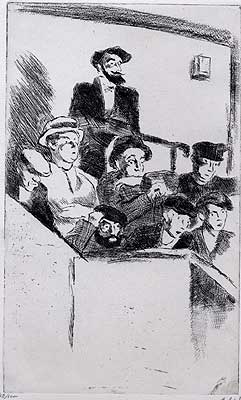
Images: At the Médrano circus and Fratellini Brothers. Sources: left and right (click to enlarge)
Wednesday, March 07, 2007
mournings, births, and dreams
Not too long ago I wrote about Darius Milhaud's Le Boeuf sur le Toit and the restaurant of the same name. Here's a little more Milhaudiana. An interesting blog called Corriente Textual recently gave this interesting group portrait by Jacques-Emile Blanche:

It shows Le Groupe des Six in 1922. Milhaud is left-center. The others are, in the center, pianist Marcelle Meyer; from bottom to top left: Germaine Tailleferre, Darius Milhaud, Arthur Honegger, Louis Durey; on the right: Georges Auric, Francis Poulenc, Jean Cocteau. Classical.net says the group socialized together but didn't attempt any collective productions. A page in French on the Ballet Russe says they shared an avant-garde preference for humor, clarity, and simplicity (think Eric Satie) and credits them with a new classicism with roots in the 18th century. This page goes on to say that Satie was an honorary or more likely uncredited actual member of the group.
 It says five of the six did have one common production, a ballet, Les Mariés de la Tour Eiffel of 1921. During this time they gathered at the Le Bœuf sur le Toit. When they separated shortly after, Cocteau summarized:
See Daniella Thompson on this as well.
It shows Le Groupe des Six in 1922. Milhaud is left-center. The others are, in the center, pianist Marcelle Meyer; from bottom to top left: Germaine Tailleferre, Darius Milhaud, Arthur Honegger, Louis Durey; on the right: Georges Auric, Francis Poulenc, Jean Cocteau. Classical.net says the group socialized together but didn't attempt any collective productions. A page in French on the Ballet Russe says they shared an avant-garde preference for humor, clarity, and simplicity (think Eric Satie) and credits them with a new classicism with roots in the 18th century. This page goes on to say that Satie was an honorary or more likely uncredited actual member of the group.
It says five of the six did have one common production, a ballet, Les Mariés de la Tour Eiffel of 1921. During this time they gathered at the Le Bœuf sur le Toit. When they separated shortly after, Cocteau summarized:D'un ordre considéré comme une anarchie, résume l'esprit d'un météore de rires, de scandales, de prospectus, de dîners hebdomadaires, de tambours, d'alcool, de larmes, de deuils, de naissances et de songes qui étonna Paris entre 1918 et 1923.Rough translation: "An anarchic assemblage, overflowing with laughter accompanied by scandals, manifestos, weekly feasts, drums, alcohol, tears, mournings, births and dreams which astonished Paris between 1918 and 1923."
See Daniella Thompson on this as well.
model planes that control themselves
I wrote about remote controlled gliders and power-planes the other day and referenced Chris Anderson on the subject. Now he's done an entry on his Long Tail blog about robotic model airplanes, ones that contain cameras and computer-contols so they can fly themselves.
Here's a link to his post: 3D Robotics Resources
This site has videos of self-guiding model aircraft in action.
Here's a link to his post: 3D Robotics Resources

This site has videos of self-guiding model aircraft in action.
Sunday, March 04, 2007
Zizou and Georgie
Gobbergo wrote me about a documentary on Zidane to be presented during the Madison Film Festival mid-April. Wikipedia has a good article on it. You can view the trailer and clips on the film's own web site. This site gives a summary of the game during which the film was shot.
I've written a little about Zizou once or twice before. He's a type of the tragic sports hero; like Georgie Best, who was, maybe, a prototype for him, though we have to hope the one doesn't share the other's endgame. Both photogenic, prodigiously talented, volatile. Both grew up in public housing projects as members of an underclass and both achieved fame when still young. Both called the world's best player, the most gifted footballer of his generation. There are differences too, mainly in their personalities, Best's being ebullient and Zidane's reticent.
I try to imagine the way kids kicking the ball around on in urban neighborhoods in Algeria and Marseilles would try to be like Zizou.

Here are a pair of YouTube videos that give some idea of the talent of each of the two men. If you only view one item in this post, look at the first of these two.
This shot of the funeral cortege for Best shows his birthplace in the Cregagh Estate of Belfast, Northern Ireland. Wikipedia says Best played soccer on the open playing fields at the center of the estate.

This is a shot of the area where Zidane was born in a housing project in the northern suburbs of Marseille.

I've written a little about Zizou once or twice before. He's a type of the tragic sports hero; like Georgie Best, who was, maybe, a prototype for him, though we have to hope the one doesn't share the other's endgame. Both photogenic, prodigiously talented, volatile. Both grew up in public housing projects as members of an underclass and both achieved fame when still young. Both called the world's best player, the most gifted footballer of his generation. There are differences too, mainly in their personalities, Best's being ebullient and Zidane's reticent.
I try to imagine the way kids kicking the ball around on in urban neighborhoods in Algeria and Marseilles would try to be like Zizou.

{source - this is Lisbon}
Here are a pair of YouTube videos that give some idea of the talent of each of the two men. If you only view one item in this post, look at the first of these two.
This shot of the funeral cortege for Best shows his birthplace in the Cregagh Estate of Belfast, Northern Ireland. Wikipedia says Best played soccer on the open playing fields at the center of the estate.
{source: BBC}
This is a shot of the area where Zidane was born in a housing project in the northern suburbs of Marseille.

{source: flickr}
the false road of the righteous champion
I'm sure I've already mentioned that I like to catch up with the Crooked Timber blog on weekends. I found the rocket in flight image in a CT post by Kieran Healey. Yesterday, John Quiggin on CT pointed to a "warblogger" post by a Norwegian named Bjørn Staerk, that's worth reading (What Went Wrong?).
A self-confessed neo-con, he's writing about "Westerners who had their reality bubble pricked by people from an alien culture, and spent the next couple of years stumbling about like idiots, unable to deal rationally with this new reality that had forced itself on them."
Here are some excerpts:
A self-confessed neo-con, he's writing about "Westerners who had their reality bubble pricked by people from an alien culture, and spent the next couple of years stumbling about like idiots, unable to deal rationally with this new reality that had forced itself on them."
Here are some excerpts:
Egging each other on, they predicted, interpreted, and labelled - and legislated and invaded. They saw clearly, through beautiful ideas. And they were wrong. Who were these people? They were us. "Us"? This seemed a lot clearer at the time. Us were the people who acknowledged the threat of Islamist terrorism, who had the common sense to see through the multicultural fog of words, and the moral courage to want to change the world by force. It included politicians like George W. Bush and Tony Blair, it included the new European right, it included brave and honest pundits, straight-talking intellectuals in the enlightenment tradition.
There aren't many people left who believe that it was a good idea for the US, Britain and their coalition to invade Iraq in 2003. At least fifty thousand Iraqis dead, (or a hundred, or several hundred), maybe two million refugees, and who knows how many more when the Americans finally give up and leave. Supporters of the war have dropped off one by one, for different reasons. Some neo-conservative intellectuals believe that the plan was good, but that George W. Bush screwed it up. There might be something to this. With smarter people in charge, the odds might have been better. But this assumes that a smarter administration would have embraced their plan to invade Iraq in the first place. I don't think it would, and I think the blame belongs with the thinkers who pushed for war, as much as the officials who carried it out.
When a state collapses, there is no upper limit to how badly it can go. Millions of people may die. Fanatics and sadists fight their way to the top, trampling the weak down beneath them. In our vision of a liberated Baghdad, we saw the beginning of a new Eastern Europe. Now, I have nightmares of Congo, Rwanda, Angola, Uganda, Algeria, Yugoslavia, Somalia, Lebanon, Afghanistan.
War opponents said a lot of things that were stupid, cynical and deluded. Some war supporters find comfort in this, I don't. The opponents were, on the whole, right. We were wrong, and people in Iraq will pay for this mistake for a long time.
Everyone agreed that terrorism was such a large threat that we had to give the state new powers to fight it. The most extreme examples were the cases of torture by proxy and imprisonment without trial by the US, but all over the West there has been a new wind of authority.
Trading freedom for security [is a mistake]. The security is often illusory, giving us little more than a temporary reduction of anxiety. The anxiety soon returns, and more freedom must be traded away. Just as a war frenzy can spin out of control, so can a panic for law and order in the face of terrorism. Especially so since the alternative is so depressing and counterintuitive. We were wrong about terrorism, we still are, and I suspect we always will be. At best we can hope for long periods of calm where personal freedom is allowed to reassert itself.
The "multicultural" worldview makes sense. We do need to doubt ourselves. We do need to worry at least as much about our own potential for evil as that of the foreigners. We do need to meet other cultures with some humility and respect. We do need to have mixed feelings about our own culture, admiration tempered by wariness, as with a wild animal. We do need to listen to people who believe differently, instead of just lecturing them. Not because there is no right or wrong, true or false, and not because every culture is equal, but because the alternative is so dangerous. The road of the righteous champion of the Army of Light.
Subscribe to:
Posts (Atom)

 Posts
Posts


