Saturday, May 26, 2007

Paul Desmond

Paul Desmond died thirty years ago, May 30, 1977 -- Memorial Day in the US. A web site called puredesmond.ca has a biography, discography, and other good stuff. The interviews are interesting because Desmond's conversation was a lot like his playing: there's an overall appearance of modesty and self-deprecation on top of an obviously massive talent. There's surface humor beneath which is a deep and serious commitment: wit in the service of high art.


In 2001, Dave Brubeck reminisced about Paul during a show about a PBS documentary. At one point Brubeck tells an anecdote that shows Paul's combination of wit and virtuosity. The interviewer is Hendrick Smith.
SMITH: Paul had this thing about quotes, and he had this thing about telling stories uh, in music. And wasn't there one night when you guys were riding in Pennsylvania and…and the cops pulled him over the side of the road for speeding - I can't remember the story. What….what happened? Do you remember what I'm talking about?

DAVE: The cops pulled us over and Paul was driving and I guess speeding a little. And, [the cop] told us to follow him and he took us down across the railroad tracks to a farm house where there was a judge. And we had to pay a certain amount of cash to this judge. Well there wasn't time to rehearse or even talk about this and the next night at the concert, in the middle of a tune, Paul laid out the whole sequence in quotes. Titles of songs that would tell the story. The first place the cop was supposed to be wearing a broad rim hat like they do in Pennsylvania, kinda, you know like the Canadian Mounted Police. The first quote he played was "Where did you get that hat?" The next thing was "Down by the railroad station, early in the morning." All wove into another tune -- quote after quote after quote that made absolute sense as a jazz chorus. And of course Paul just strung out these quotes -- he could do that.

SMITH: You told me he would even do that on stage playing with you and sometimes he'd play, I don't know, Don't Fence Me In, I mean he'd…I mean he'd play things that were sorta, you know, giving you the elbow.

DAVE: Oh yeah, he had some good quotes. We'd be playing in the middle of a song and I might hit a chord that was too far out and the next thing he would play would, you'd hear "You're driving me crazy." What did I do? (laughter)


Dave Brubeck Quartet, "These Foolish Things"


Some Desmond quotes:

Complexity can be a trap. You can have a ball developing a phrase, inverting it, playing it in different keys and times and all. But it's really more introspective than communicative. Like a crossword puzzle compared to a poem.

I think I had it in the back of my mind that I wanted it to sound like a dry martini.”

I would also like to thank my father who discouraged me from playing the violin at an early age.

We used to get on planes, and they'd ask who we were, and we'd say, 'The Dave Brubeck Quartet', and they'd say, 'Who?' In later years they'd say, 'Oh', which amounts to the same thing.

Writing is like jazz. It can be learned, but it can't be taught.

I have won several prizes as the world's slowest alto player, as well as a special award in 1961 for quietness.

I was unfashionable before anyone knew who I was.

I tried practicing for a few weeks and ended up playing too fast.

I discovered early in life that if you take gym first period, you can go into the wrestling room and sit in the corner and sleep.

On the secret of his tone: "I honestly don't know! It has something to do with the fact that I play illegally."

He was an English major in college. His reason for not pursuing a literary career, "I could only write at the beach, and I kept getting sand in my typewriter."

Desmond's fondness for scotch was well known. So in early 1976 when a physical examination showed lung cancer, he was ironically pleased that his liver was fine. "Pristine, perfect. One of the great livers of our time. Awash in Dewars and full of health."


If you're still with me, check out PAUL DESMOND interviews CHARLIE PARKER. It's a transcript from a radio broadcast from early 1954. The announcer is John McLellan. I particularly like the section in which Desmond gets Parker to tell about the hard work he devoted to the development of his skill.

Friday, May 25, 2007

Lili Schonemann (& JWvG)

As you can see from my Current Reading list, over on the right panel, I've given over historical research in order to ingest John Armstrong's Love, life, Goethe : how to be happy in an imperfect world. So far, it's pretty much what the publisher and reviewers say: an invitation to see Goethe anew, not as a distant and inapproachable component of the Western Canon of Literature, but as someone we can read for pleasure and learn from. Says Booklist: "Armstrong invites readers to appreciate Goethe as an eminently human genius perpetually striving toward personal growth and wholeness, balance and beauty." I'm one of those who find Goethe difficult to read. I like his Italian Journey, but find Werther, Faust, and the rest pretty tough going. Reading about Goethe is another matter and this is not a bad book on him; perhaps having read it, I'll do better then next time I tackle works by the man himself.

In reading Armstrong, I just got to an account of the love between the 23-year-old Goethe and 16-year-old Lili Schönemann. Armstrong says Lili was seductive with a look full of erotic knowledge and a passion for sharing little secrets with men who admired her. One of these secrets, she told Goethe, was a habit of gaining the love of men, and then showing her dominance by breaking off from them. She might have intuited that Goethe was similarly inclined. He too had loved and been loved in return, and then, like Lili, taken his leave. Armstrong says this affinity was the main reason that, having once bonded, neither wished to break off and, just as much, neither wished to marry the other.

Armstrong shows us this portrait of Lili and adds a provocative question.

The picture puts me in mind of a similar raised eyebrow in last fall's production of Hedda Gabler at Goucher College.

Addendum:

Ralph Waldo Emerson put Goethe on a plane with Shakespeare and celebrated both throughout his life. In his portrait of Goethe in Representative Men, he seems to be writing of himself as much as his subject:
His failures are the preparation of his victories. A new thought or a crisis of passion apprises him that all that he has yet learned and written is exoteric, — is not the fact, but some rumor of the fact. What then? Does he throw away the pen? No; he begins again to describe in the new light which has shined on him, — if, by some means, he may yet save some true word.

Scholars or writers see connection where the multitude see fragments, and are impelled to exhibit the facts in order, and so to supply the axis on which the frame of things turns. {This is a bit of a paraphrase.}

[The writer] reports the doings of the miraculous spirit of life that everywhere throbs and works.

[Goethe] exists for culture; not for what he can accomplish, but for what can be accomplished in him.

An intellectual man can see himself as a third person; therefore his faults and delusions interest him equally with his successes. Though he wishes to prosper in affairs, he wishes more to know the history and destiny of man; whilst the clouds of egotists drifting about him are only interested in a low success.

Source: Ralph Waldo Emerson, Representative Men, Goethe or, The Writer

Tuesday, May 22, 2007

Lloyd Alexander

Lloyd Alexander has died. We loved his books well, first read aloud at bed-time, then read and re-read to ourselves. We actually met him once, at a reading at the Library of Congress where Gobbergo -- not quite 10 -- got to tell the man how much he liked his work and where he received a warm response.

Here is a link to his author page on LibraryThing and one to his name page on Worldcat Identities. There are plenty of obits. I've listed a few at bottom.

He was 83; died from cancer a couple of weeks after the death of his wife, Janine Denni. They had been married 60 years and lived in Drexel Hill where he had been born and raised.

The New York Times quotes his acceptance speech on being awarded the Newbery Medal in 1969: "In whatever guise — our own daily nightmares of war, intolerance, inhumanity; or the struggles of an Assistant Pig-Keeper against the Lord of Death — the problems are agonizingly familiar. And an openness to compassion, love and mercy is as essential to us here and now as it is to any inhabitant of an imaginary kingdom."

Tim Burke enlarges on this theme in a tribute at Easily Distracted. Says he, "To me, the books were valuable not just as a story of swords and sorcery or even of the journey from childhood to adulthood, but also as an exploration of what it means to make moral choices. ... I think it is utterly counterproductive to teach morals by diktat and repetition. Any story for children that has a single or obvious moral teaching is a story begging to be ignored, subverted or rejected. The Prydain books explored morality as it is lived, even for children, in difficult choices, in painfully-won wisdom, from the inside of consciousness rather than the outside infrastructure of social life. ... The main characters are not noble by fiat.... One of the incidents that made the biggest impact on me as a boy was when Taran is compelled to accept the possibility that his lost father is not of noble birth, but a shepherd, and the shameful feelings he struggles with as a result. Characters die, characters suffer. When they come to a moral decision, you’re taken along with them inside the process of experience and reason that brings them to that moment. ... This is not about saying that everyone’s right, that all choices are ok. These are the kinds of fictions that take children (and adults) through the process of moral reasoning and make them relive ethical choices as painful, difficult and not blandly equanimous."

Some obits: NYT, CBC, LA Times, Boston Globe, NY Mag Washington Post.


{photo sources: at top: LibraryThing author page, Next: E. P. Dutton, about 1971 from NYT, and, last, AP photo via NYMag}

Sunday, May 20, 2007

Monty and Joost

I've been quiet about Monty Panesar for months now. He was not selected for the team that lost to Australia in the Ashes Cup test match series last fall and has not been attracting much press notice all this season. You may recall that he's seen as relatively young and unpolished. He's a spinner at a time when that style of bowling has been out of favor (think knuckball pitcher in US palance). And his fielding is sometimes laughable.

The cricket press says things appear to be changing. In a test match against the West Indies team, he bowled the English side out of trouble, dismissing batters with deceptive throws. The umpire awarded Monty three lbws, that is he ruled that three bowled balls would have struck the wicket if the batter had not put his leg in front of it. Here's and extract from the account in the Times, first noting the erratic fielding, then celebrating his bowling:
Monty’s early contribution to England’s cause yesterday at Lord’s was typical. Stationed at mid-off, his geometry was so askew he headed right while the ball sped past his left hand to the boundary. Cue the usual chortles from the cheap seats. Monty was back and a good summer’s vaudeville was in prospect. But 10 minutes before lunch Andrew Strauss threw him the ball and the tempo of the match was transformed. In one ball. A ball that had flight and a deceptive loop and which turned and bounced outside the tentative forward prod of Devon Smith. The dismissal was an exact replica of Justin Langer’s in Perth and was greeted with similar disbelief by the batsman and with trademark jig by the bowler.

Inexorably, the West Indies were drawn into the plot as Panesar bowled unchanged from the Nursery End from just before lunch to late into the evening. By then, four West Indian batsmen had succumbed, three of them left in varying states of anguish by the raised finger of Pakistan umpire Asad Rauf. The dismissals were almost carbon copies, a front leg thrust forward, a bat tucked just behind the front pad and a ball which straightened just enough to persuade Rauf to give the lbw decision.

Darren Ganga, who had compiled a watchful 49, walked away holding his bat the wrong way up in a gesture of disgust.

Runako Morton left with the rueful smile of a man on the wrong end of a conspiracy theory. Brave umpiring? Hawkeye suggested all three would have hit the stumps.
{Image credit: http://www.sportbox.tv/cricket/news/}


I've also been silent about Joost Posthuma. Recovering from an injury suffered in a race last month, he was hit by a car during a training ride. He bounced onto the hood of the car and fell onto the pavement. Treated in the hospital for deep bruises, he has been recovering from this injury over the past few weeks. The Rabobank web site has a couple of articles, in English: Joost Posthuma hurt during training and Posthuma takes a rest after accident. Here is the second of them:
Every cycling fan in the Netherlands was scared stiff after receiving the news that Rabo cyclist Joost Posthuma was involved in a major traffic accident near the Dutch-German border. He was obviously frightened as well after the crash, because that is what it was. "We were just about to take a left turn, when that car hit me. It was an 80 km-road and the police have already indicated that the driver was going too fast. One can imagine what sort of a gigantic blow it must have been." Posthuma hit the hood of the car and the windshield and was then launched. "My hat was still stuck to the windshield. The hat, by the way, looked terrible as well."

Hence, the outcome of the accident could have been a lot worse: a bruised body, strained ribs and a strained left ankle, and the most serious injury, a torn muscle in the upper leg. "It will take some time for me to be back at my old level. Fortunately, I do not feel any pressure from the team, and I am not going to put myself under pressure either, because otherwise your entire career might be at stake. There is no specific recovering time assigned to this type of injury, so I will need to listen to my body." The chances of him being able to compete in the Tour de France seem to be slim. "Never say never, but if you are realistic, you know that I will probably not appear at the start."

On the day of the accident, the Dutchman was having his second practice after suffering a knee injury a couple of weeks ago. Posthuma was just about to peak at that moment. He managed to finish second in the ranking of the three-day cycling stage race of De Panne-Koksijde. "I was in a very good shape. I was very focused on the Ronde van Vlaanderen and Paris-Roubaix. Everything that has happened over the last couple of weeks has been a major setback for me. But, of course, the accident has nothing to do with cycling. That could have also happened if I had gone for a ride with my girlfriend."

Posthuma usually lives in Lanaken, a village located in Belgium near the Dutch-Belgian border, but because he could not practice a lot, he decided to stay in his native region for Easter. He will now stay there a little longer. "I am not that mobile, so I can let people take care of me. It has its advantages," joked the time trial expert so as to put things into perspective. He will start his recovering process during the upcoming days at the facilities of the soccer team of FC Twente, in cooperation with the medical staff of the cycling team.
Joost's own web site has a link to a video interview with him in the training center of the FC Twente soccer team.
{Image credit: http://www.wielermagazine.nl/}

Sunday, May 06, 2007

Drummer Hodge

We watched History Boys. One of its achievements is to reveal the greatness of Thomas Hardy, the poet. He wrote the following a couple of months after the outbreak of the Boer War.
Drummer Hodge, Thomas Hardy

They throw in Drummer Hodge, to rest
  Uncoffined – just as found:
His landmark is a kopje-crest
  That breaks the veldt around;
And foreign constellations west
  Each night above his mound.

Young Hodge the Drummer never knew –
  Fresh from his Wessex home –
The meaning of the broad Karoo,
  The Bush, the dusty loam,
And why uprose to nightly view
  Strange stars amid the gloam.

Yet portion of that unknown plain
  Will Hodge forever be;
His homely Northern breast and brain
  Grow to some Southern tree,
And strange-eyed constellation reign
  His stars eternally.
{Boer words in the poem: kopje: small hill,
velte: prairie, Karoo: South African plain.}

From a review of the play:
Who could have thought that one of the most gripping scenes on Broadway this season would be a secondary-school teacher explaining a poem by Thomas Hardy?

It happens in "The History Boys," Alan Bennett's funny, touching and eloquent play about the meaning of education, which opened Sunday at the Broadhurst Theatre.

The teacher, Hector (the superb Richard Griffiths), has just been told he must retire from the North of England secondary school where he's worked for many years because he's been observed groping -- rather ineffectually -- his students.

Posner (Samuel Barnett), the pupil he's speaking to in an otherwise empty classroom, is confused about his sexuality, wondering if he's gay. But the scene is not about sex. It's about the consolation of poetry, thinking and understanding, connecting to something outside yourself.

The poem, "Drummer Hodge," concerns a young British soldier killed in Africa, and the usually exuberant Hector discusses it quietly and a bit wearily. ("Un-coffined is a typical Hardy usage. A compound adjective ... un-kissed, un-rejoicing, un-confessed, unembraced. ... It brings a sense of not sharing, of being out of it ... a holding back. ... Can you see that?")

The scene fascinatingly dramatizes what "The History Boys" is about: the unquantifiable value of learning.
Phillip Mallett has a good page on Hardy and the war on the home page of the University of St. Andrews.

Addendum: I've previously written about a famous battle -- Spion Kop -- and its connections with the Liverpool Football Club.

Friday, May 04, 2007

a song for summer

Here is another poem from Parnassus, the anthology compiled by Ralph Waldo Emerson in 1874 (pdf).
The Grasshopper, by Richard Lovelace (1649)

To my Noble Friend, Mr. Charles Cotton

O thou that swing'st upon the waving hair
    Of some well-filled oaten beard,
Drunk every night with a delicious tear
    Dropped thee from heaven, where now th' art reared.

The joys of earth and air are thine entire,
    That with thy feet and wings dost hop and fly;
And when thy poppy works thou dost retire
    To thy carved acorn-bed to lie.

Up with the day, the sun thou welcom'st then,
    Sport'st in the gilt-plats of his beams,
And all these merry days mak'st merry men,
    Thyself, and Melancholy streams.

But ah the sickle!  Golden ears are cropped;
    Ceres and Bacchus bid good-night;
Sharpe frosty fingers all your flowers have topped,
    And what scythes spared, winds shave off quite.

Poore verdant fool! and now green ice, thy joys
    Large and as lasting, as thy perch of grass,
Bid us lay in 'gainst winter, rain, and poise
    Their floods, with an o'erflowing glass.

Thou best of men and friends!  we will create
    A genuine summer in each other's breast;
And spite of this cold time and frozen fate
    Thaw us a warm seat to our rest.

Our sacred hearths shall burn eternally
    As vestal flames, the North-wind, he
Shall strike his frost-stretched wings, dissolve and fly
    This Etna in Epitome.

Dropping December shall come weeping in,
    Bewail th' usurping of his reign;
But when in showers of old Greek we begin,
    Shall cry he hath his crown again!

Night, as clear Hesper, shall our tapers whip
    From the light casements, where we play,
And the dark hag from her black mantle strip,
    And stick there everlasting day.

Thus richer than untempted kings are we,
    That asking nothing, nothing need:
Though Lord of all what seas embrace; yet he
    That wants himself, is poor indeed.
A biography of Lovelace is here.

Sunday, April 29, 2007

FRANÇOISE HARDY

I'm fond of Corriente Textual. I can tell you no more about it than you see on the blog itself: interesting music, interesting artwork. Alan, the author, recently provided a link to this Francoise Hardy song, and so I to you.


Francoise Hardy, Ma jeunesse fout l'camp. The song comes from the TV show, La Femme Nikita. Wikipedia has an article on the show.

Hardy is photographable and much photographed, but rarely (never?) smiling.


She's only a couple of years younger than me.


Here is a Youtube video of one of her first performances, from a French TV show of the early 60s, Conservatoire de la Chanson.

Who all the day themselves do please

Here is another poem from Parnassus, the anthology compiled by Ralph Waldo Emerson in 1874 (pdf).
THE COUNTRY LIFE, TO THE HONOURED M. END. PORTER, GROOM OF THE BEDCHAMBER TO HIS MAJESTY

by Robert Herrick

SWEET country life, to such unknown
Whose lives are others', not their own !
But serving courts and cities, be
Less happy, less enjoying thee.
Thou never plough'st the ocean's foam
To seek and bring rough pepper home ;
Nor to the Eastern Ind dost rove
To bring from thence the scorched clove ;
Nor, with the loss of thy lov'd rest,
Bring'st home the ingot from the West.
No, thy ambition's masterpiece
Flies no thought higher than a fleece ;
Or how to pay thy hinds, and clear
All scores, and so to end the year :
But walk'st about thine own dear bounds,
Not envying others larger grounds :
For well thou know'st 'tis not th' extent
Of land makes life, but sweet content.
When now the cock (the ploughman's horn)
Calls forth the lily-wristed morn,
Then to thy corn-fields thou dost go,
Which though well soyl'd, yet thou dost know
That the best compost for the lands
Is the wise master's feet and hands.
There at the plough thou find'st thy team
With a hind whistling there to them ;
And cheer'st them up, by singing how
The kingdom's portion is the plough.
This done, then to th' enamelled meads
Thou go'st, and as thy foot there treads,
Thou see'st a present God-like power
Imprinted in each herb and flower ;
And smell'st the breath of great-ey'd kine,
Sweet as the blossoms of the vine.
Here thou behold'st thy large sleek neat
Unto the dew-laps up in meat ;
And, as thou look'st, the wanton steer,
The heifer, cow, and ox draw near
To make a pleasing pastime there.
These seen, thou go'st to view thy flocks
Of sheep, safe from the wolf and fox,
And find'st their bellies there as full
Of short sweet grass as backs with wool,
And leav'st them, as they feed and fill,
A shepherd piping on a hill.
For sports, for pageantry and plays
Thou hast thy eves, and holidays ;
On which the young men and maids meet
To exercise their dancing feet ;
Tripping the comely country round,
With daffodils and daisies crown'd.
Thy wakes, thy quintels here thou hast,
Thy May-poles, too, with garlands grac'd ;
Thy morris dance, thy Whitsun ale,
Thy shearing feast which never fail ;
Thy harvest-home, thy wassail bowl,
That's toss'd up after fox i' th' hole ;
Thy mummeries, thy twelfth-tide kings
And queens, thy Christmas revellings,
Thy nut-brown mirth, thy russet wit,
And no man pays too dear for it.
To these thou hast thy times to go
And trace the hare i' th' treacherous snow ;
Thy witty wiles to draw, and get
The lark into the trammel net ;
Thou hast thy cockrood and thy glade
To take the precious pheasant made ;
Thy lime-twigs, snares and pit-falls then
To catch the pilfering birds, not men.
O happy life ! if that their good
The husbandmen but understood !
Who all the day themselves do please,
And younglings, with such sports as these,
And lying down have nought t' affright
Sweet sleep, that makes more short the night.
Unfinished — Cætera desunt — The rest is wanting

Notes on the poem
You can read about Endymion Porter here.
Notes on unfamiliar words in the poem (from luminarium.org)
Soyl'd, manured.
Compost, preparation.
Fox i' th' hole, a hopping game in which boys beat
each other with gloves.
Cockrood, a run for snaring woodcocks.
Glade, an opening in the wood across which nets were
hung to catch game. (Willoughby, Ornithologie, i. 3.)


Click image to enlarge. Source. "This letter, one of just a few documents to survive in Herrick's own hand, was carefully composed by him while a student at St. John's College, Cambridge. Herrick employs all his rhetorical powers in an effort to persuade his uncle William to give him money to buy books for his studies:
my studie craves but your assistance to furnish hir with bookes wherein She is most desirous to laboure, blame not her modest boldness, but suffer the aspertions of your love to distill upon hir, and next to Heaven, she will consecrate hir laboures unto you ...
"

Catching up with Emerson in Florence

More from Emerson's Journals. It is 1833, he is 29 years old, on his travels in Italy.
And so I left, on the twenty-third of April [1833], the city built on seven hills, the Palatine, the Capitoline, Crelian, Aventine, Quirinal, Viminal, and Esquiline.

April 26.

Passignano. Here sit I this cold eve by the fire in the Locanda of this little town on the margin of the lake of Thrasimene, and remember Hannibal and Rome. Pleases me well the clear pleasant air which savors more of New England than of Italy. To-day we came from Spoleto to Perugia on the top of how high a hill with mighty walls and towers far within the gates of the town. Old cathedral, and all around architectural ornaments of the Middle Ages. But were I a proprietor in Perugia, I would sell all and go and live upon the plain. How prepos terous too it is to live in Trevi, where the streets must make with the horizon an angle of 45 degrees. Yet here in Umbria every height shows a wide prospect of well-cultivated coun try.

April 27.

Passed a peaceful night close by the dreadful field of Hannibal and Flaminius. This morning we crossed the Sanguinetto and left the pontifi cal state. We passed by Cortona, the venerable Etruscan town, then by Arezzo, the birthplace of Petrarch, and stopped at night at Levane.

Next morn (April 28) through the beautiful Val d'Arno we came to Figline, to Incisa, and in the afternoon to fair Florence.

April 29

And how do you like Florence? Why, well. It is pleasant to see how affectionately all the artists who have resided here a little while speak of getting home to Florence. And I found at once that we live here with much more comfort than in Rome or Naples. Good streets, industrious population, spacious, well-furnished lodgings, elegant and cheap caffies. The Cathedral and the Campanile, the splendid galleries and no beggars, make this city the favorite of strangers.

How like an archangel's tent is this great Cathedral of many-coloured marble set down in the midst of the city, and by its side its won drous Campanile! I took a hasty glance at the gates of the Baptistery which Angelo said ought to be the gates of Paradise, "digne chiudere il Paradiso" and then at his own David, and hasted to the Tribune and to the Pitti Palace. I saw the statue that enchants the world. And truly the Venus deserves to be visited from far. It is not adequately represented by the plaster casts, as the Apollo and the Laocoon are. I must go again and see this statue. Then I went round this cabinet and gallery and galleries till I was i well-nigh "dazzled and drunk with beauty." I think no man has an idea of the powers of painting until he has come hither. Why should painters study at Rome ? Here, here.

I have been this day to Santa Croce, which is to Florence what Westminster Abbey is to England. I passed with consideration the tomb of Nicholas Machiavelli, but stopped long be fore that of Galileus Galileo, for I love and honor that man, except in the recantation, with my whole heart. But when I came to Michael Angelo Buonaroti my flesh crept as I read the inscription. I had strange emotions. I suppose because Italy is so full of his fame. I have lately continually heard of his name and works and opinions ; I see his face in every shop window, and now I stood over his dust.

Then I came to the empty tomb of Dante, who lies buried at Ravenna. Then to that of Alfieri.

Friday, April 27, 2007

The Birds of Killingworth

Here is another poem from Parnassus, the anthology compiled by Ralph Waldo Emerson in 1874 (pdf).
The Poet's Tale; The Birds of Killingworth

It was the season, when through all the land
The merle and mavis build, and building sing
Those lovely lyrics, written by His hand,
Whom Saxon Caedmon calls the Blitheheart King;
When on the boughs the purple buds expand,
The banners of the vanguard of the Spring,
And rivulets, rejoicing, rush and leap,
And wave their fluttering signals from the steep.

The robin and the bluebird, piping loud,
Filled all the blossoming orchards with their glee;
The sparrows chirped as if they still were proud
Their race in Holy Writ should mentioned be;
And hungry crows assembled in a crowd,
Clamored their piteous prayer incessantly,
Knowing who hears the ravens cry, and said:
"Give us, O Lord, this day our daily bread!"

Across the Sound the birds of passage sailed,
Speaking some unknown language strange and sweet
Of tropic isle remote, and passing hailed
The village with the cheers of all their fleet;
Or quarrelling together, laughed and railed
Like foreign sailors, landed in the street
Of seaport town, and with outlandish noise
Of oaths and gibberish frightening girls and boys.

Thus came the jocund Spring in Killingworth,
In fabulous days; some hundred years ago;
And thrifty farmers, as they tilled the earth,
Heard with alarm the cawing of the crow,
That mingled with the universal mirth,
Cassandra-like, prognosticating woe;
They shook their heads, and doomed with dreadful words
To swift destruction the whole race of birds.

And a town-meeting was convened straightway
To set a price upon the guilty heads
Of these marauders, who, in lieu of pay,
Levied black-mail upon the garden beds
And cornfields, and beheld without dismay
The awful scarecrow, with his fluttering shreds;
The skeleton that waited at their feast,
Whereby their sinful pleasure was increased.

Then from his house, a temple painted white,
With fluted columns, and a roof of red,
The Squire came forth, august and splendid sight!
Slowly descending, with majestic tread,
Three flights of steps, nor looking left nor right,
Down the long street he walked, as one who said,
"A town that boasts inhabitants like me
Can have no lack of good society!"

The Parson, too, appeared, a man austere,
The instinct of whose nature was to kill;
The wrath of God he preached from year to year,
And read, with fervor, Edwards on the Will;
His favorite pastime was to slay the deer
In Summer on some Adirondac hill;
E'en now, while walking down the rural lane,
He lopped the wayside lilies with his cane.

From the Academy, whose belfry crowned
The hill of Science with its vane of brass,
Came the Preceptor, gazing idly round,
Now at the clouds, and now at the green grass,
And all absorbed in reveries profound
Of fair Almira in the upper class,
Who was, as in a sonnet he had said,
As pure as water, and as good as bread.

And next the Deacon issued from his door,
In his voluminous neck-cloth, white as snow;
A suit of sable bombazine he wore;
His form was ponderous, and his step was slow;
There never was so wise a man before;
He seemed the incarnate "Well, I told you so!"
And to perpetuate his great renown
There was a street named after him in town.

These came together in the new town-hall,
With sundry farmers from the region round.
The Squire presided, dignified and tall,
His air impressive and his reasoning sound;
Ill fared it with the birds, both great and small;
Hardly a friend in all that crowd they found,
But enemies enough, who every one
Charged them with all the crimes beneath the sun.

When they had ended, from his place apart
Rose the Preceptor, to redress the wrong,
And, trembling like a steed before the start,
Looked round bewildered on the expectant throng;
Then thought of fair Almira, and took heart
To speak out what was in him, clear and strong,
Alike regardless of their smile or frown,
And quite determined not to be laughed down.

"Plato, anticipating the Reviewers,
From his Republic banished without pity
The Poets; in this little town of yours,
You put to death, by means of a Committee,
The ballad-singers and the Troubadours,
The street-musicians of the heavenly city,
The birds, who make sweet music for us all
In our dark hours, as David did for Saul.

"The thrush that carols at the dawn of day
From the green steeples of the piny wood;
The oriole in the elm; the noisy jay,
Jargoning like a foreigner at his food;
The bluebird balanced on some topmost spray,
Flooding with melody the neighborhood;
Linnet and meadow-lark, and all the throng
That dwell in nests, and have the gift of song.

"You slay them all! and wherefore? for the gain
Of a scant handful more or less of wheat,
Or rye, or barley, or some other grain,
Scratched up at random by industrious feet,
Searching for worm or weevil after rain!
Or a few cherries, that are not so sweet
As are the songs these uninvited guests,
Sing at their feast with comfortable breasts.

"Do you ne'er think what wondrous beings these?
Do you ne'er think who made them and who taught
The dialect they speak, where melodies
Alone are the interpreters of thought?
Whose household words are songs in many keys,
Sweeter than instrument of man e'er caught!
Whose habitations in the tree-tops even
Are half-way houses on the road to heaven!

"Think, every morning when the sun peeps through
The dim, leaf-latticed windows of the grove,
How jubilant the happy birds renew
Their old, melodious madrigals of love!
And when you think of this, remember too
'T is always morning somewhere, and above
The awakening continents; from shore to shore,
Somewhere the birds are singing evermore.

"Think of your woods and orchards without birds!
Of empty nests that cling to boughs and beams
As in an idiot's brain remembered words
Hang empty 'mid the cobwebs of his dreams!
Will bleat of flocks or bellowing of herds
Make up for the lost music, when your teams
Drag home the stingy harvest, and no more
The feathered gleaners follow to your door?

"What! would you rather see the incessant stir
Of insects in the windrows of the hay,
And hear the locust and the grasshopper
Their melancholy hurdy-gurdies play?
Is this more pleasant to you than the whir
Of meadow-lark, and her sweet roundelay,
Or twitter of little field-fares, as you take
Your nooning in the shade of bush and brake?

"You call them thieves and pillagers; but know,
They are the wingéd wardens of your farms,
Who from the cornfields drive the insidious foe,
And from your harvests keep a hundred harms;
Even the blackest of them all, the crow,
Renders good service as your man-at-arms,
Crushing the beetle in his coat of mail,
And crying havoc on the slug and snail.

"How can I teach your children gentleness,
And mercy to the weak, and reverence
For Life, which, in its weakness or excess,
Is still a gleam of God's omnipotence,
Or Death, which, seeming darkness, is no less
The selfsame light, although averted hence,
When by your laws, your actions, and your speech,
You contradict the very things I teach?"

With this he closed; and through the audience went
A murmur, like the rustle of dead leaves;
The farmers laughed and nodded, and some bent
Their yellow heads together like their sheaves;
Men have no faith in fine-spun sentiment
Who put their trust in bullocks and in beeves.
The birds were doomed; and, as the record shows,
A bounty offered for the heads of crows.

There was another audience out of reach,
Who had no voice nor vote in making laws,
But in the papers read his little speech,
And crowned his modest temples with applause;
They made him conscious, each one more than each,
He still was victor, vanquished in their cause.
Sweetest of all the applause he won from thee,
O fair Almira at the Academy!

And so the dreadful massacre began;
O'er fields and orchards, and o'er woodland crests,
The ceaseless fusillade of terror ran.
Dead fell the birds, with blood-stains on their breasts,
Or wounded crept away from sight of man,
While the young died of famine in their nests;
A slaughter to be told in groans, not words,
The very St. Bartholomew of Birds!

The Summer came, and all the birds were dead;
The days were like hot coals; the very ground
Was burned to ashes; in the orchards fed
Myriads of caterpillars, and around
The cultivated fields and garden beds
Hosts of devouring insects crawled, and found
No foe to check their march, till they had made
The land a desert without leaf or shade.

Devoured by worms, like Herod, was the town,
Because, like Herod, it had ruthlessly
Slaughtered the Innocents. From the trees spun down
The canker-worms upon the passers-by,
Upon each woman's bonnet, shawl, and gown,
Who shook them off with just a little cry
They were the terror of each favorite walk,
The endless theme of all the village talk.

The farmers grew impatient but a few
Confessed their error, and would not complain,
For after all, the best thing one can do
When it is raining, is to let it rain.
Then they repealed the law, although they knew
It would not call the dead to life again;
As school-boys, finding their mistake too late,
Draw a wet sponge across the accusing slate.

That year in Killingworth the Autumn came
Without the light of his majestic look,
The wonder of the falling tongues of flame,
The illumined pages of his Doom's-Day book.
A few lost leaves blushed crimson with their shame,
And drowned themselves despairing in the brook,
While the wild wind went moaning everywhere,
Lamenting the dead children of the air!

But the next Spring a stranger sight was seen,
A sight that never yet by bard was sung,
As great a wonder as it would have been
If some dumb animal had found a tongue!
A wagon, overarched with evergreen,
Upon whose boughs were wicker cages hung,
All full of singing birds, came down the street,
Filling the air with music wild and sweet.

From all the country round these birds were brought,
By order of the town, with anxious quest,
And, loosened from their wicker prisons, sought
In woods and fields the places they loved best,
Singing loud canticles, which many thought
Were satires to the authorities addressed,
While others, listening in green lanes, averred
Such lovely music never had been heard!

But blither still and louder carolled they
Upon the morrow, for they seemed to know
It was the fair Almira's wedding-day,
And everywhere, around, above, below,
When the Preceptor bore his bride away,
Their songs burst forth in joyous overflow,
And a new heaven bent over a new earth
Amid the sunny farms of Killingworth.
This poem is much more interesting than the usual Longfellow fare: Evangeline (1847), for example, or The Courtship of Miles Standish (1858) -- they're all apparently collected here. In particular, the chanting meter of the Song of Hiawatha and its false-sounding Nativism have annoyed and embarassed me. Why this as a standard for the excellence of versification in the young United States?
By the shores of Gitche Gumee,
By the shining Big-Sea-Water,
Stood the wigwam of Nokomis,
Daughter of the Moon, Nokomis.
Killingworth is a real place, a village in Connecticut with its own online paper , garden club, and Wikipedia entry (none of which mention the Longfellow poem).


{This church in Killingworth was built half a century before Longfellow wrote about the place. source}

Monday, April 23, 2007

Lillies of Spring

The weather has turned. We've had most of the flowering fruit trees, dogwoods are coming strong, and the tulips are almost done. Spring threatens to turn Summer much too quickly. So here's John Singer Sargent's, Carnation, Lily, Lily, Rose.

{Click to enlarge. My source: Google image search provides lots of reproductions. I got this from the Christian Theological Seminary site}

"you entertain angels unawares"

From the Journals of Ralph Waldo Emerson.

As he begins to write this, Emerson is getting ready to depart from Rome for Lombardy; he completes it after he has left. It's from a letter to his aunt, Mary Moody Emerson, and is a typically philosophical meditation on acquaintance and our experience of others. It's about people of the present whom we respond to on first meeting and about people of the past whose lives we perceive in our encounters with what they have made and done. Although it's not a journal entry, this text is included in the 1909 edition of the journals edited by his son, Edward Waldo Emerson, and grandson, Waldo Emerson Forbes.
FROM A LETTER TO MISS EMERSON

ROME, begun April 22.

"Here is matter for all feeling," said Byron, and yet how evanescent and superficial is most of that emotion which art and magnificence can awaken. It yields in me to the interest the most ordinary companion inspires. I never get used to men. They always awaken expectations in me which they always disappoint, and I am a poor asteroid in the great system, subject to disturbances in my orbit, not only from all the planets, but from all their moons. The wise man, the true friend, the finished character, we seek everywhere, and only find in fragments. Yet I cannot persuade myself that all the beautiful souls are fled out of the planet, or that always I shall be excluded from good company and yoked with green, dull, pitiful persons. After being cabined up by sea and by land, since I left home, with various little people, — all better to be sure and much wiser than me, but still such persons as did not help me, — how refreshing was it to fall in with two or three sensible persons with whom I could eat my bread and take my walk and feel myself a free man once more of God's universe. Still these last were not instructors, and I want instructors. God's greatest gift is a Teacher, and when will he send me one full of truth and of boundless benevolence and of heroic sentiments? I can describe the man. I know the idea well, but where is its real blood-warm counterpart? I know whilst I write thus that the creature is never to dawn upon me like a sunburst. I know too well how slowly we edge along sideways to everything good and brilliant in life, and how casually and unobservedly we make all our most valued acquaintances. And yet I saw Ellen at once in all her beauty, and she never disappointed me, but in her death. And why may not the Master whom the soul anticipates, so appear?

Our stern experience replies with the tongue of all its days: Son of Man! it saith, all giving and receiving is reciprocal; you entertain angels unawares, but they cannot impart more or higher things than you are in a state to receive, but every step of your progress affects the intercourse you hold with all others; elevates its tone, deepens its meaning, sanctifies its spirit, and when time and suffering and self-denial shall have transfigured and glorified this spotted self, you shall find your fellows also transformed, and their faces shall shine with the light of wisdom and the beauty of holiness. You who cling with both hands to the literal word and to venerable traditions will, no doubt, find in my complaints a confession and a self-accusation. You will perhaps say I do not receive whom Heaven gives. But you must not say any such thing. For I am, you see, speaking truly as to my Maker. Jesus, who has done so much to raise and sweeten human life, and who prized sincerity more than sacrifice, cannot be to me what he was to John. My mother, my brothers, my companions, must be much more to me in all respects of friendship than he can be.
"How small, of all that human hearts endure,
The part that laws or kings can cause or cure:
Still to ourselves in every place consigned,
Our own felicity we make or find."
In Rome it is not the diameter nor the circumference of the columns, it is not the dimensions, nor the materials of the temples, which constitute their chief charm. It is the name of Cicero; it is the remembrance of a wise and good man; It is the remembrance of Scipio and Cato and Regulus; the influence of human character, the heroes who struggled, the patriots who fell, the wise men who thought, — the men who contended worthily in their lifetime in the same trials which God in this city and this year is placing before each of us. Why are you dazzled with the name of Caesar? A part as important, a soul as great, a name as dear to God as his or any other's is your own.

It will take you long to learn another tongue so as to make yourself fully understood by those who speak it, but your actions are easy of translation. They understand what you do. Temperance is good English and good French and good Italian. Your courage, your kindness, your honesty, are as plain to a Turk as his own alphabet. In Boston they have an eye for improvement, a thing which does not exist in Asia nor in Africa.

And so I left, on the twenty-third of April, the city built on seven hills, the Palatine, the Capitoline, Crelian, Aventine, Quirinal, Viminal, and Esquiline.

Sunday, April 22, 2007

Update on the French Presidential election

The papers are saying that no candidate will get a majority and there will be a run-off between the top contenders next month. The two front-runners are Nicolas Sarkozy and Segolene Royal. Both are photogenic.


She especially. Do an image search on her to see what I mean. I suppose it's no surprise that I could find a photo of her with a white horse.


addendum: The press likes Sarkozy horse photos:
{Legend: "On the campaign trail ... Nicolas Sarkozy, centre, does some last-minute spruiking in the south of France on Friday.
Photo: AFP" source}
">

Joyce - Ulysses - images!

One of my many castings-about for sources on Boulangism brought me to this page. What a find!
JoyceImages.com. You can browse, chapter-by-chapter or see the whole of it all at once.

It takes the Vintage corrected text of Ulysses and gives images and context, with section and line references. For example this picture post card is used to illustrate the text "They halted, looking towards the blunt cape of Bray Head that lay on the water like the snout of a sleeping whale." (U1.181)

{Click to see full size.}


The site itself doesn't reveal much about its origins, just this statement in the footer: "JoyceImages.com is maintained by Aida Yared" along with an email address. There's also little information on Yared's profile on Amazon.

Tony Thwaites' Ulysses Dublin Tour complements JoyceImages by giving photos taken in 1004. The Joyce Foundation links page includes it along with a lot of other interesting ones.

At JoyceImages.com, the Boulanger reference reads:
"M. Millevoye," (U3.233)

Lucien Millevoye (1850-1918) was a French journalist and politician. He was the editor of 'La Patrie' and a supporter of Général Boulanger. Maud Gonne had a love affair with him in France (he was married). They had 2 children, Georges Silvère (1890-1891), and Iseult Lucille Germaine (1894-1954). Back in Ireland, Gonne passed Iseult off as her adopted niece.


One of the best images on joyceimages.com is a contemporary map of Dublin on which you can trace the wanderings of Bloom and Dedalus. It's in large format so you can see lots of locations in detail

{Click to see full size.}

a man on a horse to make everthing right

A Turkish newspaper, Sabah, has an article on the election in France in which this photo appears:

The article, from Reuters, is about Nicolas Sarkozy, an ultra-conservative candidate for President of France in today's election. You can read about the election and his candidacy in any news source. Here's a link to the Wikipedia artcle.

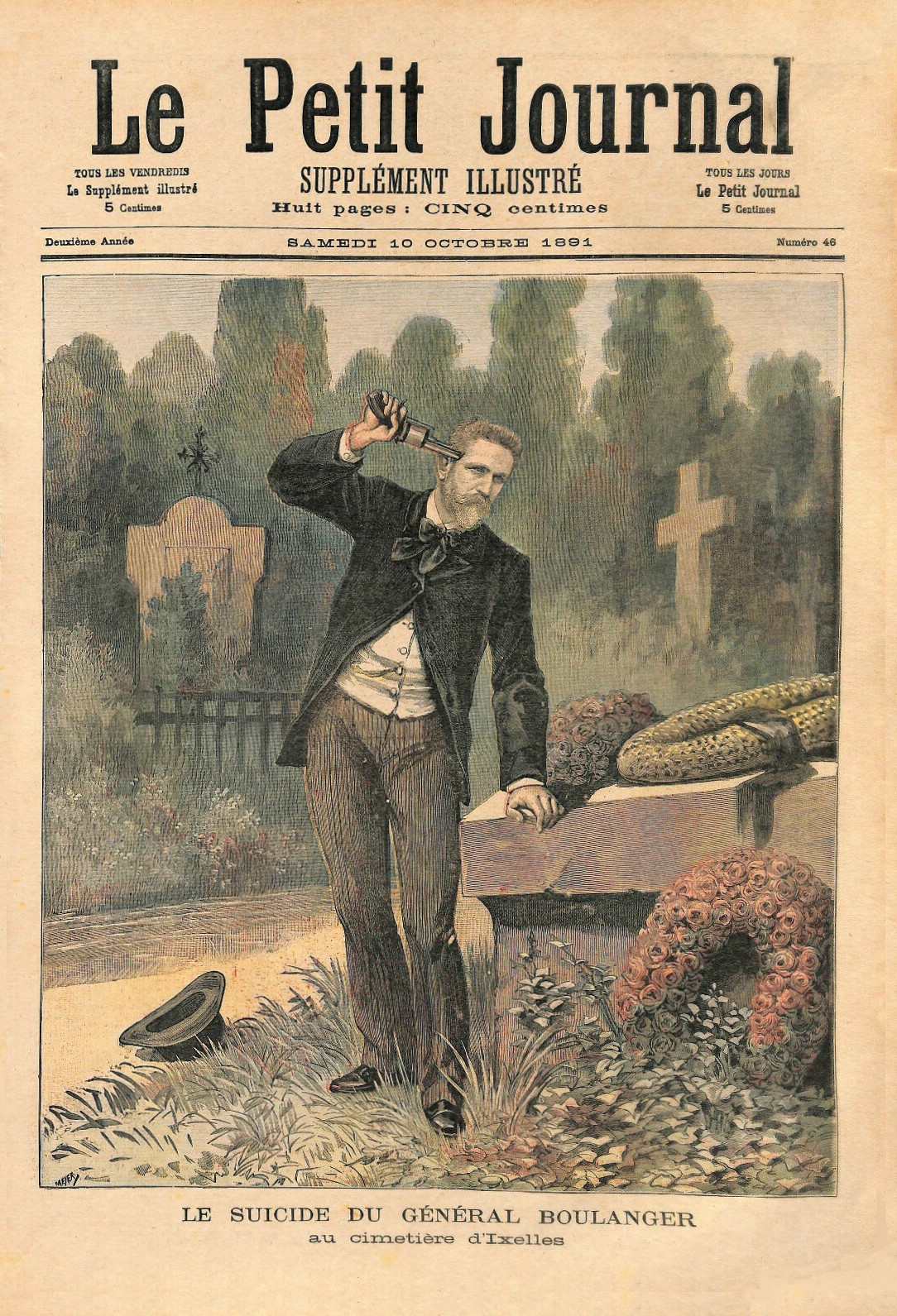
The photo of Sarkozy on his horse caught my eye because, while outsider candidates whose appeal is more emotional than rational crop up from time to time in every democracy, the man-on-a-horse is a particularly French symbol. It was Georges Boulanger who, on his black horse, caught the attention of French voters at the end of the nineteenth century and whose followers, Boulangists, seemed on the verge of carrying out a successful coup when Boulanger caused the movement to unravel at the time of the Presidential elections of 1889. The disintegration was messy as the man dithered about how fully to commit himself, then ran away when accused of a crime, and finally shot himself in despair on the grave of his recently-deceased mistress. If you're thinking "how very French," well there may be something in that.

Wikipedia tells the story well. The Columbia enclopedia has a typically concise summary. You can use your favorite search engine to find other accounts.

Here is Boulanger and a imaginative reconstruction of his suicide


{Click image to see full size. Source}

Addendum: I spent much too much time trying to track down Boulanger. How do you find information about the political man-on-a-horse phenomenon when "man-on-horse" and variants on France, election, coup, etc. don't work? I finally remembered Boulanger was the name and that did the trick. I also spent some futile time trying to find an image of the man on his horse.

Saturday, April 21, 2007

L'Allegro

Here is another poem from Parnassus, the anthology compiled by Ralph Waldo Emerson in 1874 (pdf).
L'Allegro, by John Milton

Hence, loathed Melancholy,
Of Cerberus and blackest Midnight born,
In Stygian cave forlorn
'Mongst horrid shapes, and shrieks, and sights unholy!
Find out some uncouth cell,
Where brooding Darkness spreads his jealous wings,
And the night raven sings;
There under ebon shades, and low-browed rocks,
As ragged as thy locks,
In dark Cimmerian desert ever dwell.
But come thou Goddess fair and free,
In heav'n ycleped Euphrosyne,
And by Men, heart-easing Mirth,
Whom lovely Venus at a birth
With two sister Graces more
To ivy-crowned Bacchus bore;
Or whether (as some sager sing)
The frolic wind that breathes the spring,
Zephyr, with Aurora playing,
As he met her once a-Maying,
There on beds of violets blue,
And fresh-blown roses washed in dew,
Filled her with thee a daughter fair,
So buxom, blithe, and debonair.
Haste thee, Nymph, and bring with thee
Jest, and youthful Jollity,
Quips, and Cranks, and wanton Wiles,
Nods, and Becks, and wreathed Smiles,
Such as hang on Hebe's cheek,
And love to live in dimple sleek;
Sport that wrinkled Care derides,
And Laughter holding both his sides.
Come, and trip it as you go
On the light fantastic toe;
And in thy right hand lead with thee
The mountain nymph, sweet Liberty;
And if I give thee honour due,
Mirth, admit me of thy crew,
To live with her, and live with thee,
In unreproved pleasures free;
To hear the lark begin his flight,
And singing startle the dull night,
From his watch-tow'r in the skies,
Till the dappled dawn doth rise;
Then to come in spite of sorrow,
And at my window bid good morrow,
Through the sweet-briar, or the vine,
Or the twisted eglantine:
While the cock with lively din
Scatters the rear of darkness thin,
And to the stack, or the barn-door,
Stoutly struts his dames before:
Oft list'ning how the hounds and horn
Cheerly rouse the slumb'ring morn,
From the side of some hoar hill,
Through the high wood echoing shrill:
Sometime walking, not unseen,
By hedge-row elms, on hillocks green,
Right against the eastern gate,
Where the great sun begins his state,
Robed in flames, and amber light,
The clouds in thousand liveries dight;
While the ploughman near at hand
Whistles o'er the furrowed land,
And the milkmaid singeth blithe,
And the mower whets his scythe,
And every shepherd tells his tale
Under the hawthorn in the dale.
Straight mine eye hath caught new pleasures
Whilst the landscape round it measures;
Russet lawns, and fallows grey,
Where the nibbling flocks do stray;
Mountains, on whose barren breast
The lab'ring clouds do often rest;
Meadows trim with daisies pied,
Shallow brooks, and rivers wide.
Towers and battlements it sees
Bosomed high in tufted trees,
Where perhaps some Beauty lies,
The Cynosure of neighb'ring eyes.
Hard by, a cottage chimney smokes,
From betwixt two aged oaks,
Where Corydon and Thyrsis met
Are at their savoury dinner set
Of herbs, and other country messes,
Which the neat-handed Phillis dresses;
And then in haste her bow'r she leaves,
With Thestylis to bind the sheaves;
Or, if the earlier season lead,
To the tanned haycock in the mead;
Sometimes with secure delight
The upland hamlets will invite,
When the merry bells ring round,
And the jocund rebecks sound
To many a youth and many a maid,
Dancing in the chequered shade;
And young and old come forth to play
On a sunshine holiday,
Till the live-long daylight fail;
Then to the spicy nut-brown ale,
With stories told of many a feat,
How Fairy Mab the junkets eat;
She was pinched and pulled she said,
And he by friar's lanthorn led
Tells how the drudging Goblin sweat
To earn his cream-bowl duly set,
When in one night, ere glimpse of morn,
His shadowy flail hath threshed the corn,
That ten day-lab'rers could not end;
Then lies him down the lubber fiend,
And stretched out all the chimney's length,
Basks at the fire his hairy strength,
And crop-full out of doors he flings,
Ere the first cock his matin rings.
Thus done the tales, to bed they creep,
By whispering winds soon lulled asleep.
Towered cities please us then,
And the busy hum of men,
Where throngs of knights and barons bold
In weeds of peace high triumphs hold,
With store of ladies, whose bright eyes
Rain influence, and judge the prize
Of wit or arms, while both contend
To win her grace, whom all commend.
There let Hymen oft appear
In saffron robe, with taper clear,
And pomp, and feast, and revelry,
With mask, and antique pageantry;
Such sights as youthful poets dream
On summer eves by haunted stream.
Then to the well-trod stage anon,
If Jonson's learned sock be on,
Or sweetest Shakespeare, Fancy's child,
Warble his native wood-notes wild.
And ever against eating cares
Lap me in soft Lydian airs
Married to immortal verse
Such as the meeting soul may pierce
In notes, with many a winding bout
Of linked sweetness long drawn out,
With wanton heed, and giddy cunning,
The melting voice through mazes running,
Untwisting all the chains that tie
The hidden soul of harmony;
That Orpheus' self may heave his head
From golden slumber on a bed
Of heaped Elysian flowers, and hear
Such strains as would have won the ear
Of Pluto, to have quite set free
His half-regained Eurydice.
These delights if thou canst give,
Mirth, with thee I mean to live.
Dartmouth's Milton web page says: " It is nearly impossible to understand and appreciate John Milton's L'Allegro without also having read its companion piece, Il Penseroso. Whereas l'allegro is "the happy person" who spends an idealized day in the country and a festive evening in the city, il penseroso is "the thoughtful person" whose night is filled with meditative walking in the woods and hours of study in a "lonely Towr." First published in 1645, the two poems complement each other structurally and contain images which are in specific dialogue with one another." This page explains unfamiliar terms and everything else that might need to be explained in the poem.

Friday, April 20, 2007

Italy is Byron's debtor

From the Journals of Ralph Waldo Emerson:
April 20, 1833

I have paid a last visit to the Capitoline Museum & Gallery. One visit is not enough, no, nor two to learn the lesson. The dying Gladiator is a most expressive statue but it will always be indebted to the muse of Byron for fixing upon it forever his pathetic thought. Indeed Italy is Byron's debtor, and I think no one knows how fine a poet he is who has not seen the subjects of his verse, & so learned to appreciate the justness of his thoughts & at the same time their great superiority to other men's.

I know well the great defects of Childe Harold.

In the Gallery I coveted nothing so much as Michel Angelo's Portrait by himself.
Emerson, age 30, continues his visit to Italy during his first travels in Europe. He will leave Rome in a few days and journey across the north to Venice.

Here is a link to the Capitoline Museum home page. The "dying Gladiator" which Emerson admires is usually called the Dying Gaul (in Italian, Galata Morente). Here are Byron's famous stanzas on the statue:
CXL.

I see before me the Gladiator lie:
He leans upon his hand--his manly brow
Consents to death, but conquers agony,
And his drooped head sinks gradually low -
And through his side the last drops, ebbing slow
From the red gash, fall heavy, one by one,
Like the first of a thunder-shower; and now
The arena swims around him: he is gone,
Ere ceased the inhuman shout which hailed the wretch who won.

CXLI.

He heard it, but he heeded not--his eyes
Were with his heart, and that was far away;
He recked not of the life he lost nor prize,
But where his rude hut by the Danube lay,
THERE were his young barbarians all at play,
THERE was their Dacian mother--he, their sire,
Butchered to make a Roman holiday -
All this rushed with his blood--Shall he expire,
And unavenged?--Arise! ye Goths, and glut your ire!


In small, full-figure reproduction it's hard to see why the work called forth Bryon's eloquence:


But shows some of its expressive power in detail. Note the contrast between the Gaul and the other statues visible in this image:


{Click to enlarge. source}


Here is a link to the Wikipedia article on the statue: Dying Gaul.

Regarding Childe Harold, Emerson reflects Byron himself in alluding to defects since Byron publically declared the work to be pretty bad. Nonetheless, it made a huge impression and was one of the most widely-read poems of its day. Published over a period of years toward the end of the Napoleonic era, it is, says the Wikipedia author, "an expression of the melancholy and disillusionment felt by a generation weary of the wars of the post-Revolutionary and Napoleonic eras."

Here is a link to the Full text in Project Gutenberg.

These stanzas from the poem echo the view of Emerson and many contemporaries of the proud heritage and sorry present of Italy during the first half of the 19th century:
XLII.

Italia! O Italia! thou who hast
The fatal gift of beauty, which became
A funeral dower of present woes and past,
On thy sweet brow is sorrow ploughed by shame,
And annals graved in characters of flame.
Oh God! that thou wert in thy nakedness
Less lovely or more powerful, and couldst claim
Thy right, and awe the robbers back, who press
To shed thy blood, and drink the tears of thy distress;

XLVII.

Yet, Italy! through every other land
Thy wrongs should ring, and shall, from side to side;
Mother of Arts! as once of Arms; thy hand
Was then our Guardian, and is still our guide;
Parent of our religion! whom the wide
Nations have knelt to for the keys of heaven!
Europe, repentant of her parricide,
Shall yet redeem thee, and, all backward driven,
Roll the barbarian tide, and sue to be forgiven.

L.

We gaze and turn away, and know not where,
Dazzled and drunk with beauty, till the heart
Reels with its fulness; there--for ever there -
Chained to the chariot of triumphal Art,
We stand as captives, and would not depart.
Away!--there need no words, nor terms precise,
The paltry jargon of the marble mart,
Where Pedantry gulls Folly--we have eyes:
Blood, pulse, and breast, confirm the Dardan Shepherd's prize.


Here is an image of the Michaelangelo self-portrait to which Emerson refers:

Thursday, April 19, 2007

creatures of the sun

Here is another poem from Parnassus, the anthology compiled by Ralph Waldo Emerson in 1874 (pdf).
Nature. How young and fresh am I tonight,
To see't kept day by so much light,
And twelve my sons stand in their maker's sight!
Help, wise Prometheus, something must be done
To show they are the creatures of the sun,
That each to other
Is a brother,
And Nature here no stepdame, but a mother
Chorus. Come forth, come forth, Prove all the numbers then
That make perfection up, and may absolve you men.
[Nature.] But show thy winding ways and arts,
Thy risings and thy timely starts
Of stealing fire from ladies' eyes and hearts.
Those softer circles are the young man's heaven,
And there more orbs and planets are than seven,
To know whose motion
Were a notion
As worthy of youth's study as devotion.
Chorus. Come forth, come forth, prove all the time will gain,
For Nature bids the best, and never bade in vain.
This comes from a masque, Mercury Vindicated from the Alchemists at Court. Jonson's stage direction says the poem is sung in "a glorious bower wherein Nature was placed with Prometheus at her feet, and the twelve masquers standing about them." The Wikipedia entry on it says the masque was a success with the king and may have helped to forward the ambitions of a court favorite whom Jonson wished to see promoted.

postponing one's maturity

From the Journals of Ralph Waldo Emerson
April 19, 1835

It is a happy talent to know how to play. Some men must always work if they would be respectable; for the moment they trifle, they are silly. Others show most talent when they trifle. Be it said of W that his excess of reverence made it impossible for him to realize ever that he was a man; he never assumed equality with strangers but still esteemed them older than himself though they were his own age or younger. He went through life postponing his maturity & died in his error.
Emerson is 30 years old when he writes this. His journal and other writings do not show much playfulness, though there are occasional flashes of humor in them. He might be writing of himself in saying some men must always work. The fact that he doesn't identify the deceased "W" shouldn't be taken to mean that he expected the journal entry to be published and didn't wish to embarass W's relatives. It's more likely that he shared parts of the journal with his friends and found it convenient sometimes to be a bit discrete.

• Joost still down and out

Rabobank has announced its line up for the Giro d'Italia and Joost is not in it. He was recovering from a crash in a recent race when he got into an accident during a training ride in Germany. His website says a decision will be made tomorrow whether to operate to repair his knee. There are no broken bones, but he has deep bruises and possibly more serious damage. The site reports information from Joost's girlfriend about his condition.