Showing posts with label Jack Delano. Show all posts

Friday, October 25, 2013

Delano's cupolas


This photo shows a crewmember of a freight train looking out the left side window of a caboose's cupola. It was taken in March 1943 by Jack Delano for the U.S. Office of War Information. The train was on the Atchison, Topeka, and Santa Fe system somewhere in western Texas or eastern New Mexico.

The photo is held by the Prints and Photographs Division of the Library of Congress. Although it is unlabeled, its composition and the details it shows are similar to other photos Delano took of trainmen in caboose cupolas during a photo shoot of March 1943 on frieght trains traveling from Chicago to San Bernardino along the AT&SF line. In the files assembled from this shoot the photo is located near photos whose captions give locations in the vicinity of Amarillo, Texas, and Albuquerque, New Mexico.

The trainman's tie and jacket, as well as the fedora he wears with train badge just visible all indicate that his job was conductor. You can see these details a little more clearly in this cropped image. Click this image (and all the others) to view full size.


This photo, taken a few days earlier of a different trainman, gives a full caption. The two images are strikingly similar.

{Caption: Conductor W. E. Zink, watching the train from his window in the cupola of the caboose on the Atchison, Topeka, and Santa Fe Railroad between Emporia and Wellington, Kansas; photo by Jack Delano created 1943 Mar.; source: Library of Congress Prints and Photos Division}

The purpose of these photos was documentary. They and the many other images that Delano captured during his journey south and west aimed to show one aspect of war mobilization — the great strength of the U.S. transportation system. Nonetheless, they are far from being naïve propaganda.

The outline that Delano prepared as part of the OWI request for governmental clearance to undertake the work shows his intention to give "a photographic story of the important role played by the railroads in the national war effort," and to this end he showed the astounding magnitude of U.S. rail freight operations.[1] There are lots of long shots of great rail terminals, huge plants for manufacture and repair of locomotives and rolling stock, and the vast landscape of the American Southwest. But he also showed individuals, men and women whose work enabled this vast system to function.

It's in keeping with the philosophy of the FSA/OWI photographic unit that the thousands of photos in its archives contain no photo-op news-shots of politicians, rail system managers, or other public figures. As Delano's boss, Roy Stryker put it, the units images contained "no record of big people or big events ... and absolutely no celebrities."[2] This down-to-earth approach comes out fully in Delano's AT&SF photos. We see yardmasters, engineers, conductors, brakemen, oilers, and wipers. We see workers in locomotive repair shops, on the tracks, in telegraph rooms, and in switch towers. We see workers of European heritage, American Indians, African Americans, and Mexicans.[3]

During the Depression Era the FSA was well-known for its photos of impoverished Americans. The FSA photographers showed them to have a self-possessed grace and this inherent dignity conveyed to viewers some basis for hoping that the millions who suffered misfortune would not just survive but potentially thrive within a reconstructed economy.[4] When the photographic unit was moved from FSA to OWI there was less need and no mandate to produce compelling images of poverty and individuals' struggles to overcome it. During the war buildup and after Pearl Harbor the photos taken by the photography unit both encouraged and reflected a growing sense of American cohesiveness — people working together to produce the industrial output that would be needed to win the war. The OWI photographers did this, however, without entirely abandoning their earlier point of view. From 1940 onward the photos they took continue to show the great diversity of a people who were considered at the time to be "ordinary" citizens.[5]

The portraits that Delano took of the hundreds of workers he encountered during his assignment with the Atchison, Topeka, and Santa Fe demonstrate that he possessed the skill necessary to show the simple human dignity in the "common man" (a phrase, like "ordinary citizen" that was in vogue at the time). He disassembled this collective stereotype into its very specific, individual components. The captions he gave his photos frequently state the job a subject performs and give his or her name and home town and the photos themselves tend to show personal habits through grooming, clothing, and posture. More than that, his photos have a broader aesthetic and cultural value. Delano's understanding of photographic design lifts them above the level of journalism. It's his skill as an artist which leads us now, in examining them, to see that they are something more than documentary artifacts. Delano had to plan his photos. The camera he used most frequently was awkward to use for snapshots. This wasn't really a drawback since it's obvious that he planned his photos carefully, choosing his subject, composition, and camera angle and waiting for the light to be right. It's reasonable to assume he sometimes posed his subjects, or, anyway, asked them to adjust their position to achieve the effect he wished to see.[6]

The FSA/OWI photographers were supposed to make factual images and not to alter them "for effect." During the Dust Bowl years, one of them was criticized for moving a bleached skull to improve his composition, but Delano, and his boss Stryker, understood that there was no fakery involved.[7] A photographer needed to be trusted to show a subject as it actually was in real life, and they lived up to this trust, but they also knew it to be their responsibility to make a photo that was meaningful. Stryker's mentor, Rexford Guy Tugwell, put this objective concretely in a conversation Stryker recalled long afterward. "Roy, a man may have holes in his shoes, and you may see the holes when you take the picture. But maybe your sense of the human being will teach you there's a lot more to that man than the holes in his shoes, and you ought to try and get that idea across."[8] Stryker stated the matter in his own words when, in an interview, he said how wage earners, like the trainmen in Delano's photos, could be photographed in a way that revealed their inherent worth. "They had dignity." he said, "And they sensed this guy [the photographer] could give it to them. Not make them beautiful, not make them look like something they weren't. But he put a dignity into that picture. They responded to him."[9]

Here are some more photos of trainmen in cupolas and a couple of others showing the position of the observation benches within the caboose. All are found in collections of the Prints and Photographs Division of the Library of Congress.

This shows the cupola from the outside of the caboose.

{Caption: Marceline, Missouri. Brakeman in the cupola of his caboose in the Atchison, Topeka, and Santa Fe Railroad yard}

From within the caboose, you can see the cupola benches in front of and above the rear door of the caboose.

{Caption: Conductor (right) and brakeman, in their places in the cupola of the caboose on the Atchison, Topeka, and Santa Fe Railroad between Argentine and Emporia, Kansas. On the wall between them is the air gauge showing the amount of air brake pressure in the train}

Here is the caboose interior with the end of one of the cupola benches visible at back.

{Caption: Freight train operations on the Chicago and Northwestern Railroad between Chicago and Northwestern Railroad between Chicago and Clinton, Iowa. The caboose is the conductor's second home. He always uses the same one and many conductors cook and sleep there while waiting for trains to take back from division points}

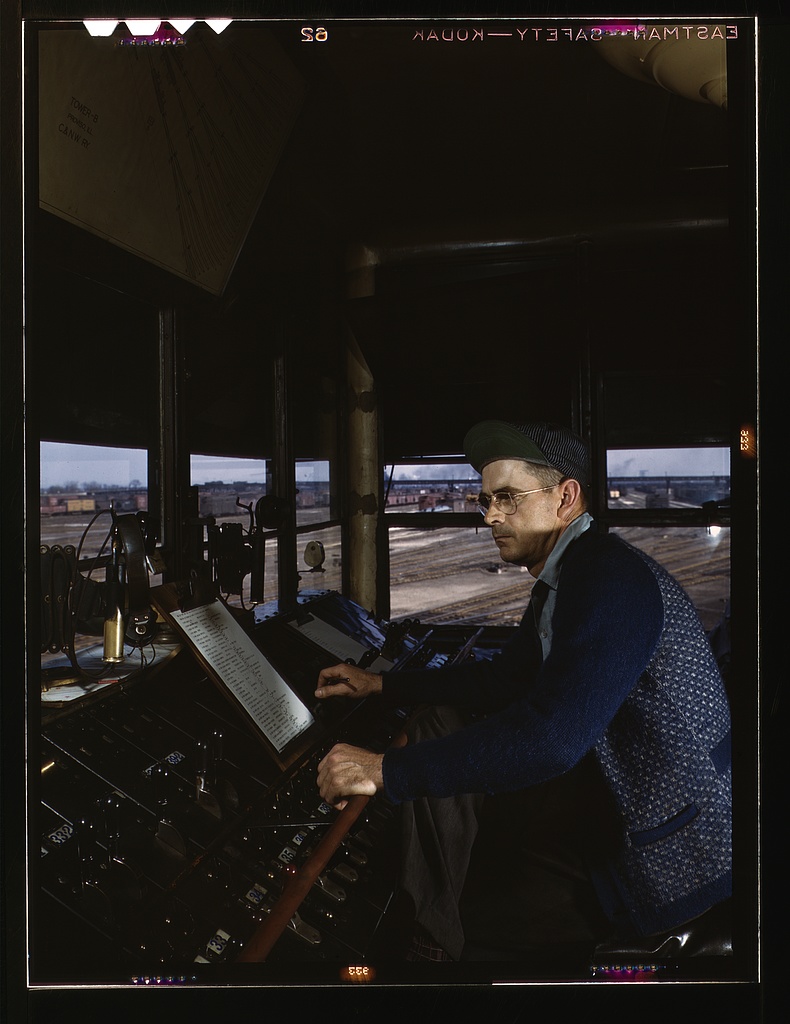
In viewing all these photos you can tell that Delano had an aesthetic appreciation for the dramatic blocks of light and dark present when trainmen observed the train through the cupola's side windows.

{Caption: Brakeman H. L. Duffield, watching the train from the window in the cupola of the caboose on the Atchison, Topeka, and Santa Fe Railroad between Emporia and Wellington, Kansas}


{Caption: Conductor J.R. Crawford, watching the train from his window in the cupola of the caboose along the Atchison, Topeka, and Santa Fe Railroad between Canadian and Amarillo, Texas}


{Caption: Rear brakeman M. H. Burdette, watching the train from his window in the cupola on the Atchison, Topeka and Santa Fe Railroad, between Chillicothe, Illinois and Fort Madison, Iowa}

It's apparent that riding in the cupola was something like sitting in the upper deck of a London bus — a place to relax and watch the world go by. I'm suspect Delano was making a joke in saying the bottle contained hot coffee.

{Caption: Rear brakeman George Clark having his lunch in the cupola of the caboose on the Atchison, Topeka, and Santa Fe Railroad, between Marceline, Missouri and Argentine, Kansas. The bottle contains hot coffee}

This is one of the few shots in which Delano used flash and it's the only one he took from below. Although it suffers the flattening that always occurs with single-source flash photography, it's still interesting in its composition, subject, and point of view.

{Caption: Hart (vicinity), Missouri. The conductor uses his air valve in emergencies when it is necessary for him to stop the train along the Atchison, Topeka, and Santa Fe Railroad between Fort Madison, Iowa and Marceline, Missouri}

Here is Delano himself, taken by an unnamed photographer.

{Caption: Jack Delano, Farm Security Administration/Office of War Information photographer, full-length portrait, holding camera, standing on front of locomotive, taken ca. 1943, location not given}

I've marked this 1939 AT&SF map to show Delano's route in March 1943.

{1939 Map of Atchison Topeka and Santa Fe Railway; source: North American Railroads of the 1930's by Richard Parks}

------

Some sources:

I've done earlier posts of Delano photos, including one from the March 1943 shoot. Click the Jack Delano label at right to view them. For posts showing other photos from Office of War Information files, click the OWI label.

Outline for a trip aboard a fast freight from Chicago Illinois to San Bernardino, Calif. (3 p.) by Jack Delano, in LOT 12024, Box 1, Clearances, Army, 1942-1943, held by the Prints and Photographs Division of the Library of Congress

Letter: Roy Stryker to L.I. McDougle, 1942 October 12 [PDF file, 1 p., 134 kb] LOT 12024, Box 1, Clearances, 1942-1943, held by the Prints and Photographs Division of the Library of Congress

Interview with Roy Stryker, conducted by Robert J. Doherty, F. Jack Hurley, Jay M. Kloner, and Carl G. Ryant on the American Suburb X web site

Oral history interview with Jack and Irene Delano, 1965 June 12 conducted by Richard Doud for the Smithsonian Archives of American Art; transcript, 63 pp of a sound recording on 2 tape reels

Jack Delano in wikipedia

Jack Delano in the Museum of Contemporary Photography web site

https://scholarworks.iupui.edu/bitstream/handle/1805/3145/Jack Delano.pdf?sequence=1 biography, Program of Digital Scholarship, Indiana University-Purdue University Indianapolis

Documenting America, 1935-1943 by Carl Fleischhauer, Beverly W. Brannan, and Lawrence W. Levine (University of California Press, 1988)

www.lllevin.com/users/LarryLevin3660/docs/ASPP Stryker's America 3-08p21-24.pdf by Larry L. Levin on his own web site

Capturing the faces of railroading Who is Jack Delano? And how did his photography change the way Americans perceived railroading? by John Gruber, December 21, 2009, on the web site of Trains, The Magazine of Railroading

www.archives.gov/atlanta/education/depression-curriculum/section-2.pdf, "This Great Nation Will Endure": Photographs of the Great Depression A Curriculum Guide, National Archives at Atlanta

Chicago and Downstate: Illinois as Seen by the Farm Security Administration Photographers, 1936-1943 by Robert L. Reid and Larry A. Viskochil (University of Illinois Press, 1989)

A Chicago Hub Railroad of the 1930's - 1940's The Atchison Topeka & Santa Fe Railway (Santa Fe) on r2parks.net

Picturing Texas: The Farm Security Administration-Office of War on the Portal to Texas History

Visual Sociology by Douglas Harper (Routledge, 2012)

The History of Photography: An Overview by Alma Davenport (UNM Press, 1991)

Picturing Faith: Photography and the Great Depression by Colleen McDannell (Yale University Press, 2004)

Ordinary People: Jack Delano by Arthur H. Bleich in Rangefinder magazine

Crucible of Freedom: Workers' Democracy in the Industrial Heartland, 1914–1960 by Eric Leif Davin (Lexington Books, Rowman & Littlefield Publishers, 2010)

American Photography and the American Dream by James Guimond (UNC Press Books, 1991)

THE ART SPIRIT By Robert Henri; Notes Taken By M. R. From Robert Henri's Criticisms And Class Talks on Afterall / Online

The Likes of Us: America in the Eyes of the Farm Security Administration by Stuart Cohen (David R. Godine, 2009)

Jack Delano’s American Sonata by David Gonzalez, Lens, New York Times, October 13, 2011

-------------

Notes:

[1] Outline for a trip aboard a fast freight from Chicago Illinois to San Bernardino, Calif. (3 p.) by Jack Delano, in LOT 12024, Box 1, Clearances, Army, 1942-1943, held by the Prints and Photographs Division of the Library of Congress. The outline shows that Delano originally expected to take frieght trains pulled by the new diesel electric engines. As it turned out the trains were engined by steam locomotives, then acknowledged to be more expensive to operate, though now seen as highly romantic. Here is the summary page from this three-page document. Click to view full size.

{Outline for a trip aboard a fast freight from Chicago Illinois to San Bernardino, Calif. (3 p.) by Jack Delano, in LOT 12024, Box 1, Clearances, Army, 1942-1943, held by the Prints and Photographs Division of the Library of Congress}

[2] Quoted in Documenting America, 1935-1943 by Carl Fleischhauer, Beverly W. Brannan, and Lawrence W. Levine (University of California Press, 1988)

[3] You can see something of this diversity by skimming the results of an online search of Delano's photographs from March 1943 in the Library of Congress Prints and Photographs Division catalog.

[4] Stryker's approach to documentary photography of the American Depression contrasted the dignity and despair of the Depression's victims. His optimism about this dicotemy came out when he said: "Maybe I'm a fool, but I believe that dignity wins out. When it doesn't then we as a people will become extinct." (Quoted in Documenting America). Stryker's biography in The History of American Photography says he came to understand this dignity and and attain his positive outlook while he and his wife were living in a New York tenement during his school years: "Their neighbors were mostly immigrants who worked feverishly simply to maintain the barest requirements of life. This experience impressed Stryker immensely. Food may have been lacking, clothing may have been scarce, but the fiber of these people was based on dignity, endurance, and the simple pleasures afforded by freedom."

[5] Stryker wanted pictures of "the common people," the hard working survivors who built America. "I think it's significant," Stryker later said, "that in our entire collection we have only one picture of Franklin Roosebvelt, the most newsworthy man of the era ... You'll find no record of big people or big events in the collection ... not a single shot of Wall Street, and absolutely no celebrities." Quoted in Crucible of Freedom: Workers' Democracy in the Industrial Heartland, 1914–1960 by Eric Leif Davin (Lexington Books, Rowman & Littlefield Publishers, 2010)

[6] Delano's military authorization for the photo shoot enabled him to have the train stopped or moved for vantage to get a photo he wanted to take. If he could have the engineer and conductor do these things for him, there's little reason to believe he wouldn't also ask his sujects to move about a bit to improve a composition for him.
When WWII began, the FSA was folded into the Office of War Information (OWI) and its photographers were assigned to projects that would promote the war effort. Much to his delight, Delano was tapped for a month-long trip to document America’s railroads; he’d ride with the crews and even had the authority to stop the train (with the engineer’s consent) to get any shots he needed. ... Delano’s first attempt to stop a train for a shot he wanted was met by the engineer’s blunt refusal. “Young man,” he said, “if I stopped the train here we could never get it started again but would go rolling down the hill backward.” So Delano waited until he was aboard a different train, one that was rounding a curve with more than a 100 cars strung out behind carrying bombs, tractors, trucks and tanks. This time the engineer complied and brought the train to a halt. Delano hopped off but found the composition wasn’t right; the train needed to be moved forward some more. He shouted instructions to the engineer and the train inched forward. “Never had I had such a sense of power,” he recalls. “I felt like Hercules. Wow! To think I could move that whole train with just the wave of my hand.” When he’d finished shooting, he signaled the engineer to get moving again and hopped on the caboose as it rolled by.
-- Quoted in
Ordinary People: Jack Delano by Arthur H. Bleich in Rangefinder magazine

[7] On the skull controversy see:
  1. Photography and the Great Depression: Arthur Rothstein, a site was created for a Photographic Archives course at the Graduate School of Library and Information Science at Simmons College
  2. The History of Photography: An Overview by lma Davenport (UNM Press, 1991)
  3. The controversy was eventually quelled when Stryker pointed out that while he moved the skull ten feet, he certainly did not move it out of the drought area, which was littered with such skulls.
  4. THE NATURALISTIC ENTHYMEME AND VISUAL ARGUMENT: PHOTOGRAPHIC REPRESENTATION IN THE 'SKULL CONTROVERSY'. by Cara A. Finnegan in Argumentation and Advocacy › Vol. 37 Nbr. 3, January 2001
  5. Oral history interview with Arthur Rothstein, 1964 May 25, an interview of Arthur Rothstein conducted in New York, N.Y., 1964 May 25, by Richard Doud, for the Archives of American Art; Transcript: 31 pages

[8] Quoted in Documenting America, 1935-1943 by Carl Fleischhauer, Beverly W. Brannan, and Lawrence W. Levine (University of California Press, 1988).

Robert Henri, famous painter in the New York Ashcan School, his paintings are realistic, in the usual sense of the word, rather than abstract. He understood the difference between a painting which records an observation and a work of art — the difference between a work of art which simply records a subject faithfully and one that brings out something more from within it. In notes from lectures he gave at the Art Students League he said "Rather paint the flying spirit of the bird than its feathers." Quoted in Affirmations for Artists, ed. by Eric Maisel (G.P. Putnam's Sons, 1996)

Delano realized that a good photograph could sometimes capture this flying spirit, but not always. He put a poem in his diary which he called "Things I cannot photograph." Here's its end:
A train is approaching us!
The glare of the headlight
With a WHOOSH of thunder as it flies by us.
The brakeman gets down from the cupola and watches it go by
Two red lights and a white one pass us
The white one waves up and down.
We answer
Then back again to the drone
I throw a cigarette out of the window
It whirls off in the backwash scattering sparks wildly like fireworks
The blackness again.

-- Quoted in: Jack Delano’s American Sonata by David Gonzalez, Lens, New York Times, October 13, 2011

[9] Oral history interview with Jack and Irene Delano, 1965 June 12 conducted by Richard Doud for the Smithsonian Archives of American Art; transcript, 63 pp of a sound recording on 2 tape reels

Monday, November 05, 2012

Potato race

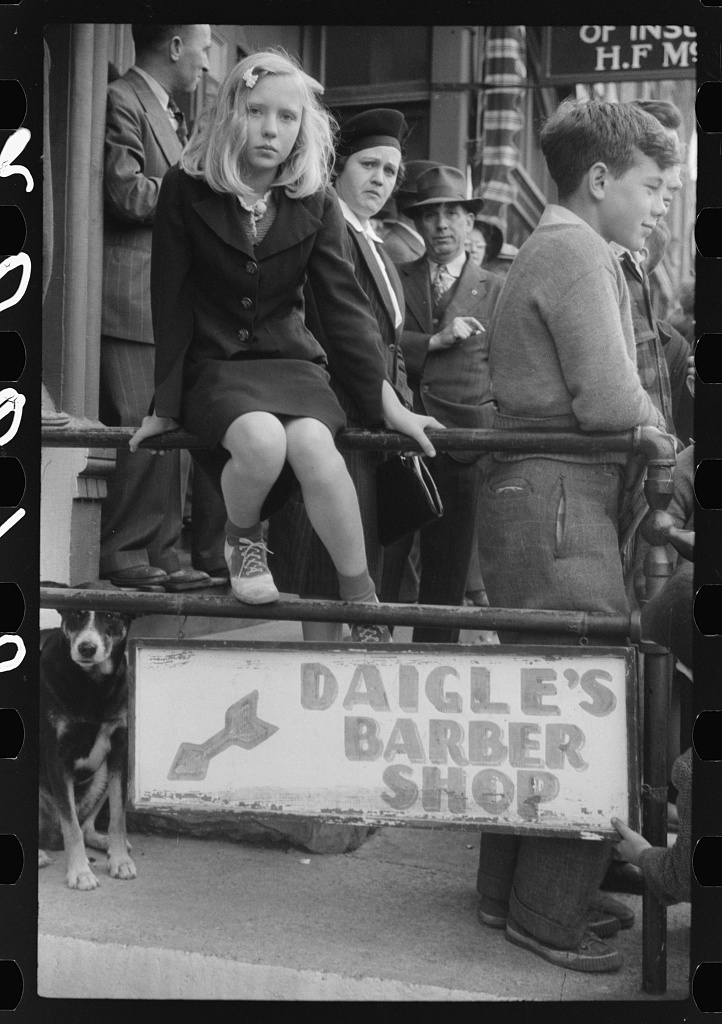
These boys were spectators at a potato barrel rolling contest held October 1940 in Presque Isle, Maine. Jack Delano attended the event to photograph it for the Farm Security Administration.


I'd guess that Delano attracted the attention of the boys before he took their picture. As these two details show, they seem happy to be photographed as much as they're happy to have climbed to an ideal viewing spot.


In one of his first assignments for FSA Delano had used his camera to document laborers and laboring communities along the U.S. east coast. Starting in Florida, he'd worked his way to the nation's north-east estremity — Aroostook County along the border with Canada. All his photos in this set come from the FSA/OWI Color Photograph collection in the Prints and Photographs Division, Library of Congress. As usual, click to enlarge.

Although this set of photos shows us the contest itself, Delano seems more interested in the people who turned out to watch it.


In the following photo, the boy who's looking at the camera would probably have been happier mingling with the kids on the roof of Chesley's Electric Service.


The next photo seems to have a post-modern sensibility. It's not about the event or even about watching the event. It seems to some degree to be an abstract display of contrasting tones and textures and an exercise in handling negative space (the light colored areas, particularly among ankles and feet) but basically I suspect he wanted to see whether a photo of people's backsides would succeed, could be at all visually satisfying.

On the other hand it might have been a kind of inside joke. In an interview some 25 years later Delano said his boss would give detailed instructions before sending photographers out on assignment. He'd give them books to read and give them things to look out for, like "there is a certain drugstore on such and such a corner which has a certain thing in the window which you must be sure to find" and even "what kind of shoes" the people wear. He'd expect Delano to absorb all this information but he also expected him to be observant and to make his own judgment about what to shoot and how.*


The caption of this one says these girls are high school students who are participating by holding spuds on the ends of sticks. At left you can see a barrel sculpture, the "pototem pole."


The caption says the string that the Boy Scout is holding is the finishing line for the barrel race.


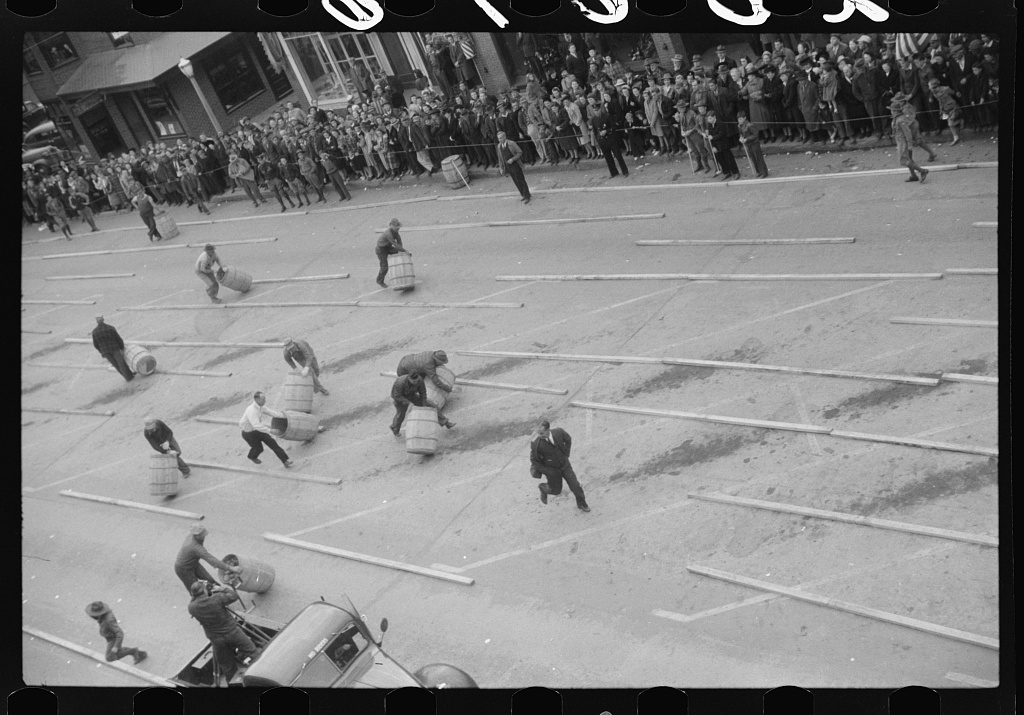
Here Delano shows the contest itself. Notice the news photographer on the back of the pickup truck and, just in front of him, the barrel with its potatoes. The caption says a full barrel weighs 200 pounds.


Detail from the previous image:


In this shot you can see more of the spectators and their reactions.


Detail from the previous image:


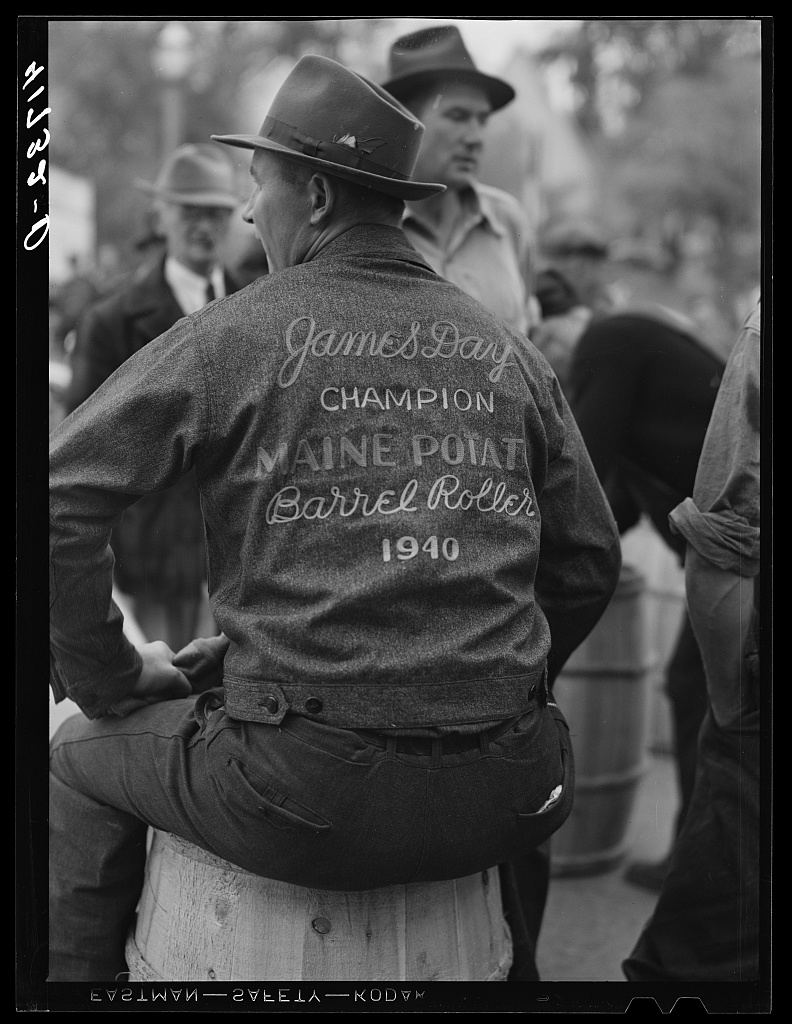
Here are two more photos from the many Delano took that day. The first is a poster advertising the contest and the second shows a champion roller. The caption says the latter shows "James Day, ace barrel roller and idol of Aroostook boys."


----------

*
Here's the relevant section of the interview:
[Interviewer:] We get these stories about how Roy would give you all sorts of books to read, and give you personal lectures and shooting scripts, and all that sort of thing. How much of that is correct?


JACK DELANO: Well, that's basically correct. I think that's quite true. Roy gave you the feeling that he knew more about everything that you did and, above all, ha knew more about America that you did, by far. And that's one of the things that I loved about Roy and one of the things I got most from him was a feeling about the United States, about America. This enthusiasm and love for the detail and the deeper meaning of everything American was something that he must have transmitted to everybody. He certainly did to me. In preparing for an assignment he not only gave us books to read, and all kinds of other things, but would talk and talk and talk in great detail about what you will find up there, and what you must look for, and there is a certain drugstore on such and such a corner which has a certain thing in the window which you must be sure to find, and so on. And he almost always would end up in saying, "But, of course, if you don't find any of these things, you do what you want to anyway." This is the way it always ended and frequently, after lengthy and detailed instructions and shooting scripts that Roy would develop, if you got up there and found that there was something else that interested you, and something else that you felt was more important and more pertinent, you just went ahead and did it; and wrote to Roy and said, "Look, Roy, it isn't like you said." This was perfectly okay with him because he wasn't imposing his ideas on you; he was trying to get you stimulated enough so that you would find out what was really there.

Interviewer: There was no dictation, I mean in this whole business he was simply trying to get you started. He didn't care if you went off on your own and took a different slant?

JACK DELANO: Not at all. On the contrary, he was trying to stimulate you to do that. In some of his letters, which we will show you -- I'm sure we'll find them this afternoon -- he would write in longhand these long letters in which he would work out for you a complete shooting script on what you should be looking for in Mauch Chunk, Pennsylvania or in Aroostook County, Maine. He would write in great detail about potato-picking, and what kind of shoes do they wear, and what kind of gloves do they wear, and where do they eat and sleep, and do all sorts of other things. But this was primarily a guide for you to open your eyes and be looking for these things. He wouldn't tell you what to photograph at all, ever.

-- Oral history interview with Jack and Irene Delano, 1965 June 12, An interview of Jack and Irene Delano in Rio Piedras, Puerto Rico, conducted 1965 June 12, by Richard Doud, for the Archives of American Art.

----------

Some sources

Jack Delano, 83; Depicted the Depression, an obituary in the New York Times by By Margarett Loke, August 15, 1997

Harvesting Potatoes, text by Richard E. Rand, images from Aroostook County Historical and Art Museum, Presque Isle Historical Society and Southern Aroostook Agricultural Museum

Aroostook County, Maine. October, 1940. Aroostook County, one of the largest potato producing centers in the world Photographed by Jack Delano for the Farm Security Administration. A collection of 160 photographic prints in the Library of Congress. Summary: Photographs show Aroostook County, one of the largest potato producing centers in the world. Aerial views of fields and farms, during harvest season. Tractor and horse drawn diggers. Crews of men, women, and children. Storage barns. Loading railroad cars for shipment. Isolated potato seed foundation farms. FSA community seed program. Demonstration of cutting and planting seed potatoes. Starch factory. Homes and families of French-Canadian farmers. Portraits.

Oral history interview with Jack and Irene Delano, 1965 June 12, An interview of Jack and Irene Delano in Rio Piedras, Puerto Rico, conducted 1965 June 12, by Richard Doud, for the Archives of American Art.

Farms in the Aroostook County, Me., Oct. 1940 : potatoes, Library of Congress

Farms in the Aroostook County, Me., Oct. 1940 : potatoes, Flickr photos from the Library of Congress

The Potato Culture of Aroostook County, Maine, USA

Aroostook Potatoes on aroostook.net

The Maine Potato Barrel Story
Extract: "The potato barrel is native to Aroostook, Maine's largest county; once the nation's largest producer of potatoes. While the other potato producing areas used burlap sacks, Aroostook farmers used the good, tongue and groove cedar barrel. It was used in the field during harvest and in the storage and sold by the barrel; they still are in Aroostook where farmers figure the cost of potatoes by the barrel. Although automated harvesters have taken over the bulk of the work, there are fields, even today, where barrels can be seen strung out in rows for the pickers to fill. Men, women and children-even grandparents bend to the task. An even today, children are excused from school for several weeks during this most important event."

Teams And Technology Educating Researching Aroostook County Tubers
Extract: "The history of the Maine potato industry reveals an industry of great change as illustrated by the number of farmers in business in the early 1900's compared to the early 2000's. The report titled, "Aroostook: Potato Capital of America" states there were over 6,000 farmers devoted to raising potatoes in Aroostook County, Maine around 1930-1940, while another report titled "A Study of the Maine Potato Industry: Its Economic impact 2003" reports only 586 potato farms in Maine in 1997."

Sunday, November 04, 2012

Aroostook potatoes


{Caption: Children gathering potatoes on a large farm, vicinity of Caribou, Aroostook County, Me. Schools do not open until the potatoes are harvested, by Jack Delano for the Farm Security Administration; source: FSA/OWI Color Photograph collection in the Prints and Photographs Division, Library of Congress}


{Caption: same}

In October 1940 Jack Delano traveled to Aroostook County, Maine, to photograph the potato harvest for the Farm Security Administration. Of all the FSA photographers who worked in color film he was the most prolific and arguably the best.

When the top photo appeared on Flickr , a woman who picked potatoes in Aroostook added a reminiscence in the comments:
I feel so fortunate to have been born and raised in the potato fields of Caribou, Maine. What a wonderful opportunity to learn a good work ethic and earn money for clothes for school. We were never cold and were well dressed at the same time. My dad was the digger and the overseer of the whole operation... he would have to get off of the bus to life [i.e. let] some of the children into the bus. Sometimes he would let the men run over a barrel to build a fire to warm up our toes and fingers while waiting for the hard frost to melt on the ground so that he could dig and we could pick!! Betty Bubar Collins. -- Elizabeth 58
Another Flickr commenter thought the boy at right might be crying. The two following detail images are inconclusive but I think his expression could be a smile.


About four basket loads would fill one of the barrels that were strewn around the field. A picker would mark each barrel with a ticket which would be used to calculate earnings. A full barrel earned the picker 12 cents in 1940. An adult picker in an average field could fill 30 or more barrels and a good picker in a field free of rocks could do maybe 100. If they stuck to it, the two boys might split two and a half dollars for their day's work.

You can see from this photo from the Aroostook shoot that at least some farmers still used horses to pull a mechanical digger through their fields.

{Caption: A horse-drawn digger in operation on a (potato) farm run by a French-Canadian, Caribou, Aroostook county, Me.}

This detail shows that the digger itself was motorized.


The following pair of images show a Massey-Harris No. 1 Potato Digger. The one at left is motorized. You can tell how it worked in the photo of a non-motorized version at right. The cow-catcher burrowed down under the potatoes and the forward motion of the digger brought them up to the conveyor. As the potatoes moved back along the conveyor the earth and plant debris dropped away and the potatoes dropped off the back.


Delano trained as an artist before he took up documentary photography. This photo from the Aroostook set shows his skill at framing, instinct for positioning the horizon, and expert handling fore-, mid-, and background elements. The photo shows his artistic use of formal design elements — the foreground's diagonal furrows contrasting with diagonal elements that point to a focal point in the group of structures positioned just off center. It also shows also his fine handling of hue — the earth and sky tones balanced against each other on either side of a contrasting band with white highlights. And the barrels and figures on the foreground artificial horizon add greatly to the visual impact of the image. As with all images on this page, click to enlarge.

{Caption: Farm in the vicinity of Van Buren, Aroostook County, Me.}

These two other long shots also show his command of photographic design.


{Caption: Farm in the vicinity of Wallagrasse, Aroostook County, Me.}


{Caption: Farms in the vicinity of Caribou, Aroostook County, Me.}

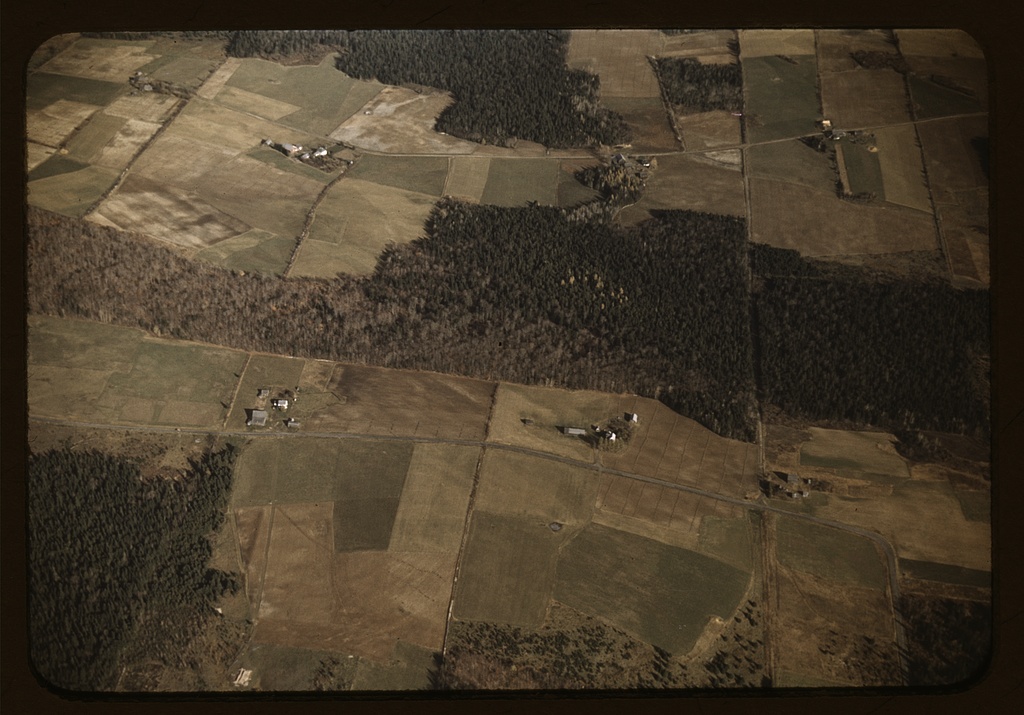
FSA photographers took comparatively few color photos and only a handful of those were taken from the air. All of these color aerials appear in Delano's Aroostook set and are reproduced below. In 1965 Delano commented on the difficulty he faced in getting authorization for them.
JACK DELANO: I think life would have been a lot simpler for Roy [Stryker, Delano's boss]and probably for the rest of us if there had been less stringent insistence, if there had been less insistence, on abiding by the letter of the law in all government procedures that had to be attended to for everything, because this was in a way a kind of unusual project and it needed a little bit of unusual treatment. For example, I found myself up in Aroostook County, Maine and I wanted to get some aerial shots of the great potato fields and this got to be a real serious problem. How did I rent a plane for an hour? Telegraphs back and forth to Roy about what papers to fill out, what forms you need, and what kind of receipt to fill out, and what does the pilot have to sign, and all these things just in order for me to take a plane for an hour.

RICHARD DOUD: Did you manage?

JACK DELANO: Oh yes, I did it. I would have done it anyway and paid it out of my own pocket.

-- Oral history interview with Jack and Irene Delano, 1965 June 12, An interview of Jack and Irene Delano in Rio Piedras, Puerto Rico, conducted 1965 June 12, by Richard Doud, for the Archives of American Art.


{Caption: Potato farms in Aroostook County, Me.}


{Caption: Potato farms showing layout of land and buildings, vicinity of Caribou, Aroostook, Me.}


{Caption: Potato farm in Aroostook county, Me., after the potatoes have been harvested}

When Aroostook potatoes were graded, the best went for seed potatoes, next were potatoes for cooking, and last potatoes for making starch. Quality controls were stringent and most of the crop might end up in the last category. The 1940 potato crop was one of the biggest ever in the U.S. and Aroostook County was the dominant producer. Starch factories did well that year.

{A starch factory along the Aroostook River, Caribou, Aroostook County, Me.}

---------

I've marked this outline map of the counties of Maine to show the location where Delano took these color photos.

{source: 1940 U.S. Census of Agriculture}

----------

Some sources:

Farm Security Administration/Office of War Information Color Photographs

Oral history interview with Jack and Irene Delano, 1965 June 12, An interview of Jack and Irene Delano in Rio Piedras, Puerto Rico, conducted 1965 June 12, by Richard Doud, for the Archives of American Art.
Extract:
RICHARD DOUD: There was no dictation, I mean in this whole business he was simply trying to get you started. He didn't care if you went off on your own and took a different slant?

JACK DELANO: Not at all. On the contrary, he was trying to stimulate you to do that. In some of his letters, which we will show you -- I'm sure we'll find them this afternoon -- he would write in longhand these long letters in which he would work out for you a complete shooting script on what you should be looking for in Mauch Chunk, Pennsylvania or in Aroostook County, Maine. He would write in great detail about potato-picking, and what kind of shoes do they wear, and what kind of gloves do they wear, and where do they eat and sleep, and do all sorts of other things. But this was primarily a guide for you to open your eyes and be looking for these things. He wouldn't tell you what to photograph at all, ever.

, I found myself up in Aroostook County, Maine and I wanted to get some aerial shots of the great potato fields and this got to be a real serious problem. How did I rent a plane for an hour? Telegraphs back and forth to Roy about what papers to fill out, what forms you need, and what kind of receipt to fill out, and what does the pilot have to sign, and all these things just in order for me to take a plane for an hour.

The Photography of Jack Délano - the Man who Colored the Forties

Potatoes, Economic Research Service, United States Department of Agriculture
Extract: "Potatoes are the leading vegetable crop in the United States (not including sweet potatoes), contributing about 15 percent of farm sales receipts for vegetables. Over 50 percent of potato sales are to processors for french fries, chips, dehydrated potatoes, and other potato products; the remainder goes to the fresh market. Although potatoes are grown year round, the fall crop comprises roughly 90 percent of potato production. "

Production of White-Potato Starch
R. H. Treadway, W. W. Howerton, Commercial Potato Production in North America, The Potato Association of America Handbook, Second Revision of American Potato Journal Supplement Volume 57 and USDA Handbook 267 by the Extension Section of The Potato Association of America
Extract: "Aroostook County became a center for production of table-stock and seed potatoes, and the starch industry provided an outlet for the culls. ... In 1940, Aroostook County had 27 starch factories, whose total daily capacity was more than 150 tons of starch. This greatly increased capacity was due mainly to construction of three modern continuous-process plants in 1938 and 1939. ... Starch factories provide an outlet for potatoes that should be kept off the food market in order to make effective the slogan, 'Sell the best—and process the rest.'"

United States Department of Agriculture, National Agricultural Statistics Service, Crop Production Historical Track Records, April 2012

Potatoes Annual Summary, National Agricultural Statistics Service

Harvesting Potatoes, text by Richard E. Rand, images from Aroostook County Historical and Art Museum, Presque Isle Historical Society and Southern Aroostook Agricultural Museum

Aroostook County, Maine. October, 1940. Aroostook County, one of the largest potato producing centers in the world Photographed by Jack Delano for the Farm Security Administration.
160 photographic prints.
Summary: Photographs show Aroostook County, one of the largest potato producing centers in the world. Aerial views of fields and farms, during harvest season. Tractor and horse drawn diggers. Crews of men, women, and children. Storage barns. Loading railroad cars for shipment. Isolated potato seed foundation farms. FSA community seed program. Demonstration of cutting and planting seed potatoes. Starch factory. Homes and families of French-Canadian farmers. Portraits.

Farms in the Aroostook County, Me., Oct. 1940 : potatoes

Farms in the Aroostook County, Me., Oct. 1940 : potatoes

The Potato Culture of Aroostook County, Maine, USA

Aroostook Potatoes

Potato country, A local harvest unearthed, by Matthew Bellico, Boston Globe Correspondent, October 5, 2008

Teams And Technology Educating Researching Aroostook County Tubers
Extract: "The history of the Maine potato industry reveals an industry of great change as illustrated by the number of farmers in business in the early 1900's compared to the early 2000's. The report titled, 'Aroostook: Potato Capital of America' states there were over 6,000 farmers devoted to raising potatoes in Aroostook County, Maine around 1930-1940, while another report titled "A Study of the Maine Potato Industry: Its Economic impact 2003" reports only 586 potato farms in Maine in 1997."

About the Maine Potato

Aroostook County, Maine on wikipedia

Aroostook War on wikipedia

Jack Delano on wikipedia

Kodachrome on wikipedia


Saturday, March 31, 2012

the hump

Freight yards like Chicago & North Western's at Proviso contain hundreds of parallel tracks. These permit arriving trains to be broken up so that individual cars can be grouped by their destinations. Some freight trains — such as those which carry coal from mines to power plants — can remain intact throughout their journey. However most contain isolated cars that are only generally headed in the right direction. These have to be reassembled one or more times along their route as they draw closer to the yards where they will be unloaded. This reassembly is accomplished by shunting cars on the parallel tracks in yards like the one at Proviso.

The shunting takes place in classification yards. The aerial photo I showed the other day gives an idea of the shape and extent of the C&NW yards circa 1940. This is a detail from that image in which you can see the track layout.
.
{Detail from photos of the 1938-1941 Aerial Survey of Illinois; source:
Illinois Aerial Photos.[1]}

This photo shows portions of two of the C&NW's "ladders" — the sets of parallel tracks into which cars would be shunted. As in my previous post, it was taken for the Office of War Information by staff photographer Jack Delano and is found in collections of the Prints and Photographs Division, Library of Congress. Notice that, as you'd expect, each pair of tracks splits from a main feeder and each has its own switch. The feeder is called a lead or drill.

{Caption: General view of one of the Chicago and Northwestern railroad classification yards, Chicago, Ill. December 1942}

This shows a switchman in the act of shunting some cars. Delano took this in April 1943.[2]

{Caption: Switchman throwing a switch at C&NW RR's Proviso yard, Chicago, Ill. 1942 Dec.}

The C&NW yards received lists via teletype showing the makeup of arriving trains and the destinations of their cars. These switch lists enabled workers such as the one shown below to map out the distribution of cars in the classification yards. The mapping is a lot easier to explain than it was to carry out in a place the size of proviso with its hundreds of switches.[3]

{Caption: Switch lists coming in by teletype to the hump office at a Chicago and Northwestern railroad yard, Chicago, Ill. 1942 Dec. }

Cars would be pushed around the yards by shunt engines and in large facilities like the one at Proviso they might also be fed to the ladders by gravity. Locomotives would push a train up a gentle incline, called a hump, and the cars would be released to roll down the lead toward the switches.

This photo shows one of the humps at the C&NW yards. A tank car has just been uncoupled and is making its way down the hump toward the ladders.

{Caption: General view of one of the yards of the Chicago and Northwestern railroad, Chicago, Ill. 1942 Dec.}

This shows a shunt engine working on a lead. You can see two towers where towermen controlled the flow of cars from the hump down the lead and into the ladders.

{General view of the hump, Chicago and Northwestern railroad classification yard, Chicago, Ill. 1942 Dec.}

In this view of the same set of ladders you can see the downslope from the hump at the foot of the foreground tower.

{General view of the hump yard at Proviso yard, C&NW RR., Chicago, Ill. 1942 Dec.}

The caption explains this photo. The hump track to which it refers is continued by the lead or drill.

{Hump master in a Chicago and Northwestern railroad yard operating a signal switch system which extends the length of the hump track. He is thus able to control movements of locomotives pushing the train over the hump from his post at the hump office; Chicago, Ill. 1942 Dec.}

There were devices called retarders on the lead tracks. These were electrically controlled and could be used to slow down cars as they descended from the hump. Switches could also be electrically operated. This towerman is shown at the retarder and switch controls.[4]

{C&NWRR, towerman R.W. Mayberry of Elmhurst, Ill., at the Proviso yard. He operates a set of retarders and switches at the hump, Melrose Park (near Chicago), Ill. 1943 May}

I think Delano took this shot from one of the towers.

{Caption: General view of one of the yards of the Chicago and Northwestern railroad, Chicago, Ill. 1942, Dec.}

------

Some sources:

"Combination Through Classification and Terminal Yard" by W.C. Copley in Railway age Vol. 58 (Simmons-Boardman Publishing Corp., 1915)

Classification yard on wikipedia

Retarder on wikipedia

Switcher on wikipedia

Shunt (rail) on wikipedia

Train shunting puzzles on wikipedia

-----

Notes:

[1] This larger detail shows the complex interconnection of the classification yards the Proviso facility. Click to view full size.


[2] Jack Delano took all the images on this page on assignment from OWI in December 1942 and April 1943 and all are from collections of the Library of Congress.

[3] Railroaders have train shunting puzzles which are games that challenge players to break up and reassemble trains (called consists) with a minimum of de-couplings and couplings.

[4] This view of a classification yard (not C&NW) shows retarders on the leads just before the ladders. I've marked two of them with yellow circles.