Showing posts with label Emerson. Show all posts

Thursday, July 23, 2009

Emerson casts off English overweight

At Sea, July 23.

Dragged day and night continually through the water by this steam engine, at the rate of near twelve knots, or fourteen statute miles, the hour; in the nearing America my inviting port, England loses its recent overweight, America resumes its commanding claims.

One long disgust is the sea. No personal bribe would hire one who loves the present moment. Who am I to be treated in this ignominious manner, tipped up, shoved against the side of the house, rolled over, suffocated with bilge mephitis and stewing-oil? These lack-lustre days go whistling over us and are those intercalaries I have often asked for, and am cursed now with, — the worthless granting of my prayer.

Thomas G. Appleton* makes now his fourteenth passage. "Shakspeare will do," he said.

The English habit of betting makes them much more accurate than we are in their knowledge of particulars. — "Which is the longest river, the Mississippi or the Missouri?" — They are about the same length. — "About! that won't do, — I've a bet upon it." Captain Lott says that 'tis difficult to know in America the precise speed of a boat because the distances are not settled between the cities, and we overrate them. In England, the distance from Boston to New York would be measured to half a foot. He says that the boat is yet to be built that will go through the water nineteen miles per hour.

In the cabin conversations about England and America, Tom Appleton amused us all by tracing all English performance home to the dear Puritans, and affirming that the Pope also was once in South America, and there met a Yankee, who gave him notions on politics and religion.

M. Lehmann, in Paris, who made a crayon sketch of my head for Madame d'Agout, remarked that in American heads was an approach to the Indian type; and in England, or perhaps from David Scott at Edinburgh, I heard a similar observation.

Gilpin's "Forest Scenery" is a good example of the sincerity of English culture.

-------------
*Note by the editor of the Journals: "Thomas Gold Appleton, the genial Boston wit."


Thomas Gold Appleton (March 31, 1812 – April 17, 1884), an American, was an artist, writer, and patron of the arts.

Henri Lehmann (1814–1882) was a French historical and portrait painter. This is his portrait of Madame Marie d'Agoult.

{Marie d'Agoult;source: wikipedia}


Painting by David Scott (1806 – 1849), a Scottish historical painter (portrait here).


{William Gilpin; source: wikipedia}

In referring to Gilpin's Forest scenery as an example of sincerety of English culture, Emerson is drawing attention to the Victorian habit of making things "agreeable." Forest Scenery is a book by William Gilpin. Gilpin (says wikipedia) was an English artist, clergyman, schoolmaster, and author, best known as one of the originators of the idea of the picturesque. He made rules by which wealthy Englishmen could create artful, and very artificial, ruins on their estates.


A source:

Journals of Ralph Waldo Emerson, ed by Edward Waldo Emerson and Waldo Emerson Forbes (Houghton Mifflin Co., 1912)

Wednesday, July 22, 2009

odiously thin and pale, this republic dances before blue bloodshot English eyes

Emerson wrote this letter during his voyage home from England.
To Samuel Gray Ward, S.S. EUROPA, July 22, 1848

At sea Steamship Europa
22 July 1848.        


The daily presence and cheerful smiles of your brother [probably Thomas Wren Ward, Jr.] make it almost imperative, if I had not besides a just debt, to write you a page, and it will be some sunshine in these head winds and long disgust of the sea, to remember all the gallery of agreeable images that are wont to appear with your name. What games we men so dumb and lunatic play with one another! What is it or can it be to you that through the long mottled trivial years a dreaming brother cherishes in a corner some picture of you as a type or nucleus of happier visions and a freer life. I am so safe in my iron limits from intrusion or extravagance, that I can well afford to indulge my humor with the figures that pass my dungeon window, without incurring any risk of a ridiculous shock from coming hand to hand with my Ariel and Gabriel. Besides, if you and other deceivers should really not have the attributes of which you hang out the sign, you were meant to have them, they are in the world, and it is with good reason that I rejoice in the tokens. Strange that what is most real and cordial in existence should lie under what is most fantastic and vanishing. I have long ago found that we belong to our life, not that it belongs to us, and that we must be content to play a sort of admiring and secondary part to our genius. But here, to relieve you of these fine cobwebs, comes an odd challenge from a fellow passenger to play chess with him; me too, who have not played chess, I suppose, for twenty years. 'T is of a piece with the oddity of my letter, and I shall accept that, as I write this. Shadows and shadows. Never say I did it. Your loving fellow film.

Sea Weeds. — Two very good men with whom I spent a Sunday in the country near Winchester lately [Arthur Helps and Thomas Carlyle on July 9], asked me if there were any Americans, if there were any who had an American idea? or what is it that thoughtful and superior men with us would have? Certainly I did not retort, after our country fashion, by defying them to show me one mortal Englishman who did not live from hand to mouth but who saw his way. No, I assured them there were such monsters hard by the setting sun, who believed in a future such as was never a past, but if I should show it to them, they would think French communism solid and practicable in the comparison. So I sketched the Boston fanaticism of right and might without bayonets or bishops, every man his own King, and all cooperation necessary and extemporaneous. Of course my men went wild at the denying to society the beautiful right to kill and imprison. But we stood fast for milk and acorns, told them that musket-worship was perfectly well known to us, [but] that it was an old bankrupt, but that we had never seen a man of sufficient valor and substance quite to carry out the other, which was nevertheless as sure as Copernican astronomy, and all heroism and invention must of course lie on this side. 'T is wonderful how odiously thin and pale this republic dances before blue bloodshot English eyes, but I had some anecdotes to bring some of its traits within their vision, and at last obtained a kind of allowance; but I doubt my tender converts are backsliding before this. — But their question which began the conversation was so dangerous that I thought of no escape but to this extreme and sacred asylum, and having got off for once through the precinct of the temple, I shall not venture into such company again, without consulting those same thoughtful Americans, whom their inquiry concerned. And you first, you who never wanted for a weapon of your faith, choose now your colors and styles, and draw in verse, or prose, or painted outline, the portrait of your American.

Forgive these ricketty faltering lines of mine; they do not come of infirm faith or love, but of the quivering ship. Ever your friend,

R. W. E.        


{Samuel Gray Ward was a banker and patron of the arts; source: flickr}


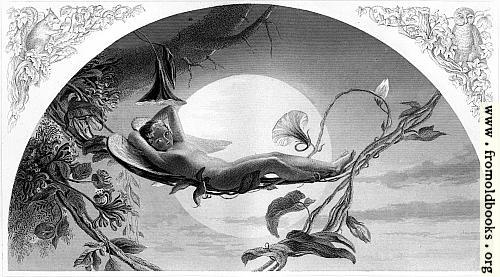
{Old image of Ariel from Shakespeare's The Tempest; source: fromoldbooks.org}


{Archangel Gabriel appearing to Daniel; source: shopforangels.com/}


Some sources:

The Letters of Ralph Waldo Emerson, ed. by Ralph Leslie Rusk and Eleanor Marguerite Tilton (Columbia University Press, 1991)

Letters from Ralph Waldo Emerson to a friend, 1838-1853, ed. by Charles Eliot Norton (Houghton, Mifflin, 1899)

Sunday, July 12, 2009

Emerson observing the privileged few

Emerson wrote in his journal a few days before he began his return to America:
July 12.        


With Mr. Kenyon and Hillard, I joined the Jays in a visit to Stoke Poges, where is Gray's churchyard; then to Eton, where we found six or seven hundred boys, the flower of English youth, some of them at cricket, on the green; others strolling in groups and pairs; some rowing in the river; and recalled Lamb's remark, "What a pity that these fine boys should be changed into frivolous members of Parliament!"

Kenyon recalled verses of his own, of which I only remember, —
O give us back our lusty youth!
and the whole place remembered Gray. Kenyon asked if ever a dirty request was couched in more beautiful verse than in the hints touching livings and preferments, addressed to the Duke of Grafton, in the Cambridge Installation Ode.
Thy liberal heart, thy judging eye,
The flower unheeded shall descry,
And bid it round heaven's altars shed
The fragrance of its blushing head;
Shall raise from earth the latent gem
To glitter on the diadem.
After seeing the chapel, we went to Windsor, where the tickets of the Jays procured admittance for the whole party to the private apartments of Her Majesty. We traversed the long corridors which form the gallery of sculpture and paintings, then the chambers, dining-room, and reception rooms of this palace. The green expanse of trim counties which these windows command, beginning with a mile of garden in front, is excellent. Then to the Royal Mews, where a hundred horses are kept; listened reverentially to all that the grooms told us of the favorite horses; looked at the carriages, etc. If hard came to hard, the camel has a good deal of hump left to spend from.

In St. George's Chapel, Mr. Kenyon pointed out the true character of stained-glass windows, which is not in large figures or good drawings, but in gem-like splendor and condensation. In like manner he quoted Lady Morgan's notion on carpets, that they should be spread, not nailed; and there should not be great elaborate figures, but such a disposition of forms and colors that they should seem like jewels trodden in.

From Windsor we went to Virginia Water, the toy lake and toy fishing-house of George IV. (But the expense squandered on these grounds does not save them from the ridicule of a tawdry counterfeit, and the spectator grudges his time. Here is a made waterfall; or a made ruin, the "Persepolis of the woods," constructed of stones brought from the ruins of Carthage.) Two red flags hanging from the little frigates afloat were quite too important in the raree-show. We suspected the two or three people in the boat were hired to sit there by the day; and the eye mistrusted the houses might be pasteboard and the rocks barley candy.


Mr. Kenyon: This probably refers to the poet John Kenyon, poet and patron of the arts. See his obituary in the Gentleman's Magazine here.

Hillard: Emerson probably refers to George Stillman Hillard, an American author and lawyer who was traveling in England at that time.

The Jays: This may refer to John Clarkson Jay (1808-1891) and his wife. Jay was a well-known American conchologist (collector and examiner of shells).

"frivolous members of Parliament": It was Charles Lamb's older brother John who made this remark.


{St Giles church Stoke Poges. Thomas Gray's Elegy Written in a Country Churchyard is believed to have been written here; source: wikipedia}


{Sketches of events during a cricket match between Eton and Harrow, 1880; source: The Graphic}


{More sketches of events during a cricket match between Eton and Harrow, 1880; source: Illustrated London News}


{A mid-19th c. Eton scene; source: Bobst Library, NYU}


{The river at Eton; source: Lippincott's Magazine of Popular Literature and Science, February, 1876, Vol. XVII, No. 98 (Gutenberg)}


Regarding the "Cambridge Installation Ode", see the Cambridge History of English and American Literature.


{The lower ward (bailey) of Windsor Castle in England. St George's Chapel is on the left and the Round Tower is centre right. Image by Joseph Nash published 1848; source: wikipedia}


{Waterlool Gallery, Windsor Castle; source: antiquemapsandprints}


{Late Victorian painting of Windsor Castle by Walter H. Goldsmith; source: goldenagepaintings}


{View from Windsor Castle; the slopes overlooking the River Thames and Eton, the Chapel being in the distance; source: thamesweb.co}


{Image from a window in St. George's Chapel, Windsor; source: stgeorges-windsor.org}


{Virginia Water. Fishing Temple & Lake; source: antiquemapsandprints}


{Cascade at Virginia Water; source: thamesweb.co}


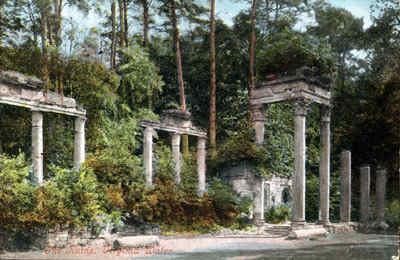
{Corinthian columns from Tripoli at Virginia Water, Windsor Castle; source: thamesweb.com}


{Frigate on Virginia Water; source thamesweb.com}


Some sources:

Journals Of Ralph Waldo Emerson 1820-1872, with Annotations, edited by Edward Waldo Emerson and Waldo Emerson Forbes; Vol. VII, 1845-1848 (London, Constable & Co.; Boston And New York Houghton Mifflin Company, 1913)

Journals Of Ralph Waldo Emerson 1820-1872, with Annotations, edited by Edward Waldo Emerson and Waldo Emerson Forbes; Vol. VII, 1845-1848, (New York, Houghton Mifflin Company, 1912)
Tuesday, July 07, 2009

a kind of modern-antique American gymnosophist

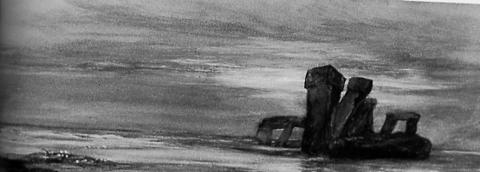
On this day in 1848, Thomas Carlyle wrote his wife about his trip to Stonehenge with Emerson:
Thomas Carlyle to Jane Welsh Carlyle

Amesbury, 7 july, 1848 —

My Dear, — It cannot be supposed that I have much to tell thee since morning, and indeed the day has passed over without accident at all; but being relegated here to a most lonesome and rather dilapidated bedroom, with no perceptible desire still to sleep, I have borrowed from Emerson a sheet of Note-paper, and from the people of the Inn a pen and inkbottle; and will vent a portion of my sorrows upon poor Chelsea before I go to bed. Eheu [Alas], am I not right to stay at home? The world holds in it no man to whom travelling is such a labour, under any and all conditions! —

We got along happily enough to Bishopstoke today, — except that it appeared, the little Forster-and-Dickens Publichouse did not lie on our road at all, but lay on the road of some Coach, which, at some unknown hour, would (had we known of it) have taken us off the S. Western railway, and landed us sooner at Salisbury or at least at Stonehenge: however, the damage was not great, and at any rate there was then no help. We did get to Salisbury, all right however, about three o'clock: all right as far as a poor wretch could be right, who could not get his lips closed, but was obliged to talk all the way; and had not slept the night before! — At the Salisbury Station we leapt straightway into a kind of Gig (inferior to the Derbyshire ones),1 and were rapidly driven to this ancient village, some 8 miles further; here we, after some confused consulting, discharged our Gig-apparatus; got some wretched dinner, of whale-blubber mutton and old peas; and then in the grey windy evening set forth to walk towards Stonehenge over the bare upland; found it, saw it: — a wild mournful, altogether enigmatic and bewildering sight; — dreadfully cold too (in my thin coat), and after about 2 hours came our ways home again to Amesbury, an enchanted-looking village, very appropriate to the neighbourhood. Stonehenge and the uplands far and wide were utterly solitary; a vast, green, wavy tract of sheep-pasture, all studded with (what they call “barrows”) the tombs of extinct nations, and that huge mass of dark, meaningless, gigantic dislocated stones; of which no creature will ever tell us the meaning, except that it is the extinct temple of an extinct people (seemingly sunk very deep in error), and the prey now of Pedants and doleful creatures whose whole element seems one of emptiness and error! The grim windy evening, spent amid those grim remains, in a mood such as mine, will probably long continue memorable to me. And that hitherto seem all the conquest I am like to get from it.2

Returning to Amesbury, which seemed already sunk into sleep (about 9 o'clock) or almost into death, we got Tea, the worst in nature, without cream, nay without milk except about half-a spoonful — no help! The place is one of those Coach villages that have been ruined by railways: once the great road from Exeter to London, 12 Coaches a-day, and half a dozen “families” (i.e. posting carriages), now left sad and silent, the big inn rotting, and not even milk to be had! We leave tomorrow morning early for Wilton (past Stonehenge again) in a Dog cart, the only attainable vehicle; and after a day of Wilton House, and Salisbury and Clarendom, hope to meet poor Helps at Bishopstoke, and attain a little cream to our tea, — attain at least the hope of soon ending such an expedition!3 Goodnight, my own poor Jeannie—ah me!— T. Carlyle

I wonder how your Chopin prospered; how your concert-tickets &c!4 — Emerson is healthy; full of cheerfulness, at least of unsubduable placidity: if I could get a little sleep, I should do well enough yet.
Why art thou then cast down my soul;
What should discourage thee?5
Good night, Dearest. /

T. C.

----------
Footnotes by the editor of Carlyle's letters:

1. Which they had taken the previous summer.

2. After seeing Stonehenge they spent the night of 7 July at the George Inn, Amesbury, 1½ mi. W of Stonehenge and 8 mi. N of Salisbury. For Emerson's account, see “Stonehenge” in his English Traits (Boston, 1856) ch. 16, and Journals and Miscellaneous Notebooks 10:334–36, 432–42.

3. In his Journal TC wrote: "Morrow morning [8 July], Dogcart across the downs to Wilton: Down or ‘Plain,’ an expanse of waving bare ground, resembling a Scotch moor, only that it is without brooks, and of much more fertile character. Scandalous to see it lying vacant in the heart of such an England as ours at present is. … then country road to Wilton; … then full inspection of Sydney Herbert's house [Wilton House], which is princely: Bust of Cato: A. Dürer's Picture; fairy ‘luncheon’ by Mrs. Wager the Housekeeper. Salisbury Cathedral and City. Old Sarum, the day before. — A. Helps caught us at Bishopsgate on the railway: home with him till the morrow (sunday) which poured a deluge of rain. To Winchester in the afternoon nevertheless. Cathedral there; first, St. Cross there. Home to Chelsea about 10 p.m. — Emerson called next day, and is now off, towards Liverpool, or Coventry &c; to sail for home on Saturday. Valeat—eheu [Let him be gone—alas]!" — See also Froude, Carlyle 3:440–41. The ruins of Clarendon Palace are ca. 2½ mi. E of Salisbury. Sidney Herbert (1810–1861; DNB), politician, second son of 11th earl of Pembroke. The Hospital of St. Cross, founded 1136 for thirteen poor brethren, is ca. 1 mi. S of Winchester Cathedral and is the setting of Trollope's The Warden (1855). Emerson records that TC cursed "the priest who received £2000 a year, that were meant for the poor" (English Traits 288).

4. Chopin gave his second matinée musicale, 7 July.

5. Cf. metrical Ps. 43:3.


---------------------------------

A couple of days later, Carlyle wrote his friend James Marshall:
Chelsea, 10 july, 1848—

My dear Sir,

. . . . .

I have just returned from a visit to Stonehenge in the Wiltshire Downs, with a certain Transatlantic Friend, R. W. Emerson, who, after some months' sojourn in these parts, is on the point of turning homewards again. A man of genius and worth in his American way; somewhat moonshiny here and there in the Results he arrives at, but beautiful in speculation if you leave practice out, — in fact a kind of modern-antique “American Gymnosophist,” for whom we are bound to be thankful. He and his affairs keep me very busy this day: so without more writing, except to offer my kind regards to Eckermann, and best thanks to Dr Weissenborn above, I subscribe myself, with true remembrances from both parties here,

Yours sincerely /

T. Carlyle


{Amesbury in 1903; source: jtfuller.btinternet.co}


{Salisbury Meadows by Constable, 1831; source: clem.mscd.edu}


{Watercolour, Stonehenge, close up view from E, [c 1830], by James Bridges; source: wilshireheritagecollections.org}


{Barrows near Stonehenge; source: annanddave.org}


{Wilton House: source: jeff.sedley.org}


Gymnosophist: is a name for practitioners such as the Indian yogis. See Gymnosophist (wikipedia)

{A yogi; source: wikipedia}


Main source:

Thomas Carlyle; the Collected Letters, Volume 23, edited by Ian M. Campbell et al (Duke University Press , 2009)

Monday, July 06, 2009

a somewhat moonshiny fellow

Thomas Carlyle, wrote about the last week of Emerson's trip to England in a letter he sent his mother this day in 1848. Here is an extract:
Thomas Carlyle To Margaret Carlyle; 6 July 1848
Chelsea, 7 [i.e. 6] july, 1848 —        


My dear Mother,

It seems to me again too long since I have written to you; but the fault has not altogether been mine: besides, the only way to mend it is to write now, before any one get in to interrupt me; which accordingly I do, the first work of the day. . . .

Doubtless you have been reading of these awful explosions in Paris, which interest everybody, and are indeed an alarming symptom of the misery of this poor time. To us the most interesting feature of all is this General Cavaignac who has had the command in that terrible business. He is the younger brother of the Cavaignac we loved much and were very intimate with here, while he lived: we often heard of him as a just and valiant and everyway excellent man, whom his brother much loved; and indeed I believe him to be really such; — which kind of character was certainly never more wanted than in the place he is now in!1 Perhaps no man in all the world could have had so cruel a duty laid upon him, as that of cannonading and suppressing these wretched people, who we may say his Father and Brother and all his kindred had devoted themselves to stirring up:2 but he saw it to be a duty, and he has bravely done it. I suppose he will get himself killed in the business, one day; and indeed he appears privately to look for nothing else. His poor old Mother still lives; has now no child but him; — has a strange history indeed to look back upon, from the days of Robespierre all the way!3 — It is very curious to me to think how the chiefs of these people, as Armand Marrast, Clement Thomas (late commander of the National Guards),4 used to sit and smoke a pipe with me in this quiet nook some years ago. And now Louis-Philippe is out, and they are in, — not forever either! "The wheel of Fortune," as old Aunt Babby's5 dream said, "the wheel of Fortune, one spake up and the other spake down!" —

Emerson has been lecturing at a considerable rate here; meeting with moderately fair encouragement from a certain class. We had to attend him, — not a very severe duty either, for there is really something of excellent in him tho' he is a little "moon shiny": — however the thing is now over; and he is fast getting ready to go home to America again; sails from Liverpool, in fact, tomorrow (or rather saturday, for this is but thursday!) week.6 A voyage of ten or twelve days, if happy, will land him at his own house-door, after a long and interesting absence; — and as for us, the likelihood is, we shall never see him again at all. His present visit has not done much for me, nor could I in any way, do much for him: but he has and keeps up from old a very friendly feeling for me, and the very separations that lie between us add themselves to this probably final parting to make it sad and affectionate! How much is every one of us left alone in this world; nothing above him but the eternal skies, no help or counsel for him except in Heaven only!

Emerson has asked me to make a little journey with him to see a strange old Antiquity, old almost as the Hills, which bears the name Stonehenge, near Salisbury in Wiltshire, about 100 miles Southwest of this. It is some 4 hours by railway; the ground, for the greater part, already known to me (for it is partly the road to Alverstoke, thro' Hampshire). I have consented to go; and so off we move tomorrow forenoon. A friend lives in the way,7 who will lodge us one night as we return, or two if we like, — perhaps over the Sabbath till Monday: On Monday evening, Emerson sets off towards the North, and we do not see him again. — Today, as you may fancy, I am making my bits of preparations and arrangements; I have various places to go to; so shall be busy all day, — and indeed ought already to be getting under way! — Jack talked to Emerson of going with us; but I know not whether he will stand good; — probably not: I must consult him before night come.

On the whole, dear Mother, I must be off. You shall hear from me again, a word about the journey, so soon as we return. Tell Jamie I do not forget that I owe him a Letter: I will pay it by and by.— From Jean at Dumfries, I hear nothing this good while; but suppose she is busy nursing, poor thing. My affectionate blessings to one and all.— Get ready for Moffat, then, and off!

Adieu dear good Mother.

Ever your affectionate

T. Carlyle

--------------------
Footnotes by the editor of the Carlyle letters:

1. The constituent assembly, elected in April and meeting for the first time, 5 May, had reorganized the govt., giving power to an executive commission that appointed to ministries men from the provisional govt., but excluded the socialists, whose attempted attack on the assembly, 15 May, had failed. The national workshops, set up to deal with unemployment, had been overwhelmed by more than 115,000 unemployed workers. Attempts to cut down the size of the workshops by the assembly led to a serious revolt by workers, socialists, and revolutionaries, 22–26 June, with savage street fighting. Many were killed, deported, or imprisoned. Responsible for the suppression as minister of war, Gen. Louis Eugène Cavaignac (1802–57; see 9:91) then became pres. of the council, responsible to the assembly, with a moderate republican ministry. He was to be overwhelmingly defeated in the presidential elections in Dec. by Louis Napoleon. He was the brother of the Carlyles' dear friend E. L. Godefroy Cavaignac.

2. His father, Jean Baptiste Cavaignac (1762–1829; see 9:8), a member of the revolutionary national convention, had voted for the death of Louis XVI; his brother had been imprisoned during the early part of Louis Philippe's regime and escaped to exile, 1835. Gen. Cavaignac remained a committed republican to his death.

3. Julie Cavaignac, b. Corancez (1780–1849; see 9:8).

4. Clément Thomas (1809–71), republican politician; escaped imprisonment and went into exile, 1835–37; commander-in-chief of the national guard in Paris, May–June, when replaced during the uprising; exiled again, 1851; executed by national guardsmen, 1871.

5. Unidentified.

6. Emerson sailed from Liverpool, 15 July, and landed in Boston, 27 July.

7. Arthur Helps lived at Vernon Hill, Bishop's Waltham, Hants, 11½ mi. SE of Winchester.


awful explosions in Paris: Carlyle refers to the June Days Uprising; see note 1 above.


{Painting of Battle at Soufflot barricades at Rue Soufflot Street on 24 June 1848, by Horace Vernet-Barricade; source: wikipedia}


that terrible business: On June 21 the National Assembly began to scale back expensive economic benefits that had been granted poor Parisians. Faced by armed resistance to this action, the Assembly called on the army to restore order. Over the next few days the army overwhelmed Parisian rebels ensconced in blockaded city streets. The victorious "Party of Order" in the Assembly then appointed general and statesman Louis Eugène Cavaignac to the head of the French state. Later, on the 10th of December, Louis-Napoléon Bonaparte was elected president of the French Republic. (Source: wikipedia.)

"moon shiny": OED
moonshiny — 3. Of the nature of moonshine; fanciful, unreal, insubstantial. Cf. MOONSHINE n. 2a.
1833 Pearl & Lit. Gaz. 23 Nov. 65/1, I threw aside the poem and the ode, and resolved to write some love ditty or moonshiny stuff — any body can write that. 1857 H. MELVILLE Confidence-man xli. 312 And moon~shiny as it in theory may be, yet a very practical philosophy. 1880 Sat. Rev. No. 1291. 122 There is a good deal of moon~shiny sentiment in it, especially in the conversation of the lovers. 1892 ‘M. TWAIN’ Amer. Claimant 36 The same old scheming, generous, goodhearted, moonshiny, hopeful, no-account failure he always was. 1990 Amer. Lit. 62 208 This complaint culminates a lifetime of deprecating descriptions of the frail, moonshiny, imaginary territory of his fictions.


{Thomas Carlyle, ca. 1848; source: e-education.net}


{Le général Cavaignac d'après Ary Scheffer; source brittanica}


{Godefroi Cavaignac (1801-1845); source: images-chapitre}


{Armand Marrast, editor of the republican Le National and a relatively conservative member of the National Assembly,; source: wikipedia}


{Clément Thomas, also an editor of Le National, was Colonel in the National Guard and a leader of the National Assembly; source: library.northwestern.edu}


{Louis Philippe, King of the French, by Franz Xaver Winterhalter; he had abdicated in February and fled the country in March; source: wikipedia}


{Mid-19th c. watercolor of Stonehenge; sourcejimandellen.org}


Main source: Thomas Carlyle; the Collected Letters, Volume 23, edited by Ian M. Campbell et al (Duke University Press , 2009)

Saturday, July 04, 2009

pride without, and a dark firmament within

Happy Independence Day

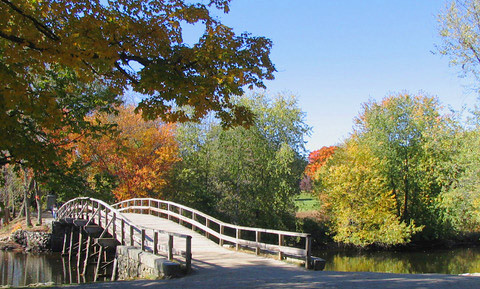
My favorite patriotic poem is Emerson's Concord Hymn, "Sung at the Completion of Concord Monument, April 19, 1836."
By the rude bridge that arched the flood,
Their flag to April's breeze unfurled,
Here once the embattled farmers stood,
And fired the shot heard round the world,

The foe long since in silence slept,
Alike the Conqueror silent sleeps,
And Time the ruined bridge has swept
Down the dark stream which seaward creeps.

On this green bank, by this soft stream,
We set to-day a votive stone,
That memory may their deed redeem,
When like our sires our sons are gone.

Spirit! who made those freemen dare
To die, or leave their children free,
Bid time and nature gently spare
The shaft we raise to them and Thee.
Pride is not the only emotion I feel on this day. I've been reading John Updike's Collected Poems these days and have come across his anti-heroic meditation, Fireworks. Written July 5, 1963, it is personal, internal, and private; not made for public recitation. All the same it seems to be colored by its time: Kennedy was President and Mao was Chairman; Cuba was embargoed and Khrushchev blustering; the Beatles were coming of age and the diet cola, TAB, was launched; the battle for civil rights in the South had no certain victor — MLK jailed, Bull Connor brandishing, Medgar Evers murdered, and George Wallace declaring "segregation now, segregation tomorrow, and segregation forever!" For me the dominant symbol of the time was to become a photo showing a Buddhist monk protesting religious persecution by the government of South Vietnam by committing self-immolation on the streets of Saigon.

Here's an extract from the poem:

From Fireworks by John Updike:
These spasms and chrysanthemums of light
are like emotions
exploding under a curved night that corresponds
to the dark firmament within.

. . .
behold, above, the sudden bloom,
turquoise, each tip a comet,
of pride - followed, after an empty bang,
by an ebbing amber galaxy, despair.

We feel our secrets bodied forth like flags
as wide as half the sky.


{the bridge; source: flickr}


{the monument; source: talkingtree}

Sunday, June 28, 2009

a face to make all things new

On June 28, 1848, Emerson wrote to his wife Lydian; here are extracts from the letter.
London, June 28.        


. . . All my duties will be quite at an end on Friday night at Exeter Hall, and I have then to determine which to choose of all the unseen spectacles of England. I have not seen Stonehenge, nor Chatsworth, nor Canterbury, nor Cambridge, — nor even Eton and Windsor, which lie so near London. I have good friends who send for me, but I do not mean to engage myself to new people or places. As Mr. Burke said, "I have had my day; I can shut the book." I am really very willing to see no new face for a year to come, — unless only it were a face that made all things new. There is very much to be learned by coining to England and France. The nations are so concentrated and so contrasted that one learns to tabulate races and their manners and traits as we do animals or chemical substances, and look at them as through the old Swedish eyeglass, each as one proper man. Also, it must be owned, one meets now and then here with wonderfully witty men, all-knowing, who have tried everything and have everything, and are quite superior to letters and science. What could they not, if they only would? I saw such a one yesterday, with the odd name, too, of Arthur Helps. On Sunday I dined at Mr. Field's at Hampstead, and found the Egyptian savant Mr. Sharpe, Rowland Hill (of the Penny Post), Stanfield the painter, and other good men. I breakfasted next morning with Stanfield, and went with him to see a famous gallery of Turner's pictures at Tottenham. That day I dined with Spence, and found Richard Owen, who is the anatomist. To-morrow he is to show me his museum. I esteem him one of the best heads in England. Last evening I went to dine with Lord Morpeth, and found my magnificent Duchess of Sutherland, and the Duke and Duchess of Argyle, and the Ladies Howard, and Lady Graham, and Mr. Helps, so omniscient, as I said. . . . This morning I breakfasted with him and Lady Lovelace, as Lord L. wished to read me a certain paper he had been writing on a book of Quetelet. We had quite a scientific time, and I learned some good things. I am to go there again to-morrow evening, to see Mrs. Somerville. . . .


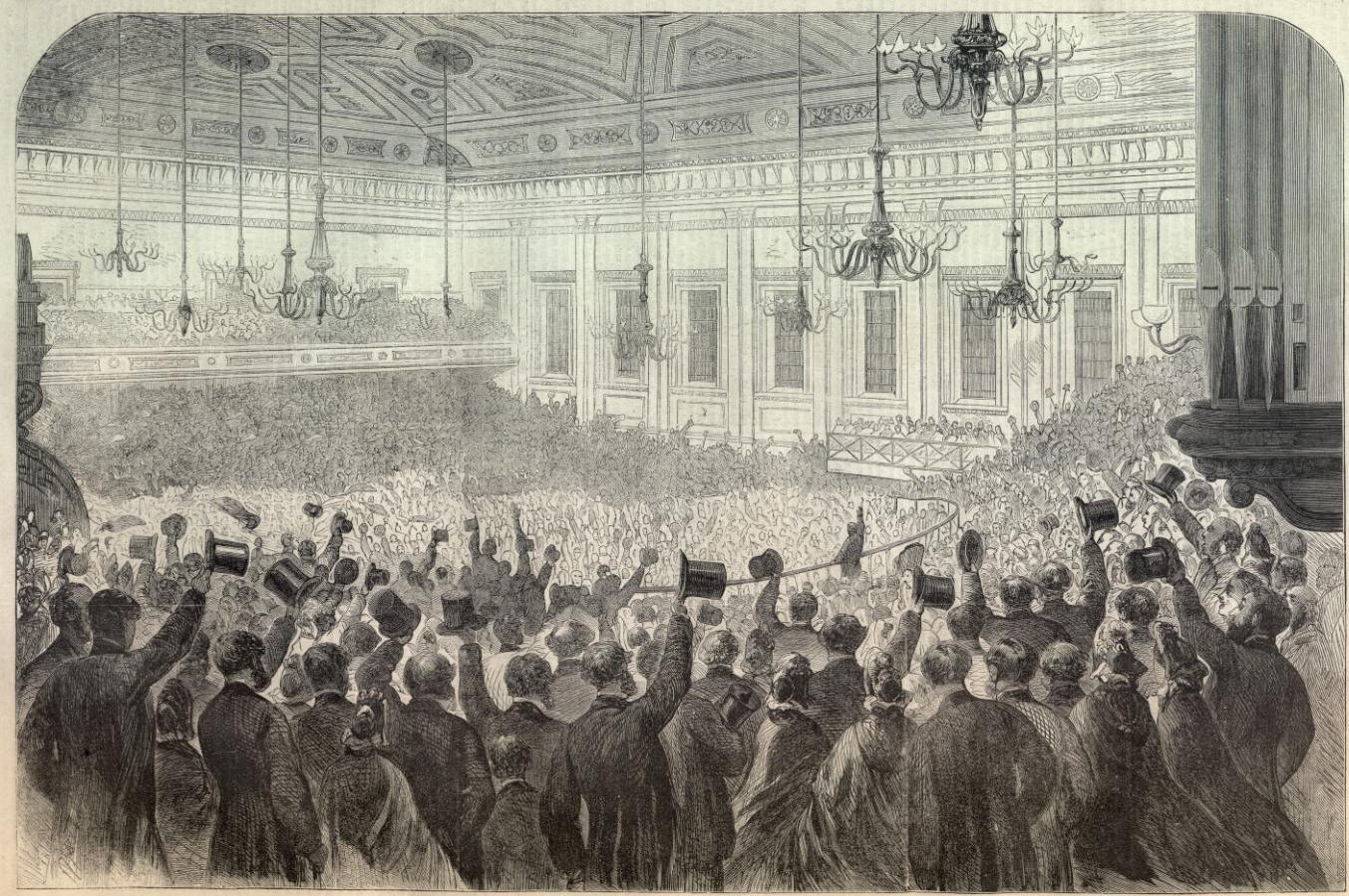
{Exeter Hall was the site of Emerson's lectures to the London populace (as opposed to its social and intellectual elites); it was built about 15 years before he spoke there; image source: sonofthesouth.net}


as Mr. Burke said: This is a reference to Edmund Burke's Speech at the Guildhall in Bristol, Previous to the Late Election In That City, Upon Certain Points Relative to his Parliamentary Conduct (1780). Here is the relevant text:
Gentlemen, I have had my day. I can never sufficiently express my gratitude to you for having set me in a place wherein I could lend the slightest help to great and laudable designs. If I have had my share in any measure giving quiet to private property and private conscience ; if by my vote I have aided in securing to families the best possession, peace; if I have joined in reconciling kings to their subjects, and subjects to their prince; if I have assisted to loosen the foreign holdings of the citizen, and taught him to look for his protection to the laws of his country, and for his comfort to the good-will of his countrymen ; — if I have thus taken my part with the best of men in the best of their actions, I can shut the book: I might wish to read a page or two more, but this is enough for my measure. I have not lived in vain.
{source: from The Works of the Right Honourable Edmund Burke (London, John C. Nimmo, 1887), vol 2, p. 421}
Arthur Helps was an English writer and dean of the Privy Council. He was youngest son of Thomas Helps, a London merchant; as an author, he was known for his aphorisms, biographies, and essays.

Edwin Wilkins Field was an English law reformer and painter. I reproduced a painting attributed to him in a previous post.


{Richard Owen was an English biologist, comparative anatomist and palaeontologist; source: wikipedia}


See earlier posts in this series for descriptions of other persons mentioned, including:


Some sources:

Journals Of Ralph Waldo Emerson 1820-1872, with Annotations, edited by Edward Waldo Emerson and Waldo Emerson Forbes; Vol. VII, 1845-1848 (London, Constable & Co.; Boston And New York Houghton Mifflin Company, 1913)

Journals Of Ralph Waldo Emerson 1820-1872, with Annotations, edited by Edward Waldo Emerson and Waldo Emerson Forbes; Vol. VII, 1845-1848, (New York, Houghton Mifflin Company, 1912)
Saturday, June 27, 2009

a world to ride virtues in

From the Journals of Ralph Waldo Emerson, written at the end of his 1847-48 trip to Britain and France.
June 27.        


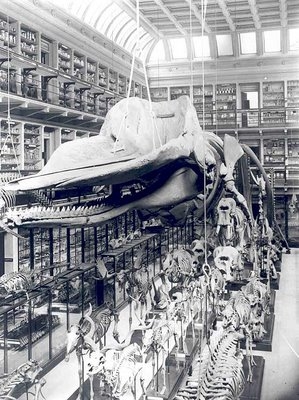
Mr. Owen invited Hillard* and myself to inspect the Hunterian (John Hunter) Museum, of which he is the Curator. Afterwards, he would carry us to Turner, the artist, who is his friend. We met accordingly at his chambers and he showed us over the Museum, communicating a great deal of valuable information, of which I deeply regret that I omitted to make immediate record. He gave a sad history of the misuse and voluntary destruction of Hunter's manuscripts by Sir Everard Home, who had built his own scientific reputation on the private use he had made of these manuscripts, and then destroyed them to hide his debt. He was displaced, and Owen himself appointed to the care of the Museum, and he does not like to sleep one night away from it. One of these days when the Museum shall be confided to other and sufficient hands, he said, he shall feel at liberty to come to America, and read lectures to the Lowell Institute of Boston, as Mr. Lowell has pressed him to do. He thought Faraday would also come to Boston. Owen seemed to me an Englishman who had made a prodigious stride in scientific liberalism for an Englishman, and indemnified himself in the good opinion of his countrymen by fixing a certain fierce limitation to his progress, and abusing without mercy all such as ven tured a little farther; these poor transmutationists, for example.

He carried us to Turner's studio, but Turner, though he had written him a note to announce his visit, was gone. So he showed us the pictures. In his earlier pictures, he said, Turner painted conventionally, painted what he knew was there, finished the coat and buttons; in the later, he paints only what the eye really sees and gives the genius of the city or landscape. He was engaged to paint a whaleship, and he came one day to see Mr. Owen and asked to see a mullet (Agassiz said, a Clio), and begged him to explain to him, from the beginning, the natural history of the creature; which he did; and Turner followed him with great accuracy. In process of time the picture was painted, and Owen went there to see his mullet; "I could not find it," he said, "in the picture, but I doubt not it is all there." He told us that, one day, being present at the annual dinner of the Royal Academy, which takes place in the Gallery itself, as the shades of evening darkened around, all the pictures became opake, all but Turner's, and these still glittered like gems, as if having light in themselves. I was much struck with the elevated manner in which Mr. Owen spoke of the few men of science he named; of Agassiz and others, he said, "Each had a manner, and a certain strength, and his own foible too," and he thought he could well discern that in all they did, and I think he added, "I can see the same in myself, too."

Turner's face, I was told, resembles much the heads of Punch.

It was Miss —— of New Haven, who on reading Ruskin's book, said "Nature was Mrs. Turner."

By the kind offices of Mr. Milnes, Mr. Milman, Lord Morpeth, and I know not what other gentlemen, I found myself elected into the "Athenaeum" Club, "during my temporary residence in England"; a privilege one must prize, not because only ten foreigners are eligible, at any one time, but because it gives all the rights of a member in the library and reading-room, a home to sit in, and see the best company, and a coffee-room, if you like it, where you eat at cost. Milnes, Milman, Crabbe Robinson, and many good men are always to be found there. Milnes is the most good-natured man in England, made of sugar; he is everywhere, and knows everything; has the largest range of acquaintances, from the Chartist to the Lord Chancellor; fat, easy, affable, and obliging; a little careless and sloven in his dress. His speeches in Parliament are always unlucky, and a signal for emptying the House, a topic of great mirth to himself and all his friends, who frankly twit him with it. He is so entirely at home everywhere, and takes life so quietly, that Sydney Smith called him "the cool of the evening," and I remember I was told some anecdotes of exploits of well-bred effrontery. They address him now as Citoyen Milnes, since Punch's, that is, Thackeray's late list of the ministry; but with pure feeling between jest and earnest they speak of him as really one who might play, one day, the part of Lamartine in England.

Carlyle, at the first meeting of the London Library, proposed to sacrifice Milnes, as a sort of acceptable Iphigenia. When he breakfasted somewhere with the Archbishop of Canterbury, his friend said, "Now, Milnes, I beg you not to slap him on the back, and call him Canterbury, before breakfast is half over." His good humor is infinite; he makes bad speeches of exquisite infelicity, and joins in the laugh against himself. He is very liberal of his money, and sincerely kind and useful to young people of merit. Coventry Patmore told me that Milnes had procured him spontaneously the place he holds of sub-librarian in the British Museum; and that he had known many good deeds of his. Jane Carlyle testified to his generosity — rare, she said, among people of fashion — with his money.

For my part, I found him uniformly kind and useful to me both in London and in Paris. He procured me cards to Lady Palmerston's soirée, introduced me there, and took pains to show me all the remarkable persons there, the Crown Prince of Prussia; the Prince of Syracuse; Rothschild, a round, young, comfortable-looking man; Mr. Hope, reputed the richest commoner in England; the Turkish Ambassador; Lord Lincoln, head of the "Young England" party; and princely foreigners, whose names I have forgotten.

Milnes took pains to make me acquainted with Chevalier Bunsen and Lady Bunsen, whom I had already met at Mr. Bancroft's; with young Mr. Cowper, son of Lady Palmerston; with Disraeli; and with Macaulay, whom I here met for the second time. I had a few words with both Lord and Lady Palmerston. He is frank (at least, in manner; Bancroft says, far from frank in business), affable, of a strong but cheerful and ringing speech.

But I soon had enough of this fine spectacle and escaped. Milnes sent me again another card from Lady Palmerston, but I did not go.

Milnes again befriended me at Sir William Molesworth's, where Bancroft carried me, one night, and made me acquainted with Dr. Elliotson, and a very sensible young man, member of Parliament, whose name I have lost. At Paris, he carried me to De Tocqueville, and at last, at my Exeter Hall lectures in London, he took the chair, and made a closing speech full of praises, perfectly well meant, if not felicitous. He is one of the most valuable companions in London, too, for the multitude of anecdotes he tells about good people, and at Paris I found him equally acquainted with everybody and a privileged man, with his pockets full of free cards, which admitted him everywhere.

Milnes said, in my presence, that he desired nothing so much as to make a good speech in Parliament. The distinguished Mrs. Norton (to whom I was carried one day by Carlyle) said that "Milnes and Disraeli were the two remarkable political failures which she had known."

Viscount Melbourne's letter in reply to Lord Brougham's sheets of objections, — "Dear B. I am sorry you don't like my appointment of N. Pray expedite the matter through all the forms as fast as possible. Yours, M."

Topics of conversation in England are Irish affairs; universal suffrage; pauperism; public education; right and duty of government to interfere with increase of population; taxes.

Paris and London have this difference, that Paris exists for the foreigner, serves him; — whilst in London is the Londoner, who is much in the foreigner's way. England has built London for its own use. France has built Paris for the world.

The French have this wonderful street courage. The least dislike, the smallest unpopularity, is intolerable to them. But they will take your fire with indifference. And is this a world to ride virtues in? There must, then, be revolutions to bring them out.

In Blanqui's Club des droits de l'Homme, an orator in blouse said, "Why should the rich fear that we shall not protect their property? We shall guard it with the utmost care, in the belief that it will soon be our own."

People eat the same dinner at every house in England, 1, soup; 2, fish; 3, beef, mutton, or hare; 4, birds; 5, pudding and pastry and jellies; 6, cheese; 7, grapes, nuts, and wine. During dinner, hock and champagne are offered you by the servant, and sherry stands at the corners of the table. Healths are not much drunk in fashionable houses. After the cloth is removed, three bottles, namely, port, sherry, and claret, invariably circulate. What rivers of wine are drunk in all England daily! One would say, every guest drinks six glasses.

The English youth has a narrow road to travel. Besides his horse and gun, all he knows is the door to the House of Commons.

Landseer the only genius of the Academy exhibition. Leslie very sensible and pleasing. There are many English portraits, the true national type. The 'Hŵs of Gibson,, like the admirably finished pictures of Scheffer, show want of all object with great powers of execution, so that we get noble vases empty.

I bring home from England — 1, the Heim-skringla, or Sea Kings of Norway, translated by Laing; 2, Wood' Athenae Oxonienses; 3, Bede; 4, The Megbaduta; 5, Lowth's Life of William of Wykeham; 6, Wordsworth's Scenery of the Lakes; 7, Jacobson's Translation of Aeschylus; 8, John Carlyle's Translation of Dante; 9, John Mill's Political Economy.

I thought how great men build substructures, and, like Cologne Cathedral, these are never finished. Lord Bacon begins, Behmen begins, Goethe, Fourier, they all begin; we, credulous, believe, of course, they can finish as they begun. If you press them, they fly to a new topic, and here again open a magnificent promise which serves the turn of interesting you, and silencing your reproaches.

I stayed in London till I had become acquainted with all the styles of face in the street, and till I had found the suburbs and then straggling houses on each end of the city. Then I took a cab, left my farewell cards, and came home.

I saw Alison, Thackeray, Cobden, Tennyson, Bailey, Marston, Macaulay, Hallam, Disraeli, Milnes, Wilson, Jeffrey, Wordsworth, Carlyle, Dickens, Lockhart, Procter, Montgomery, Collyer, Kenyon, Stephenson, Buckland, Sedgwick, Lyell, Edward Forbes, Richard Owen, Robert Owen, Cruikshank, Jenny Lind, Grisi, William Allingham, David Scott, William B. Scott, King-lake, De Tocqueville, Lamartine, Leverrier, Rachel, Barbes, Eastlake, Spence, Wilkinson, Duke of Wellington, Brougham, Joanna Baillie, De Quincey, Sir C. Fellows, Sir Henry De la Beche, John Forster.

[Note from the editor of the Journals: "Just before his final departure from London, Mr. Emerson visited Cambridge, and the next day went with Carlyle to Salisbury, and thence by carriage to Amesbury on July 7, whence they walked to Stonehenge. Next day they visited the sacred circle again with the local antiquary, then saw Wilton House, and passed Sunday with Arthur Helps at Bishop's Waltham. Monday they spent at Winchester. Of this excursion Mr. Emerson gives a full ac count in English Traits."]

-----------
*Footnote by the editor of the Journals: Probably Mr. George S. Hillard, of Boston, at one time editor of the Courier, author of Six Months in Italy, and other works.


{Richard Monckton Milnes; source: wikipedia}


{Hunterian Museum in Emerson's time; source: taxidermy4cash. The Hunterian Museum was 'founded in 1807 on the collections of the eminent Scottish physician and obstetrician, William Hunter (1718-1783) whose medical collections were the core of his career, museum and success.'}


Everard Home, British physician, a pupil of his brother-in-law, John Hunter.


{An early work of Turner's: Fishermen at Sea (1796); source: wikimdeia}


{Whale Ship by Turner (1845); source: picasaweb}


John Elliotson


{William Molesworth was a British politician and civil servant; source: wikipedia}


{Edwin Henry Landseer's painting, "Dignity and Impudence"; source: squidoo}


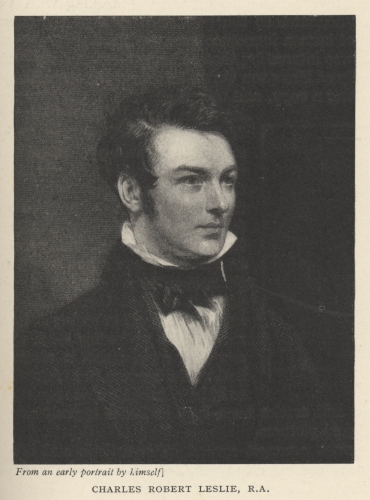
{Charles Robert Leslie; source: rossettiarchive}


{Elizabeth Fry, by Charles Robert Leslie; source: wikimedia}


For information on others mentioned in this journal entry, see these previous blog posts:


Some sources:

Journals of Ralph Waldo Emerson, With Annotations, ed. by Edward Waldo Emerson and Waldo Emerson Forbes (Houghton Mifflin company, 1912)

Friday, June 26, 2009

Emerson observes extravagant paintings

Here is the brief entry in Emerson's journals for this day in 1848:
June 26.        


[Breakfasted] at Mr. Stanfield's, who showed me some of Turner's pictures and his own. Each of Turner's cost one hundred guineas.

I went with Edwin Field and Mr. Stanfield and his son to the house of Mr. Windus, Tottenham, to see his collection of Turner's pictures and drawings of which altogether he may have a hundred. This gallery was that in which Ruskin had studied. It is quite necessary to see all these pictures to appreciate the genius of Turner through his extravagances.


Mr. Stanfield's: See yesterday's post for information about this painter. This is one of his pastoral paintings, less common and quieter than the ones depicting drama at sea.


wikimedia has an excellent gallery of Turner paintings. This extravagant one is one of his most abstractly atmospheric:

{Sunrise with Sea Monsters by J. M. W. Turner (1845); source: wikimedia}


{Shipping on the Thames, Duke shaw Wharf, Limehouse, attributed to
Edwin Wilkins Field, an English law reformer and painter; source: artnet.de }


{The Library at Tottenham belonging to Benjamin Godfrey Windus, a watercolour by John Scarlett Davis; source: britishmuseum.org}


Some sources:

Journals Of Ralph Waldo Emerson 1820-1872, with Annotations, edited by Edward Waldo Emerson and Waldo Emerson Forbes; Vol. VII, 1845-1848 (London, Constable & Co.; Boston And New York Houghton Mifflin Company, 1913)
Journals Of Ralph Waldo Emerson 1820-1872, with Annotations, edited by Edward Waldo Emerson and Waldo Emerson Forbes; Vol. VII, 1845-1848, (New York, Houghton Mifflin Company, 1912)