Showing posts with label Letters. Show all posts

Wednesday, July 22, 2009

odiously thin and pale, this republic dances before blue bloodshot English eyes

Emerson wrote this letter during his voyage home from England.
To Samuel Gray Ward, S.S. EUROPA, July 22, 1848

At sea Steamship Europa
22 July 1848.        


The daily presence and cheerful smiles of your brother [probably Thomas Wren Ward, Jr.] make it almost imperative, if I had not besides a just debt, to write you a page, and it will be some sunshine in these head winds and long disgust of the sea, to remember all the gallery of agreeable images that are wont to appear with your name. What games we men so dumb and lunatic play with one another! What is it or can it be to you that through the long mottled trivial years a dreaming brother cherishes in a corner some picture of you as a type or nucleus of happier visions and a freer life. I am so safe in my iron limits from intrusion or extravagance, that I can well afford to indulge my humor with the figures that pass my dungeon window, without incurring any risk of a ridiculous shock from coming hand to hand with my Ariel and Gabriel. Besides, if you and other deceivers should really not have the attributes of which you hang out the sign, you were meant to have them, they are in the world, and it is with good reason that I rejoice in the tokens. Strange that what is most real and cordial in existence should lie under what is most fantastic and vanishing. I have long ago found that we belong to our life, not that it belongs to us, and that we must be content to play a sort of admiring and secondary part to our genius. But here, to relieve you of these fine cobwebs, comes an odd challenge from a fellow passenger to play chess with him; me too, who have not played chess, I suppose, for twenty years. 'T is of a piece with the oddity of my letter, and I shall accept that, as I write this. Shadows and shadows. Never say I did it. Your loving fellow film.

Sea Weeds. — Two very good men with whom I spent a Sunday in the country near Winchester lately [Arthur Helps and Thomas Carlyle on July 9], asked me if there were any Americans, if there were any who had an American idea? or what is it that thoughtful and superior men with us would have? Certainly I did not retort, after our country fashion, by defying them to show me one mortal Englishman who did not live from hand to mouth but who saw his way. No, I assured them there were such monsters hard by the setting sun, who believed in a future such as was never a past, but if I should show it to them, they would think French communism solid and practicable in the comparison. So I sketched the Boston fanaticism of right and might without bayonets or bishops, every man his own King, and all cooperation necessary and extemporaneous. Of course my men went wild at the denying to society the beautiful right to kill and imprison. But we stood fast for milk and acorns, told them that musket-worship was perfectly well known to us, [but] that it was an old bankrupt, but that we had never seen a man of sufficient valor and substance quite to carry out the other, which was nevertheless as sure as Copernican astronomy, and all heroism and invention must of course lie on this side. 'T is wonderful how odiously thin and pale this republic dances before blue bloodshot English eyes, but I had some anecdotes to bring some of its traits within their vision, and at last obtained a kind of allowance; but I doubt my tender converts are backsliding before this. — But their question which began the conversation was so dangerous that I thought of no escape but to this extreme and sacred asylum, and having got off for once through the precinct of the temple, I shall not venture into such company again, without consulting those same thoughtful Americans, whom their inquiry concerned. And you first, you who never wanted for a weapon of your faith, choose now your colors and styles, and draw in verse, or prose, or painted outline, the portrait of your American.

Forgive these ricketty faltering lines of mine; they do not come of infirm faith or love, but of the quivering ship. Ever your friend,

R. W. E.        


{Samuel Gray Ward was a banker and patron of the arts; source: flickr}
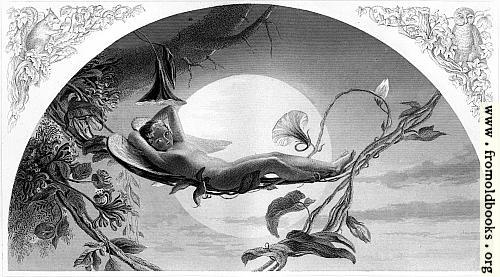


{Old image of Ariel from Shakespeare's The Tempest; source: fromoldbooks.org}


{Archangel Gabriel appearing to Daniel; source: shopforangels.com/}


Some sources:

The Letters of Ralph Waldo Emerson, ed. by Ralph Leslie Rusk and Eleanor Marguerite Tilton (Columbia University Press, 1991)

Letters from Ralph Waldo Emerson to a friend, 1838-1853, ed. by Charles Eliot Norton (Houghton, Mifflin, 1899)

Sunday, July 12, 2009

Emerson observing the privileged few

Emerson wrote in his journal a few days before he began his return to America:
July 12.        


With Mr. Kenyon and Hillard, I joined the Jays in a visit to Stoke Poges, where is Gray's churchyard; then to Eton, where we found six or seven hundred boys, the flower of English youth, some of them at cricket, on the green; others strolling in groups and pairs; some rowing in the river; and recalled Lamb's remark, "What a pity that these fine boys should be changed into frivolous members of Parliament!"

Kenyon recalled verses of his own, of which I only remember, —
O give us back our lusty youth!
and the whole place remembered Gray. Kenyon asked if ever a dirty request was couched in more beautiful verse than in the hints touching livings and preferments, addressed to the Duke of Grafton, in the Cambridge Installation Ode.
Thy liberal heart, thy judging eye,
The flower unheeded shall descry,
And bid it round heaven's altars shed
The fragrance of its blushing head;
Shall raise from earth the latent gem
To glitter on the diadem.
After seeing the chapel, we went to Windsor, where the tickets of the Jays procured admittance for the whole party to the private apartments of Her Majesty. We traversed the long corridors which form the gallery of sculpture and paintings, then the chambers, dining-room, and reception rooms of this palace. The green expanse of trim counties which these windows command, beginning with a mile of garden in front, is excellent. Then to the Royal Mews, where a hundred horses are kept; listened reverentially to all that the grooms told us of the favorite horses; looked at the carriages, etc. If hard came to hard, the camel has a good deal of hump left to spend from.

In St. George's Chapel, Mr. Kenyon pointed out the true character of stained-glass windows, which is not in large figures or good drawings, but in gem-like splendor and condensation. In like manner he quoted Lady Morgan's notion on carpets, that they should be spread, not nailed; and there should not be great elaborate figures, but such a disposition of forms and colors that they should seem like jewels trodden in.

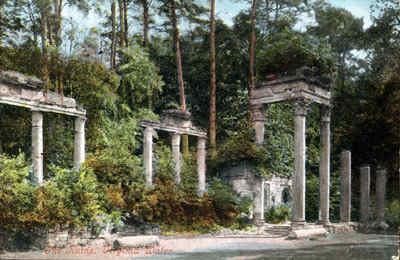
From Windsor we went to Virginia Water, the toy lake and toy fishing-house of George IV. (But the expense squandered on these grounds does not save them from the ridicule of a tawdry counterfeit, and the spectator grudges his time. Here is a made waterfall; or a made ruin, the "Persepolis of the woods," constructed of stones brought from the ruins of Carthage.) Two red flags hanging from the little frigates afloat were quite too important in the raree-show. We suspected the two or three people in the boat were hired to sit there by the day; and the eye mistrusted the houses might be pasteboard and the rocks barley candy.


Mr. Kenyon: This probably refers to the poet John Kenyon, poet and patron of the arts. See his obituary in the Gentleman's Magazine here.

Hillard: Emerson probably refers to George Stillman Hillard, an American author and lawyer who was traveling in England at that time.

The Jays: This may refer to John Clarkson Jay (1808-1891) and his wife. Jay was a well-known American conchologist (collector and examiner of shells).

"frivolous members of Parliament": It was Charles Lamb's older brother John who made this remark.


{St Giles church Stoke Poges. Thomas Gray's Elegy Written in a Country Churchyard is believed to have been written here; source: wikipedia}


{Sketches of events during a cricket match between Eton and Harrow, 1880; source: The Graphic}


{More sketches of events during a cricket match between Eton and Harrow, 1880; source: Illustrated London News}


{A mid-19th c. Eton scene; source: Bobst Library, NYU}


{The river at Eton; source: Lippincott's Magazine of Popular Literature and Science, February, 1876, Vol. XVII, No. 98 (Gutenberg)}


Regarding the "Cambridge Installation Ode", see the Cambridge History of English and American Literature.


{The lower ward (bailey) of Windsor Castle in England. St George's Chapel is on the left and the Round Tower is centre right. Image by Joseph Nash published 1848; source: wikipedia}


{Waterlool Gallery, Windsor Castle; source: antiquemapsandprints}


{Late Victorian painting of Windsor Castle by Walter H. Goldsmith; source: goldenagepaintings}


{View from Windsor Castle; the slopes overlooking the River Thames and Eton, the Chapel being in the distance; source: thamesweb.co}


{Image from a window in St. George's Chapel, Windsor; source: stgeorges-windsor.org}


{Virginia Water. Fishing Temple & Lake; source: antiquemapsandprints}


{Cascade at Virginia Water; source: thamesweb.co}


{Corinthian columns from Tripoli at Virginia Water, Windsor Castle; source: thamesweb.com}


{Frigate on Virginia Water; source thamesweb.com}


Some sources:

Journals Of Ralph Waldo Emerson 1820-1872, with Annotations, edited by Edward Waldo Emerson and Waldo Emerson Forbes; Vol. VII, 1845-1848 (London, Constable & Co.; Boston And New York Houghton Mifflin Company, 1913)

Journals Of Ralph Waldo Emerson 1820-1872, with Annotations, edited by Edward Waldo Emerson and Waldo Emerson Forbes; Vol. VII, 1845-1848, (New York, Houghton Mifflin Company, 1912)

Tuesday, July 07, 2009

a kind of modern-antique American gymnosophist

On this day in 1848, Thomas Carlyle wrote his wife about his trip to Stonehenge with Emerson:
Thomas Carlyle to Jane Welsh Carlyle

Amesbury, 7 july, 1848 —

My Dear, — It cannot be supposed that I have much to tell thee since morning, and indeed the day has passed over without accident at all; but being relegated here to a most lonesome and rather dilapidated bedroom, with no perceptible desire still to sleep, I have borrowed from Emerson a sheet of Note-paper, and from the people of the Inn a pen and inkbottle; and will vent a portion of my sorrows upon poor Chelsea before I go to bed. Eheu [Alas], am I not right to stay at home? The world holds in it no man to whom travelling is such a labour, under any and all conditions! —

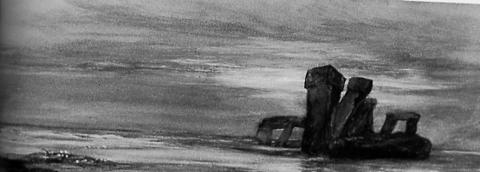
We got along happily enough to Bishopstoke today, — except that it appeared, the little Forster-and-Dickens Publichouse did not lie on our road at all, but lay on the road of some Coach, which, at some unknown hour, would (had we known of it) have taken us off the S. Western railway, and landed us sooner at Salisbury or at least at Stonehenge: however, the damage was not great, and at any rate there was then no help. We did get to Salisbury, all right however, about three o'clock: all right as far as a poor wretch could be right, who could not get his lips closed, but was obliged to talk all the way; and had not slept the night before! — At the Salisbury Station we leapt straightway into a kind of Gig (inferior to the Derbyshire ones),1 and were rapidly driven to this ancient village, some 8 miles further; here we, after some confused consulting, discharged our Gig-apparatus; got some wretched dinner, of whale-blubber mutton and old peas; and then in the grey windy evening set forth to walk towards Stonehenge over the bare upland; found it, saw it: — a wild mournful, altogether enigmatic and bewildering sight; — dreadfully cold too (in my thin coat), and after about 2 hours came our ways home again to Amesbury, an enchanted-looking village, very appropriate to the neighbourhood. Stonehenge and the uplands far and wide were utterly solitary; a vast, green, wavy tract of sheep-pasture, all studded with (what they call “barrows”) the tombs of extinct nations, and that huge mass of dark, meaningless, gigantic dislocated stones; of which no creature will ever tell us the meaning, except that it is the extinct temple of an extinct people (seemingly sunk very deep in error), and the prey now of Pedants and doleful creatures whose whole element seems one of emptiness and error! The grim windy evening, spent amid those grim remains, in a mood such as mine, will probably long continue memorable to me. And that hitherto seem all the conquest I am like to get from it.2

Returning to Amesbury, which seemed already sunk into sleep (about 9 o'clock) or almost into death, we got Tea, the worst in nature, without cream, nay without milk except about half-a spoonful — no help! The place is one of those Coach villages that have been ruined by railways: once the great road from Exeter to London, 12 Coaches a-day, and half a dozen “families” (i.e. posting carriages), now left sad and silent, the big inn rotting, and not even milk to be had! We leave tomorrow morning early for Wilton (past Stonehenge again) in a Dog cart, the only attainable vehicle; and after a day of Wilton House, and Salisbury and Clarendom, hope to meet poor Helps at Bishopstoke, and attain a little cream to our tea, — attain at least the hope of soon ending such an expedition!3 Goodnight, my own poor Jeannie—ah me!— T. Carlyle

I wonder how your Chopin prospered; how your concert-tickets &c!4 — Emerson is healthy; full of cheerfulness, at least of unsubduable placidity: if I could get a little sleep, I should do well enough yet.
Why art thou then cast down my soul;
What should discourage thee?5
Good night, Dearest. /

T. C.

----------
Footnotes by the editor of Carlyle's letters:

1. Which they had taken the previous summer.

2. After seeing Stonehenge they spent the night of 7 July at the George Inn, Amesbury, 1½ mi. W of Stonehenge and 8 mi. N of Salisbury. For Emerson's account, see “Stonehenge” in his English Traits (Boston, 1856) ch. 16, and Journals and Miscellaneous Notebooks 10:334–36, 432–42.

3. In his Journal TC wrote: "Morrow morning [8 July], Dogcart across the downs to Wilton: Down or ‘Plain,’ an expanse of waving bare ground, resembling a Scotch moor, only that it is without brooks, and of much more fertile character. Scandalous to see it lying vacant in the heart of such an England as ours at present is. … then country road to Wilton; … then full inspection of Sydney Herbert's house [Wilton House], which is princely: Bust of Cato: A. Dürer's Picture; fairy ‘luncheon’ by Mrs. Wager the Housekeeper. Salisbury Cathedral and City. Old Sarum, the day before. — A. Helps caught us at Bishopsgate on the railway: home with him till the morrow (sunday) which poured a deluge of rain. To Winchester in the afternoon nevertheless. Cathedral there; first, St. Cross there. Home to Chelsea about 10 p.m. — Emerson called next day, and is now off, towards Liverpool, or Coventry &c; to sail for home on Saturday. Valeat—eheu [Let him be gone—alas]!" — See also Froude, Carlyle 3:440–41. The ruins of Clarendon Palace are ca. 2½ mi. E of Salisbury. Sidney Herbert (1810–1861; DNB), politician, second son of 11th earl of Pembroke. The Hospital of St. Cross, founded 1136 for thirteen poor brethren, is ca. 1 mi. S of Winchester Cathedral and is the setting of Trollope's The Warden (1855). Emerson records that TC cursed "the priest who received £2000 a year, that were meant for the poor" (English Traits 288).

4. Chopin gave his second matinée musicale, 7 July.

5. Cf. metrical Ps. 43:3.


---------------------------------

A couple of days later, Carlyle wrote his friend James Marshall:
Chelsea, 10 july, 1848—

My dear Sir,

. . . . .

I have just returned from a visit to Stonehenge in the Wiltshire Downs, with a certain Transatlantic Friend, R. W. Emerson, who, after some months' sojourn in these parts, is on the point of turning homewards again. A man of genius and worth in his American way; somewhat moonshiny here and there in the Results he arrives at, but beautiful in speculation if you leave practice out, — in fact a kind of modern-antique “American Gymnosophist,” for whom we are bound to be thankful. He and his affairs keep me very busy this day: so without more writing, except to offer my kind regards to Eckermann, and best thanks to Dr Weissenborn above, I subscribe myself, with true remembrances from both parties here,

Yours sincerely /

T. Carlyle


{Amesbury in 1903; source: jtfuller.btinternet.co}


{Salisbury Meadows by Constable, 1831; source: clem.mscd.edu}


{Watercolour, Stonehenge, close up view from E, [c 1830], by James Bridges; source: wilshireheritagecollections.org}


{Barrows near Stonehenge; source: annanddave.org}


{Wilton House: source: jeff.sedley.org}


Gymnosophist: is a name for practitioners such as the Indian yogis. See Gymnosophist (wikipedia)

{A yogi; source: wikipedia}


Main source:

Thomas Carlyle; the Collected Letters, Volume 23, edited by Ian M. Campbell et al (Duke University Press , 2009)

Monday, July 06, 2009

a somewhat moonshiny fellow

Thomas Carlyle, wrote about the last week of Emerson's trip to England in a letter he sent his mother this day in 1848. Here is an extract:
Thomas Carlyle To Margaret Carlyle; 6 July 1848
Chelsea, 7 [i.e. 6] july, 1848 —        


My dear Mother,

It seems to me again too long since I have written to you; but the fault has not altogether been mine: besides, the only way to mend it is to write now, before any one get in to interrupt me; which accordingly I do, the first work of the day. . . .

Doubtless you have been reading of these awful explosions in Paris, which interest everybody, and are indeed an alarming symptom of the misery of this poor time. To us the most interesting feature of all is this General Cavaignac who has had the command in that terrible business. He is the younger brother of the Cavaignac we loved much and were very intimate with here, while he lived: we often heard of him as a just and valiant and everyway excellent man, whom his brother much loved; and indeed I believe him to be really such; — which kind of character was certainly never more wanted than in the place he is now in!1 Perhaps no man in all the world could have had so cruel a duty laid upon him, as that of cannonading and suppressing these wretched people, who we may say his Father and Brother and all his kindred had devoted themselves to stirring up:2 but he saw it to be a duty, and he has bravely done it. I suppose he will get himself killed in the business, one day; and indeed he appears privately to look for nothing else. His poor old Mother still lives; has now no child but him; — has a strange history indeed to look back upon, from the days of Robespierre all the way!3 — It is very curious to me to think how the chiefs of these people, as Armand Marrast, Clement Thomas (late commander of the National Guards),4 used to sit and smoke a pipe with me in this quiet nook some years ago. And now Louis-Philippe is out, and they are in, — not forever either! "The wheel of Fortune," as old Aunt Babby's5 dream said, "the wheel of Fortune, one spake up and the other spake down!" —

Emerson has been lecturing at a considerable rate here; meeting with moderately fair encouragement from a certain class. We had to attend him, — not a very severe duty either, for there is really something of excellent in him tho' he is a little "moon shiny": — however the thing is now over; and he is fast getting ready to go home to America again; sails from Liverpool, in fact, tomorrow (or rather saturday, for this is but thursday!) week.6 A voyage of ten or twelve days, if happy, will land him at his own house-door, after a long and interesting absence; — and as for us, the likelihood is, we shall never see him again at all. His present visit has not done much for me, nor could I in any way, do much for him: but he has and keeps up from old a very friendly feeling for me, and the very separations that lie between us add themselves to this probably final parting to make it sad and affectionate! How much is every one of us left alone in this world; nothing above him but the eternal skies, no help or counsel for him except in Heaven only!

Emerson has asked me to make a little journey with him to see a strange old Antiquity, old almost as the Hills, which bears the name Stonehenge, near Salisbury in Wiltshire, about 100 miles Southwest of this. It is some 4 hours by railway; the ground, for the greater part, already known to me (for it is partly the road to Alverstoke, thro' Hampshire). I have consented to go; and so off we move tomorrow forenoon. A friend lives in the way,7 who will lodge us one night as we return, or two if we like, — perhaps over the Sabbath till Monday: On Monday evening, Emerson sets off towards the North, and we do not see him again. — Today, as you may fancy, I am making my bits of preparations and arrangements; I have various places to go to; so shall be busy all day, — and indeed ought already to be getting under way! — Jack talked to Emerson of going with us; but I know not whether he will stand good; — probably not: I must consult him before night come.

On the whole, dear Mother, I must be off. You shall hear from me again, a word about the journey, so soon as we return. Tell Jamie I do not forget that I owe him a Letter: I will pay it by and by.— From Jean at Dumfries, I hear nothing this good while; but suppose she is busy nursing, poor thing. My affectionate blessings to one and all.— Get ready for Moffat, then, and off!

Adieu dear good Mother.

Ever your affectionate

T. Carlyle

--------------------
Footnotes by the editor of the Carlyle letters:

1. The constituent assembly, elected in April and meeting for the first time, 5 May, had reorganized the govt., giving power to an executive commission that appointed to ministries men from the provisional govt., but excluded the socialists, whose attempted attack on the assembly, 15 May, had failed. The national workshops, set up to deal with unemployment, had been overwhelmed by more than 115,000 unemployed workers. Attempts to cut down the size of the workshops by the assembly led to a serious revolt by workers, socialists, and revolutionaries, 22–26 June, with savage street fighting. Many were killed, deported, or imprisoned. Responsible for the suppression as minister of war, Gen. Louis Eugène Cavaignac (1802–57; see 9:91) then became pres. of the council, responsible to the assembly, with a moderate republican ministry. He was to be overwhelmingly defeated in the presidential elections in Dec. by Louis Napoleon. He was the brother of the Carlyles' dear friend E. L. Godefroy Cavaignac.

2. His father, Jean Baptiste Cavaignac (1762–1829; see 9:8), a member of the revolutionary national convention, had voted for the death of Louis XVI; his brother had been imprisoned during the early part of Louis Philippe's regime and escaped to exile, 1835. Gen. Cavaignac remained a committed republican to his death.

3. Julie Cavaignac, b. Corancez (1780–1849; see 9:8).

4. Clément Thomas (1809–71), republican politician; escaped imprisonment and went into exile, 1835–37; commander-in-chief of the national guard in Paris, May–June, when replaced during the uprising; exiled again, 1851; executed by national guardsmen, 1871.

5. Unidentified.

6. Emerson sailed from Liverpool, 15 July, and landed in Boston, 27 July.

7. Arthur Helps lived at Vernon Hill, Bishop's Waltham, Hants, 11½ mi. SE of Winchester.


awful explosions in Paris: Carlyle refers to the June Days Uprising; see note 1 above.


{Painting of Battle at Soufflot barricades at Rue Soufflot Street on 24 June 1848, by Horace Vernet-Barricade; source: wikipedia}


that terrible business: On June 21 the National Assembly began to scale back expensive economic benefits that had been granted poor Parisians. Faced by armed resistance to this action, the Assembly called on the army to restore order. Over the next few days the army overwhelmed Parisian rebels ensconced in blockaded city streets. The victorious "Party of Order" in the Assembly then appointed general and statesman Louis Eugène Cavaignac to the head of the French state. Later, on the 10th of December, Louis-Napoléon Bonaparte was elected president of the French Republic. (Source: wikipedia.)

"moon shiny": OED
moonshiny — 3. Of the nature of moonshine; fanciful, unreal, insubstantial. Cf. MOONSHINE n. 2a.
1833 Pearl & Lit. Gaz. 23 Nov. 65/1, I threw aside the poem and the ode, and resolved to write some love ditty or moonshiny stuff — any body can write that. 1857 H. MELVILLE Confidence-man xli. 312 And moon~shiny as it in theory may be, yet a very practical philosophy. 1880 Sat. Rev. No. 1291. 122 There is a good deal of moon~shiny sentiment in it, especially in the conversation of the lovers. 1892 ‘M. TWAIN’ Amer. Claimant 36 The same old scheming, generous, goodhearted, moonshiny, hopeful, no-account failure he always was. 1990 Amer. Lit. 62 208 This complaint culminates a lifetime of deprecating descriptions of the frail, moonshiny, imaginary territory of his fictions.


{Thomas Carlyle, ca. 1848; source: e-education.net}


{Le général Cavaignac d'après Ary Scheffer; source brittanica}


{Godefroi Cavaignac (1801-1845); source: images-chapitre}


{Armand Marrast, editor of the republican Le National and a relatively conservative member of the National Assembly,; source: wikipedia}


{Clément Thomas, also an editor of Le National, was Colonel in the National Guard and a leader of the National Assembly; source: library.northwestern.edu}


{Louis Philippe, King of the French, by Franz Xaver Winterhalter; he had abdicated in February and fled the country in March; source: wikipedia}


{Mid-19th c. watercolor of Stonehenge; sourcejimandellen.org}


Main source: Thomas Carlyle; the Collected Letters, Volume 23, edited by Ian M. Campbell et al (Duke University Press , 2009)

Sunday, June 28, 2009

a face to make all things new

On June 28, 1848, Emerson wrote to his wife Lydian; here are extracts from the letter.
London, June 28.        


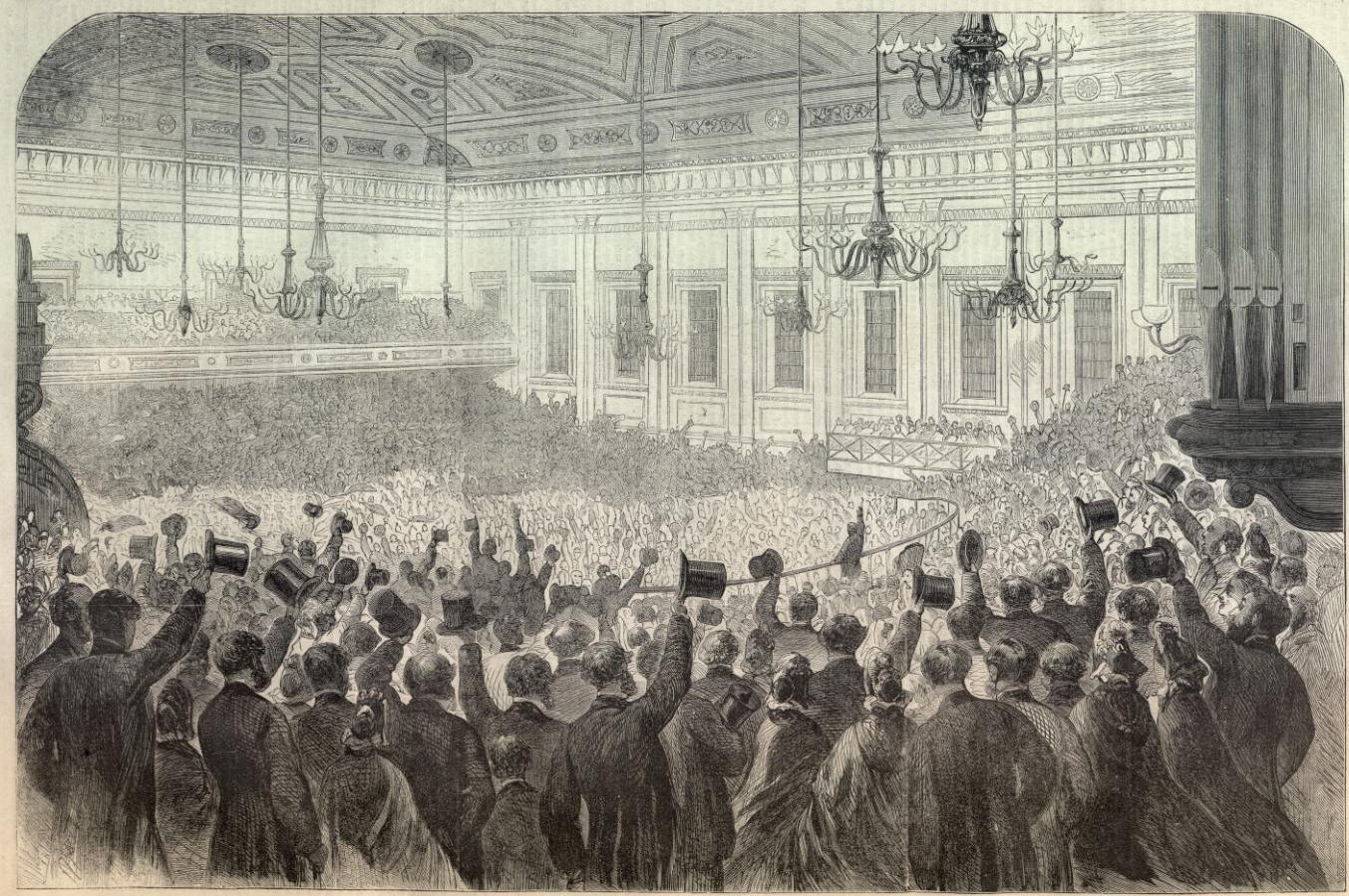
. . . All my duties will be quite at an end on Friday night at Exeter Hall, and I have then to determine which to choose of all the unseen spectacles of England. I have not seen Stonehenge, nor Chatsworth, nor Canterbury, nor Cambridge, — nor even Eton and Windsor, which lie so near London. I have good friends who send for me, but I do not mean to engage myself to new people or places. As Mr. Burke said, "I have had my day; I can shut the book." I am really very willing to see no new face for a year to come, — unless only it were a face that made all things new. There is very much to be learned by coining to England and France. The nations are so concentrated and so contrasted that one learns to tabulate races and their manners and traits as we do animals or chemical substances, and look at them as through the old Swedish eyeglass, each as one proper man. Also, it must be owned, one meets now and then here with wonderfully witty men, all-knowing, who have tried everything and have everything, and are quite superior to letters and science. What could they not, if they only would? I saw such a one yesterday, with the odd name, too, of Arthur Helps. On Sunday I dined at Mr. Field's at Hampstead, and found the Egyptian savant Mr. Sharpe, Rowland Hill (of the Penny Post), Stanfield the painter, and other good men. I breakfasted next morning with Stanfield, and went with him to see a famous gallery of Turner's pictures at Tottenham. That day I dined with Spence, and found Richard Owen, who is the anatomist. To-morrow he is to show me his museum. I esteem him one of the best heads in England. Last evening I went to dine with Lord Morpeth, and found my magnificent Duchess of Sutherland, and the Duke and Duchess of Argyle, and the Ladies Howard, and Lady Graham, and Mr. Helps, so omniscient, as I said. . . . This morning I breakfasted with him and Lady Lovelace, as Lord L. wished to read me a certain paper he had been writing on a book of Quetelet. We had quite a scientific time, and I learned some good things. I am to go there again to-morrow evening, to see Mrs. Somerville. . . .


{Exeter Hall was the site of Emerson's lectures to the London populace (as opposed to its social and intellectual elites); it was built about 15 years before he spoke there; image source: sonofthesouth.net}


as Mr. Burke said: This is a reference to Edmund Burke's Speech at the Guildhall in Bristol, Previous to the Late Election In That City, Upon Certain Points Relative to his Parliamentary Conduct (1780). Here is the relevant text:
Gentlemen, I have had my day. I can never sufficiently express my gratitude to you for having set me in a place wherein I could lend the slightest help to great and laudable designs. If I have had my share in any measure giving quiet to private property and private conscience ; if by my vote I have aided in securing to families the best possession, peace; if I have joined in reconciling kings to their subjects, and subjects to their prince; if I have assisted to loosen the foreign holdings of the citizen, and taught him to look for his protection to the laws of his country, and for his comfort to the good-will of his countrymen ; — if I have thus taken my part with the best of men in the best of their actions, I can shut the book: I might wish to read a page or two more, but this is enough for my measure. I have not lived in vain.
{source: from The Works of the Right Honourable Edmund Burke (London, John C. Nimmo, 1887), vol 2, p. 421}
Arthur Helps was an English writer and dean of the Privy Council. He was youngest son of Thomas Helps, a London merchant; as an author, he was known for his aphorisms, biographies, and essays.

Edwin Wilkins Field was an English law reformer and painter. I reproduced a painting attributed to him in a previous post.


{Richard Owen was an English biologist, comparative anatomist and palaeontologist; source: wikipedia}


See earlier posts in this series for descriptions of other persons mentioned, including:


Some sources:

Journals Of Ralph Waldo Emerson 1820-1872, with Annotations, edited by Edward Waldo Emerson and Waldo Emerson Forbes; Vol. VII, 1845-1848 (London, Constable & Co.; Boston And New York Houghton Mifflin Company, 1913)

Journals Of Ralph Waldo Emerson 1820-1872, with Annotations, edited by Edward Waldo Emerson and Waldo Emerson Forbes; Vol. VII, 1845-1848, (New York, Houghton Mifflin Company, 1912)

Sunday, June 21, 2009

a Massachusetts Indian in London society

On June 21, 1848, Emerson's travels in England and France were nearing their conclusion. Having lived more than half a year abroad, he was eager to return home. He had witnessed the (mostly) peaceful revolution of the Chartists in the one and the (considerably) violent revolution of republicans in the other. He'd become disenchanted with the orderly dignities of the British upper classes and become enthusiastic about the brash informality of the shirt-sleeved French.

Still, as he wrote to his friend Elizabeth Hoar on this date, the English aristocracy had its attractions.

TO MISS HOAR.
London, June 21, 1848.        

Dear Elizabeth, — I have been sorry to let two, or it may be three, steamers go without a word to you since your last letter. But there was no choice. Now my literary duties in London and England are for this present ended, and one has leisure not only to be glad that one's sister is alive, but to say so. I believe you are very impatient of my impatience to come home, but my pleasure, like everybody's, is in my work, and I get many more good hours in a Concord week than in a London one. Then my atelier in all these years has gradually gathered a little sufficiency of tools and conveniences for me, and I have missed its apparatus continually in England. The rich Athenaeum (Club) library, yes, and the dismaying library of the British Museum could not vie with mine in convenience. And if my journeying has furnished me new materials, I only wanted my atelier the more. To be sure, it is our vice — mine, I mean — never to be well; and to make all our gains by this indisposition. So you will not take my wishings for any more serious calamity than the common lot. And yet you must be willing that I should desire to come home and see you and the rest. Dear thanks for all the true kindness your letter brings. How gladly I would bring you such pictures of my experiences here as you would bring me, if you had them! Sometimes I have the strongest wish for your daguerreotyping eyes and narrative eloquence, but I think never more than the day before yesterday. The Duchess of Sutherland sent for me to come to lunch with her at two o'clock, and she would show me Stafford House. Now you must know this eminent lady lives in the best house in the kingdom, the Queen's not excepted. I went, and was received with great courtesy by the Duchess, who is a fair, large woman, of good figure, with much dignity and sweetness, and the kindest manners. She was surrounded by company, and she presented me to the Duke of Argyle, her son-in-law, and to her sisters, the Ladies Howard. After we left the table we went through this magnificent palace, this young and friendly Duke of Argyle being my guide. He told me he had never seen so fine a banquet hall as the one we were entering; and galleries, saloons, and anterooms were all in the same regal proportions and richness, full everywhere with sculpture and painting. We found the Duchess in the gallery, and she showed me her most valued pictures. ... I asked her if she did not come on fine mornings to walk alone amidst these beautiful forms; which she professed she liked well to do. She took care to have every best thing pointed out to me, and invited me to come and see the gallery alone whenever I liked. I assure you in this little visit the two parts of Duchess and of palace were well and truly played. ... I have seen nothing so sumptuous as was all this. One would so gladly forget that there was anything else in England than these golden chambers and the high and gentle people who walk in them! May the grim Revolution with his iron hand — if come he must — come slowly and late to Stafford House, and deal softly with its inmates! . . . Your affectionate brother, Waldo.


On this day Emerson also wrote to his wife Lydian:
Dear Lydian,
London, June 21.        

We finished the Marylebone course last Saturday afternoon, to the great joy, doubt not, of all parties. It was a curious company that came to hear the Massachusetts Indian, and partly new, Carlyle says, at every lecture. Some of the company probably came to see others; for, besides our high Duchess of Sutherland and her sister, Lord Morpeth and the Duke of Argyle came, and other aristocratic people; and as there could be no prediction what might be said, and therefore what must be heard by them, and in the presence of Carlyle and Monckton Milnes, etc., there might be fun; who knew? Carlyle, too, makes loud Scottish-Covenanter gruntings of laudation, or at least of consideration, when anything strikes him, to the edifying of the attentive vicinity. As it befell, no harm was done; no knives were concealed in the words, more 's the pity! Many things — supposed by some to be important, but on which the better part suspended their judgment — were propounded, and the assembly at last escaped without a revolution. Lord Morpeth sent me a compliment in a note, and I am to dine with him on the 28th. The Duchess of Sutherland sent for me to come to lunch on Monday, and she would show me her house. Lord Lovelace called on me on Saturday, and I am to dine with him to-morrow, and see Byon's daughter. I met Lady Byron at Mrs. Jameson's, last week, one evening. She is a quiet, sensible woman, with this merit among others, that she never mentions Lord Byron or her connection with him, and lets the world discuss her supposed griefs or joys in silence. Last night I visited Leigh Hunt, who is a very agreeable talker, and lays himself out to please; gentle, and full of anecdote. And there is no end of the Londoners. Did I tell you that Carlyle talks seriously about writing a newspaper, or at least short off-hand tracts, to follow each other rapidly, on the political questions of the day? I had a long talk with him on Sunday evening, to much more purpose than we commonly attain. He is solitary and impatient of people; lie has no weakness of respect, poor man, such as is granted to other scholars I wot of, and I see no help for him. ... I have been taxed with neglecting the middle class by these West-End lectures, and now am to read expiatory ones in Exeter Hall; only three, — three dull old songs.


one's sister: Elizabeth Hoar had been engaged to marry Emerson's brother Charles. Although Charles died of tuberculosis before the wedding could take place, Emerson subsequently considered Hoar to be as a sister and addressed her accordingly.


{The Athenaeum; source: bluffton.edu}


Reading room of the British Museum in Punch; source: ncgsjournal.com


{This daguerreotype of Emerson was taken in 1848; source: carlyleletters.dukejournals.org}


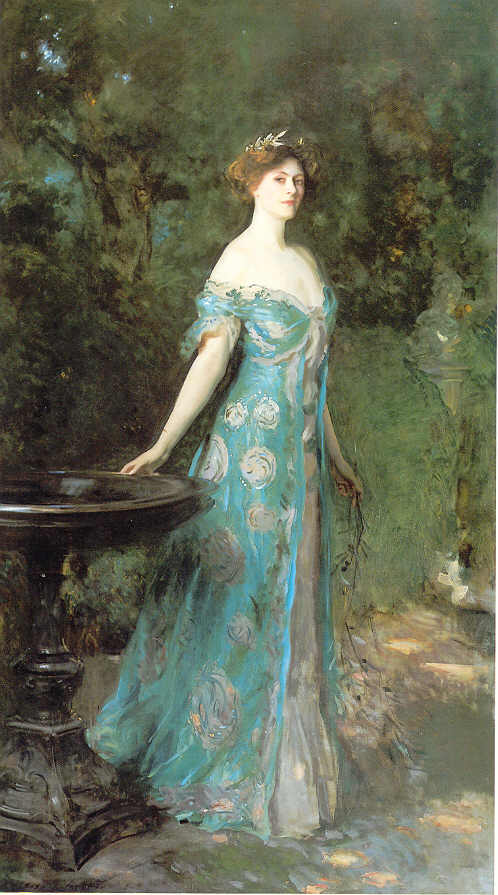
Portrait of Anne Sutherland-Leveson-Gower, Duchess of Sutherland by John Singer Sargent; source: jssgallery.org


{Galleries at Stafford House; source: gac.culture.gov.uk; other images from this source: Great Staircase, facade, }


the Marylebone course: This refers to Emerson's final series of London lectures.

Massachusetts Indian: Ironic reference to himself as outlander in English eyes.


{Lord Morpeth; source: spartacus.schoolnet}


Carlyle and Monckton Milnes, etc.: Emerson's friends, previously descrbied in this series of blog posts.

Earl of Lovelace was husband of Byron's daughter Ada.


{Byron's daughter, Ada Lovelace; source: ieeeghn.org}


{Leigh Hunt; source: english.upenn.edu}


Note on finding other posts in this series: All have the tags Emerson, journal, and 1848.


Some sources:

A memoir of Ralph Waldo Emerson, by James Elliot Cabot (Cambridge, Printed at the Riverside Press, 1887)

A Memoir of Ralph Waldo Emerson, by James Elliot Cabot (Houghton Mifflin and company, 1887)

Ralph Waldo Emerson on Transcendentalism Web (vcu.edu)

Tuesday, June 16, 2009

Emerson's last lectures in London

Nearing the end of his European travels, Emerson wrote his wife Lydian on this date:
June 16.        


My last lecture is to-morrow, and is far from ready. Then do not expect me to leave England for a fortnight yet, for I must make amends for my aristocratic lecturing in Edwards Street, at prices which exclude all my public, by reading three of my old chapters in Exeter Hall to a city association. Our little company at Marylebone has grown larger on each day, and is truly a dignified company, in which several notable men and women are patiently found. . . . Carlyle takes a lively interest in our lectures, especially in the third of the course [on the "Tendencies and Duties of Men of Thought"], and he is a very observed auditor, 't is very plain. The Duchess of Sutherland, a magnificent lady, comes, and Lady Ashburton, and Lord Lovelace, who is the husband of "Ada, sole daughter of my house and heart," and Mrs. Jameson, and Spence (of Kirby and Spence), and Barry Cornwall, and Lyell, and a great many more curiosities; but none better than Jane Carlyle and Mrs. Bancroft, who honestly come. Love to the little saints of the nursery. . . .


{Lady Harriet Baring, later Lady Ashburton; source: malcolmingram.com. See also: HARRIET, LADY ASHBURTON NYT}


Earl of Lovelace


{Ada Lovelace; source: geneall.net}


"Ada, sole daughter of my house and heart," - The quote comes from Byron's Childe Harold's pilgrimage.


{Jane Welsh Carlyle; source: malcomingram.com}

Jane Carlyle was surely honest at an attentive listener at Emerson's lectures but she would write: "I could never get up the least interest or affection for Emerson; for all so amiable as he is." (JWC TO JOSEPH NEUBERG ; 22 July 1848)

Some sources:

A memoir of Ralph Waldo Emerson by James Elliot Cabot (Houghton Mifflin and company, 1888(

A Memoir Of Ralph Waldo Emerson, by James Elliot Cabot (Cambridge, 1887)

The Life of Ralph Waldo Emerson, by Ralph L. Rusk (New York, Charles Scribner's Sons, 1949)

Thomas Carlyle; the Collected Letters, Volume 23, edited by Ian M. Campbell et al (Duke University Press , 2009)

Monday, June 08, 2009

work that may be spoiled by rapid casting

On this date Emerson wrote his wife Lydian a letter about his return from Paris to London:
London, June 8, 1848.        


I came from Paris last Saturday hither, after spending twenty-five days there, and seeing little of the inside of the houses. I had one very pleasant hour with Madame d'Agout. . . . An artist of the name of Lehmann offered me also good introductions, and I was to see Quinet, Lamennais, and others, but I turned my back and came to London. Still, Paris is much the more attractive to me of the two; in great part, no doubt, because it yields itself up entirely to serve us. I wholly forget what I have already written you concerning Paris, and must not venture on repeating my opinions, which are stereo-typed as usual, and will surely come in the same words. Besides, I have no right to be writing you at all, dear wife, as I have been writing all day, have read my second lecture to-day, and must write all to-morrow on my third for Saturday. We have a very moderate audience, and I was right, of course, in not wishing to undertake it; for I spoil my work by giving it this too rapid casting. . . . It is a regret to me to lose this summer; for in London all days and all seasons are alike, and I have not realized one natural day. . . . Carlyle talks of editing a newspaper, he has so much to say about the evil times. You have probably already seen his articles. I send you two of them in the Spectator. ... It grieves me that I cannot write to the children: to Edie for her printed letter, which is a treasure; to Ellen, who must be my own secretary directly. I cannot hear that the railroad bridge is built, and you would not have me come home till I can go clean from Boston to Concord? Will this idle scrawling tell you the sad secret that I cannot with heavy head make the smallest way in my inevitable morrow's work?


Madame d'Agoult admired and wrote favorable appraisals of Emerson's writings in the early 1840s. Of her, one of Emerson's biographers wrote:
The clever Comtesse d'Agoult was thus, as it turned out, the only Emersonian with whom Emerson had any satisfactory meeting in Paris. He recorded with restrained enthusiasm his "one very pleasant hour" with her. She recorded her meeting with "the moralist" with no more emotion but felt at least enough of her earlier admiration to have a crayon sketch made of him by Charles Lehrnann, who rediscovered the Indian type in Emerson's head.
Henri Lehmann (1814–1882) was a French historical and portrait painter, born in Kiel, Schleswig. He was a pupil of his father, Leo Lehmann, and of Ingres in Paris, where he opened a studio in 1847. (wikipedia)

Edgar Quinet (February 17, 1803–March 27, 1875) was a French historian and intellectual. (wikipedia)


{Lemannais; source: wikipedia}

Hugues Felicité Robert de Lamennais also known as Frédéric de La Mennais (June 19, 1782 - February 27, 1854), was a French priest, and philosophical and political writer. (wikipedia)


{Edith and Ellen Emerson; source: historyvortex.org}


Boston and Lowell Railroad


Some sources:

A memoir of Ralph Waldo Emerson, by James Elliot Cabot (Cambridge, Printed at the Riverside Press, 1887)

A Memoir Of Ralph Waldo Emerson, by James Elliot Cabot (Cambridge, 1887)

The Life of Ralph Waldo Emerson, by Ralph L. Rusk (New York, Charles Scribner's Sons, 1949)

History of the railroads and canals of the United States by Henry Varnum Poor (J.H. Schultz & co., 1860)

Sunday, May 24, 2009

a place of the largest liberty

Emerson writes another long letter to his wife, Lydian:
Paris, 24, May, 1848       
Dear Lidian, I have this night received your letter of 7 May, describing the several & general joy of you all in the most beautiful spring days. And beside Ellen's joys, she or Edie has sent me an honest violet which I heartily accept as a kind of "dry light." This time you send me none but good news and Elizabeth Hoar sends pure wine too. I wish Ellery, & Henry Thoreau had written a benediction also. From what you say & from what they do not say, I infer, that I write very bad letters all the time. 'Tis very likely, for in every letter you say that you show them to all your friends, and at the same time entreat me if I have any confessions to make not omit them by the next post. I find Paris a place of the largest liberty that is, I suppose, in the civilized world; and I am thankful for it, just as I am for etherization, as a resource when the accident of any hideous surgery threatens me; so Paris in the contingency of my ever needing a place of diversion and independence; this shall be my best-bower anchor. All winter I have been admiring the English and disparaging the French. Now in these weeks I have been correcting my prejudice, and the French rise many entire degrees. Their universal good-breeding is a great convenience; and the English and American superstition in regard to broadcloth seems really diminished, if not abolished, here. Knots of people converse everywhere in the street, and the blouse, or shirt-sleeves without blouse, becomes as readily the centre of discourse as any other; and Super-fine and Shirt, who never saw each other before, converse in the most earnest yet deferential way. Nothing like it could happen in England. They are the most joyous race, and put the best face on everything. Paris, to be sure, is their main performance; but one can excuse their vanity and pride, it is so admirable a city. The Seine adorns Paris; the Thames is out of sight in London. The Seine is quayed all the way, so that broad streets on both sides the river, as well as gay bridges, have all the good of it, and the sun and moon and stars look into it and are reflected. At London I cannot remember seeing the river. Here are magnificent gardens, neither too large nor too small for the convenience of the whole people, who spend every evening in them. Here are palaces truly royal. If they have cost a great deal of treasure at some time, they have at least got a palace to show for it, and a church too, in Notre Dame; whilst in England there is no palace, with all their floods of millions of guineas that have been spent. I witnessed the great national fête on Sunday last, when over 120,000 people stood in the Champ de Mars, and it was like an immense family; the perfect good-humor and fellowship is so habitual to them all.. . . You will like to know that I heard Lamartine speak to-day in the Chamber; his great speech, the journals say, on Poland. Mr. Rush lent me his own ticket for the day. He did not speak, however, with much energy, but is a manly, handsome, gray-haired gentleman, with nothing of the rust of the man of letters, and delivers himself with great ease and superiority. Instead of water the huissier put wine beside him, and he also refreshed himself occasionally with snuff. The whole chamber listened to him gladly, for he has mystified people a good deal lately, & all were eager for any distinct impressions from him. The chamber appeared like an honest country representation. [Arthur Hugh] Clough is still here, & is my chief dependence at the dining hour & afterwards. I am to go to a soiree at De Tocqueville's to-night. My French is far from being as good as Madame de Stael's.

Love to all dear children & to dear sisters too who write best letters & get nothing but ingratitude. And to Mother & Aunt Mary & W. & S

Mr Tom Appleton also I like better than any other. I go to London in a few days & am bound there three weeks from 6 June. Then I mean to come home. Farewell, dear wife.

Waldo.        


"dry light" — pure unobstructed light; hence, a clear, impartial view. - Bacon.


{Waldo's daughters, Ellen and Edie Emerson; source: historyvortex}


{William Ellery Channing; source: harvardsquarelibrary.org}


{Beginning of a letter of Emerson's of April 1848. The recipient is his London friend, Francis MacDonald, not his wife, Lidian. Source: historyvortex}


{Emerson in 1848 or therabouts; source: historyvortex}


{The first surgical anesthetic use of ether is credited to Dr. Crawford Williamson Long, MD, age 27, of Jefferson, Georgia. On March 30, 1842, he removed one of the two tumors from the neck of Mr. James Venable under ether anesthesia. Source: anesthesia-nursing.com}


bower anchors: the two largest anchors in a ship. They were usually, but by no means always, carried permanently attached to their cables, one on either bow with the cables running through the hawseholes so that the anchors were always ready for letting go in an emergency. They were originally known as best bower and small bower, but are now just known as the starboard and port bower. (Encyclopedia.com)

superstition in regard to broadcloth: This phrase refers to deference given to the upper classes of the society who were sometimes referred to as "broad cloth gentry" from the high-quality, tightly-woven, and expensive broadcloth they wore.


{Lamartine in front of the Hôtel de Ville de Paris, on the 25 February 1848, by Félix Philippoteaux; source: langlois.blog.lemonde.fr/}


Alphonse de Lamartine: Writer and poet, he was Minister of Foreign Affairs from February 24, 1848 to May 11, 1848.

huissier — Huissier From Wikipedia, the free encyclopedia. "The French word huissier comes from huis, that is, a door. The word huissier thus designates two professions that originally had to do with opening and closing doors."


Some sources:

A memoir of Ralph Waldo Emerson, by James Elliot Cabot (Cambridge, Printed at the Riverside Press, 1887)

The selected letters of Ralph Waldo Emerson, ed. by Joel Myerson (Columbia University Press, 1999)