Wednesday, July 18, 2007

a tour encounter

Michael Rasmussen has held on the Yellow Jersey since last Sunday -- that's two days of racing since Monday was a rest day. The Tour is not only the most physically taxing sporting event, it's also one of the more dangerous ones. It's surprising that there are so few crashes given the bunching of riders in the peloton, the extremely high speeds at which they ride, the crowds, the weather, the risk of equipment failure and other factors. Still, if some well-known riders were banned from the Tour for use of performance enhancing drugs, some others were done in by the race itself. (Here's a description of a rider exhibiting both positive drug test and crash.) It's not a laughing matter, nor one for thrill-seekers. At least not normally. Here's something of an exception. Yesterday, on a mountainous stage . . .

. . . a big, galumphy dog wandered out in front of the riders. Here's a video of the encounter. Neither rider nor dog was injured, but look at what happened to the outrageously costly front wheel!


{Caption: Marcus Burghardt collides with a dog on TDF Stage 9 (Val-d'Isère to Briancon). The wheels have been reported to be Lightweight Obermeyers which cost £2800 - well over $5,500 USD. Source: Youtube.}

If you've time, here's a recap of the 8th stage showing Rasmussen's dominance.

Here's a photo of the wheel un-taco'ed.

Monday, July 16, 2007

jungle book story

A favorite blog, Corriente Textual, has a post today on a 2-CD set of symphonic songs by Charles Koechlin from Rudyard Kipling's The Jungle Book.

The blog's author, Alan, provides a link for downloading the music. I hadn't known this piece before; am listening now and like it much.

Coincidentally:

A family member is performing in a children's theater production of portions of The Jungle Book. Links to articles and announcements: here, here, here, and here.

And, outside the theater following the opening performance of this production, I found my first Bookcrossing book, which, naturally, was a paperback copy of The Jungle Book. Bookcrosser, MaryZee, says she left it "on the stairs (abandoned), after the audience had left. (Well, the performers and a few patrons were still inside at a theatre workshop.) Hoping someone will pick it up." (I did!)

Kipling was a powerful story teller who influenced Rosemary Sutcliff's writing. I love almost everything that they both wrote.


Sunday, July 15, 2007

a winner for rabo

Joost Posthuma isn't in this year's Tour de France. As you know, he's still recovering from injuries suffered when a car crashed into him during a training ride last May. Others, including many favorites, are not in the Tour because they've been caught taking performance-enhancing drugs. Despite these many absences, this year's edition of Le Grand Boucle has been a good one. Joost's team, Rabobank, has placed riders in the top ten, but -- until today -- hasn't really shown its stuff. Thursday, I thought things were looking a bit bleak for the team when Oscar Freire, their sprinter, dropped out. Before that, in the early flat stages which usually end up in mass sprints, he'd done well: been second once and third twice, but he hadn't won a stage.

Today's big change was a win by Michael Rasmussen in the first of the difficult Alpine stages. He dominated the race from about the half-way point and is now both race leader and leader of the mountains points competition. The BBC web site has a good summary of his achievement. Though he's a climbing specialist and not known for time trial skills, and though it's frequently the time trial specialists who also do well in the mountains who win the Tour, the article says he thinks he might have a chance:
After Monday's rest day he has another day in the Alps to consolidate his lead and the first time trial - the format in which he generally struggles - is not until next Saturday.

Asked if he would aim to take the yellow jersey in Paris in a fortnight's time he said: "The way I'm riding, I would be stupid not to."

"I am a pure climber so I need to grab as much time as I can in the mountains.

"When I came close to the podium two years ago, it crossed my mind I could win the Tour in the future.

"This could be my year as the Pyrenees are extremely difficult but, again, I need to improve in the time trials."
It might be thought ironic that the Rabo site has an interview with him yesterday in which he's not nearly so confident of ultimate victory. In it, he says today's stage would be an important one, "But," he went on, "I do not think that tomorrow's winner will be the one standing on the number one podium spot in Paris. It will give an idea about how strong everyone is but it will not be a decisive stage. I do think it will only be decided in the Pyrenees. The Alps are only a foretaste for things to come."

Given what Rasmussen says on the Rabo site today, I think the BBC article is quoting somewhat selectively. Today's Rabo Tour commentary says the team will defend the Yellow Jersey but will see how things develop. Though unlikely, it's possible Rasumussen will come out on top. It's also possible that Denis Menchov will have a shot at it. From the Rabo Tour commmentary:
The director of the Rabo cycling teams Theo de Rooij was also overjoyed. "This has immediately made the Tour a big success, at least for now," is what he said somewhat cautiously still. "But, we have again won a wonderful mountain stage. Rasmussen experiences a day like this every year and he knows how to plan it too. But what happened behind him was also great: all classifications are open and Rasmussen profited well from it."


{Click image to enlarge. Captions: (1) "Shot at 2007-07-15 Denmark’s Michael Rasmussen (Rabobank/Ned) starts his breakaway from the group of riders during the eighth stage of the 94th Tour de France cycling race between Le-Grand Bornand and Tignes, 15 July 2007. Ramussen won the stage and took the yellow jersey as overall leader." (2) "Denmark’s Michael Rasmussen (Rabobank/Ned) rides uphill during the eighth stage of the 94th Tour de France cycling race between Le-Grand Bornand and Tignes." Credit: FRANCK FIFE/AFP/Getty Images)}

Friday, July 13, 2007

Emerson the existentialist

"How does everybody live on the outside of the world!" -- Journals of Ralph Waldo Emerson, July 11, 1833, in Paris.

I've been neglecting the journals of Emerson's travels. We left him in Rome in April. Since then he's gone across northern Italy to Venice, then northwest to Milan and on into Switzerland and Geneva. From there he journeyed to Paris, London, the Lake District, and Scotland, and now he's in Liverpool waiting for fair winds for his return to Boston.

Before I cover highlights of these adventures, I'd like to give a couple of his philosophic musings on the whole of this European excursion. Emerson's philosophy is elusive; it emerges uneasily from the journals, essays, lectures, and sermons. Some have said it is solipsistic, subjective, rose-colored, and damnably earnest, and it's true that he tends frequently to invoke God as benevolent overseer, to observe nothing but balance and order everywhere, and to neglect the pervasiveness of aggression, envy, melancholy, and despair. Others contend that these views are one-sided. He is not a naïve idealist, but a forerunner of American pragmatism and European existentialism who struck the mean between the excesses of positivism and romanticism. As summed up by one of this camp: Emerson provides "a richer notion of 'experience' than the British empiricists by maintaining -- in anticipation of Heidegger -- that moods, feelings, emotions, and imagination disclose experiences that yield knowledge and truths, about ourselves, nature, and the self-world connection."*

The first of Emerson's insights into this poetic absorption of the natural world come in the days of 1833 which correspond to the days of this week in 2007.

On July 13, while in Paris, Emerson visited a "Cabinet of Natural History." It seems to have been a transformative experience leading directly to the composition of Nature, the first of his books. His experience is summed up in one of his striking epiphanies: He says "I feel the centipede in me, — cayman, carp, eagle, and fox. I am moved by strange sympathies." The passage reads in part:
The upheaving principle of life everywhere [is] incipient, in the very rock aping organized forms. Not a form so grotesque, so savage, nor so beautiful but is an expression of some property inherent in man the observer, — an occult relation between the very scorpions and man. I feel the centipede in me, — cayman, carp, eagle, and fox. I am moved by strange sympathies.
It's difficult to make sense of the phrase "expression of some property inherent in man the observer." For me it ties Emerson directly to Heidegger and the belief that we cannot observe the world with cold objectivity -- dispassionately, mechanistically -- but only as our complex selves: nuanced by mood, feeling, and a host of internal, immaterial influences. And for Emerson this package of personal being includes a species of intuition which he calls "reason" (it's obviously neither the deductive reason of mathematical calculation nor the inductive reason of empiricism). He doesn't say so, but it's this form of intuition that permits the scientist to frame the hypothesis and set the experiment by which deductive and inductive reason operate in the scientific method.

Emerson recognized that we don't commonly acknowledge how much our experiences are colored by our feelings nor give our intuitive reason free play. As I see it, he took as goal the full marshalling of implicit, internal experience, as means of realizing explicit, external knowledge. It is for me, a quest for a kind of Heideggerian authenticity, the kind of thing Joyce had Stephen pursue.** So, a couple of days before he absorbed the meaning of the Cabinet, he had observed the variety of occupations of Parisians and exclaimed "How does everybody live on the outside of the world! All young persons thirst for a real existence for an object, - for something great and good which they shall do with all their heart. Meantime they all pack gloves, or keep books, or travel, or draw indentures, or cajole old women."***

In England a month later, Emerson added a bit to this thought stream. Visiting Kenilworth Castle, with its history of bloody dynastic power struggles, he writes about the application of this power of observation applied to human experience:
How reared himself old Kenilworth into the English morning sky. The ruin is as lordly as was the perfect state. I thought, if I had a boy to educate, I would carry him by moonlight into the inner floor of the Lancaster building. It would doom him a poet. The smell of the fresh ground, the cellar smell in a hall so princely as Lancaster's, was tragical.
The hall of Cyndyllan is gloomy this night, Wanting fire, wanting candle. I will weep awhile and then be silent.****
Here he seems to say, as he actually writes elsewhere, that the bards of the time when history was oral made easier contact between interior states of being and exterior ones. And he adds, what we'd all acknowledge, that poets strive to keep alive this bardic tradition.

====================
Notes

*Robert Hollinger, reviewing American Philosophy and the Romantic Tradition, by Russell B. Goodman (Cambridge, 1991) in The Journal of American History, Dec. 1992, p. 1161.

**This is Joyce via Stephen speaking with Cranly: "You know what Aquinas says: The three things requisite for beauty are, integrity, a wholeness, symmetry and radiance. Some day I will expand that sentence into a treatise. Consider the performance of your own mind when confronted with any object, hypothetically beautiful. Your mind to apprehend that object divides the entire universe into two parts, the object, and the void which is not the object. To apprehend it you must lift it away from everything else: and then you perceive that it is one integral thing, that is a thing. You recognise its integrity. Isn't that so? .... First we recognise that the object is one integral thing, then we recognise that it is an organised composite structure, a thing in fact: finally, when the relation of the parts is exquisite, when the parts are adjusted to the special point, we recognise that it is that thing which it is. Its soul, its whatness, leaps to us from the vestment of its appearance. The soul of the commonest object, the structure of which is so adjusted, seems to us radiant. The object achieves its epiphany." My source.

***Here's more of this part of the journals:
How men live in Paris. One man has live snakes crawling about him, and sells soap and essences. Another sells books which lie upon the ground. Another under my window all day offers a gold chain. Half a dozen walk up and down with some dozen walking sticks under the arm. A little further, one sells canetassels at 5 SOUSe Here sits Boots brandishing his brush at every dirty shoe. Then you pass several tubs of gold fish. Then a man sitting at his table cleaning gold and silver spoons with· emery and haranguing the passengers on its virtues. Then a person who cuts profiles with scissors -" shall be happy to take yours, sir." Then a table of card-puppets which are made to crawl.

Then a hand-organ. Then a wooden figure called [?] which can put an apple in its mouth whenever a child buys a plum. Then a flower merchant. Then a bird-shop with twenty parrots, four swans, hawks and nightingales. Then the show of the boy with four legs, etc., etc., without end. All these are the mere boutiques on the sidewalk, moved about from place to place as the sun or rain or the crowd may lead them.

July 9

How does everybody live on the outside of the world! All young persons thirst for a real existence for an object, - for something great and good which they shall do with all their heart. Meantime they all pack gloves, or keep books, or travel, or draw indentures, or cajole old women.
****This comes from an ancient lament by Llynwarch Hen, Llynwarch the Old. He had been a prince. Defeated by invading Angles, he became bard to another prince, Cyndyllan, in what is now Shrewsbury. Cyndyllan ultimately fell in battle with the Saxons, his house was burnt and his family massacred. Llynwarch sang: "The hall of Cyndyllan is dark tonight, without fire, without songs. Wanting fire, wanting candle. I will weep awhile and then be silent." An article on this fragment suggests that "these wild chiefs felt that poetry and music contributed as much to their comfort as fire itself." {Before the Conquest, Sacha Stookes, Music & Letters, Vol. 35, No. 4. (Oct., 1954), pp. 287-293.}

Thursday, July 12, 2007

one more voice for fixing US ag policy

In today's WaPo, George Will's column addresses the farm subsidy fiasco. He points out something that's relevant to the discussion of biofuels: price supports foster overproduction. His focus is entirely domestic and aimed at eliminating welfarestate-ism, but others point out that agricultural protectionism in the US prevents poor nations from hoping to compete in world agricultural markets -- with government subsidies, US prices are always too low. Will says:
Fifty-seven percent of farms receive no payments and two-thirds of those that do receive less than $10,000. The largest 8 percent of farms receive 58 percent of the payments. Farms with revenue of $250,000 or more receive payments averaging $70,000. Lugar wants to redirect the flow of federal funds from subsidizing favored crops to rural development, because fewer than 14 percent of residents in rural areas work on farms.

Under the continuing New Deal approach, five commodities -- corn, soybeans, cotton, rice and wheat -- got about 90 percent of last year's $19 billion in subsidies. This is a perverse incentive for overproduction of the five, which depresses prices, which triggers federal supports.
Here's the citation:

The Farmer to Fix Farm Policy
By George F. Will
Thursday, July 12, 2007; Page A23

Wednesday, July 11, 2007

alternative energy source that might work?

There's an intersting essay in Slate that showed up in Sunday's Outlook section of the Washington Post. Here's the citation: HUMAN NATURE, A Corny Cold War, by William Saletan, Sunday, July 8, 2007; Page B02

Outlook pieces are usually earnest, one-sided, wonkish, and written in self-consiously persuasive manner.

This piece is glib, ironic, and self-consiously quotable. It's Gibbon-esque in its twists and turns, though not in its sentence structure.

The subject is bio fuels. The author tells us that what seems obvious just isn't so. It does make sense to use agriculture to make fuel. Yes, the result will be higher food prices, but the increase in available energy sources, and presumably the restraint on energy price rises, should (not definitely will) more than offset them.

He says, "Fuel is the whole point of food." Which just isn't the way we're used to thinking about food: fuel for conversion to energy in animals, yes, but fuel to power motor vehicles?

What about the corruption of agricultural price supports in industrial nations? He says they're a problem: "Yes, ethanol subsidies are a scam. Yes, we should drop our trade barriers and let Brazilian sugar cane wipe out American corn." (As if they're political will for that.)

But he also says an enlighted biofuel policy can help lift third-world nations out of poverty: "Sugar cane, wood chips and switch grass. Such 'cellulosic' ethanol could lower the output of greenhouse gases and deliver up to six times the amount of energy its production requires. If you want to help poor people, biofuel beats the heck out of oil. In a biofuel economy, the chief asset is open land. Who has open land? Poor countries. Latin America has sugar cane. Africa and Asia have cassava. Switch grass, which grows in dry regions, will level the playing field further. Bush says that switch grass will empower the western United States. That's nice, but the real story is that it'll empower the Southern Hemisphere."

It's all pretty neat -- though fearfully difficult to achieve.

Read the whole thing if you have time. And notice how the author ironically pits Bush against Castro, ironically turns environmentalism and anti-globalism upside down, and uses abundant catch phrases and some provocative statements to make his case:

A fuel that literally grows on trees.

The old buzzword was "job security." The new buzzword is "food security."

Most of the corn we export today feeds livestock, not people.
Two months ago, a U.N. report calculated that one-third of the increased demand for food over the next 30 years will come from people shifting their eating habits to meat and dairy -- a net loss of dietary efficiency -- as they become able to afford it.

We're studying the use of microbes to extract fuel from straw and wood waste. We're trying to grow biofuel in algae. We're even learning to make fuel from animal fat and excrement.

Yes, we need solar power, conservation and efficiency. But don't give up on biofuel. It just needs time to grow.
human@slate.com

William Saletan covers science and technology for Slate, the online magazine at www.slate.com.

Friday, July 06, 2007

bike story

Gobbergo has a couple excellent posts on his bike rides on the Madison loop. He rides amazingly fast, sees amazingly much on the way, and has some amazing encounters with locals.

Though not so bucolic, I had a bike experience yesterday that may be worth reporting. On the way home from work I got a flat. This is unremarkable, in fact hardly unexpected since the rubber on my front tire is just about worn through and these summer months bring with them plentiful broken glass on the pavement.

What's worth recording is that my flat occured as I approached the new Victims of Communism Memorial on the little triangle where New Jersey crosses Massachusetts Ave. Just above the star on this map.

{click to enlarge; source: Mapquest}

Without much thinking about it, I had assumed that the heyday of memorial statues had come and gone. But it seems we do keep getting new ones.

This one, the statue, is modeled after the one that was paraded on Tiamamen Square during the democracy demonstrations of 1989. It's not very imposing or particularly aesthetic, but it's well proportioned to the space it's in -- a little triangle-shaped pocket park. I've put some Flickr photos at bottom taken on the day of dedication, as well as a photo from Tianamen, and an image of the dedication program.

I recall the day it was dedicated, just about a month ago. It was a Tuesday. I was doing my usual 6am inbound ride and encountered DC sanitation trucks blocking the street ahead. In fact, cop cars, sanitation trucks, and yellow tape had been used to seal off the whole area surrounding the little triangle where the statue had been placed. Usually, I'm able to by-pass police barriers on my bike. I do this when streets are blocked for fire emergencies and the like. The police almost always let me pass. Not this time. I had to re-route via 2nd street. There, I encountered a woman coming out of her condo building for a morning jog. She told me President Bush was arriving later in the morning to dedicate the memorial and that was the reason for all the security.

So, here I was yesterday in the same place, using the plinth of the statue for a table top as I removed tire & tube, replaced tube, mounted tire & tube, inflated, etc. All the time being grateful that for once I wasn't awkwardly squatting on the ground while doing these tasks. I even sat on the handsome granite bench to re-flate the tire, much easier on my back than the normal bent-over position.

Maybe I wasn't sufficiently respectful. The millions of victims of Russian and Chinese Communism deserve my sympathy and I have no reluctance in according it to them. But I didn't think that at the time, I just felt gratitude at the functionality of the place for my purpose and thought about the extreme preparations for Bush's visit a month before.


{flickr photos}


{Tianamen Square, 1989; source: http://www.wnd.com/news/article.asp?ARTICLE_ID=56097}

Thursday, July 05, 2007

Happy 4th

July 4th -- the Fourth of July -- is Independence Day, the date of the Declaration of Independence and a public holiday in the U.S. But the proper day for this celebration isn't as obvious as you might think. Arguments can be made for June 17, 1775, when the Battle of Bunker Hill took place, or June 4, 1776, when a motion for independence was first laid before the Continental Congress, or July 2 of that year, when the Congress voted unanimously for independence, or even July 8, the date the citizens of Philadelphia first celebrated their announced independence. John Adams thought July 2 was the right day.

July 4th is indisputably the day on which 10-year-old Alice Liddell asked Charles Dodgson to entertain her and her sisters with a story. Says wikipedia: "On July 4, 1862, in a rowing boat travelling on the River Thames from Oxford to Godstow for a picnic outing, 10-year-old Alice asked Charles Dodgson to entertain her and her sisters, Edith (age 8) and Lorina (age 13), with a story. As Reverend Robinson Duckworth rowed the boat, Dodgson regaled the girls with fantastic stories of a girl, named Alice, and her adventures after she fell through a rabbit-hole. The story was not unlike those Dodgson had spun for the sisters before, but this time Alice asked Mr. Dodgson to write it down for her. He promised to do so but did not get around to the task for some months. He eventually presented Alice with the manuscript of Alice's Adventures Under Ground in November 1864."


So, a bit late, I wish you a happy Through-the-Looking-Glass day.

To celebrate, here's a link to the episode guide for Joss Whedon's homage:
Through the Looking Glass, written by: Tim Minear, original Air Date: May 15, 2001. The plot is hilarious and complex beyond belief. Here are some thumbs with brief descriptions:
Cordy as princess in a realm located in another dimension.

Angel primping himself in a mirror; he's fascinated by his reflection and is self-conscious about his hair.

In the background, you can see Numfar doing the "Dance of Joy"

The inevitable library scene, poring over books to find secrets that will solve the dilemma of the moment.

Angel enjoying a brief moment as folk hero in a realm without the moral ambiguities that dog his life back home.

Cordy in obligatory fairytale princess bikini, along with drab Wes.

This is a woman named Fred who befriends Angel. One of them is unreal and she hopes it's not her.


You can see the Looking Glass manuscript on the British Library web site - the one by Lewis Carroll that is. And here's the precursor with linkable images.

{Click to enlarge. Source: http://www.the-office.com/bedtime-story/aliceunderground.htm}


On the combined theme of "Happy 4th" and Dance of Joy:


At the office this morning, I turned over a leaf in my calendar and found this. It commemorates a huge national celebration on June 30, 1878, in Paris and reminds one both of the Independence Day bunting in the US and the impending start of the Tour de France in London.

{Click to enlarge. Source: http://www.angelo.edu/faculty/rprestia/1301/list_of_illustrations9.htm}

wedding receptions are for dancing, but ...

Friends and relatives are getting themselves married - quite a few this season. Meaning lots of opportunities to dance. I like to dance and open bars reduce the crowd fear.

Dances of joy, yes.
dance of joy
{Caption: Hot Weather. The Friar proposes cider-"cupping" as a remedy. Dance of Joy in consequence. Click to enlarge. Source: http://www.classicistranieri.com/punch/1/4/7/0/14707/14707-h/14707-h.htm. See more about this at bottom.}

But not quite like Numfar's.


Here's the source of Juliet and the Friar dancing joyously.
OPERA-GOER'S DIARY.
Hot Weather. The Friar proposes cider-"cupping" as a remedy. Dance of Joy in consequence.

Monday.—GOUNOD's Roméo et Juliette. Les deux frères ("Brothers of Corse"), JEAN and EDOUARD, excellent respectively as Romeo and Friar Laurent. EDWARD looked the reverend, kind-hearted, but eccentric herbalist to the life, singing splendidly. But Brother JOHN, in black wig, black moustache, and with pallid face, look so unhealthy a Romeo that his appearance must have first excited Juliet's pity, which we all know is akin to love. My advice to JOHNNIE DE RESZKÉ is to "lighten the part," and "do it on his head,"—which, being summed up, means flaxen-haired wig and light moustache. Juliette Eames charming. Nurse Bauermeister too young. Tybalt Montariol, when killed, must not lie "toes up" too close to Curtain. Friendly members of Capulet faction rescued his legs, otherwise these members must have suffered. M. DUFRICHE, as Mercutio, mistaken for EDOUARD DE RESZKÉ. Subsequent appearance of the real Simon Pure as The Friar only complicates matters, but death of Mercutio settles it. The survivor is EDOUARD DE RESZKÉ. Mr. ALEC MARSH, late of English Comic Opera, appears as the Duke of Verona, and everyone admires his Grace.
{Source: Punch, or the London Charivari, Vol. 102, June 11, 1892 - on Project Gutenburg}


Addendum: Cider can be very intoxicating. In hot weather, too much can be debilitating. Here is a report (from H.W. Turnbull out of DNB) on the death of a man I'm studying: "In 1682 Collins was invited to advise on a proposed canal between the Isis and the Avon, and while engaged on the project became ill with asthma and consumption (which he was said to have contracted while riding on a hot day and drinking too much cider). He never recovered and died at his lodgings on Garlick Hill in London on 10 November 1683; he was buried in the parish church of St James Garlickhythe on 13 November."

Turnbull: H. W. Turnbull, ed., James Gregory tercentenary memorial volume (1939)
DNB: Oxford Dictionary of National Biography

Sunday, July 01, 2007

government-directed investment funds

I haven't written on global finance in a while. Some recent news accounts led me to take another stab at understanding the subject.

So, first off, some basic facts:

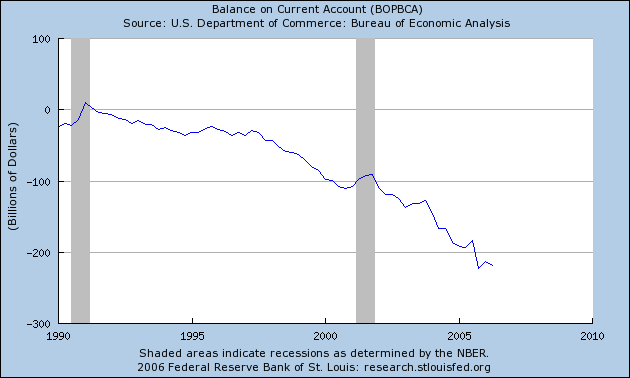
(1) Foreign individuals, institutions, and governments own a huge and rapidly growing quantity of US assets. This is dramatically shown in a graph of the US current account balance showing how many more goods and services* people in the US buy from foreigners than they sell to them. This goods and services deficit is covered by purchases of US Treasury Securities and other US investments by foreigners.

{Click to enlarge. My source: http://i17.photobucket.com/}
(2) Other advanced industrial nations need to sell their assets to foreigners but their negative account balances are much smaller. A table in the CIA World Factbook shows that the advanced industrial nation with the next largest negative balance (UK) has a negative balance a good deal less than one percent of the US negative balance (about $58 trillion vs about $862 trillion).
(3) The countries with the largest positive balances are China, Japan, Russia, Saudi Arabia, and (a bit of a surprise) Germany. Though large, the combined surpluses of China, Japan, Russia, and Saudi Arabia are only equal to 65% of the US deficit. The other countries with large positive balances are for the most part oil producers, like Saudi Arabia, or industrial nations in Europe, like Germany.
(4) There's a risk that individuals, institutions, and central bankers in countries with large postive balances will disrupt the US economy by deciding not to fund the US negative balance. This risk is said to be negligible because the disaster that would result would greatly injure the economies of those countries.

That said, there's a new set of fears:

Although individuals and institutions in the countries with the largest positive balances have bought a whole variety of US assets -- stocks, bonds, and real estate as well as Treasury Securities, the central banks of these countries have tended to use their surplus cash to make extremely conservative investments, mostly purchases of US Treasury Securities. This situation is rapidly changing as the central banks are setting up Sovereign Wealth Funds which they use to invest in stocks, bonds, and real estate. This graph gives some idea of the size of SWFs.

{My source: http://goldseek.com/}

The first fear is that the SWFs will increasingly put their investments outside the US. This fear stems from the slow down in the US economy, particularly in contrast to other advanced industrial economies. On the whole, the US slow down is good news since it means the economy is gradually retreating from overheating (as represented by the melt-down in housing). The fear arises as the US economy is seen to lag and investments elsewhere become more attractive. This lag can be seen in this graph showing the gap between the gross domestic product of the US compared with the rest of the world.

{My source: http://www.ers.usda.gov/}

The second fear is that a country such as China or Russia could use its SWF to interfere in the internal affairs of the US. Think of the way the US likes to put pressure on Japan to prevent Japanese automakers from destroying the US auto industry.

A recent blog entry on the Financial Times web site points discusses the growth of SWFs and points to some of the potential outfall of this growth: Sovereign wealth funds and the $2,500bn question

Extracts:
Sovereign wealth funds are rapidly becoming a huge force in global markets and economies, as the world is seeing in China's move to kick off its own SWF with a $3bn investment in the IPO of private equity group Blackstone. But equally compelling issues lie ahead in the nature and operation of these often opaque investment vehicles, says the FT.

Driven by trade surpluses unequalled as a percentage of the global economy since the beginning of the 20th century, official reserves held by some governments are now astronomically high, amid mounting pressure to earn better returns by putting the money with specialised investment agencies.

How and where this massive – and often secretively managed – pool of funds is deployed will be one of the big investment themes of coming years.

The IMF warned recently of the risks arising from the fact that public sector institutions such as SWFs are now large players in world financial markets.
A column in the Washinton Post gives a more acute presentation of risks:

The Next Globalization Backlash
Wait Till the Kremlin Starts Buying Our Stocks
By Sebastian Mallaby

Mallaby says SWFs are large and growing. Financial reserves held by central banks has more than trebbled over the past five years. This money is finding its way into SWFs. To take one example, the SWF of the United Arab Emirates is estimated at a trillion dollars. SWFs are virtually inevitable. The countries that set them up first, years ago, have profited greatly. A recent book** declares that governments would be irresponsible if they did not set them up.

Here's his statement of the fear:
Chunks of corporate America could be bought by Beijing's government -- or, for that matter, by the Kremlin. Given the Chinese and Russian tendency to treat corporations as tools of government policy, you don't have to be paranoid to ask whether these would be purely commercial holdings.

But the final straw may be that even the least threatening form of investment -- the purchase of publicly traded equities -- will not escape controversy. This is because of that second upheaval: the advent in the United States of something approaching shareholder democracy. As Alan Murray writes in his new book, " Revolt in the Boardroom," companies are no longer controlled by all-powerful CEOs. Instead, chief executives increasingly live in fear of activist shareholders and directors. Bosses from Harry Stonecipher of Boeing to Carly Fiorina of Hewlett-Packard have been ejected from the corporate suite in a manner that would not have been conceivable a generation earlier.

What if the Chinese are seen to have a hand in the firing of some future Fiorina? The more shareholders exercise power, the surer the backlash against governments that buy up chunks of the stock market.
======
Notes
*Actually not just goods and services, but also income from US investments abroad and net unilateral current transfers (such as foreign aid).
**This book is forthcoming from a UK publisher: Sovereign Wealth Management; see the chapter by Larry Summers, former US Secretary of the Treasury, Opportunities in an era of large and growing official wealth.

Friday, June 29, 2007

motivatin'

I've had the rockabilly song Maybellene in my head all week. Maybe that's 'cause I could use some motivatin'.

Chuck Berry first recorded the song in 1955. Here he is on Youtube in an undated performance which sounds like it might date back that far.
There are many covers, including one by Simon & Garfunkle at Central Park in 1981.

Here's the lyric:
Maybellene

Maybellene, why can’t you be true?
Oh maybellene, why can’t you be true?
You’ve started back doing the things you used to do.

As I was motivatin’ over the hill
I saw maybellene in a coup de ville.
A cadillac a-rollin’ on the open road,
Nothin’ outrun my v8 ford.
The cadillac doin’ ’bout ninety-five,
She’s bumper to bumber rollin’ side by side.

Maybellene, why can’t you be true?
Oh maybellene, why can’t you be true?
You’ve started back doing the things you used to do.

Pink in the mirror on top of the hill,
It’s just like swallowin’ up a medicine pill.
First thing I saw that cadillac grille
Doin’ a hundred and ten gallopin’ over that hill.
Offhill curve, a downhill stretch,
Me and that cadillac neck by neck.

Maybellene, why can’t you be true?
Oh maybellene, why can’t you be true?
You’ve started back doing the things you used to do.

The cadillac pulled up ahead of the ford,
The ford got hot and wouldn’t do no more.
It then got cloudy and it started to rain,
I tooted my horn for a passin’ lead
The rain water blowin’ all under my hood,
I knew that was doin’ my motor good.

Maybellene, why can’t you be true?
Oh maybellene, why can’t you be true?
You’ve started back doing the things you used to do.

The motor cooled down, the heat went down
And that’s when I heard that highway sound.
The cadillac a-sittin’ like a ton of lead
A hundred and ten a half a mile ahead.
The cadillac lookin’ like it’s sittin’ still
And I caught maybellene at the top of the hill.

Maybellene, why can’t you be true?
Oh maybellene, why can’t you be true?
You’ve started back doing the things you used to do.


{Chuck Berry in 1955
Sources: http://arted.osu.edu/160/images/50rnr/berry.gif and http://www.rocksbackpages.com/furniture/artists/berry_chuck.jpg}


{source: http://content.answers.com/}


http://shawnpatton.com/roadtrip/pink_cadillac.jpg
{1954 Cadillac Coupe de Ville; source: http://shawnpatton.com/roadtrip/pink_cadillac.jpg}


{1950 V8 Ford Custom Sedan; Click here for more photos; source: http://www.chooseyouritem.com/classics/files/127000/127328.html}
I have a feeling that the guy singing the song owns a '50 Ford with its flathead V8. Maybe because one of my best friends drove one -- all customized and souped up. It overheated just like the one in the song, but it wasn't near so fast. I pick 1954 for the model year of the Cadillac thinking Maybellene would probably go for a guy with a late model of that car. I didn't know anyone who owned a pink Cadillac, but I used to service a Series 62 black '54 four-door sedan when I worked summers in the local garage.
{Click to enlarge. Source: http://www.misterw.com/Cadillac/54Cad4Dr06b.jpg}


Extract from the "Chuck Berry" page
On the advice of blues great singer Muddy Waters, Chuck contacted Leonard Chess of Chess Records in Chicago. Chess and his house producer Willis Dixon were intrigued by "Ida Red", the piece that was performed by the Sir John's Trio and written by Berry. The song was revamped, named "Maybellene" and recorded in 1955. Alan Freed, a very popular disc-jockey, was given a copy of the single that he played for two hours continuously on his show in New York on radio station WINS. "Maybellene" went on to sell in the excess of one million copies and grabbed the number one spot on the R&B chart as well as number five on the Hot 100.

Berry's success could not be fully enjoyed, however, because the copyright for "Maybellene" was not his alone. It also listed the names of Alan Freed and Russ Frato, resulting in a reduced level of royalty payments to Berry. Around the same time, Chuck also became aware that his manager was pilfering funds from Berry's live performances. Having developed a hard-edged attitude toward show business, Berry soon acquired a reputation for being difficult to work with because of his intense desire to be in control of his own affairs.

Extract from the Chuck Berry article in Wikipedia
In December 1959, after scoring a string of hit songs and while touring often, Berry had legal problems after he invited a 14-year-old Apache waitress whom he met in Mexico to work as a hat check girl at Berry's Club Bandstand, his nightclub in St. Louis. After being fired from the club, the girl was arrested on a prostitution charge and Berry was arrested under the Mann Act. Berry was convicted, fined $5,000 and sentenced to five years in prison. This event, coupled with other early rock and roll scandals — such as Jerry Lee Lewis' marriage to his 13-year-old cousin and Alan Freed's payola conviction — gave rock and roll an image problem that limited its acceptance into mainstream U.S. society. However, when Berry was released from prison in 1963, his musical career enjoyed a resurgence due to many of the British Invasion acts of the 1960s — most notably the Beatles and the Rolling Stones — releasing cover versions of Berry's songs. In 1964–65 Berry resumed recording and placed six singles in the U.S. Hot 100, including "No Particular Place To Go" (#10), "You Never Can Tell" (#14), and "Nadine" (#23).
Addendum: Why motivatin' and not motorvatin'? I don't feel a lack of the latter, so much as the former.

Another: Chuck Berry took the melody for Maybellene from a 19th-century fiddle tune called Ida Red. According to Wikipedia, he'd heard it in 1938 done by Bob Willis. Here's a Youtube of Willis and his Texas Playboys.


PappyStuckey, who put the video on YT, says: "Brother Bob with his best Snader Telescription, I think... Joe Andrews takes the vocal with great fiddle, steel and piano solos from Bob, Joe Holley, Bobby Koefer and Skeeter Elkin along with especially hot guitar from the underappreciated Cotton Whittington. Western Swing fans take note -- look closely for Ocie Stockard on banjo."


One more: Why Mabellene and not Maybelline? The nice Wikipedia article on the song says the two are often confused.

patron saint of catalogers

Library humor is a tad lame and, within that category, cataloging humor can hardly be said to exist at all. This post, from my blog where I work, is about as good as it gets. I credit my source page at bottom. I should have done this post on the solstice, but forgot.

June 21, 762 A.D.

Death of St. Minutia, patron saint of catalogers. The birth date of St. Minutia is unknown. The only reliable chronicle has an unlucky lacuna: "Sa. Minutia in [.......an]no domini nata est", where only the last two missing letters can be supplied with any certainty. Vitae of the saint written later naively abbreviate the "...no domini" as 'n.d.', and this is the form traditionally cited for her birth. Minutia is said to have been born in the former Roman province of Nova Panonia (part of the present day Czech Republic), in the village of Sineloco (modern day Odnikud). Her time and place of birth, therefore, are usually given as "s.l., n.p., n.d."

Happily, a generous amount of hagiographical material on St. Minutia has survived, perhaps the most popular of which is a collection of her homilies and sayings, including the motto most closely associated with her: "Non pilus tam tenuis ut secari non possit."* She appears to have had some interest in ecclesiastical architecture; one early vita has references to a church which was built using plans drawn up by Minutia herself. The actual building has not survived, but there is a fragment from a contemporary description: "On either side of the main entry, St. Minutia caused innumerable added entries to be placed, such that people marvelled at the great multitude of doors, and rebuked the Saint for the labor wasted in putting them there. 'No labor has been wasted', she answered them patiently, 'for by these means no one will be barred from my church through a lack of access.'" Another account explains that her plans were an improvement on earlier designs which had called for a single entry at the east end, near the tabernacle; the inconvenience of relying on this so-called corporate entry was immediately recognized and rectified by the saint.


St. Minutia using a sword to split a hair

She was, not surprisingly, an influential member of her convent. There are a number of references to her reorganization of its agricultural property: she is said to have divided the land into holdings devoted to permanent crops (fixed fields) and holdings given over to crop rotation (variable fields). The variable fields were further divided into smaller parcels (subfields) assigned individually to peasants attached to the convent. Minutia is also renowned for her role as a mediator between the warring factions so prevalent in those chaotic times. She was continually optimistic in even the most threatening circumstances and was careful never to anticipate a conflict, although she quickly resolved them when they arose.
------------------------------------------------
*translation: There is no hair too fine to be split.

From: GREAT MOMENTS IN THE HISTORY OF TECHNICAL SERVICES

Thursday, June 28, 2007

desertification

A news search on the term "desertification" turns up lots of stories. Most stem from a press release of a study conducted by the the United Nations University. What's striking is the scale of the problem and the linkage of cyclical draughts, such as those in Africa, to global warming. The study says maybe 50 million people will flee from newly arid lands in the next 10 years.

Desertification is mainly caused by climate change, erosion, and degradation of soil in dryland areas. Crop raising based on irrigation, cattle farming, and other traditional farming practices exacerbate the problem. The report says the process might be halted by new forms of agriculture, such as encouraging forests in dry land areas. But care must be taken or efforts to help will make matters worse. For example the author of the report says that a tree-planting program in China won't stem the advance of deserts because the trees being planted needed large amounts of water, putting even more pressure on scarce resources.

Here's the press release followed by some images and links:
Desertification: UN experts prescribe global policy overhaul to avoid looming mass migrations

Desertification, exacerbated by climate change, represents “the greatest environmental challenge of our times” and governments must overhaul policy approaches to the issue or face mass migrations of people driven from degraded homelands within a single generation, warns a new analysis from the United Nations University.

Contact: Terry Collins
terrycollins@rogers.com
416-538-8712
United Nations University

In the analysis for presentation June 28 at UN Headquarters, New York, UNU experts say the loss of soil productivity and the degradation of life-support services provided by nature pose imminent threats to international stability. They outline a multi-point prescription for policy reform at every level of government.

“It is imperative that effective policies and sustainable agricultural practices be put in place to reverse the decline of drylands,” says Prof. Hans van Ginkel, UN Under Secretary-General and Rector of UNU.

Land use policy reform is urgently needed to halt overgrazing, over-exploitation, trampling and unsustainable irrigation practices, as are policies to create livelihood alternatives for dryland populations, he says.

Based on input of 200 experts from 25 countries convened in Algiers late last year, the analysis urges governments to adopt a broader, overarching view and a more coordinated, integrated and interlinked approach to dealing with desertification, climate change, poverty reduction and other public concerns.

It highlights dozens of problems and inconsistencies in policy-making today at every level, saying decisions are often taken in isolated sectoral silos, the end results of which, on balance, can be counterproductive.

“Some forces of globalization, while striving to reduce economic inequality and eliminate poverty are contributing to worsening desertification. Perverse agricultural subsidies are one such example,” says Prof. van Ginkel.

One-third of all people on Earth – about 2 billion in number – are potential victims of desertification’s creeping effect. And, left unchecked, the number of people at risk of displacement due to severe desertification is an estimated 50 million over the next 10 years – a sweep of migrants worldwide equal in number to the entire population of South Africa or South Korea.

“Addressing desertification is a critical and essential part of adaptation to climate change and mitigation of global biodiversity losses,” says Prof. van Ginkel. “UNU has led the argument over the last decade that such inter-linkages in policy formulations must be taken.”

“Reforming policies to combat desertification also represent one of the world’s most expedient ways to sequester more atmospheric carbon and help address the climate change issue,” says Zafar Adeel, lead author of the analysis and Director of the UNU’s Canadian-based International Network on Water, Environment and Health.

Policy formulation for combating desertification “has been hindered by the lack of concrete data about rates and extent of desertification,” he adds. “We must, as the global international community interested in desertification, put monitoring and assessment at the top of our policy agenda.”

Desertification shows no sign of abatement: An “environmental crisis” with major impacts

UNU says the main barrier to expanding isolated successes at combating desertification is “the lack of effective management policies.”

In some countries where policies are deemed conducive to addressing desertification, enactment and implementation falls short. Or, designed and implemented at a national level, policies fail to translate into local action. Worse, some policies provide perverse incentives, exacerbating competition and conflict over the use of land and natural resources.

Among many recommendations, the report urges governments and policy-makers to:
    * Reject the notion that aridity and water scarcity are inevitable;
    * Create financial incentives for pastoralists and other dryland users to preserve and enhance the ecosystem services their land provides to all;
    * Accept the carbon sequestration as a measure for simultaneously combating desertification and climate change. While vegetative cover in most drylands is sparse, drylands represent more than 40% of global land area, providing immense opportunities for carbon sequestration;
    * Foster alternative, sustainable livelihoods for dryland dwellers, including non-agricultural jobs in industry and tourism, for example;
    * Yield ownership and decision making to communities: empower them to take charge of land on which they depend and end the pattern of individuals chasing environmentally-detrimental short-term gains;
    * Promote greater transparency and accountability, the participation of multiple actors, information sharing, measurable results, and follow-up systems;
    * Better educate local populations and policymakers, many of whom lack adequate awareness of the fragility of their natural resource base and, in some places, fail to understand fundamental concepts of "drylands" and "desertification;"
    * Put science at the heart of policy making and beef up research on emerging issues such as thresholds or "tipping points" as they relate to migration and desertification; and
    * Improve coordination at all levels:

    Nationally: harmonize policies dispersed across a range of government ministries and agencies; rationalize and link the wide assortment of development, poverty reduction and environmental policy frameworks, independently conceived and "each in their own orbit," to encourage synergies and integration;

    Regionally: to help address transboundary issues such as integrated river basin management and environmental migration; and

    Internationally: better relate global conventions, agreements and other initiatives one to another. The analysis says the separate constitutions, priorities and procedures involved in administering the mix of international agreements operating today prevent important synchronization needed to achieve broad social and environmental goals: food security and famine relief, conflict and migration prevention, better health and poverty reduction, desertification and climate change avoidance and biodiversity protection and enhancement.
The authors urge governments to better define and understand environmental migration – its economic and ecological consequences, and to create a global framework to legally recognize and assist environmental refugees.

“The expected climatic change scenarios as projected by the recently published report of the IPCC give an additional dark shade to an already gloomy picture. However it is difficult to properly quantify the number of environmental migrants and the migration routes as long as the concept itself remains debated even from a scientific point of view,” the analysis says.

UNU advances a classification scheme based on three subgroups of migrants driven predominantly by environmental reasons:
    * Environmentally motivated migrants
    * Environmentally forced migrants
    * Environmental refugees
Finally, the analysis says governments need to measure progress in human-development terms and develop a common set of environmental indicators and data collection methods to enhance consistency for tracking and comparison purposes.

###

United Nations University

Established by the U.N. General Assembly in 1973, United Nations University is an international community of scholars engaged in research, advanced training and the dissemination of knowledge related to pressing global problems. Activities focus mainly on peace and conflict resolution, sustainable development and the use of science and technology to advance human welfare. The University operates a worldwide network of research and post-graduate training centres, with headquarters in Tokyo.

UNU-INWEH began operations in 1997 to strengthen water management capacity, particularly of developing countries, and to provide on-the-ground project support. With core funding from the Government of Canada through CIDA, it is hosted by McMaster University, Hamilton, Canada.

source: http://www.worldrevolution.org/


source: http://www.the-human-race.com/pages/about_desertification.htm


Deserts are shown in yellow. Threatened areas are in orange; the darker the color, the greater the threat. Click to view full size; source: http://www.mazerolle.fr/demographie/cours2006/chapitre-03S3d.htm


Links:

UN issues desertification warning
By Matt McGrath
BBC environment reporter
Desertification could displace up to 50m people over the next decade
Tens of millions of people could be driven from their homes by encroaching deserts, particularly in sub-Saharan Africa and Central Asia, a report says. ...

DESERT VOICES
Oral Testimony - Perhaps nowhere in the world are the impacts of desertification more challenging than in Africa, where it is inextricably linked to poverty, migration and food security. These personal accounts from Sudan and Ethiopia highlight the wide-ranging consequences of desertification, from migration for work and conflict over resources, to changes in traditions and women’s roles...

Severity Of Desertification On World Stage
Science Daily (press release) - Jun 19, 2007
Science Daily — Desertification puts the health and well-being of more than 1.2 billion people in more than 100 countries at risk, according to the United ...

Likely Spread of Deserts to Fertile Land Requires Quick Response, U.N. Report Says
The New York Times
By ELISABETH ROSENTHAL
Published: June 28, 2007
ROME, June 27 — Enough fertile land could turn into desert within the next generation to create an “environmental crisis of global proportions,” large-scale migrations and political instability in parts of Africa and Central Asia unless current trends are quickly stemmed, a new United Nations report concludes....

Desertification
From Wikipedia, the free encyclopedia
Desertification is the degradation of land in arid, semi arid and dry sub-humid areas resulting from various climatic variations, but primarily from human activities. Current desertification is taking place much faster worldwide than historically and usually arises from the demands of increased populations that settle on the land in order to grow crops and graze animals....

Monday, June 25, 2007

u might c me

1.
    I left my picture on th ground wher u walk
    so that somday if th sun was jst right
    & the rain didnt wash me awa
    u might c me out of th corner of yr i & pic me up
2.
    Your eyes are the blue
    of the deep end of the pool
    the world
    has been put through the rinse cycle
    and dries in the sun
    and i am happy

2 from th txt msg poetry cmpititn in th Guardian. 2002 but nu to me.

Wednesday, June 20, 2007

catching up with Joost

Joost Posthuma gives an update on his website. He says he's mending well and is free of pain. He passed an endurance test last Wednesday, goes to physical therapy daily, and hopes to start in training camp early in July. All going well, he thinks he might be able to enter the Sachsen Tour, beginning July 29 in Dresden.
{photo credit: http://www.joostposthuma.nl}

what you say

In a column entitled Words Of Mass Infuriation Anne Applebaum takes notice of an article in The Telegraph on the annoying things people say. Articles on language tend to be tedious debates between pedants and pragmatists, or at best vehicles for some tepid humor. The one in the Telegraph is somewhat each. My favorite example of the British vacilation between its own and our American clichés comes from a reader named Nick Godfrey who wrote:
I hear what you're saying but, with all due respect, it's not exactly rocket science. Basically, at the end of the day, the fact of the matter is you have got to be able to tick all the boxes. It's not the end of the world, but, to be perfectly honest with you, when push comes to shove, you don't want to be literally stuck between a rock and a hard place. Going forward we need to be singing from the same songsheet but you can't see the wood from the trees. Naturally hindsight is 20/20 vision and you have to take the rough with the smooth before proceeding onwards and upwards. The bottom line is you wear your heart on your sleeve and, when all is said and done, this is all part and parcel of the ongoing bigger picture. C'est la vie (if you know what I mean).
Applebaum's piece, which focuses on political verbal pablum, stimulated a fine contribution from a reader with the email handle kenonwenu:
The government nowadays speaks a language I would describe as Orwellian-Manichaean.

Remarks by the President on Homeownership at the Department of Housing and Urban Development, Washington, June 18, 2002
http://www.hud.gov/news/speeches/presremarks.cfm

"Let me first talk about how to make sure America is secure from a group of killers, people who hate -- you know what they hate? They hate the idea that somebody can go buy a home. They hate freedom; that's what they hate...

..I want to thank the choir for coming, the youngsters for being here. I just want you to know that, when we talk about war, we're really talking about peace."


{cartoons from the Telegraph article}

Monty Panesar's good days


{source: http://uk.eurosport.yahoo.com/20062007/58/monty-cracks-world-elite.html}

Monty Panesar has been all over the cricket press lately. He was instrumental in finishing off the West Indies team in the just-ended npower Test series in England. He's also become the highest rated spin bowler for England in 30 years.

Read this account of Monty's performance yesterday, one of the highlight moments of the Test: Panesar spins England to victory


{source: CricInfo has this an other excellent photos.}


The West Indies captain Daren Ganga praised Panesar's skill at keeping the pressure on his batsmen. An article in the Gulf Times quotes him as saying “He’s definitely there in the top three (spinners) as he’s winning games for England." “He’s having a heavy influence in terms of test matches that England have won. I definitely think he’s a top-class spinner.” The article says Panesar, 25, is trying not to put too much pressure on himself and says he recognized that the playing field favored his style.

There is much comment in the press about Monty's emotionalism and the rebuke he received from the umpire for his excessive celebrations. “He was saying that I should appeal before I start celebrating,” Panesar said with a smile. “I guess I get a little excited while I’m out there.”

AFP has a good overview of Monty's achievements: Panesar to keep Monty mania in check. A couple of excerpts:
Off the field Panesar, the first Sikh to play Test cricket for England, is ... a non-drinker and non-smoker, unlike [another exuberant] left-armer whose private life became the subject of some lurid newspaper headlines.

Panesar has been mocked for his poor fielding and now, in England at least, every time he succesfully gathers and returns the ball he is cheered, albeit in a supportive if patronising fashion, by spectators. However, on Monday, he surprised a few people by dismissing Darren Sammy caught and bowled following the all-rounder’s well-hit drive.
Monty has been characteristically modest about his success, crediting the advantageous pitch and his own luck as well as skill and perseverance.

{caption: Bell (right) executes a smart catch to end Corey Collymore's brief innings and hands Panesar his 10th wicket of the match; source}

Saturday, June 16, 2007

a small mystery of research

I'm reading the Diary of Robert Hooke. He was one of the prime movers of the scientific revolution during the latter part of the seventeenth century and a man of strong likes and dislikes. The Diary is not a literary exercise, like Samuel Pepys', but a terse, compressed, aid to memory.

Hooke was extremely active, making daily visits to places of work, to the homes of acquaintances and business contacts, to booksellers, to merchants, and to coffee houses. This busy-ness is well-summarized by Lotte Mulligan{fn1}. As example of it, I've copied a week's worth of entries at the bottom of this post.

These days I'm doing research on one of his acquaintances, a man who, like himself, was a Fellow of the Royal Society. On Feb 25, 1673, Hooke wrote of this man that he "reviled the Royal Society scandalously for not subscribing his proposals about Barnardinus Caldus."{fn2} This was an uncharacteristic outburst. I've seen no other like it in my research and I immediately began to seek out information about the incident. It took most of a morning to gather enough for some preliminary findings.{fn3}

First, it seems the person rendered by Hooke as Barnardinus Caldus was referred to by my man as Bernardinus Baldus (in a letter to John Beale, Aug 20, 1672; Rigaud, vol. 1, p.200).

More searching revealed that Bernardinus Baldus was more commonly called Bernardino Baldi (or Bernadino Baldi), an all-around Renaissance fellow (1553-1617) There's much to learn about him - see the Galileo Project entry for a summary.

In his letter to Beale, my man says "As to the Manilius, the ingenious Ed. Sherburne, Esq. Clerk of his Majesty's Ordnance, hath made an excellent English poem of it, with modern additions; and it is now printing. He was willing to have disbursed £20 for a copy of Bernardinus Baldus his three voll. of the lives of mathematicians, who died but in 1617; the heirs are covetous, and demand 900 pistoles, to the destruction of a design like Stanley's."{fn4} There's much to say about this statement. The gist is that my man wanted to achieve the publication, in English, of a manuscript of Baldi's, a multi-volume work on the lives of mathematicians. The phrase 'design like Stanley's' links Baldi's project to Thomas Stanley's The history of philosophy, a set of biographies of the famous philosophers of antiquity (1655).

The reference to Manilius is to a draft of Edward Sherburne's book The sphere of Marcus Manilius which would be published a couple of years later. In it, Sherburne gives a biographical listing of astronomers and their works. He also issues a warning about the loss of manuscripts from ancient times to his day and warns specifically about the possible loss of the Baldi manuscripts, referred to as "... those of the learned Bernardinus Baldus, Abbot of Guastalla, mentioned at the End of his Comment on Aristotle's Mechanicks, amongst which are two Volums of the Lives of Mathematicians, whereof Bartholinus in his Preface to the Edition of the Optick Fragments of Heliodorus Larissaeus, Printed at Paris 1657. gives an honourable Elogium." (p.117)

I conclude from all this that my man asked the Royal Society to fund the acquisition and publication of the Baldi work and the RS refused. His scandalous revilement of the Royal Society reveals his passion for advancing mathematics in particular and science in general through "intelligence" (the acquisition and sharing of information about the work being done by mathematicians) and encouragement (a parallel effort to get published as much of this work as possible). Sherburne, who knew my man well, tells us more:
We should be injurious to him, if we did not farther inlarge, by telling the World how much it is obliged for his Pains in exciting the Learned to publish their Works, and in acting the Part of an Ingenious Obstetrix at the Press, in correcting and in drawing of Schemes; So that he hath been Instrumental in furnishing the World with the many learned Mathematical Books here lately published (for which, his chief Reward hitherto hath been to obtain from the Learned the Title of Mersennus Anglicanus) and many more may be expected, if moderate Encouragements towards Printing such Works, and Leisure for such an Affair be not impeded through the necessary Avocations for a livelyhood, and though it be besides my Design, yet I cannot but digress in giving him and others like minded (which are very rare to be found) their due commendations, in promoting the laudable Design of getting Learned Men to impart their Labours to be Printed; and exciting others to encourage the same, as being of singular Use and advantage to the Republick of Learning; through the want whereof many Learned Mens Works of much worth have been lost, suppressed or long delayed.{fn5}


====================

Here is a sheet from the original diary of Robert Hooke:

Source: http://www.nmm.ac.uk/server/show/conMediaFile.4883


Here are two transcribed pages for the middle of June in 1675; click to enlarge to full size.

{source: Diary of Robert Hooke, ed. Henry W Robinson and Walter Adams (London, 1935) - fair-use reproduction.}


The text reads:

DIARY OF ROBERT HOOKE

- Wednesday, June 9th.--Agreed with Hayward for floor and frame of scales. Saw Scarborough's Draught. At Bedlam, agreed about the sewer, tile window under gallery, oak door cases, etc. At Garaways. The news of the parliaments prorogation to the 13th of October. Message from Mr. Dubois. Mr. Piercehouses view in Love Lane.
- Thursday, June 10th. -- At View in Nicholas Lane 0G. from Dr. Bradford. At Bankes. At Guildhall, Oldfields and Dr. Chamberlane and Dutch. Spoke to Sir Th. Player he promised my money next week and appoiuted me to come to him. DH. A little meethlg. I reproved Oldenburg for not Registring Experiments. Brouncker took his part. At the Taverne. With Sir J. More at Coffee. He told me of Lingars Experiments. Signior a Drunken huff with Chace and Coyne. Sir J. More had tryd his watch and approved it.
- Friday, June llth. With Mr. Fitch to Mr. Mountacues. Alt agreed. To Sir Chr. Wrens. To Tompions. DH. Met Buckworth, Rider and Curler at 3 in Winchester Street. To Garaways. Davis and Hayward brought news from Curler of his huff and Oliver.
- Saturday, June l2th. -- Fitting Helioscope and watch at Physicians College. Left Deans watch with Tompion who mended balance. At Bloomsbury met Mallet. Left Cane at Coxes for ferrule. Saw his new house. At Sir Ch. Wrens. He promised me a chamber by the Park Stairs. DH. Slept. Haak. With Sir J. Cutler. Davis indeavoured to overreach me by measur &e 1/2. Sir J. Cutler at Blagrove, took Haywards papers for floor and seats. Drunk. promised to pay whatever I signed to be paid. -- At Garaways, Leak, Tompion. Tompion here all night. Much rain. Heard of Lingars Experiment without Morefields. At the Dean of Canterbury. Mrs. Cox spoke about will. Books a guift. I want one.
- Sunday, June 13th. -- Cloudy morn noe Eclipse to be seen. I took 1/2 3 of Gua. Guag. Wrought little. Boyld 2 pipkins of Hagiox. Went not out all day. Tompion here. Wrote this Account. One day this last week I revived my old contrivance for Pocket watch by cutting the Ballance in two and inserting the halfs joynd by two side pieces. See the figure. ~ Not alterable by any, they fitted the Deanes watch well. Much afeard of nose. Tompion. Resolved to proceed.
- Monday, June 14th, and Tuesday, June 15th.--[No entries.]
- Wednesday, June 16th. -- The morning overcast and blustering afternoon fair and mild. ~ 170. wind North. Received as a present from Coll. Richards 12 bottles of Port oport. Lent Tompion, Fosters Miscellanys and Streets Astronomy. Bought of Scot, Mons. Arcoud Nouvelles Elemens de Geometric. Sir J. Cutler signd and seald Haywards papers.
- Thursday, June 17th. -- At Mr. Montacues and at the ground with Mr. Russell and Montacue. Noe councell. Society Read Dr. Grew. Outlandish physitian. Oldenburg a Rascall. I propounded my theory about the digestion of liquors, about Putrefaction, about the parts of Liquors working one upon another, &c. Received from Brounker order for receiving from Chest. Received it from Collonel Richards. Received also Hay Grains his bowle of silver from him. Gave J. Clay 5 shill.
- Friday, June 18th. -- [No entry.]
- Saturday, June 19th. -- Sent Scarborough with Leake to measure Bloomsbery. Sir Th. Player promised money -- 3 days hence. Began to drink strong water and brandy.
- Sunday, June 20th. -- Grace and I drank Senna. It wrought well with me not with Grace. DH. Tompion here. At Garaways. Finished Montacue Draughts.
- Monday, June 21st. -- To the King met Mr. Montacue in the Park. Brouncker had Zulichems watch. To Leicester house, Scarborough and Chivers plot Of Ground. Mullet fals. Sir Chr. Wren faild. DH. At Dean Tillotsons Delivered Watch. (Noe Will.) Met Mr. Axe he promised Wednesday.
- Tuesday, June 22nd. -- All the morn at Mr. Montacue, Chace and T. Fitch. Lane and Fitch disappointed. J. Fitch cavilld. DH. At Sir Ch. Wren order to view spittlefields for Title, and to direct Observatory in Greenwick park for Sir J. More. He promisd money. Chess with Haak. Saw books at Faithornes of Webb about fortifications and Engines. Met Scowen and Shaw at Divill taverne. Thence to Kingsland till 11 at night. Dr. Tillotson out of Towne.
- Wednesday, June 23rd. -- At Sir J. Mores. Walkd with Aldworth. With Sir J. More to Faithornes. With Mr. Hoskins and Dr. }{all at Tompions. Borrowd of Dr. Ball Voyage al'Athens. DH. Disappointed Hoskins. Dancing Masters view 10sh. at Scots. At the Colledge.

Here is the citation for the manuscript in the Guildhall Library, London:
Author or Name Hooke, Robert, 1635-1703.
Title Diary kept from 10 March 1671/2 to 16 May 1683.
Notes The folio commencing 6 January 1672/3, and bound up after fo. 20 in this volume, should follow fo.8. At the back of the volume are miscellaneous notes including lists of books and papers (some belonging to the Royal Society) borrowed and lent by Hooke, 1666-81.
Most of the diary was published in 1935 as "The Diary of Robert Hooke 1672-1680" edited by Henry W Robinson and Walter Adams (a copy is held in the Printed Books Section at B/H 782). The publication includes entries from 1 August 1672 and the full manuscript is printed from 1 January 1673 to 31 December 1680.
Ms number Ms 01758
Bib Id 407692
=======================
fn1: Mulligan's description is on the sample first page; you don't need a Jstor subscription to view it.
fn2: 1673: Since it would be many years before Britain adopted the reformed, Gregorian, calendar, it was -- from January through March -- 1673 there and 1674 on the Continent. Explanation here.
fn3: My main search tools: Google Book Search, Dogpile metasearch, Early English Books Online, and the catalogs of the Library of Congress, Folger Library, and British Library.
fn4: Pistoles: Wikipedia says "Pistole is the French name given to a Spanish gold coin in use in 1537; it was a double escudo, the gold unit. The name was also given to the Louis d'Or of Louis XIII of France, and to other European gold coins of about the value of the Spanish coin. One pistole was worth approximately ten livres." Of livres, it says, "The livre was established by Charlemagne as a unit of account equal to one pound of silver. It was subdivided into 20 sous (also sols), each of 12 deniers. The word livre came from the Latin word libra, a Roman unit of weight. This division is also seen in the old English pound sterling, which was divided into 20 shillings, each divided into 12 pence."
fn5: We know that Sherburne knew my man well through internal evidence, their mutual association with the Royal Observatory, and a diary entry of Hooke that links them. Mersennus Anglicanus is a reference to Marin Mersenne, 1588-1648, a famous French mathematician who used meetings and correspondence to inform other mathematicians of each others' advances.

Friday, June 15, 2007

photosynth!

Richard Wallis has a post on the Panlibus blog about photosynth: MS Photosynth - Jaw-dropping demo.

photosynth He says "Take yourself to this video of a presentation at the 2007 TED ConferenceDon't argue just take a look!."

And he gives a link to the application itself: photosynth.

He closes by connecting a few dots: "Next, mash together in your mind this, plus the Microsoft Surface technology and the Mulltitouch technology that I've discussed before. Finally, go lay down in a darkened room and imagine the way we will interact with our digitized resources in a few years time."