Monday, January 24, 2011

an obituary

My father said that his grandfather, Louis Windmuller, kept a diary but I've not seen it and know of none who have. You'll find articles by and about him in the newspapers and magazines of his day but will find in them almost nothing personal. They're not about himself but rather give his thoughts and deeds toward making things better in the world. He did write a few pieces that tell what he could recall about the merchants of New York and the business slumps they endured, and these do give personal anecdotes of "the writer," as he styled himself. However they provide nothing approaching the connected story of a memoir.[1]

There's one long letter which he sent back to his German aunts and grandfather soon after immigrating to New York. In it he marvels at the boistrous, polyglot city where he wanders daily, penniless and looking for work; he complains that almost all the family relations whose names he's been given have been unhelpful; and he expresses both determination and hope that a cousin who's taken him in will give him the opportunity to make good. There's no further correspondence showing how he did indeed make good, and then proceed to do good as well.[2]

Little can be found which allows us to imagine what it would be like to spend a few moments with this friendly and outgoing man, and that, to me, makes the following obituary in the New York Evening Post a valuable find. See whether you agree.

I give the text first and then a scan. I've used both hyperlinks and footnotes to convey explanatory context. Since the hyperlinks disrupt reading somewhat I haven't wished to add the further disruption of numbered footnotes and for this reason simply repeat phrases from the text in the unnumbered notes section at bottom.
The Evening Post, October 2, 1913

Louis Windmuller Dead

He Had Long Been a Familiar Figure in New York

Trustee of Title Guarantee and Trust Company, Banker, and a Director in Several Corporations — A Great Walker — Some Interesting Reminisces of His Early Days


Louis Windmuller, trustee and one of the organizers of the Title Guarantee and Trust Company, and a familiar figure in New York Life for half a century or more, died yesterday in his home at Woodside Heights, Queens Borough, at the age of seventy-eight.

Louis Windmuller, one of the best-known German-Americans of the days of Carl Schurz, Gen. Franz Sigel, and the others who left Germany during the disturbances which antedated the American Civil War, was born in Munster, Westphalia, in 1835. He attended the Gymnasium at that place, but left there before completing the school course. In 1853 he came to this country, and soon became a citizen and a successful business man. In 1859 he married Annie Eliza Lefman, who was a descendant of an officer in the Revolutionary War.

He stated out in business for himself as exporter and importer, and later branched out into several other fields of commerce, notably banking and insurance. After the great Chicago fire of 1871, he was quick to see the need of better protection against loss from fire, and with others he founded the German-American Insurance Company. Furthermore, ten years after the records of land ownership in Cook County, Ill., had been destroyed by the fire, Mr. Windmuller took the initiative in founding the Title Guarantee & Trust Company, an institution designed to safeguard property-holders against just such risks. He was also president of the Maiden Lane Savings Bank and director in several other corporations.

One of his principal activities was the treasurership of the Legal Aid Society, work to which he gave abundantly of his time, even after his age had come to be a handicap upon him.

Politically, Mr. Windmuller was an independent of a particularly sturdy kind. He was consistently in favor of tariff reform, was a prominent member of the Reform Club, and for many years its treasurer. He supported President Cleveland on the tariff issue, and President McKinley on the financial issue. With Carl Schurz and others, he organized the German-American Cleveland Union, which did much to bring about Cleveland's second election.

Walked with Gaynor

Mr. Windmuller was one of the familiar figures of downtown Manhattan. Walking was his favorite exercise, and he once took up a project with the late Mayor Gaynor to form a walking club for men of advanced age as a proof that the doctrines of Osler and others were wrong. Mr. Windmuller thought nothing of walking from his office at No. 20 Reade Street to the East Ninety-second Street ferry, and if he did not take this walk, he never filed to tramp up to the Pennsylvania Station at Seventh Avenue and Thirty-second Street to take a train for his home in Queens.

Several years ago he was run down by an automobile while crossing Seventh Avenue after dark on his way to the station, and he complained to Rhinelander Waldo, Commissioner of Police, of the inadequate lighting at this corner. Commission Waldo replied by specially detailing a policeman to watch out for Mr. Windmuller at this corner every evening and escort him across through the traffic. Mr. Windmuller claimed that the lamps of the automobile which knocked him down were unlighted; the policeman on duty said they were lighted.

"I could overlook the difference of opinion regarding the lamps," said Mr. Windmuller to the Commissioner, "but I take exception to the report of your officer, who says that 'Mr. Windmuller is seventy-six years old and feeble.' I have been tramping New York streets for almost sixty years, and I am strong enough now to walk from my office to the Ninety-second Street ferry."

Mr. Windmuller went to live in Long Island before the Civil War at a time when modern transportation facilities were undreamed of, and he could tell many amusing stories of the troubles of commuters of those days. Of this period, he once said:

"The experience of missing one of the two night trains run by Oliver Charlick down to Woodside is about as keen as any of my recollections. If I missed the James Slip boat I was obliged to go by way of Williamsburgh and cross the penny bridge, pass Calvary Cemetery, and walk three miles to Woodside, sometimes in the dark. It wasn't pleasant. Sometimes it rained; sometimes it snowed. If I missed the morning train my wife could drive me to Hunter's Point through Joh Jackson's turnpike tollgate. When I went to Woodside for the health of my child there were only five families there. Ravens Wood was pretty well built up and Mr. Oliver Hoyt, the leather merchant of Spruce Street, lived there.

In the Olden Days

"I haven't been in a wreck, not in forty-six years. But taxes have gone up. There used to be a good many burglaries. I was robbed several times. I never lost much of great value. I never had anything of value except books, and burglars don't take those. The burglaries continued one after another so that I got a good watchdog and he scared prowlers away. Since I've kept a good dog I haven't had any trouble.

"Charlick, who owned the road and allowed two trains a day to stop at Woodside was a queer figure: kept a liquor saloon. If I remember rightly. I don't know how he became interested in railroading. Anyway he was a rough sort.

"The cars were ricketty, and the service bad as long as Charlick ran the road. Then Poppening was the great mogul of College Point. He got hold of it and made a good road for himself and the rest of us to ride over, the only commuter perhaps, who has run his own railroad.

Mr. Windmuller was a frequent contributor to numerous periodicals, including the North American Review, the Forum, the Outlook, New York Times, Evening Post, Staats Zeitung, Berlin Nation, and Meyers's Konversations' Lexikon. He was also an ardent collector of books and pictures.

He was a member of the Chamber of Commerce, for many years serving as chairman of the committee on internal trade; managing director of the Board of Trade and Transportation, a life member of the New York Historical Society, a member of the Germanic Society, vice-president of the Germanic Museum Association, of Cambridge, Mass.; a director of the Tree Planting Association, of Queens, chairman of the Hudson-Fulton celebration committee for Queens Borough, and a member of other societies of a social and charitable nature.

After his youngest daughter, Miss May Windmuller, was burned to death in their home on Woodside Heights, in April, 1912, Mr. Windmuller lost much of the strength and vigor which had distinguished him from other men of his age.
Here is the obit iself:

{The Evening Post, October 2, 1913}

This is Louis Windmuller at about 75 years of age.
{Source: "The Commercial Progress of Gotham," by Louis Windmuller, in The Progress of the Empire State: New York State and City by Charles Arthur Conant (The Progress of the Empire State Company, 1913)}

--------------

Numbered notes:

[1] Here are three of his writings in which he relates some personal experiences:
  • "The Commercial Progress of Gotham" by Louis Windmuller, in The Progress of the Empire State: New York State and City by Charles Arthur Conant (The Progress of the Empire State Company, 1913)
  • "Reminiscences of Financial Problems" by Louis Windmuller, in The Forum, Vol. 40 (Forum Pub. Co., 1908)
  • "Some Reminiscences of Old Times; Long Before a North River Bridge Was Thought of," Letter to the editor of the Sun newspaper by Louis Windmuller, February 23, 1893.
[2] I've reproduced the letter in this blog post: Secondat: river crossings.

------------

Unnumbered notes:

"Evening Post"
At the time of his death, the morgue of the Evening Post was likely to be rich in material about Louis Windmuller. He wrote for the paper and was friends with a former owner (Henry Villard) and editor (Carl Schurz). From Wikipedia: "In 1881 Henry Villard took control of the New-York Evening Post, as well as The Nation, which became the Post's weekly edition. With this acquisition, the paper was managed by the triumvirate of Carl Schurz, Horace White and Edwin L. Godkin. When Schurz left the paper in 1883, Godkin became editor-in-chief. White became editor-in-chief in 1899, and remained in that role until his retirement in 1903. In 1897, both publications passed to the management of Villard's son, Oswald Garrison Villard, a founding member of both the National Association for the Advancement of Colored People and the American Civil Liberties Union. Villard sold the paper in 1918, after widespread allegations of pro-German sympathies during World War I hurt its circulation." - Wikipedia: New York Post. See also: New York Evening Post

The Evening Post obit writer seems to have drawn upon biographic dictionaries as well as the paper's morgue. If you compare elements in the obit with, for example, Who's who in finance, banking and insurance, you'll see quite a bit of unacknowedged borrowing.

{Who's who in finance, banking and insurance a biographical dictionary of contemporaries, by John William Leonard, Vol. 1 (Who's who in finance, incorporated., 1911)}

"Woodside Heights"
This 1927 photo shows one side of the Windmuller property at Woodside Heights


"Title Guarantee and Trust Co."
Here is a short timeline for Title Guarantee and Trust Company:
- 1883 Established German-American Loan & Trust Co of City of NY
- 1884 Name Change To Title Guarantee and Trust Company
- 01/01/1903 Acquire By Merger Manufacturers' Trust Company (1895-1903)
- 08/05/1950 Merge To State Bankers Trust Company

"The disturbances which antedated the American Civil War"
This phrase refers to the Revolutions of 1848 in the German states which have been on my mind lately: Secondat: forty-eighters. The obit lists only two German-American Forty-Eighters. Wikipedia has an extensive list of these men. Of the five I've profiled, wikipedia lists only Schurz and Jacobi, not Ottendorfer, Villard, or (as you'd expect) Windmuller.

"Annie Eliza Lefman, who was a descendant of an officer in the Revolutionary War"
Louis Windmuller's wife could trace her ancestors back to sixteenth-century England. The first to migrate to America became famous as a signer of the Flushing Remonstrance.

"German American Insurance Company"
Windmuller was a founder of this company in 1872. See Hayden's annual cyclopedia of insurance in the United States (Insurance Journal Co., 1911)
In 1908 the company built itself a distinctive structure.

{German American Bldg. by Irving Underhill, c1908; source: Library of Congress}

"Legal Aid Society"
This organization began life in 1876 as Der Deutscher Rechts-Schutz Verein (German Legal Aid Society). See The History of the Legal Aid Society and The lance of justice: a semi-centennial history of the Legal Aid Society by John MacArthur Maguire (Wm. S. Hein Publishing, 1982) and Legal Aid Society.

"German-American Cleveland Union"
Four of the five Forty-Eighters I've profiled were prominent members of this organization: Louis Windmuller, Carl Schurz, Oswald Ottendorfer, and Henry Villard. As the Times said of them, their names were "familiar throughout the land as representative German-American citizens and leaders in the reform movement in politics." -- "The German-American Spirit," New York Times, January 22, 1893.

"Famous walker"

{Noted Citizens Out For Walking Record, New York Times, February 7, 1913}

Some pedestrians of 1900. The location is near Windmuller's downtown office.

{Men walking on sidewalk, New York City, 1900, by Ernest C. Peixotto, published 1902; source: NYPL Digital Gallery}

This LIRR timetable shows the trains that served Woodside.

{Source: arrts-arrchives.com}

The Pennsylvania Station at 7th Ave and 32nd St in 1910.


Manhattan at night, 1909.

{The things that tower by Joseph Pennell, in Harper's magazine, November 1909; source: NYPL Digital Gallery}

Manhattan nighttime traffic a few years later.

{New York the wonder city, postcard by H. Finkelstein & Son, American Art Publishing Co., ca.1910-15; source: NYPL Digital Gallery}

"went to live in Long Island before the Civil War"
This is an error. Windmuller moved from Dean St. in Brooklyn to Woodside, Long Island, in 1867. There was train train and trolley service in Woodside at that time, as well as a plank road turnpike to College Point.

"James Slip"
James Slip was on the East River waterfront in downtown Manhattan. You caught the ferry there to Queens. This photo was taken in 1935.


This shows the Astoria ferry terminal in Queens in 1910.


"Penny Bridge"
The Penny Bridge linked Brooklyn and Queens. This is how it looked in the 1870s. The train in the background went to Newtown, but not Woodside.

{Source: arrtsarrchives.com}


This is how it looked in the 1910s (photos taken in 1934 and 1938).


{Penny Bridge over Newtown Creek by Percy Loomis Sperr, 1934, 1938; source: NYPL Digital Gallery}

This map shows Penny Bridge, Woodside Station, and the Windmuller property.

{Source: arrts-arrchives.com}

This photo shows the LIRR passing through Woodside in 1861.

{Source: Old Queens, 1991}

This photo shows the very first LIRR depot at Woodside, 1860.

{Source: forgottenny.com}

"Job Jackson's turnpike"
The turnpike eventually became Jackson Avenue, then Northern Boulevard: "This road was opened about 1860 to connect Flushing with the ferries at Hunters Point. The president of the Hunter's Point, Flushing and Newtown Turnpike Company was John C. Jackson whose leadership and effort caused the road to be built. The road extends in a straight line from his house, which was at 51st Street, to Flushing." -- HISTORY TOPICS: NAMES OF LONG ISLAND CITY, Greater Astoria Historical Society.

"for the health of my child"
Louis and Annie Windmuller's first child, Adolph, was healthy, but the second, born in 1866, was not. Bertha died soon after the move from Dean Street in Brooklyn to Woodside in Queens.

"Ravenswood"
Ravenswood is near Roosevelt Island about two miles west of Woodside.

{Ravenswood, Long Island, Near Hallet's Cove by Nathaniel Currier, a hand colored lithograph; source: Brooklyn Museum}

The "forgotten NY" web site shows lots of photos on its page on Ravenswood.

"I haven't been in a wreck"
Windmuller uses the word wreck in the sense of "rack and ruin" (which phrase comes from "wrack and ruin," wrack been a variant of wreck. See OED.
"Wreckers.—This elegant appellation is bestowed upon those who make a similarly-organized attack as bears upon some stock, rotten or good, according to their power, and force down the price by large and successive sudden sales. They trust to the well known fact that the ignorance of investors about the merit of the stocks they hold is so great and their fears so readily excited that they are sure to come to the help of the Wreckers, and enable them to close their transactions at a handsome profit. A Corner, Pool, Clique, Ring are all terms equivalent to a Rig or Wreck. Banging the Market only means producing a temporary fall by sheer audacity and impudent offering of stock in large quantities, or by the circulation of false telegrams and mendacious statements. The American terms for bulling and bearing are selling long and selling short, or, as they sometimes say, To go long, or go short." -- Ye outside fools!: Glimpses inside the London stock exchange by Latham Smith (Lovell, Adam, Wesson & company, 1877)

"I was robbed several times"
I wrote a blog post about one of these attempted burglaries: Secondat: helpful neighbors.

"Oliver Charlick
"The flushing rail road opened June 26, 1854 and had a station at penny bridge to serve calvary cemetery. Connections were made with the calvary omnibus line which served brooklyn via the penny bridge. The f.R.R. Was sold in bankruptcy and reorganized march 22, 1859 as the new york and flushing railroad. On july 13, 1867 the line was purchased by the long island rail road which sold it to the new flushing and north side railroad on august 11, 1868. The f.& n.S. Operated the n.Y.& f. Until their line was completed from long island city to winfield on october 8, 1869. They then abandoned service between winfield and long island city via penny bridge and sold that portion of railroad to the south side railroad of long island giving that line a terminal in long island city." -- THE FLUSHING RAIL ROAD COMPANY
And PENNY BRIDGE STATION
by Arthur John Huneke.

"Poppening"
This was Conrad Poppenhusen. See History of the Long Island Rail Road. "the building of branches was retarded by the presidency of Oliver Charlick between 1863 and 1875. Charlick was known for only building branches where necessary to cut off plans by locals to build competing lines.[2]" "From the 1850s through the 1870s rail service expanded considerably throughout Long Island, with several competitors vying for market share and making small if any profits. In 1875–76 a wealthy Whitestone, New York rubber baron named Conrad Poppenhusen acquired all the railroads. Poppenhusen, and his later successor Austin Corbin, were able to reorganize them under the umbrella of the LIRR thus forming the extensive network of lines that make up the railroad today." Poppenhusen was connected with Windmuller's friend Carl Schurz via Shurz's wife, Margarethe. She was a persuasive advocate of early childhood education and in 1856 she had set up the first kindergarden in her home. In 1870 Poppenhusen set up the first free, public kindergarden in the U.S., located in College Point.

"frequent contributor to numerous periodicals"
There are some connections here between Windmuller and the four other Forty-Eighters I am profiling. The New York Evening Post was at one time published and edited by Henry Villard and had Carl Schurz as one of its most prominent writers. The New Yorker Staats-Zeitung was run by fellow Forty-Eighter Oswald Ottendorfer and both Villard and Schurz wrote for it at one time or another.

"Chamber of Commerce"
Windmuller as an active member of the Chamber of Commerce of the State of New York and Chairman of its Committee on Internal Trade and Improvements. Oddly, it was he who nominated John Jacob Astor for membership in the Chamber.

Wednesday, January 19, 2011

forty-eighters

Louis Windmuller — himself "one of the most eminent German-Americans in the city" — was friend and colleague to other prominent German-Americans.[1] Some of these men are still remembered, but most are not. Many of us can now recall something about Carl Schurz, the great reformer, and William Steinway, maker of fine pianos, but other names receive faint recognition or none at all. Among those who worked most closely with Windmuller on projects of reform and public welfare, who now remembers Charles Hauselt, Gustav Schwab, or Ashbel Fitch? Who can say what it was that made Oswald Ottendorfer, Henry Villard, or Abraham Jacobi stand out among their peers in the latter part of the nineteenth century?[2]

Windmuller's connections with these men were consistent. He joined with them to agitate for political reform, promote social welfare, and seek cultural advancement. Some he named in his published writings as the best of the city's German immigrants.[3] The names of others show up in news accounts of public meetings, lists of leaders of charitable causes, and accounts of banquets in honor of one of their number.

In later years he would discover that he shared with four of these exceptional men the experience of participating in the German Revolutions of 1848.[4] The spontaneous mass demonstrations in Germany's cities which occurred that year aimed to oust the autocratic governments of the German states and achieve basic liberal freedoms such as those enjoyed by British subjects and American citizens (freedom of assembly, freedom of the press, democratic elections of leaders). Despite the success of popular uprisings, the task of establishing a democratic constitution for a unified Germany proved to be too difficult for the Frankfort Assembly, which had emerged from the mass movement, but the turmoil did allow Prussia to become the dominant state and, under Bismarck's leadership, unification (though without a popularly-mandated constitution) did eventually come about.[5]

Windmuller himself was only 13 at the time the mass uprisings began. He later said, "In 1848 the Parliament at Frankfort on the Main proposed Johann of Austria for Emperor of Germany and the Republicans in Munster had a jubilee in honor of the event. All but the conservatives decorated their houses. The Republican boys -- I was one of them --broke the windows in all the undecorated houses of the conservatives. My father was a conservative and I broke all his windows. Some of the boys were arrested but I escaped."[6]

In 1848 Carl Schurz, six years older than Windmuller, was a 19-year-old university student. Influenced by a radical professor, he began writing passionate articles for a small daily newspaper in Bonn and in time became a leader within the student groups that participated in the revolt. After months of agitation, after Prussian troops had dispersed the Frankfort Assembly, Schurz took up arms against government forces.[7] When the uprising proved to be a dismal failure, Schurz was forced to leave Germany. This is how he saw his situation: I was a fugitive, running away from the authorities... This was a singularly uncomfortable feeling; but a much more hideous thought followed -- that I could not be proud of the act to which I owed my outlawry, although its purpose had been patriotic. The outcome had been miserable enough to make impossible my return to my friends, until the shame of it had been wiped out. But my profoundest grief was not with regard to myself. It was the knowledge that all the insurrectionary attempts in Prussia had failed."[8] After spending most of a year in exile Schurz was able to replace his grief over this farcically romantic episode with an authentically romantic rescue of his imprisoned friend and former teacher. Although Schurz, in his flight, had been able to evade arrest, this man, Gottfried Kinkel, had been captured and put in the impregnable Spandau Prison in Berlin. Schurz returned to Germany incognito to organize and personally direct a dramatic escape. Schurz's account of the daring escape is fascinating (you can read it here).[9]

A bit older than Schurz, Oswald Ottendorfer was 22 and a university student in Vienna when the Revolutions of 1848 began. He and Schurz came from opposite ends of German-speaking Europe but their upbringings and experiences in the revolutions were similar. Both received excellent educations which they interrupted in 1848 to join the fight in their part of the world, both here highly articulate in speech and writing, both exiled themselves to avoid arrest and probable execution, and both returned from exile to rescue imprisoned comrades.

In March 1848 Ottendorfer joined the Viennese students' legion to fight for the newly-installed liberal regime. Later that year, having served briefly in a war against Denmark and then in Hungary, he returned to Vienna became attached to a mobile guard composed largely of newspapermen. The battalion was at first able to resist attacks from an invading contingent of the Austrian army but was later completely crushed. Of this period a contemporary biographer says "All through the stirring scenes in Central Europe at that period young Ottendorfer bore an active and conspicuous part. The record of his hair-breadth escapes from death or imprisonment appears like a chapter of a wild romance. He finally assisted in the rescue of one of the leaders from a life imprisonment, escaped with him into Switzerland, and after encountering many difficulties came to the city of New York in 1849, and sought literary employment."[10]

Henry Villard was born the same year as Windmuller. Like Windmuller his family suffered privation when his father lost his job when a revolutionary government took power during the upheavals that began in 1848. Like Windmuller, he sided with the rebels against his conservative father and repeatedly disobeyed his father's wishes. At age 14, he actually served in the local militia when the Prussian army attacked to regain control of his home state of Rhenish Bavaria. Unlike Windmuller, however, he was able to graduate from secondary school and attain a couple of years of university education. Then in 1853, like Windmuller, he decided to emigrate and set sail for New York. Unlike Schurz and Ottendorfer, he was not forced into exile by direct threat of imprisonment but, like Windmuller, was determined to escape what he considered to be an intolerably oppressive atmosphere at home and to make his own way in the new world.

Villard's first days as an immigrant were very much like Windmuller's. This is from Villard's memoirs (1904): "MY landing upon American soil took place under anything but auspicious circumstances. I was utterly destitute of money, had but a limited supply of wearing apparel, and that not suited to the approaching cold season, and I literally did not know a single person in New York or elsewhere in the Eastern States to whom I could apply for help and counsel. To crown all, I could not speak a word of English... [I] began my search for something to do by which I could earn my daily bread. In the pursuit of my object I saw much of New York. The city had then only about three hundred thousand inhabitants, but, unless my memory deceives me, its leading business streets presented as striking and stunning a picture of intense commercial activity as to-day. The sidewalks on Broadway were certainly very crowded with people, and the street proper jammed full of vehicles of every description. But, of course, the city had comparatively small dimensions. Fourteenth Street was the limit of animated street-life. Beyond it the rows of buildings began to thin out, and above Twenty-third Street things still had an open-country appearance." [11]

Compare this memory of Villard's with Windmuller's letter home, written in 1855 about his experiences of 1853: "The unfriendly weather and the cold reception from our relatives ... brought forth feelings of abandonment. I received from my cousin a few purses [and other merchandise] with which I eagerly went to business. I went to the houses of the wealthy (on Fifth Avenue, a row of palaces) and asked for the 'lady of the house.' I was usually turned away but sometimes invited in and very seldom I sold something. Nevertheless for a time I did well and earned a few dollars a day but after a while my luck ran out and also my money. I then tried [to sell] other things, liquor, wine, and tea; but I had no luck or patience with these... Sad, but not giving up my courage, I wandered through the streets of the metropolis where you see the greatest poverty and the greatest luxury. New York is a great city and not without justification is called the Empire City. The best products and the most beautiful works of art created by the civilized world find a market here. The flags of every nation are represented in the harbor and I believe that every nation or people on this beautiful earth is found on the streets of New York. The Spanish with their grandezza, the French with their inexhaustible politeness, the reserved Dutch, the attentive Chinese, the British with their decisiveness, all these nationalities are represented here. How amazed you would be if from your quiet Muenster you would find yourself transported to Broadway, the premier street of New York. Your ears would become deaf from the noise of wagons which are all bunched up but still move in an orderly fashion; your eyes would become blind from the wealth and luxury of the Italian marble. You would be astonished to see the busy populace which runs as if it needed to reach the end of the world. I had enough time to observe this; for days I looked at this spectacle, however my thoughts were elsewhere. I began to think how I could make a living."[12]

Born a few years before and dying a few years after Louis Windmuller, Abraham Jacobi was the only one of these five Forty-Eighters who was imprisoned for what he said and did. His family was less well off than Windmuller's but they succeeded nonetheless in supporting him through a extensive education which culminated, at age 21, in a degree as doctor of medicine. As a university student he joined the Communist League, in which Marx and Engels were also involved and for which they wrote the Communist Manifesto. Arrested for plotting to overthrow the Prussian king, he spent eighteen months in prison awaiting trial, but was finally acquitted.[13] Jacobi's association with Germany's nascent communism as well as his service in a revolutionary militia again earned him imprisonment as an accused and, in the end, a term in prison as convicted revolutionary. In 1852 he served six months for seditious speech and, with the help of a sympathetic jailer, managed to exile himself before another charge could be leveled against him. A modern biographer says that when Jacobi decided to emigrate to the United States in 1853 (the same year as Windmuller), he told Marx "I'll try it over there" and on arriving in New York immediately joined the socialist German trades union movement.[13]

In 1900, at a banquet at Delmonico's in New York City which was given to honor Jacobi, Schurz spoke of this period in their lives:
I have been asked to speak of Dr. Jacobi as a citizen, and I may say that the manner in which he got into jail in the old country — for I have to admit the fact that he did serve two years in state prisons, whatever you may at the first blush think of it — indicated at that early day very clearly what kind of a citizen he would make in this Republic. He was one of the young men of that period who had conceived certain ideals of right, justice, honor, liberty, popular government — but which they cherished and believed in with the fullest sincerity, and for which they were ready to work and to suffer, and, if necessary, to die. Theirs was a devotion, too, wholly free from self-seeking ambition — a devotion which found all its aims and aspirations and rewards within itself.
        Of that class of young men he was one, struggling with poverty and no end of other discouragements in his laborious effort to become a good physician. He knew well that political activity could not possibly help him in reaching that end, but might rather become a serious obstacle in his path. Neither had he any craving to see his name in the newspapers, or to strike an attitude before the public. But moved by a simple sense of duty to his fellow-men, he associated himself, and unostentatiously cooperated with others in advocating and propagating the principles which formed his political creed. His convictions might have been honestly modified or changed by super-study, or larger experience, but they would not yield an inch to the reductions of fortunes, or to the frowns or favors of power. And as nothing could prevail upon him to renounce or even equivocate about the faith he honestly held, he went to jail for it, suffering his martyrdom with that inflexible and, at the same time, modest fortitude which is the touchstone of true manhood. Thus to have served a term in prison was with him a mark of fidelity to his conception of his duty as a citizen.
-- Carl Schurz, Response to the toast, "The Citizen," at a complimentary dinner at Delmonico's, New York City, May 5, 1900, tendered to Dr. Jacobi on the occasion of the seventieth anniversary of his birth, in Speeches, correspondence and political papers of Carl Schurz (G.P. Putnam's Sons, 1913)[14]
The five friends I've briefly profiled here were all German idealists who while young, some still only boys, learned to question, then resist, then attack the repressive regimes under which they lived. Failing to defeat a system based on what Windmuller called "tyrannical laws and feudal prejudices," they came to New York where all of them did well, though no two in the same way. As Schurz said of Jacobi, they all had to face the fact that their revolutionary acts in Germany might prevent them from achieving success in America. Despite this, they all did succeed and in doing so none renounced his youthful radicalism.[16]

Here are portraits of the five men.

I put Abraham Jacobi first because his face was the most interesting.


{Abraham Jacobi. The inscription reads: " A Jacobi; The old man to this young friend S.A. Unzef(?) April 5/'90;" Caption: Abraham Jacobi (1830-1919) is often referred to as the "Father of American Pediatrics;" source: neonatology.org}


{Abraham Jacobi. Caption: 1912, Bain Photo Dr. Abraham Jacobi (1830-1919), considered the founder of pediatric medicine in the United States, outside City College, New York City, where a reception was held to honor Dr. Alexis Carrel for his Nobel Prize in medicine; source: Library of Congress via wikipedia.}

The following all come from Geschichte des deutschthums von New York von 1848 bis auf die gegenwart By Theodor Lemke (T. Lemke, 1891).

Carl Schurz


Charles Ottendorfer


Henry Villard


Louis Windmuller


This is the title page of the source of these photos.


-----------

Some sources:

Geschichte des deutschthums von New York von 1848 bis auf die gegenwart By Theodor Lemke (T. Lemke, 1891)

The German element in the United States by Albert Bernhardt Faust, Volume 2 (Houghton Mifflin company, 1909)

Oswald Ottendorfer

CARL SCHURZ, Balch Institute for Ethnic Studies

WHY IMMIGRATION OUGHT NOT TO BE RESTRICTED, a letter to the editor, New York Times, December 30, 1892, by Louis Windmuller

Carl Schurz, a biography by Hans Louis Trefousse (Fordham Univ Press, 1998)

Modern History Sourcebook: Documents of German Unification, 1848-1871

Germany (1848-1871)

The Reminiscences of Carl Schurz, Volume One (1829-1852)

OTTENDORFER, Oswald   1826 - 1900

Henry Villard

VILLARD, Henry (1835-1900)

Ferdinand Hilgard on spartacus

Memoirs of Henry Villard, journalist and financier, 1835-1900 edited by Fanny Garrison Villard (Houghton, Mifflin and Company, 1904)

Abraham Jacobi in wikipedia

Abraham Jacobi Biography (1830-1919) in faqs.org

Abraham Jacobi on famousamericans.net

"Abraham Jacobi — A Sketch" by Algernon Thomas Bristow in New York State journal of medicine, Vol. 10, No. 5, May 1910 (Medical Society of the State of New York, 1910)

Formative years: children's health in the United States, 1880-2000 by Howard Markel (University of Michigan Press, 2002)

Rhineland Radicals: The Democratic Movement and the Revolution of 1848-1849 by Jonathan Sperber (Princeton University Press, 1992)

"The Grandson of the Liberator" by R.L. Duffus, American Mercury Magazine edited by H. L. Mencken, September to December 1927 (Kessinger Publishing, 2003)

"DR. ABRAM JACOBI," Response to the toast, "The Citizen," at a complimentary dinner at Delmonico's, New York City, May 5, 1900, tendered to Dr. Jacobi on the occasion of the seventieth anniversary of his birth, in Speeches, correspondence and political papers of Carl Schurz Volume 6 (G.P. Putnam's Sons, 1913)

"ABRAHAM JACOBI — A SKETCH," by Algernon Thomas Bristow in (New York State journal of medicine, Vol 10, No. 5, May, 1910 (Medical Society of the State of New York, 1910)

----------

Notes:

[1] The quote comes from Leslie's history of the greater New York by Daniel Van Pelt (New York, Arkell Pub. Co., 1898). It is echoed in most of the other biographic dictionaries.

[2] I'll let one example stand for all: Charles Hauselt was well known in his day and not since. Two-thousand souls showed up for his funeral including many political dignitaries and heads of local civic organizations. The New York Times reported that "several aged Germans were so much overcome by the close atmosphere that they had to be assisted to the open air." (FUNERAL OF MR. HAUSELT.; TWO THOUSAND PERSONS ATTEND THE SERVICES AT ST. MATTHEW'S, New York Times, February 12, 1890.) A few days after the funeral, Hauselt's memory was honored at a large gathering at Steinway Hall. The Times reported said, "The great esteem in which Charles Hauselt was held, not only by his fellow-countrymen in this city but by all who had ever had relations with him, was still further testified to yesterday by the memorial services which where held in the afternoon at Steinway Hall." (HONORING CHARLES HAUSELT.; STEINWAY HALL CROWDED AT HIS MEMORIAL SERVICES., New York Times, February 17, 1890.) The Times index lists 55 instances in which it appeared in articles, and all but one in papers published prior to 1908. This Google Ngram for Charles Hauselt shows that his surname appeared in many books during his life and very few times in recent decades (the uptick in the last 20 years is for other people named Hauselt).


[3] See this previous post on prominent German-Americans.

Windmuller said this in a proposal for the city to erect a monument to the poet Goethe. Brooklyn Daily Eagle, November 24, 1909.

[4] "Between 1845 and 1854 over one million German citizens left their homes and emigrated, many of them as a result of the failed revolution of 1848 and its aftermath. The 'Forty-Eighters' who came to the United States both for political and economic reasons went through different stages of adaptation to the new country. The immigrants contributed to the political, social and cultural life of their new homeland by transforming staid communities on the East coast, by founding new settlements in the Midwest and West, and by swelling the number of politically conscious artisans and workers in the big cities. Their voting power and personal sacrifices were of great importance in the abolition of slavery in the U.S. They participated in the debate about the women's vote and in stressing the concepts of free and general education."
-- Carl Schurz and the Forty-Eighters in America.

[5] Carl Schurz wrote that the Frankfort Parliament suffered from "an overabundance of learning and virtue and a want of that political experience and sagacity." -- Reminiscences of Carl Schurz, Volume One (1829-1852), CHAPTER VI. Germany (1848-1871) on the Open Door web site gives a succinct summary. See also Modern History Sourcebook: Documents of German Unification, 1848-1871

[6] The quote comes from: Herr Windmuller Confesses, Distinguished New Yorker Breaks Down Under Cross Examination, The Sun, Saturday, June 30, 1906.


[7] Carl Schurz's parents supported his determination to take up arms in this last-ditch action. Of his mother's response, he later wrote, "Like the Spartan woman or the Roman matron of whom we read, my mother went to the room where my sword hung and gave it to me with the one admonition that I should use it with honor. And nothing could have been further from her mind than the thought that in this act there was something heroic." (Reminiscences of Carl Schurz, Volume One (1829-1852), CHAPTER VI.)

[8] Same source.

[9] To his credit, Schurz was deeply embarrassed by the effusive outpourings that followed from his rescue of Kinkel.
Although I had received in Rostock, in Edinburgh, and in London, in small circles of friends, praise of the warmest kind, I was not a little astonished and embarrassed when I learned in Paris of the sensation created by the liberation of Kinkel... It had become generally known that I, a student of the university of Bonn, had taken a somewhat important part in that affair... The Liberal newspapers in Germany had vied with one another in romantic stories about the adventure... Several newspapers put before their readers my biography, which consisted in great part of fantastic inventions, inasmuch as there was but little to say of my young life. I even became the subject of poetic effusions, which celebrated me in all sorts of sentimental exaggeration. My parents, as they afterwards wrote me, were fairly flooded with congratulations, which in great part came from persons entirely unknown to them... In every company in which I showed myself I was asked time and again: "How did you succeed in carrying out this bold stroke? Tell us." Inasmuch as I could not tell the whole truth, I preferred to tell nothing. New legends were invented which if possible were still more fantastic than the old ones. This was so oppressive to me that I became very much averse to going into society, and I fear that I sometimes repelled those who came to me and pressed me with questions in an almost unfriendly manner.
-- same source.
[10] The quote comes from History of New York City, embracing an outline sketch of events from 1609 to 1830, and a full account of its development from 1830 to 1884, by Benson John Lossing, Volume 2, (Perine Engraving and Pub. Co., 1884). Another biographer gives some further detail:
Of the few students who escaped in safety from the Austrian capital, Mr. Ottendorfer was one. After three days and nights of hiding in the chimney of an old book store, the young man made his way to Saxony, only to return, under an assumed name, with others, to the capital of Bohemia to concert another uprising. The movement was discovered, however, and the students fled to Dresden, where, in May 1849, they took part in another revolution and held possession of the city for nearly a week. This was a serious affair and ended in the recapture of the city by Prussian troops, hastily summoned by the King of Saxony. The students sought to escape to Thuringia, but those who left the city were all taken. Like their compatriots in Vienna, many were put to death an others sentenced to long imprisonment. Mr. Ottendorfer escaped by an accident. He had spent several days and nights without rest and, owing to physical exhaustion, did not awaken until noon, when he found Dresden full of Prussian soldiers. After a few days of concealment, he managed to reach Frankfort unobserved. But agitation continued and Mr. Ottendorfer would have taken part in the battle of Waghaeusel had he not been stricken down with typhoid fever in Heidelberg. His last exploit, undertaken after three months of hiding, was the rescue of Steck, who had been sentenced for life and incarcerated in the castle of Bruchsal. With his comrades and Steck, he escaped safely to Switzerland. At twenty-four, Mr. Ottendorfer had passed trough scenes of tragic adventure, such as fall to the lot of few men of his age. His hopes had been frustrated and he then resolved to begin life anew in Vienna. From this he was dissuaded by friends, who predicted certain death should he return to the scene of his revolutionary labours. In this emergency, he finally decided to emigrate to the United States. With the aid of friends, he passed through Poland and in 1850, landed in New York City. His means were small but he found a large, liberty-loving, German element in the city, who welcomed the young agitator with great cordiality.
-- OTTENDORFER, Oswald   1826 - 1900 from the Seilern Family genealogy.
[11] Memoirs of Henry Villard, journalist and financier, 1835-1900 edited by Fanny Garrison Villard (Houghton, Mifflin and Company, 1904)

[12] You can read the whole letter in English here and in German in this blog post.

[13] See On The History of the Communist League by Frederick Engels, in Sozialdemokrat November 1885.

[14] From a biographic sketch that appeared late in Jacobi's life: "The Revolution had broken out meanwhile, in 1848. There were plenty of revolutionary and socialistic teachers in the Gymnasium with whom he was brought in contact, and consequently he soon became a member of one or more of the students' societies whose object was to revolutionize the world and incidentally Prussia. Like the traditional German student of the middle ages, he packed his knapsack after he had learned what he wanted at Griefswald, and went to Goettingen to learn pathological anatomy. There he worked with Virchow, and Woehler. He remained in Goettingen a year, and finding the clinics poor, again shouldered his knapsack, and staff in hand went to Bonn, where he stayed a year and a half, from which University he finally received his diploma. Then he went to Berlin to pass his State examination, but meantime, the police had heard of his dealings with the revolutionary party, and gobbled him up... In Cologne, he met ... Karl Marx, and his bosom friend, Frederick Engels... Some of the students of other universities died on the battle field and some were shot by the Prussians. Dr. Jacobi's name was found in the correspondence, so he was jailed with others to be tried for high treason and was sent to Cologne, where he cooled his heels and his temper for a year and a half behind the thick walls of a German fortress. From one quarter of a year to another his trial was postponed, but some less fortunate were imprisoned for five years, six years, seven years. Finally Jacobi was acquitted of high treason. He had spoken disrespectfully of the King and the government of Germany, however, and the Prussians couldn't stand that, so they convicted him of "lese majestat," and off he went to Minden to be imprisoned for six months... The jailer was his friend, and when the time for his release came, as he had heard that there was something still against Jacobi, he let him out early in the morning instead of in the evening, so he could escape. Jacobi was then twenty-three years old. He went over the mountains to see his mother, then escaped to Hamburg, from whence in ten or twelve days he took ship for England." -- "ABRAHAM JACOBI — A SKETCH," by Algernon Thomas Bristow in (New York State journal of medicine, Vol 10, No. 5, May, 1910 (Medical Society of the State of New York, 1910)

[15] In this speech Schurz also described his first meeting with Jacobi: "Of Dr. Jacobi's friends assembled here, I am, no doubt, the oldest, probably the oldest in years, and certainly the oldest in friendship — for that friendship can look back upon just a half century of uninterrupted, and, I may add, unclouded duration. It was in the year 1850, in the German University town of Bonn-on-the-Rhine, that we first met. He was then still a student of medicine in regular standing. I was already an exile, but had secretly come back to Germany, engaged in a somewhat adventurous enterprise connected with the revolutionary movements of that period — an enterprise which made it necessary to conceal my whereabouts from those in power, with whom my relations were at the time, to speak within bounds, somewhat strained. I had the best reasons for desiring to avoid persons whose ill-will or indiscretion might have brought me into touch with the constituted authorities. It was then that a 'mutual friend' introduced Jacobi and me to each other during a dark night in an out-of-the-way little garden house, having described him to me as a young man who could be absolutely depended upon in every respect and under all circumstances. And as the man who can be depended upon in every respect and under all circumstances, I have known and loved him ever since; and if we could live together another half century, I should be ready to vouch for him in that sense every day of the year and every hour of the day. At the period of which I have been speaking our intercourse was very short. We travelled together a day or so — he going to Schleswig-Holstein where, as a budding physician, he expected to do service in the capacity of a volunteer surgeon in the war then going on, and I to the field of my operations." -- "DR. ABRAM JACOBI," Response to the toast, "The Citizen," at a complimentary dinner at Delmonico's, New York City, May 5, 1900, tendered to Dr. Jacobi on the occasion of the seventieth anniversary of his birth, in Speeches, correspondence and political papers of Carl Schurz Volume 6 (G.P. Putnam's Sons, 1913)

[16] Windmuller wrote this phrase in: WHY IMMIGRATION OUGHT NOT TO BE RESTRICTED, a letter to the editor, New York Times, December 30, 1892.

Thursday, January 06, 2011

Windmuller sits for a portrait


Almost a year ago I wrote a blog post on portraits of Louis Windmuller. It describes a painting by Oliver H. Perry, which the Reform Club commissioned in 1900. Thanks to a kind and generous man named Jack Beuschel I now possess this portrait. He contacted me by email explaining that he'd seen blog posts of mine about Windmuller, and, as it happened, he had a portrait of him. Not long after, he had the work carefully packaged and delivered to my address and it now sits in my living room awaiting a frame and some conservator's care.[1] I and my family are very grateful to Jack and extend him heartfelt thanks. He explained that a neighbor had given the painting to his parents in Queens Village, New York, in 1950. The neighbor, whose family name Jack remembers as Booth, obtained it via a connection with either the Legal Aid Society or the Salvation Army. Windmuller was for many years treasurer of the Legal Aid Society so that's the likely connection.

Here's an item in the New York Times which describes the painting when first put on view a bit more than 110 years ago.

{The Week in Art, New York Times, December 8, 1900}


This shows the inscription on the back of the canvas.


The artist, Oliver H. Perry, was a grandson of the famous Commodore and great-grandson of Benjamin Franklin. Here's a photo of him.

{Oliver Hazard Perry, photograph taken between 1872 and 1887 by an unknown photographer; source: Archives of American Art}

Perry was almost an exact contemporary of Windmuller, the former born 1843, the latter 1835, and both dying in 1913.

{Military Funeral for Oliver H. Perry, Evening Telegram, April 13, 1913}

As this report states, Perry was quiet and unostentatious. Perhaps for this reason it's difficult to find biographic details about his life.

{Perry Estate Left to Wife Now Dead, Brooklyn Daily Eagle, October 29, 1913}

The Brooklyn Daily Eagle for April 28, 1913, notes that O.H. Perry's widow, Maria L. Moore, died April 27, 1913. The funeral was at St. James' Church, Newtown.

There's an entry for him in a Perry genealogy: Oliver Hazard Perry and the Oliver Hazard Perry papers, 1856-1887 are in the Smithsonian Institution here in Washington, DC.

In the Spring of 1910, Perry's son John Moore Perry married into one of the oldest and most respected families in all New York.[2] In reporting the couple's engagement, New York Times mentioned something of the two families' lineages: Rikers and Moores, as well as Leveriches and Perrys, all but the last having ancient roots in the Newtown area of New York, and New Netherland before it.


{Society at Home and Abroad, New York Times, December 12, 1909}


Here's the beginning of a long account of the affair which appeared in the Newtown Register. The piece mentions many of the old Newtown families who were present including a Mr. William Thorne and a Mrs. William Thorne. They're not listed together and so may not be man and wife, but both are very likely part of the great Long Island Thorne family from which Louis Windmuller's wife descended. The report doesn't list the Windmullers' presence at the wedding, but it leaves out lots of guests' names so they may have been there. Windmuller was, after all, a friend of the groom's father, a fellow member of the Reform Club, and a resident of a neighboring community.[3]

{Perry-Leverich Nuptials, Newtown Register, May 26, 1910}

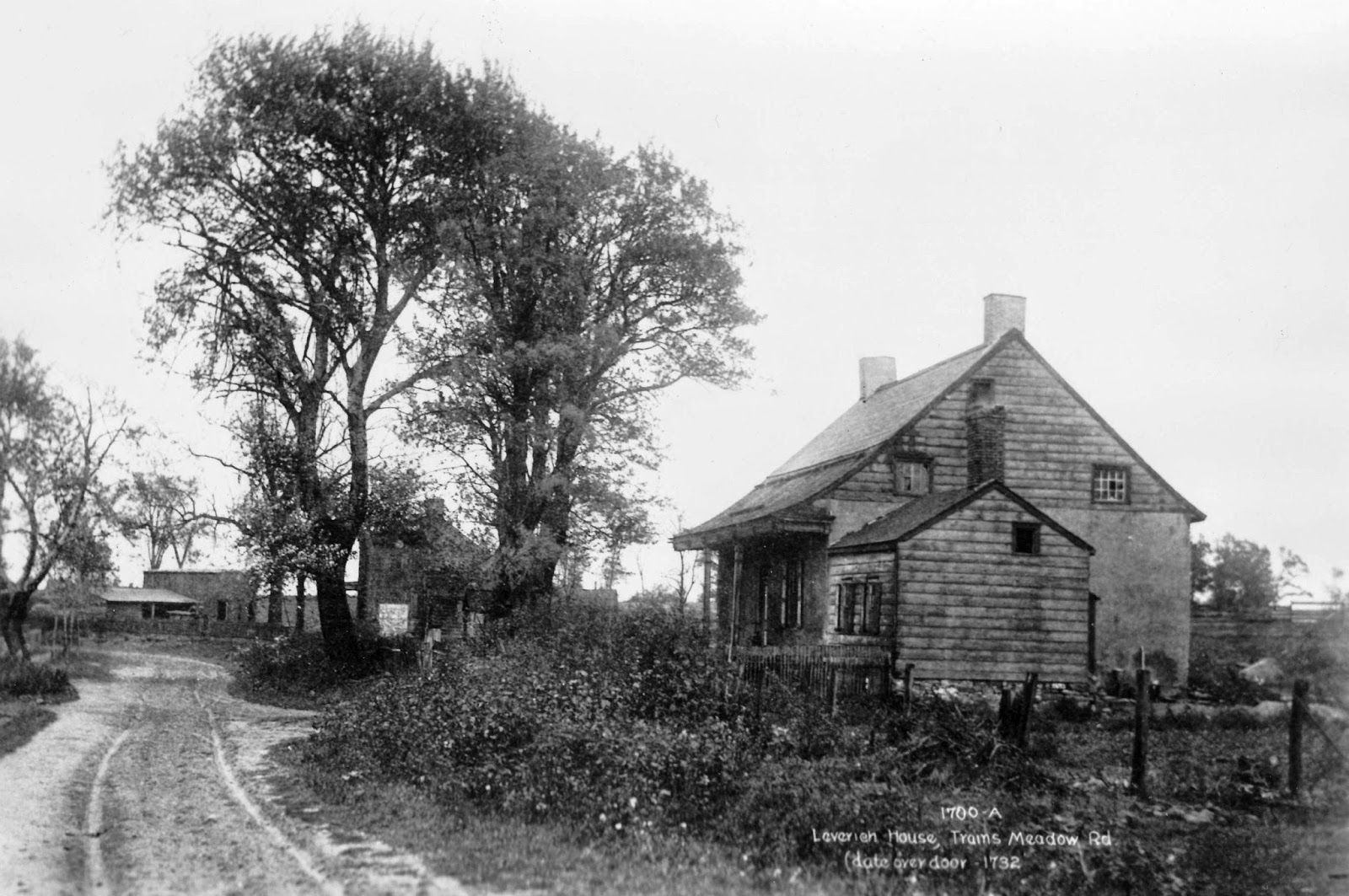
This shows the homestead of the Leverich family in Newtown, built about 1670.

{The Leverich Family Homestead - south side of Trains Meadow Road -Newtown, Queens County, Long Island, New York - before 1909. Built by 2-Caleb Leverich about 1670. Caleb's grandson 4-John Leverich built an addition to the homestead in 1732. This eastern view is now 35th Road from 70th Street Image and descriptive caption from the collection of Catherine Gregory of Woodside, N.Y. Used with permission. Mrs. Gregory is the author of Woodside, Queens County, New York: A Historical Perspective 1652-1994. found on http://www.leverichgenealogy.org/}

-----------

Notes:

[1] The painting is oil on canvas and measures 65 by 81 cm.

[2] Here are some of my earlier blog posts which tell of the Leverich family: [3] Windmuller lived in Woodside and Perry in Elmhurst, somewhat less than two miles distant.

Tuesday, January 04, 2011

America's best citizens

On coming to America, my great-grandfather, Louis Windmuller, transformed himself. He landed in 1853, an 18-year old with no money and few contacts. Within a few years he had turned his back on all but one of the relatives whose names he had been given and set himself on course to become a "thorough American in every respect," as one account would later put it.[1] Born a Jew, he became a sterling Episcopalian and left his descendants no evidence of his religious heritage.[2] His heritage as a German was another matter. Although completely acclimated to American ways, he established and nurtured ties with Germans in Europe and his fellow German-Americans in the U.S.[3]

Late in life he was a frequent contributor to periodicals and newspapers and in a few of these writings he alluded to his experience as a German immigrant. In the following extract he is not writing directly of his own experience (he came from Westphalia, not Mecklenburg) but he did serve as a grocery clerk at one point during the first couple of years after he immigrated and very likely did sometimes sleep under the counter.[4] It's also a fact that it didn't take him long before he, like the Mecklenbergers he describes, was able to establish himself on his own account. He wrote: "Of immigrants who came in the early part of the nineteenth century, the sturdy North Germans, from Mecklenburg, became our best citizens. Their language ... readily assimilated American English. These boys hardly realized that any difference existed between their mother tongue and our own. They adapted themselves to many other American ways. A great many became grocers; of some 5000 who followed this vocation in Manhattan in 1852-3, more than half were Bismarck's countrymen. Beginning as clerks sleeping under the counter, they devoted themselves assiduously to the details of the business, so that many were soon able to establish themselves on their own account."[4]

Later in this article he describes the social life of German-Americans in the 1850s and '60s and it seems likely he includes himself among the "educated Germans" of whom he writes. Here's an extract: "Germans congregated on the East Side [of Manhattan] as far north as Second Street, which was known as 'Klein Deutschland.' The writer has watched long processions of them, go down through the Bowery, Chatham Square, and Nassau Street to their respective workshops, and has seen them return home evenings by the same route. Automobiles were unknown, but pedestrians encountered reckless butcher boys who delivered, in two-wheel gigs, breakfast in the early morning, and at all hours firemen who raced down Chatham Hill, as they preferred sidewalks to the prevailing cobblestones. Educated Germans comprised the best element of our population. Conscientious in the performance of their duties during the day, they knew how to enjoy their nights. They sang in the 'Liederkranz,' danced in assembly rooms, and drank in 'gemuthliche Kneipen,' where good beer was available. Besides teaching us harmless pleasures, they spread their taste for art and literature. Amongst their foremost citizens were Carl Schurz, Oswald Ottendorfer, and Charles Hauselt."[6]

In 1892 Windmuller wrote a letter to the New York Times countering efforts to curtail immigration. He points out that America has always been a nation of immigrants and that some of America's best citizens are foreign born. He says it's understandable why some Americans would want to keep their homeland to themselves, but, he says, "we will have to repress" this natural instinct or the country will fail to prosper for want of men and women to work in its fields and factories. And he refutes the claim that "foreign influence degrades the American character." Immigrants, he writes, "generally represent the best elements of the nations from which they separated to cast their lot among us." Although he's writing as if he's native born ("cast their lot among us"), I think he's thinking of his own experience in the middle of the nineteenth century when he says "the Germans were the young men who wanted to escape from military duty; the Irish were tired of the tyrannical exactions of the lords of their realm. All came to better their fortunes by their own exertions, without the fetters of tyrannical laws or feudal prejudices. The energy of these ambitious men has developed our own. We have inherited their thrift, and we owe as much to them as they owe to us."[7] Here is an extract from the letter to the editor:

{Why Immigration Ought Not to be Restricted, letter to the editor of the New York Times, December 30, 1892}

-------------

Anti-immigrant cartoons

1882

{Uncle Sam's Lodging House, Puck, June 7, 1882; source: hsp.org}

1890

{Judge, March 28, 1890; source: fineartamerica.com}

1896

{"The Immigrant: The Stranger at Our Gate" by Frank Beard in The Ram's Horn (Chicago), 25 April 1896; source: faculty.umf.maine.edu}

-------------

Some sources:

A history of the New York Swamp by Frank Wayland Norcross (New York, Chiswick Press, 1901)

WHY IMMIGRATION OUGHT NOT TO BE RESTRICTED. - Letter - NYTimes.com

The History of the Legal Aid Society

"The Commercial Progress of Gotham," by Louis Windmuller, in The Progress of the Empire State: New York State and City by Charles Arthur Conant (The Progress of the Empire State Company, 1913)

Immigration: Era of Restriction Timeline

American Protective Association

Industrialization, Urbanization, Immigration, Jim Crow

----------

Notes:

[1] The quote comes from The book of New York; forty years' recollections of the American metropolis by Julius Chambers (New York City, The Book of New York company, 1912)

[2] I didn't learn of Louis Windmuller's Jewish heritage until distant relatives and the biographer of Windmuller's cousin, Adolph Sutro, contacted me by email. They had located my Windmuller family history web page with accompanying genealogy and gave me information which vastly expanded my knowledge of his ancestry in Germany and relations in New York. No one in my family ever talked about his Jewish heritage and, surprisingly, some thorough research done by my aunt turned up no information on it.

[3] So, for example, Windmuller took a leading role in the German-American Reform Union, was a founder of the German-American Fire Insurance Co. and German Alliance Insurance Co., headed a fund-raising campaign for the German Hospital, and agitated for public monuments to be erected to Goethe and Heine in New York City. All the same, most of businesses, reform movements, and charitable organizations with which he was associated did not have any particular German emphasis. It's notable that the German Legal Aid Society, which he helped to bring into existence, evolved into the Legal Aid Society in which for many years he served as treasurer. Julius Chambers, cited above, continued his short account of Windmuller's achievements by saying: "An Independent in politics, he has voted according to his convictions, heading strong German movements in the metropolis first for Cleveland and then for McKinley. He has been a constant writer for magazines and newspapers, producing copy with equal facility in German and English. On occasions of financial crisis, especially when American credit was assailed in Europe, Mr. Windmuller has been prompt to send letters to the principal newspapers of Germany, explaining our financial situation." -- "The Commercial Progress of Gotham," by Louis Windmuller, in The Progress of the Empire State: New York State and City by Charles Arthur Conant (The Progress of the Empire State Company, 1913).

[4] In 1906 Windmuller was interviewed for an article which strains to be humorous about his childhood and early experiences in New York. Part of it concerns the theft of a tomato:
"I was only a boy," he faltered.
"Go ahead now, make a clean breast of everything," said the inquisitor, still not unkindly.
"I was only a boy. I had just come to this country. I was a clerk in a grocery store on Vesey street. It was a bright, sunny day. I was trying to be good and forget what had happened in Munster. But at the fatal moment a cart full of tomatoes stopped in front of the door. The old appetite came back and overpowered me. [This refers to theft of cherries in Munster.] It was then that I stole the tomato. Must I say more?
-- Herr Windmuller Confesses, New York Sun, June 30, 1906.


[5] Here's the paragraph in full:
Of immigrants who came in the early part of the nineteenth century, the sturdy North Germans, from Mecklenburg, became our best citizens. Their language, an idiom Fritz Reuter has perpetuated by his Olle Camellen, readily assimilated American English. These boys hardly realized that any difference existed between their mother tongue and our own. They adapted themselves to many other American ways. A great many became grocers; of some 5000 who followed this vocation in Manhattan in 1852-3, more than half were Bismarck's countrymen. Beginning as clerks sleeping under the counter, they devoted themselves assiduously to the details of the business, so that many were soon able to establish themselves on their own account. Their advantage over American grocers — like Acker & Merrall on Chambers Street, Abram Binninger & Co., 26 Liberty Street, William S. Corwin, 639 Broadway, John Duncan, 407 Broadway, and the "Albros" on the Bowery — consisted of the privilege of selling liquor at retail, free of license, an advantage disdained by Americans, who catered more to the family trade. But our ladies could not always find it convenient to go to them and left their daily orders at the neighboring corner grocery. They were careful not to approach the partition which divided the store from the rear bar, so as to escape odors of rum and tobacco which emanated thence. In former years the writer had business relations with some of these grocers, and he remembers an occasion when he was obliged personally to present a draft. Following the established custom, he first invited the drawee to a social drink. While he was absorbed in a mint julep, the proprietor slipped out of the side door, leaving the bartender to explain his unceremonious disappearance. On a subsequent occasion we were careful to explain the object of our visit before the drinks were mixed. -- same source.
[6] This paragraph comes from the same source. In it Liederkranz were singing clubs. The word is literally a "wreath of song" and figuratively song circles. Gemuthliche Kneipen were a sort of beer hall; "cozy pubs" might be a reasonable translation. Carl Schurz remains a highly-regarded German-American of the time. Oswald Ottendorfer, as wikipedia tells us, participated in the 1848 revolutions in Germany, and, like Schurz, came to New York to escape persecution after they failed. He subsequently became a prominent New Yorker as publisher of the Staats-Zeitung newspaper. Charles Hauselt is more obscure. He was a "merchant prince in the New York leather trade" and long-time president of the German Society, which provided aid to immigrant Germans.

[7] The nativist movement of the early 1890s was specifically aimed at Roman Catholics. Centered on an organization called the American Protective Association, it was a reaction to the shift in immigration source countries from the northern European Germans, Irish, Scots, and English to Italians and other southern Europeans. It made no real headway at the time, but was followed by the more successful Immigration Restriction League and that in turn led to restrictions on immigration imposed in the 1920s. My belief that Windmuller included himself among the Germans who emigrated to escape mandatory military service and who wanted to leave tyrannical feudalism behind them is based on an exit permit he had to obtain before leaving the country and also on his reports of his joining the revolutionaries of 1848 in attacking the old order in Germany. I've written somewhat more on this subject here.

Sunday, January 02, 2011

both careful and caring


{source: Empire State Notables (New York, H. Stafford, 1914)}

Horatio-Alger-like, my great-grandfather, Louis Windmuller, applied good judgment, hard work, and an abundance of pluck to free himself from poverty. By the end of the third quarter of the nineteenth century his business enterprises had thrived sufficiently to make him comfortably well off, and he was able to devote increasing amounts of time to public affairs, charitable work, and cultural pursuits. As you'd expect, it was this last phase of his long life which attracted most attention from the editors of the era's many biographic dictionaries.[1]

Most of the biographic dictionaries focus on his financial success, public spirit, generosity to those in need, and cultural acumen. A few also credit his piety, community leadership, and passion for walking. It's in their nature that they reveal nothing derogatory, unpleasant, or embarrassing about him, but there was, anyway, apparently very little of this nature to be found out.[2] The dictionaries have entries for many who, like him, achieved success and community respect. Many others struggled up from poverty, many worked to advance the public interest, many showed philanthropic leanings, and many saw themselves as connoisseurs, but few seem to have combined these traits to the degree that he did.

He had an abundance of one more attribute which helped to distinguish him from others with whom he associated: He was a cheerful extrovert, a jolly fellow, a man who enjoyed life fully.[3] He suffered misfortunes himself and was deeply concerned about the misfortunes of others, but he was by nature an optimist and was apt to see poverty as a temporary aberration rather than the product of a fundamental flaw in the socio-economic arrangements of his time.

In business, he was careful with money, preferring gold to paper currency in the years when banks printed their own.[4] He was careful in his handling in promissory notes and bills of exchange.[5] This caution in financial transactions led him to visit, when he could, the offices of men with whom he did business.[6] Similarly, he took a personal interest in the recipients of his charity. This anecdote comes from an article that he wrote in 1908 on the panics, slumps, recessions, and other financial problems of his time: "To relieve the poor, many of whom were out of employment during the winter of 1893 to 1894, the writer joined a citizens' committee, formed under auspices of the 'Christian Alliance.' Members were expected to purchase tickets at the rate of $5 a hundred and distribute them gratis to applicants for charity. Each ticket entitled the bearer to a square meal in the basement of No. 170 Bleecker Street, New York City. As member of this committee the writer frequently convinced himself of the quality and quantity of the food furnished by Mr. Milbury, the agent. After a visit to kitchen and cellar he sat down on stools in line with other hungry men and women, and he enjoyed with them a large bowl of fragrant steaming stew, a chunk of sweet bread and a cup of good coffee. Some of those supplies were furnished gratis, others at extremely low prices; everybody was glad to help, by timely charity, the starving poor to good food."[7]

---------

Some sources:

"The Commercial Progress of Gotham," by Louis Windmuller, in The Progress of the Empire State: New York State and City by Charles Arthur Conant (The Progress of the Empire State Company, 1913)

"Reminiscences Of Financial Problems," by Louis Windmuller, in The Forum, Vol. 40, (Forum Pub. Co., 1908)

The book of New York; forty years' recollections of the American metropolis (New York City, The Book of New York company, 1912)

Instruments Of Commercial Credit from the book Money And Banking, by John Thom Holdsworth (Appleton and Company, 1917)

Types of Financial Documents, American Society of Check Collectors

----------

Notes:

[1] Here are some biographic dictionaries I've found that have entries for Windmuller: [2] This is from a relatively succinct account of his life and works:
Among the representative German-Americans of this city, Louis Windmuller has been one of the most active. He is a thorough American in every respect, although he was born in the old city of Munster and educated at the Gymnasium of that place. He came here when eighteen years of age, since which time his career has been one of continued success. To enumerate the financial institutions which he has assisted in founding would crowd out more desirable mention of his unflagging work for political reform and social uplift. He was one of the organizers of the Reform Club. An Independent in politics, he has voted according to his convictions, heading strong German movements in the metropolis first for Cleveland and then for Mckinley. He has been a constant writer for magazines and newspapers, producing copy with equal facility in German and English. On occasions of financial crisis, especially when American credit was assailed in Europe, Mr. Windmuller has been prompt to send letters to the principal newspapers of Germany, explaining our financial situation. His diversions have been confined to the collection of rare books and pictures; his library contains several early books of Gutenberg, Caxton and other famous presses. He has been an ardent supporter of the various museums and historical associations and was especially proud of his membership in the Chamber of Commerce. He is devoted to country life and his home at Woodside, Queens Borough, is one of the most attractive in that charming community. -- The book of New York; forty years' recollections of the American metropolis (New York City, The Book of New York company, 1912)
[3] In a short reminiscence dated 1991, my father wrote, "Grandpa Windmuller was a jolly, verbal person, full of energy and a great walker." There's more on this aspect of his personality here.

[4] I wrote about this in my last blog post.

[5] Merchants of the time, particularly ones like Louis Windmuller, who were in trans-Atlantic trade, used promissory notes and bills of exchange to cover their financial obligations during the period between the time they contracted to supply some merchandise and the time they were paid for delivering it to a customer. These financial documents were "negotiable instruments," that is they could be bought and sold -- always at discount -- and merchants like Windmuller would often end up trading in the notes and bills as well as in the merchandise. Here are some examples of these documents. See the list of my sources, above, for more information on this topic.

Promissory notes:

{Promissory note; source: manuscriptcheckcollector.com}


{Promissory note; source: ascheckcollectors.org}


{Promissory note; source: chestofbooks.com}

Bill of exchange:

{Bill of exchange; source: ascheckcollectors.org}

Commercial draft:

{Commercial draft; source: chestofbooks.com}

Sight draft:

{Sight draft; source: ascheckcollectors.org}

[6] He would, for example, call upon the officers of the insurance companies with which he dealt to renew his policies each year. -- "The Commercial Progress of Gotham"
in The Progress of the Empire State: New York State and City by Charles Arthur Conant (The Progress of the Empire State Company, 1913)

[7] This comes from an article called "Reminiscences Of Financial Problems" appearing in The Forum, Vol. 40, (Forum Pub. Co., 1908)