Wednesday, May 29, 2013

August, 1942, New York

Half a year after the U.S. declared war on Japan and Germany, Marjory Collins documented daily lives of New Yorkers in photographs taken for the Office of War Information. She had joined the OWI photographic unit as it transitioned from Depression-era service within the Farm Security Administration into a relatively minor component of military strategy to defeat the Axis powers. Under Joseph Goebbels the German propaganda machine was well-heeled and effective. The U.S. Government had less faith in this form of psychological warfare and was far from single-minded in its commitment to it. Within the country, the Domestic Branch of the OWI was, by design, severely restricted in its operations.[1] The Overseas Branch, in which Collins worked, was initially hampered by resistance from military leaders whose training did not lead them to see its potential value and, like the Domestic Branch but to a lesser extent, it was attacked by President Roosevelt's political opponents.[2] An article in the issue of Life magazine for March 22, 1943, told its readers that the Axis powers had "perfected great, intricate, and effective propaganda machines" while Americans, "although they are the world's masters of advertising and publicity," had been slow to master this "necessary weapon of political warfare."[3]

The Overseas Branch never matched the high production values of German propaganda and aimed instead for a level of transparent honesty to carry its message. It attempted to contrast what was then known as the American way of life with life under the authoritarian regimes of its enemies. OWI director Elmer Davis said the Overseas Branch would tell the world "that we are coming, that we are going to win, and that in the long run everybody will be better off because we won."[4] An Overseas Branch communication explained one aspect of this goal: "As the long-range directive implies, one of our chief duties is to convince people of the world of the 'overwhelming power and good faith of this country'. By informing peoples of other countries fully concerning the nature of this country and of its people, sympathy, trust and friendliness will grow".[5]

The Overseas Branch targeted people in the homelands and occupied territories of its enemies and also the citizens of allied countries and newly liberated ones. Its broadcasts and publications gave a view of America that was diametrically opposed to the propaganda with which the Nazi Ministry of Public Enlightenment and Propaganda flooded Europe, but it did not do so in a blatantly propagandistic manner. To the contrary, for the most part it showed the United States as a complex society, rich in cultural variety. Rather than ignoring or denying the existence of racism, poverty, and sexual inequality, it tended to depict members of minority groups, people who were destitute, and women in the workplace as having a pluck and determination which, while not overcoming the unjust treatment they received, showed them to have a strength of character which typified the best of the American Way.[6]

In addition to films, broadcasts, and books, the Overseas Branch published photo pamphlets and magazines. One of the magazines, called Victory, was modeled after Life (and its Nazi counterpart, Signal) in editions for the UK and other allies and re-conquered European countries. Comparing Victory to Signal, the author of the article in Life wrote:
The Chief U.S. foreign propaganda magazine Victory, over which a Congressional economy storm blew up last month, is but a pallid imitation of the German Signal. Victory has less than half the circulation of Signal, contains no terrific propaganda sock like its Nazi counterpart. The reason for this difference in wallop can be seen in ... examples of U.S. ... and Axis propaganda... The OWI sticks to facts, shuns exaggerations, tries to bring the peoples of the world messages about our leaders, our war aims, our growing armed might. The Axis harangues, scoffs, falsifies, attempts to divide.[7]
The article gave these two sets of examples to show the difference in the quality of U.S. and enemy propaganda. At left American; at right Axis.


Here are representative covers of Victory and Signal from 1942-1945.


The Photographic Unit to which Marjory Collins belonged produced images for Victory and other Overseas Branch publications. In carrying out this work her boss, Roy Stryker, assigned her to document the everyday aspects of life. Where other OWI photographers would cover mobilization and show America's industrial might, she recorded street scenes, ordinary home life, and festive occasions. In keeping with Stryker's approach to photography of the Depression and New Deal era these photos are not self-consciously inspirational but show strength through diversity and a steadfast dedication to the pursuit, if not anywhere near complete attainment, of democratic ideals.

There were critics of the Overseas Branch who maintained that photos showing the daily lives of ordinary Americans would alienate Europeans whose lives had been much more greatly disrupted by war. It was said Americans would seem pampered, arrogant, and unsympathetic. Other critics said the Overseas Branch photos would seem to confirm enemy propaganda if they showed the seamy underside of American culture. OWI's photographers evaded both these perils by showing that American culture was too diverse to be unattainably well-to-do and by deploying images of the "seamy-underside" without bitterness or despair.

Collins was particularly good at showing all stripes of Americans, including those whose standard of living was low and life challenges correspondingly high. Her shots of New York City in August, 1942, show Americans in immigrant neighborhoods — Italian Americans, as I showed in a recent post, as well as Jews and Chinese. They also show civilians mingling with military personnel: waiting for trains in Pennsylvania station and knocking back a few in local bars. Her subjects are hardly uniformly prosperous or free from care and one image shows workers at the lowest end of the scale: pin boys at a bowling alley. There's nothing gung-ho about the images but their underlying message is not pacific. Rather than a slick patriotism, they imply that Americans, in all their diversity, had adapted to war mobilization and were carrying on with their lives. They tend to show the strength of the home front — its cheerful optimism and quiet determination — as underpinning for America's massive military effort.

Here are some representative photos from the many that Marjory Collins took for the Overseas Branch of OWI in New York City, August, 1942. All come from collections in the Library of Congress.

The photos show the unglamorous ordinariness of daily life, but they're not casual snapshots. Collins chose her subjects and managed her compositions with considerable skill. The long shots rarely have a single subject and the subjects balance the composition nicely. Her technical expertise shows particularly in the photos where she used single-source flash. Except where flash is used for fill lighting, these images lack much sense of depth and Collins used this two-dimensionalness to advantage. She also broke the cardinal rule of flash photography by allowing the flash itself to be part of the image. It's clear from the frequency with which she did this that it was intended; she wanted the viewer to aware of her presence on the other side of the lens.


{Caption: Jewish printer in a small shop on Broom Street}


{Caption: Jewish weaving shop on Broom Street}


{Caption: Sidewalk merchant in the Jewish section}


{Caption: Fish store in the Jewish section}


{Caption: Fish store in the Jewish section}


{Caption: Chinaman counting on an abacus in a Chinese grocery store in Chinatown}


{Caption: Chinese-American girl playing hopscotch with American friends outside her home in Flatbush}


{Caption: Waiting Room, Pennsylvania Station}

{Detail}

{Detail}


{Caption: Waiting Room, Pennsylvania Station}

{Detail}

{Detail}


{Caption: Waiting for the trains at the Pennsylvania railroad Station}


{Caption: Waiting for trains at the Pennsylvania railroad station}

{Detail}


{Caption: Waiting for trains at the Pennsylvania railroad station}


{Caption: Waiting for trains at the Pennsylvania railroad station}

{Detail}

{Detail}

{Detail}


{Caption: Waiting for trains at the Pennsylvania railroad station}


{Caption: Irish-American bartender serving beer to British sailors in a Third Avenue bar in the "Forties"}


{Caption: O'Reilly's bar on Third Avenue in the "Fifties"}


{Caption: Boys who pick up pins and roll back balls in a Broadway bowling alley playing cards between shifts}

-------------

Notes:

[1] American citizens and their political leaders viewed domestic propaganda as undemocratic. Republican politicians also feared that the president would use its power as an electoral weapon and southern Democrats feared that it would undermine racial segregation in the Jim Crow states. Encyclopedia of twentieth-century photography, Volume 1 edited by Lynne Warren (CRC Press, 2006); Books As Weapons: Propaganda, Publishing, and the Battle for Global Markets by John Hench (Cornell University Press, 2010)

[2] LIFE (magazine), March 22, 1943, Vol. 14, No. 12 (Chicago, Ill., Time Inc)

[3] Books As Weapons: Propaganda, Publishing, and the Battle for Global Markets by John Hench (Cornell University Press, 2010)

[4] Same source

[5] Interpreting National Identity in Time of War: Competing Views in U.S. Office of War Information (OWI) Photography, 1940-1945

[6] This was in line with an Executive Order that President Roosevelt issued on June 25, 1941, for full participation of people of every race, creed, color, and national origin in the national defense program. -- Marjory Collins (1912-1985), a Biographical Essay, by Beverly W. Brannan, Curator of Photography, Prints & Photographs Division, 2009. Last revised: April 2009. The OWI showed resilience in the face of adversity as the Farm Services Administration done the during the Depression years. However both agencies had to avoid alienating powerful interests that opposed government measures aimed at ameliorating racism, poverty, and sexual inequality. They focussed on victims, not predators, and their audiences must perforce infer the one from the other.

[7] LIFE (magazine), March 22, 1943, Vol. 14, No. 12 (Chicago, Ill., Time Inc)

--------------

Some sources:

Preparing for Victory. The U.S. Office of War Information Overseas Branch’s illustrated magazines in the Netherlands and the foundations for the American Century, 1944-1945 by Marja Roholl in European Journal of American Studies, European Association for American Studies, Special issue, 2012, Wars and New Beginnings in American History, Document 10

Office of War Information in Encyclopedia of twentieth-century photography: A-F : index, Volume 1 edited by Lynne Warren (CRC Press, 2006)

Books As Weapons: Propaganda, Publishing, and the Battle for Global Markets in the Era of World War II by John Hench (Cornell University Press, 2010)

The Office of War Information on the Library of Congress web site

United States Office of War Information on Wikipedia

WWII Propaganda by Allison Christensen, Lens of War Magazine

World War II Era Propaganda and American Literati, Liberal Interventionism Revisited: American Freedom as Soft Propaganda, by Jonathan Vincent on jonathanevincent.wordpress.com

Marjory Collins; Women Photographers of the FSA and OWI by Sharon Rodriguez on sheclicks.weebly.com

Marjory Collins (1912-1985), a Biographical Essay, by Beverly W. Brannan, Curator of Photography, Prints & Photographs Division, 2009. Last revised: April 2009.

LIFE (magazine), March 22, 1943, Vol. 14, No. 12 (Chicago, Ill., Time Inc)

Davis Riddle Taber Attach on Overseas Pamphlets; Take Little Shipping Space; Not Circulated in U.S.A. by Gordon H. Cole in PM (newspaper, New York) March 7, 1943.

Friday, May 10, 2013

We Must Not Fail Them

In 1942 OWI photographer Marjory Collins worked her way around Manhattan recording the ways of the city's inhabitants in wartime. OWI stands for Office of War Information. Roy Stryker, the leader of its photographic unit, was charged to show the strength of Americans' resolve to defeat foreign aggression. In line with this objective Collins produced upbeat images of women in the workforce, children collecting scrap metal, administrators of newly-formed daycare facilities, and recruits headed out to training camps. She also shot scenes that depict patterns of American life that remained the same despite the massive restructuring brought on by the world war: teens in school, young people at public swimming pools, and adults relaxing in bars and restaurants.

Determined to show "pictures of life as it is," Collins did not limit herself to this one-sided point of view but used her camera to reveal somewhat more diversity in American life. Her photographs capture not just the confident and optimistic can-do citizens shown in the glossy magazines but also what a fellow OWI photographer disparagingly called "the seamy side of life." Subjects included relief clients, Bowery bums and members of struggling minorities. In one of her photo shoots she documented the difficulties faced by a war-widow who struggled to make ends meet and care for her young family. She also showed the daily lives of hyphenated Americans: Chinese-, Turkish-, and Italian-American residents, and, unlike the news reporters of the time, she did not present the inhabitants of immigrant communities as curiosities, but as ordinary people.

The photographs are good. Her technique was excellent and she chose subjects well. She also had fine eye for design and light values, and knew how to make good use of the 6x6 cm. frame which her twin-lens reflex camera gave her.

In the first half of 1942, as a brand new OWI staffer, she was given assignments in and around Washington, DC. In November she spent a week in a small town in Pennsylvania Dutch country. The summer and fall found her in New York City. During this time she took pictures of Chinese Americans in Manhattan and Brooklyn and Jewish merchants in the Lower East Side. She did a set on the customers in a hairdresser's salon. She showed crowds at Radio City Music hall, pin setters at a bowling alley, and patrons of O'Reilly's Bar on Third Avenue in the Fifties. She showed centers for recruiting soldiers and promoting the sale of war bonds. In September she did a lengthy shoot in the building where the New York Times was written and published (about which I've previously written). There are also a few shots of a workers' bookshop which served as Communist Party headquarters.

In mid-August she photographed a parade on Mott Street to celebrate Italian American servicemen. I've selected some of the photos from this occasion. They all can be found in the FSA/OWI collections of LC's Prints and Photos Division. As always, click image to view full size.

The parade is unlike the ones we're used to with clear separation between observers and participants. It has the spontaneity of a summer street festival. Marchers are dressed casually with few attempts at formal uniforms and the leader, dressed as Uncle Sam, is accompanied by some guys in shirt sleeves. Collins was one level above the street when she took this photo, probably on the fire escape. It's interesting that she didn't ask the person next to her to step back in order to clear the camera's view. I suspect she liked having the two out-of-focus foreground elements.

{Caption: Parade of Italian-Americans on Mott Street at a flag raising ceremony in honor of neighborhood boys in the United States Army}

Detail showing the band.


Here you see young people carrying the flag (more of a banner). They're following the band. People are throwing money onto the fabric.

{Caption: Italian-Americans of Mott Street raising a flag in honor of neighborhood boys in the United States Army.}

Now that they've passed by the parked cars you can see more of the banner. Despite its subject it's not really militaristic but has a religious theme — a priest blessing young soldiers whom we know will be going off to fight. The focus is very local. There's no evidence that the event is part of a national campaign. It appears to be of as well as by the two blocks of Mott Street where it takes place.

{Caption: Flag raising ceremony in the rain in honor of Mott Street boys in the United States Army}

Collins was in 274 Mott St. Now she's crossed to 279, on the west side of the street, to get this next shot. The parade has passed down the block and is by the back of St. Patrick's Old Cathedral. The church faces Mulberry at Prince and is at the bottom of the parade's route.


In the photo just below the viewer sees the banner's patriotic message. Banners such as this were called flags of honor. As here, they'd be hung over a street, attached to buildings on either side. Street banners were also used to announce municipal events, show support for political candidates, and advertise major shows and festivals. There's a political example from the 1930s here and a municipal one here.


These photos show people watching the raising of the banner.


This one shows that a rain shower has recently passed. You can also see members of a band who are about to play. The couple in the foreground have a quiet dignity.


Collins took another photo of this couple, identifying them as a shoemaker and his wife. It's clear that they're in the doorway to his shop.


Collins' photos tend to have the lens at a child's eye level, as here, because that's the height at which an adult holds a twin-lens reflex camera. It interests me that the shirt of the man at right has a zipper closure. In 1942 zippers were not nearly as ubiquitous as they are now and I suspect they were very rarely seen on a man's shirt.


This detail of hands and face are not the main subject but they make a nice photographic study.


This honor guard seems to have been the only formally military element in the parade and, in keeping with the spirit of the day, its discipline isn't up to parade-ground standards.

{Caption: Italian-American Legionnaries marching in a parade on Mott Street, at the Feast of San Rocco (August 16) which ended in a flag raising ceremony in honor of the boys of the neighborhood who were in the United States Army}

Here you can see the band that was gathering in the background of an earlier photo. They call themselves the "Brooklyn Dodgers" and from the looks of them I'd say they took their name not from the baseball team but from the original sense of the word dodger: cunning, devious, untrustworthy, or, as Dickens had it, artful. It's also possible they took their name from the same source as did the baseball team. Wikipedia says the Brooklyn Dodgers were originally the Brooklyn Trolley Dodgers, trolley dodger being a slang name for people from Brooklyn.

{Caption: Dancing and music on Mott Street, at a flag raising ceremony in honor of neighborhood boys in the United States Army}

The is a detail of the previous photo.


Taken only a few minutes apart, these two photos show residents at 274 Mott St.


{This building is directly opposite at 274 Mott St.}

Here are detail images of people viewing the parade from the fire escapes and windows.


One can imagine Collins wishing she had a telephoto lens so as to take close up shots of people observing from their windows. Or so it seems from this shot taken from street level.


After the parade Collins took photos of residents in an espresso shop and on the sidewalk.


{Caption: Italian-American cafe espresso shop on MacDougal Street where coffee and soft drinks are sold. The coffee machine cost one thousand dollars}


{Caption: Italian-Americans on MacDougal Street relaxing on Sunday}


In November 1942 Collins was in Lititz, Pennsylvania, and while there she took this photo of her reflection. In it you can see her camera. It's clearly a twin-lens reflex, probably a Rolleiflex. The photo shows the upper lens as bright and the lower one dark because the upper is transmitting light that is reflected from the bright sky above (it is the view lens). The lower lens is dark because it receives light but (unless the back of the camera is removed) does not transmit it.

{Lititz, Pennsylvania. Self-portrait at a public sale, November 1942}

The lower lens of Collins' has a lens hood like the one in this photo of this Rollei from 1933.

{Standard Rolleiflex Model 6RF, 1933; source: flickr}

--------

Some sources:

United States Office of War Information

Women Photographers of the FSA and OWI: Marjory Collins

Photographs by Marjory Collins, 1944, Schlesinger Library, Radcliffe Institute on Facebook

Collins, Marjory, 1912-1985. Papers of Marjory Collins, 1904-1985: A Finding Aid

Marjory Collins in Wikipedia

Marjory Collins (1912-1985), a Biographical Essay on the Library of Congress web site

Marjory Collins (1912-1985), Introduction on the Library of Congress web site

photographs of the Farm Security Administration-Office of War Information Collection on the Library of Congress web site

Women Photojournalists Prints & Photographs Division Holdings on the Library of Congress web site

Il viaggio di Marjory Collins in Sicilia. Sabato 31 marzo 2012. Ricordare Palermo. Palermo e la Sicilia durante il fascismo e la seconda guerra mondiale. Presenta una ricca galleria fotografica, sullo sbarco degli Alleati in Sicilia del 10 luglio 1943. (This article says that in July 1943 Collins was using a Rolleiflex twin lens camera.)
St. Patrick's Old Cathedral in Wikipedia

St. Patrick’s Old Cathedral on NYC-Archtecture.com

Friday, April 12, 2013

History of Woodside, Queens (New York)

I received an email from Kindle saying the blog has at least one Kindle follower and would I please put up a new post (or they'd drop me). It's true I've been otherwise occupied. A few months ago Deniz Hughes of Denizblog suggested I do an article on the history of Woodside, Queens, for Wikipedia. I said I'd try. On and off since then I worked up a somewhat longer draft than I originally expected. I loaded the piece a couple of weeks ago and so far: (1) no one's sniped at it, (2) one helpful soul has made a useful addition. Here's the link: History of Woodside, Queens.

Despite its length there was quite a bit that I left out of the article. I'm thinking I'll find some time to make a post or two out of the research that didn't seem to fit in the Wikipedia format.

I have previously had something to say about this image from the article (here) --


Tuesday, January 01, 2013

Listening to music, 1965

Doing some year-end reordering of attic storage we came across a wayward album, an LP by Tracy Nelson with whom I was friends back in 1965. Within a day or so a family member mentioned that he had begun listening to Bill Evans, specifically his album, Everybody Digs Bill Evans. Another friend, Elspeth Leacock, gave me that album in 1965 and it's found with the rest of my old LPs in our basement. The two reminded me of yet a third friend and musician, Rodney Moag, who played in a bar I frequented in 1965. He hadn't cut an LP at that time and I didn't know about the 45 he'd made that year.

Back in 1965 Rod was the most versatile of the three. He did vocals and wrote many of the songs he sang accompanying himself on the mandolin. And he was also proficient on guitar, dobro, violin, and viola. The group he led was called the Front Porch Back Steppers. I don't recall any others in that group but they probably included Charlie Taylor on bass and keyboard and maybe Don Gale on banjo.

This video was made 45 years after I met Rod but it gives some idea of the music I heard him play: Rod Moag at Forest Grove
(Rod performing at the Forest Grove Music Show, Chandler, Texas, on December 19, 2009; YouTube video uploaded by Alvin Murphy on Jan 16, 2012.)

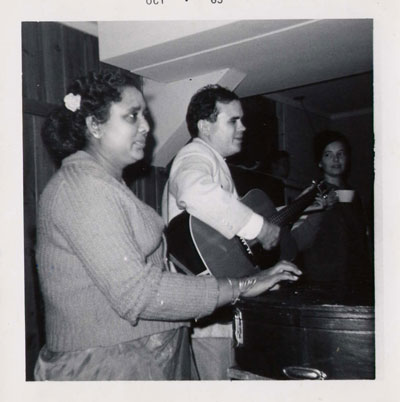
Rod is much more than a versatile musician. He's a linguist with a specialty in languages of the Indian sub-continent. When I knew him he was studying for his Master's in Indian Studies at the University of Wisconsin. This photo shows him at a Peace Corps training program where he gave instruction in speaking Malayalam, the language of the Indian state of Kerala.


Rod's blindness seems more an attribute than a liability. It certainly hasn't been an obstacle in his careers as professor and musician. When I knew him in Madison he moved easily around campus and downtown, using his foldable "elephant thermometer" as much to warn people that he was sightless as to navigate his way. He told me he liked to run foot races and that he could "watch" tv, not just listen to the audio component. He'd pepper his conversation with visual idioms such as "see you later" and "I saw him (or her) the other day."

I'd often sit with Rod's wife, Rachel, at Glenn & Ann's, the bar where the backsteppers played. She told me about Rod's ability to cook, clean, and manage his life so independently that there seemed little difference between him and her sighted friends. She did say, however, that she was taken back the first time she visited his apartment during the evening. When she saw all the lights were out, she thought maybe Rod had forgotten their date and almost left without knocking. But he'd heard her approach and called out a welcome. After that, he said he tried to remember to put a light on when he thought it might be dark outside.

I remember driving Rod and Rachel to Minneapolis one weekend. She was many months pregnant and the two of them thought it best that she not drive that long way. They owned a VW Beetle which fitted us well enough but without a whole lot of room to spare. I can't recall the purpose of the trip. Possibly to attend an event at the Guthrie Theater, possibly to visit her parents, probably both.

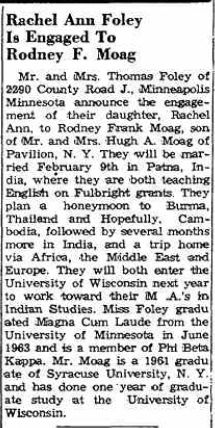
An internet search turns up this clipping announcing Rod and Rachel's engagement.

{Moag-Foley engagement, Wyoming Reporter, Thurs, Feb 6, 1964}

If Rod is the most versatile of my three musicians of 1965, Tracy Nelson is the best singer. When young, both she and Rod used radio programs as their source of inspiration. In his case it was country and bluegrass music coming out of Nashville and vicinity. In hers it was blues coming from the clubs of Chicago's South Side. Both of them nurtured their talents somewhat against the grain — he as a kid from upstate New York with a bent for the music of Appalachia and she as a kid from central Wisconsin with a talent for singing Black urban blues. She was an undergraduate in the School of Social Work at the University of Wisconsin when he was there studying for his Master's in Indian Studies.

They share a love for music that has deep roots in regional traditions, a kind of historical authenticity. For Rod this manifests as a love for old time country/bluegrass and Texas swing. Tracy's passion is two-fold: first for the music which grew from African-American field hollars and guitar blues and expressed itself in urban ghettos of burgeoning industrial cities, and second for the same Appalachian sound which Rod admires. In an interview Tracy once revealed how unsuited she felt herself to be in the Hait-Ashbury atmosphere of the early 1970s. She felt uncomfortable with the culture of drugs, hip spiritualism, and pounding rock rhythms and at that time she moved from San Francisco to Nashville, left her blues rock band and made a country album.

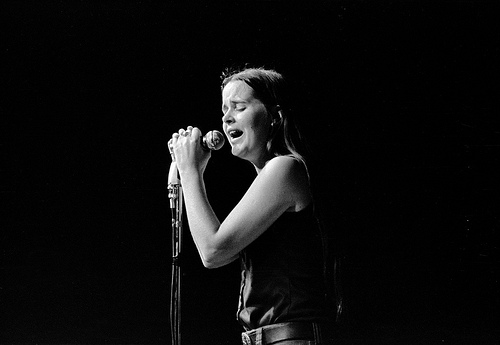
This is how she looked at the time I met her.

{Tracy Nelson, ca. 1965 from simplybek on Tumblr }

In 1964 she was able to make her first album courtesy of Sam Charters who arranged a recording session with Prestige. I came to know her at about that time. My flatmate had met her — I forget how — and after they'd started seeing one another she'd drop by and sometimes to sing but mostly just to share some beers and talk. My flatmate played stride piano, picked up from listening to radio broadcasts from his childhood home in Kansas. When Tracy put together the group that was to back her at the Prestige recording date she included him as pianist.

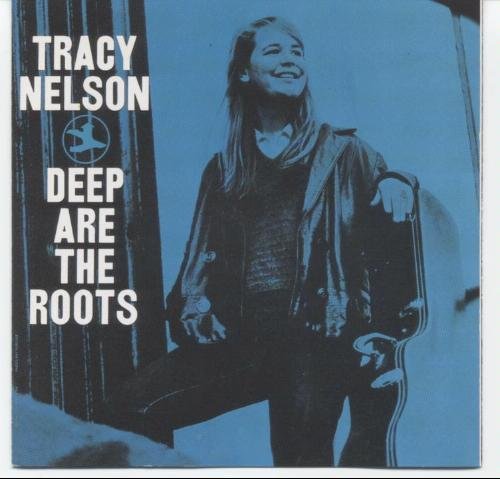
The recording is Deep Are the Roots. Released in 1965, it contained songs from the blues greats of the 1920s and '30s, including Bessie Smith and Ma Rainey.


You can hear four 30-second teasers from that record in a sampler put out by Prestige called The Bluesville Years, Vol. 7: Blues Blue, Blues White. The teasers show that Tracy's voice was powerful then but not as strong as it would become later in her professional career. They display the harmonica playing of her friend Charlie Musselwhite and the piano of my flatmate.

Tracy sang at a place called The Pub in Madison, but I don't recall going there to see her perform.

There are quite a few videos of Tracy on YouTube. One features a song she wrote in 1968. It's from The Lonesome Pine Specials of 1987 (The Kentucky Center for the Performing Arts): Tracy Nelson - Down So Low. Another comes from the 22nd Annual Simi Valley Cajun & Blues Music Festival on Memorial Day Weekend, 2011: One More Mile (Muddy Waters) - Mannish Boys Revue with Tracy Nelson - Live in Simi Valley.

She sings both blues and country in snippets played during this interview on the American Routes program (radio station WWNO, Aug. 4, 2010). This interview, which includes an excellent and succinct overview of Tracy's career, brings out a side of her music I hadn't known about. After blues and country, she turned to R&B for a while. Some of the songs she sang at this time were covers of ones by Irma Thomas and Tracy worked with Irma at least once. You can hear her with Marcia Ball doing backup vocals on this video:


Tracy showed a more popular country style in a segment of the Prairie Home Companion show of June 16, 2001: Got A New Truck - Tracy Nelson and Band, Live from the Orpheum Theater in Memphis. Before the show Tracy participated in an interview that's available here: Tracy Nelson: Living Well, June 12, 2001, by Russ Ringsak.

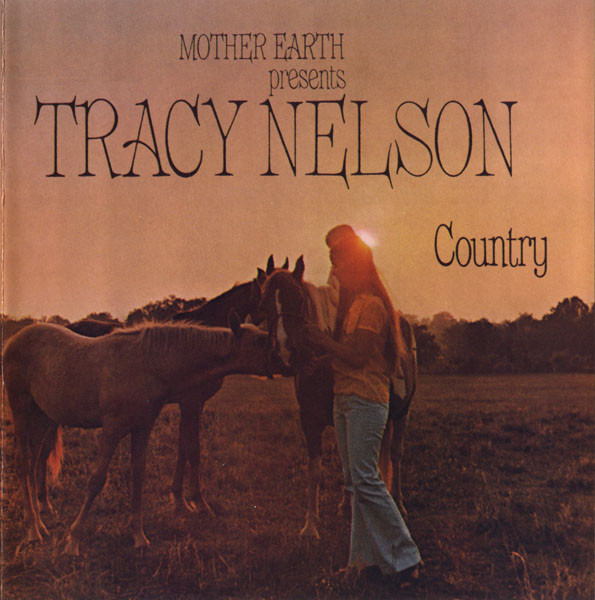
This image shows Tracy's first country album (and the one that turned up in our attic).


A few days ago, on the occasion of Tracy's birthday, a favorite blogger of mine — Bent Sorensen — linked to two of her songs, one from the earliest country album and the other from her San Francisco band, Mother Earth: (1) Tracy Nelson: I Fall To Pieces - from Mother Earth Presents Tracy Nelson Country, 1969 and (2) Mother Earth: Mother Earth (Memphis Slim) - from Living With the Animals, 1968. Of the former Bent says Tracy's version is better than Patsy Cline’s original and of the latter he says Tracy is "one of the most underrated female singers of all time." He also points out that the latter feature "Makel Blumfeld" on lead guitar, that man being the great Mike Bloomfield. It also features Barry Goldberg on keyboards.

If Rod Moag and Tracy Nelson have much in common, neither, so far as I know, has any connection with Bill Evans. His place in this blog post is really about the act of another 1965 U of W friend, Elspeth Leacock, who (as I say) put Everybody Digs Bill Evans in my hands. She gave it to me after I'd admitted that I enjoyed Miles Davis's Kind of Blue and Sketches of Spain, but did not really have much else in the way of jazz likes. Or much knowledge. I certainly didn't know that Bill Evans played on the former and didn't notice there was no piano on the latter. I've always been grateful to Elspeth for introducing me to his music. I've collected his recordings ever since and they've given me pleasure for close on fifty years.

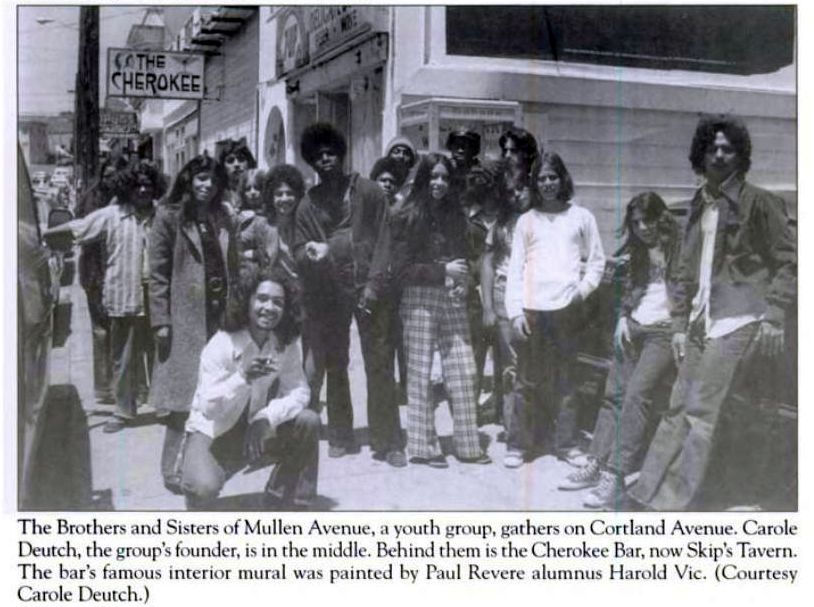
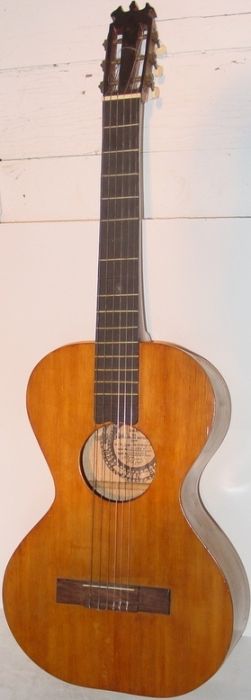
I can't recall how I came to know Elspeth but suspect we met via mutual friends Carole Deutch and Phil Buss. Phil was another Madison musician. He played and sang at the 609 Club and Nitty Gritty and he had a shop where he made high quality guitars. I recall a time when he took me out for some target practice using rifles and a pistol that he owned. Carole was a friend of his. In the late '60s she married a fellow history grad student who would later become Chairman of the Board at John Wiley & Sons.

This shows Carole in the Bernal Heights district of San Francisco in the early 1970s.

{source: San Francisco's Bernal Heights (Bernal History Project, Carl Nolte, Arcadia Publishing, 2007)}

Here is a guitar Phil made for his younger sister.

{P Buss, luthier, Fretted String Instrument Shop, Madison, Wisconsin. Made in 1964 for Mary Lynn Buss, image source: Vintage Instrument Dating}

Someone with the handle hansgy1 has put Everybody Digs Bill Evans on YouTube. I'd link to it, but I'm not sure hansgy1 obtained rights before uploading.

------------

Side notes:

1. Searching Phil brings up reminiscences from friends of his. One mentions some of the musicians who also played the Madison clubs in the mid-1960s, including Marshall Brickman, Danny Kalb, Eric Weissberg, and Paul Prestopino. I think they are all still performing; Phil died young: 15 June 1988, at the age of 49.

Here's the text of one reminiscence of Phil:
Nitty Gritty bar: Re: Marsh Shapiro, RIP

Post by snoqueen » Wed Dec 26, 2012 3:59 pm
His original Nitty Gritty was the greatest place downtown. I can picture sitting in there on a Sunday night in about 1974 listening to Phil Buss play "In The Pines" with pinball games jingling in the background. One time Phil had a bunch of friends sitting in and they jammed on Folsom Prison. It was one of those performances that lifted the roof off the building and I still get chills remembering how it just would not stop. You could tell when Marsh was happy -- he'd jump up on one of the picnic tables. He did on that night.

The Gritty hosted an amazing lineup of bands. I think the State Historical Society has a definitive collection of street posters from the era -- the beginning of "postering" -- and if someone was interested they could assemble a nice little Gritty retrospective in Marsh's memory.

Thanks to Marsh Shapiro for a fine little bar and some good times -- and that's a nice legacy.

2. The web page that contains the photo of Rod doing Peace Corps language training also includes a photo of trainees drinking beer, Blatz beer. In 1965 a 6-pack of that beer cost maybe $0.99 at the local supermarket (and if you saved your Green Stamps you might get it for less). Though that seems cheap, I didn't always have the cash to buy it. A pocket calendar I kept then contains the statement "flat broke" in the box for September 15, 1965. (In fact 99 cents was probably a fair price for that beer in current terms; using the CPI inflator shows that a 1965 dollar is now worth more than $7.00.)