Showing posts with label comics. Show all posts

Monday, May 23, 2011

color printing

In the 1890s, American printers produced some excellent color advertising. This ad for Newsboy Cigars was printed in 1894 by the Calvert Lithographic Co.


{Newsboy cigars. Manufactured by Brown Brothers, Detroit, 1894, Calvert Lithographic Co.; source: Library of Congress}

This one dates from about the same time.


{Drink Coca-Cola 5 cents, 189- , print: chromolithograph; summary: Print shows a well dressed young woman, wearing hat, white gloves, and pearls, holding up a glass of Coca-Cola, seated at a table on which is a vase of roses, the "Drink Coca-Cola" sign, and a paper giving the location of the "Home Office [of the] Coca-Cola Co." as well as branch locations; source: Library of Congress[1]}

Although digital imaging can be somewhat flakey, I imagine you can tell that these two make good use of a wide range of color tones.

Impressed on newsprint using high-speed, multi-cylinder rotary presses, advertisements in the local press couldn't attain such high quality. But, even in 1909, they looked pretty good, as this page from the New York Herald of 1909 attests. You can assume it looked a lot better on the day it came out. The highly-acidic wood-pulp paper on which it was printed will have deteriorated much more during the past century than the heavier stock on which the cigar and Coke ads appeared, and as the paper aged the colors will have grow dim.


{This comes from the Herald of 1909; source: NYPL Digital Gallery}

Newspaper color work from earlier in the 19th century is also surprisingly good. This example comes from a New York weekly, Frank Leslie's Illustrated Newspaper, in 1883.


{"North Carolina &mdash An Illicit Whisky Still in the Mountains Surprised by Revenue Officers," from a sketch by J.S. Hodgson, a page in Frank Leslie's Illustrated Newspaper for the week ending September 1, 1883; source: Shirley Stipp Ephemera Collection, D.H. Ramsey Library, Special Collections, UNC}

This one comes from more than a decade before.


{Grant at the capture of the city of Mexico by E. Leutze, made between 1860 and 1870; source: Library of Congress}

Many newspaper illustrations were what we call political cartoons. This patriotic example appeared in the New York Herald on January 9, 1898. It isn't usually identified as typical of the era's yellow journalism, but this cartoon does fit the mold pretty well. When it appeared the high-circulation dailies, such as Hearst's New York Journal were flaming American jingoism and the Spanish American War was just about to break out.[2]

{"Uncle Sam -- Now Let Some of the Other Fellows Invent Something" by Charles Nelan, New York Herald, January 9, 1898; source: Cartoon Research Library, Ohio State University}

This 1895 drawing shows a multi-cylinder color press. These presses printed multiple colors in one operation at high speed.


{source: flickr}

These presses were enormous and immensely complicated. Containing about 50,000 separate pieces, they were something like thirty-five feet long, seventeen feet high and twelve feet wide. Although they used only four colors, they'd have some 64 sources of ink, called fountains. Fed by huge rolls of paper, they build up a color illustration by overlaying first yellow, then red, then blue, one after the other. The paper wound its way through the press much too fast for the different impressions to be visible, but if they were you would be able to see what the following images show. Note that the fourth color, black, is not part of this somewhat simplistic demonstration of the overlay process.


{source:
Modern industrial progress by Charles Henry Cochrane (J.B. Lippincott company, 1904) }

Although the process was highly automated, a great deal of skill was required in creating the plates from which each impression would be drawn and setting up the press to insure that the plates and unrolling paper were precisely aligned.[3] In most cases the artist would create the original color work using pen and ink or brush and paint. The work would be photographed three or more times using color filters to isolate, respectively, the yellow, red, and blue tones, and their variants. By a process called photoengraving, the photographic negatives (all of them black and white) would be used to make at least three printing plates and these, in turn, would be used to make the stereotype plates that were attached to the rollers of the giant presses. Each stereotype printing plate would be inked with a separate color to impress the paper as it wound its way through the press.[4]

The cigar and Coke ads were not made on one of these presses. They were poster-sized placards meant for display in shop windows, on advertising kiosks, and the like. The Coke ad was made by a process called chromolithography. In the late 19th century, chromolithographs were called "chromos." They were color lithographs and their quality varied greatly, depending on the skill of the printers and the size of the project's budget. The best were costly and could be extremely faithful to the original. They were made either by repeated impressions of a flat sheet of paper against inked lithographic stones or by a rotary method called offset lithography. A book published in 1875 describes this process clearly and in some detail.[5]

This enlargement from the Coke ad shows the tonal gradations that could be achieved in a relatively high quality chromo print.


The Newsboys Cigars ad has more abrupt tonal gradations. Although the curator identified the ad as a lithograph, the enlargement I've put below shows that it has been reproduced via halftone process. While chromolithography was done on lithographic flatbed or offset presses, halftone printing could be done on letterpress printing equipment, the same type of presses that were used to publish daily newspapers. In halftone work, tonal gradations are conveyed by dots of pigment. When the dots are close together the eye sees relatively intense tones; as they're increasingly separated, the eye sees lighter tones of the pigment. Making high quality halftones is difficult and time-consuming, requiring exact registration of the paper through multiple impressions, but the process is nonetheless cheaper and faster than is high quality chromolithography. Half-tone illustrations could be inserted along with text on the pages of daily newspapers, but this would normally be done for black and white photographs rather than color pictures.[6]

Here is an enlargement from the cigar ad that's comparable to the one of the Coke ad.


Compare this detail from a halftone reproduction of a painting of Chief Joseph made in 1897.


Here's the painting from which I've taken the Chief Joseph detail. Note that in this case the Library of Congress curator has identified the print as a halftone.
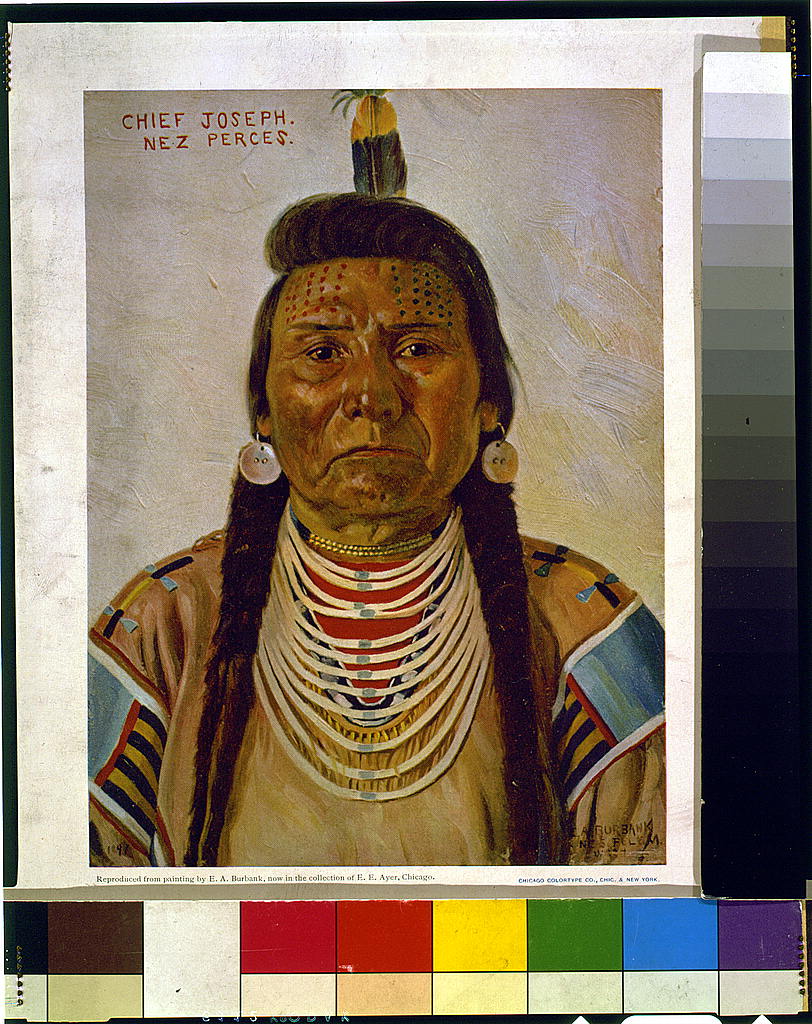

{Halftone reproduction of a painting by E.A. Burbank of Chief Joseph, Nez Percé chief, head-and-shoulders portrait, facing front, published by the Chicago Colortype Co., 1897; source: Library of Congress}


The New York Public Library has an excellent set of web pages describing and demonstrating chromolithography. Note in particular its sets of progressive proofs of a print called Prang's Prize Babies.

The two small crosses that you may have noticed on the Coke ad show it to be a type of proof. The crosses helped the printer determine that the registration was accurate as each successive color overlay was made. Once exact registration was assured, the crosses would, of course, be removed so as not to appear in the production prints.

-----------

Some sources:

The New Journalism 1865-1919

The Penny Press

Six thousand years of history see other blog post

The Daily Newspaper in America see other blog post

"Printing Presses" in The Encyclopedia Americana Encyclopedia Americana Corp., 1919

"The Development of the Rotary Web Press" in The American manual of presswork Oswald publishing company, 1916

Modern industrial progress by Charles Henry Cochrane (J.B. Lippincott company, 1904)

Color printing in wikipedia

History and present condition of the newspaper and periodical press of the United States by Simon Newton Dexter North (Govt. print. off., 1884)

American dictionary of printing and bookmaking by Wesley Washington Pasko (H. Lockwood, 1894)

History of Color Printing

COLOR PRINTING IN THE NINETEENTH CENTURY An Exhibition at the Hugh M. Morris Library, University of Delaware, Newark, Delaware, August 27 - December 19, 1996,curated by Iris Snyder

The wonders of modern mechanism, a résumé of progress in mechanical, physical, and engineering science at the dawn of the twentieth century by Charles Henry Cochrane (J.B. Lippincott company, 1900)

Chromolithography on wikipedia

"How Chromos are Made" in The living age, Vol 95 (Littell, Son and Co., 1867)

"Chromo-Lithography" in House documents, otherwise publ. as Executive documents, 13th congress, 2d session-49th congress, 1st session (Gov't Printing Office, 1876)

The half-tone process: A practical manual of photo-engraving in half-tone on zinc, copper, and brass by Julius Verfasser (Iliffe & sons, limited, 1904)

The chemistry of light and photography: in its application to art, science, and industry by Hermann Wilhelm Vogel (London, Henry S. King & Co., 1875)

Commercial engraving and printing, a manual of practical instruction and reference covering commercial illustrating and printing by all processes, for advertising managers, printers, engravers, lithographers, paper men, photographers, commercial artists, salesmen, instructors, students and all others interested in these and allied trades by Charles William Hackleman (Commercial Engraving Publishing Company, 1921)

--------

Notes:

[1] Wikipedia gives a bit more detail: '"Drink Coca-Cola 5¢", an 1890s advertising poster showing a woman in fancy clothes (partially vaguely influenced by 16th- and 17th-century styles) drinking Coke. The card on the table says "Home Office, The Coca-Cola Co. Atlanta Ga. Branches: Chicago, Philadelphia, Los Angeles, Dallas". Notice the cross-shaped color registration marks near the bottom center and top center (which presumably would have been removed for a production print run). Someone has crudely written on it at lower left (with an apparent leaking fountain pen) "Our Faovrite" [sic].'

[2] Contemporaries news readers didn't use the term yellow journalism at that time. To them it was yellow kid journalism, after Outcault's Yellow Kid comic strips, about which I've previously written (see New York Sunday comics in the 90s & aughts).

[3] A contemporary account describes the whole process in considerable detail: Modern industrial progress by Charles Henry Cochrane (J.B. Lippincott company, 1904). I've outlined the method of making newspaper text in a previous blog post: Newspaper Story.

[4] In practice, more than three printing plates could be used. There might be one for black and grey tones and another for brown. Where faithfulness to the original picture was important, such as with high quality fine art reproductions, more plates would be added for different prominent tones in the original.

[5] "Photo-Lithography" in The chemistry of light and photography: in its application to art, science, and industry by Hermann Wilhelm Vogel (London, Henry S. King & Co., 1875

[6] See "Halftones" in the same source, and:
HALF-TONE ILLUSTRATION OVERLAYING

By "half-tone," in so far as this relates to printing plates made by the photo-mechanical process, is meant all engravings, pictorial and otherwise, which have their grays or lighter tones produced or enhanced by mesh formations over the face of the engraving, whether these be conveyed through a "dotted" or "lined" glass screen — the usual mechanical manner of producing half-tone effects on this character of printing plate.
-- The Inland and American printer and lithographer (Maclean-Hunter Pub. Co., 1895)

Friday, May 13, 2011

New York Sunday comics in the 90s & aughts

One of the first and most popular uses of color printing was in the comics pages. The San Francisco Examiner is credited with publishing the first real comic in 1893. This was The Little Bears which grew out of a cartoon accompanying the daily weather report.[1]

Though not among the first, the Sunday comics in the Herald were among the best.[2] The most visually interesting of them was Winsor McCay's Little Nemo. Begun in 1905, this was the first strip with an episodic story line: the narrative continued from one weekly installment to the next. Zachary Chavez has digitized Little Nemo's adventures from the first on October 15, 1905, to the last on July 26, 1914. You can see them here:
Little Nemo in the Comic Strip Library.

Here's the first — October 15, 1905 — setting the scene for the others to follow. Little Nemo falls asleep and is called to journey to a place called Slumberland. Each comic shows his adventures as he tries to get there. Review the wikipedia entry on the strip for a full description of the plot line. Click the image to view full size. You can see McCay's potent imagination and his skill as an illustrator and you can see also the relatively high quality of the Herald's printing.[3]


This is the third; it ran October 29. 1905.


This is the sixth — December 3, 1905.


December 3, 1905

The giant elephant of September 23, 1906, is particularly spectacular. This is the first of a three-week set. You can see the second and third here and here, respectively.


On July 26, 1908, McCay drew this walking bed.


Foxy Grandpa was the Herald's first Sunday strip. It appeared on January 7, 1900, a creation of cartoonist Carl E. Schultze drawing under the name of "Bunny."[4]

Produced later the same year, Pore Lil' Mose was the first Sunday strip to feature an African American hero. Taking its humor from racial stereotypes, it's in keeping with attitudes of that time and not at all in keeping with our own. However, there's nothing vicious or much more than superficially demeaning in the comic. Here's a sample from February 1901. You can see that the artist's approach to drawing and visual design are less imaginative and more in keeping with what we consider normal comics than is McCay's.


{source: valentinecollectors.com}

The Herald's longest-lived comic strip was Buster Brown. Begun May 4, 1902, it too lacked the visual imagination and drawing skill that McCay brought to the Little Nemo strips, but it was funny and became very popular.[5]


Both Pore Lil' Mose and Buster Brown were made by Richard F. Outcault whose Hogan's Alley was one of the first and best-loved Sunday strips. Outcault specialized in depicting antics and life-in-general among the urban under class of dwellers in tenement aparments. His first, in 1894, was a series these gritty cartoons for Truth Magazine.


{Outcault's "Feudal Pride," June 2, 1894, in Truth Magazine; source: cagle.com}

In 1895 Outcault moved the Pulitzer's New York World and, while there, he made more prominent one of his Truth Magazine characters, the famous The Yellow Kid. [6] Here are a couple of these early Hogan Alley strips in which the kid appears.[7]


{"First Championship Game of the Hogan's Alley Baseball Team." Hogan's Alley. New York World. April 12, 1896.}


{"Golf—The Great Society Sport as Played in Hogan's Alley." Hogan's Alley. New York World 5 Jan. 1896.}

This next comic shows the Yellow Kid in a Thanksgiving turkey raffle. It appeared in the New York Journal following Outcault's move there in 1896. What was Hogan's Alley has now become McFadden's Row of Flats and the presentation has moved closer to an illustrated story than a simple comic.


{"A Turkey Raffle in Which the Yellow Kid Exhibits His Skills with the Dice." McFadden's Row of Flats. New York Journal. November 22, 1896.}

----------

Some sources:


Comic strip

Sunday comics

The Little Bears

The Yellow Kid

Buster Brown

Little Nemo

The Katzenjammer Kids

Winsor McCay. Extract: "Most of the prominent comic strips of the 1890s and 19-aughts are remembered today as pioneers. Little Nemo in Slumberland is among the first to be remembered for its outstanding quality. Even today, it is regarded as one of the high points in the history of comics. Winsor McCay was the son of Robert McKay (later changed to McCay) and Janet Murray McKay; Robert at various times worked as a teamster, a grocer, and a real estate agent. Winsor's exact place and year of birth are uncertain — he claimed to have been born in Spring Lake, Michigan in 1871, but his gravestone says 1869, and census reports state that he was born in Canada in 1867. He was originally named Zenas Winsor McKay, in honor of his father's employer, Zenas G. Winsor."

Finding "Little Nemo" by Douglas Wolk

R. F. Outcault

American comic strips before 1918

Rudolph Dirks

What's with the Strips, Anyway?

Comic Book Legends Revealed by Brian Cronin

Comic Book Resources

Richard Outcault

The Yellow Kid

R. F. Outcault, The Father of the American Sunday Comics

The Kid From Hogan's Alley By John Canemaker (Kitchen Sink Press, 1995)

Bill Bedard on “Little Nemo in Slumberland”

Winsor McCay

A hundred years later, fans are still over the moon about 'Little Nemo in Slumberland' comic strip October 22, 2005|By Kenneth Baker, Chronicle Art Critic

(Arguably) The Best Comic Strip Ever

Little Nemo in the Comic Strip Library

Little Nemo, a musical production; music by Victor Herbert, book by Harry Bache Smith (Cohan & Harris, 1908)

Comics Timeline, the history of the funnies in America

Chronology of Comic Strips and Comic Books in America

Comic Strip Library by Zachary Chavez

R.F. Outcault's "Pore Lil' Mose"

--------

Notes:

[1] Wikipedia defines the comic strip as "a sequence of drawings arranged in interrelated panels to display brief humor or form a narrative, often serialized, with text in balloons and captions," and says "the Little Bears (1893–96) was the first American comic with recurring characters, while the first color comic supplement was published by the Chicago Inter-Ocean sometime in the latter half of 1892. On January 31, 1912, Hearst introduced the nation's first full daily comic page in his New York Evening Journal." Here's the little guy:

{source: wikipedia}

[2] The first New York paper to feature a comic was Pulitzer's New York World (1895). The Herald's first strip was, apparently, Foxy Grandpa by Carl E. Schultze in 1900 (Chronology of Comic Strips and Comic Books in America). Here's a Foxy Grandpa strip from 1904. It does seem to display high quality color.

{Foxy Grandpa Cartoon 1904 Children Mirror Sale Joke; source: cqout.com}

The Herald's claim on having the best comics comes partly from the superiority of its color work. Among cartoonists, the Herald's printing was said to be the best (The Kid From Hogan's Alley By John Canemaker (Kitchen Sink Press, 1995). It was also known for excellence in the quality of the comics themselves, as the Little Nemo strip shows, and for its innovativeness, as the Pore Lil' Mose strip shows.

[3] Unless otherwise noted, my source for the Little Images is Zachary Chavez's Comic Strip Library. Compare the first Little Nemo, in the Herald, with this strip, the Happy Hooligan, which also debuted in 1905 (in the New York American):


{source: flickr}

[4] See note 1.

[5]Newspapers stole successful comics from each other. Outcault left the Herald for William Randolph Hearst's employ in 1906, and after a court battle, he continued his strip, now nameless, in Hearst papers, while the Herald continued their own version of Buster Brown with other artists. The latter lasted until 1911 or so, and the former until at least 1921.

[6] As the Yellow Kid grew more and more popular, William Hearst began trying to entice him over to his New York Journal. In 1896 he succeeded and Pulitzer struck back by hiring George Luks to draw his own version of The Yellow Kid. Both strips ended a year later. This was the era of yellow journalism which originally was referred to as "yellow kid journalism" after the comic.

[7] These Yellow Kid images come from The Yellow Kid on the Paper Stage by Mary Wood.

Sunday, October 17, 2010

good-good-good

Witnessed this at a car dealership yesterday afternoon.

Sales guy needs proof of insurance before he can release car to customer. Customer had bought insurance but email in customer's hand doesn't have all info needed. (Sales guy is a young man named Mikhail, born in southwestern Russia where they grow grapes and drink wine rather than vodka, but that's not relevant to this story.)

Sales guy says he'll get insurance company to fax needed doc. Finds phone number of customer service on customer's what-to-do-if-you're-in-an-accident card. Dials it on speaker phone. When speaker begins to emit robo-voice giving button-push options, sales guy hits the "O" button four times quickly. Robo voice seems confused. Mikhail hits the "O" button four more times quickly.

He might have to do this a third time before he hears a non-robo human voice (I forget). While hitting "O" he tells car buyer some insurance companies set their robo phone systems so that a live human with the authority to get something done only comes on the line only when you start yelling into the phone. This company is not one of those.

He picks up the handset to speak with actual non-robo human and quickly dispenses with ensuing "how-are-you-fine-how-are-you" exchange without being rude. "Good-good-good" he says. He gives his first name, identifies where he's calling from, and says what he needs. Speaks quickly but very clearly and gives only his first name. Gets shifted to a second person and rapidly goes through a second "good-good-good" exchange. Tells second person he needs fax showing name of insured, VIN of vehicle, and statement insurance that vehicle is insured by that person -- gives the fax phone number and his first name again to be put on fax header. Five minutes later the fax is in hand.

Here's an xkcd comic on the same general topic.


The comic's author, Randall Munroe, makes it available with a Creative Commons license. The comic home page is xkcd, a webcomic of romance, sarcasm, math, and language. xkcd may or may not stand for something. The wikipedia article on the comic discusses this topic: xkcd.

Side note: Watching Mikhail at work reminded me of olden times when, trying to arrange a flight at a travel agency, I would observe quick and efficient phone calls between agents and airline booking reps. This was back when you sometimes flew different carriers to get around and the local agent might be calling two, maybe three, airlines to get things set up.

Second side note: The experience of buying a used car at this dealership was much better than experiences at other dealerships times past. I'll be happy to identify the place if asked.

Friday, April 24, 2009

cancer

Cancer is on my mind these days. As this news article in the New York Times explains, success rates are high when it's detected early.

The article also explains that when not caught early, the disease is extremely difficult to treat and, unfortunately, "cancer investigators say, the more they study cancer, the more complex it seems."

The comic at right explains the complexity in layman's terms. It's by Jorge Cham, creator of a blog called Piled Higher and Deeper who was inspired by contact with cancer researchers after giving a talk at the M.D. Anderson Cancer Center last year.

Click the image to read the comic.

Here's the beginning of a more technical explanation by a famous medical scientist. As you'd expect, it goes into the matter in much greater detail, but it's more free of medical terminology than other writings on the subject.
How Cancer Arises (pdf) by Robert A. Weinberg

How cancer develops is no longer a mystery. During the past two decades, investigators have made astonishing progress in identifying the deepest bases of the process — those at the molecular level. These discoveries are robust: they will survive the scrutiny of future generations of researchers, and they will form the foundation for revolutionary approaches to treatment. No one can predict exactly when therapies targeted to the molecular alterations in cancer cells will find wide use, given that the translation of new understanding into clinical practice is complicated, slow and expensive. But the effort is now under way.

In truth, the term “cancer” refers to more than 100 forms of the disease. Almost every tissue in the body can spawn malignancies; some even yield several types. What is more, each cancer has unique features. Still, the basic processes that produce these diverse tumors appear to be quite similar. For that reason, I will refer in this article to “cancer” in generic terms, drawing on one or another type to illustrate the rules that seem to apply universally.

The 30 trillion cells of the normal, healthy body live in a complex, interdependent condominium, regulating one another’s proliferation. Indeed, normal cells reproduce only when instructed to do so by other cells in their vicinity. Such unceasing collaboration ensures that each tissue maintains a size and architecture appropriate to the body’s needs. Cancer cells, in stark contrast, violate this scheme; they become deaf to the usual controls on proliferation and follow their own internal agenda for reproduction. They also possess an even more insidious property — the ability to migrate from the site where they began, invading nearby tissues and forming masses at distant sites in the body. Tumors composed of such malignant cells become more and more aggressive over time, and they become lethal when they disrupt the tissues and organs needed for the survival of the organism as a whole.

This much is not new. But over the past 20 years, scientists have uncovered a set of basic principles that govern the development of cancer. We now know that the cells in a tumor descend from a common ancestral cell that at one point — usually decades before a tumor becomes palpable — initiated a program of inappropriate reproduction. Further, the malignant transformation of a cell comes about through the accumulation of mutations in specific classes of the genes within it. These genes provide the key to understanding the processes at the root of human cancer. . . .
Addendum:

I saw the NYT article in a section of the paper's innovative aggregator called Blogrunner. The section is The Annotated New York Times. Here's a smattering of its current contents:
The New York Times... Remixed.

In Long Drive to Cure Cancer, Advances Have Been Elusive

Richard M. Nixon pledged to cure cancer by 1976. EurekAlert   Science Blog   Reuters Health eLine   Medical News Today   FuturePundit   Medical News Today   Medical News Today
FULL COVERAGE »


On Climate Issue, Industry Ignored Its Scientists

A document shows that a fossil fuels industry group ran an aggressive campaign against an idea its own scientists called irrefutable: a link between heat-trapping gases and climate change. Medical News Today   PLANetizen: Front Page   Medical News Today   Rising Hegemon   ENN   The Huffington Post   Synthstuff   EurekAlert   Science Blog   DeSmogBlog - Clearing the PR Pollution that Clouds Climate Scien
FULL COVERAGE »


My Tortured Decision

A former F.B.I. agent who questioned Abu Zubaydah in 2002 says the suspected terrorist provided important intelligence under traditional interrogation methods. Talking Points Memo   Fox News Channel   Fraters Libertas   Emptywheel   NewsBusters.org   Ta-Nehisi Coates
FULL COVERAGE »


Interrogations' Effectiveness May Prove Elusive

Starkly opposing narratives have arisen about what, if anything, was gained by the C.I.A.'s use of physical pressure to intimidate Qaeda operatives. Stop The ACLU   Wonkette   The Agonist   TalkLeft   CHARMING, JUST CHARMING   The Huffington Post   Wizbang   Sweetness & Light   PrairiePundit
FULL COVERAGE »
Note: I'm asserting fair use in quoting from NYT Annotated for review purposes.

Wednesday, December 10, 2008

Yoicks!

Comic Book Exclamations

Writing a Facebook note the other day I searched my memory for an exclamation to express excitement and came up with Yoicks! The word came to me out of nowhere, unannounced. I couldn't recall ever using it nor when we might first have made each other's acquaintance. I thought I'd possibly seen it in comic books of my youth but a couple of Google searches drew a blank in that area (as it turns out this was partly because I used Yoiks instead of Yoicks). Then today I saw the word in a long scene within the first of the Palliser novels, which is my current recreational read. In it Trollope is describing a fox hunt and he has a character bellow "Yoicks, tally; gone away!" at an inopertune moment. It's an inopertune moment only because offensive to the imperious master of hounds, who responds "Do you suppose I don't know where the fox is?" This turns out to be a major put down. The DNB says the word isn't much older than the end of the 18th-c. ("The bold Fox-hunter, just come up to town, From ‘Yoicks, hark forward’, loves to seem a clown.") Altogether, except for the humor Trollope puts into it, the word and its context are unpleasantly John Bull bombastic: fox hunting is not an Austinesque country pursuit.

So, instead of Yoicks! I choose to write about comic curses and exclamations.

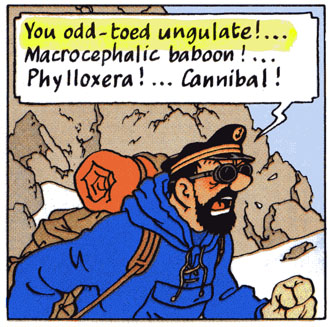
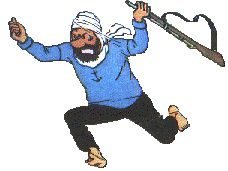
First Captain Haddock, so politically incorrect that his utterances have been deleted from Wikipedia:


Wikipedia aside, the internet provides lots of reveling in the excesses of Haddockian utterance. For example:
- Favorite Curses of Captain Haddock
- Favorite Curses, Visitor Contributions
- Speaking of curses and insults, watch out! Here comes Captain Haddock
- Captain Haddock's Curses
- THE CAPTAIN HADDOCK INSULT GENERATOR
- Exclamations used by Tintin's Captain Haddock
- Captain Haddock's Insults
- Insultes à français

Not curses, but infuriating to the man, were Bianca Castafiore's many manglings of his name: Castafiore Can't Say Haddock!

-----------------

After Yoicks! and before coming upon the delicious exploration of Haddock-exuberance, I found these other things:
- Archaic Exclamations
- Oddest Comic Book Exclamations! and
- The Comicraft Glossary of Lettering Terms

The latter of which contains some nice examples:

Tuesday, March 04, 2008

"he drew great mud"

I came across a review of a book on Bill Mauldin and thought I'd show off some of his cartoons. Famous for the Willie and Joe panels that appeared in the Army newspaper, Stars and Stripes, during World War II, he became a successful editorial cartoonist in later life.

Here's the lead of the review:
‘He Drew Great Mud’ by DAVID MICHAELIS
Published: March 2, 2008

Until surprisingly late in World War II, Army cartooning consisted of gags about mean old drill sergeants and raw recruits on K.P. duty. Then came Bill Mauldin, an impish rifleman from the 180th Infantry Regiment, who volunteered as a cartoonist for The 45th Division News. On July 10, 1943, he stumbled ashore, pistol drawn, in the Allied invasion of Sicily and went on to fight in the Italian campaign while turning the raw material of the front into captioned panel cartoons, often at the expense of superiors in the rear. Mauldin listened to his fellow dogfaces in their foxholes and sketched quickly, sometimes rendering finished work on the back of whatever scrap he could find in the rubble.
I hope these explain themselves. I've tried not to put in anything that's explicitly in copyright and claim fair use where I'm mistaken.


Fresh, spirited American troops, flushed with victory,
are bringing in thousands of hungry, ragged,
battle-weary prisoners. (News item)


"Radio th' ol' man we'll be late on account of a thousand-mile detour."


"Them buttons wuz shot off when I took this town, sir."


"Able Fox Five to Able Fox. I got a target but ya gotta be patient."


"I'll let ya know if I find th' one wot invented th' 88."


"Nonsense. S-2 reported that machine gun silenced hours ago. Stop wiggling your fingers at me."


"You blokes leave an awfully messy battlefield."


"Ya don't git combat pay 'cause ya don't fight."