Showing posts with label religion. Show all posts

Thursday, April 21, 2011

Auden's God

A couple of weeks ago we attended the funeral of an aunt. We'd had tea with her maybe a month before, but didn't know she had an aortal aneurysm that could have killed her at any time. We loved her, wish we'd seen more of her, and miss her now.

The celebrant was an Episcopalian priest who didn't know her and didn't pretend to. He conducted a short, dignified, and to me a memorable ceremony. His voice was gently sonorous and his diction precise. He did not declaim but simply spoke, yet the effect, if in no way the act, was as a musical performance, like listening to a string quartet and being carried away by the complex and familiar sounds. I felt dreamy-contemplative, one part of me communally present and the other privately wandering. He spoke the words of the King James version of the Bible, so familiar to him that he did not so much read as render them from memory. And so familiar to me that the words did not convey their usual prosaic meanings but rather, as when hearing a difficult poem, they had a collective, emotional impact more than a commonplace intellectual one.

I listened more attentively when the priest quoted Paul's first letter to the Corinthians. The letter says we are transformed when called into heaven. "All flesh is not the same flesh." As people, beasts, fishes, and birds all differ, "so also," the passage reads, "there is one glory of the sun, another glory of the moon, and another glory of the stars." When a person dies, he says, the "natural body" "is raised a spiritual body."[1]

Thinking about the "spiritual body" I recalled a homily once heard at Mass in which the priest said God is eternal, immaterial, without dimension and outside time. This description conforms to Spinoza's definition of a being that is infinite, necessary, uncaused, and indivisible.

W.H. Auden's concept of God was similar. He felt that God as father, lord, or other anthropomorphic descriptors was an artifact of language. We can't comfortably request blessings from Spinoza's God, can't envision such a being in our prayers, can't invoke what's basically indescribable in normal discourse. It followed for Auden, as Spinoza, that the immaterial God for which the anthropomorphized one stands isn't outside us but lies as much within as without. However, where Spinoza said all religion is superstition, Auden found a way to craft belief — and a commitment to religious observance — out of his faith. It mattered to him greatly that it was an act of this God to breathe into his Adam not just life, but consciousness, understanding of time's motions, and the ability to plan, make judgments, and cause things to happen.

Auden called this gift "making, knowing, and judging."[2] He believed that the way to God was through God's human creatures. Although Saint Matthew has Jesus say there are two fundamental commandments, Auden says they are one: "love thy God" (the first) is "like" (meaning identical with) "love thy neighbor" (the second).[3] Auden wrote "If it [i.e., an expression, a poem or other work of art] praises the Creator, it does so indirectly by praising His creatures..."[4] This gift which Auden's God gave humans was a terrible one; not terrible in the sense of wrongly done, but terrible in the sense of unimaginably frightening. This gift — the freedom of humankind to perceive themselves as separate beings, to make individual judgments, to create and to destroy — was once thought to have God-imposed limits, but events of the 20th century, particularly from the rise of Nazism onward, proved this belief to be a false one.

Auden considered this subject more than once, probably most memorably in a poem called Friday's Child.[5] The poem was a tribute to Dietrich Bonhoeffer, a German pastor and theologian who was executed by hanging on April 9, 1945, for his efforts to assassinate Hitler. He was one of a very few religious leaders who not only opposed National Socialism but actively worked to subvert it.

In writing about Bonhoeffer Auden concealed in a kind of joke the depth of his feeling about what seems have been a cosmic injustice. Concerning the power that totalitarian states use in order to destroy the lives of millions the poem asks:
What reverence is rightly paid
To a Divinity so odd
He lets the Adam whom He made
Perform the Acts of God?
The poem says the God-given human mind (the "self-observed observing Mind") has little skill in using the freedom it possesses:
Though instruments at Its command
Make wish and counterwish come true,
It clearly cannot understand
What It can clearly do.
The poem ends with a sorrowful meditation on Good Friday.
Meanwhile, a silence on the cross,
As dead as we shall ever be,
Speaks of some total gain or loss,
And you and I are free

To guess from the insulted face
Just what Appearances He saves
By suffering in a public place
A death reserved for slaves.
Auden agreed with what Bonhoeffer said: "To be a Christian does not mean to be religious in a particular way, to cultivate some particular form of asceticism.., but to be a human being. It is not some religious act which makes a Christian what he is, but participation in the suffering of God in the life of the world." The awful freedom which humans possess necessarily entails suffering. For Auden, the pain endured by God and humankind is mutual. We have the freedom not to experience this, but he believes we are wrong when we so choose.

These words make Auden seem profoundly pessimistic, but he was not. He believed in laughter, in getting on with life. He recognized that he had a choice between hope and despair and he chose hope and therefore learned to "bless what there is for being:"
That singular command I do not understand,
Bless what there is for being,
Which has to be obeyed, for
What else am I made for,
Agreeing or disagreeing?[6]
As Hannah Arendt said of him, his response to "the curse" was a "praise that pitches itself against all that is most unsatisfactory in man's condition on this earth and sucks its strength out of the wound." Arendt wrote this as a comment on lines in Auden's poem on W.B. Yeats.[7] Addressing Yeats, Auden makes a request:
With your unconstraining voice
Still persuade us to rejoice;

With the farming of a verse
Make a vineyard of the curse.

In the prison of his days
Teach the free man how to praise.


--------

Some sources:

canzoni

"w. h. auden - family ghosts" website by Nicholas Jenkins, Department of English, Stanford University

Auden and Christianity by Arthur C. Kirsch (Yale University Press, 2005)

Auden’s Memorial to Yeats by Katherine Bailey

W. H. AUDEN’S WISDOM, FAITH, AND HUMOR by Walter G. Moss (pdf)

Auden and God by Edward Mendelson, reviewing Auden and Christianity by Arthur Kirsch (pdf)

"Reflection on the Right to Will": Auden's "Canzone"and Arendt's Notes on Willing by SUSANNAH YOUNG-AH GOTTLIEB

"The Quest for Auden" by Austin Warren in The Sewanee Review, Vol. 87, No. 2 (Spring, 1979), pp. 229-248. Published by: The Johns Hopkins University Press Stable URL: http://www.jstor.org/stable/27543545

"Auden's Religious Leap" by Justin Replogle in Wisconsin Studies in Contemporary Literature, Vol. 7, No. 1 (Winter - Spring, 1966), pp. 47-75. Published by: University of Wisconsin Press Stable URL: http://www.jstor.org/stable/1207210 .

Auden and the Limits of Poetry by Alan Jacobs

Forgiveness as a Manifestation of Divine Charity 2011 April 12,
by Joshua Miller

Regions of sorrow: anxiety and messianism in Hannah Arendt and W.H. Auden by Susannah Young-ah Gottlieb (Stanford University Press, 2003)

"Auden in the Fifties: Rites of Homage" by Monroe K. Spears in The Sewanee Review, Vol. 69, No. 3 (Jul. - Sep., 1961), pp. 375-398. Published by: The Johns Hopkins University Press Stable URL: http://www.jstor.org/stable/27540685 .

The Bible Is Dead; Long Live the Bible by Timothy Beal

Auden Explains Real Function of All Ritual published in the April 1, 1944 issue of the Phoenix

Prose: 1939-1948 by W.H. Auden, Vol. 2 (Princeton University Press, 2002)

----------

Notes:

[1] This is I Corinthians 15:39-41, 44. It concludes,
And so it is written, 'The first man Adam became a living being.' The last Adam became a life-giving spirit. However, the spiritual is not first, but the natural, and afterward the spiritual. The first man was of the earth, made of dust; the second Man is the Lord from heaven. As was the man of dust, so also are those who are made of dust; and as is the heavenly Man, so also are those who are heavenly. And as we have borne the image of the man of dust, we shall also bear the image of the heavenly Man.
[2] "Making, Knowing, and Judging" by W.H. Auden, from The Dyer's Hand, Part IV

[3] Matthew 22:36-40 (King James Version)
Master, which is the great commandment in the law? Jesus said unto him,
Thou shalt love the Lord thy God with all thy heart, and with all thy soul, and with all thy mind. This is the first and great commandment. And the second is like unto it, Thou shalt love thy neighbour as thyself. On these two commandments hang all the law and the prophets.
[4] Auden wrote this in The Dyer's Hand ("Making, Knowing, and Judging"). Here is the context:
The impulse to create a work of art is felt when, in certain persons, the passive awe provoked by sacred beings or events is transformed into a desire to express that awe in a rite of worship or homage, and to be fit homage, this rite must be beautiful. This rite has no magical or idolatrous intention; nothing is expected in return. Nor is it, in a Christian sense, an act of devotion. If it praises the Creator, it does so indirectly by praising His creatures among which may be human notions of the Divine Nature. With God as Redeemer, it has, so far as I can see, little if anything to do.
[5] Here is the whole poem. It's available on a number of web sites. I don't mean to abuse copyright, however, and will remove it if shown that I've put it here improperly.
Friday's Child

(In memory of Dietrich Bonhoeffer, martyred at Flossenbürg, April 9, 1945)

He told us we were free to choose
But, children as we were, we thought---
"Paternal Love will only use
Force in the last resort

On those too bumptious to repent."
Accustomed to religious dread,
It never crossed our minds He meant
Exactly what He said.

Perhaps He frowns, perhaps He grieves,
But it seems idle to discuss
If anger or compassion leaves
The bigger bangs to us.

What reverence is rightly paid
To a Divinity so odd
He lets the Adam whom He made
Perform the Acts of God?

It might be jolly if we felt
Awe at this Universal Man
(When kings were local, people knelt);
Some try to, but who can?

The self-observed observing Mind
We meet when we observe at all
Is not alarming or unkind
But utterly banal.

Though instruments at Its command
Make wish and counterwish come true,
It clearly cannot understand
What It can clearly do.

Since the analogies are rot
Our senses based belief upon,
We have no means of learning what--
Is really going on,

And must put up with having learned
All proofs or disproofs that we tender
Of His existence are returned
Unopened to the sender.

Now, did He really break the seal
And rise again? We dare not say;
But conscious unbelievers feel
Quite sure of Judgement Day.

Meanwhile, a silence on the cross,
As dead as we shall ever be,`
Speaks of some total gain or loss,
And you and I are free

To guess from the insulted face
Just what Appearances He saves
By suffering in a public place
A death reserved for slaves.
[6] This comes from Auden's poem Precious five of 1950.

[7] On this, see my last blog post: insufflation.

Tuesday, October 19, 2010

the war effort

It was while I was looking at photos taken by Ann Rosener that memories of Roald Dahl's Gremlins came to mind. Rosener worked for the Office of War Information which, in 1942, had succeeded the Farm Security Administration as FDR's domestic photographic agency. OWI's main role was to document mobilization within the US to fight the Axis powers. Unabashedly propagandistic, the agency's photos showed Americans doing good things to help the country gear up for war alongside ones reminding Americans what to do or not to do to help the war effort. All in all, OWI can be seen to have achieved some very straight-forward home-front morale-building.

Ann Rosener, who was in its stable of photographers, produced thousands of workmanlike images to further this work.[1] Her speciality, if she had one, was documenting the contributions made by women, members of minority groups, and people with disabilities. She showed these folks at work in defense industries and in their homes busy conserving, recycling, and making do so that consumer resources could be diverted to military production.

I was especially taken with a set of photos showing a nun of the Roman Catholic faith who came to be known as "The Flying Nun."[2]


{Washington, D.C. Field trips for the "flying nun" pre-flight class, including inspection tours of hangars at the Washington National Airport. Here, Sister Aquinas is explaining engine structure to her students, 1943 June}

As the caption says, the photo shows Sister Aquinas and students in 1943 at DC's commercial airport. To take it, Rosener used an elevated camera location and single-source artificial light. Although she normally posed her subjects, this appears to be at least partly candid. She obviously set up the shot, but it's also pretty obvious that Sister Aquinas is instructing the class while a guy in the background does some maintenance work on a radial engine.

Sister Aquinas belonged to Franciscan Sisters of Christian Charity. She'd graduated from the Catholic University of America and Notre Dame with majors in mathematics and physics. She'd also gotten her flying license in 1938 and, as a teacher at Catholic U, taught military and civilian pilots as well as the nuns which the photo shows. A former student says she went by the nickname "Spike" though no one told him why.[3]

She continued to fly after the war, mostly small commercial aircraft like this one.

{This photo shows Sister Aquinas piloting a Piper Cherokee. It was taken much by an anonymous photographer some time in the 1960s. The caption reads: "The real flying nun, Sister Mary Aquinas Kinskey, arriving at Sheboygan County Airport with two Franciscan sisters in a Cherokee C airplane. Sister Mary Aquinas, whose mother house was in Manitowoc, learned to fly during World War II in order to teach her students. Later she was involved with pre-flight instruction for the military. After the war she continued to fly, and she introduced aviation into the science curriculum in schools in Wisconsin and elsewhere. This photograph is part of the collection of Wisconsin author Tere Rio Versace concerning an unpublished book about Sister Mary Aquinas. Confusingly, Versace was also the author of the 'The Fifteenth Pelican,' from which the fictional 'Flying Nun' was adapted." Source: wisconsinhistory.org}

This caption alludes to the TV series, The Flying Nun, which may have been "inspired" by Sister Aquinas's passion for aviation, but took nothing at all from the story of her life.

Here's are some more of Rosener's session with the Sister in June, 1943.

{Washington, D.C. Sister Aquinas, "flying nun," exchanging trade secrets with an engineer at the Washington National Airport, 1943 June.}


{Washington, D.C. The "flying nun" from Ironwood, Michigan, walking down the field at the Washington National Airport after taking her class through the hangars. Sister Aquinas holds a student pilot's license and has many flying hours to her credit, 1943 June.}


{Washington, D.C. Sister Aquinas teaching a lesson in practical radio operations to the Sisters attending her Civil Aeronautics Authority course for instructors at Catholic University, 1943 June.}


{Washington, D.C. Sister Aquinas, "flying nun," in her laboratory at Catholic University checking the grease job on one of the airplane engines, 1943 June.}


{Washington, D.C. Sister Aquinas, "flying nun", with model planes in hands walking toward the aeronautics laboratory at Catholic University where she gives a daily three-hour preflight Civil Aeronautics Authority course for instructors, 1943 June.}


{Washington, D.C. Sister Aquinas, "flying nun," applying a little glue to the model P-38 which hangs from the ceiling of her classroom at Catholic University. A veteran of fifteen years' teaching experience, the Sister is giving a summer Civil Aeronautics Authority course for instruction, 1943 June.}


{There's no caption on this photo of Sister Aquinas and model airplane enthusiasts. It's found with the photos of the June 1943 shoot and presumably was taken then.}


-----------

Here are photos of Ann Rosener by an anonymous photographer from OWI collections at the Library of Congress.


{Washington, D.C. Portrait of Ann Rosener, United States OWI (Office of War Information) photographer}


-------------

Here are a few examples of Rosener's other OWI work.


{Women in industry. Tool production. Pioneers of the production line, these two young workers are among the first women ever to operate a centerless grinder, a machine requiring both the knowledge of precision measuring instruments, and considerable experience and skill in setting up. In this Midwest drill and tool plant, manned almost exclusively by women, centerless grinders have been efficiently operated by women for more than a year, and company production figures have continued to soar. Republic Drill and Tool Company, Chicago, Illinois, 1942 Aug.}


{"How do I look?" Attractive playsuits for daughter can be made from that old housedress with the splitting seams, and junior's first long pants (no cuffs) can be cut from father's old overcoat. With shortage of wool and other materials needed by the armed forces, it's a wise mother who conserves clothing by altering and remodelling used garments for other members of the family, 1942 Feb.}


{Production. Aircraft engines. Negro women with no previous industrial experience are reconditioning used spark plugs in a large Midwest airplane plant. Despite their lack of technical knowledge, these women have become expert operators of the small testing machines. Melrose Park, Buick plant, 1942 July.}

--------------

Some sources:

Women Photojournalists, Prints and Photos Div., Library of Congress

Sister Mary Aquinas, obituary in the NYT, October 23, 1985

Flying Nun in a B-52

Sheboygan Airport and Flying Nun

All Saints Academy School, Ironwood ("Sister Mary Aquinas, who was on the faculty of St. Ambrose High School, learned how to fly a plane so she could teach aeronautics. She was the original 'flying nun!'")

Flying Nun (1941), The Home Front - Manitowoc County in World War II, Manitowoc Local History Collection, The State of Wisconsin Collection

The Flying Nun TV series, article in wikipedia

The Flying Nun (TV Series 1967–1970) on imdb

-------------

Notes:

[1] The photos can be found in the OWI collections at the Library of Congress. I'd provide a bio link for Rosener if I could find one. I've her birth date (1914) and virtually nothing else.

[2] Unless otherwise indicated, all photos come from the OWI collections of the Prints and Photos Division, Library of Congress.

[3] The student's reminiscence comes from the web site of Silver Lake College. It's Sister Aquinas taught — and flew an airplane — with strength and authority (pdf). Here's the text:
Remember your favorite teacher in high school? Was it a softspoken woman who gave you extra help after hours? Or perhaps it was the gym teacher who wouldn’t let you quit. Maybe it was a teacher who didn’t give homework and told a lot of jokes in class. For Bill Sullivan, a former student of St. Ambrose High School in Ironwood, Michigan, it was a Sister from the Franciscan Sisters of Christian Charity, who honed her affinity and talent for teaching at what was the forerunner of today’s Silver Lake College. Her degree work (undergraduate and graduate) was taken at Catholic University of America and Notre Dame in mathematics and physics.

Now, Sister Aquinas Kinskey did not fit into the stereotypical mold of what you may think a Sister might be like. In fact, Sullivan recounts that Sister Aquinas had a nickname: “Spike.” “Nobody ever told me why, but we all understood. It reflected her personal strength, her dynamics, and her take-charge image.” Sister Aquinas received her flying license in 1938, and eventually provided classroom instruction for prospective WWII pilots. She received a special citation of honor in 1957 from the US Air Force Association for her “outstanding contributions to the advancement of air power in the interest of national security and world peace.”

The nation remembers Sister Aquinas as the original “Flying Nun,” and although her work teaching for the US Air Force was incredibly important, Sullivan remembers Sister Aquinas for different reasons. His life was changed by his personal experience with her in high school.

Sullivan’s first class with Sister Aquinas was Chemistry in his junior year at high school. Before that, he knew her by reputation — and by how she took charge on an important feast day at the school. Sullivan, a trained altar boy and second tenor, recalls, “There was much going on at the altar in the church, with priests and altar boys all over the place. Spike [who directed the school choir] found herself short of second tenors. She looked up at the altar and saw me there. She marched right up to the altar, grabbed me by the collar and dragged me back to the choir loft, telling me loudly that they needed second tenors more than they needed altar boys.”

Stories about “Spike” abound at St. Ambrose High School reunions. Sister Aquinas had the stride and presence of a military general and the smile of one who was true to the person God created her to be and to the vocation God called her to follow. She inspired others to live their vocation as well. Under Sister Aquinas, Sullivan fell in love with the logic of science. As Sullivan excelled in Chemistry, he began to admire her expertise in the field of science. Sullivan recalls, “It was during this time that Sister Aquinas introduced me to someone, saying, with her hand on my shoulder, ‘This is my little chemical engineer.’ I truly did not know what a chemical engineer was at that point, but from that time on I set out to become one. I was afraid not to. I was sure she would call me to account.” Inspired, or perhaps driven, by Sister Aquinas, Sullivan went on to earn a degree in Chemical Engineering from the University of Michigan. He attained a job at Abbott Laboratories where he helped to create medicinal chemicals. Most notably, he worked with a team that helped to mass-produce the new “wonder drug” penicillin. Later, in 1962 , Sullivan received a research award for Outstanding Advances in Arythromiacin, another antibiotic.

Even a small pebble when thrown in a still pond will make a ripple, changing that pond. Those who influence the lives of others in subtle, and sometimes not so subtle ways, can spur immeasurable good during our earthly existence. We can all attest that there have been certain people who have changed the course of our lives.

More information about the life work of Sister Aquinas is available in the Holy Family Convent Archives, 920-682-772 8.

Monday, July 12, 2010

two sermons

My cousin Allen ministers to a congregation in West Brooksville, Maine, and this past Sunday he preached on the Parable of the Good Samaritan. It's a challenge to create a new way to treat this oh-so-very-familiar story, one he met head on and overcame. Weaving together four first-person narratives, he told of an accident on the back roads of rural Maine — (1) a family overturned in a van, injured and unable to help themselves; (2) a woman late for work; (3) a preacher late for service; and (4) a berry picker, lost and fearful that he and his mates would lose their jobs. The stories are spare but precise and have a personal intensity that gives them an unusually strong emotional impact. Overall, it's a simple moral tale, like the parable, and one which makes it hard for readers to be smug about themselves: you can't easily deny its message with a facile "no fear, I wouldn't be the one to pass by." This link takes you to his words on the church blog: What Must We Do?.

This is where he does his pastoring.


Not long ago he treated much the same subject from a different angle. He told his hearers that he'd been preparing for a difficult physical challenge: he was training for an attempt to row his sixteen-foot Norwegian workboat the whole thirty-three miles around Deer Isle in a single day. In that sermon he used this training experience — the discipline, endurance of pain, sense of accomplishment as training progresses, and hope of ultimate success — to illustrate the points he wished to make about some lines from Paul's Letter to the Romans: "suffering produces endurance, and endurance produces character, and character produces hope, and hope does not disappoint us."

Without belittling his own immense efforts or theirs, he says what he and other athletes face is actually somewhat trivial compared to the challenges and hardships that most all of us are forced to cope with, sooner or later. He lists these traumas — personal crises, loss of loves ones, "the end of a cherished relationship, separation from one’s children or grandchildren or friends by distance or alienation" — and says that as we confront our own pain and loss we enlarge our capacity for sympathy. We can overcome the deadening sense of isolation that we feel and find meaning where there seems to be none. The key lies in our ability to acknowledge with compassion our "commonality in suffering" with sufferers among us. It's this message of compassion which links this sermon to his later one on the Good Samaritan. Here's a link to it: The grace in which we stand.

--------

Allen's training paid off and, with support from wife and friends, completed his solo circumnavigation. Here are photos of that achievement and links to published accounts of it.

This link takes you to a brief account from a local newspaper — Brooklin Man Rows Traditional Boat Around Deer Isle.

This map shows the route. He rowed counterclockwise the 33 miles around both Deer Isle and Little Deer Isle.


These photos are all by Bob Harris who takes lots of photos for the Facebook page of the Deer Isle-Sunset Church, UCC.


{It's 2:45 AM, the sun won't be up until 5:00, and Allen's guiding himself by compass and the lights of the Deer Isle Bridge.}


{Hours later, Allen has rounded the western end of Little Deer Isle and is turning into the sunrise.}


{I think this shows him rounding the eastern end of the island and turning north.}


{Mid-morning, headed north, moving through the Lazyguts Islands off Stonington.}


{Allen has turned round the eastern end of Deer Isle and now has rising sun in his face.}


{Resting for a moment.}


{Another rest, this one along the eastern shore of the Sunshine section of Deer Isle just before he heads into Eggemoggin Reach for the last leg of his voyage.}


{Returning to his starting point after ten hours of rowing.}


{Caption: One very happy man!}


On this detail from a 1904 topographic map, the green box shows where the van carrying Leigh Anne and her family overturned.


This detail from the same topo map shows West Brooksville and the location of the church. I've stitched this image together from two adjoining sections of map.


Here is a link to the topo map section of which the right half of the above map is a detail: Bluehill 1904: Bluehill, Brooklin, Brooksville, Deer Isle, Penobscot, Sedgwick.

Monday, July 05, 2010

Quaker story

Independence Day in the U.S. is a bellicose holiday. It's ironic that it comes only a few days after the anniversary of the day on which Britain, peaceably, declared Canada to be an independent nation. Many Canadians trace their ancestry to families that were harried out of the lower colonies because they would not join in the rebellion.

I've lots of relatives, near and distant, who shouldered weapons on North American battlefields of the Revolutionary era (or who directed others who did so). And lots, too, whose religious beliefs kept them at home.

These recalcitrants belonged to the Society of Friends and could be disowned by their fellow Quakers for taking arms, signing oaths of loyalty (even under duress), paying taxes to support defense or insurgency, or paying fines to obtain exemption from military service. Those disowned were shunned; they were not welcome in Meetings, they could not call on the fellowship for support in time of need.

This makes sense when you think about it. All religions need to make it clear to believers and outsiders alike just what it is that distinguishes them from all the other faiths. And, as purveyors of beliefs that were not only unpopular, but also seen as dangerously subversive, Quakers had special reason for wanting to insure that they were united and could draw unquestioning and loving nurturance from one another. The most common reason for being disowned was "marrying out" which could mean marrying a person who was not a Quaker, being married by a priest or minister, or lying about one's suitability as potential spouse.[1]

Not so many Quakers were disowned for associating themselves with a military cause in some way. Their small numbers probably show that the great majority were staunch in their beliefs even under gross provocation (their self-righteous neighbors might tar them and feather the tar, and ride them out of the village on a rail just because they would not sign an oath of loyalty). But it's also possible that Meetings recognized that members could be forgiven for caving in under such duress. And it's quite possible too, that members left Meeting when they decided they must fight for one side or the other.[2]

Most of the many near and remote members of my family who were Quakers were in the Thorne branch. Quite a few of these Thornes were named Thomas, and one of these, a Thomas H. Thorne, was said to have gained notice in the following ways: "This Thomas Thorne was disowned from the Religious Society of Friends for participation in the Revolutionary War. He was an Aide to George Washington & led the forces across the Delaware River & destroyed the Hessian Army."[3]

This is a juicy story, but it isn't a factual one. First off, it's wildly implausible. This Thomas H. was definitely born on July 10, 1766, and would have been but 10 at the time he was supposedly a high-ranked army officer. Second, there was no Thomas Thorne among Washington's aides that anyone can now find. And third, he might have served in the war, but, if so, his name isn't be found on rosters that have survived so far as I can tell. There was some discussion of these points on a Thorne family discussion list a while back.[4] The story apparently took root at a reunion of the Thorn family of West Virginia in 1940 where someone told it to a reporter covering the event. These things happen. It's since been repeated here, here, and here.

There's a lesson for me in this little account — one about applying basic common sense before repeating family stories and seeking verification when there's reason to doubt their accuracy. It's actually a somewhat more encompassing reminder to cast a skeptical eye on the fascinating stuff that appears all over the internet.

----------


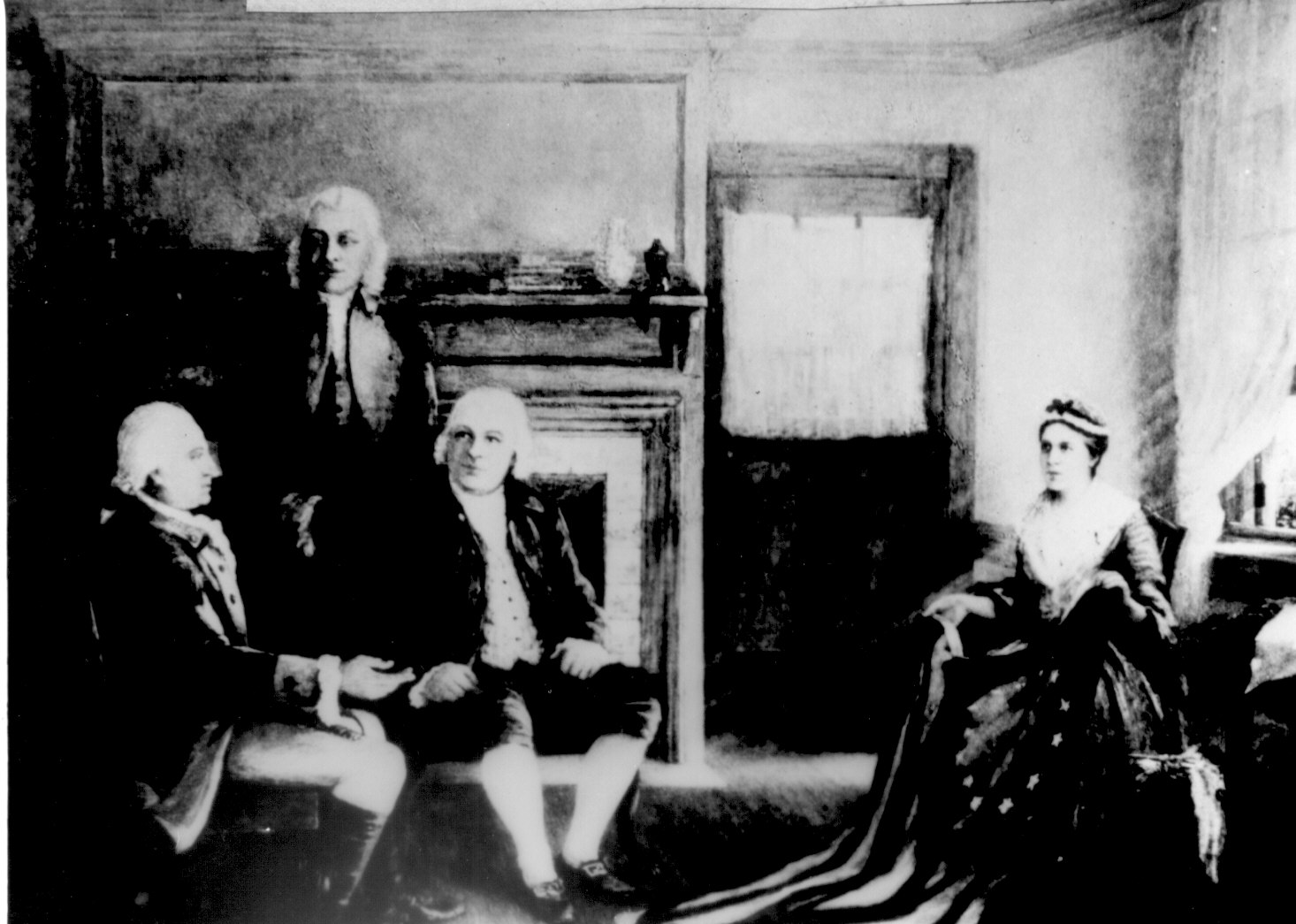
{This is an imaginative reconstruction of Betsy Ross & company; source: U. S. National Archives, image 148-GW-1210 via awesomestories.com; Betsy Ross was a Philadelphia Quaker who was disowned for marrying out. She ran an upholstery business and is thought to have made flags for the Revolutionary rebels.[5]}


{Canada Day cartoon by K. Beaton}

---------

Some sources:

Betsy Ross, Quaker Rebel

Thomas H. Thorn by John Coutant Thorn

Michelle's Family: Thorn, Thomas (1766 - 1835) - male b. 10 JUL 1766 in Crosswicks, Burlington, NJ
d. 1835 in WV father: Thorn, John (1730 - 1807) mother: Ivins, Diadamia (1734 - 1813)

The Cox family in America by Henry Miller Cox, George William Cocks, and John Cox (Printed by the Unionist gazette association, 1912)

Early Church Records of Burlington County, New Jersey, Volume 2. by Charlotte D. Meldrum (Heritage Books, 2007)

Liberty and conscience: a documentary history of the experiences of conscientious objectors in America through the Civil War by Peter Brock (Oxford University Press US, 2002)

God Angrily Clarifies 'Don't Kill' Rule, The Onion, September 26, 2001 | ISSUE 37•34 "Humans don't need religion or God as an excuse to kill each other — you've been doing that without any help from Me since you were freaking apes!" God said. "The whole point of believing in God is to have a higher standard of behavior. How obvious can you get?"

Early Quaker History

book review in the Daily Beast: The Secret Founding Fathers by T.H. Breen

----------

Notes:

[1] Quaker records often give a catch-all accusation of "disunity" when disowning a member of the society. In addition to marrying out and failing in peace testimony, Friends were made unwelcome for ill-behaviour, for going out with a man under pretence of being married, for not complying with advice to emancipate a Negro, for joining another society, and for joining the Regulators (vigilante groups of the Revolutionary period and before).

[2] Some of the few who were disowned for not living up to the Peace Testimony formed a schismatic Society of Free Quakers.

[3] My common ancestor with this Thomas H. Thorne is William Thorne (born 1616 in England). Thus (from thorn.pair.com).

Descendancy from William Thorne (born before 1617) to Thomas H. Thorne:

1. William Thorne b: Bef. 1617 in England d: Bet. 1657 - 1664 in Flushing, Long Island, NY
.. +Susannah Boothe b: Abt. 1630 d: Abt. 1675 in Flushing, Long Island, NY
... 2 John Sr Thorne b: 1643 in probably in Lynn, MA d: Aft. 1707 in Flushing
.... +Mary Parsell b: 1643 m: March 09, 1663/64 in Flushing, Long Island, NY
..... 3 John Thorn Jr. b: Abt. 1665 in Chesterfield, NJ d: Bef. August 13, 1737 in Bordertown, NJ
...... +Catherine Oakley? b: Abt. 1668 d: 1766 m: 1688
....... 4 Joseph Thorn b: November 1700 in NJ d: 1774
........ +Sarah Foulke b: September 25, 1702 in NJ d: Bef. 1774 m: 1723
......... 5 John Thorn b: 1729 in Camden, NJ d: 1807 in Camden
.......... +Diadamia Ivins b: 1733 in NJ d: 1813 in NJ m: 1753
........... 6 Thomas H Thorn b: July 10, 1766 in Burlington Co, NJ d: 1813
............ +Rebecca Steward b: 1765 m: 1785 in Crossneck, NJ

[4] From: J.C. Thorn's Family Forum - ARCHIVES
Posted by Brandon Wolf on Tuesday, 4 May 2004, at 11:21 a.m.

Just wondering about the Thomas H. Thorn in the 6th Generation of the William Thorne line (b.10 Jul 1766) The page states:

==========================
This Thomas Thorne was disowned from the Religous Society of Friends for participation in the Revolutionary War. He was an Aide to George Washington & led the forces across the Delaware River & destroyed the Hessian Army.
==========================

Who is credited with this research? I cannot find anything to confirm this. In fact, the famous Crossing of the Delwaware happened December 26, 1776. Which would have made Thomas H. Thorn 10 years old. I could see him being an Aide, but leading forces across and destroying the Hessian Army? Just curious if anyone can confirm this at all?

---------------

Posted by Roger Templeton on Wednesday, 16 June 2004, at 11:51 a.m., in response to Thomas H. Thorn - George Washington's Aide?, posted by Brandon Wolf on Tuesday, 4 May 2004, at 11:21 a.m.
Brandon - I have almost the same language in my files, an article copied on typewritten onion-skin by my aunt many years ago:

"The SENTINEL, Parkersburg, West Virginia, Aug. 1940 --
"THORN REUNION AT BUTCHER HILL CLUB
[...] "In the sixth generation of record is found Thomas Thorn, born July 10, 1766. He was disowned from the Society of Friends for participating in the Revolutionary War. He was personal aide to General Washington and led the forces who crossed the Deleware."

Pretty heady, for a 10-year old, eh?
------------------

Posted by Betty Renick on Wednesday, 16 June 2004, at 1:58 p.m., in response to Thomas H. Thorn - George Washington's Aide?, posted by Brandon Wolf on Tuesday, 4 May 2004, at 11:21 a.m.
I've heard this 'story' over the years and also seen it questioned. I have found no documentation. I have this information on his grandfather Joseph Thorne:

Joseph THORNE. was born about 1700 probably in New Jersey. He probably died in 1774 in New Jersey (Will executed 7/15/1774 & proved 3/25/1775). According to Anthony T. Thorn (descendant) this Joseph Thorn received cuts & swords wounds from Hessian soldiers, who attempted to invade his home.

It has been suggested that because he used force to defend his home, he might have been the one to have been disowned by the Society of Friends. In my line from William, I also show Thomas born 1766 which, if correct, would make him too young for Rev War. His father John could have participated (born 4 May 1730) but I have no record of any Rev War service for my Thorn(e) ancestors.
[5] Betsy Ross - Brief Bio:
Elizabeth Griscom (later known as Betsy Ross) was born in 1752, the eighth of seventeen children. When she was three, her family moved from New Jersey to Philadelphia. By the time she was a young woman, Betsy (a Quaker) was a trained upholsterer.

Her first husband, John Ross, was an Anglican (which meant that Betsy’s family opposed the marriage). The young couple started their own upholstery business on Mulberry Street (now Arch Street) in today’s Old City of Philadelphia.

A bit more than two years after their wedding, John was guarding munitions near the Delaware River. He was killed when gunpowder exploded. Betsy became a widow at 24.

In addition to running her upholstery business, which she continued to work after John’s death, Betsy earned extra money by mending uniforms (and other similar items) for members of the Continental Army. She married again in June of 1777.

Joseph Ashburn, her second husband, was a mariner often away at sea. In 1780, when Betsy was expecting the couple’s second child (a daughter, Eliza), the British captured Ashburn’s ship and charged the whole crew with treason.

Jailed at the Old Mill Prison (in Plymouth, England), Joseph died before Britain released their American prisoners in 1782. So did Zilla Ashburn, the couple’s older daughter. She had lived just nine months.

A widow again (this time at age 30), Betsy renewed her friendship with John Claypoole. They married, in May of 1783, and were together thirty-four years.

Betsy, herself, lived a long life. She died in her sleep, on the 30th of January, 1836. By that time, she was 84 years old and totally blind.
Credits

U. S. National Archives, image 148-GW-1210.

Saturday, January 30, 2010

love, peace and liberty condemn hatred, war and bondage

Volume 34 of the Lineage book - National Society of the Daughters of the American Revolution (1912) gives a lineage for Minnie Roelker showing that she was eligible to be inducted into the society. The report in DAR yearbook is succinct:
MRS. EMILIE VIRGINIA ROELKER. 33483

Born in Hoboken, New Jersey.
Wife of Hugo B. Roelker.
Descendant of Ensign Thomas Lenington, of New York.
Daughter of Henry Lefman and Sarah Lenington Thorne, his wife.
Granddaughter of John Edmund Thorne (b. 1815) and Abby Lenington, his wife.
Gr.-granddaughter of Thomas Lenington and Sarah Van Sickles, his wife.
Gr.-gr.-granddaughter of Thomas Lenington and Sarah Sickerton, his wife, m. 1777.

Thomas Lenington, (1755-1829), served as sergeant under Capt. John Nicholson in the Canadian campaign; was promoted ensign 1776; was taken prisoner and confined fourteen months at Quebec and Halifax. After his exchange he was employed in the quartermaster's department and had command of a vessel on the North River. The widow was one hundred and four years old in 1848 and a pension was allowed her for over two years actual service as sergeant and ensign in the New York line. She was married in New Providence, New Jersey and received her pension in Brooklyn, N. Y.
Minnie was sister of my great-grandmother Annie Windmuller and as I recall, the family found it slightly embarrassing that anyone related to us wanted to be a part of that tainted organization. Still, Minnie's genealogical research gives some interesting stories, which my aunt Florence collected and saved. I've summarized aunt Florence's work here.

A bit of further research turns up a considerably more distant and somewhat more interesting relative. Both Minnie and her sister, my great-grandmother, were descended from a man named William Thorne. There have be many men of that name. This one is distinguished for having agitated for freedom of religion in Dutch New Amsterdam back when the American colonies were still young.

The story is succinctly told here and at greater length here (pdf).

In 1638 this William Thorne left England so he could practice his religion without interference and then left Massachusetts when he found he disagreed with the practices of the Puritans there. In New Amsterdam he thought he'd found the tolerance he sought, but a change in government brought new restrictions, not on his own freedoms but on those of a near-universally persecuted sect, the Society of Friends, or Quakers. Standing on principle and seeking for others what he valued so much for himself, Thorne joined with others, none of them Quakers, to request that Quakers be able to practice their religion in Flushing, Long Island, the town in which they'd settled. The government of the time refused but was, in time, overridden by the home office in Amsterdam.

William Thorne and his son, also William, both signed this request and both are direct ancestors.*

The document is untitled and has since come to be called the Remonstrance of the Inhabitants of the Town of Flushing to Governor Stuyvesant, December 27, 1657.

This is what it looks like:

{source: Marilynn K. Yee/The New York Times}

It's the first formal request for freedom of religion in the American colonies and is a precursor of the freedom of religion clause in the Bill of Rights of the US Constitution.

It asks Peter Stuyvesant, the governor, to "let every man stand or fall to his own Master." And it reminds him, "wee are bounde by the law to do good unto all men, especially to those of the household of faith." It also says, "love, peace and liberty, extending to all in Christ Jesus, condemns hatred, war and bondage... if any of these said persons come in love unto us, we cannot in conscience lay violent hands upon them, but give them free egresse and regresse unto our Town, and houses, as God shall persuade our consciences, for we are bounde by the law of God and man to doe good unto all men and evil to noe man. And this is according to the patent and charter of our Towne, given unto us in the name of the States General, which we are not willing to infringe, and violate, but shall houlde to our patent and shall remaine, your humble subjects, the inhabitants of Vlishing [i.e., Flushing]."

-----------

See also:

A Colony With a Conscience an Op-Ed article in the New York Times by By Kenneth T. Jackson

The Flushing Remonstrance by Michael Peabody in Liberty Magazine, whose purpose is to honor freedom of religion ("The God-given right of religious liberty is best exercised when church and state are separate")

Flushing Remonstrance article in wikipedia

Precursor of the Constitution Goes on Display in Queens, an article in the New York Times on an exhibition to celebrate the 350th anniversary of the remonstrance

350th Anniversary of the Flushing Remonstrance: 1657-2007 a set of web pages honoring the anniversary

Roots of a Westchester Wedding Planted Deeply in Religious Freedom (pdf)

-----------

Note:

* You can see the descendency here: Windmuller Family Genealogy.

Monday, December 28, 2009

good will, again

I mentioned that good will overtook me while in church Christmas eve, but — sad to say — the words themselves more than the feeling. I thought of what the shepherds heard and wondered what it meant, then let my mind wander to variants. Good Will, I thought wouldn't be a bad handle for Shakespeare. A good will is one that survives probate intact, of course, and financiers like to trade in the goodwill of businesses, meaning something like the value of their reputations. It occurred to me that some believe the good will inherit the earth and, if so, it may be that no good will come of it. I wondered whether the phrase Good Will Hunting might have multiply layered meanings in the movie of that title (which I haven't seen). And some obvious variants came to mind: God's will, the goad that will prick, and, as my Indiana grandma might have said, 'it's a good while since I've seen you.'

What is there in this phrase?

Since it's Biblical, it's hardly surprising that there's dispute about it.

The Gospel of Luke is the only one that has shepherds being awed by glad tidings. Like the others, it was written in Greek. It's a bit of a surprise that the Greek word the author used — εὐδοκίας (eudokia) — was an esoteric word, appearing in Bible texts but rarely elsewhere.1 It's likely to have been brought over from a Hebrew word that appears frequently in the Torah, רצון (rason), meaning God's will, favor, or pleasure.2 Good will thus seems to be excellent English for the word.3

Although the King James Bible gives it thus, it's also rendered as good pleasure and similar phrases indicating God's pleasure. Still, the translations all convey well being.

So what's the dispute about?

The issue that has been argued over the centuries, and is still debated, is whether God is promising good will among people or making a wondrous announcement to people who please him, those, presumably, who will become Christians now that Christ is born. The King James version reads 'Glory to God in the highest, and on earth peace, good will toward men.' Should this be — as the Douay-Rheims Bible has it — 'Glory to God in the highest; and on earth peace to men of good will'?4 Most now say yes and I'm not going to disagree.5

There's a subsidiary dispute over whether God is addressing all people, including women, or just men. The word in the gospel is ανθρωποις (anthropos), which, in the singular, is literally man-faced, and thus means a man, or a human being. One writer suggests that internal analysis of the text indicates that the gospel author intended the latter.6 This makes sense since the author of Luke is more focused on women than the authors of the other gospels. As a wikipedia article points out, this gospel has more characters who are women, features a female prophet (2:36), and details the experience of pregnancy.

As I said in yesterday's blog post, the Gospel of Luke brings out the inclusiveness in the teachings of Jesus particularly with respect to outcasts and fringe members of society. It shows empathy with people who are poor and with oppressed minorities as well as with women. It's in keeping with this characteristic attitude that this gospel, alone of the four, says that the angels and assembled hosts gave the good news of Jesus' birth to a group of shepherds. A modern commentator explains: "To modern romantics the shepherds described by Luke take on the gentleness of their flocks, and in recent centuries they have triumphed over the magi as a better Christmas symbol for the common man. But such interests are foreign to Luke's purpose. In fact, far from being regarded as either gentle, or noble, in Jesus' time shepherds were often considered as dishonest, outside the Law."7 I try to imagine what it must have been like for the first people to read or hear this text and comprehend that these renegade types are pleasing to God, are among God's chosen people, and are being invited to become the world's first Christian believers.

Here are some images of ancient texts containing all or part of Luke's gospel. A set of web pages by Timothy W. Seid at the Earlham School of Religion shows how scholars cope with the difficulties of ancient manuscripts such as these. (See Interpreting Ancient Manuscripts and its contents page.) In many cases the pages are damaged and even the most complete and legible lack word spacing and punctuation. There are a lot of scribal errors of transcription. Where one text differs from another, there's often no easy way to determine which is the best.


{Papyrus 75, a codex with 51 surviving leaves containing the earliest segments of the Gospel of Luke. The pages were originally about 10.2 by 5.1 inches and well preserved. Each page is written in a single column of from 38 to 45 lines and each line has 25 to 36 letters. The pages are not numbered. The handwriting is a clear uncial which when compared to other papyri dates the manuscript to sometime between 175 and 225; source: earlham.edu}


{Papyrus 45 fragment containing part of the Gospel of Luke, heavily damaged; probably created around 250 in Egypt.; source: wikipedia}


{St Luke's gospel, Codex Sinaiticus, c.350, one of the two earliest Christian Bibles; contains the earliest surviving copy of the complete New Testament. Consists of parchment from both sheepskin and goatskin. The parchment, originally in double sheets, may have measured about 40 by 70 cm. All codex consists, with a few exceptions, of quires of eight leaves, a format popular throughout the middle ages. Each line of the text has some twelve to fourteen Greek uncial letters, arranged in four columns. source: British Library}


{The Codex Vaticanus, a 4th century uncial manuscript in Greek of the Septuagint and the New Testament, written in Greek, on 759 vellum leaves; it is one of the two extant 4th century texts of the Old and New Testament in the form used by the early Christians, the other being the Codex Sinaiticus. The manuscript has been housed in the Vatican Library, founded in 1448, for as long as it has been known, appearing in the Vatican Library's earliest catalogue in 1475. source: historyofscience.com}


{The Codex Vercellensis, earliest surviving manuscript of the Old Latin gospels, circa 350. The MS appears in silver letters, in very narrow columns, on extremely thin vellum stained with purple. Because the codex was used for the taking of oaths in the early Middle Ages, much of it is either difficult to read or destroyed. source: katapi.org}


{Codex Bezae Cantabrigensis, circa 400; written in an uncial hand on vellum; Greek pages on the left face Latin ones on the right; source: historyofscience.com}


{Gospel of Luke in Coptic; source: earlham.edu}

----------

Notes:

1 At least according to a highly-sourced Bible study text from Prairie View Christian Church: Euodokia [i.e., Eudokia] in pdf

2 "Hans Bietenhard commenting on the usage of eudokia in the LXX, writes, 'The noun eudokia occurs 25 times (only in Pss., Cant., 1 Chr., Sir.). In 8 places it is a translation of Hebrew rason (56 times in MT), good-pleasure, grace, the will of God (40 times in MT). Eudokia can denote the will or pleasure of man (cf. Ps. 141 &140]:5; Sir. 8:14; 9:12), but also the divine good-pleasure, God’s grace and blessing (Ps. 5:13; 51:19 &50:21]; 89 &88]:17; Ps. Sol. 8:22). Sir., in particular, displays the tendency to use eudokia to render Hebrew rason, in order to describe God’s good pleasure, His gracious will, activity and election (e.g., Sir. 1:27; 11:17; 15:15 et al.). Eudokia denotes the divine purpose or determination in, e.g., Sir. 33:13; 36:13; 39:18)' (The New International Dictionary of New Testament Theology volume 2, page 818)." source: Euodokia [i.e., Eudokia] in pdf; and see The Gospel of Luke: a commentary on the Greek text by I. Howard Marshall (reprint by Wm. B. Eerdmans Publishing, 1978)

3 εὐδοκία is also given as satisfaction, i.e. (subjectively) delight, or (objectively) kindness, wish, purpose -- desire, good pleasure (will), seem good. Other synonyms include kindness, kindly intent, benevolence, delight. -- source: Euodokia [i.e., Eudokia] in pdf.

4 The Biblos web site gives comparative translations from many sources. See also a post by Patrick and Teresa Nielsen Hayden on their Making Light blog. They give many other renderings of the text in Luke, including Anglo-Saxon and the Middle English and Early Modern translations. A commenter adds one in Esperanto. Here is Lowland Scots: 'Glore tae God i the heicht o heiven, an peace on the yird tae men he delytes in!'

5 There has been quite a bit of blogging on this subject this Christmas season. See for example: Round-up of posts on Luke 2:14: And see Translating Luke 2:14 ('Glory to God in heaven and peace to people on earth who please him.') and comment upon this, December 17-18, 2009 ('Glory to God among the highest [beings] and peace on earth among people pleasing [to God].' And also see: The story of the Bible By Eugene Stock (Dutton, 1906) as well as my previous post on this: good will.

6 The writer is J.K. Gayle in Getting Luke 2:14 as Glorious Wordplay.

7 The Annunciation to the Shepherds (Luke 2:8-14) in Birth of the Messiah by Raymond E. Brown (Anchor Bible, 1999) See also Karen Armstrong's article, The season has meaning for all, celebrators and skeptics alike.

Saturday, December 26, 2009

good will

This morning I read an intriguing article by Karen Armstrong, an author whose work never fails to interest. In a short piece called The season has meaning for all, celebrators and skeptics alike, she wrote: "the Christmas story is a salutary reminder that faith has also encouraged radical visions for a more compassionate world." She says the Gospel's two nativity stories, given in Matthew and Luke, used imagined accounts of the messiah's birth to convey the unsettling message that this new religion welcomed outsiders, particularly the poor and marginalized people of the places where the new churches were forming.

As it happens, I was thinking about one part of the nativity stories while in church Christmas eve. I wondered about the phrase "good will" which, as it also happens, was not in the readings this year. As I'm sure you know, Luke's gospel tell us how angels announced the coming of Jesus to shepherds in their fields at night and heavenly hosts joined them to proclaim peace and good will.

While there are many English renderings of the verse in Luke where the good will of the King James Bible appears,* two that make good sense if not good poetry are 'highest honor to God, peace in the world, and kindness among men' and 'Glory in the high heavens to God, and on Earth peace with favored people.'** Perhaps the best literal translation is the one given by J.K. Gayle in a blog called Aristotle's Feminist Subject: 'Brilliant renown to god in the highest places and on the ground peace in blessed honor to mortals.'***

These literal readings line up well with Armstrong's homily. She tells us Luke's night-watching shepherds did not belong to a class of people who found favor in the culture of their time, and, probably for this reason, his God chose them to be the first to hear the good news. Shepherds, she says, were outsiders, a type "sometimes regarded as sinners by the pious Jewish establishment because they did not observe the purity laws." These members of a social fringe group were the prototype followers of the Christian faith. They were preëminently favored by God to hear of peace and blessings to come.

The authors of the King James Bible, and those who followed their lead, did well in choosing good will as their rendering of the Greek not because of its literal accuracy but because of its subtlety. The online Oxford English Dictionary gives nuances of the phrase in screenful after screenful of definition and usage example. Consider these two examples from Wordsworth and Shelley:
The Horses have worked with right good-will. (The Waggoner 1805)

And I will give thee as a good-will token / The beautiful wand of wealth and happiness. (Hymn to Mercury Translated from the Greek of Homer 1820)

One major strain of these meanings is the association of good will with empathy, a generosity of spirit, and concern for the well-being of others. I found this passage in a book of 1670 on the great fire that had consumed most of London in 1666:
When the will is strongly enclined and byassed [biased] to works of charity, so that a man would fain be a giving to the poor; and a supplying the wants and necessities of the needy; but can't for want of an estate; in this case God accepts of the will for the deed. David had a purpose and a will to build God a house, and God took it so kindly at his hands, that he dispatches an Embassadour to him, to tell him, how highly he resented [meaning the opposite of what this word means to us now] his purpose and good will, to build him a house. The Widows will was in her two mites which she cast into Gods Treasury; and therefore Christ sets a more honourable value upon them, than he dos upon all the vast summs that others cast in. Many Princes and Queens, Lords and Ladies are forgotten, when this poor Widow, who had a will to be nobly charitable, has her name written in letters of Gold, and her charity put upon record for all eternity. The King of Persia did lovingly accept of the poor mans handful of water, because his good will was in it, and put it into a Golden Vessel, and gave the poor man the Vessel of Gold. And do you think, that the King of Kings will be out-done by the King of Persia? Surely no.
-- London's lamentations: or, A serious discourse concerning that late fiery dispensation that turned our (once renowned) city into a ruinous heap. Also the several lessons that are incumbent upon those whose houses have escaped the consuming flames, by Thomas Brooks (Printed for J. Hancock and N. Ponder, 1670)

A second major strain in the OED's definitions of good will suggests the promise held out to the shepherds of tranquility and social justice that will come, all in good time, to people such as them. In the following passage an African-American preacher of the late 19th-century tells his hearers that the world is no pleasant place now, but there will come times when people will live together without conflict and, one is pretty sure, all will be able to hold their heads high.
Once more on the tall cliffs of Mount Paradise rest the melting rays of a setting sun. The bald tops of Gedor, Gibeah, and Mais Elias, as a thousand times before, flame in the distance with burnished gold. Gedor and Gibeah, from their bald tops, without emotion look down on centuries that have rolled away before them, like the mist of the morning. What shifting scenes, what tragedies of life have been played out on their sides and in the vales below. What mighty forces have gone out from before them to subdue the world, and to bring to it, peace and good will towards men. And still old Gedor and Gibeah stand on and on in grim silence, waiting for the perfection of that peace to come.
-- Poems by Howard Marion McClellan, African Methodist Episcopal Church. Sunday School Union. (Publishing House A.M.E. Church Sunday School Union, 1895)


---------
Notes:

* The Biblos web site's comparative texts for Gospel, Luke Chapter 2 verses 7-14 include:
  • King James Bible: 'Glory to God in the highest, and on earth peace, good will toward men.'
  • New American Standard Bible: 'Glory to God in the highest, And on earth peace among men with whom He is pleased.'
  • Darby Bible Translation: 'Glory to God in the highest, and on earth peace, good pleasure in men.'
  • Young's Literal Translation: 'Glory in the highest to God, and upon earth peace, among men -- good will.'
  • Douay-Rheims Bible: 'Glory to God in the highest; and on earth peace to men of good will.'
. ** From: luke 2:14 on the shields-up blog.

*** Luke 2:14 in Greek is δόξα ἐν ὑψίστοις θεῷ καὶ ἐπὶ γῆς εἰρήνη ἐν ἀνθρώποις εὐδοκίας. The last two words: (1) ἀνθρώποις, anthropos, is in the dative plural masculine, means man-faced, i.e. a human being -- certain, man and (2) εὐδοκίας, eudokia, in the nominative singular feminine, means satisfaction, i.e. (subjectively) delight, or (objectively) kindness, wish, purpose -- desire, good pleasure (will), seem good. Gayle's blog post calls attention to rhymes and word-play in Luke's text in order to show that Luke's inclusive language encompassed women as well as (presumably masculine) poor shepherds.


Wednesday, October 28, 2009

the rapture of mere being

Last Sunday my cousin Alice based her sermon on the opening verses of Psalm 34. She took for her title the beginning of the fifth: “Look to God, and Be Radiant”.

Her sermons are frequently informative, charming, witty, and profound and this one is no exception. She tells us what the word Paradise meant to early Christians — a place where you could go to find comfort, beauty, and freedom from the stresses of daily life; a garden, but not a remote or long-ago one like Eden, but rather a here-and-now public space, a park, a place of repose.

She says early Christians expanded the pre-Christian definition of the term to cover their experience of their religion in the world of their time. Drawing upon a book called Saving Paradise: How Christianity Traded Love of This World for Crucifixion and Empire, she goes on to say "Paradise. That was the defining visual metaphor of the early church – not suffering, not death – not atonement, not sacrifice – but Christian life as life in paradise. Jesus as giver of paradise, and not paradise in our sense of the word, an other worldly place – but paradise in the here and now. '[T]his world, permeated and blessed by the Spirit of God.'[p. xv]"

She says, more than a place, paradise was "a way of being in the world, a way of living — and that way of living and being was most present and obvious in the church."

For us today, she says, paradise is metaphorically a place to experience
theosis — human divinity — not in the sense of, “Oh goody, I get to be boss and I am GOD!” but rather in the sense of – “All of creation expresses God and I am part of that. I am completely one with God.”
In closing she exhorts us to "Live in paradise. Be radiant!"

One evening in April 1895 William James said something quite similar in an address to the Young Men's Christian Association in Harvard.* His subject was not joyful embracing of life through community worship. He did not describe church as a space in which "clouds of witnesses embraced this life and lifted it to touch the heavens."** Rather, his subject was the effects of a psychological condition, the indifference that he saw among people of his time — a feeling of disconnectedness, a sense of powerlessness in the face of the uncertainties and ambiguities of daily life, a condition he called (after Seneca) tedium vitae.

But though his subject was different the thrust of his argument was very similar to my cousin's.

He said he knew that the progress of knowledge over the course of the century which then was coming to a close had negated the religious certainties of earlier generations. He quotes a pessimistic poet of his day on the meaninglessness of a life ruled by chance and uncertainty in which churches are unable to guarantee redemption:
We have no personal life beyond the grave;
There is no God; Fate knows nor wrath nor ruth:
Can I find here the comfort which I crave?***
He told his audience that they could not count upon a divine reckoning, on second coming to judge the living and the dead; they could not realistically hope to ascend into Heaven after death. There was no real likelihood of atonement for sins and nothing to be gained by religious sacrifice. Still, he told them, with the sort of faith he advocated they might again learn to experience "the rapture of mere being." In fact, he said, it that their faith might help bring about this paradise. Though he used a different terminology, he said in effect that they, by means of faith, could (just maybe) experience theosis and experience a sort of paradise in this world.

He told them they had to accept the battering that religious dogma had taken throughout the century as scientific advances and philosophic inquiry undermined its rational bases:
We of the nineteenth century, with our evolutionary theories and our mechanical philosophies, already know nature too impartially and too well to worship unreservedly any God of whose character she can be an adequate expression. Truly, all we know of good and duty proceeds from nature; but none the less so all we know of evil. Visible nature is all plasticity and indifference, — a moral multiverse, as one might call it, and not a moral universe. To such a harlot we owe no allegiance; with her as a whole we can establish no moral communion; and we are free in our dealings with her several parts to obey or destroy, and to follow no law but that of prudence in coming to terms with such other particular features as will help us to our private ends. If there be a divine Spirit of the universe, nature, such as we know her, cannot possibly be its ultimate word to man. Either there is no Spirit revealed in nature, or else it is inadequately revealed there.

James said the people of his time should in effect move on from the now untenable beliefs of their forefathers. He challenged them to see unbelief as itself a challenge and invited them to accept the adventure of a fight waged resolutely and obstinately against great odds in opposition with the "powers of darkness." He said the weapons of this fight were mankind's natural curiosity, its sense of honor, and its latent pugnacity and willingness to go into battle.

And he said the purpose of this struggle should be to reveal a "harmonious spiritual intent" in the universe beyond the scientific certainties of the known world. He says people have a psychological predisposition to believe in "harmonies hidden between all the chinks and interstices of the crude natural world." This predisposition is as much a fact as other scientific certainties "and if needs of ours outrun the visible universe, why may not that be a sign that an invisible universe is there?"

He said he believed that faith could make life worth living, but not a conventional, unquestioning one. He said faith must acknowledge intellectual doubts and philosophic uncertainties. Religion gains strength and effectiveness not from its dogma, from any supposed literal and factual truth, or from its liturgical practices, but from the "personal response" of believers: "I do not see why the very existence of an invisible world may not in part depend on the personal response which any one of us may make to the religious appeal. God himself, in short, may draw vital strength and increase of very being from our fidelity."

He says life is an adventure. As with all adventures there can be no certainty of the outcome. But, despite the uncertainty inherent in human existence, the adventure is an exciting and fulfilling one. And the faith we hold in the human potential for goodness is our salvation from the despair that can overwhelm us in the face of our uncertainties.
For my own part, I do not know what the sweat and blood and tragedy of this life mean, if they mean anything short of this. If this life be not a real fight, in which something is eternally gained for the universe by success, it is no better than a game of private theatricals from which one may withdraw at will. But it feels like a real fight, — as if there were something really wild in the universe which we, with all our idealities and faithfulnesses, are needed to redeem; and first of all to redeem our own hearts from atheisms and fears. For such a half-wild, half-saved universe our nature is adapted.
He says (paraphrasing), it is "through the cracks and crannies of caverns that waters form the fountain-heads of springs, and likewise it is within our deep selves, our crepuscular depths of personality, that the sources of all our outer deeds and decisions take their rise." He asks us to seek out the heart of our inner being where "we dwell alone with our willingnesses and unwillingnesses, our faiths and fears" and to "be not afraid of life. Believe that life is worth living, and your belief will help create the fact."


{William James; source: pragmatism.org}


{William James; source: wagner.edu}

-------------

Some sources:

“Look to God, and Be Radiant”
October 25, 2009
Rev. Alice Hildebrand
Sunset Congregational Church, UCC
First Congregational Church of Deer Isle, UCC
Psalm 34:1-13, Jeremiah 31:7-14, Mark 10:46-52

'This present paradise' by Rita Nakashima Brock And Rebecca Ann Parker

Is life worth living? by William James (S. Burns Weston, 1896)

The Will To Believe and Other Essays in Popular Philosophy by William James (Longmans, Green, And Co. New York, 1912)

Seneca's Epistles Volume I

--------------

Notes:

* Is life worth living? by William James (S. Burns Weston, 1896) - or - The Will To Believe and Other Essays in Popular Philosophy by William James (Longmans, Green, And Co. New York, 1912). Jackson Lears discusses this lecture in a book I'm currently reading: Rebirth of a Nation: The Making of Modern America, 1877-1920.

** Source: 'This present paradise' by Rita Nakashima Brock And Rebecca Ann Parker

*** Source: Our country, its possible future and its present crisis by Josiah Strong (Pub. by the Baker & Taylor Co. for the American Home Missionary Society, 1891)

Wednesday, September 23, 2009

of love and irritation

A couple of weeks ago I attended a funeral Mass for Tina, a woman who had been afflicted with Down's Syndrome. She defied what I had thought to be conventional wisdom about that impairment by attaining a long and largely independent existence. With support from care-givers and a community of similarly-disabled people she lived on her own and earned her own livelihood. Her self-knowledge was substantial. She wished she could have been tall and slender; recognized that she must carry art supplies with her so, as she said, she could keep her hands busy; and explained her stubborn streak as an inherited Irish mulishness.

She was well and deeply loved by family, friends, and those professionally responsible for helping her. She also could irritate others, so much so that her care-givers would fairly quickly burn out. One of the eulogists who spoke at the Mass gave some insight into both the love she attracted and the — not really incompatible — prickliness of her personality, prickliness that made her somewhat difficult. She, the eulogist, said a care-taker asked to move on but relented on hearing how much she herself, her presence and care, meant to Tina. She saw how much affection Tina had for her and I think she also realized that she reciprocated this affection.

One of Tina's sometimes-irritating traits was her outspokenness. She had little fear of speaking her mind regardless of social inhibitions and the likelihood that embarrassment and hurt feelings might result.

The conjoining of mutual expression of affection along with unwelcome public outbursts reminds me of events in the life of George Fox. He thrived during the middle of the 17th century England when religious controversy had stirred up large numbers of noisy and intrusive eccentrics. And although almost all of them disappeared from sight, he was founder of an enduring sect, the Society of Friends, called Quakers. His was a message of love, but, as with Tina, he had little fear of irritating others.

There are many traits which make this plain. Like other Quaker men, he refused to defer to his social betters by doffing his hat or using the formal "you" in place of the informal "thee." He also, like Tina, would speak his mind plainly in public places, whether outdoors in the marketplace or inside churches ("steeple-houses" as he called them).

The following extracts from his Journals are among his best descriptions of his freedom from reserve. The account follows his release from prison (one of many arduous imprisonments that he and co-believers suffered). He is afoot, as usual, and, wandering northward from London, finds himself outside Lichfied. He says:
Then was I commanded by the Lord to pull off my shoes. I stood still, for it was winter; and the Word of the Lord was like a fire in me. So I put off my shoes, and left them with the shepherds; and the poor shepherds trembled, and were astonished. Then I walked on about a mile, and as soon as I was got within the city, the Word of the Lord came to me again, saying, "Cry, 'Woe to the bloody city of Lichfield!'" So I went up and down the streets, crying with a loud voice, "Woe to the bloody city of Lichfield!" It being market-day, I went into the market-place, and to and fro in the several parts of it, and made stands, crying as before, "Woe to the bloody city of Lichfield!" And no one laid hands on me.

As I went thus crying through the streets, there seemed to me to be a channel of blood running down the streets, and the market-place appeared like a pool of blood.

When I had declared what was upon me, and felt myself clear, I went out of the town in peace, and, returning to the shepherds, I gave them some money, and took my shoes of them again. But the fire of the Lord was so in my feet, and all over me, that I did not matter to put on my shoes again, and was at a stand whether I should or no, till I felt freedom from the Lord so to do; then, after I had washed my feet, I put on my shoes again.

The next day I went to Cranswick, While I was here, there came a great woman of Beverley to speak to Justice Hotham about some business; and in discourse she told him that the last Sabbath-day (as she called it) there came an angel or spirit into the church at Beverley, and spoke the wonderful things of God, to the astonishment of all that were there; and when it had done, it passed away, and they did not know whence it came, nor whither it went; but it astonished all, -- priest, professors, and magistrates of the town. This relation Justice Hotham gave me afterwards, and then I gave him an account of how I had been that day at Beverley steeple-house, and had declared truth to the priest and people there.

I went to another steeple-house about three miles off, where preached a great high-priest, called a doctor, one of them whom Justice Hotham would have sent for to speak with me. I went into the steeple-house, and stayed till the priest had done. The words which he took for his text were these, "Ho, every one that thirsteth, come ye to the waters; and he that hath no money, come ye, buy and eat, yea come, buy wine and milk without money and without price."

Then was I moved of the Lord God to say unto him, "Come down, thou deceiver; dost thou bid people come freely, and take of the water of life freely, and yet thou takest three hundred pounds a year of them for preaching the Scriptures to them. Mayest thou not blush for shame? Did the prophet Isaiah, and Christ do so, who spoke the words, and gave them forth freely? Did not Christ say to His ministers, whom He sent to preach, 'Freely ye have received, freely give'?"

The priest, like a man amazed, hastened away. After he had left his flock, I had as much time as I could desire to speak to the people; and I directed them from the darkness to the Light, and to the grace of God, that would teach them, and bring them salvation; to the Spirit of God in their inward parts, which would be a free teacher unto them.


{George Fox, shod; source: stokenewingtonquakers.org}


{Market Square in Lichfiled with church in background; nearly a century after Fox's visit, Samuel Johnson was born in Lichfield, and the statue is of his biographer James Boswell; source: Herbaltablet's photostream on flickr}


My source for the journal entry: GEORGE FOX - An Autobiography CHAPTER V. One Man May Shake the Country for Ten Miles 1651-1652.