Showing posts with label mathematics. Show all posts

Wednesday, February 08, 2012

rules and other mathematical instruments

Rules matter: both the ones used, as Cleopatra says, by "Mechanic slaves / With greasy aprons, rules, and hammers" and the ones used by mathematical practitioners, as I wrote a little while ago.[1] We think of the simple straight edge — a ruler — that we used at school. The one I remember looked like this.


In the 16th and 17th centuries most rules probably were easily identifiable as ancestors of the school ruler of the 1950s. This one comes from a carpenter's toolbox aboard a warship that was sunk during a sea fight in 1545.

{From a group of carpenter's tools, including a mallet, drill handle, and plane, found in chests stowed in one of the main deck cabins of the Mary Rose, one of Henry VIII's warships which was sunk in battle in 1545; source: wikipedia}

From Shakespeare's time forward, however, rules could be and often were both more precise and more versatile. Here is a folding rule used by a ship's carpenter in during the first half of the 17th century.[2]

Front

Back

Extension arm


{17th Century English Three-Fold Ship Carpenter’s Rule, a two foot rule, made of boxwood and brass. Front has four scales (inch, two sets of lines for setting a ship's mast, and a scale for making octagon shapes — use of the octagon scale is described here). Back was used for timber and board measure and contains scales for measuring areas and volumes. The extension arm carries a logarithmic line of numbers 1-10 and would have been used with a pair of dividers. Source: http://www.teodolite.it/arch_carp_rule.htm in antichi strumenti topografici. (I have reproduced this image under fair use provisions of US copyright law.)}

The scales on the back of this rule are for estimating how much wood is needed for a given construction project, whether as timber or board measure. Timber measure was given in cubic feet or yards; board measure in square feet or yards. These scales accord with instructions given by Leonard Digges in 1556. Here is a page from Digges' book, A booke named Tectonicon, brieflie shewing the exact measuring, and speedie reckoning all manner of land, squares, timber, stone, steeples, pillers, globes, etc..


Here is Digges' template for a carpenter's rule showing the timber scale and another one to be used for calculating board measure.[3]

This handsome example of a two-foot folding carpenter's rule has the Digges scales on its first arm (the arm having inch measure 1 to 12). The second arm continues the lumber measure scales and labels them. There are also degree markings on its hinged joint permitting the rule to be used as a sector for measuring distances and heights. It is nicely detailed and worth a close look (as usual, click to view full size).

{Folding Rule, Brass, 305 mm in radius, signed by Humfrey Cole, 1575, London; source: Museum of the History of Science, Oxford (I have reproduced this image under fair use provisions of US copyright law.)}

It's a safe bet that most of Digges' readers would use his instructions to obtain wooden rules like the ship's carpenter's version not shiny brass ones. The latter would be too expensive for most of the men whom Digges called artificers to afford. In writing the book, Digges addressed himself expressly to such men, those who could read but only in English and who could count money (as most men could) but whose knowledge of mathematics was limited.

In his prefatory remarks Digges says others before him have written books on surveying, carpentry, and related subjects, but they wrote in inaccessible languages (as he says, "locked up in strange Tongues") and assume knowledge of mathematics (that is, they require the "art of numbring"). For these reasons, he says, they have little value for British artificers: "they doe profit (or have furthered) very little the most part: Certes nothing at all, the Landmeater, Carpenter, Mason, wanting the aforesaid".[4]

Digges' book serves his readers well. It's written clearly in an informal style and gives many useful examples. The surveyors, carpenters, masons, and other workmen who followed his advice, giving it a first reading "confusely," then closely, and finally with diligence, "wittely to practise: so few things shall be unknowe."

Writing a whole century later, John Collins does much the same for seamen, makers of sun dials, and students of navigation.

In a book called Navigation by the mariners plain scale new plain'd he gives basic lessons in elementary geometry with many illustrations, provides detailed instructions for applying this mathematical knowledge in navigation at sea, and shows many demonstrations from actual experience. He tells his readers how to account for changes in vessel speed and in compass readings due to magnetic variation and how to adjust for the drift of a vessel due to wind and currents, and he discusses problems resulting from cloud covers obscuring the sun or stars, and the like.[5] He also acknowledges that seamen are hampered most of all through not having accurate charts for their points of destination: "unless the true Longitudes and Latitudes of Places be known, their true Courses and Distances cannot be found, whence it will unavoidably follow, that no true reckoning can be kept." This chapter concludes: "Notwithstanding the imperfections and uncertainties that arise in the practick part, yet it should be our endeavour to render this excellent Art as easie and certain as we can, which is the thing I am at, and the Instrument here used being the Plaine Scale, is, as I said before, in every mans power."[6]

The Plaine Scale to which Collins referred is a rule which he shows thus:


On this scale,
C is the scale of secants
S the scale of sines
C the scale of chords
R the scale of rhumbe
P the scale of semi-tangents, and
L the scale of tangents
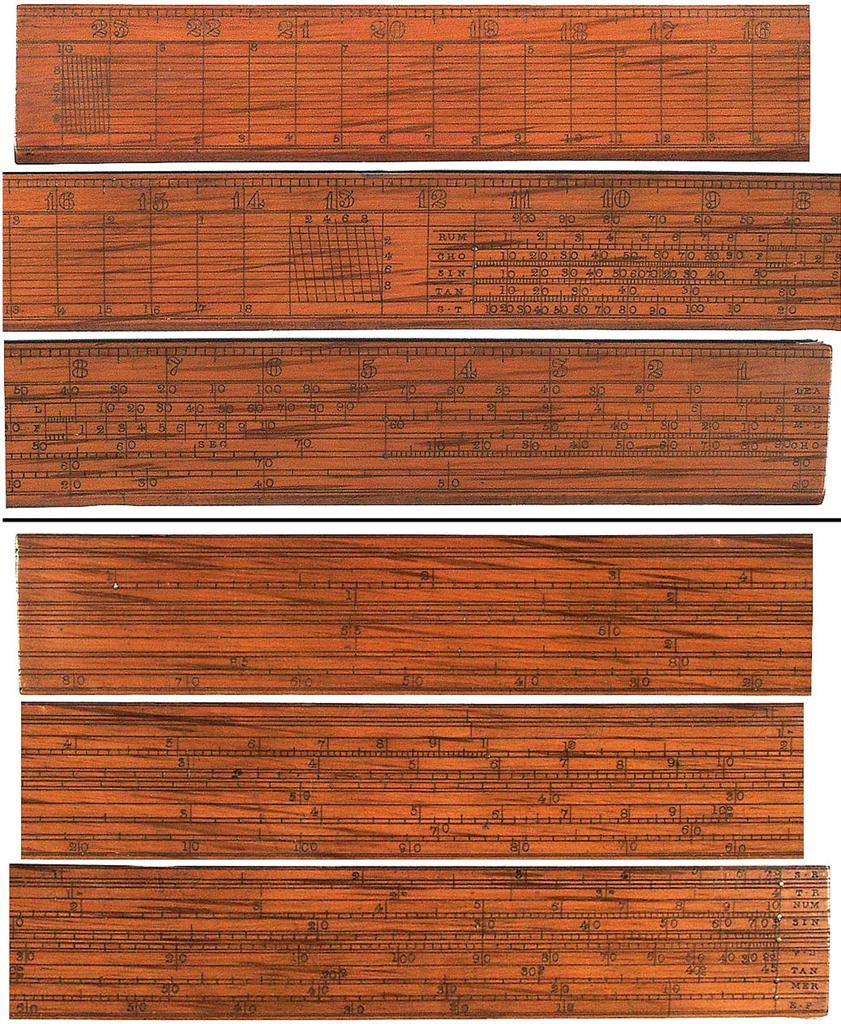
Collins' plain scale is a version of Gunter's scale. Invented by Edmund Gunter and first described in a book he wrote in 1624,[7] this scale eventually became so common on sailing ships as simply to be called the Gunter by its users.[8] This is a detail from a common two-foot version of the scale. Its top line of numbers shows inches. I don't know what the next scale is. Below it you find rhumbe, chord, sine, tangent, semi-tangent.

{Detail from a Gunter's scale. You can vier the whole scale here. Source: KRING HISTORISCHE REKENINSTRUMENTEN}

Like Digges, Collins addresses readers of, in his words, the "meanest sort," i.e., those who possess few or no advantages of wealth and education. To that end he includes engraved plates showing the plain scale and other tools which readers could make for themselves. Aside from them, the only tools needed were a straight edge and a pair of dividers, or as he put it "a pair of Compasses and a bare Ruler."

A few years ago there was a Gresham lecture which brings out points similar to the ones I'm making here about the production and use of mathematical instruments and those who made them, about those who instructed others about these instruments, and about those who actually put them to use. It's History from Below: mathematics, instruments and archaeology, a lecture by Stephen Johnston, Museum of the History of Science, Oxford University, Thursday, 3 November 2005.

-----

Some sources:

A booke named Tectonicon, brieflie shewing the exact measuring, and speedie reckoning all manner of land, squares, timber, stone, steeples, pillers, globes, etc. ... With other things pleasant and necessarie, most conducible for surveyers, landmeaters, joyners, carpenters, and masons by Leonard Digges (London, Imprinted by F. Kyngston, 1605); first published in 1556

Navigation by the mariners plain scale new plain'd, or, A treatise of geometrical and arithmetical navigation; wherein sayling is performed in all the three kindes by a right line, and a circle divided into equal parts. Containing 1. New ways of keeping of a reckoning, or platting of a traverse, both upon the plain and Mercators chart ... 2. New rules for estimating the ships way through currents, and for correcting the dead reckoning. 3. The refutation of divers errors, and of the plain chart, and how to remove the error committed thereby ... as also a table thereof made to every other centesm. 4. A new easie method of calculation for great circle-sayling, with new projections, schemes and charts ... 5. Arithmetical navigation, or navigation performed by the pen, if tables were wanting ... By John Collins of London, Pen-man, accomptant, philomathet (London : printed by Tho. Johnson for Francis Cossinet, and are to be sold at the Anchor and Mariner in Tower-street, as also by Henry Sutton mathematical instrument-maker in Thread needle street, behinde the Exchange, 1659)

Digges, Leonard in the galileo Project at Rice Univ.

Folding Rule, signed by Humfrey Cole, 1575, London
Brass, 305 mm in radius, Inventory no. 49631, Epact number: 79726

A Late 17th-Century Armed Merchant Vessel in the Western Approaches by Neil Cunningham Dobson, Odyssey Marine Exploration, Tampa, USA, and Sean A. Kingsley, Wreck Watch Int., London, United Kingdom (pdf)

Like father, like son? John Dee, Thomas Digges and the identity of the mathematician by Stephen Johnston, Museum of the History of Science, University of Oxford

The Logarithms and Rules on the Calculating Tools page of the History of Computers web site

Gunter's rule, one step before the Slide Rule, on the History of Computing web site

The description, nature and general use, of the sector and plain-scale briefly and plainly laid down; as also a short account of the uses of the lines of numbers, artificial sines and tangents by Edmund Stone (Printed for Tho. Wright; and sold by Tho. Heath mathematical instrument maker, next the Fountain Tavern in the Strand., 1721)

An introduction to the theory ... of plane and spherical trigonometry ... including the theory of navigation by Thomas Keith (London, Longman, Hurst, Rees, Orme, and Brown, 1816)

On the history of Gunter's scale and the slide rule during the seventeenth century by Florian Cajori (Berkeley, Univ. of California Press, 1920)

History from Below: mathematics, instruments and archaeology, a lecture by Stephen Johnston, Museum of the History of Science, Oxford University, Thursday, 3 November 2005


-----------

Notes:

[1] The post is men holding rules, Secondat, January 21, 2012.

[2] Full caption: "17th Century English Three Fold Ship Carpenter’s Rule — The two foot rule, made of boxwood and brass SCALES 1. Side A has four scales: -a. An inch scale [0]-18, divided to unit, half, quarter, eighth and numbered by 1 to 18. This continues to 24 on the brass leg. -b. A pair of sectoral lines, used for setting out the taper of a ship’s mast. The inner sector lines on each of the boxwood legs are graduated P, 3Q, 2Q, 1Q and MH, representing Partners, third, second, and first Quarters, and Masthead. The function of this sector is to provide a series of diameter measurements. The second, or outer set of the two sector lines are designated S, 3Q, 2Q, 1Q and YA, for Slings, third, second, and first Quarters, and Yardarm. -c. the octagon scale, to left and right of the rule joint, scaled 0 to 28 Side B for timber and board measure was designed to be used for measuring areas and volumes. This particular format was established during the 17th century as an adaptation of a design first published by Leonard Digges in 1556 Side B has three elements: -a. The line of board measure running from 9 to 36. The scale ends 4in from the end of the leg (4 x 36 = 144 = 1ft square). -b. The line of timber measure from 11 to 33. -c. A table of timber undermeasure. This is continuous with the timber line and supplies values for 1 to 8in, which the rule cannot accommodate on the scale line. The edge carries a logarithmic line of numbers 1-10. The logarithmic line of numbers on the edge was first published by Edmund Gunter in the 1620s. In the form found here, which appeared on a range of instruments in the 17th century, it would have been used with a pair of dividers."

[3] Note that Digges puts the lumber scales are on the front side of the rule he describes, along with a 12-inch scale. The back side of his rule has a scale for use in measuring angles and distances (a quadrant). Note also that he calls the device a ruler not a rule. The terms seem to have been interchangeable at the time. And finally, notice that the printer has done Digges wrong: the numbers by the side of the timber and board hash marks are grossly misplaced.

[4] The landmeater measured land, apparently with less skill than the surveyor. Here is Digge's address to the reader in full:
L. D. to the Reader — Although many have put forth sufficient and certain rules to measure all manner of superficies, etc., yet in that the art of numbring hath been required, yea, chiefly those rules hid and as it were locked up in strange tongues, they doe profit or have furthered very little, for the most part, yea, nothing at all, the landmeater, carpenter, mason, wanting the aforesayd. For their sakes I am here provoked not to hide but to open the talent I have received, yea, to publish in this our tongue very shortly if God give life a volumne containing the flowers of the sciences mathematicall largely applied to our outward practise profitably pleasant to all manner men. Here mine advice shall be to those artificers, that will profit in this or any of my bookes now published, or that hereafter shall be, first confusedly to read them through, then with more judgement, read at the third reading wittily to practise. So, few things shall be unknowne. Note, oft diligent reading joyned with ingenious practise causeth profitable labour. Thus most hartely farewell, loving reader, to whom I wish myselfe present to further thy desire and practise in these.
[5] Leonard's son, Thomas Digges, was John Dee's foster son wikipedia: "Thomas was the son of Leonard Digges, the mathematician and surveyor. After the death of his father, Thomas grew up under the guardianship of John Dee, a typical Renaissance natural philosopher."

[5] This discussion of the "uncertainties of navigation" includes description of the parallax error that occurs when the sun is at the horizon. Since readings are taken at noon, this problem only occurs during winter in northern latitudes.

[6] Collins gives this definition: "By a Plain Chart, is meant a Chart drawn on Paper or Pasteboard, lined with Meridians and Parallels, making right Angles each with other, and numbered with degrees both of Latitude and Longitude, each equal to other, and what is commonly performed in casting up a Traverse on such a Chart, we shall perform on a Blank of Paper."

[7] Gunter's book is The description and use of the sector, cross-staff, bow, quadrant, and other instruments (London, 1624) republished in The works of Edmund Gunter : containing the description and use of the sector, cross-staff, bow, quadrant, and other instruments. with a canon of artificial sines and tangents to a radius of 10,00000 parts, and the logarithms from an unite to 10000 ... and some questions in navigation added by Mr. Henry Bond ... To which is added, the description and use of another sector and quadrant, both of them invented by Mr. Sam. Foster ... furnished with more lines, and differing from those of Mr.Gunters both in form and manner of working by Edmund Gunter, ed. by William Leybourn (London, Printed by A.C. for Francis Eglesfield, 1673).

[8] Gunter's navigational scale was used by the Royal Navy up to the 1840s. The historian of mathematics, Florian Cajori, gives this description:
We begin with Anthony Wood's account of Wingate's introduction of Gunter's scale into France.
In 1624 he transported into France the rule of proportion, having a little before been invented by Edra. Gunter of Gresham Coll. and communicated it to most of the chiefest mathematicians then residing in Paris: who apprehend[ed] the great benefit that might accrue thereby...
Gunter's scale, which Wingate calls the "rule of proportion," contained, as described in the French edition of 1624, four lines: (1) A single line of numbers; (2) a line of tangents; (3) a line of sines; (4) a line, one foot in length, divided into 12 inches and tenths of inches, also a line, one foot in length, divided into tenths and hundredths.

Tuesday, January 03, 2012

mathematical practitioners

In his criticism of the universities for teaching subjects that have little practical value, John Webster asks (rhetorically) "What is Grammar, Lodgick, Rhetorick, Poesie, Politicks, Ethicks, Oeconomicks, nay Metaphysicks? if they serve to no other use than bare and fruitless speculation?" In arguing that the universities should emphasize mathematics and the empirical sciences which have some practical use he tacitly acknowledges that scholars can learn some mathematics at Oxford or Cambridge, but he says this math is the wrong kind. He asks "Can the Mathematical Sciences, the most noble, useful, and of the greatest certitude of all the rest, serve for no more profitable end, than speculatively and abstractively to be considered of?"[1]

He says, in other words, the math that's taught should be useful. Regarding this more profitable mathematics he asks, "How could the life of man be happily led, nay how could men in a manner consist without it? Truly I may justly say of it as Cicero of Philosophy, it hath taught men to build houses, to live in Cities and walled Towns; it hath taught men to measure and divide the Earth; more facilely to negotiate and trade one with another: From whence was found out and ordered the art of Navigation, the art of War, Engins, Fortifications, all mechanick operations, were not all these and innumerable others the progeny of this never-sufficiently praised Science?"

Webster was a preacher and not a particularly astute scholar. As I pointed out in my last post, he joined many of his contemporaries in believing magic, alchemy, and astrology to be subjects of equal weight with mathematics and natural philosophy (as what we call simply science was then called). In doing so he echoes a man, John Dee, who lived half a century before him and whom he calls a "myrror of manifold learning."[2] In a well-known preface to the first English translation of Euclid's Elements, Dee, like Webster, praises math and science as topics for university study and, just as much, magic, alchemy, and astrology.[3] And, like Webster, he says the application of mathematics is at least as important as is abstract speculation. In his words, "the very chief perfection (almost) of Numbers Practicall use" can be attained by the "mixtyng of speculation and practise."

In the preface Dee catalogs many of math's practical uses — from merchants' reliance on arithmetic, to the tangible uses of algebra[4], and to the many uses of geometry made by surveyors, military commanders, navigators, builders, excise men, and others. With regret Dee says he's been writing against a deadline ("the Printer, hath looked for this Præface, a day or two") and tells us his subject "is so ample and wonderfull, that, an whole yeare long, one might finde fruitfull matter therin, to speake of: and also in practise, is a Threasure endeles."

Despite the passion he shows for his subject in the preface, Dee's life was devoted more to the intangible aspects of math than the material ones. It's true he used Euclidian geometry to solve problems of navigation and trained the crews of ships so they could find their way across the Atlantic in early voyages to North America, but he believed his life's mission to be the uncovering of the spiritual forms underlying the material world. To him math was a language for use in speaking with angels. He associated its abstract beauty with mystical powers of divination which he claimed to possess.

Of the angelical beauty of mathematics he wrote: "All thinges ... do appeare to be Formed by the reason of Numbers. For this was the principall example or patterne in the minde of the Creator. ... By Numbers propertie ... we may ... ascend, and mount up (with Speculative winges) in spirit, to behold in the Glas of Creation, the Forme of Formes, the Exemplar Number of all thinges Numerable: both visible and inuisible, mortall and immortall, Corporall and Spirituall."[5]

The only son of a minor member of the royal court, he had a brilliant career at university and possessed both inclination and sufficient means to extend his education after graduation through extensive travel in Europe. Not himself wealthy, he was able to make himself useful to wealthy members of the aristocracy of England and the European continent. There appears to have been no snobbishness in him however. At a time when "gentles" treated unlettered artisans with contempt, scorn, or — at best — indifference, and when dramatists could be sure to draw laughs by poking fun at men whom they characterized as "rude mechanicals"[6], Dee was unusual in the sympathetic recognition he gave to the emerging class of "Common Artificer."

He closes the Preface by citing advantages of instruction — not in the Latin of the universities but in the English of the shop and street — made available to London tradesmen, many of whom were the first of their families to have acquired the ability to read. Of the book in which the Preface appears — Billingsley's translation of Euclid's Elements (which, as I say, was the first version to be published in English) — he writes: "[H]ow many a Common Artificer, is there, in these Realmes of England and Ireland, that dealeth with Numbers, Rule, & Cumpasse: Who, with their owne Skill and experience, already had, will be hable (by these good helpes and informations) to finde out, and devise, new workes, straunge Engines, and Instrumentes: for sundry purposes in the Common Wealth? or for private pleasure? and for the better maintayning of their owne estate?"

This title page to Billingsley's Euclid depicts some of the practical applications of mathematics to which Dee refers. (It's also, you'll notice, not prudish in depicting naked bodies.)

{The title page of Henry Billingsley's translation of Euclid's Elements (1570), with preface by John Dee; source: wikipedia}

It's generally thought that Dee's Preface and all of Billingsley's Euclid helped set in motion a gradual shift in attitudes toward mathematics and the book's readers appear to have fostered the growth of applied mathematics outside the universities. As a partial result, it's pretty clear that in the century following its appearance mathematical practitioners — the men who employed mathematics in their work as well as the printers and authors of practical math texts, the makers of technical instruments, and the technical advisors who assisted university-trained natural philosophers — became more prosperous and grew somewhat in social standing.[6]

----

Some sources:

The Mathematical Practitioners of Tudor and Stuart England by E.G.R. Taylor (Cambridge, 1954)

John Dee's "Mathematicall Praeface": A Sixteenth Century Classification of the Mathematical Arts and Sciences by Charles St. Clair (pdf)

The Mathematicall Praeface to Elements of Geometrie of Euclid of Megara by John Dee from Sir Henry Billingsley's first English version of Euclid's Elements, 1570

"John Dee" by Thompson Cooper in Dictionary of national biography ed. by Leslie Stephen and Sidney Lee (Smith, Elder, & co., 1888)

"John Dee and His Supplication to Queen Mary" by P. Evans Lewin, Woolwich Public Libraries in The Library world, Vol. 5 (Library Supply Co., 1903) Extract: 'Whilst at Cambridge he only slept four hours every night, and spent eighteen hours of the day in study. So great was his knowledge, that his acquaintance was eagerly sought by such men as Gemma Frisius, Mercator, and Gaspar a Mirca, all of whom he visited in his twentyfirst year. Even at this period he was looked on askance, for he relates that in 1547 he "sett forth" at Trinity College a Greek comedy of Aristophanes, "with the performance of the Scarabaeus, his flying up to Jupiter's palace with a man and his basket of victuals on her back, whereat was great wondering and many vain reports spread about." This, probably, was only a piece of stage mechanism suitable to the crude ideas of the time and in keeping with Greene's instructions in "Tamburlaine" — "exit Venus; or if you can conveniently let a chair come down from the top of the stage and draw her up."'

"The Mistaking of 'the Mathematicks' for Magic in Tudor and Stuart England" by J. Peter Zetterberg in The Sixteenth Century Journal, Vol. 11, No. 1 (Spring, 1980), pp. 83-97. Stable URL: http://www.jstor.org/stable/2539477

"Science and Education in the Seventeenth Century: The Webster-Ward Debate" by G. Allen, reviewed by Theodore M. Brown in Isis, Vol. 64, No. 3 (Sep., 1973), pp. 422-424. (The University of Chicago Press) Stable URL: http://www.jstor.org/stable/2297

A general dictionary: historical and critical, in which a new and accurate translation of that of the celebrated Mr. Bayle, with the corrections and observations printed in the late edition at Paris, is included; and interspersed with several thousand lives never before published. The whole containing the history of the most illustrious persons of all ages and nations particularly those of Great Britain and Ireland, distinguished by their rank, actions, learning and other accomplishments. With reflections on such passages of Bayle, as seem to favor scepticism and the Manichee system, Volume 10 by Pierre Bayle, John Peter Bernard, Thomas Birch, John Lockman, George Sale, Alexis Gaudin, Anthelme Tricaud, Pierre Desmaizeaux (Printed by J. Bettenham, 1741)

Billingsley Euclid in Mathematical Treasures by Frank J. Swetz and Victor J. Katz

Shakespeare from the margins by Patricia A. Parker (University of Chicago Press, 1996)

---------

Notes:

[1] My quotes from John Webster come from his Academiarum Examen: Academiarum examen, or the examination of academies wherein is discussed and examined the matter, method and customes of academick and scholastick learning by John Webster (Calvert, 1654).

[2] My quotes from John Dee come from his The Mathematicall Praeface to Elements of Geometrie of Euclid of Megara by John Dee from Sir Henry Billingsley's first English version of Euclid's Elements, 1570. I have modernized Dee's use of the letter "u" where we would put "v" and given the "long s" (ſ) as "s".

[3] Dee's passion for mathematics leads him to claim (quoting Boetius) that "All thinges (which from the very first originall being of thinges, have bene framed and made) do appeare to be Formed by the reason of Numbers. For this was the principall example or patterne in the minde of the Creator." And further: "By Numbers propertie therefore, of us, by all possible meanes, (to the perfection of the Science) learned, we may both winde and draw our selves into the inward and deepe search and vew, of all creatures distinct vertues, natures, properties, and Formes: And also, farder, arise, clime, ascend, and mount up (with Speculatiue winges) in spirit, to behold in the Glas of Creation, the Forme of Formes, the Exemplar Number of all thinges Numerable: both visible and invisible, mortall and immortall, Corporall and Spirituall."

[4] Of algebra he says: "This Rule, and Arithmetike of Algiebra, is so profound, so generall and so (in maner) conteyneth the whole power of Numbers Application practicall: that mans witt, can deale with nothyng, more proffitable about numbers: nor match, with a thyng, more mete for the divine force of the Soule, (in humane Studies, affaires, or exercises) to be tryed in."

[5] Here's the full quote: "All thinges (which from the very first originall being of thinges, have bene framed and made) do appeare to be Formed by the reason of Numbers. For this was the principall example or patterne in the minde of the Creator. O comfortable allurement, O ravishing perswasion, to deale with a Science, whose Subiect, is so Auncient, so pure, so excellent, so surmounting all creatures, so used of the Almighty and incomprehensible wisdome of the Creator, in the distinct creation of all creatures: in all their distinct partes, properties, natures, and vertues, by order, and most absolute number, brought, from Nothing, to the Formalitie of their being and state. By Numbers propertie therefore, of us, by all possible meanes, (to the perfection of the Science) learned, we may both winde and draw our selves into the inward and deepe search and vew, of all creatures distinct vertues, natures, properties, and Formes: And also, farder, arise, clime, ascend, and mount up (with Speculative winges) in spirit, to behold in the Glas of Creation, the Forme of Formes, the Exemplar Number of all thinges Numerable: both visible and inuisible, mortall and immortall, Corporall and Spirituall."

[6] A Midsummer Night's Dream: Act 3, Scene 2
PUCK
6 My mistress with a monster is in love.
7 Near to her close and consecrated bower,
8 While she was in her dull and sleeping hour,
9 A crew of patches, rude mechanicals,
10 That work for bread upon Athenian stalls,
11 Were met together to rehearse a play
12 Intended for great Theseus' nuptial-day.
13 The shallowest thick-skin of that barren sort,
14 Who Pyramus presented, in their sport
15 Forsook his scene and enter'd in a brake
16 When I did him at this advantage take,
17 An ass's nole I fixed on his head:
18 Anon his Thisby must be answered,
19 And forth my mimic comes. When they him spy,
20 As wild geese that the creeping fowler eye,
21 Or russet-pated choughs, many in sort,
22 Rising and cawing at the gun's report,
23 Sever themselves and madly sweep the sky,
24 So, at his sight, away his fellows fly;
25 And, at our stamp, here o'er and o'er one falls;
26 He murder cries and help from Athens calls.
[7] Stephen Johnston makes this point. See The identity of the mathematical practitioner in 16th-century England from the proceedings of a 1995 conference in Duisburg: Irmgarde Hantsche (ed.), Der “mathematicus”: Zur Entwicklung und Bedeutung einer neuen Berufsgruppe in der Zeit Gerhard Mercators, Duisburger Mercator-Studien, vol. 4 (Bochum: Brockmeyer, 1996), 93-120. It is closely based on material in the introduction to my thesis, and appears here by permission of Universitätsverlag Dr. N. Brockmeyer. See also: The making of the English middle class; business, society, and family life in London, 1660-1730 by Peter Earle (University of California Press, 1989)

Monday, December 26, 2011

early-modern science

It's generally pretty easy to distinguish fantasy from reality. We can tell the difference between intuited knowledge and knowledge gained through observation and careful measurement. We know that magicians perform tricks without aid from (probably diabolical) higher powers. Astrology and astronomy are to us two very different things; so too alchemy and chemistry, numerology and mathematics. But a few hundred years ago these distinctions were fuzzier.

As late medieval merged into early modern times, European men (almost always just men) started to correct serious mistakes that earlier generations had made about the natural world around them and the celestial bodies above. Some of these mistakes stemmed from religious beliefs, others from the writings of the ancient Greek philosophers and their successors. By questioning received authority, carefully examining natural phenomena, making complex mathematical calculations, and faithfully recording their findings these men transformed a scholastic philosophy into a new natural philosophy. The intellectual freedom achieved by this practice of scientific demonstration (as some of them were beginning to call it) was revolutionary in its magnitude, but not in the speed with which it took place.

Just as the transition from scholasticism and faith-based cosmology was evolutionary, so too the transition from belief in astrology, alchemy, and an ability to communicate with supernatural powers as legitimate tools for interacting with the natural world. Surprisingly, this second transition — scientists' rejection of hermetic beliefs — was even more gradual than their rejection of received truth from ancient authorities and of religious superstition (the "vain religion" of the schoolmen, as one of them put it).[1]

The men whom we now call scientists would study the real world using careful observation and rigorous measurement, but they would also, for example, use astrology to cast one another's natal charts. And the men and women who paid the bills — aristocratic or even royal patrons, wealthy merchants, and large land owners — expected their scientist clients to produce marvels — things out of the ordinary — to show off to their friends. Or, just as likely, they expected predictions of future events that might be advantageous to them.

On the sheet of paper I've reproduced below Galileo Galilei sketched the beginnings of a birth chart for a patron, Cosimo II, which Galileo used to show that Cosimo's future was an auspicious one. At the bottom of the page he drew the moon in its waxing phase at it appeared on January 19, 1609.

{Galileo’s sketch of the waxing Moon, as viewed on 19th January 1609 through his x20 telescope, on the same sheet as his first draft of the Cosimo II de Medici nativity; source: The Inspiration of Astronomical Phenomena, Proc. of 4th INSAP Conference, Oxford, Ed. N. Campion, Bristol 2004}

There are other instances of this service of natural philosophers to those they wished to flatter. For example Johannes Kepler created horoscopes for the Holy Roman Emperor, Rudolf II, and Tycho Brahe made annual charts for the Danish king, Fredrik, and the royal princes. Here is one of the birthday charts that Tycho Brahe made for Prince Christian in 1577.

{source: tychobrahesverden.dk}

Early modern natural philosophers and mathematicians would also prepare genitures for themselves and their friends. Without at first recognizing what they were, I encountered these tables when working in manuscript collections containing correspondence among Isaac Newton and other prominent mathematicians of the late seventeenth century. I also noticed that a writer of brief biographies, like the gossipy John Aubrey, might inquire about the exact moment of a man's birth, not having reason to do so except the making of an accurate birth chart for him.

{Detail from the entry for John Collins in "Brief lives", chiefly of contemporaries by John Aubrey, ed. by Andrew Clark, Andrew, Volume: 1 (Oxford, Clarendon Press, 1898)}

The Elizabethan magus, John Dee, presents an extreme example of a mathematician and astronomer who was also a self-proclaimed astrologer, alchemist, and practitioner of magic arts. Dee, among many other similar works, cast a horoscope to determine a favorable day for the coronation of Queen Elizabeth.[2] Here's a chart that John Dee made for himself.

{Natal chart made for himself by John Dee; source: C.U.R.A. The International Astrology Research Center}

Here's a final example of belief in astrology, astronomy, and magic persisting alongside the new natural philosophy. In the mid-1650s a man named John Webster (not the famous author but a chaplain of Parliamentarian forces in the English Civil War) wrote a book criticising the archaic curriculum of the English universities. In it he said the subjects taught were hopelessly — indeed dangerously — out-of-date and devoid of usefulness. Rather than forcing students to learn dead languages or memorize the writings of Aristotle and other ancient and more recent scholastic authors, he says they should be taught mathematics and experimental science.[3]

Webster says "Surely natural Philosophy hath a more noble, sublime, and ultimate end, than to rest in speculation, abstractive notions, mental operations, and verball disputes: for as it should lead us to know and understand the causes, properties, operations and affections of nature..." He acclaims applied mathematics — which, he points out, benefits merchants, mariners, surveyors, mechanics and others — and he condemns theoretical mathematics as merely speculative and abstract.[4] He heaps praise on chemistry, physics, and medicine as subjects of study that are "sublime, and never sufficiently praised."

But he gives as much in the way of accolades to the esoteric subjects of magic, alchemy, and astrology. He calls magic a "noble, and almost devine Science." To him, alchemy is "the most admirable and soul-ravishing knowledge of the three great Hypostatical principles of nature." And astrology is "high, noble, excellent, and useful." As you see in this extract, he lets himself be carried away on the subject.

{transcription: "What shall I say of the Science or art of Astrology, shall the blind fury of Misotechnists, and malicious spirits deter me from giving it the commendations that it deserves? shall the Acadamies who have not only sleighted and neglected it, but also scoffed at it, terrifie me from expressing my thoughts of so noble and beneficial a Science? shall the arguments of Picus Mirandula, and others, who have bitterly inveighed against it, fright me from owning the truth? shall the thundering Pulpit men, who would have all mens faith pinned upon their sleeves, and usually condemn all things they understand not, make me be silent in so just a cause? No truly, I must needs defend that which my judgment evidences to me to be laudable, and profitable; not but that I utterly condemn the ignorance, knavery, and impostorage of many pretending Sciolists, that abuse the same; but shall the art of medicine or Chymistry be condemned, and rejected, because many ignorant Empericks and false Alcumists do profess them? Surely no, let the blame be upon the protestors, not upon the profession it self. For the art it self is high, noble, excellent and useful to all mankind, and is a study not unbeseeming the best wits, and greatest Scholars, and no way offinsive to God or true Religion. And therefore I cannot, without detracting from worth and vertue, pass without a due Eulogy in the commendation of my learned and industrious Countrymen, Mr. Ashmole, Mr. William Lilly, Mr. Booker, Mr. Sanders, Mr. Culpepper, and others, who have taken unwearied pains for the resuscitation and promotion of this noble Science, and with much patience against many unworthy scandals have laboured to propagate it to posterity, and if it were not beyond the present scope I have in hand, I should have given sufficient reasons in the vindication of Astrology." [Acad. Examen, p. 51]; source: Academiarum examen, or the examination of academies wherein is discussed and examined the matter, method and customes of academick and scholastick learning by John Webster (Calvert, 1654)}

-----

Some sources:

"Celestial Offerings: Astrological Motifs in the Dedicatory Letters of Kepler's Astronomia Nova and Galileo's Sidereus Nuncius" by H. Darrel Rutkin in Secrets of nature: astrology and alchemy in early modern Europe ed. by Anthony Grafton (MIT Press, 2001)

Galileo's Astrology by Nick KIollerstrom on skyscript.co.uk

How Galileo Dedicated the Moons of Jupiter to Cosimo II de Medici by Nick Kollerstrom, The Inspiration of Astronomical Phenomena, Proc. of 4th INSAP Conference, Oxford, Ed. N. Campion, Bristol 2004, pp. 165-181.

Tycho Brahe och Astrology

John Dee's "Mathematicall Praeface": A Sixteenth Century Classification of the Mathematical Arts and Sciences by Charles St. Clair, Norman

The Mathematicall Praeface to Elements of Geometrie of Euclid of Megara by John Dee from Sir Henry Billingsley's first English version of Euclid's Elements, 1570

Isaac Newton and the Transmutation of Alchemy An Alternative View of the Scientific Revolution by Philip Ashley Fanning (North Atlantic Books, 2009)

Academiarum examen, or the examination of academies, wherein is discussed and examined the matter, method and customes of academick and scholastick learning by John Webster (London, Printed for Giles Calvert, 1654)

"Education" by J.W. Adamson in The Cambridge history of English literature , in 18 Volumes (1907–21) Volume IX, From Steele and Addison to Pope and Swift ed. by Adolphus Ward and Alfred Waller (Cambridge, the University Press, 1912)

"Brief lives", chiefly of contemporaries by John Aubrey, ed. by Andrew Clark, Andrew, Volume: 1 (Oxford, Clarendon Press, 1898)

"Brief Lives" by John Aubrey, ed. by Andrew Clark (Oxford, At the Clarendon Press, 1898)

Biographies in John Aubrey's Brief Lives

Only 26 and already a professor! in Renaissance Mathematicus

"Scientific Studies in the English Universities of the Seventeenth Century" by Phyllis Allen, Journal of the History of Ideas, Vol. 10, No. 2 (Apr., 1949) Stable URL: http://www.jstor.org/stable/2707416

"John Dee" by Thompson Cooper in Dictionary of national biography ed. by Leslie Stephen and Sidney Lee (Smith, Elder, & co., 1888)

"John Dee and His Supplication to Queen Mary" by P. Evans Lewin, Woolwich Public Libraries in The Library world, Vol. 5 (Library Supply Co., 1903) Extract: 'Whilst at Cambridge he only slept four hours every night, and spent eighteen hours of the day in study. So great was his knowledge, that his acquaintance was eagerly sought by such men as Gemma Frisius, Mercator, and Gaspar a Mirca, all of whom he visited in his twentyfirst year. Even at this period he was looked on askance, for he relates that in 1547 he "sett forth" at Trinity College a Greek comedy of Aristophanes, " with the performance of the Scarabaeus, his flying up to Jupiter's palace with a man and his basket of victuals on her back, whereat was great wondering and many vain reports spread about." This, probably, was only a piece of stage mechanism suitable to the crude ideas of the time and in keeping with Greene's instructions in "Tamburlaine "—" exit Venus; or if you can conveniently let a chair come down from the top of the stage and draw her up."'

"The Mistaking of 'the Mathematicks' for Magic in Tudor and Stuart England" by J. Peter Zetterberg in The Sixteenth Century Journal, Vol. 11, No. 1 (Spring, 1980), pp. 83-97. Stable URL: http://www.jstor.org/stable/2539477

"Science and Education in the Seventeenth Century: The Webster-Ward Debate" by G. Allen; reviewed by Theodore M. Brown in Isis, Vol. 64, No. 3 (Sep., 1973), pp. 422-424. (The University of Chicago Press) Stable URL: http://www.jstor.org/stable/229755

Hermeticism in wikipedia

John Aubrey in wikipedia

Brief Lives in wikipedia

---------

Notes:

[1] The quote comes from Academiarum examen, or the examination of academies, wherein is discussed and examined the matter, method and customes of academick and scholastick learning by John Webster (London, Printed for Giles Calvert, 1654)

[2] "John Dee" by Thompson Cooper in Dictionary of national biography ed. by Leslie Stephen and Sidney Lee (Smith, Elder, & co., 1888)

[3] Webster's diatribe was criticized by scholars who pointed to instances where the universities were teaching the new subjects. But as Phyllis Allen and others have pointed out the chief emphasis of education at Oxford and Cambridge remained as it had been. Mathematics and natural philosophy were emphatically secondary subjects of education. "As a rule, the tutor rather than the college had the greatest influence upon the student's work. A good tutor could do much for his pupil by making wise choices in the question of reading matter. Most tutors were not interested in the new experimental sciences, and some even overlooked the work of ancient scientists. One Cambridge tutor insisted that 'Mathematics and Natural Philosophy [were] not to be hurried.' Judging by the small amount of either that the average student seems to have learned, most tutors must rarely have found time to pursue these studies in an unhurried manner. ... Aside from these classics [Aristotle, Ptolomy, Euclid, ...] there were a few modern texts available. In algebra, the more advanced undergraduate could read Thomas Hariot's Artis Analyticae Praxis (London, 1631), in which he introduced Francis Vieta's methods to England. In arithmetic, a popular text was Edmund Wingate's Arithmetique Made Easie (London, 1630). For geometry, Henry Billingsley's translation of Euclid was used, together with Christopher Clavius' commentaries upon the same author, and John Speidell's Geometrical Extraction (London, 1616), which John Aubrey says "made young men have a love to geometry." -- "Scientific Studies in the English Universities of the Seventeenth Century" by Phyllis Allen, Journal of the History of Ideas, Vol. 10, No. 2 (Apr., 1949) Stable URL: http://www.jstor.org/stable/2707416

[4] Webster cites John Dee as a main source for his comments on the value of applied mathematics and praises him as "that myrror of manifold learning." -- Academiarum examen, or the examination of academies, wherein is discussed and examined the matter, method and customes of academick and scholastick learning by John Webster (London, Printed for Giles Calvert, 1654)