Showing posts with label Rabo. Show all posts

Wednesday, August 18, 2010

Passo di Gavia

I record sporting events to watch while I'm doing my afternoon treadmill run. These days I'm finishing a review of this year's Giro d'Italia and I've just come to Stage 20 for which the numbers are impressive. Only 110 miles long, the stage was short by Giro standards but not the less difficult since five mountains and almost 21,000 feet of climbing were packed into it. The riders crossed the highest point on the fourth of the five climbs. As is normal at that time of year — May 28th — that fourth mountain, the Passo di Gavia, was covered by many feet of snow. For most of the race the weather was windy and clouds were low, but there was no precipitation. However, conditions were so bad at the mountain finish that Italian TV was only sporadically able to provide the video images being captured by its many motorcycle- and helicopter-borne cameras.

During video outages, the race commentators showed clips of the 1988 race over the Gavia. On that memorable occasion, the riders crossed the pass in a snowstorm. Erik Breukink took the stage and Andy Hampsten rose to overall leader, having the lowest cumulative time for all stages to that point. At the end of the three-week race, Erik would end up in second place and Andy in first — the only American (or any non-European) ever to win the Giro. Andy currently divides his time between homes in Tuscany and Colorado. He leads bike tours in Tuscany and sells Hampsten-branded bikes in the US. He reports that life is good. Erik is currently manager of the Rabobank racing team and is pleased with the team's performance in major tours, though wins have been scarce.

Back in 2007, I did a blog post on Erik and Andy on the Gavia: snow, gentle and ferocious.

This photo shows Erik on that occasion:


{source: giroditalia's flickr photstream}

And this one shows Andy:


{Andy Hampsten, Passo di Gavia, 1988; source: outyourbackdoor.com}

Here's what the pass looked like this year:


{source: Giro d’Italia Stage 20 on cyclingtipsblog}

This year's race profile map gives an idea of the stage's climbs and descents.


{source: Giro home page}

This photo of part of the Gavia gives an idea what the riders face in both climbing and descending the mountain.


{source: iegestuhl-und-action.de}

Here are links to two Youtube videos from this year:

Giro 2010 Stage 20 Passo di Gavia (pt.1) on Youtube

Giro 2010 Stage 20 Passo di Gavia (pt.2) on Youtube

And here's one from 1988:

Giro d'Italia 1988, Passo di Gavia on Youtube

-----------

Some sources:

Update: Gavia Pass for Saturday on the ItalianCyclingJournal blog

Giro’10 St. 20 on Pez Cycling News

Andy’s Epic Day On The Gavia on Pez Cycling News

Gavia Pass on wikipedia

Friday, July 16, 2010

not your usual race tactic

As I mentioned the other day, Joost Posthuma rode the Tour of Austria this year rather than the Tour de France. Österreich Rundfahrt runs only a week, while La Grande Boucle runs a full three. Joost's in training these days rather than racing so, after four years of riding the TdF, he gets to watch it on TV this year. In an interview held earlier this week — posted on his website — He says he's enjoying watching the race, an experience which he finds quite strange and very unlike riding in it. To him the images on the screen make the event seem remote and much less physically and mentally taxing than it is in real life. He gives as an example the bunch sprint that often comes at the end of flat stages. On screen it looks smooth and efficient, but in the pack it's frighteningly fast and chaotic. The speed is extremely high. Riders are tired and some so spaced-out that they can't concentrate as they should.

He said this the day before Mark Renshaw was ejected from the race for head butting Julian Dean. Both were trying to set up the run to the finish line for their teams' respective top sprinters, Mark Cavendish and Tyler Farrar. They and the other lead-out men had cranked up the speed of the peloton to over 40 miles per hour (70 kph). At this speed the tiniest mistake can cause a massive crash. Renshaw accelerated to pass Dean on his left and Dean put his elbow in front of Renshaw's to counteract the move. In most sprints Renshaw would then have countered by leaning into Dean with his shoulder. In this one, Renshaw believed he couldn't use his shoulder without bringing them both down so he bumped Dean's helmet with his own. He did this three times. This image, taken from video, shows one of these head butts.


{source: 3news.co.nz}

Here's a video of the event.


Jon Brand reports that "As Renshaw hit Dean, one fan shouted, 'Zizou, Zizou,' the nickname of former French soccer star Zinedine Zidane. Zidane was famously ejected for head-butting an Italian defender during the 2006 World Cup final in Germany." (As it happens, I did a blog post or two on Zidane back then.)

As in the Zizou incident, no one was injured by Renshaw's unusual tactic.

Interviewed afterward, Dean said he was flabbergasted to get bonked on the helmet. He supported the officials' decision to send Renshaw packing. Renshaw said when Dean hooked his elbow over his own he had no choice but to use his head in order to keep his position. He said, "the object was to hold my line and stay upright."

Most of the articles I've seen say that Renshaw did wrong. They say shoulder bumping and elbowing are permitted in sprint lead outs, but not butting. It's also generally seen as ok to push with the head, but, as one coach says, a sprinter will get in trouble for using his helmet like a hammer. Others say head butts are a legitimate tactic for maintaining position. A former racer is quoted as saying "I’ve been mixed up in bunch sprints where I have been the lead out man or I have been having to sprint myself and people have head butted me. I've done it back. I've even taken my hand off to fend people off me."

Here's a smattering of news accounts.

Mark Cavendish's team-mate Mark Renshaw disqualified

Head butting is part of the cycling game

Tour de France Stage 11 turns into 'gladiator arena'

Head Butts Mar Stage Finish at Tour de France

Dean says ejection a fair punishment for head-butting rival

----------

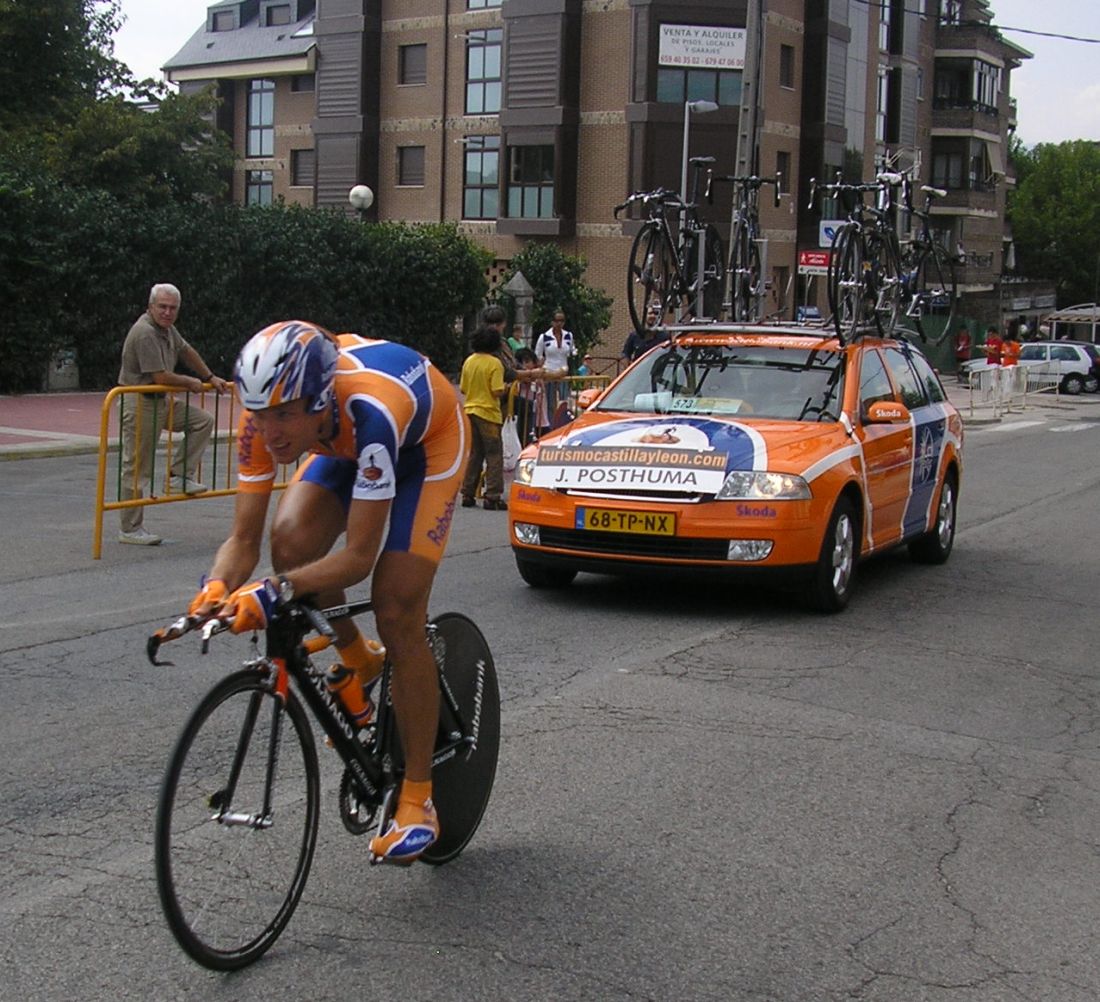
This photo, from Joost's website, shows him on the podium after he won the time trial in the Tour of Austria last week.

Wednesday, March 24, 2010

Milan-San Remo

Milan-San Remo, the Spring classic bike race which bills itself as La Classicissima went off very well this year. At the line, Oscar Frere proved to have the right tactics and the best legs. He rides for the Rabobank squad and although the rider I follow most closely, Joost Posthuma, wasn't in this race, the result is a satisfying one. 'Tho it was the third time Oscar won, the announcers and the race cameras picked out other former winners and current favorites in the run up to the finish. I kept seeing the bright orange flash of his jersey behind or nearby the guys the photogs were watching. The replays showed both his skill in maneuvering himself into position leading up to the sprint and the enormous surge with which he pulled away from contenders.


Julian Dean's race diary blog tells a different story. Milan-San Remo is so very long and so very fast that — after a few hours of riding — racers who get shelled out the back have little hope of rejoining the front bunch. About half way through, Dean got caught up in a crash, was unable to reconnect, and lost so much time that he and another sufferer lost more than an hour on the lead group. He writes, in typical New Zealand idiom:
I was out the arse because I was going bad, now I had to keep going to the finish, hoping that at some point I might see someone coming from the finish to collect me after they finally realised I was MIA. But it didn't happen and I had to ride a miserable 100km to the finish with no fluids or food on one of the worst days I’ve had on the bike for as long as I can remember. . . .

Eventually, after almost 8 hours, I rolled into San Remo to the team bus feeling more than a little cheesed off and disillusioned as to the lack of consideration of the welfare the team has for its riders - especially for an athlete who’s struck a bad day and needs a little more support than they might need on regular occasions. What added to my frustration was that in my heart I knew I had done all I could to get back on top of my form after being crook and even though I couldn’t contribute much on this particular day, I still buried myself for the team.

Anyway that’s often what you get when you have a bad day. Unless you are running at the top of your game, professional sport can be very demoralizing and disheartening no matter how long you’ve been in it and how much stature you have. Everybody prefers to be with a winner....


{Dean at MSR on another day; source: his team's website}

A couple of days ago, a race page I follow called Cyclingnews did an article on an experience similar to Dean's from twenty-five years ago: Phinney and Kiefel recall 7-11's wild Milan-San Remo

At that time the American team, 7-Eleven, had just begun racing in Europe. They entered MSR hoping to put someone on the podium but expecting just to gain some valuable experience. Davis Phinney and Ron Kiefel were their two star riders, both successful in US races, and, eventually, in European ones as well. This day, March 16, 1985, was not to be Phinney's best. Beforehand he's given what he takes to be valuable advice to eat constantly in order to avoid running out of energy at the end — the race being so very long and hard. He fills his jersey pockets with the pannini that riders ate in those days and ate one after the other. For this, he's derided by one of the best racers of all time. As he tells it, "After about 60km Sean Kelly pulls up next to me while I'm stuffing my face. My gut is so full that my knees are banging into it while I'm pedalling. Kelly says, 'What are you doing? You're eating like a pig! You'll never make the finish like that'."

Then: "As we came into the little town before the Turchino [climb] started I was on the far right side, in the second row, and we're just flying along. There's a sharp left turn and the pack drifted a little bit wide to the point where I was pushed off the road. I went flying off the road, crashed into this chain fence separating the road from the sidewalk and dislocated my finger."

It was very cold and wet that day. Fellow team member Eric Heiden stopped to help Phinney and manages to pull the dislocated finger back to normal, but Phinney had lost steam. Heiden managed to get himself back in the race, but Phinney did not. He remembers: "Here I am at this big race, Milan-San Remo, off the back with three other knuckleheads, still riding with race numbers on. I'm dirty, wet, cold and hungry, because I have no food, and we're still a long way from San Remo. We realized that we're screwed."

Two of the four struggle on but Phinney and a Belgian rider decide to leave the course and see whether they can't hitch a ride to the finish on the nearby autostrada — a limited-access tollroad. They're stopped at the tollbooth and since neither knows the dialect which the tolltaker uses, they're near out of hope until the tolltaker finally figures out why these two bike riders are plaguing him and calls race headquarters. Phinney's team manager eventually sends a car for them. I'd love to see a photo of the two, dirty, cold, wet, hungry, dejected; standing by their bikes at the entrance to an Italian superhighway.


{Kiefel and Phinney at a warm and sunny race in Colorado a year or two before their MSR adventure; source: rbaction.net}

Saturday, July 25, 2009

inside view of the Tour de France

This is the last day of this year's edition of the Tour de France. By tradition there's no real competition until the very end on the boulevards of Paris. While I'm writing, the riders are rolling through the countryside conversing casually with each other. In pre-race interviews they say the race was unusually tactical and hard, building from a relatively undramatic beginning to a major conflict in yesterday's stage ending with the fierce climb of Mont Ventoux. They also point out that the number and enthusiasm of spectators was astounding this year, culminating with huge crowds of joyful people on Ventoux. And they point out that drug testing seems finally have succeeded in eliminating illegal performance-enhancing substances: a huge amount of controls and no detections.

I'm confident that one racer whose career I've been following off and on for the past few years hasn't used any such substances. He's a personable and modest guy of relatively modest achievements who's Dutch born riding for a Dutch team: Joost Posthuma.

This photo, taken last year, shows him in less garish clothing than his blue and orange Rabo kit:

{source: dailypeloton}


There are short biographies and early photos of him on his own web page and at this Dutch site: http://www.owc-oldenzaal.nl/?RubriekID=2399

His personal web site also has an extensive photo gallery.

Quite a few riders have personal blogs and a growing number of them tweet and some regularly blog.

This year, Joost has been doing daily interviews from his mobile phone while on the massage table each evening.

Here are some highlights from his calls.

His work day can seem surprisingly mundane. He loves his morning coffee, gets cranky when he's delayed at an airport and looks forward to a pre-dinner shower at the end of a short flight; he puts in his day's work and relaxes in the evening by reading a book, watching sports on TV, catching up with friends and family on his mobile phone, and accessing the Internet with his notebook.

Although he's won some of the less-well-known races, here at the Tour de France he's a support rider, helping to give the team's leading riders a chance at winning stages and placing highly in the overall classification. He's looked out for opportunities to get in breaks during the flat stages but missed the deciding break of the day until yesterday's great stage to Mont Ventoux. This 16-man break stayed away from the third kilometer until nearly the last of this 167 k stage. He worried that the peloton would catch the group and increased his pace to keep them off.

This photo shows him at peak effort as lead rider on the lower slopes of Mont Ventoux:

{source: cyclingnews}


Not a mountain specialist, Joost's effort helped give his teammate, Juan Garate, the wherwithal to win the stage at the top of the mountain.


{Garate pulling away to win;source: cyclingnews. Click here for a thumbnail page of cyclingnews images from this stage.}


Most of this tour's 21 stages, he helped protect the leaders and ferried food and drink from the cars at rear back to team members in the peloton. Although the team's managers were growing increasingly upset with the team's performance until it's success yesterday, Joost never felt that he'd performed poorly and reports times he won praise for doing good work from both his fellow team members and the team's managers.

An even-tempered and friendly kind of guy, he's not prone to make controversial statements. He can be pretty funny as for example in his comments on the Tour's radio-free day. Calling the stage a race without ears, he said race organizers, in seeking ways to back off from technological advances, should require riders to go back to using toeclips and hairnets (which he calls "sausage hats").

Perhaps it's odd that Joost doesn't say much about performance-enhancing drugs. Along with other team members, he was recently called to to give information as evidence is accumulated against a former member of his team. He only just mentions that and his other comments deal with the extensive test program of the Tour, which he takes in stride.

In response to the interviewer's question, he says he's never broken a bone, though he's had his share of injuries. The topic arises because, as usually happens, a couple of riders have crashed and been forced to abandon because of bone breaks. He's strained his knee but has avoided scrapes and bruises as well.

He appreciates encouragement he's received from the many Dutch fans who line the roads but didn't like being thumped on the back by an over-enthusiastic (and probably over-beered) Netherlander on one mountain stage.

He's content with the cold and wet as well as the hot and dry weather they've encountered and didn't complain about the winds of Provence which raged yesterday.

He looks forward to visits with his parents and other relatives, and with his girl friend of course, when they're able to attend stages. He looks forward to getting back to his garden at home and being reunited with his dog.

Friends and family members write in the "guestbook" on his website to give words of encouragement during the unsuccessful stages of this year's Tour and congratulations on his success yesterday. One couple say, roughly: "Hey beautiful mountain goat. We've been watching this afternoon's ride you with awe and admiration. We congratulate you, on the team's stage victory, and your own performance 1.56 behind the winner on the Mont Ventoux." A woman admirer writes: "Congratulations on the victory of Mont Ventoux. You rode very strongly today. Echt Klasse! Yesterday night I rode back from the Tour along with your parents who were sitting in our bus. I had a nice week's holiday at the Tour."


Notes:
--------------------
Some previous posts about Joost:

---------------------
Some examples of rider blogs:


----------------
Joost on "ears:"
No oortjes - ears: "I just got a phone voice mail from my mother. She is angry and disappointed in the [radio-free] stage today. She's a major cycle racing fan, and is upset at how tame the racing is right now. Today there was no real competition.
------------------------

Joost on radio-free day:

The interviewer asks Joost whether there was tacit agreement to take the day easy in protest. Joost says nothing concerted, but a kind of consensus to ride easy. He says, "It is ridiculous that we possess modern communications and can't use them." What's next? he says, will tomorrow they require the riders to used toeclips and wear sausage helmets. "Back in time."


{toeclip pedals; source: wikipedia}


{toeclip cleats; source: wikipedia}


{"sausage helmet"; aka hairnet or vegetable basket; source: labicletta}


{Laurent Fignon with toeclips; source: grahamwatson}


{Fignon with "sausage helmet"; source: pezcyclingnews}


------------

Drug testing:
According to Pat McQuaid, the head of the International Cycling Union, the Tour de France will be the most rigorously tested sports event in history. There will be about 520 doping tests, and several of the 180 riders are already in the cross-hairs even before the three-week showcase even begins. {source}


----------------

This shows Laurens ten Dam scraped and bruised. He fell on a fast descent and posted this photo of himself afterward.


{photo by Laurens ten Dam posted on Twitter}

Friday, July 24, 2009

three weeks in July

Alan Taylor's "Big Picture" on Boston.com has a feature on the Tour de France today:

{Bradley Wiggins of Britain speeds down Col du Tourmalet in the Pyrenees mountains during the 9th stage of the Tour de France on Sunday July 12, 2009. (AP Photo/Bas Czerwinski)}

There's one more hugely difficult stage to run before the final run-in to Paris on Sunday. In three weeks of tough riding everyone's been rung through the ringer time after time. My favorite rider isn't one of the stars, he's one of the guys on the Rabobank team who provides support to the team's sprinters and its contender for the overall race leader. Though he's been doing his job extremely well, the team has done poorly. Through bad luck, tactical mistakes, and lack of form, they've failed to take a stage victory and have no chance for a high-place finish at the conclusion of the race.

That's put only a small damper on my enthusiasm. It's been an interesting race all the same. In daily telephone interviews, the guy I follow, Joost Posthuma, has been giving insights into the events of this year's Tour and the difficulties he's faced. You can read the series, in Dutch, here: https://www.rabobankcentraaltwente.nl/JoostPosthuma/.

I'll give some highlights in another post.

For now, here are a few photos from the gallery on his web site.
{All photos are copyrighted; I'm providing these thumbnails under fair use provisions of copyright law.}


12th stage, hot and dry, July 16

13th stage, cold and wet, July 17
 

14th stage, July 18: his mom was able to get off work this day

15th stage, July 19: collecting water bottles to distribute to team members,

Thursday, April 03, 2008

more on Joost's win

About his win today Joost says, "Hier even een berichtje van mij. Het was vandaag een superdag. Ik had gehoopt om de tijdrit te winnen, maar dat ik dan ook de Driedaagse van De Panne win, is helemaal fantastisch. Het draaide gewoon super. Ik had echt power vandaag. Bij het eerste meetpunt had ik een goede tussentijd en de laatste vier kilometer ben ik op de elf vol doorgereden richting de finish. Vorig jaar kwam ik een paar seconden tekort en nu heb ik er een paar over. Fantastisch! Ik ga nu samen met Rick Flens, die ook al fantastisch heeft gereden, naar Lanaken toe. En dan op naar de Ronde van Vlaanderen. Groeten, Joost."

This roughly translates into:
Here's a quick message. This was a super day. I had hoped win the time trial, and winning the whole three-day race is entirely fantastic. My form was great. I had real power today in the time trial. I was riding well at the first time check and in the last four kilometres I kept on driving driving hard to the finish. Last year I finished second overall in the race. And now I have two podium finishes in it. Fantastic! I'm on my way to Lanaken now with Rick Flens, who also rode a good race. [Lanaken is site of the Amstel Gold race later this month.] And then on to the Ronde van Vlaanderen [on Sunday]. Greetings, Joost.
Cyclingnews says Posthuma's win was most impressive. The article says last year's winner of Three Days of De Panne went on to win the Ronde van Vlaanderen, but Joost isn't saying he can do that (I quoted him on this in the previous post). The article quotes him as saying the win is a very special victory for him and a totally unexpected one. He was surprised when he proved able to overcome a 27 second deficit in the afternoon TT, and didn't really think he had a chance until he found himself passing the rider who had started a minute before him. That gave him confidence to give it all he had up to the finish. The author also says he's got the knowledge and skill to win other big stage races and quotes him as saying "I'm not a specialist in the high mountains, but I can climb for sure. Overall, I'm a very constant rider."

Velonews calls Joost a "Dutch flier" and says he credits hard winter training for his time trial success.

Joost wins


Today Joost Posthuma won a major stage race, the Three Days of De Panne. He did this by placing high in the first three stages and acing this afternoon's time trial. The race is ideal for him since many of Europe's top riders are focussing on Sunday's Ronde van Vlaanderen, a one-day race that is one of Europe's most hotly-contested. Asked about prospects for that race, Joost told an interviewer that Rabobank's Juan Antonio Flecha will be the protected rider. "Flecha is our absolute leader for Sunday," he said, "But if I am in the right place at the right time, I might try for the win. Why not? I exclude nothing."

I post more on this from Joost's web page when he puts something up.

Here are final results from the Belgian site, sporza.

1. Joost Posthuma (Ned) in 14u15'05"
2. Manuel Quinziato (Ita) op 2"
3. Enrico Gasparotto (Ita) 8"
4. Niki Terpstra (Ned) 10"
5. Simon Spilak (Svn) 40"
6. Rick Flens (Ned) 46"
7. Alessandro Ballan (Ita) 53"
8. Magnus Bäckstedt (Zwe) 58"
9. George Hincapie (VS) 59"
10. Luca Paolini (Ita) 1'04"
18. Leif Hoste 1'38"
19. Kurt Hovelynck 1'41"

Wednesday, March 26, 2008

Joost Posthuma update

Time for an update on Joost Posthuma. You'll recall that he was hit by a car while on a training ride last summer. His injuries mended and he recovered his form late in the season. He generally served the Rabobank team in a supporting role through the fall races, but won one race in September, the Sachsen Tour.

Early winter, he took a holiday in Egypt and then went to the team training camp in Spain where he showed himself to be one of the better riders on this very strong team. He gave an Interview in January in which he said he expected his 2008 season to be much like 2007's with the addition of the Olympics. In answers to questions about illegal performance enhancing he said he's sorry drugs have given the sport a bad name and said he supports the stepped-up enforcement that's taking place this year. Concerning his role as support rider rather than team leader he said he likes Rabobank because, though he's not one of the stars, there are still races in which he gets to be the team leader (the protected rider).

He caught the 'flu during one of the season's first races. On recovering, he regained his form and was designated as the team leader for the Tirreno-Adriatico. In this race, a couple days after his 27th birthday, one of the riders in front of him crashed, bringing him down hard and causing a serious injury to his shoulder. He's since recovered from that injury and again regained his form. Today, in his first day back in on the team, he rode very aggressively in an extremely tough race, the Dwars door Vlaanderen. On a cold, wet, and windy day, he kept close to the front of the pack through most of the race then pushed forward to join a group of eight riders who were chasing down a leading group of three. The chase group came very close to closing the gap and in the end Joost made a highly respectable ninth.

Some Joost photos here.

Here are a few from his own web site and other sources (via Google image search):


Wednesday, December 05, 2007

snow, gentle and ferocious

We're having our first snow fall. It's gently descending. We'll get maybe an inch and a half over the course of the day. This summer's geraniums haven't given up yet. They're a bit droopy after a few frigid mornings, but still pretty.

{Click image to view full size}


The snow reminds me of a famous day in the Giro d'Italia, Italy's version of the Tour de France. On that day an American riding for an American Team won what most probably consider to be the most difficult stage of any European professional race in the modern era. He not only took the stage, but went on to be the first and only American ever to be the overall winner in the Giro.

The connection with snow is a bit surprising. It was June 5, 1988. The race was in the mountains that day, and one of them, Passo Gavia, was experiencing blizzard conditions. The mountain is a high one, 2652 meters, but even at that altitude, in Italy one does not expect a blizzard on June 5.

The American rider is Andy Hampsten, a sweet-natured, clean-living, child of the 70s who -- from appearance and personality -- doesn't seem likely to possess the iron will and indefatigable constitution needed to not just endure but overcome all opponents in mountainous ice and snow. He's a favorite of mine partly because there is no chance, none at all, that he ever used illegal performance-enhancing drugs. And partly also because we have pretty much the same body measurements and thus ride bikes of the same dimensions. It isn't too outrageous for me to fantasize being Andy.

As the accounts I cite below explain, his performance on the Gravia gave Andy a commanding lead in the competition for overall race leader, but he did not win the stage. The stage winner was Erik Breukink, current manager of my favorite professional team, Rabobank. His account of the day would also make an interesting read. The Dutch riders, such as he, and men of Flanders are notoriously hard men, well-adapted to cold, wet conditions they must endure in training for and racing the Spring Classics, Northern Europe's famous one-day races.

Andy gave lots of interviews describing his ordeal that day. One of the best appeared in 2003: Giro 1988: Andy's Epic Day, by Richard Pestes (PezCyclingNews). Give it a read. Here's the opener: "As part of our series on the Giro climbs, we asked Andy Hampsten to recount his epic day on the Passo Gavia in 1988. A day of unquestioned cycling history, Andy started the 17th stage of that Giro in second place, and despite the Italians pleading with him to ride “piano piano” over the last climb, he went on an epic attack that earned him the maglia rosa, and the only American win of Italy’s grand tour. Pull on your woolies – it’s gonna be a cold one … "

Here are some excerpts from other accounts he's given. Note his self-awareness. His modesty has nothing false about it and it's characteristic that he says he didn't win the Tour de France because there were always a handful of racers better than he; there's no hint that he believes he might have won if they, like he, were drug-free.

1. "It was the most difficult day of my life. Nobody would have complained or argued with me if I had pulled over and not raced. It was above and beyond what anyone is asked to do at a race. As a bike racer. . . . It was really hard for me to turn pro and go to Europe. Coming from North Dakota and going all the way to Europe was what I was dreaming about the whole time, so I convinced myself to keep riding and keep racing all the way down the mountain. . . . The fans really appreciated the fact that it wasn't cancelled. It was kind of an end of an era where all the racers raced. Nowadays when the weather is bad sometimes a race gets cancelled. I'm not going to say that's good or bad."

2. "My personality is very good for bike racing. I like doing hard things ... sort of the monotonous beating my head against the wall. And that's the mentality it really takes to do the training to be a bike racer. Now, you know, looking back over the 10 years or so since I've retired, I have chilled out a lot. I don't tell myself everyday that it's another Gavia. I still like to work hard, but I also like to play pretty hard too. One thing I've learned is to not take things so seriously anymore. . . . Do I wish I were a bigger media icon? Personally, no. I tried to win the Tour de France every year I raced, and I didn't. I don't look at it as a failure. There were always three to five other riders faster than me. I'm glad I had all the opportunities that I did to try. I wanted to win the Tour because I respected it. That would have been the coolest accomplishment I could have achieved, and I'm glad I focused on it instead of trying to win more one day races. I wouldn't wish being as famous as Lance Armstrong on anybody. Knowing the way I am, that's not the way I would want it to be. I'd rather just be out riding my bike. . . . [On the descent from the top of the Gavia], at about 6km to go, Breukink caught me, but I was totally blocked and could not respond. Breukink had no rain jacket on, just a jersey, so he could descend faster on the long straight drop into Bormio. There was no bloody way I was going to take my jacket off. . . . After I crossed the finish line, I headed straight for our our soigneur, Julie. I was in such a rage trying to get down the mountain in one piece that when our team doctor, Max Testa, came up behind me and tried to put his jacket around me, I didn't realize who it was and since he was keeping me from Julie and my warm clothes, I started punching him. Mike Neel came over and straightened me out and got me in the team car, which was running it's heater full blast! When I started to warm up the pain started to come back. Mike then told me I had the jersey and the pain and the euphoria swept over me and I just started crying, laughing and shaking. A whole wave of emotions covering the range of finishing the stage to the realization that I would survive gave me a brief and refreshing emotional meltdown. . . . Within 10 minutes of the finish, I was up on the podium. The pink jersey felt good. I slipped it on and all my doubts went away. The TV interviews began and I remember saying 'Incredible, I have never seen conditions like this, even in Colorado. Today it was not sport, it was something beyond sport.'"

This is Andy on the Gravia.


This is one of his struggling opponents.


Here is Erik Breukink.


Andy in the pink jersey of the overall leader after the Gravia had given him a commanding lead. Click image to view full size.


Here are newspaper accounts from that time. Click to view full size.


There's a YouTube video of some Gravia footage, but it mostly concerns Pedro Delgado, another famous rider, and the images are very fuzzy.

Monday, November 12, 2007

Joost and his team

[Update: Chris Selden has an summary of the Rasmussen inquiry and its outcome on Pez Cycling News.] I haven't written about Joost Posthuma for a few weeks.

Late in September, he crashed during the individual time trial in the World Cycling Chamionships, but wasn't badly hurt and has since recovered. His web site says it started raining while he was on the course. He went too fast around a corner and slipped. At the time he was doing very well and, but for the crash, might have achieved a finish within the top ten.

Early in October he re-injured his hip during the Paris Tours race. He hasn't raced since then, but he reports that he has signed up for another two years with the team and is now taking a holiday in Egypt with his family.

There's been plenty of news about the Rabobank Team itself. They sacked their leader during the Tour de France while he was in first place with good expectation of achieving the overall win. At the time they explained that he had missed two drug tests in the weeks before the race and had lied about his whereabouts. The Rabo site, the cycling press, and Rasmussen's own web site now have reports of an official inquiry into the incident.

Rasmussen says the team knew where he was all the time, he didn't take performance-enhancing drugs,* and he lied about his location for private reasons. The private reasons have to do with his family, specifically his wife, and he asks the press to respect his desire for privacy.

The press says that the ruling body of cycle racing, the UCI, does not accept Rasmussen's account as an acceptible explanation. They say that the fact that he lied is enough to bar him from the sport.

Two reports on the Rabo site say that the executive board of the group that runs Rabo cycling commissioned the inquiry and supports its conclusions. They admit that they had information about Rasmussen's whereabouts, knew that he lied, and had contact him at least some of the time while he was in Italy and France when he said he was in Mexico. (There had already been a partial admission of Rabo compicity. Without giving details, the Rabo cycling director admitted wrong-doing and resigned right after the Tour de France last July.)

As I see this, the good news is that Rabo do admit they made serious mistakes, they did sack Rasmussen, though they should not even have let him start the race, and they can say they are clean: there has been no allegation nor any evidence that the team, its sports staff, or its medical staff had anything to do with illegal drugs.

Here's a link to Rabo's report of the matter. A brief extract: "The Executive Board commissioned the committee to conduct an independent inquiry into the course of events surrounding the Rasmussen affair. The main conclusion of the report is that Rasmussen was rightly expelled from the competition and later dismissed. He demonstrably lied about and tampered with his whereabouts. There is no evidence that Rasmussen used doping. ... Serious errors of judgement were clearly made, primarily by the Chairman of the Board of Directors. ... It is patently obvious from the information known now that Rasmussen should not have been allowed to start in the Tour de France."

=================
* Rasmussen doesn't say he never took any drugs, but rather "I have never during my career taken EPO or Dynepo." However, to his credit, his web site gives a table showing the dope tests he took and their results from March 2005 through October 2007. Here are the concluding paragraphs on the subject on his web site:
In order to steer clear of speculations concerning what went on in Italy and whether he has complied with the doping regulations Michael Rasmussen presents his so called ‘biological passport’ in terms of tests from the previous 3 years. All the values show normal variations which should give absolutely no cause for suspicion about manipulation. These values are of course known by the UCI.

“In this connection I would like to stress that I have violated the whereabouts regulations but I have never missed a doping control performed by the UCI. From this point on I will obey all UCI rules and I am still available for control. Thus, I can also tell you that after the Tour de France I have had two further out of competition tests from the UCI with no remarks,” says Michael Rasmussen.

“My greatest wish right now is to ensure clarity about this matter and be able to return to professional cycling,” Michael Rasmussen says.