Showing posts with label Five Points. Show all posts

Wednesday, September 01, 2010

Broadway in the '30s

The print shows a section of Broadway in 1836. It's an etching made from a drawing by an English artist and land surveyor, Thomas Hornor, and it's remarkable for its accurate detail and something akin to photographic realism.[1] Our viewpoint is a position on Broadway just south of its intersection with Canal Street. We are looking north and can clearly see the block between Canal and Grand Street but beyond that point it's increasingly difficult to make things out.

{Caption: Broadway, New-York. Shewing each Building from the Hygeian Depot corner of Canal Street, to beyond Niblo's Garden. Etched by T. Hornor. Printed by W. Neale. 17% x 27. Published in New York by Joseph Stanley and Co. Source: Library of Congress}

Here are some detail views of this interesting cityscape.

1. Broadway above Canal in 1836 had trees. Most look to be poplars. Its a shopping district and there are apartments above the shops. In one of these a woman, apparently with babe in arms, looks out at the passing scene. The sidewalks are crowded with people who seem to be well-dressed and — many of them — better than modestly prosperous. Dogs run loose while horses are kept carefully under control.


2. We are at the dawn of the age of electric traction and the first electric streetcar was already running on nearby Fourth Avenue. Here on Broadway, however, horses are the only means of transport, so much so that they are almost as abundant as people. Pedestrians occupy the streets as well as the sidewalks. There is a high pole with foot pegs for climbing and a Phrygian cap on top.[2] It must be a Liberty pole. There was one of these poles nearby at City Hall Park and evidently here at Broadway and Grand as well.[3] Note the presence of "Tattersalls" mid-block. Broadway House looks like a hotel but was considered to be an inn or tavern at the time. It was known for hosting political meetings.[4]


3. Joseph Stanley published this etching and he was not shy to have Hornor put his establishment front and center.[5] The uprights with cross-pieces were evidently used to display goods for sale, though no goods are here present. Note the cigar store. Two of my German-immigrant relatives were in the "segar" selling business in these years, though the shops they operated were in Washington Street a few blocks away. Nearby, Cornelius McLean runs a business making fanlights and window sashes.[6] The Bank Coffee House started out south of this location, in the rear of the Bank of New York at William and Pine Streets. I don't know when it moved here. "Coffee house" in this instance is a euphemism for tavern. The place was known as a merchants' gathering place.[7] The wagon carrying "Spring Water" is a reminder that the Croton Aqueduct has yet to be constructed.[8]


4. In these times people gathered at windows to catch light for reading or sewing, as do these ladies. The sign at 416 announces a trunk maker, but a book published in 1833 records a boot and shoe manufactury run by C.B. and J.C. Greene at this location.[9] In 1850, the owner's name was Adolphus Loss.[10] Mr. Wright, also at 416, sells, caps, and furs. [11]


5. Located at Stanley's shop at 50 Canal Street, the "General Depot for the Sale of Morison's Hygeian Medicine" sold the "Vegetable Universal Pills" of James Morison, a British entrepreneur who had announced that everyone could maintain his own health without the services of "elitistic" physicians. The plants in the windows proclaim the virtues of medicines based on natural plant products.[12] Analysis of the secret-formula pills showed that they were no more than laxatives. Signs proclaim the bookseller, Stanley, to be the American agent for sale of all London editions and of English editions of London and American writers. Here, in the 1830s, English authors seem to outrank the home-grown variety. In this view as in others, it's apparent that this part of Broadway was the fashionable shopping district of the 1830s.


6. There are horse-drawn omnibuses and hired coaches as well as private carriages. This was a period when men still rode horses in the city merely to get from one place to another. In a short while the cost and inconvenience of this form of transportation would eliminate it from common use.


7. Here we have one of the omnibuses, grandly pulled by four matched horses. The driver is assisted by a groom. Everyone rides inside. The British mail-style coach with roof-top seating would come later.[13] If it hasn't been plain before, it certainly is now clear to us that anarchy reigns on this part of Broadway. There's no lane discipline nor any sense that vehicles in motion take precedence over bodies at rest.[14] There are three large beams rising at angles on the sidewalk, but what they are I cannot say.


8. More public transport, more dogs, more pedestrians strolling street and sidewalk. There are many women out and about, most of them unescorted by men. There's only one cab-like vehicle that I can see. The hansom cab was invented in England in 1834 and only later introduced into the traffic of New York City. At the time our drawing was made people would hire much less maneuverable and more expensive Hackney Coaches to get around in.


9. Street-sellers outside the trunk and hat shops. You can buy wood to burn, potted flowers and notions, boots and curtain stuff. Note that the woodseller will cut to order.


10. Ice was a summer luxury. It would be harvested from ice ponds in winter and kept in sawdust-filled warehouses as long as possible through the warm months.


11. Lockwood's was a bookseller, here advertising as a school book depository. A memoirist of 1893 remembers the "famous book-store of Roe Lockwood, on Broadway, below Lispenard Street, where all the boys of forty years ago went to purchase their school-books."[15] I think the wig maker was John Hotblack, "wig and ornamental hair manufacturer, wholesale and retail, 415 Broadway."[16] One of the dogs has a dead bird in its mouth; two others look ready to fight over it. No one nearby pays any attention to the three. Street sellers on this side of Broadway offer potatoes and other foodstuffs that can't be identified.


12. Here's the title of the print. Niblo's Garden was operated by John Niblo at 557 Broadway, then only a couple of years old. It was a public garden and theater.[17] Back then, the suburbs began not far north of its location.


Here's a copy of the print with aquatint in lower resolution.


{Hand-colored etching aquatinted by J. Hill, 1838; source: "unforth Claire H." on flickr -- About unforth / Claire H.}

She also gives these detail views.


An old book has yet another version.


{Broadway and Canal in 1836 from Valentine's manual of old New York, Volume 12, edited by Henry Collins Brown (Valentine's manual, inc., 1917)}

-----------

Some sources:

Niblo's Garden, in The New York clipper annual (1892) at Columbia University Libraries
(New York : Frank Queen Pub. Co., 1883-)

Thomas Hornor: Pictural Land Surveyor, by Ralph Hyde; Source: Imago Mundi, Vol. 29 (1977), pp. 23-34. Published by: Imago Mundi, Ltd. Stable URL: http://www.jstor.org/

The iconography of Manhattan Island 1498-1909 (v. 6) by I. N. Phelps Stokes
(New York, Robert H. Dodd, 1915-1928)

The New York mercantile union business directory (S. French, L.C. & H.L. Pratt, 1850).

Bowery Village, The diary of Michael Floy, Jr., Bowery village, 1833-1837, by M Floy; Richard Albert Edward Brooks; Margaret Floy Washburn (New Haven, Yale University Press, 1941)

Valentine's manual of old New York, Volume 12, edited by Henry Collins Brown (Valentine's manual, inc., 1917)

----------------

Notes:

[1] Photography had been invented at the time Hornor made this drawing, but no photograph of the time could match the fine detail he produced.

[2] To Americans of the time, the Phrygian cap symbolized liberty achieved by revolution. It was the bonnet rouge of the Parisian sans-culottes and Marianne, the national symbol of France, is normally shown wearing one.

[3] There was definitely one at this intersection in 1856 &mdash see Liberty Pole on barrypopik.com. However, this drawing made in 1852 shows the pole sporting an American flag, still surmounted by windvane but lacking the cap.

{Broadway looking north at Grand St., engraved on copper for the Society of Iconophiles of New York, by Walter M. Aikman 1905 from a painting by R. Bond 1852. Source: NYPL Digital Gallery}

[4] Tattersall's is easy to make out in this drawing. Broadway House is the large building on the corner to the left.

{Broadway between Howard and Grand Streets, in 1840. 17 x 24.8 cm. Cutting from Munsey's magazine. Source: NYPL Digital Gallery}

Regarding Broadway House, see The iconography of Manhattan Island 1498-1909 (v. 6) by I. N. Phelps Stokes
(New York, Robert H. Dodd, 1915-1928) and Historic Lower Broadway, Relics of the Past Becoming Scarce in That Section, but a Few Remain to Recall the Men and Events of Importance in Days Gone By. New York Times, May 24, 1903, Sunday, Page 33.

[5] As well as publishing books and prints, J. Stanley & Co. ran the Franklin Circulating Library and Reading Room. This ad appears in New York As It Is (1833).


[6] See New-York as it is: containing a general description of the City of New-York; list of officers, public institutions, and other useful information: including the public officers, &c. of the City of Brooklyn : with additions and corrections : accompanied by a correct map by Edwin Williams (T.R. Tanner, 1833)

[7] See History Of Coffee in Old New York.

[8] I've written a number of blog posts about the aqueduct. One of them discusses "tea water," a term, like "spring water," which merchants used to convey the notions of purity and fresh taste. [9] Trow's New York city directory (J. F. Trow., 1860)

[10] New-York as it is: containing a general description of the City of New-York; list of officers, public institutions, and other useful information: including the public officers, &c. of the City of Brooklyn : with additions and corrections : accompanied by a correct map by Edwin Williams (T.R. Tanner, 1833)

[11] For Adolphus Loss: The New York mercantile union business directory (S. French, L.C. & H.L. Pratt, 1850).

[12] See The Nineteenth Century — The Beginnings of Modern Medicine by Albert S. Lyons>. Here is a page from New-York as it is of 1833:


[13] I've done a series of blog posts on these horse-drawn omnibuses: [14] In fact the practice of marking lanes and enforcing lane discipline did not evolve until the 20th century. See the wikipedia article on lanes for more on this.

[15] The quote comes from Bowery Village, The diary of Michael Floy, Jr., Bowery village, 1833-1837, by M Floy; Richard Albert Edward Brooks; Margaret Floy Washburn (New Haven, Yale University Press, 1941). See also The New York mercantile union business directory) (S. French, L.C. & H.L. Pratt, 1850)

[16] Wigs New-York as it is (1833).

[17] New-York As It Is (1833) carried this ad for Niblo's:


And see (The New York mercantile union business directory). And see also Niblo's Garden, The New York clipper annual, 1892(New York, Frank Queen Pub. Co., 1883-)

Sunday, August 22, 2010

Jewish Market on the East Side

This postcard shows Eastern European Jewish immigrants on the lower east side of Manhattan just before 1900. Like Cliff Dwellers, the painting by George Bellows I showed the other day, it reveals the vibrancy of high-density urban neighborhoods and not, except by implication, the extreme hardships endured by the people who lived in them.


{Caption: New Jewish market on the East Side, New York, postcard by the Detroit Photographic Co. from a photo of 1900; source: Library of Congress}

Here is a copy with inscription from "Lizzie R."


{New Jewish Market On The East Side. Postmarked New York 1906. Source: ad on eBay}

As Jacob Riis had something to say about the content of the painting (though twenty years beforehand), so he had something to say about the street market (though this particular "New" market hadn't yet come into existence):
The crowds that jostle each other at the wagons and about the sidewalk shops, where a gutter plank on two ash-barrels does duty for a counter! Pushing, struggling, babbling, and shouting in foreign tongues, a veritable Babel of confusion. An English word falls upon the ear almost with a sense of shock, as something unexpected and strange. ... [Apart from pigs,] there is scarcely anything else that can be hawked from a wagon that is not to be found, and at ridiculously low prices. Bandannas and tin cups at two cents, peaches at a cent a quart, “damaged” eggs for a song, hats for a quarter, and spectacles, warranted to suit the eye, at the optician’s who has opened shop on a Hester Street door-step, for thirty five cents; frowzy-looking chickens and half-plucked geese, hung by the neck and protesting with wildly strutting feet even in death against the outrage, are the great staple of the market. ... Old coats are hawked for fifty cents, “as good as new.” ... The endless panorama of the tenements, rows upon rows, between stony streets, stretches to the north, to the south, and to the west as far as the eye reaches.[2]
I think the photo shows the south end of Elizabeth Street. The camera seems to be located just north of Bayard, aimed up toward Canal.

Canal St. is at the arrow point on this 1879 birds eye map. Division St. bears the elevated railway running east from Chatham Sq. and the E. Broadway of Cliff Dwellers is parallel to and just south of Division.


{The city of New York, by Will L. Taylor, 1879; source: Library of Congress}


Here's the original photo from which the photocrom was made.


{Caption: Jewish market on the East Side, New York, N.Y., by Detroit Publishing Co., taken between 1890 and 1901; source: Library of Congress}


The block contains mid-century wooden buildings with small brick structures and newer dumbbell tenements. Judging from the open windows and number of people in shirtsleeves, the day is warm, probably during one of the summer months.

If I'm right about its location, this market is only two blocks from the Italian street market on Mulberry St. Riis noted the similarities between the Jewish and Italian markets: "A common pulse beats in the quarters of the Polish Jews and in the Mulberry Bend, though they have little else in common. Life over yonder in fine weather is a perpetual holiday, here a veritable tread-mill of industry. Friday brings out all the latent color and picturesqueness of the Italians, as of these Semites. The crowds and the common poverty are the bonds of sympathy between them." Here's the Mulberry St. market in 1900. There's also a famous photocrom version of it.[4]
{Mulberry St., New York, N.Y. c1900; Detroit Publishing Co.; source: Library of Congress}

Here are some detail views from the "Jewish Market" photo.

1. A woman watching out a window seems to be looking directly at us. The appears to have a pine tree; you can't tell what's being advertised. There's a high intensity electric lamp, a version of New York's first electric street lighting. Someone's apron has found its way to the top of the sheet metal awning.


2. The boy with hand on head catches my eye, then, to the left, the bearded guy with "boater" and open collar. The wrought iron gate just behind him is a bit of a mystery. Vendors would rent the barrows for twenty five cents a day. Two guys are having a discussion and one scratches his nose.


3. The kerchiefed woman on the left has soiled her apron and the woman with top knot in front of her seems to be bustling to get her shopping done. A vendor has sold almost all the potatoes on his cart. Two boys are looking at a woman's improvised countertop which displays books and bric a brac.


4. I think this is a meat wagon. The harness is more elaborate than normal on delivery wagons, possibly because the loads were heavy. Note the heart cutout at back.


5. A vendor cries his wares while a girl sits somewhat slumped looking out.


6. It's mainly potatoes on this side of the street.


7. A young vegetable seller has some friends to hang out with.


8. The stall at left is selling pants. Riis said "Old coats are hawked for fifty cents, “as good as new,” and “pants” — there are no trousers in Jewtown, only pants — at anything that can be got. There is a knot of half a dozen “pants” pedlars in the middle of the street, twice as many men of their own race fingering their wares and plucking at the seams with the anxious scrutiny of would-be buyers, though none of them has the least idea of investing in a pair. Yes, stop! This baker, fresh from his trough, bare-headed and with bare arms, has made an offer: for this pair thirty cents; a dollar and forty was the price asked."


9. It can't be easy to keep up with the washing when your clothes line is so short.


10. Selling socks off an old baby carriage.


11. I wonder whether the boy is just observing or has been tasked with keeping the horse quiet.


12. A close-up of the nose gesture.


13. Selling ice.


-----------

Notes:

[1] This card was almost certainly made using the photocrom method for converting black and white photographs to lithographic prints. From the 1880s and into the 20th century, this was the dominant method for making colored postcards and the Detroit Photographic Co. made thousands of them.

[2] Jewtown, by Jacob A. Riis, Chapter X of his book, How the Other Half Lives, (New York, Charles Scribner’s Sons, 1890). As with Chapter XI, to which I drew attention the other day, this article is worth reading in full. Also, as I said then, Riis didn't mean to disparage Jews in using the term Jewtown, but intended it as we use the terms Chinatown and Little Italy.

[3] Canal Street got its name from a ditch used half a century before to drain Collect Pond. Once drained, the area that was Collect Pond became the notorious Five Points district. If you're interested, see my last blog for a list of posts I've done on Five Points. Elizabeth Street, like others I've mentioned, lies on the route my great-grandfather took between his home in Woodside, Queens, and his office on Reade Street. Known for his optimistic outlook and sense of humor, he once told of petty thefts he made at street markets like this back when, as a teenager, he first arrived in New York. In an interview that appeared in The Sun, June 30, 1906, he said that in 1854 he had stolen a tomato off a wagon in Vesey Street: "I was only a boy. I had just come to this country. I was a clerk in a grocery store on Vesey street. I was trying to be good and forget what had happened in Munster. But at the fatal moment a cart full of tomatoes stopped in front of the door. ... It was then I stole the tomato." (A sudden decline in family finances forced him to leave a prestigious high school in Munster. It's unclear what happened but, at age 18, he apparently moved in with an aunt and uncle and then emigrated to New York. Another reason for wishing to "forget what happened in Munster" was his participation in the radical rebellion of 1848 in that city and its outcome for him and the other rebels.)

[4] See my blog posts on the two: Mulberry Street 1900 and Mulberry Street, again. Although Riis refers to Mulberry Bend, the market was located somewhat to the north. The Bend is just visible three blocks south of the camera in the photo. Like his contemporaries, Riis refers to the Jewish refugees from the pogroms and poverty of the Eastern-European areas of the Russian Empire as Polish.

Tuesday, June 29, 2010

two champions

Reading about Archbishop John Hughes, I noticed a few similarities between his life and that of my great-great-grandfather, Rabbi Abraham Sutro. They both were born in the last decades of the eighteenth century and both died in the seventh decade of the nineteenth. They were both religious leaders who attained a level of political influence. Both were fierce enemies of second-class citizenship for people of a religious minority, both worked to overcome barriers to those peoples' social and political advancement, and both sought and achieved educational reforms to ensure that an alien "established" religion would not be forced upon the community's children. Although they were each in their own way reformers, neither would be called a liberal. They both upheld traditional religious values, advocated traditional hierarchies of authority, and resisted ecumenism. They opposed assimilation, seeing it more of less as a form of capitulation to the entrenched power-structure. They were somewhat similar in the education they received and in their rise to positions of authority. Hughes emigrated from Ireland to the U.S. at the age of 19, worked as a gardener and then advanced from student in a Catholic college, to priest, to bishop, to archbishop. Sutro was born in a town in Westphalia, Germany, and studied at the yeshibot of Fürth (Germany) and of Prague. Having completed his studies, he taught in Prague. After returning to Westphalia, he continued to teach and, while doing so, was named rabbi of the district of Warburg. Later, he was appointed "Landesrabbiner," or spiritual leader, for the districts of Münster and Dortmund (Westphalia), and finally chief rabbi of the district of Paderborn (also Westphalia). Both engaged in power struggles with members of their own confessions. Hughes battled trustees for priestly control of Church administration while Sutro battled leaders of the Reform movement. They also shared a failure: both were unsuccessful in efforts to obtain public funding for religious education. Some of the differences between them were trivial and obvious: the one Irish Catholic, the other Westphalian Jew; the one a man of action and the public forum; the other a man of contemplation and the schoolroom. Their greatest difference lay in the cohesion of their followers and their respective constituency's force of numbers. Established authorities both feared and respected Hughes, while Sutro could only use moral suasion and his skill in administration to win himself political favor. Hughes left behind enduring monuments that attest to the power of his influence: He built an orphan asylum and numerous churches. He began construction of St. Patrick's Cathedral. He started the independent Catholic school system in the U.S. He founded Fordham University and three Catholic colleges in New York. His legacy was described by the historian Richard Henry Clarke: "His varied and gigantic services to religion, and his bold, able, and successful championship of the faith in the United States, at a time when such services were most needed, seem to mark him out as a man raised by Providence for great purposes, as the man for the times and country in which his lot was cast, and as one whose influence is destined long to survive him."[1] Sutro's legacy was three-fold: establishment of religious education for Jews in Westphalia, emancipation of the Jews throughout Prussia, and the mentoring of a man who would become one of the most famous of American rabbis. Thus he created and administered as system of instruction for Westphalian Jews and he stubbornly petitioned the Prussian Diet to repeal the ordinances declaring the Jews ineligible for public office and only a few months before his death saw passage of a law removing all the disabilities that had been placed on the Jews. The American rabbi was Isaac Leeser, who, both as publisher and preacher, helped mold the scattered Jews of America into a community of faith. Sutro's leanings were not entirely conservative. He was the first rabbi to preach in the German language. If Hughes had a progressive side, it lay in his actions in defense of a persecuted people. He was fearless in confronting bigots and he battled the Protestant School Association for abusing the pubic trust by using tax money to teach anti-Catholic and anti-Irish doctrine in supposedly non-denominational schools. There are relatively few biographic essays on Sutro and none of them gives a succinct appreciation of his accomplishments. I'll let this small tribute stand for more than it says. Of Sutro's accomplishments as an educational administrator, the historian, Jacob Raphael, wrote this of Sutro's influence within the town of Beckum in Westphalia:
The turn of the century became an epoch of historic development, with an abundance of new ideas, hopes and ambitions. Moses Mendelsohn, the Descartes of the Jews, opened new avenues for German Jewry, that finally also penetrated into the remoter regions. It is evident that the influence of this philosopher from Berlin, also reached Beckum. The desire for spiritual learning and cultural activity within the community prompted the appointment of religious leaders, rabbis, and skilled religious officials. The first groping attempts were made at educating the young generation in Jewish subjects according to pedagogic principles. Those were first attempts, because Jewish schooling was still in its early stages, and there was not yet any systematic training of teachers and educators. It was thanks to the energetic efforts of Rabbi Sutro of the Münster region that the religious affairs of the Beckum community became supervised, and compulsory religious education was initiated. He made sure that the Jewish youngsters of Beckum would have competent teachers.
There is an abundance of eulogistic summaries of Hughes' life and works, but, among them all, one stands out as not coming from a source that anyone could consider to be biased in his favor. It appeared in the issue of Harper's Weekly for Saturday, January 16, 1864. You expect obituaries to celebrate the positive influence given the world by the deceased person, but it's nonetheless a surprise to find this paper praising the man. During his life it published a large number of vicious — bigoted and unprincipled — attacks in Thomas Nast's cartoons and accompanying text. I showed some of these in my last blog post. Here is what the obit writer for Harper's Weekly had to say about Hughes:
The Catholic Archbishop of New York, the Rev. JOHN HUGHES, died on Sunday evening, January 3, aged about 65 years. Few men of his day exercised so wide an influence, social, moral, and political, and few men have exercised it, upon the whole, so honestly and wisely. He was born in Ireland in 1798, the son of a respectable farmer. He came to America in 1817, and soon after became a student at the Catholic College at Emmetsburg, Maryland. In 1825 he received ordination, and was appointed to the charge of a church in Philadelphia, and became recognized as a man of mark in his Church. In 1838 he was appointed coadjutor to the venerable Bishop Dubois of New York, who was fast sinking under age and infirmity. A fortnight had hardly passed before Bishop Dubois was struck down by paralysis, and the oversight of the Diocese fell upon Mr. Hughes, who four years later, upon the death of his superior, became Bishop of New York. In this position he had full scope for the exercise of his great administrative powers. To the general public he was best known by the various controversies in which he was at several times engaged, prominent among which were those with Dr. John Breckenridge, that upon the Public School Question, that with his fellow-countryman, Dr. Nicholas Murray (Kirwan), and one with the Hon. Erastus Brooks. But his true work was in the organization of the affairs of his diocese, and the establishment of its educational and religious concerns upon a firm basis. It would require a volume to detail his labors. It is sufficient to say that he gradually gathered into his own strong hands the entire control of the Catholic schools and churches of his Diocese. The amount of church property nominally vested in him has been stated at fully five millions of dollars. He found his Diocese weak and disjointed; he left it strong and consolidated. His position gave him great political influence; this he rarely used except when he thought the interests of the Church were in question, and then always with telling effect. In 1850 the Diocese of New York was divided by the erection of the Sees of Albany and Buffalo, while that of New York was raised to the dignity of an Archbishopric. After the breaking out of the insurrection, Archbishop Hughes, at the desire of our Government, went to Europe on a mission to aid the Union cause; for his exertions in this mission he received the official thanks of the authorities of the City of New York. Within a few months his health began to give way, and his public appearances became more rare. His last notable effort was his speech to the Catholics of New York, at the time of the riots of last July. This speech was sharply and, we think, justly criticised. Its intent was good; but we thought at the time, and must think still, that it contained some highly objectionable features. We apprehend that the mental, as well as the physical, strength of the Archbishop was impaired when he made this speech, which we are confident was heard or read with regret by the best and wisest of his friends. Apart from this speech, conceived and delivered when the venerable prelate was not his old self, we think it would be difficult to point to a single important act in his long administration that was not wise and politic, and which, viewed from his own standpoint, was not right and honorable. He died as he had lived, a true man, and a sincere Christian. There will probably be a sharp contest, open or concealed, as to who shall succeed to the post left vacant by his death. It will be well for the Church and the country if the second Archbishop of New York be, all in all, a worthy successor of John Hughes. -- Harper's Weekly, Saturday, January 16, 1864
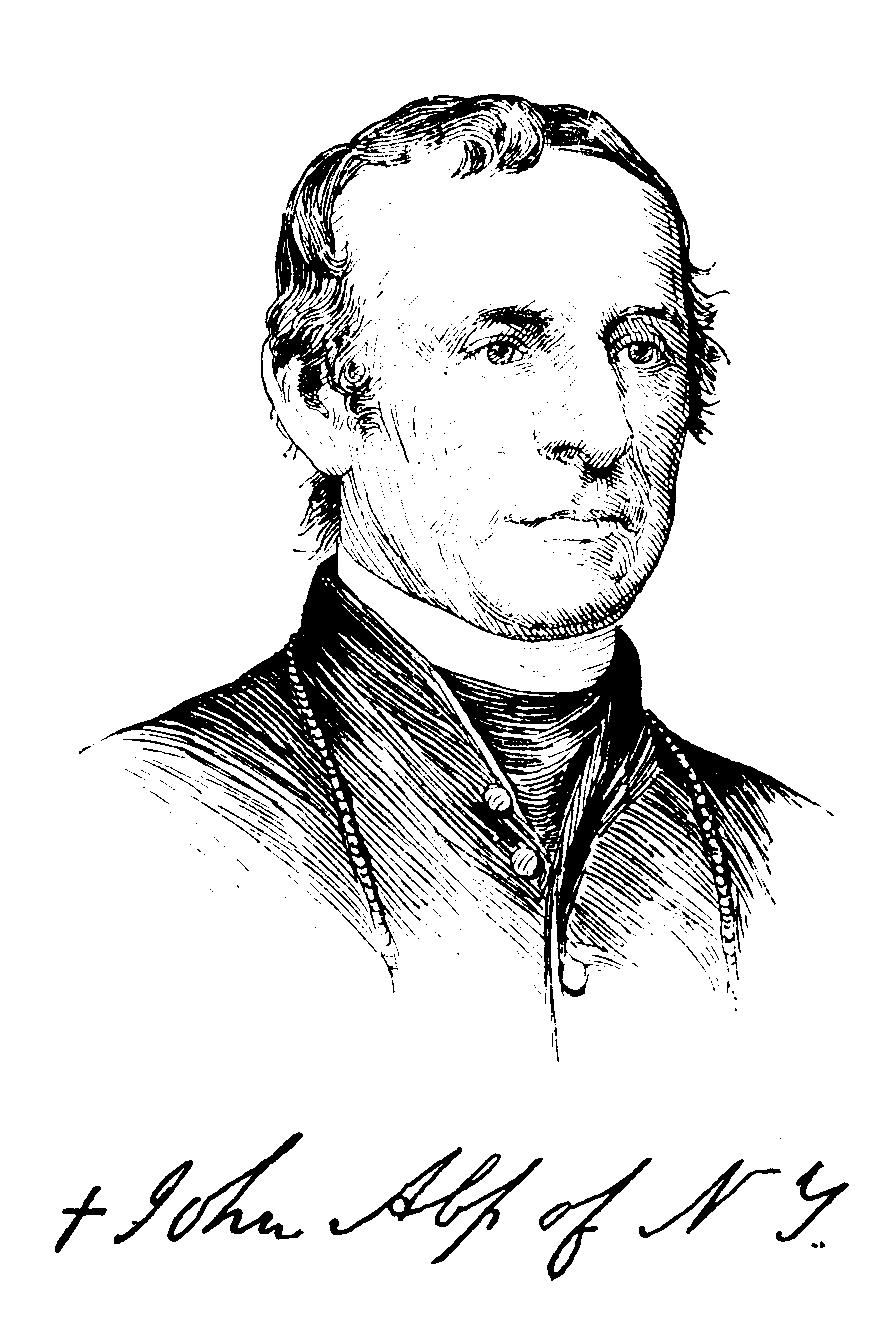
{John Hughes with his "dagger John" signature; source: virtualogy.com}
{Abraham Sutro; source: wikipedia.de}
--------- This blog post is one of a series on the Five Points district of Manhattan. Here are others in the series. The Five Points series began with a set on Mulberry Street. Here are the posts in that series. This post is also in a series giving stories from my family history. Here are others in that series. Unlike the two preceding lists, these are given in newest-to-oldest order: --------- Some sources on John Hughes and Abraham Sutro: A History of Public Education in the United States by Deeptha Thattai A PRAYER FOR THE PUBLIC SCHOOLS by Kevin Baker Anti-Catholicism and the History of Catholic School Funding Elementary Education: History The cyclopædia of education edited by Henry Kiddle and Alexander Jacob Schem (E. Steiger & co., 1883) Archbishop John Hughes The Irish Catholic Who Helped Shape American Catholicism by Kyle Sanders John Hughes article in the New Advent Encyclopedia "Bishop Hughes versus the Public School Society of New York," by Joseph J. McCadden, The Catholic Historical Review, Vol. 50, No. 2 (Jul., 1964), pp. 188-207, retrieved from jstor: http://www.jstor.org/stable/25017420 SUTRO, ABRAHAM article in the Jewish Encyclopedia Isaac Leeser and the Making of American Judaism by Lance J. Sussman (Wayne State University Press, 1996) Revolution and evolution, 1848 in German-Jewish history edited by Werner Eugen Mosse, Arnold Paucker, and Reinhard Rürup (Mohr Siebeck, 1981) The greatest rabbis hall of fame by Alex J. Goldman (SP Books, 1987) History of the Jewish Community of Beckum by Zeev Raphael Lives of the deceased bishops of the Catholic Church in the United States, Volume 2, by Richard Henry Clarke (R. H. Clarke, 1888) Abraham Sutro in wikipedia.de --------- Notes: [1] Quoted in: John Hughes (archbishop): Episcopacy [2] Paraphrased from Jacob Raphael: Die Synagogengemeindein (1924) in History of the Jewish Community of Beckum.

Monday, June 28, 2010

Dagger John

By the middle of the nineteenth century anti-Catholic and anti-Irish hostility was common in New York and the New England states. Americans aped the British in their fear of Popery and condemned the Irish as a sub-human species. Below the text I've reproduced some bigoted cartoons that reflect these prejudices.

Catholics in general and the Irish in particular resisted these attacks and eventually overcame them. They did this partly by assimilation — demonstrating to the Protestant ascendancy that there was nothing to fear — and partly through self-assertion — demonstrating the power of their solidarity, discipline, and force of numbers.

And they did it with the impassioned leadership of an Irish-American priest, John Hughes. This was much more than a spiritual leadership. Hughes gained authority within the Church by his determination, polemical skills, and a large measure of bullying. Stubbornly, he overcame resistance to men who wished to deny him a Catholic education, and those, later, who wished to deny him the priesthood, advancement into the ranks of New York's bishops, and selection as the city's archbishop. As he forcefully attacked those who would resist his advance, so also he attacked those he considered to enemies of the Church and of the hundreds of thousands of Catholic immigrants who arrived from Ireland during his lifetime.

His feisty demeanor, along with a habit of putting a cross by his signature, earned him the nickname "Dagger John" in the local press, but he was not so fierce in private. If Dagger John was utterly fearless, possessing an indomitable will, unwavering resolution, firmness of purpose, he was also warm and generous. Equally able to express both genial humor and cutting sarcasm, he had a sensitive nature and a gift for establishing and nurturing close friendships.[1]

To my mind this detail from a portrait shows empathy and the nurturing side of his character.


{Matthew Brady made this portrait of Hughes after he became archbishop; source: wikipedia}

Further down this page I've given a short biography of the man and his works; the Sources section (also below) gives links for lots more information about him. His achievements are extensive. One of his biographers says "It is an understatement to say that John Hughes was a complex character. He was impetuous and authoritarian, a poor administrator and worse financial manager, indifferent to the non-Irish members of his flock, and prone to invent reality when it suited the purposes of his rhetoric."[2] But as another says, "Dagger John Hughes proved himself a formidable force in an era when a fighting bishop was needed. When the Vatican nuncio, Archbishop Bedini, asked an American priest to explain why people in America held Archbishop Hughes in such esteem, the answer was: 'It is because he is always game.'"[3] And a third calls him "a master-builder of the Church in the United States and one of the most helpful and sagacious of the makers of America" and "a prelate and citizen whose strong personality, indomitable courage, and invaluable service constituted him the man needed in his day to meet critical conditions."[4]

Hughes had no illusion about the state of Irish immigrants in New York, calling them "the poorest and most wretched population that can be found in the world — the scattered debris of the Irish nation."[5] He said this to describe not condemn. His feelings for Irish-Americans and the Irish homeland were as strong as was his commitment to his vocation and the Church.

You can see this deep compassion in a speech he gave at the height of the Irish famine. It is an oration in the classical mode -- majestic, Ciceronian, persuasive, articulate, and impassioned. In it he condemns the British state for its evil policies, gives no quarter, and takes no prisoners. He does not praise the starving Irish for the patient endurance and Christian forbearance they have shown under unmerited English durance, but says they have the right to seize for themselves the food that their landlords were sending out of Ireland in the midst of the potato famine.

He condemns the English governing class for imprisoning itself in "a defective or vicious system of social and political economy" and he tells his listeners that this system has become the "great cause of Ireland's peculiarly depressed condition."

He says, "The fault that I find with [this system of social and political economy] is, that it provides wholesome food, comfortable raiment and lodgings for the rogues, and thieves, and murderers of the dominions, whilst it leaves the honest, industrious, virtuous peasant to stagger at his labour through inanition, and fall to rise no more."

He tells us of an "admirable resignation," praised by Ireland's overlords: "This same political economy authorises the provision merchant, even amidst the desolation, to keep his doors locked, and his sacks of corn tied up within, waiting for a better price, whilst he himself is, perhaps, at his desk, describing the wretchedness of the people and the extent of the misery; setting forth for the eye of the first lord of the treasury with what exemplary patience the peasantry bear their sufferings, with what admirable resignation they fall down through weakness at the threshold of his warehouse, without having even attempted to burst a door, or break a window."

But he does not himself praise this patient fortitude: "The rights of life are dearer and higher than those of property; and in a general famine like the present, there is no law of Heaven, nor of nature that forbids a starving man to seize on bread wherever he can find it, even though it should be the loaves of proposition on the altar of God's temple."[6]

And he concludes by describing the impersonal obliteration of a people: "The vice which is inherent in our system of social and political economy is so subtile that it eludes all pursuit, that you cannot find or trace it to any responsible source. The man, indeed, over whose dead body the coroner holds the inquest, has been murdered, but no one has killed him. There is no external wound, there is no symptom of internal disease. Society guarded him against all outward violence; it merely encircled him around in order to keep up what is termed the regular current of trade, and then political economy, with an invisible hand, applied the air-pump to the narrow limits within which he was confined, and exhausted the atmosphere of his physical life. Who did it? No one did it, and yet it has been done."

At end, he calls upon the spirit within the Irish which will survive and again flourish: "There was this one sovereignty which they never relinquished — the sovereignty of conscience and the privilege of self-respect. Their soul has never been conquered; and if it was said in Pagan times that the noblest spectacle which this earth could present to the eye of the immortal gods, was that of a virtuous man bravely struggling with adversity, what might not be said of a nation of such men who have so struggled through entire centuries? Neither can it be said that their spirit is yet broken. Intellect, sentiment, fancy, wit, eloquence, music, and poetry, are, I might say, natural and hereditary attributes of the Irish mind and the Irish heart; and if no adversity of ages was sufficient to crush these capacities and powers, who will say that such a people have not, under happier circumstances, within themselves a principle of self-regeneration and improvement, which will secure to them at least an ordinary portion of the happiness of which they have been so long deprived?"[7]

--------------------

This is the how John Hughes signed himself. The cross by his name gave the excuse for his nickname.


Here is the full portrait by Matthew Brady.


Here are some anti-Catholic and anti-Irish cartoons from nineteenth century America. Many were by Thomas Nast and appeared in Harper's Weekly, a paper with Republican, and thus anti-Democratic, anti-Irish, and anti-Catholic sympathies.

1. Showing Irish-Americans as anti-assimilationist. For many of them, as for Hughes, Irish solidarity was a source of strength, in resistance to American prejudices, in development of a political and economic power base, and in insuring close ties with the old homeland.


{The Mortar of Assimilation and the One Element that Won't Mix, Puck, June 26, 1889; source: museum.msu.edu}

2. The LC caption to the cartoon reads: The Usual Irish Way of Doing Things, a savage anti-Irish cartoon by Thomas Nast, depicting a drunk Irishman lighting a powder keg and swinging a bottle. Published 1871-09-02 in Harper's Weekly.


{Political cartoon titled "The Usual Irish Way of Doing Things" by Thomas Nast (1840-1902) published in Harper's Weekly on 1871-09-02; source: wikipedia }

3. This savage caricature shows Irish-Americans as sub-human beings as its caption states.

{source: salon.com/blog/marygrav (reviewing: Race: A History Beyond Black and White by Marc Aronson (2007)}

4. This is a complex cartoon by Nast on the city's cancellation of a parade by Protestant Irish-Americans because of expected disruption by Catholic ones.[8]

{Harper's Weekly, July 29, 1871: Thomas Nast, “Something That Will Not ‘Blow Over'” source: assumption.edu}

5. New York's Irish-American vote grew increasingly potent as the nineteenth century proceeded. At first most Irish-Americans voted against the Tammany Hall political machine, but they later exploited it to their great advantage. Tammany's party were the Democrats. This cartoon shows an Irish-American thug and a Catholic priest carving up the Democratic Party, shown as the goose that laid the golden eggs.


{By Thomas Nast; source: latinamericanstudies.org}

6. This vicious Thomas Nast cartoon speaks for itself.


{Nast depicted the Irish as violent ape-like creatures; source: latinamericanstudies.org}

7. It's 1868 and a Southern rebel, the Democratic Party presidential candidate, and an Irish thug are joining forces to defeat the Republican Party's Reconstruction policies and stomp on newly freed slaves. Notice that the Irishman has "5 Points" written on his hat.


{Harper's Weekly, Sept. 5, 1868}

----------------

Brief biography of John Hughes:
The embodiment of this trend toward an authoritarian clergy and hostility to evangelical Protestant reform was John Hughes (1797-1864), bishop of New York. Born in County Tyrone he came to the U.S. in 1818 and soon entered Mount St. Mary’s seminary in Maryland. Ordained in 1826 he soon achieved a national reputation as a fiery pro-Catholic polemicist, engaging in several high profile “debates” in the pages of leading Protestant and Catholic newspapers. His detractors took to calling him “Dagger John” because of his personality and the fact that he always drew a dagger-like cross under his signature.
              He was made Bishop of New York in 1842 (and Archbishop in 1850). He became a leading figure in the reshaping of the American Catholic Church along Irish lines – that is a militant brand of worship that emphasized obedience, piety, regular worship, and reception of the sacraments -- backed by an authoritarian clergy. Central to this plan was a program of institution building designed to insulate Catholics from the corrupting influences of American culture. This included not just parish building, but the establishment of a vast system of parochial schools, hospitals, and orphanages, plus separate fraternal societies to compete with American ones. On more than one occasion, Hughes mused that it might be more important to build a parochial school first, followed by the parish church. This outlook was understandable, given the hostile environment of his era. However, critics then and in subsequent generations have argued that in the long run Hughes’ model of defensive Catholicism hindered the full participation of Catholics in American life until the mid-20th century.
-- "Dagger John" Hughes by Edward T. O'Donnell
------------

Some sources:

DEATH OF ARCHBISHOP HUGHES.; HIS SICKNESS AND LAST MOMENTS. SKETCH OF HIS LIFE, New York Times, January 4, 1864

Complete works of the most Rev. John Hughes, archbishop of New York: comprising his sermons, letters, lectures, speeches, etc edited by Lawrence Kehoe (Lawrence Kehoe, 1866)

Complete works of the most Rev. John Hughes, archbishop of New York: comprising his sermons, letters, lectures, speeches, etc, Volume 2 edited by Lawrence Kehoe (Lawrence Kehoe, 1866)

Life of the Most Reverend John Hughes, D.D.: first archbishop of New York. With extracts from his private correspondence Volume 257 of American culture series by John Rose Greene Hassard (D. Appleton and company, 1866)

Biographical sketch of the Most Rev. John Hughes, D. D. archbishop of New York by the Office of the "Metropolitan record", 1864

Archbishop John Hughes by William J. Stern

Archbishop John Hughes and Irish Catholicism in New York by Richard McCarthy

New York's Catholic Century, New York Times, by Peter Quinn, June 4, 2006

Archbishop John J. Hughes (1797-1863) by the Lincoln Institute

John Hughes (archbishop)

Refractive History: Memory and the Founders of the Emigrant Savings Bank
Author(s): Marion R. Casey
Source: Radharc, Vol. 3 (2002), pp. 55-96
Published by: Glucksman Ireland House, New York University
Stable URL: http://www.jstor.org/stable/25114415

Immigrants in the City: New York's Irish and German Catholics
Author(s): Jay P. Dolan
Source: Church History, Vol. 41, No. 3 (Sep., 1972), pp. 354-368
Published by: Cambridge University Press on behalf of the American Society of Church
History
Stable URL: http://www.jstor.org/stable/3164221

The New York Irish ed. by Ronald H. Bayor and Timothy J. Meagher (JHU Press, 1997)

Irish American Solidarity

The Irish (in countries other than Ireland) In the United States

From Famine to Five Points: Lord Lansdowne's Irish Tenants Encounter North America's Most Notorious Slum by Tyler Anbinder, American Historical Review, Vol. 107, No. 2, April 2002.

The Catholic encyclopedia: an international work of reference on the constitution, doctrine, discipline, and history of the Catholic Church

How Dagger John Saved New York's Irish by William J. Stern

Archbishop John Hughes and the Church in New York by Thomas J. Shelley

CITY LORE; New York's Catholic Century by Peter Quinn, New York Times, June 4, 2006

Harper's Weekly, July 29, 1871: Thomas Nast, “Something That Will Not ‘Blow Over'”

Anti-Irish racism

Nativism and Bigotry Thomas Nast

-------

Notes:

[1] Paraphrased from Biographical sketch of the Most Rev. John Hughes, D. D. archbishop of New York
Office of the "Metropolitan record", 1864. Here's the extract:
The brave heart of the Bishop throbbed as evenly when his home and life were threatened by a bigoted and insensate mob, as it did when presiding over a Diocesan Convention in his own episcopal city. Indeed, his utter fearlessness, his unwavering resolution, his indomitable will, and his firmness of purpose, gained him the esteem of generous opponents, and awakened in meaner minds a salutary dread of coming in conflict with him. Not in the United States alone was his preeminence acknowledged and his lofty qualities appreciated — in every part of the Catholic world his name was a household word. Ireland placed him high among her noblest and most gifted sons, and Rome regarded him as one of the staunchest pillars of the Church of God.

The love and pride that Ireland felt in him he repaid in kind. Throughout all his life he took a deep and abiding interest in everything that concerned her, everything that affected her for weal or woe. Next to his devotion to the Church, and his love for the people committed to his spiritual care, was his love for Ireland, the land from which he derived his most striking characteristics — his genius, his intellectual combativeness, his force of will, his quick perception, his pride of race, his cutting sarcasm and his genial humor, his generosity, his warm feelings, and his sensitiveness on the point of fame or reputation. His generosity was as unostentatious as it was untiring. The writer of this was cognizant of many and many an act of munificent generosity so delicately bestowed that to the recipients it seemed rather a friendly gift than a charitable donation.
[2] Found in Archbishop John J. Hughes (1797-1863) by the Lincoln Institute

[3] Quoted in Pope at St. Patrick’s in New York: We Owe Bishop Hughes

[4] By J. B. wainewright in The Catholic encyclopedia. Here's the whole paragraph:
He lived and passed away amid stirring times; it was providential for Church and country that he lived when he did. His natural gifts of mind and heart, independent of his education, were of a high order and made him pre-eminent in leadership; not only was he a great ruler of an important diocese in a hierarchy remarkable for distinguished bishops, but also a master-builder of the Church in the United States and one of the most helpful and sagacious of the makers of America. Church and nation are indebted forever to the prelate and citizen whose strong personality, indomitable courage, and invaluable service constituted him the man needed in his day to meet critical conditions. He was resolute, fearless, far-sighted, and full of practical wisdom based on the sanest and soundest principles. To bring out the innate power within him required but the opportunity presented by the Church struggling for a footing in a rather hostile community, anoby the nation endeavouring to cope with harassing questions at home and impending trouble abroad. His failures were few; his achievements many and lasting. He was feared and loved; misunderstood and idolized; misrepresented even to his ecclesiastical superiors in Rome, whose confidence in him, however, remained unshaken. Severe of manner, kindly of heart, he was not aggressive until assailed.
[5] Archives of the University of Notre Dame, (hereafter referred to as AUND), Bishop John Hughes to Society for the Propagation of the Faith, Paris, June 26, 1849, f. 104; Browne, "The Archdiocese of New York a Century Ago," p. 165. This is quoted in: "Immigrants in the City: New York's Irish and German Catholics" by Jay P. Dolan, Church History, Vol. 41, No. 3 (Sep., 1972), pp. 354-368, retrieved from jstor: http://www.jstor.org/stable/3164221

[6] The Loaves of Proposition were the "Hallowed Bread" of the Hebrews' tabernacle. They were specially prepared, unleavened, and are also know in English as show-bread and presence-bread.

[7] Here's more of the context of this part of the speech.
I have not come here to enlarge upon the feelings of sympathy that have been aroused in our own bosoms, nor yet on those of gratitude that will soon be awakened in the breasts of the Irish people. I come, not to describe the inconceivable horrors of a calamity which, in the midst of the Nineteenth Century, eighteen hundred and forty seven years after the coming of Christ, either by want or pestilence, or both combined, threatens almost the annihilation of a whole Christian people. The newspapers tell us that this calamity has been produced by the failure of the potato crop; but this ought not to be a sufficient cause of so frightful a consequence; the potato is but one species of the endless varieties of food which the Almighty has provided for the sustenance of his creatures; and why is it that the life or death of the great body of any nation should be so little regarded as to be left dependent on the capricious growth of a single root? Many essays will be published; many eloquent speeches pronounced; much precious time unprofitably employed, by the State economists of Great Britain, assigning the cause or causes of the scourge which now threatens to depopulate Ireland. I shall not enter into the immediately antecedent circumstances or influences that have produced this result. Some will say that it is the cruelty of unfeeling and rapacious landlords; others will have it, that it is the improvident and indolent character of the people themselves; others, still, will say that it is owing to the poverty of the country, the want of capital, the general ignorance of the people, and especially their ignorance in reference to the improved science of agriculture. I shall not question the truth or the fallacy of any of these theories; admitting them all, if you will, to contain each more or less of truth, they yet do not explain the famine which they are cited to account for. They are themselves to be accounted for, rather as the effect of other causes, than as the real causes of effects, such as we now witness and deplore. ...

I have ventured to suggest a defective or vicious system of social and political economy as the other great cause of Ireland's peculiarly depressed condition. By social economy I mean that effort of society, organized into a sovereign State, to accomplish the welfare of all its members. ... The fault that I find with the system is, that it not only allows but sanctions and approves of a principle, which operates differently in two provinces of the same State, divided only by a channel of the sea. It multiplies deposits of idle money in the banks, on one side of that channel, and multiplies dead and coffinless bodies in the cabins, and along the highways, on the other. The fault that I find with it is, that it guarantees the right of the rich man to enter on the fields cultivated by the poor man whom he calls his tenant, and carry away the harvest of his labour, and this, whilst it imposes on him no duty to leave behind at least food enough to keep that poor man alive, until the earth shall again yield its fruits. The fault that I find with it is, that it provides wholesome food, comfortable raiment and lodgings for the rogues, and thieves, and murderers of the dominions, whilst it leaves the honest, industrious, virtuous peasant to stagger at his labour through inanition, and fall to rise no more. ...

They call its God's famine! No! no! God's famine is known by the general scarcity &mdash there has been no general scarcity of food in Ireland either the present or the past year except in one species of vegetable. The soil has produced its usual tribute for the support of those by whom it has been cultivated; but political economy found the Irish people too poor to pay for the harvest of their own labor, and has exported it to a better market, leaving them to die of famine, or to live on alms; and this same political economy authorises the provision merchant, even amidst the desolation, to keep his doors locked, and his sacks of corn tied up within, waiting for a better price, whilst he himself is, perhaps, at his desk, describing the wretchedness of the people and the extent of the misery; setting forth for the eye of the first lord of the treasury with what exemplary patience the peasantry bear their sufferings, with what admirable resignation they fall down through weakness at the threshold of his warehouse, without having even attempted to burst a door, or break a window.

The rights of life are dearer and higher than those of property; and in a general famine like the present, there is no law of Heaven, nor of nature that forbids a starving man to seize on bread wherever he can find it, even though it should be the loaves of proposition on the altar of God's temple.

The vice which is inherent in our system of social and political economy is so subtile that it eludes all pursuit, that you cannot find or trace it to any responsible source. The man, indeed, over whose dead body the coroner holds the inquest, has been murdered, but no one has killed him. There is no external wound, there is no symptom of internal disease. Society guarded him against all outward violence; it merely encircled him around in order to keep up what is termed the regular current of trade, and then political economy, with an invisible hand, applied the air-pump to the narrow limits within which he was confined, and exhausted the atmosphere of his physical life. Who did it? No one did it, and yet it has been done.

There was this one sovereignty which they never relinquished — the sovereignty of conscience and the privilege of self-respect. Their soul has never been conquered; and if it was said in Pagan times that the noblest spectacle which this earth could present to the eye of the immortal gods, was that of a virtuous man bravely struggling with adversity, what might not be said of a nation of such men who have so struggled through entire centuries?

Neither can it be said that their spirit is yet broken. Intellect, sentiment, fancy, wit, eloquence, music, and poetry, are, I might say, natural and hereditary attributes of the Irish mind and the Irish heart; and if no adversity of ages was sufficient to crush these capacities and powers, who will say that such a people have not, under happier circumstances, within themselves a principle of self-regeneration and improvement, which will secure to them at least an ordinary portion of the happiness of which they have been so long deprived? The charity of other countries, and among them pre-eminently of England herself, the sympathy of distant and free States, on this occasion, will themselves have an effect. They will show Ireland that she is cared for; they will inspire her with the pleasing hope that she is not to be always the down-trodden and neglected province, the outcast nation among the nations of the earth.

-- A Lecture on the Antecedent Causes of the Irish Famine in 1847. Delivered Under the Auspices of the General Committee for the Relief of the Suffering Poor of Ireland, by The Right Rev. John Hughes, D. D., Bishop of New York, at the Broadway Tabernacle, March 20, 1847, in Life of Archbishop Hughes, with a full account of his funeral, Bishop McCloskey's oration, and Bishop Loughlin's month's mind sermon. Also Archbishop Hughes' Sermon on Catholic emancipation and his great speeches on the school question : including his three days' speech in Carroll Hall ..., Volume 1 (American News Co., 1864)
[8] Here's a full explanation of the cartoon.
Unlike present-day editorial cartoons, which typically feature a single, immediately recognizable image, Thomas Nast and his contemporaries assumed that readers would spend the time needed to completely "read" their works. In "Something That Will Not 'Blow Over'" students encounter one of Nast's most complex and most compelling cartoons, one that says much about the racial and ethnic tensions of the period surrounding the Civil War and how they were complicated by New York City politics.

Nast's double-page cartoon on the July 12th Orange Riot appeared only a few days after the New York Times began its exposé of the Tweed Ring. The Times editorialized on July 20 that: "Everybody should see, and seeing, retain Nast’s great 'Riot Cartoons' in the New Number of Harper's Weekly."

The Orange parade commemorated the victory of the Protestant William of Orange, the new king of England, over the Catholics in the Battle of the Boyne in Ireland in 1692 and was celebrated annually by Protestants in Ireland and, starting in 1870, in New York. Both Nast and Harper's Weekly thought that the Irish Catholics were a bane and that the Protestant Irish deserved the full protection of the city, state, and nation in their expression of their loathing of the Irish Catholics. The Catholic Irish had rioted during the 1870 parade. In 1871 they petitioned New York City officials to ban the Orange parade.

On July 10, Police Superintendent James J. Kelso denied the Orangemen a permit on the grounds that the parade would threaten public safety, an ironic tribute to the previous year's riot, and that obscene or violently derogatory language or gestures in public were misdemeanors. In 1870 both groups had engaged in such behavior before getting down to physical measures. Irish Catholics praised the decision, which was endorsed by William "Boss" Tweed of Tammany Hall, the Democratic political machine that controlled city government. Irish Protestants of course objected. They pointed out that not only did Catholic Irish routinely receive a permit for the annual St. Patrick's Day parade but also that the mayor and others routinely attended it. They claimed a right to equal treatment. Governor John Hoffman intervened, the permit was granted, and the parade and the riot got underway just after noon on July 12.

Nast's title drew upon the initial response of "Boss" Tweed to the Times stories of municipal corruption, that they were much ado about nothing and would soon "blow over." The central image, under the heading "Has no caste, no sect, no nation, any rights that the infallible, ultramontane Catholic is bound to respect," portrays gorilla-like Irish thugs assaulting a parade that includes not just Orangemen but virtually every other group in America. They include Chinese, Native Americans, blacks, Free Masons, liberal Catholics, and Germans. The burning orphanage and the lynching recall two of the most notorious excesses of the 1863 Draft Riot. The heading paraphrases the Dred Scott Decision in which Chief Justice Taney ruled that blacks had no rights that whites were bound to respect. Many New York Democrats, including the Irish, had supported the decision. The "infallible, ultramontane" modifiers of Catholic refer to the recent proclamation of papal infallibility in matters of faith and morals at the 1870 Vatican Council and to the allegiance all Catholics owed to the Pope in Rome (over the mountains from a German perspective; Nast was a German Protest immigrant). Note that the American flag is flying upside down while the new standard of "Centralization" with Tammany and Popery flanking an Irish harp proudly waves from a flagpole topped with a cross.

The upper left panel shows Columbia rewarding the police and National Guard troops who protected the Orangemen. Just below the "people" rise up, led by Columbia before whom cower members of the Tweed Ring. Below that Columbia speaks. In the opposite corner is "Pat's Complaint." In between is another caricature of the Tweed Ring, this time portrayed as "slaves" of the Irish. The header — "Well, what are you going to do about it?" — turns another Tweed response to the corruption allegations into a taunt aimed at the Ring. The "slaves" description complements the panel just above "Pat's Complaint" in which Tweed and his cohorts give in to the Catholic demand that the city ban the Orange parade. The upper right panel indicates the significance of July 12 to the Orangemen and highlights their offer to discontinue their parade if the Catholic Irish would cease marching on St. Patrick's Day. A haughty Irish "pope" replies: NIVIR!

-- July 12th Orange Riot