Sunday, September 07, 2008

credit and discredit, trust and mistrust

I apologize for the length of this. I'm too lazy to break it into bite-size pieces.

The thesis research I'm doing these days deals indirectly with the development of a credit-based economy in 17th century England. I'm studying ways of calculating interest received or paid and it's apparent that promises written out on pieces of paper served for money with growing frequency. Although shortages of coins, the dangers of carrying lots of coins, and the difficulties of calculating the true value of coins made credit transactions necessary, people were coming to see lots of other advantages.

At first the word "credit" carried all the weight of its multiple meanings. In particular it connoted trust, the assurance that both parties were committed and fully able to do exactly what they promised one another in the paper documents they signed. In time, merchants' courts evolved to enforce these promises making it unnecessary for one party to personally acquainted with the other. However, these courts came to have little influence over the speculative trading of some forms of credit transactions, in particular the buying and selling of securities -- the bonds that the government used to borrow from citizens and the stock issued by the East India Company and other trading ventures. Securities were a different form of credit, one much more subject to abuse than merchants' credit.

My research isn't concerned with the emerging stock exchanges in European cities of the time, but as it happens I'm reading a book that deals with the subject: David Liss's Conspiracy of Paper. It's an excellent amalgam of mystery story, historical novel, adventure tale, and exploration of chicanery on a huge scale. It is set in London at the time the South Sea Bubble and its hero takes us into the intricacies of that vast web of intrigue. Bit by bit the author unfolds the conspiracies, manipulations, and crimes of some of the wealthiest and most powerful men of the time -- men whose place in society and its institutions was one of public trust. The story thus concerns, in part, the abuse of trust.

If you know the story of the South Sea Bubble at all, you know that this massive abuse of trust led to the ruin of many English men and women from all walks of life.

{One of many images depicting the bubble mania, this comes from Harvard Business School's Baker Library}


{This is a detail from a contemporary print warning of the dangers of the mania.}


As it happens, too, we ate out last night at the New Deal Cafe in Greenbelt Maryland.


Greenbelt was created as part of the New Deal in the aftermath of the bursting of another financial bubble -- the the Wall Street Crash of 1929. It's cooperative approach to commerce and civic life has made it a conscious antidote to the greed and betrayals of trust that foment financial bubbles.

After the meal, we attended a performance of G. B. Shaw's play Mrs. Warren's Profession at the Greenbelt Arts Center


The play is about Mrs. Warren's profession, of course, but also about women's rights, the generational gap between a mother and daughter, the conflicting impulses of career and romance and of business and the arts. But it's also about people with wealth and social position who maintain an aura of probity while earning money in anti-social ways. In this sense, it compliments the Conspiracy of Paper and the betrayal of public trust. In fact, Shaw makes this connection fairly plain in speeches by two characters: the mother, Mrs. Warren herself, and her partner, Crofts. The latter, a Baronet, speaks of the financial dealings men of his class, including for example his brother the M.P. who "gets his 22 per cent out of a factory with 600 girls in it, and not one of them getting wages enough to live on." He says, "As long as you don't fly openly in the face of society, society doesn't ask any inconvenient questions; and it makes precious short work of the cads who do. There are no secrets better kept than the secrets everybody guesses." Later Mrs. Warren puts the matter a little more bluntly: "You think that people are what they pretend to be: that the way you were taught at school and college to think right and proper is the way things really are. But it's not: it's all only a pretense, to keep the cowardly slavish common run of people quiet. It's truth, gospel truth Vivie: the big people, the clever people, the managing people, all know it. They do as I do, and think what I think. I know plenty of them."

This tirade brought to mind this: A Con Game In Pinstripes
Extracts:

What is so telling about these stories [of financiers lying to their clients, regulators, and the public] -- and, rest assured, there will be many more before we're finished -- is that they come only a few years after these same companies reached similar settlements for defrauding many of the same investors during the telecom and dot-com boom. While the fraud back then had more to do with bogus research and accounting and manipulation of initial public offerings, it is clear that they sprang from the same slimy ethical culture that has produced the current credit crisis. Wall Street has become a fundamentally corrupt enterprise in which the motto is: "We'll do anything for a fee."

I refer not to the narrow legal definition of "corrupt," but to the general instinct to mislead clients, double-cross and collude with counterparties, and pull the wool over the eyes of investors. It is the kind of corruption grounded in the attitude that it's all just a game in which the only rules are "buyer beware" and "heads I win, tails you lose." In a corrupt business culture like that of modern-day Wall Street, cynicism is rampant, candor and accountability are first casualties, and a man is measured by the size of his bonus rather than the depth of his integrity. It's not so much immoral as amoral.

The tell-tale signs of this endemic corruption now litter the financial landscape.

To find it, look no farther than the televised bleatings of research directors and equity strategists who, until the last few weeks, were still talking about a stock market rebound in the second half of the year and have never once forecast a losing year for the S&P 500.

You can find it in the spectacularly misguided mergers and acquisitions that were conceived, negotiated, blessed and underwritten by investment bankers who are paid enormous fees no matter how things turn out for investors. Their latest bright idea: the merger of Fannie Mae and Freddie Mac.

It's right there in the Wall Street Journal, where it is reported without a trace of irony, that some master of the universe who was forced out of Citi for overseeing the loss of billions of dollars has been snatched up by Morgan Stanley while another is staked for a couple of billion dollars to start his own hedge fund.
Addendum:

I hadn't been to Greenbelt in years. Back then I would occasionally join in the Greenbelt National Park Training Race Series

Wednesday, August 27, 2008

of hedgehogs and foxes

Isaiah Berlin warned against sweeping generalizations. He inoculated whole populations of readers against abuse of the golden rule of historians and journalists: "simplify and then exaggerate." But the temptation concoct a coherent but somewhat fictitious story out of a body of messy facts is a powerful one. I'm one thus afflicted. I love history on a grand scale, the stories that answer big questions, and resent intrusion of nuancing details that detract from the push of narrative. For example I want to know about Hitlerism -- how it came about, why it succeeded so long as it did, how a modern state could become and sustain itself as a killing machine, why it was that a coalition dominated by another tyranny finally overcame it -- and though I want good answers, I suspect that none are as simple as I'd like.

And so,...

It intrigued me that two authors cite Berlin in essays which are

1. broad and sweeping, close to excessive in their simplifying and exaggerating
2. on topics that really matter
3. pleasingly scattered with paradoxical facts
4. bold in asserting their main points.

And which, as essays should, work through the simplifications and exaggerations to conclusions that are more thought provoking than imperative. What's more, they're both by Yale professors who teach modern history with an emphasis on the Second World and Cold Wars.

Ending Tyranny , by John Lewis Gaddis in The American Interest, subtitled Jefferson’s eternal hostility to tyranny should be our guiding light today. On reading this I thought back to my high school years when I took pride in the idealism of American foreign policy (e.g., the Monroe Doctrine), and then to my college years when I came to realize that the facts didn't quite fit this comforting view (e.g., Manifest Destiny, gun boat diplomacy, and the Spanish-American War). Now, I think first that Gaddis both warns against single-mindedness in forming policies and urges a single-minded attack on tyrannical regimes. And I think second, that economic policies matter at least as much as diplomatic ones; a fact he glosses over.


Nazism's dialectic of death, by Timothy Snyder in the Times (UK), subtitled How Hitler tried to form an empire by killing rather than converting. This essay left me perplexed. He seems to be saying that as Hitler's idealism (kill all Jews and -- one way or another -- eliminate everyone else in conquered territories to the East) gave way to pragmatism (make slaves out of conquered people) when his plan quickly to carve out a huge new German state in the East began to fall apart. He says he expected the West to go along with his plan (Britain and the US accepting -- practically welcoming -- an Central and Eastern Europe ruled by Germany. But it's my understanding that Hitler wasn't nearly so consistent in his thinking. He certainly viewed Churchill as the devil, no way a potential ally. And, as I recall, he didn't really know where to stop once he sent the German armies East. Snyder's imaging of Hitler a (20th-century anti-) Napoleon doesn't seem to fit the facts. It also seems to make victims of the Eastern populations (including those that welcomed Germans as Russian killers) in the way that the Jewish populations were victims. Not so, I think.

Endnote:

Regarding my subject line, see Bill Keller's blog post in the NYT Sunday Book Review Reading Room: Ich Bin Ein Berliner.

Image source: Project Gutenberg

Saturday, August 16, 2008

pig food

We encountered lots of algae on Petenwell Lake while vacationing in central Wisconsin this summer. The guy who handled our boat rental had just come from a meeting in which people whose livelihoods depend on the health of the lake were pitted against the powerful agricultural commmunity, source of much harmful runoff.

The sea of green reminded us of China's problems with the same. An account in the International Herald Tribune summarizes:
Olympic nightmare: A red tide in the Yellow Sea

By Jim Yardley
Published: June 30, 2008

source: IHT, caption: Residents clearing the coastline of Qingdao, Shandong province on Monday. (Stringer/Reuters)


Extracts:

Many coastal Chinese cities dump untreated sewage into the sea. At the same time, rivers and tributaries emptying into coastal waters are often contaminated with high levels of nitrates from agricultural and industrial runoff. These nitrates contribute to the red tides of algae that often bloom along sections of China's coastline.

But officials in Qingdao said pollution and poor water quality did not have a "substantial link" to the current outbreak. Instead, scientists blamed the bloom on increased rainfall and warmer waters in the Yellow Sea. Algae are now blooming over more than 12,900 square kilometers, or 5,000 square miles, of the sea, according to Xinhua.

State media reported that 100,000 tons of the algae had already been taken out of the water. Much of it was being transported to farms as feed for pigs and other animals, according to news reports.
Today, there's an AFP report on the problem:

Ocean 'dead zones' expanding worldwide: study
by Virginie Montet Fri Aug 15, 4:33 PM ET

Extracts:

"The formation of dead zones has been exacerbated by the increase in (pollution) ... fueled by riverine runoff of fertilizers and the burning of fossil fuels," the study said.

The phenomenon, called eutrophication, is caused by industrial pollution as well as runoff of water containing phosphates and nitrates into the oceans.

Oceans react to the boost in pollution by growing more algae and vegetation in coastal areas.

When the algae dies and sinks to the bottom, it decreases the amount of oxygen available in the bottom waters, a process called hypoxia, eventually wiping out fish and crustaceans that live there, as well as the foods they eat.

Dead zones tend to creep up in calm waters that see lower water exchange, but have more recently been affecting major fishery areas in the Baltic, Kattegat, and Black Seas as well as the Gulf of Mexico and East China Sea, the study said.

The researchers said the expansion of dead zones in these areas threatens commercial fishing and shrimping near the coastlines.

The phenomenon was first noted along the Adriatic Coast in the 1950s.

Seasonal dead zones affect the Gulf of Mexico, Chesapeake Bay and Scandinavian waters.
Here are some photos I took on Lake Petenwell:


The lake is clear at its north end, where the Wisconsin River flows into it.


At that point, you can fish, swim, and idle an afternoon away drifting on clear waters.


On the eastern shore things are very different. The surface is green.


In protected areas of the eastern shore, like the marina where we rented the boat, the problem is acute. The smell is ugly.


The surface is so deeply green that in places it's blue.


And lies thick enough on the surface to support a cast-off soda bottle.

Wednesday, August 13, 2008

seal stories

I was intrigued by the following story in Agence France Presse. It interested me that elephant seals swim under the Antarctic ice floes and I appreciated the immaginative use of this behavior pattern. I was also surprised they didn't include a photo of these huge animals. Looking for a photo, I found another story, also cited below. I wasn't surprised that the current story didn't reference the earlier one, but wouldn't it be a good thing for reporters to do a little research so as to provide some additional background, and not just re-write what they're given in press releases?
Seals give scientists unique glimpse under Antarctic ice, by Lawrence Bartlett Tue Aug 12, 10:35 AM ET

extracts:

SYDNEY (AFP) - Huge elephant seals have been recruited to help scientists break through a critical blind spot and chart climate change under the Antarctic sea ice in winter, researchers said Tuesday.

The seals, which can weigh up to three tonnes, are fitted with sensors that transmit previously unavailable data to satellites when they surface to breathe.

The seals measure temperature, salinity and depth as they dive up to nearly two kilometres (1.25 miles) and cover distances of up to 65 kilometres a day.

They have provided a 30-fold increase in data over conventional methods.

The polar regions play an important role in the Earth's climate system and are changing more rapidly than any other part of the world, with the potential to accelerate the rate of change elsewhere, scientists say.

The sensors, about the size of a mobile phone, are fitted when the seals return to sub-Antarctic islands to breed and to moult during the summer.

Once they have grown the next season's fur, the sensors are glued to the fur on the back of the animal's head, so when it surfaces to breathe the sensor is out of the water and the antennae can transmit the data to satellite.

Though the seals are not particularly concerned about humans and scientists can approach them quite close, the animals are sedated with a syringe on the end of a pole to ensure the sensors can be attached safely.

The sensors stay on through the winter season and fall off when the seals return to the islands and shed their fur for the summer.
A quick search of Google Images turned up a large number of good photos. The most interesting was part of a NASA release which tells the story from a different viewpoint:
Mission News Satellites and Sea Lions: Working Together to Improve Ocean Models, by Rosemary Sullivant, 02.06.07

extracts:

The best oceanographers in the world never studied at a university. Yet they know how to navigate expertly along oceanic fronts, the invisible boundaries between waters of different temperatures and densities. These ocean experts can find rich fishing in places and at depths that others would assume are barren. They regularly visit the most interesting and dynamic parts of the sea.

Sea lions, seals, sharks, tuna and other top ocean predators share some of their experiences with human researchers, thanks to electronic tags. Besides tracking the animals, these sensors also collect oceanographic data, such as temperature and salinity. Scientists are beginning to incorporate this rich store of information into ocean models providing new insights into the inner workings of the ocean and the lives of its creatures.

"Our goal is to produce a three-dimensional model of the ocean," says JPL oceanographer Dr. Yi Chao. Chao uses data from satellites, ships, buoys and floats to map the currents, heat content and different water densities beneath the ocean surface.

"Satellites provide a two-dimensional view of the ocean," says Chao. "Animals give us a slice of the ocean. They're like weather balloons in reverse."

"We are at the forefront of knowing how animals use the ocean," says [Chao's collaborator] Costa. "But we want to understand the environment better. We still see the ocean primarily as deep or shallow or near-shore or offshore. But just as there are different habitats on land, the ocean has fine-scale features that are very important to animals," he explains. "We want to be able to look at the ocean and say the equivalent of "this is a grassland" or "this is a forest."

In late January, Costa and his research group headed up the California coast to begin tagging elephant seals and collecting tags that were deployed last spring. The work is strictly regulated to ensure that the animals are protected from harm, and it requires a permit from the National Marine Fisheries Service.

"Marine scientists have been tracking marine animals for years," says Chao. "It's an interesting challenge, though, to use the data. There are all sorts-- from tuna, sharks, seals--you name it. Some of these data sets have small errors, others much larger errors. Figuring out how to put these in our system is a challenge, "he says. "But five years from now, we should be able to see the ocean the way a turtle sees it."

What is most important about using marine animals as ocean sensors is that the work benefits the animals, Costa explains. "Collaborations between biologists and physical oceanographers are critical for understanding why the animals go where they go," he says, "as we need to know and understand the ocean physics and its relationship to climate processes. Further, the ability to understand how climate change is affecting the world oceans is not only of benefit to humans, but is vital for trying figure out what is going to happen to habitat of marine animals."
Here are a couple of images from the NASA site:

The field team attaches a tag to the fur of a sedated male elephant seal. Special permits are required for this work to ensure the animal's protection. Image credit: Daniel Costa


A male sea lion shares his intimate knowledge of the ocean with researchers via an electronic tag. Image credit: Mike Weise


And here are a couple more from Cathy Webster on her own web site.

South Georgia, St. Andrew's Bay, adult male elephant seal
12/16/2005


South Georgia, St. Andrew's Bay, me talking to a young elephant seal
12/17/2005

Tuesday, August 12, 2008

opinionated women

I used to think that journalism was somewhat behind other writing professions in attaining gender balance, but I'm having a rethink about that. Today I just happened to notice that many of the best columnists are women and their articles are hardly restricted to issues that are traditionally considered to be feminine. Take for example:

(1) Washington Post writer, Anne Applebaum, writes about a weighty study that is being widely read in its Chinese original but not (yet anyway) available in English.
When China Starved, by Anne Applebaum, Tuesday, August 12, 2008; Page A13.

extracts:

"Tombstone" -- in two volumes and 1,100 pages -- establishes beyond any doubt that China's misguided charge toward industrialization -- Mao's "Great Leap Forward" -- was an utter disaster.

[The author] is not a dissident but a longtime Communist Party member. For more than three decades, he was a reporter for Xinhua, the official Chinese news agency. As a result, he had access to party documents that no one else has ever had.

Like the communist legacy, the famine exists in a kind of limbo: undiscussed in public, unacknowledged by the state, yet a vivid part of popular memory. Because China is no longer a totalitarian country, merely an authoritarian one, a journalist like Yang could spend 10 years working on the history of the famine, openly soliciting interviews and documents. But because the Chinese Communist Party neither openly embraces nor rejects the legacy of Mao, there is no public discussion or debate.

Why does a nominally Marxist party, one whose economic theories proved utterly bankrupt in the past, still preside over an explosively capitalist society?
(2) Or Chrystia Freeland in the Financial Times:
The new age of authoritarianism, by Chrystia Freeland, Published: August 11 2008 19:48


{image credit: FT}


extracts:

Today, in much of the world, the spread of freedom is being checked by an authoritarian revanche. That shift has been most obvious in the petro-states, where oil is casting its usual curse. From Latin America to Africa to the Middle East, the black-gold bonanza has given authoritarian regimes the currency to buy off or to repress their subjects. In Russia, oil has fuelled an economic boom that prime minister Vladimir Putin, and some of his foreign admirers, mistakenly attribute to his careful demolition of the chaotic democracy of the 1990s.

The Chinese Communist Party studied the collapse of Soviet communism with great care. And rather than seeing it as proof of the inevitable, global triumph of western liberalism, the Chinese comrades treated the Russian example as a textbook case of what a ruling Communist party ought not to do.

The west has been remarkably sanguine about this resurgence of authoritarianism, and one reason is that, this time, the comrades have money. Even as the Kremlin repeatedly confiscates the assets not just of its own businesspeople, but of foreign ones, too, investment bankers, and plain old investors, are flocking to a Moscow flush with petro-roubles. The same is true of the Gulf states. China, on a path to become the world’s largest economy, is the most attractive of all.

Russia’s expert taunting of the hotheads in Georgia, followed by immediate and massive retaliation the moment Tbilisi took the bait, is the latest evidence that, for the Kremlin, neo-imperialism is an essential bulwark of neo-authoritarianism. Bringing down the walls really did make the world safer. Now that so many leaders are building them back up again, figuring out how to contain the 21st century’s monied authoritarians is our most pressing foreign policy dilemma.
(3) Or the Post's Ruth Marcus, on a topic that might once have seemed appropriate for the Style Section (which evolved from the old women's pages), but is now Politics with a capital P:
A Tad Short Of 99%, by Ruth Marcus, Tuesday, August 12, 2008; Page A13

extracts:

There are two especially creepy aspects to [the Edwards infidelity] story. The first is the reverential, almost messianic way Elizabeth Edwards spoke about "this fine man" during the interview with Couric. This was disconcerting at the time; excruciating, in retrospect.

Even creepier part is John Edwards's resort to the exculpatory language of pop psychology to explain his behavior. "I went from being a senator, a young senator to being considered for vice president, running for president, being a vice presidential candidate and becoming a national public figure. All of which fed a self-focus, an egotism, a narcissism that leads you to believe that you can do whatever you want."

Right. The adulation made him do it.

He was the one who told us that character counted. As in these remarks about Bill Clinton in 1999: "I think this president has shown a remarkable disrespect for his office, for the moral dimensions of leadership, for his friends, for his wife, for his precious daughter. It is breathtaking to me the level to which that disrespect has risen."

Thursday, August 07, 2008

a girl and her father

While vacationing in Madison I spent a quarter to buy a copy of Neil Gaiman's Coraline at Saint Vinnie's on Willy Street. As the book comes to a close the title character heroically takes on a final Herculean challenge and in doing so uses trickery worthy of Odysseus himself to rid the world of the witch's disembodied hand which pursues her. She has learned about bravery from her sweet-natured, absent-minded dad and she thinks of him while she tries to keep up her nerve. Gaiman writes:
She tried to whistle, but nothing happened, so she sang out loud instead, a song her father had made up for her when she was a little baby and which had always made her laugh. It went,
Oh --- my twitchy witchy girl
I think you are so nice,
I give you bowls of porridge
And I give you bowls of ice
Cream.
I give you lots of kisses,
And I give you lots of hugs,
But I never give you sandwiches
With bugs
In.
That was what she sang as she sauntered through the woods, and her voice hardly trembled at all. (pp. 156-57)

Friday, July 18, 2008

an old book

Have you been following the press coverage about the copy of Shakespeare's First Folio that showed up at the Folger Library recently? The Washington Post rushed in to somewhat breathlessly cover the story when it first broke and followed up later with a personality piece on the man who brought it in. The NYT has been somewhat more restrained. While the British tabloids are loving it up:
- Cuban lover of Briton at centre of Shakespeare Folio probe tells of her shock at his arrest

- 'I'm innocent', says book dealer arrested over £15m Shakespeare ...
And the British press in general has had some fun with it:
- I want my book back arrested man says

- Experts examine mountain of books at Folio suspect's home

- FBI investigate Shakespeare theft drama
I particularly like this from the Sunderland Echo: My innocent role in Shakespeare drama, by Ross Robertson.

It's hard to know how serious to take this. The alleged perp is far from the usual type of obsessive, clinically depressed, and reclusive rare book thief. Ditto his alleged accomplice. The persons connected with the discovery and all the academics called upon to spout about its importance are clearly reveling in their pleasant moment in the public eye. I suppose the story will ravel in time though may not be news when it does.


It does interest me that the Folger has nothing on its web site about the incident, not even in is "press room" section.

Also, I'm interested in the role played by Garland Scott, Folger's press secretary. She appears to have done her job well, fronting for the org and keeping its employees from being pestered by the press. She was clearly a main source in the original WaPo account:
"It's come back after all this time, and there is an interesting tale to it," said Charlie Westberg, a spokesman for the Durham Constabulary. "That is what will make this a great movie one day," said Garland Scott, head of external relations for the Folger library. . . . When the mysterious man arrived at the Folger last month, he had a story to go with his book: He said the work was from a family library in Cuba, and he was representing the family. "From time to time, people have asked us to help them to figure out what a book might be," the Folger's Scott said. "On the other hand, usually those people have called or e-mailed beforehand. It's a little unusual to just show up." Librarian Richard Kuhta met the man and examined the book. "It's clear to Richard immediately that this is something important," Scott said. Kuhta asked the man if the library could keep the volume for further study, and the man agreed to leave it for two days. "Alarm bells" were going off in the minds of the library's staff, Scott said. "It's the first time a genuine First Folio has walked into our doors unannounced."
You can read about her :here and in this brief profile in a local weekly freepaper, the Hill Rag: A Capital Person: Garland Scott.

Finally, this all interests me because I've been working with a whole lot of books published in the sixteenth and seventeenth centuries. I've read, skimmed, and glanced at somewhat more than 600 so far, and thought myself a bit blasé about old printed books when the Folger discovery hit the news. A Shakespeare first folio, I have to say, is another thing altogether.

Also, I was stirred to pull this stuff together now on reading this nice piece in Slate today: Folioed Again!
Why Shakespeare is the world's worst stolen treasure, by Paul Collins.

Some photos from sources cited above:


Scott with alleged accomplice and her mom.

Raymond Scott, of course.


Police hauling stuff away from Scott's place.


amazing

A young relative of mine is participating in a celebration of poetry this week. The event is amazing: gut-wrenching, funny, lyrical, pumped-up, engrossing, somber, and just, well, amazing. Strangely, you wouldn't know anything about it from reading the local press. There's no coverage. Not an inch. Bloggers, yes; newsmedia, no. This is sad because what's being presented are works of art, some of them really, really good. It's poetry that's written, staged, and performed by the authors, some individually, some in groups of two to four. The subject matter ranges from deeply and painfully personal to historical and topical to social and political. The writing standard is high and the emotions are strong. The audience becomes deeply involved in the performaces, encouraging, punctuating, feeding back deep feelings as they're being received.

Some details:

The event involves young people in their teens, participating as teams in a style of judged competition where you find kids responding to each other's work in a most uncompetitive way (cheering others' work as much as their own). They come from across the country. The venues are small theater spaces. A web page called UpWords calls the event a poetry party. In announcing the event this site says:
Across the land, teenagers participate in poetry slams and other events organized by teachers, schools, local poets, community organizers and youth workers. Although the slam is a competitive event, competition is de-emphasized and commitment to craft and growth in the writer as person and community member are encouraged. From these local events and programs, 4-6 poets (13-19 years old) are selected to represent their city at Brave New Voices. More than 400 young poets will participate in this year’s festival held in Washington DC July 2008 representing over 44 parts of the country and globe.
Here's a link to a video of the opening ceremony: Video from the 11th Annual International Youth Poetry Slam.

Some other links:

- press release for the event (pdf)
- Festival home page
- Anouncement on the FreeinDc site.
- A blog post on the event
- Another blog post

Monday, July 14, 2008

Guizhou Weng'an riots

EastSouthWestNorth, a China newsblog by a Hong Kong resident named Roland Soong (wikipedia) has continued to update its compilation of stories and photos on the Weng'an Mass Incident. Currently, the article at the bottom of the page is a long summary of events from a Chinese newsmagazine called Southern Weekend, a weekly newspaper from Guangzhou, China (wikipedia). The article illustrates something that's interested me about coverage of the event: The official news agency, Xinhua, at first tried to whitewash the event, but was never able to establish its spin and suffered servere criticism on blogs and both foreign and domestic news coverage for its inept attempts: its bland weasel-worded accounts of the incident, its quotes from officials speaking bureaucrateeze and quotes from locals who were obviously, and painfully, trying to say what they thought officials wanted to hear. So, as things turned out, the Chinese press coverage was pretty thorough and pretty well balanced; raising questions and pointing out contradictions in different accounts. Other things about coverage are also interesting: (1) how much cell-phone photography there was, how quickly photos and videos showed up on blogs, how inventive people were in getting around internet censorship in China; (2) how the riot managed to limit itself to destruction of property with no loss of life and very little injury to participants or police; (3) how the frame enlarged from the tragic death of a 15-year-old to include the ineptitude of local officials and police and the legitimate grievances of residents; and (4) how much the current Chinese version of totalitarianism lacks totality -- police so unprepared to deal with crowd violence that the police station itself could be trashed, the family of the dead girl able to claim her body and display it (for payment of contributions) in a refrigerated coffin on the banks of the river where she died, the friends who were with her at time of death first sequestered by authorities but then released to be interviewed and, being interviewed, not mouthing official pieties, and the release, finally, of information that balanced against rumors of rape and murder (some plausible motiviations for the girl to be distraught because of actions by her family). I don't expect there will ever be a single "truth" that emerges from the story, but that's normal for emotion-charged events outside Communist societies as well as within them.

Thursday, July 03, 2008

TIOOYK

This year's version of the Tour de France starts Saturday. Organizers promise us the cleanest Tour ever. They've said that before. But after the debacles of previous years, what are they to say? It's true that there's much more dope testing than ever before, but organizers are still on the defensive.

Here are some sites on which to follow the action:
- Cyclingnews: 95th Tour de France, July 5-27, 2008

- Velonews

- PEZ

- The official Tour de France site
There are also bunches of rider diaries to follow. I'm fond of the ones from Garmin-Chipotle.

One of these, Will Frischkorn's, isn't on the main site. Here's his latest: One last night of peace, and then — the Tour, By Will Frischkorn, Team Garmin-Chipotle, posted Jul. 1, 2008. Will also has a flickr photostream: willfrischkorn's photostream.

On the other hand, one of the best rider blogs is on the Garmin-Chipotle site. David Millar knows his stuff and writes well. Here's his latest: When Superbad is soothing, Author: David Millar.

The same site has an interesting post by the woman who puts together all the stuff that riders need to keep them going day by day: The Tour packing list!.

And there's a link to a profile on Taylor Phinney which leads me to mention a good post on one of the best Tours ever, the one held in 1986: Tour Redux: 7-11's Crazy Weekend, Wednesday, July 02, 2008, by Edmond Hood.

I'll be following the Rabobank Team in general and Joost Posthuma in particular, but I'm not confident that this will be a good year for either of them.

Here's a look at the week ahead: TDF08: Parcours Up Close - Week 1, Wednesday, July 02, 2008, by Richard Pestes.

If you're curious about the title of this post, look here. After Merckx made that memorable quote, the initialism it showed up repeatedly on the old bike racing newsgroup, rec.bicycles.racing and eventually found its way into the group's FAQ. (It's one of those internet shorthands that have so many uses.*) As David Millar says, " Having so many of the world’s most talented cyclists at 100% of their fitness and motivation racing against each other is something to behold. And that’s the biggest difference between this race and others, everybody is excellent."

-----------------
* For example what the phrase Doing Push-Ups has now become. See here, and here, and here.

Tuesday, July 01, 2008

more on the Weng'an, Guizhou riots

Here's a short update to my post just below (a death in Guiyang). (I seem to be the only person refering to the event by the city where the riot took place, Guiyang. I've put the more common reference points in the subject of this post.)

There's still plenty of coverage in the news media, although it's not front page stuff. As Kenneth Tan says on shanghaiist, the best coverage of this story continues to come from the blog eastsouthwestnorth.

The ESWN bloggers are saying that Chinese web portals are deleting posts related to the event as quickly as they show up. On one forum it was estimated that Weng'an-related posts had an avererage lifespan of only 15 seconds. Because of this most discussion of the event appears as comments on the official Xinhua news reports.

Xinhua, the Communist Party news agency, is reporting that a high ranking official is investigating the death of the teenage girl. The report says the "incident was a simple affair that a small number of people with ulterior motives managed to manipulate and leverage, with the direct participation of organized crime forces, to provoke and challenge the Party and the government publicly." The blog comments on the Xinhua article: "The above Xinhua article is just about unreadable because it is just another stream of homilies without content. Is this how people really think and talk?"

ESWN also points out the confusion caused by government efforts to take control of coverage, to put their own spin on it, and give it the frame they wish it to have:
The second phenomenon was the amount of noisy chaff released. On one hand, there is the legendary "50-cent gang." These are supposed to be professional Internet writers who get paid 0.50 RMB for every post favorable to the government position. When yet another version of the Weng'an mass incident gets published as being the ultimate truth, the author is accused of being a member of the "50-cent gang" who is trying to confuse the public. Indeed, if you read through enough versions, you will probably throw up your hands and decide that you don't know what the truth is anymore. Instead, you change your investigation to questioning the motives of the people who are producing these versions.

On the other hand, there is the legendary "Internet special agent (??)." These are supposed to be professional spies who are paid by anti-China hostile forces to publish unfavorable information about China. For example, some of the posts mentioned that the People's Liberation Army has been dispatched to Weng'an with tanks and artillery, with the hint of a Tiananmen-like massacre to follow. Immediately, the other netizens reacted by pointing that these posts are coming from "Internet special agents." The netizens want to draw a very clear line: they may be protesting against what is happening in Weng'an but they will not serve the purpose of the anti-China hostile forces. This is very clear.
ESWN also provides a link to another blog site which gives a quote from a local Communist Party newspaper that is unaffiliated with Xinhua. In an editorial comment, the paper criticizes the response by government leaders and the national press, saying that there wouldn't have been a riot with great property damage and the rest if leaders had addressed the core element in the story. The editorial writer says:
But the actual fuse that led to this incident, the details on the actual case involving the death hasn’t been explained or described. The short description that “some people are dissatisfied with the determination of ’cause of death’” isn’t enough of a conclusion. This is no different than wrapping gunpowder with paper (ed: similar to the English idiom walking on land-mines), and will lead to guesses and assumptions, and the people’s dissatisfaction is completely understandable.
A comment on the posts in this other blog site says that Xinhua has now published a report by editor Yan Liang giving many more facts and indicating for the first time why local residents were so upset. The article says:
But the police account proved difficult to accept for the girl's family and their supporters. Li's classmates and her landlord said she was a good student and couldn't have killed herself.

"She was a quiet and nice child. She seldom hung out or played around. I don't think she killed herself," said landlord Liu Jinxue, who helped pull her body from the river. Li's hometown was a rural township and she lived in a rented apartment in the county.

Liu told Xinhua that the girl's uncle, Li Xiuzhong, had several serious confrontations with the police, and was beaten by unidentified men in the street.

The uncle was in a county hospital last week, but had since been transferred elsewhere, Xinhua learnt.

Li's grandmother Lu Xiuzhen said the girl's father had departed for provincial capital, Guiyang, to petition the government and could not be reached. The mother had "gone mad" since the incident, she said.

"I demand the government thoroughly investigate the incident and give us a justifiable explanation," she said.
What's interesting -- according to other commenters on the blog -- is that Xinhua put this up on the English-language part of its web site. The version of the Chinese-language side of the site is apparently much more bland:
The English one was written by writers working for Xinhua, and contains a fairly reasonable report of the incident with quotes from various parties. The Chinese article, however, comes from local Guizhou news report (????-????), and is, frustratingly, of the typical style of official non-sense and white wash everyone hated so much. That article basically reported that the party boss of Guizhou held meetings with local officials to discuss the incident, already casting it as mostly caused by misguided people incited by a few and laid only light blame on officials who “didn’t do a good enough job” locally.
Here's the blog post in shanghaiist:
More on the Weng'an, Guizhou riots

As usual, Roland Soong of EastSouthWestNorth is on top of the incident, busy piecing together all the information he can find. He informs us that Weng'an is now a sensitive word, the uncle of the female student is still alive, and the body of the student is still resting in a refrigerated coffin awaiting autopsy despite this popularly-believed story. Soong also observes that the Xinhua story (which all Chinese media are made to carry) opens more questions than it answers, paving the way for all sorts of unsubstantiated rumours to dominate public opinion.

An AP story has some photos by Andy Wong.
Chinese paramilitary police officers patrol in Weng'an county of Guizhou province, China, Monday, June. 30, 2008. Authorities detained hundreds of people suspected of setting fire to police and government buildings in southwest China in protests over a teenage student's death, a human rights organization said Monday.


Sunday, June 29, 2008

a death in Guiyang

I saw a link to a BBC news story with the headline Chinese riots over girl's death. There's so much Chinese news these days, what with the upcoming Olymic Games, the ongoing tragedy following from the massive earthquake in Sichuan Province, the Tibetan conflict in which the Dalai Lama figures, the slowing of China's unbelievably fast-growing economy, Chinese massive energy requirements, Chinese environmental problems, and social problems stemming from the fast growth of China's middle class. The BBC article piqued my interest partly because I'd seen a recent headline on the Chinese power structure which pointed out that Communist Party leaders in local areas were practically autonomous. That article tallied with conclusions I'd drawn from reading Qiu Xiaolong's gritty detective stories set in southeast China.

News accounts of the riots are interesting partly because they don't all say the same thing. In the west, it seems to me, when there's broad coverage of an event, all the reporters have pretty much the same sources and their accounts differ very little from one another. It's more difficult to cover a closed society like China and -- sources being more difficult to find -- the accounts differ somewhat more.

In this case the western stories tend to build on one another as the set of facts enlarges. They differ in that, but also in the emphasis they place on the story's main elements. The current lead paragraphs in the AFP account gives some of the basics up front:
Rioters in southwestern China torched government buildings and cars after anger over a probe into a schoolgirl's death exploded into violent protests, locals and state press said Sunday.

The riots occurred Saturday in Guizhou province when protesters ransacked three government and police buildings after the girl's uncle died from an alleged beating by police trying to stop him from protesting against the handling of the case, locals and Internet postings said.
The BBC gives the map I put above and adds a crucial point:
Local residents were angered after a police inquiry concluded that the girl, found dead in a river earlier in June, had committed suicide. Her family accused the son of a local official of raping and killing her.
Reuters makes the cause of local anger more plain:
"Local residents were very angry about the injustice exercised by local authorities," the resident, who is an official at a local government office, told Reuters by telephone.
It's not surprising that the account in the politically-controlled Chinese news agency contrasts dramatically with the reports in free-press media. The Chinese story tells that there's been a riot, but the reporter tells us that a bunch of misguided people went overboard and attacked the local police station and government buildings because they were "dissatisfied with the medicolegal expertise on the death of a local girl student." The emphasis is on destruction of public property and efforts to restore order. The action of the mob is described as torching government office buildings and assaulting local officials. The scene is characterized by the word chaos.

You'd think that all reports coming out of China would be similarly slanted, so I was surprised to find an account on a Shanghai web site that I find better than many of the news stories that originate outside China. The site gives succinct coverage and a number of useful links:
Riot in Weng'an County, Guizhou Province

Several thousand rioters have gathered in Guizhou's Weng'an County, torched a police station, ransacked government buildings and overturned police cars, after allegations of a cover-up over a 15 year old girl's death blew up. Ming Pao reports the son of the county's vice-deputy mayor had raped and murdered the girl along with another youth and tossed her body into the Ximen River. Police only detained the suspects for five hours and released them without charge. EastSouthWestNorth says unconfirmed, conflicting reports are now swirling around the Internet but has several telling pictures which indicate a large proportion of the population was out on the streets. [Xinhua] [Reuters] [AP] [AFP] [Youtube videos 1, 2, 3, 4, 5]

By Kenneth Tan in News | Link
You can learn more about the shanghaiist site from their about page. It seems they actually publish from Shanghai in China. The wikipedia article on the city makes it sound like a very interesting place.

Here are photos from a site called eastsouthwestnorth. Notice that they all come from myspace.cn, the Chinese myspace site that went live about a year ago.

This is the young woman:


This shows the size of the crowd:


The city apparently has a large central square surrounded by government buildings:


One of the accounts says that locals hate their police:


One account says how much smoke there was:


Here you can see, in the aftermath, that young people participated:

Friday, June 27, 2008

Windmuller, Heine, and Lorelei

Catching up with Arts & Letters Daily after a couple weeks, I've found a lot of interesting stuff. I've put some of the teasers at the bottom of this post so you can see what I mean.

One of the items deals with the German poet, Heinrich Heine, with whom I have a remote familial connection. The item is a book review by Michael Dirda in the Wall Street Journal. Here's the link: Touring With an Eccentric Guide (June 14, 2008; Page W11). The book is Travel Pictures, by Heinrich Heine (Translated by Peter Worstman, Archipelago, 223 pages, $17).*

Dirda's review is typically good. He says
Heinrich Heine (1797-1856) once described himself as the last of the romantics and the first of the moderns, which may account for the winning combination of the playful and the serious in his writing. Today he is largely remembered for his ballad-like poetry, much of it set to music by Schubert, Wolf and other lieder composers. In his own day, however, this author of such verse masterpieces as "Die Lorelei" -- about the siren who lures Rhine boatmen to their doom -- was equally celebrated as a prose writer, spending much of his adult life in Paris as a journalist, explaining the French to the Germans and the Germans to the French.

Throughout his life, though, this witty man of letters was utterly serious about defending civil liberties and religious freedom, counting among his friends not only artists like Balzac and Berlioz but also revolutionaries like Karl Marx. In one of his plays Heine, who was Jewish, presciently observed that "where they begin by burning books, they will end by burning people."
While I was reading this review the family connection with Heine came to mind. My great grandfather, prominent New Yorker of the late 19th century, once led a committee that collected funds to have a statue to Heine installed in a New York park. The effort succeeded and the elaborate fountain can be seen in what is now called Joyce Kilmer Park in the Bronx.

The New York Times did an article on the appearance of my forebear before the park commissioners to request the installation: THE HEINE MEMORIAL MONUMENT Description Furnished the Park Board -- Mr. Windmuller's Plea (April 4, 1895, Wednesday, Page 16).** It includes a sketch of the statue with description by an art expert. Here's the sketch; click image to view full size:


Here are excerpts from the art expert's description of the monument:


And here is a bit of history from the web site for Kilmer Park.
The Lorelei fountain celebrates the German poet, Heinrich Heine (1797-1856), author of an ode to Die Lorelei -- a siren from German mythology who lured sailors to their deaths on the Rhine. The fountain was created by German sculptor Ernest Herter for the poet's home city, Dusseldorf. However, political groups opposed to Heine's Jewish origins and political views blocked its installation there. The fountain was finally erected in the Bronx in 1899, thanks to a subscription led by Americans of German ancestry. Funds are now being raised to restore the fountain, the victim of decades of weathering and vandalism, to its former glory.
Windmuller shared Heine's politics and (by birth anyway) his religion. He contributed much to promoting German arts and culture in New York and the welfare of Germans in America. He sided with German liberals like Heine and Karl Schurz in opposition to the growing irrationality of men like Wagner, Nietzsche, and Spengler. There's no proof, but it's pretty likely he emigrated from Munster in 1850 as an indirect result of his participation in the radical uprisings of 1848.

There's a park in Queens that's dedicated to his memory which, a year ago, was the "park of the month:" Windmuller Park. A Google search turns up information about it.

For what it's worth, New York has a park named after Carl Schurz too, but none for Wagner, Nietzsche, or Spengler.


Here are the promised teasers from today's Arts & Letters Daily

Share your grief and you may double your sorrow. Better, perhaps, that all you’ve seen, and all that you suffered, should go with you to the grave... more»

The rise of the therapeutic and the eclipse of the tragic ensures college students’ expectations soar even as their intellectual abilities to handle life’s setbacks erode... more»

We get the art we deserve, and today what we deserve is the splashy, pretentious, dumbed down trophy art that dominates the art world ... more»

An “it-wasn’t-my-fault” industry now produces books like Scott McClellan’s White House memoir. Next in line: Donald Rumsfeld... more»

Country music knows what it means to be trapped by poverty, a lousy job, lust, and booze. To grasp the USA, just listen... more»

John Updike started with art as a small child, newspaper comics at first. Edward Hopper and Mark Rothko came later... more»

A butterfly flaps its wing and a hurricane hits Mongolia. Or whatever. Everybody loves the “butterfly effect,” and everybody gets it totally wrong... more»

Q: “So is Marxism-Leninism scientific?” A: “Surely not. If it were, they would have tested it on animals first.” Old Soviet jokes... more»

For all of Churchill’s faults, we may still be grateful for a 1930s politician who found it intolerable even to breathe the same air as the Nazis... more»

The British invented curry? Not quite. But the Madras curry (Tamil: kari) was born with the East India Company... more»

Will unplugging our cellphone chargers or turning TVs off standby reduce energy use and help fight global warming? How do the numbers stack up?... more»

“I am astonished that the Bush people are so robotic,” says Peggy Noonan. Criticize the boss and you’re banished from the kingdom... more»

Add more signs, directions, and limits on the road, and drivers will be safer, right? Wrong. Drivers tend to compensate... more»

Paris is a miraculous city in no small measure because modern architects have not been able to get their hands on it. Roger Scruton explains... more»

Under Kinderarchy, parents are little more than indentured servants. It’s all about the kids: their schooling, brightness, cuteness, and their quite astonishing creativity... more»

The central image of Samuel Johnson in James Boswell’s Life is that of a heroic figure battling his demons and keeping them at bay... more»

Critical texts to go with contemporary art are so twisted and woolly they could pass for self-parody. Yet they require us to take them seriously... more»


------------------------
Notes:
*You can download an older translation of the book from Google Book Search: Pictures of Travel, by Heinrich Heine; translated by Charles Godfrey Leland (New York : D. Appleton, 1904).
**I'm not sure why, but I had to use Internet Explorer to follow the Times link to the pdf article.

Wednesday, June 18, 2008

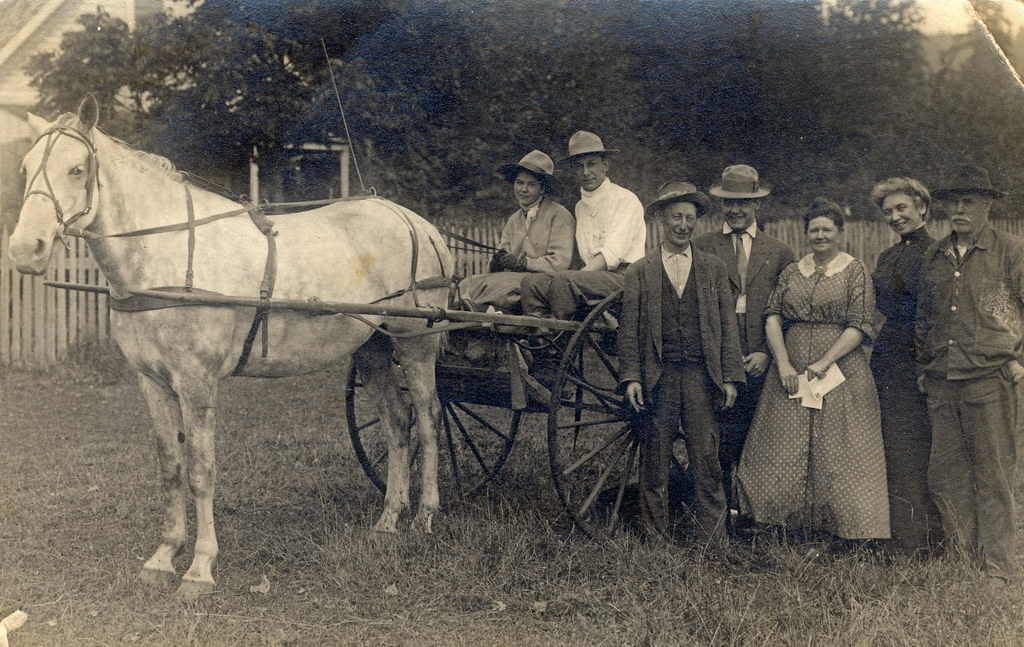
country life, 1905


{click to view full-size}

This photo is from the Smithsonian Institution's photostream on flickr. The Smithsonian has joined the Library of Congress in making available some of its vast collections of images in taggable sets. The intro page is here. A post on the subject on the flickr blog is here. The flickr inititative by which public institutions post their photos is called The Commons. The other two participants in the project are the Powerhouse Museum and the Brooklyn Museum.

The description line for this photo says the subjects are unidentified. It's from the National Postal Museum collection and shows a rural free delivery post carrier using a two-wheel horse drawn mail cart.

The curator who wrote the description says the carrier is a man The person with reins in hand looks like a woman to me. So maybe the other person is the one they mean. Or, maybe I'm wrong about the sex of the driver.

I like how this photo is nicely unlike other documentary shots of its time. It was taken in 1905, when photo subjects still tended to be stony-faced, yet this group is pretty cheerful. I like how the horse is observing the camera along with the people. And I like to think that the driver is a woman.

My son told me about the Smithsonian photos on flickr. Thanks to him!