Wednesday, January 14, 2009

H.E.F. in his den


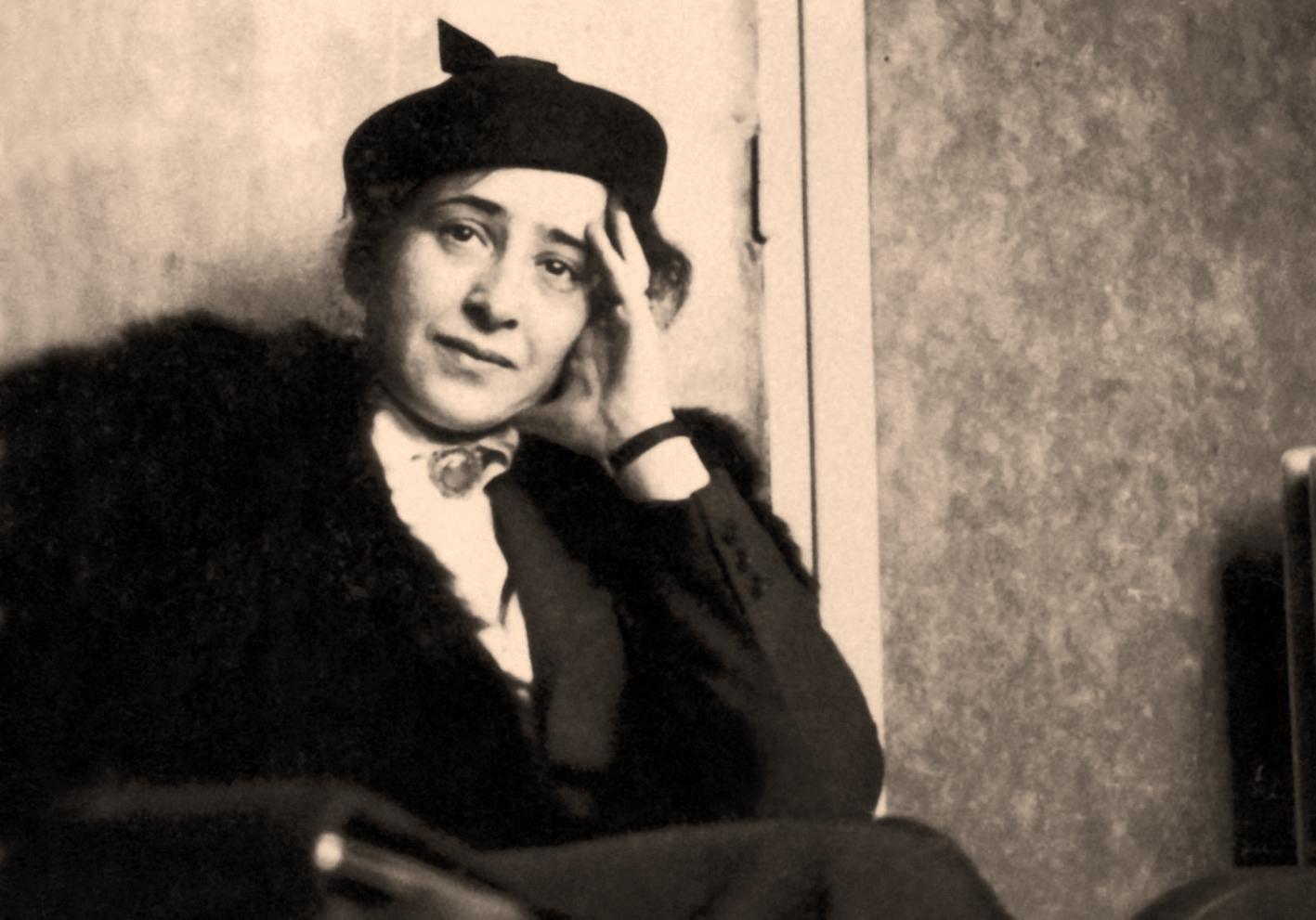
This interesting photograph comes from the National Photo collection in the LC Prints and Photos division. Click to view full size. The LC curator says it has the title "H.E.F. in den, 2227 Nichols" and was taken between 1910 and 1925. The Shorpy blog says it shows Herbert E. French, the owner of the photo company and the author dates it ca. 1920. Nichols Avenue is now Martin Luther King Avenue SE, Washington, DC. The address 2227 is on MLK Av. between W and 13th Sts.


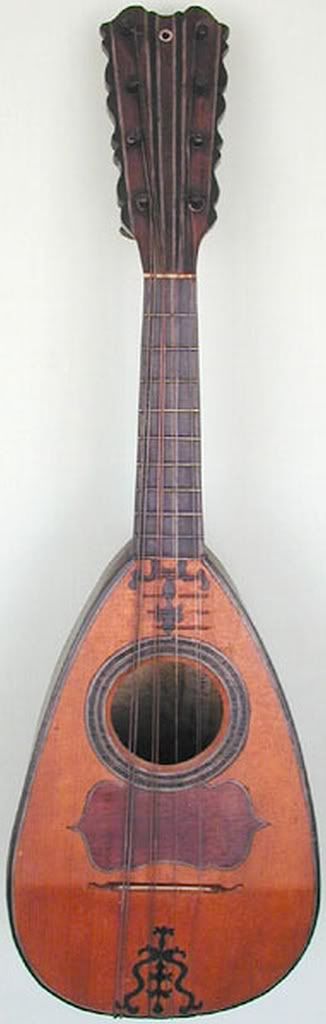
This detail shows a photo mounted on what seems to be headboard of a bed on the floor behind French. The photo seems to have been taken in the same office (the curtains are the same). It may show French trying to learn to play the mandolin.


French appears to have liked to make playing cards out of photos. A commenter on the Shorpy blog connects this with his (obvious) love of illustrations showing men and women ca. 1900-1914.


The pattern on this gauzy curtain is very handsome. What's the style? Is it Art Nouveau?


This a detail from French's desk chair. A commenter says it's Roycroft work. In general the commenters agree that it looks uncomfortable.


This says
"Man is made of dust,
Dust Settles
Are You a Man?"


This motto, over the entry door, says "Opportunity knocks daily
Usually in the morning
."


This says
You should be ve-ry careful, you know,
you might get interested
in your work, and
let your pipe go out.
-- James McNeill Whistler


A glance at the walls shows that French was fond of drawings by Charles Dana Gibson (and his ilk). These two cushions, each found on one of the window seats, show that he liked the subjects and style of this artist well enough to acquire more than just prints.


A commenter shows the original of this poster. It's an advertisement for hat bands.


The be-ribboned object looks like a walking stick or maybe a large crop or swagger stick.


It's clear French was fond of dogs. The white object is probably something he uses as a paperweight. It looks like a socket for an electric light bulb.


There are many interesting things on the desk. Commenters wonder what the flexible tubing is for: a nautical speaking tube, a hose, a humorous found object? There's tobacco, ink, and related stuff.


Comments suggest this is a naval weapon, a harpoon gun, or a navigational device for ships. I suggest the latter. It appears the operator looks through the left-side narrow end of the telescope-like tube.


Commenters say this is a walking stick made to look like a snake, or a rubber snake, or just a snake replica of some kind. One commenter includes a better detail than mine. It's a polished wooden snake.


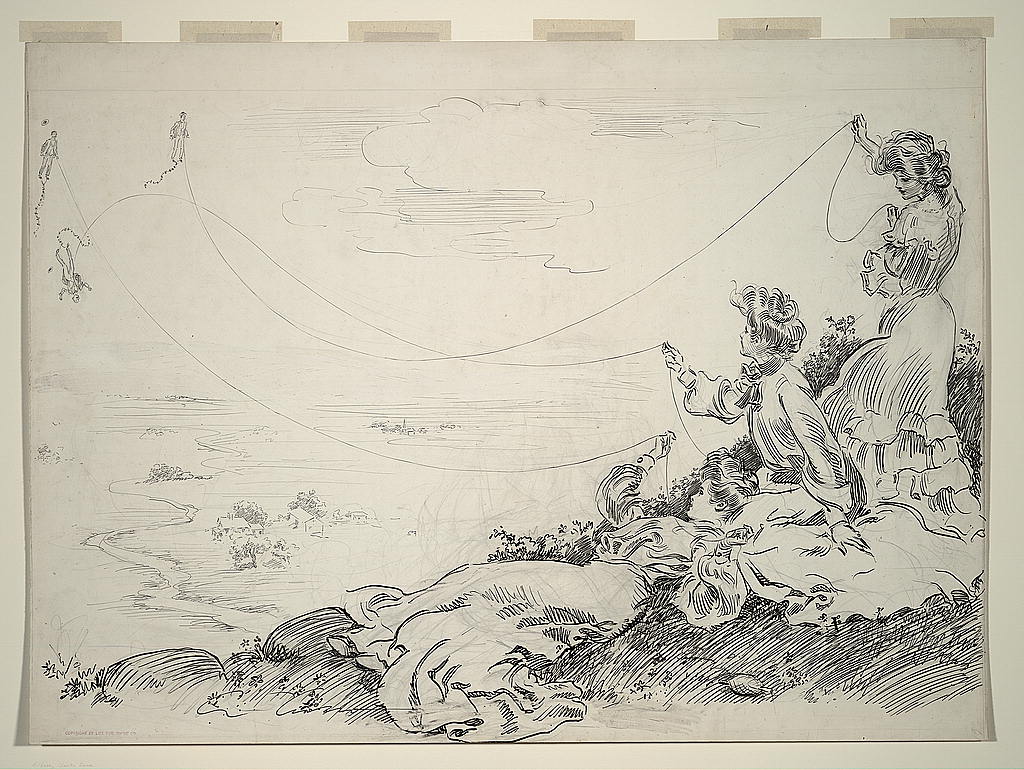
You can't miss the abundance of illustrations mounted all over French's office. They show a version of feminine beauty that was popular early in the 20th-century as well as the sense of humor of the times. It's all pretty solidly upper middle-class and all of the style associated with Charles Gibson. The period was supposed to be a golden age for the upper classes, La Belle Époque in fashion and high culture. LC has a collection of Gibson drawings that bears out this observation. Here is a representative sample from that collection:


Caption: "I want you to like me, Jose : I want to be able to like you : I shall have need of friends, she said half to herself." ca. 1911


No caption. Early 20th c.


Caption: "The weaker sex. II." Early 20th c.


No caption. Early 20th c.


No caption. Early 20th c.


Caption: Molly Bawn. 1910 or 1911. This is an illustration for Margaret Hamilton's novel Molly Bawn.


Caption: "Summer sports." ca. 1904


Caption: "A 'quick change' -- for the rest of the afternoon. ca. 1901


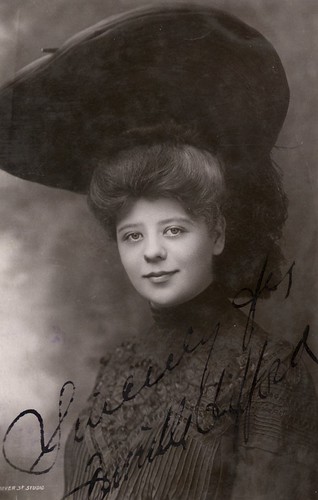
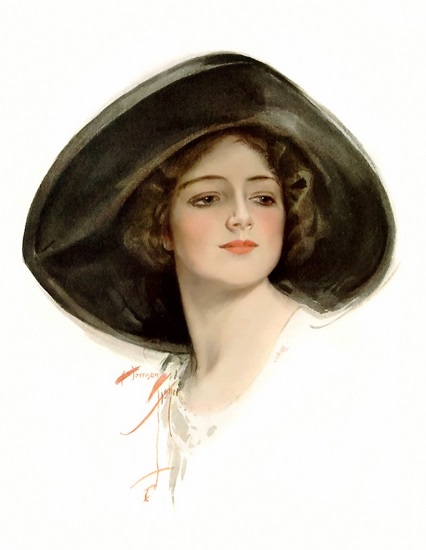
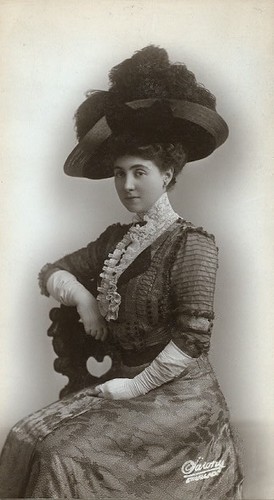
The following images, from other sources, show the prevalence of the Gibson style at the time. These first ones show the big-hat style that French seemed particularly to admire.


This photo shows the wasp waist that he also seems to have favored.


These drawings are typical of the humor he seemed to enjoy.


Caption: "Accident to a young man with a weak heart."


Gibson, "One Difficulty of the Game: Keeping Your Eye on the Ball," from the magazine Americans, 1900.

Grey Lady no more

Newspapers have been suffering a long, slow slide as ad revenues in print media decline and revenues in online media fail to compensate. The slide has accelerated in the current recession and most papers either fear for their survival or have plans to leave the scene. The big nationals -- Washington Post, Wall Street Journal, NY Times -- at first seemed primed to pick up the pieces. It's been thought that, as in past economic slumps, the businesses with greatest capitalization will be able to expand by purchase of failed competitors and will emerge stronger than ever when the economy's downturn reverses.

In the news business, most of us can think of dailies that were bought out by competitors during hard times. Ones that come to my mind include the a bunch of NY papers including the Press, PM, Daily Mirror, Evening Graphic, Brooklyn Eagle. The mastheads of surviving papers tended to grow and grow. The World, Telegram, and Sun survived the three papers in its name, and then it died. The Evening Journal and the American merged to the Journal American and then that paper died. The Herald and Tribune merged and then the Herald Tribune died.

This time around it's unlikely that the big papers can count on a survival of the fittest. There's no rosy future for the big national papers, even the very biggest and strongest, unless they find ways to -- as it's said -- successfully monetize the internet.

Of the biggies, I have been thinking the WSJ and FT have the best chance of achieving this success. They both have a relatively well-heeled readership, both have current pay-per-view internet policies that seem to work ok, and both have highly-respected knowledge bases that are not easily duplicated (meaning they can't easily be knocked out of their niche positions by bloggers or other competing online media).

I've respected the NYT for the strengths it's shown along similar lines. As newspaper-of-record you'd think it had much the same advantages as do WSJ and FT. But apparently this is not so. An attempt to charge readers for online views failed miserably.

And now we're getting reports of serious problems. Last month the paper said it needed to raise millions of dollars by mortgaging its headquarters building and more recently it began putting ads on the front page. As one paper reported:
The cash-strapped New York Times put up for sale on Monday its most treasured piece of property: the front page. After staff cuts, page reductions, and plans to re-mortgage the gleaming Manhattan headquarters, the daily has now opened its editorial holy of holies to advertising. The maiden ad, a color banner display for CBS television across the bottom of the page, might seem innocuous. But it reflects troubling economic times in the battered US newspaper industry. The daily described the invasion of advertising into the once sacrosanct page as "the latest concession to the worst revenue slide since the Depression."
It's sad. Particularly so since the Times web presence has gained a well-deserved popularity. The Times pages are among the most popular sites on the web with high ratings not just for number of views but also for the length of time spent viewing pages.

And it's sad because the Times has made some excellent innovations in its web presence, not just placing itself on social sites like Facebook, with a couple hundred thousand fans, but also producing good stuff of its own. Here are three that I like.

1. The Annotated New York Times which the paper calls "The New York Times... Remixed." There are descriptions here and here.


2. Blogrunner, which the Times says, "is a news aggregator that monitors articles and blog posts and tracks news stories as they develop across the Web." (See the FAQ: What is Blogrunner?.)


3. Week in Review
This, in paper form, goes back to my childhood; we used to receive free copies in the classroom back in the 1950s.


Online, it offers much more than the paper version does or ever did, with categories such as LaughLines, Ideas, and Cartoons as well as Most-Emailed and Most-Blogged stories, a Weekly News Quiz, This Week's Headlines, Editors' Choices (In Case You Missed It), and a graphic link to an online version of the paper copy:


This, from the current issue, is a nice example of its content:
The Buzzwords of 2008.

Here's the first entry:
Largely used online, this is a verb turned into a mass noun, as in “A bucket of fail.” Common forms include epic fail, meaning a huge overall tendency toward failure or a great example of failure, and FAIL! as an interjection or derogation. Often an antonym of win, seen online in forms like “Full of win!” which means, “It’s good!”
It's not an objection, to me, that some the stuff in these three pages -- Annotated Times, Blogrunner, and Week in Review -- is repurposed from other Times pages. Its packaging of them and the value added to them make the three standout nicely.

----------------

A couple of pages for further info on the main topic of this blog post:

State of the News Media 2008
Newspapers

Defunct New York City newspapers

Monday, January 12, 2009

Walter, Hannah

This is the post which I said I might write about the intersected lives of Hannah Arendt and Walter Benjamin. In 1933 they became friends in Paris having both fled Germany to escape Nazi persecution. I've been trying to imagine them at that time, in that place, circumstanced as they were. And I've been failing. She was 27, he 41. She was plucky and outgoing, he more cautious and fearful. There was no stability in their lives, no predictability, no scope for plans of any substantial duration. They lived moment-to-moment and mere survival was their main objective. Yet there were opportunities. They were served by what optimism they could each muster regarding their ability to survive. They came to understand that one of their most important duties to themselves was to nurture tight bonds with widely-separated friends, to help friends and to call upon friends for help. Their lives sound romantic, adventurous, full of possibilities for the remaking their world out of the debris created by its collapse. But having to flee to survive, having to exist in poverty, being stateless, homeless, and subject to an immensely powerful, viscious, and implacably evil enemy, all these things lack any element of gratification.

Hannah Arendt and Walter Benjamin became friends in that wartime Paris of 1933. They remained close until 1940 when, believing he was about to be captured by the Gestapo, he killed himself. The death brought Arendt closer to Benjamin's great friend Gershom Scholem. Subsequently, the two exchanged letters, mostly about him, until their falling out in 1963 over Arendt's treatment of the Eichmann trial in Jerusalem. I recently wrote something about an article Benjamin on aura in art and something about Arendt's conception of evil.

Arendt and Benjamin had much in common. Both were determined individualists and neither's lasting significance or accomplishments can be summarized in only a few words. Both understood the immense destructive potential of the modern nation state. Both believed that subject peoples (whether defined by enthnicity, religion, culture, or class) were fundamentally at risk unless they had means of defending themselves. Both believed that the Jewish people should not form a state of their own, but that they should work to set up federal structures in which groups could live together in harmony.*

And both rejected the self-confident materialism of their parents' milieu. They rebelled against the whole generation of German Jews represented by their parents, with their assertion of class-superiority among lesser Jews and their blindness to the deeply rooted antisemitism of the Christian culture in which they lived.

There are many lesser common threads in the lives of Hannah Arendt and Walter Benjamin. He was quite a bit older than she, but they were both secular, assimilated, German Jews, both born to families having substantial means, both urban, both highly educated. They were both members of the European intelligentsia and were both articulate, creative, and highly individualistic. Both suffered from the obscene antisemitism which the Nazi's brought out in the German people. Both were incarcerated for being Jews and managed to escape. Both confronted the Zionism of their times and both developed beliefs that were political and cultural rather than religious. Both confronted Marxism and, undogmatically, neither joined the Communist Party, but both had proletarian sympathies, were anti-capitalist, and both gave serious consideration to the possibility that Marxist theory might offer a solution to the impasses of European politics (though benjamin's thought aligned with Marxism much more closely than Arendt's).

Both endured periods of hand-to-mouth existence. Both were theorists. Both worked to help young people. Both hated clichés. Both had lovers and spouses. Both were great talkers who loved impassioned conversation.

As friends they supported one another. Arendt, for example, tried to help Benjamin in 1939 when he, despondent and eager to leave occupied Paris, needed contacts in safer places.

Their similarities are somewhat clarified by seeing how they differed from their common friend Scholem. He had been born in the same circumstances -- substantial, assimilated, secular, urban, German, and Jewish. But, unlike Arendt and Benjamin, his rebellion against crude materialism and fruitless attempts at a true assimilation led him to a deep commitment to the Jewish faith. Where they stayed secular, worldly, deeply skeptical about the irrationalities of religious belief, he became a mystic and, ultimately, a celebrated professor of Judaism at the university in Jerusalem.

There were also differences between the two. For example, he was morose, she outgoing. His work was as a student of culture, hers as a student of politics.

Their biographies are worth reading. I've listed some sources below.


{Benjamin in Paris, around 1938; from a web page about an opera that includes him as a character}


{Working in the in the bibliothèque national, 1939; source: isgreaterthan.net}
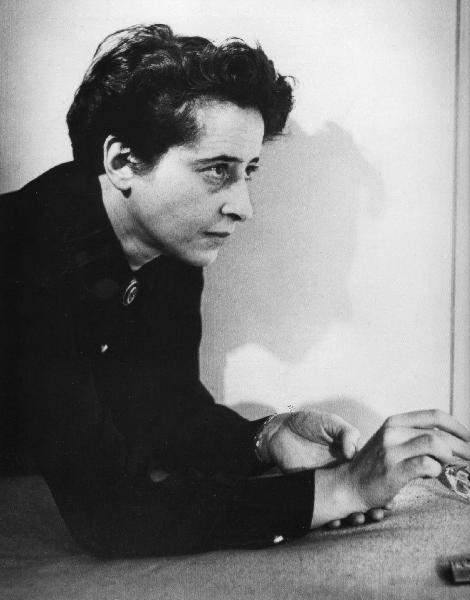


{Arendt in Paris in the mid-1930's, by Algosobre Vestibular}


{An affidavit used in lieu of passport. As stateless persons neither Arendt nor Benjamin could travel without some form of documentation and this (which was hers) is an example. Source: LC Manuscripts Division}


{Introduction to the third edition of Origins of Totalitarianism Typescript with author's alterations from the LC Manuscript Div}


some of my sources:

Walter Benjamin, By Gershom Gerhard Scholem, Gershom Scholem, Lee Siegel, Harry Zohn

Hannah Arendt at Jewish Virtual Library.

A Question of Justice, on Arendt, at the Malaspina modern lit site.

ZION’S REBEL DAUGHTER in New Left Review.

Hannah Arendt and Heinrich Blücher at Louis Proyect's blog.

Hannah Arendt (1906-1975) at Kirjasto.Sci.Fi a literary calendar site.

Encyclopedia of World Biography on Walter Benjamin.

Benjamin Chronology (pdf)

Walter Benjamin: The Story of a Friendship by Gershom Scholem.

Walter Benjamin: the Story of a Friendship, review by Mike Mosher of the book by Gershom Scholem.

Gerschom Scholem by Sharon Naveh.

Illuminations: Essays and Reflections, by Walter Benjamin.

The Correspondence of Walter Benjamin, 1910-1940, Translated , edited, and annotated by Manfred R. Jacobson and Evelyn M. Jacobson.

‘I merely belong to them’, Judith Butler's LRB review.

---------------------
Note
* The ideal of a federation of peoples was fairly widely held from the end of the 19th century through the early 1950's. It began with a statement of principles from the Social Democratic Party in Austria, became a more widely held position in the aftermath of World War I, and was resurrected by Arendt in criticising plans for the establishment of a Jewish nation-state in Palestine.

Judith Butler explains Arendt's thought on the subject in a review of The Jewish Writings in LRB, May 10, 2007:
In the late 1930s and early 1940s, Arendt thought that the Jews might become a nation among nations, part of a federated Europe; she imagined that all the European nations that were struggling against Fascism could ally with one another, and that the Jews might have their own army that would fight against Fascism alongside other European armies. She argued then for a nation without territory, a nation that makes sense only in a federated form, that would be, by definition, a constitutive part of a plurality. Later she would prefer the proposal of a federated Jewish-Arab state to the established notion that the state of Israel should be based on principles of Jewish sovereignty. ... If the nation-state relies on nationalism and invariably produces massive numbers of stateless people, it clearly needs to be opposed. ... The polity she comes to imagine, however briefly, is something other than the nation-state: a federation that diffuses both claims of national sovereignty and the ontology of individualism. In her critique of Fascism as well as in her scepticism towards Zionism, she clearly opposes those disparate forms of the nation-state that rely on nationalism and create massive statelessness and destitution. Paradoxically, and perhaps shrewdly, the terms in which Arendt criticised Fascism came to inform her criticisms of Zionism, though she did not and would not conflate the two.
- ‘I merely belong to them’
See also:

The Reluctant Modernism of Hannah Arendt, by Seyla Benhabib:
Arendt distinguishes the grand French idea of the "sovereignty of the people" from "the nationalist claims of autarchical existence." The sovereignty of the people refers to the democratic self-organization and political will of a group of people, who may or may not be members of the same nationality, to constitute themselves as a self-governing and self-regulating body politic. Through such acts of sovereignty, as a nation of citizens, as opposed to a nation of ethnic affiliation.
- The Reluctant Modernism of Hannah Arendt
Regarding the proposal by the Austrian Social Democrats, see the wikipedia article on Austromarxism:
Austromarxism was a Marxist theoretical current, led by Victor Adler, Otto Bauer, Karl Renner and Max Adler, members of the Social Democratic Workers' Party of Austria during the late decades of the Austro-Hungarian Monarchy and the First Austrian Republic (1918-1934). It is known for its theory of nationality and nationalism, and its attempt to conciliate it with socialism in the imperial context. Hence, Otto Bauer thought of the "personal principle" as a way of gathering the geographically divided members of the same nation. In Social Democracy and the Nationalities Question (1907), he wrote that "The personal principle wants to organize nations not in territorial bodies but in simple association of persons.", thus radically disjoining the nation from the territory and making of the nation a non-territorial association.
- Austromarxism
And a 1935 article by the Spanish Communist revolutionary, Andrés Nin:
The nation is a “personal association”. The complexity of present day economic relationships and the ease of communications encourage constant migration within multi-national States, with the result that those who leave their native land are considered foreigners and receive worse legal treatment. “No nation can be confined to pre-determined limits.” Therefore the principle of nationalities is fundamentally anti-national.

According to Renner, a solution will be found through a “personal”, not a territorial principle. “Nations should organise, not according to territorial units but as associations of persons, not as States but as peoples ...” “Naturally, as a people cannot exist without territory, the local population must be able to influence the administration. If that is organised on the basis of the personal principle, a territorial organisation will be a useful coordinator which will allow nationalities to be identified and help isolated people to join the relevant group.” The Nation State is adequate in situations where there are few internal national conflicts, but if applied in Austria it would cause problems and ultimately break up the State. Everything will be for the best, as in the best possible world, if the territorial principle is replaced by the panacea of a complicated system of “judicial” and “cultural” institutions.

People of the same nationality, living in a given area within the State, outside their own territory, will form a “national Community”, that is a “Corporation with its own public and private law, with capital and the power to make laws and raise taxes”. A given number of communities, linked territorially and culturally will form a district with similar corporate rights. “Those districts combined constitute the nation, that is a legal person in public and private law.”
- Austro-Marxism and the National Question, Andrés Nin, 1935

Saturday, January 10, 2009

auratic?

Gloria Origgi recently wrapped up the old year with a series of bests: GLORIA'S RANKING 2008. She lists food she's enjoyed, cultural events that pleased her, and favorite internet experiences. Among philosophic papers and meetings, she singles out a best academic talk: "Steven Shapin on science as a vocation given at the Jean Nicod Institute in Paris on June 2nd. Perfect voice, timing, rhetoric, facial mimicry, a piece of performance art, sadly neglected by a distracted audience." She also tells us the best day and the best place, the best friend and the best culninary invention. Her best "discovered etymology" is for the word desire, "which comes from desiderium in Latin, which, itself, is made by the prefix de and sidera, star. Desiderium is thus a deprivation of stars, a feeling of absence of light, a craving for aura."

What caught my attention was her use of the word auratic in the entry for best friend: "Best friend of the year: Catherine Legallais, a discrete and auratic Paris-based poet and critic, with an outstanding capacity of listening and understanding. I think she's the only person who really understood my way of looking at my childhood in my Italian book, La Figlia della Gallina Nera."

I hadn't encountered the word before. I didn't know its meaning but I liked the associations and overtones it suggested: golden and radiant, glowing, having a halo. I couldn't find the word in a dictionary, but cognates suggest that it can be used to mean authentic and unique, having the quality of visual light and of lightness, airy, or having properties of sound as well as of light.

Uses I found are mostly academic and mostly in connection with the fine arts. I thought it safe to conclude that it's a bit of arty jargon and wondered about its origin. A bit of searching turned up this paper: Walter Benjamin's Concept of Art as Auratic: the Nexus between Modern Art and Technology. It turns out Benjamin did not coin the word himself but rather his use of the word aura in a manifesto he published (in German) in 1935 led to the coining of the adjective. The manifesto is The Work of Art in the Age of Mechanical Reproduction. A thoroughgoing Marxist, Benjamin argued that in a communist society that which is unique (a work of art or the experience of a dramatic work) must be abolished to make way for a new, mass-oriented, aesthetic of lens-based replication (mainly photographs and movies). For him the word aura conveyed uniqueness, authenticity, and a primitive power to evoke feelings of awe or of reverence. He associated it with magic, deception, feudal values, and bourgeois sensibilities. He said that photographs and movies free art from its specific place and time. Mass production of copies permits simultaneous collective experience. "Mechanical reproduction of art changes the reaction of the masses toward art. The reactionary attitude toward a Picasso painting changes into the progressive reaction toward a Chaplin movie... For the first time in world history, mechanical reproduction emancipates the work of art from its parasitical dependence on ritual."

From what I've read, it seems that in transmuting Benjamin's noun aura to the newly-coined adjective auratic, art historians adopted the concept but inverted the attitude from negative (a condemnation of elitist values) to positive (an appreciation of certain aesthetic values). Do a web search for "auratic art" and see if you agree.


{Walter Benjamin from the tirado.files blog}


{A photo by Capa on assirio.com}


{Another photo from the same source}


Wikipedia's article on Walter Benjamin is pretty good. His life intersected with Hannah Arendt's. I may write about that separately.

Friday, January 09, 2009

a home of mine that my neighbor respects

Denis Dutton's Arts and Letters Daily always contains something that interests. The other day he pointed to Adam Kirsch's New Yorker profile of Hannah Arendt and drew attention not, as I did, to the personal flaws which Kirsch says kept Arendt from any effective "confrontation with political evil, especially the evil of the Holocaust," but rather to Kirsch's comment that Arendt is "still a thinker for our time, ... a time when failed states have again and again become the settings for mass murder."

I like the way this statement draws attention to an oddity in Kirsch's argument.

Kirsch says Arendt kept an aristocratic disdain which made her unable to sympathize with, he says to love, people in any collective sense. He says this aloofness led her to believe that, in his words, "our love for the world actually makes it harder for us to love the people who inhabit it." This rings true as a trait of Arendt's, but the statement seems to me less than profound since it's true as well of other political theorists and public intellectuals both of her own generation and of ones that came before. Kirsch says Arendt's "rejection of inwardness" is key to appreciating the value of her work but he also says that it makes her legacy "questionable." Myself, I believe conscious separation of the personal from the public in her life and work shows a strength that she shares with her peers in the philosophic community. She and they recognize that while objectivity is unattainable, a person should try to create conditions which favor its possibility and to suppress conditions which are likely to prevent it.

Were she alive, Arendt, I believe, would have responded to Kirsch by saying that authentic love of people in any collective sense is nonsensical. During the avalanche of criticism that followed the publication of Eichmann in Jerusalem, Arendt was tasked with failing to show a "love of the Jewish people." In reply she said the word love is not appropriate for an abstract collective entity such as "Jewish people." Even if its close relation "belief" were substituted for the original "love," she said there would be little practical significance in the phrase. Religious belief made sense to her, although she believed it did not belong in politics. A non-religious fervor for a people did not.*

As Dutton shows, Kirsch praises Arendt for her recognition that the rhetoric of human rights does not help groups of people when they are attacked. When assaulted by others a people must fight back and if they have too little power they will be beaten. Kirsch mentions Yugoslavia and Rwanda, and Darfur in this connection, but does not point out that the struggle between Palestine and Israel is of the same character. Many Israelis were stateless before the formation of that nation and many Palestinians became stateless during the wars that followed that formation. Though their tactics differ dramatically, both sides have struggled to attain enough power to resist the other. The title of Kirsch's essay is Beware of Pity as if to say that the neutrality Arendt strove to achieve kept her from feeling sympathy with the Jews. I wonder, in the current conflict in Gaza what would pity avail; what does it avail? It is true of Gaza as it is true of Yugoslavia, Rwanda, and Darfur, the problem is a political one "and it can be solved only politically."

Arendt had no illusions about the nature of this political problem or the difficulty of solving it. During the 1948 war for Israeli independence Arendt wrote that local inhabitants should not be driven out of what was then Palestine. She believed that Israel should not establish itself as a fortress Jewish state surrounded by hostile Arab ones. At the time she wrote: "A home that my neighbor does not recognize and respect is not a home." Instead of the state that was wished for by "world Jewry, Zionist and non-Zionist," Israel would be an armed and introverted society, in which "political thought would center around military strategy," degenerating into "one of those small warrior tribes about whose possibilities and importance history has amply informed us since the days of Sparta," leaving the Arabs "homeless exiles," and the Arab problem as "the only real moral and political issue of Israeli politics."
{The quotes are from ‘Peace or Armistice in the Near East?’, in Jewish Writings, pp. 444, 448, which I found in Zion’s Rebel Daughter, by Gabriel Piterberg.}

----------------
* In an article in the London Review of Books (‘I merely belong to them’, May 10, 2007), Judith Butler describes this exchange between Arendt and Gershom Scholem in 1963. She writes:
Scholem went on to impugn Arendt’s personal motives: ‘In the Jewish tradition there is a concept, hard to define and yet concrete enough, which we know as Ahabath Israel: “Love of the Jewish people”. In you, dear Hannah, as in so many intellectuals who came from the German left, I find little trace of this.’ Arendt, after disputing that she was from the German left (and, indeed, she was no Marxist), replies:
You are quite right – I am not moved by any ‘love’ of this sort, and for two reasons: I have never in my life ‘loved’ any people or collective – neither the German people, nor the French, nor the American, nor the working class or anything of that sort. I indeed love ‘only’ my friends and the only kind of love I know of and believe in is the love of persons. Secondly, this ‘love of the Jews’ would appear to me, since I am myself Jewish, as something rather suspect. I cannot love myself or anything which I know is part and parcel of my own person. To clarify this, let me tell you of a conversation I had in Israel with a prominent political personality who was defending the – in my opinion disastrous – non-separation of religion and state in Israel. What [she] said – I am not sure of the exact words any more – ran something like this: ‘You will understand that, as a socialist, I, of course, do not believe in God; I believe in the Jewish people.’ I found this a shocking statement and, being too shocked, I did not reply at the time. But I could have answered: the greatness of this people was once that it believed in God, and believed in Him in such a way that its trust and love towards Him was greater than its fear. And now this people believes only in itself? What good can come out of that? Well, in this sense I do not ‘love’ the Jews, nor do I ‘believe’ in them; I merely belong to them as a matter of course, beyond dispute or argument.
Butler's article is a review of Jewish Writings.

Addendum:

I've tweaked this post repeatedly in an effort to get it to say what I mean. I'm done now. I wish I had the self-discipline to revise my posts in draft until I'm fully satisfied with them.

Wednesday, January 07, 2009

So sinks the day-star in the Ocean bed

I'm reading my way through Anthony Trollope's Palliser Novels and am near half way through the third of them, Phineas Redux.

I enjoy Trollope in general and this series particularly. He has great command of the language, his descriptive details are vivid, the chief characters are well drawn, and the plots, if not riveting, are, at worst, diverting.

Still, ...

There is much to offend modern sensibilities. Trollope and his characters love fox hunting and take pleasure in the death of the fox. He and they rarely question class distinctions and believe that personal merit is as likely to be bred as acquired. While the traits of people in upper classes are satirized, people in the lower ones are shown to be less amenable to refined humor; their comic presence can be demeaning, as it is with Shakespeare's clowns. Trollope appreciates alike the delusions and clear purposes of his main characters and he lovingly makes fun of them, but he caricatures the lesser ones and allows them to be subjected to the meanness of the time's upper-class prejudices.

Politics and alliances are his main subject. Of alliances, the chief ones are between men and women. He gives striking portraits of intense friendship and makes much of the misunderstandings that can arise when men and women form them with each other. Similarly, he shows the culture's complex attitudes towards courtship and marriage. Marriage for love and love alone is exceptional. Most courting is premeditated with both sides calculating their relative advantage by possession of money, physical attractiveness, social rank, and character traits. Calculating their advantage and then weighing the chances of happiness with the prospective mate.

Trollope is famous for showing women who possess courage, tenacity, and flair. They may make poor choices but, whether they do or not, they remain true to themselves, their families, their friends, and the cultural values that guide them.

He is also famous for depicting the struggles among his male characters to achieve and sustain position, honor, and public recognition. Here, for example, is part of a section on an unfolding battle between the heads of the Liberal and Conservative parties in the House of Commons:
A man destined to sit conspicuously on our Treasury Bench, or on the seat opposite to it, should ask the gods for a thick skin as a first gift. The need of this in our national assembly is greater than elsewhere, because the differences between the men opposed to each other are smaller. When two foes meet together in the same Chamber, one of whom advocates the personal government of an individual ruler, and the other that form of State, which has come to be called a Red Republic, they deal, no doubt, weighty blows of oratory at each other, but blows which never hurt at the moment. They may cut each other’s throats if they can find an opportunity; but they do not bite each other like dogs over a bone. But when opponents are almost in accord, as is always the case with our parliamentary gladiators, they are ever striving to give maddening little wounds through the joints of the harness. What is there with us to create the divergence necessary for debate but the pride of personal skill in the encounter? Who desires among us to put down the Queen, or to repudiate the National Debt, or to destroy religious worship, or even to disturb the ranks of society? When some small measure of reform has thoroughly recommended itself to the country — so thoroughly that all men know that the country will have it — then the question arises whether its details shall be arranged by the political party which calls itself Liberal — or by that which is termed Conservative. The men are so near to each other in all their convictions and theories of life that nothing is left to them but personal competition for the doing of the thing that is to be done. It is the same in religion. The apostle of Christianity and the infidel can meet without a chance of a quarrel; but it is never safe to bring together two men who differ about a saint or a surplice.
Trollope also makes good use of literary allusion. In Phineas Redux, for example, he draws from Milton's short poem, Lycidas. Milton compares Lycidas to the sun which must set, but which also rises again in glory. He says at the end of night the sun "tricks his beams" and "flames in the forehead of the morning sky:"
Weep no more, woful Shepherds weep no more,
For Lycidas your sorrow is not dead,
Sunk though he be beneath the watry floar,
So sinks the day-star in the Ocean bed,
And yet anon repairs his drooping head,
And tricks his beams, and with new-spangled Ore,
Flames in the forehead of the morning sky:
So Lycidas sunk low, but mounted high,
Through the dear might of him that walk'd the waves;
Milton: Lycidas cont.

Where other groves, and other streams along,
With Nectar pure his oozy Lock's he laves,
And hears the unexpressive nuptiall Song,
In the blest Kingdoms meek of joy and love.
Trollope uses the expression twice in Phineas Redux, both times in association with Phineas himself and with Lady Laura, a woman whose tragedy it is to have married another despite her love for him.

On page 58 of the Oxford edition, Lady Laura writes to Phineas, using the phrase to describe the turnaround of her beloved brother Oswald:
To me it is all one tragedy. I cannot but think of things as they were two or three years since. My father and my husband were both in the Cabinet, and you, young as you were, stood but one step below it. Oswald was out in the cold. He was very poor. Papa thought all evil of him. Violet had refused him over and over again. He quarrelled with you, and all the world seemed against him. Then of a sudden you vanished, and we vanished. An ineffable misery fell upon me and upon my wretched husband. All our good things went from us at a blow. I and my poor father became as it were outcasts. But Oswald suddenly retricked his beams, and is flaming in the forehead of the morning sky. He, I believe, has no more than he had deserved. He won his wife honestly;--did he not? And he has ever been honest. It is my pride to think I never gave him up. But the bitter part of my cup consists in this,--that as he has won what he has deserved, so have we. I complain of no injustice. Our castle was built upon the sand. Why should Mr. Kennedy have been a Cabinet Minister;--and why should I have been his wife? There is no one else of whom I can ask that question as I can of you, and no one else who can answer it as you can do.
And on p. 175 of the same Trollope uses the phrase in referring back to an earlier time in which Phineas recovered from her rejection of his marriage proposal:
She, with the imperturbable serenity of a matured kind-hearted woman, had patted him on the back, as it were, as she told him of her existing engagement with Mr. Kennedy. Could it be that at that moment she could have loved him as she now said she did, and that she should have been so cold, so calm, and so kind; while, at that very moment, this coldness, calmness, and kindness was but a thin crust over so strong a passion? How different had been his own love! He had been neither calm nor kind. He had felt himself for a day or two to be so terribly knocked about that the world was nothing to him. For a month or two he had regarded himself as a man peculiarly circumstanced,--marked for misfortune and for a solitary life. Then he had retricked his beams, and before twelve months were passed had almost forgotten his love. He knew now, or thought that he knew,--that the continued indulgence of a hopeless passion was a folly opposed to the very instincts of man and woman,--a weakness showing want of fibre and of muscle in the character. But here was a woman who could calmly conceal her passion in its early days and marry a man whom she did not love in spite of it, who could make her heart, her feelings, and all her feminine delicacy subordinate to material considerations, and nevertheless could not rid herself of her passion in the course of years, although she felt its existence to be an intolerable burden on her conscience. On which side lay strength of character and on which side weakness? Was he strong or was she?

Notes:

Trollope liked the phrase well enough to use it in other novels, including The Small House at Allington and The Claverings.

Milton used a variant of the expression in Il Penseroso line 123
Till civil-suited Morn appeer,
Not trickt and frounc't as she was wont,
With Attick Boy to hunt,
But Cherchef't in a comly Cloud.
Of Milton's use of the word tricks and other nearby words in Lycidas, Homer Baxter Sprague explains:
Tricks (Welsh treciaw, to furnish ; or, better, from Dutch trek, a draught; pull; deceit; feature; whence, perhaps, though Wedgwood doubts it, comes Fr. tricher, to cheat; Ita1. treccare), dresses, sets off. "Tricked," says Dyce, "is properly an heraldic term = blazoned."
Spangled (Gaelic spang, a shining metal plate). Milton often uses this word; but, like tinsel, it 'has lost somewhat of dignity.' See Trench (Study of Words, and English Past and Present).
Ore. In Shakespeare (as in Hamlet, IV. i. 24, 25, 'like some ore among a mineral of metals base') we have 'ore' meaning gold, or golden splendor. 'Ore' would seem to be more appropriate to the sun than to a star.
Forehead. In the Puritan Sylvester's translation of the Divine Weeks and Works of the Protestant Du Bartas, a favorite book of Milton's, we find the line,
— Oft seen in forehead of the frowning skies.
That walked the waves. Matt. xiv. 25, 26 ; Mark vi. 48, 49. The student will not fail to observe the beautiful appropriateness of this allusion to Christ's power over the waters.
Other groves and streams than those which he used to frequent on earth.
Along = beside, 'without the usual idea of motion.' Jerram.
Nectar, the drink of the gods. " It was also used by way of ablution to preserve immortality."
Laves. So the 'aged Nereus' 'reared the lank head' of the drowned Sabrina,
And gave her to his daughters to imbathe
In nectared lavers.
- Comus, 836, 837.
Oozy (A.-S. wos, juice; wosig, juicy; Provincial Eng. ouse, the liquor in a tanner's vat).
Unexpressive, inexpressible, ineffably sweet. So Shakespeare has 'the fair, the chaste, and unexpressive she.' As You Like It, III. ii. 10.
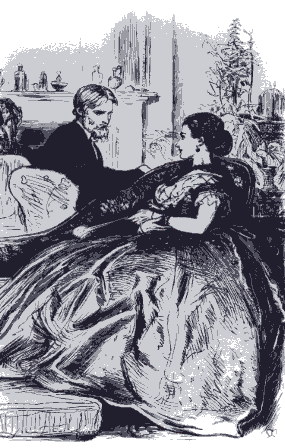
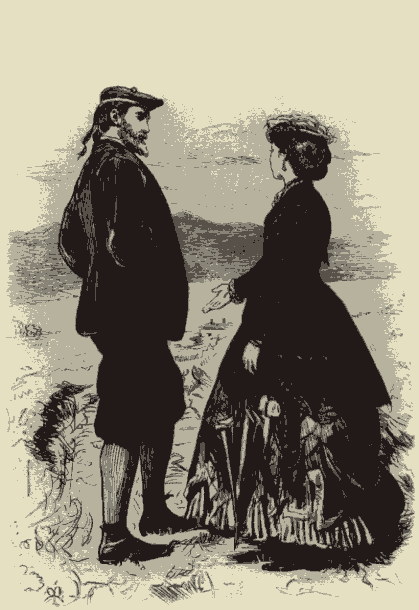
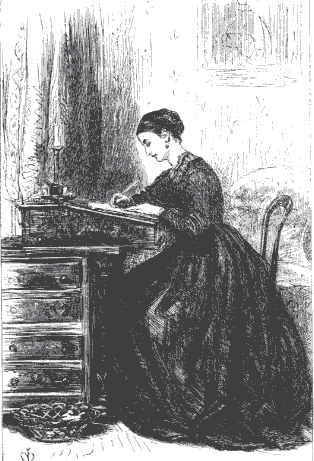
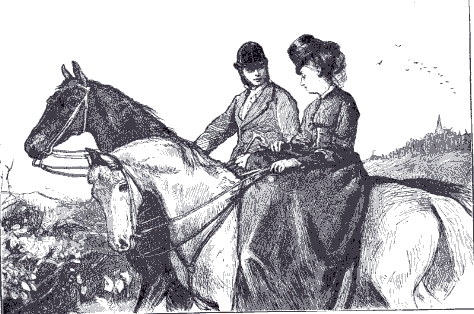
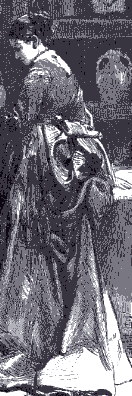
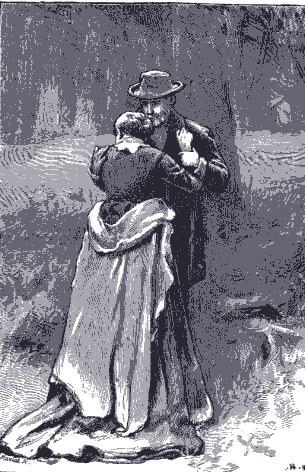
A set of pages called jimandellen.org reproduces illustrations from Trollope novels, including Phineas Finn and Phineas Redux, from which these come.


Phineas and Laura


Same


Mary, wife of Phineas, who dies before Phineas Redux begins.


At a fox hunt, one character makes a marriage proposal to another.


Lady Laura


Phineas and Laura


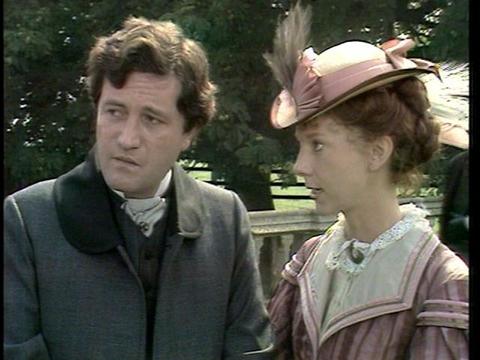
Phineas and Laura, from the 1974 BBC production of the Palliser novels

Tuesday, January 06, 2009

shining light on darkness

Update: I've found a short piece that chronicles the impact of Arendt's book on Eichmann: The Eichmann Polemics: Hannah Arendt and Her Critics, by Michael Ezra (London, 2007).


A while back I wrote about the Milgram experiments and what I called the problem of evil. At the time I recalled, but did not mention, Hannah Arendt's notorious construction, "fearsome, word-and-thought-defying banality of evil." A quarter century ago Arendt was attacked for her use of the phrase with its suggestion that the perpetrators of the Holocaust were normal in the same sense that their victims were normal. She was held to be trivializing a world-changing event and demeaning the millions who perished in it. Though she wrote that Adolpf Eichmann deserved to die on the gallows, many believed that she had excused him of guilt and, in fact, indulged in the hideous act of blaming European Jews themselves for their extermination.

It took a decade or more before more balanced appraisals could appear. In an NYRB exchange of letters printed in 1980, A.P. Martinich said Elie Kedourie had unfairly attacked Arendt by calling her perverse and saying she trivialized Eichmann's crimes. In his response, Kedourie says that wasn't the intent but that he could not accept Arendt's conclusion that evil could be banal: "What the qualification banal seems to me in the end to do is, precisely, to banalize evil, to make it not something in which choice is central, but rather the outcome of the inability to avoid clichés and the like. This I find unsustainable and objectionable."

Since then it has become less objectionable to assert that ordinary-seeming people can do monstrous things. As James Waller wrote in a book called Becoming Evil (OUP, 2002), Eichmann "did his job simply, and thoughtlessly, because he was a person 'duty bound' to a social hierarchy committed to such extraordinary evil."

And more recently two authors of a paper given in the Argyle Lecture series of 2007 say that ordinary people are drawn to join groups that develop their predisposition to cruelty and then collectively "normalize oppression." They say
This view that ordinary people can do monstrous things derives strength neither from psychology alone nor from history alone, but from the convergence between the two. And that convergence extends beyond identification of the phenomenon, to the way in which it is explained. ...

When Milgram sought to make sense of what had happened in his own obedience studies, ... he translated Arendt’s ideas into the concept of an 'agentic state' in which people suspend their capacity to make informed moral judgments and relinquish responsibility for what they do to those in authority. Regardless of what it is that they are being asked to do, once in an agentic state, the person’s sole concern becomes how well they do the bidding of these authorities. These ideas were later taken even further by Zimbardo. He argued that the sense of obligation and duty to which Milgram referred was not dependent on the presence of strong authority figures. Instead, he suggested that people can be led to perpetrate atrocities not because they blindly follow orders, but because they conform blindly to what is expected of them as a group member.
{see Questioning the banality of evil, S. Alexander Haslam and Stephen D. Reicher re-examine the established view, in an article based on the 2007 Argyle Lecture and Stanford prison experiment.}
This makes sense to me. Boys and girls are taught that life is precious and murder heinous and yet those who become soldiers are then taught to kill. In this teaching inflicting death is taught as duty; it is taught by imposing the disciplines of strict hierarchy; and it is assured by establishing a culture in which group loyalties surpass personal needs and desires. The experiments of Milgram and Zimbardo show how easily this is done.

Strangely, Adam Kirsch ignores these developments in a New Yorker piece devoted to what he sees as Arendt's regretable predispositon to view evil as banal: Beware of Pity, Hannah Arendt and the power of the impersonal, January 12, 2009. Though he does not say so outright, the piece conveys to the reader that Arendt did, indeed, excuse the executioner and unpityingly convict the blameless victim. Read it if you have the time. While unfair to Arendt and her work it is well written and gives many useful insights into her psychological makeup and the key moments in the development of her intellectual and personal lives.

Some extracts:
Arendt’s legend—or, perhaps it is better to say, her image—has become as important to posterity as her theories. In part, of course, this is because Arendt is one of the few women in the traditionally male pantheon of political philosophy. It makes sense that it is feminist readers who find the most food for thought in Arendt’s image—even though Arendt denied that she was a feminist. Julia Kristeva devotes some pages of her recent book on Arendt to her changing appearance, as documented in photographs: from the girlish “seductress” of the nineteen-twenties, gazing poetically at the camera, to the confident intellectual of the fifties, whose “femininity . . . beats a retreat” as her face becomes “a caricature of the . . . battle scars” received during her public career.

Kristeva’s reverie on Arendt’s “psychic bisexuality” is not the kind of attention that gets paid to Kant or Heidegger. Yet it is a sign of the way that Arendt has emerged as something both more and less than a political theorist. The most rewarding way to read Arendt, and the best way to make sense of both the strengths and the limitations of her work, is to approach her as Michelle-Irène Brudny does in “Hannah Arendt: An Essay in Intellectual Biography”: “I definitely take Hannah Arendt to be less a political philosopher or a political theorist . . . than an author in the strong sense of the word.” Kristeva, still more emphatically, considers Arendt’s writings “to be less a body of work than an action.” Like so many Jewish writers of her generation, Arendt attempted in her work to shine the light of intellect on the extreme darkness she lived through. That she chose to do this in the most impersonal of genres—philosophy and history—rather than through memoir, or even poetry (which she loved to read, and wrote from time to time), is itself a clue to the immense psychological pressures that shaped her work and, in the end, partly disfigured it.


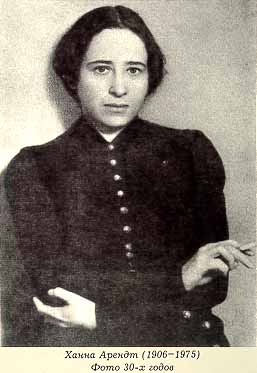
{source: Judith Butler, Asociación de Estudiantes de Filosofía UCR}


{source: http://photo.sina.com.cn/photo/4af198f522564acf6b521}


{source: Aronnax}


{caption: Arendt in a Paris café, in 1935. Source: Three White Leopards}


{source: flickr}


{source: flickr}

Monday, January 05, 2009

book meme

"It is a pity we know so little about the way in which bimetalism and trimetalism operated in the Ancient Period." ~ The History of Foreign Exchange, Paul Einzig (McMillan, London, 1962)

1. Grab the nearest book.
2. Open it to page 56.
3. Find the fifth sentence.
4. Post the text of the sentence in your journal along with these instructions.
5. Don't dig for your favorite book, the cool book, or the intellectual one: pick the CLOSEST.

My source: book meme by ~eokyere.

Some contributions on Soup.io:

"Er stellte sich in Positur, die Arme über der Brust gefaltet."
aus: "Der aufhaltsame Aufstieg des Arturo Ui" von Bertolt Brecht.

"Il s'appelait Cacombo, et aimait fort son maître, parce que son maître était un fort bon homme."
Voltaire: Candide ou l'Optimisme

"Dieser Abschnitt behandelt die SQL-Befehle FLUSH, KILL und SHOW und deren Ausgaben." – MySQL GE-PACKT von Stefan Hinz

"Ob marginale Magie, gewöhnlicher Verstand oder hohe Philosophie, stets gelangen wir zu demselben Ergebnis: daß pan den Panoptes überwindet."
Michel Serres - Die fünf Sinne

"Der Diener ging nach Hause und überlegte die ganze Nacht."
Osho - Das Feuer der Meditation

"wahrscheinlich ist mir nichts eingefallen, was erklären würde, warum ich am ende des traums irgendwo runtergefallen bin."
"deutsches theater" - benjamin v. stuckrad-barre

"Like the Investigators I had never had any trouble passing as a native, if I wanted to; among all the Karhidish dialects my accent went unnoticed and my sexual anomalies were hidden by the heavy clothing."
~ The Left Hand of Darkness, Ursula K. LeGuin

shoeshine redux

Catherine, commenting on my shoeshine blog post (downtown DC in the early 20's) says that a detail from the photo contains boaters not rags and she's right.

LC's P&P Division has a second photo of the Grand Palace.


It reveals the dark interior a bit more clearly and definitely shows boaters and their bands as Catherine says.


This version was taken at a time of day when only the manager was present. The clock seems to show that it's 20 to 4 in the afternoon, but it seems to show the same time in the other photo (that's hard to say). Maybe it's 20 past 8 in the morning in this shot, maybe there's an unusually big second hand, or maybe the clock's not working.


In this shot it looks like the hat store next door hasn't yet set up it's display for the day. Its window shows a jumble of homburgs with a cloth cap where in the other photo it has neatly arrayed boaters and caps.


On this day you can see that the cigar store features fashion and theater magazines along with the racing sheets and a baseball paper. Given the masculine ambiance of the three establishments, I suppose it was expected that men would pick up these magazines for wives and sweethearts.


I can't read the titles of the pamphlets that the cigar store has out:


I like this advert in the hat store for its implicit assumptions about male attractiveness.

Sunday, January 04, 2009

system gaming

Gaming The System

This year's Edge question is "What Will Change Everything? What game-changing scientific ideas and developments do you expect to live to see?" As usual, most of the respondents are long-windedly optimistic about the benefits of technology -- though frequently giving if-onlies to hedge their bets.

A favorite composer is therefore refreshingly contrary. Brian Eno tersely says: "Human development thus far has been fueled and guided by the feeling that things could be, and are probably going to be, better. But suppose the feeling changes ... Humans fragment into tighter, more selfish bands ... Long term projects are abandoned–their payoffs are too remote. Global projects are abandoned–not enough trust to make them work. Resources that are already scarce will be rapidly exhausted as everybody tries to grab the last precious bits ... Survivalism rules. Might will be right."

Eno is one of a tiny few fundamentally skeptical respondents. Most are not only (wholly or guardedly) optimistic, but also celebrants of the internet and its potentialities. Kevin Slavin, for example, tells us that our collective memory is being transposed from our individual brains to the complex ethereal archive of the Web: "We are moving towards a culture that has outsourced this essential quality of existence to machines, to a vast and distributed prosthesis." He dwells on the upside of this phenomenon. He says:
In just a few years, we’ll see the first generation of adults whose every breath has been drawn on the grid. A generation for whom every key moment (e.g., birth) has been documented and distributed globally. Not just the key moments, of course, but also the most banal: eating pasta, missing the train, and having a bad day at the office. Ski trips and puppies.

These trips and puppies are not simply happening, they are becoming data, building up the global database of distributed memories. They are networked digital photos – 3 billion on Flickr, 10 billion on Facebook. They were blog posts, and now they are tweets, too (a billion in 18 months). They are Facebook posts, Dopplr journals, Last.FM updates.

Further, more and more of these traces we produce will be passive or semi-passive. Consider Loopt, which allows us to track ourselves, our friends through GPS. Consider voicemail transcription bots that transcribe the voice messages we leave into searchable text in email boxes on into eternity. The next song you listen to will likely be stored in a database record somewhere. Next time you take a phonecam photo, it may well have the event’s latitude and longitude baked into the photo’s metadata.

The sharp upswing in all of this record-keeping – both active and passive – are redefining one of the core elements of what it means to be human, namely to remember. We are moving towards a culture that has outsourced this essential quality of existence to machines, to a vast and distributed prosthesis.
So does Gloria Origgi who says that "teh internets" are generating a collective wisdom via accumulation of reputation votes made on social sites. She looks forward to the use of social filtering to assemble a new age of knowledge based on the judgments of millions of others. There's sense in this. I frequently turn to Amazon for reviews of products in which I'm interested and give some respect to the star-system that Amazon provides for ranking consumers' experiences with the products. I do the same on the Sierra Trading Post site and other internet retailers with whom I have accounts. Like millions of others, I'm sure, I also check the reputation of eBay sellers before I bid on items they're auctioning. There are many other sites where user-contributed reputation markers can be useful. Their value seems most often to lie in giving information that adds to what you can learn from the promotional blurbs and photos (as for example whether the hat sizes true or is maybe half a size larger than marked). But it sometimes just warns you off, revealing the flaws of products, rather than their neutral characteristics or their strengths. For example, while looking for a new dehumidifier for our basement I was surprised to see negative reviews of all the Sears products on the Sears site itself. I've also used this negative weeding out on TripAdvisor and even Staples. Why would a web retailer give its users negative reviews of products it sells? I suppose it's sensible to conclude that the benefits outweigh the drawbacks; that and it may be that they understand that their reputation as a retailer would suffer if they were revealed to be censoring reviewer comments.

Still, the temptation to game the system is strong. I recall the way Google eclipsed AltaVista when the latter failed to develop an algorithm to defeat tricks that webmasters used to get their pages on top. Google itself has constantly to tweak its page rank system to keep it working properly. Likewise eBay struggles to prevent sellers from using elicit means to enhance reputation. Craigs List and many other sites have similar problems.

But beyond this system gaming, there's another problem with Origgi's prediction. It's that reputation is self-reinforcing. You can see this in Google search results that are obviously popular but not otherwise valuable. A recent study from MIT finds that this "steep tail" effect exists (See Long Tail or Steep Tail?) so does this Harvard study.

This supports my guess that internet retailers have learned that it's good business not to manipulate their customer review systems. They need fully-informed potential customers or they won't be able to sell the niche products along with the hyper-popular ones. And retailers like Amazon survive not on sales of best-sellers but on their success in moving the backlist.

Addendum:

Gloria Origgi has an interesting bunch of sites:

- her own home page
- a blog called Miscellanea
- a jointly-authored recipe blog called Tuttipiatti
- a blog-memoire called Autobiografia di mio figlio
- a blog which is a "melancholic dictionary of the expressions that were used in my childhood in Milan:" La figlia della gallina nera
- and yet another which she keeps only for family and friends: Il mio lessico familiare

Origgi uses this photo to illustrate a blog post on trust.


A philosopher and member of the French intelligentsia, she doesn't seem to be as fierce or as theory-bound as many of her kind are reputed to be. (You can see photos of her on the blogs cited above.)

Saturday, January 03, 2009

downtown DC in the early 20's


As you can readily see, this photo shows the Grand Palace shoe shining parlor, a multi-service establishment where you could have your suit cleaned, your hat blocked, or your trousers let out at the waist. Located at 719 1/2 14th St. NW, it was on the block between G St and New York Ave, a short walk from the White House and executive office buildings. The image was captured sometime between 1921 and 1922 by a photographer working for the National Photo Company and is now found in the collections of the Prints and Photos Div of the Library of Congress (which see for a page on this company's photos).

Close up, you can see, as you'd expect that the shining is done by black men, then called "shoe shine boys" no matter what their age. These are uniformed as if hotel bellhops and this may be appropriate because, like bellhops, they depended on tips for their income. The good ones did their work with flair, working quickly and keeping up an appealing chatter while they did. They applied wax and buffed leather to a shine, then they brushed down their customers with small wisk brooms. All the while these customers conversed with their neighbors on either side, men they would know as friends, associates, or frequently-encountered friendly strangers.


This was a masculine world of cigars and sports papers, and, since it was summer, cooling sodas for some.


Men wore hats: fedoras in the cooler months, boaters in the warm ones. At any time a man wouldn't be seen outdoors without a hat.


Caps were for men who got paid by the hour or who earned a living by providing services to others, like the parlor's manager himself. Men of higher class wore caps only during leisure hours, notably while driving their autos or while out on the links.


It's hard to say what's shown in this detail.


Presumably lots of polishing rags for different colors of wax.


The concept of social class is a slippery one. If I remember correctly, back then a black man would be considered middle class if he were fortunate enough to earn a living as a boot black in a location such as the Grand Palace. Malcolm X, who worked as one in Boston, says something like this in his Autobiography. The cap-wearing manager might be considered low class because of immigrant origin, but he might also be considerably wealthier than many of his be-hatted customers (this one still in cool-weather mode).


You might think the rigidity of the time's class structure went unquestioned, but you'd be wrong. The time frame of this photo was a period of social turmoil, following upon the race riots of 1917-19 in East St. Louis, Houston, Chicago, and DC itself. Women were asserting and attaining rights and the masculine saloon culture was under siege. Sons and daughters of immigrants were beginning to use their numbers and growing prosperity to alter America's WASP culture irrevocably.

All in all, there's not much scope for nostalgia in this photo. I was going to say that at least it shows a pleasing lack of hurry. Men could afford to take a quarter hour out of their days to buff up their appearance and catch up with local gossip, but then, this privilege was limited to the men in the chairs, not to be shared by the "boys" or manager.

Thursday, January 01, 2009

a fountain pen put in pledge

As you can see from my LibraryThing widget on the right, I'm currently reading a book by Margaret Atwood, Payback: Debt and the Shadow Side of Wealth. It's a compilation of the set of five Massey Lectures which aired in 2008 on CBC. I'm a bit less than half way through and thinking about doing a book-review-in-progress.

While I let that thought jell, I thought I'd provide a story she gives which helps show the book's charm as well as her treatment of the main topic:
When my brother was born, in mid-February 1937 - in the depths of the Great Depression - there was a special Valentine's Day excursion price on the train from Nova Scotia to Montreal. It cost ten dollars. My aunt and a girlfriend scraped together the ten dollars each and went to Montreal to help out my mother with her new­born baby. When they got there, my mother was still in the hospital, because my father hadn't received his monthly paycheque and thus couldn't pay the bill and bail her out, hospitals at that time having a lot in common with debtors' prisons. My father was finally able to spring my mother, but paying the hospital bill - ninety­nine dollars, as I found from looking in my mother's account book - used up all of the paycheque.

My parents didn't have a bean at that time, so my father had no cash reserves, and he pawned his fountain pen in order to take my aunt out for a thank-you lunch. (The fact that he felt the need to do this shows that he understood the need for a gift of gratitude in return for a gift of care and service, which was what my aunt had bestowed.) When my aunt and her friend took the train back to Nova Scotia, they were also given two valuable going-away presents: a bunch of grapes and a small box of Laura Secord chocolates - and this is all they had to eat during the train ride. They had no berths, so they had to sit up the whole time, and this was uncomfortable; but a man was renting pillows for twenty-five cents each. Alas, they had only forty-eight cents between the two of them, but they offered the forty-eight cents and two of the chocolates - fluttering their eyelashes, said my aunt­ and their offer was accepted. Thus they slept in comfort.

When I heard this story as a child, I rejoiced at the successful securing of the pillows, and remembered the lesson of the haggling procedure: if you don't offer a deal, you won't get one. Later, having become interested in pens, I thought, What kind of fountain pen was it? And considering the fact that my parents didn't have a bean, how could my father have had a fountain pen that was expensive enough to pawn? Still later, I marvelled at the cheapness of the train trip - ten dollars would hardly get you a bottle of water and a few potato chips now - and the high value placed on the bunch of grapes.

But now I think, My father! That man of rectitude!

Going into a pawnshop! How incongruous! Indeed, this part of the story was told in a hushed but delighted tone, as if the pawnshop episode was disreputable - like sneaking into a girly show - and transgressive - some line had been crossed - but also courageous and self-sacrificing: look what my father was willing to put himself through in order to do the right thing!

- From Payback : debt and the shadow side of wealth
by Margaret Atwood; pages 52-53,
I've reproduced this excerpt by way of review with no intent to violate copyright or other reserved rights.