Tuesday, April 20, 2010

Makovsky

I'm fond of a tumblr blog called they humm of mystery by a person called sealmaiden. True to its subtitle, Art Finds, it gives a daily dose of paintings and other high art. Sealmaiden never fails to interest and amuse and sometimes strikes a lot deeper.

Today the blog shows a detail from this painting by Konstantin Makovsky.


A Russian artist who thrived during the second half of the nineteenth century, Makovsky is known for large scale historical genre paintings. This one, which he completed in 1889, depicts a scene from the mid-seventeenth century. It's oil on canvas and it's life size: 110 x 147 inches or better than 9 by 12 feet. Sources give the title as either The Russian Bride's Attire or simply The Russian Bride.

The curators at San Francisco's Legion of Honor Museum, where it's hung, give this description:
This is believed to be a picture of Tsar Alexis of Russia (upper right, entering the room) and his bride. Be that as it may, Makovsky has also painted a marvelous mixture of culture, design, technique, color, and narrative. The clothing is faithful to Russian custom and tradition. The architecture of the room is true to the period, from the ceiling beams to the beautifully patterned carpet. Makovsky was careful to use indirect light from the window to gently illuminate the room and the figures, allowing for local (true) color. Here, Makovsky describes the moment when family and friends help prepare the bride for a wedding. Tsar Alexis is held off by a bride's maid for good luck, a narrative of the superstition that the groom must avoid viewing the bride before the wedding.
Here are details.


----------------

Intrigued by the Russian Bride, I sought out other paintings of Makovsky and came up with these two:

1. The Appeal of Minin, a painting that depicts a crucial moment in the effort to defend Moscow from an attack by a Lithuanian-Polish force. It shows a local merchant, the butcher Kuzma Minin, rallying citizens to support a counter-attack of the invaders after the Russian army had been crushed by them. The volunteers he assembled succeeded in driving off the Poles and Lithuanians and consequently the area in front of the Kremlin is now known as Minin Square. The painting is held by Nizhni Novgorod Art Museum whose curator says: "The subject-matter of this huge painting (42 m. sq.) is Kozma Minin's speech before the citizens of Nizhni Novgorod in 1611 in which he appealed to sacrifice money for creating people's volunteer corps to liberate Russia from foreign enemies." Forty-two square meters! It must be about 19 by 24 feet.


Some details:


2. This one is called The Kissing Custom. It's difficult to find information about it. One source says it's subtitled At the Feast of Boyar Morozov and was completed in 1895: "This is at the end of the wedding reception, and everyone is a little worse for wear, I say. I doubt there are many sober faces amongst the men. Thank God, we women are exempt from the vodka bouts. Although I should tell you… most of us can keep pace with the fellows. However… SOMEONE has to roll them home." Just below, I've included a short piece on the custom itself.


Some details:


RUSSIAN KISSING
Numerous foreigners who visited Russia in 17th century were deeply surprised when a Russian husband would ask all guests to kiss his wife on the lips and at the disappointment that would follow if someone refused!

Another tradition existed in the 17th century that called for everyone to kiss one another in honor of Christ at Easter. This was also the case in Europe, however the Europeans carried out this tradition only on Easter Sunday. In Russia however, people would keep on kissing each other for 40 days after Easter Sunday. Even in the Russian Orthodox Church men and women were kissing all the time: at first they kissed an icon, then a Priest "without any shame" and then each other. The advantage of this approach – even the ugliest got a smooch.

One more Russian tradition is to yell out the word "Gor'ko" (bitter) at weddings. If you have ever been to a Russian wedding, you will know what we are talking about. The guests start to chant gorko, gorko, gorko and the newlyweds kiss and kiss and kiss. This tradition has its own wisdom. The guests by asking the "молодых" (young folks) to kiss are performing two tasks: to entertain and also to prepare the couple for their wedding night. This tradition is very relevant nowadays and probably will live on for many years to come. It is similar to the symbolism of the kiss that can frequently be found in mythology. Here, the kiss symbolizes the union of human souls - almost like a mixing of the two people's blood.

For more on The Appeal of Minin, see Russian Unity Day.

Monday, April 19, 2010

a book story

I've been struggling with this post, as will, I'm sure, become increasingly apparent as you read.

I just finished The Lost: A Search for Six of Six Million by Daniel Mendelsohn. It's one of many books I've consumed concerning the murderous 30s and 40s of the last century.*

The Lost is as good as the reviews say; I wholeheartedly recommend it. It's also a source of frustration.

To my way of thinking, there's a contrived naïvete in Mendelsohn's writing. He does full justice to the importance of his subject but he indulges too much in showing his own uncertainties and the difficulties he faces in telling the story. He foreshadows overmuch and he tells us too frequently that he doesn't believe in the magical significance of coincidences as he's revealing yet another one of them. As one critical reviewer puts it the book shows a bit too much self-absorption, is a bit too dismissive about the victims apart from his six relatives, builds itself into a bit too much a bloated memoir.

Mendelsohn took Proust as a model and this was not a wise decision. As Beckett found when he came to write about Proust, the man adored making what seem to be loose-ends but are actually stylistic foreshadowings, setting off on what seem to be meaningless excursions away from his subject, and mapping these side trips into what one writer calls "clinching and resonant conclusions." Beckett did not allow his respect for Proust's writing style to keep him from mocking it. Mendelsohn seems too much to give it untempered reverence.

Beckett's Proust comes to mind because I happened recently to be reading a book about Beckett's writings. There was no forethought in this. We went to the Easter Vigil service this year and arrived early to be sure of decent seating. To pass waiting time I brought with me the smallest book that came to hand which happened to be Richard Coe's Samuel Beckett. During the wait I managed to get through most of the second chapter, "Baroque Rationalism," which is mostly about Murphy's self-annihilation.

I think the accident of this reading was fortuitous. I'd brought pocket books to Mass on other occasions when we'd arrived early and, having once before left my book behind, I tried not to forget my Coe this time. When I found I'd done so, I thought first I'd just let it go. The book had fallen to the floor of our sometimes wet basement and gotten water damaged. I said to myself I'd replace it some day, but a little checking showed that would not be easily or cheaply done. Having decided to get it back, it took two tries before I succeeded. When located at last, it was not in the usual lost and found place, but in the priests' robing room. There's something to think about: my little Beckett book in its Grove Press Evergreen Black Cat edition** and me seeking help from robing priests before Mass in order to retrieve it.

The book impressed me more this reading than it has before. Coe brings out Beckett's fascination with many sages, mystics, and above all philosophers of past millennia, for example, Arnold Geulincx, he, the man of celestial clocks, whose "ubi nihil vales, ibi nihil velis" Beckett quotes as a "beautiful Belgo-Latin."
And Coe also makes plain that Beckett's exploration of the metaphysical and philosophic problems associated with Murphy's contemplation of a blindingly opaque, infinite, nothingness are, to Murphy anyway, "of little interest."

The Sunday after Easter we were introduced to a newly ordained deacon, and, being new, he was empowered to give his first homily to us. He got through it just fine, but managed early on to startle a woman standing a row in front of me and a bit to the right. He used a strong image to show how the Jerusalem mob which condemned Jesus would, following his death and resurrection, come to praise and worship him. The image was out of Nietsche: "God is dead." When he uttered these words and began to explain what they meant to him the woman gasped and said something I couldn't make out. I'm pretty sure she was distressed at the deacon's misuse of the reference. Nietsche was not writing of an unthinking mob, out for blood. Nor was he exulting in the conquest of a supposed religious superstition, but rather he was declaring that the abandonment of religious beliefs carried with it a dreadful burden. Without religious certainties to guide life, people would, he believed, find it almost impossible to lead ethical and fulfilling lives. With Ralph Waldo Emerson before him, Nietsche saw the assertion of an individual, transcendent morality to be both an unavoidable responsibility and an extremely heavy one.

The men and women in Beckett's works can be seen as grappling with the trauma that descends upon them from this state of affairs. Quite unlike them, Beckett found in himself the will to rise above it. He himself was not a victim of doubt-induced immobility, indecisiveness, and confusion. He persevered in his art although first publication and then recognition were long in coming. He was a good companion to his friends and strove to be helpful to them. He opposed Fascism, Stalinism, and other forms of repression. Although citizen of a neutral country and not subject to military draft, he chose to fight Germans in France as member of a Resistance cell.*** Although his writings are rigorously anti-romantic, he himself formed and over 50 years maintained a close relationship with a woman Suzanne Dechevaux-Dumesnil and, ultimately, was interred next to her, as her marriage partner.**** He loved sports and the outdoors. Most surprisingly, to me anyway, he enjoyed the pleasures of bourgeois life in upscale Paris and his suburban retreat. As one brief biography has it: "Unlike his tormented characters, he was distinguished by a great serenity of spirit."*****

The people whose lives Mendelsohn researches are dissimilar from one another in the way Beckett was unlike the fictional characters he brought to life. Some are decisive, confident in their ethical judgments, and heroic in their resistance to an overwhelmingly powerful combination of evil forces. Others are passive by-standers, passive victims, informers, or collaborators.

Mendolsohn tries not to takes sides, tries himself not to judge others based on the evidence of their good or bad actions that he uncovers. This approach has the appearance of scientific detachment, but, in context, makes no sense. Historians, genealogists, memoirists all have moral attitudes and their attitudes suffuse their writings whether they will or no. When the subject is something as morally charged as the Holocaust, it is not only impossible to be dispassionate, it is wrong to try.

Their subject matter is similar and Beckett shared with Mendelsohn a deep concern with clear expression, but they are stylistically at odds. Beckett wrote spare prose, verse, and dialogue. He used gestures, allusions, symbols to express what he, rightly, found language inadequate to express. He wasn't concerned with plot or the mechanics of story-telling. Mendolsohn constantly worries the reader with his uncertainty about the unfolding of his story and how it should be told. Beckett's silences are emphatic and informative. Mendelsohn tells us what he's telling, reviews what he's told, foreshadows what's coming, and even tells us that there are things he's not telling. Where Beckett is dignified and reserved, Mendelsohn seems to lower himself on occasion to gossip about the characters he's researching.

This is Beckett.


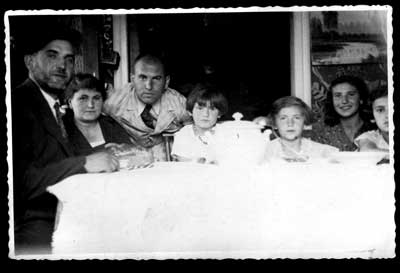
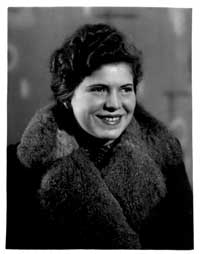
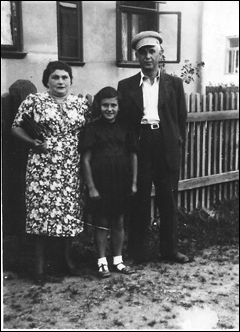
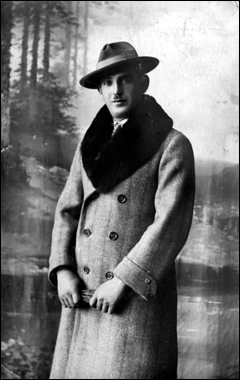
These photos from Mendolsohn's family photo albums appear in his book. I've reproduced them from an Italian web site — Daniel MENDELSOHN, Gli scomparsi — and will take them down if their appearance here is inappropriate.


{caption: Mendelsohn's uncle, Schmiel Jäger, his wife Esther and daughters Lorka, Frydka, Ruchel, and Bron}


{Frydka}


{Schmiel Jäger, his wife Esther, and daughter Frydka}


{Schmiel Jäger}

----------------

See also:

Le Temps de Proust: About reading In Search of Lost Time, associated Proust criticism, and other secondary literature.

Beckett’s ‘Proust’ John Pilling

Samuel Beckett Is Dead at 83; His 'Godot' Changed Theater

Samuel Beckett and the Philosophers by John Fletcher in Comparative Literature, Vol. 17, No. 1 (Winter, 1965), pp. 43-56 — you need a Jstor account to read this.

Beckett in the French Resistance

-----------------

Notes:

* From the catalog of books I've read that I keep in my LibraryThing account:
  • Antisemitism: The Longest Hatred, by Robert Solomon Wistrich, 1994
  • The Journal of Hélène Berr, by Hélène Berr, 2009
  • Red Orchestra: The Story of the Berlin Underground and the Circle of Friends Who Resisted Hitler, by Anne Nelson, 2009
  • Nazi Seizure of Power: The Experience of a Single German Town 1922-1945 (Social Studies: History of the World), by William Allen, 1984
  • The Third Reich at War, by Richard J. Evans, 2009
  • Flight from the Reich: Refugee Jews, 1933-1946, by Debórah Dwork, 2009
  • Resistance: A Frenchwoman's Journal of the War, by Agnes Humbert, 2008


**Grove Press is celebrated as an avant-garde publisher of works that formerly would be found on the Index Librorum Prohibitorum as well as many that used to be illegal to send through the US mails.

*** "Although Samuel Beckett rarely if ever spoke about his wartime activities, during the two years he stayed in Roussillon, he helped the Maquis sabotage the German army in the Vaucluse mountains. While in hiding, he continued work on the novel Watt, started in 1941, completed in 1945, but not published until 1953. For his efforts in fighting the German occupation, he was awarded the Croix de Guerre and the Médaille de la Résistance by the French government. Even to the end of his life, Beckett would refer to his laborous efforts for the French Resistance as 'boy scout stuff'." -- Samuel Beckett

**** Beckett's romance with Dechevaux-Dumesnil was not a fairy tale love story, as the wikipedia article says: "In the 1930s, Beckett, an avid tennis fan his whole life, chose Dechevaux-Dumesnil [also a tennis player] as his lover over the heiress Peggy Guggenheim. Six years older than Beckett, Dechevaux-Demesnil was an austere woman known for avante-garde tastes and left-wing politics." They stuck together and nurtured each other though Beckett is known to have taken at least one other lover during their long association with each other.

***** Another: "All in all he had a good life, was loved by those around him, honored by the world, read and performed with deep admiration and attention by admirers and interpreters, always his own man, who, after initial pains and confusions, found his genuine self and was true to it to the end. There was sorrow at the close, but is it otherwise for any of us? He was modest but richly gifted: he worked hard, and the work repaid him in consummate artistic achievement."

Sunday, April 18, 2010

all in a day

Went a memorial mass yesterday for the wife of a close friend who succumbed to cancer exactly twenty years ago. The friend is also a deacon of the church where we gathered. He gave a homily which told of his wife's ability to be present, to put aside distractions, worries, and the nags of daily chores and simply be present, listening and responding — attending — to whatever it might be that another person needed of her at a moment, a particular moment in time. He went on to say his new spiritual adviser asked him to lay out his daily routine. He began explaining his work as teacher, his duties as deacon, his responsibilities as a elected commissioner for his neighborhood, his volunteer work in Cub Scouting, and quite a bit more. He said he made time for daily religious observance, every evening without fail and mornings as often as he could. The adviser cut him short and said he needed to give himself time for meditation; not doing something, but not doing. We in the pews sighed in agreement with the spiritual adviser when our friend got to this part of the homily. We rely on him to bring us together, as he faithfully, does three or four times a year, at the same time we realize that his devotion to our social welfare in providing festive occasions for our periodic gathering together is not a burden that we ourselves could take on.

At the buffet lunch he provided after the ceremony a young guy asked what I'm up to these days. My life is much less full than our mutual friend's (actually his uncle, my friend). I gave a brief outline of my routine and thought how easy it is for me to make time for meditation in my life.

Maybe partly as a result of that conversational exchange, today I found myself busier than usual. I did my usual morning tracking of internet locations that had updated since the day before. I found a page to link to on Facebook. I worked on a draft blog post that has been giving me trouble. I rehung the hanging geraniums on our back porch so they can be more easily seen outside our kitchen door. I mowed the lawn. I went off to do some shopping at our local Trader Joe foodstore. On return, putting my bike away, I heard a hissing that told me my rear tire was going flat. I ate my lunch and then worked on the tire (it only needed a new tube) and gave the bike some extra cleaning while the wheel was off.

Then, because on my way home for TJ I'd seen some pressure-treated, eight-foot 4x4 pieces of wood out for pick up I went in the car and collected these two timbers thinking I'd use them as a barrier between the lower part of our yard and one section of our uphill neighbor's, where a discharge pipe from a basement sump pump has been issuing an intermittent stream even in dry weather. I didn't think I could do more than mitigate the swampy condition but thought I'd do this simple thing as a first step while she decides whether to put in a dry well to solve the problem altogether. I picked up the wood and carted it home. It needed some disassembly since its previous use had been in supporting an fairly big and elaborate arbor. This I did and then prepared the muddy earth where I'd lay the timbers and put them in place. Realizing I needed some extra turf to support them and improve the water barrier, I did a second project: moving a concrete pad from our far back yard (where no longer needed) to a spot by our garage (where it could serve a useful purpose). The concrete is about two foot square by about four inches deep. I removed earth from the target location and used it with the barrier timbers and then installed the stepping stone in its new home.

There's no moral to this story. I was a bit sore when I completed my afternoon exercise routine and a bit thoughtful about the odd day, like this one, that contains somewhat more busy-ness than usual.

This image shows six of the eight bolts I removed in disassembling the arbor to get my timbers. I thought they might be photogenic and that's really the reason I wrote all this.


I recommend that you click this image to see a full-screen view; or, if you wish, click this link to view at highest resolution.

Saturday, April 17, 2010

April 15th, the aftermath

Philip Gentry, whose pleasurable blog I quoted the other day, was born 38 years and a day after me. He explains in this blog post: Thursday, April 15, 2010 : Speaking of April. The post includes these photos of events which began on the 14th and carried over to the day of his birth.


{Gentry's caption: The sinking of the Titantic, in 1912, which hit the iceberg on the 14th but succumbed on the 15th.}


{caption: The death of Abraham Lincoln in 1865--similarly, he was shot on the 14th but succumbed on the 15th}

He adds, somewhat as I did, "On the plus side, it's also the birthday of Leonardo da Vinci (1452), Emma Watson (1990) and myself! (1980)"

Friday, April 16, 2010

April 14, a memorable day

As it happens, this year's anniversary of my birth was remarkable not only for the many memorable events of years past but also for three that occurred during those twenty-four hours.

Item One

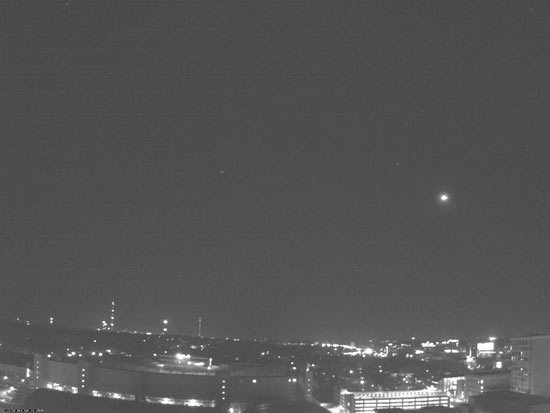
A giant green Nighttime fireball came crashing down through the atmosphere over Wisconsin and neighboring states at 10:07pm or thereabouts.

This shows the meteor as it begins to enter the atmosphere.

{image captured around 10:07 p.m., April 14 by a camera mounted on the northwest corner of the Atmospheric and Oceanic Sciences Building on the University of Wisconsin-Madison campus}


This shows the dazzling flash as the object burnt up.

{same source}


This comes from a video recording made (inadvertently) by the dashboard camera of a police vehicle in Howard County, Iowa.

{source: AP, Youtube}


This photo is given by a blogger; since it lacks photo credit and bears little similarity to other images, I doubt its validity.

{source: styleblips.com}


Here's the video.

{caption: Midwest/Meteor/Fireball - Howard County Sheriff}

There's another video, taken in Milwaukee, on the WISN TV website:
Meteor Lights Up Skies

---------------

Item Two

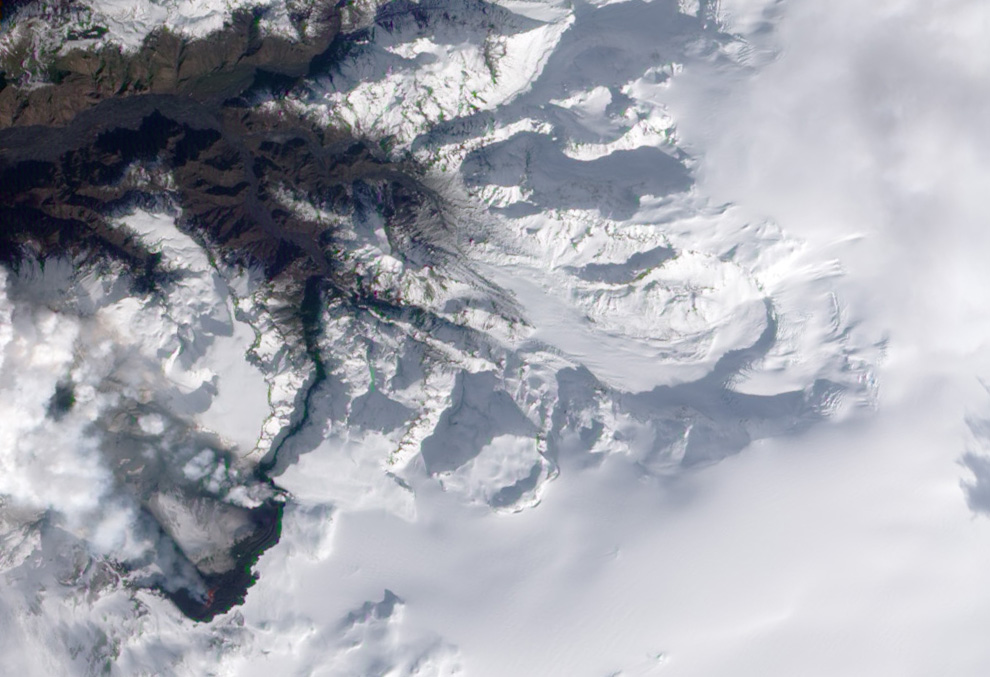
An Icelandic volcano under the icecap at a place called Eyjafjallajokull had minor activity in March and then erupted in a major way last Wednesday -- as everyone must know by now since the ash cloud has severely disrupted air traffic across Europe.

The Big Picture has a bunch of good photos, including this one:

{source: Big Picture on Boston.com}
----------

Item Three

China suffered a mag. 6.9 earthquake high on the Tibetan plateau. Boston.com reports that "thousands of wood-earth buildings collapsed and many larger structured heavily damaged or destroyed. The region is difficult to reach for the response teams of the Chinese government outside aid groups - lying at an elevation of 3,700m (12,000 ft) and connected by few roads, most of which were damaged in the quake. Chinese state media now says the death toll has risen to 1,144. Rescuers continue to search for survivors as homeless residents work to recover what they can and set up shelter from the freezing overnight temperatures." The Big Picture has photos of this disaster as well, including this one:


----------

See also:

Fireball lights up Midwest, April 15

Soaring meteor lights up skies across the Midwest, April 15

Meteor fragment lands in UW-Madison geoscience department, April 16

Eruption of Eyjafjallajökull Volcano, Iceland

Icelandic Eruptions May Disrupt European Air Traffic for Months

Eruption of Iceland's Eyjafjallajokull Volcano on April 14, 2010

2010 eruptions of Eyjafjallajökull

Official and grassroots relief groups rally in wake of China earthquake, April 16

China quake death toll 'passes 1,000', April 16

China races to the rescue, April 16

Chinese Premier Visits Tibetan Quake Survivors, April 16

Thursday, April 15, 2010

Fourteenth of April, not done yet

Philip Gentry, in his blog, 2'23", adds to the list of unfortunate events* for which my birthdate, April 14, can be remembered. He says:
April 14th is often given by periodizing historians as the end of Reconstruction, and the beginning of the resurgence of white supremacy in the south. On this day in 1873, the Supreme Court handed down its decision in the so-called "Slaughterhouse Cases", holding that the Federal government had no right to protect the voting rights of African Americans. And that same day, down in Louisiana, a group of white militia slaughtered over a hundred black citizens in the Colfax Massacre, burning down a courthouse in which a large group had taken refugee, and shooting all those who tried to escape the flames. It's a bit much to claim that this single day sent our country down the path of Jim Crow laws, segregation, and the Ku Klux Klan, but it was certainly the beginning.

Happy April 14th.
A good post, worth a few moments of your time it includes, and discusses the significance of, this image:


----------
*The list contains many battles and other violent doings, including —

- 1865, U.S. President Abraham Lincoln is assassinated in Ford's Theatre by John Wilkes Booth.

- 1912, the British passenger liner RMS Titanic hits an iceberg in the North Atlantic at 11:40pm. The ship sinks the following morning with the loss of 1,517 lives.

But, be it remembered, also:

- 1775, the first abolition society in North America is established. The Society for the Relief of Free Negroes Unlawfully Held in Bondage is organized in Philadelphia, Pennsylvania by Benjamin Franklin and Benjamin Rush.

Fourteenth of April

Yesterday was the anniversary of the day I was born and my friend Ashe sent me a list of some April 14 happenings which I reproduce at bottom. As he does every day, Bent Sørensen gave his own visual and auditory wrap up of the date's milestones. You can find it at: Ordinary Finds, April 14, 2010. This painting comes from his compilation. It's Victor Borisov-Musatov's "Portrait of Nadezhda Stanyukovich."


{Portrait of Nadezhda Stanyukovich - 1903 - Oil on canvas, hung in the Tretyakov Gallery, Moscow; my source: wikipedia which got it from Olga's Gallery}

Bent also notes these men and women who share my birthdate:
  • Chicago style jazz tenor man Gene Ammons, called The Boss - April 14, 1925 - 1974
  • Great English Shakespearean actor, John Gielgud - April 14, 1904 - 2000
  • British actress Julie Christie (b. April 14, 1941)
  • Coal Miner's Daughter, Loretta Lynn, country singer (b. April 14, 1935)
  • German-American painter and printmaker, Emil Ganso, painter (April 14, 1895 - 1941)
  • Belgian painter, James Ensor (April 13, 1860 – 1949)

Today my friend Kate provided a link to an article in the Guardian announcing availability of the The Illustrated London News on the web (albeit by subscription, not for free). The Guardian reporter says: "All 160 years of the pioneering Illustrated London News, from its launch in 1842 to its last abortive relaunch in 2003, have been digitised by Gale for students, historians and researchers – including all the colour, and the special issues." The article offers this teaser ILN photo, which I might have included in what has turned out to be one of the most popular web posts on this blog (the higher, the more awful, and the more sublime).


Soon after seeing Kate's reference to the digitizing of the Illustrated London News I saw this blog post and thought it might be a belated April Fool: How Tweet It Is!: Library Acquires Entire Twitter Archive. But not so, the Library of Congress will indeed archive Twitter. As it happens, the announcement of this intention comes alongside an announcement that Google will make the entire Twitter archive searchable (Twitter's own archive, not the future LC one). See Epicenter Mind Our Tech Business Library of Congress Archives Twitter History, While Google Searches It (on Wired) and Library of Congress Will Save Tweets on NYT.

Here's the list I got from Ashe with her smiley at end. It's not intended to be comprehensive, rather a smattering showing variety.

1989 - 1,100,000,000th Chinese born
1983 - President Reagan signs $165 billion Social Security rescue
1981 - 1st Space Shuttle-Columbia 1-returns to Earth
1980 - 52nd Academy Awards - "Kramer vs Kramer," Dustin Hoffman & Sally Field win
1977 - Supreme Court says people may refuse to display state motto on license
1971 - Stephen Sondheim's musical "Follies," premieres in New York City
1969 - 1st major league baseball game outside U.S. played (Montreal Canada)
1963 - George Harrison is impressed by unsigned group "Rolling Stones"
1961 - U.S. element 103 (Lawrencium) discovered
1956 - Ampex Corp demonstrates 1st commercial videotape recorder
1939 - John Steinbeck novel "The Grapes of Wrath" published
1910 - President Taft begins tradition of throwing out ball on opening day
1894 - 1st public showing of Edison's kinetoscope (moving pictures)
1860 - 1st Pony Express rider arrives in San Francisco from St. Joseph, Missouri
1859 - Charles Dickens' "A Tale Of Two Cities" published
1853 - Harriet Tubman began her Underground Railroad, helping slaves escape
1841 - Edgar Allen Poe's "Murders in the Rue Morgue," published
193 - Lucius Septimus Severus crowned emperor of Rome

:)

Wednesday, April 14, 2010

a quiet man

Most families include ancestors, maybe only a few, who achieved distinction — those whose actions made them famous or, it might be just as likely, notorious in their time. The majority lead lives which leave little trace. These men and women are obscure, not in any pejorative sense, but rather, in the shadows of the distant past, they are hard to make out.

I've written before about an ancestor of mine who opposed totalitarianism with simple human dignity, another who stood up for the rights of others in peril of his own. I've also written about nineteenth-century ancestors who achieved wealth and position but who were nonetheless liberal advocates of those who were poor and powerless.

Quite a few near and distant relatives served in military campaigns. Some of them fought for and others against British colonial rule in the American Revolutionary War. Similarly, some wore the Federal uniform and some that of the Confederacy during the Civil War. One served in the Navy from the Civil War through the end of the Spanish-American War, ending with rank of Rear-Admiral. Another took on great risks as a frogman in the South Pacific Theater of World War II.

Less heroically by far, I have one relative who was banished from his home town for having solicited sexual favors from a young woman he knew, man of contrary personality who was frequently at odds with his neighbors and fellow townsmen. There's another, silversmith, who was imprisoned for stealing from his landlord and who devised a small sculpture commemorating the event.

Still, most of the ancestry lacks such prominence. Their lives were less memorable and, not surprisingly, they are less remembered.

This circumstance was put somewhat elegantly by a man, Jeremy Pine, who had this to say about a distant relative:
Samuel Thorn, oldest son of Thomas and Abigail (Borough) Thorn, was born 4/11/1762, in the Thorndale farmhouse where it is likely that all his boyhood days and years of his youth were passed. So long a period has passed by since his decease that almost all recollections of him as a man have also vanished, there being no one now living in 1902 who ever saw him. We who are living in the early part of the twentieth century may never know his personal characteristics, whether he was a social person, a popular individual or otherwise, for memory dies, and beyond simply the dates recorded in his family bible and in the books of the monthly meeting of Friends of which he was a member there is little to write about him.

Success without advancement has been the general condition of the branch, and social and unassuming manners are attached to its members in general, although in a few instances a touch of haughtiness has, in a measure, separated some of the cousins from many of the family.
It may be fitting that I can learn nothing about Jeremy Pine or the writing from which this is excerpted. I found it on John Coutant Thorn's set of web pages: Descendants of William Thorne

{This is the Haddonfield Meeting where Samuel Thorne and his family worshiped; source: History of the Society of Friends in America, by James Bowden's, vol. II, 1854.}


---------

Here are some of my previous blog posts on family history:

Friday, April 09, 2010

Flatiron, 1905

I saw this photo on Shorpy and, somewhat laboriously, managed to find it in the Prints and Photos website of the Library of Congress. (Though they recently overhauled their website, I still can't easily find what I'm looking for. My fault or theirs?)

It's called Flatiron Building, Broadway and Fifth Av., New York City. The year is 1905 and the photo is not one I've previously made available on this blog. As with so many of the New York City photos I reproduce from LC collections, it was made by the Detroit Publishing Co. and 'tho it shows a copyright insignia, it's now in the public domain.


Here are some cropped images from it.

1. The clock tells us it's 9:20. That's in the A.M. as we can tell by the orientation of the camera, shooting from the north, and the direction of the sunlight, coming strongly and acutely angled from the east.


2. The photographer chose a moment when the sun was poring directly down the side streets; not only was it morning, but morning in one of the late-fall or early-spring months when the sun was low on the horizon at that hour.


3. In the main photo you can see the flags and chimney smoke blowing in a west wind. This wind was stronger and less uni-directional down at street level. After the Flatiron building was erected, the intersection of Broadway and Fifth Avenue came to be called "The Windiest Corner in the World".* The workmen in this segment of the photo may be repairing wind-caused damage.**


4. It's actually relatively calm this day. Note in this image the reflection in the plate glass window of the man who's just starting to pass by the goods wagon on his right. This wagon has attracted the attention of the local police. Notice how many policemen are within this picture as a whole. Broadway at Fifth Avenue must have been very well protected from unwanted occurrences.


5. Here we have a man out on a ledge for a purpose difficult to determine. His posture suggests that he's not fearful of wind gusts. The man above is more cautious and seems mainly intent on catching some rays and observing the scene below.


6. The horse-drawn cabs and wagons go where they will across the wide intersection, mingling freely with but not threatening pedestrians or each other. In this image my eye is drawn to the man at right striding purposefully with head lowered against the bright facing sun.


7. In this part of the picture the traffic is all going in the same general direction although one wagon is intent on cutting off another. I expect the pace of both is slow enough so there's no real problem here. It's interesting that the one has two wheels and two horses while the other has four wheels and one horse. The traffic also includes a two-man, two-wheeled conveyance of the kind we used to see at railway stations when I was young. I think they're just called handcarts.


8. This last segment contains an interesting pattern of trolley tracks, with their mid-track groove for electric supply. The composition is also interesting for contrast of the horizontal movement in the lower section with the diagonals of the upper part. Notice among the left-right traffic a handsome horse pulling a gig; it's the only conveyance I notice that seems to be privately owned.


The the photographer has placed the camera just behind and above Worth Monument in the building at 204 Fifth Avenue. This photo shows the monument and that building (with its White Horse whiskey sign) at center.


Here's a link to a Google map of the area.

-------------

Notes:

*In an article with this as its title, the author said, "the building, towering above all nearby structures, is the only obstruction to the breeze that sweeps unimpeded from North River to East River. This, in connection with the open space afforded by Madison Square, forms an eddy, or windwhirl. The 'Flat Iron' building presents to East and West winds, a flat surface like an enormous fence, three hundred by two hundred feet in size, and the winds sweep over the top and down into the street where they meet other winds coming up or down Broadway and still others coming up or down Fifth Avenue, and all these winds join hands and romp and gambol in the street, and do things that no nice gentlemanly wind would do."

**The same author wrote: "On the opposite side of Broadway [i.e., across from the Flatiron building] is a row of smaller buildings and the plate glass window of one of these shops seems to have been particularly singled out by the untamed wind; it has been crushed in a number of times, and the owner of the shop has brought suit to recover damages. Why the wind should have a spite against that particular shop no one can tell, but to have one's plate glass continually falling in or out is quite a blow. But it is rather difficult to see how owners of the 'Flat Iron' building can stop the wind, for wind is noted for blowing 'where it listeth,' and it listeth to blow in the windows of that shop.

Thursday, April 08, 2010

Iwo Jima, 65 years ago


This photo shows the Navy's original frog men, members of an Underwater Demolition Team, returning from a mission in the waters off the western beaches of Iwo Jima, sixty-five years ago.*

A 65th anniversary of the Battle of Iwo Jima occurred a few weeks back. My uncle, Arthur Hettema, took part in it as a Navy swimmer — a member of an Underwater Demolition Team. His rank was Chief Carpenter's Mate which meant he was a SeaBee, part of the US Navy's construction battalions that built airstrips (and much else) on Pacific islands as they were captured from the Japanese.

He turned up in swim trunks in the turbulent waters off Iwo because the Navy needed to expand its elite units of aquatic commandos and most volunteers came, as he did, from among the SeaBees. The wikipedia article on UDTs gives a concise explanation.

The conquest of Iwo Jima is remembered not for any doubt about its outcome but rather for its ferocity. It was a Japanese stronghold, the first of the Home Islands to be taken by American forces during the war. Both sides knew it to be an essential base for the impending invasion of the mainland. The Japanese hoped to kill enough Americans to make military leaders think twice about invading the mainland. The Americans simply knew they had to take the island no matter what.

An anonymous editor of the New York Times summed things in a short front-page article that appeared after the attack had begun:
There are only two things which could have prevented our conquest of this bleak rock, if that was our purpose. One is superior naval power and the other is superior air power. Japan has neither. We have both. Nevertheless, Iwo Jima will not be taken easily. Symbolically it is almost the last useful remnant of Japan's once proud island power in the Pacific. Physically it is a volcanic mountain peak thrust up from the sea, and every crevice in the rocks is packed with enemy troops. Its garrison is said to number 10,000 men, which is a formidable force to defend such a tiny speck of land. Moreover, every beach is commanded by gun-mounted heights which no bombardment from the sea can destroy. The most skillful use of our amphibious technique will be required to overcome these natural obstacles.
-- NYT, New York, N.Y. Feb 19, 1945 pg. 1**
The UDTs were an essential part of the "amphibious technique" which this author anticipates. The Navy had learned that it could not land invasion forces without first determining the undersea terrain that lay between its ships and the beaches. In attempting landings on other islands, there was great and needless loss of life as landing craft got hung up on reefs and invisible obstacles. At Iwo, the UDTs mapped the seafloor. They explored for explosive devices and were prepared to detonate any that they found. And they emerged on the beaches themselves to obtain sand samples so Naval engineers could determine whether wheeled vehicles would become bogged down. In doing these things they exposed themselves to enemy fire, during their approach in the small fast boats that conveyed them, while at work in the water, and during their return to the ships on which they came.

They did most of this work on D-Day minus 2: two days before the invasion.

The Navy knew that no bombardment could destroy the enemy positions that covered the beach; nonetheless the island was subjected to massive attacks from airplanes and ships over the days before the invasion began. They brought light ships close to shore on on the morning of D-Day minus 2, when underwater reconnaissance began. These were called LCI(G)s, gunboats that could be used for landing infantry on shore, but they were essentially rocket platforms on this morning. The Japanese were ready for them and, though reluctant to pull back, the heavy damage they took forced them to do so.


1. This photo shows the LCI(G)s moving into position.


{LCI(G)s moving toward Iwo Jima, 17 Feb 1945}

2. This shot of LCI(G)s was taken from one of the boats conveying the swimmers toward the shore. The small blobs are LCPLs, small, fast, shallow-draft boats used to convey the swimmers shoreward.


{A line of LCI(G)s in position off landing beaches.}

3. This photo shows the an LCI(G) that has taken a shell but not sunk; it has returned to its mother ship with dead and wounded sailors.


{LCI(G) damaged off Iwo Jima 17 Feb 1945}

4. In the afternoon, destroyers were deployed to provide covering fire. Here, a destroyer is firing at mortar and artillery positions on shore. The destroyers replaced the badly damaged LCI(G)s which were originally scheduled for the task.


{Bombardment of Iwo Jima, 17 Feb 1945}

5. Another photo of a destroyer shelling the intended landing beaches during the afternoon.

Arthur Hettema was in Platoon 4 of team UDT-15 which was assigned the duty of reconnaissance and underwater demolition in the afternoon. As things turned out, there were no munitions for them to blow up. That circumstance hardly lessened the danger however, for if the Japanese defenders were on guard for the morning excursion, they were ever more so in the afternoon. The risk to the swimmers was increased to the more by the use of destroyers for cover fire rather than the more maneuverable and accurate LCI(G)s. Worse yet, a smokescreen that was to be provided by airplanes never materialize and the group had to make do with less dense smoke from shells fired by the destroyers.

My uncle had been in a forward team on a reserve LCPL in the morning. He described the experience as extremely harrowing: "For one and a half hours, I watched. I was seeing the most nerve-wracking and horrible sight I had ever witnessed. We could see the gunboats getting hit and hear men screaming for doctors. I was completely and absolutely exhausted when I returned to our ship. I couldn't eat a bite of chow."***

As his group prepared to go out that afternoon he said he was extremely agitated, "Outwardly I probably seems cool, calm, and collected, but inwardly I was in turmoil — everything inside me was churning."


6. Underwater Demolition Team swimmers smear themselves with grease to protect against the cold water.


7. The small, fast, low-draft boats that carried the swimmers also carried rubber boats. They used the latter in picking up swimmers at the end of a mission. The rubber boat would be dragged behind the LCR and a sailor would hold a loop rope out over the water. Swimmers would space themselves so that they could be brought aboard the rubber boat one after the other at high speed, by putting their arm through the loop and swinging up and over the side.

In the morning the boats carrying the swimmers had been shelled continuously, so much so that, according to one account, spray had soaked everyone and twice the boats had been lifted out of the water by concussion.

Surprisingly, the enemy fire turned out to be less withering in the afternoon. The covering fire of the destroyers plus some smoke laid down by planes that had finally arrived reduced the quantity and accuracy of mortar and artillery fire from the defenders. Where the LCI(G)s had earlier failed for the most part even to get in position to fire their rockets, the destroyers were able to bombard the shore with impunity. One swimmer reported that the fire from the destroyers smothered the beach — it was just a sheet of fire; and the noise was deafening. Nonetheless, there was constant machine gun fire from beach emplacements: "All the time around us the machine gun fire kept us ducking. You pop your head up and they would miss you on the left. It got to be a little game — which way were you going to surface."


8. This photo shows an LCPR moving into position to drop swimmers.


9. It's a little hard to make out what's going on here. The small blob is an LCPR. The smoke comes from the destroyers' heavy shelling of the beaches.

To keep from getting shot, the swimmers were careful to emerge only in the troughs of waves, never at their peaks. They swam in pairs. They dove to look for electric cables attached to mines. Periodically one would take a sounding (with a three fathom lead line) and give his results to the other who would write it on a plexiglass slate. They noted where the guns were placed on the beach. They measured the height of the sand and the height of the breakers. They went all the way to shore and collected sand samples from the surface of the beach.


10. This shows a wrecked Japanese freighter from which Japanese snipers and machine gun teams fired on the boats and swimmers.


11. Here is an LCPR in the rendezvous area getting ready to collect swimmers. You can also see a destroyer that's part of the group shelling the beach. Mount Suribachi is in the upper right corner.

Notice the distance to the beach. The swimmers had a long way to go to get to the reconnaissance area and back again. Imagine what it must have been like to do that much swimming and also carry out a difficult mission while under enemy fire.


12. In this shot LCPRs are waiting to pick up swimmers. You can again see how far they stood off shore.


13. My uncle and his partner Halvor Ravanholt, were the last pair to be dropped. They were also the last to be picked up. Having completed their mission and returned to the pick up point, they saw the boat pick up the other pairs but race by without seeing them. My uncle said: "We didn't panic, just hoped and prayed. The boat officer ordered the coxwain to make one more pass. This time they did see us and at full speed approached us. The sailor in the rubber boat held out the rope-ring, which we put our arm through and they pulled us aboard. We crawled to the bottom of the craft, hastily put on our metal helmets, and downed a two-ounce bottle of brandy."

I'm repeating this shot to show the way the rubber raft was used in collecting swimmers.


14. This shows one group of swimmers on its way back to the home ship. They put on long johns and foul-weather gear after being picked up. The water was about 67 deg. f., not too cold, but they were exhausted and strung out; the gear wasn't a luxury but a necessity.


15. Their job done, the UDTs could take it easy while the invasion proceeded. This shows the first landings on D-Day itself.


{photo credit: Naval History and Heritage web site}

16. This shows the first flag raising on Mount Suribachi on D-Day plus 5, 23 Feb. 1945.


{photo credit: Naval History and Heritage web site}


17. Map of Iwo used by US military war planners
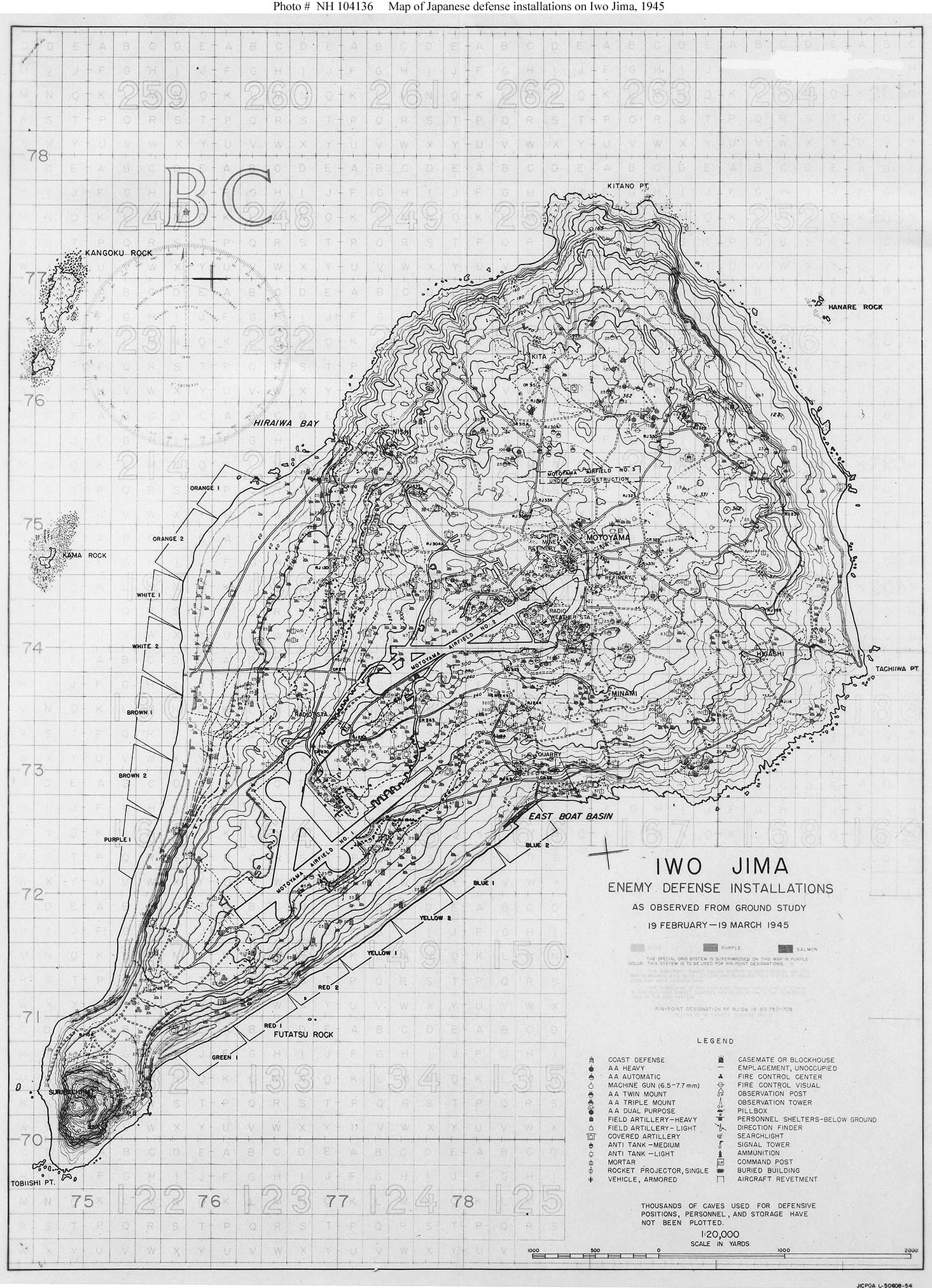
{The UDT reconnaissance took place on the western approaches from Blue down to Green. Image source: ibiblio.org}


Unfortunately, the UDTs' period of relaxation was brief. On the day after their reconnaissance, D-Day minus 1, their home ship, the destroyer escort USS Blessman was hit in its mess hall by a large bomb dropped from a Japanese plane — the type known as a Betty. The explosion killed 40, including 15 men of the UDT. Uncle Arthur wrote about this tragedy in a newspaper article that appeared a few weeks after the 40th anniversary of the battle. Here's the account:
Bombed at Sea

Arthur Hettema 3095 Windmill Village
Punta Gorda, Fla. 33950

On Feb. 19, 1945, the USS Blessman, an attack personal destroyer, was being towed by a salvage tug on our way back to Saipan.**** We could still hear the bombardment of Iwo Jima where we had been in the pre-assault attack on the western and eastern beaches. The night before, we frogmen, after clearing the approaches to the beaches, making sure there were no mines, reefs or obstacles that would prevent the Marines from reaching the beach to be invaded, were in a happy mood.

At 9:20, a Japanese bomber dropped two bombs, one just missing and the other penetrating the boat deck before exploding on the deck below. The ship caught on fire and, with both engine rooms knocked out, there was no power to operate the fire pumps. We were able to contact the U.S. Gilmore, our command ship, and it came with hoses to put out the fire in about three hours.

With the salvage tug towing us at no more than 6 knots, we were concerned that a sub could overtake us. The enemy had a submarine base only 100 miles away.

The next day, I, with several other volunteers, took ponchos and waded into the troop compartment, where we recovered the bodies of 40 men. We buried two at a time the next morning as the captain read the burial passage. Everyone had tears running down their cheeks, with the loss of their close friends.

We made coffee that morning over a trash can that hung at the fantail of the ship. One of the Seabees, a sheet-metal worker, made a stove of a big metal locker and we were able to cook meals. We started at 5 in the morning and made large quantities of scrambled eggs. For the evening meal, we made a stew with meat, potatoes, onions and carrots. We were outside all the time, sleeping on the deck, so our appetites were still good.

In the evening, we blacked out at 7, as usual, and sitting around on the deck, we listened to the supply officer play on his flute the sweetest music you ever heard. It was more or less a sleepless night: We were still nervous and jumpy from the bomb hit we took. We kept the 8-inch LeRoix pumps going and, with 40 feet of the starboard side torn out, we reached Saipan in six days.

We could buy beer there for 10 cents a bottle and, for a small amount, we could order a steak dinner.

-- Sarasota Herald-Tribune, Sunday, April 14, 1985
Another account says that Uncle Art helped put out the fires caused by the bomb and, especially, to keep the flames away from the ship's ammunition. He said "As we fought to bring it under control, the 20mm and 40mm ammunition in the storage rooms on the main deck got so hot they kept exploding." He then volunteered to help bring up and throw overboard the heavy explosives from the hold. About this he said "Believe me, it was some job to get the men to go down belowdecks." About the service for the dead, he said "No tears were held back. We all grieved deeply for our lost buddies."

Uncle Art had other adventures and close calls while swimming for the Navy. In one of them he came in contact with an enormous man o' war jellyfish in heavy surf on a UDT mission. Half his body was paralyzed by the poison stingers. He could barely stay afloat. He and his partner had become separated and there was no one to help. He could not swim to the rendezvous location. It was night and his only hope of recovery was to use his emergency flashlight to signal the pickup boat. By a miracle this worked. At considerable risk, the boat left the rendezvous location and approached the beach to come pick him up. He said it took a long time before he felt normal again.

---------------

see also:

First flag raising slide show, National Museum of the Marine Corps

second flag raising

Iwo Jima Recon: The U.S. Navy at War, February 17, 1945 by Dick Camp (MBI Publishing Company, 2007)

Blessman US Navy, Dictionary of American Naval Fighting Ships

Diving in the U.S. Navy: A Brief History, US Navy, Naval Historical Center


Flags of Our Fathers Clint Eastwood's 2006 film which follows the men who raised the famous flag and its companion Letters from Iwo Jima Clint Eastwood's Oscar winning film of the same year

• • •

---------------
Notes:

*Unless otherwise noted, all photos come from Naval collections of the US National Archives. Many photos are displayed a less than full size; click for full view.

**The wikipedia article on the battle confirms what this editor writes but corrects the size of the Japanese garrison. It was actually between 18,061 and 18,591 men, with exactly 216 of these taken prisoner. The author of the wikipedia article says the rest were either killed or missing.

***This and other quotes are from Dick Camp's book, Iwo Jima Recon: The U.S. Navy at War, February 17, 1945.

****Uncle Art misremembered the date and he was probably wrong about the salvage tug too. Another account says
The following day [i.e., 18 Feb], she headed for a screening station. While she was en route, however, an enemy bomber, identified as a "Betty," came in at 2121, very low over the port quarter, strafing, and scored a direct bomb hit in the high-speed transport's starboard mess hall, above her number one engine room. A second bomb hit her stack, glanced off, and splashed close aboard without exploding. Fire broke out immediately in the mess hall, galley, and troop quarters on the main deck; and the ship lost all power. Heavy smoke forced the abandonment of the number two fire and engine rooms, while a 500-gallon-per-minute portable pump was demolished and all other such pumps were rendered inoperable by the shock. This damage reduced Blessman's crew to bucket brigades and the use of helmets to keep the blaze from spreading. Her sailors jettisoned topside ammunition aft, and attempted to clear ammunition from clipping rooms and bedding from troop quarters to halt the fire's spread. At 2250, antiaircraft and small arms ammunition began exploding, forcing the evacuation of wounded to the bow and stern. Meanwhile, bucket brigades kept the fire from spreading to the superstructure deck, confining the blaze to the enclosed spaces on the main deck.
And another:
That evening [18 Feb.] we had been steaming at flank speed from the vicinity of Iwo Jima to the outer screening area. With the usual efficiency with which anything connected with UDT15 functions, the BLESSMAN, APD 48 found itself able to take the place of another ship that had engine trouble. While speeding at 22 knots, the BLESSMAN left a wake that could be seen for miles and one which was seen by a member of the opposition. A twin engine Betty with numerous five hundred pound bombs came in on our wake, swung to the left when he saw us and then made a 180 degree turn coming back in our beam, dropping one bomb of the five hundred pound variety. It went through the top port PR, several pieces of pipe, down through the overhead of the starboard mess hall and exploded when it struck the deck of the same. A second bomb creased one of our boat davits but failed to explode until it hit the water. When we got topside we saw that the starboard mess hall had been opened up just like a matchbox with a huge exploding firecracker. The midsection of the ship was engulfed in flame and the smell of burning flesh was everywhere.