Note: I have updated this blog post to reclaim some images that the photo archive deleted (1/17/2018).
In July 1939 Dorothea Lange made a series of photos in the Piedmont region of North Carolina. The assignment was unusual for her. It came on short notice and, although she didn't know it at the time, its main purpose was to get her out of Washington, DC.
1
The following photos all come from the Farm Security Administration Collection in LC's
Prints and Photos Division. The captions are by LC staff from information in the FSA sets of negatives and prints; they are supplemented by field notes that were made as part of the shoot.
One of the researchers who worked with Lange on the project later wrote about Lange's technique, saying she would climb onto the car when she wished to get a higher viewpoint and that she would engage in long conversations with the people she photographed asking questions but also answering the many they would ask about why she was taking the photos and what employment conditions were like in other places, such as California, where she had worked.
1. The Whitfield family, Gordonton, Person County
Field notes show that Lange and
Margaret Jarman Hagood, a sociologist and research assistant at the
Odum Institute for Research in Social Science at the University of North Carolina visited the Whitfield family on the morning of July 3, 1939.
2
Although impoverished farmers were generally reluctant to be photographed at all and almost never permitted photographs within their homes, the Whitfields welcomed the two women and opened their home to them. At the end of their visit Mrs. Whitfield invited them to stay to dinner (the mid-day meal). She apologized that she hadn't prepared for company and only had tomatoes, snap beans, and bread she cooked at breakfast-time.
Like other sharecropper houses, the Whitfield's lacked electricity and plumbing. It was more substantial than most, with two stories, a kitchen at the back and a porch in the front. However, the family of six used only three rooms and slept in two double beds in one of them.
Tobacco sharecroppers were advanced seed and supplies for growing their crop and they split the crop with the landowner at the end of the season. Most of them reported that it was a good year when they broke even rather and did not end the year in debt.
3
The family had five acres and were the only sharecroppers on the property. The owner possessed 100 acres of land his parents passed down to him from what had been a 1,200 acre plantation.

{There is no LC caption for this photo. The field notes identify the man as Charles Dewey Whitfield and the girl as his daughter, Katie Collen, age 3. The Whitfield's were share-croppers. The photo shows him topping tobacco plants while Katie looks for worms. The notes say: "Her father says she is learning but she is a little too rough with the tobacco leaves sometimes and bruises them. The children like to go to the field with their father. When the mother goes the oldest girl has to stay at home with the baby."}

{LC caption: Tobacco sharecroppers and family at back of their house. Person County, North Carolina
Additional information from field notes: In addition to Charles Dewey and Katie Collen, the photo shows Mrs. Whitfield (given name not recorded), Dorothy Lee, 9; Millard, 6; and Isabel, 6 months. Both parents came from farm families in the county and had always been sharecroppers. At the time, they owed debts only to their doctor and the local hospital, both the result of cesarean births of the two youngest children. The notes say: "The mother has helped 'right smart' this year because Mr. Whitfield has been 'falling off.' She thinks it is because he is so worried over paying the doctor and hospital bill."}
Note the chickens; the field notes say "The children explained how they 'claim' the pigs, chickens; and feed the animals they claim."
Charles Dewey Whitfield was 39 when Lange took these photographs. He was born in September 1899 on the day when Admiral George Dewey was recognized for his victory in the Spanish-American Way by a triumphal parade in New York City. The field notes record that Mrs. Whitfield was 33 years old and had married at 21. She had purchased the dress she wears from J.C. Penney for 87¢. She was barefooted when Lange and Hagood arrived but put on her white high-heeled shoes for the photos — wanting to look her best — and "was loathe" to take them off. The field notes say of Mrs. Whitfield: "She was brought up, she said, to follow her daddy around and likes field work better than cooking and housekeeping." Of Dorothy Lee the field notes say: "The mother is proud of her oldest daughter who has done well at school, and 'has made A grade both years she's been going to school."

{LC caption: Corner of kitchen. Home of tobacco sharecropper. Person County, North Carolina
Additional information from field notes: The cook-stove they use is their own; none is provided in the house. The rooms are clean. When churning butter, Mrs. Whitfield keeps the churn and utensils scrupulously clean.}

{LC caption: Wife of tobacco sharecropper in kitchen of home. Person County, North Carolina

{There is no LC caption for this image}

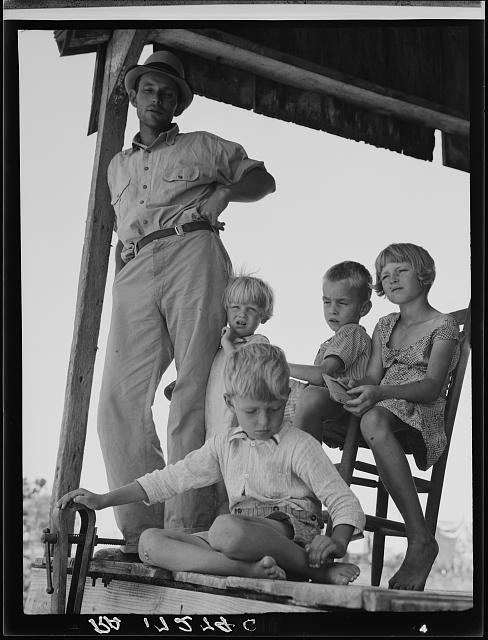
{LC caption: Mr. Whitfield, tobacco sharecropper, with baby on front porch. North Carolina, Person County}

{LC caption: Children helping father, tobacco sharecropper, at work in tobacco patch. Person County, North Carolina}

{LC caption: Tobacco sharecropper with his oldest daughter. Person County, North Carolina}
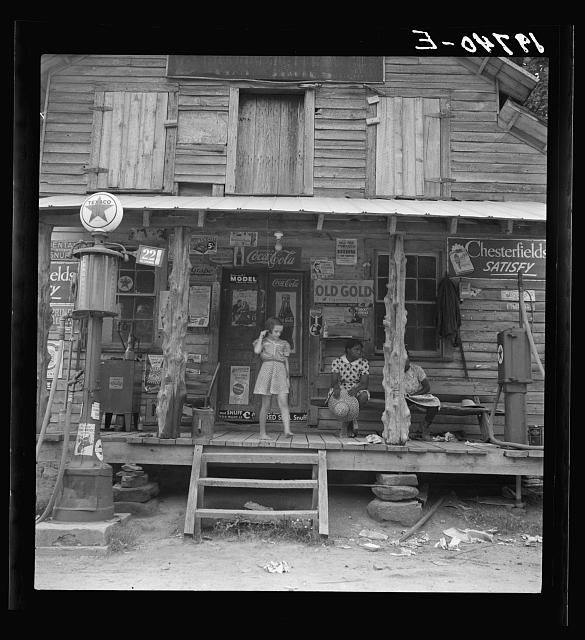
{LC caption: Daughter of white tobacco sharecropper at country store. Person County, North Carolina}

{This is another image of the store. The LC caption reads: "Country store on dirt road. Sunday afternoon. Note the kerosene pump on the right and the gasoline pump on the left. Rough, unfinished timber posts have been used as supports for porch roof. Negro men are sitting on the porch. Brother of store owner stands in doorway. Gordonton, North Carolina"}

{Another shot of the family taken at the back of the house. There is no LC caption for this image}

{This shot shows the front of the house and the dirt road it fronts upon. LC caption: Tobacco sharecropper's house. White family. Rural rehabilitation clients. Whitfield family. Near Gordonton, North Carolina}
Update: I have found a few more photos:


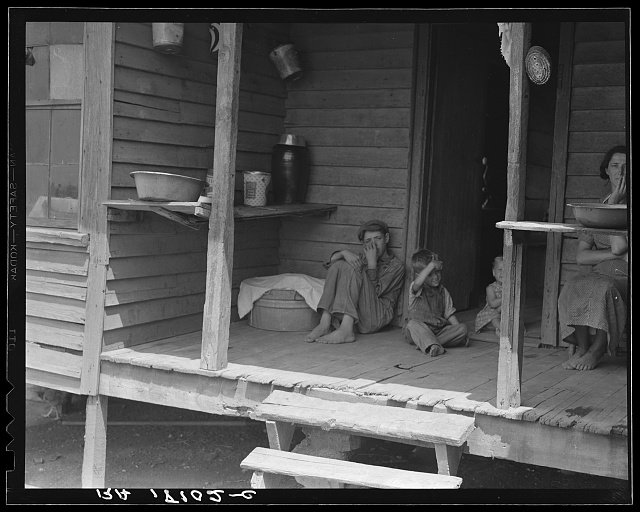
{Neither photo has an LC caption; they show the Mrs. Whitfield and the children on their front porch.}

{LC caption: Corner of tobacco farmer's front room. Shows enclosed stairway and corner of the new fancy bed. Person County, North Carolina.
Field notes say the family used only three downstairs rooms so the stairway door, though unlocked, presumably stayed closed at all times. The cut-out at its bottom may have been for the use of mousing barn cats (rural people not usually keeping house cats). You can see the corner of a bedstead. About this the field notes say "Mrs. Whitfield's mother died last year and they sold her small farm and divided up the money. The Whitfields bought their 'Company bed room suite' with their share: a glaring, Grand Rapids, highly polished imitation walnut bed, dresser, and dressing table." Lange noticed the calendars on the walls; there were nine in all and they were presumably kept for decoration rather than keeping track of day and date. These two show January and March 1939,one has its picture obscured by some hanging gear; the other appears to be a family scene with man standing at left, woman seated before him, and others in background.}
2. The Lyon family, Upchurch, Wake County
Field notes show that Lange and Hagood visited the Lyon family on June 30 1939. The family had 13 acres of tobacco which they had previously worked with another sharecropper family but were now working on their own with part-time help from a neighbor's child. The owner has 11 other families on his property raising tobacco and a little cotton.
Lyons moved here the previous year and is happy with the land, the house, and his landlord. His first year he made more than he had in his previous location. The notes say: "His landlord has plenty of money and furnishes him whatever cash he needs so that he doesn't even have to run a store account. He says these folks want their tenants to make money and they treat them nice."

{LC caption: Zollie Lyon, Negro sharecropper, home from the field for dinner at noontime, with his wife and part of his family. Note dog run. Wake County, North Carolina
Additional information from field notes: The house is a modified "dog-run" type meaning that the two rooms are connected by a breezeway. The yard is swept by brush brooms. The photo shows Zollie Lyon, his wife, their children, and grandchildren. The field notes say the photo also shows a little girl who is visiting.}

{Another view of the family and their home. LC caption: Zollie Lyons, Negro sharecropper, home from the field for dinner at noontime, and part of his family. Upchurch, North Carolina. He has thirteen acres of tobacco and a labor force of five}

{LC caption: Son of Negro sharecropper "worming" tobacco. Wake County, North Carolina; field notes say: "the worms are very bad this year."}

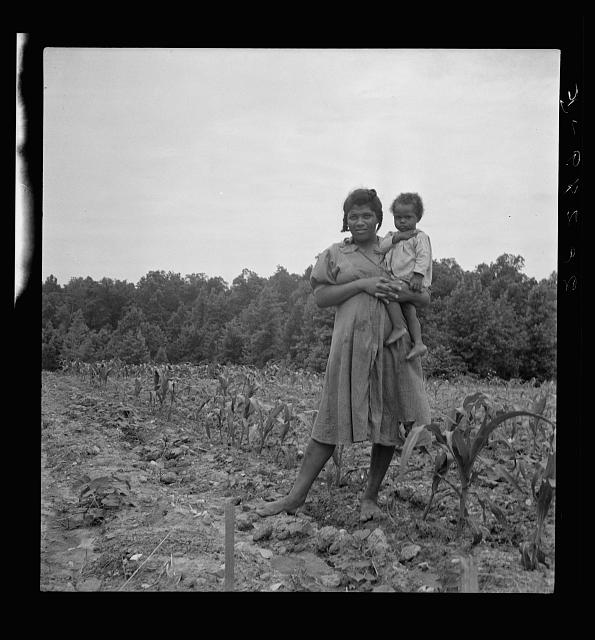
{LC caption: Daughter of Negro sharecropper goes up and down the rows "worming" the tobacco. Wake County, North Carolina}

{LC caption: Grandchildren of tobacco sharecropper down at barns. Note construction of tobacco sleds which have just been repaired by Zollie Lyons. Beyond them the screened platform in which that member of the family sleeps who tends the fire during the night. Wake County, North Carolina}

{LC caption: Grandchild of Zollie Lyons, tobacco sharecropper. Wake County, North Carolina}

{There is no LC caption for this photo; it shows the grandchildren of Zollie Lyons.}

{There is no LC caption for this photo; the field notes say that 13 acres is a large field for this area. The tobacco is topped ready for priming.}

{There is no LC caption for this photo; the field notes say a sled is used to haul tobacco from the field. In this case it's being used for weeds and broken leaves.}
------------------
Main source:
Daring to look: Dorothea Lange's photographs and reports from the field
By Anne Whiston Spirn, Dorothea Lange
University of Chicago Press, 2008
-------------------
Notes:
1 Anne Whiston Spirn reports that Dorothea Lange had arranged for Ansel Adams to prepare images for a book on West Coast migrant labor. When she asked her FSA boss to make the negatives available to Adams he refused. She then traveled to Washington DC so that she could herself supervise printing at the FSA lab. Her boss believed that this would throw the lab into chaos and quickly arranged for her to be sent to North Carolina. He contacted Howard Odum, head of the Institute for Research in Social Science at the University of North Carolina. Odum arranged for Lange to assist two researchers in their investigation of sharecropping and tenant farming in the Piedmont region of the state. As Sprin says, within four days of her arrval in Washington, "doubtless wholly unaware of the plot, and presumably after frantic hours in the FSA lab supervising the printing of her negatives for the book, Lange was out of Washington and on Zollie Lyons's farm in Wake County, North Carolina."
2 The project that Odum arranged for Lange was called "research through photography" and was considered to be a "Photographic Study of the 13 County Subregional Area" of the Piedmont. The two researchers identified places to visit and arranged with landowners and sharecroppers for the photographs to be taken. Lange and the researchers made notes of their visits and the photos taken. These are the source of the field notes I've summarized or quoted in this piece.
3 Source: Spirn's book,
Daring to Look, p. 93.








 Posts
Posts


