Thursday, April 10, 2008

whither China?

Newspapers are reporting that China's currency has appreciated against the US dollar to the highest point since 1994. This pleases US policy makers who maintain that the Yuan has been artificially low.

As the Yuan rises in value, Chinese exports become more costly to Americans. Americans who spend a lot of time in Wal-Mart and Target have benefited from the cheap Yuan. They'll regret the appreciation of the currency. American producers consider the cheap Yuan to be unfair competition. American politicians dislike the unequal trade balance that has resulted, as exports from America to China represent only a tiny offset to the enormous volume of American imports from China.*

Things are much more complicated than that.

China has been constrained from letting the Yuan rise in value because its factories provide employment to millions of its citizens. The nation set a fixed ratio of the Yuan to the dollar at least partly in order to stimulate exports and thus provide jobs to those who were barely surviving on subsistence agriculture. Chinese factories produced cheap clothing and other low-wage goods, Americans bought this output, and the Chinese economy grew at a rapid rate.

China sees that there are limits to this policy and has more recently begun to diversify its manufacturing. It has been purchasing high-tech production equipment and improving educational opportunities so that it can develop a better-trained workforce and produce more sophisticated goods and services.

It has been induced to make this change partly because its currency manipulation has stimulated inflation and partly because middle class Chinese people need better investment opportunities: it does not make sense for them to continue to invest in low-end manufacturing.

Chinese policy makers also realize that as Chinese people gain wealth (or at least reasonable incomes) from exports, their desire to consume high-end goods and services increases. The Chinese government would prefer to meet this need from within China rather than by way of imports.

Inflation is a world-wide concern. The price of oil continues to rise and now rises in the price of food are causing great concern. China has to worry about the rising price of rice as much as do its Asian neighbors. There's great risk that people who can't afford food will rebel against their governments.

Echoing many financial experts, a blogger says China should be more aggressive in revaluing its currency:
China's PMI Numbers Are Too Strong, by Michael Pettis.

Extracts:

China should have begun the appreciation of [its currency] much earlier than it did and it should have appreciated more aggressively. Unfortunately, perhaps because of the excess global liquidity of the past few years and especially of the past few months, China is now caught in a monetary trap in which the high trade surplus forces the central bank to buy large amounts of foreign exchange, which of course causes very rapid domestic money expansion. This money expansion feeds directly into excessively high levels of investment, which force up industrial production and so causes the trade surplus to rise or remain high. It will be extremely difficult for China to get out of this trap.

As China’s labor force, especially in the wealthy south and southeast, move out of low value-added assembly and into higher quality manufacturing and service jobs, companies that rely on cheap, unsophisticated labor will necessarily find conditions more difficult and may even go out of business.

Policies aimed at creating a higher quality manufacturing and service base in places like Guangdong are succeeding. As long as overall exports continue to grow it is hard to see how the rising RMB** has caused trouble for Chinese exporters in general.

In China, appreciation will not reduce inflationary pressures through the price impact on imported goods. It can only really reduce inflation if it reduces the amount of foreign exchange the central bank has to buy every month, and so reduce the growth of the domestic money supply. As long as China’s money supply keeps expanding at such a fast pace, it will be impossible to bring inflation down, and as long as the central bank is forced to purchase very high levels of foreign exchange every month, China’s money supply will keep growing too quickly. The recent appreciation has done nothing to slow the trade surplus but it may have increased speculative inflows, so it actually causes an even further increase in the money supply.
Chinese policy makers say this analysis overstates their ability to revalue the Yuan. There is a limit to how quickly the country can replace low-level manufacturing with manufacturing that requires a more educated workforce. Moving too fast could cause economic chaos world-wide.

The US and other western governments don't substantially disagree, but see it as in their interest to keep the pressure on China.

Coincidentally, the global concern with inflation and the rising price of food comes as China is attempting to show the best side of itself with the coming Olympic games. Its difficulty in answering critics of its civil rights policies in general and in particular of its policies toward Tibet is only one of many concerns connected with this aim to look good.

China thus has lots of reasons to allow its currency to continue to appreciate.

One final complication, however, is the expected recession in the US and (to a lesser extent) around the globe. That event will cause American imports to decline and the decline in imports from China will provide counter-pressure against appreciation of the Yuan. The logic is thus: appreciation increases the price of exports and reduces the expansion of the Chinese money supply through purchase of dollars. US recession reduces the volume of exports and this makes it less necessary to purchase dollars. The result is less need to purchase dollars and consequently less inflationary pressure on the economy.

If China succeeds in controlling the rise in prices of oil and food imports, the recession in the US and slowed growth throughout the world may give Chinese policy makers greater flexibility in transforming the country's industrial infrastructure from low-end toward high-end manufacturing. If they do get this flexibility and use it wisely, expected benefits should flow over from China to the global marketplace. That is to say, all of us stand to benefit from Chinese modernization. However, these benefits will not be evenly distributed (whenever are benefits evenly distributed?) and, in the long run, while the US may be able to increase exports to China, it will not be easy for Americans to make a transition from prosperity based on expanding consumption (driven by low interest rates and manifested substantially in an abundance of cheap imports from China) to one in which interest rates are more rational (i.e., higher) and prosperity is achieved by growth in production as much as by growth in consumption. Along the way, as I've said, there's a good chance that the US will lose its status as preeminent financial power.

One last quote. Here is the head of the IMF on the Chinese economic situation. Note that he mentions social inequality, energy efficiency, and social services as areas that the Chinese government should address in addition to more purely economic and financial ones. He doesn't say so outright, but it's implicit that carbon emissions and other forms of pollution are and should be a major concern. It's not his place to add that China needs to address the corruption of its political regime. Although China has immensely talented and well-educated bureaucrats and policy makers, Party hacks block needed economic, social, and political reforms, and -- to some extent -- permeate the government from top to bottom. And the Chinese judicial system is unable to insure due process either for the Chinese people or those who do business with them.
Statement by IMF Managing Director Dominique Strauss-Kahn at the Conclusion of his Visit to China.

Extract

The Chinese government is confronting several macroeconomic policy challenges, including preventing inflation—largely the result of food price increases in recent months—from becoming entrenched, and rebalancing growth away from heavy reliance on exports and investment toward consumption. Addressing social inequalities and improving energy efficiency are also priorities.

We agreed that continued tight monetary policy will be important in containing investment growth and inflationary pressures. The government's emphasis on reorienting the budget toward improving social services—including health and education programs—can also help both to reduce disparities and rebalance growth. In addition, we also see the government's focus on financial sector reforms as key for achieving these goals. On exchange rate policy, we welcome the authorities' objective of allowing greater flexibility over time. However, we encourage a faster pace of appreciation that would be helpful for addressing China's key economic challenges and would also contribute to preserving global economic stability.


-----------
* The BEA reports that the Chinese trade surplus with the US was $20 billion in January and a little less in February. $20 billion is more than a quarter of the total January deficit in US import/export of goods.
**RMB: The renminbi (literally "people's currency") is the currency of the mainland of the People's Republic of China whose principal unit is the yuan. (Wikipedia)

proportional representation

Earlier this week we spent our dinner hour watching Jonathan Demme's film, Jimmy Carter Man from Plains. It's a fine movie though its eulogistic tilt can be annoying (however much agreed with). Discussion of opinion within Israel about the rights of residents in the Palestinian territories reminded me about the perils of proportional representation, a well-intentioned electoral policy from which Israel suffers.

Today, the papers tell us Carter will soon be meeting with an exiled Hamas political leader in Syira. The accounts bear out something that's made plain in Demme's film: While popular with Jewish voters in the U.S., Israel's policy of ostracizing Hamas is not universally approved within Israel. A recent poll, reported by the Israeli paper, Haaretz, showed a surprising 64 percent of Israelis to favor direct talks with Hamas. I've quoted the article below.

The connection with proportional representation is not brought out in the news accounts but seems plain to me. PR results in coalition governments in which minority parties can frequently dictate policy. As I understand the situation, Israeli settlers in the territories are supported by one such minority party which, as things turns out, has sufficient leverage to insure that Israel rules out any possibility of negotiation as it continues to use military force against Hamas and the Palestinian terrorists in the territories. This policy results in actions aimed at protecting Israeli settlers at the expense of the Palestinian population in general (that is to say there is little attempt to protect the civil rights of Palestinians, at least partly on the assumption that since they elected Hamas, they must sympathize with the terrorists though not engaging in terrorists acts themselves).

Here is the official Israeli explanation of its proportional representation system:
The Electoral System in Israel

Summary:
Israel has an electoral system based on nation-wide proportional representation, and the number of seats which every list receives in the Knesset is proportional to the number of voters who voted for it. The only limitation is the 1.5% qualifying threshold. In other words, a party must receive at least 1.5% of the votes in order to be elected. According to this system, the voters vote for a party list, and not for a particular person on the list. Since the institution of the primaries system in some of the parties, these parties directly elect their candidates for the Knesset. Some of the parties elect their candidates via the party's institutions. In the ultra-religious parties their spiritual leaders appoint the candidates. The Knesset elections take place once every four years, but the Knesset or the Prime Minister can decide to hold early elections, and under certain circumstances can serve for more than four years.

The electoral system
Israel has an electoral system based on nation-wide proportional representation. In other words, the number of seats that each list receives in the Knesset - the House of Representatives - is proportional to the number of votes it received. Unlike most of the Western parliamentary democracies, the system in Israel is followed in an extreme manner, and the only limitation on a list which participated in the elections being elected is that it should pass the qualifying threshold, which is currently 1.5% (until the elections to the 13th Knesset the qualifying threshold was only 1%).

Historical background
The State of Israel inherited the rigid system of proportional representation from the political system of the yishuv (the organized Jewish community) in mandatory times. This system was based on the zeal with which the various political parties - in which ideology and personalities played a major role - fought to preserve their independence. The justification given for the large number of parties resulting from the system was, that in a period in which major, far-reaching and rapid changes were still taking place in the population make-up as a result of immigration, it was important to enable maximal representation for various groups and opinions.
Here is the text of the Haaretz article on the opinion poll:
Sixty-four percent of Israelis say the government must hold direct talks with the Hamas government in Gaza toward a cease-fire and the release of captive soldier Gilad Shalit. Less than one-third (28 percent) still opposes such talks.

The figures were obtained in a Haaretz-Dialog poll conducted Tuesday under the supervision of Professor Camil Fuchs of Tel Aviv University.

According to the findings, Israelis are fed up with seven years of Qassam rockets falling on Sderot and the communities near Gaza, as well as the fact that Shalit has been held captive for more than a year and a half.
Advertisement
An increasing number of public figures, including senior officers in the Israel Defense Forces' reserves, have expressed similar positions on talks with Hamas.

It now appears that this opinion is gaining traction in the wider public, which until recently vehemently rejected such negotiations.

The survey also showed that Likud voters are much more moderate than their Knesset representatives. About half (48 percent) support talks with Hamas.

In Kadima, 55 percent are for talks, while among Labor voters, the number jumps to 72 percent.

With regard to Tuesday's High Court ruling rejecting petitions against ex-president Moshe Katsav's plea bargain, about half of those polled said the decision was not justified.

Supreme Court President Dorit Beinisch, who was part of a minority position against the plea bargain, can thus take some comfort that many people are with her. About one-third of those polled supported the majority opinion in favor of the plea bargain.

On the suspended sentence and fine Katsav is likely to receive, about half of those asked (47 percent) said the sentence was not harsh enough, as opposed to 29 percent who said the punishment was "fitting," and 8 percent who said it was "too harsh."
Here is a link to the news account in the Washington Post which brought the poll to my attention: Former President Carter to Meet With Hamas Chief. The relevant paragraph reads: "However, Carter's trip would also come at a time when a growing number of experts in the United States and Israel have argued that isolating Hamas is not productive. A poll published in February in the Israeli newspaper Haaretz found that 64 percent of Israelis favor direct talks with Hamas. Both Efraim Halevy, a former head of the Mossad spy agency, and Shlomo Ben-Ami, a former foreign minister, say Hamas can no longer be ignored."

Tuesday, April 08, 2008

a time for committed and credible American leadership

In last Sunday's Outlook Section, a Washington Post columnist made some of the same arguments about international finance which I made in a recent post (a process of mutual understanding). The article is No Cushion Against Hubris, by Jim Hoagland. Here are a few extracts:
"The first panacea for a mismanaged nation is inflation of the currency; the second is war." -- Ernest Hemingway, Esquire magazine, September 1935

There is still time to covet and honor the American greenback as the strongest link of stability in the international financial system. [But] the "golden moment" that enveloped the global economy for most of this decade is fading -- at least psychologically if not materially -- as we reach the end of an era of hubris in global affairs.

[The moment is fading] not just because President Bush will leave the White House next year, although that will help. The brash Texan has personified the global zeitgeist of his time: one of audacity curdling into hubris. He was elected to pursue a powerful nation's impulses and ambitions to be stronger and richer than any country in history, and he and his compatriots have pursued those dreams into the ditch.

However necessary and skillfully managed, the rescue efforts [of the Federal Reserve] add devastating new pressure on the dollar's value as a traded currency (which then affects oil and other commodity prices) and on rising U.S. inflation rates. They also eat into the fixed-income investments of many retirees. Like so much that has happened on Bush's watch, the bill for today's maneuvers will come due after he has gone.

It is hard to see how the world's global trading and financial systems can be fixed or even rebalanced without committed and credible American leadership based on realism and not hubris. But it is even harder to see that leadership coming forth unless the United States can first put its own house in order.
Hoagland doesn't say so directly, but it's implicit in his argument that we're at risk of destroying the status of the dollar as the world's standard currency. This de-facto standard has given Americans the ability to set internal monetary policy without considering international repercussions. As this site points out:
Today over half of all dollar notes in circulation are held outside the borders of the US. Almost half of US Treasury securities are owned by foreigners, mainly held as reserves by foreign central banks. The dollar is the main currency in international capital flows, as well as the currency of invoice for commodities and for many manufactured goods and services. All countries that trade directly with the US invoice both imports and exports in US dollars. . . . The US can issue dollar-denominated claims to the rest of the world which may never have to be redeemed so long as it maintains the domestic purchasing power of the dollar. While this gives the US a unique advantage in terms of borrowing in its own currency, the existence of a safe reserve asset is a great convenience to other countries. Only a serious loss of confidence in the dollar could depose it as the primary medium of international exchange, such as might be due to a prolonged major inflation in the US.
It's the "loss of confidence" in the dollar that's now becoming a realistic possibility and the failure of Americans to recognize this fact is part of the hubris that Hoagland warns against.

Friday, April 04, 2008

a political question

E.J. Dionne Jr. helps to answer a question I've been asking myself lately. Long ago when I was young the Democratic Party was a coalition of unlikely forces: liberal urban elites, old-line progressives of the West, minority groups such as Jews and Negroes, voters in cities run by machine politicians, members of trade unions, working-class whites whether union members or not, and -- jarringly -- virtually the whole South. This coalition fell apart in the third quarter of the 20th century.

Liberals and minorities remain generally Democratic. The western progressives and machine politicians have gradually died off I think. I knew the South switched its loyalty during the sea-change in Federal race policy during the 1950s and 60s. That was pretty easy to see. In the 1970s many young men and women who would naturally have become Democrats became independent voters in reaction to the war in Vietnam.

I couldn't recall what caused the working-class whites -- many of them union members -- to join the Republican ranks.

In Washington Post column today, Dionne dates the disaffection of blue collar white men with the publication of the Kerner Commission report, which blamed white racism for riots in black ghettos. In this article, When Liberalism's Moment Ended, he says:
A shrewd politician named Richard Nixon sensed the direction of the political winds. When President Johnson's commission on urban unrest released its report in early 1968 and blamed the previous year's rioting on "white racism," Nixon would have none of it. The commission, he said, "blames everybody for the riots except the perpetrators of the riots." He urged "retaliation." . . . It is easy to forget that the core themes of contemporary conservatism were born in response to the events of 1968. The attacks on "big government," the defense of states' rights, and the scorn for "liberal judicial activism," "liberal do-gooders," "liberal elitists," "liberal guilt" and "liberal permissiveness" were rooted in the reaction that gathered force as liberal optimism receded.

Thursday, April 03, 2008

more on Joost's win

About his win today Joost says, "Hier even een berichtje van mij. Het was vandaag een superdag. Ik had gehoopt om de tijdrit te winnen, maar dat ik dan ook de Driedaagse van De Panne win, is helemaal fantastisch. Het draaide gewoon super. Ik had echt power vandaag. Bij het eerste meetpunt had ik een goede tussentijd en de laatste vier kilometer ben ik op de elf vol doorgereden richting de finish. Vorig jaar kwam ik een paar seconden tekort en nu heb ik er een paar over. Fantastisch! Ik ga nu samen met Rick Flens, die ook al fantastisch heeft gereden, naar Lanaken toe. En dan op naar de Ronde van Vlaanderen. Groeten, Joost."

This roughly translates into:
Here's a quick message. This was a super day. I had hoped win the time trial, and winning the whole three-day race is entirely fantastic. My form was great. I had real power today in the time trial. I was riding well at the first time check and in the last four kilometres I kept on driving driving hard to the finish. Last year I finished second overall in the race. And now I have two podium finishes in it. Fantastic! I'm on my way to Lanaken now with Rick Flens, who also rode a good race. [Lanaken is site of the Amstel Gold race later this month.] And then on to the Ronde van Vlaanderen [on Sunday]. Greetings, Joost.
Cyclingnews says Posthuma's win was most impressive. The article says last year's winner of Three Days of De Panne went on to win the Ronde van Vlaanderen, but Joost isn't saying he can do that (I quoted him on this in the previous post). The article quotes him as saying the win is a very special victory for him and a totally unexpected one. He was surprised when he proved able to overcome a 27 second deficit in the afternoon TT, and didn't really think he had a chance until he found himself passing the rider who had started a minute before him. That gave him confidence to give it all he had up to the finish. The author also says he's got the knowledge and skill to win other big stage races and quotes him as saying "I'm not a specialist in the high mountains, but I can climb for sure. Overall, I'm a very constant rider."

Velonews calls Joost a "Dutch flier" and says he credits hard winter training for his time trial success.

Joost wins


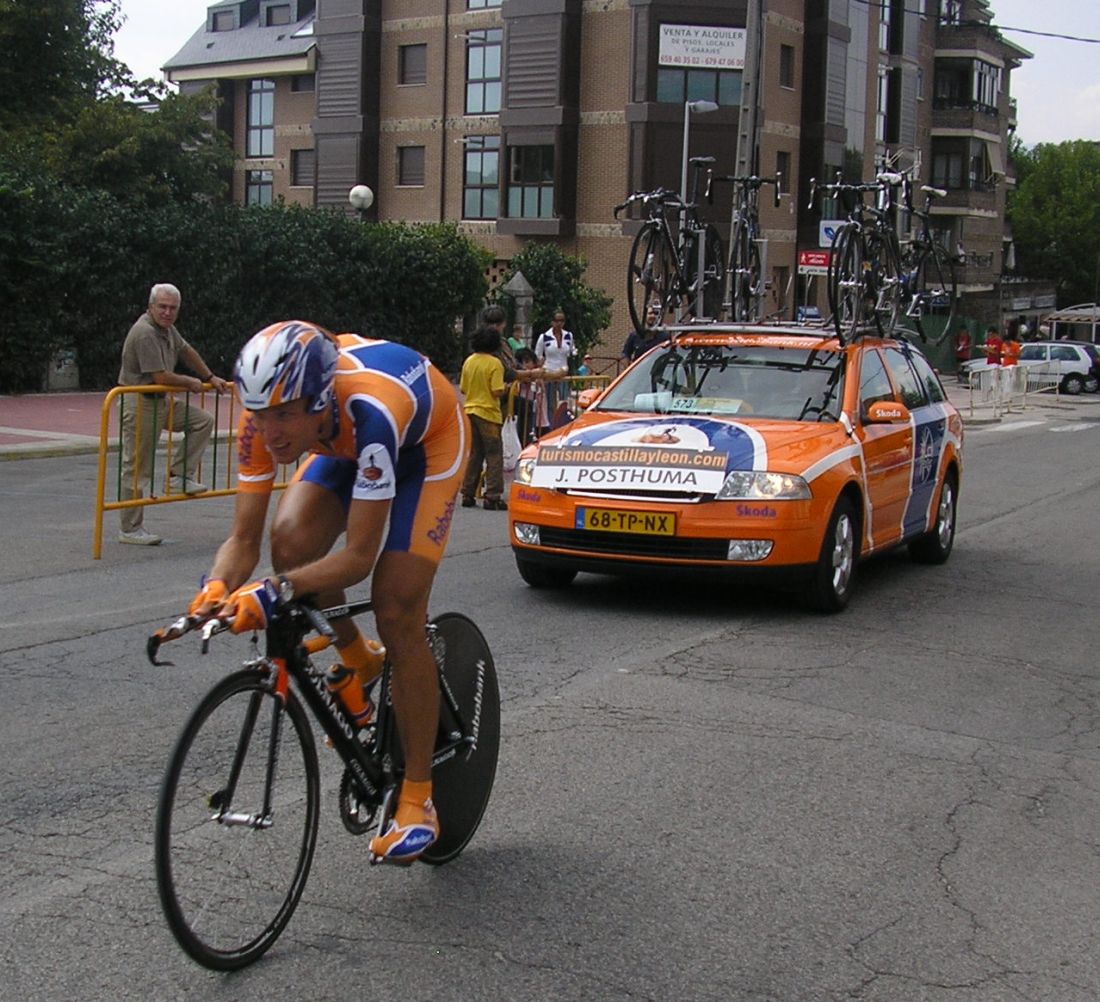
Today Joost Posthuma won a major stage race, the Three Days of De Panne. He did this by placing high in the first three stages and acing this afternoon's time trial. The race is ideal for him since many of Europe's top riders are focussing on Sunday's Ronde van Vlaanderen, a one-day race that is one of Europe's most hotly-contested. Asked about prospects for that race, Joost told an interviewer that Rabobank's Juan Antonio Flecha will be the protected rider. "Flecha is our absolute leader for Sunday," he said, "But if I am in the right place at the right time, I might try for the win. Why not? I exclude nothing."

I post more on this from Joost's web page when he puts something up.

Here are final results from the Belgian site, sporza.

1. Joost Posthuma (Ned) in 14u15'05"
2. Manuel Quinziato (Ita) op 2"
3. Enrico Gasparotto (Ita) 8"
4. Niki Terpstra (Ned) 10"
5. Simon Spilak (Svn) 40"
6. Rick Flens (Ned) 46"
7. Alessandro Ballan (Ita) 53"
8. Magnus Bäckstedt (Zwe) 58"
9. George Hincapie (VS) 59"
10. Luca Paolini (Ita) 1'04"
18. Leif Hoste 1'38"
19. Kurt Hovelynck 1'41"

Wednesday, March 26, 2008

Joost Posthuma update

Time for an update on Joost Posthuma. You'll recall that he was hit by a car while on a training ride last summer. His injuries mended and he recovered his form late in the season. He generally served the Rabobank team in a supporting role through the fall races, but won one race in September, the Sachsen Tour.

Early winter, he took a holiday in Egypt and then went to the team training camp in Spain where he showed himself to be one of the better riders on this very strong team. He gave an Interview in January in which he said he expected his 2008 season to be much like 2007's with the addition of the Olympics. In answers to questions about illegal performance enhancing he said he's sorry drugs have given the sport a bad name and said he supports the stepped-up enforcement that's taking place this year. Concerning his role as support rider rather than team leader he said he likes Rabobank because, though he's not one of the stars, there are still races in which he gets to be the team leader (the protected rider).

He caught the 'flu during one of the season's first races. On recovering, he regained his form and was designated as the team leader for the Tirreno-Adriatico. In this race, a couple days after his 27th birthday, one of the riders in front of him crashed, bringing him down hard and causing a serious injury to his shoulder. He's since recovered from that injury and again regained his form. Today, in his first day back in on the team, he rode very aggressively in an extremely tough race, the Dwars door Vlaanderen. On a cold, wet, and windy day, he kept close to the front of the pack through most of the race then pushed forward to join a group of eight riders who were chasing down a leading group of three. The chase group came very close to closing the gap and in the end Joost made a highly respectable ninth.

Some Joost photos here.

Here are a few from his own web site and other sources (via Google image search):


Tuesday, March 25, 2008

a process of mutual understanding

It's been quite a while since I wrote a post here on financial matters. In fact, though the US is in the midst of a meltdown and on the cusp of recession, there hasn't been much change in the global situation. It's simply becoming more clear that there are serious problems which are not being addressed. The oil-producing states are more than ever awash in US dollars, but haven't shown inclination to redirect their investment of these dollars in the economies of third-world developing nations. The developing nations haven't reformed themselves enough, in fact, to give the oil-rich nations much inclination to invest in them. The newly-rich nations on whom Americans rely for cheap imports and off-shore contract services -- China and India -- haven't been able to lessen their dependence on export of goods and services to the US. The US hasn't reduced its dependence on foreigners to cover its deficits. And the old industrial nations of Europe continue to suffer from low productivity growth.

It seems obvious that concerted international action is needed to make the changes necessary to bring international imbalances into a new dynamic equilibrium in which the US has greater household savings, reduced importation of oil, and stable export growth; in which China has lower household savings and is finally able to cease artificially enhancing the value of its currency; in which Japan solves its interest-rate problems; in which Europe reduces its government-funded social entitlements; and of course in which economic growth in the third-world is sustained by investments by oil producers. But there's little effort being made, that I can see, toward coordinated action to achieve this obvious set of goals.

A Bloomberg reporter named Rich Miller has put together a neat summary of financial difficulties facing Americans at the moment: Recession in U.S. Sows Slower Growth, Weaker Dollar. It's too compact to lend itself to summarizing, so just click and read.

Notice that it almost entirely ignores the global implications of US policy. Difficult though our domestic situation may be, it's made that much more difficult by the interconnectedness of the world's economies. There's great risk in policy decisions which ignore this fact of life.

The biggest of these risks is also one of the least likely, at least in the short run. That is the abandonment of the US dollar as the defacto international standard monetary unit. The existence of this defacto standard permits the US Federal Reserve to undermine the value of the dollar by reducing interest rates and helping to rescue the failing financial system. Foreigners -- the oil producers, export giants, and our partners in the Euro-area -- are all hurt by this devaluation. They see this unilateral action as arrogant and selfish, but -- at least this time around -- there's not much they can do about it.

It's a open question what lesson they will learn from it. If they follow the lead of the US and they too behave defensively, protectively, and selfishly, all will lose. They understand this, but circumstances may make it impossible, or maybe just imprudent, for them to act collectively to solve mutual problems. When one economic entity fosters its own economy at the expense of others, its international partners -- all the world's other economic entities -- come under pressure to do the same.

Isn't this what happened when the US adopted protectionism in the 1920s and didn't the world economy then fall apart in the 1930s? I'm not saying the current situation has much in common with that one, but the same sequence of unilaterality could now be disastrous as it was then.

A book review in the New Yorker calls attention to the need for global ethics. It's germane since world financial polices are a major aspect of these ethics. The book is The Open Road: The Global Journey of the Fourteenth Dalai Lama by Pico Iyer. Here are extracts from the review:
In his public appearances before English-speaking audiences, he prefers to speak of “global ethics” rather than of the abstruse Buddhist concept of Nirvana. Doubtless he doesn’t want to put off the largely secular middle-class Americans in weekend casuals who crowd Central Park to listen to him, but, as Iyer points out, this is also a reaffirmation of a Buddhist philosophical vision in which all existence is deeply interconnected. Indeed, this notion may be why the Dalai Lama was early to grasp the existential and political challenges of globalized human existence, decades before they were underlined by the disasters of climate change.

“For the first time in history,” Hannah Arendt wrote in 1957, “all peoples on earth have a common present. . . . Every country has become the almost immediate neighbor of every other country, and every man feels the shock of events which take place at the other end of the globe.” Arendt feared that this new “unity of the world” would be a largely negative phenomenon if it wasn’t accompanied by the “renunciation, not of one’s own tradition and national past, but of the binding authority and universal validity which tradition and past have always claimed.” . . . .

As China grows unassailable, it is easy to become pessimistic about Tibet, and to imagine its spiritual leader becoming increasingly prey to fatalism. The Dalai Lama’s retreat from the exclusivist claims of ancestral religion and the nation-state can seem the reflex of someone who, since he first copied out his predecessor’s prophecy, has helplessly watched his country’s landmarks disappear. The bracing virtue of Iyer’s thoughtful essay, however, is that it allows us to imagine the Dalai Lama as something of an intellectual and spiritual adventurer, exploring fresh sources of individual identity and belonging in the newly united world.

Certainly, Arendt’s “solidarity of mankind,” enforced by capitalism and technology, has become, as she observed, “an unbearable burden,” provoking “political apathy, isolationist nationalism, or desperate rebellion against all powers that be.” There are few things that Tibetans lashing out at the Chinese presence in Lhasa today fear more than absorption into the ruthless new economy and culture of China. Iyer’s book makes it plausible that the boy from the Tibetan backwoods may be outlining, in his own frequently Forrest Gumpish way, “a process of mutual understanding and progressing self-clarification on a gigantic scale” — the process that Arendt believed necessary for halting the “tremendous increase in mutual hatred and a somewhat universal irritability of everybody against everybody else.” It is hard to see the Dalai Lama bringing about mutual understanding in the world at large when he has failed to bring it about between China and Tibet. Such, however, are the advantages of being a simple Buddhist monk that he is less likely—indeed, less able—than most politicians to compromise his noble ends with dubious means, even as he, following the Buddha’s deathbed exhortation, diligently strives on.


{Photo source: The New Yorker}

a sky full of stars

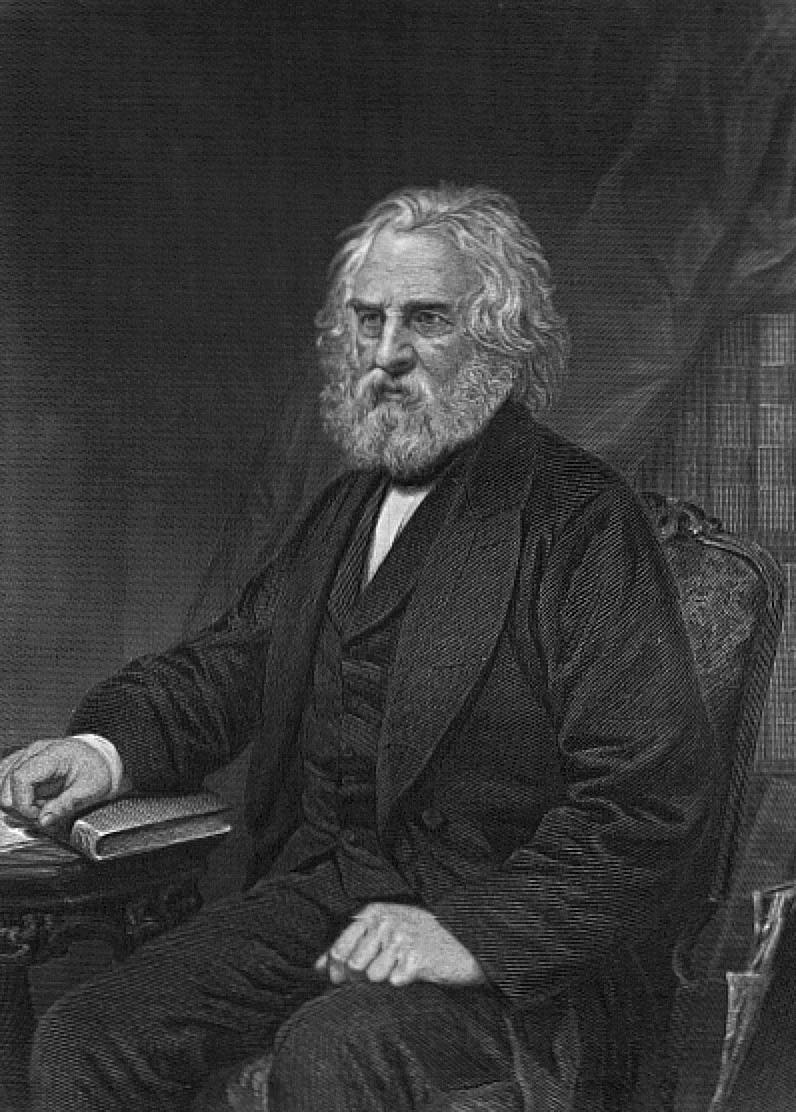
Ralph Waldo Emerson complained that America -- the generation of Americans born after Independence -- needed to find its own voice, needed to stop parroting English masters. And many came who did just that, men such as Walt Whitman and Emerson himself. Henry Wadsworth Longfellow was of this generation, but his originality quotient was low. His epic poem, The Song of Hiawatha, ought to be a soaring, mythic tribute to native Americans, but is instead an embarrassment of sentimentality written in an attempt at native American dance meter which comes off as military-march time. (By the shores of Gitche Gumee, / By the shining Big-Sea-Water, / Stood the wigwam of Nokomis, / Daughter of the Moon, Nokomis.)

So it surprises me to find that I can not only read but actually like one of his poems. Maybe that's because it speaks to me in my present situation. Not great, but quite good. He wrote:
What then? Shall we sit idly down and say
The night hath come; it is no longer day?
The night hath not yet come; we are not quite
Cut off from labor by the failing light;
Something remains for us to do or dare;
Even the oldest tree some fruit may bear;
Not Oedipus Coloneus, or Greek Ode,
Or tales of pilgrims that one morning rode
Out of the gateway of the Tabard Inn,
But other something, would we but begin;
For age is opportunity no less
Than youth itself, though in another dress,
And as the evening twilight fades away
The sky is filled with stars, invisible by day.


This comes from Morituri Salutamus.

Friday, March 21, 2008

raysoda

I'm fond of RaySoda a photosite by a community of amateur and professional photographers, most of them Korean. The subject matter is amazingly various and artistic merit generally excellent. Many images have conventional design values; many have interesting eccentricities. These images show something of the site's breadth and depth. Click to view full size.


$40 billion per year

The widget on top of the right-hand panel shows the cost of the war in Iraq. The numbers include ongoing costs that are directly attributable to the war. They include combat pay, but not regular pay of armed forces. They don't include the cost of interest on the federal deficit that the war makes necessary. They include some replacement of equipment as it wears out in the field. But they do not include the cost of rebuilding military armament as equipment ages throughout the armed forces.

This article in the National Journal explains this last set of costs:
On the sea and in the air, military bills come due, by Sydney J. Freedberg Jr. National Journal March 20, 2008.

excerpts:

On the sea and in the air, America has coasted for two decades on investments made in the 1980s.

Now, after a generation of heavy use around the globe, from Somalia and the Balkans in the 1990s to Afghanistan and Iraq today, hardware bought during the Reagan buildup is simply wearing out.

The chief of the Air Force has said publicly that he needs an extra $20 billion -- per year -- beyond the administration's requested budget to restock his arsenal. Outside analysts suggest that the less-outspoken Navy needs about the same amount. But the services are laying that $40 billion charge for future weapons on a country that is increasingly chafing under the costs of the current war.

With the end of the Cold War, defense spending dropped by $42 billion between 1990 and 1994. Some $39 billion of that came out of the research, development, and procurement budget. So, while the military's expenditures for operations, maintenance, and personnel stayed about level, even as the size of the armed forces shrank, the Pentagon had only about half as much to spend on new equipment.

The services weathered this "procurement holiday" in different ways. The average age of the Air Force's fighter fleet doubled, from less than 10 years old in 1991 to more than 20 today. The Navy made ends meet by retiring older, expensive-to-maintain vessels ahead of schedule, keeping the fleet relatively young at the price of halving its size.

The bottom line for both services was the same: Major new purchases were delayed, stretched out, or cut. This was a stopgap, not a solution. Throughout the 1990s, a growing chorus of defense analysts warned of a coming train wreck, when all of the deferred modernization bills would arrive at once. What they did not expect was that those bills would come due during America's biggest and most expensive war since Vietnam.

It is hard for Defense officials to make a case for supersonic stealth fighters and warships bristling with missiles when policy makers are grilling them about body armor and mine-resistant trucks for troops in battle every day.

The air and sea services certainly make the case for their own relevance. Whether these long-term arguments will shake an extra $40 billion out of Congress is an open question. And whether the services' planned purchases are the right investments for the future is another question altogether.

{Image source: wikimedia}

This article explains military spending estimates in the President's proposed budget for fiscal year 2009: Feeding the military monster warps our spending priorities. It says:
Studies agree that the U.S. spends more on our military than the rest of the world combined. Our Fiscal Year 2008 military budget of some $623 billion is well above the entire rest of the world, which will spend about $500 billion in FY 2008.

For FY 2009, President George W. Bush proposed a military budget of $515 billion, plus $70 billion — at least — for Iraq and Afghanistan; total: at least $585 billion. But even before the ink was dry on the FY 2009 budget, Defense Secretary Robert Gates admitted the total would be closer to $685 billion. What's a hundred billion between friends?

Tuesday, March 04, 2008

"he drew great mud"

I came across a review of a book on Bill Mauldin and thought I'd show off some of his cartoons. Famous for the Willie and Joe panels that appeared in the Army newspaper, Stars and Stripes, during World War II, he became a successful editorial cartoonist in later life.

Here's the lead of the review:
‘He Drew Great Mud’ by DAVID MICHAELIS
Published: March 2, 2008

Until surprisingly late in World War II, Army cartooning consisted of gags about mean old drill sergeants and raw recruits on K.P. duty. Then came Bill Mauldin, an impish rifleman from the 180th Infantry Regiment, who volunteered as a cartoonist for The 45th Division News. On July 10, 1943, he stumbled ashore, pistol drawn, in the Allied invasion of Sicily and went on to fight in the Italian campaign while turning the raw material of the front into captioned panel cartoons, often at the expense of superiors in the rear. Mauldin listened to his fellow dogfaces in their foxholes and sketched quickly, sometimes rendering finished work on the back of whatever scrap he could find in the rubble.
I hope these explain themselves. I've tried not to put in anything that's explicitly in copyright and claim fair use where I'm mistaken.


Fresh, spirited American troops, flushed with victory,
are bringing in thousands of hungry, ragged,
battle-weary prisoners. (News item)


"Radio th' ol' man we'll be late on account of a thousand-mile detour."


"Them buttons wuz shot off when I took this town, sir."


"Able Fox Five to Able Fox. I got a target but ya gotta be patient."


"I'll let ya know if I find th' one wot invented th' 88."


"Nonsense. S-2 reported that machine gun silenced hours ago. Stop wiggling your fingers at me."


"You blokes leave an awfully messy battlefield."


"Ya don't git combat pay 'cause ya don't fight."


Saturday, February 23, 2008

Vietnam through Hayden's eyes

I recommend an article called The Old Revolutionaries of Vietnam by Tom Hayden (from the March 10, 2008 issue of The Nation). People my age remember Hayden for his SDS presidency and the Port Huron Statement, his arrest at the 1968 Chicago convention, his political work in California and, most of all, his opposition to the war in Vietnam. We also remember that he likes to be in front of cameras and is attracted to Hollywood celebritydom. He divorced his first wife to marry Jane Fonda and when they divorced he married another actress. Reading his bio in wikipedia, I found that he's done some admirable low-profile political work which belies the publicity-hound image you might get of him from the many headlines in which his name has appeared over the decades.

The article is short and relatively free of bombast. It shows Hayden's nostalgia for the ideals of the 1960s and his current opposition to our culture's superficiality and the growing inequality of haves and have-nots. It also shows the difficulty he has in coming to terms with the quick-growth economic policies of the current socialist government in Hanoi. He says, "far be it from me to question the desire of Vietnamese to share our globalized consumer culture like everyone else," but it's obvious that's not the outcome he would have wanted.

He tells of secular Santa Clauses and Christmas carols in Hanoi's shopping district and quotes a young Vietnamese blogger: "I have only one dream is buy one of brand new Harley-Davidson, now I waiting for Harley-Davidson deal to open in Saigon. I need a Fatboy."

Much of the article is given over to reminiscences with Vietnamese members of the old guard whom he sought out on a visit to Hanoi last Christmas. They, like he, are saddened by the younger generation's loss of revolutionary fervor, its wholesale adoption of American values, and its growing passion for material possessions.

One says, "Look carefully now at the peace we have, painful, bitter, and sad. And look who won the war. To win, martyrs had sacrificed their lives in order that others might survive. Not a new phenomenon, true. But those still living to know that the kindest, most worthy people have all fallen away, or even been tortured, humiliated before being killed, or buried and wiped away by the machinery of war, then this beautiful landscape of calm and peace is an appalling paradox." Another says, "The government is trying to reduce poverty, but it's already a reality. The rich are getting richer because they have the means. And the poor don't. We are better off materially, but not mentally, ethically."

In the end, he resists the temptation to bludgeon the reader with the old-timers vs. youngsters dichotomy. Here are the closing paragraphs:
Finally, there was a visit to my oldest friend, Do Xuan Oanh, who first greeted me at Hanoi's airport on a December day forty-two years before. He went through a "bitter period" after retirement, someone told me, but was feeling better, having recently translated into English an edition of Vietnamese women's poetry. He lived alone, his wife having died after many years of illness, his three sons all abroad. As I remembered him, Oanh loved America in unique ways. For example, after learning English from the BBC, he translated Huckleberry Finn into Vietnamese, a massive challenge. A musician, he could sing many American protest songs. A romantic, he wept easily and became close to many Americans.

Now, in a carload of old revolutionaries, I traveled along a narrow cement path past houses, until we came to the gate of Oanh's home of fifty years. He was standing in the door, a thin shadow of the Oanh I remembered. Taking my hand, he led me into a windowless room where a couch and piano were the most prominent fixtures. There were alcoves for painting and a kitchen. We sat and looked at each other. He held my hand on his knee, while the others sat in a quiet circle. It was more a last visit than a time to renew an old conversation.

"Do you want some booze?" Oanh asked with a low chuckle, pointing to a half-bottle of Jim Beam. I deferred, worried what might happen after a few drinks. My wife said Oanh seemed fit and energetic for an 85-year-old. She asked if he would play the piano, and he performed an original piece in a classic European style. He gave me a copy of the song, signed to his "precious friend," and a small carving of a beautiful Vietnamese woman carrying a student briefcase, which he said reminded him of his wife "before the revolution." He repeated the phrase, then relaxed. Gradually, the others began to reminisce about the old days. I wondered if we would ever meet again. I remembered an e-mail from Oanh's son in San Francisco: "I believe God assigned my father and myself to serve the American people." His son would come for a visit in the summer, Oanh said.

We walked back along the dark path to the street filled with motorbikes and strolling couples out for a coffee. Oanh looked at me intently, pointing a finger for emphasis. "Nothing can be predicted," were his last words before we said goodbye.
Hayden has his own website and he blogs on Huffington Post. Noting that he was a community organizer in Newark, New Jersey, in the mid-1960s, at the same time Leroi Jones (Amiri Baraka) was there, I did a Google search and turned up a fascinating bit of history. This comes from Alan Ginsburg's description of his FBI file:
Ginsberg said that some of the papers in his file come from related customs and Treasury Department investigative bureaus. His file crisscrosses those of other writers. "They include Leroi Jones, who was the victim of much more attack than people understand and, in that context, his anger is understandable," Ginsberg said. "Most people don't realize what he and other black literati have been through, assuming that all past injustices have been redressed or somehow disappeared out of mind. The waste remains, the waste remains and kills. The section on Tom Hayden in Newark intersects with Jones, since Jones was influenced by an FBI misinformation campaign to denounce Hayden as an [FBI] agent and drive him out of Newark.
{Source: Allen Ginsberg's FBI file from Herbert Mitgang, Dangerous dossiers : exposing the secret war against America's greatest authors (New York : D.I. Fine, 1988)}
Addendum: Leroi Jones comes up in a post on this blog a few months back: two women. I was given his book, Blues People, as a Christmas present and have half a thought to do a blog post on him one day.

Sunday, February 17, 2008

Clarissa, samurai

Not long ago I made a case for Clarissa as existentialist hero and found I was not alone in holding this view.  I drew some parallels between existentialist authenticity and religious insights: the visions of mystics as to the wholeness of things, of eternity and emptiness, of life and death. I linked both to Zen Buddhist percepts and made a final connection with the goals of samurai warriors and the guides for achievement of those goals, particularly Musashi's Book of Five Rings

There's no evidence that Virginia Woolf was directly influenced by Kierkegaard, Heidegger, or another of the existentialist thinkers (so-called), nor by any practitioners of Eastern philosophies; and it's a good guess that she never read a samurai sword fighting manual.  It's true that some of the popular philosophies of the day were congruent with existentialism, mystic perceptions of wholeness, and the Japanese ethics of Zen and samurai.  The influence on T.S. Eliot of the philosophies of India are well known and, during the years VW was developing her ideas for and then writing Mrs. Dalloway, her complex relationship with Eliot was evolving into a close friendship.  At the same time G.E. Moore was writing and speaking about his ideas on intuition and collective states of mind which have something in common with Eastern thinking.  And he too was part of Woolf's circle of friends.  But these are tenuous connections.  VW might have absorbed some of her ideas on continuity and expansion from others, but nothing even remotely tending toward the writings of Miyamoto Musashi.  The parallels I find in Mrs. Dalloway and existentialism, Zen, and samurai training are coincidental ones.  They're nothing she intended.

But present all the same.

In Mrs. Dalloway, Clarissa's personal growth and final realization are those of a samurai.  To be sure, there is much about her that protests this characterization.  She is far from the time and place of the samurai, a creature of 20th-century England.  She is a woman and samurai are men.  Moreover the cultural milieu of Japanese society in the time of the samurai was resolutely masculine.  Women were subjugated to second-class status. 

Still, she possesses what we used to think of as aristocratic attributes --  poise, bearing, dignity, humility.  Peter points out these attributes in her.  The samurai aspired to the same. 

She has an unselfconsious grace.  During the course of the novel, she becomes more and more self-possessed.  The reader can visualize development of her senses of balance and rhythm, an ability to dispel inner tension so as to become relaxed and alert, self-respect sufficient to keep her from being easily intimidated, ability to empathize, freedom from prejudice, clear-headedness, ability to resist mindless adherence to social conventions, ability to be either reticent or communicative as occasion calls for.  One might debate the extent to which VW shows Clarissa's personal growth to include all these abilities to which samurai aspired, but they belong to her as a cluster of traits in greater or lesser degree.

There's no doubt that she shares with samurai her highly-developed powers of observation and perception, an instinctive awareness not just of the objective world but of its moral, aesthetic, and metaphoric content.  WV tells us how Clarissa sees things and Peter does not, how she must make him put on his glasses to see what is around him.  But more than seeing, she comprehends.  As VW tells us, she knew people by instinct, "If you put her in a room with some one, up went her back like a cat’s; or she purred." 

And she has a samurai ability to remove herself from the context of the moment, to release herself from the busy noise of thoughts running through her mind, to shake off distracting complacencies, and to make instantaneous, intuitive judgments.  As VW says, "She sliced like a knife through everything; at the same time was outside, looking on. She had a perpetual sense, as she watched the taxi cabs, of being out, out, far out to sea and alone; she always had the feeling that it was very, very dangerous to live even one day."

Clarissa knows how to position herself so as to remain grounded, as when she is receiving her guests, has the knack of perceiving her milieu all at once, of experiencing emotions fully and not blocking off their free flow through her and out of her. 

She knows that she is not strong -- not physically strong (particularly so as a recovering invalid), not strong by right of political or social accomplishment, not strong by fame or inherited position -- but her weakness is not a liability.  During the course of the novel she comes to understand the samurai (and also Zen) paradox of weakness as a source of strength. 

All these are samurai affinities that Clarissa possesses, comes to possess, or shows aptitude for possessing as she continues he life-path.

Clarissa's eventual ability to accept unflinchingly the pointlessness of existence and, beyond that, her faith in goodness without promise of religious rewards is also samurai.  As VW has Peter think, "To see your own sister killed by a falling tree ... before your very eyes, a girl too on the verge of life, the most gifted of them, Clarissa always said, was enough to turn one bitter. Later she wasn’t so positive perhaps; she thought there were no Gods; no one was to blame; and so she evolved this atheist’s religion of doing good for the sake of goodness."

As I say, it's quite common for religions to tell of adepts (mystics, say) who can achieve a sense of oneness with the universe and all that it contains.  But both Zen and samurai (neither of them a religion of mystical revelation handed down by God) take this a step further.  They see the possibility that people can achieve this completeness repeatedly in the affairs of ordinary life.

Eiji Yoshikawa expresses this in his novel, Musashi.  He presents the swordsman as a brash youth who gets put on the path to enlightenment by an eccentric Zen monk who treats him abominably. He demonstrates his Buddhist reverence for all life forms by tricking Musashi, tying him high up in a tree, and to all appearances leaving him to die of exposure. This tough love works, turning Musashi from a thug into a devoted student of samurai. Thereafter , in hundreds of sword contests Musashi is never defeated but his amazing success does not lead him to believe he has mastered his art.  Frequently these fights are over a microsecond after they start.  Musashi parries an attack and counters with such blinding speed that no one present sees what has happened, even his adversary can't immediately comprehend how rapidly he has been defeated.  Gradually, Musashi comes to understand that there are men who can overcome him without use of any weapon, merely by force of personality, by intangibles of which he's only vaguely aware, such as the breadth of their understanding,  their creativity, their mastery of high art, all conveyed wordlessly in the way the hold themselves, by their calm dignity -- a kind of charisma, though that is not quite the right term for it. 

We say that the possession of charisma gives a person power over others.  Stated this way it sounds like charisma is an attribute, but samurai charisma is better seen as a fullness, an authenticity, a freedom from self-deception.  This form of charisma isn't something you aim to get so you can have power, but something that conveys a gentle self-possession -- not authority, nor strength, but rather a state of being vulnerable without being weak.  It's only perceived as power.

I'm less than half-way through the book, but eventually I believe Yoshikawa will describe how Musashi develops a technique called "no-sword" based on this understanding of artistic achievement. 

VW shows us that Clarissa is developing a skill in no-sword contests with an opponent in her encounters with Peter.  Always bickering -- his puncturing of her aesthetic, emotional joys -- flowers as vegetables, his preference for men over cauliflowers, his trivializing Clarissa's moment with Sally as star-gazing.  Their first encounter is a contest with everything that's important left unsaid, but intuited all the same.  He with his knife out.  She with her sewing needle, her scissors. 

Clarissa and Peter confront each other not just with weapons, but with their emotions, memories, the weaknesses that give them strength.  And, in this contest and as the novel progresses, Peter remains what he is and has been, while Clarissa develops her competence, learns how to exist fully in the moment, how to be real.  This growth and its culmination in authentic being -- with the gift of a the life of a stranger, thrown away -- bring Clarissa not just to existential fulfillment, but also to a samurai mastery, the mastery of a Zen art.

You can imagine two warriors facing off for a contest in VW's descriptions of Peter and Clarissa. 

Her recall of his past thrusts at her: "Cold, heartless, a prude, he called her. Never could she understand how he cared. But those Indian women did presumably— silly, pretty, flimsy nincompoops. And she wasted her pity. For he was quite happy, he assured her—perfectly happy, though he had never done a thing that they talked of; his whole life had been a failure. It made her angry still."

His positioning himself defensively: "Then, just as happens on a terrace in the moonlight, when one person begins to feel ashamed that he is already bored, and yet as the other sits silent, very quiet, sadly looking at the moon, does not like to speak, moves his foot, clears his throat, notices some iron scroll on a table leg, stirs a leaf, but says nothing—so Peter Walsh did now. For why go back like this to the past? he thought. Why make him think of it again? Why make him suffer, when she had tortured him so infernally? Why?"

Their first moves. first his: "'Well, and what’s happened to you?' she said. So before a battle begins, the horses paw the ground; toss their heads; the light shines on their flanks; their necks curve. So Peter Walsh and Clarissa, sitting side by side on the blue sofa, challenged each other. His powers chafed and tossed in him. He assembled from different quarters all sorts of things; praise; his career at Oxford; his marriage, which she knew nothing whatever about; how he had loved; and altogether done his job. "

Then hers: "She flattered him; she fooled him, thought Clarissa; shaping the woman, the wife of the Major in the Indian Army, with three strokes of a knife. What a waste! What a folly! All his life long Peter had been fooled like that; first getting sent down from Oxford; next marrying the girl on the boat going out to India; now the wife of a Major in the Indian Army—thank Heaven she had refused to marry him! Still, he was in love; her old friend, her dear Peter, he was in love.

And at the end, Clarissa's ability to be fully vulnerable, gives her an edge: "Take me with you, Clarissa thought impulsively, as if he were starting directly upon some great voyage; and then, next moment, it was as if the five acts of a play that had been very exciting and moving were now over and she had lived a lifetime in them and had run away, had lived with Peter, and it was now over."

And it is all quickly over.  Clarissa has bested Peter, but not so as to defeat him: "Now it was time to move, and, as a woman gathers her things together, her cloak, her gloves, her opera-glasses, and gets up to go out of the theatre into the street, she rose from the sofa and went to Peter. ... And it was awfully strange, he thought, how she still had the power, as she came tinkling, rustling, still had the power as she came across the room, to make the moon, which he detested, rise at Bourton on the terrace in the summer sky."

This power of Clarissa's is ineffable.  As the rest of the novel unfolds, it's possible, more and more, to see in it the elements of samurai greatness.

Thursday, February 07, 2008

Clarissa's Party: conversation

Clarissa's Party

1. Conversation, communication, communion, threads of connection

Virginia Woolf's Mrs. Dalloway continues to occupy my thoughts.

Clarissa's party, which is the climax of the story, is not simply a social gathering. She and those who serve her spend the day preparing for it.

She sends invitations, orders the flowers, mends her dress, and sees that the rooms are ready to receive her guests.

Clarissa cannot call this conversation into being by herself; rather she creates conditions that are favorable. She uses her skill and intuition as an artist; her party is a creative venture. Virginia Woolf helps us see this:
What did it mean to her, this thing she called life? Oh, it was very queer. Here was So-and-so in South Kensington; some one up in Bayswater; and somebody else, say, in Mayfair. And she felt quite continuously a sense of their existence; and she felt what a waste; and she felt what a pity; and she felt if only they could be brought together; so she did it. And it was an offering; to combine, to create; but to whom?

She has decided to have no music, no dancing. And, despite a second-guessing about this decision, she's right to leave entertainment to the guests themselves. She has brought together a mix of people at this particular place and time for one main purpose: to converse.

What seems superficial conversation is much more. The word conversation, in this context, has overtones from its antique meaning: it's the action of showing one's character, displaying one's course of life. To converse, in this context, has overtones of another antique meaning: to move within a circle of acquaintances, to establish and maintain threads of connection.

What happens is not just talk.

This is communication, in a broad sense, the sense that John Dewey gives it. He said it's the way people make links among themselves, acknowledging and sharing a common experience. They establish and reinforce these links as they converse. The process enhances each person's sense of self -- individuality -- and also gives the group a sense of its collective existence and it strengthens the ties that bind the group together. More than that, he said there's no pure individuality. We're all an inextricable mixture of personal and social attributes. There's no perceptible point at which an individual's sense of self ends and that person's sense of belonging begins.

Virginia Woolf shows us the guests arriving, each publicly announced by name to the assembly. At that point their individual identities are most pronounced. And this identity decreases as their participation in the communal flow grows.
Every one was unreal in one way; much more real in another. It was, she thought, partly their clothes, partly being taken out of their ordinary ways, partly the background, it was possible to say things you couldn’t say anyhow else, things that needed an effort; possible to go much deeper. But not for her; not yet anyhow.

Her party shows us the hum of existence, complex interactions of individuals.

People circulate through the rooms. Everyone talks animatedly.

Earlier in the novel, Virginia Woolf has given us the image of a thread -- the thread of a spider, or of the fine silk thread Clarissa uses to mend her dress. After lunch at Millicent Bruton's, Hugh and Richard remain connected to her by this ethereal link. The connection is a single spider's thread, stretching and getting thinner as they walk down the pavement. She, in releasing her consciousness into dreams, loses hold on her end of it "as a single spider’s thread is blotted with rain-drops, and, burdened, sags down." A few moments later, Richard's love for Clarissa figuratively manifests as a single spider’s thread, which, "after wavering here and there attaches itself to the point of a leaf." Woolf uses the image again to show us the esoteric communication of the old woman's love song at the Regents Park tube station: "Cheerfully, almost gaily, the invincible thread of sound wound up into the air like the smoke from a cottage chimney, winding up clean beech trees and issuing in a tuft of blue smoke among the topmost leaves." Woolf associates these threads with the bonds of affection, but also the life force itself, the "thread of life" as she expresses it.

The novel also gives us images of flight and wind. Birds take flight, an airplane writes diaphanous messages in the sky, the warm June breezes blow, gentle and strong. In Clarissa's home "gently the yellow curtain with all the birds of Paradise blew out and it seemed as if there were a flight of wings into the room, right out, then sucked back. (For the windows were open.)"

And of windows -- windows that open out to the world, shop windows displaying merchandise, the curtained windows of the Prime Minister's car, the window across the way which Clarissa looks into to observe her friend, the old lady who lives there, the window out of which Septimus jumps to his death. Windows open to the ecstasies of her youth as, in her memory, she steps through French windows at her beloved Bournton. One is also imagined as helping the soul of a dead woman regain the unknown space from which it came: a woman "opening the window of the room where [another] had just brought off that act of supreme dignity."

And bells. Big Ben which, when we hear it, locates locates us in Westminster; which tolls to mark each moment of precious time, which tells of the day's many events. Bells always signify clocks and clocks signify measurement, the antithesis of the imponderable flow from eternity past into eternity future. Bells are the beat of time kept by clocks.

In using the images Woolf helps us understand the greater meaning of the party as it unfolds. The images help us to visualize the many interconnections among the party's guests, growing more intense as more people arrive until finally a sort of critical mass is achieved.

Clarissa observes the exact moment when this occurs: when Ralph Lyon beats back the curtain: "The curtain with its flight of birds of Paradise blew out again. And Clarissa saw—she saw Ralph Lyon beat it back, and go on talking. So it wasn’t a failure after all! it was going to be all right now—her party. It had begun. It had started. But it was still touch and go. She must stand there for the present. People seemed to come in a rush." For Ralph Lyon, the flow of time is no longer of consequence; his concentration is on the conversation of the moment, however long that moment might stretch out in time. Clarissa's creativity has made it possible for the party to have its own being, temporarily outside time.

At the moment Ralph Lyon beats back the curtain, Woolf reminds us of the images she has been using: birds, flight, a breeze, the window. The threads of connection are not mentioned but implicit. For as she stands, greeting the individual guests as they arrrive, she has a momentary thought, one that's interrupted before she gets to its conclusion: "a sense one had" she says to herself, and Woolf adds "as they came up the stairs one after another." Obliquely to be sure, this succession of arrivals suggests the thread-of-connection image. So does the motion of Clarissa, circling around the packed rooms, moving from one little group to the next, to the next.

She has created the conditions for this moment through her own and her servants' careful preparations. One of the most important of these is the list of invited guests. This importance is seen in the problem of Ellie Henderson. Clarissa does not want to invite her because she knows Ellie will not be an active participant. She is a dangerous guest, in Clarissa's view, because she is disengaged. For the party to succeed, everyone must contribute to make the whole come alive as an organic entity, a creation to which Clarissa contributes her virtuosity, but which is ultimately made by them all.

The importance of this detail shows also in the actions of Peter and Sally. Both were last-minute additions to the list of invited guests. A bit confusingly, Clarissa tells Peter she will not invite him, but then does. She has no choice in this. But they resemble Ellie more than they resemble the other guests. The are not part of the flow, don't enter into the community of conversation. Instead they take themselves apart, speaking only to each other -- and briefly to Clarissa. Their isolation helps show the social cohesion of the others.

Guests arrive over an extended period of time. One of the last couples, Sir William Bradshaw and his wife, might be thought to be as unwelcome as Ellie Henderson, but this is not so. Clarissa disliked Bradshaw; he coerced people; he was evil. Yet these were not reasons to keep him from her party. He converses, making connections with the others in the room, showing himself as he is, contributing to the scene as it evolves.

Woolf shows the importance of Bradshaw, the enemy, being present when Clarissa thinks of another enemy, "Kilman" -- the man killer whom Clarissa, with all her impeccable manners, cannot bring to call "Miss" when she comes to mind. Of Kilman she now thinks "she hated her: she loved her. It was enemies one wanted, not friends." How is this? Partly at least the cause is Clarissa's growing realization of about the chain of being -- the community which Clarissa has made possible is an instance of this chain. She has arranged for it to welcome active participants whose presence, whether by reinforcement or contradiction, helps its individual members realize their real, genuine selves.

Peter's thoughts show us Clarissa at this moment, as she moves about the rooms. She has "the most perfect ease and air of a creature floating in its element." And she has "that gift still; to be; to exist; to sum it all up in the moment as she passed." It's a gift of hers to be able to manifest in her bearing, her presence, all that is right in the occasion -- her party.

Sunday, February 03, 2008

shared space

Shared Space

I live on a street that's barely two lanes wide. That is, two on-coming cars can pass each other but two large trucks cannot. It's a two-way street with parking on one side. When cars approach from opposite directions, one must usually pull over so the other may pass.

The street has sidewalks and during much of the day, the sidewalks have pedestrians: women and children going to and from the school at the end of the block and its playground; commuters going to and from the major bus route at the end of the street; people running errands; and various helpers -- caretakers, maids -- who come and go to their work in the neighborhood homes.  It's a family-friendly place.  And it's quite unusual. Streets in new residential neighborhoods, ones that meet current standards, are more than twice as wide. We have about 30 feet from the edge of one sidewalk to the edge of the other across the way. The standard calls for this width to be 70 feet. But 70 feet, though appropriate from a traffic engineering point of view, is not a humane distance. It doesn't foster community. The new subdivisions with enormous streets, feel sterile and unwelcoming compared to our more human-scale space.


Our environment isn't teeming with humanity like the Mulberry Street of 1900 which I blogged not too long ago, but it's not as empty as the new subdivisions farther out in the suburbs.


Its streets have shared space in the sense that they aren't totally dominated by the needs of motor vehicles. This gives them quite a bit in common with experimental shared-space urban areas in Europe and other places.

Here's a definition
of the term: "Shared space is a term used to describe an approach to the design, management and maintenance of public spaces which reduces the adverse effects of conventional traffic engineering. The shared space approach is based on the observation that individuals' behaviour in traffic is more positively affected by the built environment of the public space than it is by conventional traffic control devices (signals, signs, road markings, etc.) and regulations.

"

Since it has stop signs, my neighborhood doesn't have shared space as outlined in this definition. It's also almost entirely residential. It isn't a mixture of apartments and commercial space -- places where people go to drink coffee, shop for books, buy bread, and the like (though it does have shops within walking distance).

This shared space exists in , where we spent some time last June.

Some of the characteristics are also present in Kensington, a town a bit to the north of us.

It's pleasant to fantasize about a life both free of traffic control and also blessed with people who are civil to one another -- considerate, unhurried, convivial. But outside the special situations created to ensure that -- as much as possible -- the second condition accompanies the first, I don't see this happening. In fact, as a bike commuter, I'm sure I wouldn't appreciate the time I would lose if my crossing of every intersection had to be negotiated with appropriate politesse.

It's a concept that works in my neighborhood -- at least most of the time. And it's one I treasure in cities and towns that I visit. But until everyone lives within walking distance of job, merchants, service organizations, and other needs -- or until humankind has learned to get about by means other than cars, it ain't gonna happen.


Here are some shared-space links:

- Shared Space: home page for seven pilot projects in: Province of Fryslân (Lead Partner, the Netherlands), Municipality of Emmen (the Netherlands), Municipality of Haren (the Netherlands), Municipality of Ejby (Denmark), Municipality of Bohmte (Germany), Suffolk County Council (United Kingdom) and Municipality of Oostend (Belgium).

- Wikipedia article

- Lose the Traffic Lights to Improve Our Streets?, Written by Joshua Liberles.
Wednesday, 23 January 2008

- A civilising influence, By Clare Dowdy. Published: April 20 2007 18:37 | Last updated: April 20 2007 18:37

- "Shared Space" Traffic Calming: Counterintuitive, But It Works, Erica Barnett. January 4, 2008 2:46 PM

- Sharing street space for a safer Bohmte, Posted by: Jeannie Choe on Friday, January 25 2008.

- A Green Light for Common Sense, To Slow Drivers, German Town Drops Traffic Signals and Lane Markers. Monday, December 24, 2007.

- The shared-space: Shared Space is a European project with the purpose of developing new policies for the planning of public space. For this purpose, a new view regarding the planning of public space is applied in seven pilot projects. The essence of the new approach is that people’s behaviour in the street is stronger affected by expression of the surroundings than by the application of the usual traffic instruments such as speed bumps, traffic islands, or pedestrian crossings.

Photo from the Washington Post:
Bohmte, Germany, has been tearing out stop signs, traffic lights and sidewalks since September to force drivers and pedestrians to share the pavement, in an approach known as shared space. Several towns across Europe have undertaken similar measures.
(Photos By Craig Whitlock -- The Washington Post)

Here's a shared-space video link.

Friday, February 01, 2008

Clarissa and a man named Smith

I'm working on a post I'll call "Clarissa and Virginia" in which I'll give my thoughts on how Clarissa evolved and how she counterbalances Septimus in Mrs. Dalloway. This quick post concerns one little corner this thinking: how Virginia Woolf perceives "reality" in literature. She participated in a lengthy debate with Arnold Bennett about description from the outside vs. from the inside in the modern novel. Woolf argued that the author should let the reader see chacters' thoughts, feelings, and memories -- their and multi-layered sense of the present moment. Bennett accused her of being too clever and too fanciful; he said she intellectualized where she should have been "genuine." She smarted under the accusation because she did want to be genuine (this is her word), but she wanted to depict the whole of reality, not just its surface.

There's a section in one of her essays that deals with the reality that lies below the surface. In it she says there's no single reality that we all acknowledge to exist. In fact truth is frequently more fanciful than prosaic: "We know indeed that this reality is a chameleon quality, the fantastic becoming as we grow used to it often the closest to the truth, the sober the furthest from it, and nothing proving a writer's greatness more than his capacity to consolidate his scene by the use of what, until he touched them, seemed wisps of cloud and threads of gossamer."

This treatment of truth, with its conclusion that a writer achieves greatness when able to direct the reader's perception below the surface without sacrificing verisimilitude, leads me to see what what it was that Woolf was attempting to achieve -- did achieve -- in her characterizations of Septimus and Clarissa.

She gives both these characters a intense perception of their surroundings. For Septimus, the perception is not hallucinatory, but he sees it as an aberration, a heightened sense of reality that normal people do not possess. For Woolf, this is one aspect of his insanity. Clarissa also has an intense awareness of things, but she is the author's "sane" character.

The difference between the two seems to lie in the degree of each character's self-control. Septimus has no control. He is emotionally drained, prey to his perceptions. Woolf described an episode of this nature from her own life. It appears in her diary entry for a day in the period in which she was writing Mrs. D. The entry shows Woolf herself to have an uncontrolled Septimus-like stepping outside normal reality with heightened awareness of what's around her. I've put the entry at bottom of this post.

Clarissa does not have attacks of this nature. She perceives things brilliantly but is not a victim of the "the old devil" who "has once more got his spine through the waves" (Woolf's words in the diary entry).

As I see it, Clarissa has found the method of controlled perception as does Woolf's imaginary playwright in the following passage. That is, she can let her fancy range free and also keep herself grounded in that reality which, to the Bennett's of the world, is genuine. She can perceive both poetic and prosaic truth. She can, as the passage has it, both wander in the land of the unicorn and also keep one toe touching Liverpool.

This passage is from an essay on which she was working while she was writing Mrs. D: NOTES ON AN ELIZABETHAN PLAY

extracts:

At the outset in reading an Elizabethan play we are overcome by the extraordinary discrepancy between the Elizabethan view of reality and our own. The reality to which we have grown accustomed, is, speaking roughly, based upon the life and death of some knight called Smith, who succeeded his father in the family business of pitwood importers, timber merchants and coal exporters, was well known in political, temperance, and church circles, did much for the poor of Liverpool, and died last Wednesday of pneumonia while on a visit to his son at Muswell Hill. That is the world we know. That is the reality which our poets and novelists have to expound and illuminate. Then we open the first Elizabethan play that comes to hand and read how

I once did see In my young travels through Armenia An angry unicorn in his full career Charge with too swift a foot a jeweller That watch'd him for the treasure of his brow And ere he could get shelter of a tree Nail him with his rich antlers to the earth.

Where is Smith, we ask, where is Liverpool'? And the groves of Elizabethan drama echo "Where '?" Exquisite is the delight, sublime the relief of being set free to wander in the land of the unicorn and the jeweller among dukes and grandees, Gonzaloes and Bellimperias, who spend their lives in murder and intrigue, dress up as men if they are women, as women if they are men, see ghosts, run mad, and die in the greatest profusion on the slightest provocation, uttering as the fall imprecations of superb vigour or elegies of the wildest despair. . . .

Is it not that literature, if it is to keep us on the alert through five acts or thirty-two chapters must somehow be based on Smith, have one toe touching Liverpool, take off into whatever heights it pleases from reality? We are not so purblind as to suppose that a man because his name is Smith and he lives at Liverpool is therefore "real". We know indeed that this reality is a chameleon quality, the fantastic becoming as we grow used to it often the closest to the truth, the sober the furthest from it, and nothing proving a writer's greatness more than his capacity to consolidate his scene by the use of what, until he touched them, seemed wisps of cloud and threads of gossamer. Our contention merely is that there is a station, somewhere in mid-air, whence Smith and Liverpool can be seen to the best advantage; that the great artist is the man who knows where to place himself above the shifting scenery; that while he never loses sight of Liverpool he never sees it in the wrong perspective.

-- From: The Common Reader, First Series, by Virginia Woolf (1925), pp 74-75.


From the Diary:
Monday, 15 October, 1923 -- -- Hogarth

This last entry seems long ago. And I meant to record for psychological purposes that strange night when I went to meet Leonard & did not meet him. What an intensity of feeling was pressed into those hours! It was a wet windy night; & as I walked back across the field I said Now I am meeting it; now the old devil has once more got his spine through the waves. (but I cannot re-capture really). And such was the strength of my feeling that I became physically rigid. Reality; so I thought, was unveiled. And there was something noble in feeling like this; tragic, not at all petty. Then cold white lights went over the fields; & went out; & I stood under the great trees at Hord waiting for the lights of the bus.

And that went by; & I felt lonelier. There was a man with a barrow walking into Lewes, who looked at me. But I could toy with, at least control all this, until suddenly, after the last likely train had come in I felt it was intolerable to sit about, & must do the final thing, which was to go to London. Off I rode, without much time, against such a wind; & again I had a satisfaction in being matched with powerful things, like wind & dark. I battled, had to walk; got on; drove ahead; dropped the torch; picked it up, & so on again without any lights. Saw men & women walking together; thought, you're safe & happy I'm an outcast; took my ticket; had 3 minutes to spare, & then, turning the corner of the station stairs, saw Leonard, coming along, bending rather, like a person walking very quick, in his mackintosh. He was rather cold & angry (as, perhaps was natural). And then, not to show my feelings, I went outside & did something to my bicycle. Also, I went back to the ticket office, & said to the humane man there, "Its all right. My husband caught the last train. Give me back my fare" which he did. And I got the money more to set myself right with Leonard than because I wanted it. All the way back we talked about a row (about reviewers) at the office. ( & all the time I was feeling My God, thats over. I'm out of that. Its over. Really, it was a physical feeling, of lightness & relief & safety. & 'j there was too something terrible behind it -- the fact of this pain, suppose; which continued for several days -- I think I should feel it again if I went over that road at night; & it became connected with the death of the miners, & with Aubrey Herbert's death next day.* But I have not got it all in, by any means. . . .

Note
----------
* On 25 September 1923 the No. 23 Redding Pit near Falkirk was flooded and 41 men lost their lives. Lt.-Col. Aubrey Herbert MP (b. 1880), died on 26 September 1923; he was a half-brother of Lady Margaret Duckworth.