She remembers the allowance she got (a nickel for her, a quarter for me) and how its spending -- in those primitive days -- led to much tooth decay. She remembers the tactics we used for accumulating wealth in comic books, glass marbles, and cards. (She recalls cigarette cards while mine mostly came from bubble gum packs.) She remembers the bank where she deposited money earned on her first paying job -- the fear of the tellers behind their high counters and the mystery of money "earning" more money in interest that showed up in the little savings book with its dark blue cover and light blue pages. About bank interest she asks "How could a fiction generate real objects? I knew from Peter Pan that if you ceased to believe in fairies they would drop dead: if I stopped believing in banks, would they too expire? The adult view was that fairies were unreal and banks were real. But was that true?" I never asked myself that question. But -- although I couldn't slake my addiction to candy or discipline myself to frequent and thorough tooth brushing, my first experience of banking did lead me to understand that you could save and, much later, buy things much more expensive than a ten-cent ice cream cone.
My first real job was a paper route. It was 1956 and I was 14-15. The route was long: out-and-back, about 4 mi. each way. It took me over the biggest hills our village possessed and it passed through none of the new housing "developments" with their closely-set newspaper customers. It must have been one of the least desirable I think now, but then it just was what it was. I was proud to learn the ways of shouldering the loaded bag on my Rudge Whitworth and was mostly conscientious -- in my own shy way -- in making my weekday afternoon round. I plagued my mom to drive me (in snow, ice, or pouring rain) as little as might be.
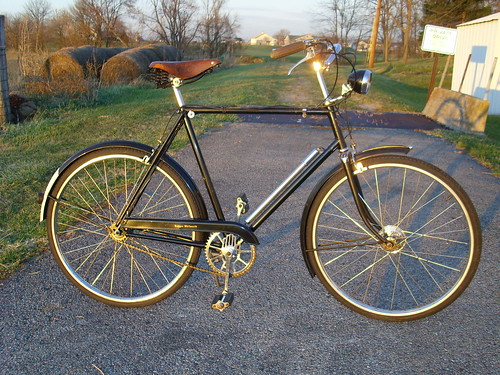
{A Rudge Whitworth, courtesy flickr}


{The red line shows the route; I left from and returned to our home, just about where the "e" is on Dalmeny Rd. -- upper right; Kemey's Cove (mentioned below) is left of the square by Revolutionary Rd.}
I earned money and remembered who paid up on time and who didn't, who tipped in coins and who in candy bars. I banked much of my take. And I observed.
I knew the mom's, some of the kids, and all of the dogs. And, because it was in the blood of boys my age at the time, I knew every car in every driveway.
Those were the years when performance and efficiency mattered little, style much. Cars were V8 powered, chromed, finned, and huge. I appreciated the cars of that time though never thought to own one. (My first car, bought 3 years later for $50, was a '50 Chev, all black with rusted out floorboards.)
Observing the newer models on my paper route, I noticed the three-tone jobs and in particular the three-tone Desoto. It's now hard to find images of this car. Here's one:

{Desoto three-tone 1955 on allpar.com}
Here is a shot of the much-finned 1956 Fireflite, two-tone:

{1956 Desoto from a geocities page}
(If you care, there's a A Full History of DeSoto.)
Though I didn't really aspire to own a Desoto, I did have plans for my paper route savings. For $110 I bought a kit to make a 10-foot racing pram much like this.
 "
{This comes from jimshotwellboats.com; I have a photo of mine somewhere or other which I'll post if ever found*}
 Typically, I researched the purchase, carefully made the boat, and then didn't find much use for it. The river wasn't all that close to home and I couldn't drive myself there. I had no local friends with boats. So it sat down on Kemey's Cove while I found other things to do with my adolescent life and later became an embarrassment to my parents while I stored it in our next door neighbor's garage.
You'd think there was a lesson for me in this -- one about spending as wisely as you save, but I think I got all I really wished for in saving for, purchasing, and building the kit into a seaworthy racer.
------------------
* I found it:


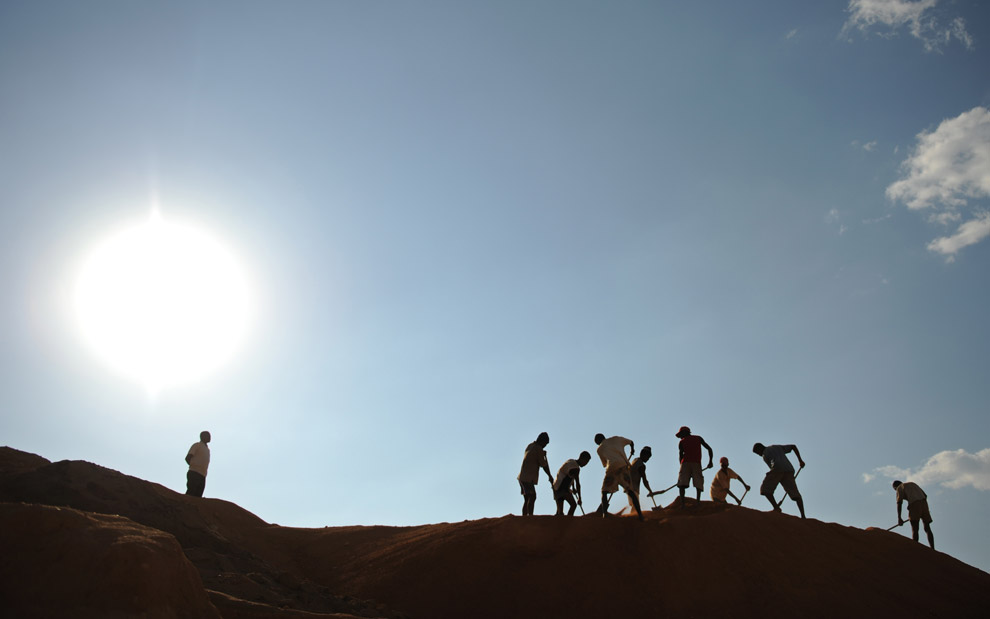

 The blog says: "The Big Picture is a photo blog for the Boston Globe/boston.com, compiled semi-regularly by Alan Taylor. Inspired by publications like Life Magazine (of old), National Geographic, and online experiences like MSNBC.com's Picture Stories galleries and Brian Storm's MediaStorm, The Big Picture is intended to highlight high-quality, amazing imagery - with a focus on current events, lesser-known stories and, well, just about anything that comes across the wire that looks really interesting."


 This morning I was looking at one of the most popular of all these books, William Mather's Young Man's Companion, a comprehensive work of instruction and reference that went through 24 editions between 1681 and 1775. What caught my eye was a reference to a pamphlet he wrote about the invidious meddling of women in the affairs of men. It's called A Novelty: Or, A Government Of Women Distinct From Men, Erected Amoungst Some Of The People, Call'd Quakers. Published in 1694, it complains about the power held by Quaker women in Bedfordshire at the time.
 Mather had become a Quaker nearly 35 years before writing this and was to return to the Church of England the next year. George Fox was of course the founder of the Religious Society of Friends. As bold as he was peaceful, his writings make for very interesting reading. Answering Mather and other critics, he

 Here is the citation for the WaPo article:


 The play is about Mrs. Warren's profession, of course, but also about women's rights, the generational gap between a mother and daughter, the conflicting impulses of career and romance and of business and the arts. But it's also about people with wealth and social position who maintain an aura of probity while earning money in anti-social ways. In this sense, it compliments the


 Posts


