Sunday, June 29, 2014

canal


This is the Amstel canal from Grand Café Amstelhoeck. We'd been caught in a spate of rain. You can see the outdoor tables are wet. The big building at left is NH City Centre. The handsome spire belongs to Oude Kerk. The canal is the Amstel. I took the photo in September 2012 during that trip to visit places where ancestors once lived. I like the near symmetries in the vee of blue sky topping trees on one side, building fronts on other, descending down the Rokin to the church; them and the three strong verticals.

Saturday, June 28, 2014

a boat on the bay


This shows a lobster boat moving down Blue Hill Bay as the sun is about to rise over the southern end of Western Mountain. At least I think it's Western; Cadillac is farther away but taller. You can see the darker outline of Tinker Island just before it. I've been slowing getting used to the utility cables crossing this view. They showed up sometime in the last couple of decades. At first I was sure they spoiled the view, but I've come to accept that they can contribute to the design of a photo, as the large one does here, scribing an arbitrary division just above the horizon. Creating an eye-arresting dissonance it helps keep the photo from being just another pretty picture.

Friday, June 27, 2014

Schwarzwald


I didn't think too much of this photo when I took it. The subject seemed busy and incoherent; the landscape is not picturesque. You can't tell what the point of it is.


Those things are true, but I've come to like the image anyway. Looked at as a two-dimensional surface—blocks of light and dark, colored shapes—it has an interesting design. Seen as presenting three dimensions, it nicely segregates fore-, mid-, and background elements.


What you can't really see is that these nondescript structures are set in the quaint German hamlet of Schwarzwald, at the foot of a dam, the Ohratallsperre, which holds back a large, scenic reservoir. The dam is dead center in the photo just above the two whitish-gray structures. My brother, sister, and I hiked there from Oberhof, a ski sport center which was pleasantly quiet during our brief September stay there.

Wednesday, June 25, 2014

collection


The college I attended turned 150 this year and the my class celebrated its survival all of 50 years from the date we graduated. This photo seems to show a church, but since the college was founded by Quakers, it's actually a meeting hall where we turned out for a mandatory lecture each week (called "collection") and, that burden having been lifted, where current students go to hang out.


I took the photo as myself and classmates, with all the other classes present, trooped to the school's amphitheater to hear speakers in what the program named an Alumni Collection, which turned out to be something like a graduation ceremony without the graduates.


The building is called Clothier Hall. Philadelphians will recognize the name. Strawbridge and Clothier was one of the city's most prominent department store chains. Strawbridges and Clothiers were both Quaker families and, while the Strawbridges favored two other nearby Quaker colleges for their charitable contributions, the Clothiers gave a lot of their money and much of their time toward making the school I attended a good place to study. The Clothiers were also somewhat fanatic about football and, though the college has since abandoned that sport, it was for a long time a major interest for those who could tear themselves away from their books on a Saturday afternoon.

Tuesday, June 24, 2014

daylilies


Though not much different from other tricoleurs, the Dutch flag is a handsome one and, since I like to find occasions to fly it, I've been putting it out when the national team wins a game in Brazil.


As the world knows, Dutch people consider orange to be their national color. When they wear orange clothing to cheer on the home team, Dutch spectators do not also show some red, white, and blue. The colors don't mix well together. Nonetheless, I liked the look of my flag behind the orange daylilies that front our house. The orange does well with the green foliage that surrounds it and, in design terms, the backlit flag is more an interesting counterpoint than a jarring distraction.

Monday, June 23, 2014

sunset


My sister lives in a mobile home perched midway on a palisade a half mile above the Pacific near Santa Monica. I took this photo on a visit there a couple years back. Her place is behind my right shoulder. I'm watching the sun set over Malibu. The scene is paradisiacal.

Sunday, June 22, 2014

barn


This shows the field of a small farm at Herrick Bay in the Penobscot region of Maine. I was first brought to this area in 1949 and have returned many times since. Its memorable features are sea views across broad bays to islands and a great expanse of ocean glimpsed among them, rocky shoreline teeming with sealife, and cabins nestled around a great house, the Lookout. There are woods of spruce, pine, and birch. In my youth there was a dirt road which lay warm, inviting summer's hardened bare feet.


This photo is clearly not the standard against which scenic images of the place are measured. I took it during a pause on my daily run when the brilliant, low morning light made views like this one, seen hundreds of times, seem fresh and new. I like the variations of green and ochre in the grassy foreground, the line that suggests the presence of the bay without showing it, and the play of light on the barn and trees.

Saturday, June 21, 2014

travel diary


In the summer of 1932 my grandmother sent my father and his older brother on a visit to Germany. My father was then 21 years old. This is a page from the travel diary he kept through most of the trip. There were members of the family to meet with and a short stay at the University of Munich, but also much touring to see the sights. On debarking at Bremen the two bought a tiny car which gave them constant trouble and had to be abandoned putting them on trains for the last segment of their journey. Their route took them clockwise through much of Germany and a bit of Austria.


The diary is conventional: the weather was so, we stayed here, saw this; we ate, we drank. You would not guess that in those months the Nazi party was becoming ascendent. Brownshirts were marching through the streets of the cities and towns they visited. The swastika flag was omnipresent and posters extolled the Party, condemned Communists, and vilified Jews. These things the diary never mentions.

When I and my siblings were young, my father would tell us stories of that trip. One involved witnessing a Nazi rally. The pair did not attend out of interest in Nazism, only for the spectacle. My father's politics at that time were undeveloped; later he was a left-liberal, tending to vote Socialist. The rally is not mentioned in the diary. He said he and his brother arrived early and seated themselves on some bleachers. As others arrived, they noticed that those who seated themselves on the bleachers were all in Nazi uniforms. It gradually dawned on the brothers that they were in a VIP section of the viewing stands but nobody told them to move. My father said that in the Germany of that time everyone was always expected to know what do do, what place to occupy. Since the two brothers were obviously not ruffians but rather middle class gentlemen, they were not questioned or asked to move, much less man-handled by the Brownshirt enforcers who kept order at rallies.


One of the many ironies of our family history is that my father (and his whole family) did not know that his grandfather on his mother's side was the grandson of the most prominent rabbi in Westphalia. The grandfather had converted to Christianity on emigrating to the U.S. and never spoke of his German family. That family can be traced these days via internet searches. During the Nazi era, many emigrated and those who didn't were almost all exterminated.


Not long ago, my brother, sister, and I travelled through the Netherlands and Germany to see the places where our ancestors had lived. In Germany we stopped in Celle, source of the photo I showed yesterday, and also in Beckum, where many of my great-grandfather's relatives lived. One of them was Salomon Windmüller who was great-grandson of a brother of the prominent rabbi who was the grandfather of my great-grandfather. He was a prominent merchant in Beckum. Two years after my father's summer tour, Salomon was arrested, convicted, and imprisoned for and act of defiance: having a servant remove a Nazi anti-Jewish poster from the wall of the building where he lived. He was an old man at the time and did not live long after the end of his prison sentence.


This news item appeared shortly after his conviction (translated from the German):

Last Saturday several persons were sentenced at the Beckum district court, to several weeks’ imprisonment for damaging posters of the Westfalen-Nord district command. They were the following opponents of the National-Socialist movement and government: Mrs Franz Windhövel, Wilhelmstrasse 61 (three weeks imprisonment), the innkeeper Ferdinand Hagedorn, Weststrasse 45 (three weeks imprisonment), the Priest Stroetmann, Provost of the St Paulus Workers Association (three weeks imprisonment), and the last of this illustrious company; the 73-year-old cattle Jew Salomon Windmüller, Weststrasse 19 (six weeks imprisonment). All those sentenced were taken into custody. The Jew Windmüller was imprisoned immediately.

With this verdict, the Beckum district court has made it abundantly clear that the National-Socialist state will not be intimidated by anybody, not even by the Catholic clergy. All subversive activities will in future be severely punished.

Friday, June 20, 2014

Celle


This morning I looked at an online folder full of images and asked myself which would intrigue me, supposing I were coming upon them for the first time. Since it's not at all easy for me to do that, I gave myself a leg up by viewing them in thumbnail. Squashed to the size of a 35mm slide, each appears different enough from its true self that it just about takes on an individual identity.


This one immediately caught my eye. Taken in one of the few German cities that were left intact by the Allied bombing campaign of World War II, it isn't a treasured memento of a pleasant trip to view ancestral homelands (which is true of other photos in the folder), but more of an abstract study in light and shadow. The place is Celle, in Saxony, and it's full of medieval timber-frame houses, nestled side by side, above cobbled streets, mostly free of cars, trucks, and buses. Though well-preserved, it's not a museum-like restoration, like Colonial Williamsburg in the United States, but a commercial center, the capital of the district in which it's located. Quite a feat.


Typifying Celle's modernity mingled with historic preservation, our brief stay in Celle was in a building from the early seventeenth century and our landlady was Lithuanian, youthful, outgoing, with a decidedly contemporary outlook.

Thursday, June 19, 2014

sunlight


As we near the summer solstice, rays of early-morning sun slant through a north-facing window and cast this reflection on the west wall of our dining room. Sometimes, if there's a light breeze, rustling leaves cause the light to dance, but today the image simply descended slowly downward as the sun rose.

Wednesday, June 18, 2014

digger


There's construction going on where I do my daily shopping. The food store that serves most of my needs is on the top floor of a building where an exterior balcony makes a theater of a construction site in one corner of the building's plot. Lately, the contractors have been excavating and their tracked digger has the tricky job of removing earth from a confined space, all the while leaving itself a steep pathway to give itself a route out of the hole. The current one is out of view to the camera's left.


Just as interesting as the digger and its work are the holes in the retaining wall. I can't tell why they occur or what purpose they serve. My engineer-brother would know. I'll ask him next chance I get. In addition to the mini-cavern in this photo, you can see two others, one fully shown, blocked with timbers and the other, at far left, only partly in view. The site has two others.


The retaining wall keeps two streets from collapsing into the excavation. It appears to have been put in place long ago, was, until recently, kept in place by the dirt and rocks that the digger is removing, and clearly now needs to be shored up.


I don't know what the owners of the building plan for this space. It surely is expected to be revenue-producing whatever it is. Before the digging began it was a pleasant, nicely-landscaped courtyard, bordered on one side by old and many-blossomed Japanese cherry trees.


Tuesday, June 17, 2014

a miller


This is the milling machine that removed the top surface of our street. When it's operating a carbide-toothed drum scrapes up old asphalt and the long-neck conveyor transports it to a dump truck. In its present waiting state this machine reminds me (to continue yesterday's thought process) of the spaceship Firefly in the Joss Whedon TV series of that name.


In my photo, the miller has finished work on our part of the street. It feels strange and a little unnerving to have big machines so thoroughly disrupt the quiet routines of our little neighborhood and some of us wonder what flaws lay in the old surface, not visible to our eyes, that made it necessary for our village council to carry out this major transformation.


In any event, today our street sports new blacktop, richly black and still warm after being poured, let set, and rolled smooth.

Monday, June 16, 2014

resurfacing

In our little neighborhood messages from our village manager arrived in email inboxes over the weekend. They warned us that in coming days the narrow lane outside our houses would fill with trucks and paving equipment. The street is having its top layer of old asphalt removed today and a new layer put down tomorrow. The front loader in this photo came into view shortly after the first pass of the milling machine. It's highly maneuverable -- can turn literally on a dime -- and, as you can see, is not afraid to travel with its front wheels lifted up. It has a sort of compact cuteness that reminds me of Wall-E from the sci-fi movie of the same name.

Sunday, June 15, 2014

a painting by Karl Knaths

This is a painting by Karl Knaths. He was one of America's first modernist painters. Out of an early affection for the work of Cézanne, he let his work evolve into a personal blend of abstract and realist elements, all of it pretty much influenced by the sort of cubist technique that led from those early Cézanne innovations. It's all interesting and mostly good. Art critics, museum curators, and collectors all liked (and still like) his stuff, though not so exuberantly as they like the work of many other American artists (that's why you're probably not familiar with it).


I wrote an article in Wikipedia on him. It's remarkable for snagging only one gripe from that institution's picky editors. She or he put a box at top of the article telling the world that I used too many external links.


I'm fond of this particular painting partly because its owners gave me permission to use it in the Wikipedia article. In my experience owners almost never wish to do this since it requires that they, basically, give up all rights and put the image in the public domain. I'm sure you realize that restrictions imposed by copyright or Creative Commons licenses do little good in keeping protected works off the Internet, but that doesn't make these protections entirely useless and owners are understandably reluctant to let them go.


The painting is called Pumpkin. Knaths painted it late in his career, in 1964. It is oil on canvas, measures 30" x 36" and comes from the collection of the Provincetown Art Association and Museum; gift of Mr. and Mrs. David Orr, in memory of Louise Ault.

Saturday, June 14, 2014

Flag of the USS Blessman

On June 14th the United States celebrates Flag Day. During the battle of Iwo Jima in February 1945, the USS Blessman was severely damaged in an attack by a Japanese bomber. The ship was a destroyer escort converted to high-speed transport and only the day before it had been under bombardment by shore defenses as the underwater demolition teams that it carried were conducting reconnaissance of the Iwo beaches where Marines would soon be landed.

My uncle, Arthur Hettema, was one of the swimmers who surveyed the waters where the amphibious landings would take place. Like the other frogmen, he swam more than a thousand yards from drop off point to the beach, dressed simply in swimming trunks and having a noteboard strapped on his leg so he could make notes of sand, surf, and obstructions using a grease pen. He swam under the waves, dove to check the sandy bottom, and, hoping not to become a target, surfaced in troughs to breathe. He and his partner did the job and swam back to their pickup point without being hit.

Later, he was onboard the Blessman when it took two bombs mid-ship, immediately disabling it. He and the other surviving UDT members had to deal with explosions; dead, dying, and wounded sailors; fires; and the confusion that's inevitable when a ship receives direct hits. For the work he did in the water and on shipboard he was given the Bronze Star.

He was also presented with this flag, which the Blessman had flown.

Friday, June 13, 2014

Last summer I noticed a bee nosing around some hosta blossoms, sought out my camera, and, amazingly, was able to catch this shot.

Thursday, June 12, 2014

close observation


There's a story about this tiny blossom and its out-of-focus cousin behind. While eating lunch on our side porch I noticed a little girl stooping to look at something in the dirt at the foot of our driveway. She squatted to look closely and said something excitedly to her mom. I thought whatever it was she saw had to be pretty unusual, like a dead baby bird maybe. When I'd finished my sandwich and strolled out to look, I found these two little flowers which had sprung up under our scraggly hedge.

Wednesday, June 11, 2014

windowsill


My blogging impulse having fled some months ago, I'm ready to try something new; well, not exactly new, but borrowed from my friend Deniz (whose inspiration has also waned). Starting today, it's my goal to post occasional photos, all of them my own taking and most in that vague category of images that stick in memory for reasons difficult to state. This, above, is the first.

Friday, October 25, 2013

Delano's cupolas


This photo shows a crewmember of a freight train looking out the left side window of a caboose's cupola. It was taken in March 1943 by Jack Delano for the U.S. Office of War Information. The train was on the Atchison, Topeka, and Santa Fe system somewhere in western Texas or eastern New Mexico.

The photo is held by the Prints and Photographs Division of the Library of Congress. Although it is unlabeled, its composition and the details it shows are similar to other photos Delano took of trainmen in caboose cupolas during a photo shoot of March 1943 on frieght trains traveling from Chicago to San Bernardino along the AT&SF line. In the files assembled from this shoot the photo is located near photos whose captions give locations in the vicinity of Amarillo, Texas, and Albuquerque, New Mexico.

The trainman's tie and jacket, as well as the fedora he wears with train badge just visible all indicate that his job was conductor. You can see these details a little more clearly in this cropped image. Click this image (and all the others) to view full size.


This photo, taken a few days earlier of a different trainman, gives a full caption. The two images are strikingly similar.

{Caption: Conductor W. E. Zink, watching the train from his window in the cupola of the caboose on the Atchison, Topeka, and Santa Fe Railroad between Emporia and Wellington, Kansas; photo by Jack Delano created 1943 Mar.; source: Library of Congress Prints and Photos Division}

The purpose of these photos was documentary. They and the many other images that Delano captured during his journey south and west aimed to show one aspect of war mobilization — the great strength of the U.S. transportation system. Nonetheless, they are far from being naïve propaganda.

The outline that Delano prepared as part of the OWI request for governmental clearance to undertake the work shows his intention to give "a photographic story of the important role played by the railroads in the national war effort," and to this end he showed the astounding magnitude of U.S. rail freight operations.[1] There are lots of long shots of great rail terminals, huge plants for manufacture and repair of locomotives and rolling stock, and the vast landscape of the American Southwest. But he also showed individuals, men and women whose work enabled this vast system to function.

It's in keeping with the philosophy of the FSA/OWI photographic unit that the thousands of photos in its archives contain no photo-op news-shots of politicians, rail system managers, or other public figures. As Delano's boss, Roy Stryker put it, the units images contained "no record of big people or big events ... and absolutely no celebrities."[2] This down-to-earth approach comes out fully in Delano's AT&SF photos. We see yardmasters, engineers, conductors, brakemen, oilers, and wipers. We see workers in locomotive repair shops, on the tracks, in telegraph rooms, and in switch towers. We see workers of European heritage, American Indians, African Americans, and Mexicans.[3]

During the Depression Era the FSA was well-known for its photos of impoverished Americans. The FSA photographers showed them to have a self-possessed grace and this inherent dignity conveyed to viewers some basis for hoping that the millions who suffered misfortune would not just survive but potentially thrive within a reconstructed economy.[4] When the photographic unit was moved from FSA to OWI there was less need and no mandate to produce compelling images of poverty and individuals' struggles to overcome it. During the war buildup and after Pearl Harbor the photos taken by the photography unit both encouraged and reflected a growing sense of American cohesiveness — people working together to produce the industrial output that would be needed to win the war. The OWI photographers did this, however, without entirely abandoning their earlier point of view. From 1940 onward the photos they took continue to show the great diversity of a people who were considered at the time to be "ordinary" citizens.[5]

The portraits that Delano took of the hundreds of workers he encountered during his assignment with the Atchison, Topeka, and Santa Fe demonstrate that he possessed the skill necessary to show the simple human dignity in the "common man" (a phrase, like "ordinary citizen" that was in vogue at the time). He disassembled this collective stereotype into its very specific, individual components. The captions he gave his photos frequently state the job a subject performs and give his or her name and home town and the photos themselves tend to show personal habits through grooming, clothing, and posture. More than that, his photos have a broader aesthetic and cultural value. Delano's understanding of photographic design lifts them above the level of journalism. It's his skill as an artist which leads us now, in examining them, to see that they are something more than documentary artifacts. Delano had to plan his photos. The camera he used most frequently was awkward to use for snapshots. This wasn't really a drawback since it's obvious that he planned his photos carefully, choosing his subject, composition, and camera angle and waiting for the light to be right. It's reasonable to assume he sometimes posed his subjects, or, anyway, asked them to adjust their position to achieve the effect he wished to see.[6]

The FSA/OWI photographers were supposed to make factual images and not to alter them "for effect." During the Dust Bowl years, one of them was criticized for moving a bleached skull to improve his composition, but Delano, and his boss Stryker, understood that there was no fakery involved.[7] A photographer needed to be trusted to show a subject as it actually was in real life, and they lived up to this trust, but they also knew it to be their responsibility to make a photo that was meaningful. Stryker's mentor, Rexford Guy Tugwell, put this objective concretely in a conversation Stryker recalled long afterward. "Roy, a man may have holes in his shoes, and you may see the holes when you take the picture. But maybe your sense of the human being will teach you there's a lot more to that man than the holes in his shoes, and you ought to try and get that idea across."[8] Stryker stated the matter in his own words when, in an interview, he said how wage earners, like the trainmen in Delano's photos, could be photographed in a way that revealed their inherent worth. "They had dignity." he said, "And they sensed this guy [the photographer] could give it to them. Not make them beautiful, not make them look like something they weren't. But he put a dignity into that picture. They responded to him."[9]

Here are some more photos of trainmen in cupolas and a couple of others showing the position of the observation benches within the caboose. All are found in collections of the Prints and Photographs Division of the Library of Congress.

This shows the cupola from the outside of the caboose.

{Caption: Marceline, Missouri. Brakeman in the cupola of his caboose in the Atchison, Topeka, and Santa Fe Railroad yard}

From within the caboose, you can see the cupola benches in front of and above the rear door of the caboose.

{Caption: Conductor (right) and brakeman, in their places in the cupola of the caboose on the Atchison, Topeka, and Santa Fe Railroad between Argentine and Emporia, Kansas. On the wall between them is the air gauge showing the amount of air brake pressure in the train}

Here is the caboose interior with the end of one of the cupola benches visible at back.

{Caption: Freight train operations on the Chicago and Northwestern Railroad between Chicago and Northwestern Railroad between Chicago and Clinton, Iowa. The caboose is the conductor's second home. He always uses the same one and many conductors cook and sleep there while waiting for trains to take back from division points}

In viewing all these photos you can tell that Delano had an aesthetic appreciation for the dramatic blocks of light and dark present when trainmen observed the train through the cupola's side windows.

{Caption: Brakeman H. L. Duffield, watching the train from the window in the cupola of the caboose on the Atchison, Topeka, and Santa Fe Railroad between Emporia and Wellington, Kansas}


{Caption: Conductor J.R. Crawford, watching the train from his window in the cupola of the caboose along the Atchison, Topeka, and Santa Fe Railroad between Canadian and Amarillo, Texas}


{Caption: Rear brakeman M. H. Burdette, watching the train from his window in the cupola on the Atchison, Topeka and Santa Fe Railroad, between Chillicothe, Illinois and Fort Madison, Iowa}

It's apparent that riding in the cupola was something like sitting in the upper deck of a London bus — a place to relax and watch the world go by. I'm suspect Delano was making a joke in saying the bottle contained hot coffee.

{Caption: Rear brakeman George Clark having his lunch in the cupola of the caboose on the Atchison, Topeka, and Santa Fe Railroad, between Marceline, Missouri and Argentine, Kansas. The bottle contains hot coffee}

This is one of the few shots in which Delano used flash and it's the only one he took from below. Although it suffers the flattening that always occurs with single-source flash photography, it's still interesting in its composition, subject, and point of view.

{Caption: Hart (vicinity), Missouri. The conductor uses his air valve in emergencies when it is necessary for him to stop the train along the Atchison, Topeka, and Santa Fe Railroad between Fort Madison, Iowa and Marceline, Missouri}

Here is Delano himself, taken by an unnamed photographer.

{Caption: Jack Delano, Farm Security Administration/Office of War Information photographer, full-length portrait, holding camera, standing on front of locomotive, taken ca. 1943, location not given}

I've marked this 1939 AT&SF map to show Delano's route in March 1943.

{1939 Map of Atchison Topeka and Santa Fe Railway; source: North American Railroads of the 1930's by Richard Parks}

------

Some sources:

I've done earlier posts of Delano photos, including one from the March 1943 shoot. Click the Jack Delano label at right to view them. For posts showing other photos from Office of War Information files, click the OWI label.

Outline for a trip aboard a fast freight from Chicago Illinois to San Bernardino, Calif. (3 p.) by Jack Delano, in LOT 12024, Box 1, Clearances, Army, 1942-1943, held by the Prints and Photographs Division of the Library of Congress

Letter: Roy Stryker to L.I. McDougle, 1942 October 12 [PDF file, 1 p., 134 kb] LOT 12024, Box 1, Clearances, 1942-1943, held by the Prints and Photographs Division of the Library of Congress

Interview with Roy Stryker, conducted by Robert J. Doherty, F. Jack Hurley, Jay M. Kloner, and Carl G. Ryant on the American Suburb X web site

Oral history interview with Jack and Irene Delano, 1965 June 12 conducted by Richard Doud for the Smithsonian Archives of American Art; transcript, 63 pp of a sound recording on 2 tape reels

Jack Delano in wikipedia

Jack Delano in the Museum of Contemporary Photography web site

https://scholarworks.iupui.edu/bitstream/handle/1805/3145/Jack Delano.pdf?sequence=1 biography, Program of Digital Scholarship, Indiana University-Purdue University Indianapolis

Documenting America, 1935-1943 by Carl Fleischhauer, Beverly W. Brannan, and Lawrence W. Levine (University of California Press, 1988)

www.lllevin.com/users/LarryLevin3660/docs/ASPP Stryker's America 3-08p21-24.pdf by Larry L. Levin on his own web site

Capturing the faces of railroading Who is Jack Delano? And how did his photography change the way Americans perceived railroading? by John Gruber, December 21, 2009, on the web site of Trains, The Magazine of Railroading

www.archives.gov/atlanta/education/depression-curriculum/section-2.pdf, "This Great Nation Will Endure": Photographs of the Great Depression A Curriculum Guide, National Archives at Atlanta

Chicago and Downstate: Illinois as Seen by the Farm Security Administration Photographers, 1936-1943 by Robert L. Reid and Larry A. Viskochil (University of Illinois Press, 1989)

A Chicago Hub Railroad of the 1930's - 1940's The Atchison Topeka & Santa Fe Railway (Santa Fe) on r2parks.net

Picturing Texas: The Farm Security Administration-Office of War on the Portal to Texas History

Visual Sociology by Douglas Harper (Routledge, 2012)

The History of Photography: An Overview by Alma Davenport (UNM Press, 1991)

Picturing Faith: Photography and the Great Depression by Colleen McDannell (Yale University Press, 2004)

Ordinary People: Jack Delano by Arthur H. Bleich in Rangefinder magazine

Crucible of Freedom: Workers' Democracy in the Industrial Heartland, 1914–1960 by Eric Leif Davin (Lexington Books, Rowman & Littlefield Publishers, 2010)

American Photography and the American Dream by James Guimond (UNC Press Books, 1991)

THE ART SPIRIT By Robert Henri; Notes Taken By M. R. From Robert Henri's Criticisms And Class Talks on Afterall / Online

The Likes of Us: America in the Eyes of the Farm Security Administration by Stuart Cohen (David R. Godine, 2009)

Jack Delano’s American Sonata by David Gonzalez, Lens, New York Times, October 13, 2011

-------------

Notes:

[1] Outline for a trip aboard a fast freight from Chicago Illinois to San Bernardino, Calif. (3 p.) by Jack Delano, in LOT 12024, Box 1, Clearances, Army, 1942-1943, held by the Prints and Photographs Division of the Library of Congress. The outline shows that Delano originally expected to take frieght trains pulled by the new diesel electric engines. As it turned out the trains were engined by steam locomotives, then acknowledged to be more expensive to operate, though now seen as highly romantic. Here is the summary page from this three-page document. Click to view full size.

{Outline for a trip aboard a fast freight from Chicago Illinois to San Bernardino, Calif. (3 p.) by Jack Delano, in LOT 12024, Box 1, Clearances, Army, 1942-1943, held by the Prints and Photographs Division of the Library of Congress}

[2] Quoted in Documenting America, 1935-1943 by Carl Fleischhauer, Beverly W. Brannan, and Lawrence W. Levine (University of California Press, 1988)

[3] You can see something of this diversity by skimming the results of an online search of Delano's photographs from March 1943 in the Library of Congress Prints and Photographs Division catalog.

[4] Stryker's approach to documentary photography of the American Depression contrasted the dignity and despair of the Depression's victims. His optimism about this dicotemy came out when he said: "Maybe I'm a fool, but I believe that dignity wins out. When it doesn't then we as a people will become extinct." (Quoted in Documenting America). Stryker's biography in The History of American Photography says he came to understand this dignity and and attain his positive outlook while he and his wife were living in a New York tenement during his school years: "Their neighbors were mostly immigrants who worked feverishly simply to maintain the barest requirements of life. This experience impressed Stryker immensely. Food may have been lacking, clothing may have been scarce, but the fiber of these people was based on dignity, endurance, and the simple pleasures afforded by freedom."

[5] Stryker wanted pictures of "the common people," the hard working survivors who built America. "I think it's significant," Stryker later said, "that in our entire collection we have only one picture of Franklin Roosebvelt, the most newsworthy man of the era ... You'll find no record of big people or big events in the collection ... not a single shot of Wall Street, and absolutely no celebrities." Quoted in Crucible of Freedom: Workers' Democracy in the Industrial Heartland, 1914–1960 by Eric Leif Davin (Lexington Books, Rowman & Littlefield Publishers, 2010)

[6] Delano's military authorization for the photo shoot enabled him to have the train stopped or moved for vantage to get a photo he wanted to take. If he could have the engineer and conductor do these things for him, there's little reason to believe he wouldn't also ask his sujects to move about a bit to improve a composition for him.
When WWII began, the FSA was folded into the Office of War Information (OWI) and its photographers were assigned to projects that would promote the war effort. Much to his delight, Delano was tapped for a month-long trip to document America’s railroads; he’d ride with the crews and even had the authority to stop the train (with the engineer’s consent) to get any shots he needed. ... Delano’s first attempt to stop a train for a shot he wanted was met by the engineer’s blunt refusal. “Young man,” he said, “if I stopped the train here we could never get it started again but would go rolling down the hill backward.” So Delano waited until he was aboard a different train, one that was rounding a curve with more than a 100 cars strung out behind carrying bombs, tractors, trucks and tanks. This time the engineer complied and brought the train to a halt. Delano hopped off but found the composition wasn’t right; the train needed to be moved forward some more. He shouted instructions to the engineer and the train inched forward. “Never had I had such a sense of power,” he recalls. “I felt like Hercules. Wow! To think I could move that whole train with just the wave of my hand.” When he’d finished shooting, he signaled the engineer to get moving again and hopped on the caboose as it rolled by.
-- Quoted in
Ordinary People: Jack Delano by Arthur H. Bleich in Rangefinder magazine

[7] On the skull controversy see:
  1. Photography and the Great Depression: Arthur Rothstein, a site was created for a Photographic Archives course at the Graduate School of Library and Information Science at Simmons College
  2. The History of Photography: An Overview by lma Davenport (UNM Press, 1991)
  3. The controversy was eventually quelled when Stryker pointed out that while he moved the skull ten feet, he certainly did not move it out of the drought area, which was littered with such skulls.
  4. THE NATURALISTIC ENTHYMEME AND VISUAL ARGUMENT: PHOTOGRAPHIC REPRESENTATION IN THE 'SKULL CONTROVERSY'. by Cara A. Finnegan in Argumentation and Advocacy › Vol. 37 Nbr. 3, January 2001
  5. Oral history interview with Arthur Rothstein, 1964 May 25, an interview of Arthur Rothstein conducted in New York, N.Y., 1964 May 25, by Richard Doud, for the Archives of American Art; Transcript: 31 pages

[8] Quoted in Documenting America, 1935-1943 by Carl Fleischhauer, Beverly W. Brannan, and Lawrence W. Levine (University of California Press, 1988).

Robert Henri, famous painter in the New York Ashcan School, his paintings are realistic, in the usual sense of the word, rather than abstract. He understood the difference between a painting which records an observation and a work of art — the difference between a work of art which simply records a subject faithfully and one that brings out something more from within it. In notes from lectures he gave at the Art Students League he said "Rather paint the flying spirit of the bird than its feathers." Quoted in Affirmations for Artists, ed. by Eric Maisel (G.P. Putnam's Sons, 1996)

Delano realized that a good photograph could sometimes capture this flying spirit, but not always. He put a poem in his diary which he called "Things I cannot photograph." Here's its end:
A train is approaching us!
The glare of the headlight
With a WHOOSH of thunder as it flies by us.
The brakeman gets down from the cupola and watches it go by
Two red lights and a white one pass us
The white one waves up and down.
We answer
Then back again to the drone
I throw a cigarette out of the window
It whirls off in the backwash scattering sparks wildly like fireworks
The blackness again.

-- Quoted in: Jack Delano’s American Sonata by David Gonzalez, Lens, New York Times, October 13, 2011

[9] Oral history interview with Jack and Irene Delano, 1965 June 12 conducted by Richard Doud for the Smithsonian Archives of American Art; transcript, 63 pp of a sound recording on 2 tape reels

Thursday, September 26, 2013

Fast boats

A boat owned by billionaire Larry Ellison won the 2013 America's Cup series of sailboat races. It defeated the challenger Emirates Team New Zealand in a comeback performance having lost most of the early races and won all the late ones. A costly series of overnight refits is credited with lifting the US boat's fortunes.

There is a compilation of videos documenting the race here: America's Cup 2013.

Run on and off since the middle of the nineteenth century, the race pits boats from two countries against each other. An ornate trophy passes to the winner of the event. Various yacht clubs and syndicates in the United States held the cup for many years, and during the past few decades it has been won, and defended, by Australia, Italy, Switzerland, and New Zealand. Great Britain, the first to accept a challenge for the cup, has never won it. By convention, the defending country determines the rules of each race, including the specifications of the boats.

This year's series of races took place between boats representing the United States and New Zealand. It followed elimination contests among challengers from Italy and Sweden as well as New Zealand. Aiming to profit from interest by local spectators and an international video audience, the US syndicate opted for a location, San Francisco Bay, which offered excellent spectator views and a scenic backdrop for video cameras. It chose a boat design which took advantage of the Bay's strong winds and tidal currents. And it set a course which insured that the boats would achieve maximum speed in long up- and downwind legs. The boats themselves, designated AC72, were large catamarans with sails like airplane wings, rudders analogous to the rudder/elevator combination of airplanes, and daggerboards which (akin to the tail and wings of an airplane) served the dual purpose of keel/centerboard and hydrofoil. During preliminary races, the top speed of these boats proved to be greater than fifty miles per hour.

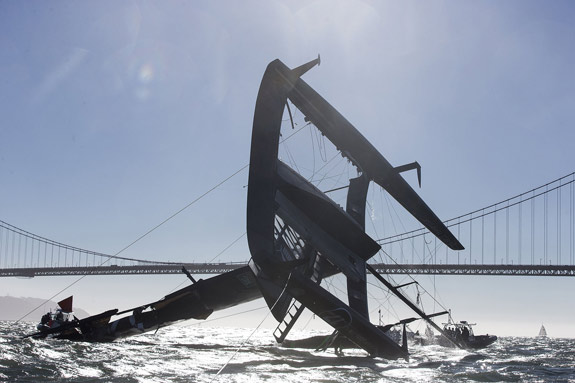
However, sailing at top speed proved to be too dangerous. During the preliminaries an Oracle boat in the US stable flipped and was wrecked with no injury to the crew and another, Artemis from Sweden, flipped at high speed, killing one member of the crew. As a result the race committee established rules to rein in dangerous maneuvering at high speed.

Over the eleven miles that the boats traveled in each race, the eleven-man teams accomplished complicated changes of course — tacks and jibes — very rapidly and with great skill and they made frequent rapid adjustments when traveling on straight paths at top speed, all aimed at gaining the few seconds advantage that made the difference between victory and defeat. Almost literally flying, the boats were made to travel in the downwind leg of the course at twice the speed of the wind. Explanations of the physics that lie behind this achievement are opaque. The skipper of a sailboat will trim his sails to achieve maximum speed for any given course. When the boat is at rest the true wind and something called the "apparent wind" come from the same direction at the same speed. When the boat is sailing at an angle into the wind, the "apparent wind" is greater than the true wind and we are told that the difference between apparent and true wind is what enables a boat to sail faster than the wind.
As the sail moves into the wind, it "feels" a faster wind on its face. This is called the relative velocity of the wind with respect to the sail. A wind of larger relative velocity exerts a larger force on the sail, which accelerates the boat. The boat moves faster, which increases the relative speed of the wind, which increases the wind-force, which accelerates the boat, and on and on.

-- How Sailboats Sail Against the Wind, Physics for Architects

A boat won't actually sail faster than the wind, however, unless the sails are unusually efficient and the drag of the water on the hull is reduced to a minimum. The most efficient sails are no longer made of cloth but rather carbon fiber and kevlar. Called wingsails, they are composed of fore and aft sections that resemble the wing and flap of airplanes. The wingsail's "flap" is unlike the airplane's, however, being proportionately much larger than the wing itself. The wing and flap are constantly monitored by sensors connected to onboard computers and can be independently adjusted to increase or decrease the amount of lift the wing provides. Greatest lift is needed at slow speeds, but it comes at the cost of increased drag. Thus, like an airplane during take off, in flight, and landing, the boat's wingsail is adjusted to give the best balance of lift and drag as the boat moves faster or slower through the water. This constant adjustment takes the place of much of the sail trimming that's needed when using conventional sails (sheeting in and sheeting out) and in fact the AC72's wingsail is swung off center a great deal less than are conventional sails.

This graphic names the parts of a wingsail and explains its operation.

{source: Wing-Sail-tech on uconnwelcomemat.wordpress.com}

The second major element in achieving flight on water is the reduction in resistance of the water itself. This drag is reduced to a minimum by use of wing-like hydrofoils to raise the hulls out of the water. Once the wingsail has brought the boat to a critical speed one of the two foils, or both, raise the hulls out of the water. Like the job done by the wingsail, the work done by the foils is difficult to fathom. The weight of the America's Cup AC72 boats is something like 13,000 pounds. Once the boat is foiling, it can accelerate to maximum speed, up to about twice the speed of the wind.

The following photo shows the Emirates Team New Zealand boat elevated on one of its two hydrofoils (the other is raised above the port hull). The two aft rudders have adjustable wing extensions, but they are used, like the elevators on the tail section of an airplane to which they are analogous, to keep the hulls parallel with the water surface and not to raise the hulls into flying mode.

{Caption: Emirates Team New Zealand’s AC72 foil sailing on the Hauraki gulf. Auckland, 6 September 2012. Photo copyright Chris Cameron / Emirates Team New Zealand; source: vsail.info}

Below is a computer drawing of an AC72 catamaran such as the ones racing for the America's Cup. I've marked the image to show the articulated wingsail and the starboard hydrofoil, which sailors call a daggerboard. Daggerboards not only provide lift, but also help keep the boat from being pushed sideways against the wind. This function is performed by the keel or centerboard of mono-hulled vessels. Note that AC72 daggerboards are lifted up and down vertically while centerboards swing up and down from a forward pivot (keels are fixed in place). The AC72 boats can carry two jibs, as shown here, but in most races they have carried only one small one. The jibs (also called foresails or softsails) are made of cloth and their main job is to direct air over the wingsail.


This image shows the two boats that competed in this year's America's Cup series. The next one, directly below, shows what America's Cup competitors looked like in 1899.

{Caption: Emirates Team New Zealand leads Oracle Team USA down the first run in race seven on day four of the America's Cup 34, 9/12/2013; source: emirates-team-new-zealand.americascup.com}

The 1899 boats, like all America's Cup boats contenders to 1988, were mono-hulled. They were gaff-rigged sloops with narrow beam. The sail area was enormous. It's evident that they are manned by about twice the number of sailors as are this year's boats (which the rules limit to a total of eleven).

{Caption: Shamrock and Columbia maneuvering for the start, Detroit Publishing Co., Oct. 19, 1899; source: Library of Congress Prints and Photographs Division}

This image indicates how large is the AC72 wingsail. The AC45 is a catamaran which closely resembles the AC72 on a smaller scale. It was used in shakedown and elimination races prior to this years America's Cup series.

{Source: uconnwelcomemat.com}

As the image suggests, it's the height of the AC72 wingsail which most impresses. Its supporting mast is 131 feet high. By comparison, the yacht that won the America's Cup for the first time (1851) and the schooners and sloops that raced for the Cup during the rest of the nineteenth century had masts no higher than 105 feet.

The location of the race in San Francisco Bay and its windward/leeward course as well as the speed-oriented design of the boats themselves were chosen with a view to making money off the event. Huge numbers of on-site spectators and world-wide TV viewers could pretty much be guaranteed by the excitement generated in extremely fast racing close to a major city, offering on-land as well as on-water viewing of spectators, and TV viewing via large numbers of video cameras, in helicopter, in tracking boats, and onboard the AC72s themselves.

In fact, the boats' design proved to sacrifice safety for speed. When, during preliminary races, one accident destroyed a boat and another killed a sailor, rules had to be revised to prevent possible collisions during the critical moments just prior to start and to shut down racing when winds, currents, and wave heights made it too dangerous. "Too dangerous" is a relative measure, however, as the race series has proved to involve a great deal of risk for boats and crews.

This graphic shows the course. The high-speed long legs between windward and leeward gates, which the boats traversed three times during each race, insured that spectators got to see many extremely fast tacks and jibes.


It's difficult for people accustomed to soft-sail racing to comprehend how the AC72s are able to reach their highest speeds when sailing with the wind at their backs. They do not run before the wind in the usual sense but rather jibe and jibe again just as if they were tacking into the wind. That is to say they take a zig-zag course when the wind is astern just as they do when it is coming from the front. During these jibes they actually look like they are tacking since the wingsail is not let out, as a soft sail would be, but is kept close-hauled as in tacking. As one sailor said: "You might have also observed how tight in the sails were trimmed in the 'downwind' heading. They were tight – even the non-winged headsail. This means the AC72s were on a close haul heading downwind. Messes with your mind doesn't it?" (Apparent Wind on Americas Cup AC72's)

So, the defender and the challenger in this year's America's Cup were fast and exciting to watch. During early races in the series they were also evenly matched. The boats seemed to be capable of the same speed and maneuverability. Sailing skill, tactical acumen, and quite a bit of luck mattered most in determining who would win each race in the series. Oracle gained an edge, however, after making a number of adjustments to the boat after it lost enough races to come within one of losing the Cup. The most significant change was apparently the installation or revision of an automatic levelling system. It is said that the Emirates Team New Zealand boat, relying on manual control of its stabilizers, couldn't match Oracle's computerized system. Ironically, the technology used by Oracle was designed and built by New Zealanders under contract to Oracle's owner Larry Ellison. It's worth noting that both boats were built in New Zealand and both were mostly crewed by New Zealanders. Many accounts credited the Oracle Team USA win with increases in sailing skill achieved during the race series rather than changes made to the boat.

Early on, the US team had shown that they were capable of cheating. During preliminary races the crew of the US boat were caught adding weight to the bow in order to improve its fore-and-aft trim. In other sports, it's the norm to exclude cheaters from competition, but, since the United States were the defenders, the entire series of races would have to be canceled if the US side was prevented from sailing. Therefore, although race officials declared that "the seriousness of the breaches cannot be understated," they contented themselves with barring from competition the sailors who were found to be directly involved in the scandal and with giving the challenger a two point advantage in the race series. The two-point advantage meant that the Emirates Team New Zealand boat needed nine points to win while Oracle Team USA required eleven. A "point" in this context is the winning of a race in the America's Cup series.

One might suspect that the lack of sportsmanship shown by the American side had something to do with the billionaires' club atmosphere of the races themselves, billionaires being thought by some to be accustomed to getting their way by fair means or foul.

We are accustomed to the influence of individual wealth in sports: baseball, football, and soccer teams owned by billionaires as well as billionaire owners of race horses and race cars. As owners and participants both, wealthy people dominate elite sports like polo and dressage, and they reserve to themselves certain exclusive ski resorts, golf clubs, and shore properties. The America's Cup races were dominated by men of wealth considerably more than other sports. The cost of competing was calculated at about $100 million per participant. Larry Ellison, owner of the US boats, is said to be the third richest man in America, fifth richest in the world, and the owners or major investors in the challenger boats were mainly billionaires themselves. There were three challengers participating in preliminary races to determine who would sail against Oracle Team USA. Sweden's boat, Artemis, belongs to billionaire Torbjorn Tornqvist, a Swedish oil magnate; Italy's, Luna Rossa, by billionaire Patrizio Bertelli, Prada's chief executive, backed Italy’s Luna Rossa. Although New Zealand's team was partly financed by its government, its main source of funds was the sovereign wealth fund of the United Arab Emirates and that fund is directed by the ruling monarch of the country and his family, who are billionaires.

As we're accustomed to the presence of billionaires in sports, so we're also accustomed to the billionaires' practice of treating sports as investments, or quasi-businesses, whose tax consequences are often the production of massive deductions. I've found little information on this practice in the America's Cup races beyond the obvious concern to maximize revenue from spectators, whether in San Francisco or watching TV worldwide.

The down-to-the-wire racing and a dramatic come-from-behind finish of this year's America's Cup series made for an exciting spectacle, but the sport is so much more outrageously elitist than other spectator sports that this Cup is bound, like most of the others, to be quickly forgotten. As the editor of Slate says,
Oracle Team USA fell way behind and then beat Emirates Team New Zealand, proving once and for all that the mercenary Kiwis who race monstrously expensive death boats for the good old Stars and Stripes perform better in the clutch than the Kiwis who race monstrously expensive death boats for the motherland... There’s really no rational reason for someone who isn't from New Zealand and/or some type of robber baron to care even one bit about the America’s Cup, or to root for Larry Ellison and his team of sailing carpetbaggers.
-- The Miracle on San Francisco Bay; Oracle Team USA’s billionaire-funded, cheat-tastic America’s Cup comeback reveals the awesome power of the inspirational sports narrative. by Josh Levin, Sept. 25, 2013, in Slate

----------------

Some additional images:

This shows the left, leeward, hull of the US boat, Oracle, showing the leeward hydrofoil daggerboard (below the American flag) and the leeward rudder (red). The rudder has a fin which provides horizontal trim to the hull (it raises and lowers the stern) as well as twisting to turn the boat.

source: AC34, Louis Vuitton Finals: Weekend Wrapup on catsailingnews.com

This shows the Emirates New Zealand boat from above. It is here shown headed downwind, but nonetheless close-hauled (both jib and wingsail are close to parallel with the hull). The white dash-marks just to the right of the wing (a wide center-mark and adjacent narrow marks) show how very little the wing swivels from side to side. You can see that the starboard daggerboard is down while the port one is up. It's hard to tell, but it seems that neither hull is touching the water; that is to say, the boat is flying on its starboard hydrofoil daggerboard. You can see the disturbance in the water caused by the port rudder, but it's obvious the port hull is entirely elevated.

source: catsailingnews.com


This list gives the AC72 design parameters:
LOA 22.0 meters (72 feet)
Beam 14.0 meters (46 feet)
Displacement 5,700 kilograms (12,500 pounds)
All-up weight 7,000 kilograms (15,500 pounds)
Wingsail area 260 square meters (2,800 square feet)
Wingsail height 40 meters (130 feet)
Wingsail chord 8.5 meters (28 feet)
Sail trimming Manual grinders
Configuration Twin-hulled catamaran
Crew 11
Sail trimming No mechanically powered systems
Sail area reduction Removable top sections/leech elements
Appendages Maximum of 2 rudders, 2 daggerboards
Construction Minimum 600 grams per square meter outer-skin;
High-modulus carbon-fiber permitted in wingsail spar

-- 34th America’s Cup: New AC72 class, the fast, spectacular, wingsail catamaran unveiled, September 20, 2010

This shows one of Oracle's boats capsizing in preliminary trails a year ago.

{Caption: Oct 16, 2012: Oracle Team USA's disastrous AC72 capsize; source: cupinfo.com}

This gives an idea of the size of the wingsail.

{Caption: Emirates New Zealand wing sail; source sfgate.com}

-------------

Some sources:

Kiwis Reach Record Speed in AC 72-Foot Catamaran, Associated Press, Jul 19, 2013

The Boat That Could Sink the America’s Cup by Adam Fisher, 05/09/13 on wired.com

America's Cup
on YouTube

Day 6 racing blog
SEPTEMBER 15, 2013
on americascup.com
Race 10 Performance Data

Course: 5 Legs/10.02 nautical miles
Elapsed Time: ETNZ – 22:00, OTUSA – 22:16
Delta: ETNZ +:16
Total distance sailed: ETNZ – 11.8 NM, OTUSA – 11.7 NM
Average Speed: ETNZ – 32.25 knots (37 mph), OTUSA – 31.76 knots (36 mph)
Top Speed: ETNZ – 43.01 knots (49 mph), OTUSA – 44.98 knots (52 mph)
Windspeed: Average – 18.3 knots, Peak – 22.3 knots
Number of Tacks/Jibes: ETNZ – 7/7, OTUSA – 7/7

Emirates Team New Zealand gets leg up on ORACLE TEAM USA
SEPTEMBER 7, 2013
by Sean McNeill

America's Cup: Emirates Team NZ admits AC72 can foil sailing downwind by Richard Gladwell on sail-world.com

Americas Cup Apparent Wind on nauticed.org

Apparent Wind on Americas Cup AC72's on nauticed.org

America's Cup boats use innovative design built for speed and power on latimes.com

The Sailors and Their Flying Machines, nytimes.com

THE WORLD’S FASTEST BOATS on americascup.com

wingsails on wingsails.com

America's Cup News and Information on cupinfo.com

America's Cup on YouTube

America's Cup: How hydrofoiling works in the AC72's on sail-world.com

Image Bank on americascup.com

Severe penalties for cheating Team Oracle by Duncan Johnstone, 4/9/13, on stuff.co.nz

Yet another AC34 Controversy by Adam Cort, Aug 16, 2013, on sailmagazine.com

AC34 Team Oracle Caught Cheating…Again on flyingpenguin.com

Billionaire death race: inside America's Cup and the world's most dangerous sailboat. Capsized yachts and a sailor’s death cast a pall over this week’s finals. by Casey Newton on September 3, 2013, on The Verge

Winging It: America’s Cup Racers Push the Sailboat to Its Limits by Adam Fisher, August 18, 2011, in Wired magazine

The Husky Sailors Take on America…or at least its Cup

The Lawson history of the America's cup: a record of fifty years by Winfield M. Thompson (Boston, Mass., T.W. Lawson, 1902)

Wing-Sail-tech at uconnwelcomemat.wordpress.com

AC34: The Anatomy of an AC72 by Mike Drummond, Jun 19, 2013, in Sail Magazine

AC34: How to Get Around the Racecourse by Kimball Livingston, Sail Magazine, Jun 18, 2013

Well at least the horse racing industry is recovering by Lydia DePillis, September 23, 2013, in the Washington Post

"Valkyrie's Steel Mast Will Be One Hundred and Five Feet Long and Very Light." New York Times, August 6, 1896 (filed Glascow, July 7).

Made-for-TV America’s Cup Imperils Sailors Pursuing Speed by Aaron Kuriloff, Sep 12, 2013, on bloomberg.com

AC72: Ellison's Dream Is Scariest Racing Yacht Yet on bloomberg.com

Larry Ellison's Ahab-Like Quest For The America's Cup by Daniel Fisher, on Forbes, 5/22/2013

Meet the Billionaires Behind America’s Cup by Tara Loader Wilkinson, 14 August 2013, on wealthx.com

Board of Directors, Investment Corporation of Dubai

Larry Ellison's Amazing Victory and Huge Failure by Jonathan Mahler Sep 25, 2013, on bloomberg.com

The Miracle on San Francisco Bay; Oracle Team USA’s billionaire-funded, cheat-tastic America’s Cup comeback reveals the awesome power of the inspirational sports narrative. by Josh Levin, Sept. 25, 2013, in Slate

Kiwi fans ask: 'Did Oracle cheat?' by Tom McRae, 26 Sep 2013, 3news.co.nz

America's Cup: Legal challenge not likely by Paul Lewis, Sep 26, 2013, on nzherald.co.nz

America's Cup on wikipedia

AC72 (America's Cup 72 class) on wikipedia

Sailing faster than the wind on wikipedia

Wingsail on wikipedia

Sailing hydrofoil

-------------

Note: Photos on this page are either in the public domain or are reproduced under fair use provisions of copyright law. Images link back to source and sources are explicitly named. Photos deemed to be infringing will be removed on notification to this blog's owner via comment or email.