Showing posts sorted by relevance for query "madison square". Sort by date Show all posts

Thursday, July 01, 2010

Fuller's Flatiron Building in the early 1900s

New York's Flatiron Building is easy to like. Erected in the early years of the twentieth century, it has always been a magnet for photographers and artists. I thought about its visual appeal on reading Jonathan Yardley's nice review of a new book: The Flatiron: The New York Landmark and the Incomparable City That Arose with It by Alice Sparberg Alexiou.

Designed by a Chicago company, the building was formally called the Fuller Building, but instantly became universally known by the name of the triangular plot on which it was built. A steel-framed building, it has its lower three stories faced with stone and the remainder clad in terracotta. It was not the first nor the tallest of the new skyscrapers, but was the first to capture the romantic imagination of New Yorkers, New York's visitors, and many others who saw the images that depicted it.

Yardley does a good job of describing its significance and the affection he feels for it. He says, "When I lived in New York in the early 1960s I made regular pilgrimages to Madison Square in order to gaze reverently at the Flatiron, after which I walked a few blocks south to Union Square and the used book district that -- O lost! -- then thrived nearby. This was long before New York's renaissance, and the neighborhood was distinctly grubby, but even under a deep coat of soot the Flatiron's beauty and dignity shone through, and it was easy to imagine how much it had startled and thrilled the city six decades earlier."

Unfortunately, the review is accompanied by a single not very impressive photo.

I've done two previous web posts celebrating it in photos from the beginning of the twentieth century: (1) Flatiron, 1905 and (2) Madison Park 1905.

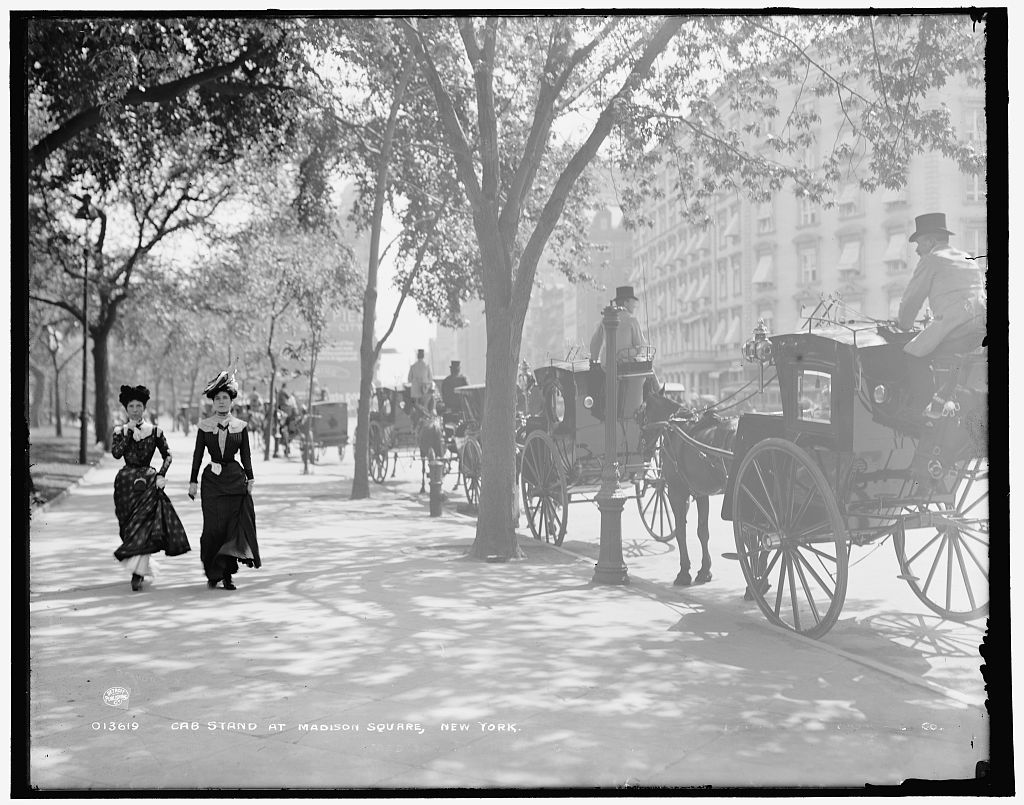
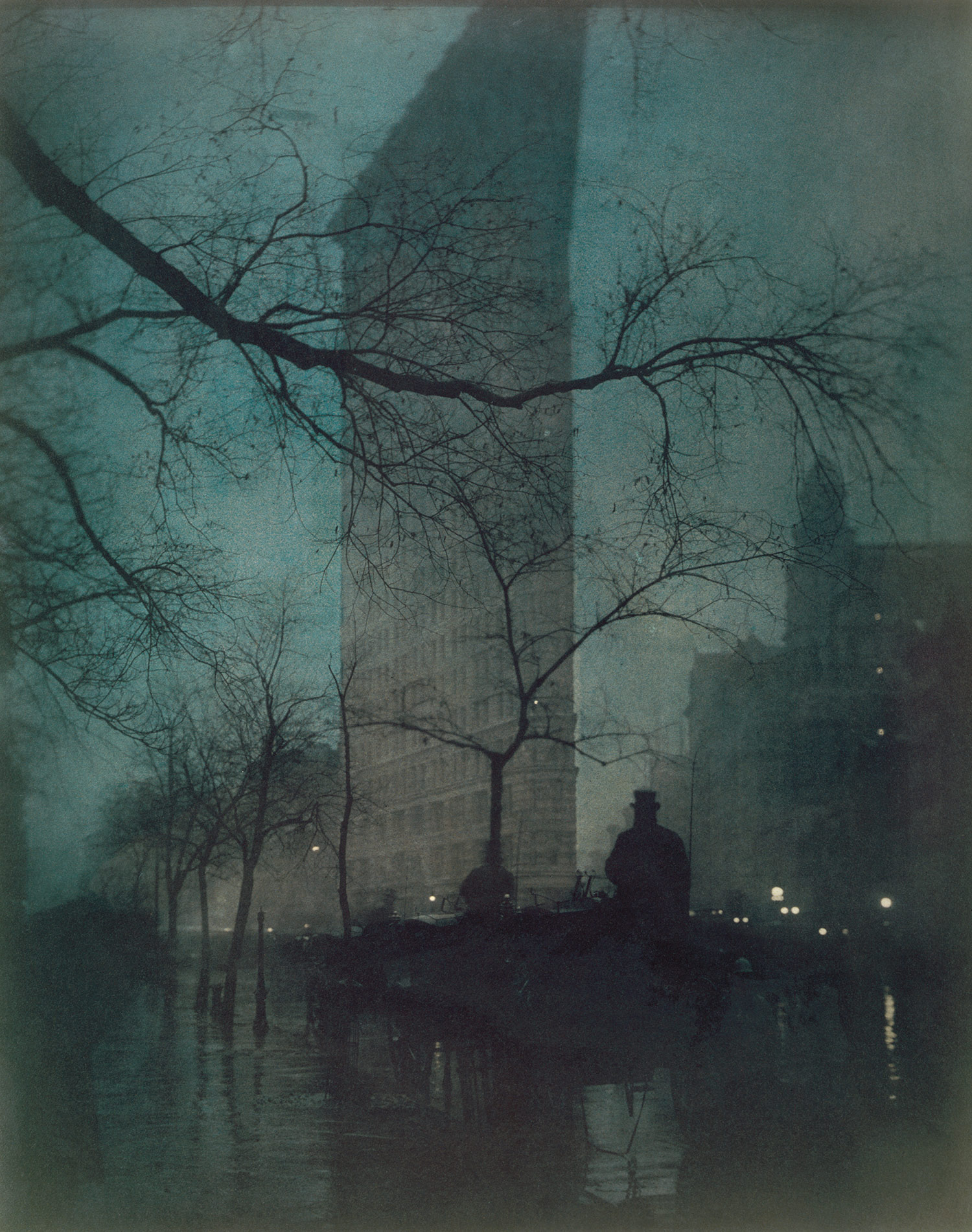
Here are some more of the many images that celebrate the building and the great expanse of Madison Square which it overlooks. You can find others via web search, including the great ones by Alfred Stieglitz and Edward Steichen.

1. This brief film pans from street level to roof along the axis of the building's apex.

{Photographed October 8, 1902 by Robert K. Bonine for the American Mutoscope and Biograph Company, this shows a view looking south from Madison Square, across the intersection of Broadway, Fifth Avenue, and Twenty-third Street, to the famous Fuller (or "Flatiron") Building. The cameraman elevates his camera, going from street level to the roof. Source: Library of Congress}

These still images all come from LC's Prints and Photos Division unless otherwise noted.

2. Some photos and a drawing made during its first decade of existence.

{"Flat Iron" Building, Fifth Avenue and Broadway, stereograph by the Keystone View Company, c1903}


{Fuller Building, N.Y. by A. Loeffler, c1902}


{Fuller Building (The Flatiron) by Irving Underhill, c1905}


{Fuller Building (The Flatiron) by Irving Underhill, c 1908}


{Fuller Building (The Flatiron) by Irving Underhill, c1910}


{Flatiron Building from Fifth Avenue and Twenty-Seventh Street by Joseph Pennell, drawing on dark brown paper: colored crayons, pencil; sheet 29.3 x 23.2 cm. made between ca. 1904 and 1908}

3. The structure in the foreground is the Victory Arch, put up to honor soldiers who were killed in World War I and later taken down.

{Victory Arch and Flatiron Bldg. by Irving Underhill, 1919}

4. The Flatiron building is located at the southern end of the great intersection of Broadway and Fifth Avenue called Madison Square. To the east of the intersection lies Madison Square Park.

{Flatiron Bldg. from Madison Square Park, by the Detroit Publishing Co. between 1902 and 1910}


{Flatiron Building from Madison Square Park, by the Detroit Publishing Co. between 1902 and 1910}

5. We are looking down Fifth with the park on the left.

{Fifth Avenue, by the Detroit Publishing Co. c1906}

6. This panorama shows: at right, the sharp northern corner of the Flatiron Building, called the cowcatcher; in the middle, Madison Square; and in the background, Metropolitan Tower.

{Madison Square, New York, 1908 showing part of the Flatiron Building, at right, and the second Madison Square Garden, built in 1890, in the center background; source: wikipedia}

7. We are looking south down Madison Avenue, one block to the east of Fifth. The Met Tower dominates the photo, but you can see the trees of the eastern side of Madison Square Park at its foot in the hazy distance.

{Madison Avenue and the towers, by the Detroit Publishing Co. between 1900 and 1915}

8. The photographer stands at the western side of the park and points his the Flatiron Building on his left, out of sight.

{A hansom at Madison Square, by Byron, ca. 1900}

9. The Flatiron Building is out of sight to the left in this view; the artist was an American impressionist who specialized in cityscapes.

{"After the Rain" painting of Madison Square by Paul Cornoyer, c.1900; source: wikipedia}

10. The photographer is located in the building just behind the triangular plot where the Flatiron Building will be erected. The camera is pointed north; Broadway extends to the left, Fifth Avenue to the right. The image is a scanned from a printed halftone that was made in the decade before the Flatiron Building was constructed.

{Madison Square looking north, Manhattan, New York City, in 1893, reproduced from The Street Book by Henry Moscow; source: wikipedia}

11. As the captions say, these stereoscopic photos show Broadway just south of Madison Square.

{Broadway from Union Square to Madison Square, stereograph by Strohmeyer & Wyman., c1892}


{Broadway from Union Square to Madison Square, stereograph by Strohmeyer & Wyman., c1892}

12. The photographer is facing north and is standing at about the spot where the Flatiron Building will later be erected.

{Madison Square, by Alfred S. Campbell, c1896}

13. This shows the north and east sides of the Square. The photographer would have to turn 90° to the left in order to see the Flatiron Building.

{Bird's-eye view of Madison Square, as seen by the workmen on Metropolitan Tower, stereograph by H.C. White Co., c1908}

14. This short movie shows windy Madison Square near the Flatiron Building.

{This street level view is of the Broadway side of the Flatiron, or Fuller Building, near the narrow north corner. Filmed on a very windy day, pedestrians of various descriptions are seen passing by the camera, clutching hats and skirts against the wind. According to some New York City historians, this corner was known as the windiest corner of the city, and in the era of the long skirt, standing on it was considered a good vantage point for a glimpse of a lady's ankle. Policemen would chase away such loungers from the 23rd Street corner, giving rise to the expression "twenty-three skidoo." Source: Library of Congress via Youtube}

Soon after the building was erected it became apparent that its shape and location resulted in erratic and quite severe gusts. The engineers had anticipated this problem and included extra wind bracing in the framework of the structure.

---------------

Some sources:

See in particular THE FLATIRON BUILDING, photos from nyc-archtecture.com

THE FLATIRON BUILDING; New York Architecture Images

Flatiron Building; Glass, Steel, and Stone

Flatiron Building on wikipedia

The Flatiron Building; the Birth of the Skyscraper

Flatiron Building; a view on cities

Beaux-arts architecture in New York: a photographic guide by Edmund Vincent Gillon, Henry Hope Reed (Dover Publications, 1988)

Tuesday, January 31, 2012

"super" as in "over the top"

I've never developed any lasting fidelities to professional sports teams. It's true though that I've had an interest in the football Giants going back to the glory years of Frank Gifford, Sam Huff, Roosevelt Brown, Andy Robustelli, Alex Webster, and, ultimately, the great old man, Yelberton Abraham Tittle. And so I'll be watching the Super Bowl this Sunday. And so also I've been reading Mike Tanier's blog postings in the NYT, hoping, as he does, that fortune will favor the New Yorkers while expecting that the Patriots will pull off a win.

Yesterday, Mike wrote about the transformation of the Super Bowl's host city. The post has an eye-popping typo in its headline which alerts you to the fact that this is a true weblog and not an article in the Grey Lady herself. The blog post is Everything Indy: The Invastion of the Roman Numerals in
The Fifth Down (New York Times N.F.L. Blog), January 30, 2012.*

Mike says "The N.F.L.’s fascination with Roman numerals is one of the league’s most bombastic traits, but the commitment to classical pretense pays off when the league builds on an epic scale. Park a giant '46' in the middle of a city, and passersby scratch their heads. Erect a hulking 'XLVI' into town central, and watch everyone stop to take pictures in front of it. ... While monolithic and omnipresent, the N.F.L.’s makeover is obviously temporary upon close inspection. The enormous numerals are made of fabric fastened over mesh, the sunburst pattern on the sides of the numerals resembling plywood when viewed from a distance."

{This image is in the public domain. Mike's blog shows one that's similar but copyright protected.}

The giant numerals remind me of another extravagant urban makeover, one that celebrated a naval victory over the Spanish Empire in 1898: the Dewey Arch.

Wikipedia explains:
The Dewey Arch was a triumphal arch that stood from 1899 to 1901 at Madison Square in Manhattan, New York. It had been erected for the parade in honor of Admiral George Dewey to celebrate his victory in the Battle of Manila Bay at the Philippines in 1898.

In spring 1899, planning for the parade, which was scheduled for September, began. Architect Charles R. Lamb found support for his idea of building a triumphal arch amongst the members of the National Sculpture Society, of which he also was a member. A committee of the society, comprising Lamb, Karl Bitter, Frederick W. Ruckstull, John Quincy Adams Ward, and John De Witt Warner, proposed the construction of an arch to the city of New York, which approved these plans in July 1899.

With only about two months left, it was decided to build the arch and its colonnade in staff, a material that had been used for the temporary buildings of several World's Fairs. Modeled after the Arch of Titus in Rome, the Dewey Arch was decorated with the works of 28 sculptors and featured a large quadriga (done by Ward) on top that showed four horses drawing a ship. At night, the arch was illuminated with electric light bulbs.

After the parade on September 30, 1899, the arch quickly began to deteriorate. An attempt to raise money to have the arch rebuilt with more durable materials (as had been done for the arch in Washington Square Park) failed, and thus the arch was demolished in 1901. The larger sculptures were sent to Charleston for an exhibit, and were destroyed afterwards.

Here is a photo of the Dewey Arch taken an employee of the Detroit Publishing Co. and found in collections of the Prints and Photos Division of the Library of Congress. It is a photochrom, that is to say a lithographic print made via an early type of colorizing that was generally used to make postcards.

{Caption: The Naval Arch at Madison Square, New York City, ca. 1900}

Here's the original from which the color version was made. It comes from a large-format glass plate negative.

{Caption: Madison Square and Dewey Arch, New York, N.Y., 1900, 1 negative, glass, 8 x 10 in.}

The photo just below is the right half of a panoramic view of Madison Square Park taken in 1905. It shows what the park and the intersection of Fifth Avenue and Broadway looked like without the Dewey Arch. See my blog post, Madison Park 1905, for details from the photo-pair. (I've written frequently about the park and its part of the city. To find the posts, search 'Madison Park' in this blog.)

{Caption: Madison Square from the Flat-Iron [i.e. Flatiron] Building, New York, 1905, 2 glass negatives, 8 x 10 in.}

Here are some details from the Dewey Arch photo.

1. You can tell that it's 20 past noon on a warm day. The park is full of people enjoying the shady peace it offers. It seems to be a work day; in other photos there are prams and children, but not this one. As usual the streets have lots of pedestrians and you can see bicyclists, two in this case, one of whom you see here, framed by the massive arch.


2. The wagon catches your eye, but also the crumbling imitation rock (called "staff") out of which the arch is constructed.


3. The contrast between Corinthian capitals and self-absorbed bench sitters is pointed, as they say.


3. A nice contrast here, as well, between imaginary heroic figures and a a very real New Yorker, pedestrian, literally, but I think not figuratively.


4. A contrast here between mundane and angelic with our interest falling more naturally with the former over the latter.


5. The great tower atop the old Madison Square Garden shows the only advertising on view in this photo.


-----------
*Update: the headline has been corrected: Everything Indy: The Invasion of the Roman Numerals

Sunday, October 02, 2011

dead man's curve

This magazine cover shows a Manhattan intersection called "Dead Man's Curve." The place got its name from treacherous conditions caused by cable-pulled street cars as they rounded the curve at the southwest corner of Union Square. The treacherous conditions arose from an idiosyncrasy of the cable system that was used in the 1890s: the cable's speed was just right for the straight passage up and down Broadway, but at the curve where Broadway turned onto the the square the pace was dangerously fast. The cable speed was constant; it was the curve that produced the danger. This illustration shows how pedestrians felt about the risks they took when crossing that intersection.

{'Dead Man's Curve'—New York's Most Dangerous Crossing, by W. A. Rogers (Harper's
Weekly, March 27, 1897); source: cdlib}

In 1907, my great-grandfather, Louis Windmuller, noted that the Dead Man's Curve problem had been solved at Union Square and the intersection of Broadway, Fifth Avenue, and 23rd Street had taken its place.[1] His letter to the editor on the subject is on the left. To the right is an excerpt from the article which he references.[2]

{On the left: "Perils of the Cruel City," New York Times, February 6, 1907; on the right: "Choate Argues for 14th St. Expresses," New York Times, February 1, 1907}

This photograph shows, at left, the "new" Dead Man's Curve on the southwest corner of Madison Park.

{Madison Square, New York, N.Y. (Detroit Publishing Co., taken between 1910 and 1915); seventh photo in a nine-part panorama set; source: Prints and Photos Div., Library of Congress}

This detail of that photo is marked to show the street car lines, the Seward statue, and, by white arrows, the path Louis Windmuller would take, walking north on the east side of Broadway. You can see a traffic cop in the intersection and quite a bit of traffic (though not nearly as much at the early hour when this photo was taken as there would be at noon and beyond).


This photo shows Broadway and Fifth Avenue as they separate from one another and proceed northward away from the park. Louis Windmuller would take the sidewalk on the west side of the park and then walk up the east side of Fifth Avenue, stopping at the Reform Club on 27th if he wished (he was a founder and, as its treasurer, had bought the building at 2 East 27th) and then on to his "winter" home on 46th.

{Madison Square, New York, N.Y. (Detroit Publishing Co., taken between 1910 and 1915); first photo in a nine-part panorama set; source: Prints and Photos Div., Library of Congress}

Taken 15 years earlier, this photo shows the intersection at bottom right, with the west side of the park at near left and, at far left, the passage of Fifth Avenue to the north.

{Manhattan: Broadway - 23rd Street (Brown Brothers, 1893); source: NYPL Digital Gallery}

This map shows Louis Windmuller's route from his office at 20 Reade Street to his winter home at 19 W. 46th, with the Reform Club, at 27th, in between. Both the 14th St. and 23rd St. Dead Man's Curves are shown in green. Windmuller was a famous walker. I've previously written about his walking, his office on Reade St., and his winter home on 46th.[3] I've also previously written about the block that's outlined in red.[4]

{Manhattan Hotels and Theaters Map, 1906; source: Library of Congress}

This is another view of the intersection, this time with the camera facing northwest. The photo was taken during a quiet moment in 1901 by William Henry Jackson, a well-known photographer working for the Detroit Publishing Co. (notice the three bicyclists, one of them a lady). The Fifth Avenue Hotel, at left, was owned by Amos Eno, a dry goods merchant who became a fabulously-wealthy real estate magnate. The Reform Club building on 27th had been Eno's home; was purchased from the estate at his death.

{Madison Square, New York, by William Henry Jackson, for the Detroit Publishing Co. (New York, 1901), first of three photographs making up a panorama; Prints and Photos Div., Library of Congress}

This photo shows the Dead Man's Curve at Union Square after electrification of the street cars. No one, including the lone (male) bicyclist, seems to be worried about the risk of injury.

{Lincoln Statue, Union Square, 1906; source: wikipedia}

This detail from a panorama photo shows the building owned by the Reform Club in 1911, just after the club had moved to new quarters in the financial district. The Club's address had been 2 East 27th Street, but the building is now identified as 233 Fifth Avenue.

{Detail from plate no. 24 in the book Fifth Avenue, New York, from Start to Finish (Welles & Co., 1911); source: NYPL Digital Gallery}

This panorama photo shows the block on the east side of Fifth Avenue just north of Madison Square and just south of the Reform Club location.

{Detail from plate no. 22 in the book Fifth Avenue, New York, from Start to Finish (Welles & Co., 1911); source: NYPL Digital Gallery}

---------------

Some sources:

DEADMAN'S CURVE REFORM.; New Traffic Regulations for the Benefit of Pedestrians, New York Times, January 10, 1905

Dead Man's Curve on snopes.com

Union Square and the demise of 'Dead Man's Curve'

CHOATE ARGUES FOR 14TH ST. EXPRESSES, Appears Before Transit Board for Those Opposing 23d Street. MORE NEED AT 14TH STREET Metz Resolution on Bridge Subway Loop Opposed by the Mayor -- Committee to Confer with B.R.T., New York Times, February 1, 1907
"There would also be added danger at 'dead man's curve,' he went on, evidently under the impression that the curve was at Twenty-third Street. The term has been applied more generally at Fourteenth Street."

NOTED CITIZENS OUT FOR WALKING RECORD, Gaynor, Choate, Hornblower, Parsons, and Windmuller Form the Pedestrians Club, New York Times, February 7, 1913

THE REFORM CLUB'S HOME.; PLANNING PLEASANT QUARTERS FOR ITS MANY MEMBERS, New York Times, April 18, 1890

IN THE REAL ESTATE FIELD, New York Times, March 18, 1910. "Reform Club Buys Building -- The Reform Club, through Louis Windmuller, Treasurer, purchased yesterday from the Cutting estate the building 9 South William Street, facing also on Mill Lane and extending through this lane to Stone Street. The building will be altered so that the club can use it as a midday luncheon club and for committee members to meet. Limited space will compel the club to restrict membership to a small number beyond the present roster."

A.R. ENO'S WILL PROBATED, It Disposes of an Estate Estimated at from $20,000,000 to $40,000,000. SMALL SHARE FOR SON JOHN C. All the Heirs Waive Citation and There Will Be No Contest -- Many Bequests Paid During the Testator's Lifetime Are Canceled New York Times, March 12, 1898. First para: "The will of Amos R. Eno was filed for probate with the Surrogate yesterday. Mrs. Antoinette E. Wood, a daughter of the testator, was the proponent, and in her petition she says that the value of the real estate and personalty is "not definitely known." The combined values are estimated to be between $20,000,000 and $40,000,000."


--------------

[1] The problem at Union Square had been solved by switching from cable-pulled to electric-powered cars.

[2] Eventually the City would decide that 14th Street should have an express stop; 23rd Street should not. Choate and Windmuller were acquaintances, probably friends. They served together on corporate boards (including the German-American Insurance Co.) and were walking companions, as evidenced by this article: NOTED CITIZENS OUT FOR WALKING RECORD, Gaynor, Choate, Hornblower, Parsons, and Windmuller Form the Pedestrians Club, New York Times, February 7, 1913

[3] Some blog posts on his walking, the office, and the 46th St. place:
[4] My two recent posts on 23rd St. between 5th and 6th are 23rd St. and New York Newsstand, 1903.

Thursday, January 14, 2010

Madison Park 1905

This set of two photos shows the west side of Madison Square in New York City on a warm and sunny day in 1905. It was taken from the Flatiron Building, then only a couple of years old and known as the Fuller Building. Edward Steichen made a famous photo of this building the year before.*

The view is to the north up Broadway on the left and Fifth Avenue on the right.

The large building on the left side is the Fifth Avenue Hotel which stood there from 1859 to 1908.**

The tower in the second photo adorns the old Madison Square Garden.

The photographer worked for the Detroit Publishing Co. which was famous for large-format shots such as the ones you see below.


The two photos that make up this panorama come from collections of the Library of Congress Prints and Photos Division. Here they are in high resolution jpg files. Click to enlarge.


Here are details from the two photos.

1. In this detail we are looking up Broadway. The clock tells us that is near noon. By the shadows you can tell the sun is directly overhead indicating that this day is one near the summer solstice. June 21 fell on a Wednesday that year and this is was probably taken that day or maybe the one before or after it. The many (many) trolley cars are powered by electric lines running under the street between the rails. There are horse drawn wagons, hansom cabs, and carriages. A mounted policeman speaks with a sanding one. Traffic is orderly and seems to be moving at a leisurely pace. Pedestrians use the street as well as the sidewalks.


2. You can see a street clock more clearly in this detail. The street lamp is electric, converted from gas. In those days as this one, New Yorkers seemed to prefer to wear black over any other color. The ticket taker on one of the trolley cars is standing on the running board.


3. It's a breezy day. In these windows of the Fifth Avenue Hotel you can see that a curtain blown out of an open window and people have let the awning cords flop loose.


4. A man sits on the hotel balcony observing the street scene below. I expect others will join him as the afternoon wears on and the building's shadow offers some shade.


5. Below the man on the balcony there's a pith-helmeted sanitation worker dressed in white, one of a vast crew known as white wings. You can see many gents taking their liesure under the awning of the hat store and the columned portico of the hotel.


5. The building that separates Broadway from Fifth Avenue sports a whiskey ad; behind it you see the familiar Cross logo used to advertise apartments and chambers.


6. The building that sports the whiskey sign belongs to Berlitz, which advertises its English classes more than its foreign language ones. The monument in front of it honors General william Jenkins Worth.


7. There's a set of real estate offices in Berlitz Building and in one window a woman observing the scene in General Worth Square below.


8. This detail shows Fifth Avenue from 23rd Street north toward 34th. You can see a couple of trees on the north west corner of Madison Square and by them a small open motor car.


9. Near the monument the mounted policeman speaks with a colleague.


10. On the other side of the monument — on the wide expanse of pavement where Fifth Avenue splits off from Broadway — we see a bicyclist, motor hansom cab, delivery wagon, and sundry pedestrians.


11. A bit to the south, where Broadway crosses Fifth, we see another motor hansom and a most unusual trackless trolley.


12. This shows part of a wire fence which creates a traffic-free space at Broadway and Fifth, a kind of a cab rank it appears.


13. Here are lots more hansom cabs parked on the west side of Madison Square along with a white horse hitched to a delivery wagon.


14. A close-up of horse and wagon.


15. Many New Yorkers are enjoying a quite noontime moment in the park.


16. A woman pushes a baby pram through the park.


--------------

A bonus:

Here are two other photos of Madison Square taken at about the same time. The first was taken on a day very similar to the one on which the panorama photos were taken; the second was shot during a winter snowstorm. The camera is facing south down Fifth Avenue in both shots (hence hotel is on the right). Like the pano shots, the two are from the Detroit Publishing Co. collection in LC.


---------------

Notes:

* Here's a copy of this famous photo.

{The Flatiron Building in a photograph of 1904, taken by Edward Steichen; source: wikipedia}


Here are two other contemporary photos of the Fuller Building from LC.


** More on the Fifth Avenue Hotel:

{The Fifth Avenue Hotel when new in 1859; source: Old New York}


{An albumen print of the Fifth Avenue Hotel, from a stereoscopic pair of images taken sometime between 1859 and 1896; source: wikipedia}