Showing posts sorted by relevance for query flatiron. Sort by date Show all posts

Thursday, July 01, 2010

Fuller's Flatiron Building in the early 1900s

New York's Flatiron Building is easy to like. Erected in the early years of the twentieth century, it has always been a magnet for photographers and artists. I thought about its visual appeal on reading Jonathan Yardley's nice review of a new book: The Flatiron: The New York Landmark and the Incomparable City That Arose with It by Alice Sparberg Alexiou.

Designed by a Chicago company, the building was formally called the Fuller Building, but instantly became universally known by the name of the triangular plot on which it was built. A steel-framed building, it has its lower three stories faced with stone and the remainder clad in terracotta. It was not the first nor the tallest of the new skyscrapers, but was the first to capture the romantic imagination of New Yorkers, New York's visitors, and many others who saw the images that depicted it.

Yardley does a good job of describing its significance and the affection he feels for it. He says, "When I lived in New York in the early 1960s I made regular pilgrimages to Madison Square in order to gaze reverently at the Flatiron, after which I walked a few blocks south to Union Square and the used book district that -- O lost! -- then thrived nearby. This was long before New York's renaissance, and the neighborhood was distinctly grubby, but even under a deep coat of soot the Flatiron's beauty and dignity shone through, and it was easy to imagine how much it had startled and thrilled the city six decades earlier."

Unfortunately, the review is accompanied by a single not very impressive photo.

I've done two previous web posts celebrating it in photos from the beginning of the twentieth century: (1) Flatiron, 1905 and (2) Madison Park 1905.

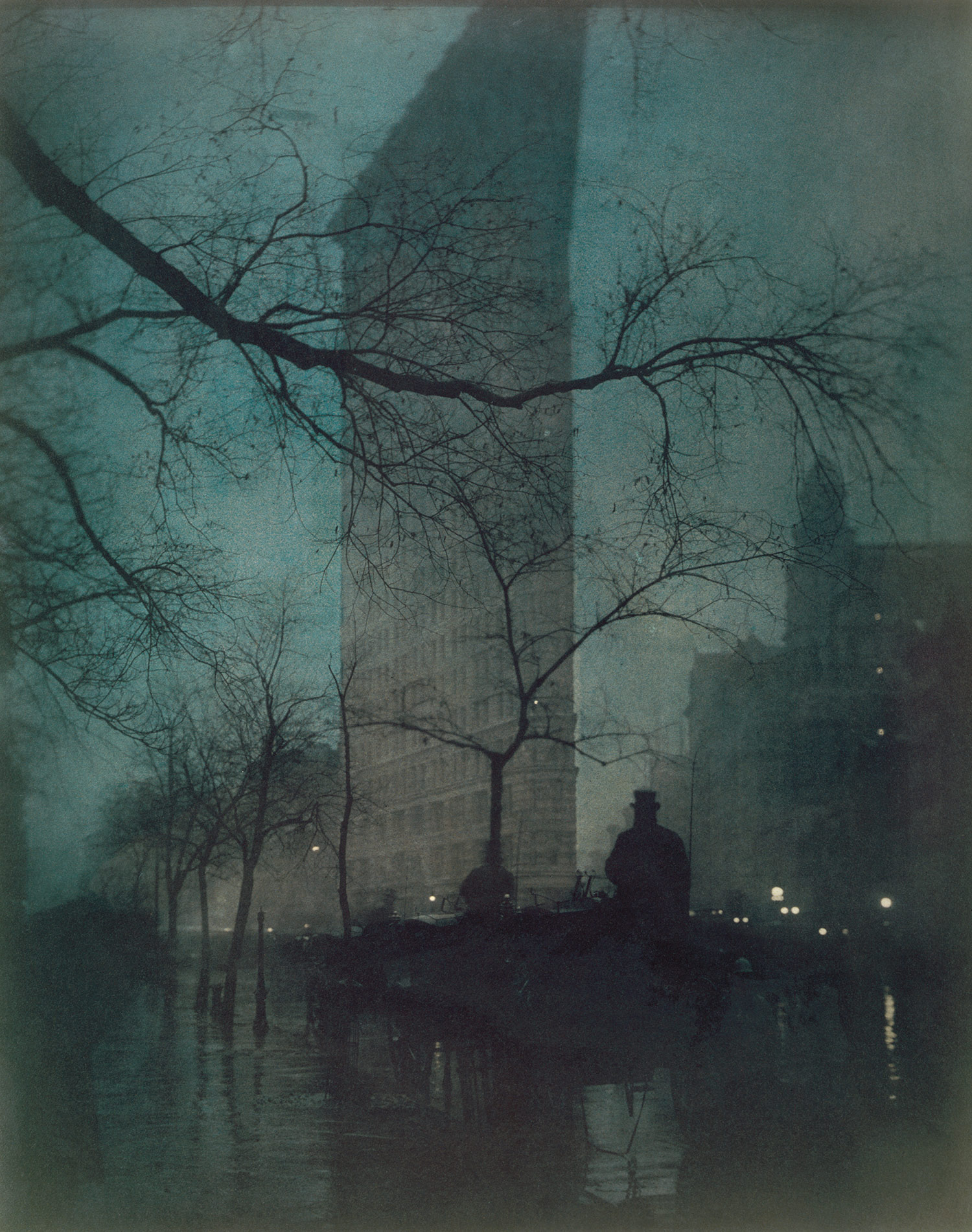
Here are some more of the many images that celebrate the building and the great expanse of Madison Square which it overlooks. You can find others via web search, including the great ones by Alfred Stieglitz and Edward Steichen.

1. This brief film pans from street level to roof along the axis of the building's apex.

{Photographed October 8, 1902 by Robert K. Bonine for the American Mutoscope and Biograph Company, this shows a view looking south from Madison Square, across the intersection of Broadway, Fifth Avenue, and Twenty-third Street, to the famous Fuller (or "Flatiron") Building. The cameraman elevates his camera, going from street level to the roof. Source: Library of Congress}

These still images all come from LC's Prints and Photos Division unless otherwise noted.

2. Some photos and a drawing made during its first decade of existence.

{"Flat Iron" Building, Fifth Avenue and Broadway, stereograph by the Keystone View Company, c1903}


{Fuller Building, N.Y. by A. Loeffler, c1902}


{Fuller Building (The Flatiron) by Irving Underhill, c1905}


{Fuller Building (The Flatiron) by Irving Underhill, c 1908}


{Fuller Building (The Flatiron) by Irving Underhill, c1910}


{Flatiron Building from Fifth Avenue and Twenty-Seventh Street by Joseph Pennell, drawing on dark brown paper: colored crayons, pencil; sheet 29.3 x 23.2 cm. made between ca. 1904 and 1908}

3. The structure in the foreground is the Victory Arch, put up to honor soldiers who were killed in World War I and later taken down.

{Victory Arch and Flatiron Bldg. by Irving Underhill, 1919}

4. The Flatiron building is located at the southern end of the great intersection of Broadway and Fifth Avenue called Madison Square. To the east of the intersection lies Madison Square Park.

{Flatiron Bldg. from Madison Square Park, by the Detroit Publishing Co. between 1902 and 1910}


{Flatiron Building from Madison Square Park, by the Detroit Publishing Co. between 1902 and 1910}

5. We are looking down Fifth with the park on the left.

{Fifth Avenue, by the Detroit Publishing Co. c1906}

6. This panorama shows: at right, the sharp northern corner of the Flatiron Building, called the cowcatcher; in the middle, Madison Square; and in the background, Metropolitan Tower.

{Madison Square, New York, 1908 showing part of the Flatiron Building, at right, and the second Madison Square Garden, built in 1890, in the center background; source: wikipedia}

7. We are looking south down Madison Avenue, one block to the east of Fifth. The Met Tower dominates the photo, but you can see the trees of the eastern side of Madison Square Park at its foot in the hazy distance.

{Madison Avenue and the towers, by the Detroit Publishing Co. between 1900 and 1915}

8. The photographer stands at the western side of the park and points his the Flatiron Building on his left, out of sight.

{A hansom at Madison Square, by Byron, ca. 1900}

9. The Flatiron Building is out of sight to the left in this view; the artist was an American impressionist who specialized in cityscapes.

{"After the Rain" painting of Madison Square by Paul Cornoyer, c.1900; source: wikipedia}

10. The photographer is located in the building just behind the triangular plot where the Flatiron Building will be erected. The camera is pointed north; Broadway extends to the left, Fifth Avenue to the right. The image is a scanned from a printed halftone that was made in the decade before the Flatiron Building was constructed.

{Madison Square looking north, Manhattan, New York City, in 1893, reproduced from The Street Book by Henry Moscow; source: wikipedia}

11. As the captions say, these stereoscopic photos show Broadway just south of Madison Square.

{Broadway from Union Square to Madison Square, stereograph by Strohmeyer & Wyman., c1892}


{Broadway from Union Square to Madison Square, stereograph by Strohmeyer & Wyman., c1892}

12. The photographer is facing north and is standing at about the spot where the Flatiron Building will later be erected.

{Madison Square, by Alfred S. Campbell, c1896}

13. This shows the north and east sides of the Square. The photographer would have to turn 90° to the left in order to see the Flatiron Building.

{Bird's-eye view of Madison Square, as seen by the workmen on Metropolitan Tower, stereograph by H.C. White Co., c1908}

14. This short movie shows windy Madison Square near the Flatiron Building.

{This street level view is of the Broadway side of the Flatiron, or Fuller Building, near the narrow north corner. Filmed on a very windy day, pedestrians of various descriptions are seen passing by the camera, clutching hats and skirts against the wind. According to some New York City historians, this corner was known as the windiest corner of the city, and in the era of the long skirt, standing on it was considered a good vantage point for a glimpse of a lady's ankle. Policemen would chase away such loungers from the 23rd Street corner, giving rise to the expression "twenty-three skidoo." Source: Library of Congress via Youtube}

Soon after the building was erected it became apparent that its shape and location resulted in erratic and quite severe gusts. The engineers had anticipated this problem and included extra wind bracing in the framework of the structure.

---------------

Some sources:

See in particular THE FLATIRON BUILDING, photos from nyc-archtecture.com

THE FLATIRON BUILDING; New York Architecture Images

Flatiron Building; Glass, Steel, and Stone

Flatiron Building on wikipedia

The Flatiron Building; the Birth of the Skyscraper

Flatiron Building; a view on cities

Beaux-arts architecture in New York: a photographic guide by Edmund Vincent Gillon, Henry Hope Reed (Dover Publications, 1988)

Friday, April 09, 2010

Flatiron, 1905

I saw this photo on Shorpy and, somewhat laboriously, managed to find it in the Prints and Photos website of the Library of Congress. (Though they recently overhauled their website, I still can't easily find what I'm looking for. My fault or theirs?)

It's called Flatiron Building, Broadway and Fifth Av., New York City. The year is 1905 and the photo is not one I've previously made available on this blog. As with so many of the New York City photos I reproduce from LC collections, it was made by the Detroit Publishing Co. and 'tho it shows a copyright insignia, it's now in the public domain.


Here are some cropped images from it.

1. The clock tells us it's 9:20. That's in the A.M. as we can tell by the orientation of the camera, shooting from the north, and the direction of the sunlight, coming strongly and acutely angled from the east.


2. The photographer chose a moment when the sun was poring directly down the side streets; not only was it morning, but morning in one of the late-fall or early-spring months when the sun was low on the horizon at that hour.


3. In the main photo you can see the flags and chimney smoke blowing in a west wind. This wind was stronger and less uni-directional down at street level. After the Flatiron building was erected, the intersection of Broadway and Fifth Avenue came to be called "The Windiest Corner in the World".* The workmen in this segment of the photo may be repairing wind-caused damage.**


4. It's actually relatively calm this day. Note in this image the reflection in the plate glass window of the man who's just starting to pass by the goods wagon on his right. This wagon has attracted the attention of the local police. Notice how many policemen are within this picture as a whole. Broadway at Fifth Avenue must have been very well protected from unwanted occurrences.


5. Here we have a man out on a ledge for a purpose difficult to determine. His posture suggests that he's not fearful of wind gusts. The man above is more cautious and seems mainly intent on catching some rays and observing the scene below.


6. The horse-drawn cabs and wagons go where they will across the wide intersection, mingling freely with but not threatening pedestrians or each other. In this image my eye is drawn to the man at right striding purposefully with head lowered against the bright facing sun.


7. In this part of the picture the traffic is all going in the same general direction although one wagon is intent on cutting off another. I expect the pace of both is slow enough so there's no real problem here. It's interesting that the one has two wheels and two horses while the other has four wheels and one horse. The traffic also includes a two-man, two-wheeled conveyance of the kind we used to see at railway stations when I was young. I think they're just called handcarts.


8. This last segment contains an interesting pattern of trolley tracks, with their mid-track groove for electric supply. The composition is also interesting for contrast of the horizontal movement in the lower section with the diagonals of the upper part. Notice among the left-right traffic a handsome horse pulling a gig; it's the only conveyance I notice that seems to be privately owned.


The the photographer has placed the camera just behind and above Worth Monument in the building at 204 Fifth Avenue. This photo shows the monument and that building (with its White Horse whiskey sign) at center.


Here's a link to a Google map of the area.

-------------

Notes:

*In an article with this as its title, the author said, "the building, towering above all nearby structures, is the only obstruction to the breeze that sweeps unimpeded from North River to East River. This, in connection with the open space afforded by Madison Square, forms an eddy, or windwhirl. The 'Flat Iron' building presents to East and West winds, a flat surface like an enormous fence, three hundred by two hundred feet in size, and the winds sweep over the top and down into the street where they meet other winds coming up or down Broadway and still others coming up or down Fifth Avenue, and all these winds join hands and romp and gambol in the street, and do things that no nice gentlemanly wind would do."

**The same author wrote: "On the opposite side of Broadway [i.e., across from the Flatiron building] is a row of smaller buildings and the plate glass window of one of these shops seems to have been particularly singled out by the untamed wind; it has been crushed in a number of times, and the owner of the shop has brought suit to recover damages. Why the wind should have a spite against that particular shop no one can tell, but to have one's plate glass continually falling in or out is quite a blow. But it is rather difficult to see how owners of the 'Flat Iron' building can stop the wind, for wind is noted for blowing 'where it listeth,' and it listeth to blow in the windows of that shop.

Thursday, September 29, 2011

23rd St.

When this photo was taken the block that it shows, 23rd street west of 5th Avenue, was a retail center for women's clothing, jewelry, toys, books, and furniture. Some buildings, like McCreery's, at right, were huge dry goods stores. Others, like Best & Co next door, were more modest in size but still given over entirely to one business. Most housed storefronts at street level and, above, a mixture of offices, small manufacturing operations, wholesale merchants, and upper-floor retail stores. Some of the shops are still pretty well known. Best & Co. is one such. Others are Bonwit Teller, F.A.O. Schwarz, and the publishing house, G. P. Putnam's Sons. A dwindling number of the old brownstones were still private residences. No. 49, for example, was the home of W.C. Schermerhorn, whose family owned much Manhattan property, including some of this block. More typically, No. 14, where Edith Wharton had been born, was now the James McCutcheon & Co. dry goods store, selling imported handkerchiefs, table linens, towels and embroideries. There was one variety theater on the block and many nearby.[1] And there were many galleries and artists' show rooms (one of which showed a portrait of my great-grandfather in 1900).[2] The other major industry in the vicinity was hostelry. There was one famous hotel on the block and quite a few others, both large and small, in the vicinity.[3]


{caption: 23rd [Twenty-third] Street, east from 6th Ave. [Sixth Avenue], New York, N.Y., Detroit Publishing Co., circa 1908; source: Library of Congress Prints and Photographs Division}

The photo is interesting partly because it lacks the crystal clarity of other photos by the Detroit Publishing Co. Compare, for example, the image of the same general location taken a few years before (which I showed in a recent post) or the images of nearby Madison Park which I showed a bit more than a year ago. The haze which obscures the photo's background gives the appearance of great depth and provokes a small sense of mystery.

The photographer was standing on the platform of the 23rd Street station of the Sixth Avenue elevated railway. The large building to the right, McCreery's, is on the corner of 23rd and 6th. The block ends just before the tallest building visible in the smoky distance — the famous Flatiron Building. In between, we should be able to see 17 buildings, but there appear to be only six or seven.

This detail from a 1910 fire insurance map names most of the structures on the south side of the block.

{Detail from: Manhattan, Atlas 114, V. 4, Plate No. 1; Map bounded by 6th Ave., W. 25th St., 5th Ave., W. 22nd St., (Sanborn Map Company, 1910); source: NYPL Digital Gallery. Click here for two see the atlas sheet from which this detail was taken.}

To our left, the view is even less certain. We can make out the last few letters of the sign at the Eden Musee, then the "Toys" sign at F.A.O. Schwarz. There seem to be just two buildings between that one and the hotel on the end of the block (whose sign you can just make out at top: "Fifth Avenue Hotel", of which only the "UE" and "L" are visible). However the insurance map shows five buildings between F.A.O. Schwarz and the hotel.

The foreshortening on this, the north side, is more pronounced beyond the hotel. At that point we should see a wide intersection (where 23rd, Broadway, and 5th Ave. come together) and the southern end of Madison Square Park. We do see some trees, but the separation between the Fifth Avenue Hotel and the next building to the east, the Metropolitan Life Insurance Building, seems much to small. Similarly, the Flatiron Building seems squeezed between the Union Trust building on the west and the Hotel Bartholdi to its east.

At the farthest point in our sightline we can see the 23rd St. station of the Third Avenue elevated railway. Intervening buildings include the Society for Prevention of Cruelty to Children and the College of the City of New York.

Here are some details from the photo.

There are many more people afoot than there are being carried about in a vehicle. At this date, at the dawn of the motor age, there are hardly any private motor cars. People took the elevated railways, the street cars, and the horse-cabs. You can see by the clock of Le Bolt & Co., jewelers, that it's just a bit past noon. The clock is directly across from the signpost for the Eden Musee and both are placed high enough to be seen by people exiting the 23rd St. station of the Sixth Avenue El. To the left, on the north side of the street, merchants have put up awnings against the bright morning sun. The iron-gated steps lead to the Schermerhorn residence. Click to view this detail full-size.


The broad sidewalk on the south side of the street is crowded with window shoppers and pedestrians. It must be summer since many women are wearing light-colored clothing.


In this view you can see a sign for the Lilliputian Bazaar in the Best & Co. building. The bazaar specialized in clothing for children. You can also see that Bonwit Teller specializes in Women's Outer Garments.


The Flatiron Bldg. seems much closer to Stern Brothers than it is.


The photographer who took the picture worked for the Detroit Publishing Co. which specialized in postcards, both color and black and white. Here's a postcard which they made from the same negative as the one shown above.[4] In it, you can't see the Flatiron Building at all.

{source: wikipedia}

From the postures of the people in the street it's easy to tell that the postcard was made from the negative. It looks at first glance that the postcard is simply a cropped version of the negative, but although that's true on three of its sides, the left side of the postcard shows a bit more than the black & white image. This is yet another mystery. The postcard may have the extra bit stitched in (Detroit Publishing occasionally combined two negatives to make a card). Or, perhaps the scanner from which the b&w image was made somehow cut off the left edge.

This next postcard was made about the same time and from nearly the same spot on the platform of the El station, but at a different time of day, by a different publishing organization, and with use of a different process of colorization.[5]

{Caption: Postcard: 23rd Street in Manhattan, New York City, published in 1907 or before; source: this card is available on a number of web sites, my source for this copy was flickr}

The scrawled note says "A windy day, and I have a bad case of blues. Deb." The other side is addressed to Dr. E.L. Johnson, Iron River, Douglas Co., Missouri. As you can see, the card identifies itself as "Twenty Third St. Shopping District, New York". The publisher is identified on the back: "Souvenir Post Card Co. New York and Berlin"[6]

Within the next five years the block would be transformed and by 1920 most of the retail stores had moved uptown as warehouses and lofts were erected in their place.

Here, via Google Street View, is what it looks like today.

View Larger Map
And here, by contrast, is what it looked like during a snowstorm in 1905.

{Caption: Bloc[k]aded cars on 23rd St., New York. [Blockaded cars on Twenty-third Street, New York.] (1905); source: NYPL Digital Gallery}

--------

Some sources:

Demolished buildings, What we lost

FAO Schwarz in wikipedia

Knoedler & Company

GOUPIL'S GALLERY, New York Times, November 29, 1876

"Reform Club" in Club men of New York, their occupations, and business and home addresses: sketches of each of the organizations: college alumni associations (Republic Press, 1893)

The Ehrich Brothers Store, New York Times, February 12, 1995

KOSTER & BIAL'S TO BE SOLD, New York Times, August 18, 1893

A NEW MUSIC HALL, The Trocadero on West Twenty-Third Street Opened Last Night with an Excellent Variety Programme, New York Times, March 10, 1896

JACKSON-MACK CO. FAILS FOR $1,000,000, New York Times, October 12, 1912

MRS. SALLODE AFTER SCHNEIDER.; Determined to Purity Her Neighborhood in West Twenty-fourth Street, New York Times, August 8, 1894

IN THE REAL ESTATE FIELD, New York Times, July 15, 1910 ("the cloak and suit firm of Bonwit, Teller Co., now located at 58 West Twenty-third Street")

TWENTY-THIRD STREET'S BUSY RETAIL BLOCK DESTINED FOR GREAT WHOLESALE CENTRE, New York Times, March 1, 1914

W. C. SCHERMERHORN BURIED, New York Times, January 5, 1903.

New York's Theatres, Old and New, New York Times, June 15, 1902

A history of the New York stage from the first performance in 1732 to 1901 by Thomas Allston Brown (Dodd, Mead and company, 1903)

Manhattan Street Directory (Manhattan Guide Company, 1901)

Passing of the Fifth Avenue Hotel About to Remove One of New York's Noted Landmarks, New York Times, July 7, 1907

MADISON SQUARE A GREAT BUSINESS CENTRE; RADICAL TRANSFORMATION IN RECENT YEARS, New York Times, May 19, 1912

Souvenir Post Card Co. 1905-1914: "268 Canal Street, New York, NY. A major publisher of a variety of postcard types. They used three different printers over the course of their business, which changed the look of their cards. Some of the early cards were printed with the name E. Frey (owner?) on them. The company was purchased by Valentine and Sons. and they produced cards in America under the name Valentine-Souvenir Co."

IN THE REAL ESTATE FIELD; Twenty-third Street Concern to Move to Fifth Avenue, New York Times, June 30, 1906

From Wharton to Starbucks -- No. 14 West 23rd Street

IRT Third Avenue Line in wikipedia

--------

Notes:

[1] At the center of the block on the north side, the Eden Musee possessed a music hall as well as wax works and dining room. Nearby theaters and halls included Proctor's Twenty-third Street Theatre and the Trocadero or Bon Ton (one block to the west), the Grand Opera House (farther west, at 8th Avenue), the Madison Square Theatre (on 24th just west of Broadway), the Lyceum (on 4th Ave. between 23rd and 24th), the Fifth Avenue Theatre (Broadway and 28th), and Miner's (8th Ave near 25th). The old Madison Square Garden took up a whole block (26th-27th, Madison-4th Ave.). The block had formerly possessed the famous Booth's Theatre at the corner of 23rd and 6th Ave.

[2] I now have this portrait. Here are some of the galleries near the block: The Artist Artisan Institute was a block to the west. The most famous nearby gallery was Goupil's, part of Knoedler & Co. (5th Ave. and 22nd.) Other nearby galleries included the National Academy of Design (23rd at 4th Ave.), L. Crist Delmonico (5th Ave. near 22nd), Klackner Art Gallery (7 W. 28th), and William Schaus (5th Ave. near 25th).

[3] Fifth Avenue Hotel, Hoffman House, Albemarle Hotel, Brunswick Hotel, Bartholdi Hotel, Richfield Hotel,

[4] The colorizing process they used, called photochrom, used black and white negatives in a lithographic printing operation.

[5] There's a black and white version of this card on wikipedia with the following information: "Unmailed postcard. Store Web page states year published is estimated to be 1910 (title of Web page: "NY~NEW YORK CITY~23rd Street at Night~c1910 BEAUTY" Picture side of postcard (only side shown on store Web page) states "1940 ILLUSTRATED POST CARD CO., NEW YORK." The number "1940" is a typical inventory or catalog number of a type seen on many postcards in the early Twentieth century." Of the Illustrated Post Card Co., the web site of the Metropolitan Postcard Club of New York City says: "Illustrated Post Card 1905-1914 520 West 84th Street, New York, NY. This major publisher produced a wide variety of tinted halftone postcards in series that were printed by Emil Pinkau in Leipzig, Saxony. Each city or location of their color card sets were assigned the same number prefix. They also published an unnumbered series of chromolithographic fine art cards that were printed in Dresden. Many of their early cards do not have their name on them, only their distinct eagle logo.

[6] Here's the database entry for this publisher in the web site of the Metropolitan Postcard Club of New York City: "Souvenir Post Card Co. 1905-1914. 268 Canal Street, New York, NYA major publisher of a variety of postcard types. They used three different printers over the course of their business, which changed the look of their cards. Some of the early cards were printed with the name E. Frey (owner?) on them. The company was purchased by Valentine and Sons. and they produced cards in America under the name Valentine-Souvenir Co."

Wednesday, May 02, 2012

West Twenty-Third east from Sixth

I've written quite a few posts about the area where Broadway and Fifth Avenue come together in New York City. Their topics were the Flatiron Building, which dominates that intersection; Madison Square Park, which adjoins it; and locations in the vicinity that were associated with my great-grandfather, Louis Windmuller.*

I've also done some posts about the block of 23rd Street that lies between Fifth and Sixth Avenues at this location. They are 23rd St., New York Newsstand, 1903, and Eden Musee, a major attraction at mid-block.

Those posts give lots of views of the area. Here are just a couple more. They were taken at the same general time and from same general place as the one in the first of the three posts listed above, and they can be found in collections of the Prints and Photographs Division of the Library of Congress.


{Caption: West Twenty-third Street from Sixth Avenue, New York, N.Y. by the Detroit Publishing Co., ca. 1908}

Details of this image:

1. We're looking at the south side of the block. The photographer has positioned himself at the foot of the stairs to the elevated railway at 6th Avenue and 23rd. He's facing east. As you see, it's late in the afternoon on a warm but overcast day. The Flatiron Building dominates the skyline, but its the department stores, shops, and most of all the bustle of the street which attracts the eye.


2. This is the north side of the block with Eden Musee, F.A.O. Schwarz toys, and the Fifth Avenue Hotel dominating the scene.


3. Best & Co., the famous women's shop, then marketed itself as the Lilliputian Bazaar. Notice that the large plate glass windows reflect the buildings opposite.


4. You can see the reflections more clearly here.


5. A display of women's fashions on the second floor. The shop is Best & Co.'s neighbor, Bonwit Teller.


The negative of this second photo is getting moldy, but most of it is still in good shape. The photographer seems to be standing on the top of a hansom cab (horse's head just visible at bottom).

{Caption: West Twenty-third Street, New York, N.Y. by Detroit Publishing Co., ca. 1908}

Details:

1. The Eden Musee again. I did a blog post about this place, whose board of directors had Louis Windmuller as a member.


2. You see that it's about 1:16 PM, so this photo was made earlier in the day, possibly the very same hazy day as the first photo.


3. Here again the glass reflects the scene across the street. The gent with the light colored top hat is a bit more dapper than the others. The women almost seem to be in uniform.


4. Seen more closely, the gent appears to be looking directly at the photographer.


5. This shows two women who are out of uniform, one all in black, the other in a light dress instead of skirt and shirtwaist.


-----------

Note:

* See for example: