Showing posts sorted by relevance for query sharecropping. Sort by date Show all posts

Wednesday, January 20, 2010

thirteen-year old sharecropper boy

This photo comes from a series taken in July 1937 by Dorothea Lange while on assignment in rural Georgia. She took many in Greene and Macon Counties, but this is the only one from Sumter County, which borders Macon to its south and west. Like the others,1 it comes from the FSA collections in LC's Prints and Photos Division. Click image to view full size.


{Lange's caption: Thirteen-year old sharecropper boy near Americus, Georgia, 1937 July.}


Three detailed views of this image:


Sumter, like Greene and Macon, was a county of landless families attempting to survive by growing cotton "on shares." As many have pointed out, these families had almost no chance of coming out ahead. By the time Lange took this photo, most had given up farming and moved out to find jobs in cities.

Cotton would eventually regain its antebellum status as a profitable cash crop, but only after mechanization had entirely displaced the sharecroppers of the 1930s. Seeing this photo of a plow-wielding teenager, a survivor of those times recently recalled how "my grandfather used to tell tales of walking all day behind one of these bottom plows, all day, one row at the time. There are still very many of these one-row plows stored away and forgotten sitting under barns all over Georgia to this day. Today we have air conditioned cabs and 10+ row plows that can do in less than an hour what it would probably take this boy the better part of a week to do."2

Jimmy Carter was raised in Sumter County. His memoirs tell how mechanization would eventually force sharecroppers, tenant farmers, and most wage-earning farm laborers off the land.3

They also tell how, during the 1930s Georgia landowners, like his own father, resisted this trend. Labor was plentiful and cheap and until government subsidies began to take effect, the county, like most others in the state, was cash poor but land rich. Most rural transactions of goods and services depended on credit or barter.

The town-dwelling merchants, bankers, and lawyers benefited most from this situation. Landowners were next most prosperous in the economic hierarchy of the times. They ran "commissaries" for their tenants and were likely to own the country stores and filling stations that dotted the rural landscape.4

The landless farming families were kept poor by their numbers, lack of educational opportunities, and a host of other factors, but mostly because of their dependence on landowners for all aspects of their bleak livelihood. This dependence was particularly brutal for African Americans, whose legal rights were practically non-existent. Carter tells an anecdote on this subject, one that I've seen in other sources as well. He writes:
One of the old stories told around the filling stations and stables was about the landlord who finished settling up with his sharecropper and said, "Well, Jim, you almost broke even again this year. You just owe me twenty dollars." Jim replied, "Boss, I thank the Lord for this good year! I have one more bale of cotton in the storehouse not ginned yet." The landlord said, "Well I think I forgot about the interest charges. We'll have to figure your account one more time." -- An hour before daylight: memories of a rural boyhood by Jimmy Carter (Simon and Schuster, 2001)
----------

See also:

Sharecropping in Georgia

Sumter County, article in the New Georgia Cyclopedia

Americus, Georgia

Sumter County, Georgia

An hour before daylight: memories of a rural boyhood by Jimmy Carter (Simon and Schuster, 2001)

Why not the best?: the first fifty years by Jimmy Carter (Bantam Books, 1976)

A Short History of Sumter County, 1825-36

A Chronology of Americus and Sumter County, Georgia 1915 - 1961

Local Black History Chronology

-----------

Notes:

1 Previous posts in this series of photos by Dorothea Lange: 2 The comment appeared with a copy of the photo on the Shorpy blog, August 16, 2009.

3 Here are excerpts from Carter's memoirs:
.. cursed is the ground for thy sake; in sorrow shalt thou eat of it all the days of thy life; thorns also and thistles shall it bring forth to thee... Genesis 3:17, 18
No one bore a heavier burden than those who owned no land but worked the fields with increasing hopelessness and despair.

[The farming system of sharecropping could be and was abused.] But it would have been difficult if not impossible to devise a reasonable alternative.

Many white farmers didn't own land and had to rent or work on shares, but I don't usually think of white sharecroppers, because none of them lived on our place and my personal involvement was with the black families that I knew. The tenancy arrangements depended on the type of crops grown, the amount of manual labor required, the fertilizer used, the availability of competing day laborers, and the personal preferences of the landowners and tenants. Workers were plentiful and there were enough experienced farmers who did not own any land to provide a reservoir of eager tenant families. I was familiar with two basic arrangements that formed a framework for our economic system.

Those who did not own land, mules, equipment, or tools other than a hoe and an ax had almost the same lowly status as day laborers and usually worked "on halves." The landowner would allot the family as much land as they could work, and usually furnish two mules, a wagon, necessary equipment for plowing, fertilizer, and seed, plus a cabin and a garden plot. Depending on the size of the family they were expected to work from twenty to forty acres of land, relying almost entirely for income on cotton and peanuts. They had the right to cut firewood as well. When the harvest came in, the owner received half of everything produced on the farm, and collected what the cropper had borrowed, or "drawn," to meet the needs of his family during the year. A typical draw might be $3 or $4 a week, as mutually agreed in advance of the planting season. It was expected, of course, that almost all of this would be spent at the owner's commissary. These stores were an important source of income for landowners who could abuse their tenants by charging unscrupulously high prices and credit charges for the loans and supplies. One study in the South showed that credit and interest charges averaged about 25 percent. I presume that these rates prevailed in our area.

Unlike most other landowners around Plains, Daddy disliked this arrangement of working on halves, and traded with more dependable and competent families to work our land. They had their own livestock and equipment and worked on "thirds and fourths." In exchange for use of the land, the family allotted one-third of the cash crops and one-fourth of the corn to the landowner. Various formulas, were used to decide who furnished how much of the seed and fertilizer. Where the tenants were able to furnish all of it, a common agreement was for a specific amount of the cash crop in bales of cotton or tons of peanuts or some combination of the two, to go to the owner as "straight rent."

In all too many cases, the poorer sharecroppers failed to produce an adequate cash crop to pay their accumulated debts. They would go from one year to the next seeing their obligation to the landowner increase each time, or at best, stay the same. For all practical purposes. their negotiating freedom was lost, The planters kept the books, and in some cases the landowner's year-end settlement was unfair. Even if a barely literate tenant kept rudimentary records or carried the owner's records to someone else for analysis and found them to be in error, there was little he could do. The Influence and legal presumption lay with the owner of land, and to question his honesty was a serious matter indeed. If the tenant was black (about 80 percent in our area) and the owner white, such an accusation was almost inconceivable. In some cases an owner was known by his white peers to be harsh or unfair, and commiseration was felt with the unfortunate families who came under his financial domination. But nothing was done to help them.
-- An hour before daylight: memories of a rural boyhood by Jimmy Carter (Simon and Schuster, 2001)
4 As in Greene County: "Small town mercantile stores became the very center of commerce and life in Greene and the rest of the South during the years prior to the turn of the century. Supplies, fertilizer, provisions, and feed were all procured on credit, the loan itself often procured from the storeowner." -- History of Greene County, Georgia

Monday, January 18, 2010

men of Macon County, July 1937

Farmers in Macon County, Georgia, suffered hard times during the 1930s and sharecroppers had it particularly bad.1 As in Greene County, they tried and most often failed to make money off cotton. Depleted land, expensive fertilizers, low prices per bale, inefficient farming methods, and boll weevil devastations all kept them poor.2

In July 1937 Dorothea Lange took her cameras to this county. Working for the Farm Security Administration, she took wonderful photographs to document the hard lives of its inhabitants. Although she's best known for iconic images of women and of families, these few show her skill in portraying working men.

They come from FSA collections in the Library of Congress Prints and Photos Division. Click to view full size.

Although Lange generally gave full descriptions of her subjects and the shoot, she gave no more than bare essentials for this set. We'd like to know more, but we simply can't.


{Caption: Father of landless sharecropper family. Macon County, Georgia, 1937 July}


{Caption: Sharecropper. Receives five dollars a month "furnish" from the landowner. Macon County, Georgia, 1937 July}


{Detail of image given below}


{Detail of image given below}


{There is no caption for this photo (the one found with it is an obvious error)}


This photo is more typical of the work for which Lange became best known:

{There is no caption for this photo; it's located with one having this caption: Cotton sharecropper family. Macon County, Georgia}


This photo shows the documentary side of her work, as opposed to the more artistic side:

{Caption: Farm boy with sack full of boll weevils which he has picked off of cotton plants. Macon County, Georgia, 1937 July}


{Detail of this image}


Here is a low-resolution establishing shot for the above photo:

{Farm boy with sack full of boll weevils which he has picked off of cotton plants. Macon County, Georgia, 1937 July.}
----------------

See also:

Macon County, Georgia

Sharecropping

-----------------

Previous posts in this series:

----------

Notes:

1 As I explained in my post on the Greene County county photo shoot, Lange found conditions in the Piedmont Region of North Carolina to be quite different. The landless farmers in that area were very poor but nonetheless reasonably content and somewhat hopeful. They had some reason. Their cash crop, tobacco, paid better then and in the coming decade than did the cotton grown in Georgia's Greene and Macon Counties.

2 Pioneering sociological research by Arthur F. Raper clearly documented the plight of these farmers. His book — Preface to peasantry: a tale of two black belt counties by Arthur F. Raper (University of North Carolina Press, 1936) — provided a statistical portrait of Greene and Macon Counties. Here's an excerpt.
GREENE AND MACON COUNTIES

The major agricultural products of Greene County are cotton and corn, with minor dairy and poultry enterprises supplementing the home production of part of the meat and other foods consumed by the county's farm families. In addition to cotton and corn Macon County's agricultural products include peaches, asparagus, melons, pecans, and peanuts in marketable quantities. The major portion of the county's farmers, however, are limited, as in Greene, to the production of cotton and corn and a part of the meat and other foods consumed.

Rank of the Counties.

The per capita value of all agricultural and manufactured products in 1929 was $239 in Greene, $233 in Macon, $327 in Georgia. The per capita value of taxable property in 1930 was $246.59 in Greene, $221.53 in Macon, $348.03 in Georgia. In 1925 there was one income tax return in Greene to every 154 persons, one in Macon to every 158, one in Georgia to every 46 persons; in 1932, in Greene one income tax return to every 350 persons, in Macon one to every 361, in Georgia one to every 87.16 The bank de­ posits per capita in 1925 were $43 in Greene, $ 50 in Macon, $116 in Georgia; in 1934, $2 in Greene, $41 in Macon, $91 in Georgia. The per capita retail trade in 1929 was $104 in Greene, $99 in Macon, $219 in Georgia.

In 1925 the population per automobile was 24.9 in Greene, 16.5 in Macon, 14.2 in Georgia; in 1934 the population per automobile was 10.4 in Greene, 15.0 in Macon, 7.3 in Georgia. In 1934 the population per telephone was 41.5 in Greene, 46.9 in Macon, 18 in Georgia. In March 1933, the population per residential electricity subscriber was 28.9 in Greene, 40.4 in Macon, 23.1 in Georgia.

The number of persons per medical doctor in 1930 were 1,577 in Greene, 1,492 in Macon, 1,034 in Georgia. The infant mortality rate per thousand live births in 1933 was 80.0 in Greene, 75.7 in Macon, 67.2 in Georgia.23

There is little need to present further data to establish the fact that Greene and Macon counties rank below the state average, as do most rural Black Belt counties. Black Belt states in turn rank at the bottom when the forty-eight states are rated on over fifty per capita measures, including those listed above.

Population Elements.

ln 1930, 99.9 per cent of all the people of both counties were native born whites and Negroes, the latter constituting 52.2 per cent of Greene's and 67.2 per cent of Macon's total population. Greene had but thirty-four persons of foreign or mixed parentage, Macon but thirty-two.

The whites are descended in main from the English, Scotch, Irish, and German stocks, although Norwegian, French, Italian, and Semitic strains are not altogether lacking. The Negroes are descended from various African peoples, including the Sudan and Bantu stocks, with a considerable admixture of other groups, particularly the Arabs, the American Indians, and the American whites. Despite the mixed heredity of the members of both races, there are almost no strangers in either county. From these rural families young men and women have migrated to cities in the South and North.

Man-Land Relations.

The agricultural ladder has four rungs: landowners at the top, renters next, then croppers, and wage hands at the bottom. Only one out of every ten Negro farmers owns any land, and scarcely half of these have enough to make a living on. Of the nine-tenths who own no land, about half are croppers, owning no work animals or plows or other farm equipment; nearly a fourth are farm wage hands, the poorest people in the community; the other fourth are renters, who own some work stock and farm equipment, and occupy a place midway between the owners and the croppers.

Although the whites own more than ninety-five out of every hundred acres, a little over half the rural white families are landless. They live as renters and croppers and wage hands in competition with the Negroes in these same tenure classes. About two-thirds of the resident whites who own land cultivate it.

Thursday, November 12, 2009

Whitfields, Bains, and a heritage of slavery

Note: I've edited this blog post from 2009 to reclaim some lost images (Jan. 17, 2018)

Born into slavery, Caroline Atwater eventually became sufficiently prosperous to share with her husband the ownership of a small farm. When Dorothea Lange photographed her at this farm on July 1, 1939, Atwater said she had been born at the beginning of the Civil War and could remember 'waiting on the mistis' of a plantation belonging to a member of the Whitfield family. The Whitfields owned her mother while her father belonged another slave-owning family, the Bains.

She said she had four living children and "three or four dead." The field notes of Lange and the academic researcher she accompanied said of Atwater that
Her name is on the mail box rather than her husband's because he can not read or write. She went to a "subscription" school and learned. While in the kitchen door being photographed she was telling of their church and of how she sells a little here and there to get some money, of how the stores nowadays won't let you run accounts, "except maybe until next sad'dy."'
-- quoted in Daring to Look: Dorothea Lange's Photographs, by Anne Whiston Spirn (University Of Chicago Press, 2008)

Lange encountered Atwood during a photoshoot of July 1939 in the Piedmont region of North Carolina. She had been sent there by her boss in the Farm Security Administration to work with two researchers, Margaret Jarman Hagood and Harriet L. Herring, documenting farm conditions particularly among tenant farmers and sharecroppers.*

A couple of days after they visited with Atgood, Lange and Hagood visited with a farming family named Whitfield. There were many Whitfields in that part of North Carolina so it may not be strange to find that neither Lange nor Hagood noted a possible connection between the Whitfields who had owned Atgood and the Whitfields whom they met with. If there were a connection it would be an ironic one since the Whitfields visited on July 3, 1939, were not prosperous landowners; they were an impoverished sharecropping family.

By some coincidence, this family had the only sharecrop on property owned by a man named Bain. There weren't so many Bains as Whitfields in that area and it's quite likely that this Bain was a direct descendant of the Bain family which owned Atwood's father back at the time of the Civil War. There's no obvious reason why Lange and Hagood did not note this coincidence in their field notes. They may have simply forgotten what Atgood told them or they may have considered the fact an unimportant one.

Their field notes of the visit with the Whitfield family say that the man who owned the land they sharecropped was son of "Old man Bain" who had divided his large farm among his children when he died early in the 1930s. Each of the 11 children had received about 100 acres and the Whitfield's landlord was farming all of his 100 apart from the five he made available to the Whitfields.

A few years ago, in preparing to write her book on Lange, Anne Whiston Spirn tried to locate the Bain farm and any of the Whitfield family who might still be in the area. She wrote about the trip in her blog. Without too much difficulty she tracked down a man who was a neighbor of the Whitfields and who knew the two Whitfield children who were about his age: Millard and Dorothy Lee. Here, from my blog post of Lange's photos of the Whitfields, is Lange's photo of the Whitfield family showing those two with their siblings and parents:

From the left are Irene Isabel (age 35), Dorothy Lee (age 3), Colene (age 9), Isobel (6 months), Millard (age 6), and Charles Dewey (39 and known as Dewey).

The combined portrait that Lange and Hagood make of the Whitfields in photos and field notes is a greatly appealing one.** They have no money and their farming venture is precarious but they are optimistic about what the future may hold for them and willing to believe the federal government can help. They seem so much more content than you could readily expect, to the extent, it seems, that they experience as normal, everyday, and even pleasant what we would experience as hardship verging on destitution.

You can tell something about the family's unexpected equanimity from comments Irene made as recorded in the field notes:
The mother is barefooted in the picture which shows her churning and is standing so that her feet will not show. When she left the churn she covered it with the cloth to protect it from the flies. She showed us how she churned with one hand and waved the other to keep the flies away. She scalded all the milk utensils after washing them carefull so they would not sour. She was brought up, she said, to follow her daddy around and likes field work better than cooking and housekeeping.***

All this even-termperedness is a bit harder to understand given Dewey's connection to the prominent and, it would seem, prosperous Whitfield clan of Person County. You might think he would revewl some resentment at being a poor relation, but if he has that feeling, he doesn't show it. The opprobrious terms red neck and poor white trash don't fit him or his family and neither does the stereotypical image of the grudge-holding white supremicist or Ku Klux Klaner. Yet it's likely to be a fact that Dewey's ancestors were the Whitfield family on whose farmland Carolyn Atwater was born as slave nearly 80 years before.****

In a neighboring post, Spirn describes how she found Colene. From her she learned that Lange and Hagood had mixed up the names of two elder daughters and she was able to supply the name of their mother, which the field notes had omitted (I've given all correctly above).

Here are some of Lange's photos showing Colene:


With her dad and the rest of the family on the porch of their house.


Another shot with Dewey.


On the porch of a nearby country store.


Caroline Atwater was about the same age in 1939 when Lange took her photograph. They both came through hard times and each in her way prospered, but it seems the journey has been harder on the latter, though that may mean that the outcome, land ownership and independent -- if poor -- living, may be the more satisfying. Here is Lange's portrait of Caroline Atwater taken July 1, 1939:


Of Dewey's Whitfield contemporaries and forebears

Some internet searching turns up information about the Whitfields of Person County, many of them Dewey's ancestors and near relations.

You can probably locate land owned by members of the family from some Person County place names, most of them within a few miles of the property that the Dewey Whitfields sharecropped. Near Wheeley's Church there is a Frank Whitfield Road, part of State Road 1166. Near that road there is a Whitfield Cemetery and elsewhere in the county you can find a Huff-Blalock-Whitfield Cemetery and an Edwin Whitfield Cemetery. Not far away is Whitfield Farms Airport and Whitfield Pond.

There are Whitfield family members are buried in the cemetery of Ebenezer Primitive Baptist Church a bit to the west on John Pleasant Rd.

An online map search also turns up in the same part of Person County a Robert Whitfield Rd, a Rogers-Whitfield Rd, a Welch-Whitfield Rd, and a Whitfield Farm Rd.

Genealogical pages show more than 50 of Dewey's Whitfield relatives who were living in Person County during his time, including eight brothers and sisters. His uncle Charles Asbury Whitfield was fairly well known. Born in Person County in 1859, he was elected to the North Carolina state house of representatives in 1899 and again in 1913. He was buried in the Whitfield Cemetery.

Genealogical pages also show that "Charles Dewey WHITFIELD was born 28 SEP 1899, and died 8 SEP 1976. He married Irene TATUM. She was born 1905 in Person Co, NC, and died 27 SEP 2003 in Burlington, NC."

Internet searching also turns up extracts from two early 19th-century wills which dispose of slaves and other property and seem to suggest that the Person County plantations owned by Whitfields and Bains did not keep large numbers of slaves. They are from members of the Winstead family, into which both Whitfields and Bains married. See the extracts from wills of Samuel and Mandley Winstead at the bottom of this post.

------------------

Main sources:

Unless otherwise noted, all photos come from the FSA collection of the Prints and Photos Division of the Library of Congress. Click to view full size.

Daring to look: Dorothea Lange's photographs and reports from the field by Anne Whiston Spirn (University of Chicago Press, 2008)

In this book, Spirn tells how Lange, who enjoyed conversing with people whom she photographed, offered to buy Mrs. Atwater's apron and Mrs. Atwater declined, saying she had received it as a gift from her daughter.

Anne Whiston Spirn, a blog by the author

------------------

Extracts from wills of Samuel and Mandley Winstead
Samuel Winstead, III (10 Jul 1723 - 1806)
In the name of God, Amen. I, Samuel Winstead of Person County, North Carolina, being very low of and weak in body but in perfect mind as usual and calling to mind the certainty of death and uncertainty of life-make this mmy last Will and Testament (to wit) after all my just debts are paid. It is my will and desire that my wife, Elizabeth Winstead, have during her natural life the use of the land and plantation whereon I now live, also the following Negroes — Jo, Oliver, Hat, Solomon, Isbal, Glascon and Davenport. Also my stock and of all kinds together with all my household and kitchen furniture and plantation tools with all the crops made on my plantation in the year One thousand Eight Hundred and Five — my will is that my Negro, Bet, be sold and the money arising from such sale be paid to my wife, Elizabeth Winstead, for her own proper use. I give to my son, Custance (Sic) Winstead, a bond now in my possession against Benjamin Vestal, also the land and plantation I now live on and one cubbard. At the death of his mother, Elizabeth Winstead, to him and his heirs forever. . . .

I do hereby constitute and appoint Elizabeth Winstead and Custance Winstead Executors of this my last Will and Testament. In witness whereof I do hereunto set my hand and affix my seal this 17th day of October 1805.

(signed) Samuel Winstead

--------------------

Mandley Winstead (29 Oct 1760 - 26 Dec 1846)

Will Book 5, page 321 Hopkins County, Kentucky

In the name of God Amen I Mandley Winstead of Hopkins County and the State of Kentucky being of sound mind and disposing memory but calling to mind that it is appointed once for man to die, do therefore proceed to make this my last Will and Testament in manner and form as followeth, to wit, My body I resign to its mother dust when it may please God to remove my spirit and my soul I bequeath to God who gave it hoping to participate with him in the hapiness of Heaven where he dwelleth.

As to my property I make the following disposition, First I give and bequath to my beloved wife Amy Winstead all the property of every description which she had in possession at the time I married her consisting of one tract of land in Hopkins County on Bull Creek containing one hundred and seventy acres and one negro man named Bob and one boy named Henry and two feather beds and furniture and one common work horse and one cow and calf also two breeding sows and barrows other articles of less value and may be known by the families as her former property also one full year's provisions for my said wife. . . .

Sixthly I have heretofore given my son Bushard D. Winstead one negro girl named Parthema worth two hundred dollars I have also given my son Charles T. Winstead one negro boy named Beverly worth three hundred dollars I have also given my Daughter Sally Cox one negro boy named Alfred worth two hundred and fifty dollars I have also given my daughter Elizabeth Weir one hundred and twenty dollars. I also have given my daughter Anna Yarbrough one hundred and twenty dollars, I have also given my daughter Jane Cox one hundred and twenty dollars now my will and direction is the price or value fixed upon the three negroes above named and the money above given namd be paid or divided among my first six children, to wit , Elizabeth Weir, Anna Yarbrough, Bushard D. Winstead, Jane Cox, Sally Cox, and Charles T. Winstead so each may have the same amount of the other.

Seventhly I give and bequath to my daughter Elizabeth Weir during her life and at her death the heirs of her body, Bushard D. Winstead, Anna Yarbrough during her life and at her death the heirs of her body, Jane Cox, Sally Cox, and Charles T. Winstead a certain negro man Jack, a negro Woman named Kesiah, a Negro boy named Daniel, and a negro girl namd Eliza to be equally divided among my said children as they may see fit.

Eighthly All my negroes with their increase not here before namd and disposed of I give and bequath to all of my children namely Elizabeth Weir during her life and at her death to her children, Bushard D. Winstead, Anna Yarbrough during her lifetime and at her death to her children, Jane Cox, Sally Cox, Charles T. Winstead, William M. Winstead, Pleasant B. Winstead to be equally divided between them all as they may see fit.

Ninthly I give and bequath all my personal estate consisting of stock, horses, cattle, sheep, hogs, household furniture, farming utensils and all and every species of property not herein before named and disposed of to my eight children above named.

Tenthly I nominate and appoint my son Charles T. Winstead to execute this my last will and Testament acknowledged and signed this 13th day of July eighteen hundred an thirty-three.

Test Mandley Winstead
James W. Williams
Jas Metcalf Kentucky

Hopkins County January County Court 1850
----------------------

Notes:

*Anne Whiston Spirn describes this research project here. See also my post on Carolyn Atwood here.

** See my previous post the Whitfield and Lyons families, North Carolina,1939 and the field notes given in Spirn's book: Daring to look

***Here are Lange's photos of Irene churning and cleaning the churn.


This one shows her cleaning up after lunch; Dorothy Lee is in the doorway.

**** You can infer this from genealogical records as I somewhat loosely indicate below.

Wednesday, November 04, 2009

the Whitfield and Lyons families, North Carolina,1939

Note: I have updated this blog post to reclaim some images that the photo archive deleted (1/17/2018).

In July 1939 Dorothea Lange made a series of photos in the Piedmont region of North Carolina. The assignment was unusual for her. It came on short notice and, although she didn't know it at the time, its main purpose was to get her out of Washington, DC.1

The following photos all come from the Farm Security Administration Collection in LC's Prints and Photos Division. The captions are by LC staff from information in the FSA sets of negatives and prints; they are supplemented by field notes that were made as part of the shoot.

One of the researchers who worked with Lange on the project later wrote about Lange's technique, saying she would climb onto the car when she wished to get a higher viewpoint and that she would engage in long conversations with the people she photographed asking questions but also answering the many they would ask about why she was taking the photos and what employment conditions were like in other places, such as California, where she had worked.

1. The Whitfield family, Gordonton, Person County

Field notes show that Lange and Margaret Jarman Hagood, a sociologist and research assistant at the Odum Institute for Research in Social Science at the University of North Carolina visited the Whitfield family on the morning of July 3, 1939.2

Although impoverished farmers were generally reluctant to be photographed at all and almost never permitted photographs within their homes, the Whitfields welcomed the two women and opened their home to them. At the end of their visit Mrs. Whitfield invited them to stay to dinner (the mid-day meal). She apologized that she hadn't prepared for company and only had tomatoes, snap beans, and bread she cooked at breakfast-time.

Like other sharecropper houses, the Whitfield's lacked electricity and plumbing. It was more substantial than most, with two stories, a kitchen at the back and a porch in the front. However, the family of six used only three rooms and slept in two double beds in one of them.

Tobacco sharecroppers were advanced seed and supplies for growing their crop and they split the crop with the landowner at the end of the season. Most of them reported that it was a good year when they broke even rather and did not end the year in debt.3

The family had five acres and were the only sharecroppers on the property. The owner possessed 100 acres of land his parents passed down to him from what had been a 1,200 acre plantation.


{There is no LC caption for this photo. The field notes identify the man as Charles Dewey Whitfield and the girl as his daughter, Katie Collen, age 3. The Whitfield's were share-croppers. The photo shows him topping tobacco plants while Katie looks for worms. The notes say: "Her father says she is learning but she is a little too rough with the tobacco leaves sometimes and bruises them. The children like to go to the field with their father. When the mother goes the oldest girl has to stay at home with the baby."}


{LC caption: Tobacco sharecroppers and family at back of their house. Person County, North Carolina
Additional information from field notes: In addition to Charles Dewey and Katie Collen, the photo shows Mrs. Whitfield (given name not recorded), Dorothy Lee, 9; Millard, 6; and Isabel, 6 months. Both parents came from farm families in the county and had always been sharecroppers. At the time, they owed debts only to their doctor and the local hospital, both the result of cesarean births of the two youngest children. The notes say: "The mother has helped 'right smart' this year because Mr. Whitfield has been 'falling off.' She thinks it is because he is so worried over paying the doctor and hospital bill."}

Note the chickens; the field notes say "The children explained how they 'claim' the pigs, chickens; and feed the animals they claim."

Charles Dewey Whitfield was 39 when Lange took these photographs. He was born in September 1899 on the day when Admiral George Dewey was recognized for his victory in the Spanish-American Way by a triumphal parade in New York City. The field notes record that Mrs. Whitfield was 33 years old and had married at 21. She had purchased the dress she wears from J.C. Penney for 87¢. She was barefooted when Lange and Hagood arrived but put on her white high-heeled shoes for the photos — wanting to look her best — and "was loathe" to take them off. The field notes say of Mrs. Whitfield: "She was brought up, she said, to follow her daddy around and likes field work better than cooking and housekeeping." Of Dorothy Lee the field notes say: "The mother is proud of her oldest daughter who has done well at school, and 'has made A grade both years she's been going to school."


{LC caption: Corner of kitchen. Home of tobacco sharecropper. Person County, North Carolina
Additional information from field notes: The cook-stove they use is their own; none is provided in the house. The rooms are clean. When churning butter, Mrs. Whitfield keeps the churn and utensils scrupulously clean.}


{LC caption: Wife of tobacco sharecropper in kitchen of home. Person County, North Carolina


{There is no LC caption for this image}


{LC caption: Mr. Whitfield, tobacco sharecropper, with baby on front porch. North Carolina, Person County}


{LC caption: Children helping father, tobacco sharecropper, at work in tobacco patch. Person County, North Carolina}


{LC caption: Tobacco sharecropper with his oldest daughter. Person County, North Carolina}


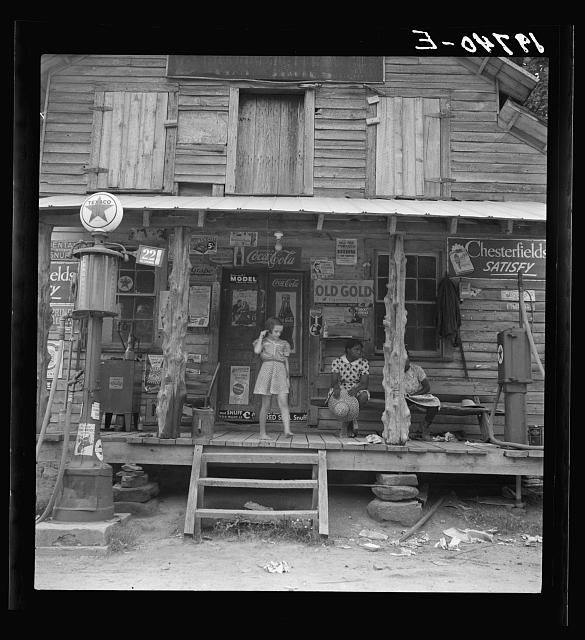
{LC caption: Daughter of white tobacco sharecropper at country store. Person County, North Carolina}


{This is another image of the store. The LC caption reads: "Country store on dirt road. Sunday afternoon. Note the kerosene pump on the right and the gasoline pump on the left. Rough, unfinished timber posts have been used as supports for porch roof. Negro men are sitting on the porch. Brother of store owner stands in doorway. Gordonton, North Carolina"}


{Another shot of the family taken at the back of the house. There is no LC caption for this image}


{This shot shows the front of the house and the dirt road it fronts upon. LC caption: Tobacco sharecropper's house. White family. Rural rehabilitation clients. Whitfield family. Near Gordonton, North Carolina}

Update: I have found a few more photos:


{Neither photo has an LC caption; they show the Mrs. Whitfield and the children on their front porch.}


{LC caption: Corner of tobacco farmer's front room. Shows enclosed stairway and corner of the new fancy bed. Person County, North Carolina.
Field notes say the family used only three downstairs rooms so the stairway door, though unlocked, presumably stayed closed at all times. The cut-out at its bottom may have been for the use of mousing barn cats (rural people not usually keeping house cats). You can see the corner of a bedstead. About this the field notes say "Mrs. Whitfield's mother died last year and they sold her small farm and divided up the money. The Whitfields bought their 'Company bed room suite' with their share: a glaring, Grand Rapids, highly polished imitation walnut bed, dresser, and dressing table." Lange noticed the calendars on the walls; there were nine in all and they were presumably kept for decoration rather than keeping track of day and date. These two show January and March 1939,one has its picture obscured by some hanging gear; the other appears to be a family scene with man standing at left, woman seated before him, and others in background.}

2. The Lyon family, Upchurch, Wake County

Field notes show that Lange and Hagood visited the Lyon family on June 30 1939. The family had 13 acres of tobacco which they had previously worked with another sharecropper family but were now working on their own with part-time help from a neighbor's child. The owner has 11 other families on his property raising tobacco and a little cotton.

Lyons moved here the previous year and is happy with the land, the house, and his landlord. His first year he made more than he had in his previous location. The notes say: "His landlord has plenty of money and furnishes him whatever cash he needs so that he doesn't even have to run a store account. He says these folks want their tenants to make money and they treat them nice."


{LC caption: Zollie Lyon, Negro sharecropper, home from the field for dinner at noontime, with his wife and part of his family. Note dog run. Wake County, North Carolina
Additional information from field notes: The house is a modified "dog-run" type meaning that the two rooms are connected by a breezeway. The yard is swept by brush brooms. The photo shows Zollie Lyon, his wife, their children, and grandchildren. The field notes say the photo also shows a little girl who is visiting.}


{Another view of the family and their home. LC caption: Zollie Lyons, Negro sharecropper, home from the field for dinner at noontime, and part of his family. Upchurch, North Carolina. He has thirteen acres of tobacco and a labor force of five}


{LC caption: Son of Negro sharecropper "worming" tobacco. Wake County, North Carolina; field notes say: "the worms are very bad this year."}


{LC caption: Daughter of Negro sharecropper goes up and down the rows "worming" the tobacco. Wake County, North Carolina}


{LC caption: Grandchildren of tobacco sharecropper down at barns. Note construction of tobacco sleds which have just been repaired by Zollie Lyons. Beyond them the screened platform in which that member of the family sleeps who tends the fire during the night. Wake County, North Carolina}


{LC caption: Grandchild of Zollie Lyons, tobacco sharecropper. Wake County, North Carolina}


{There is no LC caption for this photo; it shows the grandchildren of Zollie Lyons.}


{There is no LC caption for this photo; the field notes say that 13 acres is a large field for this area. The tobacco is topped ready for priming.}


{There is no LC caption for this photo; the field notes say a sled is used to haul tobacco from the field. In this case it's being used for weeds and broken leaves.}

------------------

Main source:

Daring to look: Dorothea Lange's photographs and reports from the field
By Anne Whiston Spirn, Dorothea Lange
University of Chicago Press, 2008

-------------------

Notes:

1 Anne Whiston Spirn reports that Dorothea Lange had arranged for Ansel Adams to prepare images for a book on West Coast migrant labor. When she asked her FSA boss to make the negatives available to Adams he refused. She then traveled to Washington DC so that she could herself supervise printing at the FSA lab. Her boss believed that this would throw the lab into chaos and quickly arranged for her to be sent to North Carolina. He contacted Howard Odum, head of the Institute for Research in Social Science at the University of North Carolina. Odum arranged for Lange to assist two researchers in their investigation of sharecropping and tenant farming in the Piedmont region of the state. As Sprin says, within four days of her arrval in Washington, "doubtless wholly unaware of the plot, and presumably after frantic hours in the FSA lab supervising the printing of her negatives for the book, Lange was out of Washington and on Zollie Lyons's farm in Wake County, North Carolina."

2 The project that Odum arranged for Lange was called "research through photography" and was considered to be a "Photographic Study of the 13 County Subregional Area" of the Piedmont. The two researchers identified places to visit and arranged with landowners and sharecroppers for the photographs to be taken. Lange and the researchers made notes of their visits and the photos taken. These are the source of the field notes I've summarized or quoted in this piece.

3 Source: Spirn's book, Daring to Look, p. 93.