Wednesday, June 28, 2006

Standing up before the King

As the subject line says, this is about not bowing down to Royalty.

My Friesian relatives were pretty strict Calvinists. My great great grandfather Hette Pieters Hettema, who was a leader of a secessionist sect of them, left a memoir that is mainly about his religious life. There is a brief description on a site devoted to the history of the secession movement in Hallum. A selection of the memoir was published in 1978 as a book entitled "Kroniek van een Friese boer." Here is a link to a web page, in Dutch, that describes the book, which has the English title,Chronicle of a Friesian Farmer. A great aunt, Bettie Hutter, made a synopsis. She writes:
In spring of 1839, great grand father & elder Hamming of Burum, went to Amsterdam as representatives of Friesland, where the divisions of the church were discussed. After that, because the judges continued to fine the separatists every time more than 19 people attended a meeting, the congregation at Wanswerd elected great grandfather and Lammert Hoogendigh from Ferwerd, to go to the King with a petition against the persecution.

Dec. 14, 1839, they left Leeuwarden for ________? [blank appears in typescript] where they stayed over-night. They travelled by coach. In Amsterdam, where the Rev. Van Velsen now lived, they stayed with him over Sunday, and went to the Hague on Monday. They were to find a Sir Golverdinge, who helped them to find their way, and on Tuesday they were to go to the palace. At 11 A.M. they were to sign their names in the great hall and state their purpose.

At twelve noon they were taken in to the king, who was congenial and listened to each of them in turn as they told of their persecution. The King promised to look into the situation and they returned to Leeuwarden, travelling straight through. It took some time, but before too long, they were granted freedom of religion and their own parish.
This incident came to mind when I prepared the following "quote-of-the-week" for my work-blog:
• Who gets borrowing privileges?

This quote of the week comes from the Annals of the Bodleian Library, Oxford, AD 1598-AD1867, by William Dunn Macray (Riverintons, London, 1868).
A.D. 1645.
A small slip of paper, carefully preserved, is the memorial of an interesting incident connected with the last days in Oxford of the Martyr-King [i.e., Charles I] whose history is so indissolubly united with that of the place. Amidst all the darkening anxieties which filled the three or four months preceding the surrender of himself to the Scots, King Charles appears to have snatched some leisure mo­ments for refreshment in quiet reading. His own library was no longer his; but there was one close at hand which could more than supply it. So, to the Librarian Rous, (the friend of Milton, but whose anti-monarchical tendencies, we may be sure, had ­always hitherto been carefully concealed) there came, on Dec. 30, an order, ‘To the Keeper of the University Library, or to his deputy,’ couched in the following terms: ‘Deliver unto the bearer hereof, for the present use of his Majesty, a book intituled, Histoire universelle du Sieur D’AubingnĂ©, and this shall be your warrant;’ and the order was one which the Vice-Chancellor had subscribed with his special authorization, ‘His Majestyes use is in commaund to us. S. Fell, Vice Can.’ But the Librarian had sworn to observe the Statutes which, with no respect of persons, forbad such a re­moval of a book; and so, on the reception of Fell’s order, Rous goes to the King; and shews him the Statutes, which being read, the King would not have the booke, nor permit it to be taken out of the Library, saying it was fit that the will and statutes of the pious founder should be religiously observed.’

Perhaps a little of the hitherto undeveloped Puritan spirit may have helped to enliven the conscience of the Librarian, who, had he been a Cavalier, might have possibly found something in the exceptional circumstances of the case, to excuse a violation of the rule; but, as the matter stood, it reflects, on the one hand, the highest credit both on Rous’s honesty and courage, and shows him to have been fit for the place he held, while, on the other hand, the King’s acquiescence in the refusal does equal credit to his good-sense and good-temper. We shall see that this oc­currence formed a precedent for a like refusal to the Protector in 1654 by Rous’s successor, when Cromwell showed equal good feeling and equal respect for law.

Addendum: My Friesian relatives were stubborn as well as stedfast in their faith. For many years Hette Pieters Hettema refused to have himself or his family innoculated against smallpox, relenting only after losing half his family, including his wife.

Another Addendum: The Secessionists' complaint resulted from religious reforms enacted by the relatively liberal regime installed in The Netherlands by Napoleon. They wished to continue worship in the old way rather than in the Dutch Reformed Church of the time.

Yet another: The king of the Netherlands in 1839 was William I. Wikipedia says he had been reigning 25 years by that time and would stand down the following year. Says the official site of the Kingdom of the Netherlands:
In 1689 stadtholder Prince Willem III of Orange became King of Great Britain after his wife Mary II Stuart was chosen as Queen of Great Britain. In 1795 the last stadtholder Prince Willem V fled to England and the Netherlands became a part of the French Republic and later the French Empire of Napoleon. Between 1806 and 1810 Louis Napoleon, a brother of the Emperor Napoleon, was the first King of Holland.

In 1813 the son of the last stadtholder was chosen as sovereign. At the Congress of Vienna the Kingdom of the Netherlands was drafted and in 1815 this sovereign became King Willem I. His Kingdom also enclosed the later Kingdom of Belgium and the Grand Duchy of Luxemburg. In the battle of Waterloo in 1815 the new crown prince Willem played a quite important part. Afterwards it gave him the nickname Hero of Waterloo, and the Russian czar offered him his sister Anna Pavlovna as his bride. Belgium became independent after a revolt in 1830, but the Netherlands didn't recognize the new kingdom until 1839. King Willem I abdicated in 1840 and died in Berlin in 1843.

Saturday, June 17, 2006

Dirty people and the marvels of Tibet

This post is about dirt.

There's an Irish children's song on an old Clancy Brothers album that we love. It goes:
Ahem, ahem,
me mother has gone to church.
She told me not to play wit' you
because you're in the dirt.
It isn't because you're dirty.
It isn't because you're clean.
It's because you have the whooping cough
and eat margerine.
One of my favorite books is this one:
Narratives of the mission of George Bogle to Tibet and of the journey of Thomas Manning to Lhasa
by Clements R Markham, Sir; George Bogle; Thomas Manning
First published: London, 1876
Reprinted: New Delhi, Manjusri Pub. House, 1971.
Why? It's a history of the high Victorian era and like others of its type is ambitious to tell a good story, is based on primary source documents, and being first to tell the tale, doesn't have to account for others' interpretations of the same material. It gives a facinating account which is at once adventure story, travel narrative, and a revelation about how British imperialism functioned in a part of the Indian sub-continent when still relatively unformed. It's also a rare find: not a book you'll come across in the second-hand stores or even most libraries.

Bogel was young, courageous, and -- an anti-archetype -- surprisingly empathetic with the peoples he encountered. Though his goal of economic penetration was largely unrealized, he succeeded in striking a friendship with Tibet's principal secular and religious leader, the Panchen Lama. As presented in the history, his letters and journals are full of detail, but also express his wonder: "When I look upon the time I have spent among the Hills it appears like a fairy dream," he wrote. Bogle was envoy of the East India Company. Manning was one of the many intrepid travelers who sought to go where none of their kind had previously been. He became the first Englishman to enter and study Lasha, Tibet's capital, and its inhabitants.

Markham explains in the preface:
It has long been known that the first British mission to Tibet was sent by Warren Hastings in 1774 under Mr. George Bogle, that a great friendship was found between Mr. Bogle and the Teshu Lama, and that intercourse was then established between the Governments of British India and Tibet. It is less generally known that the only Englishman who ever visited Lhasa, the capital of Tibet, and saw the Dalai Lama, was Mr. Thomas Manning, an adventurous traveler who performed that extraordinary feat in 1811. No account has hitherto been published of Mr. Manning’s remarkable journey. These two gaps in the history of intercourse between India and Tibet have now been filled up. His family in Scotland has carefully preserved the whole of Mr. Bogle’s journals, memoranda, official and private correspondence. These valuable manuscripts, after having been judiciously arranged, were placed in the hands of the present editor. These consisted of journals, memoranda of various kinds, and on many subjects numerous bundles of private letter including correspondence with Warren Hastings , appointments, minutes of conversations and official dispatches. The whole of this voluminous mass of papers had to be carefully read through and annotated before any attempt could be made to arrange a consecutive narrative of the mission. Mr. Manning appears o have hastily jotted down his first impressions, day by day, in a rough notebook, which was copied out fair by his sister. He was a man of learning and great ability, and was well able to have written a good account of his remarkable journey. He never did so. His rough journal was placed in my hands. Thus an account of the visit to Lhasa of the only Englishman who ever entered that famous city is now presented to the world. This account of the important mission of George Bogle to Bhutan and Tibet has been gathered partly from journals, partly from official dispatches, and partly from private correspondence; and it is now presented for the first time in a connected form. That of Mr. Manning’s extraordinary journey to Lhasa is from a fragmentary series of notes and jottings, which alone remain to bear testimony to a feat, which still remains unparalleled.
What about dirt?

One of the things that struck Manning about the peoples of Tibet was their dirtyness. A caring man who wished to promote health and well-being, he tried to clean them up, but encountered resistance. Their aversion to a good wash might be put down to scarcity of water much of the year in the high plateaus. Or to the heavy layers of clothes they wore even while within doors. But, as the following AP news item seems to show, their dirtyness might also have resulted from Darwinian selection.
Rat study shows dirty better than clean
By SETH BORENSTEIN, AP Science Writer
Fri Jun 16, 10:56 PM ET

extracts:

WASHINGTON - Gritty rats and mice living in sewers and farms seem to have healthier immune systems than their squeaky clean cousins that frolic in cushy antiseptic labs, two studies indicate. The lesson for humans: Clean living may make us sick.

The studies give more weight to a 17-year-old theory that the sanitized Western world may be partly to blame for soaring rates of human allergy and asthma cases and some autoimmune diseases, such as Type I diabetes and rheumatoid arthritis. The theory, called the hygiene hypothesis, figures that people's immune systems aren't being challenged by disease and dirt early in life, so the body's natural defenses overreact to small irritants such as pollen.

The new studies, one of which was published Friday in the peer reviewed Scandinavian Journal of Immunology, found significant differences in the immune systems between euthanized wild and lab rodents.

Co-author Dr. William Parker, a Duke University professor of experimental surgery said: "Your immune system is like the person who lives in the perfect house and has all the food they want."

Parker said he hopes to build a 50-foot artificial sewer for his next step, so that he could introduce the clean lab rats to an artificial dirty environment and see how and when the immunity was activated.

That may be the biggest thing to come out of the wild and lab rodent studies, Platt said: "Then all of a sudden it becomes possible to expose people to the few things (that exercise the immune system) and gives them the benefit of the dirty environment without having to expose them to the dirt."

Monday, May 29, 2006

a global monetary storm triggered by the Bank of Japan?

The IMF remains sanguine about current imbalances in the global economy and worried about the inevitable unwinding that eventually must occur. With just about every other observor, IMF experts tell us that the strength of the US economy -- driven largely by low interest rates and rampant consumerism -- insures that the fantastically large debts that the US and its citizens owe other nations and theirs are not (yet) disrupting world markets. The IMF managing director said the usual things about this situation as recently as last Wednesday.

Cite: The IMF in Asia and the World Economy. Speech by Rodrigo de Rato, Managing Director
International Monetary Fund at the Economic Society of Singapore, May 24, 2006.

He said:
Global imbalances must eventually unwind. The risk is that they will be unwound in an abrupt and disorderly way. For example, there could be an abrupt fall in the rate of consumption growth in the United States, perhaps triggered by a slowing housing market. Or a disorderly adjustment might be triggered by developments in financial markets. Trends in exchange rates in recent months are in the right direction to help aid the adjustment process and, so far, have been orderly. But if investors become suddenly unwilling to hold U.S. financial assets at prevailing exchange rates and interest rates, this could lead to an abrupt depreciation of the U.S. dollar and increases in U.S. interest rates. This could cause global financial market disruptions as well as a downturn, and both could affect the open, trading economies of Asia seriously.

There is a broad consensus among policy makers on the measures that are needed to reduce global imbalances. Most policy makers around the world agree that what is needed is fiscal adjustment and measures to stimulate private saving in the United States, further exchange rate appreciation and measures to stimulate domestic demand in some countries in emerging Asia, and structural reforms to stimulate demand and improve productivity in the non-tradeables sector in Europe and Japan. But this consensus has so far been translated into only limited action.
He said nothing about a change in policy at the Bank of Japan which began last month and about which the financial press has headlines today. A search of the IMF web site indicates that none of the IMF specialists, including their man in Japan, said anything about this. Maybe they know, but are unwilling to say, fearing that they'll make a bad situation worse by calling attention to it.

Ambrose Evans-Pritchard, writing in the Telegraph, has the clearest explanation of what's going on.

{Cite: Ignore the world's biggest central banks at your peril. (Filed: 29/05/2006) Ambrose Evans-Pritchard.}


It's worthwhile reading the whole article. Evans-Pritchard says Japan has stopped battling it's long-term deflation and the Bank of Japan has been, since early this year, reducing its cash holdings. It's purchasing fewer US securities and allowing the Yen to increase its value, particularly against the dollar. Its action is causing an increase in interest rates across the world, particularly bond interest rates and in that sector particularly US Treasuries.

The fallout from this event is a slump in global stock markets, particularly markets in emerging-market countries, as investment capital becomes more expensive and thus more scarce.

The housing market may be the first economic sector to unwind (or burst, since most think of it as a bubble). Evans-Pritchard writes:
"Housing mayhem seems unavoidable. The US hard landing begins now," said Charles Dumas, global strategist at Lombard Street Research.

Mortgage applications are down 17pc in a year. House sales are down 5.7pc, and inventories of unsold new houses are at their highest since 1996. The central prop holding up the US consumer boom is crumbling, leaving behind record household debts equal to 127pc of disposable income.


He concludes:
Teun Draaisma, Morgan Stanley's chief European equity strategist, had a warning for bargain hunters, even after the 8pc fall in European stocks and 15pc fall in the MSCI emerging markets index. "Do not be tempted to buy. The first violent part of this correction took nine trading days: the second part may well take several months," he said.

The world has enjoyed a magnificent boom for 24 years, punctuated only by light downturns along the way. The cycle has been kept alive beyond its natural life by ever-laxer monetary policy, feeding ever bigger asset bubbles and encouraging ever-higher levels of debt.

Central banks can draw down prosperity from the future for a while. In the end - now? - the future arrives.

Sunday, May 28, 2006

is this an inevitable downside of prosperity?

Back in the sixties I studied British imprisonment for debt. I labored to find useful statistics but found the going hard. It was clear that many adult males would find themselves in debtors' prison at some point in their lives. With diligence I thought I might be able to show that most families had one or more members behind bars for this reason at some time or another.

Since then I've become interested in the proportion of black males that are in jail, in prison, or being "supervised" by the prison system. The Bureau of Justice reports these things. Current stats show 12% of black males to be incarcerated. This proportion has remained fairly constant over recent years. Maybe it's more interesting that the current BOJ report says "one in every 136 U.S. residents were in prison or jail" a year ago. Also it says 60% of inmates are racial or ethnic minorities. And: the number of people committed to do time is increasing faster than the number of people being released back to civilized society.

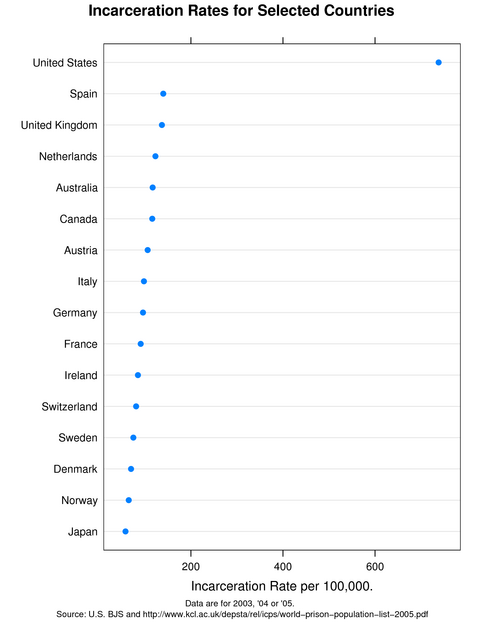
The BOJ doesn't point out, as others have, that the US imprisons far more of its citizens than do other nations. Kieran Healy, a favorite Crooked Timber author, has noticed the BOJ stats and done the following graph.


This comes from his second post on the topic. He explains: "The comments in my recent post about U.S. incarceration rates got a little bad tempered.... The point of the figure was to bring home that the U.S. has the highest rate of incarceration in the world, bar none. To illustrate this is not to explain it." The graph included with his first post showed many authoritarian states with lower incarceration rates than the US. The graph given above doesn't include places where "the whole country be a kind of prison." It compares the US with its peers and he points out the obvious: "By the standards of comparable countries, the U.S.’s rate of incarceration is frankly astonishing."

A footnote:
Healy addresses another objection and gives yet another graph:
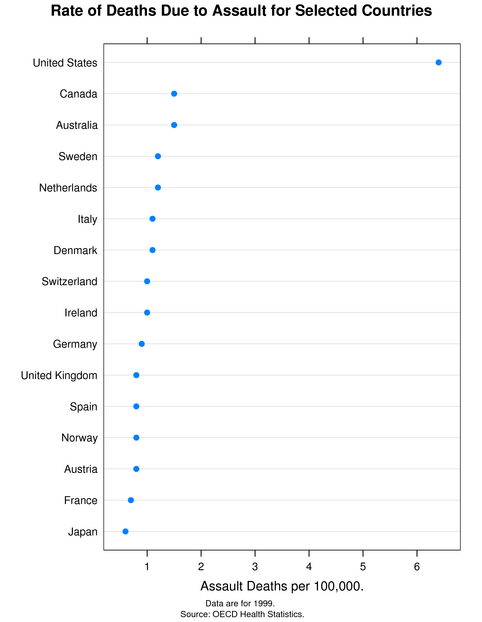
A second objection was, this only tells a little bit of the story, to which we can say, of course. Jet asks, “Yeah, and where would the US fall in a graph showing percentage of the population victimized by crime?” Cross-national comparisons of crime statistics are hard, because of reporting and definitional issues. (This is true in the U.S. between states, too, or even between different cities and neighborhoods.) Your best bet is crimes involving a dead victim, because that’s most often reported. So here is the same list of countries ordered this time by the rate of deaths due to assault in 1999, the most recent year I have available.


Addendum: I have this print on my wall in my office. When I put it up, I thought maybe people would ask about it so I could tell them it shows the Marshalsea Prison and explain its interesting history. No one has.

Marshalsea Prison
{click to enlarge}

Sunday, May 21, 2006

reaching across a collision of cultures

Rosemary SutcliffSomewhere along my path from green to grey I got over my absurd preference for writings by men written for grownups. Ursula LeGuin's Earthsea series made a memorable milestone along the way, read aloud to my chicks for the music it made in my telling more than the wonderful pull of its coming-of-age plot lines. The historical fictions of Rosemary Sutcliff came later, a by-product of my connection to a team of children's literature catalogers.

She wrote of the warrior where Le Guin wrote of the mage and she re-created an actual past for her readers where Le Guin re-created an eternal present that never did or would exist. They both drew upon archeological and anthropological research, both made hauntingly beautiful stories, both were penetrating observers of people, places, and events. Of the school of Baron Secondat de Montesquieu and Sir Isaiah Berlin, they both showed little interest in deep probes of their characters' psyches, but rather celebrated cultural polarities and interconnections. LeGuin still does these things. Sutcliff died long ago.

Disabled, under-educated, often left to herself while young, she made herself into the author she became through an affection for Kipling and a passion, all her own, for research and writing.

I re-read her books: particularly the Eagle of the Ninth series about late-Roman Britain, but they are (almost) all equally good.

It's Eagle of the Ninth itself that I'm reading now. I picked it up again because my main (academic) reading now mostly requires a notebook, pencil, writing surface, and a fairly high level of alertness -- I'm reading about and trying to master 17th-century mathematics (such as quartic equations and other algebraic complexities) and need something else to read when without notebook, pencil, writing surface, or alertness.

Eagle of the Ninth is an adventure story set in Roman Britain and the Britain that was beyond Roman control. Like most of Sutcliff's heroes, its main character is a warrior among warrior/hunters and among the dogs and horses that accompany them.

The narrative is engaging, rapid, with compelling twists and turns. Sutcliff, like Kipling, takes delight in the telling of a good story. But the book is also artful. Its observations are poetic and its imagery gives a hefty infrastructure to the plot. Sutcliff lets us see -- she's a marvelous observer -- but also hear, smell, and roundly experience the environments through which her characters pass.

Blossoms abound: a "little round stiff flower" on a knife sheaf, "garlands of late summer flowers" on womenfolk, a pot-bound rose-bush in a frontier fort, "the summer scent of thyme and rosemary;" as well as the trees and bushes of North Britain, particularly thorn: harsh and gently flowered, a barrier and a refuge. A knife has an "iron blade perfect in shape as a laurel leaf."

Birds soar; disturbed, they announce one's presence; their feathers adorn, but also symbolize flight and victory in war. The eagle of the book's title is its strongest symbol of the power that enables one culture to dominate another, of a personal continuity between father and son, and of the intangible bonds that link men who both oppose and respect one another.

Water flows, shimmers, forms barriers, enables connections. At one point her hero and his companion find themselves "on the crest of a steep ridge above the Western Ocean. It was an evening coloured like a dove's breast; a little wind feathered the shining water, and far out on the dreaming brightness many scattered islands seemed to float lightly as sleeping sea-birds. In the safe harbourage inshore, a few trading-vessels lay at anchor, the blue sails that had brought them from Hibernia furled as though they, too, were asleep. And to the north, brooding over the whole scene, rose [mount] Cruachan, sombre, cloaked in shadows, crested with mist - Cruachan, the shield-boss of the world."

The weather is eternally present in all its variability. To give one example: "Here in Britain the wind moaned through the desolate woods, the skies wept, and wet, gale-blown leaves pattered against the windows and stuck there, making little pathetic shadows against the steamy glass. There had been wild weather often enough in his own country, but that had been the wild weather of home: here was the wind and rain and wet leaves of exile."

Light and dark are as characters in the story, signifying gods and the faith of their worshipers -- people of the light and people of the dark, each with their own special value -- as in this description of a holy place: "They climbed steadily to the mountain saddle, and came dropping down on the seaward side. They traversed a steep glen and swung out along a ridge. Down again, and another steep climb, and suddenly they were on the lip of a wide upland valley running at an angle to the sea. It lay at their feet, already brimmed with shadows under a sky still webbed and washed with light that seemed to burst upward from the hidden sun; but at its head a great turf mound rose steeply, catching still a faint glow from the sunset on its thorn-crowned crest and the tips of the great standing stones that ringed it round like a bodyguard. Marcus had seen the long barrows of the Ancient People often enough before, but none had caught and held his awareness as this one did, at the head of its lonely valley, between the gold of the sunset and the silver of the new moon."

As Cruachan is "the shield-boss of the world," the shield-boss is itself the symbol of the ancient peoples of Britain whom Sutcliff's hero, Marcus, goes among and comes to understand in the fullness of their own way of life. Though they are his antagonists -- his quest is to take back from them a treasure they have captured in battle -- and though they pursue him to kill and re-capture, they are also his brothers.

Sutcliff repeats this theme of contrast and inter-connectedness repeatedly, often using the shield-boss as motif.

Here's the first use of the symbol, one of my favorite sections in all her books:
Marcus [Roman Centurion] leaned back, his hands behind his neck, ... 'Esca [a Briton, his companion], why do all the frontier tribes resent our coming so bitterly?' he asked on a sudden impulse. 'The tribes of the South have taken to our ways easily enough.'

'We have ways of our own,' said Esca. He squatted on one heel beside the bench. 'The tribes of the South had lost their birthright before ever the Eagles came in war. They sold it for the things that Rome could give. They were fat with Roman merchandise and their souls had grown lazy within them.'

'But these things that Rome had to give, are they not good things?' Marcus demanded. 'Justice, and order, and good roads; worth having, surely?'

'These be all good things,' Esca agreed. 'But the price is too high.'

'The price? Freedom?'

'Yes - and other things than freedom.'

'What other things? Tell me, Esca; I want to know. I want to understand.'

Esca thought for a while, staring straight before him. 'Look at the pattern embossed here on your dagger-sheath,' he said at last. 'See, here is a tight curve, and here is another facing the other way to balance it, and here between them is a little round stiff flower; and then it is all repeated here, and here, and here again. It is beautiful, yes, but to me it is as meaningless as an unlit lamp.' Marcus nodded as the other glanced up at him. 'Go on.'

Esca took up the shield which had been laid aside at Cottia's coming. 'Look now at this shield-boss. See the bulging curves that flow from each other as water flows from water and wind from wind, as the stars turn in the heavens and blown sand drifts into dunes. These are the curves of life; and the man who traced them had in him knowledge of things that your people have lost the key to - if they ever had it.' He looked up at Marcus again very earnestly. 'You cannot expect the man who made his shield to live easily under the rule of the man who worked the sheath of this dagger.'

'The sheath was made by a British craftsman,' Marcus said stubbornly. 'I bought it at Anderida when I first landed.'

'By a British craftsman, yes, making a Roman pattern. One who had lived so long under the wings of Rome - he and his fathers before him - that he had forgotten the ways and the spirit of his own people.' He laid the shield down again. 'You are the builders of coursed stone walls, the makers of straight roads and ordered justice and disciplined troops. We know that, we know it all too well. We know that your justice is more sure than ours, and when we rise against you, we see our hosts break against the discipline of your troops, as the sea breaks against a rock. And we do not understand, because all these things are of the ordered pattern, and only the free curves of the shield-boss are real to us. We do not understand. And when the time comes that we begin to understand your world, too often we lose the understanding of our own.'

For a while they were silent, ... then Marcus said, 'When I came out from home,. A year and a half ago, it all seemed so simple.' His gaze dropped again to the buckler on the bench beside him, seeing the strange, swelling curves of the boss with new eyes. Esca had chosen his symbol well, he thought: between the formal pattern on his dagger-sheath and the formless yet potent beauty of the shield-boss lay all the distance that could lie between two worlds. And yet between individual people, people like Esca and Marcus and Cottia, the distance narrowed so that you could reach across it, one to another, so that it ceased to matter.


Addendum: My copy of Eagle of the Ninth is a student edition with historical introduction and study material published for use in schools in the provinces of Quebec and Saskatchewan.

Friday, May 19, 2006

keeping up

I do a Quote of the Week on my work blog. Here's this week's:

"Myspace has become the new 'home base' for internet users."
{Source: Bill Tancer on Hitwise}

We're told that libraries need to adapt to the new internet environment if they are to survive. It's interesting how rapidly that environment can change. Everyone says it's dominated by Google now, that emulating the Google experience is our goal. But one wonders, will that domination last?

Take, for example, MySpace. How do we respond to its rapidly increasing popularity? As I'm sure you must already know, MySpace is the wild and unruly home to millions (and millions) of (mostly) teenagers. Try a Google search on MySpace and one in Google News to get a sense of its power, even to the extent of provoking blocking attempts in Congress.

About this, John Battelle says: "I've had MySpace again on my mind after talking Weds with Jon Miller, CEO of AOL ... [T]he thing that struck me was how Miller mentioned MySpace in the same breath as Google, AOL, Yahoo, eBay, and Amazon. It had made it into the majors as far as he was concerned, because it owned the social networking space."

So it's no surprise that MySpace has risen to the sixth most popular site -- worldwide -- on the web, as measured by Alexa and that it's the third most popular site in the US (look what sites it outranks):

Alexa top sites in the US:
1. Yahoo!
2. Google
3. Myspace
4. Microsoft Network (MSN)
5. EBay
6. Amazon.com

Good thing that among all the other social networking services (Blogs, Chat Rooms, Comedy, Classifieds, Games, Horoscopes, Music Videos, ... ) there's a MySpace Books?

Thursday, May 18, 2006

coping with the little things that go wrong

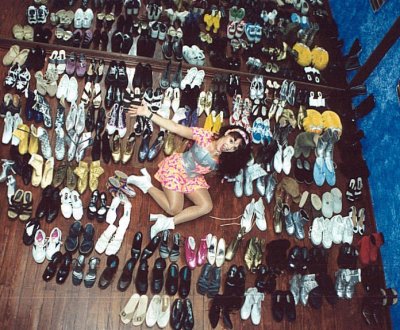
Three flat tires on my way to work. Actually the third occurred as I was trying to get back home. I failed to find the source of puncture the first two times. Didn't tempt fate. Took the car to work today. Take pride in having lost only 45 minutes of work time. (Ok, maybe 50 or 55.) The photo is not me, but shows what I probably look like in the same situation. I can remember when, years ago, I'd quickly fall into despair when things went wrong -- that or a helpless raging against fate. I'm more methodical and less emotional in my advanced maturity. But still, I have to guard against the mental blur that seems always to accompany adversity -- it's hard, for example, to allow enough time for the glue to dry. Putting the patch on the tube before the glue is set just causes more agony and delay, but it's difficult to keep a level of rationality that provides that patience. And difficult to keep sufficiently focused so that you don't leave stuff behind when you're ready to roll again (how awful to be without a pump, e.g.).
I've been getting flats lately, not all from the same causes (puncture in this case, faulty tubes in other recent instances). Passers by are generally sympathetic. A few weeks ago, in the city, while changing a tube, a guy came out and offered me a chair to sit in.

Thursday, May 11, 2006

consumer frenzy

Every think about how is wealth created? I mean how it comes about that the overall stock of wealth is increased. A lot depends on what you mean by "wealth" of course. To me, it seems there's no wealth created when one entity -- a person, city, country, group of countries, etc. -- sees its measure of wealth increase at the expense of another (that's just a transfer). Similarly, there's no wealth created when I receive an increase in salary and the amount of that increase is offset by a decline in the purchasing power of the money I'm given (i.e., an inflationary offset).

If you think back, you may recall history texts telling you of Mercantilism, supplanted by Laissez Faire, supplanted by other theories up to the Keynesian era and today's mixed bag. Mercantilists were political economists. They saw the nations of their day competing something as businesses compete. Their policies fostered national strength as best they could given the limited data they could obtain and the limited ability of governments to enforce the laws and regulations they passed. (They also had to contend with competing political objectives -- meaning occasions when economic were at odds with other political objectives -- and corruption within government.) As everyone knows, they tended to associate wealth with accumulation of money and the gold and silver from which money was minted.

The next generation of economists, led by Adam Smith, saw that much of mercantilist regulation was self-defeating. They agreed that the state needed to make itself strong, but -- to be overly simplistic -- said also that states didn't compete with each other the way mercantilists thought. Where mercantilists said states competed the way businesses do -- each using the same raw materials and producing the same end products -- the laissez faire group said nations were blessed with different stocks of raw materials, different cultural strengths and weaknesses, different means of transportation and communication (etc.). These differences meant to them that states could, if they wished, mutually benefit from the trade that passed between them.

As is well known, the mercantilists tended to see the world as having a fixed amount of wealth, and to see it in the interests of nations to get as much of it as they could.

The laissez faire group said there was the potential for trade to create new wealth. A bold insight. This is generally what has been believed ever since. Though you must recall that the laissez faire group stressed the potential of wealth creation, but did not say that states should not regulate trade (or industry, or protect access to raw materials, etc). They recognized that state economies could rise and fall -- as they saw the Dutch economy fall and the British rise. They recognized that state intervention would be needed to prevent this occurring, if possible.

So what are the means by which the overall stock of wealth gets increased? Looking around the net, I'm surprised that I can't easily find an academic site that gives a checklist of the ways real wealth gets created. So Wikipedia to the rescue once again. The article on Wealth says that it's created by these means:
* Natural resources can be harvested and sold to those who want them.
* Material can be changed into something more valuable through proper application of knowledge, skill, labor and equipment.
* Better/smarter production methods also create additional wealth by allowing faster creation of wealth.
* Ideas create additional wealth by allowing it to be created faster or with new methods.

For example, consider our early ancestors. Building a house from trees created something of greater value for the builder. Hunting and firewood created food and fed a growing family. Agriculture converted labor into more food and resources. Continuing use of resources and effort has allowed many descendants to own much more than that first house.

This is still true today. It is more obvious to those working with physical material than to a service worker or knowledge worker. A cubicle worker may not be aware in how many ways their work is creating something which is of more value to their employer than the amount that employer paid to produce it. This profit creates wealth for the owners of the organization. The process also provides income for employees, and suppliers, and it makes the continued existence of the organization possible.
What strikes me as odd is that this little discussion does not mention the role of money and credit in wealth creation. Not just money and credit, but the system of trust, optimism, and greed that leverages money and credit into wealth. Not seeing this anywhere, I'm worried that my ideas on this subject are haywire. But it seems to me that wealth is created when people borrow money in order -- so they hope -- to make more money with it. When banks lend money, they make available funds -- as credit -- far in excess of the amounts they have received as deposits. If all goes well, they receive in interest payments far more than they pay out in interest to depositors. They're banking (forgive the pun) on the trust, optimism, and greed of their depositors. Most of the time the system works and both lenders and depositors are rewarded.

Borrowers, likewise, benefit. They pay a premium -- interest -- for the money and quite often hedge their bets by buying some kind of insurance to protect themselves against failure. These actions involve trust, optimism, and greed (along with knowledge, skill, and good ideas as mentioned in the Wikipedia article). The classic example out of history would be the merchant who undertakes the risky venture of importing luxury goods from the far east, or an industrialist who borrows to expand his manufacturing plant.

Quite often, it seems, these clusters of knowledge, skills, and ideas together with trust, optimism, and greed serve the end of supplying people with material goods that they want but don't really need. (I think of Imelda Marcos and all her shoes, but it goes back to the luxury goods imported for royals and aristocrats -- silks probably being the classic example.)

For a long time I've felt that the economy (and to some extent also the creation of wealth) is founded on people buying what they don't need -- what we used to call the disposable economy and now are more prone to think of as a system where we tend to give away or sell the things we no longer want so we can fill our lives with new ones. In many places, particularly the US, people trade up their possessions using credit. This doesn't automatically generate new wealth, but it can go hand in hand with wealth creation. (The consumers are in effect saying that they believe they will have greater wealth in the future than they have now.)

Also, it's the situation in the US that people are borrowing more than they're saving. This imbalance contributes to the status of the US as a debtor nation, but that's a topic for another post.

Earlier this week I posted an entry about how to buy nothing. At his wonderful 43 Folders, Merlin Mann has shared his technique for fending off mindless purchases.

I have a […] “buy me stuff” capture device, but more for the purpose of outgassing my brain’s frequently mindless consumer pollution. My file is called “crap I just don’t need.txt,” and I have fended off many ridiculous purchases just by parking the desired item there. Just viewing the long list of previous entries is an embarrassing exercise in aversion therapy. Not to say this always ensures a non-purchase — consumer lust has a permanent apartment in my heart — but at least it provides a satisfying speed bump on the race to the checkout screen.
We live in a consumer culture. We’re constantly bombarded by advertising, advertising that is cleverly designed to get us to buy the latest Thneed (or Zizzer-Zoof Seeds). It’s easy to become swept away by desire. We’re manipulated into desire by marketing. It’s not something to feel guilty about, but it is something to strive to overcome.

I have a long Amazon wishlist, but I rarely use it. In fact, several times a year I take great delight in purging the list of all of those items I once thought I must have, but which now seem like so much junk.


Do what works for you.

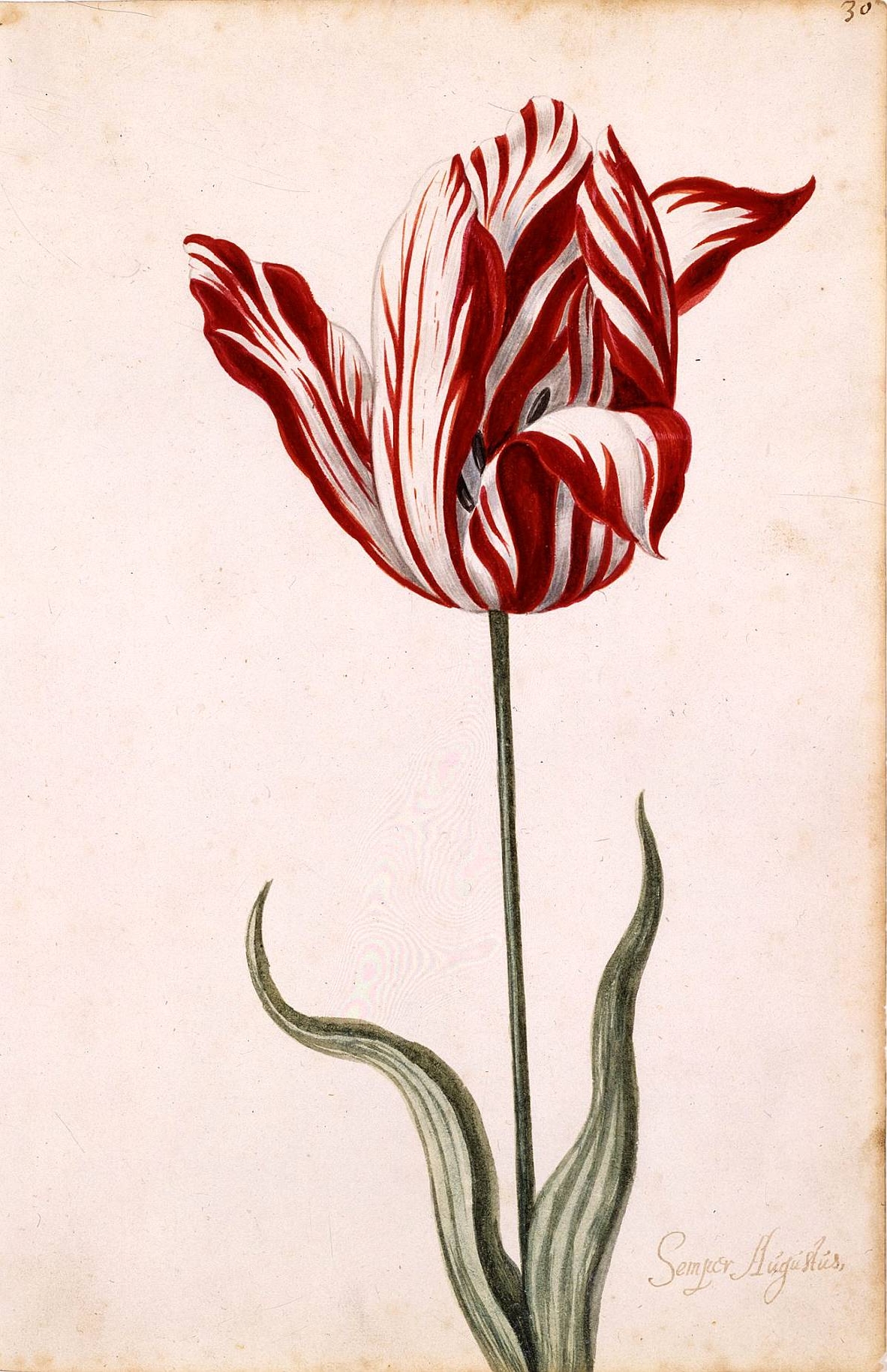
tulip mania in Rockefeller Plaza

Warhol Campbell'sNews accounts say the art market has blossomed as has the real estate market and the market for gold and other precious metals. Well, he said cynically, the Bush administration is obviously putting so much money into the pockets of the rich that they're falling over each other to spend it. Art, real estate, and gold are all investments, of course. But it's arguable that In the case of the art market, buyers are competing not just to increase the amount of their absurd wealth, but also to own and enjoy the beautiful, powerful, emotionally rewarding works they acquire. Or maybe not.

Take, for example, this week's auction of contempory artists at Christie's. One of the priciest items sold was this one -- Warhol's Small Torn Campbell’s Soup Can (Pepper Pot). Produced in 1962, it's historically important, but I don't think most of us would say it has twelve million dollars worth of beauty, power, and emotional rewards.

I don't mean that Warhol's work isn't good. As everyone says, it's iconographic. I mean that it's interesting for its bold embrace of a world driven mad by consumerism and adoration of celebrities (to indulge in a little hyperbole).

Bennett Lorber 2005Though both have geometric elements and both place value on surface. My friend Bennett paints circles around Warhol. His work is much more than surface event. It's richly textured and deeply rewards concentrated observation. A measure of the difference, for me, is the ability of reproductions to convey. A Warhol reproduction isn't the real thing, you can tell that pretty well, but it isnt' that far removed from the real thing. In contrast, reproductions of Bennett's works give you only a general idea of their richness.

On the right is a Bennett Lorber work from his most recent show. You can click to enlarge this and the other images in this post. Viewed full-size, you can see brush strokes, interplay of colors, and foreground/background layering. You may have to click twice for greatest detail (depends on your browser settings).


Says Art Market Watch:
$143 MILLION AT CHRISTIE’S CONTEMPORARY

excerpts:

Tulipmania! That one-word definition of irrational market exuberance came to mind during Christie’s New York sale of post-war and contemporary art on the evening of May 9, 2006, as lot 25 came to the block. A galvanized metal box, roughly two feet square and six inches deep, covered with a blue plastic lid -- an untitled Donald Judd sculpture from 1985 -- the work carried a presale estimate of $300,000-$400,000, and followed the sale of two dozen similar boxes for similarly high prices. $300,000 for a shallow metal box? The mind reeled. But then auctioneer Christopher Burge knocked it down to a phone bidder for $450,000 ($531,200 with the auction-house premium), and the art world snapped back into focus.

Christie’s unusually long sale of 91 lots -- 60 lots is a more typical number these days -- totaled $143,187,200, with 83 of 91 items finding buyers, or 88 percent.

The sale set new auction highs for ten artists: David Hockney ($3,600,000), Damien Hirst ($3,376,000), Brice Marden ($2,984,000), Lucio Fontana ($2,704,000), Eva Hesse ($2,256,000), Piero Manzoni ($1,920,000), Morris Louis ($1,808,000), Richard Prince ($1,360,000), Mike Kelley ($688,000) and Dirk Skreber ($496,600). New records for work on paper were set for Robert Rauschenberg ($1,360,000) and Alberto Giacometti ($1,584,000).

Elements VIn this list of auction highs, Marden's name was the one that caught my eye. Reproductions of his paintings, such as this one, are useful for identification, but, as with Bennett's, for little else. He grew up in the same town as I and our families were close. His older brother baby sat me and my sibs when we were that young. It was Bennett who taught me to love Marden's paintings and I'm happy that his (Marden's) one painting in the sale fetched a record amount. Here are the details:
lot# 71
Artist Brice Marden
Title Elements V
Year 1984 -
Medium oil on linen
Size 47.5 x 36 in. / 120.7 x 91.5 cm.
Misc. Signed, Inscribed
Estimate 1,500,000 - 2,000,000 US$
Sold For 2,984,000 US$ PREMIUM


Read Wikipedia on tulip mania.
overpriced tulip

Wednesday, May 10, 2006

tax cuts and global prosperity

I've written often enough about the risks associated with the growing deficit in the U.S., enough I'm sure to have become tedious on the subject. And so I take no delight in the announcement of extended tax cuts. The Washington Post article on the subject points out that -- once again -- lots of money will go to the wealthy and regressively little to people in the middle and lower brackets. It also deals with a question that is for me very important: What effect, if any, does this outrageous give-away have on the economy? It's an important question because the U.S. economy is the strongest in the world. It's because of this strength that foreigners are willing to purchase our debt, finance our deficit, and invest in our securities markets. We know this relative strength is partly based on the weakness of other industrial economies (Europe and Japan) and on the high levels of productivity achieved by U.S. businesses.

Is any of this strength dependent on the radically imbalanced U.S. tax policy?

The article says Republicans claim this is so. Others, and not just their opponents, say otherwise. Here are extracts on this topic:
Republicans say .. tax cuts were crucial to spurring economic growth over the past three years, by persuading more corporations to offer larger dividends and by sparking new business investment. ... Some economists say the timing of those gains was coincidental. "You might credit the cuts with providing a little bit of a jump-start. But I think the main reason the economy has done so well the last couple of years has nothing to do with tax policy, and more to do with the corporate sector starting to spend some of their record profits," said Ethan Harris, chief U.S. economist of the Lehman Brothers investment bank. "We had very good markets in the '90s, before all these tax cuts went into effect," said former Treasury secretary Robert E. Rubin.


Here's a citation for the article and two useful tables.

GOP Reaches Deal on Tax Cuts
$70 Billion Measure Would Extend Breaks

By Jonathan Weisman and Paul Blustein
Washington Post Staff Writers
Wednesday, May 10, 2006; Page A01

How Much Would You Save Under the Plan? - Average tax saving
Income,
in 2005 dollars
Average
tax saving
$10,000-20,000
$2
$20,000-30,000
9
$30,000-40,000
16
$40,000-50,000
46
$50,000-75,000
110
$75,000-100,000
403
$100,000-200,000
1,388
$200,000-500,000
4,499
$500,000-1 million
5,562
More than $1 million
41,977


Highlights of the Tax Package - House and Senate Republicans finalized a five-year, nearly $70 billion tax package. Some key points:

  COST BENEFIT
Reduced rates on capital gains and dividends
(House bill provision)
$20.6 billion over 5 years, $50.8 billion over 10 years. Reduces 15 percent tax rate under current law to zero in 2008 for taxpayers in the 10 and 15 percent tax brackets. The provision extends these reduced rates through 2010.
Individual alternative minimum tax (AMT) exemption amount
(Senate provision)
$31.0 billion over 5 years and 10 years. Extends exemption levels through the end of 2006 at a higher level - $62,550 (married) and $42,500 (other).
AMT relief for personal tax credits
(Senate provision with modifications)
$2.8 billion over 5 years and 10 years. Allows the nonrefundable personal tax credits to the full extent of the individual's regular tax and alternative minimum tax for taxable years beginning in 2006.

Tuesday, May 09, 2006

wanderings on a sea of non-identity

One of the books I'm currently reading is A history of mathematics: from Mesopotamia to modernity by Luke Hodgkin (Oxford, 2005). The author includes some startling quotes. Thus at lunch today I encountered: "the soul ... wanders hither and thither on the sea of non-identity ... immersed in the storm of the coming-to-be and the passing-away, where there is no standard of measurement." Kind of poetic, isn't it? The discussion is of "incommensurabilities" or irrational numbers, which were said to trouble Pythagoras greatly. The classic incommensurable and the one which supposedly caused the great mathematician such trouble was the ratio of the sides of a square with its diagonal.

Wikipedia explains:
The discovery of the irrational numbers is usually attributed to the Pythagorean Hippasus of Metapontum, who produced a (most likely geometrical) proof of the irrationality of the square root of 2. The story goes that Hippasus discovered irrational numbers when trying to represent the square root of 2 as a fraction . However Pythagoras believed in the absoluteness of numbers, and could not accept the existence of irrational numbers. He could not disprove their existence through logic, but his beliefs would not accept the existence of irrational numbers and so he sentenced Hippasus to death by drowning.


square root of 2
Here's an explanation, not from Hodgkin, but from this source:
The ratio of the length of the diagonal of a square figure to the length of one of its sides is not “the ratio of a number to a number.” Pappus, in his Commentary on Book X of Euclid’s Elements, says about this pythagorean discovery,
[The pythagoreans] sought to express their conviction that firstly, it is better to conceal (or veil) every surd, or irrational, or inconceivable in the universe, and, secondly, that the soul which by error or heedlessness discovers or reveals anything of this nature which is in it or in this world, wanders [thereafter] hither and thither on the sea of non-identity (i.e., lacking all similarity of quality or accident), immersed in the stream of the coming-to-be and the passing-away, where there is no standard of measurement.


A couple of pages further along, Hodgkin -- still discussing incommensurables -- moves on to Samuel Beckett's masterpiece Murphy:
"But betray me," said Neary, "and you go the way of Hippasos."

"The Akousmatic, I presume," said Wylie. "His retribution slips my mind."

"Drowned in a puddle," said Neary, "for having divulged the incommensurability of side and diagonal."

"So perish all babblers," said Wylie.

"And the construction of the regular dodeca - hic- dodecahedreon," said Neary. "Excuse me."
Hodgkin tells us what this is about, if you care to know; see p. 45.

Here's a partial explanation from another source (citation given below):
One of Samuel Beckett's enduring themes was the search for a suitable language to express that mental, inner realm of experience that lay beyond the rational, a language that did for the written text what irrationals did for mathematics. In Beckett's early novel Murphy (1938), we witness the early stages of his struggle with the problem. ... [T]he narrator tells us that Murphy went to sit at the feet of Neary, "a Pythagorean," who had learned the art of stopping his own heart: "For Murphy had such an irrational heart that no physician could get to the root of it." This is signaled most clearly when we find a direct reference to Hippasos who is drowned in a mud puddle for revealing the incommensurability of side and diagonal. (As usual, Beckett has slightly altered the image to suit his own obsessions--in this case, changing the ocean to the recurrent puddle.)
{Source: Configurations 2.3 (1994) 537-571, via jstor:
Hacking the Brainstem: Postmodern Metaphysics and Stephenson's Snow Crash by David Porush}

Monday, May 08, 2006

Peace Piece

Bill EvansSR Klassiskt just gave me another little lift, this wet and dreary Monday morning. The station just completed a short set of the Bill Evans tune "Peace Piece," starting with the orginal from Everybody Digs Bill Evans and ending with an odd orchestral version. SRK is not a jazz station and never plays jazz (though sometimes show tunes), making the event for me a special pleasure. I love the music and vividly recall how it came into my life via a friend, Elsbeth, in graduate school.

Some links:
Everybody Digs Bill Evans (photo credit)

Sunday, May 07, 2006

Pride and Prejudice

We finally saw the new Pride & Prejudice last night and liked it. The cinematography is arresting; romantic landscapes, colorful village bustle, elegant stately homes, all lush, vivid, and artistically framed. There's great depth of focus for most of the scenes, recalling Robert Altman's great, busy shots, fully of genre detail.

This thumbnail photo shows St George's Square, Stamford, Linconshire, which was used as the village of Meryton. There's one "Meryton" scene that gives a quick glimpse in the background of the retreating rump of a huge black workhorse -- I Shire I suspect. Shire.
{As usual, click images to enlarge.}


Temple of Appolo, StourheadThough I thought the directing was imaginative, there are some film clichés that, I suppose, are almost required; for example, it was almost always sunny -- sunrise, midday, and sunset all casting interesting light (even within windowed rooms). Except, of course, when Lizzy and Darcy have their pride and prejudice spat, he showing the latter in his proposal of marriage and her showing the former in her refusal. Then it's raining, a heavy evening rain which drenches them both and out of which they find refuge in a highly romantic Palladian neo-ruin (Stourhead).

Last summer I did a comparison of the Elizabeth Bennet actresses. You can find it here -- it's one of the most popular posts I've written, having been picked up by "Jennite" in a post on the Jennifer Ehle fanblog.

I thought then that Keira Knightley probably wouldn't better Ehle's performance and Knightley's acting ability was thus a bit of a surprise. The camera, costume, settings, and other context do most of the work for her, but she says her lines well and her body language is apt. I expected I'd think her too slender for the part and I still do. Ehle looks more as Lizzy should. All the same, looking at the other actresses who've played the part, Knightley isn't worse than most and better than some.

Matthew McFayden as Mr.Darcy, Judi Dench as his aunt, Brenda Blethyn, as the insufferable mother, and Donald Sutherland as the distracted, loving father are all very good. How can one not like a film that has Dame Judi and Donald S. in it, he asked rhetorically. The Bennet sisters are a suprise: all superbe, particularly Rosamund Pike as Jane. The web pages devoted to Judi Dench's career have extensive coverage of her involvement with the film. It gives some nice anecdotes, such as this one from an invterview: "[Kiera] said that both Judi and Donald S. were just as excited the first day of filming as were the two girls playing her sisters who were in their first film. She thought that was great. She said that with so many young actors in the film that there was a great social life during the shoot, which was entirely on location. Donald Sutherland won't let anyone smoke around him. They finally got him to come to one of the parties, and he showed up in a full gas mask so that everybody else who wanted could smoke!" photo credit

The music is good, both composition by Dario Marianelli and performance (mostly solo piano by Jean-Yves Thibaudet.

The filming locations, all in England, and the reverential treatment they're given are the film's greatest strength. IMDB gives the list of places. There's also a good tour of them at this site and Working Title Films give some stills of the main ones.

Chatsworth House - "Pemberley"

Groombridge Place used as "Longbourn" (notice the magnificent trees)
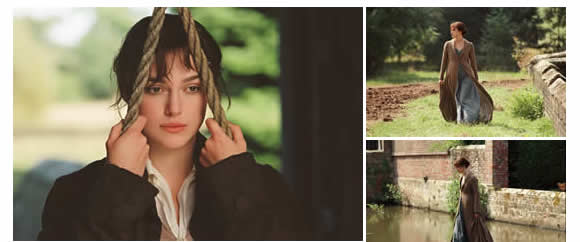
Of the Longbourne transformation by Production Designer Sarah Greenwood, the Working Titles site says: "[She] and her art department were able to transform the house interior to late 18th Century shabby chic. 'Longbourn' became a house overrun with young women. The home of a genteel family but not a wealthy one, where the only tranquillity is to be found in Mr Bennet's library. On the exterior, Lizzie's duckboard bridge was built across the moat, windows were changed to match the period portrayed, and the tidy courtyard became the manure-rich, animal refuge of the various farmyard creatures kept for the family table."

There's a good set of Longbourne photos at the GroomBridge Place web site.

Monday, May 01, 2006

scraping Amazon's statistically improbable phrases

My favorite sources for finding books include the bibliographies I find in books and journal articles; the Library of Congress catalog; Jstor, DNB, OED, and the other proprietary databases which my library website makes available; Google Book Search; Google Scholar; and just plain Google. Each requires its own little skill set to avoid either an overabundance of results or getting nothing.

I've been intrigued with the bibliographic details that Amazon gives, but haven't found a way to use that information as a means of finding books. William J. Turkel, who writes a blog called Digital History Hacks seems to have accomplished this trick. Take a look at his post called SIP Mapping.

He says: "Amazon keeps track of phrases that are distinctive to a small set of books. These SIPs (statistically improbable phrases) can be used to get some idea of the conceptual landscape in and around particular works, and thus can be used to generate bibliographies." And, having recognized this possibility, he wrote a Perl applet to pull together statistically improbable phrases in books. I haven't had a chance to play with it. Seems to be it could be a valuable tool.

Saturday, April 29, 2006

NYRB economics

I remember when The New York Review of Books gave birth to itself back in the days when the NYT was brought to its knees by the publishing strike of 1963. I was a subscriber and faithful reader for some years and a sporatic reader in recent decades (when we grew fond of calling it "the New York review of each others' books" for the tendency of a certain class of liberal authors to exchange adulation in its pages). It's a great pleasure to notice that, on the whole, its quality remains high after all these years. The amazing archive of past articles attests to this. To get a feel for its strengths, search "sontag," "arendt," "beckett," and "isaiah berlin." (And, if inclined, you can find evidence of its weaknesses by searching "pastan," "sutcliff," and "leguin," all favaorite authors of mine whom the NYRB shuns.)

This is prelude to my main point. The NYRB for May 11 has a long, unsimplistic, and extremely interesting article on youth demonstrations in France and the global capitalism of this era -- France: The Children's Hour, by William Pfaff (NYRB, Volume 53, Number 8, May 11, 2006). From the title, you'd think the main focus was on events in France, but it's just as much about the current mode of open-market capitalism whose stakeholders are not the societies to which corporations contribute wealth but only shareholders and chief officers.

The trickle-down or rising boats theories are used to justify laissez faire approach to corporate regulation and taxation. It says corporate wealth results in a prosperity in which all have a share. Pfaff and many others note, however, that recent experience in the US has been otherwise. Here, benefits to the wealthy (including shareholders) have been great but the incomes of most Americans have increased little, stagnated, or declined.

Pfaff also points out that this narrow-focused capitalism exists in a global rather than national environment. He says: "The crucial effect of this for society in the advanced countries is that it puts labor into competition with the poorest countries on earth. The Nobel laureate Joseph Stiglitz is one of many arguing that trade liberalization puts downward pressure on skilled as well as unskilled wages."

He wraps up this part of the essay with a useful insight:
We need to note the classical economist David Ricardo's neglected "iron law of wages," which says that in conditions of wage competition and unlimited labor supply, wages will fall to just above subsistence level. This "law" in the past seemed irrelevant since there never before has been unlimited access to labor. Thanks to globalization, that is now in prospect. The consequences have only begun to be felt.

In this perspective, what in France seems a sterile popular defense of an obsolete social and economic order might instead be understood as a premonitory appeal for a humane successor to an economic model that considers labor a commodity and extends price competition for that commodity to the entire world. The apparently reactionary or even Luddite position inspired by French reactions might prove prophetic.


He doesn't mention, though others commonly do, that those at the very bottom of the labor supply system reap benefits from this system. These are the poorest peasants in the backward sections of developing nations (like China) and the marginally-surviving inhabitants of many nations whose populations are almost entirely poor. It's also important to notice that for many of these desparate poor people, these benefits are precarious (cutthroat price competition at the bottom of the industrial pyramid can wipe out export platforms overnight and they are just as vulnerable to policy changes, as when import quotas or duties are altered even a little).

As the IMF frequently points out, frequently quoted on this blog, there's economic justice to be had by careful regulation of the global economy as a whole and all its constituent parts, but great danger in independent action (as in protectionism) to serve the interests of only one nation or constituent part of the system. Pfaff's appeal for a new economic order makes sense only if this new order is adopted across the board.

Thursday, April 27, 2006

Miro

A brief update to my brief post on Google's celebration of Miro's birthday (from Diglet):
Google takes down Miro logo art

Artist's family asks Google to take down 'painted' logo


The family of Joan Miro and the Artists Rights Society, a group that represents the Miro family and more than 40,000 visual artists and their estates, asked Google to remove the Miro-esque google logo -- which google put up to celebrate the anniversary of Miro's birthday. Google quickly complied. But the thing that stuck out at me was this little quote:

In September, the Authors Guild sued Google for reproducing works in it's "library project'" that were still under the protection of copyright. In a news release, Authors Guild president Nick Taylor called the project, "a plain and brazen'' violation of copyright law.


"It's not up to Google or anyone other than authors, the rightful owners of these copyrights, to decide whether and how their works will be copied,'' Taylor said.

Maybe Taylor needs to read Title 17 regarding Fair Use again. Google took down the image, but I believe these copyright holders' organizations (that includes MPAA and RIAA) are pushing the boundaries of copyright in order to kill fair use and the public domain. Cornell University Law School's Legal Information Institute and Stanford Libraries fair use site offer much information and background on the topic of copyright.


Tuesday, April 25, 2006

Turandot on tap

As I've written before, I like to listen to LĂĄtlista SR Klassiskt, the Swedish public radio station on the web. It plays the kind of classical music I like best: a mix of chamber, vocal, and (not too much) orchestral, mixing familiar with stuff I don't know. One of its main attractions is that it's pleasant but not distracting. I can concentrate -- Muzak as it should be.

Not right now. They're playing stuff from Puccini's Turandot, and what stuff: arias reconfigured for piano (wild glissandos and such), arias that Puccini wrote for solo voice done in choral treatment. Arias as Puccini did write them. All excellent performances. Wonderful! But I do have to work.

Saturday, April 22, 2006

Diary of Lady Shelburne - Thomas Coulican Phoenix

In recent posts I've reproduced parts of Lady Shelburne's diary -- as you can see from the listing in the sidebar. I identified the people, places, and events of the diary as best I could, using mainly online sources and an occasional printed one when handy. If I couldn't track something down quickly, I left it alone or made a best guess about it.

I'd like to go back to one of those little mysteries. On November 25, 1768, Sophie wrote: "This morning I had christened, at St. George's Church, a little negro boy of five years old, that was given me by Mr. Richard Wells on Friday last, by the names of Thomas Coulican Phoenix; the latter he had been called after the ship he was brought in. He is pretty and very good humoured, and I hope by proper care will turn out well."

I wonder. Why would Sophie be "given" a little Negro boy? Why would she accept such a gift? Who was Richard Wells? What was the ship he was brought in?

As answers all I have is surmises.

Taking the ship first:

My first find turned out to be a dead end. Not long after the appearance of the biography containing the extracts from Sophie's diary, there appeared a reference to this name, Thomas Coulican Phoenix, in Notes and Queries, a periodical for passionate antiquarians. In March, 1877, one of N&Q's most frequent contributors, A.O.V.P., participated in a discussion thread that had been begun the previous month concerning "Unusual Christian Names."

* It's a digression, which is absolutely in keeping with the ethos of N&Q, to give the beginning of the thread. On a page of the magazine, along with contributions headed "Gloucestershire Provincialism," "Think To It," "Yankee," and "St. Mary's, Newington, Surrey," is one headed "Unusual Christian Names," by J. Charles Fox. He jotted down names from the registers of Youlgreave in Derbyshire saying he was struck by the number of infrequent names he found and adds: "In 1708 William and Mary Castle caused their son to be baptized Windsor, thus making the curious combination of "Windsor Castle." And also: "In 1739 the vicar enters: 'Baptized Charity, the daughter of the Lord knows who.'"

This discussion morphed into one on unusual family names and A.O.V.P. took up this thread in an entry headed Phœnix, writing: "Some time ago there was a correspondence in "N.& Q." as to the origin of the family name Phœnix. The following quotation from Lady Shelburne's diary may therefore perhaps be of interest to some of your readers." He then quotes the diary entry and gives a full citation to the biography. There's nothing more. (The Fitzmaurice biography seems to have been popular in its day since there's another reference to it on the same page, one about an old measure of land, Uncia, Unciata Terræ..) {Source: Notes and Queries, 5th S. VII, Mar-Apr, 1877.}

A second effort was more fruitful. My friend Mitch, who's studying for a PhD in English History at Duke, told me the ship Phoenix appears in The Transatlantic Slave Trade: A Database on CD-ROM (New York: Cambridge University Press, 1999). It took me a while to find the time to retrieve and view this source; when I did, I found a whole bunch of slave ships named Phoenix.

In our period (in and around 1768), there was one that had been constructed in New York in 1759. This ship took slaves from Biafra, Africa, to Kingston, Jamaica, in 1765 and 1768, returning to Liverpool after each voyage. There was another that had been constructed in Salisbury, Massachusetts, in 1753. It sailed in November, 1760, from Liverpool to the Windward Coast of Africa (roughly the modern Ivory Coast). The database entry says the ship was "captured before slaves embarked" and says it's not known who did the capturing. A third Phoenix was constructed in Spain at an unknown date and later registered as a British vessel. It departed Bristol in 1766 to pick up slaves in Biafra and deliver them to Dominica. It never made it back to England, having sunk due to natural causes after departure from Dominica. From the dates of voyage and outcomes, it seems likely that the Phoenix in which the boy came to England was the first (made in New York). It's just possible that he arrived in the second of the two voyages in our period, landing in Liverpool in 1768, but why he wasn't sold off in Kingston is a question that needs answering.

The night after I did this research in The Transatlantic Slave Trade I kept waking up with bad dreams about the fate of the Africans who were captured, sold into slavery, shipped across the ocean, and made to work cane into sugar for the rest of their (presumably short) lives. The database entry for the voyage that may have brought the boy to Liverpool records, laconically as databases do, that 40 of the 400 Africans who were its cargo "died between last port of purchase and first port of disembarkation." Horrible though their deaths certainly were, they may have been fortunate.

Next: Who was Richard Wells?

I thought at first he was a Virginia planter, but this seems far-fetched. More likely, he was an ancestor of Orson Welles, the famous director (movies and theater). Writing about his origins, a biographer says:
I was surprised to discover that Orson Welles, who was not noted for his modesty, had completely hidden the distinction of his liberal forebears on both sides of his family. It was startling to find that his finest American ancestor on his father's side was a Quaker, Richard Wells, from Cottness near Sheffield, Yorkshire.
Our author adds: "Richard Wells's father, Dr. Gideon Wells, was both poet and physician and attended the health of many ruling families of England, including the parents of George Gordon, Lord Byron." Gideon Wells died in 1760 which puts the reach of his life near the bounds of Sophie's diary and makes it plausible that the Shelburne's knew him or of him. When his father died, Richard, the eldest surviving son, was forced to sell the family estate to settle its debts. He then emigrated to America and became a Quaker. In 1773, after our period, he was to become principal officer of the Bank of North America in Philadelphia. {Source: Orson Welles: Rise and Fall of an American Genius, by Charles Higham, St. Martin's Press, 2002. pp. 5, 14, 15.}

Richard Wells was an author of pamphlets, as well as Quaker and banker. He wrote The Middle Line (Philadelphia, 1775) at the height of the crisis leading up to the Declaration of Independence, taking a "line" as the title indicates, between the extreme separatists and the Anglophile conservatives. In fact his politics at this time were practically identical with those of Sophie's husband, Shelburne. He also wrote A Few Political Reflections Submitted to the Consideration of the British Colonies (Philadelphia, 1774) and "To The Freemen of America," (Charleston, South-Carolina Gazette, June, 6, 1774). Wells was later to become a member of the Philadelphia Society for the Abolition of Slavery, and, in all three publications, he combined political rhetoric with arguments against slavery and the slave trade. In 1789 he would petition Congress to enact a "remedy against the gross national iniquity of trafficking in the persons of fellow men." {Source: Winterthur Portfolio, Vol. 2, p. 91}

Next: What about the little boy?

Putting together guesses about the ship and Richard Wells, I surmise that Richard Wells came to England in 1768 along with other Americans to confer with Shelburne about the crisis in colonial affairs in America. Their goal would be to resolve differences and avert armed conflict, though both sides must have realized that intransigence had progressed too far on both sides for such a resolution to be easy to achieve. I surmise that he had been able to rescue one of the slaves from the Phoenix; it's possible, even, that he obtained passage from Philadelphia to Liverpool on the Phoenix to become more familiar with the doings of slavers and the trade and that he purchased or was given the boy who had somehow escaped been sold into slavery in Kingston.

If this is true, then he might have brought the rescued slave to Sophie for her to raise in England. I can imagine she would have welcomed the opportunity to make a stand in this way against the evils of slavery and the slave trade and do what she could to make amends.

Thursday, April 20, 2006

"You are accusing yourself"

As Sharon Howard points out, the proceedings of the Old Bailey are interesting. I found this while looking for information on the Quaker and Pennsylvanian, Richard Wells. It's the trial of a man accused of stealing from Juliana Penn, one of Lady Shelburne's aunts. Born Juliana Fermor, she married Thomas Penn, a son of the famous William Penn, who had made a fortune in America and returned to England to enjoy it. One source records that the fortune-making was, at best, highly unethical, but that has no bearing on this little tale.

We're often told that eighteenth-century London was "a rough and disorderly age, with mob violence, violent crimes" and the rest {source of quote}, but this case shows quite the opposite. It is the pawnbroker (intended receiver of stolen goods) who takes the thief and accomplice in hand and brings them before the magistrate. And the thief himself is amazingly innocent, not of the crime, but innocent like a child (unhardened, naive, ignorant of the consequences that await him). Read for yourself. I've copied some Hogarthian London at the bottom, followed by a list of Lady Shelburne's family on her mother's side.

The Proceedings of the Old Bailey 16th October, 1782

DAVID HUGHES, THOMAS DYSON, theft : specified place, theft : receiving stolen goods.

The Proceedings of the Old Bailey Ref: t17821016-3

Original Text:

614. DAVID HUGHES was indicted for feloniously stealing on the 28th of September last, one pair of silver wax candlesticks, value 40 s. a silver half pint mug, value 30 s. a silver cream pot, value 20 s. one piece of a broken silver table spoon, value 5 s. two silver handles of a knife case, value 5 s. and one silver foot of a knife case, value 1 s. the goods of Juliana Penn , widow, in her dwelling house . And THOMAS DYSON was indicted for feloniously receiving on the same day the said silver candlesticks, half pint mug, and cream pot, part and parcel of the said goods, knowing them to be stolen .

JAMES ALDUS sworn.

I am a pawnbroker in Berwick-street: on the 28th of September, about nine in the morning the prisoner Dyson brought to me to pledge, a pair of silver candlesticks, a half pint mug, and a cream pot; he asked me two guineas on them, I agreed to give him the money and a duplicate, he wanted some things out. There being a crest on them, I desired to know where he lived, he said in Poland-street No. 12, I told him I should go with him and see that they were his, he desired to have either the plate or the money, then he said he lived in St. Ann's court; I then immediately sent for a coach to take him to the magistrate, as soon as the coach came he said the plate belonged to his wife who was in the country, and lived in a gentleman's family; I said I should take them to a magistrate's, he said there was a man at the door could give me an account whose they were; the prisoner David Hughes was then standing in the street, as soon as he came out at the door the prisoner Dyson called David, and I took them both to the magistrate's; the prisoner begged I would let him go; he said he was servant to Lady Penn in Spring-Gardens; he said he wanted to raise some money and that all the things belonged to Lady Penn; and said he would carry them home if I would let him go: at the magistrate's he said Dyson came to him at a public house, and it was consulted that they should be brought to his lodgings.

WILLIAM SHERMAN sworn.

I am servant to Lady Juliana Penn ; I know the prisoner Hughes, he was servant to my Lady, as butler; I know this plate to be Lady Juliana Penn 's property, it used to be kept in a chest in his pantry, the family were not in town at that time; the plate was used but seldom, I cannot tell how long before it had been used; the prisoner had an inventory of the plate when the other servant left the place which was about a fortnight before; I have lived with my Lady a year and a quarter before she went abroad, and a year since; I do not know the prisoner Dyson, I remember seeing him at my Lady's once on the Thursday night, and he was detected with the plate on the Saturday morning with David Hughes .

MOSES MORANT sworn.

The prisoners were brought to the office, I searched the pocket of Hughes, and I found a broken spoon, two handles of a knife case and a foot of a knife case.

William Sherman . The broken spoon and the pieces of the handle are my Lady's property.

Court. Have they any mark? - No, I am sure they are her property, because I have seen the pieces of spoons in the case with my Lady's crest on them.

Court. How do you know these are the identical things? - Because there are some of them upon the knife cases at home just like this, these pieces were broken off, and were laid by.

PRISONER HUGHES's DEFENCE.

On the 27th of September, Thomas Dyson sent for me to a public house, the ship, and he called for a pint of beer; I went toview a gif image of the original file
See original him, he said he was going to his place the next day the 28th, in the afternoon, and he was very much distressed and he did not know how to get into his place, he wanted to get some things out of pawn, and he asked me if I had any thing of my own to put into pawn, or any thing to help him out to go into his place, and I said no, he said if I could put any thing in pawn for a guinea or that, I should take it up again and have the duplicate; I said I did not know a pawnbroker, he said he knew of one, then I agreed to take him a few things to have the value of that money.

Court. You are accusing yourself, instead of defending yourself.

Prisoner Hughes. Then I went to the pawnbroker's and waited for the duplicate, I thought it was a long while, I went towards the place and found he was taken and stopped; I did not know the consequence.

Court. The consequence is very heavy on you, perhaps beyond what you expect; when men do bad things they do not know what will be the end of it very often.

Prisoner Hughes. If I had known the consequence I would not have gone up; then they stopped me, and I went to Bow-street.

PRISONER DYSON's DEFENCE.

On the Friday night I was with this young man, he desired me to wait for him, he might want to send me of a message; he came to the house about half past seven, he said he was going to Covent-Garden to raise some money from a friend as he was distressed; being a new servant he did not wish to have it known, that he wanted money for cards, and messages, and letters, and the like of that; we parted, and he said if he got money he should not see me, but if he did not, he would bring me some things to pledge; he was very fearful of losing them.

Court. Did you take it to be an honest thing for him to take his Lady's property to pawn? - I did not know it was his Lady's.

Then you took it to be his own? - He told me the next morning that he had these things from a certain person that he kept company with, which were left with her by her sweetheart, and he wished me to pledge them.

Court to Hughes. Where did you live before? - With Lord Frederick Campbell about four months.

HUGHES GUILTY , ( Death .)

DYSON GUILTY , Transportation for fourteen years .

Tried by the First Middlesex Jury, before Mr. Baron EYRE .
source: The Proceedings of the Old Bailey 16th October, 1782
The Proceedings of the Old Bailey Ref: f17821016-1

THE WHOLE PROCEEDINGS ON THE KING's Commission of the Peace, Oyer and Terminer, and Gaol Delivery for the CITY of LONDON; AND ALSO, The Gaol Delivery for the County of Middlesex; HELD AT JUSTICE HALL in the OLD BAILEY, On Wednesday the 16th of OCTOBER, 1782, and the following Days;

Being the EIGHTH SESSION in the Mayoralty of The Right Hon. Sir William Plomer , Knt. LORD MAYOR OF THE CITY OF LONDON.

TAKEN IN SHORT HAND BY E. HODGSON, And Published by Authority.

NUMBER VIII. PART I.

LONDON:

Printed for E. HODGSON (the Proprietor) And Sold by J. WALMSLAY, No. 35, Chancery Lane, and S. BLADON No. 13, Pater-noster Row.

MDCCLXXXII.


click to enlarge

Addendum List of Sophie's aunts, uncles, and grandparents on her mother's side:

from: 'Fermor1', a genealogy of the Fermor family

Grandfather: Thomas Fermor, 1st Earl of Pomfret or Pontefract (b 23.03.1697, d 15/08.07.1753)
Grandmother: m. (14.07.1720) Henrietta Louisa Jeffreys (d 17.12.1761, dau of John Jeffreys, 2nd Lord of Wem)

Her mother (Sophia), aunts, and uncles, in birth order:

(A) George Fermor, 2nd Earl of Pomfret (b 25.06.1722, d 09.06.1785)
m. (03.05.1764) Anna Maria Delagard
(B) Henrietta Fermor
m. (1747) John Conyers of Copt Hall
(C) Sophia Fermor (b 29.05.1721, d 07.10.1745)
m. (14.04.1744) John Carteret, Earl Granville (b 22.04.1690, d 02.01.1763)
(D) Charlotte Fermor (d 1813)
m. (09.08.1746) William Finch (d 25.12.1766)
(E) Juliana Fermor
m. (1751) Thomas Penn of Stoke Park
(F) Louisa Fermor
m. Sir Thomas Clayton, Bart
(G) Anne Fermor (bpt 25.05.1733, d 01.03.1769)
m. (15.08.1754) Thomas Dawson, Viscount Cremorne (b 25.02.1725, dsps 01.03.1813)
(H)+ other issue - William (d unm 1714, Captain RN), John (d 1729), Thomas (d young)