Monday, October 18, 2010

gremlins

My generation of war babies came just before the Boomers. I can just barely recall the ecology of homefront shortages. My mother grew vegetables and put up many jars of preserves. Children would flatten metal cans for recycling and collect Halloween pennies for the copper they contained. The war comics showed evil looking yellow-faced men with slanty eyes, buck teeth, and eyeglasses: the Japs or Nips. Germans looked more like normal human beings. The comic I most clearly recall was not about the enemy but about fighter pilots on our side. It showed funny little people who made things go wrong with the pilots' planes. Doing a little research, I find that it was Roald Dahl's Gremlins of 1943. It's described as his first children's book. He sold it to Disney who intended to produce an animated version for theaters but never did.

Here are images from it. Most are from jimhillmedia.com. The exceptions are noted.[1]


{source: 1stedition.net}

Gremlin Gus and Pilot Officer Gus

{source: 2.bp.blogspot.com}


{source: blueyonderinteractive.com}


Fifinella, female of the species


The adult males are gremlins, children are widgets


Back cover.

{source: animatedviews.com}

A gremlin named Gus is the star of the story. He's first seen as a pilot is maneuvering to attack German bombers in the Battle of Britain. The pilot looks out his canopy and sees this little man drilling a hole in his wing. The pilot, also named Gus, eventually learns that gremlins are angry about the destruction of their forest home to build an aircraft factory. Gus the pilot turns the gremlins to friends when his Hurricane fighter comes apart over the English Channel and, in saving a gremlin from going down with the wreckage, he's able to convince the little guy that they should join forces against the attacking Germans.

The author of a wikipedia article on the book tells the rest: "Eventually, the gremlins are re-trained by the Royal Air Force to help repair, rather than sabotage, aircraft, and they also help restore Gus to active flight status after a particularly severe crash. The book also contains picturesque details about the ordinary lives of gremlins: baby gremlins, for instance, are known as widgets, and females as fifinellas, a name taken from the great 'flying' filly racehorse Fifinella, that won both the Epsom Derby and Epsom Oaks in 1916, the year Dahl was born."

It's hard to be sure back so many years, but I think what made the little book memorable for me was the treatment of human error (mistakes made during aircraft manufacture, maintenance, or operation) as the action of bug-like creatures. Apparently, pilots had been doing this for quite a while before Dahl wrote the story. A blog post, in Spanish, explains in detail.[2]

The blog post includes this image from a letter dated November 1943 from a fighter pilot to his girlfriend.

{source: photobucket.com}

An Australian airman tells this story:[3]
I first heard about Gremlins when I was eight years old. That was in 1940, and the Battle of Britain was being fought over Kent. My old Uncle Alf told me about them. He picked up this info from an RAF pilot he met in our village pub - the pilot was recuperating from a crash caused by Gremlins in the fuel system of his Spitfire.

Gremlins were apparently a British manifestation, although there is evidence that some may have migrated to Australia after the war. Interestingly, they seemed to be peculiar to only British designed aircraft as there were no reports of American gremlins causing problems.

They were first discovered by RAF pilots of the Photographic Reconnaissance Units who flew unarmed Spitfires and Mosquitoes at great heights on photographic missions over enemy territory. Their presence caused great concern, so much so that an alert order was sent to all RAF units. It was in the form of verse which was published in RAF bulletins, and often sung to a familiar tune. It went like this:

This is the tale of the Gremlins
As told by the PRU
At Benson and Wick and St Eval —
And believe me, you slobs, it's true.

When you're seven miles up in the heavens,
(That's a hell of a lonely spot)
And it's fifty degrees below zero,
Which isn't exactly hot.

When you're frozen blue like your Spitfire,
And your scared a Mosquito pink.
When you're thousands of miles from nowhere,
And there's nothing below but the drink.

It's then that you'll see the Gremlins,
Green and gamboge and gold,
Male and female and neuter,
Gremlins both young and old.

It's no good trying to dodge them,
The lessons you learnt on the Link
Won't help you evade a Gremlin,
Though you boost and you dive and you jink.

White one's will wiggle your wing tips,
Male one's will muddle your maps,
Green one's will guzzle your glycol,
Females will flutter your flaps.

Pink one's will perch on your perspex,
And dance pirouettes on your prop,
There's a spherical middle-aged Gremlin,
Who'll spin on your stick like a top.

They'll freeze up your camera shutters,
They'll bite through your aerilon wires,
They'll bend and they'll break and they'll batter,
They'll insert toasting forks into your tyres.

And that is the tale of the Gremlins,
As told by the PRU,
(P)retty (R)uddy (U)nlikely to many,
But a fact, none the less, to the few.
This is a photo of a Supermarine Spitfire Mk XIX fighter in high-altitude reconnaissance mode — armor and armaments removed to increase range. One source says "the high altitude flights tended to be very cold as the heat from the engines were re-routed away from the pilot to the cameras to keep them warm. No one plane was assigned to one pilot, pilots would often fly a different Recce Spit each time they took off and this supposedly started the 'Gremlins' tale."


This picture comes from a gremlin story published in an RAF monthly magazine in 1942.

{source: photobucket.com}

This shows Roald Dahl as Flight Lieutenant in 1942.

{source: 4.bp.blogspot.com}

---------

Some sources:

The Gremlins article in wikipedia

9 de noviembre de 2009 El origen de los Gremlins on a blog in Spanish called The Lost View

The Gremlins (1943) A novel by Roald Dahl on fantasticfiction

Disney, The Gremlins, and World War 2 on a blog called meine kleine fabrik

The airplane gremlin legend on yonderblog

"The Gremlins: The Lost Walt Disney Production" finally finds its way back into bookstores

The Gremlins on Amazon

Biography for Roald Dahl on imbd.com

Yet More Swag on Panabasis, journal of the Janus Museum

First Edition The Gremlins Auction

DO YOU BELIEVE IN GREMLINS?, Stories of 10 Squadron RAAF in Townsville, by John Laming

"Gremlins" Originated from Spitfire Pilots?, discussion on rec.aviation.military

---------

Notes:

[1] I'm reproducing these images under fair use provisions of copyright law. If my assertion of this right isn't correct I'll take them down.

[2] : El origen de los Gremlins. Here are extracts from a computer translation:
9 de noviembre de 2009
El origen de los Gremlins

A little history

The term "gremlin" was first used in the jargon of the airmen of the Royal Air Force (RAF) in Malta, Middle East and India, and the first written reference exists one appears in a poem published in the journal Aeroplane, in Malta (April 1929).

The belief of the small monsters sabotaged aerial equipment became popular during World War II among the men of the RAF, particularly within the staff of the Photographic Reconnaissance Unit (PRU) of the RAF Coastal Command. The creatures were responsible for all the inexplicable accidents that occurred during the flight, and were supposed side with the Germans, a fact that was questionable, since research revealed that they suffered similar mishaps. In a letter dated November 1943, a pilot included this charming picture [shown above] in a letter he wrote to his girlfriend.

The gremlins were causing problems in the same way on both sides, not taking sides in the conflict, acting only in their own interests. They made an easy way to pass the buck or put mishaps down to bad luck rather than human error. As folklore expert John Hazen said, "the gremlin has been the product of the era of aerial machinery." Many of the pilots began to carry small rag dolls emulating "gremlins kind" as protection against the harmful attacks of the evil beings.

{source: photobucket.com}

An early reference to the Gremlin appears in an article by Hubert Griffith in Contact, the monthly publication of the RAF on 18 April 1942, where testimonies of pilots described as beings who "appeared from the clouds and fell sharply on the nose of the plane" even setting different kinds of gremlins (the ordinary kind and another acting at the altitude of 10,000 feet, the most dangerous).

{source: photobucket.com}

While the text highlights the existence of these stories, their existence had long been known going back to the desperate defense put up by Spitfires at the Battle of Britain in 1940. Other sources claim that there is evidence going back to the First World War, but there is no graphic record of this.
[3] DO YOU BELIEVE IN GREMLINS?, Stories of 10 Squadron RAAF in Townsville, by John Laming

Sunday, October 17, 2010

good-good-good

Witnessed this at a car dealership yesterday afternoon.

Sales guy needs proof of insurance before he can release car to customer. Customer had bought insurance but email in customer's hand doesn't have all info needed. (Sales guy is a young man named Mikhail, born in southwestern Russia where they grow grapes and drink wine rather than vodka, but that's not relevant to this story.)

Sales guy says he'll get insurance company to fax needed doc. Finds phone number of customer service on customer's what-to-do-if-you're-in-an-accident card. Dials it on speaker phone. When speaker begins to emit robo-voice giving button-push options, sales guy hits the "O" button four times quickly. Robo voice seems confused. Mikhail hits the "O" button four more times quickly.

He might have to do this a third time before he hears a non-robo human voice (I forget). While hitting "O" he tells car buyer some insurance companies set their robo phone systems so that a live human with the authority to get something done only comes on the line only when you start yelling into the phone. This company is not one of those.

He picks up the handset to speak with actual non-robo human and quickly dispenses with ensuing "how-are-you-fine-how-are-you" exchange without being rude. "Good-good-good" he says. He gives his first name, identifies where he's calling from, and says what he needs. Speaks quickly but very clearly and gives only his first name. Gets shifted to a second person and rapidly goes through a second "good-good-good" exchange. Tells second person he needs fax showing name of insured, VIN of vehicle, and statement insurance that vehicle is insured by that person -- gives the fax phone number and his first name again to be put on fax header. Five minutes later the fax is in hand.

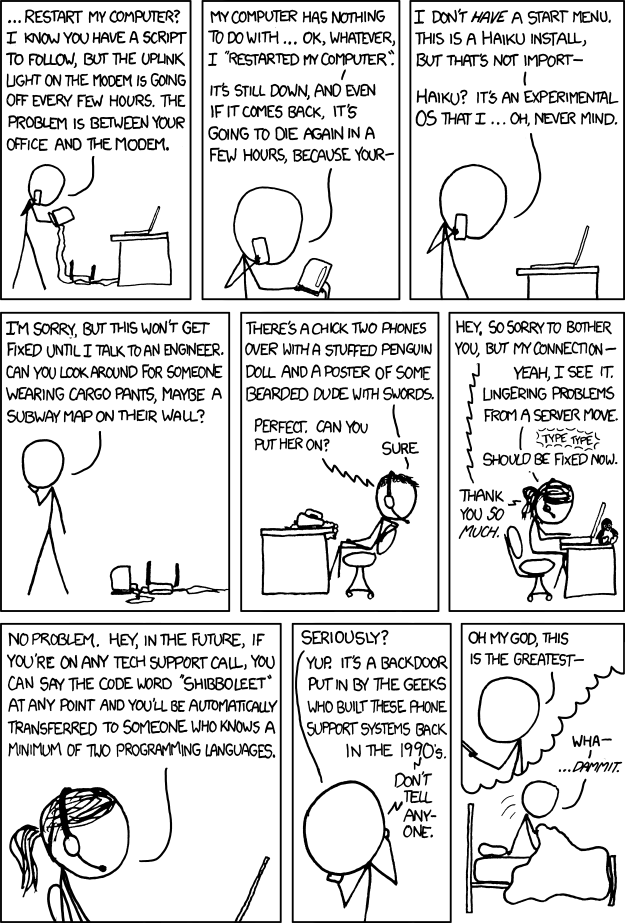
Here's an xkcd comic on the same general topic.


The comic's author, Randall Munroe, makes it available with a Creative Commons license. The comic home page is xkcd, a webcomic of romance, sarcasm, math, and language. xkcd may or may not stand for something. The wikipedia article on the comic discusses this topic: xkcd.

Side note: Watching Mikhail at work reminded me of olden times when, trying to arrange a flight at a travel agency, I would observe quick and efficient phone calls between agents and airline booking reps. This was back when you sometimes flew different carriers to get around and the local agent might be calling two, maybe three, airlines to get things set up.

Second side note: The experience of buying a used car at this dealership was much better than experiences at other dealerships times past. I'll be happy to identify the place if asked.

Thursday, October 14, 2010

coal miner's wife, 1938

On her first shoot for the FSA in September, 1938, Marion Post Wolcott went to Marine, West Virginia, which exists now only as a few houses on Tunnel Hill Road by County Road 7, a couple of miles outside a tiny place called Davy. There, living in abandoned houses and an old store, lived the families of miners who could find no work. And there, Wolcott made this memorable image.

{Wolcott's caption: "Wife of unemployed coal miner, suffering from T.B., living in old company store. Abandoned mining town of Marine, West Virginia." 1938, September. Source: Farm Security Administration - Office of War Information Photograph Collection at the Library of Congress}

The photo has much in common with ones taken by other FSA photographers, particularly Dorothea Lang. FSA collections have quite a few images of young mothers on the porches of their dilapidated rural homes. Even the somewhat surprising smile and engaging facial expression are not particularly unusual. The FSA photographers were pleasantly surprised to find that poverty did not always grind down its victims. They encountered people whose sense of oppression did not keep them from cooperating among themselves and whose poverty did not remove all hope for betterment; people who showed themselves able to experience moments of contentment, even joy.[1]

However, this photo succeeds not just for showing a refusal to give in to despair, but also for its overtones of sensuality, even glamor. As other women photographers were able to do, Wolcott has overcome the subject's resistance to being made an object of pity and there's an evident rapport between the person behind the camera and the one in front of it. Wolcott has given the woman a pose that reminds one (reminds me anyway) of provocative poses used in fashion photography and, by having her lean forward, has brought out the subject's sensuality, even eroticism.

It's reasonably possible that the woman was, as the image makes it seem, unconscious of her sexual appeal. It seems to me that she's not trying to appear sexy and that her flimsy dress is open at top not for allure but because she's a nursing mother and because it's a hot day. Other photos that Wolcott took at this time, shown below, support this conjecture. The first of them shows that the youngest of her five children and own mother were close by when Wolcott made the woman's portrait. The third, taken inside with flash, suggests that the open-top dress was a convenience for nursing. The second photo gives an indication of the diseases which afflict her. Wolcott took another photo during this session showing the woman holding her fist to her mouth during a tuberculosis fit of coughing.

Years later, Wolcott recalled her subject and the image she made.
This woman had TB. I think she was living in an abandoned store. It was in West Virginia, down near Welch, on that first trip I made for Roy. I can see the road in. I can see her leaning over that railing talking to me. There may have been four or five families living in that store. They were all piled together. She's pretty erotic, isn't she? I probably admired that. I knew immediately I wanted to shoot her. She was so beaten down by life and yet there was all this sexuality in her, not just sexuality but sensuality. I talked to her for a while and then I went on. But I knew I had it. -- quoted in Looking for the light: the hidden life and art of Marion Post Wolcott by Paul Hendrickson (Knopf, 1992)
You can see the preparation for such a high level of creative portraiture in Wolcott's upbringing and previous experience. She was daughter of a highly conventional father and a decidedly unconventional mother. Raised in affluent conditions, she was sent to a progressive boarding school when her parents divorced and later chose to spend her time much more with her bohemian mother in a tiny Greenwich Village flat than at her stuffy father's suburban home. She completed her formal education at the New School for Social Research and NYU and spent a couple of years studying dance in Paris and Vienna. In these environments she mixed with artists, poets, and students; with a radical theater group and with women who struggled to achieve social independence and creative freedom.

Returning to America she tried and quickly abandoned teaching as a career and took up photography when a close friend of her sister's saw that she had a talent for the craft. She was able to find work as a photo-journalist but didn't like being assigned to cover fashion and do "ladies stories."[1] With recommendations from New York photographer friends, she was, in 1938, able to land a position with the FSA.

She liked the government work and appreciated the creative freedom she was given in carrying it out. She also liked being part of a collective effort to expose the hard lives endured by Depression-era American families and to show the benefits of New Deal efforts to make things better for them.

Here are three other photos from Wolcott's visit with the woman and her family.


{Mother, wife and child of unemployed coal miner, Marine, West Virginia, 1938 Sept.; source: Farm Security Administration - Office of War Information Photograph Collection, Library of Congress}


{Wife and two children of unemployed mine worker. She has TB and syphilis. They are one of five families living in old abandoned company store in abandoned mining community of Marine, West Virginia, 1938 Sept.; source: Farm Security Administration - Office of War Information Photograph Collection, Library of Congress}


{Wife and two children of coal miner. She is sick, has five other children. Marine, West Virginia, 1938 Sept.; source: Farm Security Administration - Office of War Information Photograph Collection, Library of Congress}

----------

This shows four of the woman's five children. Wolcott rejected this one by punching a hole in the negative.


{Untitled reject; source: Farm Security Administration - Office of War Information Photograph Collection, Library of Congress}

----------

This shot shows what there was to see of the hamlet of Marine at that time.

{Carrying water to one of the houses in abandoned mining community, Marine, West Virginia, 1938 Sept.; source: Farm Security Administration - Office of War Information Photograph Collection, Library of Congress}

-----------

This is a satellite view of Marine today.

View Larger Map

This shows the nearest village, Davy (A), and Marine (B).

View Larger Map

----------

Here's another fine portrait by Wolcott. Taken two years later, this one is somewhat less alluring.

{Mountain woman by her home up Stinking Creek, Pine Mountain, Kentucky, 1940 Aug.; source: Farm Security Administration - Office of War Information Photograph Collection, Library of Congress}

-----------

My interpretation of Wolcott's photo of the unemployed miner's wife is little different from others I've read with the exception of one over-the-top Marxist-feminist interpretation by Jacqueline Ellis, an associate professor at New Jersey City University. In a book called Silent witnesses: representations of working-class women in the United States, she says the FSA was set up in order to reassure middle-class Americans that the working classes were harmless, that its photographers were required to toe the line in supporting a conservative political perspective, and that its output was a collection of photographs which reflected "traditionally democratic and idealistic American values" and which "often excluded economically and socially marginalized subjects from official representation." Wolcott did not address these assertions directly, but she did contradict them in an oral history exchange conducted in 1965.[3]

Having attacked FSA, Ellis makes some pretty wild claims for Wolcott's "miner's wife" photo:
The photograph was a manifestation of Post Wolcott's feminist impulses. The woman is positioned at the center of the image where her body symbolically dominates the front of the house which as the title states, is owned by the mining company. This emphasis is compounded by the way the wooden rail reframes the woman's body around her exposed breasts and her hip. From this construction, her figure seems to counteract the economic situation that has defined her material circumstances. According to this perspective, Post Wolcott has portrayed the radical power of female sexuality in dialectic opposition to the oppressive force of industrialized capitalism which, in contrast, is logically defined as male.
This is just a bit more than Wolcott herself would claim for the photo and her experience with FSA. In the oral history interview she expressed pride at having served with FSA, having collaborated with the other photographers enjoying considerable artistic freedom over choice of subject and manner of treatment, and having contributed to a literature of what she called "propaganda," that is, a government effort to convince the American public of the existence of extreme poverty and the importance of programs aimed at eliminating it.

---------

Some sources:

Bibliography of primary and secondary sources on Marion Post Wolcott

There's another short bibliography on the University of Virginia web pages on Wolcott

Silent witnesses: representations of working-class women in the United States by Jacqueline Ellis (Popular Press, 1998)

And see my earlier post on Wolcott for many sources.

----------

Notes:

[1] Wolcott recalled her surprise at this resilience in an interview conducted many years later. She said of this first FSA assignment in Marine, "I found the people not as apathetic as I had expected they might be. They weren't too beaten down. Of course, many of them were but they were people with hope and some of them still had a little drive, although, of course, their health was so bad it was telling." (quoted from Oral history interview with Marion Post Wolcott, 1965 Jan. 18, conducted by Richard Doud at Artist's Home in Mill Valley, California, January 18, 1965)

[2] Addressing a conference on Women in Photography, she told what her first days on the newspaper were like:
When I took the FSA job, I already had battle scars. I had weathered…the first weeks as a female full-time staff photographer on the Philadelphia Evening Bulletin…The ten male photographers with whom I was to work, immediately put out their cigarette butts in my developer, spit in and hypoed it, probably peed in it; threw spit balls into my cubby-hole darkroom until my aim and speed became better than theirs. Finally, I exploded—telling them I was there to stay…I told them how and when I could be very useful to them, and that I needed their help in return; that they could teach me about a Speed Graphic and how to develop and print for a newspaper, that they could openly use their accustomed language and the four-letter words which I’d heard and used, and would welcome the opportunity to feel free to use them myself, again. That did it; we reached a truce…soon each one confidentially telling me that the others were wolves and he was going to be my protector. -- The Photography of Marion Post Wolcott by Linda Wolcott-Moore
[3] The Ellis quotes are from Silent witnesses: representations of working-class women in the United States by Jacqueline Ellis (Popular Press, 1998). The oral history is Oral history interview with Marion Post Wolcott, 1965 Jan. 18, conducted by Richard Doud at Artist's Home in Mill Valley, California, January 18, 1965)

Wednesday, October 13, 2010

Henry Lefman, part two

This post continues where Henry Lefman, part one left off.

1851
Henry Lefman & Co. located at 232 Washington St. (home 15 Union, Hoboken)
I can't locate 15 Union Place in Hoboken. There was a Union Place a couple of miles away in a town then called Union Hill. In 1923 when Union Hill joined with West Hoboken to become Union City, Union Place became 37th Street. There was also a Union Street in West Hoboken in 1903.


1852
Amelia Virginia Lefman born. Called Minnie, she will become, in family lore, "the Belle of Hoboken."

1853
Louis Windmuller emigrates to New York on board the SS Hermann.

1854
Henry's son, Henry S., traveling in Paris, receives a letter from his grandmother, Abbe Wolf.[1] Henry's wife, Sarah, was daughter of Abbe and her first husband, John Thorne. They had married in 1814 when she was 20. In 1838, when she was 44, she married Dr. Elias Wolf.

1854
Henry writes to a letter of fatherly advice to his eldest daughter, Annie.[2] He writes from his home address. There's no indication that she is traveling or living apart from him.

1855
Louis Windmuller writes a letter to his grandfather, aunts, uncles, cousins, and sisters in Münster. In it he says Henry Lefman has been the only German relative in New York to provide him with any real help: "I found a helping hand from my cousin Henry Lefman. And he is now the only one on whom I can depend. Without him I would be lost. He is a well-to-do honest man."
. There's more about this letter in my blog post called river crossings.

1855
Henry's children, Emma, age 10, and George W., age 11, are admitted to the School of the Reformed Dutch Church. Their residence is given as 15 Union Place, Hoboken. The school, which offers free attendance to parishioners, is famous for the quality of its teaching.[3] At this time, the school is located at 183 Fourth St. in Manhattan adjoining the church's Marble Cemetery. This photo, of a much later date, shows the cemetery.

{Marble Cemetery, Manhattan, 2nd Street, Between 1st and 2nd Avenues, by Victor Volnar, n.d.; source: NYPL Digital Gallery}

1856
Robert L. Lefman, age 6, is admitted to School of the Reformed Dutch Church.


1856
Henry shows up in another edition of the city directory: "Lefman Henry & Co. mers. 242 Washington, h Hoboken."

1857
In a city directory for 1857-58 Henry is listed as selling "woodenware" at 242 Washington.[4]

1858
George W. Lefman graduates from the School of the Reformed Dutch Church.


1859
Henry puts his name on a list of "citizens of New York, irrespective of party, in favor of an honest, faithful and independent administration of the city government."[5]

1859
Amelia Lefman, age 6, is admitted to the School of the Reformed Dutch Church. She will leave in 1864 without graduating.


1859
Emma L. Lefman joins 17 other youngsters in the graduating class on the 225th anniversary of the School of the Reformed Dutch Church.[6] From the New York Times, October 27, 1859:


1859
A city directory lists "Lefman, Henry, imp. 318 B'way, h 15 Union pl. Hoboken" and "Lefman, Kiefer & Thomass, imp. 318 B'way."


1859
Annie Lefman and Louis Windmuller marry in the Dutch Reformed Church, Hoboken, on November 23. Their marriage will last 54 years until the death of Louis in 1913.

1860
A last child, Albert Clarence Lefman, is born. Henry is 56 and ailing (he has a weak heart). Sarah is 44 and thus beyond the age when women were then expected to be bearing children.

1860
Louis and Annie Windmuller move to a large mansion on 100 acres of land in Woodside, Queens, "far out in the country," as Annie's daughter, my grandmother, will later say.

1860
Henry's business is listed as "Lefman, Kiefer & Thomass, imps. 318 B'way;" -- Trow's New York city directory (J. F. Trow., 1860).

1860
Henry dies of heart failure. "LEFMAN — At Hoboken, on Friday, March 9, suddenly, of disease of the heart, Henry Lefman, aged 50 years, 8 months and 6 days. The relatives and friends of the family are invited respectfully to attend his funeral on Monday, the 12th inst., at 10 o'clock in the forenoon, from his late residence, No. 15 Union place, Hoboken. Interment in New-York Bay Cemetery. (NEW-YORK DAILY TRIBUNE, MONDAY, MARCH 12, 1860.) There was no will. I don't know why my records say he was born July 6, 1804, and this account says July 1, 1809. These things happen.

1861
Henry is dead but his firm lives on. A city directory lists "Lefman Henry, imp. 318 B'way, h Hoboken" and "Lefman, Kiefer & Thomas, imps. 818 B'way;" -- Trow's New York city directory (J. F. Trow., 1861).

1862
There is a city directory entry for Henry's son: "Lefman Henry S. mer. 189 Duane, b - B'way h.."

1865
The city directory for this year gives a new business address for Henry S.: "Lefman Henry S. mer. 51 White, b - B'way h.;" -- Trow's New York city directory (J. F. Trow., 1865).

1866
Sarah Lefman, widow of Henry, is recorded as living in Hoboken at 76 Bloomfield; -- Gopsill's Jersey City and Hoboken directory for the year ending 30th April, 1867 (Hoboken, Gopsill, 1866).


1867
Henry S. Lefman dies at age 29. There is no will.[7]

1872
Albert D. Lefman graduates from School of the Reformed Dutch Church. As parent, the name of a male guardian appears, not that of his mother.


1874
Minnie Lefman and Hugo B. Roelker marry. She's 21 at the time. He is a brother of Louis Windmuller's partner, Alfred Roelker. I've written about him before.

1881
A city directory lists Albert: "Lefman, Albert C., lithographer, 207 Fulton, h 321 W. 32d St." The same directory lists Sarah as living at 143d N. Brook Av.

1881
Sarah Lenington Thorne Lefman dies.[8]

1893
Albert Clarence Lefman dies.

1909
Emma Louise Lefman dies.[9]

1926
Minnie dies.

1929
Hannah Eliza Lefman Windmuller dies.

----------

Some sources:

Union City, New Jersey - Hudson County Genealogy Page

West Hoboken + Union Hill = Union City

History of Hudson County : genealogies of prominent families by Feldra, Robert (Union, N.J., Michel & Rank, 1917)

Collegiate School, the oldest independent school in the United States

FIRST NEW YORK CHURCH

Collegiate Archives Collegiate Church Corporation

An Historical Sketch of the Early Collegiate Church
----------

Notes:

[1] Here's the text:
New York, April 18, 1854


To Henry I. Lefman, Paris

My dear boy,

Your dear mother came to me this morning bringing me the welcome news of your safe passage. I have thought of you every day. you know I have been to sea. when I heard the wind blow I felt for you and would say "I fear Henry is sick" you are now safe on land - the Dr. and Hannah have been very ill they are now better, and send their love to you.

Henry by dear boy - you are in a gay and pleasing city you are young and innocent. God watch over and protect you, do not forget your studies a good education will be to you a fortune easy to carry and the best introduction in scarcity, the road to knowledge may appear to you difficult - do not go half way climb to the top and you will be all I can wish.

I must make this letter short as the time will not allow. my next will be long. I shall expect a letter for myself alone from you.

and now my dear-Henry adieu
Under every sky your loving
Grand mother, Abbe Wolf (signed)
[2] Here's the text:
For my Daughter Annie E. Lefman

The performance of Duty insures the protection of God. ... Read useful books, practice your piano forte, your German, your French, your History of your own Country as well as of Europe in which you have to extend your little store as also your other Studies, try to become efficient in all Household affairs, in cooking, washing, ironing, baking, cleaning, and useful economy.

Read over the above Rules and maxims very often at least once a week -- Recollect they are written by your best Friend at Home No. 15 Union Place, Hoboken, NJ, the 22 Day of February 1854 (the Birthday of the Father of your glorious Country George Washington.)

Keep a Journal in which you write every Evening the Passages you meet during the Day.

Be Virtuous and clever my dear Daughter and let you Deeds, actions and everthing be such that they bring Honour to Yourself and Family, this is the sincere with of your affectionate Father

Henry Lefman
[3] History of the school of the Collegiate Reformed Dutch church in the city of New York, from 1633 to 1883 by Henry Webb Dunshee, 2d ed, (Aldine press, 1883)

[4] In the 1980s, on a trip to New York from her home in San Diego, my genealogist aunt Florence consulted city directories at the New York Public Library. She found much that I've cited from online sources and a quite a few more. Here and below, where I don't cite an online source, you can assume it's her work that I'm using.

[5] "A meeting of citizens of New York, irrespective of party, in favor of an honest, faithful and independent administration of the city government; of effective measures for representing peculation, fraud and corruption in our municipal affairs, and of the election of William Frederick Havemeyer as mayor and Samuel J. Tilden as Corporation Counsel. subscribed: ... Henry Lefman...." Evening Post, Wednesday, November 30, 1859.

[6] It's interesting that the school was co-educational, although classes were not mixed. Some of her male classmates came from notable families: The father of George Augustus Bedford was a Commander in the British Navy in 1843, then Captain, 1854-64, and he later became a Vice Admiral. The father of James R. Hitchcock was a Colonel in the American army, commander of the Ninth Regiment, in 1878. The father of Augustus Wentz was apparently Lt. Col. [Augustus] Wentz, 7th. Iowa Regt., who died in a Civil War battle near Belmont, MO, in 1861. And finally Cornelius Vanderbilt (born 1830, full name Cornelius Jeremiah Vanderbilt -- 1830–1882) was an unloved son of the Commodore himself, Cornelius Vanderbilt, Sr. The son was to shoot himself to death in 1882. He suffered from epilepsy, did not pay his debts, "was always at outs with everybody," got relatively little from his father's will, had a "particular friend" in a man named Mr. Terry. (Sources: the navy list, Mariners-L Archives, ILLNESS OF COL. JAMES R. HITCHCOCK (NYT), Cornelius Vanderbilt (entry in wikipedia).

[7] My genealogist aunt Florence found a petition headed thus. She wrote:

I was surprised that the name of the petitioner was what looks like Sarah Narley but it could be Harley [this may be John Harley; see the entry for 1872]. Anyway she says she is the mother of Henry. Henry was the second child of Sarah and Henry Lefman. I knew he died 26 Oct. 1867, according to Grandma Clara's notation and buried on the 28th. He was 29 yrs. 11 mos.

Sarah says he was unmarried and that she, George, Emma, Robert, Minnie, & Alice survived him. He left no will. All the children were minors except George who was full age.

I do not have a record of Alice at all. She is mentioned by Sarah in their petition, but is not named as being under the protection of the guardian (below).

I wondered if Sarah had married again after Henry's death in 1860, maybe briefly, and then became a window again. Do you recall that the Orphans Court Record for the minor children Emma, Robert, Amelia, and Albert shows their guardian to be James Beusau (sp?) and I wondered why. This was in 1865. Perhaps Sarah married the second time about this date and to protect the children a guardian was appointed. But Sarah would not have been married long because she signed the petition (Admin papers) in 1867 as a widow. The City Directories in the 1870s show her name as Sarah Lefman so does her death certificate 14 Nov. 1881, age 65 (gastro-enteritis). I had always wondered why the younger (minor) children had to be protected and the possible second marriage of Sarah may be the answer.
[8] Aunt Florence transcribed
Sarah's death certificate. I have her birth date as March 19, 1816, and according to this it was October 20 of that year. Once again I can't account for the difference. Here's the text.
Health Department
Certificate of Death
Name Sarah Lefman
Age 65 years, 1 months, 23 days
Widow, without occupation
Birthplace: NY Albany
Lived 65 years in US
Resident in NYC for 3 years
Father's name: Thorne
Mother's name: Thorne
Place of Death: 143 St.

Signed: A.C. Lefman 184 Second Ave. NY

deceased died on the 12th day of November 1881, about 5- o'clock A.M.
Cause of death: gastro-enteritis; duration: one moneh 14 days.

Doctor's signature

Burial: New York Bay, Nov. 14, 1881
Signed: undertaker
[9] The New York Times carried a death notice:
Lefman -- Entered into rest on Wednesday morning, May 5, 1909, Emma Louise Lefman. Funeral service at the residence of her sister, Mrs. Hugo B. Roelker, 43 West 97th St., New York City, on Friday morning at 10 o'clock. Interment at New York Bay Cemetary. -- Obituary 1, No Title, NYT May 6, 1909, Thursday, Page 9.

Henry Lefman, part one

As I said the other day, Henry Lefman was cousin, mentor, partner, and father-in-law to my great-grandfather, Louis Windmuller. Lefman emigrated from Germany to New York in 1831. His mother, Elise Windmuller Lefman, was a sister of Louis Windmuller's father, Abraham Windmuller[1] and also of Solomon Windmuller, who had previously emigrated to New York and about whom I've previously written.

Here's what I know about Henry Lefman, presented in timeline format.

1804
Henry is born into the small Jewish community in the town of Telgte not far from Münster, Germany.[2] He was related, though I don't know how closely, to a well-known philologist, Salomon Lefmann, also of Telgte. The place is picturesque, as shows this photo of a very old mill.

{Telgte - Haus Langen; source: pestel-institut.de}

1816
Sarah Lenington Thorne is born in Albany, NY. When she married Henry, she became my great-great-grandmother. Her ancestral line is a long one and its stories are good.[3]

1830
Henry's father, Solomon Levi Lefman, dies in Telgte. He may have been father or uncle to the philologist who bears his name (Salomon being a variant of Solomon and Lefmann of Lefman). I wish I knew.

1831
Henry is granted permission to emigrate from Telgte to New York, joining his uncle Solomon Windmuller. This comes from the Westphalian Society for Genealogy and Family Research in Münster.[4]


1830s
City directories show Henry Lefman to be a tobacco merchant ("segars").

1836
Henry marries Sarah Lennington Thorne on March 29 in New York. Although his family is Jewish and hers Episcopalian, they raise their children in the Dutch Reform faith. By an odd coincidence, my mother and her family, not at all related to the Lefmans except via my father, were all raised in the same confession. The Lefmans raised their family in German-American Hoboken, NJ, while my mother's parents raised theirs in Dutch-American Passaic, twelve miles to the north and west.

1836
Henry and Sarah's first child, Hannah Eliza Lefman, is born. At age 23 she will marry Louis Windmuller and become my great-grandmother. From childhood on the family knows her as Annie.

1837
Henry and Sarah's first son is born: Henry S. Lefman.

1839
A city directory lists Henry Lefman as a commission merchant at 25 Old-slip, living at 60 Grove.[5]

This drawing shows Coenties Slip, not Old-Slip and it was made at the end of the century not the middle of it. Still, it shows something like how Old-Slip looked.

{source: flickr}

This house on Grove Street is not no. 60, but it does date back to the 1850s.

{source: flickr}

1840
Henry Lefman advertises seasonable dry goods in the New York Sun - 85 Pearl upstairs.


1840
Henry Lefman announces that he will not honor debts incurred by his wife, Sarah: New York Sun. I've no knowledge what this is about, but note what follows.


1841
Henry Lefman declares bankruptcy: Evening Post, Thursday, Feb. 3, 1841.


1842
The city directory for this year lists Jacob Windmuller at the same home addresses as Henry. Jacob was Henry's nephew, son of Elise's brother, Isaac Levi Windmuller. He shows up in my blog post on Louis Windmuller's New York cousins and other family. His business address is shared not only with Henry, but with other Winmuller relations in a firm called A. "Windmuller & Brothers, importers."


1844
Henry and Sarah's second son, George W. Lefman, is born.

1845
Doggett's City Directory shows Henry Lefman's business address as 232 Washington and his home as 579 Broome. The World Trade Center would later be built just south of 232 Washington, as you can see from this satellite photo.

1846
Henry Lefman obtains judgement against a man who deceived him about collateral in the matter of an obligation against which Henry gave his good name. This comes from the National Police Gazette of that year (I don't know the month or day).


1848
Doggett's New-York City directory lists "Lefman Henry, mer. 232 Washington, h. 107 Warren," and "Lefman & Co. mers. 232 Washington."

1849
Henry and Sarah's third son, Robert L. Lefman, is born. Henry is 45 and Sarah 33 years old.

1850
Our very limited file of family memorabilia includes a portrait of Sarah taken this year. The family appear to have been traveling in Germany because, as you can see, the studio, A.H. Heckmann, is located in Osanbrück at Johannesstrasse 68. Osnabrück is not far from Henry's home town of Telgte. My great-grandfather, Louis Windmuller, went to high school in Osnabrück at the Gymnasium Carolinum and so did another relative who migrated to New York: Bernard Roelker. In fact the Roelker family were centered in Osnabrück and it tempting to hypothesize that there was some link between them and the Lefmans, though what it might be I cannot say. Sarah was 34 when she sat for this portrait.


1850
Henry's name appears in another city directory. While most of these publications are strictly alphabetical — like the later phone book white pages — one of these a classified listing — like the yellow. In it, Henry is given two entries, one under the heading "wine & liquor dealers," styles him "Lefman H. & Co., 232 Washington," while the other, under the heading "merchants, general," refers to him simply as "Lefman, Henry" and gives the same address.

-----------

Some sources:

The Windmuller Family genealogical database I've been compiling and the narrative that goes with it: Louis Windmüller and Family

Der jüdische Friedhof in Telgte

-----------

Notes:

[1] These name links take you to the genealogical database for my ancestors on my father's side.

[2] The Nazis destroyed the cemeteries as well as stealing their homes and possessions and finally murdering them. For this reason only a few names can now be recovered from the old Jewish cemetery at Telgte. Among those that can be found are Salomon Leffmann (1788–1875), Nathan Lefmann (1876–1878), Siegfried Leffmann (1879–1880), and Jakob Leffmann (1846–1883). See Der jüdische Friedhof in Telgte. I've not been able to uncover their connection with Henry and his parents, Elise, and Solomon.

[3] It's not difficult to trace our Thorne ancestors back to sixteenth- and the Leningtons to seventeenth-century England. Here are some posts that mention them [4] This roughly translates as: "Permitted Emigration ... Name: Heinrich Lefmann, Residence: Warendorf, Occupation: merchant, Birthdate: 7 June 1804, Birthplace: Telgte [Telgte is a township in the Warendorf District], Parents: Widow Elise Lefmann, maiden name Windmuller, Year of Emigration: 1831, Country and Place of Emigration: North America / New York, Remarks: His uncle Samuel Windmuller has lived for many years in New York." -- Source: Beitrage zur Westfalischen Familienforschung (Verlag Ascendorff, Munster, 1966).

[5] The directory is Longworth's American Almanac, New-York Register and City Directory for 1839.

Monday, October 11, 2010

Marion Post Wolcott

I've done some blog posts on photographers of the 1930s and '40s who worked for the Farm Security Administration and one on a photographer who worked for Federal Art Project.[1] They were all talented and their work endures. Photography, like most professions in that era, was seen as man's work. Women photographers were as rare as women doctors, women journalists, or women painters.[2] The head of FSA's photographic unit departed radically from the social, cultural, and even governmental norms of the day when he hired women — some of them self-taught, others almost entirely unschooled in the craft — to document the Depression era and World War II America. Among them was the subject of this blog post, Marion Post Wolcott.

This is one of her FSA photos. Her field notes record that it shows "mountain people carrying a homemade coffin up the creek bed to the family graveyard where it will be buried. This section is too isolated to have a formal funeral service immediately."

{Up South Fork of the Kentucky River, Kentucky, 1940 August, Farm Security Administration - Office of War Information Photograph Collection; source: Library of Congress}

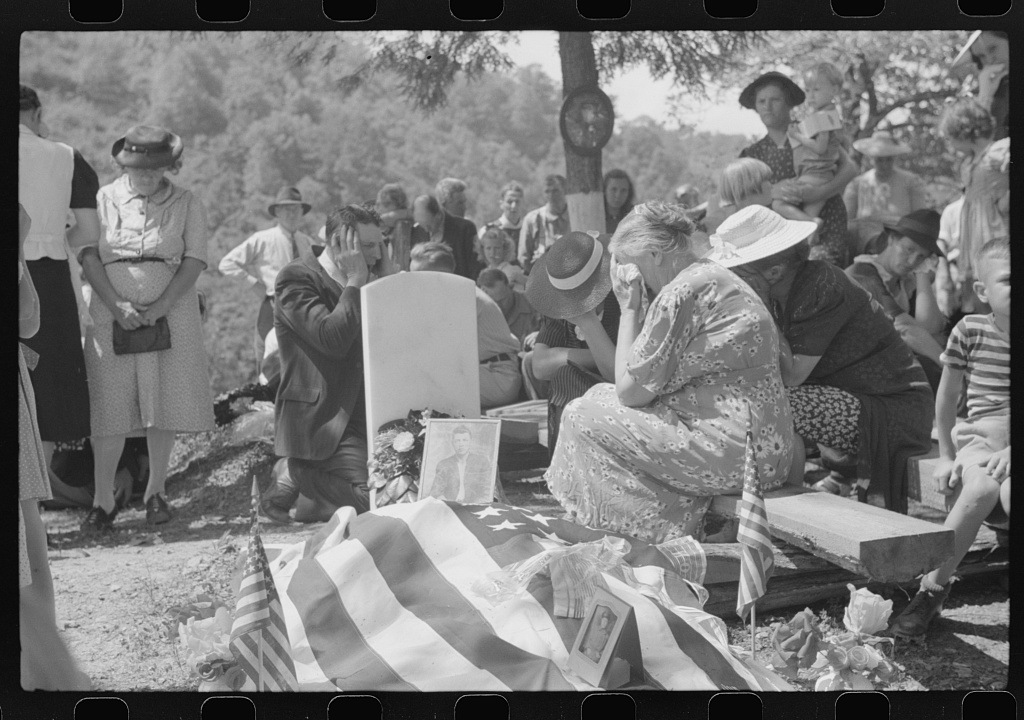
Here, with her captions, are some photos that Wolcott took of a memorial service such as the one she mentions in field notes for the previous shot.

{Mother and relatives weeping at the grave of deceased at memorial meeting. Preacher, with hands over ears, is praying. Near Jackson, Breathitt County, Kentucky, 1940 Aug.; source: Library of Congress}


{Friends of the deceased's family, at an annual memorial meeting in the family cemetery. In the mountains near Jackson, Kentucky, 1940 August; source: Library of Congress}


{Gravestones in a family cemetery where memorial meetings are held annually. In the mountains near Jackson, Kentucky, 1940 July-August; source: Library of Congress}


{Friends of the deceased's family, at an annual memorial meeting in the family cemetery. In the mountains near Jackson, Kentucky, 1940 Aug.?; source: Library of Congress}

And finally, here is another photo from her visit to Breathitt, Kentucky.

{Mountain girl riding home from school on muleback. Up South fork of the Kentucky River. Breathitt County, Kentucky, 1940 Sept.?; source: Library of Congress}

----------

This photo shows Wolcott in 1940.

{Photograph of Wolcott, "Up Stinking Creek, Pine Mountain, Kentucky," February 1940}

This one, taken in 1940, is on the wikipedia page for her.


This one by another of the FSA photographers shows her on a farm in Montgomery County, Maryland.

{Marion Post Wolcott with Rolleiflex and Speed Graphic in hand, by Arthur Rothstein, 1940 Jan.; source: Library of Congress}

This one was taken in New York in 1934 by Trude Fleischmann.


----------

Some sources — web sites:

Color photos in LC collection via Flickr

Marion Post Wolcott, New Deal Narratives, FSA photography, Juliet Gorman, May 2001, Oberlin College

Marion Post Wolcott

Marion Post Wolcott on Shorpy.com, which is "a vintage photo blog featuring thousands of high-definition images from the 1850s to 1950s. The site is named after Shorpy Higginbotham, a teenage coal miner who lived 100 years ago."

Oral history interview with Marion Post Wolcott conducted by Richard Doud at her home in Mill Valley, California, January 18, 1965.

The Photography of Marion Post Wolcott from the University of Virginia, edited by Linda Wolcott-Moore

Marion Post Wolcott Photography for the Farm Security Administration from the University of Virginia

Marion Post Wolcott - FSA photos Part 1 from the University of Virginia

Marion Post Wolcott - FSA photos Part 2 from the University of Virginia

Marion Post Wolcott - FSA photos Part 3 from the University of Virginia

Marion Post Wolcott Post FSA Photography from the University of Virginia

Marion Post Wolcott A biographical sketch by Linda Wolcott-Moore

This link takes you to photos of her and images of her photographs on Google: Marion Post Wolcott on Google Images.

-----------

Some sources — books:

Looking for the light: the hidden life and art of Marion Post Wolcott by Paul Hendrickson (New York: Knopf, 1992)

Marion Post Wolcott: a photographic journey by Jack Hurley (Albuquerque: University of New Mexico Press, 1989)

Marion Post Wolcott, FSA Photographs (Carmel, CA: Friends of Photography, 1983)

The photographs of Marion Post Wolcott (Washington, DC: Library of Congress in association with GILES, 2008)

Marion Post Wolcott: Farm Security Administration photographer in eastern Kentucky by Margaret Anna MacKichan (University of New Mexico, 1977)

Let us now praise famous women: women photographers for the U.S. government, 1935 to 1944: Esther Bubley, Marjory Collins, Pauline Ehrlich, Dorothea Lange, Martha McMillan Roberts, Marion Post Wolcott, Ann Rosener, Louise Rosskam by Andrea Fisher (National Museum of Photography, Film, and Television, Great Britain, Pandora Press, 1987)

The farm security administration photographs of Marion Post Wolcott: a cultural history by Julie M. Boddy (State University of New York at Buffalo, 1982)

---------

Notes:

[1] To see my FSA and FAP posts, click the FSA and FAP labels on the right-hand panel of this blog

[2] Curators in the Library of Congress Prints and Photographs Division have put together a useful web page on Women Photojournalists of twentieth century America.