Thursday, May 31, 2012

manners unfaulted

I recently finished reading Hilary Mantel's new book, Bring Up the Bodies, and I liked it, every page. She's a marvelous writer, so good that it's difficult to pin down what she's doing that's so much better than anyone else does. Putting her work into the "historical fiction" warehouse doesn't make sense; it isn't genre, it's simply literature.

My affection for the book comes partly from my interest in the lives of early modern Englishmen who did not receive a university education. I've been studying one of them, the mathematician John Collins, and Mantel's subject, Thomas Cromwell, is another. The lives of the two men were very different. Cromwell lived a full century and a half before Collins and achieved wealth and power as an able politician and chief minister to a king (Henry VIII). Collins attained neither wealth nor power. He was a clerk, teacher, author, accountant, and, on the side, an "Ingenious Obstetrix of the Press promoting the laudable Design of getting Learned Men to impart their Labours to be Printed; and exciting others to encourage the same, as being of singular Use and advantage to the Republick of Learning; through the want whereof many Learned Mens Works of much worth have been lost, suppressed or long delayed."[1]

Nonetheless they were in some ways similar. Both were born "of low estate," Cromwell as son of a blacksmith and small businessman and Collins as son of a poor clergyman who was barred from preaching in any church. Both left England while young and, while on the Continent, gained knowledge and skills that served them well on their return home. Both were largely self-taught, learning more by experience than education. On returning to England both attracted the notice of high-placed men and used these contacts to advance themselves. Both married only once and were devoted to their wives and families.

I don't mark up books I'm reading, or turn down corners -- none of that. But I do occasionally write out something -- a phrase, line, paragraph, or page -- that seems especially meaningful and this I chose to scribble into my Moleskine from Bring Up the Bodies. In it we see Cromwell's thoughts about his son:
Gregory is a good boy, though all the Latin he has learned, all the sonorous periods of the great authors, have rolled through his head and out again, like stones. Still, you think of Thomas More’s boy: offspring of a scholar all Europe admired, and poor young John can barely stumble through his Pater Noster. Gregory is a fine archer, a fine horseman, a shining star in the tilt yard, and his manners cannot be faulted. He speaks reverently to his superiors, not scuffling his feet or standing on one leg, and he is mild and polite with those below him. He knows how to bow to foreign diplomats in the manner of their own countries, sits at table without fidgeting or feeding spaniels, can neatly carve and joint any fowl if requested to serve his elders. He doesn't slouch around with his jacket off one shoulder, or look in windows to admire himself, or stare around in church, or interrupt old men, or finish their stories for them. If anyone sneezes, he says, “Christ help you!”
I was able to copy and paste this quote, rather than key it, because a reviewer chose to quote it as well. Writing in the New Yorker on May 7, James Wood uses the paragraph to show how Mantel uses a "cunning universalism" to link Cromwell with modern parents, indeed any parents, whose concern about their children leads them to catalog their strengths and weaknesses.

I did not see this aspect of the quote. For me it shows in glorious detail some of the main attributes of the "gently-" as against the "meanly-" born young men of early modern England. Cromwell and Collins were "of mean birth" and by their attainments came to be known as gentlemen. As adults they mastered the forms of address, techniques of polite conversation, and deportment sufficiently well to be accepted among the gently born. By contrast Cromwell's son Gregory, as Mantel presents him, was raised from childhood to be "courteous" in the original sense of the word.[2]

Spenser gives this sense of "courtesie" in the Faerie Queene.
Of Court, it seemes, men Courtesie doe call
For that it there most useth to abound :
And well beseemeth that in Prince's hall
That vertue should be plentifully found
Which of all goodly manners is the ground.
And roote of civill conversation.
-- Spenser, Faerie Queene, VI, i, i.
It's implied that Gregory knows how to behave in Court, that is the chambers where royals and nobles gather. He knows how to restrain any of his impulses which might be considered impolite, he shows deference to his betters, and possesses a confident demeanor which frees him from distasteful arrogance. His manners are easy and graceful. This ease and grace is the basis of what Spenser calls "civill conversation."[3]

Mantel puts most of Gregory's courtly achievements as negative virtues — bad habits he has had to overcome — and this is typical of the many books of polite manners that appeared in the centuries after the invention of the printing press. She and they take it as given that people are born with unsocial impulses which must be restrained if they are to get along well with each other. It's also implicit that those belonging to the courtly classes have advantages which others lack — chiefly wealth (or at least credit) and leisure. To them being industrious is not a virtue, and, although many of the gently born do work hard, they are encouraged not to make a show of it. Their leisure is not one of idleness, ideally, but their energy should be expended in sport (tilting or hunting) and social engagements (such as riding and dancing) rather than any effort that would appear busy.

Gregory is not literally "gently born." Writers of courtesy books divided pretty much evenly over those who equated gentility with good breeding and those who said it could be acquired as well as bred, but they all acknowledged that people were accepted as gentles either way. They also implicitly or explicitly accepted that this characterization — gently born — applied pretty much equally to all those who belonged in the upper classes, from the lowest of gentry through to the highest of nobles and royals. The gap between people of mean birth and those of gentle birth was, in this instance at any rate, more significant than the gap between a poor but well mannered landowner and a duke or earl. Men like Cromwell and Collins breached the first sort of gap, but they did not do so easily and their hold on their new status was tenuous. I suspect they hoped their sons would, as men, be able to accept gentility with unselfconscious ease.


{Cromwell by Holbein from the Frick Collection; source: wikipedia}

-----

Some sources:

The ideal of a gentleman; or, A mirror for gentlefolks, a portrayal in literature from the earliest times by Abram Smythe Palmer (Routledge; New York, Dutton)

"The English Gentleman," by Sir George Sitwell in The Ancestor, No. I (Westminster, April 1902)

Peacham's Comple'at Gentleman (1634), with an introduction by G. S. Gordon (Oxford, 1906)

Rhetoric and Courtliness in Early Modern Literature by Jennifer Richards (Cambridge, Cambridge University Press, 2003)

From Civilitas to Civility: Codes of Manners in Medieval and Early Modern England by John Gillingham, Transactions of the Royal Historical Society, Sixth Series, Vol. 12 (2002), pp. 267-289. Stable URL: http://www.jstor.org/stable/3679348.

Invitation to a Beheading, The Thomas Cromwell novels of Hilary Mantel, a review by James Wood in The New Yorker, May 7, 2012.

-----

Notes:

[1] ... -- The sphere of Marcus Manilius [by Marcus Manilius], made an English poem with annotations and an astronomical appendix by Edward Sherburne, squire (1675).

Sherburne says:
We should be injurious to him, if we did not farther inlarge, by telling the World how much it is obliged for his Pains in exciting the Learned to publish their Works, and in acting the Part of an Ingenious Obstetrix at the Press, in correcting and in drawing of Schemes; So that he hath been Instrumental in furnishing the World with the many learned Mathematical Books here lately published (for which, his chief Reward hitherto hath been to obtain from the Learned the Title of Mersennus Anglicanus) and many more may be expected, if moderate Encouragements towards Printing such Works, and Leisure for such an Affair be not impeded through the necessary Avocations for a livelyhood, and though it be besides my Design, yet I cannot but digress in giving him and others like minded (which are very rare to be found) their due commendations, in promoting the laudable Design of getting Learned Men to impart their Labours to be Printed; and exciting others to encourage the same, as being of singular Use and advantage to the Republick of Learning; through the want whereof many Learned Mens Works of much worth have been lost, suppressed or long delayed.

a Barnabas among those mathematical apostles, his tact and
devotion in calming the headstrong and drawing out the reticent
being above all praise.

[2] "Courteous" comes from the 14th-century French word curteis and it then meant "having courtly bearing or manners." The phrases I put in quotes were common in early modern England. In the 16th and 17th centuries a literature, quite a large literature, grew up giving instructions on courtesy.

[3] As one source says, Spenser took the term "civill conversation" from an Italian work of 1574 in which gentles are shown as harmoniously intermingling with an unselfconscious grace. (The Spenser Encyclopedia by Albert Charles Hamilton (Taylor & Francis, 1990)).

Tuesday, May 08, 2012

Defender

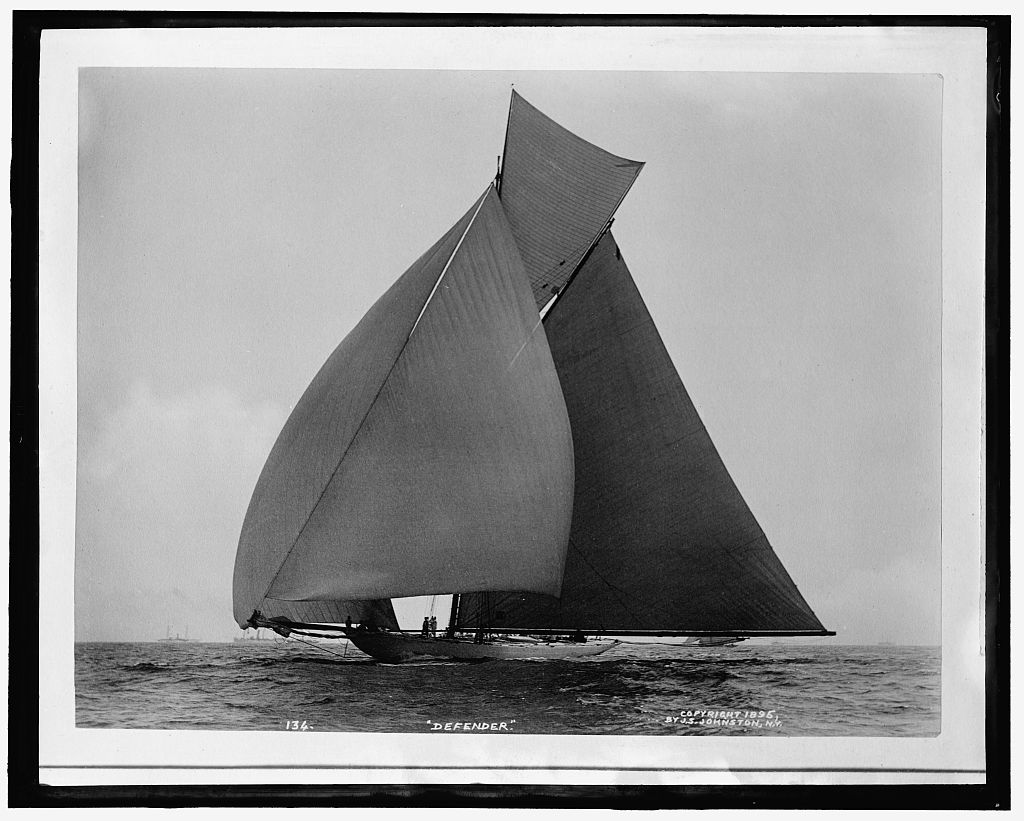
I found this image on a favorite tumblelog and I subsequently used it in a tumblr post of my own.[1]


It shows the yacht Defender and it can be found in the Detroit Publishing Company Collection of LC's Prints and Photographs Division.[2] The photographer, John S. Johnston, did a whole series on the Defender.

The caption gives the year (1895) but does not give the month or day. It does have "134" written on it and a nearby photo, number 132, shows the Defender on August 2, 1895, competing in the Goelet Cup so it's pretty near certain our photo was taken during the same race.

The yacht belonged to William Kissam Vanderbilt.[3] He was a cousin of Louis Windmuller's wife, Annie.[4] Windmuller didn't go in for yacht racing. His recreations were urban and close to home. He belonged to city clubs and supported city charities. An immigrant from Germany who never lost his German connections, he loved the city's German singing clubs and beer gardens. He was also a famous city walker and one of his last acts was to form a club of walkers. He traveled much for business, but also for pleasure, chiefly to Germany, France, England, and Italy.

Louis Windmuller had arrived in New York penniless and worked his way up to a comfortable prosperity. William Kissam Vanderbilt was born to wealthy parents and was never forced to earn a living. He did work as a manager of the family railroads but as someone learning the family business rather than in the entrepreneurial spirit of his grand- and my great-grandfather.[5] The differences between the two men were many, but the most obvious, I think, was in their choice of recreation. Where Windmuller walked, W.K.V. raced. He raced horses and he raced yachts. He founded New York's Jockey Club, owned both stables and race courses, and ran horses that won. And he was co-owner of the yacht defender.

Windmuller and his wife Annie saw only two of their six children survive to adulthood: a son and a daughter. Neither possessed the energy, cheerful optimism, and tempered ambition of their father. The son, Adolph, made a half-hearted effort to manage one of his father's enterprises (the importing firm which was Windmuller's first success) but did not stick with it and lived most of his life as a man of leisure.[6] My father, his nephew, called him a n'er do well. The daughter, Clara, was not expected to earn a living and, unlike others among her contemporaries in upper-middle-class New York, she did not attempt to make a name for herself by charity work, cultural contributions, agitation for reform, or even any sort of active participation in New York society.[7]

Somewhat late in life, Clara married a man who worked for her father. He, Julius, was a distant relative who had come from Germany with the expectation that Windmuller would put him to work. After serving in a clerical position in an organization of which Windmuller was treasurer he was, in the year following his marriage to Clara, appointed secretary-treasurer of a bank that Windmuller had helped to found and of which he was president.[8] In 1913, when his father in law died, the will was found to be not so generous to him as it was to Adolph and Julius consequently labored in the bank for the rest of his working life, eventually rising to be its manager. Once he found himself secure in his employment, he put in his bankers' hours, married his benefactor's daughter, fathered a family of four, let himself be caught with a girlfriend in the conjugal bed, and indulged in a passion for boating. The last two were actually related since he had the habit of inviting women to cruise with him from time to time.

This photo shows Julius and Clara shipboard during the first (happy) years of their marriage.

The year is 1902 or '03. He is 34 and she two years younger.

Julius was a power boat enthusiast so this photo — taken at about the same time — shows Clara on someone else's ship.


From about 1900 to about 1942 Julius owned maybe half a dozen craft, each 30- to 40 feet long, with paid skipper and crew. At the bank they called him "Commodore" (as, in similar manner, underlings had given Cornelius Vanderbilt that title) and he belonged to a number of yacht clubs including the Colonial, uptown on the Hudson near his home on Riverside Drive, and the Harlem on City Island.[9] My father once took me to the latter. The club house was rustic and in my memory its chief feature was a monumental pool table near windows overlooking the moorings.

This shows a diving demonstration at the Colonial Yacht Club in 1914 or 1915.

{Caption: Famous diver Elsie Hanneman at the Colonial Yacht Club; photo by the Bain News Service; the club was located on the small beach just below Riverside Drive on the Hudson River, roughly between 140th and 142nd Streets in Harlem; source: Library of Congress Prints and Photographs Division}

Taken at about the same time, this photo shows canoe jousting, the club, and some of the city in the background.

{Caption: Canoe Tilting at the Colonial Yacht Club, by the Bain News Service; same source }

This shows the Harlem Yacht Club in 1906. I recollect it looked much the same in the late 1950s when my father took me there.

{Caption: Harlem Yacht Club, City Island, N.Y. by the W. F. Sleight Post Card Co., Mount Vernon, N.Y., 1906; source: Long Island Historic Postcards Collection (collection 346), Special Collections and University Archives, Stony Brook University Libraries}

----------

Some sources:

The Yacht Photography of J.S. Johnston - Defender

Defender - 32nd America's Cup

Goelet Cup, New York Times, August 6, 1887

DEFENDER BREAKS DOWN; Snapped a Hollow Gaff in Goelet Cup Races, New York Times, August 2, 1895

THE GOELET CUP, New York Times, August 3, 1895

William Kissam Vanderbilt on wikipedia

"Newly-elected officers of the Colonial Y. C." in The Rudder, Volume 35 (Fawcett Publications, 1919)

Harlem Yacht Club By Evelyn Schneider, Harlem Yacht Club historian, as published in the July 2008 issue of Wind Check

Century of American savings banks, pub. under the auspices of the Savings banks association of the state of New York in commemoration of the centenary of savings banks in America (New York : B. F. Buck & company, 1917)


----------

Notes:

[1] The favorite Tumblr blog is Chemin faisant by Catherine Willis and my own is rouleur.

[2] Prints and Photographs Division of the Library of Congress

[3] W.K. Vanderbilt was co-owner.

[4] Annie and W.K. were niece and nephew-once-removed, respectively, of John Edmund Thorne. W.K.'s father, also W.K., was son of J.E.T.'s brother-in-law, Samuel Kissam. Annie was daughter of J.E.T.'s sister, Sarah Lenington Thorne. If you've patience, you can trace the connection in these genealogies: Descendants of William Thorne & Susannah Booth and Windmuller Genealogy. I've written fequently about my great-grandfather. To see posts about him, click the "Louis Windmuller" link in the list of labels in the panel at right.

[5] Up until 1903 William Kissam Vanderbilt was active in the management of the family railroads, including the New York Central. His grandfather Cornelius had owned that business and, it doesn't surprise me to find that Louis Windmuller was a shareholder. Cornelius and Louis were different in many ways, but both were energetic businessmen and managers of financial affairs. In 1865 Windmuller joined other prominent New Yorkers in petitioning the state government for relief from Civil War regulations that kept rail fares and tariffs artificially low (Evening Journal, New York, March 21, 1865). In addition to the names of Cornelius and my great-grandfather, the petition showed those of William Astor, Henry Sloane, and other prominent merchants and financiers.

[6] Louis Windmuller's first successful business was "Louis Windmuller and Roelker, commissioning agents." I've written a few posts dealing with its affairs. [7] My blog post on the wives of the forty-eighters gives some idea of what determined women could accomplish at the time. It is four notable German-American women. Even within her narrow community Annie was outshined by her close neighbors the Sussdorfs whose womenfolk founded a local Sunday school and provided support for the church to which they and the Windmullers belonged. Regarding the social whirl, the Windmuller family does appear in the Social Register but the only Windmuller parties you'll find in the newspapers of the time are privately family ones and the Windmullers are never seen out coaching or at Newport or even in connection with their socially-prominent daughter in law, Adolph's wife Carolyn Hague, known as Madam Thurn.

[8] In 1901 Windmuller made Julius secretary in the Legal Aid Society, which he had helped to found and of which he was treasurer. In 1903 Windmuller helped found the Maiden Lane Bank for Savings in the building where he had previously helped found the Maiden Lane Safe Deposit Company. Here are excerpts from an article about the bank.
At the time of the establishment of the Maiden Lane Savings Bank — 1903, under the General Banking Law — it was estimated that there were about 150,000 clerks and workingmen employed in the Jewelry District, who were all earning good wages and of whom at least 25 per cent. were living either in New Jersey or on Long Island and did not have the time to make deposits in the banks in the neighborhood where they lived. In order to give these people proper facilities for depositing their surplus earn-ings without inconvenience, it was proposed to establish a new Savings Bank in that section of the city and to keep it open for receiving deposits from 9 o'clock in the morning until 5:30 in the evening, Saturdays included. It was proposed to locate the bank in the basement of the building at the corner of Maiden Lane and Broadway, where the Maiden Lane Safe Deposit Company had their premises. ... The board of directors of the Maiden Lane Safe Deposit Company was approached with the proposition to rent space in their premises and the proposition was met in a liberal manner. ... The rapid increase in deposits is ample proof that a Savings Bank was needed in the down-town section of the Borough of Manhattan. ... First officers: Louis Windmiiller, president; J. Heynen, secretary-treasurer. -- Century of American savings banks, pub. under the auspices of the Savings banks association of the state of New York in commemoration of the centenary of savings banks in America (New York : B. F. Buck & company, 1917)

[9] In 1919 Julius was elected to the board of directors of the Colonial. SeeThe Rudder, Volume 35 (Fawcett Publications, 1919).

Wednesday, May 02, 2012

West Twenty-Third east from Sixth

I've written quite a few posts about the area where Broadway and Fifth Avenue come together in New York City. Their topics were the Flatiron Building, which dominates that intersection; Madison Square Park, which adjoins it; and locations in the vicinity that were associated with my great-grandfather, Louis Windmuller.*

I've also done some posts about the block of 23rd Street that lies between Fifth and Sixth Avenues at this location. They are 23rd St., New York Newsstand, 1903, and Eden Musee, a major attraction at mid-block.

Those posts give lots of views of the area. Here are just a couple more. They were taken at the same general time and from same general place as the one in the first of the three posts listed above, and they can be found in collections of the Prints and Photographs Division of the Library of Congress.


{Caption: West Twenty-third Street from Sixth Avenue, New York, N.Y. by the Detroit Publishing Co., ca. 1908}

Details of this image:

1. We're looking at the south side of the block. The photographer has positioned himself at the foot of the stairs to the elevated railway at 6th Avenue and 23rd. He's facing east. As you see, it's late in the afternoon on a warm but overcast day. The Flatiron Building dominates the skyline, but its the department stores, shops, and most of all the bustle of the street which attracts the eye.


2. This is the north side of the block with Eden Musee, F.A.O. Schwarz toys, and the Fifth Avenue Hotel dominating the scene.


3. Best & Co., the famous women's shop, then marketed itself as the Lilliputian Bazaar. Notice that the large plate glass windows reflect the buildings opposite.


4. You can see the reflections more clearly here.


5. A display of women's fashions on the second floor. The shop is Best & Co.'s neighbor, Bonwit Teller.


The negative of this second photo is getting moldy, but most of it is still in good shape. The photographer seems to be standing on the top of a hansom cab (horse's head just visible at bottom).

{Caption: West Twenty-third Street, New York, N.Y. by Detroit Publishing Co., ca. 1908}

Details:

1. The Eden Musee again. I did a blog post about this place, whose board of directors had Louis Windmuller as a member.


2. You see that it's about 1:16 PM, so this photo was made earlier in the day, possibly the very same hazy day as the first photo.


3. Here again the glass reflects the scene across the street. The gent with the light colored top hat is a bit more dapper than the others. The women almost seem to be in uniform.


4. Seen more closely, the gent appears to be looking directly at the photographer.


5. This shows two women who are out of uniform, one all in black, the other in a light dress instead of skirt and shirtwaist.


-----------

Note:

* See for example:

Saturday, March 31, 2012

the hump

Freight yards like Chicago & North Western's at Proviso contain hundreds of parallel tracks. These permit arriving trains to be broken up so that individual cars can be grouped by their destinations. Some freight trains — such as those which carry coal from mines to power plants — can remain intact throughout their journey. However most contain isolated cars that are only generally headed in the right direction. These have to be reassembled one or more times along their route as they draw closer to the yards where they will be unloaded. This reassembly is accomplished by shunting cars on the parallel tracks in yards like the one at Proviso.

The shunting takes place in classification yards. The aerial photo I showed the other day gives an idea of the shape and extent of the C&NW yards circa 1940. This is a detail from that image in which you can see the track layout.
.
{Detail from photos of the 1938-1941 Aerial Survey of Illinois; source:
Illinois Aerial Photos.[1]}

This photo shows portions of two of the C&NW's "ladders" — the sets of parallel tracks into which cars would be shunted. As in my previous post, it was taken for the Office of War Information by staff photographer Jack Delano and is found in collections of the Prints and Photographs Division, Library of Congress. Notice that, as you'd expect, each pair of tracks splits from a main feeder and each has its own switch. The feeder is called a lead or drill.

{Caption: General view of one of the Chicago and Northwestern railroad classification yards, Chicago, Ill. December 1942}

This shows a switchman in the act of shunting some cars. Delano took this in April 1943.[2]

{Caption: Switchman throwing a switch at C&NW RR's Proviso yard, Chicago, Ill. 1942 Dec.}

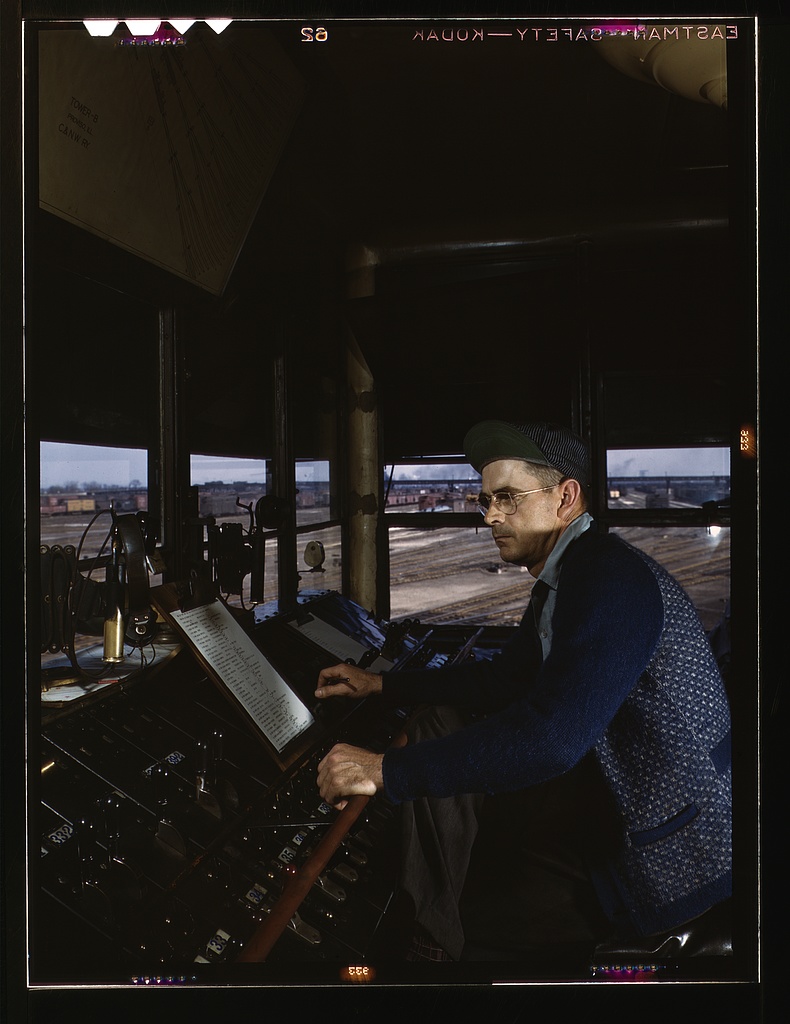
The C&NW yards received lists via teletype showing the makeup of arriving trains and the destinations of their cars. These switch lists enabled workers such as the one shown below to map out the distribution of cars in the classification yards. The mapping is a lot easier to explain than it was to carry out in a place the size of proviso with its hundreds of switches.[3]

{Caption: Switch lists coming in by teletype to the hump office at a Chicago and Northwestern railroad yard, Chicago, Ill. 1942 Dec. }

Cars would be pushed around the yards by shunt engines and in large facilities like the one at Proviso they might also be fed to the ladders by gravity. Locomotives would push a train up a gentle incline, called a hump, and the cars would be released to roll down the lead toward the switches.

This photo shows one of the humps at the C&NW yards. A tank car has just been uncoupled and is making its way down the hump toward the ladders.

{Caption: General view of one of the yards of the Chicago and Northwestern railroad, Chicago, Ill. 1942 Dec.}

This shows a shunt engine working on a lead. You can see two towers where towermen controlled the flow of cars from the hump down the lead and into the ladders.

{General view of the hump, Chicago and Northwestern railroad classification yard, Chicago, Ill. 1942 Dec.}

In this view of the same set of ladders you can see the downslope from the hump at the foot of the foreground tower.

{General view of the hump yard at Proviso yard, C&NW RR., Chicago, Ill. 1942 Dec.}

The caption explains this photo. The hump track to which it refers is continued by the lead or drill.

{Hump master in a Chicago and Northwestern railroad yard operating a signal switch system which extends the length of the hump track. He is thus able to control movements of locomotives pushing the train over the hump from his post at the hump office; Chicago, Ill. 1942 Dec.}

There were devices called retarders on the lead tracks. These were electrically controlled and could be used to slow down cars as they descended from the hump. Switches could also be electrically operated. This towerman is shown at the retarder and switch controls.[4]

{C&NWRR, towerman R.W. Mayberry of Elmhurst, Ill., at the Proviso yard. He operates a set of retarders and switches at the hump, Melrose Park (near Chicago), Ill. 1943 May}

I think Delano took this shot from one of the towers.

{Caption: General view of one of the yards of the Chicago and Northwestern railroad, Chicago, Ill. 1942, Dec.}

------

Some sources:

"Combination Through Classification and Terminal Yard" by W.C. Copley in Railway age Vol. 58 (Simmons-Boardman Publishing Corp., 1915)

Classification yard on wikipedia

Retarder on wikipedia

Switcher on wikipedia

Shunt (rail) on wikipedia

Train shunting puzzles on wikipedia

-----

Notes:

[1] This larger detail shows the complex interconnection of the classification yards the Proviso facility. Click to view full size.


[2] Jack Delano took all the images on this page on assignment from OWI in December 1942 and April 1943 and all are from collections of the Library of Congress.

[3] Railroaders have train shunting puzzles which are games that challenge players to break up and reassemble trains (called consists) with a minimum of de-couplings and couplings.

[4] This view of a classification yard (not C&NW) shows retarders on the leads just before the ladders. I've marked two of them with yellow circles.

Friday, March 30, 2012

Proviso Yards, December, 1942

After the US entered the Second World War, the government set up a domestic propaganda operation called the Office of War Information to help rally citizens as the country geared up for the fight. Isolationism had been a strong force in the 1930s and the America Firsters argued against intervention even after war broke out on the European continent. The OWI helped neutralize opposition once the US entered the war. Despite its importance this has to have been one of the mildest forms of propaganda conducted by a state at war. One of its principal tools was documentary photography and its photographs did not preach but simply put on display a view of America's industrial might and of the people whose labor was one of its chief resources.

This gentle approach had been learned in the 1930s when an agency called the Farm Security Administration was used photographic images to convince people that the miseries caused by the Great Depression — great as they were — could be first mitigated and finally overcome by the strengthening of the agricultural (and in due course industrial) economy. The result was what has to have been the most aesthetically potent propaganda campaigns of all time. I've written about this before. Click the FSA label in the panel at right to see these blog posts. The Prints and Photographs Division of the Library of Congress, which holds most of these photos, has collected some of them here.

When the US declared war on the Axis Powers the FSA photography unit was merged into the new Office of War Information and the emphasis of the group's documentary output shifted from Depression to war mobilization. I've shown quite a few OWI photos in previous posts. To see them, click the OWI label at right.

War mobilization meant that factories which had been making products for domestic consumption switched over to production of war materiel.[1] The OWI photos show American workers making ships, planes, bombs, and all the other implements of war — large numbers of them being women doing jobs to free men for the armed services.[2]

War mobilization also meant that the volume of traffic on the nation's transportation systems shot upward. And no traffic grew more than that of the railroads. As this graph shows, the numbers of miles of freight and passenger transportation by rail decreased substantially during the Depression years and then shot upwards to levels that have never since been equalled.

{Caption: source: Economic Results of Diesel Electric Motive Power. On the Railways of the United States of America (pdf) by H.F. Brown for the Institution of Mechanical Engineers (London, 1960)}

The war years of the 1940s were the glory years of US rail service and Jack Delano, one of OWI's documentary photographers, took pains to show its strength. Here are some photos from one shoot, made at the rail yards of the Chicago and North Western Transportation Company in December 1942.[3]

In this one Delano shows both the great size of the yards and the volume of freight they handled.

{Caption: View of a classification yard at C & NW RR's Proviso yard, Chicago, Ill.}

In this detail notice the man on top of a freight car as well as the one at the rail switch.


Here you see a trainman walking toward the location where Delano is positioned. You can tell that Delano is standing on an overpass because of the dangling warning cords hung over the tracks above the man's head.


This photo shows an overpass such as the one on which Delano was standing to take the previous one. You can tell that the shoot carried over enough days so that some shots show snow on the ground and some do not.

{Caption: A general view of a classification yard at C & NW RR's Proviso yard, Chicago, Ill.}

I've stitched together details from two aerial photos of the Proviso Yards to show something of their scale. Click the image to view full size. The photos were taken a year or so before Delano did his shoot there.

{Details from photos of the 1938-1941 Aerial Survey of Illinois; source:
Illinois Aerial Photos}

This detail shows where Delano was standing to take the second of the two images of the yard. I can't see a tower there but suppose there is one and that he's on it.


Delano's photos of the freight yards don't show many workers and it's apparent that this vast system required very few people to operate it. Here is the man who had main responsibility for the operation along with an assistant or maybe just a man on break.

{Caption: The yardmaster's office at the receiving yard, North Proviso(?), C & NW RR, Chicago, Ill.}

The Yardmaster


Assistant or man on break.


Another detail from this photo.


And another.


And one final one.


Here are a couple of freight engines moving what is probably a long train of hopper cars.

{Caption: Locomotive in a railroad yard, Chicago and Northwestern RR, near Chicago, Ill.}

Unlike the freight yards, the service areas show a fairly high concentration of men at work. Here are locomotives receiving some maintenance.

{Caption: Locomotives over the ash pit at the roundhouse and coaling station at the Chicago and Northwestern Railroad yards, Chicago, Ill.}

The captions of these photos explain their subjects.

{Caption: Chicago and Northwestern railroad locomotive shops, Chicago, Ill.}


{Caption: Worn tires on locomotive wheels are refaced on this machine in the wheel shop of the Chicago and Northwestern Railroad, Chicago, Ill.}


{Caption: Working on the boiler of a locomotive at the 40th Street shops of the C & NW RR, Chicago, Ill.}


{Caption: Working on a locomotive at the 40th Street shop of the C & NW RR, Chicago, Ill.}


{Caption: A young worker at the C & NW RR 40th Street shops, Chicago, Ill.}


{Caption: Greasing a locomotive at the 40th Street shops of the C & NW RR.}


{Caption: Locomotive lubrication chart in the laboratory of the Chicago and Northwestern Railroad. The laboratory assistant in foreground is working at a precision balance. Chicago, Ill}

-----

Some sources:

Selected Bibliography and Related Web Sites about the FSA and OWI from the Library of Congress

Jack Delano, a brief biography from the Museum of Contemporary Photography

Oral history interview with Jack and Irene Delano, 1965 June 12 from the Smithsonian Institution

The Farm Security Administration page at the Library of Congress

Chicago and North Western Transportation Company on wikipedia

Chicago & North Western Historical Society

Links from the Chicago & North Western Historical Society

Chicago & North Western - A Capsule History

----

Notes:

[1] My blog post on Fox Conner touches on this. The factory he ran switched from making "porous plasters" to alleviate back pain to making bullet-proof liners for the fuel tanks of airplanes and military tanks.

[2] See for example these photos by OWI's Ann Rosener taken in 1943 at a California shipyard.

[3] All the photos come from the Prints and Photos Div of the Library of Congress.