Tuesday, September 11, 2012

summer arts & crafts

This photo is called "Fair Bros. play ground." An anonymous employee of the National Photo Company took it in the summer of 1922.


{Caption: Fair Bros. play ground; date Created/Published: [1922]; medium: 1 negative : glass ; 4 x 5 in. or smaller; source: Prints and Photographs Collections, Library of Congress. I saw this first on Shorpy}

There's whole lots in this photo to like (click here to view full size). First off, the eyes. You expect eyes in group shots but not so many expressive pairs of them. Next the poses. This is not a Kodak snap but professional work on glass neg. within bellows camera on tripod. Someone grouped the kids and kept them more or less in place while the photog did his laborious best to make an enduring image. Yet it feels, and quite clearly is, spontaneous. No one's nervous about the ungainly apparatus they're fronting; some a few are curious, one's coy, the rest can't be bothered to give it notice. Then there're the swingers. Catching them as he did the camera man achieved something remarkable. This is not easy to do with a cumbersome, sheet negative, view camera. He surely had a lens shutter but with sensitized plate and lens both inevitably slow, the catching of the swingers to freeze motion is remarkably ept, and doing so artistically is much more so. The framing seems banal until you notice that the right swinger is almost entirely out of view. That plus the structures at right lead the eye off the image and you hardly notice that there's also an off frame mysterious something at left as well. And the compositional reference to Da Vinci's Last Supper is certainly unconscious — accidental — but not too subtly present all the same. You can tell by the light that it's noon but not so bright a day that shadows are harsh. The light suffuses the shot nicely modeling the faces. There's lots more to see. Each child is shown to have her or his own personality; none uninteresting. We're in Washington DC and it's 1922. Many of these kids would have black playmates but there would be segregation of races in schools, businesses, and public places like this park and its summer program. Still, it's not like the families of these kids are many notches higher in the ranking of social classes than their black neighbors. The playground is hardscrabble. The boys are mostly barefoot. Nobody's in tatters but there are none of the sailor outfits that uppers put their kids into. I don't know anything about the actual location and the internets are not helpful. What is the "Fair Bros. play ground"? What do you see here? A bit more than a quarter of a century later I could be found in a group like this, 'tho with trees and grass and some tennis courts and a pool as well as the swing set. And we did gimp projects rather than yarn boards. But my feet were bare, the group was mixed ages and sexes as here, and the counselors were not that much older than the participants.

Thursday, September 06, 2012

not so much inclined towards the cultivation of the earth

My friend Mitch prepared a well-researched and -written article for a blog called "Unique at penn" (the classy lower case p is theirs, not my typing error). In it he gives a careful description of a manuscript map of 1793 showing the route from Philadelphia to the site of a treaty negotiation with leaders of the Miami Indians near Sandusky, Ohio.

His nice analysis called to mind another document related to the dealings of the new U.S. Government with the Miami's chiefs. A decade after the year the map was made two chiefs wrote the following letter to members of the Baltimore Yearly Meeting of the Society of Friends. From a time just after the making of the map the Meeting had been trying, with little success, to help the Miami survive. After U.S. forces had defeated the Indians and taken most of their hunting lands the Miami chiefs came to believe that survival depended on a cultural transformation: learning to farm and becoming a settled agricultural community. They saw the plight of the young men, defeated in battle and no long able to spend their days hunting, becoming dispirited and succumbing to alcoholism, and they saw the tribes weakened and suceptible to disease. When the Baltimore Yearly Meeting offered help, they readily accepted. The Quakers sent farming tools, put pressure on the government to outlaw sale of liquor to the Indians, and went out to Ohio to teach and advise. The letter tells how little this effort succeeded:
The Little Turtle's Town, Sept. 18th, 1803. - From the Little Turtle, The Five Medals, and others, to Evan Thomas, George Ellicott, and others.

Brother's and Friends of our hearts, — We have received your speech from the hand of our friend, Wm. Wells, with the implements of husbandry, that you were so kind to send to his care, — all in good order.

Brothers, it is our wish that the Great Spirit will enable you to render to your Red Brethren that service which you appear to be so desirous of doing them, and which their women and children are so much in need of.

Brothers, we will try to use the articles you have sent us, and if we should want more, we will let you know it.

Brothers, we are sorry to say that the minds of our people are not so much inclined towards the cultivation of the earth as we could wish them.

Brothers, our Father, the President of the United States, has prevented our traders from selling liquor to our people, which is the best thing he could do for his Red Children.

Brothers, our people appear dissatisfied, because our traders do not, as usual, bring them liquor, and, we believe, will request our Father to let the traders bring them liquor, and if he does, your Red Brethren are all lost forever.

Brothers, you will see, from what we have said, that our prospects are bad at present, though we hope the Great Spirit will change the minds of our people, and tell them it will be better for them to cultivate the earth than to drink whiskey.

Brothers, we hope the Great Spirit will permit some of you to come and see us, — when you will be able to know whether you can do anything for us or not.

Brothers, we delivered you the sentiments of our hearts, when we spoke to you at Baltimore, and shall say nothing more to you at present. We now take you by the hand, and thank you for the articles you were so kind to send us.

Signed,

The Little Turtle, Miami Chief,
The Five Medals, Potowatamy Chief
-----

Little Turtle, Gerard T. Hopkins, and the Baltimore Yearly Meeting

In 1795 the Baltimore Yearly Meeting had appointed Indian Committees to consider how best to help the Miami. When in 1797 Chief Little Turtle came to Philadelphia to meet President Washington the Friends invited him to come address the Yearly Meeting. The Quakers then sent tools and instructors to the tribes and used their influence to have the sale of liquor banned.

In 1804 a merchant named Gerard T. Hopkins, uncle and benefactor of the famous Johns Hopkins) documented the Quakers efforts to help the Miami tribes. His diary and letters were latter collected into a book published in a book called A mission to the Indians, from the Indian committee of Baltimore Yearly Meeting, to Fort Wayne (cited below).

Little Turtle, with miniature of George Washington on neck band.

{Source: Chicago Historical Society}

Little Turtle's name and mark (one up from the bottom) on the
Treaty of Fort Greenville, August 1795, signed by chiefs of the Ohio tribes after defeat by General Wayne at the Battle of Fallen Timbers.

{National Archives and Records Administration (U.S.)}

------

Some sources:

Preparing for a Treaty at the Early War Department by Mitch Fraas, Wednesday, September 5, 2012

A mission to the Indians, from the Indian committee of Baltimore Yearly Meeting, to Fort Wayne, in 18O4
by Gerard T. Hopkins, Baltimore Yearly Meeting of the Religious Society of Friends, edited by Martha Ellicott Tyson (Philadelphia, T. Ellwood Zell, 1862)

A Quaker pilgrimage: being a mission to the Indians from the Indian Committee of the Baltimore Yearly Meeting to Fort Wayne, 1804, edited by Alene Godfrey, prepared by the staff of the Public Library of Fort Wayne and Allen County, 1959

Historical Narratives of Early Canada
Extract:
When an important peace parley failed American commissioners sent the following coded message to a waiting general."We did not effect peace." The general translated this into "Begin vigorous offensive action." The offensive action occurred at a place called Fallen Timbers on August 20th 1794. The army of Brigadier General Anthony Wayne, the Natives' nemesis, met and defeated a large force of western Natives. The Miami chief, Little Turtle, was a fierce opponent of the Americans but by the time of this battle he advocated peace.

Subsequent to this defeat some 110 chiefs and warriors signed the Treaty of Fort Greenville in August 1795. By this treaty, the most important in the history of the United States, the sachems and War Chiefs gave away 25,000 square miles which today includes most of present-day Ohio, part of Indiana and the sites of Detroit, Chicago and a number of other mid-western cities for a measely 25,000 dollars in trade goods - calico shirts, farm tools, trade hatchets, ribbons, combs, mirrors and blankets and an annuity of $9500 to be divided among the tribes. It was a humiliating settlement for the payments represented a mere pittance with some tribes receiving as little as $500 a year. Few could challenge its terms, however, for when Wayne destroyed their fields, most of the destitute Natives became dependent on the United States for food. The situation and the ceremony were mocked. When a calumet or peace pipe was smoked by the parties to finalize the terms of the treaty, the ceremony was ridiculed by one American negotiator as "a tedious routine."
Battle of Fallen Timbers on Ohio History Central

Little Turtle, Chief of the Miami, prepared by the staff of the Public Library of Fort Wayne and Allen County, published 1954 by The Library in [Fort Wayne, Ind.]

Quaker Agriculture missions to the Miami in wikipedia

Johns Hopkins in wikipedia

Battle of Fallen Timbers in wikipedia

Tuesday, July 24, 2012

Stalingrad

The battles that took place in Western Russia and the Ukraine during 1941 and 1942 are easy to summarize but difficult to comprehend. On June 22, 1941, Germany broke its treaty with the Soviet Union and, in the largest attack ever made by one country on another, began a blitzkrieg on the entire western border from the Baltic to the Black Sea. Soviet intelligence knew that the attack would come but Stalin refused to believe his own (excellent) sources as to its timing. As a result the Soviet command did not concentrate its forces so as to delay and possibly arrest the lightening advance. By the time he came to realize the speed, extent, and targets of the German attack, huge amounts of Soviet military hardware and more than a million military personnel had been killed, wounded, or captured.[1]

It's believed that Stalin made a second major blunder at this time in issuing orders that essentially said soldiers must fight to the death without giving ground and this policy increased the Germans' ability to cut off and surround Soviet armies.

Nonetheless, by the time the Germans reached Moscow the thick and sticky mud of the Russian autumn slowed their advance to a halt and, learning from intelligences sources that the Japanese did not plan to attack from the east, Soviet military leaders were able to move armies from places like Siberia to the front lines in the west.

In the summer of 1942 Stalin made yet another mistake, not realizing that the Panzer strikes in the south were aimed at obtaining the oil fields in the Caucasus near Stalingrad. At this point Hitler committed the same sort of ego-driven error that Stalin had been making. German armies could have by-passed Stalingrad and pushed on into the Caucasus, but, when a bottleneck developed slowing movement southward, he directed that the 4th Panzer Army be diverted to attack Stalingrad.

The result of this pair of mistakes was the Battle of Stalingrad. Hitler ordered that the city be taken and Stalin ordered that it be held at all costs. In this fight to the death the Soviet side prevailed. The Germans had great advantage in armor, air coverage, and field discipline, but these were of little value in the house-to-house, floor-to-floor, room-to-room fighting in the city. In that environment, the superior numbers of the Soviet forces, their skill in face-to-face combat, their endurance under impossible conditions, and the determination of great numbers of them to defend to the death gave them a superiority they'd previously lacked.

The battle was horrific, devastating in the most literal sense. One author calls it "the greatest and most hideous ... conflict in history." And many consider it to be decisive. The failure of the Germans to take Moscow had been a symbolic victory that did not lead to the repulse of attacks elsewhere, but the fanatic struggle for Stalingrad led to the first Soviet victories in counter attacks that cut off the 4th Panzer Army and eliminated it as a fighting force.[2]

That's my summary, but it's not my main topic.

I'm currently reading Vasily Grossman's A Writer at War: A Soviet Journalist with the Red Army, 1941-1945 (Pantheon, 2007)

Grossman was a novelist who volunteered to serve as a war correspondent. In that role he covered action throughout the Soviet defeats and withdrawals up to and including the Battle for Moscow and then covered all of the fighting in Stalingrad and the subsequent crushing of German forces from the Caucasus to Berlin between 1943 and 1945.

A Moscow intellectual, non-Party member and Jew, he was an unlikely battle journalist, but his work was superb and he became one of the best known and most highly regarded of all the newsmen covering the war.

He knew that all news accounts must serve the interests of the Party and its leader, Stalin. And he knew the lines that must not be crossed on pain of imprisonment or death. He could not write anything that expressed or suggested inconvenient truths. No Soviet citizen or soldier could be shown as anything but resolute in defending the motherland. No officer could be seen to falter in judgement. No soldier could be shown to criticize a superior or question the authority of any part of the governmental apparatus.

Yet, against regulations and what we would think to be common sense, he kept notebooks in which he put what were in fact treasonous statements that he heard in interviews and informal discussions with all sorts of people, military and civilian alike.

He recorded forbidden topics: desertion, self-mutilation to avoid combat, support willingly given the enemy (or, just as bad, coerced support). He wrote about the battalions behind Soviet lines whose job it was to arrest (or sometimes just shoot) anyone who refused to fight, malingered, or showed unwillingness to face the enemy and die fighting.

He wrote about Soviet snipers who were ordered to shoot Russians whom the Germans had forced to act as water carriers, even children who ran errands in return for the promise of a crust of bread.

He quoted men who believed their officers to be fools. And he wrote about hardships which were not to be made public — lack of ammunition, lack of food.

He recorded petty rivalries among high-ranking officers and incidents in which these rivalries affected tactics. And, rarely, he found commanders who were willing to speak of their own mistakes and to criticize not rival officers but (treasonous speech) the high-command in Moscow.

And he kept his notebooks secret. While listening to an interviewee or simply engaging in informal discussion, he generally wrote nothing down. Although he clearly recorded some details at the time (names particularly), only later did he write up what he'd heard, privately and in detail.

But he was not a dissident in the usual sense of the word. The notebooks were source material for his novels and the novels were not overtly anti-Stalin, anti-Party, anti-totalitarian state. He had no trouble getting them published (except for the very last) and they were widely admired. In 1942 Grossman was sure winner of the Stalin Prize in literature but Stalin crossed his name off the list. It was understood that his transgression was not anti-communism but too little Stalinism: he gave more than lip service to internationalism.

A Writer at War is based on the notebooks, his letters, and other writings. It's full of fragments rather than extended prose and jottings rather than well-composed sentences. But it also has quoted statements from people Grossman interviewed.

One set of these narratives comes from women who served in the Army as nurses, clerks, medics, signalers and the like. There were also women who were fighter pilots, snipers, and infantry soldiers.[3] And there were women who served out of uniform as partisans, spies, and the like. These, by contrast, were uniformed non-combatants.

Here are excerpts from Grossman's notebooks on non-combatant women in the Battle of Stalingrad. He is with a division of Siberian troops led by Colonel Lieontiy Nikolaïevitch Gurtiev. The division is at the heart of the fiercest fighting of the Battle of Stalingrad in which virtually all participants were killed, wounded, or captured. The location is a factory building. After the battle, Grossman quoted from his notebooks in writing up the ferocious defense put up by the Siberians.[4]

The editor of the book and source of text labeled "editor" in these excerpts is the respected historian Antony Beevor.
[Editor:] Grossman observed life at Gurtiev's command post.
[Grossman:] Reports [written] on forms, scraps of sheets from plant, party papers, etc. The return of Zoya Kalganova. She had been wounded twice. The divisional commander [greeted her]: 'Hello, my dear girl.'
[Editor:] The courage of the young women medical orderlies was respected by everyone. Most of those in the 62nd Army's Sanitary Company were Stalingrad high school students or graduates, but the 308th Rifle Division had brought some of their own female medics, clerks and signalers all the way from Siberia. The medical orderlies went out under heavy fire to collect the wounded and carry or drag them to safety. They would also take rations forward.
[Grossman, quoting Gurtiev:] Our girls, with thermos flasks on their shoulders, bring us breakfast. Soldiers speak of them with so much love. These girls have not dug themselves any slit-trenches.
[Editor:] One of the young women later provided an improvised casualty list for him of those who had come with her from Siberia.
[Grossman, quoting the casualty list:]
Lyolya Novikova, a cheerful nurse afraid of nothing, was hit by two bullets in the head. Lysorchuk, Nina, wounded. Borodina, Katya, her right hand was smashed. Yegorova, Antonina, she was killed. She went into an attack with her platoon. She was a junior nurse. A sub­machine-gunner shot her through both legs and she died from loss of blood. Arkanova, Tonya, accompanied wounded soldiers and was posted missing. Kanysheva, Galya, killed by a direct hit from a bomb. And there are just two of us left: Zoya and I ... I was wounded by a mortar-bomb fragment near the bunker, and then by a shell splinter near the Volga crossing.

We studied at School No. 13 in Tobolsk. Mothers were crying: "How come you're going [to the front]? There are only men there." We imagined war very differently to how it's turned out. Our battalion was in the advance guard of the regiment. It went into battle at ten in the morning. Although it was frightening, it was very interesting for us. Thirteen girls survived out of eighteen.

I had long been afraid of dead men, but one night, I had to hide behind a corpse when a sub-machine-gunner blazed away. And I lay behind this corpse. I was so afraid of blood on that first day that I didn't want to eat anything, and I saw blood when I closed my eyes.

We had marched for eight days, 120 kilometres, without sleep and without food. I had been imagining what war was like — everything on fire, children crying, cats running about, and when we got to Stalingrad it really turned out to be like that, only more terrible.

I was peeling potatoes with the cook. We were engrossed in a conversation about soldiers. Suddenly, smoke covered everything, and the cook was killed, and a few minutes later, when the lieutenant came, a mortar bomb exploded and we were both wounded.

It's particularly frightening to move during the night when Germans are shouting not far away, and everything is burning all around. It's very hard to carry the wounded. We made soldiers carry them.

I cried when I was wounded. We didn't collect the wounded in the daytime. Only once, when Kazantseva was carrying Kanysheva, but a sub-machine-gunner shot her in the head. In the daytime, we put them into a shelter, and collected them in the evenings, helped by soldiers.

There were moments sometimes when I regretted having volunteered, but I consoled myself saying to myself that I was not the first one, and not the last. And Klava said: "Such wonderful people get killed, what difference would my death make?" We received letters from our teachers. They were proud of having brought up such daughters. Our friends are jealous of us, that we have the chance to bandage wounds. Papa writes: "Serve with honesty. Come back home with victory." And Mama writes ... Well, when I read what she writes to me, tears start streaming.
[Grossman:] Klava Kopylova, clerk: 'I was buried in the bunker while I was typing an order. The lieutenant shouted to us: "Are you alive?" They dug me out. I moved to a bunker next door, and was buried there once again. They dug me out again, and I started typing again, and typed the document to the end. I will never forget it if I manage to stay alive. There was a bombardment that night. Everything was on fire. They woke me up. All were Party members in the bunker. They congratulated me so warmly, so nicely. On 7 November, I was given my Party card. They tried to photograph me several times for the Party identity card, but shells and mortar bombs were falling all the time. On quiet days, we tap dance and sing "The Little Blue Shawl". I read Anna Karenina and Resurrection.'*

[Grossman:] Lyolya Novikova, junior nurse: 'Galya Titova's friends told me that once when she was bandaging someone, there was heavy firing, the soldier was killed, and she was wounded. She stood up straight and said: "Goodbye, girls," and fell. We buried her ... The wounded soldiers write mostly to their commissars,** ... Although I speak German, I never speak to the prisoners, I don't want even to speak to them.

'My favourite subject was algebra. I had wanted to study at the Machine Manufacturing Institute ... There are just three of us left, out of eighteen girls ... We buried Tonya Yegorova. After the first battle, we lost two girls. We saw the corporal who said that Tonya had died in his arms. She had said to him: "Ay, I am dying. I am in such pain, I don't know whether these legs are mine, or nor." He said: "They are yours." It was impossible to get close to the tank for two days. When we finally got there, we found her lying in the trench. We dressed her, put a handkerchief there, covered her face with a blouse. We were crying. There was myself, Galya Kanysheva and Klava Vasilyeva. They are both dead now. In reserve, we didn't get on well with the soldiers. We checked them for lice and quarrelled with them all the time. And now the soldiers are saying: "We are very grateful to our girls."

'We have gone into the attack with our platoon, and crawled side by side with them. We have fed soldiers, given them water, bandaged them under fire. We turned out to be more resilient than the soldiers, we even used to urge them on. Sometimes, trembling at night, we would think: "Oh, if I were at home right now.

Editor's notes in the text:
* 'The Little Blue Shawl' had such a powerful influence that some soldiers even added the song title to the official battle cry so that it became: 'Za Rodinu, za Stalina, za Siny Platochek!' - 'For the Motherland, for Stalin, for the Blue Shawl!'

** A good soldier when wounded feared, with justification, that he would never be allowed to return to his comrades. The authorities in the rear would just make up a batch of those deemed to be battleworthy again and send them off to any regiment. This was why they were writing to their political officers.
--------------

These images do not come from the book, but from other sources. I'm sorry to say I didn't remember to collect source information as I usually do.


Vasily Grossman in Stalingrad, September 1942


Female medic tending wounded soldier outside Stalingrad


These both were taken at the Battle of Stalingrad

----------

Some sources:

Soviet photos from the battle for Stalingrad 1942
http://warnet.ws/news/5396

WOIIeastbattle

Fatal Beauty: Women In Russia'S Military

two Soviet snipers

VASSILY GROSSMAN, excerpt from In the Line of the Main Attack

Moscow--Stalingrad, 1941-1942, recollections, stories, reports by A. Vassilevsky et. al.; compiled by Vladimir Sevruk; translated from the Russian; edited by Bryan Bean (Moscow, Progress Publishers, 1970)

Vasily Grossman in wikipedia

Women's roles in the World Wars in wikipedia

Battle of Stalingrad in wikipedia

Operation Barbarossa in wikipedia Extract: "The death toll may never be established with any degree of certainty. A recent estimate of Soviet military deaths is 8.7 million that lost their lives either in combat or in Axis captivity . . . The Red Army had suffered losses of 259% of their initial strength in 1941."

Stalingrad (book)

-------------

Notes:

[1] Both Hitler and Stalin pursued "total war." For the Germans this meant that millions Soviet prisoners were allowed to die of starvation, disease, and brutal forced labor. For the Soviets it meant the death of German prisoners in corresponding numbers. But for the Soviets it also meant a willingness to sacrifice the lives of Soviet citizens — soldiers and civilians alike — brutally and without compunction.

[2] The wikipedia article on the Battle of Stalingrad gives an exensive bibliography and list of sources for further reading. You can find it here. Despite its length, it omits an important source — the first two volumes of the trilogy by David M. Glantz: To the Gates of Stalingrad and Armageddon in Stalingrad: September-November 1942 (University Press of Kansas, 2009).

[3] The quote comes from Absolute War: Soviet Russia in the Second World War by Chris Bellamy (Knopf, 2007))
Both Hitler and Stalin pursued "total war." For the Germans this meant that millions Soviet prisoners were allowed to die of starvation, disease, and brutal forced labor. For the Soviets it meant the death of German prisoners in corresponding numbers. But for the Soviets it also meant a willingness to sacrifice the lives of Soviet citizens — soldiers and civilians alike — brutally and without compunction. The authors of the wikipedia article on the battle summarize it thus: "The Battle of Stalingrad was a major and decisive battle of World War II in which Nazi Germany and its allies fought the Soviet Union for control of the city of Stalingrad (now Volgograd) in southwestern Russia. The battle took place between 23 August 1942 to 2 February 1943 and was marked by brutality and disregard for military and civilian casualties. It is among the bloodiest battles in the history of warfare, with the higher estimates of combined casualties amounting to nearly two million. The heavy losses inflicted on the German army made it a significant turning point in the whole war. After the Battle of Stalingrad, German forces never recovered their earlier strength, and attained no further strategic victories in the East."

[3] I've written previously about two Soviet snipers.

[4] "This battle, unequalled in its cruelty and ferocity, lasted for several days and nights uninterrupted. It was fought for every step of a staircase, for every corner in a dark passage, for every machine and the space between them, for every gas pipe. No one took a step back in this battle. And if the Germans gained some ground it meant that there was nobody left alive to defend it. Everyone fought like the giant red-haired tankman, whose name Chamov was never to learn; like the sapper Kosichenko, who, his left arm broken, took to removing the pin of his grenades with his teeth. It was as if the fallen were giving added strength to the living, and there were moments when ten men held a line that had been defended by a whole battalion. The workshops changed hands many times in the course of the battle. The Germans succeeded in occupying several buildings and workshops. It was in this battle that the German offensive reached its climax. This was the highwater mark of their main attack. As if they had lifted a weight that was too heavy for them, they overstrained some inner spring that had set their battering-ram in motion." - VASSILY GROSSMAN, excerpt from In the Line of the Main Attack

Sunday, June 10, 2012

better drowned than duffers

I've been reading books meant for young readers since the late 1980s. Back then, I began managing a cataloging operation which included something called the Children's Literature Team. The leader of that group would go to professional meetings and bring back reading lists. Starting with some books by Diana Wynne Jones it didn't take me long to get hooked. All the same, somehow, 'til now, I've missed out on the Swallows and Amazon books by Arthur Ransome. I've just finished the first of them.

It's well loved and has been discussed at length by admirers and some detractors. A review on Amazon by an eleven year old reader pins down one of the books main attributes: Its story is set in place that feels real and its characters feel just as true. Their adventures involve great amounts of imagination but everything they do might easily be done by any other children in their situation. The eleven year old writes: "What's best about their adventures is that all of them are possible! They don't do impossible things like ride on dragons or become invisible. Their adventures really could happen! I loved this book from the start, and have read it again and again. I would also recommend the other books in this series. They are all super, and will become treasures to pass on to later generations. Thank you, Mr. Ransome, for writing such a wonderful book!"

The defects found by detractors also bring out interesting attributes of the book: It contains lots of lore — particularly lore related to some leisurely summer weeks on a large, well-situated lake. The children (and occasional grown-ups as well) swim, row, fish, and most of all sail. With exception of a pair of fascinating charcoal burners there's little information about doings on the shores of the lake. But there's much about its islands and about what it takes to sail upon it. With so much description of managing a sailboat and so much plot devoted to the imagination-sprung adventures of sub-teen children, the book disappoints readers whose taste bends more toward dragon-riding coming-of-age stories.[1] Here are excerpts from reviews by two such disappointed readers: (1) "The vocabulary is VERY sophisticated, quaint, and old-fashioned. Also, it's hard to understand all the sailing terminology. It has sentences like this: 'Is there a cleat under the thwart where the mast is stepped?' Who talks like that???" (2) "The real problem is in the lack of plot. The kids just go and do their thing. There isn't any problem or climax."

The author's passion for things-on-the-lake-as-they-are shows in a short description of a bird as observed by one of the children:


The eldest of the children is 12, the youngest 7. They are distinctly their own selves, different from one another, yet each, for his or her age, is admirably competent and well informed. In the passage quoted above Tilly, who is barely 9, knows her pirate literature well and it is she who recognizes that a lookout point above the lake must be their Darien. Ransome writes so skillfully that the reader (this reader anyway) does not question her extensive though apparently narrowly focused book learning.

His skill also keeps you from wondering why the children do not bicker; there's no whining, pouting, name calling, tale telling, or similar behavior and this is one of the reasons reviewers overwork the word "idyllic" in discussing the story. The idyllism is there, but it's not idyllic pleasures in the normal sense that concern the children (not picturesque nor redolent with pastoral simplicity). For them, the story of this brief part of their lives is one of self-directed adventure, of invented games, of a childish freedom that gives full rein to their separate imaginations. It's idyllic largely because the responsible adults — two mothers, an absent father, and some neighbors who inhabit the lake's shore — all watch over the children's doings from a distance; they provide care and nurturing while keeping themselves apart.

The only adult exception is Uncle Jim, alias Captain Flint. He's a responsible adult who has not lost the ability to join in childish imaginings with a wholehearted enthusiasm. As an adult he takes offense at a prank and a later burglary which he assumes (based on reasonable evidence) to have been committed by the eldest, John, and the other Swallow children. This adult side of him is too quick to condemn and, he soon finds out, is wholly wrong to do so. He handsomely apologizes and, in making amends, plays host to the children in a climax to their summer adventures. Ransome handles this character so deftly that it doesn't seem odd that this one adult is so different from the others.

In the passage shown just below Uncle Jim has just come back on board his house boat having been overcome by two gangs of pirates and made to walk the plank. Before the attack he had had the foresight to obtain materials for a feast which he and the children now sit down to enjoy. (Rio is their name for the nearest village and Mate Susan is second in age rank among the four Swallows.)


After Titty has observed the dipper her mother rows across to the island where the Swallows are camping. She, Titty, has been left behind as lookout while her brothers and sister are off adventuring in the little sailboat. Mother is a "native" in the children's way of seeing the world, that is to say an adult who's not part of their game of exploration and pirating. Left all alone on the island Titty imagines herself to be Robinson Crusoe and her mother instantly realizes that she herself must be Man Friday. (The Blackett children are a pair of sisters, both tomboys, says their mother. They are the Amazons of the title and it is they for whom Titty has been on watch.)


In her conversation with Titty, Mother talks about her own childhood in Australia and, in doing so, reminds Titty (and the reader too) that life is not all summer holidays. The ocean, as first seen from Darien, might seem pacific, but it is not always so peaceful. Here's the brief chat between the two. Note the snake, an adder kept by a charcoal burner for good luck, and the drought in the Australian sheep ranches.


All this interested and pleased me while reading the book, but what I paid most attention to was the children's self-assurance. They know what they're doing. They know how to set up and maintain camp, to make fires and cook out, to swim, to fish, to row, to sail. They know how best to treat one another, the elders among them watching out for the youngers and the youngers pulling their weight and respecting the older ones. When one of them does something well the others give credit and praise.

They do not just observe middle-class conventions, they honor them. Twelve-year-old John behaves much like his Navy Commander father, providing his siblings with an easy and unquestioned leadership. Eleven-year-old Susan is like her mother, tending to the needs of the Youngest (Roger) by (for example) sewing on his loose buttons, as well as organizing food, preparing meals, and keeping the campsite tidy.

I'm sure the children's confidence comes from the ascendancy of families like theirs (the English middle class of the time) and its shared values.

All 6 children, the 4 Swallows and the 2 tomboy Amazons, are well-spoken, considerate even when in mock-fierce competition with each other, and share a set of values that need not be expressed to be evident. The two sets — the 4 and the 2 — meet for the first time at the beginning of the story, but they have no trouble recognizing themselves as social equals: by upbringing and education they share with each other much more than they do with other children who inhabit the lake. These other children must be present, but they are never mentioned. The only local whom they encounter who has a child-like personality is a local policeman, entirely grown up but still easily cowed by the elder of the two Amazons.

In the exchange shown here, Ruth is the elder Amazon (though called Nancy while adventuring on the lake) and she's berating Sammy, the policeman, for interviewing John about a burglary that John is wrongly supposed to have committed (it's this false accusation that Uncle Jim has to answer for later in the book). There's no difficulty in seeing that Ruth and Sammy are social unequals. Sammy, in fact, is the son of the woman who was nurse both to Ruth's mother and to herself. I infer from this conversation that it's almost unthinkable that local children have any common ground with the 6 children whose story is being told.


This passage is not typical of the book. It jars in the same way Uncle Jim's hasty accusation jars and, since Ruth/Nancy is stepping in to right that wrong, her outburst is the mirror her uncle's. And it shows the divide between the Ruths and Sammys of 1929 England. This divide was the subject of my last blog post. The families of the Swallows and the Amazons are not literally "gently born" as I use the term in that post, but they possess the same social qualities. They are well spoken, sure of themselves, and well-versed in a shared set of social conventions which they do not question. There's a gulf between them and those of "mean birth," like Sammy and his mother, and like the somewhat exotic yet kindly charcoal burners.[2] You can see this in the contrast between the forthright and articulate apologies that Uncle Jim makes and Sammy's stammered ones. Although he has done no more than follow orders, Sammy is abject and cringing.[3]

Sammy is a descendant of Bottom and Shakespeare's other clowns. He is a large, ungainly fellow. Like Uncle Jim he is an adult who's retained childhood habits, but in him the adult does not seem to be in control of the child. He is awkward and clumsy and retains a childhood fear of his mother's anger. It's this last trait that enables Ruth to command him. Ransome shows the great distance between this large adult creature and the bright, agile, adventurous young Swallows and Amazons.

Sammy lacks their poise and it cannot be pleasant for him to contemplate his second-class status. While he is not in the same crowd as a pair of outsiders who drink at the pub and provoke themselves into burglarizing Uncle Jim's houseboat, you can nonetheless imagine him — at some point in his life — becoming outraged at the attitudes of his "betters" (sorry for the scare quotes) and striking back.

Ransome's Sammy is an individual, not a type. But if you take him as representative of a class, it's easy to see a main source of the massive grudge held in common by that class during the 1920s. This grudge famously exploded in the general strike of UK trades unions of 1926. The book makes no reference to the strike but since it was published only a few years later and since it presumably takes place at about that time, many readers would easily be able to recall it.

The families of the Swallows and Amazons do not exploit workers as the great industrialists exploit them, but they are found together on one side of the social divide I'm trying to describe. The members of these families have an unassuming grace of manner, are cultivated, live comfortably, and of course speak well. The exploited ones either do not have these traits or are not thought to have them. The family of the Swallows has a nurse who minds the youngest child, infant Vicki. Unlike Sammy's mother, who is given a name, this servant is simply called "nurse." She is generous and kindly. Her interactions with Mother are cordial, but it's pretty clear they are employer and employee and just as clear that there's no point in referring to her by name.[4]

The presence of this nurse does not mean the family of the Swallows are well to do. You can tell they just comfortably sufficient because they live on a naval officer's salary and because they do not have their own holiday villa but rather rent rooms in a lake-side farmhouse. The family of the Amazons are better off. The mother, who is a widow, owns the villa in which they spend their summers and they have been coming to the lake for long enough that they are treated as rather high-placed residents by locals. But it's obvious the two families have much more in common with each other than with any locals. They share a familiarity with each other which they do not offer to people not so privileged as they.

--------

You might think Arthur Ransome to have been something of a snob, or at least ridden by unconscious assumptions of place and class. There may be some truth in this, but it is also true that he approved of the Russian Revolution and supported the Bolshevik regime.[5]


{Arthur Ransome; source: drgodine.blogspot.com}

-------

When I was studying British History in the 1960s a professor, G. Peter Browne, told me two anecdotes that touch on this subject. First, he said when Oxford began admintting more than a token number of lower class students the upper class ones would sneer at them in a cultivated sort of way. The example he gave was a request by one of the uppers in the dining hall. Glancing at one of the lowers nearby he said "Do please pass the vege..., oh excuse me, please pass the greens." It sounds innocuous but was vicious all the same.

Brown also told me, however, that on going to an American dentist's office for the first time, he was surprised when the assistant said "Hi, I'm Jennifer and I'll be cleaning your teeth today." He told me it would never occur to him to address her by any other name but "nurse."

----------

LibraryThing.com is a good place to learn about the setting, protagonists, and plot. It contains a short description and some extended reviews.[6]

---------


{Film still (1974) of John, Susan, Titty, and Roger in the Swallow; source: dare.co.uk/cinema}


{Endpaper map from the first edition; source: stellabooks.com}

    
{Dustjacket of the first edition (wikipedia) and cover of the Puffin edition of 1974 (childrensbookshop.com)}

---------

About the title of this post:
In Swallows and Amazons, the Swallows all write letters to Daddy at Malta (but under orders for Hong Kong), asking for his permission to sail Swallow to Wild Cat Island and camp there.

Daddy replies in the famous Duffers telegram:

BETTER DROWNED THAN DUFFERS IF NOT DUFFERS WON'T DROWN

Susan says that he added the won't drown to comfort Mother.

John says that Daddy thinks we shall none of us get drowned, and that if any of us do get drowned it’s a good riddance. He is particularly keen not to let Daddy down. Hugh Brogan comments: John’s father’s telegram is famous. John’s comment is enormously significant: ‘Daddy knows we aren’t duffers’. It was something that the boy Arthur could never have said to himself with any confidence; yet how much he wanted to! Now, in fiction, all could be arranged.

-- Arthur Ransome Wiki

Duffer (OED)
A person who proves to be without practical ability or capacity; one who is incapable, inefficient, or useless in his business or occupation; the reverse of an adept or competent person. Also more generally, a stupid or foolish person.
1889 J. K. Jerome Three Men in Boat 171 ‘Is it all right?’..‘Lovely..You are duffers not to come in’.
1891 A. Lang Angling Sketches 8 Next to being an expert, it is well to be a contented duffer.

---------

Some sources:

manners unfaulted

Swallows and Amazons, 45 editions First published in 1930, on Open Library

Swallows and Amazons by Arthur Ransome (London, Random House, 1930) on WorldCat

Swallows and Amazons by Arthur Ransome, work description on LibraryThing

Swallows And Amazons by Arthur Ransome (reprint Godine Publisher, 1986) on Google Books

Swallows and Amazons series on wikipedia

Arthur Ransome wiki, a wiki maintained by fans

Nancy Blackett on wikipedia

"'Which One's the Mockingbird?' Children's Literature from the 1920s to the Present" by Sheila Egoff in Theory into Practice, Vol. 21, No. 4, Children's Literature (Autumn, 1982), pp. 239-246 (Taylor & Francis, Ltd.) Stable URL: http://www.jstor.org/stable/1476345.
Excerpt:
I was working at the Toronto Public Library during the 1940s and I can still remember the excitement engendered in the children by the appearance of a new Ransome book. In the Ransome books we have the between-the-wars and post-war children healthy, happy, sane, self-reliant, friendly-and yet they aren't prigs in any conceivable way. These children are allowed to go off adventuring without adult supervision, the youngest being only seven years of age. Yet Ransome does not strain our credulity. First of all, the children have been trained in various skills and what they don't know, they soon find out. They pore over maps, charts, plans, books; they can cook over an open fire, mend a net and tickle trout ("Tickle trout?" said a friend of mine. "You made that up." "It's in a Ransome book," I said, "therefore it must be true."). Above all, the children can sail. It has been pointed out to me that you could actually learn to sail a boat by reading the Ransome books. It is quickly noticeable, I think, that the children fall into adult patterns as do the children in the Narnia books when they become kings and queens, which was what the society of the time expected from children. Susan, for example, takes on the mother's role. But the point of reality here is that without adult supervision, would anyone allow their children weeks of sailing and camping alone? Susan is an anchor in a world of high adventure that helps the reader believe it really could happen-independence from adult supervision-if Susan will supervise toothbrushing.

Small-boat sailing; an explanation of the management of small yachts, half-decked and open sailing-boats of various rigs; sailing on sea and on river; cruising, etc by Edward Frederick Knight (New York, E. P. Dutton & co., 1902) was Ransome's bible

Arthur Ransome on schoolnet

Arthur Ransome and Communism

Swallows, Amazons and Bolsheviks ‘The Last Englishman,’ by Roland Chambers a review by Ken Kalfus, NYT, May 25, 2012

Arthur Ransome Russia in 1919

V. I. Lenin Interview With Arthur Ransome Manchester Guardian Correspondent, October 27 - November 5, 1922

Arthur Ransome 1884-1967 on marxists.org

These two Marxist (and critical) reviews are both by the same author:
The Family as an Ideological Construct in the Fiction of Arthur Ransome by Ian Wojcik-Andrews in The Lion and the Unicorn, Volume 14, Number 2, December 1990, pp. 7-15
Excerpt: "As Marx and Engels note in The German Ideology: "The ideas of the ruling class are in every epoch the ruling ideas." Familiar family hierarchies set up in the opening scenes establish the Walker parents in traditional work and sex-related roles which they (and the children) maintain as the novel comes full circle—it opens and closes with the same characters in the same place bound by the same parental/child hierarchy. ... In short, Ransome uses the Walker family to paint a powerful portrait of middle-class family life, one that foregrounds conventional work and heterosexist ideologies."

Introduction: Notes Toward a Theory of Class in Children's Literature by Ian Wojcik-Andrews in The Lion and the Unicorn, Volume 17, Number 2, December 1993, pp. 113-123
Excerpt: "Arthur Ransome wrote the quintessentially middle-class Swallows and Amazons. Complete with nurse, the Walker family (actually the mother and children) are on holiday in the idyllic Lake District whilst Navy Commander Mr. Walker sails the high seas, symbolically defending the British Empire."

Behind the scenes at Radio 4 by Clarissa Maycock 10:30, Monday, 23 April 2012
Excerpt: "Crawford Logan has voiced a new 5-part recording of Swallows and Amazons for BBC Radio 4 Extra. He writes:
Look at the comments for 'Swallows and Amazons' on Amazon(!), and you'll find very polarised opinions, almost all either five stars or one. For the fives it's a vivid childhood memory with characters they loved, a picture of a world which has disappeared, if indeed it ever really existed at all. But for the ones, Swallows and Amazons is an easy target for every modern brickbat--it's old-fashioned, dull, middle-class, sexist (Susan does all the cooking), slow and in serious need of editing. Worst of all: "nothing happens".

Three Men in a Boat by Jerome K Jerome (London, J.M. Dent and sons, 1889)

Diana Wynne Jones on wikipedia.

Diana Wynne Jones, the web page of British fantasy and science fiction writer Diana Wynne Jones.

The Many Worlds of Diana Wynne Jones

Accessible Adventure in 'Swallows and Amazons' by Nicholas Thomas in Anthropology Today, Vol. 3, No. 5 (Oct., 1987), pp. 8-11 (Royal Anthropological Institute of Great Britain and Ireland) Stable URL: http://www.jstor.org/stable/3032888 .

----------

Notes:

[1] I don't mean to imply that readers can't like both dragons and swallows (I'm one) but some do like a great deal more tension in their narratives than this book provides.

[2] I put "mean birth" in quotes because it's a term used in the seventeenth century. People of Ransome's generation might have said "lower classes." I think "mean birth" to be a little more expressive, particularly in contrast to "gently borm."

[3] Lovers of his novels have made an Arthur Ransome wiki for us. Its entry on Sammy's mother, Mrs Lewthwaite says: Mrs Lewthwaite used to be Mrs Blackett's nurse, and that of the Amazons when they were young. ... Sammy, her eldest son is a policeman. He is afraid of Nancy.

[4] I expect Sammy's mother is named because she belongs to the lake-side community, the way the charcoal burners (who are also named) belong to it. The nurse of the Swallow family, being of no special community, can be treated a bit like an appliance.

[5] Ransome was a journalist in Russia during the Communist Revolution. While there he was was recruited by the British espionage office, MI6, as a spy. However, he showed such great sympathy for the Communists that when he returned to England in 1919 he was arrested by the police under the terms of the Defence of the Realm Act. He convinced the police that though he was sympathic to Communism he was not himself a revolutionary.

[6] Here are brief extracts from LibraryThing reviews:

"Swallows and Amazons, a paean to children’s make-believe play and exploring their surrounding world, is a very pleasant story that involves the great outdoors, boats, fishing, and camping, with rich characterization, vivid descriptions, wholesome reading, and old-fashioned ideals. It includes a good deal of everyday Lakeland life in the early twentieth century, from the local farmers to charcoal burners working in the woods. Seldom have I ever come to the end of a book and felt sorry that it was over."

"One thing that the book does really well is to explore the imaginative life of children, taking the everyday world around them and turning it into something much more exciting and exotic."

"The Walker and Blackett children are given an amazing amount of freedom and use that gift to its fullest. They are adventuresome, curious, imaginative, and mischievous. Oh to be able to spend weeks on end sailing and camping and exploring. Even though Ransome was writing in the 1930s, the girls and women he created are strong and capable: good swimmers, good sailors, smart, fearless, and reliable. It's no wonder that this series was among my favorite childhood books. Here is a quote that has stayed with me since I was in fourth grade: "Her real name isn't Nancy," said Peggy. "Her name is Ruth, but Uncle Jim said that Amazons were ruthless . . . [so] we had to change her name." (p. 119)


Thursday, May 31, 2012

manners unfaulted

I recently finished reading Hilary Mantel's new book, Bring Up the Bodies, and I liked it, every page. She's a marvelous writer, so good that it's difficult to pin down what she's doing that's so much better than anyone else does. Putting her work into the "historical fiction" warehouse doesn't make sense; it isn't genre, it's simply literature.

My affection for the book comes partly from my interest in the lives of early modern Englishmen who did not receive a university education. I've been studying one of them, the mathematician John Collins, and Mantel's subject, Thomas Cromwell, is another. The lives of the two men were very different. Cromwell lived a full century and a half before Collins and achieved wealth and power as an able politician and chief minister to a king (Henry VIII). Collins attained neither wealth nor power. He was a clerk, teacher, author, accountant, and, on the side, an "Ingenious Obstetrix of the Press promoting the laudable Design of getting Learned Men to impart their Labours to be Printed; and exciting others to encourage the same, as being of singular Use and advantage to the Republick of Learning; through the want whereof many Learned Mens Works of much worth have been lost, suppressed or long delayed."[1]

Nonetheless they were in some ways similar. Both were born "of low estate," Cromwell as son of a blacksmith and small businessman and Collins as son of a poor clergyman who was barred from preaching in any church. Both left England while young and, while on the Continent, gained knowledge and skills that served them well on their return home. Both were largely self-taught, learning more by experience than education. On returning to England both attracted the notice of high-placed men and used these contacts to advance themselves. Both married only once and were devoted to their wives and families.

I don't mark up books I'm reading, or turn down corners -- none of that. But I do occasionally write out something -- a phrase, line, paragraph, or page -- that seems especially meaningful and this I chose to scribble into my Moleskine from Bring Up the Bodies. In it we see Cromwell's thoughts about his son:
Gregory is a good boy, though all the Latin he has learned, all the sonorous periods of the great authors, have rolled through his head and out again, like stones. Still, you think of Thomas More’s boy: offspring of a scholar all Europe admired, and poor young John can barely stumble through his Pater Noster. Gregory is a fine archer, a fine horseman, a shining star in the tilt yard, and his manners cannot be faulted. He speaks reverently to his superiors, not scuffling his feet or standing on one leg, and he is mild and polite with those below him. He knows how to bow to foreign diplomats in the manner of their own countries, sits at table without fidgeting or feeding spaniels, can neatly carve and joint any fowl if requested to serve his elders. He doesn't slouch around with his jacket off one shoulder, or look in windows to admire himself, or stare around in church, or interrupt old men, or finish their stories for them. If anyone sneezes, he says, “Christ help you!”
I was able to copy and paste this quote, rather than key it, because a reviewer chose to quote it as well. Writing in the New Yorker on May 7, James Wood uses the paragraph to show how Mantel uses a "cunning universalism" to link Cromwell with modern parents, indeed any parents, whose concern about their children leads them to catalog their strengths and weaknesses.

I did not see this aspect of the quote. For me it shows in glorious detail some of the main attributes of the "gently-" as against the "meanly-" born young men of early modern England. Cromwell and Collins were "of mean birth" and by their attainments came to be known as gentlemen. As adults they mastered the forms of address, techniques of polite conversation, and deportment sufficiently well to be accepted among the gently born. By contrast Cromwell's son Gregory, as Mantel presents him, was raised from childhood to be "courteous" in the original sense of the word.[2]

Spenser gives this sense of "courtesie" in the Faerie Queene.
Of Court, it seemes, men Courtesie doe call
For that it there most useth to abound :
And well beseemeth that in Prince's hall
That vertue should be plentifully found
Which of all goodly manners is the ground.
And roote of civill conversation.
-- Spenser, Faerie Queene, VI, i, i.
It's implied that Gregory knows how to behave in Court, that is the chambers where royals and nobles gather. He knows how to restrain any of his impulses which might be considered impolite, he shows deference to his betters, and possesses a confident demeanor which frees him from distasteful arrogance. His manners are easy and graceful. This ease and grace is the basis of what Spenser calls "civill conversation."[3]

Mantel puts most of Gregory's courtly achievements as negative virtues — bad habits he has had to overcome — and this is typical of the many books of polite manners that appeared in the centuries after the invention of the printing press. She and they take it as given that people are born with unsocial impulses which must be restrained if they are to get along well with each other. It's also implicit that those belonging to the courtly classes have advantages which others lack — chiefly wealth (or at least credit) and leisure. To them being industrious is not a virtue, and, although many of the gently born do work hard, they are encouraged not to make a show of it. Their leisure is not one of idleness, ideally, but their energy should be expended in sport (tilting or hunting) and social engagements (such as riding and dancing) rather than any effort that would appear busy.

Gregory is not literally "gently born." Writers of courtesy books divided pretty much evenly over those who equated gentility with good breeding and those who said it could be acquired as well as bred, but they all acknowledged that people were accepted as gentles either way. They also implicitly or explicitly accepted that this characterization — gently born — applied pretty much equally to all those who belonged in the upper classes, from the lowest of gentry through to the highest of nobles and royals. The gap between people of mean birth and those of gentle birth was, in this instance at any rate, more significant than the gap between a poor but well mannered landowner and a duke or earl. Men like Cromwell and Collins breached the first sort of gap, but they did not do so easily and their hold on their new status was tenuous. I suspect they hoped their sons would, as men, be able to accept gentility with unselfconscious ease.


{Cromwell by Holbein from the Frick Collection; source: wikipedia}

-----

Some sources:

The ideal of a gentleman; or, A mirror for gentlefolks, a portrayal in literature from the earliest times by Abram Smythe Palmer (Routledge; New York, Dutton)

"The English Gentleman," by Sir George Sitwell in The Ancestor, No. I (Westminster, April 1902)

Peacham's Comple'at Gentleman (1634), with an introduction by G. S. Gordon (Oxford, 1906)

Rhetoric and Courtliness in Early Modern Literature by Jennifer Richards (Cambridge, Cambridge University Press, 2003)

From Civilitas to Civility: Codes of Manners in Medieval and Early Modern England by John Gillingham, Transactions of the Royal Historical Society, Sixth Series, Vol. 12 (2002), pp. 267-289. Stable URL: http://www.jstor.org/stable/3679348.

Invitation to a Beheading, The Thomas Cromwell novels of Hilary Mantel, a review by James Wood in The New Yorker, May 7, 2012.

-----

Notes:

[1] ... -- The sphere of Marcus Manilius [by Marcus Manilius], made an English poem with annotations and an astronomical appendix by Edward Sherburne, squire (1675).

Sherburne says:
We should be injurious to him, if we did not farther inlarge, by telling the World how much it is obliged for his Pains in exciting the Learned to publish their Works, and in acting the Part of an Ingenious Obstetrix at the Press, in correcting and in drawing of Schemes; So that he hath been Instrumental in furnishing the World with the many learned Mathematical Books here lately published (for which, his chief Reward hitherto hath been to obtain from the Learned the Title of Mersennus Anglicanus) and many more may be expected, if moderate Encouragements towards Printing such Works, and Leisure for such an Affair be not impeded through the necessary Avocations for a livelyhood, and though it be besides my Design, yet I cannot but digress in giving him and others like minded (which are very rare to be found) their due commendations, in promoting the laudable Design of getting Learned Men to impart their Labours to be Printed; and exciting others to encourage the same, as being of singular Use and advantage to the Republick of Learning; through the want whereof many Learned Mens Works of much worth have been lost, suppressed or long delayed.

a Barnabas among those mathematical apostles, his tact and
devotion in calming the headstrong and drawing out the reticent
being above all praise.

[2] "Courteous" comes from the 14th-century French word curteis and it then meant "having courtly bearing or manners." The phrases I put in quotes were common in early modern England. In the 16th and 17th centuries a literature, quite a large literature, grew up giving instructions on courtesy.

[3] As one source says, Spenser took the term "civill conversation" from an Italian work of 1574 in which gentles are shown as harmoniously intermingling with an unselfconscious grace. (The Spenser Encyclopedia by Albert Charles Hamilton (Taylor & Francis, 1990)).

Tuesday, May 08, 2012

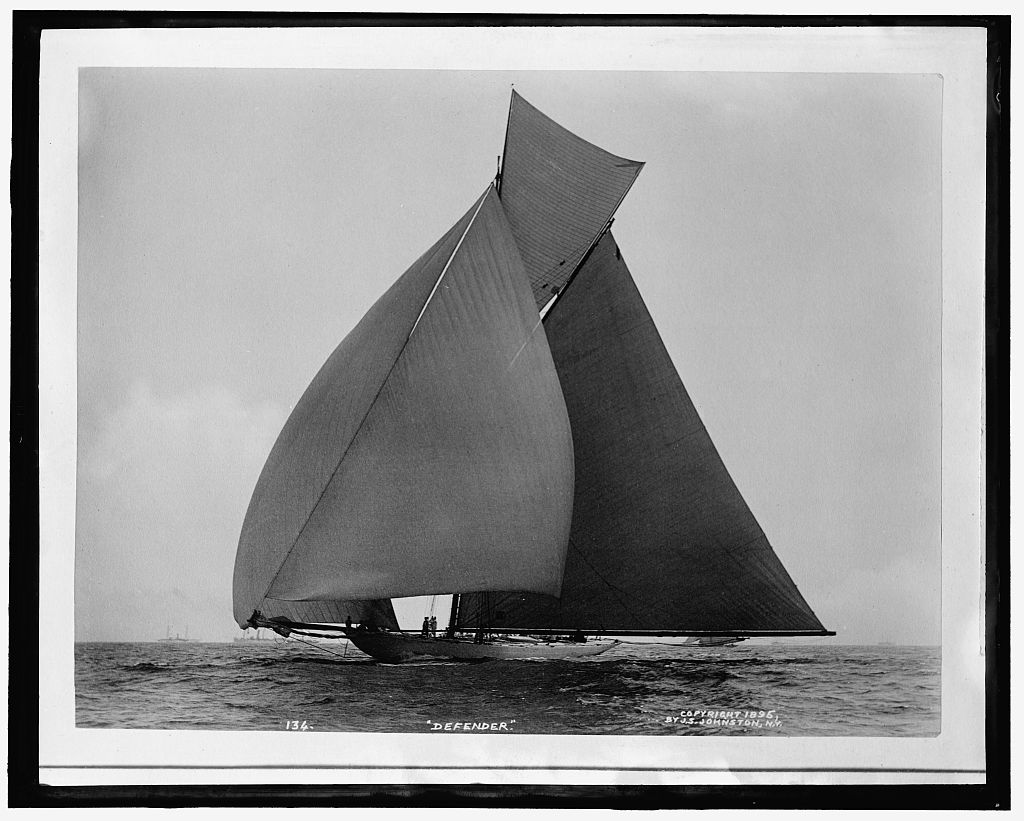
Defender

I found this image on a favorite tumblelog and I subsequently used it in a tumblr post of my own.[1]


It shows the yacht Defender and it can be found in the Detroit Publishing Company Collection of LC's Prints and Photographs Division.[2] The photographer, John S. Johnston, did a whole series on the Defender.

The caption gives the year (1895) but does not give the month or day. It does have "134" written on it and a nearby photo, number 132, shows the Defender on August 2, 1895, competing in the Goelet Cup so it's pretty near certain our photo was taken during the same race.

The yacht belonged to William Kissam Vanderbilt.[3] He was a cousin of Louis Windmuller's wife, Annie.[4] Windmuller didn't go in for yacht racing. His recreations were urban and close to home. He belonged to city clubs and supported city charities. An immigrant from Germany who never lost his German connections, he loved the city's German singing clubs and beer gardens. He was also a famous city walker and one of his last acts was to form a club of walkers. He traveled much for business, but also for pleasure, chiefly to Germany, France, England, and Italy.

Louis Windmuller had arrived in New York penniless and worked his way up to a comfortable prosperity. William Kissam Vanderbilt was born to wealthy parents and was never forced to earn a living. He did work as a manager of the family railroads but as someone learning the family business rather than in the entrepreneurial spirit of his grand- and my great-grandfather.[5] The differences between the two men were many, but the most obvious, I think, was in their choice of recreation. Where Windmuller walked, W.K.V. raced. He raced horses and he raced yachts. He founded New York's Jockey Club, owned both stables and race courses, and ran horses that won. And he was co-owner of the yacht defender.

Windmuller and his wife Annie saw only two of their six children survive to adulthood: a son and a daughter. Neither possessed the energy, cheerful optimism, and tempered ambition of their father. The son, Adolph, made a half-hearted effort to manage one of his father's enterprises (the importing firm which was Windmuller's first success) but did not stick with it and lived most of his life as a man of leisure.[6] My father, his nephew, called him a n'er do well. The daughter, Clara, was not expected to earn a living and, unlike others among her contemporaries in upper-middle-class New York, she did not attempt to make a name for herself by charity work, cultural contributions, agitation for reform, or even any sort of active participation in New York society.[7]

Somewhat late in life, Clara married a man who worked for her father. He, Julius, was a distant relative who had come from Germany with the expectation that Windmuller would put him to work. After serving in a clerical position in an organization of which Windmuller was treasurer he was, in the year following his marriage to Clara, appointed secretary-treasurer of a bank that Windmuller had helped to found and of which he was president.[8] In 1913, when his father in law died, the will was found to be not so generous to him as it was to Adolph and Julius consequently labored in the bank for the rest of his working life, eventually rising to be its manager. Once he found himself secure in his employment, he put in his bankers' hours, married his benefactor's daughter, fathered a family of four, let himself be caught with a girlfriend in the conjugal bed, and indulged in a passion for boating. The last two were actually related since he had the habit of inviting women to cruise with him from time to time.

This photo shows Julius and Clara shipboard during the first (happy) years of their marriage.

The year is 1902 or '03. He is 34 and she two years younger.

Julius was a power boat enthusiast so this photo — taken at about the same time — shows Clara on someone else's ship.


From about 1900 to about 1942 Julius owned maybe half a dozen craft, each 30- to 40 feet long, with paid skipper and crew. At the bank they called him "Commodore" (as, in similar manner, underlings had given Cornelius Vanderbilt that title) and he belonged to a number of yacht clubs including the Colonial, uptown on the Hudson near his home on Riverside Drive, and the Harlem on City Island.[9] My father once took me to the latter. The club house was rustic and in my memory its chief feature was a monumental pool table near windows overlooking the moorings.

This shows a diving demonstration at the Colonial Yacht Club in 1914 or 1915.

{Caption: Famous diver Elsie Hanneman at the Colonial Yacht Club; photo by the Bain News Service; the club was located on the small beach just below Riverside Drive on the Hudson River, roughly between 140th and 142nd Streets in Harlem; source: Library of Congress Prints and Photographs Division}

Taken at about the same time, this photo shows canoe jousting, the club, and some of the city in the background.

{Caption: Canoe Tilting at the Colonial Yacht Club, by the Bain News Service; same source }

This shows the Harlem Yacht Club in 1906. I recollect it looked much the same in the late 1950s when my father took me there.

{Caption: Harlem Yacht Club, City Island, N.Y. by the W. F. Sleight Post Card Co., Mount Vernon, N.Y., 1906; source: Long Island Historic Postcards Collection (collection 346), Special Collections and University Archives, Stony Brook University Libraries}

----------

Some sources:

The Yacht Photography of J.S. Johnston - Defender

Defender - 32nd America's Cup

Goelet Cup, New York Times, August 6, 1887

DEFENDER BREAKS DOWN; Snapped a Hollow Gaff in Goelet Cup Races, New York Times, August 2, 1895

THE GOELET CUP, New York Times, August 3, 1895

William Kissam Vanderbilt on wikipedia

"Newly-elected officers of the Colonial Y. C." in The Rudder, Volume 35 (Fawcett Publications, 1919)
Harlem Yacht Club By Evelyn Schneider, Harlem Yacht Club historian, as published in the July 2008 issue of Wind Check

Century of American savings banks, pub. under the auspices of the Savings banks association of the state of New York in commemoration of the centenary of savings banks in America (New York : B. F. Buck & company, 1917)


----------

Notes:

[1] The favorite Tumblr blog is Chemin faisant by Catherine Willis and my own is rouleur.

[2] Prints and Photographs Division of the Library of Congress

[3] W.K. Vanderbilt was co-owner.

[4] Annie and W.K. were niece and nephew-once-removed, respectively, of John Edmund Thorne. W.K.'s father, also W.K., was son of J.E.T.'s brother-in-law, Samuel Kissam. Annie was daughter of J.E.T.'s sister, Sarah Lenington Thorne. If you've patience, you can trace the connection in these genealogies: Descendants of William Thorne & Susannah Booth and Windmuller Genealogy. I've written fequently about my great-grandfather. To see posts about him, click the "Louis Windmuller" link in the list of labels in the panel at right.

[5] Up until 1903 William Kissam Vanderbilt was active in the management of the family railroads, including the New York Central. His grandfather Cornelius had owned that business and, it doesn't surprise me to find that Louis Windmuller was a shareholder. Cornelius and Louis were different in many ways, but both were energetic businessmen and managers of financial affairs. In 1865 Windmuller joined other prominent New Yorkers in petitioning the state government for relief from Civil War regulations that kept rail fares and tariffs artificially low (Evening Journal, New York, March 21, 1865). In addition to the names of Cornelius and my great-grandfather, the petition showed those of William Astor, Henry Sloane, and other prominent merchants and financiers.

[6] Louis Windmuller's first successful business was "Louis Windmuller and Roelker, commissioning agents." I've written a few posts dealing with its affairs. [7] My blog post on the wives of the forty-eighters gives some idea of what determined women could accomplish at the time. It is four notable German-American women. Even within her narrow community Annie was outshined by her close neighbors the Sussdorfs whose womenfolk founded a local Sunday school and provided support for the church to which they and the Windmullers belonged. Regarding the social whirl, the Windmuller family does appear in the Social Register but the only Windmuller parties you'll find in the newspapers of the time are privately family ones and the Windmullers are never seen out coaching or at Newport or even in connection with their socially-prominent daughter in law, Adolph's wife Carolyn Hague, known as Madam Thurn.

[8] In 1901 Windmuller made Julius secretary in the Legal Aid Society, which he had helped to found and of which he was treasurer. In 1903 Windmuller helped found the Maiden Lane Bank for Savings in the building where he had previously helped found the Maiden Lane Safe Deposit Company. Here are excerpts from an article about the bank.
At the time of the establishment of the Maiden Lane Savings Bank — 1903, under the General Banking Law — it was estimated that there were about 150,000 clerks and workingmen employed in the Jewelry District, who were all earning good wages and of whom at least 25 per cent. were living either in New Jersey or on Long Island and did not have the time to make deposits in the banks in the neighborhood where they lived. In order to give these people proper facilities for depositing their surplus earn-ings without inconvenience, it was proposed to establish a new Savings Bank in that section of the city and to keep it open for receiving deposits from 9 o'clock in the morning until 5:30 in the evening, Saturdays included. It was proposed to locate the bank in the basement of the building at the corner of Maiden Lane and Broadway, where the Maiden Lane Safe Deposit Company had their premises. ... The board of directors of the Maiden Lane Safe Deposit Company was approached with the proposition to rent space in their premises and the proposition was met in a liberal manner. ... The rapid increase in deposits is ample proof that a Savings Bank was needed in the down-town section of the Borough of Manhattan. ... First officers: Louis Windmiiller, president; J. Heynen, secretary-treasurer. -- Century of American savings banks, pub. under the auspices of the Savings banks association of the state of New York in commemoration of the centenary of savings banks in America (New York : B. F. Buck & company, 1917)

[9] In 1919 Julius was elected to the board of directors of the Colonial. SeeThe Rudder, Volume 35 (Fawcett Publications, 1919).

Wednesday, May 02, 2012

West Twenty-Third east from Sixth

I've written quite a few posts about the area where Broadway and Fifth Avenue come together in New York City. Their topics were the Flatiron Building, which dominates that intersection; Madison Square Park, which adjoins it; and locations in the vicinity that were associated with my great-grandfather, Louis Windmuller.*

I've also done some posts about the block of 23rd Street that lies between Fifth and Sixth Avenues at this location. They are 23rd St., New York Newsstand, 1903, and Eden Musee, a major attraction at mid-block.

Those posts give lots of views of the area. Here are just a couple more. They were taken at the same general time and from same general place as the one in the first of the three posts listed above, and they can be found in collections of the Prints and Photographs Division of the Library of Congress.


{Caption: West Twenty-third Street from Sixth Avenue, New York, N.Y. by the Detroit Publishing Co., ca. 1908}

Details of this image:

1. We're looking at the south side of the block. The photographer has positioned himself at the foot of the stairs to the elevated railway at 6th Avenue and 23rd. He's facing east. As you see, it's late in the afternoon on a warm but overcast day. The Flatiron Building dominates the skyline, but its the department stores, shops, and most of all the bustle of the street which attracts the eye.


2. This is the north side of the block with Eden Musee, F.A.O. Schwarz toys, and the Fifth Avenue Hotel dominating the scene.


3. Best & Co., the famous women's shop, then marketed itself as the Lilliputian Bazaar. Notice that the large plate glass windows reflect the buildings opposite.


4. You can see the reflections more clearly here.


5. A display of women's fashions on the second floor. The shop is Best & Co.'s neighbor, Bonwit Teller.


The negative of this second photo is getting moldy, but most of it is still in good shape. The photographer seems to be standing on the top of a hansom cab (horse's head just visible at bottom).

{Caption: West Twenty-third Street, New York, N.Y. by Detroit Publishing Co., ca. 1908}

Details:

1. The Eden Musee again. I did a blog post about this place, whose board of directors had Louis Windmuller as a member.


2. You see that it's about 1:16 PM, so this photo was made earlier in the day, possibly the very same hazy day as the first photo.


3. Here again the glass reflects the scene across the street. The gent with the light colored top hat is a bit more dapper than the others. The women almost seem to be in uniform.


4. Seen more closely, the gent appears to be looking directly at the photographer.


5. This shows two women who are out of uniform, one all in black, the other in a light dress instead of skirt and shirtwaist.


-----------

Note:

* See for example:

Saturday, March 31, 2012

the hump

Freight yards like Chicago & North Western's at Proviso contain hundreds of parallel tracks. These permit arriving trains to be broken up so that individual cars can be grouped by their destinations. Some freight trains — such as those which carry coal from mines to power plants — can remain intact throughout their journey. However most contain isolated cars that are only generally headed in the right direction. These have to be reassembled one or more times along their route as they draw closer to the yards where they will be unloaded. This reassembly is accomplished by shunting cars on the parallel tracks in yards like the one at Proviso.

The shunting takes place in classification yards. The aerial photo I showed the other day gives an idea of the shape and extent of the C&NW yards circa 1940. This is a detail from that image in which you can see the track layout.
.
{Detail from photos of the 1938-1941 Aerial Survey of Illinois; source:
Illinois Aerial Photos.[1]}

This photo shows portions of two of the C&NW's "ladders" — the sets of parallel tracks into which cars would be shunted. As in my previous post, it was taken for the Office of War Information by staff photographer Jack Delano and is found in collections of the Prints and Photographs Division, Library of Congress. Notice that, as you'd expect, each pair of tracks splits from a main feeder and each has its own switch. The feeder is called a lead or drill.

{Caption: General view of one of the Chicago and Northwestern railroad classification yards, Chicago, Ill. December 1942}

This shows a switchman in the act of shunting some cars. Delano took this in April 1943.[2]

{Caption: Switchman throwing a switch at C&NW RR's Proviso yard, Chicago, Ill. 1942 Dec.}

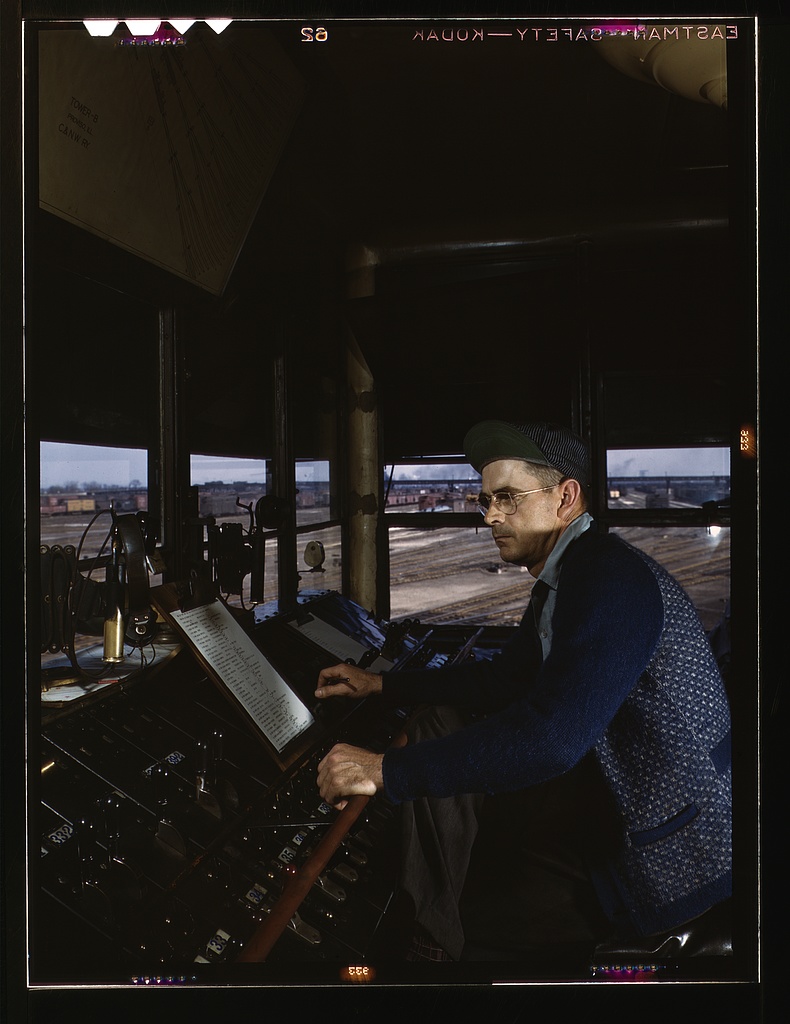
The C&NW yards received lists via teletype showing the makeup of arriving trains and the destinations of their cars. These switch lists enabled workers such as the one shown below to map out the distribution of cars in the classification yards. The mapping is a lot easier to explain than it was to carry out in a place the size of proviso with its hundreds of switches.[3]

{Caption: Switch lists coming in by teletype to the hump office at a Chicago and Northwestern railroad yard, Chicago, Ill. 1942 Dec. }

Cars would be pushed around the yards by shunt engines and in large facilities like the one at Proviso they might also be fed to the ladders by gravity. Locomotives would push a train up a gentle incline, called a hump, and the cars would be released to roll down the lead toward the switches.

This photo shows one of the humps at the C&NW yards. A tank car has just been uncoupled and is making its way down the hump toward the ladders.

{Caption: General view of one of the yards of the Chicago and Northwestern railroad, Chicago, Ill. 1942 Dec.}

This shows a shunt engine working on a lead. You can see two towers where towermen controlled the flow of cars from the hump down the lead and into the ladders.

{General view of the hump, Chicago and Northwestern railroad classification yard, Chicago, Ill. 1942 Dec.}

In this view of the same set of ladders you can see the downslope from the hump at the foot of the foreground tower.

{General view of the hump yard at Proviso yard, C&NW RR., Chicago, Ill. 1942 Dec.}

The caption explains this photo. The hump track to which it refers is continued by the lead or drill.

{Hump master in a Chicago and Northwestern railroad yard operating a signal switch system which extends the length of the hump track. He is thus able to control movements of locomotives pushing the train over the hump from his post at the hump office; Chicago, Ill. 1942 Dec.}

There were devices called retarders on the lead tracks. These were electrically controlled and could be used to slow down cars as they descended from the hump. Switches could also be electrically operated. This towerman is shown at the retarder and switch controls.[4]

{C&NWRR, towerman R.W. Mayberry of Elmhurst, Ill., at the Proviso yard. He operates a set of retarders and switches at the hump, Melrose Park (near Chicago), Ill. 1943 May}

I think Delano took this shot from one of the towers.

{Caption: General view of one of the yards of the Chicago and Northwestern railroad, Chicago, Ill. 1942, Dec.}

------

Some sources:

"Combination Through Classification and Terminal Yard" by W.C. Copley in Railway age Vol. 58 (Simmons-Boardman Publishing Corp., 1915)

Classification yard on wikipedia

Retarder on wikipedia

Switcher on wikipedia

Shunt (rail) on wikipedia

Train shunting puzzles on wikipedia

-----

Notes:

[1] This larger detail shows the complex interconnection of the classification yards the Proviso facility. Click to view full size.


[2] Jack Delano took all the images on this page on assignment from OWI in December 1942 and April 1943 and all are from collections of the Library of Congress.

[3] Railroaders have train shunting puzzles which are games that challenge players to break up and reassemble trains (called consists) with a minimum of de-couplings and couplings.

[4] This view of a classification yard (not C&NW) shows retarders on the leads just before the ladders. I've marked two of them with yellow circles.