Saturday, February 23, 2008

Vietnam through Hayden's eyes

I recommend an article called The Old Revolutionaries of Vietnam by Tom Hayden (from the March 10, 2008 issue of The Nation). People my age remember Hayden for his SDS presidency and the Port Huron Statement, his arrest at the 1968 Chicago convention, his political work in California and, most of all, his opposition to the war in Vietnam. We also remember that he likes to be in front of cameras and is attracted to Hollywood celebritydom. He divorced his first wife to marry Jane Fonda and when they divorced he married another actress. Reading his bio in wikipedia, I found that he's done some admirable low-profile political work which belies the publicity-hound image you might get of him from the many headlines in which his name has appeared over the decades.

The article is short and relatively free of bombast. It shows Hayden's nostalgia for the ideals of the 1960s and his current opposition to our culture's superficiality and the growing inequality of haves and have-nots. It also shows the difficulty he has in coming to terms with the quick-growth economic policies of the current socialist government in Hanoi. He says, "far be it from me to question the desire of Vietnamese to share our globalized consumer culture like everyone else," but it's obvious that's not the outcome he would have wanted.

He tells of secular Santa Clauses and Christmas carols in Hanoi's shopping district and quotes a young Vietnamese blogger: "I have only one dream is buy one of brand new Harley-Davidson, now I waiting for Harley-Davidson deal to open in Saigon. I need a Fatboy."

Much of the article is given over to reminiscences with Vietnamese members of the old guard whom he sought out on a visit to Hanoi last Christmas. They, like he, are saddened by the younger generation's loss of revolutionary fervor, its wholesale adoption of American values, and its growing passion for material possessions.

One says, "Look carefully now at the peace we have, painful, bitter, and sad. And look who won the war. To win, martyrs had sacrificed their lives in order that others might survive. Not a new phenomenon, true. But those still living to know that the kindest, most worthy people have all fallen away, or even been tortured, humiliated before being killed, or buried and wiped away by the machinery of war, then this beautiful landscape of calm and peace is an appalling paradox." Another says, "The government is trying to reduce poverty, but it's already a reality. The rich are getting richer because they have the means. And the poor don't. We are better off materially, but not mentally, ethically."

In the end, he resists the temptation to bludgeon the reader with the old-timers vs. youngsters dichotomy. Here are the closing paragraphs:
Finally, there was a visit to my oldest friend, Do Xuan Oanh, who first greeted me at Hanoi's airport on a December day forty-two years before. He went through a "bitter period" after retirement, someone told me, but was feeling better, having recently translated into English an edition of Vietnamese women's poetry. He lived alone, his wife having died after many years of illness, his three sons all abroad. As I remembered him, Oanh loved America in unique ways. For example, after learning English from the BBC, he translated Huckleberry Finn into Vietnamese, a massive challenge. A musician, he could sing many American protest songs. A romantic, he wept easily and became close to many Americans.

Now, in a carload of old revolutionaries, I traveled along a narrow cement path past houses, until we came to the gate of Oanh's home of fifty years. He was standing in the door, a thin shadow of the Oanh I remembered. Taking my hand, he led me into a windowless room where a couch and piano were the most prominent fixtures. There were alcoves for painting and a kitchen. We sat and looked at each other. He held my hand on his knee, while the others sat in a quiet circle. It was more a last visit than a time to renew an old conversation.

"Do you want some booze?" Oanh asked with a low chuckle, pointing to a half-bottle of Jim Beam. I deferred, worried what might happen after a few drinks. My wife said Oanh seemed fit and energetic for an 85-year-old. She asked if he would play the piano, and he performed an original piece in a classic European style. He gave me a copy of the song, signed to his "precious friend," and a small carving of a beautiful Vietnamese woman carrying a student briefcase, which he said reminded him of his wife "before the revolution." He repeated the phrase, then relaxed. Gradually, the others began to reminisce about the old days. I wondered if we would ever meet again. I remembered an e-mail from Oanh's son in San Francisco: "I believe God assigned my father and myself to serve the American people." His son would come for a visit in the summer, Oanh said.

We walked back along the dark path to the street filled with motorbikes and strolling couples out for a coffee. Oanh looked at me intently, pointing a finger for emphasis. "Nothing can be predicted," were his last words before we said goodbye.
Hayden has his own website and he blogs on Huffington Post. Noting that he was a community organizer in Newark, New Jersey, in the mid-1960s, at the same time Leroi Jones (Amiri Baraka) was there, I did a Google search and turned up a fascinating bit of history. This comes from Alan Ginsburg's description of his FBI file:
Ginsberg said that some of the papers in his file come from related customs and Treasury Department investigative bureaus. His file crisscrosses those of other writers. "They include Leroi Jones, who was the victim of much more attack than people understand and, in that context, his anger is understandable," Ginsberg said. "Most people don't realize what he and other black literati have been through, assuming that all past injustices have been redressed or somehow disappeared out of mind. The waste remains, the waste remains and kills. The section on Tom Hayden in Newark intersects with Jones, since Jones was influenced by an FBI misinformation campaign to denounce Hayden as an [FBI] agent and drive him out of Newark.
{Source: Allen Ginsberg's FBI file from Herbert Mitgang, Dangerous dossiers : exposing the secret war against America's greatest authors (New York : D.I. Fine, 1988)}
Addendum: Leroi Jones comes up in a post on this blog a few months back: two women. I was given his book, Blues People, as a Christmas present and have half a thought to do a blog post on him one day.

Sunday, February 17, 2008

Clarissa, samurai

Not long ago I made a case for Clarissa as existentialist hero and found I was not alone in holding this view.  I drew some parallels between existentialist authenticity and religious insights: the visions of mystics as to the wholeness of things, of eternity and emptiness, of life and death. I linked both to Zen Buddhist percepts and made a final connection with the goals of samurai warriors and the guides for achievement of those goals, particularly Musashi's Book of Five Rings

There's no evidence that Virginia Woolf was directly influenced by Kierkegaard, Heidegger, or another of the existentialist thinkers (so-called), nor by any practitioners of Eastern philosophies; and it's a good guess that she never read a samurai sword fighting manual.  It's true that some of the popular philosophies of the day were congruent with existentialism, mystic perceptions of wholeness, and the Japanese ethics of Zen and samurai.  The influence on T.S. Eliot of the philosophies of India are well known and, during the years VW was developing her ideas for and then writing Mrs. Dalloway, her complex relationship with Eliot was evolving into a close friendship.  At the same time G.E. Moore was writing and speaking about his ideas on intuition and collective states of mind which have something in common with Eastern thinking.  And he too was part of Woolf's circle of friends.  But these are tenuous connections.  VW might have absorbed some of her ideas on continuity and expansion from others, but nothing even remotely tending toward the writings of Miyamoto Musashi.  The parallels I find in Mrs. Dalloway and existentialism, Zen, and samurai training are coincidental ones.  They're nothing she intended.

But present all the same.

In Mrs. Dalloway, Clarissa's personal growth and final realization are those of a samurai.  To be sure, there is much about her that protests this characterization.  She is far from the time and place of the samurai, a creature of 20th-century England.  She is a woman and samurai are men.  Moreover the cultural milieu of Japanese society in the time of the samurai was resolutely masculine.  Women were subjugated to second-class status. 

Still, she possesses what we used to think of as aristocratic attributes --  poise, bearing, dignity, humility.  Peter points out these attributes in her.  The samurai aspired to the same. 

She has an unselfconsious grace.  During the course of the novel, she becomes more and more self-possessed.  The reader can visualize development of her senses of balance and rhythm, an ability to dispel inner tension so as to become relaxed and alert, self-respect sufficient to keep her from being easily intimidated, ability to empathize, freedom from prejudice, clear-headedness, ability to resist mindless adherence to social conventions, ability to be either reticent or communicative as occasion calls for.  One might debate the extent to which VW shows Clarissa's personal growth to include all these abilities to which samurai aspired, but they belong to her as a cluster of traits in greater or lesser degree.

There's no doubt that she shares with samurai her highly-developed powers of observation and perception, an instinctive awareness not just of the objective world but of its moral, aesthetic, and metaphoric content.  WV tells us how Clarissa sees things and Peter does not, how she must make him put on his glasses to see what is around him.  But more than seeing, she comprehends.  As VW tells us, she knew people by instinct, "If you put her in a room with some one, up went her back like a cat’s; or she purred." 

And she has a samurai ability to remove herself from the context of the moment, to release herself from the busy noise of thoughts running through her mind, to shake off distracting complacencies, and to make instantaneous, intuitive judgments.  As VW says, "She sliced like a knife through everything; at the same time was outside, looking on. She had a perpetual sense, as she watched the taxi cabs, of being out, out, far out to sea and alone; she always had the feeling that it was very, very dangerous to live even one day."

Clarissa knows how to position herself so as to remain grounded, as when she is receiving her guests, has the knack of perceiving her milieu all at once, of experiencing emotions fully and not blocking off their free flow through her and out of her. 

She knows that she is not strong -- not physically strong (particularly so as a recovering invalid), not strong by right of political or social accomplishment, not strong by fame or inherited position -- but her weakness is not a liability.  During the course of the novel she comes to understand the samurai (and also Zen) paradox of weakness as a source of strength. 

All these are samurai affinities that Clarissa possesses, comes to possess, or shows aptitude for possessing as she continues he life-path.

Clarissa's eventual ability to accept unflinchingly the pointlessness of existence and, beyond that, her faith in goodness without promise of religious rewards is also samurai.  As VW has Peter think, "To see your own sister killed by a falling tree ... before your very eyes, a girl too on the verge of life, the most gifted of them, Clarissa always said, was enough to turn one bitter. Later she wasn’t so positive perhaps; she thought there were no Gods; no one was to blame; and so she evolved this atheist’s religion of doing good for the sake of goodness."

As I say, it's quite common for religions to tell of adepts (mystics, say) who can achieve a sense of oneness with the universe and all that it contains.  But both Zen and samurai (neither of them a religion of mystical revelation handed down by God) take this a step further.  They see the possibility that people can achieve this completeness repeatedly in the affairs of ordinary life.

Eiji Yoshikawa expresses this in his novel, Musashi.  He presents the swordsman as a brash youth who gets put on the path to enlightenment by an eccentric Zen monk who treats him abominably. He demonstrates his Buddhist reverence for all life forms by tricking Musashi, tying him high up in a tree, and to all appearances leaving him to die of exposure. This tough love works, turning Musashi from a thug into a devoted student of samurai. Thereafter , in hundreds of sword contests Musashi is never defeated but his amazing success does not lead him to believe he has mastered his art.  Frequently these fights are over a microsecond after they start.  Musashi parries an attack and counters with such blinding speed that no one present sees what has happened, even his adversary can't immediately comprehend how rapidly he has been defeated.  Gradually, Musashi comes to understand that there are men who can overcome him without use of any weapon, merely by force of personality, by intangibles of which he's only vaguely aware, such as the breadth of their understanding,  their creativity, their mastery of high art, all conveyed wordlessly in the way the hold themselves, by their calm dignity -- a kind of charisma, though that is not quite the right term for it. 

We say that the possession of charisma gives a person power over others.  Stated this way it sounds like charisma is an attribute, but samurai charisma is better seen as a fullness, an authenticity, a freedom from self-deception.  This form of charisma isn't something you aim to get so you can have power, but something that conveys a gentle self-possession -- not authority, nor strength, but rather a state of being vulnerable without being weak.  It's only perceived as power.

I'm less than half-way through the book, but eventually I believe Yoshikawa will describe how Musashi develops a technique called "no-sword" based on this understanding of artistic achievement. 

VW shows us that Clarissa is developing a skill in no-sword contests with an opponent in her encounters with Peter.  Always bickering -- his puncturing of her aesthetic, emotional joys -- flowers as vegetables, his preference for men over cauliflowers, his trivializing Clarissa's moment with Sally as star-gazing.  Their first encounter is a contest with everything that's important left unsaid, but intuited all the same.  He with his knife out.  She with her sewing needle, her scissors. 

Clarissa and Peter confront each other not just with weapons, but with their emotions, memories, the weaknesses that give them strength.  And, in this contest and as the novel progresses, Peter remains what he is and has been, while Clarissa develops her competence, learns how to exist fully in the moment, how to be real.  This growth and its culmination in authentic being -- with the gift of a the life of a stranger, thrown away -- bring Clarissa not just to existential fulfillment, but also to a samurai mastery, the mastery of a Zen art.

You can imagine two warriors facing off for a contest in VW's descriptions of Peter and Clarissa. 

Her recall of his past thrusts at her: "Cold, heartless, a prude, he called her. Never could she understand how he cared. But those Indian women did presumably— silly, pretty, flimsy nincompoops. And she wasted her pity. For he was quite happy, he assured her—perfectly happy, though he had never done a thing that they talked of; his whole life had been a failure. It made her angry still."

His positioning himself defensively: "Then, just as happens on a terrace in the moonlight, when one person begins to feel ashamed that he is already bored, and yet as the other sits silent, very quiet, sadly looking at the moon, does not like to speak, moves his foot, clears his throat, notices some iron scroll on a table leg, stirs a leaf, but says nothing—so Peter Walsh did now. For why go back like this to the past? he thought. Why make him think of it again? Why make him suffer, when she had tortured him so infernally? Why?"

Their first moves. first his: "'Well, and what’s happened to you?' she said. So before a battle begins, the horses paw the ground; toss their heads; the light shines on their flanks; their necks curve. So Peter Walsh and Clarissa, sitting side by side on the blue sofa, challenged each other. His powers chafed and tossed in him. He assembled from different quarters all sorts of things; praise; his career at Oxford; his marriage, which she knew nothing whatever about; how he had loved; and altogether done his job. "

Then hers: "She flattered him; she fooled him, thought Clarissa; shaping the woman, the wife of the Major in the Indian Army, with three strokes of a knife. What a waste! What a folly! All his life long Peter had been fooled like that; first getting sent down from Oxford; next marrying the girl on the boat going out to India; now the wife of a Major in the Indian Army—thank Heaven she had refused to marry him! Still, he was in love; her old friend, her dear Peter, he was in love.

And at the end, Clarissa's ability to be fully vulnerable, gives her an edge: "Take me with you, Clarissa thought impulsively, as if he were starting directly upon some great voyage; and then, next moment, it was as if the five acts of a play that had been very exciting and moving were now over and she had lived a lifetime in them and had run away, had lived with Peter, and it was now over."

And it is all quickly over.  Clarissa has bested Peter, but not so as to defeat him: "Now it was time to move, and, as a woman gathers her things together, her cloak, her gloves, her opera-glasses, and gets up to go out of the theatre into the street, she rose from the sofa and went to Peter. ... And it was awfully strange, he thought, how she still had the power, as she came tinkling, rustling, still had the power as she came across the room, to make the moon, which he detested, rise at Bourton on the terrace in the summer sky."

This power of Clarissa's is ineffable.  As the rest of the novel unfolds, it's possible, more and more, to see in it the elements of samurai greatness.

Thursday, February 07, 2008

Clarissa's Party: conversation

Clarissa's Party

1. Conversation, communication, communion, threads of connection

Virginia Woolf's Mrs. Dalloway continues to occupy my thoughts.

Clarissa's party, which is the climax of the story, is not simply a social gathering. She and those who serve her spend the day preparing for it.

She sends invitations, orders the flowers, mends her dress, and sees that the rooms are ready to receive her guests.

Clarissa cannot call this conversation into being by herself; rather she creates conditions that are favorable. She uses her skill and intuition as an artist; her party is a creative venture. Virginia Woolf helps us see this:
What did it mean to her, this thing she called life? Oh, it was very queer. Here was So-and-so in South Kensington; some one up in Bayswater; and somebody else, say, in Mayfair. And she felt quite continuously a sense of their existence; and she felt what a waste; and she felt what a pity; and she felt if only they could be brought together; so she did it. And it was an offering; to combine, to create; but to whom?

She has decided to have no music, no dancing. And, despite a second-guessing about this decision, she's right to leave entertainment to the guests themselves. She has brought together a mix of people at this particular place and time for one main purpose: to converse.

What seems superficial conversation is much more. The word conversation, in this context, has overtones from its antique meaning: it's the action of showing one's character, displaying one's course of life. To converse, in this context, has overtones of another antique meaning: to move within a circle of acquaintances, to establish and maintain threads of connection.

What happens is not just talk.

This is communication, in a broad sense, the sense that John Dewey gives it. He said it's the way people make links among themselves, acknowledging and sharing a common experience. They establish and reinforce these links as they converse. The process enhances each person's sense of self -- individuality -- and also gives the group a sense of its collective existence and it strengthens the ties that bind the group together. More than that, he said there's no pure individuality. We're all an inextricable mixture of personal and social attributes. There's no perceptible point at which an individual's sense of self ends and that person's sense of belonging begins.

Virginia Woolf shows us the guests arriving, each publicly announced by name to the assembly. At that point their individual identities are most pronounced. And this identity decreases as their participation in the communal flow grows.
Every one was unreal in one way; much more real in another. It was, she thought, partly their clothes, partly being taken out of their ordinary ways, partly the background, it was possible to say things you couldn’t say anyhow else, things that needed an effort; possible to go much deeper. But not for her; not yet anyhow.

Her party shows us the hum of existence, complex interactions of individuals.

People circulate through the rooms. Everyone talks animatedly.

Earlier in the novel, Virginia Woolf has given us the image of a thread -- the thread of a spider, or of the fine silk thread Clarissa uses to mend her dress. After lunch at Millicent Bruton's, Hugh and Richard remain connected to her by this ethereal link. The connection is a single spider's thread, stretching and getting thinner as they walk down the pavement. She, in releasing her consciousness into dreams, loses hold on her end of it "as a single spider’s thread is blotted with rain-drops, and, burdened, sags down." A few moments later, Richard's love for Clarissa figuratively manifests as a single spider’s thread, which, "after wavering here and there attaches itself to the point of a leaf." Woolf uses the image again to show us the esoteric communication of the old woman's love song at the Regents Park tube station: "Cheerfully, almost gaily, the invincible thread of sound wound up into the air like the smoke from a cottage chimney, winding up clean beech trees and issuing in a tuft of blue smoke among the topmost leaves." Woolf associates these threads with the bonds of affection, but also the life force itself, the "thread of life" as she expresses it.

The novel also gives us images of flight and wind. Birds take flight, an airplane writes diaphanous messages in the sky, the warm June breezes blow, gentle and strong. In Clarissa's home "gently the yellow curtain with all the birds of Paradise blew out and it seemed as if there were a flight of wings into the room, right out, then sucked back. (For the windows were open.)"

And of windows -- windows that open out to the world, shop windows displaying merchandise, the curtained windows of the Prime Minister's car, the window across the way which Clarissa looks into to observe her friend, the old lady who lives there, the window out of which Septimus jumps to his death. Windows open to the ecstasies of her youth as, in her memory, she steps through French windows at her beloved Bournton. One is also imagined as helping the soul of a dead woman regain the unknown space from which it came: a woman "opening the window of the room where [another] had just brought off that act of supreme dignity."

And bells. Big Ben which, when we hear it, locates locates us in Westminster; which tolls to mark each moment of precious time, which tells of the day's many events. Bells always signify clocks and clocks signify measurement, the antithesis of the imponderable flow from eternity past into eternity future. Bells are the beat of time kept by clocks.

In using the images Woolf helps us understand the greater meaning of the party as it unfolds. The images help us to visualize the many interconnections among the party's guests, growing more intense as more people arrive until finally a sort of critical mass is achieved.

Clarissa observes the exact moment when this occurs: when Ralph Lyon beats back the curtain: "The curtain with its flight of birds of Paradise blew out again. And Clarissa saw—she saw Ralph Lyon beat it back, and go on talking. So it wasn’t a failure after all! it was going to be all right now—her party. It had begun. It had started. But it was still touch and go. She must stand there for the present. People seemed to come in a rush." For Ralph Lyon, the flow of time is no longer of consequence; his concentration is on the conversation of the moment, however long that moment might stretch out in time. Clarissa's creativity has made it possible for the party to have its own being, temporarily outside time.

At the moment Ralph Lyon beats back the curtain, Woolf reminds us of the images she has been using: birds, flight, a breeze, the window. The threads of connection are not mentioned but implicit. For as she stands, greeting the individual guests as they arrrive, she has a momentary thought, one that's interrupted before she gets to its conclusion: "a sense one had" she says to herself, and Woolf adds "as they came up the stairs one after another." Obliquely to be sure, this succession of arrivals suggests the thread-of-connection image. So does the motion of Clarissa, circling around the packed rooms, moving from one little group to the next, to the next.

She has created the conditions for this moment through her own and her servants' careful preparations. One of the most important of these is the list of invited guests. This importance is seen in the problem of Ellie Henderson. Clarissa does not want to invite her because she knows Ellie will not be an active participant. She is a dangerous guest, in Clarissa's view, because she is disengaged. For the party to succeed, everyone must contribute to make the whole come alive as an organic entity, a creation to which Clarissa contributes her virtuosity, but which is ultimately made by them all.

The importance of this detail shows also in the actions of Peter and Sally. Both were last-minute additions to the list of invited guests. A bit confusingly, Clarissa tells Peter she will not invite him, but then does. She has no choice in this. But they resemble Ellie more than they resemble the other guests. The are not part of the flow, don't enter into the community of conversation. Instead they take themselves apart, speaking only to each other -- and briefly to Clarissa. Their isolation helps show the social cohesion of the others.

Guests arrive over an extended period of time. One of the last couples, Sir William Bradshaw and his wife, might be thought to be as unwelcome as Ellie Henderson, but this is not so. Clarissa disliked Bradshaw; he coerced people; he was evil. Yet these were not reasons to keep him from her party. He converses, making connections with the others in the room, showing himself as he is, contributing to the scene as it evolves.

Woolf shows the importance of Bradshaw, the enemy, being present when Clarissa thinks of another enemy, "Kilman" -- the man killer whom Clarissa, with all her impeccable manners, cannot bring to call "Miss" when she comes to mind. Of Kilman she now thinks "she hated her: she loved her. It was enemies one wanted, not friends." How is this? Partly at least the cause is Clarissa's growing realization of about the chain of being -- the community which Clarissa has made possible is an instance of this chain. She has arranged for it to welcome active participants whose presence, whether by reinforcement or contradiction, helps its individual members realize their real, genuine selves.

Peter's thoughts show us Clarissa at this moment, as she moves about the rooms. She has "the most perfect ease and air of a creature floating in its element." And she has "that gift still; to be; to exist; to sum it all up in the moment as she passed." It's a gift of hers to be able to manifest in her bearing, her presence, all that is right in the occasion -- her party.

Sunday, February 03, 2008

shared space

Shared Space

I live on a street that's barely two lanes wide. That is, two on-coming cars can pass each other but two large trucks cannot. It's a two-way street with parking on one side. When cars approach from opposite directions, one must usually pull over so the other may pass.

The street has sidewalks and during much of the day, the sidewalks have pedestrians: women and children going to and from the school at the end of the block and its playground; commuters going to and from the major bus route at the end of the street; people running errands; and various helpers -- caretakers, maids -- who come and go to their work in the neighborhood homes.  It's a family-friendly place.  And it's quite unusual. Streets in new residential neighborhoods, ones that meet current standards, are more than twice as wide. We have about 30 feet from the edge of one sidewalk to the edge of the other across the way. The standard calls for this width to be 70 feet. But 70 feet, though appropriate from a traffic engineering point of view, is not a humane distance. It doesn't foster community. The new subdivisions with enormous streets, feel sterile and unwelcoming compared to our more human-scale space.


Our environment isn't teeming with humanity like the Mulberry Street of 1900 which I blogged not too long ago, but it's not as empty as the new subdivisions farther out in the suburbs.


Its streets have shared space in the sense that they aren't totally dominated by the needs of motor vehicles. This gives them quite a bit in common with experimental shared-space urban areas in Europe and other places.

Here's a definition
of the term: "Shared space is a term used to describe an approach to the design, management and maintenance of public spaces which reduces the adverse effects of conventional traffic engineering. The shared space approach is based on the observation that individuals' behaviour in traffic is more positively affected by the built environment of the public space than it is by conventional traffic control devices (signals, signs, road markings, etc.) and regulations.

"

Since it has stop signs, my neighborhood doesn't have shared space as outlined in this definition. It's also almost entirely residential. It isn't a mixture of apartments and commercial space -- places where people go to drink coffee, shop for books, buy bread, and the like (though it does have shops within walking distance).

This shared space exists in , where we spent some time last June.

Some of the characteristics are also present in Kensington, a town a bit to the north of us.

It's pleasant to fantasize about a life both free of traffic control and also blessed with people who are civil to one another -- considerate, unhurried, convivial. But outside the special situations created to ensure that -- as much as possible -- the second condition accompanies the first, I don't see this happening. In fact, as a bike commuter, I'm sure I wouldn't appreciate the time I would lose if my crossing of every intersection had to be negotiated with appropriate politesse.

It's a concept that works in my neighborhood -- at least most of the time. And it's one I treasure in cities and towns that I visit. But until everyone lives within walking distance of job, merchants, service organizations, and other needs -- or until humankind has learned to get about by means other than cars, it ain't gonna happen.


Here are some shared-space links:

- Shared Space: home page for seven pilot projects in: Province of Fryslân (Lead Partner, the Netherlands), Municipality of Emmen (the Netherlands), Municipality of Haren (the Netherlands), Municipality of Ejby (Denmark), Municipality of Bohmte (Germany), Suffolk County Council (United Kingdom) and Municipality of Oostend (Belgium).

- Wikipedia article

- Lose the Traffic Lights to Improve Our Streets?, Written by Joshua Liberles.
Wednesday, 23 January 2008

- A civilising influence, By Clare Dowdy. Published: April 20 2007 18:37 | Last updated: April 20 2007 18:37

- "Shared Space" Traffic Calming: Counterintuitive, But It Works, Erica Barnett. January 4, 2008 2:46 PM

- Sharing street space for a safer Bohmte, Posted by: Jeannie Choe on Friday, January 25 2008.

- A Green Light for Common Sense, To Slow Drivers, German Town Drops Traffic Signals and Lane Markers. Monday, December 24, 2007.

- The shared-space: Shared Space is a European project with the purpose of developing new policies for the planning of public space. For this purpose, a new view regarding the planning of public space is applied in seven pilot projects. The essence of the new approach is that people’s behaviour in the street is stronger affected by expression of the surroundings than by the application of the usual traffic instruments such as speed bumps, traffic islands, or pedestrian crossings.

Photo from the Washington Post:
Bohmte, Germany, has been tearing out stop signs, traffic lights and sidewalks since September to force drivers and pedestrians to share the pavement, in an approach known as shared space. Several towns across Europe have undertaken similar measures.
(Photos By Craig Whitlock -- The Washington Post)

Here's a shared-space video link.

Friday, February 01, 2008

Clarissa and a man named Smith

I'm working on a post I'll call "Clarissa and Virginia" in which I'll give my thoughts on how Clarissa evolved and how she counterbalances Septimus in Mrs. Dalloway. This quick post concerns one little corner this thinking: how Virginia Woolf perceives "reality" in literature. She participated in a lengthy debate with Arnold Bennett about description from the outside vs. from the inside in the modern novel. Woolf argued that the author should let the reader see chacters' thoughts, feelings, and memories -- their and multi-layered sense of the present moment. Bennett accused her of being too clever and too fanciful; he said she intellectualized where she should have been "genuine." She smarted under the accusation because she did want to be genuine (this is her word), but she wanted to depict the whole of reality, not just its surface.

There's a section in one of her essays that deals with the reality that lies below the surface. In it she says there's no single reality that we all acknowledge to exist. In fact truth is frequently more fanciful than prosaic: "We know indeed that this reality is a chameleon quality, the fantastic becoming as we grow used to it often the closest to the truth, the sober the furthest from it, and nothing proving a writer's greatness more than his capacity to consolidate his scene by the use of what, until he touched them, seemed wisps of cloud and threads of gossamer."

This treatment of truth, with its conclusion that a writer achieves greatness when able to direct the reader's perception below the surface without sacrificing verisimilitude, leads me to see what what it was that Woolf was attempting to achieve -- did achieve -- in her characterizations of Septimus and Clarissa.

She gives both these characters a intense perception of their surroundings. For Septimus, the perception is not hallucinatory, but he sees it as an aberration, a heightened sense of reality that normal people do not possess. For Woolf, this is one aspect of his insanity. Clarissa also has an intense awareness of things, but she is the author's "sane" character.

The difference between the two seems to lie in the degree of each character's self-control. Septimus has no control. He is emotionally drained, prey to his perceptions. Woolf described an episode of this nature from her own life. It appears in her diary entry for a day in the period in which she was writing Mrs. D. The entry shows Woolf herself to have an uncontrolled Septimus-like stepping outside normal reality with heightened awareness of what's around her. I've put the entry at bottom of this post.

Clarissa does not have attacks of this nature. She perceives things brilliantly but is not a victim of the "the old devil" who "has once more got his spine through the waves" (Woolf's words in the diary entry).

As I see it, Clarissa has found the method of controlled perception as does Woolf's imaginary playwright in the following passage. That is, she can let her fancy range free and also keep herself grounded in that reality which, to the Bennett's of the world, is genuine. She can perceive both poetic and prosaic truth. She can, as the passage has it, both wander in the land of the unicorn and also keep one toe touching Liverpool.

This passage is from an essay on which she was working while she was writing Mrs. D: NOTES ON AN ELIZABETHAN PLAY

extracts:

At the outset in reading an Elizabethan play we are overcome by the extraordinary discrepancy between the Elizabethan view of reality and our own. The reality to which we have grown accustomed, is, speaking roughly, based upon the life and death of some knight called Smith, who succeeded his father in the family business of pitwood importers, timber merchants and coal exporters, was well known in political, temperance, and church circles, did much for the poor of Liverpool, and died last Wednesday of pneumonia while on a visit to his son at Muswell Hill. That is the world we know. That is the reality which our poets and novelists have to expound and illuminate. Then we open the first Elizabethan play that comes to hand and read how

I once did see In my young travels through Armenia An angry unicorn in his full career Charge with too swift a foot a jeweller That watch'd him for the treasure of his brow And ere he could get shelter of a tree Nail him with his rich antlers to the earth.

Where is Smith, we ask, where is Liverpool'? And the groves of Elizabethan drama echo "Where '?" Exquisite is the delight, sublime the relief of being set free to wander in the land of the unicorn and the jeweller among dukes and grandees, Gonzaloes and Bellimperias, who spend their lives in murder and intrigue, dress up as men if they are women, as women if they are men, see ghosts, run mad, and die in the greatest profusion on the slightest provocation, uttering as the fall imprecations of superb vigour or elegies of the wildest despair. . . .

Is it not that literature, if it is to keep us on the alert through five acts or thirty-two chapters must somehow be based on Smith, have one toe touching Liverpool, take off into whatever heights it pleases from reality? We are not so purblind as to suppose that a man because his name is Smith and he lives at Liverpool is therefore "real". We know indeed that this reality is a chameleon quality, the fantastic becoming as we grow used to it often the closest to the truth, the sober the furthest from it, and nothing proving a writer's greatness more than his capacity to consolidate his scene by the use of what, until he touched them, seemed wisps of cloud and threads of gossamer. Our contention merely is that there is a station, somewhere in mid-air, whence Smith and Liverpool can be seen to the best advantage; that the great artist is the man who knows where to place himself above the shifting scenery; that while he never loses sight of Liverpool he never sees it in the wrong perspective.

-- From: The Common Reader, First Series, by Virginia Woolf (1925), pp 74-75.


From the Diary:
Monday, 15 October, 1923 -- -- Hogarth

This last entry seems long ago. And I meant to record for psychological purposes that strange night when I went to meet Leonard & did not meet him. What an intensity of feeling was pressed into those hours! It was a wet windy night; & as I walked back across the field I said Now I am meeting it; now the old devil has once more got his spine through the waves. (but I cannot re-capture really). And such was the strength of my feeling that I became physically rigid. Reality; so I thought, was unveiled. And there was something noble in feeling like this; tragic, not at all petty. Then cold white lights went over the fields; & went out; & I stood under the great trees at Hord waiting for the lights of the bus.

And that went by; & I felt lonelier. There was a man with a barrow walking into Lewes, who looked at me. But I could toy with, at least control all this, until suddenly, after the last likely train had come in I felt it was intolerable to sit about, & must do the final thing, which was to go to London. Off I rode, without much time, against such a wind; & again I had a satisfaction in being matched with powerful things, like wind & dark. I battled, had to walk; got on; drove ahead; dropped the torch; picked it up, & so on again without any lights. Saw men & women walking together; thought, you're safe & happy I'm an outcast; took my ticket; had 3 minutes to spare, & then, turning the corner of the station stairs, saw Leonard, coming along, bending rather, like a person walking very quick, in his mackintosh. He was rather cold & angry (as, perhaps was natural). And then, not to show my feelings, I went outside & did something to my bicycle. Also, I went back to the ticket office, & said to the humane man there, "Its all right. My husband caught the last train. Give me back my fare" which he did. And I got the money more to set myself right with Leonard than because I wanted it. All the way back we talked about a row (about reviewers) at the office. ( & all the time I was feeling My God, thats over. I'm out of that. Its over. Really, it was a physical feeling, of lightness & relief & safety. & 'j there was too something terrible behind it -- the fact of this pain, suppose; which continued for several days -- I think I should feel it again if I went over that road at night; & it became connected with the death of the miners, & with Aubrey Herbert's death next day.* But I have not got it all in, by any means. . . .

Note
----------
* On 25 September 1923 the No. 23 Redding Pit near Falkirk was flooded and 41 men lost their lives. Lt.-Col. Aubrey Herbert MP (b. 1880), died on 26 September 1923; he was a half-brother of Lady Margaret Duckworth.

Tuesday, January 29, 2008

1942 photos from OWI

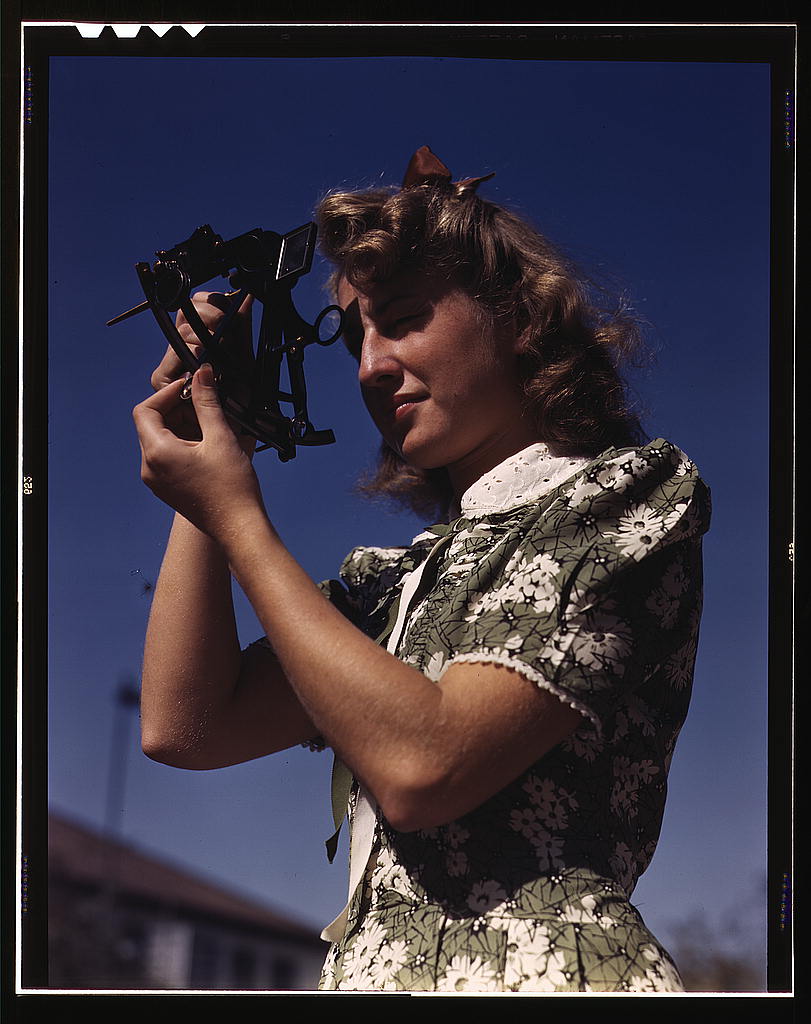
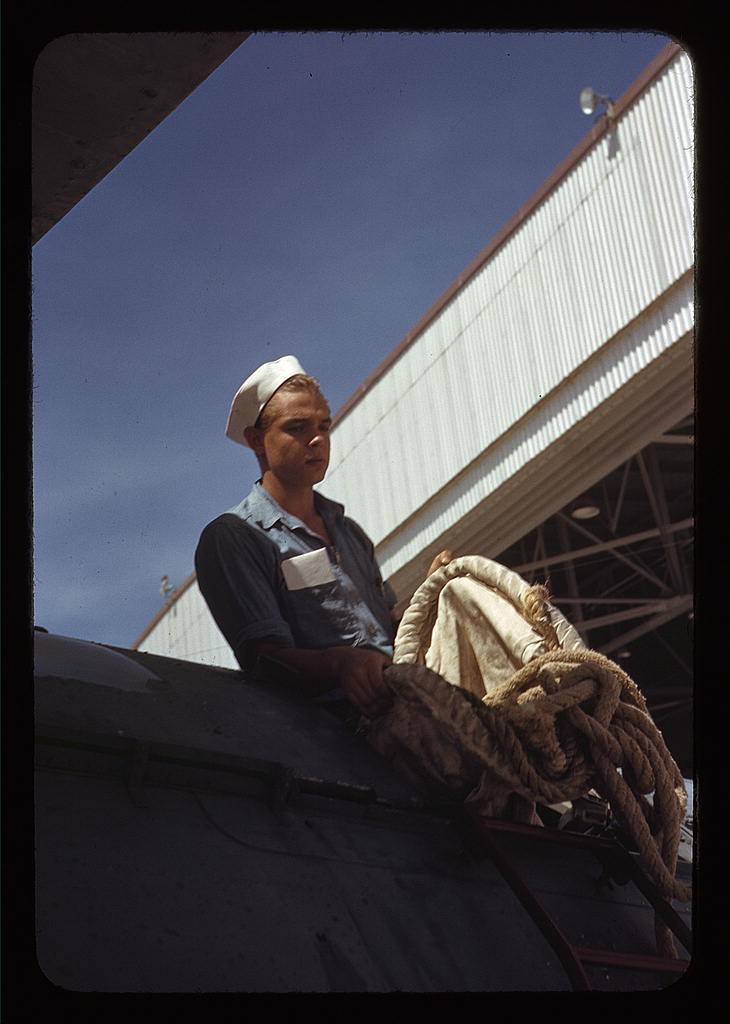
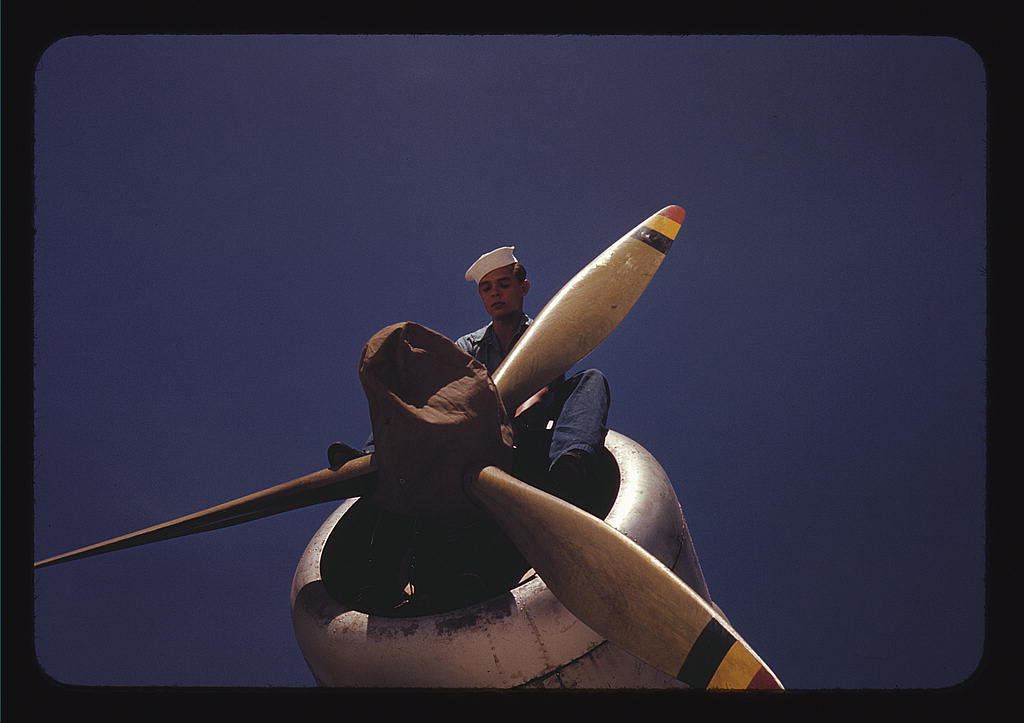
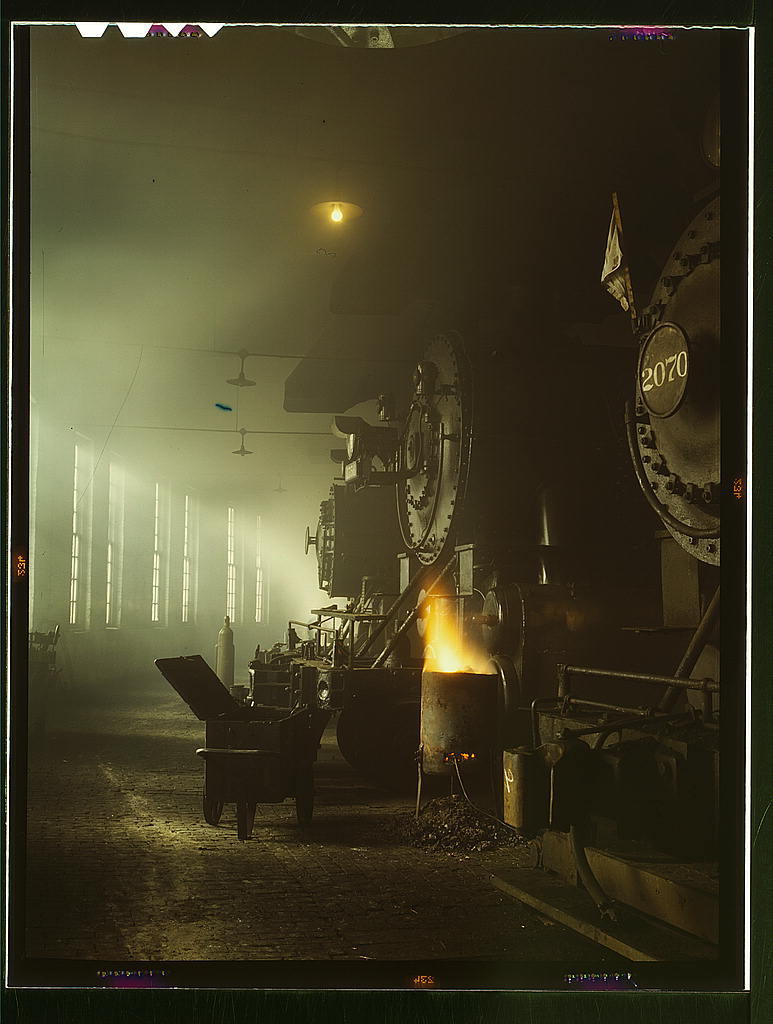
Here are some more photos taken in 1942 by photographers in the US Office of War Information. They're part of the large collection being uploaded to Flickr by the Library of Congress. They're clearly works of propaganda, not journalism or personal reminiscence. They're also from a time when color photography was still relatively new. Color emulsions gave high quality images, but the film was very slow. With long shutter speeds, subjects had to remain motionless for a second or so and lighting had to be fairly intense.

Click images to view them full size. Do this; they're much better that way.

Caption: Palmer, Alfred T.,, photographer. Learning how to determine latitude by using a sextant is Senta Osoling, student at Polytechnic High School, Los Angeles, Calif. Navigation classes are part of the school's program for training its students for specific contributions to the war effort. 1942 Sept.

Caption: Palmer, Alfred T.,, photographer. M-4 tank crews of the United States, Ft. Knox, Ky. 1942 June

Caption: Hollem, Howard R.,, photographer. Sailor mechanic inspecting a PBY plane at the Naval Air Base, Corpus Christi, Texas. 1942 August

Caption: Hollem, Howard R.,, photographer. Mary Louise Stepan, 21, used to be a waitress. She has a brother in the air corps. She is working on transport parts in the hand mill, Consolidated Aircraft Corp., Fort Worth, Texas. 1942 Oct.

Caption: Hollem, Howard R.,, photographer. Painting the American insignia on airplane wings is a job that Mrs. Irma Lee McElroy, a former office worker, does with precision and patriotic zeal. Mrs. McElroy is a civil service employee at the naval Air Base, Corpus Christi, Texas. Her husband is a flight instructor. 1942

Caption: Hollem, Howard R.,, photographer. Lathe operator machining parts for transport planes at the Consolidated Aircraft Corporation plant, Fort Worth, Texas. 1942 Oct.

Caption: Hollem, Howard R.,, photographer. This sailor mechanic is inspecting a PBY plane at the Naval Air Base in Corpus Christi, Texas. The ship had been reconditioned by the Civil Service employees at the Assembly and Repair Department in the base. 1942 August

Caption: Hollem, Howard R.,, photographer. Mrs. Eloise J. Ellis, senior supervisor in the Assembly and Repairs Dept. of the Naval Air Base, talking with one of the men, Corpus Christi, Texas. 1942 August

Caption: Hollem, Howard R.,, photographer. Lorena Craig is a cowler under civil service at the Naval Air Base, Corpus Christi, Texas. 1942 August

Caption: Delano, Jack,, 1914-, photographer. C & NW RR; locomotives in the roundhouse at Proviso yard, Chicago, Ill. 1942 Dec.

Caption: Delano, Jack,, 1914-, photographer. Melrose Park (near Chicago), Ill; C & NW RR; L. Logan, of West Chicago, boilermaker at the roundhouse at the Proviso yard. 1942 Dec.

Sunday, January 27, 2008

Capa and Taro

Robert Capa's war photographs are legendary. He has been the subject of much biographical writing and his photographs have been endlessly analyzed and appreciated. A Google image search turns up many gems. He has other photographic creds as well. Take for example this famous shot of Pablo Picasso and Françoise Gilot, taken in 1948.


Today, the New York Times reports on the recovery of many Capa negatives from his time as a partisan in the Spanish Civil War: The Capa Cache, by Randy Kennedy.

The article points out that Capa's companion Gerda Taro was an equally accomplished photojournalist during the mid-1930s. Like his, her life was full of action and as much at risk as the soldiers whom she photographed. Unlike his, her luck ran out all too quickly. She died in an accident leaving a battlefield in 1937. She had hitched a ride on a car by jumping onto its running board and died when a tank accidentally collided with the car.

The Times reproduces some of the best war photos of Capa-Taro in a slide show here.

Not long ago, a photojournalism magazine, The Digital Journalist, did a nice piece on the couple: Capa and Taro: Together at Last.

Here are some images from the article:


GERDA TARO: Republican militiawomen training on the beach outside Barcelona, Spain. August 1936.


ROBERT CAPA: Gerda Taro and soldier, Córdoba front, Spain. 1936.


GERDA TARO: Republican dinamiteros, Carabanchel neighborhood of Madrid, Spain. June 1937.


FRED STEIN: Gerda Taro and Robert Capa, Paris. 1935.


[Photographer Unknown]: GERDA TARO, Guadalajara front, Spain. July 1937.


GERDA TARO: Robert Capa, Segovia front, Spain. Late May-early June 1937.


[Unidentified Photographer]: Robert Capa holding his 35mm Contax on a Japanese tank captured at the Battle of Tai'erzhuang, Xuzhou Front, China. April 1938.

Here's a photo showing the Contax camera Capa used; click to view full size:


And a photo of the Leica 3f that Taro sometimes used (she also used a Rolleiflex):

Taro was born the same year my father was. He bought a very similar Leica during a trip to Germany in the early 1930s. As you can tell from her biography, his comfortable middle-class Manhattan life could hardly have been more different from her life as a left-wing militant in central- and western-Europe during that tumultuous time.

Clarissa, Waldo, and Tom

There are parallels and correspondences between Emerson's Brahma and Eliot's Burnt Norton, on the one hand, and Woolf's Mrs. Dalloway, on the other. They are tantalizing, but, unfortunately, they are not profound. Emerson tells us much that Woolf shows: the dispassion of a fully-realized life and the paradoxes that emerge from that realization: the collapsing of space and time and the temporary suspension of the compulsions of ego and id.

Burnt Norton's resemblance is not so superficial. The place from which the poem takes its name is something like Clarissa's Bourton, a manor house he once visited having an ethereal rose garden. Possessing uncannily similar names, both are in Gloucestershire and both are freighted with nostalgia of nearly Edenic intensity.

Both the poem and the novel have a circular structure, returning at end to the point of departure, though this is less obvious in the novel. Both use the imagery of time to convey esoteric meaning: the flow of time; the experience of past, present and future; the illumination that accompanies a release from the confinement imposed by time. For both the word that best describes the enlightened state is love, not of physical desire, but a metaphysical acceptance of all and everything -- good and bad, important and trivial, handsome and ugly, permanent and transient. Both evoke nonexistence as counterpoint to the physical world, what Eliot calls the still point in the gap between un-being and being.

The big difference is one of religious faith. Eliot's point of view is entirely Christian, his faith in redemption and eternal life. Woolf neither accepts nor denies religious faith. It, like everything else, is part of life, but is not life itself. Woolf's point of view is more complex. She gives us the minute details of each living moment to treasure. She gives us our lives to live, fully if we can, but without any certainties, lacking all permanence, and having no freedom from doubt. Woolf's imagery deals with unfathomable nature -- that of oceans, skies, and piercing light -- and also much natural beauty -- of trees, gardens, and bounteous flowers. Her essential theme, I believe, is the peculiar courage that can face up to aboriginal fear -- fear of non-being, fear of death -- and, having allowed ourselves to exerience this deep amorphous dread, do more than survive, ourselves shine forth in fully-realized humanity. This is very different from Eliot's vision of purification, perfection, and spiritual unity.

Early in Mrs. Dalloway, Clarissa decides she should mend her dress. Woolf uses the dress itself, her acquisition of it, the maker, and its need for repair to show us Clarissa's compassion, ability to live life as it is, and potential to experience fear -- existential dread I would say -- as a necessary part of life. Using fairly complex imagery it's possible also that in this passage Woolf intimates Clarissa's capacity for enlightenment, the epiphany Clarissa will experience at the end of the novel which will reveal her fully to us as existential heroine, transformed but still present ("there she was") and still the person who will do for herself that she was at the outset.

Here is the passage:
Quiet descended on her, calm, content, as her needle, drawing the silk smoothly to its gentle pause, collected the green folds together and attached them, very lightly, to the belt. So on a summer’s day waves collect, overbalance, and fall; collect and fall; and the whole world seems to be saying “that is all” more and more ponderously, until even the heart in the body which lies in the sun on the beach says too, That is all. Fear no more, says the heart. Fear no more, says the heart, committing its burden to some sea, which sighs collectively for all sorrows, and renews, begins, collects, lets fall. And the body alone listens to the passing bee; the wave breaking; the dog barking, far away barking and barking.

Here's Emerson's poem. It's one of only a handful of really good ones that he wrote during his long lifetime and it first appeared in the very first issue of The Atlantic Monthly in November 1857.
Brahma
by Ralph Waldo Emerson

If the red slayer think he slays,
Or if the slain think he is slain,
They know not well the subtle ways
I keep, and pass, and turn again.

Far or forgot to me is near,
Shadow and sunlight are the same,
The vanished gods to me appear,
And one to me are shame and fame.

They reckon ill who leave me out;
When me they fly, I am the wings;
I am the doubter and the doubt,
And I the hymn the Brahmin sings.

The strong gods pine for my abode,
And pine in vain the sacred Seven;
But thou, meek lover of the good!
Find me, and turn thy back on heaven.

Eliot's poem is widely available. An internet search turns up a number of locations where you can read Burnt Norton including this one.

He is the much greater poet; they are not in the same league at all. And Four Quartets, of which Burnt Norton is a part, is a masterpiece.

There's no intersection between the lives of Woolf and Emerson, of course, and no reason to expect that Woolf had more than passing interest in his poetry. Eliot, on the other hand, was more than an acquaintance of hers. She and Leonard published his poetry -- hand-setting it for printing at the Hogarth Press which they jointly ran. And Eliot is mentioned in her diaries, though it's not evident that his work had any influence on hers. Some anecdotes of Eliot and the Woolfs, along with a description of their early publishing business, is given here.

Saturday, January 26, 2008

Clarissa: existentialist heroine

I promised to revisit my essay on Clarissa Dalloway as existentialist heroine in the context of Lucio P. Ruolto's treatment of the same.

Ruotolo and I both draw upon the same existentialist pantheon to establish the boundaries and essence of the philosophy, including Kierkegaard, Sartre, and, more than anyone else, Heidegger. However, Ruotolo's main secondary source appears to be William Barrett's What Is Existentialism? whereas mine is Anthony Manser's article in the old Dictionary of the History of Ideas.

Ruotolo says explicitly what I imply, that Woolf's novel is extraordinary existentialist literature. Most works in the genre are pessimistic. They depict the mass of humankind as passive and tragically self-deceived. They depict life as an absurdly futile interval between the vacancy that precedes birth and the vacancy that succeeds death. They may have a main character who possesses innately, or works to achieve an ability to perceive all that's wrong, but they generally show this person as lonely victim of persecution -- an outcast.

Ruotolo points out that Clarissa Dalloway is unusual in that Woolf gives her an existential triumph, not of course by defeating adversaries but by permitting herself to confront and to respect the absurdity of life and the inevitability of death; to dislodge and examine her own personal strengths and weaknesses; and to closely observe both the superficial attributes and underlying foibles of others and to find within herself a unpassionate love for each in their full individuality.

Ruotolo shows us Clarissa's emerging self-realization partly, as I do, by revealing the incompleteness of the novel's other characters, but he does this much more thoroughly. On the other hand I more than he try to show the transformation which Clarissa undergoes during the course of the day. He brings in other writings of Virginia Woolf to explicate his thesis, particularly the Diary and a lecture she gave at Cambridge in 1924, Mr. Bennett and Mrs. Brown. I do not.

Ruotolo is more prudent than I in maintaining the boundaries of the frame we've chosen. He writes about Clarissa as existentialist hero and doesn't let his imagination wander on to the other pathways which lead to authentic living -- those of the religious mystics, Zen masters, and even Samurai warriors. Whereas I . . . . well to quote myself,
For me, Zen is existentialist. Its end product is overcoming dread of nothingness and of death by facing up to both. It is subjective practice aiming at a transcendent objectivity. It values the absurd and is enemy of complacency. Zen adepts are fully conscious of the choices they make; if there is self-deception among them, it is conscious self-deception.

And I use this amplified frame to show something Ruotolo doesn't bring out: that in the end, Clarissa, now enlightened -- in the Zen sense -- is back where she began. She has given herself time and space in which she can transform -- move gracefully from cherished memories of the past, through each precious moment of time in which she finds herself, into a future which is indetermined, but in which she knows she will be both different from whom she was time past and is time present, but also, paradoxically, the same. She is, that is to say, not transformed out of her life, but into it. Accepting this paradox is a heroic achievement, an existentialist triumph.

Ruotolo more than I stresses the presence Clarissa has attained. He uses the Heideggerian term "being there" to describe this and he closes his essay by emphasizing the importance of the phrase with which Woolf closes the novel:
Peter and Sally, however, are no less human by virtue of their inauthenticity. The fear that drives them to dominate others is stamped upon Clarissa's world and no doubt our own. If Peter has denied (more than once) the sanctity of the human heart by reducing Clarissa to "the perfect hostess," on other occasions he has responded to such mystery. Early in the book he describes the magical quality of her parties. Clarissa, he confesses, has "that extraordinary gift, that woman's gift, of making a world of her own wherever she happened to be." During her parties it was not what she did or said that one remembered but rather the extraordinary sense of her being there, "There she was" (pp. 114-115).

In the closing scene, as Clarissa moves from her small room toward Peter, her miraculous presence fills him once again with an undefinable sense of terror and ecstasy; reduced to wonder he can only exclaim: "It is Clarissa." The novel's last words, reiterating Peter's messianic invocation - "For there she was" - challenge each critic's effort to fathom Mrs. Dalloway. Is the statement a final irony - Peter's romantic affirmation of a presence that sustains his melancholy - or does the reader respond with similar apostolic fervor to Clarissa as being there in some special way? Since Virginia Woolf sought to portray the mysterious reality of character it is fitting that, finally, this question remains unanswered.


A few more differences as afterthought: (1) Ruotolo very nicely brings in support from Ludwig Wittgenstein:
Wittgenstein's Lecture on Ethics. The connection between Woolf and Wittgenstein is tenuous but Ruotolo says "In a letter dated July 28, 1965, Leonard Woolf informs me that although he and his wife did not know Wittgenstein well they spent some time with him when the philosopher stayed with Maynard Keynes in a house close to their own." (2) And also brings in support from Sigmund Freud. He says "Freud's late comments on the artist, quoted by Ernest Jones, seems particularly relevant: 'The artist, like the neurotic, had withdrawn from an unsatisfying reality into this world of imagination; but, unlike the neurotic, he knew how to find a way back from it and once more to get a firm foothold in reality.'" (3) I make more of the Shakespearean quote Fear no more the heat o' the sun. (4) He does not point out as I do that Clarissa, in counterpoint to the fearful sun, is a radiant being (Clarissa = "clear," "bright," "famous").

1942 again

A short time ago I noted that the Library of Congress has posted photos to a flickr page and I reproduced some photos from that collection from my birth year, 1942. The LC initiative has become very popular, eliciting this statement from an archivist at the National Museum of Health and Medicine:
The National Museum of Health and Medicine has been uploading pictures to Flickr since September 2006. We've transcribed, of course, all information that we have for each picture, but have also been posting some for which we have relatively little information, such as LC is doing, with the hope that a Flickr user will recognize them and be able to tell us more.We've been uploading the hard way, mostly one picture at a time, choosing from among the several hundred thousand we've been digitizing over the last three years. Until that database goes live, this is our way of sharing our favorite photos from our many collections. You can see our photos at:
- http://www.flickr.com/photos/99129398@N00,
- http://www.flickr.com/photos/7438870@N04/,
- and http://www.flickr.com/photos/22719239@N04/


That said, here are photos tagged "1942" from the NMHM collections on flickr. As usual, click image to view full size.


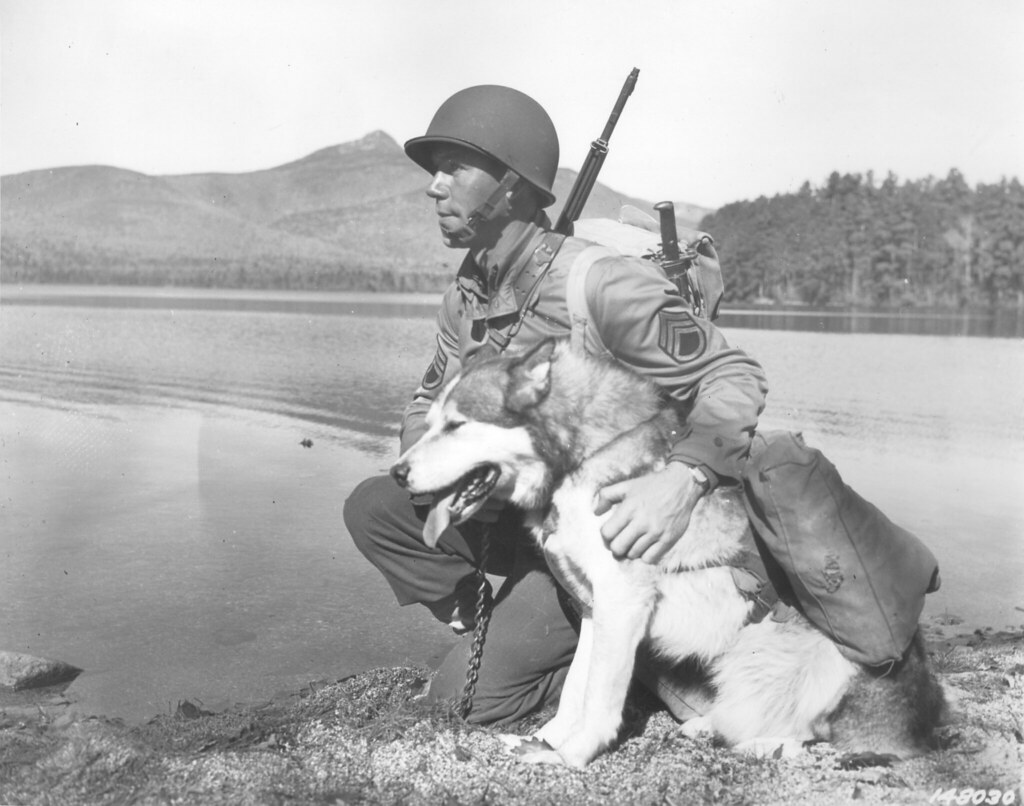
Caption: Chinook Kennels for U.S. Army dogs, New Hampshire... S/Sgt. Stanley Kovak, stops with his dog for a short rest. 1942.


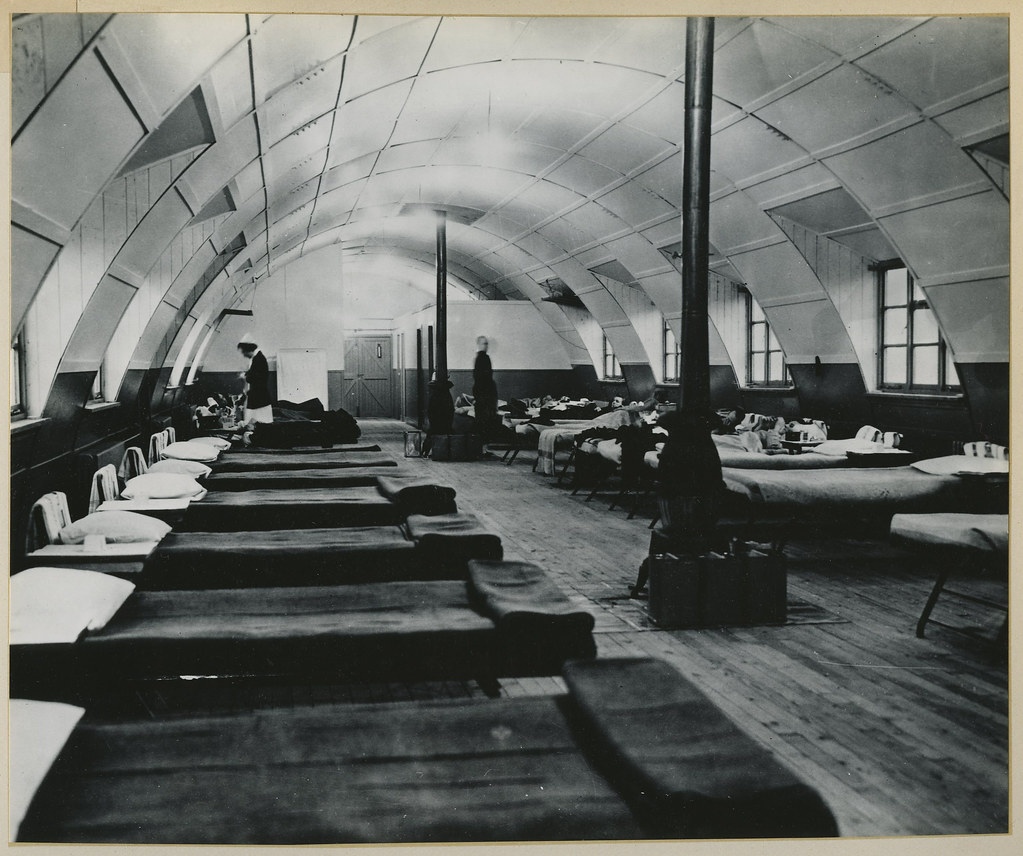
Caption: One of the wards at a U.S. Army Station Hospital in Iceland. Nurses, doctors and linen rooms are located in the back. November 25, 1942.


Caption: Army Medical Museum. Main exhibit hall. 1942.

Friday, January 25, 2008

Clarissa's party

Mrs. Dalloway has many poetic sections whose meaning must be picked out, hesitantly interpreted. The novel comes close to its swing point when Clarissa recognizes that, after all and once again, she's created space, via one of her parties, for people to reach outside themselves and see their lives, briefly and tentatively, in a new frame of reference.

The words she uses to describe this recognition are puzzling. Clarissa knows all is well only when Ralph Lyon beats back the curtain. Ralph Lyon is just a name; he has no significance outside this one action. The curtain is in the drawing room. Woolf has already told us about it while Ellie Henderson is asserting her right to wallflowerdom: "Gently the yellow curtain with all the birds of Paradise blew out and it seemed as if there were a flight of wings into the room, right out, then sucked back. (For the windows were open.)"

Here's the block of text for the moment, later in the party, when Ralph Lyon beats back the curtain:
The curtain with its flight of birds of Paradise blew out again. And Clarissa saw—she saw Ralph Lyon beat it back, and go on talking. So it wasn’t a failure after all! it was going to be all right now—her party. It had begun. It had started. But it was still touch and go. She must stand there for the present. People seemed to come in a rush.

Colonel and Mrs. Garrod . . . Mr. Hugh Whitbread . . . Mr. Bowley . . . Mrs. Hilbery . . . Lady Mary Maddox . . . Mr. Quin . . . intoned Wilkin. She had six or seven words with each, and they went on, they went into the rooms; into something now, not nothing, since Ralph Lyon had beat back the curtain.

And yet for her own part, it was too much of an effort. She was not enjoying it. It was too much like being—just anybody, standing there; anybody could do it; yet this anybody she did a little admire, couldn’t help feeling that she had, anyhow, made this happen, that it marked a stage, this post that she felt herself to have become, for oddly enough she had quite forgotten what she looked like, but felt herself a stake driven in at the top of her stairs. Every time she gave a party she had this feeling of being something not herself, and that every one was unreal in one way; much more real in another. It was, she thought, partly their clothes, partly being taken out of their ordinary ways, partly the background, it was possible to say things you couldn’t say anyhow else, things that needed an effort; possible to go much deeper. But not for her; not yet anyhow.

{Not Clarissa's curtain, but nice.}

Thursday, January 24, 2008

Clarissa Dalloway: Existential Heroine

Mrs. Dalloway continues to occupy my mind. Though there's a vast amount of scholarly output on the book, until today I'd been able to find only a few passing references to its existential nature. What I found today is an excellent little book called Six Existentialist Heroes, by Lucio Ruotolo. Since it's contents are not web-accessible, it took me a little extra effort to discover that Clarissa Dalloway is one of Ruotolo's heroes. (I borrowed a copy in the library where I work after seeing a reference to it in an academic journal; the reference didn't mention Clarissa or Existentialism, but the context made me suspect it would be worthwhile taking a look at the book.)

I'll write about the content of the chapter in another post. For now, here's some information about the author, written in appreciation following his death a few years back. Note that his treatment of Clarissa as Existential Hero almost didn't appear in print.
Longtime professor Lucio Ruotolo, expert on Virginia Woolf, dies

Stanford Report, July 23, 2003

extract: Lucio Ruotolo, a professor emeritus of English whose work on Virginia Woolf helped to cement her reputation as one of the great writers of the 20th century, died July 4 at Stanford Hospital. He was 76.

Woolf's Mrs. Dalloway is a subject of his award-winning first book, Six Existential Heroes: The Politics of Faith (Harvard University Press, 1973), in which he explores existentialism as a positive, life-embracing philosophy that can serve as a catalyst for change.

"The book grew out of the notion of a hero who develops in relation to a world he seeks to remedy," Ruotolo said in a 1983 interview with the News Service. "My object was to redefine the notion of an existential hero in more political terms. ... A recurring criticism of existentialism is its supposed disposition to pessimism, anarchy and disillusion -- that it remains essentially a destructive posture. I assume that the courage to raise the question 'If not something, why not nothing?' is linked to the capacity to suspend, at least provisionally, traditional solutions and to entertain often radically new procedures."

================


MEMORIAL RESOLUTION LUCIO RUOTOLO, Ph.D. (1927-2003)

extract: Lucio Ruotolo, a professor emeritus of English, died July 4, 2003, at Stanford Hospital, of complications following heart surgery. He was 76.

His first book, based in part on his dissertation, Six Existential Heroes: The Politics of Faith, contained a chapter on Woolf's novel, Mrs. Dalloway. A long-time friend recalls that he was pressured to exclude Woolf from the book because she was the only woman in the study and not highly regarded, but Ruotolo refused to back down. He even had to change his publisher in order to stick to his principles. The book won the Thomas J. Wilson Memorial Prize, awarded by the Harvard Board of Syndics.

Wednesday, January 23, 2008

presidential prevarications

A year ago The Atlantic printed an article by Carl M. Cannon, Untruth and Consequences, detailing presidential lies over the years. He says "Presidents prevaricate for the reasons other people do: pathology, politeness, paternalism, convenience, shame, self-promotion, insecurity, ego, narcissism, and even, on occasion, to further a noble goal," and he tells of Franklin Roosevelt's deception about the state of his health, quotes Churchill to Stalin: “In wartime, truth is so precious that she should always be attended by a bodyguard of lies,” and gives the following marvelous Lincoln anecdote:
Abraham Lincoln was said to have walked miles as an Illinois store clerk to return a few cents’ change. His “Honest Abe” nickname, which predated his presidency, was an advantage that his opponent Stephen Douglas tried to erase by calling him “two-faced.” (Lincoln’s response: “I leave it to [my audience]. If I had another face, do you think I’d wear this one?”)


{source: the Cannon article in the Atlantic}


Not long ago I did a post on the Watergate tapes and mentioned my evolving disillusionment about government truthfulness. Cannon recalls a couple of the incidents that brought about this loss of faith: Nixon's Watergate lies and the revelations in the tapes including Lyndon Johnson's admission to Robert McNamara that the Gulf of Tonkin incident was fabricated. He says,
By 1975, the year Saigon fell, 69 percent of Americans answered affirmatively to a poll question asking whether “over the last ten years this country’s leaders have consistently lied to the people.”
It's easy to find Presidents' lies on the internet. Just a few here:
"The world will note that the first atomic bomb was dropped on Hiroshima, a military base. That was because we wished in this first attack to avoid, insofar as possible, the killing of civilians."

"We did not--repeat, did not--trade weapons or anything else for hostages, nor will we"

"I did not have sexual relations with that woman, Miss Lewinsky."

"We are now threatened with a missile gap that leaves us in a position of potentially grave danger."

It's normal for full details of this mis-leadership by US administrations to appear long after the occasion for the lies. So it's no surprise that now, so many years afterwards, the press is giving extensive coverage to a study showing that the present administration put out hundreds of them during the months preceding the US attack on Iraq. Here's a link to the AP story:
Study: False statements preceded war by Douglass K. Daniel.

excerpts:

A study by two nonprofit journalism organizations ... concluded that the statements "were part of an orchestrated campaign that effectively galvanized public opinion and, in the process, led the nation to war under decidedly false pretenses."

The study counted 935 false statements in the two-year period. It found that in speeches, briefings, interviews and other venues, Bush and administration officials stated unequivocally on at least 532 occasions that Iraq had weapons of mass destruction or was trying to produce or obtain them or had links to al-Qaida or both.

"The cumulative effect of these false statements — amplified by thousands of news stories and broadcasts — was massive, with the media coverage creating an almost impenetrable din for several critical months in the run-up to war," the study concluded.


{AP Photo}

Monday, January 21, 2008

Miyamoto Musashi

Calligraphy and paintings by Miyamoto Musashi, who wrote A Book of Five Rings (Gorin no shô)

A cormorant, ink on paper
click image to view full size

A dragon (detail of a large painting)
click image to view full size


Horse
click image to view full size


The god, Hotei, contemplating two fighting cocks. Hotei is one of the gods of good fortune.
click image to view full size


The calligraphy on the left is Senki, the War Spirit. It reads, "The Moon in the cold stream like a mirror." The drawing on the right shows Daruma (Bodhidharma) the father of Zen Buddhism in China and Japan
click image to view full size


A shrike
click image to view full size


One side of a screen
click image to view full size


The other side
click image to view full size


Not by Miyamoto, but an imaginary depiction of what he might have looked like
click image to view full size


Also not by Miyamoto, this is the character Earth (or Ground) by Dr. K. Itoh (Earth is the first book in Five Rings)
click image to view full size


The character Void by Dr. K. Itoh (Void is the last book in Five Rings)
click image to view full size


Sources: About half the images are scans from the book. The others came from an image search. Ultimately, most are reproductions of works held by the Eisei Bunko museum in Tokyo (described here).

Sunday, January 20, 2008

Clarissa's day

I said that The Traveler and Mrs. Dalloway were less unlike that one might expect. Among their likenesses is an existential core which they share. In The Traveler this core is in plain sight; the novel is forthrightly speculative and its author sets out his thesis forthrightly: humans exist in a tragic, futile, passivity. Only a few adepts can break free of this anomie. They do this at great risk and their success does not lead to the power of social control, but only the power of self-realization. Between the unhappy mass of humans and the few enlightened warriors, the author places a third body -- an evil order of men that abuses technology to impose its twisted will on humanity. The plot is driven by the unequal contest between the sword-carrying warriors and the steel-willed devils having immense resources at their command.

Virginia Woolf is both less direct and more satisfying in showing us a life well-lived.

She lets her characters speak to us, shows them to us from the inside. Each makes individual response to the fundamental challenges of life. And together their individual struggles help the reader see the surprising fullness of the life of the central character. It's fitting that this central character, a Mrs. Dalloway, is gradually shown to be Clarissa, a woman who, having her own light, fears not the heat of the sun.

The incompleteness of other characters is made plain by absence: Richard and Elizabeth in simplicity, love of nature, and awkwardness among people; Doris Kilman in failure to respect her own self and false faith in salvation through religion; Peter Walsh in his dependence on others, in his awkwardness with his pocket knife as unacknowledged defensive weapon, and in a fickle inability to make right choices in life; Sally Walsh, charming like Peter, like him volatile, and more than him adventurous, not fickle in making choices, but too cowardly to make right choices all the same.

Septimus Smith shows more than others the fullness of life that Clarissa is eventually able to claim for herself. He cannot hide from knowledge of death, but he is overwhelmed by it and has lost his ability to experience emotion. He sees life as meaningless but cannot accept what he sees. Pursued by the only truly evil character in the book, his despair drives him to suicide, a violent, ugly, and disfiguring death.

Woolf shows us Mrs. Dalloway struggling to acknowledge the unfairness of life -- futile, mean, barren, and lonely -- and to use that knowledge to achieve a love beyond the love of individuals for other individuals, a love of humankind in all its flawed beauty. It is a love that transcends the shallowness of complacency (Hugh Whitbread's for example), accepts the inequity that makes life nasty, brutish, and short for many (the Armenians, or maybe it's the Albanians, for example), and does not judge the shortcomings of all others (forgives them for judging her). Clarissa, Woolf tells us, simply likes life. Speaking aloud to life itself she says "That's what I do it for." She comes to possess the most perfect ease as if she were a creature floating in its element; her dignity is inexpressible, her cordiality exquisite.

Struggling also to come to terms with fear of death. Mrs. Dalloway fears death, so the author tells us. Most of the characters fail to face this fear and of course Septimus is done in by it. Peter has thoughts of death but they are a component of his mood swings -- he does not face up to it, but fears and denies alternately.

Clarissa knows how it is certain we must die. Helped by her reaction to the odious Sir William Bradshaw, she is given the grace to overcome her dread. At the party which ends her day she thinks how that morning she had experienced her fear of death. She thinks, "there was the terror; the overwhelming incapacity, one’s parents giving it into one’s hands, this life, to be lived to the end, to be walked with serenely; there was in the depths of her heart an awful fear." Then, learning of the suicide of Septimus, she begins to come to terms with this terror. "Somehow [she thinks] it was her disaster — her disgrace. It was her punishment to see sink and disappear here a man, there a woman, in this profound darkness, and she forced to stand here in her evening dress. She had schemed; she had pilfered. She was never wholly admirable. She had wanted success. Lady Bexborough and the rest of it. And once she had walked on the terrace at Bourton."

Indirectly, Woolf lets us know the practice that Clarissa follows as her acknowledgment leads to acceptance. She views the death with sacrificial empathy. More than a scapegoat, Septimus becomes a token for the mortality of oneself and all humankind. Of course she knows that Golden lads and girls all must,/As chimney-sweepers, come to dust. But when she absorbs the news of Septimus's death, the event is not a topic for gossip or quick moralizing. In her emerging sense of self-awareness she sees the importance of death in the midst of life. She is not shocked and she does not pity him. As the novel comes to an end, of all the characters, she alone, in the fullness of her life, learns not to fear the heat of sun.

Woolf's recurrent images of ageless womankind help us see the connection Clarissa comes to make between her own individuality and all the individuals who were, are, and ever will be. Using these images of female presence, she indirectly reaffirms this connectedness, continuity, primal force.

• The beggar woman at Regent's Park tube station.
ee um fah um so
foo swee too eem oo
And rocks and creaks and moans in the eternal breeze.

Through all ages — when the pavement was grass, when it was swamp, through the age of tusk and mammoth, through the age of silent sunrise, the battered woman—for she wore a skirt — with her right hand exposed, her left clutching at her side, stood singing of love—love which has lasted a million years, she sang, love which prevails, and millions of years ago, her lover, who had been dead these centuries, had walked, she crooned, with her in May; but in the course of ages, long as summer days, and flaming, she remembered, with nothing but red asters, he had gone; death’s enormous sickle had swept those tremendous hills, and when at last she laid her hoary and immensely aged head on the earth, now become a mere cinder of ice, she implored the Gods to lay by her side a bunch of purple-heather, there on her high burial place which the last rays of the last sun caressed; for then the pageant of the universe would be over.

• Old Miss Parry who is dead and not. Here is how Richard renders her:
There was old Miss Parry, her aunt.

For Miss Helena Parry was not dead: Miss Parry was alive. She was past eighty. She ascended staircases slowly with a stick. She was placed in a chair (Richard had seen to it). People who had known Burma in the ‘seventies were always led up to her. Where had Peter got to? They used to be such friends. For at the mention of India, or even Ceylon, her eyes (only one was glass) slowly deepened, became blue, beheld, not human beings—she had no tender memories, no proud illusions about Viceroys, Generals, Mutinies—it was orchids she saw, and mountain passes and herself carried on the backs of coolies in the ‘sixties over solitary peaks; or descending to uproot orchids (startling blossoms, never beheld before) which she painted in water-colour; an indomitable Englishwoman, fretful if disturbed by the War, say, which dropped a bomb at her very door, from her deep meditation over orchids and her own figure journeying in the ‘sixties in India—but here was Peter.

• The old woman in the building opposite. Here is Clarissa's epiphany on this woman:
She [Clarissa] walked to the window.

It held, foolish as the idea was, something of her own in it, this country sky, this sky above Westminster. She parted the curtains; she looked. Oh, but how surprising!—in the room opposite the old lady stared straight at her! She was going to bed. And the sky. It will be a solemn sky, she had thought, it will be a dusky sky, turning away its cheek in beauty. But there it was—ashen pale, raced over quickly by tapering vast clouds. It was new to her. The wind must have risen. She was going to bed, in the room opposite. It was fascinating to watch her, moving about, that old lady, crossing the room, coming to the window. Could she see her? It was fascinating, with people still laughing and shouting in the drawing-room, to watch that old woman, quite quietly, going to bed. She pulled the blind now. The clock began striking. The young man had killed himself; but she did not pity him; with the clock striking the hour, one, two, three, she did not pity him, with all this going on. There! the old lady had put out her light! the whole house was dark now with this going on, she repeated, and the words came to her, Fear no more the heat of the sun. She must go back to them. But what an extraordinary night! She felt somehow very like him — the young man who had killed himself. She felt glad that he had done it; thrown it away. The clock was striking. The leaden circles dissolved in the air. He made her feel the beauty; made her feel the fun. But she must go back. She must assemble. She must find Sally and Peter. And she came in from the little room.

What has Mrs. Dalloway done? She has ended where she began, as Clarissa, but grown and changed as the day extended into evening and night.

How is this existential? The poetic force of Woolf's writing makes this now seem a trivial question.

Still, Mrs. Dalloway -- Clarissa -- has achieved what was given to the great medieval mystics to achieve, what the Yogi's seek, what Zen masters sit endlessly to become, what Samurai swordsmen trained for: she has allowed herself to become an authentic being. She is lover of life. She has discovered the gift which others lack. As Woolf says it is to exist, to be, not needing to add, to exist wholly, to be authentically human.

And she has done this as Heidegger says we must: First by asserting her individuality, e pluribus unum; a full realization that each of us is essential. The all that we call the world cannot exist without us, each person an own individual self. Second by absorbing and rising above the full busyness of life with its trivialities, its work-of-the-world, its tedious, meaningless, futility; by transcending the ordinary without denying it. Third by facing up to the twin dread of emptiness and death; experiencing the blank void where nothing exists and fully accepting that death is an essential feature of life. Though traditionally the process of overcoming fear of emptiness and death is depicted as descent in to the dark and return to light, experiencing the dark night of the soul and welcoming the morning sun as enlightened adept, Clarissa -- life-lover, whose symbols are floral and who famously will buy her own flowers -- she fears no more the heat of the sun. She is, I think Woolf is saying, her own brightness, not a helpless creature whom the universe overwhelms by its unimaginable immensity, but her own fully-realized authentic self.

I wish to give the last word not to Heidegger (who possessed much of Sir William's odiousness) but to Miyamoto Musashi and those other adepts who teach that the end brings you back to the beginning. As Musashi's translator says: "The first technique is the last, the beginner and the master behave in the same way. Knowledge is a full circle." This is Clarissa's story. In the 24 hours of one particular day she has realized her life in its timeless fullness and unique individuality. She has ended where she began. Coming full circle, she is not the same self, but a fully-realized instance of the same.


Sources: All my Dalloway quotes come from an online edition. My source for Musashi is the Overlook Press edition.