Sunday, January 17, 2010

nothing to wear

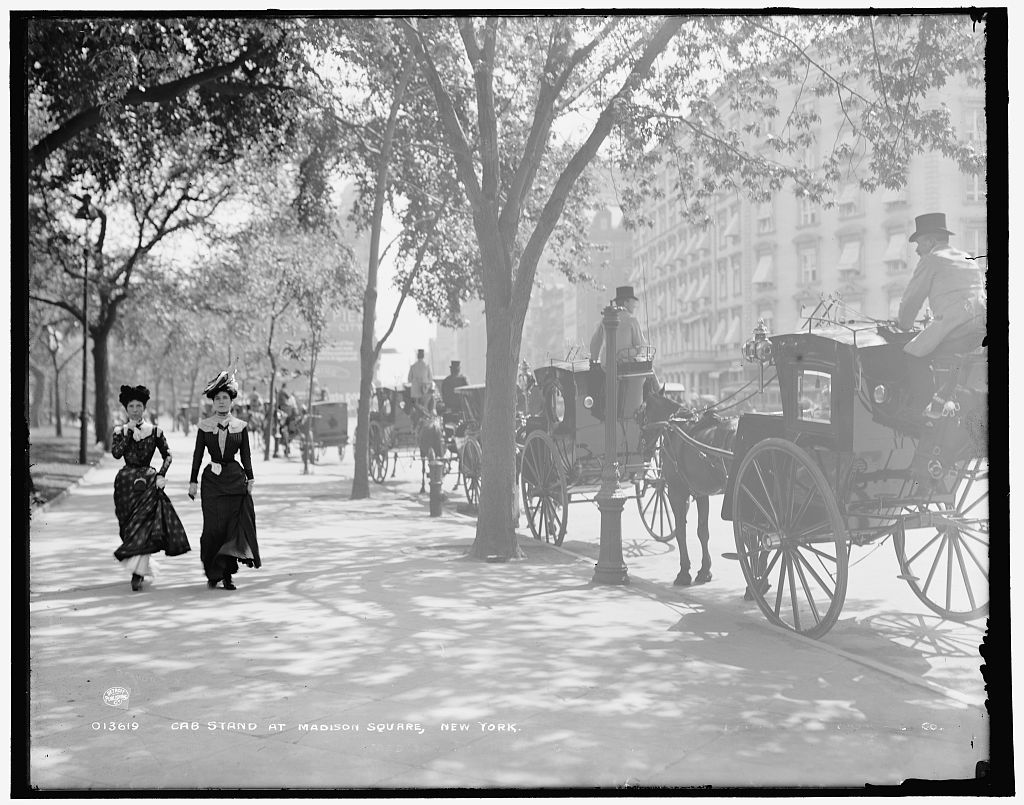
Two young women stroll by a line of waiting hansom cabs. They're headed north on the east side of Madison Square in New York City. It's a spring morning in the year 1900.


{Caption: cab stand at Madison Square, New York, ca. 1900; source: Detroit Publishing Co. collection in the Library of Congress}


{A detail of the same photo}

The other day, when I found this image of these fashionable ladies in this fashionable park, I also found a predecessor, the fictional "Miss Flora McFlimsey of Madison Square" whose complaint is that she has "nothing to wear."

This drawing of Miss Flora appears on the title sheet of a poem, Nothing To Wear. An Episode Of City Life, which first saw life in the issue of Harper's Weekly for February 7, 1857. Its author, William Allen Butler, satirizes the shallow life of a spoiled young lady who had a closet full of clothes but, she tells us, nothing to wear.1


{Image source: assumption.edu}

Flora McFlimsey soon became a celebrity and by 1863, when this next illustration appeared, her elegance and self-regard are both readily apparent.


{Miss Flora McFlimsey in 1863, from Leslie's Illustrated Newspaper; source: assumption.edu}

The poem begins:
Miss Flora McFlimsey, of Madison Square,
Has made three separate journeys to Paris,
And her father assures me, each time she was there,
That she and her friend Mrs. Harris
(Not the lady whose name is so famous in history,
But plain Mrs. H., without romance or mystery)2
Spent six consecutive weeks without stopping
In one continuous round of shopping, —
Shopping alone, and shopping together,
At all hours of the day, and in all sorts of weather, —
For all manner of things that a woman can put
On the crown of her head or the sole of her foot,
Or wrap round her shoulders, or fit round her waist,
Or that can be sewed on, or pinned on, or laced,
Or tied on with a string, or stitched on with a bow,
In front or behind, above or below;
For bonnets, mantillas, capes, collars, and shawls;
Dresses for breakfasts and dinners and balls;
Dresses to sit in and stand in and walk in;
Dresses to dance in and flirt in and talk in;
Dresses in which to do nothing at all;
Dresses for winter, spring, summer, and fall;
All of them different in color and pattern,
Silk, muslin, and lace, crape, velvet, and satin,
Brocade, and broadcloth, and other material,
Quite as expensive and much more ethereal;
In short, for all things that could ever be thought of,
Or milliner, modiste, or tradesman be bought of,
From ten-thousand-francs robes to twenty-sous frills;
In all quarters of Paris, and to every store,
While McFlimsey in vain stormed, scolded, and swore,
They footed the streets, and he footed the bills.

Here are some illustrated excerpts from the rest of the poem:3

I should mention just here, that out of Miss Flora's
Two hundred and fifty or sixty adorers,
I had just been selected as he who should throw all
The rest in the shade, by the gracious bestowal
On myself, after twenty or thirty rejections,
Of those fossil remains which she called "her affections,"
And that rather decayed, but well-known work of art,
Which Miss Flora persisted in styling "her heart."
So we were engaged. Our troth had been plighted,
Not by moonbeam or starbeam, by fountain or grove,
But in a front parlor, most brilliantly lighted,
Beneath the gas-fixtures we whispered our love.
Without any romance, or raptures, or sighs,
Without any tears in Miss Flora's blue eyes,
Or blushes, or transports, or such silly actions,
It was one of the quietest business transactions,
With a very small sprinkling of sentiment, if any,
And a very large diamond imported by Tiffany.
On her virginal lips while I printed a kiss.
She exclaimed, as a sort of parenthesis,
And by way of putting me quite at my ease,
"You know, I'm to polka as much as I please,
And flirt when I like—now stop, don't you speak —
And you must not come here more than twice in the week,
Or talk to me either at party or ball,
But always be ready to come when I call
So don't prose to me about duty and stuff.
If we don't break this off, there will be time enough
For that sort of thing; but the bargain must be
That, as long as I choose, I am perfectly free,
For this is a sort of engagement, you see,
Which is binding on you but not binding on me."

I found her, — as ladies are apt to be found,
When the time intervening between the first sound
Of the bell and the visitor's entry is shorter
Than usual, — I found — I won't say, I caught her, —
Intent on the pier-glass, undoubtedly meaning
To see if perhaps it didn't need cleaning.
She turned as I entered, — "Why, Harry, you sinner,
I thought that you went to the Flashers' to dinner!"
"So I did," I replied; "but the dinner is swallowed
And digested, I trust, for 'tis now nine and more,
So being relieved from that duty, I followed
Inclination, which led me, you see, to your door;
And now will your ladyship so condescend
As just to inform me if you intend
Your beauty and graces and presence to lend
(All of which, when I own, I hope no one will borrow)
To the Stuckups', whose party, you know, is to-morrow?"
The fair Flora looked up with a pitiful air,
And answered quite promptly, "Why, Harry, mon cher,
I should like above all things to go with you there;
But really and truly — I've nothing to wear."

"Then wear," I exclaimed, in a tone which quite crushed
Opposition, "that gorgeous toilette which you sported
In Paris last spring, at the grand presentation,
When you quite turned the head of the head of the nation;
And by all the grand court were so very much courted."
The end of the nose was portentously tipped up,
And both the bright eyes shot forth in dignation,
As she burst upon me with the fierce exclamation,
"I have worn it three times at the least calculation,
And that and the most of my dresses are ripped up!"
Here I ripped out something, perhaps rather rash,
Quite innocent, though; but, to use an expression
More striking than classic, it "settled my hash,"
And proved very soon the last act of our session.
"Fiddlesticks, it is, sir? I wonder the ceiling
Doesn't fall down and crush you — oh! you men have no feeling;
You selfish, unnatural, illiberal creatures,
Who set yourselves up as patterns and preachers,
Your silly pretense, — why, what a mere guess it is!
Pray, what do you know of a woman's necessities!
I have told you and shown you I've nothing to wear,
And it's perfectly plain you not only don't care,
But you do not believe me" (here the nose went still higher).
"I suppose, if you dared, you would call me a liar.
Our engagement is ended, sir — yes, on the spot;
You're a brute and a monster, and—I don't know what."

Well, I felt for the lady, and felt for my hat, too,
Improvised on the crown of the latter a tattoo,
In lieu of expressing the feelings which lay
Quite too deep for words, as Wordsworth would say;
Then, without going through the form of a bow,
Found myself in the entry — I hardly knew how, —
On doorstep and sidewalk, past lamp-post and square,
At home and up stairs, in my own easy-chair;
Poked my feet into slippers, my fire into blaze,
And said to myself, as I lit my cigar,
Supposing a man had the wealth of the Czar
Of the Russias to boot, for the rest of his days,
On the whole, do you think he would have much to spare,
If he married a woman with nothing to wear?"

Since that night, taking pains that it should not be bruited
Abroad in society, I've instituted
A course of inquiry, extensive and thorough,
On this vital subject, and find, to my horror,
That the fair Flora's case is by no means surprising,
But that there exists the greatest distress
In our female community, solely arising
From this unsupplied destitution of dress,
Whose unfortunate victims are filling the air
With the pitiful wail of "Nothing to wear."

Researches in some of the "Upper Ten" districts
Reveal the most painful and startling statistics,
Of which let me mention only a few:
In one single house, on Fifth Avenue,
Three young ladies were found, all below twenty-two,
Who have been three whole weeks without anything new

But the choicest assortment of French sleeves and collars
Ever sent out from Paris, worth thousands of dollars,
And all as to style most recherche and rare,
The want of which leaves her with nothing to wear,
And renders her life so drear and dyspeptic
That she's quite a recluse, and almost a sceptic;
For she touchingly says that this sort of grief
Cannot find in Religion the slightest relief,
And Philosophy has not a maxim to spare
For the victims of such overwhelming despair.
But the saddest by far of all these sad features
Is the cruelty practised upon the poor creatures
By husbands and fathers, real Bluebeards and Timons,
Who resist the most touching appeals made for diamonds
By their wives and their daughters, and leave them for days
Unsupplied with new jewelry, fans, or bouquets,
Even laugh at their miseries whenever they have a chance,
And deride their demands as useless extravagance;
One case of a bride was brought to my view,
Too sad for belief, but, alas! 'twas too true,
Whose husband refused, as savage as Charon,
To permit her to take more than ten trunks to Sharon.
The consequence was, that when she got there,
At the end of three weeks she had nothing to wear,
And when she proposed to finish the season
At Newport, the monster refused out and out,
For his infamous conduct alleging no reason,
Except that the waters were good for his gout.
Such treatment as this was too shocking, of course,
And proceedings are now going on for divorce.

Oh ladies, dear ladies, the next sunny day
Please trundle your hoops just out of Broadway,
From its whirl and its bustle, its fashion and pride,
And the temples of Trade which tower on each side,
To the alleys and lanes, where Misfortune and Guilt
Their children have gathered, their city have built;
Where Hunger and Vice, like twin beasts of prey,
Have hunted their victims to gloom and despair;
Raise the rich, dainty dress, and the fine broidered skirt,
Pick your delicate way through the dampness and dirt,
Grope through the dark dens, climb the rickety stair
To the garret, where wretches, the young and the old,
Half-starved, and half-naked, lie crouched from the cold.
See those skeleton limbs, those frost-bitten feet,
All bleeding and bruised by the stones of the street;
Hear the sharp cry of childhood, the deep groans that swell
From the poor dying creature who writhes on the floor,
Hear the curses that sound like the echoes of Hell,
As you sicken and shudder and fly from the door;
Then home to your wardrobes, and say, if you dare,—
Spoiled children of Fashion,—you've nothing to wear!
And oh, if perchance there should be a sphere
Where all is made right which so puzzles us here,
Where the glare and the glitter and tinsel of Time
Fade and die in the light of that region sublime,
Where the soul, disenchanted of flesh and of sense,
Unscreened by its trappings and shows and pretence,
Must be clothed for the life and the service above,
With purity, truth, faith, meekness, and love;
O daughters of Earth! foolish virgins, beware!
Lest in that upper realm you have nothing to wear!
---------

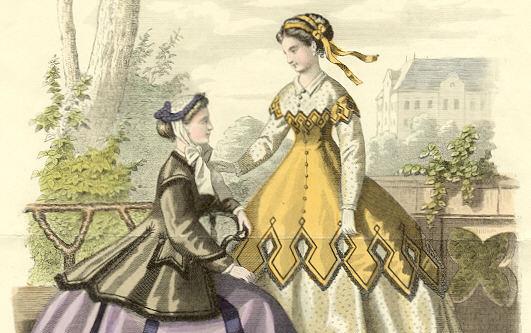
The hoop-skirt fashions of the middle of the nineteenth century drew some good-natured ridicule from cartoonists as well as moralists and satirical poets. This appeared in Frank Leslie's Illustrated Newspaper at mid-century.


The contrast with earlier fashion was obvious even to those who approved of the change, as these 1857 cartoons from Harper's Weekly demonstrate.


{From Harper's Weekly, 1857; source: dig.lib.niu}


{From Harper's Weekly, 1857; source: wikipedia}


A few other images of the fashions of the time:


{from Harper's Weekly, 1857; source: dig.lib.niu}

{Victorian fashion; source: koshka-the-cat.com}


{An illustration from 1859.}


{Painting by Federico de Madrazo}


-----------

See also:

Victorian Fashion- Dressing the Victorian Lady from the 1850s

The Mid Nineteenth Century

The lady's guide to perfect gentility, in manners, dress, and conversation ... also a useful instructor in letter writing by Emily Thornwell (Derby & Jackson, 1857)

1850s in fashion

Godey's Lady's Book illustrations from 1855-59

Dress of the 1850's

Madison Square Park

-------------

Notes:

1 Neither Miss Flora's picture nor Butler's name appeared in that February issue of Harper's Weekly. They are both together, as you see, on this reissue which appeared later the same year in Harper's sister magazine, the illustrated Monthly. William Allen Butler was a celebrated lawyer with a talent for humorous verse. The poem, which was an immediate success, appeared in book form before the year was out and appeared again repeatedly over the next few decades. As one source explains:
Butler, in his poem of "Nothing to Wear," made one of those hits which become immortal in literature. The inconsistency of a phrase so constantly heard in an age of extravagance, almost unexampled in history, give a point to the conventional miseries of Miss Flora McFlimsey, that drew laughter from all, even from the thousand copies of the great prototype. Few of our readers can fail to remember among the artistic beauties that covered the walls of the National Academy of Design, at its last exhibition, a charming "Nothing to Wear," from the pencil of Louis Lang. A painter of merit, and rapidly rising in the public esteem, he needs but time to assume a high rank among the artists of America. We present our readers with a copy of the beautiful piece to which we have alluded.

The figure of Miss Flora McFlimsey, amid the luxury of her boudoir, where all breathes of wealth, ancestral pride, and voluptuous ease, is charmingly conceived, and the chagrin on her fair brow, as gazing on her rich dress she is forced to confess that she has nothing to wear, is such a picture of real sorrow, that properly understood and appreciated, as it will doubtless be by our readers, it must move the sympathetic even to tears.
-- quoted from Leslie's Illustrated Newspaper, 1863

2 The Mrs. H. of romance and mystery was probably Sairey Gamp's imaginary friend in The life and adventures of Martin Chuzzlewit by Charles Dickens.
"Sairey" Gamp. She was a fat old woman, with a red face, a husky voice and a moist eye, which often turned up so as to show only the white. Wherever she went she carried a faded umbrella with a round white patch on top, and she always smelled of whisky. Mrs. Gamp was fond of talking of a certain "Mrs. Harris," whom she spoke of as a dear friend, but whom nobody else had ever seen. When she wanted to say something nice of herself she would put it in the mouth of Mrs. Harris. She was always quoting, "I says to Mrs. Harris," or "Mrs. Harris says to me." People used to say there was no such person at all, but this never failed to make Mrs. Gamp very angry. ... "Bother Mrs Harris," said Betsey Prig, "I don't believe there's no such person."
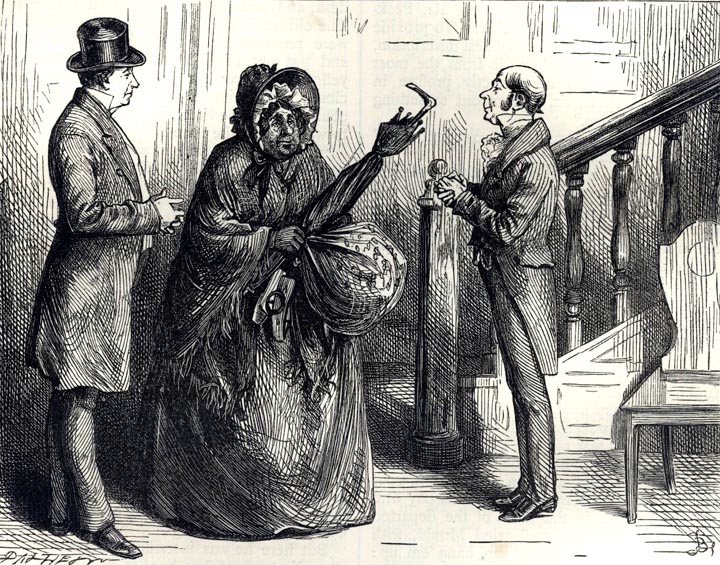

{"Well Mrs. Gamp, and how are 'you,' Mrs. Gamp?" said this gentleman, in a voice as soft as his step. Illustration by Fred Barnard for Dickens's Martin Chuzzlewit. [Pecksniff and the recently-engaged alcoholic nurse Sairey Gamp encounter the local undertaker, Mr. Mould.] source: victorianweb}

3 The illustrator is Augustus Hoppin and the pictures appear in Nothing to wear: an episode of city life: from Harpers weekly by William Allen Butler, illustrated by Augustus Hoppin (J. Bradburn, 1862)

Thursday, January 14, 2010

Madison Park 1905

This set of two photos shows the west side of Madison Square in New York City on a warm and sunny day in 1905. It was taken from the Flatiron Building, then only a couple of years old and known as the Fuller Building. Edward Steichen made a famous photo of this building the year before.*

The view is to the north up Broadway on the left and Fifth Avenue on the right.

The large building on the left side is the Fifth Avenue Hotel which stood there from 1859 to 1908.**

The tower in the second photo adorns the old Madison Square Garden.

The photographer worked for the Detroit Publishing Co. which was famous for large-format shots such as the ones you see below.


The two photos that make up this panorama come from collections of the Library of Congress Prints and Photos Division. Here they are in high resolution jpg files. Click to enlarge.


Here are details from the two photos.

1. In this detail we are looking up Broadway. The clock tells us that is near noon. By the shadows you can tell the sun is directly overhead indicating that this day is one near the summer solstice. June 21 fell on a Wednesday that year and this is was probably taken that day or maybe the one before or after it. The many (many) trolley cars are powered by electric lines running under the street between the rails. There are horse drawn wagons, hansom cabs, and carriages. A mounted policeman speaks with a sanding one. Traffic is orderly and seems to be moving at a leisurely pace. Pedestrians use the street as well as the sidewalks.


2. You can see a street clock more clearly in this detail. The street lamp is electric, converted from gas. In those days as this one, New Yorkers seemed to prefer to wear black over any other color. The ticket taker on one of the trolley cars is standing on the running board.


3. It's a breezy day. In these windows of the Fifth Avenue Hotel you can see that a curtain blown out of an open window and people have let the awning cords flop loose.


4. A man sits on the hotel balcony observing the street scene below. I expect others will join him as the afternoon wears on and the building's shadow offers some shade.


5. Below the man on the balcony there's a pith-helmeted sanitation worker dressed in white, one of a vast crew known as white wings. You can see many gents taking their liesure under the awning of the hat store and the columned portico of the hotel.


5. The building that separates Broadway from Fifth Avenue sports a whiskey ad; behind it you see the familiar Cross logo used to advertise apartments and chambers.


6. The building that sports the whiskey sign belongs to Berlitz, which advertises its English classes more than its foreign language ones. The monument in front of it honors General william Jenkins Worth.


7. There's a set of real estate offices in Berlitz Building and in one window a woman observing the scene in General Worth Square below.


8. This detail shows Fifth Avenue from 23rd Street north toward 34th. You can see a couple of trees on the north west corner of Madison Square and by them a small open motor car.


9. Near the monument the mounted policeman speaks with a colleague.


10. On the other side of the monument — on the wide expanse of pavement where Fifth Avenue splits off from Broadway — we see a bicyclist, motor hansom cab, delivery wagon, and sundry pedestrians.


11. A bit to the south, where Broadway crosses Fifth, we see another motor hansom and a most unusual trackless trolley.


12. This shows part of a wire fence which creates a traffic-free space at Broadway and Fifth, a kind of a cab rank it appears.


13. Here are lots more hansom cabs parked on the west side of Madison Square along with a white horse hitched to a delivery wagon.


14. A close-up of horse and wagon.


15. Many New Yorkers are enjoying a quite noontime moment in the park.


16. A woman pushes a baby pram through the park.


--------------

A bonus:

Here are two other photos of Madison Square taken at about the same time. The first was taken on a day very similar to the one on which the panorama photos were taken; the second was shot during a winter snowstorm. The camera is facing south down Fifth Avenue in both shots (hence hotel is on the right). Like the pano shots, the two are from the Detroit Publishing Co. collection in LC.


---------------

Notes:

* Here's a copy of this famous photo.

{The Flatiron Building in a photograph of 1904, taken by Edward Steichen; source: wikipedia}


Here are two other contemporary photos of the Fuller Building from LC.


** More on the Fifth Avenue Hotel:

{The Fifth Avenue Hotel when new in 1859; source: Old New York}


{An albumen print of the Fifth Avenue Hotel, from a stereoscopic pair of images taken sometime between 1859 and 1896; source: wikipedia}

Help Haiti

Here are some links on donating money to help Haiti. Most important tip, I think, is to give to an organization that already has a presence on the island and whose staff members are skilled in providing needed relief. I fear that millions of dollars in well-intended giving will worsen chaotic conditions there as other aid orgs show up and, in effect, tragically compete with ones already on the ground.

Here's a list of charities that have been helping Haitians and are prepared to use new funds responsibly. I got it from Daily Beast.
The Red Cross: You can give $10 to the Red Cross’s International Response Fund by texting HAITI to 90999. 100 percent of your donation benefits the Red Cross, and you can print a receipt through mGive, a foundation that helps non-profits take advantage of mobile technology.

UNICEF, the United Nations Fund focusing on children, has worked on the ground in Haiti since 1949, so has the expertise to make a difference. You can donate here.

Doctors Without Borders is also present in-country. One senior staff member reports, “The situation is chaotic. I visited five medical centers, including a major hospital, and most of them were not functioning.” Donate to support public health efforts here.

MADRE, the international women’s rights NGO, partners with the Zanmi Lasante Clinic on the ground in Haiti. “The most urgent needs right now are bandages, broad-spectrum antibiotics and other medical supplies, as well as water tablets to prevent cholera outbreaks,” MADRE reports. Donate here.

Action Against Hunger has had a team in Haiti since 1985, and is ready to fly planeloads of emergency supplies from Paris to Port-au-Prince. Food is one necessity, but so is sanitation; in some Haitian towns, 70 percent of homes do not have plumbing. Donate here.

Mercy Corps has a history of deploying aid to regions affected by catastrophic earthquakes, such as Peru in 2007, China and Pakistan in 2008, and Indonesia last year. They are deploying a team to Haiti, and you can support their efforts here.

Partners in Health is the NGO founded in Haiti in 1987 by Dr. Paul Farmer, the celebrated physician and anthropologist who focuses on international social justice. The group’s emergency response focuses on delivering medical supplies and staff. Louise Ivers, PIH’s clinical director in the country, sent the message, “Port-au-Prince is devastated, lot of deaths. SOS. SOS.” Donate here.

• The International Rescue Committee, which in the past has resettled Haitian refugees in the United States, is deploying an Emergency Response Team to assist overwhelmed local aid groups. It will focus on critical medical, water, and sanitation assistance. Donate here.
This list doesn't include any religious organizations and thus omits one that I respect. Catholic Relief Services has been in the country for more than 50 years and has a substantial presence there. Here is a link to the CRS online donation form. The CRS blog reports that you can donate from your mobile phone by texting RELIEF to 30644.

See also:
Aid Workers Scramble Amid Haiti’s Chaos

How to Make Sure Your Donation Helps Haitian Earthquake Victims

How To Spot Dubious Haiti Charity Pleas

Help the Victims of the Haiti Earthquake

How to Help Haiti

Wednesday, January 13, 2010

Elizabeth Barton

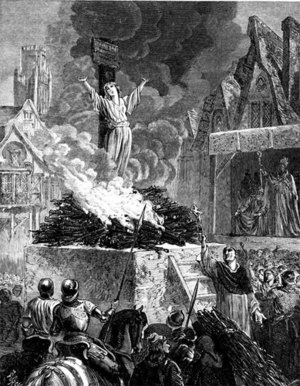
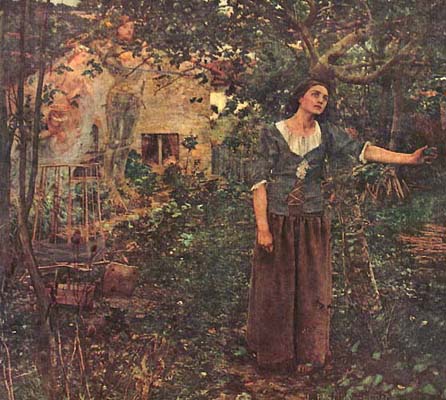
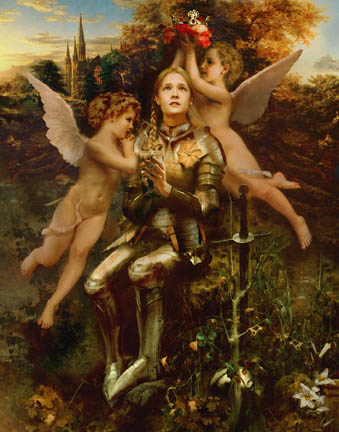
Yesterday I saw a review of yet another book on Joan of Arc. The book is The Virgin Warrior: The Life and Death of Joan of Arc by Larissa Juliet Taylor (Yale University Press, 320 pp., $30). The review is by David A. Bell in TNR. Do we need another book on this person? Truly the attention that has been paid to Joan over the centuries is excessive,1 but its quantity and persistence are hardly surprising. As a confident maiden warrior martyr, she was one of a kind. Her life was heroic and the tragedy of her unjust trial, conviction, and execution by public burning is heart-rending. The Medieval setting is a romantic one. Since no one knows what she looked like, the many varied images of Joan show not how she was but rather how we the public wish to see her.2

Bell's review gives some useful background:
While it was not altogether uncommon for teenage peasant girls in the late Middle Ages to have religious visions, it was rather more unusual for them to advise kings and lead armies into battle. From the moment the teenage Joan and her visions appeared at the French court in 1429, she attracted enormous attention, which only increased as she helped guide French forces to a string of victories over the English. This was followed by King Charles VII’s formal coronation — a decisive moment in the Hundred Years War. And then, in a stroke of excellent luck for her biographers (if not for Joan herself), she fell into the hands of the single institution that compiled more complete records of intimate lives than any in history up to that point: the Inquisition. In an effort to prove Joan guilty of heresy, the inquisitors interrogated her, and numerous witnesses, in remarkable detail about her actions, her visions, and her beliefs.
A full century after Joan's execution another maiden visionary was hung for treason. Although her life story is very different from Joan's, it was given a similar extensive record in contemporary court documents. She was Elizabeth Barton, called the Holy Maid, Mad Maid, or simply Nun of Kent. Although not nearly so popular as Joan, there are many accounts of Barton's exploits and it's interesting that, for all this extensive discussion,3 there's still some controversy about her.

The controversy concerns whether she was a true or false visionary. The evidence all points to the latter. Those who dispute it do not offer contrary evidence, but say existing records are biased. Here's the basic outline: As a young serving girl she had suffered hallucinations on recovering from a serious illness. She worked as one of the lowest servants in an archbishop's establishment and thus was constantly in contact with monks, priests, and other religious. Some of these men proved to be opportunistic and unscrupulous. They encouraged her to manufacture visions that served their own private interests and the interest of the Catholic Church in England.

The public record includes a copy of a statement Barton made on the scaffold as she was about to be hung for treason. It was too late to beg clemency and we can thus expect what she said to have been the truth as she saw it. Here's Gilbert Burnet's account of what she said:
Soon after that, on the 20th of April, the Nun, and [her accused accomplices] Docking, Master, Deering, Risby, and Gold (Rich is not named, being perhaps either dead or pardoned) were brought to Tyburn. The Nun spake these words: — "Hither I am come to die; and I have not been only the cause of mine own death, which most justly I have deserved, but also I am the cause of the death of all those persons, which at this time here suffer. And yet, to say the truth, I am not so much to be blamed, considering that it was well known to these learned men that I was a poor wench, without learning, and therefore they might easily have perceived that the things that were done by me could not proceed in no such sort; but their capacities and learning could right well judge, from whence they proceeded, and that they were altogether feigned; but because the thing that I feigned was profitable that the things that were done by me could not proceed in no such sort; but their capacities and learning could right well judge from whence they proceeded, and that they were altogether feigned; but because the thing which I feigned was profitable to them, therefore they much praised me, and bore me in hand, that it was the Holy Ghost, and not I, that did them; and then I, being puffed up with their praises, fell into a certain pride and foolish fantasy with myself, and thought I might feign what I would, which thing hath brought me to this case: and for other which now I cry God and the King's Highness most heartily mercy, and desire you all, good people, to pray to God to have mercy on me, and on all them that here suffer with me." 4
-- The history of the reformation of the Church of England, Volume 1 by Gilbert Burnet (Scott, Webster, & Geary, 1889)
The difficulty with this is that there is no independent verification; the person who disseminated it may simply have made it up. Still, the evidence that exists all points one way and those who deny it have little to offer.

In the novel Wolf Hall, about which I recently wrote, Hilary Martel shows her protagonist, Thomas Cromwell, to see Barton as an unfortunate whose delusions priests market to the credulous. He recalls hearing of her speaking in alien voices, her visions of the principal saints, and her reputation as a seer: telling people whether their dead relatives are in Heaven or Hell. He's heard that following an illness she began to suffer "spasms, torsions, and trances." She was accepted into a convent at Canterbury and the money then came rolling in. "There are cures," he says. "The lame walk, the blind see. Candles light by themselves. The pilgrims are thick upon the roads. Why do I feel I have heard this story before? She has a flock of monks and priests about her, who direct the people's eyes heavenward while picking their pockets."5

Barton's popularity brought wealth to her handlers but they wanted more; soon her voices began to tell her that King Henry VIII would die and go to Hell if he continued his quest to put aside Queen Katharine and marry Anne Bolene. Wikipedia puts it thus: "Around 1532 she began prophesying that if the King would remarry he would die shortly thereafter. (He would in fact live for 15 years.) Remarkably, Barton went unpunished for nearly a year, in large part because she appears to have been more popular than the King in many quarters.6 In fact, Barton was tried for treason only after supporters of the King had spread rumours that Barton was engaged in sexual relationships with her priests. Others asserted that Barton suffered from mental illness. With her reputation damaged, in 1533 the crown arrested her and forced Barton to make either a real confession or a fabricated one."7

A breakaway Anglican organization, the Anglican Catholic Church, considers Barton to be a holy martyr and one of its member churches has put up an icon to her memory:


-------------

Additional sources on Joan of Arc (see note 3 for sources on Elizabeth Barton): --------------

Notes:

1 A search of WorldCat turns up 10,417 works for the phrase "Joan of Arc". WorldCat contains 5,065 books with Joan of Arc as main subject and it contains 2,681 with Joan of Arc as title. Google has more than a couple million hits for the phrase.

2 The wikipedia article on Joan says the only portrait for which she is known to have sat has not survived. It gives this minature of c. 1485 as the earliest artist's interpretation.


There's a wikipedia article that discusses cultural depictions of Joan of Arc.

Here's a smattering of images taken from Google:

by an unknown artist, 20th century, found on theage.com


by Eugene Thirion in 1876 from maidofheaven.com


an early 19th c. engraving out of Le Brun de Charmette’s L’OrlĂ©anide poème national from columiba.edu


artist and date unknown, found on nndb.com


artist and date unknown, found on sott.net


artist and date unknown, found on nndb.com from the Isabell Dell collection at Pace University


an Impressionist work made in 1880 by Bastien-Lepage found on stjoan-center.com


by Howard David Johnson found on thejohnsongalleries.com


from a photoengraving by Mme. Zoe-Laure de Chatillon about 1880, found on about.com


by Jules-Eugène Lenepveu abuot 1890 found on powellhistory.com


at the Coronation of Charles VII
by Jean-Auguste-Dominique Ingres found on powellhistory.com


by Gaston Bussiere found on powellhistory.com


(It's not surprising these images generally show Joan looking upward. Depictions of women saints usually do. But, for me anyway, the convention conceals the feisty spirit that she undoubtedly possessed. Compare the upward glancing ones with those others shown above where she's look at or below the horizon -- or directly at the viewer.)

3 A search of WorldCat gives only a couple dozen works about the "Holy Maid of Kent" or variant sobriquets. Here are some web sources:
4 Compare a confession that Joan made and then retracted. First the confession:
Jeanne's Abjuration

"All those who have erred and been at fault in the Christian faith and have by God's grace returned to the light of truth and unity of Our Holy Mother Church, should vigilantly prevent the Enemy of Hell from driving them back and causing their relapse into error and damnation. Therefore, I, Jeanne, commonly called The Maid, a miserable sinner recognizing the snares of error in which I was held, and being by God's grace returned to Our Holy Mother Church, in order to show that my return is made not feignedly but with a good heart and will, I confess that I have most grievously sinned in falsely pretending to have had revelations and apparitions from God, His angels, St. Catherine and St. Margaret; in seducing others; in believing foolishly and lightly; in making superstitious divinations, in blaspheming God and His Saints; in breaking the divine law, Holy Scripture, and the canon laws; in wearing a dissolute, ill-shaped and immodest dress against the decency of nature, and hair cropped round like a man's, against all the modesty of womankind; also in bearing arms most presumptuously; in cruelly desiring the shedding of human blood; in declaring that I did all these things by the command of God, His angels and the said saints, and that to do so was good and not to err; in being seditious and idolatrous, adoring and calling up evil spirits. I confess also that I have been schismatic and in many ways have erred from the path: These crimes and errors, I, being by God's grace returned to the way of truth through the holy doctrine and good counsel of yourself and the doctors and masters whom you sent me, unfeignedly and with a good heart abjure and recant, renouncing and cutting myself off from them all. Upon all the aforesaid things I submit to the correction, disposition, amendment and entire decision of Our Holy Mother Church and of your good justice. And I vow, swear and promise to you, to my lord Saint Peter, Prince of the Apostles, to Our Holy Father the Pope of Rome, his vicar and his successors, to you, my lords, to the lord bishop of Beauvais and the religious brother Jean Le Maistre, vicar of the lord Inquisitor of the faith, my judges, that I will never through exhortation or other means return to the aforesaid errors, from which it has pleased God to deliver and remove me; but will always dwell in the unity of Our Holy Mother Church and the obedience of our Holy Father the Pope of Rome. This I say, affirm and swear by God almighty and the holy Gospels. In sign whereof I have signed this schedule with my mark."

Signed "Jehanne +."
-- The Trial of Joan of Arc
And the retraction:
Now because the said Jeanne was wearing a man's dress, a short mantle, a hood, a doublet and other garments used by men (which at our order she had recently put off in favor of woman's dress), we questioned her to find out when and for what reason she had resumed man's dress and rejected woman's clothes. Jeanne said she had but recently resumed man's dress and rejected woman's clothes.

Asked why she had resumed it, and who had compelled her to wear it, she answered that she had taken it of her own will, under no compulsion, as she preferred man's to woman's dress.

She was told that she had promised and sworn not to wear man's dress again, and answered that she never meant to take such an oath.

Asked for what reason she had assumed male costume, she answered that it was more lawful and convenient for her to wear it, since she was among men, than to wear woman's dress. She said she had resumed it because the promises made to her had not been kept, which were to permit her to go to Mass and receive her Saviour, and to take off her chains.

Asked whether she had not abjured and sworn in particular not to resume this male costume, she answered that she would rather die than be in chains, but if she were allowed to go to Mass, if her chains were taken off and she were put in a gracious prison [and were given a woman as companion], she would be good and obey the Church.

As we her judges had heard from certain people that she had not yet cut herself off from her illusions and pretended revelations, Which she had previously renounced, we asked her whether she had not since Thursday heard the voices of St. Catherine and St. Margaret. She answered yes.

Asked what they told her, she answered that they told her God had sent her word through St. Catherine and St. Margaret of the great pity of this treason by which she consented to abjure and recant in order to save her life; that she had damned herself to save her life. She said that before Thursday they told her what to do and say then, which she did. Further her voices told her, when she was on the scaffold or platform before the people, to answer the preacher boldly. The said Jeanne declared that he was a false preacher, and had accused her of many things she had not done. She said that if she declared God had not sent her she would damn herself, for in truth she was sent from God. She said-that her voices had since told her that she had done a great evil in declaring that what she had done was wrong. She said that what she had declared and recanted on Thursday was done only for fear of the fire.

Asked if she believed her voices to be St. Catherine and St. Margaret, she answered "Yes, and they came from God."

Asked to speak truthfully of the crown which is mentioned above, she replied: "In everything, I told you the truth about it in my trial, as well as I could."

When she was told that when she made her abjuration on the scaffold or platform before the judges and the people, she had admitted that she had falsely boasted that her voices were St. Catherine and St. Margaret, she answered that she did not mean to do or say so.

She said she did not deny or intend to deny her apparitions, that is that they were St. Catherine and St. Margaret; all that she said was from fear of the fire. She recanted nothing which was not against the truth. She said she would rather do penance once and for all, that is die, than endure any longer the suffering of her prison. She said that whatever they had made her deny she had never done anything against God or the faith: she did not understand what was in the formula of abjuration. She said she did not mean to revoke anything except at God's good pleasure. If the judges wished, she would once more wear woman's dress, but for the rest she would do no more.

After hearing these declarations we left her to proceed further according to law and reason.
-- same source


5 Wolf Hall, a novel by Hilary Mantel (Macmillan, 2009, p. 313 et seq)

6 Belief that Barton was truly a Holy Maid extended beyond the unlettered populace to men, such as the Archbishop of Canterbury, who held high positions in the church. Here is Archbishop Warham writing Cardinal Wolsey showing that he was disposed to take her seriously: "Pleace it your Grace, so it is that Elizabeth Barton, being a religious woman, professed in Saint Sepulcres in Canterbury, which had all the Visions at our Lady of Courtopscet, a very well disposyd and vertuouse woman (as I am enformyd by hir susters) is very desierouse to speke with your Grace personally. What she hathe to say, or whether it be good or yll, I do not know ; but she hath desyered me to write vnto your Grace and to desier the same (as I do) that she may come to your Grace's presence. Whom, when your Grace have harde, ye may ordre as shall please the same. For I assure your Grace she hath made very importune suit to me to be a meane to your Grace that she may speke with you. At Canterbery, the first day of October."
-- This Letter was probably written about 1528. [Stat. Pap. Off. Wolsey's Corresp. xvi. Supplem. 12. Orig.] Original Letters Illustrative of English History: To 1535

7 In this lengthy letter, Warham's successor, Archbishop Cranmer gives the Barton story as he understood it:
Archbishop Cranmer to a friend then upon an Embassy abroad, detailing the story of the Holy Maid of Kent.

Master Archedekyn in my right hartie wise I commende me vnto you. Theis be to assertayne you of such newis as be here nowe in fame amonges vs in Englande. And firste, ye shall understande that att Canterburye, within my Dioces, abowte viij. yers paste, ther was wrowght a great myracle in a mayde by the power of God and our Lady, named our Lady of Courte up stret, by reason of the whiche myracle ther is stablyshed a greate Pilgrymage, and ever syns many devoute people hath sowghte to that devout forsaid Lady of Curte of strett. The myracle was this. The mayde was taken with a grevous and continuall sykenes and in duryng her said sykenes she hadd dyuers and many transes, spekyng of many high and godly thyngs, tellyng also wonderously by the power of the Holy Goste (as it was thowghte) thyngs done and said in other placeis, wher as nether she was herself, nor yett harde no reporte therof. She had also in her transes many strange visions and reuelacions, as of Heven, Hell, and Purgatorye, and of the state of certeyne sowles departed, and amonges all other visions, one was that [she] shuld be conveyed to our Lady of Courte of strett, where she was promised to be heled of her sykenes, and that Almyghtie God shuld wourke wonders in her. And whan she was browghte theder and layde before the ymage of our Lady, her face was wonderfully disfigured, her tong hangyng owte, and her eyees beyng in a maner plucked owte and layd upon her cheks, and so greatly defored. Than was ther harde a voice spekyng within her belie as it hadd byn in a towne, her lippes not greatly movyng, she all that while contynewyng by the space of iij. howers and more in a traunce, the whiche voice whan it tolde any thyng of the joyes of Heven, it spake so swetlie and so hevenly that every man was ravysshed with the heryng therof; and contrary whan it told any thyng of hell, it spake so horrybly and terribly that it put the hearers in a great feare. Yt spake also many thyngs for the confirmacion of Pylgrimages and Trentalles, heryng of Masses, and Confession, and many such other thyngs. And after she hadd lyen there a long tyme, she cam to herself agayne, and was perfectly hole, and so this myracle was fynyshed and solemply ronge, and a boke written of all the hole storie therof, and puttinto prynte, which euer syns that tyme hath byn comonly sold and goone abrod amongs all people.

After this myracle doon, she hadd a comandement from God in a vision (as she said) to professe her self a Nune, and so she was professed, and hath so contynewed in a Nunrye at Canterburye called Saincte Sepulcres ever syns. And than she chose a Monke of Christes churche, a doctor in diuinitie, to be her goostly father, whose councell she hath used and evermore folowed in all her doyng. And evermore syns, frome tyme to tyme, hath hadd all moste euery weke, or at the fortheste euery fortenyght newe visions and revelac5ns, and she hath hadd eften tymes trances and rapts, by reason wherof and also of the great perfectnes that was thoughte to be in her, dyvers and many, aswell great men of the realme as meane men, and many lerned men, but specially dyverse and many religious men, had great confidence in her, and often resorted unto her and comuned with her to th'entent thei myght by her knowe the will of God, and cheifly concernyng the Kynge's mariege, the great heriseis and sysmes within the realme, and the takyng away the liberties of the Churche. For in theis iij. poyntes standeth the great nombr of her visions which were so many, that her goostlie father culd scantly write theym in iij. or iiij. qwere of paperAnd suerly I thynke that she did marvelously stopp the goyng forward of the Kings marieg, by the reason of her visions which she said was of Gode, persuadyng theym that cam vnto her how highly God was displeased therwith, and what vengeance Almyghtie God wold take vpon all the favorers thereof, insomoche that she wrotte lettres to the Pope callyng upon hym in God's behalf to stoppe and lett the said mariege, and to vse his high and hevenly power therin as he wold avoyd the great stroke of God whiche than hanged redy ouer his hedd if he did the contrarie. She had also comunicacon with my Lorde Cardinall and with my Lorde of Canterbury, my predecessour, in the matier, and myn opinion with her fayned visions and godly thretnynges she stayed theym very muche in the mateir. She had also secret knowlege of dyvers other thynges, and than she fayned that she hadd knowlege therof from God, insomuche that she conceyved lettres and sent theym furthe makyng dyuers people beleve that those lettres were written in heven, and sent from thens to earthly creatures. Nowe abowte Mydsomer laste, I heryng of thies matiers sent for this holy Maide to examen her, and frome me she was hadd to Master Cromewell to be further examynde there. And nowe she hath confessed all, and uttered the very truthe, which is this, that she neuer had vision in all her lyff, but all that ever she said was fayned of her owne ymagynacon, only to satisfie the myndes of theym whiche resorted unto her, and to obtayn worldly prayse; by reason of the whiche her confession many and dyvers both religious men and other be now in troble, forasmoche as thei consented to her myschevous and fayned visions, which conteyned muche perilous sedicion, and also treason, and would not utter it butt rather furder the same to their power. She said that the Kynge shuld not contynew Kyng a moneth after that he were maried, and within vj. monethes after, God would stryke the realme with such a plagge as neuer was seen. And than the Kyng shuld be distroyed. She toke vpon her also to shewe the condition and state of sowles departed, as of my Lorde Cardinall, my late Lorde of Canterburye, with dyuers other. To shewe you the hole storie of all the matier it were to long to write in ij. or iij. lettres, you shall knowe further therof at your coniyng home.

As towchyng the Byshopryks that be voyd, ye shall vnderstand that Doctor Salcott the abbott of Hydde, is electe bysshop of Banger, Doctor Lee, the lawer, is electe bisshop of Chestre. Ther is as yett none electe bissop of Elie. You shall knowe at your comyng home who shalbe. The Parliament is not holden this terme, but is proroged to the xv. day of January. The Queenes Grace was browght abowte the xiij. or xiiij. daye of Septembr of a Princes. I myself was godfather, the old Duchesse of Northfolke and my Lady Marques Dorset were godmothers. The Duke of Richmond hath maried my Lady Mary, the Duke of Northfolkes daughter. From Lamethe the xx. daye of Decembr. A0, xxv. Reg.
-- LETTER CCXXXI. [mS. HarL. 6148. fol. 40.] Original Letters Illustrative of English History: To 1535, Volume 2, Including Numerous Royal Letters; from Autographs in the British Museum, the State Paper Office, and One Or Two Other Collections, edited by Sir Henry Ellis (R. Bentley, 1846)*