Saturday, March 31, 2012

the hump

Freight yards like Chicago & North Western's at Proviso contain hundreds of parallel tracks. These permit arriving trains to be broken up so that individual cars can be grouped by their destinations. Some freight trains — such as those which carry coal from mines to power plants — can remain intact throughout their journey. However most contain isolated cars that are only generally headed in the right direction. These have to be reassembled one or more times along their route as they draw closer to the yards where they will be unloaded. This reassembly is accomplished by shunting cars on the parallel tracks in yards like the one at Proviso.

The shunting takes place in classification yards. The aerial photo I showed the other day gives an idea of the shape and extent of the C&NW yards circa 1940. This is a detail from that image in which you can see the track layout.
.
{Detail from photos of the 1938-1941 Aerial Survey of Illinois; source:
Illinois Aerial Photos.[1]}

This photo shows portions of two of the C&NW's "ladders" — the sets of parallel tracks into which cars would be shunted. As in my previous post, it was taken for the Office of War Information by staff photographer Jack Delano and is found in collections of the Prints and Photographs Division, Library of Congress. Notice that, as you'd expect, each pair of tracks splits from a main feeder and each has its own switch. The feeder is called a lead or drill.

{Caption: General view of one of the Chicago and Northwestern railroad classification yards, Chicago, Ill. December 1942}

This shows a switchman in the act of shunting some cars. Delano took this in April 1943.[2]

{Caption: Switchman throwing a switch at C&NW RR's Proviso yard, Chicago, Ill. 1942 Dec.}

The C&NW yards received lists via teletype showing the makeup of arriving trains and the destinations of their cars. These switch lists enabled workers such as the one shown below to map out the distribution of cars in the classification yards. The mapping is a lot easier to explain than it was to carry out in a place the size of proviso with its hundreds of switches.[3]

{Caption: Switch lists coming in by teletype to the hump office at a Chicago and Northwestern railroad yard, Chicago, Ill. 1942 Dec. }

Cars would be pushed around the yards by shunt engines and in large facilities like the one at Proviso they might also be fed to the ladders by gravity. Locomotives would push a train up a gentle incline, called a hump, and the cars would be released to roll down the lead toward the switches.

This photo shows one of the humps at the C&NW yards. A tank car has just been uncoupled and is making its way down the hump toward the ladders.

{Caption: General view of one of the yards of the Chicago and Northwestern railroad, Chicago, Ill. 1942 Dec.}

This shows a shunt engine working on a lead. You can see two towers where towermen controlled the flow of cars from the hump down the lead and into the ladders.

{General view of the hump, Chicago and Northwestern railroad classification yard, Chicago, Ill. 1942 Dec.}

In this view of the same set of ladders you can see the downslope from the hump at the foot of the foreground tower.

{General view of the hump yard at Proviso yard, C&NW RR., Chicago, Ill. 1942 Dec.}

The caption explains this photo. The hump track to which it refers is continued by the lead or drill.

{Hump master in a Chicago and Northwestern railroad yard operating a signal switch system which extends the length of the hump track. He is thus able to control movements of locomotives pushing the train over the hump from his post at the hump office; Chicago, Ill. 1942 Dec.}

There were devices called retarders on the lead tracks. These were electrically controlled and could be used to slow down cars as they descended from the hump. Switches could also be electrically operated. This towerman is shown at the retarder and switch controls.[4]

{C&NWRR, towerman R.W. Mayberry of Elmhurst, Ill., at the Proviso yard. He operates a set of retarders and switches at the hump, Melrose Park (near Chicago), Ill. 1943 May}

I think Delano took this shot from one of the towers.

{Caption: General view of one of the yards of the Chicago and Northwestern railroad, Chicago, Ill. 1942, Dec.}

------

Some sources:

"Combination Through Classification and Terminal Yard" by W.C. Copley in Railway age Vol. 58 (Simmons-Boardman Publishing Corp., 1915)

Classification yard on wikipedia

Retarder on wikipedia

Switcher on wikipedia

Shunt (rail) on wikipedia

Train shunting puzzles on wikipedia

-----

Notes:

[1] This larger detail shows the complex interconnection of the classification yards the Proviso facility. Click to view full size.


[2] Jack Delano took all the images on this page on assignment from OWI in December 1942 and April 1943 and all are from collections of the Library of Congress.

[3] Railroaders have train shunting puzzles which are games that challenge players to break up and reassemble trains (called consists) with a minimum of de-couplings and couplings.

[4] This view of a classification yard (not C&NW) shows retarders on the leads just before the ladders. I've marked two of them with yellow circles.

Friday, March 30, 2012

Proviso Yards, December, 1942

After the US entered the Second World War, the government set up a domestic propaganda operation called the Office of War Information to help rally citizens as the country geared up for the fight. Isolationism had been a strong force in the 1930s and the America Firsters argued against intervention even after war broke out on the European continent. The OWI helped neutralize opposition once the US entered the war. Despite its importance this has to have been one of the mildest forms of propaganda conducted by a state at war. One of its principal tools was documentary photography and its photographs did not preach but simply put on display a view of America's industrial might and of the people whose labor was one of its chief resources.

This gentle approach had been learned in the 1930s when an agency called the Farm Security Administration was used photographic images to convince people that the miseries caused by the Great Depression — great as they were — could be first mitigated and finally overcome by the strengthening of the agricultural (and in due course industrial) economy. The result was what has to have been the most aesthetically potent propaganda campaigns of all time. I've written about this before. Click the FSA label in the panel at right to see these blog posts. The Prints and Photographs Division of the Library of Congress, which holds most of these photos, has collected some of them here.

When the US declared war on the Axis Powers the FSA photography unit was merged into the new Office of War Information and the emphasis of the group's documentary output shifted from Depression to war mobilization. I've shown quite a few OWI photos in previous posts. To see them, click the OWI label at right.

War mobilization meant that factories which had been making products for domestic consumption switched over to production of war materiel.[1] The OWI photos show American workers making ships, planes, bombs, and all the other implements of war — large numbers of them being women doing jobs to free men for the armed services.[2]

War mobilization also meant that the volume of traffic on the nation's transportation systems shot upward. And no traffic grew more than that of the railroads. As this graph shows, the numbers of miles of freight and passenger transportation by rail decreased substantially during the Depression years and then shot upwards to levels that have never since been equalled.

{Caption: source: Economic Results of Diesel Electric Motive Power. On the Railways of the United States of America (pdf) by H.F. Brown for the Institution of Mechanical Engineers (London, 1960)}

The war years of the 1940s were the glory years of US rail service and Jack Delano, one of OWI's documentary photographers, took pains to show its strength. Here are some photos from one shoot, made at the rail yards of the Chicago and North Western Transportation Company in December 1942.[3]

In this one Delano shows both the great size of the yards and the volume of freight they handled.

{Caption: View of a classification yard at C & NW RR's Proviso yard, Chicago, Ill.}

In this detail notice the man on top of a freight car as well as the one at the rail switch.


Here you see a trainman walking toward the location where Delano is positioned. You can tell that Delano is standing on an overpass because of the dangling warning cords hung over the tracks above the man's head.


This photo shows an overpass such as the one on which Delano was standing to take the previous one. You can tell that the shoot carried over enough days so that some shots show snow on the ground and some do not.

{Caption: A general view of a classification yard at C & NW RR's Proviso yard, Chicago, Ill.}

I've stitched together details from two aerial photos of the Proviso Yards to show something of their scale. Click the image to view full size. The photos were taken a year or so before Delano did his shoot there.

{Details from photos of the 1938-1941 Aerial Survey of Illinois; source:
Illinois Aerial Photos}

This detail shows where Delano was standing to take the second of the two images of the yard. I can't see a tower there but suppose there is one and that he's on it.


Delano's photos of the freight yards don't show many workers and it's apparent that this vast system required very few people to operate it. Here is the man who had main responsibility for the operation along with an assistant or maybe just a man on break.

{Caption: The yardmaster's office at the receiving yard, North Proviso(?), C & NW RR, Chicago, Ill.}

The Yardmaster


Assistant or man on break.


Another detail from this photo.


And another.


And one final one.


Here are a couple of freight engines moving what is probably a long train of hopper cars.

{Caption: Locomotive in a railroad yard, Chicago and Northwestern RR, near Chicago, Ill.}

Unlike the freight yards, the service areas show a fairly high concentration of men at work. Here are locomotives receiving some maintenance.

{Caption: Locomotives over the ash pit at the roundhouse and coaling station at the Chicago and Northwestern Railroad yards, Chicago, Ill.}

The captions of these photos explain their subjects.

{Caption: Chicago and Northwestern railroad locomotive shops, Chicago, Ill.}


{Caption: Worn tires on locomotive wheels are refaced on this machine in the wheel shop of the Chicago and Northwestern Railroad, Chicago, Ill.}


{Caption: Working on the boiler of a locomotive at the 40th Street shops of the C & NW RR, Chicago, Ill.}


{Caption: Working on a locomotive at the 40th Street shop of the C & NW RR, Chicago, Ill.}


{Caption: A young worker at the C & NW RR 40th Street shops, Chicago, Ill.}


{Caption: Greasing a locomotive at the 40th Street shops of the C & NW RR.}


{Caption: Locomotive lubrication chart in the laboratory of the Chicago and Northwestern Railroad. The laboratory assistant in foreground is working at a precision balance. Chicago, Ill}

-----

Some sources:

Selected Bibliography and Related Web Sites about the FSA and OWI from the Library of Congress

Jack Delano, a brief biography from the Museum of Contemporary Photography

Oral history interview with Jack and Irene Delano, 1965 June 12 from the Smithsonian Institution

The Farm Security Administration page at the Library of Congress

Chicago and North Western Transportation Company on wikipedia

Chicago & North Western Historical Society

Links from the Chicago & North Western Historical Society

Chicago & North Western - A Capsule History

----

Notes:

[1] My blog post on Fox Conner touches on this. The factory he ran switched from making "porous plasters" to alleviate back pain to making bullet-proof liners for the fuel tanks of airplanes and military tanks.

[2] See for example these photos by OWI's Ann Rosener taken in 1943 at a California shipyard.

[3] All the photos come from the Prints and Photos Div of the Library of Congress.

Sunday, March 25, 2012

Palladian

The forecast promised downpours and maybe thunderstorms but the rain crept in out of a gray mist and fell sparsely, hardly dampening the earth.

Scenes in the book I'm reading take place in such somber weather. The book is Elizabeth Taylor's second novel, Palladian and its theme is wisdom, as you can tell from the title, but its underlying subject is death.

The chief character is introduced to us in the first sentence: "Cassandra, with all her novel reading, could be sure of experiencing the proper emotions..." The character's name might put the reader on guard, expecting onslaught of tempestuous love ending tragically, but the book's style is playful and we can tell that our heroine is (somewhat ambivalently) both Englishly proper and girlishly eager for romance. Her parents dying, she becomes governess to a girl named Sophy in a romantically dilapidated mansion whose inhabitants are ill-matched but kept together by ties of family, circumstance, and an unbreakable bond with Sophy's mother who died giving birth to her.

Though Taylor does not say so, you can tell that Cassandra feels the novelistic elements of the situation — some Charlotte Brontë, some of Jane Austin, some of George Eliot.

In their first meeting together in his study, her employer tells her there are no diversions where she now finds herself. There is only the forward stretch of time with little to fill it. "When there is so much time," he says, "there is never enough."

He speaks of a conversation that takes place in Turgenev's A Month in the Country; quoting him:
Will you walk about in the garden with a book in your hand, which you will never read? That is all there is to do here. There is all day long and the night, too; and yet, there is only time to dip into books and turn over a few pages. You'll find that. When there is so much time, there is never enough. Those long summers in the Russian novels — the endless bewitched country summers — and the idle men and women — making lace. Do you remember in A Month in the Country — that was how Natalia described their conversation — it was love conversation, too — that it was making lace ... they never moved an inch to the left or right ... only idle people are like that ... they talk to pass the time for they know that time is only a landscape we travel across. . . . They hope to make a busy journey of it ... (ellipses in original)
After she leaves him, Cassandra considers what he has said about the unending succession of one moment to another — an unmoving transition which negates change, in which only time exists and time is without meaning.

Cassandra understands this notion of time without meaning to convey a belief in life without meaning. She does not reject the thought but seeks to compartmentalize it. Taylor writes of her:
She had come a long way from the life of yesterday, of the day before that — the shabby home, the traffic, the bush full of tram tickets, the crowds on the pavements, clotting, thinning out, pressing forward; travelling across time, Marion had called it but they were really going to work, or going home from work, or shopping, or wooing one another. 'Quite separate,' she thought. 'Each quite separate. That is the only safe way of looking at it. And we can never be safe unless we believe we are great and that human life is abiding and the sun constant and that we matter. Once broken that fragile illusion would disclose the secret panic, the vacuity within us. Life then could not be tolerable.' Marion, with his talk of lace-making, had threatened to reveal the panic and confusion and so create an intolerable world for her.
In this gentle satire, it is not just Cassandra who tries to make life tolerable by repressing a secret panic. Taylor examines, charitably, but with painful clarity, all the book's main characters as they seek refuge from despair and their own regrets.

Marion's younger cousin, Tom, for example, "had been early overthrown, had failed to recover, and now cloaked himself in melodrama — the laconic drunkard or the sordid roué — to put himself beyond the reach of his mother or other women, or men." And they are, each differently, hounded by death. Tom, for example, in a brief exchange which embarrasses Marion, says "I am drinking myself to death." And this, says Taylor, was a melodramatic statement, but one, all the same, which "had the seeds of great tragedy in it." Marion responds: "In a different way, I am done for too. ... I am reading myself to death, that is all the difference is."

The book swims with allusions to classical Greece. The title refers not just to Cassandra's reverence for Pallas Athena, but also, prosaically, to the façade of the old house where the action takes place. The house is medieval at the core, but has been layered over in successive attempts to conceal its origins, the latest being a Palladian front, which is to say an 18th century imitation of classical Greek ideals. Athena's attribute is sophia, wisdom, personified in Cassandra's charge, Sophy.

The Cassandra of classical mythology is a tragic figure, a prophetess gifted with second sight whose knowledge is wasted on those around her. Taylor's Cassandra has no such heroic dimensions. When Taylor has Cassandra seek safety in her belief that "human life is abiding and the sun constant," she alludes to the relationship between the Cassandra of myth and Apollo, god of healing and of the sun and brother to Athena. It was Apollo who instilled in Cassandra the ability to see the past and future as if they were present. This insight is generally described as a gift which he later reversed by causing her to speak prophesies that no one believed but the "gift" can be seen another way: as sight so clear that there can be no "fragile illusion" (as Taylor has it) of "the vacuity within us." Unlike Taylor's Cassandra, the classical one has no choice but to see clearly what she wishes she could not.

Early in Palladian, Mrs. Turner, her school-mistress and mentor, gives Cassandra a book and the gift shows the unbridgeable gulf between the larger-than-life reality of Attic Greece and the depressed life of the English in the years following World War II. The book is called The Classical Tradition and it's meant to provide a guide for right living. Cassandra loves her disorganized, well-meaning friend but finds her writing to be unreadable. In Cassandra's hands this gift book "had a strange fungus smell and its pages were stippled with moles. The prose was formal and exact, remote from Mrs. Turner's personality and yielding up nothing between the lines..."

The time and place of Palladian is not that of classical Greece. Aeschylus's Cassandra can shriek in a mad fury about the murder she is about to suffer at Clytemnestra's hands and pray to the sun that her enemies pay a bloody penalty for slaughtering herself who has become a slave, an easy prey.[1] Taylor's Cassandra is proper and conventional. What little she knows of life she has learned from novels and immediately expects that Marion will be Rochester to her Jane.[2] The Cassandra of Aeschylus has seen much death and destruction and has no romantic illusions. Wild with grief she is eager for the fates to revenge her murder. For her, death does not steal quietly in, and a pleasant life of aristocratic ease can be wiped out in a moment: "the dash of a wet sponge blots out the drawing and that is far the most pitiable thing of all."

Taylor's setting is not classical Greece where a bright light can be brought to shine on the misdeeds of humankind, but shadowy England, "a mouldering and rank corner of earth," with its leaden skies and inescapable damp, where emotions are not primitive and raw, but rather where personalities are quirky and human lives intersect with one another obliquely. Words, rationally deployed, are used to wound and wounds are often self-inflicted. The tone of Palladian is not heroic but humorously ironic and in its pages human life is made tolerable not through hubris but by maintaining illusions.

Taylor's characters live out their lives in more-or-less desperate passivity. Although Elizabeth Taylor and Samuel Beckett seem to have had nothing in common save their roughly contempraneous lives, these characters and those of Beckett's first novel, Murphy, share this comedic absence of affect, agility in deflecting the concerns of ordinary life, and sense of death as constant companion.

Neither Taylor's Cassandra nor any others of her characters, as with Beckett's, have anything in common with the Cassandra of Elizabeth Barrett Browning (out of Aeschylus) who moans at the doorway to her death-chamber with wild eyes and "wide nostrils scenting fate."
For the rest, — a mystic moaning,
        Kept Cassandra at the gate,
With wild eyes the vision shone in, —
        And wide nostrils scenting fate.
-- from The Island Wine of Cyprus by Elizabeth Barrett Browning[3]


{Source: LibraryThing}


I began this post thinking it would be about Taylor's Cassandra and the Four Noble Truths of the Buddha, how her statement concerning the fragile illusion concerning the meaning of life connects with his insight about the need for humans to free themselves from illusions concerning their personal significance and their collective permanence in an impersonal and impermanent universe. But I have written something else, haven't I?[4]

I've written three other posts on novels of Elizabeth Taylor:
-------

Notes:

[1] In Aeschylus's Agamemnon Cassandra has fallen from princess — daughter of Priam, sister of Hector — to slave. Agamemnon himself has taken her as concubine and she is to be murdered along with him by his wife, Clytemnestra, and her lover. Her mad scene is powerful theater.
Once more the dreadful throes of true prophecy whirl and distract me with their ill-boding onset. Do you see them there — beating against the wall — shapes that gather in a dream? Children, they seem, slaughtered by their own kindred, their hands full of the meat of their own flesh; they are clear to my sight, holding their vitals and their inward parts. And their father drank their blood.

For this cause I tell you that a lion, wallowing in his bed, plots vengeance, a watchman waiting for my master's coming home — yes, my master, for the yoke of slavery is nailed about my neck. The commander of the fleet and the overthrower of Ilium knows not this she-wolf's tongue which licks and fawns, and laughs with ear up-sprung, to bite in the end like secret death. Such boldness has she, a woman to slay a man. What odious monster shall I fitly call her ... a raging, devil's mother, breathing relentless war against her husband? ... And yet, it is all one, whether or not I am believed. What does it matter? What is to come, will come. And soon you, yourself present here, shall with great pity pronounce me all too true a prophetess.
[2] Marion Vanbrugh is ambiguously sexed (or perhaps unsexed). As his first name suggests he is a male with feminine attributes. There is nothing Byronic about him; he is not a reincarnation of Jane Eyre's Edward Rochester. Nor has he anything in common with Fitzwilliam Darcy. And while he is bookish, he is no self-defeating scholar like Edward Casaubon. His surname suggests his character might be like that of John Vanbrugh, but it is not.

[3] Aeschylus has Cassandra say: "Since first I saw the city of Ilium fare what it has fared, while her captors, by the gods' sentence, are coming to such an end, I will go in and meet my fate. I will dare to die. This door I greet as the gates of Death. And I pray that, dealt a mortal stroke, without a struggle, my life-blood ebbing away in easy death, I may close these eyes."

[4] This is from Into the Silence by Wade Davis: "The essence of the dharma, which the Buddha had distilled in the Four Noble Truths. First, all life is suffering. By this the Buddha did not mean that all life is negation, but only that terrible things happen. Evil was not exceptional but part of the existing order of things, a consequence of human actions, or karma. Second, the cause of suffering is ignorance. By ignorance the Buddha did not mean stupidity, He meant the tendency of human beings to cling to the cruel illusion of their own permanence and centrality, their isolation and separation from the stream of universal existence. The third of the noble truths was the revelation that ignorance could be overcome and the fourth and most essential was the delineation of a contemplative practice that, if followed, promised an end to suffering and a true liberation and transformation of the human heart. The goal was not to escape the world but to escape being enslaved by it. The purpose of practice was not the elimination of self but the annihilation of ignorance and the unmasking of the true Buddha nature, which, like a buried jewel, shines bright within every human being, waiting to be revealed. Padma Sambhava's transmission, in short, offered nothing less than a road map to enlightenment."

Sunday, March 18, 2012

Bugatti

As a twelve-year-old I devoured books of instruction, from the WWII NAVPER books on hand tools, to a Kodak "data book" on how to take good pictures; from a book on how to shoot with bow and arrow, to one on fishing with fly rod, and (a little later) another on maintenance of two-cycle outboard motors. Though I was notoriously a daydreamer, this reading wasn't entirely removed from reality. I never mastered any of the skills, but I did make a not-so-bad-for-a-sixth-grader attempt at all of them. On the other hand, it's true my favorite book was on a subject about which I could only fantasize. This was a little mass-market paperback by Ken W. Purdy called The Kings of the Road. The image at right shows the cover of my copy, now a majestic 58 years old and one of only a handful of books I've retained that long. Purdy was then editor of True magazine and, you can read in the book's acknowledgements, had written some of the book's chapters as articles in the mag.[1]

The best of them is Chapter II of the book, "The Fabulous Bugatti," which had appeared in True's issue of October 1949.

This chapter (along with all the rest of them) is now available on a blog:
The Kings Of The Road - by Ken W. Purdy by a British student who calls himself Scooby_Lab.

Here's an excerpt.
[Ettore Bugatti] ... was a demonstrable genius, a combination of artist and engineer. His life was a compound of paradox. He did not particularly care for motor racing, yet his cars were fastest over the ground of their time. He was a mild and courteous man, yet he liked to be given, even in his home, the autocratic title, ‘Le Patron’. ... The products of his wizardry were twentieth century to the minute, yet he ran his factory, with which was combined his aviaries, his kennels, his stables, his vineyards, his museums, his distillery, his boatyard, like a prince’s domain. ... He was not wealthy, but he refused to consider the question of cost in the making of a motor-car.

What kind of cars inspire this devotion? Are they dead silent, smooth riding as mobile feather beds, quick to start in the blackness of zero mornings, so easy to drive that a child can manage them? They are not! Most Bugattis are noisy in every way a car can be noisy, plus a few ways peculiar to themselves; when the temperature slips to the area of 30F. most of them are seized with a stubborn reluctance to fire at all, and indeed Bugatti himself blandly advised purchasers of his cars to invest in heated garages. ... And no Bug ever built was designed to be driven by children of the rich. ... The multiplate Bugatti clutches are often either all in or all out and nothing in between, giving the car a marked tendency to start off with a neck-snapping jerk. The clutch on some models must be adjusted to a hair and dosed with just the right mixture of kerosene and oil, lest it refuse to come free at all, thus forcing the hapless driver to make gear changes with hope and prayer. Bugatti favoured cable-operated brakes demanding heavy foot pressure, and on one occasion loftily told a customer that he made his cars to go, not to stop. Heavy though they were, the race-bred Bugatti brakes were efficient and virtually fade-proof. Bugatti detested detachable cylinder heads. On one model the rear axle, transmission and crankshaft must be removed before the valves can be ground. The Bugatti water pump is something to make strong men weep, and some of the racing models fling oil about like a gusher gone berserk. ‘It comes out of everything but the tyre valves and gets into everything including your hair,’ one devoted owner reports.
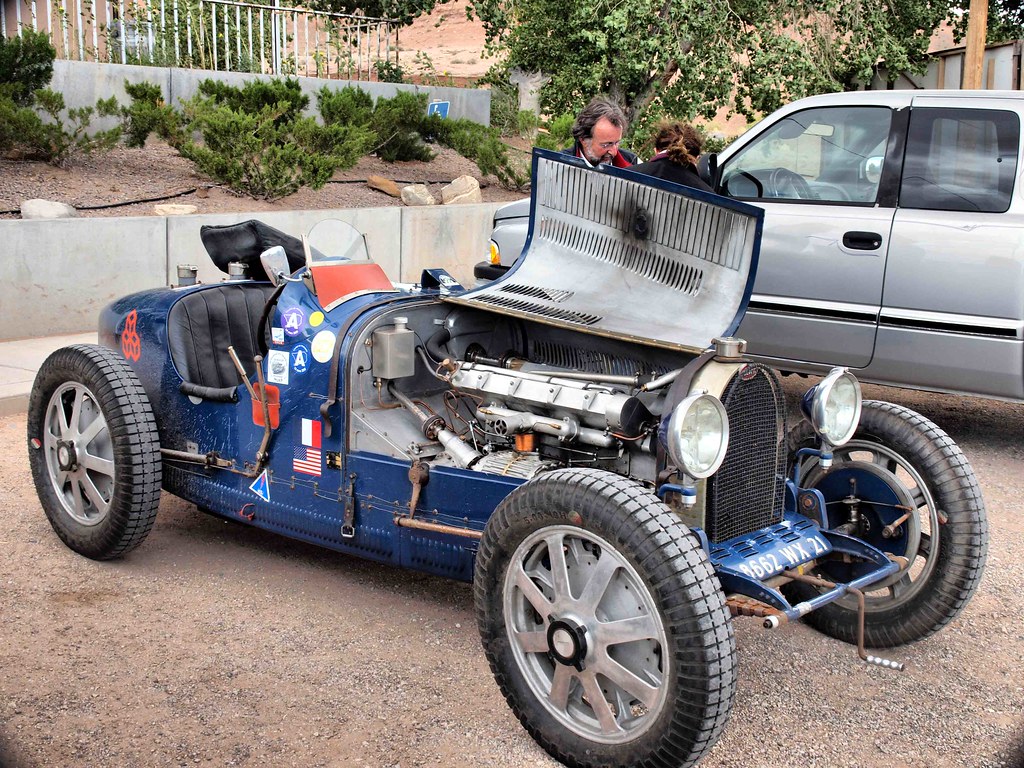
Purdy's passion for the Bugatti came to mind recently when I saw this photo.


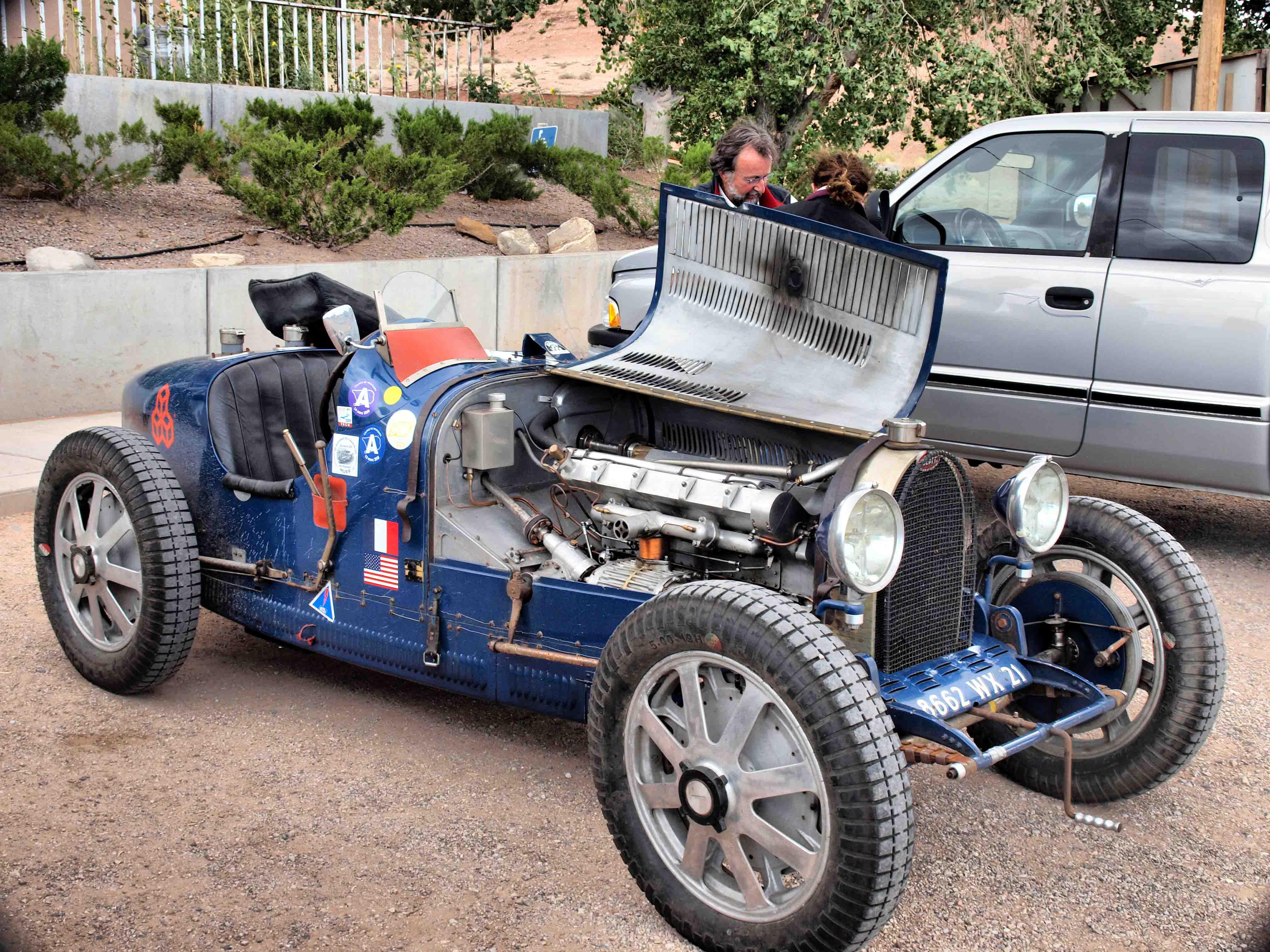
It comes from a photojournal of flickr images by Ken Hircock called saxonfenken's photostream. This link takes you to the original post: Vintage Bugatti. His full-size image of the car is here.

There are lots and lots of Bugatti photos on the web. What sets this one apart is the condition of the car. It's not another Concours-d'Elegance showpiece, but rather a "driver." It's clearly not an car that's kept for show and only given infrequent and short outings. About it, Ken Hircock says "In a small Utah country town of Hanksville, a convoy of Vintage Bugatti's pulled up for breakfast, they were touring the United States and had already travelled 1500 miles"

I judge this car to be one of only fifty that were manufactured between 1928 and 1930, the supercharged Type 35C. Of the various Type 35 models, the author of a wikipedia article says: "The Type 35 was phenomenally successful, winning over 1,000 races in its time. It took the Grand Prix World Championship in 1926 after winning 351 races and setting 47 records in the two prior years. At its height, Type 35s averaged 14 race wins per week. Bugatti organized the Targa Florio as a special spotlight for this car, and it claimed victory there for five consecutive years, from 1925 through 1929."

And about the 35C: "The Type 35C featured a roots type supercharger, despite Ettore Bugatti's disdain for forced induction. Output was nearly 128 hp (95 kW) with a single Zenith carburettor. Type 35Cs won the 1928 and 1930 French Grand Prix. Fifty examples left the factory."

This Youtube video of a 35C show car is lovingly filmed with decent audio of the engine sound. Note the instrument panel to be seen between 20 and 30 sec. and the external gear shift and hand brake levers between 30 and 40.

{Uploaded by carchannelclassic on Sep 14, 2011. "I recorded this beautiful blue Bugatti Type 35 B during Concours d'Elegance Antwerp."}

This Youtube shows the 35 in full race mode.

{Uploaded by 4kam on Jul 8, 2010. Monaco Historic Grand Prix 2010, Bugatti Type 35 onboard video footage courtesy of Duncan Pittaway. The Bugatti Type 35 was the first ever winner of the Monaco Grand Prix in 1929. Footage shot with a 4Kam Onboard Camera and DV4 Solid State Video Recorder.}

You can see still photos of this car and its driver here. It's clearly a version A of 1925 (dual-carbs and not supercharger).

You'll find a bunch of other good Type 35 videos here.

There's a famous story that the great Isadora Duncan was killed in an accident while riding in a Type 35 (or maybe a Type 37). As the story has it: "According to oral tradition, her last words were: 'Farewell, my friends, I am off to glory!' As the car drove off, she threw a long silk scarf around her neck, which entangled in one of the car’s open-spoked wheels. The heavy embroidered silk pulled instantly taut and snapped the dancer’s neck."[2]

You can find a description of the 35C engine, with photos, here and this video gives a CAD tour of the engine, inside out, including the blower.

Two other videos.
Tour en Bugatti Type 35

Bugatti Type 37A at Road America

----------

Some sources:

Bugatti Type 35 35B 35C 35T

Bugatti type 35

Bugatti Models

1927 Bugatti Type 35B

Bugatti Type 35 engine

Bugatti Type 35 (1924)

------

General note: I've reproduced text and photos under fair use provisions of U.S. Copyright Law and will remove any for which it's shown fair use does not apply.

Notes to text:

[1] This is the cover of the issue of True magazine in which Purdy's article on the Bugatti appeared (Oct. 1949).
.
{Contents:

Issue Date: OCTOBER, 1949; VOL. 25, NO.149
COVER: Special Fly to Hunt map. Cover by John Atherton.

BOOK-LENGTHER: The Pioneer Baron of Burglars ... Alan Hynd. In the palmy days of bank burglary, the top man of them all was Maximilian Shinburn, a real artist at turning off a jug. Full page color illustration by David Berger.

ADVENTURE:
The Champions of the Northland ... Bruce A. Wilson. Illustrated by John Pike.
A Time for Battle ... George Scullin. Full page color illustration by Tom Lovell.
The White Magic of Voodoo ... Allan Gould & Emile C. Schurmacher.

IN THE NEWS:
"We Will Be First to Die" ... Richard Tregaskis.
The Hamster Man . ... Robert M. Hyatt.
Store Hair ... Fred Rosen.
Your Clothes Do the Talking.
TRUE Tested Trends.

PERSONALITIES: TRUE'S Who: How to Pick Pockets in Public ... Daniel P. Mannix.

SPORTS:
Good Hunting--and Where. Map by John R. Hull.
Cricket Is for Men Only ... Bob Deindorfer.
You Want to Watch Them ... Marshall Goldberg.

SCIENCE:
The Fabulous Bugatti ... Ken W. Purdy. [With color photos!]
What's New in Scope Sights? ... Lucian Cary.

PICTORIAL: Vip's Tips for Men--How to Baby-Sit ... Virgil Partch.

FACT MYSTERY: The Case of the Naked Widow ... Archie McFedries. Full page color illustration by Louis Glanzman.

SHORT FEATURES: TRUEly Yours; Next Month; The Editor Speaking; Man to Man Answers; TRUE Goes Shopping; Books for Men; This Funny Life; Strange But True; The Mountain Boys; A Slight Oversight; The Offshore Bus; Pennsylvania's Last Buffalo; Build It Yourself; Never Underestimate an Eskimo; Know These Railroad Records; Twists. TRUE, A Fawcett Publication.
-- source: eBay}

Here's a different, but representative, article from magaszine: The Sky-High Invention, Hiller's Flying Platform, by John DuBarry, True Magazine, September 1956

[2] I've mentioned Isadora Duncan once before.

rouleur

I've begun posting to my tumblr microblog, Rouleur. Like most tumblogs, it's simply a vehicle for re-posting entries that have caught my eye elsewhere. This is a representative example:

11th Mar 2012

A Change of Scenery II (Making Mountains) by Rob Gonsalves; reposted from nothing new, a soup microblog by "charlottinka."

Sunday, February 26, 2012

Fox Conner

I dote on Ralph E. Luker's postings to the history blog called Cliopatria and while visiting there I happened upon a link to a book review by Jonathan Yardley. Yardley is always worth reading and this piece is as good as most. It's his review of Jean Edward Smith's new book on Dwight Eisenhower and in it he happens to mention the military officers who mentored Eisenhower during the two decades following his 1915 graduation from West Point. The name of one of these men caught my eye because it's the name of an uncle of my brother's wife.

I remember the uncle as owner of a smallish manufacturing plant which, from the 1930s through the '60s, produced a humane animal trap called Havahart™. I remembered two other facts: (1) the traps were invented by an eccentric German who sold the patent to the uncle sometime before WWII and (2) after the outbreak of that war, the uncle switched production from traps to a military item: liners for the fuel tanks of armored vehicles.

A bit of research shows both these facts to be true.

I also have a vague memory of the old brick factory where the traps and liners were made, located in Ossining right next door to the village in which I had been raised. Though I'm uncertain I actually saw it, there's no doubt about the existence of the place. Having begun as a plant for making a patent medicine called Brandreth's Pills and having been turned to other uses in the next 150 years or so, it now stands unkempt and empty.

This image shows the office building with the factory structures behind.

{The photo was taken from the west, or river, side of the property; caption: Buildings of the former Brandreth Pill Factory complex in Ossining, NY, USA source: wikipedia}

This is what the main factory buildings look like.

{Taken from the north, this shows part of the office and two of the Brandreth factory buildings; source: aolcdn.com}[1]

This river-side view of the property comes from a certificate awarding the right to sell Brandreth Pills in Italy. It is dated 1863. The base of the copula still exists but there are only a few indistinct remains of the Greek-revival portico seen up the hill at right. The buildings are located on a cove of the Hudson River with the New York Central Railroad (indicated by smoke from a locomotive chimney) and Haverstraw Bay (indicated by distant hills) shown on the horizon. There is some artistic license taken. The cove was somewhat smaller than shown and the buildings are shown facing the wrong direction. They faced the river to the west, not, as shown, south toward the hamlets of Sing Sing and Sparta. The building at center is the original factory; at right is an office, and the hill-side structures are a "summer house" (with copula) and residence (with columned portico).[2]

{Detail from a Brandreth certificate of agency of 1863; source: Westchester Archives}

This detail from an 1868 property atlas shows the cove and orientation of the buildings. Click to view full size. Most of the factory structures are shown top left. There is one by the train tracks at river side and the remaining Brandreth buildings are office, store house, stable and residences.[3]

{Detail from Singsing, Town of Ossining, Westchester Co., N.Y. (Atlas of New York and vicinity by F.W. Beers published by Beers, Ellis & Soule, New York, 1868); source: David Rumsey Historical Map Collection}

This satellite image shows the area as it is now. The two residences that I've marked are both modern buildings built roughly on the location of the original ones. The building marked "Office" dates from 1838 and is the first factory building on the site. It is labeled "Pill Fact." on the 1863 atlas. The buildings I call "Pill and Plaster Factory Bldgs" were built in the next couple of decades and are called "Drug Mill & Plaster Manufactury" on the atlas.[4]

{source: Google}

This photo shows the property from out on the river to the west. The "Pill and Plaster Factory Bldgs" are directly behind the white structure at left. The "office" is along the shore at right. Other structures are hidden by the trees. The church seen mid-right is the one where the factory owners and their families attended services.

{The Brandreth property seen from the river; source: hiddencove.us}

The uncle's name was Fox Conner as was the name of Eisenhower's mentor, and the one was son to the other — Fox Brandreth Conner, son of Fox Conner. Fox Conner was General Pershing's chief of staff. There's much to be read about him, and if you're interested, the wikipedia article on him is a good place to start. There's also a book on him, Grey Eminence: Fox Conner and the Art of Mentorship by Edward Cox (New Forums Press, 2010).

The factory that Fox Brandreth Conner ran has an interesting history.

The first factory building was put up in 1836 on property purchased from Oliver Cromwell Field, a direct descendant of the Lord Protector.[5] Field's house, on a promontory called Spring Hill, became the residence of the new owner, Benjamin Brandreth. You can read a concise history of Benjamin Brandreth and his family here (pdf). His grandfather invented Brandreth's Pills in Leeds, England, and Benjamin brought the business first to New York City and then to the land he'd bought from Field. The pills were a powerful vegetable-based purgative. A great-great grandfather of Fox Brandreth Conner, Benjamin was one of America's first advertising geniuses. His entrepreneurial ability made them just about universally known in their time. An astute businessman, he succeeded in acquiring and preserving a considerable fortune. In his book, Humbugs of the World P.T. Barnum describes Brandreth's early success:
"Great and reasonable as might have been the faith of Dr. Brandreth in the efficacy of his pills, his faith in the potency of advertising them was equally strong. ... Column upon column of advertisements appeared in the newspapers, in the shape of learned and scientific pathological dissertations, the very reading of which would tempt a poor mortal to rush for a box of Brandreth's Pills; so evident was it (according to the advertisement) that nobody ever had or ever would have "pure blood," until from one to a dozen boxes of the pills had been taken as "purifiers." The ingenuity displayed in concocting these advertisements was superb, and was probably hardly equaled by that required to concoct the pills.

No pain, ache, twinge, or other sensation, good, bad, or indifferent, ever experienced by a member of the human family, but was a most irrefragable evidence of the impurity of the blood; and it would have been blasphemy to have denied the "self-evident" theory, that " all diseases arise from impurity or imperfect circulation of the' blood, and that by purgation with Brandreth's Pills all disease may be cured." The doctor continued to let his advertising keep pace with his patronage; and he was finally, in the year 1836, compelled to remove his manufactory to Sing Sing, where such perfectly incredible quantities of Brandreth's Pills have been manufactured and sold that it would hardly be safe to give the statistics. Suffice it to say, that the only "humbug" which I suspect in connection with the pills was, the very harmless and unobjectionable yet novel method of advertising them; and as the doctor amassed a great fortune by their manufacture, this very fact is prima facie evidence that the pill was a valuable purgative.
In 1848 Brandreth purchased rights to a sticking plaster for relieving aches and pains: Allcock's Porous Plasters for Lumbago and All Pains. This too he heavily advertised and it was said to be so beneficial that the only problem its users faced was in removing the thing once it had done its work. Over the next century Brandreth and his successors added to the list of manufactured goods produced in the factory buildings: (1) ammunition-box liners for the military during World War I, (2) nail polish (3) mannequins, (4) cell forms for bulletproof fuel tanks during World War II, (5) an ersatz coffee, and (6) a fiberglass boat, the Swallow Model Adirondack Guideboat.

This lithograph was made just prior to the time Brandreth built his first factory building. The artist is standing on high land in the hamlet of Sing Sing, later to become the village of Ossining. The view is to the north west and Oliver Cromwell Field's property, where Brandreth will build, is out of sight, over the hill at center. The neck of land jutting into the Hudson is Croton Point. This part of the river is called Haverstraw Bay. The small peak pointed skyward on the horizon is High Tor, where Rip Van Winkle fell asleep.

{Caption: Sing-Sing or Mount Pleasant, lithograph by Jacques Gérard Milbert, Jacques, from: Itineraire pittoresque du fleuve Hudson et des parties laterales de l'Amerique du Nord, d'apres les dessins originaux pris sur les lieux. Source: NYPL Digital Gallery}

This painting shows Haverstraw Bay in 1839 with the artist standing in Sing Sing looking south and west. By this time Brandreth had built his first factory but it and the Field residence are out of sight to our right.

{The artist is W.H. Bartlett; source: rootsweb.ancestry.com}

This 1885 ad for the pills and the porous plasters shows Haverstraw Bay looking southwest from the river-side factory. The boy has one of the plasters on his back.

{source: wikipedia}

Here are some testimonial-style advertisements from the New York Tribune in 1871. Notice the willingness of officials to help promote what was then a place where many of the village's young women and not a few of its men found work.

{The Tribune almanac and political register edited by Horace Greeley (The Tribune Association, 1871)}

This detail from a property atlas shows the factory structures and residences as of 1893. H.C. Symonds was a member of the Brandreth clan. The house was labeled "Mrs. Brandreth" on earlier maps. I suspect that Miss J. Van Wyck was one as well. Her house was labeled "P.G. Van Wyck" on earlier maps. The original factory building is here labeled "Store House".

{Atlas: Sing Sing by Julius Bien & Co., 1893: source: David Rumsey Map Collection}

This larger view shows the growth of the village in the 60 years since Brandreth first moved there.


I haven't forgotten that it was the humane traps which first attracted my interest in the factory. This ad for it appeared in 1962.


As I say, Ossining is next door to the village where I was raised and I've consequently done some blog posts in which it figures. Here are some links: --------

Some sources:

“Eisenhower in War and Peace” by Jean Edward Smith a review by Jonathan Yardley, February 6, 2012

"Brandreth Pills" in Brother Jonathan: A weekly compend of belles lettres and the fine arts, standard literature, and general intelligence Horatio Hastings Weld, John Neal, George M. Snow, Edward Stephens (Wilson & Company, 1842)

Brandreth Pills in The Humbugs of the World, An Account of Humbugs, Delusions, Impositions, Quackeries, Deceits and Deceivers Generally, in All Ages, by P. T. Barnum (1866)

Ossining's Historic Brandreth Pill Factory, Ossining's Brandreth Pill factory gained its National Register designation in 1980 because of its connection with Dr. Benjamin Brandreth, by former Ossining Mayor Miguel Hernandez in Ossining Patch

Benjamin Brandreth on DaleCemetery.com

EPN Real Estate Services to complete Hidden Cove on the Hudson, New England Real Estate Journal, January 8, 2008, an article about proposed development of the property

Hidden Cove on the Hudson, documents related to proposed development of the property for upscale housing

Draft Environmental Impact Statement Hidden Cove on the Hudson (pdf), one of the documents

Archaeological Assessment Hidden Cove on the Hudson (pdf) another of the documents

When Sing Sing Was a 'Model' Prison March 19, 2009, in Postscripts, an online magazine offering a pastiche of articles on current affairs, history, technics, opinion, writing, advice, humor and trivia.

Purgation Unlimited James Harvey Young, in The Toadstool Millionaires: A Social History of Patent Medicines in America before Federal Regulation

Brandreth Pill Factory Documents, 1863-1900

The Tribune almanac and political register edited by Horace Greeley (The Tribune Association, 1871)

Archaeological Assessment and Field Investigation, Hidden Cove Development, Brandreth Pill Factory, Village Of Ossining, Westchester County, New York (pdf)

"A Most Mephitic Mystery" by venta Belgarum in The Sandisfield Times, Vol. 1, No. 5, August 2010

Brandreth's Pills in Historical Images of the Drug Market, Medical Collectors Association Newsletter, December 22, 2000


Allcock's Porous Plasters by Caroline Rance on October 16th, 2009

Œuvres complètes d'Alexis de Tocqueville (M. Lévy frères, 1865)

Fiberglass Adirondack Guideboat in Boats and Boating in the Adirondacks by Hallie E. Bond (Syracuse University Press, 1998)

Gen Fox Conner on findagrave.com

Thomas Allcock on findagrave.com

Benjamin Brandreth on wikipedia

Thomas Allcock on wikipedia

FUNERAL OF DR. BRANDRETH.; SING SIGN VILLAGE IN MOURNING--THE WHOLE POPULATION AT THE FUNERAL, New York Times, February 23, 1880

DEATH OF G.A. BRANDRETH.; Head of a Well-Known Manufacturing Company and Prominent in the Affairs of His Town, New York Times, November 16, 1897

BERNJAMIN BRANDRETH'S WILL.; HOW HE DISPOSED OF HIS PROPERTY AND BUSINESS, New York Times, February 26, 1880

Dr. Brandreth Symonds, New York Times, August 26, 1905

DEATH OF G.A. BRANDRETH.; Head of a Well-Known Manufacturing Company and Prominent in the Affairs of His Town, New York Times, November 16, 1897

Conner -- Brandreth, New York Times, June 5, 1902

Paid Notice: Deaths CONNER, FOX BRANDRETH, New York Times, July 19, 2000
Extract: "CONNER, FOX BRANDRETH - Fox Brandreth Conner of Ossining died on July 17, 2000, at the Arden Hill Nursing Home in Goshen, NY. He was 95. Mr. Conner was born June 23, 1905, at Fort Hamilton Army Base in Brooklyn, NY. He was the son of Major General Fox Conner, Chief of Operations for the American Expeditionary Forces in Europe during World War I, and Virginia Brandreth Conner. Mr. Conner married Muriel Macpherson in 1927. She died on September 12, 1986. ... In 1929, he joined the family business, the Allcock Manufacturing Company, in Ossining. ... In the 1930s, the company began producing Havahart traps, humane traps that capture animals alive and unhurt. Mr. Conner became President of the company in 1945 and began to focus exclusively on manufacturing Havahart traps, which became the country's most popular humane animal traps, sold in the United States and overseas. ... Mr. Conner was an avid fisherman and outdoor sportsman, spending much of his time at the family seasonal residence in the Adirondack Mountains at Brandreth Park, NY. He enjoyed gardening and reading, and was an accomplished wood sculptor. ... "

Brandreth Pill Factory
Extract: "During the later years of the 19th century and the early 20th, the factory began to diversify its operations in response to increasing federal regulation of the patent-medicine industry. Among the new products were ammunition-box liners for the military during World War I. ... Franklin Brandreth stepped down in 1928 and was replaced by his grandson Fox Brandreth Conner. By then the domestic market for the pills it had once manufactured in abundance was gone. ...In 1940 the company sold the buildings at the southern end of the property to the Gallowhur corporation, which used them to make insect repellent and suntan lotion. The rights to the pill formula were also sold off after World War II. Brandreth's company, under the Allcock name, continued its manufacturing operations in the 1870s complex until 1979. They were later used by the Filex Corporation, a maker of steel office furniture."

------

Notes:

[1] Jaime Martorano and Abandoned New York have made available excellent, though fiercely protected, photo sets of the factory complex.

[2] Here is the full certificate.

{source: hudsonriver.westchesterarchives.com}

[3] Notice that one local resident bears the name Conner: "Jas. Conner" lives in a house on Snowden Ave. (top right of image). I don't know anything about the man but there may be a connection with the Conner family which eventually took over management of the Brandreth factory. It's also interesting to see a member of the Van Wyck family on the Brandeth property. The house of "P.G. Van Vyk" at Grove Hill is just east of the office and store house and somewhat north of Mrs. Brandreth's residence.

[4] Notice that there is a Van Wyck St. pointing south west toward the Van Wyck property. An atlas of 1893 shows "Miss J. Van Wyck" to be owner of this place. It also shows that the house of Mrs. Brandreth then belonged to a "H.C. Symonds". Symonds was a member of the Brandreth family.

[5] Alexis de Tocqueville once visited Oliver Cromwell Field at his home in Sing Sing: "Singsing, 31 mai 1831. Il y a à Singsing un vieillard qui se rappelle avoir vu les Indiens établis dans 'ce lieu. Le nom même de Singsing est tiré du nom d'un chef indien. On nous montre une maison où demeure un descendant d'Olivier Cromwell."