 Today's Guardian has an interview with Cecilia Bartoli to plug her new album. The author makes a point about her fondness for 18th century composers and tries to get her to acknowledge she's afraid of the 19th-century opera repertoire and to answer critics who say she'll never be a true diva until she goes mainstream. She'll have none of it. She loves the baroque and observes that her audiences come to her, and bountifully so, to hear what she wants them to appreciate and learn to love. The article is The last diva by Stephen Moss. The lead in reads: "Cecilia Bartoli is feted as operatic royalty. But why does she insist on such an obscure repertoire?" The new CD is Opera Proibita (Forbidden Opera), a collection of arias by Handel, Alessandro Scarlatti and Antonio Caldara from the first decade of the 18th century, "when," as Moss says, "the Catholic church in Rome clamped down on opera and composers cleverly circumvented the restrictions by stretching the boundaries of oratorio instead."
 more extracts from the article:
"I love the baroque period," she says. "It's not just the music; I like baroque painting, baroque architecture. I like the structure of baroque music - it gives you a lot of freedom of interpretation. It's very rhythmic and you have this contrast between rhythm and simple melodies. Two years ago, I did [Handel's] Il Trionfo del Tempo e del Disinganno with Marc Minkowski in Zurich, and I was fascinated and overwhelmed by its beauty." Working with her pet musicologist (and former boyfriend) Claudio Osele, she found out more about the period in which the oratorio was written and the tensions of early 18th-century Rome. Forbidden Opera is the result of their labours.
Bartoli likes to initiate her own projects, but how do Decca feel about her more unusual choices? "When I suggested a Vivaldi disc [in the late 90s], it was difficult to convince them to do it. But it was enormously successful and I proved that there was an audience ready to discover it. I like to present a project which has both a commercial and a cultural element. I try to combine them.... I have to bring people to this baroque project. This is the goal. "


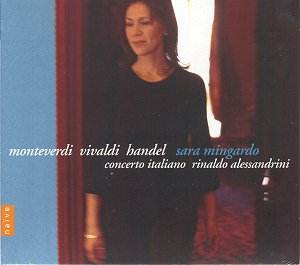
I listen to quite a bit of 18th century music. Among vocalists, I like the countertenors, David Daniels, Andreas Scholl, and Paul Esswood. I lose track of the sopranos & mezzos. I think my favorites are Bartoli, Elly Ameling, and Edith Baker. I've lately discovered the alto/contralto Sara Mingardo:
Arias, madrigals, & cantatas by Monteverdi, Vivaldi, Handel, Carissimi, Cavalli, Legrenzi, Merula, & Salvatore; Sara Mingardo (alto); Monica Bacelli (mezzo-soprano, in "Vorrei baciarti"); Concerto Italiano, Rinaldo Alessandrini; Naïve- OP 30395(CD) reviewed here.




 Kurt Vonnegut is a favorite author -- particularly Julia's -- and he's in the news.
 Click image for full view.
 Click image for full view.
 I named our family web site after Montesquieu. Recently, in updating my email address list as we prepare for the family runion in November, I found myself wondering about the origin of Raul's web site (ok Raùl's if you're set up to read ASCII char 151 properly).

 OCLC is a bibliographic service used by many thousands of libraries worldwide. One of its member libraries recently contributed the billionth holding record to the system, meaning that the OCLC database, called WorldCat, now can lead patrons to a billion books that libraries have on their shelves. This is the number of unique titles times the number of holdings of each title. As you can see the title is The Monkees: The Day-By-Day Story of the 60s TV Pop Sensation. Here's a link to the "find in a library" entry in




 Seeing notice of this immediately brought to mind one of the "improving" poems that Carroll parodies, the one that begins "How doth the little busy bee." It's title is "Against Idleness And Mischief" and it's by Isaac Watts, included in a collection published in 1715 entitled Divine Songs Attempted in Easy Language for the Use of CHILDREN (London: M. Lawrence). Here's the poem:
 For now, here is Carroll's parody of Watt's 'How doth:'
  And finally, the busy bee in life,


 That's a long introduction to a prosaic topic. Sports coaches and my own dad used to say "you've got to put your heart into it." For the coaches, "it" was football most frequently and sometimes basketball. I never heard it from my track coaches. For my dad, "it" was household chores, particularly cleaning up after dinner and most specifically the job of sweeping the 18 square feet of linoleum flooring in our tiny kitchen.
  Neither coaches nor dad made much impact on my attitude at the time. I see things differently now. An epiphany when I was struggling to succeed as a head log bucker one summer in a northern California saw mill: I didn't see how I could do the job well. The mill wright who was also foreman told me yes I could. I changed my attitude and did the job well.
  When I learned to practice Zen, I also learned that everything in life is work. I spent time at the Green Gulch farm of San Francisco Zen Center and for me this
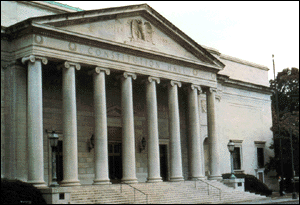 The venue was


 Posts
Posts


