Saturday, October 15, 2005

checheeleea

Today's Guardian has an interview with Cecilia Bartoli to plug her new album. The author makes a point about her fondness for 18th century composers and tries to get her to acknowledge she's afraid of the 19th-century opera repertoire and to answer critics who say she'll never be a true diva until she goes mainstream. She'll have none of it. She loves the baroque and observes that her audiences come to her, and bountifully so, to hear what she wants them to appreciate and learn to love. The article is The last diva by Stephen Moss. The lead in reads: "Cecilia Bartoli is feted as operatic royalty. But why does she insist on such an obscure repertoire?" The new CD is Opera Proibita (Forbidden Opera), a collection of arias by Handel, Alessandro Scarlatti and Antonio Caldara from the first decade of the 18th century, "when," as Moss says, "the Catholic church in Rome clamped down on opera and composers cleverly circumvented the restrictions by stretching the boundaries of oratorio instead."

more extracts from the article:
"I love the baroque period," she says. "It's not just the music; I like baroque painting, baroque architecture. I like the structure of baroque music - it gives you a lot of freedom of interpretation. It's very rhythmic and you have this contrast between rhythm and simple melodies. Two years ago, I did [Handel's] Il Trionfo del Tempo e del Disinganno with Marc Minkowski in Zurich, and I was fascinated and overwhelmed by its beauty." Working with her pet musicologist (and former boyfriend) Claudio Osele, she found out more about the period in which the oratorio was written and the tensions of early 18th-century Rome. Forbidden Opera is the result of their labours.

Bartoli likes to initiate her own projects, but how do Decca feel about her more unusual choices? "When I suggested a Vivaldi disc [in the late 90s], it was difficult to convince them to do it. But it was enormously successful and I proved that there was an audience ready to discover it. I like to present a project which has both a commercial and a cultural element. I try to combine them.... I have to bring people to this baroque project. This is the goal. "
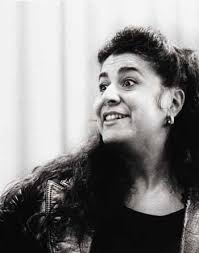


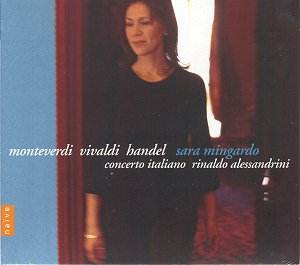
I listen to quite a bit of 18th century music. Among vocalists, I like the countertenors, David Daniels, Andreas Scholl, and Paul Esswood. I lose track of the sopranos & mezzos. I think my favorites are Bartoli, Elly Ameling, and Edith Baker. I've lately discovered the alto/contralto Sara Mingardo:

Arias, madrigals, & cantatas by Monteverdi, Vivaldi, Handel, Carissimi, Cavalli, Legrenzi, Merula, & Salvatore; Sara Mingardo (alto); Monica Bacelli (mezzo-soprano, in "Vorrei baciarti"); Concerto Italiano, Rinaldo Alessandrini; Naïve- OP 30395(CD) reviewed here.

Tuesday, October 11, 2005

Beauties of the mind

In yesterday's post I said Sarah Thorn's poems celebrate intelligence and intellectual brilliance. Here's an example.

This poem makes me think of a letter that my great-grandfather wrote when he was a new immigrant in New York City. The year was 1855, just 21 years from the date my great- great-grandmother wrote the poem. He was 20 and she 18 at the time each of them wrote. Addressing his aunt Sarah, back in Münster, he wrote:
Now that I have reported all my doings up to now, it is up to you to let me know what has happened in the family since I last heard from you. I hope you, dear grandfather, are in the best of health. I beg you earnestly, dear Sarah, to tell my sisters to become useful members of society. Let them be industrious, thrifty, and god-fearing. Instill in them the good old teaching: Do right and fear none. When you raise them with these basics and when I may be so fortunate to see them again as blossoming young women physically strong and intellectually developed, then nothing would be more precious to me than to show you my gratitude.
It's touching to see the spirited young man giving orders to his elders, not in a bossy way (he was not a bossy person; my father's favorite adjective for him was 'jolly'), but earnestly. More than that, the phrase I've put in Italics, "blossoming young women physically strong and intellectually developed" makes me think of this poem's emphasis on beauty as an attribute of people and things, and beauty as an attribute of minds and intelligence.

You can read a full transcription of my great-grandfather's letter here.

Some of this transcription is doubtful. I welcome corrections.
An Untitled Poem by Sarah Thorn

The downey Cheek so bright so fair
Thy bosoms snowy whiteness
The panting lips so red so rare
The eye with sparkling brightness
Her beauty's like the summer leaf
Which length of time decay
For evening time that cruel thief
Will surely steal away
            _________________

But when conjoined with them we find
Charms that surpass all beauty
A virtuous heart a feeling mind
Success becomes a duty
Mad are those who idly range
To all but beauty blind
For time nor place can never change
The beauties of the mind.

S...h

Monday, October 10, 2005

Sarah Thorn and the cult of domesticity

I've been thinking about the cultural environment in which my great- great-grandmother, Sarah Thorn, grew up. She was born in 1816 in Albany and died 65 years later in New York City. She began her book of poems in 1834 when she was 18 and married Henry Lefman two years later.

During her youth the United States hadn't yet developed its own literary presence. Washington Irving, its literary star, did not have a distinctively American voice. Poe, Hawthorne, Melville, Whitman, and Emerson hadn't yet been published or, if published, noticed. Emily Dickinson and Louisa May Alcott weren't even born until Sarah was in her late teens.

In the period beginning roughly with the year of her birth the US began a rapid infrastructure development to foster economic growth. By the 1830s steam power, the canals, and railroads were being developed and the nation's westward expansion and exploitation of vast natural resources by its rapidly-growing population was assumed to be a fact.

When she reached the threshold of adulthood in the early 1830's the US government was forcibly evicting American Indian tribes of the southeast from their homelands and the division of the country into distinct sections was becoming an obvious source of political conflict, particularly between North and South and particularly with respect to slavery.

The world of commerce, industry, and government was exclusively masculine. Partly because of the nation's growing wealth and urbanization, white, middleclass husbands and wives developed a divison of labor by which the exclusive domain of woman was homemaker, child raiser, and cultivator of religious values.

It wasn't until ten years later that this division into spheres of responsibility began to be called into question. In the Dial magazine for January 1841, Sophia Ripley raised for the first time, I think, the "woman question" in an article called Woman which contains the opening line: 'There have been no topics, for the last two years, more generally talked of than woman, and "the sphere of woman."'

Ripley's critique of the cult of domesticity shows both its cultural pervasiveness and the unreasonable burden it placed on women. She says women are popularly supposed to be feeble, good, quiet, and gentle: a "spritualized image" that no woman "could or would become." Far from weak and submissive, Riply says women must possess a strength and energy as great and untiring as the man's because, "if there is a being exposed to turmoil and indurating care, it is woman." It's plain from the essay that many women collapsed under the weight both of these responsibilities and the unwritten rule that they appear ethereal and pure, weak and mild, yet also morally superior to men, steadfastly defending religous truth, and counteracting the taint of the competitive, increasingly industrial masculine sphere.

Since resistence to the cult of the true womanhood did not begin until the 1840s and since its beginnings were even then tentative and with little impact, it's hardly surprising that Sarah Thorn's poems show little of a rebellious spirit. They praise religious feeling and condemn the evils of gambling and tobacco and their overall subject is blossoming love. Yet they also celebrate intelligence and intellectual brilliance. I suspect she didn't see herself as an archetype of the true woman.

Here's a poignant might-have-been which shows some of the constraints of her time which she could accept only with difficulty.

To A Friend

Think not, my love'd, my valued friend,
That I possess an airy heart,
I wish I did, it would defend,
My peace from present anxious smart.
From the first hour I met with thee,
(Though I of friends had ceas'd to dream,)
That soul which loves society,
An effort made for your esteem.
And when eclips'd in sorrow's shade
Surrounded by a slanderous throng,
My feelings all the world portray'd,
As full of friends who did me wrong.
'Twas then the glance of thy kind eye,
Dispell'd my cheerless revery;
It was thy look of sympathy,
Which makes thee still so dear to me.
And this I own without disguise,
Had we acquainted been before,
When I was free from others ties,
I might have dared to love you more.


But since we know 'tis thus decreed,
And we no more than friends can be;
We ne'er must think of word or deed,
That's not stamp'd with purity.

INCOG.                                                          


Sunday, October 09, 2005

'My Heart and Lute,' Sarah Thorn

Here's another poem from the commonplace book of my great- great-grandmother, Sarah Thorn.


My Heart And Lute

I give the all I can no more
tho poor the offering be
My heart and lute are the store
That I can bring to thee.
A lute, whose gentle song reveals
The soul of love full well,
and, better far, a heart that feels
Much more than lute could tell
I give the all I can no more.

-2-

Tho' love and song may fail, alas!
To keep life's clouds away,
At least 'twill make them lighter pass,
Or gild them if they stay.
If every Care her discord flings
O'er life's enchanted stranes
Let love but gently touch the strings,
Twill all br bright an sweet again!
I give the all can no more.


Vonnegut

Kurt Vonnegut is a favorite author -- particularly Julia's -- and he's in the news.

Vonnegut, on politics, presidents and librarians, By Jacqueline Blais, USA TODAY

extracts:


NEW YORK — Kurt Vonnegut opens an interview at La Mediterranée, a pretty Manhattan restaurant, this way:

"What do you want to talk about? Politics? Our president is a complete twit. I'll talk about the death of the novel. I'll talk about anything you want."

We are making "thermodynamic whoopee with atomic energy and fossil fuel." The part that makes him feel unfunny for the rest of his life: People don't "give a damn whether the planet goes on or not." We are, he writes, too cheap and lazy.

In short: "Human beings, past and present, have trashed the joint."

There is more where that came from.

The guessers (never filled with doubts) are in charge, wise people are despised, and the USA is now operating on the snake-oil standard, he writes.

Yes, and more.

From his perspective as a former World War II prisoner of war, Vonnegut writes that American soldiers in the Middle East are "being treated, as I never was, like toys a rich kid got for Christmas."

Then, beyond all the gloom and doom, there are things to cling to.

Music (especially the blues) cheers him, as do people who behave decently. Librarians, too — "not famous for their physical strength" — who resist having books removed from shelves and refuse to give names of people who have checked out certain books in the era of the Patriot Act.

"The America I loved," he writes, "still exists in the front desks of public libraries."

His new book is A Man Without a Country (Seven Stories Press)

About the book one reviewer says:

Despite its appearance at the twilight of Vonnegut’s career, it is the ideal place to start reading his work, if you haven’t already. The book provides a straightforward, no-nonsense view of his thoughts, whereas his past work can be more alienating, using absurd and often abstract stories to get his points across.

There are no such excuses for not reading this book. It’s packed with brilliance, is easy to read, and will most likely be the last published book by one of the most relevant authors of our lifetime.

Saturday, October 08, 2005

Some things speak for themselves

Click image for full view.

This chart comes from Encarta via United States National Debt (1938 to Present, An Analysis of the Presidents Who Are Responsible For Excessive Spending, By Steve McGourty, Updated 9 April 2005

McGourtry says, in part:
The chart shows the United Stated national debt (per Microsoft’s Encarta Encyclopedia and US Government data) with the various Presidents’ terms marked by vertical lines. Under Clinton the growth in debt ceased, but note the radical change in direction debt has taken since George W. Bush entered office. There is no question that the steepest upward rises in debt take place after Reagan was elected when so called Conservative Republican Presidents are in office (see red below).

Since the Neo-Conservative movement has become the dominate force in the Republican Party the national debt has grown and continues to grow by any measure you care to use. In addition, experience has shown that “trickle down tax cuts” only work to concentrate the nation’s wealth into fewer hands and never help to rebound the economy. Mr. Bush has no plan to deal with the debt he has already created, and all his future plans only balloon the debt even larger. We can not count on him to contain government spending.

Fortunately our nation is fundamentally strong and it has always had the strength to overcome bad Presidents and their failed economic policies in the past. Our economy can and will endure the downward vortex of this misguided Neo-Conservative trend as well. However, for the sake of our nation, our jobs and our future let us all hope that we see an end to the dominance of the disastrous Neo-Conservative economic polices soon.

He also points out that the economy, expressed as Gross Domestic Product (GDP) is not growing along with debt:
Using government projections, US debt will double under Mr. Bush’s leadership (or lack of it) in real dollars and as a percent of GDP. The nation has to wonder when will the fiscally conservative side of Mr. Bush reveal itself? He only has a few years left in office and while he talks about reducing the debt, the fact is that he has so far only increased it. He keeps telling us that cutting taxes will pump up the economy and thus generate more revenue for the government. The facts do not support his, or the Gipper’s unsubstantiated claims on this point.


He give us another chart to demonstrate this point:
Click image for full view.

Thursday, October 06, 2005

Con Poco Coco

I named our family web site after Montesquieu. Recently, in updating my email address list as we prepare for the family runion in November, I found myself wondering about the origin of Raul's web site (ok Raùl's if you're set up to read ASCII char 151 properly).

Anyway, I put a few queries into the Scroogle Scraper search box on Firefox and came up with a strong possibility: Con Poco Coco is a historic Cuban jam session. According to the notes on the a CD I just acquired:
It is the first Cuban descarga or jam session, ever recorded in Cuba. According to Bebo Valdès, then pianist and arranger for Armando Romeu's Tropicana Hotel orchestra, he was approached by an American living in Havana who operated a record store:
One evening Mr. Irving Price, owner of Andre's record store, told me Norman Granz did not believe that Cuban musicians were capable of playing jazz. We recorded four tracks that were released as 45s. They were also going to be side A of a 10" Mercury LP, Cubano...Andre's All Stars. That is when we decided to improvise as we went along.


You can listen to part of a Chucho Valdis rendition of Con Poco Coco on a Smithsonian Folkways CD:
Con Poco Coco - Chucho Valdis. Here's a link to the Smithsonian page on the CD and the exhibition of which its a component: Latin Jazz: La Combinación Perfecta

I bought myself the Verve recording of the the original cut recorded in Havana in October 1952 -- Mambo Kings. You can listen to excerpts from the CD's tracks on the Verve site. Here's a full citation: Various Artists, The Original Mambo Kings: An Introduction To Afro-Cubop 1948-1954 CD (Verve/Poly. 314 513 876), Released 1993.

About this Verve CD, Max Salazar says: "I consider this to be the best recording in my collection. It is the history of Afro-Cuban jazz with rarities from Machito, Dizzy Gillespie, Chico O'Farrill, Howard McGhee, and Bebo Valdes' 'Con Poco Coco.' The first Cuban descarga, recorded in October of 1952."

There's a transcription of a radio interview with our Chevy Chase neighbor Murray Horowitz in which he says
This CD really gives you the feeling of what it must have been like in New York and Havana in the 1940s and '50s, when some of the greatest jazz musicians and some of the greatest Latin musicians were playing together.

INTERVIEWER: I know that's one of the greatest: Charlie Parker.

HORWITZ: Charlie Parker, Flip Phillips, Dizzy Gillespie, "Sweets" Edison, Buddy Rich, Lucky Thompson. There's a whole pile of familiar jazz names on this CD. But there's a lot of equally great musicians with probably less familiar names.

INTERVIEWER: Probably less Anglicized, too, Murray.

HORWITZ: You got it! Machito, Maurio Bauza, Jose Mangual, Ubaldo Nieto, Bebo Valdés, who is the father of Chucho Valdés, the pianist. And there is Chico O'Farrill, so I guess he's a little bit of both. But the mix of musicians gives a whole range of textures to this music.


Here's a more extensive narrative about the recording of Con Poco Coco from Latin Beat Magazine, Feb, 1997, written by Max Salazar:
Cuba's first recorded descarga occurred during 1952 when American jazz impresario Norman Grantz was vacationing in Havana. Grantz visited the Andres record store owned by Irving Price. Mr. Price mentioned he knew Cuban musicians who made him feel at home with their brand of jazz. Grantz laughed and said no one played like American jazz musicians. Price convinced Grantz to finance a recording session which was performed at the Havana Panart Studios. Price then contracted pianist Bebo Valdés, who selected the Hotel Tropicana musicians Gustavo Mas on tenor sax, Salvador "El Negro" Vivar on trumpet, Kiki Hernández on bass, Guillermo Barretto on timbales, and Rolando Alfonso on conga. Valdés' group recorded the tunes Desconfianza, Tabu, Duerme and Blues for Andre. Grantz was dumbfounded. His words of praise indicated that for him Cuban musicians were on the same level of proficiency with American jazz and Latin musicians. Grantz requested they record How High The Moon but Hernández said he was not familiar with the tune. In recalling this historical moment, Bebo Valdés said, "we were asked to do one more tune, so I started it with a guajeo, you know, a jam session for seven minutes... we called the tune Con Poco Coco." The reason Cuban music historians didn't know about the session is that it was recorded for Grantz and released a sa 45 in the United States in early 1953. To own Con Poco Coco, one had to purchase the 10" Panart label LP CUBANO...The Andres All Stars. This historic recording is available on the Verve CD The Original Mambo Kings.


This is Bebo Valdès. Click it for a photo-print version.

Wednesday, October 05, 2005

How many library books?

OCLC is a bibliographic service used by many thousands of libraries worldwide. One of its member libraries recently contributed the billionth holding record to the system, meaning that the OCLC database, called WorldCat, now can lead patrons to a billion books that libraries have on their shelves. This is the number of unique titles times the number of holdings of each title. As you can see the title is The Monkees: The Day-By-Day Story of the 60s TV Pop Sensation. Here's a link to the "find in a library" entry in WorldCat and here's a link to the Amazon page for the book.

This is OCLC's press release about the milestone.
WorldCat reaches 1 billion holdings

At 2:21:34 p.m. EDT on August 11th, 2005, Anne Slane, a cataloger for Worthington (Ohio) Libraries, entered holdings information for the book The Monkees: The Day-By-Day Story of the 60s Pop Sensation, becoming the one billionth holding record in the WorldCat database. OCLC congratulates Anne and all libraries that contribute data to WorldCat.

As expected, the march to the billionth holding was a sprint, with mere fractions of a second separating the entries at the wire.

Tuesday, October 04, 2005

What book should I read next?

The internet provides a wonderful range of services for book readers. Here's a new one:

What Book Should I Read Next

From the FAQ

WSIRN produces recommendations based purely on collective taste: when books are entered into the same favourites list, they become associated with each other. The more often particular books appear on different lists, the stronger that association becomes. Purely and simply, WSIRN represents mass opinion about books. Over time the recommendations should get better and better as the database grows.

If you simply want a quick recommendation, you only need to enter one book; confirm that we've got the right one on the next page, and then you can click the WSIRN button to get some recommendations. The best thing to do, though, is enter a list of favourites. This will give you more focused recommendations, as well as helping to build the database and share your taste with other users of the site. If you enter your email address, your list of favourites will be remembered next time you visit, so you can then add new titles and get even more appropriate recommendations. You can also add your own comments about each book which other users can see.

Monday, October 03, 2005

An information society

This is from one of the library blogs in my RSS aggregator.

An information society?

Some media experiences in the last day or two:


A TV ad: a driver is rung up and asked if he would like to schedule an oil change for his BMW. How did they know it was due? Why the car had communicated it to them directly.

Another TV ad: a truck is lost - the boxes on it say so. How do they know? RFID. An ad for IBM. (I have fuzzy memories of this one - it did not have my full attention ;-)


There was a story in Tuesday's Guardian about how the UK Supermarket chain Tesco is building up a data resource on every household in the UK, based on data from various sources including its own card loyalty program.

Tesco is quietly building a profile of you, along with every individual in the country - a map of personality, travel habits, shopping preferences and even how charitable and eco-friendly you are. A subsidiary of the supermarket chain has set up a database, called Crucible, that is collating detailed information on every household in the UK, whether they choose to shop at the retailer or not. [Guardian Unlimited | The Guardian | Tesco stocks up on inside knowledge of shoppers' lives]


These are all examples of how, increasingly, services are reflexively adapted based on tracking and usage data.


They are a part of what we mean when we say that we are living in an information society. `Informationalization' is a word coined by Manuel Castells on the model of 'industrialisation'. Informational activities are activities where productivity is maximised through the use of knowledge, gathered and diffused through information technologies. 'Informationalisation' is visible at all levels: doors open automatically, money is disappearing; the flow of materials is monitored by satellite tracking systems; domestic and office environments will become intelligent buildings; distribution chains, the disposition of goods around retail floors, investment decisions, these and others will be driven by the movement of figures; corporations and other organizations manage deep databases about customers, products, relationships, transactions. Complex webs of data are built up around our lives as patients, as students, as customers, as clients. Increasingly, flows of people and materials follow the flows of data as organizations depend for operation on the management and flow of greater amounts of data.


Increasingly, when I think of 'information' this is what I think of - the particular type of information - or intelligence - that makes things work in the modern world. A range of activities is increasingly data-driven.


At the same time, we live in the world of Google where a growing resource is immediately available to the consumer.


This is one reason why I responded warmly to Bob Martin's repeated assertion that libraries were not about the management of, and access to, information during his incumbency at IMLS.

We often hear it said that libraries (and librarians) select, organize, retrieve, and transmit information or knowledge. That is true. But those are the activities, not the mission, of the library. Certainly we perform those activities, but the important question is: "To what purpose?" We do not do those things by and for themselves. We do them in order to address an important and continuing need of the society we seek to serve. In short, we do it to support learning. [IMLS: What's New: Current News]
Libraries support learning, and learning is an important political and institutional value. Interestingly, the British Library ('the world's knowledge') emphasizes its role in support of research in its recently published Redefining the Library: The British Library's strategy 2005 - 2008. Indeed, one of its 6 strategic priorities is to Build the digital research environment. The emphasis in on providing information at the point of need within the research life cycle - whether this is in a corporate, academic, or library environment.


Libraries support research and learning. They manage the records and documents that support argument, education, scholarship and debate. We need better ways of talking about their value than in purely 'information' terms.


Talking about them as central agencies of the knowledge economy or the information society is not a good direction to take. Information is everywhere, and lots of people manage it.


Sunday, October 02, 2005

Miss Sarah Thorne, Her Book

Here are a few of the writings of Sarah Lefman.

In these poems I think you can see some of the cultural pressures on a young woman in the years just prior to the dawn of the Victorian era: the socially-acceptable values of humility and meekness and a preference for religion and high culture over other aspirations. They depict romantic love in extremes of pleasure and pain ("rapture," "ecstacy," "But oh! to mingle souls, and part / It burns a death blow to the heart") but also, it seems fair to infer, from a passive and somewhat Platonic perspective.

Still, I think it would be a mistake to see them as no more than reflections of common attitudes of the time in which they were written.

I suggest they be read not as examples of the bourgeois literary conventions of the 1830s, but as sincere explorations of personal feeling: examples of what people of the time might call a true sensibility. As you know from my Busy Bee post, I once dismissed stuff such as this as smothering, probably hyocritical sentimentalism.

What I see in these poems now is an attempt to establish a personal voice, honest and sometimes apparently painful exploration of feeling and belief, and maybe also a struggle to bridge from adolescence to maturity.

I am particulary fond of their immediacy and grounding in one person's own experience. Notice the ellipsis (which is Sarah's) in the "Warm Embrace" poem: "And round .......'s bright form dancing."

About the author: Sarah Lennington Thorn was born in 1816 in Albany and died in 1881 in NYC. She was the daughter of Abby Lennington and John Edmund Thorne and step daughter of Elias Wolf. In 1836 she married a German immigrant, Henry Lefman. Lefman was the benefactor and a distant relative of my great-grandfather, Louis Windmuller. The Lenningtons were an old American family and Sarah's grandfather, Thomas Lennington, had served ably in the Revolutionary War and afterwards had become a banker in Albany, NY.

Extracts from Sarah's commonplace book begun when she was 18 years old:

Miss Sarah Thorne
Her book
24 February 1834


The winged hours flew along, we met --
Embraced -- and parted -- but oh! yet
There was a rapture in the eye,
A veilless glow of ecstasy


A treasure in that warm embrace,
A lingering smile upon the face;
Then was the soul in every word
My marvelling ear with ardour heard,
There was a charm in every tread,
That thrilled my heart, and pleasures bred.
A thousand loves were vision glancing,
And round .......'s bright form dancing,
And all the scene of full delight
Was warming, beautiful, and bright.
'Tis heaven to meet the forms we love,
When our dull eyeballs widely rove,
Around the earth, o'en vacancy,
Nor catch a glimpse of beauty nigh;
But oh! to mingle souls, and part --
It burns a death blow to the heart.
Yet, yet, we must ere long again,
And then we'll link a golden chain.


O; I would walk a weary journey
To the furthest verge of the big world,
To Kiss that good mans hand,
Who in the blare of wisdom and art,
Preserves a lowly mind, and to his God,
Feeling the sense of his own littleness,
Is as a child in meek simplicity.


O love - Religion - music -
All that's left of Eden upon Earth,
The only blessing since the fall of our weak souls,
That still recalls a trace of their high glorious birth.


Gaming
Tis the worst passion I protest
That's known to haunt the human breast
Of all vile habitudes the worst
The most delusive and accurst
When such a victim we behold
Urged by the rampant lust of gold


Saturday, October 01, 2005

chilly

I've a new cyclecomputer. It gives me lots of information that I don't use: speed tendency, acceleration/deceleration, max speed, ... I generally use it to tell the time and miles per hour (it shows both at the same time). Sometimes, but rarely, I use the trip odometer, trip timer, and average speed calculator on one of my usual routes.

It also lets me know the temperature (in tenths of a degree!). All this for not much more than 10 bucks. Technology amazes but so does how much of it you get for your dollar.

I've known that the temperature gets lower as I ride down into Rock Creek Park on my in-bound commute, but I haven't known how much. These recent chilly mornings I find that it drops about 5 degrees to the coldest point then rises a bit above the starting temp. For example, two mornings last week:

55 at home
48 in RCP
56 on Cap Hill

48 at home
43 in RCP
50 on Cap Hill

On the day it was 43 going in, it was a nice brisk 66 or so going out. I felt my usual creaky reluctance to get into motion. I dislike stretching, but stretch I must, and when I do the creakyness dissolves somewhat; as I ride I pretty quickly forget the reluctance. This particular ride, things went nicely right and I didn't have to actually stop for any of the 20 or more stop lights, though I slowed for a couple and had to jump smartly ahead to make others. My motivation rose again when I managed to keep up with one of the youngish, fit-looking guys who does training rides on the same hills I take.

On the day it was 48 going in, on entering the building from the garage, I fell in behind a couple of women who car pool together. They were discussing the wonders of a toddler-age grandchild -- the new words she was using and how quickly she was growing up. One of them had her hair done a new way -- or maybe a new wig. I noticed the young police woman on duty gave her a look but I couldn't interpret it.

I didn't think I'd ever spoken to the woman before, but while we waited for the elevator she asked me whether I'd just done my nine miles. (I should say that on seeing me in my bike duds people generally ask how far I ride and how long it takes. So she was one who had asked and remembered what I responded.) Then she and her carpool mate discussed how far they'd likely go if they tried to bike in; maybe a mile they agreed. Nine miles -- a big deal.

The red line on this map traces (roughly) the northern half of my commute. If I ever see a cayote (see below), the most likely spot is about where the line enters Rock Creek Park (shown in green).


It's pretty common to see wildlife on ride to work, mostly deer, fox, raccoon. I've yet to see a cayote, but it seems I could. I go right by a place where one has been sighted.


Rock Creek Park caption: Coyote sightings have been reported since May 2004; they were confirmed by staff in September 2004. Several animals have been seen in Rock Creek Park. Most of the sighting have been on the western side of the park in the Oregon Avenue/Bingham Road and Oregon Avenue/Military Road areas.

Friday, September 30, 2005

For Nick

My Super Mario 64 sleep shirt was on the top of the pile earlier this week so it's been on my back a couple of nights. It's a nice coincidence that I found this at about the same time. I haven't listened to the music or looked at the trailer so I can't vouch for the contents.

It does remind me of Mario mania in our house some years ago, particularly when Nick invented a dance to go with the Mario theme.


Super Mario! The Opera


What if, on a crowded street, you look up and see something appear that should not, given what we know, be there. You either shake your head and dismiss it, or you accept that there is much more to the world than we think. Perhaps it really is a doorway to another place. If you choose to go inside you may find many unexpected things....
-Mario creator, Shigeru Miyamoto


The Mario Opera by Jonathan Mann - "An Opera based on the Super Mario Bros."

Thursday, September 29, 2005

Glossary of Technical Theatre Terms

For Julia: This site calls itself the Biggest Theatre Glossary on the Web.


Theatrecrafts.com - Glossary of Technical Theatre Terms

In addition to a word search, it has a category search grouping definitions in the following categories:
    Lighting - Beginners
    Lighting - Advanced
    Lighting - All

    The Theatre Building
    Sound
    Forms of Theatre
    Stage Management
    Beginners Terms
    Costume

    Directing
    Scenic / Stage Design
    Theatre Jobs
    Rigging
    Administration
    Audio-Visual

    Themed Entertainment

Tuesday, September 27, 2005

A ride to Rahway in 1842

Here is a letter from Hannah Wolf, step-sister to Sarah Lefman, my great- great-grandmother. It's probably a draft of something she mailed to her father who was away from home at the time, hence the absence of capital letters and punctuation (which make it look something like a posting in livejournal).
Hannah Wolf
New-York June 28th 1842

A Ride to Rahway

we rode down to the Jersey City ferry and went in the steamboat, then on the cars to Rahway. We went through Newark, Elizabethtown and several other places. Rahway is a very pleasant village; we walked to upper Rahway and went to see Mrs. Phelps' school; it is a large building; she had a great many scholars; I heard them play upon the piano, and they sang some very pretty songs we then went to the Mansion house and waited for the cars. I saw at Mr. Thompson's, a number of Shells in a glass case, some large and hansome [sic] and a case of stuffed birds of all kinds, and some very pretty butterflies. The cars came and I left the pleasant village of Rahway for New-York. The cars go very fast; they don't give you time to view as you pass. I am fond of riding in them. We arrived safe at New-York; we then took the stage and rode home through Broadway and saw a great many hansome things.


My great-grandfather told the following story about a mid-winter attempt at the Hudson crossing. His "best girl" was named after Sarah, called Annie, and later to be my great-grandmother.
Some years previously [to 1857 - so this would be very soon after his arrival in New York] I lived in the boarding house of Mrs. F., 54 Barclay street, and my best girl was in Bloomfield street, Hoboken. She was sitting in her father's parlor on a fine winter evening waiting for me to take her to the firemen's ball, where I had been rash enough to invite her. Not minding the warning of my friends, I started in my "swallow tail" on regulation time, by the Chancellor Livingston [a ferry across the Hudson], but did not get far before we were stuck fast in masses of ice. The wheels [of the steamboat] absolutely refused to turn: with our assistance some of the deck hands finally allowed themselves to be lowered by ropes, with lanterns in one hand and shovels in the other, to remove the obstruction from the blades of our paddles. By heroic efforts they finally succeeded so as to be able to more. We effected a landing at Hoboken about midnight, and I met a reception from my lady as cold as the ice was in the river. We arrived at the ball in time for supper and the champagne soon revivied our spirits; but I will never forget the worry of that long evening.

A steam ferry (this one from Toronto)


Another old sidewheeler ferry


Main Street, Rahway (1920s)


Jersey City cars (1920s)


Trolley in Springfield, NJ, ca. 1915


A New Jersey trolley, 1900 or a bit later

Monday, September 26, 2005

“Now do puppies!” pleaded Vishnu. “And kitties!”

I was going to post about something else and then a headline caught my eye:

'Intelligent design' rule faces court test
Washington — A rule instructing high school biology teachers to tell students that "intelligent design" is a viable scientific alternative to evolution faces its first challenge in a federal court today.

The suit was brought by 11 parents in the Pennsylvania town of Dover who charge the school board is attempting to promote a religion, Christianity, in violation of the U.S. Constitution.

The suit has made Dover — a town 100 miles west of Philadelphia with five elementary schools, one intermediate school and one high school — the scene of the first courtroom battle of the new century in a national struggle over whether alternatives to evolution should be forced into high school texts.


So what about intelligent design?


Intelligent design is not science, it has no testable hypotheses, no proposed methodologies, no research data. It is derived from its own claims. Its philosophical arguments have been rejected by the science community."

--Jack Krebs, vice president of Kansas Citizens for Science
(Source)


Here's a link to a nice long article with lots of reasons for discarding the idea:

Intelligent Design

extracts

A 2005 national survey by the Harris polling agency found that 54% say they do not believe humans evolved from earlier species, while 64% believe that human beings were created directly by God.

To deny that God has the power to create living things using natural selection is to assert something unknowable. It is also inconsistent with the belief in an omnipotent Creator. There is no inconsistency in believing in God the Creator of the universe and in natural selection. Natural selection could have been designed by God. Or, natural selection could have occurred even if God did not exist. Thus, the first of several fallacies committed by ID defenders is the false dilemma.

There is also much hypocrisy and deceit in a movement that does not refer to God in published documents as the intelligent designer, but opens its public presentations with a Christian prayer and doesn't hesitate to refer to God when alternatives such as aliens as the designers are brought up.* Dembski puts it this way:

Intelligent design is a modest position theologically and philosophically. It attributes the complexity and diversity of life to intelligence, but does not identify that intelligence with the God of any religious faith or philosophical system. The task for the Christian who accepts intelligent design is therefore to formulate a theology of nature and creation that makes sense of intelligent design in light of one’s Christian faith.*


In other words, you Christians know who the intelligent designer is even though we don't mention Him by name!

To teach ID properly would be to demonstrate to the students that nothing of scientific interest follows after one posits an external agent to explain something. To say the eye was designed by God or an alien race is to say: Stop, go no further in trying to understand this. Students might be taught that ID is just the kind of theory that some philosophers and theologians find interesting but since it doesn't lead to any deeper understanding of biological mechanisms, doesn't lead to new discoveries or research ventures, and doesn't have any practical scientific applications, it is left to those in other fields to pursue. A good biology teacher ought to be able to explain why ID, even if true, is of little scientific interest in about 15 or 20 minutes. That should leave plenty of time for them to instruct their students in science.


It has it's humorous side:

Have you seen Intelligent Design in the New Yorker? It's a wonderful parody. Best line: “Now do puppies!” pleaded Vishnu. “And kitties!”


Sunday, September 25, 2005

How doth the little busy bee


The British Library now offers a digital version of Lewis Carroll’s original ‘Alice’ manuscript. The site says: "Alice’s Adventures Under Ground by Lewis Carroll (mathematician and pioneer photographer Charles Dodgson) is one of the most famous of British Library’s treasures. It is Carroll’s hand-written version of the work later published as Alice’s Adventures in Wonderland (1865).

Seeing notice of this immediately brought to mind one of the "improving" poems that Carroll parodies, the one that begins "How doth the little busy bee." It's title is "Against Idleness And Mischief" and it's by Isaac Watts, included in a collection published in 1715 entitled Divine Songs Attempted in Easy Language for the Use of CHILDREN (London: M. Lawrence). Here's the poem:
How doth the little busy bee
Improve each shining hour,
And gather honey all the day
From every opening flower!

How skillfully she builds her cell!
How neat she spreads the wax!
And labours hard to store it well
With the sweet food she makes.

In works of labour or of skill,
I would be busy too;
For Satan finds some mischief still
For idle hands to do.

In books, or work, or healthy play,
Let my first years be passed
That I may give for every day
Some good account at last.

In my youth and middle age these sentiments and their expression in these bouncy quatrains were wholly alien. I saw in them sentimentality and hypocracy. They were for me mindless and complacent expressions of an uncaring ascendancy. I had no patience for them. I saw them as transparent and cynical manipulation.

Among poets it was easy to lump Tennyson and even Kipling into this Victorian closet to be contempuously dismissed.

But now that I've advanced beyond middle age I've learned to love Tennyson and appreciate Kipling. Having developed a mild passion for British thought in the eighteenth century, I now try to imagine the impetus behind the goal of giving good account for every day in books or work or healthy play. It seems now that it might be one of the beginnings of a revolutionary change from passive acceptance of hierarchy and place, to a new, fresh sense that life was susceptible to improvement; one could better oneself and the world could be made a better place.

These thoughts brought back to mind the writings of some 19th-century relatives: Sarah Thorne and Hannah Wolf. A very few pages came down to me from them, none with any explanation. I'll write about them in another post.

For now, here is Carroll's parody of Watt's 'How doth:'


How doth the little crocodile
Improve his shining tail,
And pour the waters of the Nile
On every golden scale!

How cheerfully he seems to grin,
How neatly spread his claws,
And welcome little fishes in
With gently smiling jaws!


And here a link to The Poems in Alice in Wonderland, by Florence Milner (published in 'Bookman', 1903.


And finally, the busy bee in life,

Saturday, September 24, 2005

Tom Tomorrow and the party faithful

I haven't done a pointer to Crooked Timber or Cliopatria in a while. They're both group blogs, both academically oriented; despite that both are readable, entertaining, and quite often somewhat profound.

Cases in point:

1. Latte Ordoliberals, a thoughtful post in CT on the German elections turning on the question of Germany's economic standing in the world as a welfare state. This post has 70 comments, some of them as good as the post itself.

2. Save Us From The Vegans on Cliopatria. This post reads in full:

You almost have to live here to appreciate DeKalb County, Georgia. Our representative in Congress is Cynthia McKinney. Our former sheriff was convicted of having planned the execution of his elected successor. Our county executive faces rape charges. But I feel safer because the Homeland Security Division of the DeKalb County Police Department has been keeping tabs on aggressive vegans. Eugene Volokh and the ACLU are on their case.

3. A trillion dollar war on CT. Another provocative CT post, this time with 37 comments of which quite a few are excellent. If nothing else, read two items to which commenters link: (1) "This Modern World" by Tom Tomorrow (Full page view here.) (2) One of the commenters expands the costing beyond the United States to (a) Iraq and (b) the rest of the world. He also mentions the "medical and supplemental pension costs to US veterans – a few $ billions a year. Not a big deal in the total, but politically important as the Bush Administration apparently doesn’t propose to fund these costs but to shift them on to the returning Tommy Atkinses." The "Tommy Atkins" reference is to the Kipling poem which is a most-typical barrack-room ballad from that too-frequently under-rated writer.

Friday, September 23, 2005

Commuting events

I suffered two flat tires yesterday on my home-bound commute. The first one was easily fixed. The tire had lost air during the day and I replaced it with a spare that I carry before I set off on my ride. Then that replacement tube expired about a third of the way into my ride. I don't carry a second spare tube and so had to first find the hole in one tube or the other, then repair with patch and latex glue that I carry. Finding the hole proved to be the difficult part. I was reduced, in the end, to segregating sections of tube (by folding it in on itself) while pumping. The weather was cooperative, dry and not overly hot, and the neighborhood (between Shaw and Howard Univ) not too scary; though the repair took 20 minutes or so I didn't lose my composure very much and only worried that B would be worrying.


Caption: Getting the patch on the tube is easy enough, but I've learned the hard way that you have to be patient about the latex glue: you must rough up the tube, then apply the glue -- not too much, not too little -- then wait, wait, wait, until it's practically dry then you can press the patch onto the glue spot. (It's also important that the area of glue match the area of patch pretty closely.)

Thursday, September 22, 2005

Where am I?

I'm fond of idiosyncrasies: organic, sometimes chaotic growths that seem to have no rhyme nor reason. I encounter them fairly frequently in some of the bureaucratic policies and arbitrary rules that govern the way we do things here at work. I particularly appreciate architectural oddities and especially ones involving what librarians call "signage."

Here's what stirs this little thought: Tuesday I was signed up to attend a training session in our Adams Building. The room number was given as G-42. The easiest way to get there from my office is via a tunnel that takes one to the bottom floor of Adams. Unfortunately, the Adams elevators don't show a floor "G" or Ground. The buttons are labeled (from bottom to top): C, B, 1, 2, 3, 4. It turns out that Adams floor B (basement) is also G (ground). The doors on that level are labeled G though the elevator says B.

Adams has other such perplexities. Though that bank of elevators tops out at 4, the building actually has a 5th floor, a kind of penthouse that is smaller than the rest of the building. You can only get to it via the bank of elevators on the east side of the building; not the west side, which is the side from which you access Adams from the other two buildings.

My own building, Madison, doesn't have very confusing floor numbering, but it is inconsistent with the others. Where the bottom of Adams is its cellar, the bottom of Madison is its sub-basement. And where Adams combines basement and ground floor together, Madison has a basement above the sub-basement, then its ground floor. And where Adams has its ground floor at street level, Madison has its street level at its first floor (at least for its main entrance).

When I worked in publishing many years ago, I arranged to have a scholar's desk in our Jefferson Building (then called the main building). These desks were in the stacks. You can't get them any more. I felt like quite an insider, particularly because quite a bit of arcane knowledge was needed to locate the desk and the stack areas around it. Jefferson has two main floors plus cellar, basement, and attic. Most of its stairways and elevators only take you from cellar to second floor. The stack elevators are much more interesting. They are labeled with the main floors plus the deck floors, the areas of where books are shelved. The number of decks is bizarre: Deck 1 is on top and the lowest deck, Deck 49, is at the bottom. Above Deck 1 is a smaller attic deck area with stack levels that are identified by letters and go the opposite way: starting with A on the lowest level and going up to C. The elevator numbers show all these plus the regular floor numbers so the sequence is C, 49, 48, 47, B, 46, 45, 44, 1, 43, 42, etc. Very interesting. No?

Here is a link to a short history of the buildings and some shots of the three buildings. The photo captions are the ones that appear in the history.
‘Suitable Apartments’, The Library’s Buildings and Spaces, 1800-2000, BY JOHN Y. COLE. April 2000.


The Thomas Jefferson Building shortly after opening; construction engineer Bernard R. Green (1843-1914) played a major role in the construction of the Jefferson Building from 1888 until its completion in 1897 — even designing its bookstacks — then served as superintendent of the Library building and grounds until his death.


Construction on the extension of the Jefferson Building’s east side, from 1933.


Workers look out at the Jefferson Building from a floor of the James Madison Memorial Building, under construction in 1974. The building was dedicated in 1980.

We've expanded beyond the three original buildings and now have a Taylor Street Annex, for the Division of the Blind and Physically Handicapped, a warehouse at Landover, a motion picture film preservation lab at Wright-Patterson AFB in Ohio, a huge and ever growing offsite storage facility at Ft. Meade, and a new film, video, and sound recording center being constructed in Culpeper, VA.

Here's are a few "fascinating facts" from the LC web sites: "The Library of Congress is the largest library in the world, with more than 130 million items on approximately 530 miles of bookshelves. The collections include more than 29 million books and other printed materials, 2.7 million recordings, 12 million photographs, 4.8 million maps, 5 million music items and 58 million manuscripts."

Wednesday, September 21, 2005

Currency

I'm composing this rapidly during my lunch break.

I've gotten a third the way through the third volume of Neal Stephenson's Baroque Cycle. Each of the three is near a thousand pages long so it's an achievement to have persevered, and also a pleasure. There are fantastical action plots of the dime-novel sort, or as Stephenson calls such action-stories: picaroon romances. But there are also long passages of intellectual history, partly imagined history, but mostly out of real life.

The themes include the firm founding of the scientific method and the use of inventions, such as telescope and microscope, to further science. Paired with this, an exploration of what men of the Enlightenment saw as superstition and enslavement to the ideas of magic and of miracles. Their enemies were both clerics and alchemists.

The themes also include the evolution of commerce, industry, and particularly finance. There's much about the invention of financial instruments, like the bill of exchange and paper money, which have no intrinsic value and whose worth is based on trust. This is marvelous: how value becomes attached to expectations -- not just of payment in goods or precious metals, but expectations of financial gain -- and how value is determined not just by the amount of expected gain, but also by the amount of risk of things going wrong: misplaced trust, wars and other unforeseen eruptions, acts of piracy, in general, contingencies that might arise. Neither the amount of future gain nor the associated risk could be estimated accurately and it became the objective of many men to use news, intelligence, and such mechanisms as law enforcement, the courts, and insurance to help compensate for dread of the unknown.

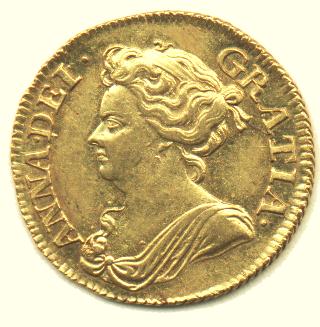
At the point I've reached, Sophie, the Electress of Hanover, and Caroline, future Queen of England and present Princess in Hanover, are discussing a new usage: "currency" denoting money rather than the action of water flowing in a stream. It's 1814 and England's Tories are trying to prevent the House of Hanover from inheriting the English Throne. England, as had Holland, Genoa, and Venice beforehand, is a nation whose strength rests on the faith that people place in its currency. Lacking the gold and silver mines of Spain and the great natural resources of France, England has learned to create money out of trust -- trust (the balancing of anticipated risks and rewards) that wealthy Spaniards and Frenchmen place in England by committing their money to English bankers. Now Louis XIV is plotting with some of these Tories to undermine this trust by calling into question the worth of English currency, and at the moment it looks like he (and they) will succeed, enabling the Stuart "Pretender" -- a French pawn -- to be awarded the English Throne.

This web site gives a good overview of the history of the period and describes it's coinage.


This is the front and back of Queen Anne's guinea, the coin being discussed by Sophie and Caroline as "currency".

Here's the Oxford English Dictionary on the word "currency" (extracts):

1. The fact or condition of flowing, flow; course; a current, stream.
1657 HOWELL Londinop. 18 To preserve the currency of the stream. 1698 TYSON in Phil. Trans. XX. 135 To shew the Currency of their Canalis here. 1758 BINNELL Descr. Thames 11 The Currency runs..with such Force, as to render the Navigation thereof imperfect.

2. The course (of time); the time during which anything is current.
1726 AYLIFFE Parergon 196 The Currency of Time to establish a Custom, ought to be with a Continuando from the beginning to the end of the Term.

3. Of money: The fact or quality of being current or passing from man to man as a medium of exchange; circulation.
1699 LOCKE 2nd Reply to Bp. of Worcester (R.), 'Tis the receiving of them by others, their very passing, that gives them their authority and currency. 1722 Lond. Gaz. No. 6078/2 All such of the said Bills..lose their Currency. 1729 POPE Dunc. I. 23 note, The papers of Drapier against the currency of Wood's copper coin in Ireland.

Tuesday, September 20, 2005

A little mystery

The body is a more often than not a mystery. It might be more accurate to say the body which is myself is frequently difficult for me to understand. Neither statement profound except that it's kind of a miracle that we can seem to observe ourselves from a vantage outside ourselves.
That's a long introduction to a prosaic topic. Sports coaches and my own dad used to say "you've got to put your heart into it." For the coaches, "it" was football most frequently and sometimes basketball. I never heard it from my track coaches. For my dad, "it" was household chores, particularly cleaning up after dinner and most specifically the job of sweeping the 18 square feet of linoleum flooring in our tiny kitchen.

Neither coaches nor dad made much impact on my attitude at the time. I see things differently now. An epiphany when I was struggling to succeed as a head log bucker one summer in a northern California saw mill: I didn't see how I could do the job well. The mill wright who was also foreman told me yes I could. I changed my attitude and did the job well.

When I learned to practice Zen, I also learned that everything in life is work. I spent time at the Green Gulch farm of San Francisco Zen Center and for me this talk on Zen work, given at the farm, rings true.

The speaker says work is our life and our joy: "Every task requires a different kind of effort and we need to discover the kind of effort that is appropriate. And we need always to reflect on our attitude and to see how we are doing. Complaining a lot or feeling like we're working too hard or joylessly are signs that we're forgetting to own our work." It still sounds like my father telling me to put my heart into the after-dinner cleanup routine, but that doesn't make it wrong. As the speaker also says, work is form of meditation and it can produce a wider awareness and sense of release.

I once had this sense of awareness and release on a hill I've climbed a thousand times and more. I thought I was taking it as fast as I could. Another biker demonstrated that it could be taken much faster (breezing by me). I sped up and, yes, I could indeed open my heart and do it much faster.

I went through this process a couple of weeks ago. For many days, pretty much constantly since returning from summer vacation, I was feeling old and decrepit on bike. Weak and achy. Slow. Then there came a time when, unaccountably, my spirits rose and I rushed home just about as fast as I ever have. There's always some luck involved in doing a fast commute. Traffic was light, the weather was warm and not humid, the west breeze was gentle. Traffic lights were green. But there was also this little mystery: My muscles had rebuilt but I was still thinking of myself as old and decrepit. Something (what?) turned my attitude; cleared the way so I could put my heart into the work of riding.

Monday, September 19, 2005

• change d'avis

Just back from an event-filled weekend. B and I drove to Westchester County to attend a reunion celebrating the 45th anniversary of high school graduation. I'll blog about that when my head clears. We also welcomed a visitor from out of town and attended the a picnic buffet that our little community puts on each year. It seemed this morning, on returning to work, that I was returning from three or four days off, not just the usual Sat & Sun. At the buffet ('party in the park'), a neighbor said he'd recently been to his 30th high school reunion as was struck by how little people changed -- not appearance but attitude, temperment, personality; particulary he was struck by how they could maintain grudges over the decades. I told him my experience at my 45th was more positive and heart-warming. The subject of changing of minds led me to think about an article I'd recently read. This post is about the subject of that article.


Much of the good stuff in my life has come to me via friends and people (like my wife) to whom I'm related.

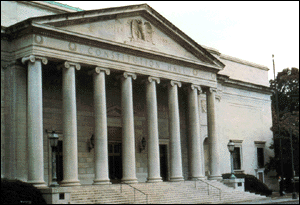
Back in the '70's a friend got me to join her to go hear the Dalai Lama speak. The venue was DAR's Constitution Hall, not your usual New Age auditorium. She knew about the water lilies that you'd pass by as you approached the hall from the west, so that's the way we came. He was intelligent, humane, undogmatic. The lilies were quietly bold, coming open in the twighlight. I don't know what intellectual rationale there may be for the lotus symbol in Buddhism, but, then and there, it made emotional, aesthetic sense.


This returns to mind because of a recent artilce in the New York Sun quoting the Dalia Lama on the subject of science and, implicitly, intelligent design. Here's a citation and some extracts:


Science Without Borders
Books
By MICHAEL SHERMER
September 14, 2005

In a 1987 lecture on "The Burden of Skepticism," the astronomer Carl Sagan opined:

*In science it often happens that scientists say, 'You know that's a really good argument; my position is mistaken,' and then they actually change their minds and you never hear that old view from them again. They really do it. It doesn't happen as often as it should, because scientists are human and change is sometimes painful. But it happens every day. I cannot recall the last time something like that happened in politics or religion.*

Tenzin Gyatso [is] the 14th Dalai Lama, who at the age of 6 was enthroned as the reincarnation of his predecessor, the 13th Dalai Lama, in the Tibetan capital of Lhasa. Born to a peasant family in a small village called Takster in northeastern Tibet, the Dalai Lama ended up in an exile that brought him in contact with many of the world's leading scientists.

He talks about his youthful encounters with science, especially his meetings with some of the world's leading scientists, including physicists Carl von Weizsacker and David Bohm, and the philosopher of science Karl Popper. From these encounters, as well as his Buddhist studies, the Dalai Lama found a way to harmonize science and religion, even while recognizing (and respecting) their differences. Both science and Buddhism, he points out, share a strong empirical basis: "Buddhism must accept the facts - whether found by science or found by contemplative insights. If, when we investigate something, we find there is reason and proof for it, we must acknowledge that as reality - even if it is in contradiction with a literal scriptural explanation that has held sway for many centuries or with a deeply held opinion or view."

Instead of filtering scientific findings through the sieve of his religion, the Dalai Lama approaches science with humility and openness. "As my comprehension of science has grown, it has gradually become evident to me that, insofar as understanding the physical world is concerned, there are many areas of traditional Buddhist thought where our explanations and theories are rudimentary when compared with those of modern science." This book is "not an attempt to unite science and spirituality," he explains, "but an effort to explore two important human disciplines for the purpose of developing a more holistic and integrated way of understanding the world."