Tuesday, December 11, 2007

a saint

Update: Over a year ago, Alan Cooperman reviewed an exhibit of early Bible texts at DC's Sackler Gallery (A Testament To Change: Early Scraps Of the Bible). In the review, he gives an anecdote about the Bible that St. Ceolfrith commissioned:
For pure symbolism, however, it would be hard to top the Latin translation of both the Old and New Testaments commissioned by the Abbott Ceolfrith when he retired from the monastery of Wearmouth-Jarrow in northern England in 716. The Sackler has just a few leaves of one of these volumes. As a gift for the pope, Ceolfrith called for a huge, lavishly illuminated version, which took three people to lift. The message it was meant to send was that 'the farthest outpost of the empire is where it's at now; we can outdo Rome in craftsmanship, we can outdo Rome in scholarship'. That message, apparently, was received. Sometime in the 9th or 10th centuries, Ceolfrith's name was scratched out of the Bible sent to the pope. It was replaced with the name of an Italian saint, and the codex was assumed to be Italian until the 1880s.

I thought I might find a name-saint so I could celebrate a yearly feast day as do the other members of my family. There's no St. Jeffrey, but there are a few other candidates: a St. Geoffroy of Amiens (also: Godfrey & other variants), a St. Godfrey of Cappenberg, and a St. Ceolfrith (variant spelling: Ceolfrid; in English: Geoffrey). I think I'll go with the last one since one of his celebrated accomplishments was to assemble the largest library in Anglo-Saxon England, and also because he was mentor to Bede. One source says: "The celebrity of his school, in which Bede imbibed his great learning, was very extensive." Here's a link to the entry for him in About.com.

Two images that show him. In the first, he is receiving messengers from Nechtan IV, King of the Picts. The second is a icon. The source doesn't explain its origin. In it, he's seen with a book, appropriate because of his acquisition of books and also because he commissioned the Codex Amiatinus, one of the most famous of all Bibles.


{Source: rootsweb. Click to view full size.}


Butler's Lives of the Saints gives a full description of his life and accomplishments.
SEPTEMBER XXV.
SAINT CEOLFRID, ABBOT.
From Bede, Hist. 1,5, et 1. de Vitis Abbat. Wirim. Item, 1. de Tempo, ribus. See Leland de Scriptor. Bulteau, Hist. 1. 4. Pitseus, and Suysken, t. 7. Sept. p. 123.

A. D. 716.

CEOLFRID is the same Teutonic name with Geoffrey, and signifies Joyful, as Camden remarks. The saint was nobly born in Bernicia, and related to St. Bennet Bishop, with whom he joined in the generous resolution of quitting the world. With him he made a journey to Rome, partly out of devotion, and partly for improvement in sacred studies and divine knowledge. After their return he was St. Bennet's assistant in the foundation of his monastery of St. Peter at Wiremouth, on the north bank of the river, in the bishopric of Durham.

St.Ceolfrid would have regarded it as his greatest felicity on earth, if he could have been as much forgotten by all creatures, and contemned by every one as he contemned and studied to forget himself: and he lived in his community as St. Antony and St. Hilarion lived on their mountains, in the most profound recollection, and in the practice of the most austere penance. When St. Bennet built the monastery of St. Paul at Jarrow, he sent Ceolfrid, with seventeen monks, to lay the foundation of that house, and appointed him abbot. Our saint governed this abbey seven years in St. Bennet's life-time, and was constituted at the desire of that saint, in his last sickness, abbot also of Wiremouth: from which time he presided, for twenty-eight years, over both those monasteries, which for their propinquity and constant connexion were usually esteemed as one, and were generally subject to one abbot.

St. Ceolfrid was diligent and active in everything he took in hand, of a sharp wit, mature in judgment, and fervent in zeal. Bede, who had the happiness to live under this admirable man, has left us most authentic testimonies of his learning, abilities, and extraordinary sanctity. He was a great lover of sacred literature, and enriched the libraries of his two monasteries with a great number of good books; but banished those which could only serve to entertain curiosity. To how great a pitch he carried the sacred sciences in his monasteries, Bede is an instance. He was himself very learned. Naitan, king of the Picts, sent to him, desiring to be informed concerning the right time of celebrating Easter, and the true form of the clerical tonsure. The holy abbot strongly proved and recommended to him the Catholic custom of observing Easter and the Roman tonsure called St. Peters, by a letter which Bede hath inserted in his history.* The king received it with great joy and satisfaction, and commanded both points to be received and observed throughout his dominions. This king likewise desired our saint to send him builders, who might erect a stone church, after the manner of the Romans, promising to dedicate it in honour of St. Peter. The abbot complied also with this request.

St. Ceolfrid finding himself broken with age and infirmities, and no longer capable of teaching his monks, by word and example, the perfect form of monastic observance, resigned his abbacy. The monks entreated him on their knees to alter his resolution; but were, obliged to acquiesce, and, upon his recommendation, chose Hucthbert, or rather Hubert, a very learned priest, abbot of both monasteries, in which then lived six hundred monks. This being done, the saint having sung mass in the morning, made them a strong exhortation to mutual love and concord; and, for fear of being stopped by the grandees of the kingdom, who all held him in great veneration, set out immediately with a design to perform a pilgrimage to the tombs of the apostles at Rome. On the road, besides the canonical hours, he every day sung the whole psalter twice over, and also offered to God the saving victim in the mass which he sung every day, except one when he was upon the sea, and the three last days of his life. After travelling one hundred and fourteen days he arrived at Langres, in France, where, being stopped by sickness, he happily died on the 25th of September, in the year of our Lord 716, of his age seventy-four, of his sacerdotal character forty-seven, and his abbatial dignity thirty-five. He was buried in the church of the three twin martyrs, SS. Speusippus, Eleusippus, and Meleusippus. His relics were afterwards removed to his monastery of Jarrow, and thence, in the time of the Danish devastations, to Glastenbury.
(l) Leland saw a square stone at Jarrow, on which was this inscription: (2) "The dedication of the church of St. Paul at Jarrow, (1) See App. ad Martyr. Gallic. Malmesb. de Reg. 1. 1, c. 3, et Monast. Angl. 1. 1, c. 4. ( 2) See Leland, de Scriptor. ed. a Tanner, p. 162.

=======================
* L. 5, c. 22. St. Ceolfrid calls that tonsure St. Peter's, in which the crown was entire of the whole head: but that Simon Magus's, in which the circle was imperfect, and only on the fore part. See Mabillon, Praefat 2d Saec. 2. Bened.

From: The Lives of the Fathers, Martyrs, and Other Principal Saints by Alban Butler (Published 1866, J. Duffy)


Here's more on St. Geoffroy, given because he shows up in a poem about a picture and because the picture is available online.

One source say: "As bishop he did not cease to take care of the poor and the sick. When some lepers came to him he commanded his cook to prepare food for them; four hours later nothing had yet been done, and he himself went to the kitchen and found a large, prepared salmon which he took to the famished lepers. The cook remonstrated with him, and the Saint told him that it was injustice to allow the poor to die of hunger while unworthy bishops enjoyed food that was too succulent."

This is an extract from a poem about painting:
But sickness comes; and Painting shows
How holy men did cheer its woes.
Saint Godefroy, whom old Amiens knew
As tending sick men, comes to view;
Yon see him standing by their bed:
With these few touches all is said.
From "The Power of Painting" by Kenelm Henry Digby. Little Low Bushes: Poems London, 1869.


Monday, December 10, 2007

a neighborhood, all neighborhoods

Gobbergo has an homage to Mr. Rogers. There was a time I couldn't abide such things -- embarrassing sentimentalia associated with my neurotically smothering Germanic grandmother, turning a blind eye, as I saw it, to the injustices and brutalities of life. With respect to Mr. R, I'm with Gobbergo; I'm done with that attitude.

a blog on vélib' and other bike-sharing programs

Bike-sharing Blog is devoted to bike-sharing systems like the Vélib' program in Paris. It's produced by a bike consulting firm, MetroBike LLC. I've been posting quite a bit on this subject and am happy to be able to point you to a good source for current into on it. The photo is from the current post. It shows bikes from a company with which the University of Washington has a contract for a bike-sharing pilot. The bikes are electric-powered. Here's a press release.
Another post has a nice mash-up from Google Maps. The guy who writes the blog says there are now 62 mature bike-sharing programs. Sixty-one in Europe, one in Asia, and none in North America or elsewhere.

He agrees with me that plans for bike sharing in Washington DC are extremely lame. He says:
Small, but hey, it'll be the first in North America. D.C. contracted for the 120 bikes four years ago when it released its Request for Proposals forits bus shelter contract. Four years ago, a fleet of 120 was impressive. With larger and successful programs like Velib' (10,600 bikes now with 20,600 planned) and Bicing (3,000 bikes now with 6,000 planned), the relative size of a small program has shifted. D.C. officials are already considering how to expand the size of their program.
Incidentally: I used the ScribeFire Firefox extension to prepare this post. Nice and easy. I like it.

Sunday, December 09, 2007

a memorable professor

In the early 60s I was taught Roman history by Russell Meiggs, an Oxford don who was visiting professor for a semester. He had boundless enthusiasm for his subject and life in general. The first uninhibited British academic I met, he actually put on a bathing suit to frolic in the snow on one of the few occasions when we had enough of the stuff for cafeteria-tray sledding and the like. From him I learned about Ostia and its excavations, a subject on which he was typically passionate.

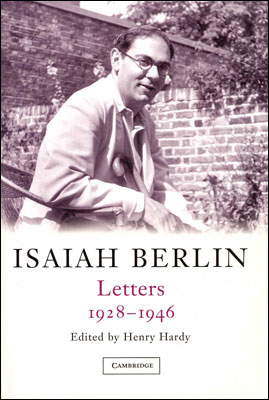
All this came back to me on reading a letter of Isaiah Berlin's from the mid-1930s.* Berlin is writing with typical humor about highbrows, middlebrows, and lowbrows, from which he morphs into a playful introspection on himself as aesthete. Along the way he mentions Meiggs as definitely neither highbrow nor aesthete. The man, he says, spoke and wrote energetically, sprinkling real and figurative exclamation marks throughout. Reading that called back this leonine person, ebullient, unpredictable, and magnetic; a professor to make an indelible mark in my otherwise pretty porous undergraduate memory banks.

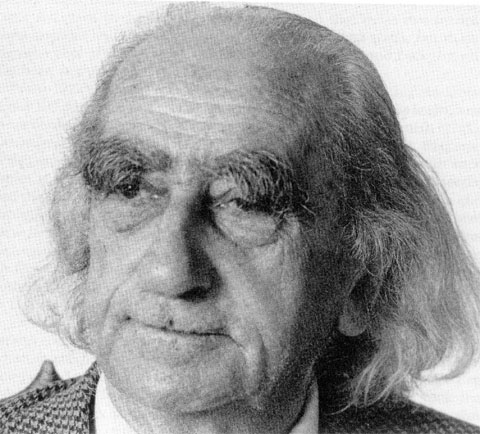
Here's his portrait by Michael Noakes which hangs in the Oxford College, Balliol, where he was Fellow for many years.


A website devoted to the archaelology of ancient Ostia provides this strikingly similar photo.


This site also gives the most interesting anecdote about the man:
And then there was Russell Meiggs. He was a very nice man, an eccentric, with long hair. He would still be wearing shorts in November! He had a blue jumper that his wife had made for him, which featured the Portus lighthouse flanked by two ships, like a mosaic in the Square of the Guilds. I remember a very strange visit to Portus. One day Meiggs arrived riding a motorcycle with a sidecar."Jump in! We're off to Portus!"."We haven't got a permit", I said, "the ruins are on private land, the Torlonia estate!". Anyway, in the end we went. We got in through a hole in the fence, but we were discovered by the custodians who called the police at Fiumicino. Meiggs explained, long and loud, that he'd entered the grounds because he was finishing a very important book, and he was given a permit on the spot, something the Italians had been asking for in vain for years!" (From an interview with the archaeologist Alberino Vicari by Jan Theo Bakker, January 1988. I added the links.)
This site also has an appreciation of him that mentions the eccentricity I best recall:
Meiggs was devoted to Swarthmore College and to his colleagues there, and the sentiment was certainly reciprocated. When he came to America he brought with him some of his more exuberant habits, such as rolling in the snow in the coldest days of winter in scant bathing attire. (by G.W. Bowerstock)
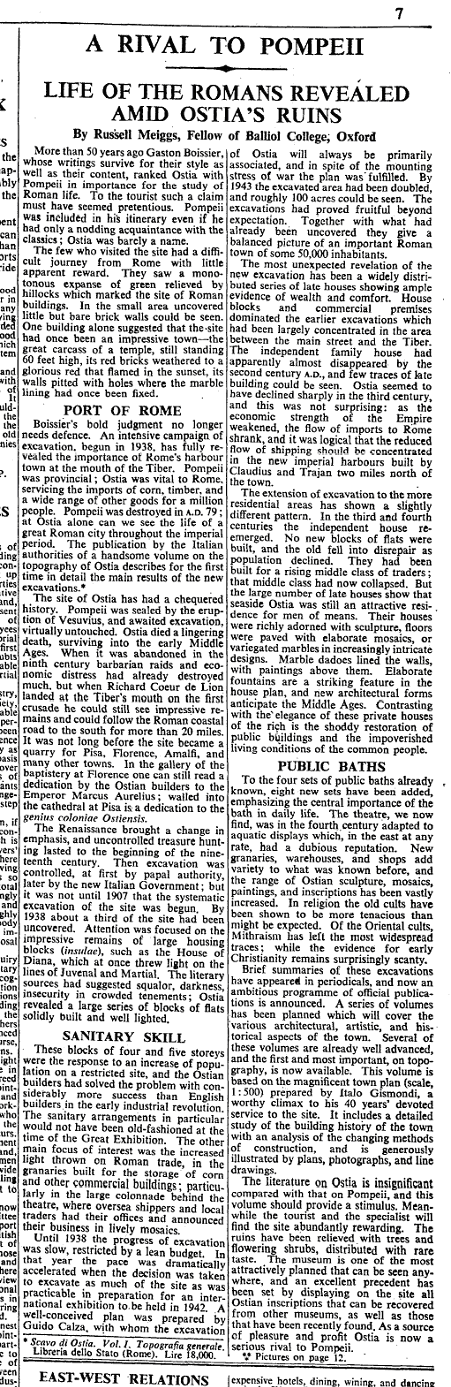
From this same website, here's a reproduction of an article on Ostia from the Times (of London) Meiggs wrote in 1954. (I assume the Times editor took out the exclamations that must have been present in the copy Meiggs submitted.)

{Click image to view full size.}


There's also a good page devoted Meiggs giving links on his life and his writings.

=================
*Isaiah Berlin - Selected Letters 1928-1946, by Isaiah Berlin (Author), Henry Hardy (Editor)

Saturday, December 08, 2007

caricatures

This caricature shows the Earl of Sandwich. He's being lampooned for making himself available for office in an abortive effort by Charles James Fox to form a ministry in April 1757 at the end of the reign of George II in England.

It's a detail from a cartoon by Charles Townshend, one of many he made recklessly ridiculing contemporaries. Townshend was a military officer and politician. He served under Wolfe at Quebec and later, as an MP for Norfolk, was responsible for the infamous Townshend Acts which he intended as just payment by the American colonies to help cover costs of their defense and which the Americans attacked as taxation without representation (first use of that phrase).

Sandwich is the subject of a good biography by N.A.M. Rodger. Rodger defends Sandwich against the accusations of libertinism and compulsive gambling made by contemporaries, but Sandwich did have many mistresses and was a famous gambler. He was also attacked as hypocrite for a speech in the House of Lords in which he effectively destroyed the political career of the notorious John Wilkes, a friend of Charles Townshend. (Sandwich showed Wilkes to be obscene and misogynist and Sandwich's enemies said he was no better; Rodger denies this.) Sandwich was also a naval reformer and administrative reformer in general. When Cook discovered the Hawaiian islands he named them for his patron, Sandwich and, it's true, the sandwich we consume many lunchtimes is also named for him. My favorite Sandwich connection is musical: He loved music, played it himself, and sponsored musical events at his home. He was passionately fond of Handel and took as lifelong companion Martha Ray, a young tradeswoman whose ability as a singer he particularly admired. (This alliance has its own separate story.)

In the Townshend cartoon Sandwich is made to say "I love deep play; this or nothing!" He has a cricket bat over his shoulder in place of musket. Deep play refers to a batting style in cricket but also underhandedness in politics -- an opportunism that was seen at the time as dishonorable, though common. I think the stuff dangling from the end of the bat are his cricket shoes and socks.

The cartoon was an immediate success -- outraging Fox and adherents and tittilating the political gossips in London coffee houses. It was immediately pirated; cards were printed showing each of the individuals it ridicules.

Here's the original. You see Fox leading a bunch of ill-assorted recruits towards an altar, on which is placed the king's son and commander-in-chief, the fat Duke of Cumberland, crowned with laurel. In addition to Sandwich, the recruits included Winchelsea (First Lord of the Admiralty), and Bubb Dodington.


Source: jstor. Click to view full size.


You can read more about this in The Caricature History of the Georges.

Here is a cartoon showing Sandwich's first encounter with Martha Ray.

Source: LoC. Click to view full size.


My source for the Sandwich caricature at top is the book, England Under the House of Hanover. The National Portrait Gallery has the pen and ink original:
NPG 4855(23)
John Montagu, 4th Earl of Sandwich
by George Townshend, 4th Viscount and 1st Marquess Townshend
pen and ink, 1751-1758
5 1/4 in. x 3 1/8 in. (134 mm x 80 mm)
Bequeathed by Robert Wyndham Ketton-Cremer, 1971

Wednesday, December 05, 2007

snow, gentle and ferocious

We're having our first snow fall. It's gently descending. We'll get maybe an inch and a half over the course of the day. This summer's geraniums haven't given up yet. They're a bit droopy after a few frigid mornings, but still pretty.

{Click image to view full size}


The snow reminds me of a famous day in the Giro d'Italia, Italy's version of the Tour de France. On that day an American riding for an American Team won what most probably consider to be the most difficult stage of any European professional race in the modern era. He not only took the stage, but went on to be the first and only American ever to be the overall winner in the Giro.

The connection with snow is a bit surprising. It was June 5, 1988. The race was in the mountains that day, and one of them, Passo Gavia, was experiencing blizzard conditions. The mountain is a high one, 2652 meters, but even at that altitude, in Italy one does not expect a blizzard on June 5.

The American rider is Andy Hampsten, a sweet-natured, clean-living, child of the 70s who -- from appearance and personality -- doesn't seem likely to possess the iron will and indefatigable constitution needed to not just endure but overcome all opponents in mountainous ice and snow. He's a favorite of mine partly because there is no chance, none at all, that he ever used illegal performance-enhancing drugs. And partly also because we have pretty much the same body measurements and thus ride bikes of the same dimensions. It isn't too outrageous for me to fantasize being Andy.

As the accounts I cite below explain, his performance on the Gravia gave Andy a commanding lead in the competition for overall race leader, but he did not win the stage. The stage winner was Erik Breukink, current manager of my favorite professional team, Rabobank. His account of the day would also make an interesting read. The Dutch riders, such as he, and men of Flanders are notoriously hard men, well-adapted to cold, wet conditions they must endure in training for and racing the Spring Classics, Northern Europe's famous one-day races.

Andy gave lots of interviews describing his ordeal that day. One of the best appeared in 2003: Giro 1988: Andy's Epic Day, by Richard Pestes (PezCyclingNews). Give it a read. Here's the opener: "As part of our series on the Giro climbs, we asked Andy Hampsten to recount his epic day on the Passo Gavia in 1988. A day of unquestioned cycling history, Andy started the 17th stage of that Giro in second place, and despite the Italians pleading with him to ride “piano piano” over the last climb, he went on an epic attack that earned him the maglia rosa, and the only American win of Italy’s grand tour. Pull on your woolies – it’s gonna be a cold one … "

Here are some excerpts from other accounts he's given. Note his self-awareness. His modesty has nothing false about it and it's characteristic that he says he didn't win the Tour de France because there were always a handful of racers better than he; there's no hint that he believes he might have won if they, like he, were drug-free.

1. "It was the most difficult day of my life. Nobody would have complained or argued with me if I had pulled over and not raced. It was above and beyond what anyone is asked to do at a race. As a bike racer. . . . It was really hard for me to turn pro and go to Europe. Coming from North Dakota and going all the way to Europe was what I was dreaming about the whole time, so I convinced myself to keep riding and keep racing all the way down the mountain. . . . The fans really appreciated the fact that it wasn't cancelled. It was kind of an end of an era where all the racers raced. Nowadays when the weather is bad sometimes a race gets cancelled. I'm not going to say that's good or bad."

2. "My personality is very good for bike racing. I like doing hard things ... sort of the monotonous beating my head against the wall. And that's the mentality it really takes to do the training to be a bike racer. Now, you know, looking back over the 10 years or so since I've retired, I have chilled out a lot. I don't tell myself everyday that it's another Gavia. I still like to work hard, but I also like to play pretty hard too. One thing I've learned is to not take things so seriously anymore. . . . Do I wish I were a bigger media icon? Personally, no. I tried to win the Tour de France every year I raced, and I didn't. I don't look at it as a failure. There were always three to five other riders faster than me. I'm glad I had all the opportunities that I did to try. I wanted to win the Tour because I respected it. That would have been the coolest accomplishment I could have achieved, and I'm glad I focused on it instead of trying to win more one day races. I wouldn't wish being as famous as Lance Armstrong on anybody. Knowing the way I am, that's not the way I would want it to be. I'd rather just be out riding my bike. . . . [On the descent from the top of the Gavia], at about 6km to go, Breukink caught me, but I was totally blocked and could not respond. Breukink had no rain jacket on, just a jersey, so he could descend faster on the long straight drop into Bormio. There was no bloody way I was going to take my jacket off. . . . After I crossed the finish line, I headed straight for our our soigneur, Julie. I was in such a rage trying to get down the mountain in one piece that when our team doctor, Max Testa, came up behind me and tried to put his jacket around me, I didn't realize who it was and since he was keeping me from Julie and my warm clothes, I started punching him. Mike Neel came over and straightened me out and got me in the team car, which was running it's heater full blast! When I started to warm up the pain started to come back. Mike then told me I had the jersey and the pain and the euphoria swept over me and I just started crying, laughing and shaking. A whole wave of emotions covering the range of finishing the stage to the realization that I would survive gave me a brief and refreshing emotional meltdown. . . . Within 10 minutes of the finish, I was up on the podium. The pink jersey felt good. I slipped it on and all my doubts went away. The TV interviews began and I remember saying 'Incredible, I have never seen conditions like this, even in Colorado. Today it was not sport, it was something beyond sport.'"

This is Andy on the Gravia.


This is one of his struggling opponents.


Here is Erik Breukink.


Andy in the pink jersey of the overall leader after the Gravia had given him a commanding lead. Click image to view full size.


Here are newspaper accounts from that time. Click to view full size.


There's a YouTube video of some Gravia footage, but it mostly concerns Pedro Delgado, another famous rider, and the images are very fuzzy.

Friday, November 30, 2007

on pluralism: sontag, berlin, and gray

I've been reading John Gray and Susan Sontag.

Gray is interesting because he's an outspoken maverick. He's a public intellectual with a good track record in showing how actions that seem good play out badly in the end. He's done this at the time Communism fell apart in 1989, with the growth of globilization and faith in free markets, in the contradictions of the "war on terror," and with the attempt to impose democracy by force in Iraq. His method is simple. As was Thomas Hobbes, he's a pessimist and a skeptic, deeply studied and highly articulate. His guiding principal is that when people take action "the ideas and consequences are rarely those intended, and never only those."

Gray delights in telling us how frequently our preconceptions are wrong. He's best known for pointing to the tragic outcomes -- a couple centuries after the fact -- of the Enlightenment faith in reason and improvement (whether economic, social, cultural, or political). The events themselves are plain enough: There are many advances celebrated in high school history texts -- such as the harnessing of steam power and then electricity, the shrinking of distance via rail, advances in communication, the ascendancy of democracy and democratic ideals in much of the world, the abolition of slavery, the revolution in agriculture. We, most of us I think, unconsciously accept these as instances of progress -- the betterment of mankind or at least some subset of peopledom. But, Gray asks us, don't we also recognize that none -- practically none -- of these advances are unaccompanied by dreadful events: from the horrors of exploitation in the agricultural and industrial revolutions through to the mass slaughters of the 20th and 21st centuries, the plague of AIDs, the injustices of globalization, and tragic failures in ham-fisted efforts to spread democracy. To see what I mean about Gray's single-minded determination to show us the downside of "progress," take a look at any of the many short books he's published, or maybe just scan his articles in the New Statesman.

Gray appreciates Sontag as a fellow-contrarian. Like him, she said that modern civilization is deeply flawed. To quote wikipedia:
Sontag drew fire for writing that "Mozart, Pascal, Boolean algebra, Shakespeare, parliamentary government, baroque churches, Newton, the emancipation of women, Kant, Balanchine ballets, et al. don't redeem what this particular civilization has wrought upon the world. The white race is the cancer of human history." (Partisan Review, Winter 1967, p. 57.) ([2]) Sontag later offered an ironic apology for the remark, saying it was insensitive to cancer victims.
Also like him, she delighted in questioning widely-held assumptions, even those held by intellectuals like herself. The obit in the New York Times calls attention to this side of her:
Ms. Sontag had a knack - or perhaps a penchant - for getting into trouble. She could be provocative to the point of being inflammatory, as when she championed the Nazi filmmaker Leni Riefenstahl in a 1965 essay; she would revise her position some years later. She celebrated the communist societies of Cuba and North Vietnam; just as provocatively, she later denounced communism as a form of fascism. After the attacks of Sept. 11, 2001, she wrote in The New Yorker, "Whatever may be said of the perpetrators of Tuesday's slaughter, they were not cowards."

Despite these similarities, there's a wide gulf in the writings of Gray and Sontag. He's persistent in pushing one big idea -- the pernicious working out of Enlightenment ideals over the centuries since it took hold. While she doesn't pretend to any all-inclusive overview and you can't find an intellectual thread which permeates her writings. There's no doubt about her credentials as a member of the intelligentsia, but she was not dogmatic and she believed that our understanding of the world, the quest to achieve wisdom, isn't wholly the product of our intellects, but just as much a matter of intuition.

Gray understands this anti-intellectual force, but uses it mainly to reinforce his anti-Enlightenment thesis. Note here his emphasis on the power of religion as a countervailing force and his use of the useful phrase "works of clairvoyant speculation" in a review of books in a series devoted to worked that altered history (Battle of the books):
The return of religion as a pivotal factor in politics and war is one of the defining features of the age, and it is time Paine, Marx and other secular prophets were gently shelved in the stacks. The writings of these Enlightenment savants have stirred events for a very brief period in history, now clearly coming to an end. Against this background it is good to have Bruce Lawrence's admirably balanced and informative volume on the Qur'an, and to look forward to Karen Armstrong's volume on the Bible appearing in the Atlantic series next spring. A few great books of science have altered history, as have some works of clairvoyant speculation, such as Freud's Interpretation of Dreams. But the books that have most formed the past, and which are sure also to shape the future, are the central texts of the world religions. Future volumes in the series must surely include Confucius's Analects and the Tao Te Ching, the Bhagavadgita and the Buddha's Fire Sermon - texts that have never ceased to shake the world and, as far as anyone can tell, always will.

All this leads me to a consideration of Gray's take on Isaiah Berlin. Gray knew Berlin personally and in some ways his writings reinforce the pluralist point of view that Berlin consistently advocated. Berlin would certainly agree with Gray's attacks on the fundamentalist point of view and in fact all sources of motivation that are founded on faith in simple, basic, naive beliefs (whether political -- as in the neo-con faith in exporting democracy via warfare, economic -- as in the industrial world's faith in a globalized form of "free-enterprise," or other). But Gray tries to fit Berlin himself into a simple intellectual structure. He says Berlin's philosophy is dominated by a belief in incommensurability: that diverse human values cannot be reconciled with one another (see here for an explanation of this). And in this I believe he's wrong. Berlin's writings warn us against simplistic analyses of complex events and they say you cannot assume there to be a single human nature that all people share and have always shared. But he was not so pessimistic as to write that values cannot be reconciled, must always be in opposition. Unlike Gray he was proud to be both a pluralist and a liberal.

Gray believes "we are ultimately powerless over both our individual and collective destinies, which leads to our nonsensical faith in progress." Berlin believed that individuals and groups can effect change and can overcome conflicts in order to improve their lot. He had a fundamental belief in human decency and he was optimistic about the power of decent people to effect change for the good.

Gray seems to be saying that some core values are inately true. You can't question the basic rules of morality. They are universally true. That belief he shares with Berlin. But they differ when Gray goes on to say there's nothing you can do about the problem of evil -- a failure to act in accordance with these ethical values.

Berlin, like Sontag, believed that intellectuals shouldn't just be skeptics. He believed that people can and should make ethical choices, that conflicting value systems can be reconciled -- at least some of the time, and that a pragmatic outlook coupled with understanding and imagination, can lead to improvements in peoples' lives. As Sontag put it, "I don't want to express alienation. It isn't what I feel. I'm interested in various kinds of passionate engagement. All my work says, be serious, be passionate, wake up."

I conclude that, ironically, Gray, who espouses a kind of pluralism, has a monist flaw. In Berlin's terms, he's at core a hedgehog and not a fox, while Berlin himself, and Sontag, are undoubtedly in the fox's den.

Addenda:

1. Here's Berlin's famous statement about hedgehogs and foxes:
The Hedgehog and the Fox - Isaiah Berlin (excerpt)
There is a line among the fragments of the Greek poet Archilochus which says: 'The fox knows many things, but the hedgehog knows one big thing'. Scholars have differed about the correct interpretation of these dark words, which may mean no more than that the fox, for all his cunning, is defeated by the hedgehog's one defense. But, taken figuratively, the words can be made to yield a sense in which they mark one of the deepest differences which divide writers and thinkers, and, it may be, human beings in general. For there exists a great chasm between those, on one side, who relate everything to a single central vision, one system less or more coherent or articulate, in terms of which they understand, think and feel - a single, universal, organizing principle in terms of which alone all that they are and say has significance - and, on the other side, those who pursue many ends, often unrelated and even contradictory, connected, if at all, only in some de facto way, for some psychological or physiological cause, related by no moral or aesthetic principle; these last lead lives, perform acts, and entertain ideas that are centrifugal rather than centripetal, their thought is scattered or diffused, moving on many levels, seizing upon the essence of a vast variety of experiences and objects for what they are in themselves, without consciously or unconsciously, seeking to fit them into, or exclude them from, any one unchanging, all-embracing, sometimes self-contradictory and incomplete, at times fanatical, unitary inner vision. The first kind of intellectual and artistic personality belongs to the hedgehogs, the second to the foxes; and without insisting on a rigid classification, we may, without too much fear of contradiction, say that, in this sense, Dante belongs to the first category, Shakespeare to the second; Plato, Lucretius, Pascal, Hegel, Dostoevsky, Nietzsche, Ibsen, Proust are, in varying degrees, hedgehogs; Herodotus, Aristotle, Montaigne, Erasmus, Molière, Goethe, Pushkin, Balzac, Joyce are foxes.

2. Here's a link to a good introduction to Berlin's ideas. I urge you to read it. From the book, The Power of Ideas, by Isaiah Berlin, edited by Henry Hardy: MY INTELLECTUAL PATH Chapter I (Also available as pdf

3. Here's a link to Sontag's excellent essay on appreciating beauty (pdf).

4. There was a good interview article on Gray in The Independent a few years back. It explains some of Gray's appeal, much like that of Christopher Hitchins, Here's a paragraph:
Gray is very good at his destruct jobs. Here he is on Post-Modernism: 'Just the latest fad in anthropocentrism.'; on atheism: 'Secularism is like chastity, a condition defined by what it denies.'; on environmentalism: 'A high-tech Green utopia, in which a few humans live happily in balance with the rest of life, is scientifically feasible, but it is humanly unimaginable.'; on Buddhism 'This is only another doctrine of salvation, subtler than that of the Christians, but no different from Christianity in its goal of leaving our animal inheritance behind.' As you can see, this is not some work of middle brow, Alain de Bottonesque consolation, philosophy viewed as an antiseptic sticking plaster for the fevered mind. This is the full monte, with isms falling right left and centre, free will savagely downsized and morality revealed as a perennial but threadbare attempt to market white as the new black.

Monday, November 26, 2007

untergunther


Sometimes the news makes you feel good. For instance:

Undercover restorers fix Paris landmark's clock
'Cultural guerrillas' cleared of lawbreaking over secret workshop in Pantheon
Emilie Boyer King in Paris
Monday November 26, 2007
The Guardian

Excerpts:
Four members of an underground "cultural guerrilla" movement known as the Untergunther, whose purpose is to restore France's cultural heritage, were cleared on Friday of breaking into the 18th-century monument in a plot worthy of Dan Brown or Umberto Eco.

Under the supervision of group member Jean-Baptiste Viot, a professional clockmaker, they pieced apart and repaired the antique clock that had been left to rust in the building since the 1960s.

"When we had finished the repairs, we had a big debate on whether we should let the Panthéon's officials know or not," said Lazar Klausmann, a spokesperson for the Untergunther. "We decided to tell them in the end so that they would know to wind the clock up so it would still work."

Klausmann and his crew are connoisseurs of the Parisian underworld. Since the 1990s they have restored crypts, staged readings and plays in monuments at night, and organised rock concerts in quarries. The network was unknown to the authorities until 2004, when the police discovered an underground cinema, complete with bar and restaurant, under the Seine.

"We would like to be able to replace the state in the areas it is incompetent," said Klausmann. "But our means are limited and we can only do a fraction of what needs to be done. There's so much to do in Paris that we won't manage in our lifetime."
Addendum: I've been reading John Gray lately. Not the Mars and Venus guy, but the guy who has activated Isaiah Berlin's philosophy (willy-nilly). Gray might not approve of UX, but he should. The Times (UK) has a readable introduction to himself and his thought. Other sources: wikipedia, Granta, NYRB, The Guardian, publications list.

Saturday, November 24, 2007

save the bones for henry jones

I should have posted this on Thanksgiving. In an interview with Nancy Grace, Hettie Jones says she used to sing a Johnny Mercer tune, "Save the bones for Henry Jones, 'cause Henry don't eat no meat."

Update:
For $0.89 Amazon will sell you an mp3 of the song as performed by Johnny Mercer and Nat King Cole. Here are details: Original Release Date: April 6, 1942; MP3 Release Date: January 12, 1999; Label: Capitol; Song Length: 3:04 minutes.

Here's a recent, abbreviated version by the Jumpin' Joz Trio.

The song was written by Danny Barker and Vernon Lee and the version most people know is performed by Nat King Cole & Johnny Mercer.

Here's the full lyric

SAVE THE BONES FOR HENRY JONES
(Danny Barker / Vernon Lee aka Michael H. Goldson)
Nat King Cole & Johnny Mercer

We’re gonna have a supper
We’ll eat some food that’s rare
And at the head of the table
We’ll place brother Henry’s chair
Invite all the local big dogs
We’ll laugh and talk and eat
But we’ll save the bones for Henry Jones
‘Cause Henry don’t eat no meat

Today I’ll go to market
Buy up a lotta fish
Well, that will thrill brother Henry
‘Cause fish is his special dish
Get a large can of molasses
Have something really sweet
But we’ll save the bones for Henry Jones
‘Cause Henry don’t eat no meat

Henry is not a drinker
He rarely takes a nip
He don’t need a napkin
‘Cause the things he eats don’t drip – blip!
One day we had a banquet
It really was a bake
They started off with short ribs
Then finished off with steak
But when the feast was over
Brother Henry just kept his seat
And we served the bones to Henry Jones
‘Cause Henry don’t eat no meat

Our banquet was most proper
Right down to demitasse
From soup to lox and bagels
And pheasant under glass – class!
We thought the chops were mellow
He said his chops were beat – reet!
We served the bones to Henry Jones
‘Cause Henry don’t eat no meat
He’s an egg man
Henry don’t eat no meat
He loves a pullet
Henry don’t eat no meat
A vegetarian
Henry?
Coming mother!
Soup’s on
Here's the Q & A from the interview of Jones:
NG: Do you think your own poetry and fiction somehow manifests, as does some other Beat poetry and literature, the black street language of the time? For example, there's some in your memoir, but not as much as, say, what we see in Diane di Prima's early poetry,.

Jones: Yeah, I don't mean to accuse Diane wrongly, but think I wouldn't have done it that way. She was just being hip. I feel that hers was really an adaptation, in a way. Mine comes out of the language of my young adulthood that I have always used. I'm always surprised that people laugh at the things I say. For instance, once in response to a friend of mine I said, "Yeah, you just ain't bumpin' your gums!" And she said, "What? What is that? Did you learn that from your children?" But, no, that was just an old 40s expression that became a part of my language. I also know and am more intimately involved with what we-I guess-call black culture than most adults of my age. I was at a conference last week, and began to sing, "Save the bones for Henry Jones, 'cause Henry don't eat no meat." And people looked at me like I just stone crazy! "What is that" they said. And I said, "It's a song from the 40s." Then I told this story to an older black man, and he laughed and laughed. He understood. So, that's that what I know, and it comes out in my language. I don't feel it as an adaptation.

Friday, November 23, 2007

two women

I've wanted to write about Cathy Wilkerson and Hettie Jones, separately or together, but while my subconscious genie was pleased to send this little mania, it didn't give me a clue what to do with it. So this post starts out without an end in view. I'm eager to see where it takes me.

Some three-to-four decades past, Cathy was a couple classes behind me at college and Hettie worked at the nonprofit where I volunteered. My knowledge of each was infinitessimal and hardly more extensive now. They both stand for something: a test of the notion that a person can, by intention, achieve something large in the world. For Cathy this something large was to participate in a chivalric destruction of the Establishment's exploitation of weak, poor, and despised minorities in the US. For Hettie it was to help people who were members of these weak, poor, and despised minorities understand that they needed to break free of their servitude through their own initiative, and to help them learn how to do this. Cathy now admits that her attempt was a total failure. In Hettie's case, I think it's not clear whether things have changed for the better since her time: maybe they have, maybe not. I think it's safe to say we both wish it so.

So what did they do? You'll probably recall that Wilkerson made the newspapers when she and companions managed to blow up her parents Greenwich Village townhouse back in 1970. (Put your cursor over the dot on W 11th St in this map of the Radical Big Apple.) The group was going to use the bomb to blow up some soldiers at Ft. Dix in NJ.


{Click to view full size: This is Cathy today, outside the place she helped destroy. Photo credits: AP & NYT}


Jones did not make the news. She married a newsworthy man, gave birth to children, watched him go out and away from her and them, and moved on with her life.

The two women have in common a passion for righting society's wrongs. Both are literate, middle-class, and white. Both have endured and attempted to overcome male dominance within groups dedicated to overthrowing racial, class, and political injustices. Both have written memoirs.

But Wilkerson born in 1943, grew up in a prosperous Quaker home in Connecticut, while Jones (born Cohen), 9 years older, grew up in a less prosperous Jewish one in Queens.

Wilkerson says she was totally innocent of radical politics until 1962 when she entered college.
Swarthmore was a real hot bed of intellectual discussion. I mean the classes were peripheral and what happened amongst the students was more important to most of the students than what happened in the classes. And there were also people from every political sect on the left there. I had never met anyone from the left. I mean there were red diaper babies, there were Trots, there were Social Democrats, there were everything. ... My freshman year, I went to a couple of meetings ... I couldn’t understand a word anybody was saying about anything. And no women ever spoke. But the spring of my freshman year they organized trips to go down to Cambridge, Maryland, to participate in the demonstrations that were going on down there. ... If there’s one event that changed my life, that’s what it was. I don’t remember the demonstrations really clearly. But I remember, I think there were dogs and it was, you know, Southern, very Southern. ... It was big and intense and heavy. It just completely blew my mind, and nothing was ever the same again.*
After that for her it was SDS and then the Weather Underground, and the rest is history. She became single-minded, dogmatic, and driven by the notion that the ends justify the means. As she says,
Rather than listening closely to what people had said, I tried to manipulate them into adopting the organization's current perspective, into carrying out the organization's wishes in order to protect my own standing. Rather than facing the complexity of problems, I had settled for simplistic solutions and for the fiction that we, the authors of those solutions, were somehow superior to those we sought to guide.**
The transitions of Jones's life were less sudden, momentous, or radical.
{Click image at right to view full size: The cover of Hettie's memoir shows her in youth and middle age. Photo credit: Books.Google.com}


A quiet rebellion took her away from straight-laced, homogeneous Queens into the publishing and jazz scene of Manhattan. She says,
By 1951, the year we were labeled the Silent Generation, I'd been recommended to silence often. Men had little use for an outspoken woman, I'd been warned. What I wanted, I was told, was security and upward mobility, which might be mine if I learned to shut my mouth. Myself I simply expected, by force of will, to assume a new shape in the future. Unlike any woman in my family or anyone I'd ever actually known, I was going to become -- something, anything, whatever that meant. To accomplish this I felt the need to cloister myself for a while, away from the usual expectations, at what was knows as an "all-girls college." Accepted at Vassar I chose instead Mary Washington, the woman's college of the University of Virginia.
She went there because it was cheaper and, she thought, less snobbish than Vassar, but she knew nothing about the place. For the first time in her life she was among Christians and, even more frighteningly, immersed in the culture of the ladies of the American South.
These were the people of white gloves and horse breeds, who had patterns of culture officially, including formal dinners and vespers.... I felt very much the Yankee Jew from New York. In the dining room, with a kind of tense awe, I was asked, "Are you Puerto Rican?" ... I seemed unique. In my dorm a black woman who worked as a maid sometimes picked up extra money ironing. As I had with my mother, I ironed beside her. She seemed to understand, smiled when she saw me coming, and showed me how to handle the tucks in my blouses. Apart from her, I met no other black people regularly.
A drama major, she had only one role in a college production, but performed many times for in the classrooms of backwoods schools and in the meeting rooms of Veterans' Hospitals. On graduating, she moved into Manhattan, taking menial jobs to get by. She listed to Wanda Landowska playing Bach on the harpsichord, read Whitman in Riverside Park, and studied Brecht at Columbia in a class taught by Eric Bentley.

Her life-changing event was wholly unlike Wilkerson's. She had been dating men of other races, religions, and cultures and so it's not entirely surprising to find that meeting Leroi Jones was transformational for her. She was working as a clerk in a Greenwich Village record store at the time. Here is her description of the encounter:
Nearby, running half the length of a cluttered storefront office, is a six-foot-high row of wooden milk crates, housing old 78 rpm jazz records in crumbling paper sleeves. Flakes of this yellow-brown stuff drift down and settle like snow on the dirty linoleum, and the smell of it masks the casual funk from a darker back room, where Richard (Dick) Hadlock, editor of the Record Changer, the magazine published here, sleeps whenever he's not with his girlfriend.

But he's with her now--or somewhere--leaving me: Hettie Cohen. a small, dark, twenty-two-year-old Jew from Laurelton, Queens, with a paperback book in my hand, Kafka's Amerika. I'm the Subscription Manager and I'm about to interview an applicant for the job of Shipping Manager. It's March 1957 in Greenwich Village. A haphazard pile of boxes, holding unsold issues, partly obscures the unwashed front (and only) window of the store. From time to time I glance toward this pale daylight, up from Amerika, waiting.

The applicant, arrived on a gust of sweet afternoon, turned out to be a young black man, no surprise. It was he who was surprised. "You're reading Kafka!" he said happily. He was small and wiry, with a widow's peak that sharpened his closecut hair, and a mustache and goatee to match. Yet the rakishness of all these triangles was set back, made reticent, by a button-down shirt and Clark's shoes. A Brooks Brothers look. I sat him down and we started to talk. He was smart, and very direct, and for emphasis stabbed the air with his third -- not index --finger, an affectation to notice, of course. But his movements were easy, those of man at home not only in skin but in muscle and bone. And he led with his head. What had started with Kafka just went on going. An hour later, when Dick arrived, we were still talking. "Did you tell him about the job?" Dick asked me. "The.job?" I echoed, and blushed. Left responsible and gone derelict. No interview. I see myself, now, as the heat invades my face, a hand up to my open, astonished mouth. On the left is my subscription corner, the typewriter, unanswered mail. And on my right LeRoi Jones--square-jawed, pointy-browed, grinning at me shyly, and still, I think, a little surprised I'd had so much to say.
She stuck with Roi as she called him from then on. They stuck to each other, that is, until he unstuck himself. By then, she'd been through an abortion, wedding, and birth of two children. She wrote with him, edited a magazine with him, and supported their kids -- with no help from him -- after he left. She did not waver in her faith that she -- and anyone else -- could breach barriers of race, religion, ethnic origin, and the like by making a conscious effort to learn, understand, and honor the differences among people and treat none as simply a member of some group, whatever the group or its stereotype. When the path of my life briefly intersected with hers, she had helped design the innovative Head Start Program in which I worked, one which paid women on welfare to take care of the children of other women on welfare, freeing the women to work their way out of poverty and giving their children a high quality preschool education. While the money to support the program lasted, it worked well, but the money didn't last long enough for it to achieve its aims. She was a leader in what was, in the 1960s, a controversial effort to give people tools to overcome poverty. Accounts have since said the effort was bound to fail since as poor people began to exert influence in local affairs, they provoked insuperable resentment in their local jurisdictions -- the local power structure.

Hettie is still an author and now also teaches writing to others, including -- no surprise -- people incarcerated in state and federal prisons. You can read her academic curriculum vitae on The New School web site.

Cathy Wilkerson's memoir is Flying Close to the Sun: My Life and Times as a Weatherman. Seven Stories Press, 2007. Hettie Jones' is How I Became Hettie Jones, Dutton, 1990. As well as showing their opposite approaches to making the world a better place (narrow-focussed and exclusive vs. broad-based and inclusive), the memoirs demonstrate the difficulties faced by women radicals during the 1960s and '70s.

You can read about Wilkerson's memoir in many places. I noticed it in a review by Scott McLemee in Newsday which I recommend. You can get yourself a second-hand copy of Jones' memoir very cheaply and it's widely available in academic libraries.

================
Some addenda:

1. Though closer in age to Wilkerson than Jones, I'm tempermentally more sympathetic to the latter. I envy her for being able to experience the cultural transformation effected by the Beat Generation in Greenwich Village of the '50s and '60s. (More on this here.) Her memoir uses a quote from Beat poet which is pertinent to her life: "The idea ... is to change first of our own volition and according to our own inner promptings before they impose completely arbitrary changes on us." (Janes Bowles, Two Serious Ladies, 1943). This faith in self-actualization through self-realization contrasts strongly with Wilkerson's tragic yielding to the rage she felt on encountering the repression of people poor, uneducated, and inarticulate.

2. Jones' husband is a subject all his own. Born Everette L. Jones, he re-made himself first to LeRoi Jones, then Imamu Amiri Baraka. The wikipedia article on him describes his transformations pretty well. I know him best as the author of the book Blues People.

3. Note that all three of these interesting people have mingled intellectual and activist pursuits in their lives. All three write. All three have produced readable memoirs.

4. I thought maybe one of the three might have released some writings into the internet under a Creative Commons license, but their idealism does not seem to take them that direction.

5. While researching this post, I came across an article on SDS at Swarthmore which quotes my friend and classmate Paul Booth.

6. Hettie Jones answered questions about her memoir in an interview entitled Women of the Beat Generation: Conversations with Joyce Johnson and Hettie Jones.

Saturday, November 17, 2007

Mulberry Street 1900

This photograph gives entry into the amazing vitality of Little Italy on the Lower East Side of Manhattan, New York City. It was taken in 1900 when the nation took all comers and millions accepted the invitation.

{Click image to view larger version.}
It's from the archives of the Detroit Publishing Co. The photographer and occasion for the photograph are not given.

Here is a link to the full photograph in all its glory; it's very large. Retrieve uncompressed archival TIFF version. Look at it now.

And here are some crops from the photo. I'll let them speak for themselves. Apart from the third one and the last, you can see a larger view by clicking on the image.


We may all remember "And to Think that I saw it on Mulberry Street," the book by Dr. Suess.

My memory is of a street on the Lower East Side not far from where I worked as a VISTA volunteer in 1967-68. I mentioned this work in a blog post recently.

At that time I lived on East 5th near Tompkins Square Park. The building is just out of view, mid-right in this photo:


Strangely, the portion of Mulberry Street I remember was a vibrant neighborhood of Jewish immigrants from Eastern Europe and their descendants while the portion shown in the photo, shows a teeming portion of Little Italy.

This map shows where I lived, where I worked, and the two ethnically different parts of Mulberry Street. The blue arrow at right points to the building where I lived in a walk-up fourth floor studio. The middle blue arrow points to the approximate location of Mobilization for Youth, home base for the work I did (which work took me to many places in Manhattan and Brooklyn). The left arrow points to the Mulberry Street I remember and the red arrow points to Mulberry Street in Little Italy.

{Click to see larger version. Credit: Mapblast.com}

Here is a link to the catalog entry for this photograph in LS's Prints and Photographs catalog.

The catalog gives links to the various states of the photograph:

color film copy transparency
Medium resolution JPEG version (71 kilobytes)
Retrieve higher resolution JPEG version (229 kilobytes)
Retrieve uncompressed archival TIFF version (65 megabytes)

color film copy neg.
Medium resolution JPEG version (78 kilobytes)
Retrieve higher resolution JPEG version (287 kilobytes)

Thursday, November 15, 2007

Vélibers in the Paris transportation strike

France is in the second day of its transportation strike. There's plenty of news coverage (Washington Post, BBC). As predicted, Paris' Vélib bicycle system has been popular. Although the system started big and has been growing, it was overtaxed by new users on day one.

MetroFrance uploaded this video showing the Vélib experience some Parisians new to the system. It's from the DailyMotion web site. The descriptive tag says "Parisians are discovering Vélib on day one of the big transportation strike."


The BBC gives a personal narrative (from which comes the photo at top) which says: "French drivers are sometimes not the most polite of people but there was a certain sense of solidarity on the Parisian roads this morning. Angry horns gave way to politeness as cars edged into reverse to let pedestrians and cyclists cut across the jams. Everyone understood this was not a normal day. 'No worries', smiled the cyclist whose rear tyre I shunted accidentally in trying to squeeze my own bike through the narrow gap between the van and the pavement. It soon became clear the best way to make progress was to filter down the middle lane and be swept along with the motorbikes and rollerblades."

Photo caption: "A man using a Velib bicycle on the Champs Elysees in Paris (14 November 2007)"

Monday, November 12, 2007

Joost and his team

[Update: Chris Selden has an summary of the Rasmussen inquiry and its outcome on Pez Cycling News.] I haven't written about Joost Posthuma for a few weeks.

Late in September, he crashed during the individual time trial in the World Cycling Chamionships, but wasn't badly hurt and has since recovered. His web site says it started raining while he was on the course. He went too fast around a corner and slipped. At the time he was doing very well and, but for the crash, might have achieved a finish within the top ten.

Early in October he re-injured his hip during the Paris Tours race. He hasn't raced since then, but he reports that he has signed up for another two years with the team and is now taking a holiday in Egypt with his family.

There's been plenty of news about the Rabobank Team itself. They sacked their leader during the Tour de France while he was in first place with good expectation of achieving the overall win. At the time they explained that he had missed two drug tests in the weeks before the race and had lied about his whereabouts. The Rabo site, the cycling press, and Rasmussen's own web site now have reports of an official inquiry into the incident.

Rasmussen says the team knew where he was all the time, he didn't take performance-enhancing drugs,* and he lied about his location for private reasons. The private reasons have to do with his family, specifically his wife, and he asks the press to respect his desire for privacy.

The press says that the ruling body of cycle racing, the UCI, does not accept Rasmussen's account as an acceptible explanation. They say that the fact that he lied is enough to bar him from the sport.

Two reports on the Rabo site say that the executive board of the group that runs Rabo cycling commissioned the inquiry and supports its conclusions. They admit that they had information about Rasmussen's whereabouts, knew that he lied, and had contact him at least some of the time while he was in Italy and France when he said he was in Mexico. (There had already been a partial admission of Rabo compicity. Without giving details, the Rabo cycling director admitted wrong-doing and resigned right after the Tour de France last July.)

As I see this, the good news is that Rabo do admit they made serious mistakes, they did sack Rasmussen, though they should not even have let him start the race, and they can say they are clean: there has been no allegation nor any evidence that the team, its sports staff, or its medical staff had anything to do with illegal drugs.

Here's a link to Rabo's report of the matter. A brief extract: "The Executive Board commissioned the committee to conduct an independent inquiry into the course of events surrounding the Rasmussen affair. The main conclusion of the report is that Rasmussen was rightly expelled from the competition and later dismissed. He demonstrably lied about and tampered with his whereabouts. There is no evidence that Rasmussen used doping. ... Serious errors of judgement were clearly made, primarily by the Chairman of the Board of Directors. ... It is patently obvious from the information known now that Rasmussen should not have been allowed to start in the Tour de France."

=================
* Rasmussen doesn't say he never took any drugs, but rather "I have never during my career taken EPO or Dynepo." However, to his credit, his web site gives a table showing the dope tests he took and their results from March 2005 through October 2007. Here are the concluding paragraphs on the subject on his web site:
In order to steer clear of speculations concerning what went on in Italy and whether he has complied with the doping regulations Michael Rasmussen presents his so called ‘biological passport’ in terms of tests from the previous 3 years. All the values show normal variations which should give absolutely no cause for suspicion about manipulation. These values are of course known by the UCI.

“In this connection I would like to stress that I have violated the whereabouts regulations but I have never missed a doping control performed by the UCI. From this point on I will obey all UCI rules and I am still available for control. Thus, I can also tell you that after the Tour de France I have had two further out of competition tests from the UCI with no remarks,” says Michael Rasmussen.

“My greatest wish right now is to ensure clarity about this matter and be able to return to professional cycling,” Michael Rasmussen says.

Sunday, November 11, 2007

appreciation

The Sunday Washington Post Book World has long had a poet's corner. Currently occupied by Robert Pinsky, it's sometimes the best thing the section has to offer. Last week, Pinsky offered up two by Reed Whittemore, one of which, "The Mind," is lyrical about the quiet dignity that can accompany old age. Here are excerpts.
The mind wears many hats . . .
It knows not what it knows deep.
. . . one kind of mind whose vision
Is steady as the sphinx's, and whose mold
Is rock against all sea and salt and season.
Such a mind, soul, have the old.
. . .
I know a mind, soul, whose time now leads it
Shoreward to silence.
Not long ago it chattered like half a school,
And bade the desert dance.
On the Sunday before Hallowe'en, Pinsky gave us Robert Bridges' "Low Barometer," pointing out its scary imagry of old terrors loosed when gale-blown clouds cross the moon and ghosts "creep from their caves to life again."

Now I read a letter about this in the Book World section taking Pinsky to task for limiting his comment to the All Hallows Eve connotations. Here's the letter. It's nicely full of restrained jubilation at one-upping the Post's chosen guide to things poetic.
Robert Pinsky's choice of "Low Barometer" by Robert Bridges (Poet's Choice, Book World, Oct. 28) brought a very evocative poem to our attention. Pinsky commented on Bridges's use of archaic language, but did not mention that such a word as "unhouseld" strongly summons up Shakespeare, as in the ghost of Hamlet's father complaining that he was sent to his death "unhouseld, disappointed, unaneld." There are many other Shakespearean references in the poem. "On such a night" is a direct quote from "The Merchant of Venice," and the lines "the pack'd/Pollution and remorse of time" have the swing and cadence of "What see'st thou else In the dark backward and abysm of Time?" from "The Tempest." And the entire fifth stanza rephrases the lines in "Julius Caesar" in which the fearful citizens exchange their dire news about the supernatural events seen in Rome after the death of Caesar.
ad_icon

Altogether Bridges's fine poem is wonderfully resonant of Shakespeare's words, and Shakespeare's frequent use of ghosts and supernatural occurrences. I can only marvel that Pinsky did not comment further on this marvelous entwining.

-- JUDITH JUDSON
Arlington, Va.
Christopher Ricks, admirer of allusion and all the tricks of the poetic trade, mentions this not. I don't doubt Judson's findings all the same, nor doubt that the witty Ricks would enjoy the letter she wrote.

It seems sometimes that culture advances more from competition than cooperation. Intellectuals have always taken pleasure in one-upping each other. There's frequently more than a cheap thrill in the conflict itself. Even when there's no clear outcome, positions are often sharped by the process of debate, and besting an adversary can sometimes bring tangible rewards. This goes back at least to medieval times when academic advancement and currying favor with a patron might hinge on taking on an intellectual adversary and besting him in some way (as mathematicians would challenge each other to solve complex problems going back to antiquity).

Mary Beard sums it up in a question: 'Isn't intellectual life about having an argument?'

And here's the poem:
Low Barometer, by Robert Bridges

The south-wind strengthens to a gale,
Across the moon the clouds fly fast,
The house is smitten as with a flail,
The chimney shudders to the blast.

On such a night, when Air has loosed
Its guardian grasp on blood and brain,
Old terrors then of god or ghost
Creep from their caves to life again;

And Reason kens he herits in
A haunted house. Tenants unknown
Assert their squalid lease of sin
With earlier title than his own.

Unbodied presences, the packed
Pollution and remorse of Time,
Slipped from oblivion re-enact
The horrors of unhousehold crime.

Some men would quell the thing with prayer
Whose sightless footsteps pad the floor,
Whose fearful trespass mounts the stair
Or burst the locked forbidden door.

Some have seen corpses long interred
Escape from hallowing control,
Pale charnel forms - nay even have heard
The shrilling of a troubled soul,

That wanders till the dawn has crossed
The dolorous dark, or Earth has wound
Closer her storm-spread cloak, and thrust
The baleful phantoms underground.

case study

Norman Mailer died the other day. Somehow he managed to survive to his 83rd year, ever trying to transmute himself into something better, or a least different, from the person he was in his youth.

He was a feisty celebrity; a self-indulgent romantic, kin to Brendan Behan and Dylan Thomas, though himself from a world opposite to theirs. I compare him to Amiri Baraka, chameleon revolutionist, poet, and chronicler of The Blues.*

Noting the dozens and more of appreciations that Mailer's death generated,** I spent a fruitless hour yesterday trying to find a record of what was obvious to me when I was a neo-grad student many years ago: Mailer modeled the characters in his debut novel, The Naked and The Dead, on potted neo-Freudian case studies contained in many an academic psych text book.

I did not find any account that mentioned this borrowing, though it was so flagrant, it seemed to me, as to be recognized and condemned as plagiarism if attempted by a college student. Only one comes close. Roger Kimball, who is sort of a professional contrarian, writes:
From 1944 to 1946, he [Mailer] served with the U.S. Army in the Philippines and Japan.

In 1948, when he was only twenty-five, Mailer’s war novel, The Naked and the Dead, was published. For most critics of war fiction, The Naked and the Dead ranks somewhere between the novels of Herman Wouk (e.g., The Caine Mutiny) and James Jones (From Here to Eternity). It is more pretentious, but less well-crafted, and its narrative develops less momentum. Its heavy-handed psychologizing and use of four-letter words were thought smart in 1948; most contemporary readers will find them quaint if not downright embarrassing.
I knew about Mailer's unacknowledged borrowing because I'd used a text book in college that outlined the various psyches of the characters in Mailer's novel with pretty much word-for-word accuracy. I don't have either that text or the novel handy and cannot demonstrate what I say, but have a vivid memory of the time I made I put this 2 plus 2 together. It's 1965. I'm studying British History, and my girlfriend, who's is doing a paper on Naked and Dead, asks me to look at what she's got. I give her to low-down on the case-study connection. She gets an A. I notice, yet again, how much easier it is to work on someone else's assignments than on one's own.

===================
*Why Behan, Thomas, and Baraka? Give me time and I will explain, but not today.

**Here are a bunch (courtesy ALD): NYT ... AP
... LAT ... Nation ... Guardian ... Reuters ... Telegraph ... Salon ... Chic Trib ... BBC ... Newsday ... Boston Globe ... NPR ... Time ... CNN ... NYT ... USAToday ... Wash Post ... London Times ... LAT ... Salon ... SF Chron ... Independent

Friday, November 09, 2007

some Jacobean prose from an Elizabethan hold-over

My friend Catherine says (with wit) that she wonders where Musharraf gets off pretending to be Henry VI.

As it happens I was reading last night Sir Walter Raleigh's caustic account of the wrongs done by English monarchs. Raleigh does not mention Joan of Arc (to whom Catherine alludes), but does boldly chronicle the brutality of kings and nobles. {Update/correction: Catherine says: "Actually, I was going for 'first thing we do, let's kill all the lawyers,' but it seems the allegory works more levels than I'd thought."}

Here are some extracts:
Among our kings of the Norman race, we have no sooner passed over the violence of the Norman Conquest, than we encounter with a singular and most remarkable example of God's justice, upon the children of Henry the First. For that King, when both by force, craft, and cruelty, he had dispossessed, overreached, and lastly made blind and destroyed his elder brother Robert Duke of Normandy, to make his own sons lords of this land: God cast them all, male and female, nephews and nieces (Maud excepted) into the bottom of the sea, with above a hundred and fifty others that attended them; whereof a great many were noble and of the King dearly beloved. . . .

To pass over the rest, till we come to Edward the Second; it is certain, that. after the murder of that King, the issue of blood then made, though it had some times of stay and stopping, did again break out, and that so often and in such abundance, as all our princes of the masculine race ( very few excepted) died of the same disease.
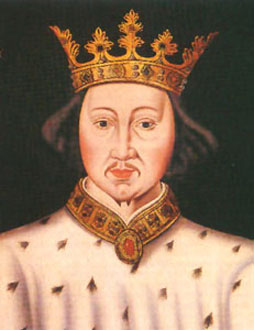
Richard the Second, who saw both his Treasurers, his Chancellor, and his Steward, with divers others of his counsellors, some of them slaughtered by the people, others in his absence executed by his enemies, yet he always took himself for over-wise to be taught by examples. The Earls of Huntingdon and Kent, Montagu and Spencer, who thought themselves as great politicians in those days as others have done in these: hoping to please the King, and to secure themselves, by the murder of Gloucester; died soon after, with many other their adherents, by the like violent hands; and far more shamefully than did that duke. And as for the King himself (who in regard of many deeds, unworthy of his greatness, cannot be excused, as the disavowing himself by breach of faith, charters, pardons, and patents) : he was in the prime of his youth deposed, and murdered by his cousin-german and vassal, Henry of Lancaster, afterwards Henry the Fourth. . . .
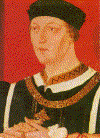
Now for Henry the Sixth, upon whom the great storm of his grandfather's grievous faults fell, as it formerly had done upon Richard the grandchild of Edward: although he was generally esteemed for a gentle and innocent prince, yet as he refused the daughter of Armagnac, of the House of Navarre, the greatest of the Princes of France, to whom he was affianced (by which match he might have defended his inheritance in France) and married the daughter of Anjou, (by which he lost all that he had in France) so in condescending to the unworthy death of his uncle of Gloucester, the main and strong pillar of the House of Lancaster; he drew on himself and this kingdom the greatest joint-loss and dishonor, that ever it sustained since the Norman Conquest. Of whom it may truly be said which a counsellor of his own spake of Henry the Third of France, " Qu'il estait une fort gentile Prince; mais son reigne est advenu en une fort mauvais temps:" " He was a very gentle Prince; but his reign happened in a very unfortunate season." . . .
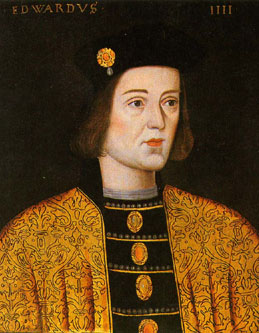
Edward the Fourth (to omit more than many of his other cruelties) beheld and allowed the slaughter which Gloucester, Dorset, Hastings, and others, made of Edward the Prince in his own presence; of which tragical actors, there was not one that escaped the judgment of God in the same kind. And he, which (besides the execution of his brother Clarence, for none other offence than he himself had formed in his own imagination) instructed Gloucester to kill Henry the Sixth, his predecessor; taught him also by the same art to kill his own sons and successors, Edward and Richard.

Those kings which have sold the blood of others at a low rate; have but made the market for their own enemies, to buy of theirs at the same price.
At the end of the preface, Raleigh explains why he did not write a history of his own times, saying he knows he would write the truth as he saw it and that the truth would be injurious to his health. (As it happens he was beheaded only a couple of years after he wrote this, though not for its writing.)
I know that it will be said by many, that I might have been more pleasing to the reader, if I had written the story of mine own times, having been permitted to draw water as near the well-head as another. To this I answer, that whosoever in writing a modern history, shall follow truth too near the heels, it may haply strike out his teeth. There is no mistress or guide, that hath led her followers and servants into greater miseries. He that goes after her too far off, loseth her sight, and loseth himself: and he that walks after her at a middle distance: I know not whether I should call that kind of course, temper or baseness. It is true, that I never travelled after men's opinions, when I might have made the best use of them: and I have now too few days remaining, to imitate those, that either out of extreme ambition, or of extreme cowardice, or both, do yet (when death hath them on his shoulders) flatter the world, between the bed and the grave. It is enough for me (being in that state I am) to write of the eldest times: wherein also why may it not be said, that in speaking of the past, I point at the present, and tax the vices of those that are yet living, in their persons that are long since dead; and have it laid to my charge ? But this I cannot help, though innocent. And certainly, if there be any, that finding themselves spotted like the tigers of old time, shall find fault with me for painting them over anew, they shall therein accuse themselves justly, and me falsely.
My source: Prefaces and Prologues to Famous Books, vol 39 in the Harvard Classics series, which you can download from Google Book Search if you wish.

============
Addendum: Musharraf is not a monarch and his tyranny does not conform to the murderous pattern of eliminating real and imagined rivals that Raleigh describes. There's plenty of violence associated with his rule, but it isn't alleged that he offed opponents in rising to, or staying in power.