Tuesday, June 15, 2010

"black Irish"?

African Americans had a major impact on the culture of the Five Points neighborhood in mid-nineteenth century Manhattan.[1] They never were numerically dominant, however, and from the 1840s on, their numbers declined relative to other groups. This is partly because more of them left than entered the district in those years but also because immigrants from Ireland began to arrive in greater and greater numbers. African American residents moved out partly because their financial success enabled them to but also because mobs had attacked their homes during the first of New York's anti-abolitionist riots in 1834. This organized violence pitted local pro-slavery thugs against a few clerical anti-slavery activists and many unresisting Five Points black residents. The newspapers of the day tended to express outrage about the actions of the mob, as you'd expect, but some claimed to see the abolitionists as instigators as well. None said the African Americans were to blame.[2]

It wasn't long before Five Points became predominantly Irish. This change was documented in a morally-uplifting book of 1869 which praises the "heroic women" who set out to save souls in the Five Points district three decades before. In setting the scene of the Methodist ladies' attempt to overcome unbelief and all its evil consequences, the book profiles the inhabitants of a single block in that teeming neighborhood: "One block contains 382 families. Persons composing these families were, 812 Irish, 218 Germans, 186 Italians, 189 Poles, 12 French, 9 English, 7 Portuguese, 2 Welsh, 39 Negroes, 10 Americans."[3]

The following map, which depicts concentrations of the ethnic groups of Five Points in 1850, shows the predominance of Irish immigrants and low concentration of African Americans. Overall, at that time, more than half the area's residents were Irish. The next-largest immigrant group were the Germans, who were ethnically divided between two groups which had little in common: west-German Christians and east-German Jews.[4]


The Irish who descended on Five Points in the potato-blight years of the '40s and '50s were the most miserable of all Five Points miserable residents. An 1951 article of the New York Tribune described their lot, saying their life in the home country was unbearable, so too was the passage to America, and their experience of New York was just another great trial for them. Here are extracts:
In the [steerage-passage] mode of conveying emigrants, evils have for a long time existed, not the less grievous because they have occupied but little public attention. ... On the Irish Emigrants, and they are by far the most numerous, such miseries fall with the heaviest weight. From the moment one of these leave his home [he suffers an] ordeal to which overruling necessity alone could compel him to submit. To reach this western continent, [the destitute Irish emigrant] must go east to Liverpool. There, confused and overpowered in the bustle of a foreign commercial city, he falls an easy prey to imposition and deceit.

Misery, with increasing bitterness, follows him upon the sea. He remains cooped up for weeks in the dark hold of an emigrant ship where, men and women, huddle together with utter disregard of decency, wear away the wretched hours in hunger, filth, and discomfort, or sicken and die without sympathy or help, often subjected to brutal treatment and exposed to the contagion of vice.

[Finally arriving in America,] he enters on his new career physically and morally degraded, and carries with him into the thronging population of our eastern cities the seeds of pestilence and the example of depravity. With this unhappy preparation he finds himself, on his arrival on these shores, cast into a society of whose condition he knows nothing. Unable to shape his course in a strange land, he lingers in some seaport city, adding to the supply of labor and diminishing its reward, or swelling the tide of vagrancy and pauperism.

-- New-York Daily Tribune, Saturday, September 6, 1851
A few months before this article appeared in the Tribune, a news report in the same paper described the condition of one group of Irish immigrants who later found their way to Five Points:
Destitute Emigrants. — Several destitute emigrants who arrived in this city a few days ago by the ship Montezuma, from Liverpool, were found Monday afternoon in the streets, in a starving condition. They were taken to the [local police station], where they were provided with food, after which they were sent to the Commissioners of Emigration. These emigrants, it appears, were taken out of the poorhouses in Ireland, by Lord Lansdowne."
-- New-York Daily Tribune, Wednesday, March 19, 1851.
These cartoons come from a web page by Christine Haug called The Stereotyping of the Irish Immigrant in 19th Century Periodicals. They're both from the 1850s and both reflect prejudices of the time. The first tells us the Irish are no better than black slaves and the second suggests that they will be a burden on New York social services as they have been on the Irish ones.

{source: victoriana.com}

-------------

See also:

Enter the Irish-American by Edward Wakin (iUniverse, 2002)

Irish Immigrants in America

The Stereotyping of the Irish Immigrant in 19th Century Periodicals by Christine Haug

-------------

Notes:

[1] They were economically a bit more successful than their immigrant neighbors, rented much of the dwelling space, and ran many of the grogshops. They also operated popular dance houses where you could watch famous Irish and African American dancers square off against each other in break-down competitions. I wrote about this in my previous post: African Americans in Five Points.

[2] A lot has been written about this riot. Contemporaries deplored the violence and generally sympathised with its victims, but the mercantile and commercial interests tended to see the "abolitionists and amalgamators" as purveyors of "wicked and absurd doctrines" and thus, in part, instigators of the riot. Here are some sources: After the riot, a woman gave news of it to her daughter in a letter that describes African Americans seeking refuge from mob attack. The reference to "the Recorder" is to the judge who presided at the Court of Common Pleas. The writer's brother Richard MacNeven then held that position and was considered to be an "undeviating and uncompromising friend of Ireland" and the mob contained many Irish immigrants in its numbers (fearful that slaves, if freed, would deprive them of jobs). A Vivid Account of the 1834 New York Anti-Abolitionist Riots Jane M. MacNeven. Autograph Letter Signed, “your Mother JMM,” to daughter Rosa P. MacNeven. New York City, July 20, 1834, 4 pp.
During this time [a heat wave in the city] we had the antislavery excitement ... what it might have increased to I know not if the military and civil authorities had not turned out in their strength and put a finale to the scene ... [In this period of] wild excitement and misrule came the sacriligious breaking in of churches and the disturbing and unsheltering of the poor black people who, in reality, are most unoffending on this occasion – during the mob reign your uncle Richard was here one night and left us between twelve and one on his way down just at the head of Anthony street, he met a party of colored women, children and grown boys half frightened out of their senses and flying from the rioters – they entreated the protection of your uncle and a friend who was with him – to save them for mercy sake from their enraged enemies – Brother bid them not to be alarmed but to follow him down to the police where they might remain in safety till morning – they embraced his offer and formed in a group around him pressing so closely upon his heels as almost to inconvenience him – They had proceeded but a little way, when a party of the marauders assailed them in their front – observing your Uncle at the head of his little squad they mistook him for an Abolitionist ‘Down with the abolitionists here they come!’ and they menaced him most feircely when he called out ‘it is the Recorder – don’t you know the Recorder!’ ‘Oh is it the Recorder;’ they cry ‘hurra for the Recorder!’ and with a reiterated cheer they let them all pass – during the interuption, the frightened group pressed to the side of their protector – like a flock of sheep to their shepherd … But all is quiet now and the world goes on smoothly again …
[3] Here are the paragraphs that precede this little inventory.
Persons who perambulate Broadway, on a pleasant day, who look on the elegantly-dressed throng that crowd the pavement, and through the costly plate-glass at the rich goods displayed, would be slow to believe that within a stone's throw squalid want and criminal woe have their abode. Here lie the Fourth and Sixth Wards, so famous in the history of crime in New York. In this locality one walks amid drunkenness, wretchedness, and suffering, within sound of the rumble of Broadway, within sight of the merry, gay, and well-dressed thousands who move up and down this thoroughfare of the city. No pen can describe the homes of the lowly where the New York poor lodge. It is a region of wickedness, filth, and woe. Lodging-houses are under ground, foul and slimy, without ventilation, and often without windows, and overrun with rats and every species of vermin. Bunks filled with decayed rags, or canvas bags filled with rotten straw, make the beds. All lodgers pay as they enter these dark domains. The fee is from five to ten cents, and all are welcome. Black and white, young and old, men and women, drunk and sober, occupy the room and fill the bunks. If there are no beds, lodgers throw themselves on the hard, dirty floor, and sleep till morning. Lodging-rooms above ground are numerous in the narrow lanes, and in the dark and dangerous alleys that surround the Five Points. Rooms are rented from two to ten dollars a month, into which no human being would put a dog, — attics, dark as midnight at noonday, without window or door they can shut, without chimney or stove, and crowded with men, women, and little children. Children are born in sorrow, and raised in reeking vice and bestiality, that no' heathen degradation can exceed.

Every state in the Union, and every nation almost in the world, have representatives in this foul and dangerous locality. Its tenant and cellar population exceed half a million. One block contains 382 families. Persons composing these families were, 812 Irish, 218 Germans, 186 Italians, 189 Poles, 12 French, 9 English, 7 Portuguese, 2 Welsh, 39 Negroes, 10 Americans. Of religious faiths 118 represented the Protestant, 287 were Jews, 160 Catholics; but of 614 children, only 1 in 66 attended any school. Out of 916 adults, 605 could neither read nor write.Sunshine and Shadow in New York by Matthew Hale Smith (1869)
[4] In New York as a whole, Irish immigrants were similarly split between Protestant north and Catholic south, but in Five Points there were almost no northerners. Irish Protestants had arrived earlier, before the Five Points neighborhood existed. Poverty-stricken Irish Catholics had been finding their way to Five Points even before the famine years of the '40s and '50s and their numbers greatly increased during those decades. It was they, of course, to whom critics referred when they groused about "the Irish." On this subject see Five Points: the 19th-century New York City neighborhood that invented tap dance, stole elections, and became the world's most notorious slum by Tyler Anbinder (Simon and Schuster, 2001)

Thursday, June 10, 2010

African Americans in Five Points

African-Americans inhabited the area that would later become Five Points on and off from the mid-seventeenth century onward. In 1679 a Dutch traveler wrote of a trip outside the northern boundary of New Amsterdam: "We went from the city, following the Broadway, over the valley, or the fresh water. Upon both sides of this way were many habitations of negroes, mulattoes and whites. These negroes were formerly the proper slaves of the (West India) company, but, in consequence of the frequent changes and conquests of the country, they have obtained their freedom and settled themselves down where they have thought proper, and thus on this road, where they have ground enough to live on with their families." The "fresh water" to which he refers is Collect Pond and its west-flowing creek. He was wrong in believing that African Americans were free to settle where they thought proper; they had been granted the land conditionally and, when the area came under British rule, they had to give it up.[1] Still, parts of the area were less suitable for farming than others and, being so, were left to African Americans as places to eke out a living.

After slavery was abolished in New York, early in the nineteenth century, slaves who had been agricultural laborers tended to migrate to Manhattan and many came to the area around Collect Pond where black freemen had made their homes and by the time Collect Pond was drained and filled in, these freemen and freed slaves had come to be the most prevalent as well as longest-term residents.[2] As impoverished immigrants began to arrive in increasing numbers, the African Americans whom they joined proved to be the most prosperous of the destitute masses in the area. Bear in mind, however, that this prosperity was entirely relative; African Americans weren't rich, they continued to be treated as second class citizens (or worse), and they were severely restricted in their means of earning money. They were, in this instance, simply not at the bottom of the economic ladder for a change.

An 1857 report by a commission investigating Manhattan's worst housing conditions gives an explanation. By that time, as a result of the potato blight, Irish immigration had increased dramatically and the Irish had become the largest of the pauper classes. From the report:
But we must pass over without description hundreds of dilapidated, dirty and densely populated old structures which the committee inspected in different wards. In most of them the Irish are predominant as occupants, though in some streets negroes are found swarming from cellar to garret of tottering tenant houses. In this connection, it may be well to remark, that in some of the better class of houses built for tenantry, negroes have been preferred as occupants to Irish or German poor; the incentive of possessing comparatively decent quarters appearing to inspire the colored residents with more desire for personal cleanliness and regard for property than is impressed upon the Whites of their own condition. In one building the committee remarked much neatness and seeming comfort, with not a little evidence of a prolific habit on the part of families which might not have pleased a Malthusian philosopher. In answer to inquiries, and in fact by ocular demonstration, it was ascertained that nearly all the inhabitants were practical amalgamationists — black husbands and white (generally Irish) wives making up the heads of constantly increasing families.[3]
Some, perhaps most, of the African Americans who achieved a slight economic advantage over their immigrant neighbors did so by running grocery-grog shops, taverns, oyster-bars, and — most notably — dance halls.

Charles Dickens was one of the first writers to call attention to this relative prosperity. In his write up a trip to the US in 1842, he noted a bit of African American prosperity in a Five Points dance hall. After describing the horrible conditions of life in the district (as many others were doing then and would continue to do), he descends into a place called Almack's and tells us: "Heyday! the landlady of Almack's thrives! A buxom fat mulatto woman, with sparkling eyes, whose head is daintily ornamented with a handkerchief of many colours. Nor is the landlord much behind her in his finery, being attired in a smart blue jacket, like a ship's steward, with a thick gold ring upon his little finger, and round his neck a gleaming, golden watch-guard. How glad he is to see us! What will we please to call for? A dance? It shall be done directly, sir: 'a regular break-down.'"[4]

A decade later, another sensationalist writer asked his readers to "see the squalid females, sottish males and half-starved urchins, perching about the windows, stoops and cellar doors [of Five Points], like buzzards on dead trees, viewing the dead carcass beneath." He tells us "The population of the Points is about equally divided between whites and blacks. The blacks however are, for the most part, the rulers; they own and keep a majority of the drinking and dance-houses."

Like Dickens, this moralist describes the best-known of the Five Points dance-houses: Almack's, also known as Pete Williams'. There were other dance halls in Five Points and many other establishments and tenements owned and leased by African Americans, but Pete Williams' was the one successful business that upper class white men patronized and it's the one that continued to show up in the press. This writer says,
But now it is time for Pete Williams's ball to open. Let us go down. We enter a cellar, where we see a few males and females, black, yellow, and white, seated or swaggering about the room; as many males smoking segars and swearing off some story of the day. Upon a sort of platform sit two or three negroes representing the orchestra, and opposite is the bar, behind which stands a negro, or Pete (who is a negro) himself, dealing out whisky, tobacco, beer, and segars, at three cents a glass, or a penny apiece. The music commences, and out sally two or three cotillions of this piebald party, and away they whirl in a most disgusting and revolting manner. The negroes seem to attract the most attention. What a commentary upon the authorities of the city. This is certainly the most — &msdash; [in the original text, two words are omitted as if censored]. Bah! let us get out, my senses refuse to behold longer such scenes. For two or three hundred yards square there is not a house or person worthy of respect; but all seem to partake of the polluting atmosphere which floats about, freely.[5]
Pete Williams died the same year that this diatribe was printed and the New York Times gave him a short tribute, saying for many years he ran "the dance-house of the Five Points" which was a "renowned place of resort," popular with men of importance, including Governors, members of Legislatures from various States, and prominent men from other countries." The obit writer apparently couldn't resist closing the piece with a nonchalant bit of contemporary racism, saying he hoped that "Pete has 'gone where the good darkies go.'"[6]

That same year some Methodist ladies set up a mission in Five Points, aiming to bring some evangelical truth to the district's Roman Catholics, Jews, and heathens. An historical account of their work gives results of a some shoe-leather research in one block, profiling the its inhabitants' mix of nationalities, races, religions, and levels of illiteracy and including a piece of information that helps us understand one aspect of the economy of the place: "In the same block there were 33 undergound lodging-houses, ten feet below the sidewalk, and 20 of the vilest grog-shops in the city. During five hours on the Sabbath, two of these grogshops were visited by 1054 persons, — 450 men and 445 women, 91 boys and 68 girls."[7]

About the time this account appeared, the New York Clipper, the city's entertainment paper, printed a brief memoir which once again described a visit to Pete Williams' and gave an indication of its profitability. The author tells us "Upon certain evenings of the week it was a carnival of fun to step down from Centre street to Pete Williams' when the lamps were ablaze. ... There was 'life' in Pete Williams', I tell you, and gay life, too." Calling it the "Hotel de Williams" and a "celebrated shantee," he says "the highest as well as the lowest class of people in the city of New-York visited Pete Williams." Like Dickens before him, he gives us evidence of prosperity: "Pete had as handsome a Creole to receive them, and as good a bottle of wine to crack for them, as any other man on this Island of Manhattan, 'and more too.'" He says, "Pete's girls were not only the handsomest specimens of their color in the United States, but the most agile and beautiful dancers I've ever seen. ... When the quadrille was finished, [the famous performers] Johnny Diamond or Juba gave us a jig, and let me tell you that 'a shower of browns' was not the reward of a fine specimen of heel-and-toe-ology in that house, but good bright solid half-dollar pieces and bills on the 'Chemical Bank,' in a match dance."[8]


{Master Juba; source: wikipedia}


{Master Juba; source: wikipedia}


{A Five Points building that might have housed a grogshop and dance hall}

----------

Notes:

[1] New York African Burial Ground Archaeology Final Report (pdf)
February 2006 CHAPTER 2. DOCUMENTARY EVIDENCE ON THE ORIGIN AND USE OF THE AFRICAN BURIAL GROUND

[2] Gotham: a history of New York City to 1898, The History of NYC Series, by Edwin G. Burrows and Mike Wallace (Oxford University Press US, 2000) and Free Blacks and Slaves In Dutch Manhattan African American History of New York Before the British, Nov 19, 2009, by Melissa Cooper.

[3] Report of the Select Committee appointed to examine into the condition of Tenant Houses in New-York and Brooklyn, Documents of the Assembly of the State of New York, Volume 3, 1857.

[4] American Notes by Charles Dickens (Harper & Brothers, 1842) Here's the relevant bit of text:
Let us go on again and ... plunge into the Five Points. But it is needful, first, that we take as our escort these two heads of the police, whom you would know for sharp and well-trained officers if you met them in the Great Desert. ... What place is this, to which the squalid street conducts us? A kind of square of leprous houses, some of which are attainable only by crazy wooden stairs without. What lies beyond this tottering flight of steps, that creak beneath our tread? — A miserable room, lighted by one dim candle, and destitute of all comfort, save that which may be hidden in a wretched bed. ...

Ascend these pitch-dark stairs, heedful of a false footing on the trembling boards, and grope your way with me into this wolfish den, where neither ray of light nor breath of air appears to come. ...

Mount up these other stairs with no less caution (there are traps and pitfalls here for those who are not so well escorted as ourselves) into the housetop; where the bare beams and rafters meet overhead, and calm night looks down through the crevices in the roof. ... From every corner, as you glance about you in these dark retreats, some figure crawls half awakened, as if the judgment hour were near at hand, and every obscene grave were giving up its dead. Where dogs would howl to lie, women, and men, and boys slink off to sleep, forcing the dislodged rats to move away in quest of better lodgings.

Here, too, are lanes and alleys, paved with mud knee deep: underground chambers, where they dance and game; the walls bedecked with rough designs of ships, and forts, and flags, and American Eagles out of number: ruined houses, open to the street, whence, through wide gaps in the walls, other ruins loom upon the eye, as though the world of vice and misery had nothing else to show: hideous tenements which take their name from robbery and murder; all that is loathsome, drooping, and decayed is here.

Our leader has his hand upon the latch of "Almack's," and calls to us from the bottom of the steps; for the assembly-room of the Five-Point fashionables is approached by a descent. Shall we go in? It is but a moment.

Heyday! the landlady of Almack's thrives! A buxom fat mulatto woman, with sparkling eyes, whose head is daintily ornamented with a handkerchief of many colours. Nor is the landlord much behind her in his finery, being attired in a smart blue jacket, like a ship's steward, with a thick gold ring upon his little finger, and round his neck a gleaming, golden watch-guard. How glad he is to see us! What will we please to call for? A dance? It shall be done directly, sir: "a regular break-down."

The corpulent black fiddler, and his friend who plays the tambourine, stamp upon the boarding of the small raised orchestra in which they sit, and play a lively measure. Five or six couple come upon the floor, marshalled by a lively young negro, who is the wit of the assembly, and the greatest dancer known. He never leaves off making queer faces, and is the delight of all the rest, who grin from ear to ear incessantly. Among the dancers are two young mulatto girls, with large, black, drooping eyes, and head-gear after the fashion of the hostess, who are as shy, or feign to be, as though they never danced before, and so look down before the visitors, that their partners can see nothing but the long fringed lashes.

But the dance commences. Every gentleman sets as long as he likes to the opposite lady, and the opposite lady to him, and all are so long about it that the sport begins to languish, when suddenly the lively hero dashes in to the rescue. Instantly the fiddler grins, and goes at it tooth and nail; there is new energy in the tambourine; new laughter in the dancers; new smiles in the landlady; new confidence in the landlord; new brightness in the very candles. Single shuffle, double shuffle, cut and cross-cut: snapping his fingers, rolling his eyes, turning in his knees, presenting the backs of his legs in front, spinning about on his toes and heels like nothing but the man's fingers on the tambourine; dancing with two left legs, two right legs, two wooden legs, two wire legs, two spring legs — all sorts of legs and no legs — what is this to him? And in what walk of life, or dance of life, does man ever get such stimulating applause as thunders about him, when, having danced his partner off her feet, and himself too, he finishes by leaping gloriously on the bar-counter, and calling for something to drink, with the chuckle of a million of counterfeit Jim Crows, in one inimitable sound?
[5] Glimpses of New York city; Glimpses of New York city; by William M. Bobo (J. J. McCarter, 1852)

[6] Death of a Noted Colored Man, New York Times, November 29, 1852, Wednesday, Page 8, 822 words

[7] Sunshine and shadow in New York by Matthew Hale Smith (J. B. Burr and company, 1869)

[8] Here's the brief reminiscence from the Clipper:
I probably can recite as many strange reminiscences of that classical region known as the "Five Points" as any man my age, and I think I can give a good many old residents odds of a few years, and beat them on those matters.

At the period of which I write I was merely a boy, or at least of that age which youngsters now-a-days consider to be manhood, viz., turning nineteen years. I was brought up in the "Bloody Sixth Ward," and my life was identified then, as it has been since, to a great degree, with its habits and institutions.

What boy ever lived or was reared in this great city had a better opportunity of seeing and knowing the difference between the good and the bad than one brought up in the Sixth Ward? And although it has borne a hard ... [illeg.] noon-tide of my life, willing to that that locality, even in a ... [illeg.] -sideration and thought, says, has always been "more sinned against than sinning."

At the time of which I speak, and for a few years after, there was sport there — aye, by the gods, and real sport, too. Upon certain evenings of the week it was a carnival of fun to step down from Centre street to Pete Williams' when the lamps were ablaze.

There was "life" in Pete Williams', I tell you, and gay life, too, sonny boy. The writer had returned from the Free Academy, had entered his name as a pupil in one of the best gymnasiums in the city, and being of a truant turn of mind, and fond of excitement, he desired to better relaxation than to step down for a few minutes in the evening and take an inventory of the ladies and gents visiting Hotel de Williams.

It is almost needless for me to speak to the readers of the Clipper of the wild and giddy sport that might be indulged in there, and the dangers that might have been passed if that sport was carried to extremes. But if any one had a license for his extravagance in that matter, it certainly was a "Sixth Ward boy."

There is a wonderful history to be written of that locality, and especially Pete Williams' house. That was the institution of the "bay," as it has been more recently called, and a number of those who since then have arose to the position of City Fathers, and other prominent places in our city government, have spent their wildest and most boisterous house in that celebrated "shantee." The highest as well as the lowest class of people in the city of New-York visited Pete Williams.

No one, I presume, who knows anything about the place, will attempt to deny this. As for my part, I am willing to make my "affidavy" that I have seen some of the biggest bugs in this city spread themselves in Little Water street. But Pete had as handsome a Creole to receive them, and as good a bottle of wine to crack for them, as any other man on this Island of Manhattan, "and more too."

Oh, if the walls of that rough and uncouth "crib" had audible language, what a shriek of dismay and misery they could send through some "brown stone fronts" that I know of now on Fifth Avenue.

So much for a boy's recollection. Those sports who used to revel in wine and Southern Creoles, and exhausted their mirthfulness and purses in the heart of the Five Points (hard as it may sound) in those days, have become staid and dignified citizens, and may be seen every afternoon promenading on the twenty-five cent side of Broadway.

It is a notorious fact, that Pete Williams received the best and most lucrative part of his patronage from those who were bound by connubial ties to home. But since those men were of a sportive disposition, there certainly was no place in this town where they could enjoy themselves better. This advantage they surely indulged in to their heart's content.

I declare, it makes my heart light to think of that house. Many and many a splendid gallopede and reel I've footed there. Pete's girls were not only the handsomest specimens of their color in the United States, but the most agile and beautiful dancers I've ever seen. It was a terpsichorean treat, I tell you, to see some of 'em "forward two." Then when the quadrille was finished, Johnny Diamond or Juba gave us a jig, and let me tell you that "a shower of browns" was not the reward of a fine specimen of heel-and-toe-ology in that house, but good bright solid half-dollar pieces and bills on the "Chemical Bank," in a match dance.

After Johnny beat Juba he became a little stiff and mazy, and the desire was so great to see him "throw himself," that we remember him often to have made his nice little twenty-five or fifty ... [illeg.] out of Williams' Hotel.

If Johnny Diamond had been wise and temperate, he would have been a millionaire to-day. But he was "as good as they made 'em" every time. He was gifted, generous, and fond of his mother. I know this, because I grew up with him; and no matter where he performed, if I couldn't be allowed behind the scenes, no Johnny Diamond would dance there.

But the Clipperites, who are generally "right smart fellows," and want to hold on to the thread of a narrative, will naturally inquire how about the "Hour with the Convict."

Well, I'll tell you. Just as I left Pete Williams' one night, and carried with me a few glasses of the ruby, I stopped into C. (excuse me, I don't like to mention proper names) Brown's mills, I mean. ... Thus perished one of the once most intelligent and respected, but subsequently one of the most depraved and obdurate convicts that had ever cursed the State Prison with his presence.

The night alluded to was a night of terror to me. I was comparatively young and unsophisticated, although I was fond of sport, and would be, if possible, where it was going on. I got more than I wanted on the occasion referred to. It took the starch out of my collar and made such an indelible impression upon my mind as to make mere member as long as I live, that never-to-be-forgotten "hour with a convict."

-- An Hour With a Convict. A Reminiscence of the Five Points. Written expressly for the New York Clipper by John F. Gilwer. New York Clipper Annual. 1855-66.

Sunday, June 06, 2010

some residents of Five Points

In the litter of the internet, in our daily interactions with each other, and in much that we read in print, we may be dismayed but are not surprised to encounter ethnic, racial, and social stereotyping, are we? It's so common that examples are hardly needed — people of Hispanic appearance as wetbacks, aliens, illegal immigrants; young black men as street dealers, brawlers, amoral murderers; people who live in low-cost housing as a class who are unable or, probably, unwilling to do much to help themselves improve their lot in life. Legal protection against unjust discrimination may seem a poor weapon against these prejudices, but the problem is much less serious in this time and place than time past and elsewhere. Genocide, holy war, tribal violence, blanket anti-immigration policies are all extreme forms of intolerance which persist in much of the world and the past is splashed over with examples of even greater extremes (think only of the Nazi Holocaust and the millions killed in the name of Communism). The United States is hardly exempt. Until 1865 its constitution legitimated slavery and until the mid-20th century racial discrimination against African Americans was, generally, neither improper nor illegal. The annihilation of Native Americans may have come mostly in an indirect way by means of European disease, but it came about also by the direct actions of white Americans. Only in the 20th century have women gained legal equality with men.

Still, it's surprising to see the boldness with which 19th-century writers condemned whole broad swatches of their communities by their ethnicity, race, or impoverished condition.

Here are four examples from New York by gas-light: with here and there a streak of sunshine by George G. Foster (Dewitt & Davenport, 1850). They concern residents of New York's Five Points district about which I've been writing lately.[1]

1. Women characterized as prostitutes — persons of disreputable character and vile habits: "It is no unusual thing for a mother and her two or three daughters &mdash all of course prostitutes — to receive their 'men' at the same time and in the same room — passing in and out and going through all the transactions of their hellish intercourse, with a sang froid at which devils would stand aghast and struck with horror." Foster describes the women of Five Points taverns as "bare-headed, bare-armed, and bare-bosomed ... painted Jezebels."

2. Men of Five Points characterized as nothing but predators and their prey: Foster says this generalization "is mostly true of all the inhabitants in this region." To him, the prey are "sailors, negroes, and the worst loafers and vagabonds," they who "dance and drink to stupefying intoxication" and give themselves over to "paroxysms of drunken lust," leaving themselves vulnerable to be completely robbed of any money or valuables. Foster's predator class "burrow in secret holes and dens all day. ... They are the obscene night-birds who flit and howl and hoot by night, and whose crimes and abominations make them shun the light of day — nor merely because they fear detection, but because day is hateful to them." These are the pickpockets, prowlers, robbers, burglars, and arsonists, men who use games of chance to pluck pigeons, who "being plucked to the last feather, are most likely left bleeding and senseless in the street."

3. The African Americans of Five Points characterized as beastly, violent, misogynists : Foster says these residents are "savage, sullen, reckless dogs, ... continually promoting some 'muss' or other, which not infrequently leads to absolute riot," and who are more able than whites to tolerate the area's "constantly pouring stream of mephitic air" and sustain their existence amid "all their filth and degradation." He credits police with the power to keep "the wooly-heads in tolerable subjection"

4. The Jews of Five Points are slimy, underhanded, cheating merchants: Foster calls Jewish residents "the human kite, formed to be feared, hated and despised, yet to prey upon mankind" He describes the "'fences' or shops for the reception and purchase of stolen goods. ... kept entirely by Jews." These shops are a "squalid undercrust, ... beggarly little shanties." He says Jews raise large families, "the descendants of Israel being as celebrated for fecundity as cats or Irish women." And he describes their appearance, including "glittering eye-sparkle ... hook of nose."

5. Undeserving poor: This fifth example comes from the author of a report about Five Points residents. The reporter begins by saying "It is a common boast that in our free and plentyful land the alternative of want or crime is presented to none, except through their voluntary rejection of the paths of industry and virtue."
-- THE OUTCAST POOR; A Report by the Directors of the Five Points House of Industry, under the charge of Rev. L.M. Pease. New York Times, October 15, 1853, Wednesday, Page 3, 5778 words

6. Unbelievers: Many writers characterized Five Points as home ground to depraved sinners, a heathen people who daily reap the evil fruits of their rejection of Christianity. One says, in this "region of wickedness, filth, and woe, children are born in sorrow, and raised in reeking vice and bestiality, that no heathen degradation can exceed."
-- Sunshine and shadow in New York, Volume 289 of American culture series by Matthew Hale Smith (J. B. Burr and company, 1869)
Another writer quotes a local minister on the "reformatory influences" of missionary efforts in Five Points.[2]

7. A people invisible but always present: This final example lumps together the people of Five Points into a regrettable but inevitable concomitant of civilized progress. The author says, "The Five Points presents the other side of life, the unpleasant and painful side, which we think to banish by ignoring. Going there, we are brought face to face with the sternest and most revolting facts of civilization, and compelled to admit, much as we may wish it otherwise, that education and advancement can never be more than partial. How vice always creeps under the hedge where virtue blossoms fragrantly! The Five Points is merely a background to Broadway and Fifth avenue—a background most of us are unwilling to see, but which exists, nevertheless, in all its hideousness."

These accounts are not exceptional and could be multiplied many times over. Fewer are the writers who see a complex and vibrant society, a city within a city in which for every stereotype can be found a polar opposite and many between. As, for example:

1. Of women: In 1852 a reporter visited with two Five Points women who were impoverished and vulnerable, yet industrious, hard-working, and poised. They both prefer their independent, though extremely precarious, existence to the oppressive religious regimen of the local missionary workhouse. I've copied this article in full below.

2. Of men and women in working families: The same article very briefly counters the stereotype of dysfunctional families, and, obliquely, of men seen only as predators and prey. Notice how in this description a family of quiet working people can be found in a room next door to two a pair of prostitutes and to "some desperate-looking men:" "Our next visit was to a needle-woman of rather better class. The house was in an alley leading out of Pearl-street. We entered it by a stairway on the back-side, and, it seemed to me, wound about through some half-dozen passages and up and down some half-dozen stairways before we reached the room. Each room that we passed appeared to have a separate family in it — in one, quiet working people, cooking their supper; in another, a company of coarsely-talking women, putting on their finery for their evening walks through the streets; in another, some desperate-looking men, whom one would rather not meet in a lonely alley of a dark night, and who glance at us suspiciously as we pass by. In general, however, we are not noticed."

3. Of African Americans Foster recognizes that at least some of the African American residents are not impoverished savages but, to the contrary they "have done well for themselves." He says, "They manage, many of them, to become house-keepers and landlords, and in one way and another scrape together a good deal of money. They associate upon at least equal terms with the men and women of the parish, and many of them are regarded as desirable companions and lovers: by the 'girls.' They most of them have either white wives or white mistresses."

4. Of crushing poverty, filth, and degradation, which none survive: In a photo essay on Five Points called Urban Woes, a curator at the New York Public Library points out: "In spite of the neighborhood's terrible poverty and reputation, artifacts of domestic life — tea sets, pins and thimbles, and fabric swatches — uncovered recently during construction of a new federal courthouse on Foley Square, suggest that many of the area's residents clearly were hard-working citizens."
-- Urban Woes NYPL Humanities and Social Sciences Library > Collections & Reading Rooms > Print Collection > MOVING UPTOWN Section VI

Contemporary writers were wrong in giving oversimplified, distorted, and prejudiced descriptions of the people of Five Points. They certainly also exaggerated some of the worst aspects of the place. But that's not to say it wasn't horrible. As the author of a recent book says: "Much of what was written by contemporaries was simply not true. Yet in their well-intentioned efforts to identify prejudice, [some modern writers] have lost sight of some unpleasant truths. Even if one considers only the statements of Five Pointers themselves, rather than the biased views of outsiders, one finds a neighborhood rife with vice, crime, and misery. Brothels were everywhere. Alcoholism was omnipresent. Habitually drunken men beat their wives and children. The neighborhood's many female alcoholics neglected their sons and daughters, producing some of the Five Points' most heart-rending tales of abuse and suffering. Upwards of 1,000 Five Pointers at any given time lived in filthy, overcrowded, disease-ridden, tumbledown tenements whose conditions are unimaginable to modern Americans. Previous generations of writers may have exaggerated certain aspects of life in Five Points, but the truth is that conditions there were quite wretched."[3]

-----------
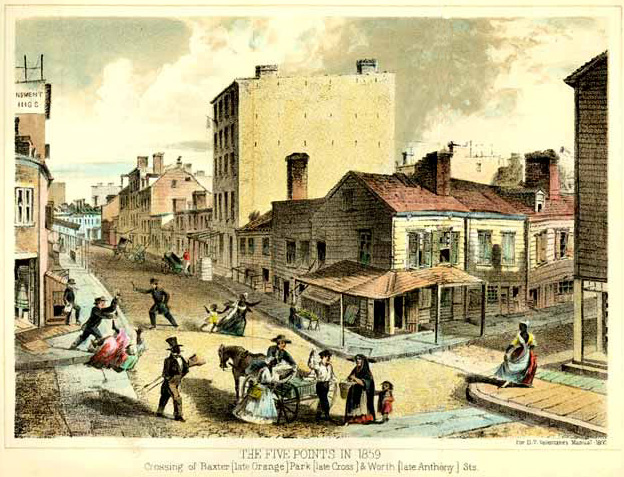

{Five Points in 1859}

-------------

Here is the New York Times article mentioned above. As you begin to read it, you recognize a familiar story pattern: the stories of two women, briefly told, who are pure, virtuous, and untainted by the decrepit environment in which they're forced to live and work. They are true to the highest moral values of their culture. They are uncomplaining, work hard, and show not bitterness at the hardships and heartbreak that fate has brought them. One has a fresh, healthy optimism and youthful charm; the other has a quiet dignity and refinement; she refuses to be crushed by loss of financial support and disappointment in love. Both show pluck in insisting upon their own independence and mistrusting offers of work that pays more by that also requires their subjection to a religious discipline. The reader expects good things to come to these earnest and well-meaning heroines, but the reporter and missionary who is his guide crush this wishful thinking.
Walks among the New-York Poor

We started in one of the streets leading from the Five Points, and after winding about all manner of strange alleys and dark courts, entered a low passage in a house back of the "Old Brewery." My companion was Mr. Pease, the Missionary, and he knew the ground better, I let him lead, keeping as close behind him as possible and, it must be confessed, grasping my cane with a feeling of some satisfaction. As we groped along the dark passage, a door opened occasionally and lights gleamed out, and haggard, filthy faces looked at us, but with no especial curiosity, no one knows or cares for anyone else in the great rookeries. At length, as we turned an angle, we found ourselves in more light, and an open door showed a crowd of low women in a small dirty room gathered in great glee around some poor fellow they were plucking. Scarce glancing in, we passed, and in the next room, the door, there stood two or three dirty children. Something in the expression of one — perhaps a look of such sad want — struck me, that I involuntarily stopped and the children rushed forward, recognizing Mr. Pease, and clung to his arm most affectionately. Hardly stopping, we turned down another stairway, led me into a cellar of the old building, then going on steps, knocked at the door of a room. It was opened at once, and we were welcomed by a nice young Irish girl. The place looked neat and there was a table-cloth on the table, with a candle burning in the centre — and the floor was well swept. In one corner, was a large bed with three children in it. The air was very damp in the room, and rank with the odors from without. This young girl and her mother occupied the room. Her mother was out. Mr. P. fell at once into conversation with her. After some talk, he asked her, "What she was working at now?" "Plain check shirts, sir," she said showing them to us. "What did she get for them?" "Ten cents apiece," she replied. "How many can you do in a day?" "Two, and sometimes three, if I begin at six and work till late at night." "You do other work?" "Oh yes sir, pantaloons — and I can get two shillings form them, and sometimes three and six by the day; and dress making beside — though I don't often get that. When I do, I can earn a dollar a day. You know it won't do to wait for work &mdash I must take what comes, and ladies don't like to put fine work in such places, and so I takes them shirts."

"So all you make with them is twenty to thirty cents a day?"

"Yes, sir."

"Ain't you afraid of falling behind — with your rent and everything?"

"Oh no, sir — I always comes out right."

"You did much better with me, Jane — what did you use to earn at my work?"

"About six shillings, sir."

"Well, come over to the house to-morrow, and I can give you some more work!" And after a little further talk we bid her good night.

The girl was not more than twenty-two years old — with a fresh, cheerful, healthful face, which it did one good to look upon. I can not in any way convey the healthy, hopeful tone, with which she spoke or her meagre wages, and the chances of work; though none knew better than she in that foul neighborhood the terrible alternative, if she did fall behind. She was not of the best class of seamstresses; yet there was to me in her clear, hearty look and her neat dress, and her whole bearing, a purity which contrasted singularly with her vile quarters. Mr. Pease says he has known her for years and that there is not a more virtuous girl in the city. As I made my way out of the filthy den, I could not but think of how differently she might be living if she had chosen anything but on honest life. The virtue that holds out in such places, must be worth something.

Our next visit was to a needle-woman of rather better class. The house was in an alley leading out of Pearl-street. We entered it by a stairway on the back-side, and, it seemed to me, wound about through some half-dozen passages and up and down some half-dozen stairways before we reached the room. Each room that we passed appeared to have a separate family in it — in one, quiet working people, cooking their supper; in another, a company of coarsely-talking women, putting on their finery for their evening walks through the streets; in another, some desperate-looking men, whom one would rather not meet in a lonely alley of a dark night, and who glance at us suspiciously as we pass by. In general, however, we are not noticed.

The seamstress opens the door at our rap, and meets Mr. P. in a very friendly manner. We are invited in, and chairs placed for us, and she introduces her aunt, with whom she occupies the room — all done as quietly and easily as any lady would do it.

This sewing woman Mr. P. had known in better days. She was the daughter of a religious, educated man, and by his sudden death had been left to support herself with her needle.

There were some other sad things about her life which I did not enquire particularly into — a love and promised marriage, and then the affair broken off, which had all left a gloom upon her.

She seemed about twenty-eight years old, in full womanhood — a striking, noble face, with black waving hair, a rich complexion, and a full, dark eye — which no lively talk seemed for a moment to relieve of its sad, wearied expression. She is one of the best shirt-sewers in the City. She works from six in the morning till eleven at night. Sometimes at stitching five shirts a-day, and earning usually $3.50 a-week; her board and washing costing her from $2 to $2.50 per week.

We asked how she could bear such steady work. She said she had not lost a day for two years and a half.

Her aunt added to us, that she would very often sew and then go to bed because she was so weak, and then get up and sew; but "sometimes she could hardly work for crying so!"

She laughed, and said "she very often pulled herself up in her bed to work; and at one time her eyes had suffered so that she could not see a person across the street, but they were better now."

I do not knew, but I believe our eyes were a little dimmed, as we thought of the weary hours of toil, which must have blurred such bright eyes as hers.

Mr. Pease was trying to induce her to go into an, establishment he could procure her, where she could earn just much as she earned now, without working in the evenings, and on easy, plain work.

She feared to change. There was always so much risk in changing. He assured her there would be no risk; and here, if she wanted a spare day occasionally, she could have it. No, she never wanted spare days; she would think of it and thanked him much.

Before we went, she told Mr. P. of an employer to whom she had lately been, who doubted the testimonials of character which Mr. Pease had procured her.

Her cheek flushed, and the dark eye gleamed as she spoke of the suspecting questions of the man, "until at last," said she, "I told him I would do no work for him at any price, after such impertinent questions."

You do not know it — ye in the City, who pay the scanty wages and squeeze the enormous profits from the needle woman's toil — that often her honor is as sensitive, her reputation as dearly bought and as carefully cherished as that of your own wives and sisters. It is easy to drop the base, insinuating word, which shall rankle in her heart more than all your legalized exactions and oppressions.

As we went out, she lighted us down through the winding stairways. "What would you do way up here in case or a fire?" said Mr. P.; for it seemed almost impossible for anyone to find his way out in case of any confusion. "There is a passage over to the next roof," she answered.

As we worked our way out into the cheerful, lighted, streets again, I felt a sensation of relief.

"You see how a religious woman works," said Mr. P. "She knows what is behind her; and yet she probably never saves more than fifty cents a week, and always has the tremendous chance of sickness before her."

"But what becomes of such women?" said I.

"God only knows," he replied. "Sometimes they marry, though usually men much lower and coarser than themselves; generally they work on. Many die young; others you find sometimes the last destitution, in the lowest haunts of the City; and, alas! very many end in the brothel and the syphilitic hospital. They disappear from all knowledge of any one. God help them!"

"GOD HELP THEM!" say I, from my heart, for Man seldom will.

-- C. L. B.


Walks among the New-York Poor, New York Times, October 11, 1852, Wednesday, Page 1, 1593 words
---------

Notes:

[1] Two posts so far: Collect Pond and the origins of Five Points and an office on Reade Street.

[2] This is the Reverend Dr. De Witt in an address given during the dedication of the "Old Brewery" Methodist Mission at Five Points:
Here a spring of life will be opened, with its purifying influences. There are buildings in other parts of the city — for the rich; but have we not been neglecting the masses? Have we not been too much, like the Priests and Levites, avoiding the degraded classes? This effort in this locality seems to have originated in the spirit which actuated the Saviour, and thus far to have been crowned with His blessing. May this be the origin of a reviving spirit in the Churches!

The gospel applies to all, but to the poor and wretched of this world it is especially adapted. The impression that those residing in this locality were too degraded to be benefitted has tended to paralyze Christian effort. The gospel is for the poor, and it will be deteriorating to the higher classes if reformatory influences are neglected among the lower classes.
-- The old brewery, and the new mission house at the Five Points (Stringer & Townsend, 1854)
[3[Five Points: the 19th-century New York City neighborhood that invented tap dance, stole elections, and became the world's most notorious slum by Tyler Anbinder (Simon and Schuster, 2001). Tyler Anbinder teaches history at George Washington University.

Saturday, June 05, 2010

an office on Reade Street

This blog post is second in a series on the history of an area of New York City called Five Points. It's part of a larger series on New York's Mulberry Street and its residents.[1]

There are some (quite tangential) family associations with the Five Points area. In 1853 my great-grandfather arrived in New York with, as my father said, "$5 and a steamer trunk." By the end of the century he was a successful man: prosperous, influential, and well-respected.[2] A search of the New York Times archive yields 531 articles in which he figures, including 58 which he wrote himself. All cast him in a favorable light. Earnest, good-natured, progressive, and reform-minded, he did well for himself, his family, and the community in which he lived.

Many other immigrants landed in New York in the early 1850s. Steamships and sailboats of the time crowded hundreds of them into their steerage compartments. Few, practically none, of these hopeful arrivals made good like my great-grandfather. Many of them were shunted into Five Points and other dreadful slums and others put in massive effort to avoid that fate. There's no telling exactly why my great-grandfather's outcome was so different. Education was certainly a factor. Before his family suffered a severe financial setback, he was able to obtain a good education, including a couple of years at a famous high school, the Catholic Gymnasium Paulium, said to have been founded by Charlemagne in the eighth century. Many arriving immigrants had been given the addresses of relatives in New York, but my great-grandfather was fortunate in having a handful of them, enough so that where one or another disappointed, yet one more proved helpful. A final set of factors is my great-grandfather's optimism, his self-confidence, a sense of ambition coupled with a belief in caution and probity, and an unshakable belief in the great potential for personal and financial success that America offered one who was both prudent and bold.[3]

Arriving on the SS Hermann in 1853, he struggled with poverty and loneliness during his first months in the city. He contacted relatives whose addresses he had been given before leaving his family's home in Germany, but they proved to be at best unhelpful and at worst unkind. One, his cousin Philip Frankenheimer, who ran an importing business at 257 Broadway — only about three blocks southwest of Five Points — gave him a cold shoulder.

Over the next few months, he tried selling merchandise door-to-door, worked in a factory in Brooklyn, and served as a clerk for a grocer on Vesey Street in lower Manhattan. Finally, reaching the end of his meager resources, he spoke with another cousin, Henry Lefman, with whom he hit it off and who gave him a recommendation for a job as clerk in a store.[4] I do not know the address of the store, but Lefman's importing business was located at 242 Washington St., a bit further from Five Points, but still only a short walk to the west.

A few years after this tender beginning, when my great-grandfather had managed to pull together some capital of his own, he joined with a friend and fellow German immigrant, Alfred Roelker, to begin a business handling imports from the old country. Their office, as it happens, was even closer to Five Points, a mere block from its south-western boundary at 20 Reade St. As he became more and more successful, he branched out into insurance and banking, yet, from 1865 when he first moved into it until his death in 1913, he continued to use this office as his home base for business activities.

Lefman and Frankenheimer were not the only relatives in the vicinity. A cousin, Bernhard Sutro, had set up the office of his importing business a block away at 268 Broadway.

Although Frankenheimer, Sutro, Lefman, Roelker, and my great-grandfather all happened to have offices fairly close to Five Points, there's no evidence that they had any dealings there, went slumming there, or sought entertainment there.

It is certain, however, that after building a home in Woodside, Queens, in 1867, my great-grandfather passed through or by Five Points in his daily commute — on foot — from home to office and back. If he ever recorded his impressions of the place, his words haven't come down to me. However, two years after his arrival, while still only 19, he did send his German relatives a letter in which he described the whole city as it appeared to him. Translated from the German, it tells them,
I wandered through the streets of the metropolis where you see the greatest poverty and the greatest luxury. New York is a great city and not without justification is called the Empire City. The best products and the most beautiful works of art created by the civilized world find a market here. The flags of every nation are represented in the harbor and I believe that every nation or people on this beautiful earth is found on the streets of New York. The Spanish with their grandezza, the French with their inexhaustible politeness, the reserved Dutch, the attentive Chinese, the British with their decisiveness, all these nationalities are represented here. How amazed you would be if from your quiet MĂĽnster you would find yourself transported to Broadway, the premier street of New York. Your ears would become deaf from the noise of wagons which are all bunched up but still move in an orderly fashion; your eyes would become blind from the wealth and luxury of the Italian marble. You would be astonished to see the busy populace which runs as if it needed to reach the end of the world.[5]
With the spectacle of New York before him, it's unlikely that Five Points held more than passing attraction for him. Unlike most of the outsiders who showed up there, he took no prurient interest in the residents' low life and did not feel impelled to convert them from their evil ways to an evangelical truth it was his mission to impart. Nor was he a night-prowling "sporting man." He was not addicted to gambling or blood sports, was not a tavern-drinker, and, so far as anyone in our family knows, was not one to frequent brothels. He was interested in reform politics and did campaign against the corruption that took hold in Five Points and spread throughout the city, but he did not concern himself directly with the corrupt dealings in Five Points' Ward 6 elections.

This map of lower Manhattan in 1847 is marked to show Five Points and some of the locations associated with my family. In Manhattan, 20 Reade St., 268 and 257 Broadway, 242 Washington are labeled. My great-grandfather's home in Woodside, Queens, is in the north-east corner.


{click to view full size; City of New York in 1856 by C. Parsons for N. Currier (lithograph, 58.5 x 74.5 cm. source: Library of Congress}

--------

Notes:

[1] These are the Mulberry posts: And the Five Points posts:

[2] Late in life, he was subject of many Who's-Who style biographic sketches which spoke of his early experiences in New York. Here are a few excerpts:
1. WINDMUELLER, Louis, merchant and importer, was born at Mueuster, Westphalia, about 1836. After studying for a while at the Catholic college of Muenster, pecuniary difficulties compelled him to leave before graduating, and he resolved to emigrate to America. In 1853, therefore, he came to New York, landing in that city without money and with no acquaintances to assist him in finding means of support. He had an iron will, fortunately, and went to work courageously and with so much success, that by the year 1858 he had an established business of his own.
-- The National cyclopaedia of American biography
Volume 4
The National Cyclopaedia of American Biography: Being the History of the United States as Illustrated in the Lives of the Founders, Builders, and Defenders of the Republic, and of the Men and Women who are Doing the Work and Moulding the Thought of the Present Time
Publisher J. T. White company, 1893

2. Louis Windmuller born in Westphalia, received his education in the Catholic College of Munster. To his regret, circumstances compelled him to abandon his favorite studies for the mercantile career, and he resolved to emigrate, at the age of seventeen. He always had a predilection for his country. At the age of 12 he wrote at school an essay "Why America Finally must Become the Principal Stage of the World's History." He believes to this day that it will, with New York as it commercial centre. Landing here in 1853, he served as clerk in various branches of trade, his first situation being in a dry goods establishment, where he earned $4, while he paid $3 a week for his board. Shortly before the panic of 1857, he began trading for his own account, first in a small way, and after his marriage in 1859, on a larger scale. He commenced soon to import goods on commission, and continues to do so ever since. He often had to work early and late; by his application to business and the promptitude with which he met engagements, he soon established a good reputation, and weathered all the financial storms through which this country has passed.
-- The University Magazine, New York, (published by the University Magazine, 70 South St., NY), Volume 9, 1893, p. 547

3. Louis Windmuller. Coming to New York city in 1853 with about $15 in his pocket and no acquaintances to assist him, he found work as a clerk in a store and within four years had succeeded so well that he established merchandising business of his own.
-- National Cyclopedia 1944
[3] At the age of 12 he had written a school essay on "Why America Finally must Become the Principal Stage of the World's History."
-- source: The University Magazine, New York, (published by the University Magazine, 70 South St., NY), Volume 9, 1893, p. 547

[4] On 24 February 1855 he wrote his family in Germany that some of the relatives whose names he had been given gave him a cold reception and others were unable to help him. Finally, he wrote, "I found a helping hand from my cousin Henry Lefman. And he is now the only one on whom I can depend. Without him I would be lost. Yesterday I received a position starting March 1 in a dry goods store on Broadway due to a recommendation from him."

[5] Here are extracts from the letter, translated from the German:
New York 24 February 1855

My dear Grandfather! My dearest Sisters! Dear Aunts and Uncles!

In keeping with my promise, I write today, three months after the day when I first touched American soil and describe the pleasant and unpleasant impressions which I have experienced during this time.

But first I have to complain that you neither answered my letter from Southampton from the 8th November nor the one sent from here on the 24th of this month. You cannot use the excuse that in the last letter my address was not altogether clear since you do have the addresses of my cousin Jacob WindmĂĽller through the Kappels as well as the S. Frankenheimers & Sutros which you gave me before my departure. If in the future you still remain silent which I cannot explain, then I'll start writing to friends who will reply to my letters.

The unfriendly weather and the cold reception from our relatives which ... brought forth feelings of abandonment. ...

Sad, but not giving up my courage, I wandered through the streets of the metropolis where you see the greatest poverty and the greatest luxury. New York is a great city and not without justification is called the Empire City. The best products, the most beautiful works of art created by the civilized world find a market here. The flags of every nation are represented in the harbor and I believe that every nation or people on this beautiful earth is found on the streets of New York. The Spanish with their grandezza, the French with their inexhaustible politeness, the reserved Dutch, the attentive Chinese, the British with their decisiveness, all these nationalities are represented here. How amazed you would be if from your quiet Muenster you would find yourself transported to Broadway, the premier street of New York. Your ears would become deaf from the noise of wagons which are all bunched up but still move in an orderly fashion; your eyes would become blind from the wealth and luxury of the Italian marble. You would be astonished to see the busy populace which runs as if it needed to reach the end of the world. I had enough time to observe this; for days I looked at this spectacle, however my thoughts were elsewhere. I began to think how I could make a living. After I had worked for a few days in the factory of Mr. Frankenheimer which was not suitable work for me, I decided to look up my other relatives. I found a helping hand from my cousin Henry Lefman. And he is now the only one on whom I can depend. Without him I would be lost. He is a well-to-do honest man. He is in every respect above Philipp Frankenheimer.

Concerning myself again, I received from my cousin a few purses, etc. with which I eagerly went to business. I also went to the houses of the wealthy (on Fifth Avenue, a row of palaces) and asked for the "lady of the house." I was quickly turned away and sometimes invited in and very seldom I sold something. Nevertheless for a time I did well and earned a few dollars a day but after a while my luck ran out and also my money. I then tried [to sell] other things, liquor, wine, and tea; but I had no luck or patience with these.

Later I got a position in a manufacturing business in Brooklyn and stayed there 14 days until I saw that the boss did not treat me fairly. At present I have no occupation but to go for a stroll. Yesterday I received a position starting March 1 in a dry goods store on Broadway due to a recommendation from Henry Lefman.

Concerning my present life, it is pleasant since I left P. F. [Phillipp Frankenheimer]. At first I lived with Americans where I had the opportunity to observe the Yankee way of life and to further my knowledge of English. Now I "board" in a German hotel whose owner was my travel companion on the Hermann and who keeps an excellent kitchen.

...

"Good bye my dear aunts, uncles, and sisters, yours truly Louis WindmĂĽller."

Wednesday, June 02, 2010

Collect Pond and the origins of Five Points

This blog post is second in a series on the history of an area of New York City called Five Points. It's part of a larger series on New York's Mulberry Street and its residents.[1]

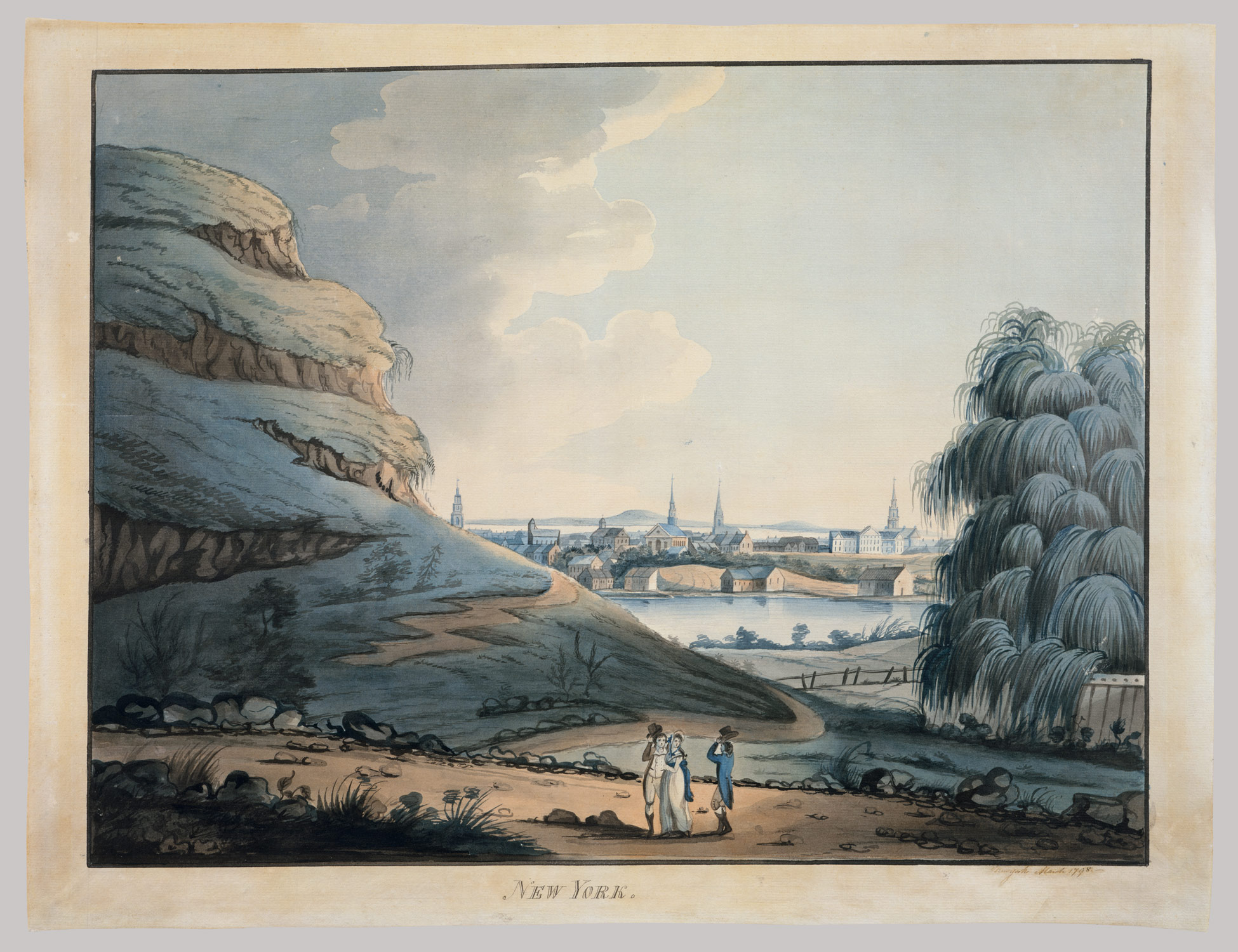
Five Points came into existence after a canal was cut along a meandering creek to drain a body of water called Collect Pond. This drawing somewhat fancifully shows the appealing nature of this little lake in 1798. The artist was standing about where Mulberry Street would later be laid down.[2]


{Collect Pond, New York City, 1798 Attributed to Archibald Robertson. Watercolor and black chalk on off-white laid paper, 17 3/4 x 23 1/16 in. From the Met Museum's Edward W. C. Arnold Collection of New York Prints, Maps, and Pictures}

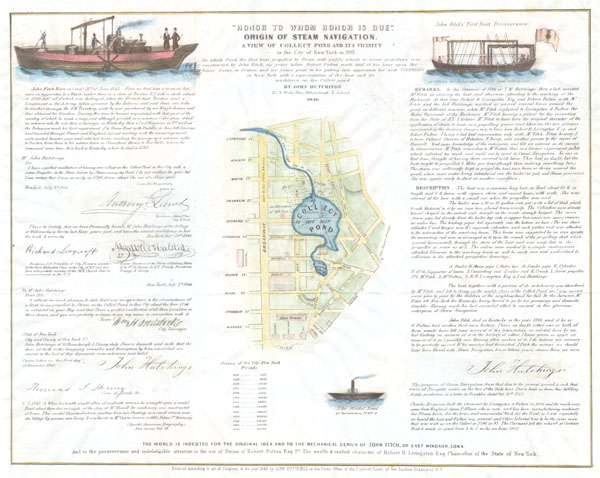
This lithograph shows the pond as it looked in 1796. I think the artist is standing on the east side looking west.


{Engraved by Philip Meeder ca. 1836 for a book called History of the city of New York: its origin, rise and progress. (New York, Barnes, 1877-1896.) via wikipedia}

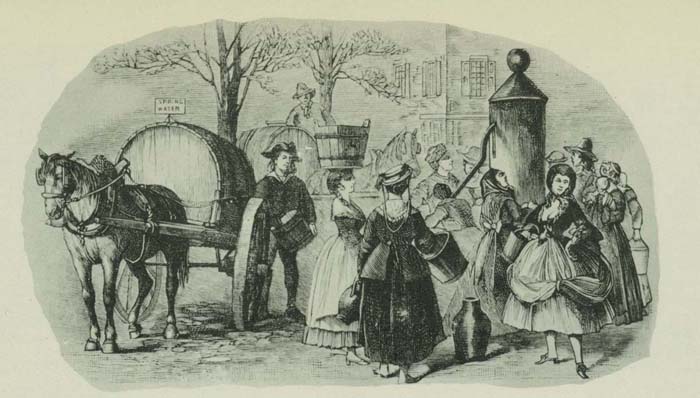
This print from the early nineteenth century shows locals at one of the pumps that tapped the spring which fed Collect Pond.


{From the same book; source: virtualny.cuny.edu}

As the source of the print explains, this pump dispensed tea-water not in the sense that it was brown and brackish, but rather that it was clear, sweet-tasting, and suitable for use in brewing expensive Indian tea.

This shows a more famous tea-water pump, located to the southeast of the pond.


{"The Tea Water Pump at Roosevelt and Chatham Streets, one of the city's principal fountains." Source: virtualny.cuny.edu}

This map of lower Manhattan in 1803 shows the location of the Collect Pond, Mulberry St., Tea-Water Pump, and Pump St. Knapp's Pump is off map to the north and west. Pump Street was named to commemorate Teawater Pump and adjacent Teawater Gardens.[3]


{Source: urbanography.com}

You'd think Collect Pond got its name from its job of collecting water from the spring that fed both it and the nearby pumps. Not so; collect is a corruption of the Dutch word kolk meaning a small body of water. Kolk morphed into kolch and then kalch before getting Englished to collect. This map gives the old name.


{source: nymapsociety.org}

You can see from this map that the spring-fed pond emptied by rivulets both east and west across the island. In fact, one source says before the arrival of Europeans the indigenous Native Americans could — during the spring floods — paddle from the East River to the Hudson River through the Collect Pond.[4]

The steamboat in the print by Philip Meeder that I reproduced above shows the first successful experiment in the US to build a working steamboat. In the summer of 1796, the designer, John Fitch, selected Collect Pond as the place to show off his achievement. As the world knows, it was Robert Fulton who eventually produced the first commercially successful steamboat, launching it in the nearby Hudson.[5]

By the time Fitch conducted his test the pond was making a transition from the bucolic spot shown in Robertson's and Meeder's pictures and was being inundated with noxiousness: slaughterhouses, tanneries, gunpowder storage facilities, seasonally-flooded bogs, and prisons. As early as 1798, the year of Robertson's watercolor, it was described as "a shocking hole, where all impure things centre together and engender the worst of unwholesome productions."[6]

A few years later, in an action of urban cleansing, the pond was drained and filled in to make room for more buildings in which to house the city's growing population. A canal was dug along the stream that fed from the pond to the Hudson on its west and a new road, Canal Street, was constructed by its banks.

This 1811 lithograph shows the drainage canal as it passes under a bridge at Broadway. Canal Street runs on both sides of the water.


After the canal drained off most of the water, "Bunker Hill," the little hill in Robertson's watercolor, was leveled and its mass used to fill the wetlands that remained. By 1813 there were no visible remains of pond or hill.[7]

A nineteenth-century historian explains the city's next actions:
At the spring election of 1835 a most serious question was submitted to the decision of the people. New-York had never enjoyed any proper and reasonably assured water-supply for a population of her extent and promise. The tea-water works, which were put up in 1786 at the Collect pond, or Fresh Water, had supplied the city by casks until 1799, when the Manhattan Company was chartered to bring a supply from the Bronx River. A pump was built near the Collect and wooden pipes laid through the streets, but the Manhattan Company never tapped the waters of the Bronx, and the city was forced to content itself with the old Collect supply. ... It was now decided by popular vote, by a large majority, to construct an aqueduct from the Croton River, an undertaking of great magnitude in those days, considering that the distance the water had to be conveyed was forty miles.
-- The Memorial History of the City of New-York: From Its First Settlement to the Year 1892, Vol. 3, ed. by James Grant Wilson (New York History Co., 1893)
I've written previously about Croton Aqueduct and some of its many associations.[8]

The aqueduct, which was the greatest engineering feat yet attempted in the US, proved to be a great success. New Yorkers celebrated extravagantly when its waters first flowed in for their use. To show how great was the achievement and how abundant the water, the city set up fountains, including this one, just south of the place where Collect Pond and the Chatham Street Tea-Water Pump had been located.


{View of the Park Fountain & City Hall N.Y., N. Currier, 1846; source: nymapsociety.org}

Despite drainage and in-filling, the area around Collect Pond remained marshy, mosquito-ridden, and unwholesome. Being unhealthy, the land was cheap. Being infirm, it could not support multi-storied brick buildings, but only small brick or wooden frame structures. The resulting cheapness of land and its dwellings meant that the area became a magnet for the city's poorest citizens, those who could afford no other place to live. Out of this mix, the slum called Five Points was born.

This lithograph depicts the center of the slum, in Five Points intersection itself, just 14 years after the pond was covered over.


{Five Points by George Catlin, 1827; source: Maulleigh flickr page}

As you can see from this detail, there was then a pump drawing water from the spring that still flowed under feet of the area's residents.


Some additional sources:

Collect Pond on wikipedia

Collect Pond, Manhattan from the New York Public Library

The Documentary history of the state of New-York The Documentary history of the state of New-York: arranged under direction of the Hon. Christopher Morgan, secretary of State, Volume 2, ed. by Edmund Bailey O'Callaghan (Weed, Parsons & co., public printers, 1849)

Collect Pond on the New York Parks web site

Canal Street on forgottenny.com

THE FIVE POINTS on urbanography.com

Evolution of City Hall Park and Foley Square from nymapsociety.org

1850 US Census of the New York City Prison AKA The Tombs on rootsweb.ancestry.com

Harper's magazine, Vol. 98, 1899, "A Historic Institution. The Manhattan Company — 1799-18989" by John Kendrick Bangs (Harper's Magazine Co., 1899)

Collect Pond in New York City Map and Steamship Test Print, 1846 on georgeglazer.com

The Life of John Fitch the Inventor of the Steamboat by Thompson Westcott (Philadelphia: J. B. Lippincott & Co., 1857)

-------------

Notes:

[1] Here are the blog posts on Mulberry Street so far:
Mulberry Street 1900
Mulberry Street, again
a tenement on Mulberry Street
five-cent den on Pearl St.
[2] A curator at the Metropolitan Museum of Art writes of this picture: "The natural pool Collect Pond was located in lower Manhattan near present-day Foley Square. This watercolor of the site exemplifies the formulaic method of drawing taught at the Columbian Academy of Painting in New York City, founded by the brothers Archibald and Alexander Robertson. Both the hill at left and the willow tree at right were rendered in highly stylized fashion, with broad contours and schematic curving lines. Spatial depth was achieved with swaths of dark wash in the foreground, setting off the lighter forms in the distance. Indeed, the whole picture observes a kind of artistic etiquette embodied in the polite company of figures in the foreground."

[3] This map shows the pond in 1793 overlayed by 19th-c. streets.

{source: nymapsociety.org}


[4] In a web page called Evolution of City Hall Park and Foley Square, Philip Ernest Schoenberg, writes:
For hundreds of years, the area had been the site of an Indian village. ... The Indians were part of the Leni Lenape, Algonquin, or Delaware people. The population on the site may have been between 5,000 and 10,000. The total Leni Lenape population of Manhattan Island may have been as high as 30,000 and the New York metropolitan area may have been 65,000. Diseases reduced the native population of the area to 200 by the year 1700.

The village was known as “Werpoes” or “Hare” in the language of the Algonquin Indians. They were semi-nomadic. The village would move each planting season as the Indians burned the woods to gain new land to farm and let old land recover. The Leni Lenape planted the “Three Sisters” — squash, corn, and beans. They would also go to Washington Heights and Inwood neighborhoods of Manhattan to hunt deer and other animals. ...

In the Dutch period, the area was set aside as a Commons where anyone could graze a cow or sheep for free. It also became the ceremonial area for parades, celebrations, executions, and public gatherings. ...

In the British period, the area that had been center of the Indian village became the African Burial Ground. The blacks, slave and free, segregated in life, were segregated in death and were not permitted to be buried in the churchyards. By the end of the eighteenth century, the area was forgotten as residential development moved northward. An estimated 15,000 to 20,000 Africans and African-Americans were buried between today's Chambers and Reade Streets, Broadway and Centre Streets.
[4] Wikipedia's article on John Fitch says he "was an American inventor, clockmaker, and silversmith who, in 1787, built the first recorded steam-powered boat in the United States." Two decades later, Robert Fulton was able to make steamboats profitable. This broadside celebrates Fitch's achievement.

{Title: Honor to Whom Honor is Due" Origin of Steam Navigation. A View of Collect Pond and Its Vicinity in the City of New York in 1793"}
Description: An extremely scarce 1846 broadside issued by John Hutchings to promote the awareness of John Fitch as a pioneer of steam navigation. Fitch was an instrument maker working in the later part of the 18th century. As an early pioneer of steam navigation, Fitch tested several steamboats on the Delaware River between 1785 and 1788. One of these, the Perseverance, is depicted in the upper right quadrant of this sheet. Fitch’s real success, however, occurred a few years later when, in 1793 he tested another ship equipped with a paddle wheel on New York’s Collect Pond. This was a full six years before Fulton and Livingston launched “Fulton’s Folly” on the Seine. Hutchings claims to have been a “lad” at the time who “assisted Mr. Fitch in steering the boat”. Hutchings asserts that it was in fact Fitch who designed the steam propulsion mechanism. He claims that both Fulton and Livingston were present during the Collect Pond tests and in fact depicts both, as well as Fitch and himself, in a paddlewheel steam ship in the upper left quadrant. Though Fulton seems to have received most of the credit for the era of steam navigation, Hutchings hoped, through the publication of this broadside, to shed some light on Fitch’s contributions as well. Central to this publication is a map of the Collect Pond and vicinity extending roughly from Broadway westward to Chatam Street, south as far as City Hall Park and north to Canal. Roughly between Barlet Street and Franklin rested the Collect Pond, a natural depression and drainage area that filled with water seasonally. The Collect Pond appears in early maps of New York City and until the construction of the Croton Aqueduct was one of the few sources of fresh water in lower Manhattan. This pond was filled in around 1811 when it transformed into the notorious and poverty stricken "Five Points" district. When Fitch tested his steamboat the pond would have been surrounded by slaughterhouses, tanneries, gunpowder storage, bogs and prisons – not exactly a pretty place for an afternoon boat ride. The map image is surrounded by a brief biography of Fitch, signed attestations from important figures regarding the character of Fitch and Hutchings, and eye-witness accounts of the events in question. Right of the map is a description, written by Hutchings, describing the event and the Collect Pond vessel itself. Dated and copyrighted: “Entered according to act of Congress in the year 1846 by John Hutchings in the Clerk’s Office of the District Court of the Southern District of N.Y.” Date: 1846
References: "Collect Pond, Manhattan." New York Public Library: American Shores, Maps of the Mid Atlantic Region to 1850. 2002, http://www.nypl.org/research/midatlantic/geo_collect.html. Peters, Harry T., AMERICA ON STONE / THE OTHER PRINTMAKERS TO THE AMERICAN PEOPLE, p. 282
1846 Broadside of the Collect Pond, New York and Steam Boat ( Five Points )
[6] Quoted in: The Memorial History of the City of New-York: From Its First Settlement to the Year 1892, Vol. 3, ed. by James Grant Wilson (New York History Co., 1893)

[7] See the additional sources above, particularly: The Memorial History of the City of New-York: From Its First Settlement to the Year 1892, Vol. 3, ed. by James Grant Wilson (New York History Co., 1893)

[8] Here's a list of the posts:

Five Points

A couple of years ago I did a post on a famous photo showing the Italian immigrants of New York's Mulberry Street on a warm day in 1900. Since then I've done a few more posts on the same topic,[1] but not having yet exhausted it or myself, I'll do a few more.

This is about one of the most notorious of the city's noxious slums, called Five Points, which Mulberry bounded on the east.

This 1832 map shows the path of Mulberry St. and the location of Five Points.


I first noticed the existence of the place in a news item from the New York Times, Independence Day, 1853. It said, in full:
An Italian named John Boese, was arrested yesterday by Officer Kelly, of the Tenth District Police, for soliciting alms in Grand-street. He had a card pinned on his breast on which was printed, "The bearer is blind, and also very poor and unable to support his three small children; his wife is dead, and he is now left alone to protect them." The officer searched him, and found safely stowed away in his clothes the sum of $30.04. On being examined, he stated that he was blind only in one eye; that he had no children in this country, but had three in Leghorn, Italy, and that he lived in the Five Points. He was first sent to the Alms-House, and afterward to the Work-House, for 6 months.
-- New-York City. Arrest of a beggar New York Times, July 4, 1853, Wednesday, Page 6
A bit more research showed that John Boese's home base, Five Points, was a favorite topic for nineteenth-century news reporters, editorial writers, and authors of magazine articles and even books. It was home to beggars like himself as well as gamblers, con men, thieves, burglars, gangsters, corrupt politicians, and others out to cadge a quick buck. It was also home to multitudes of the poorest of the poor — rag pickers, seamstresses, scavengers, day servants, and prostitutes.

Although New York had numerous pockets of crime and poverty, Five Points was distinguished for the extravagance with which it put them on view. At a time when mixing different sorts of people together was apt to be considered promiscuous rather than desirable, Five Points was also notorious for its mixtures of people of different race, religion, and national origin. New York had freed its black slaves in 1827 and many came to settle on the swampy and disease-ridden land out of which Five Points evolved. Even before the potato famine beginning in 1845 came those dirt poor Irish peasants who could afford to live nowhere else. Others drifted there from the Italian enclaves around Mulberry St. and still others were attracted by the relative freedom from enforcement of laws.

In 1842 the great Charles Dickens came to observe and write up what he saw:
Let us go on again, and ... plunge into the Five Points ... We have seen no beggars in the streets by night or day, but of other kinds of strollers plenty. Poverty, wretchedness, and vice are rife enough where we are going now.

This is the place — these narrow ways, diverging to the right and left, and reeking everywhere with, dirt and filth. Such lives as are led here bear the same fruits here as elsewhere. The coarse and bloated faces at the doors have counterparts at home and all the wide world over. Debauchery has made the very houses prematurely old. See how the rotten beams are tumbling down, and how the patched and broken windows seem to scowl dimly, like eyes that have been hurt in drunken frays. Many of those pigs live here. Do they ever wonder why their masters walk upright in lien of going on all-fours? And why they talk instead of grunting?

So far nearly every house is a low tavern, and on the bar-room walls are colored prints of Washington, and Queen Victoria of England, and the American eagle. Among the pigeon-holes that hold the bottles are pieces of plate-glass and colored paper, for there is, in some sort, a taste for decoration, even here ...

-- American notes for general circulation by Charles Dickens (Harper & Brothers, 1842)
Al Capone got his start there; when he was convicted for tax evasion in 1931, he was quoted in newspapers saying, "I shoulda never left Five Points."

Dickens was not the only tourist to go there. New Yorkers themselves and visitors from other places came to observe with, as one writer puts it, both "moral indignation and prurient fascination."[2] Many, like Dickens, sought the company of a police officer (he brought two with him).

Men also flocked to Five Points by night for the entertainment. There they would find "sporting events," such as gamblers' pit-contests between dogs and rats, taverns and brothels in abundance, and dance halls where Irish and African-American dance would be merged into an entirely new style.

There is much here to interest: extreme poverty and its excruciating results; underworld figures preying on the poor and also doing battle with the forces of the ruling establishment; and, in an atmosphere of freedom and license — a freedom from the oppressive social controls of self-appointed moral guardians — an explosion of creative energy evident in the dance halls.

There is more of interest specifically to me. A number of coincidences connect the history of Five Points to other stories I've been telling. There are connections to the Croton Aqueduct, about which I've written numerous posts, to my family's own history, and even to the family of Diary of Sophia Carteret, Lady Shelburne, whose diary I've reproduced at length.

I'll write about these connections as time permits in coming weeks.

Here are some images of the place:


{New York City - "Doing the slums" - A scene in the Five Points / from a sketch by a staff artist - 1885 - Frank Leslie's illustrated newspaper, v. 61, (1885 Dec. 5), p. 245. Wood engraving. Source: Library of Congress Prints and Photographs Division}


{End of the poor Funeral from a tenement house in Baxter Street, Five Points, New York - from a sketch by our artist - 1865 - Frank Leslie's illustrated newspaper, v. 20 (1865 July 1), p. 225. Wood engraving. Source: Library of Congress Prints and Photographs Division}


{New York City - Among the poor - 1873 - A Summer evening scene at the Five Points / sketched by Matt Morgan, from Frank Leslie's illustrated newspaper, v. 36, (1873 August 26), p. 357. Wood engraving. Source: Library of Congress Prints and Photographs Division }


{Life sketches in the metropolis - Our homeless poor - Early morning in Donovan Lane, near the Five Points - 1872 - Frank Leslie's illustrated newspaper, v. 34, (1872 March 16), p. 5.. Wood engraving. Source: Library of Congress Prints and Photographs Division}


{The Old Brewery. Lithograph of Five Points, New York; source: nyhistory.org/}

Tuesday, June 01, 2010

wartime Washington

Esther Bubley took these two photographs in March 1943. She took both in Washington DC while working for the Farm Security Administration, Office of War Information.

The first is captioned "Women gossiping in a drugstore over cokes" and the second "Riding on a streetcar."


They're both from collections in the Library of Congress Prints and Photos Div.

About a year ago, I did a blog post showing lots of her wartime photos: Esther Bubley