Showing posts with label T.E. Lawrence. Show all posts

Tuesday, March 31, 2009

is hope not plumed?

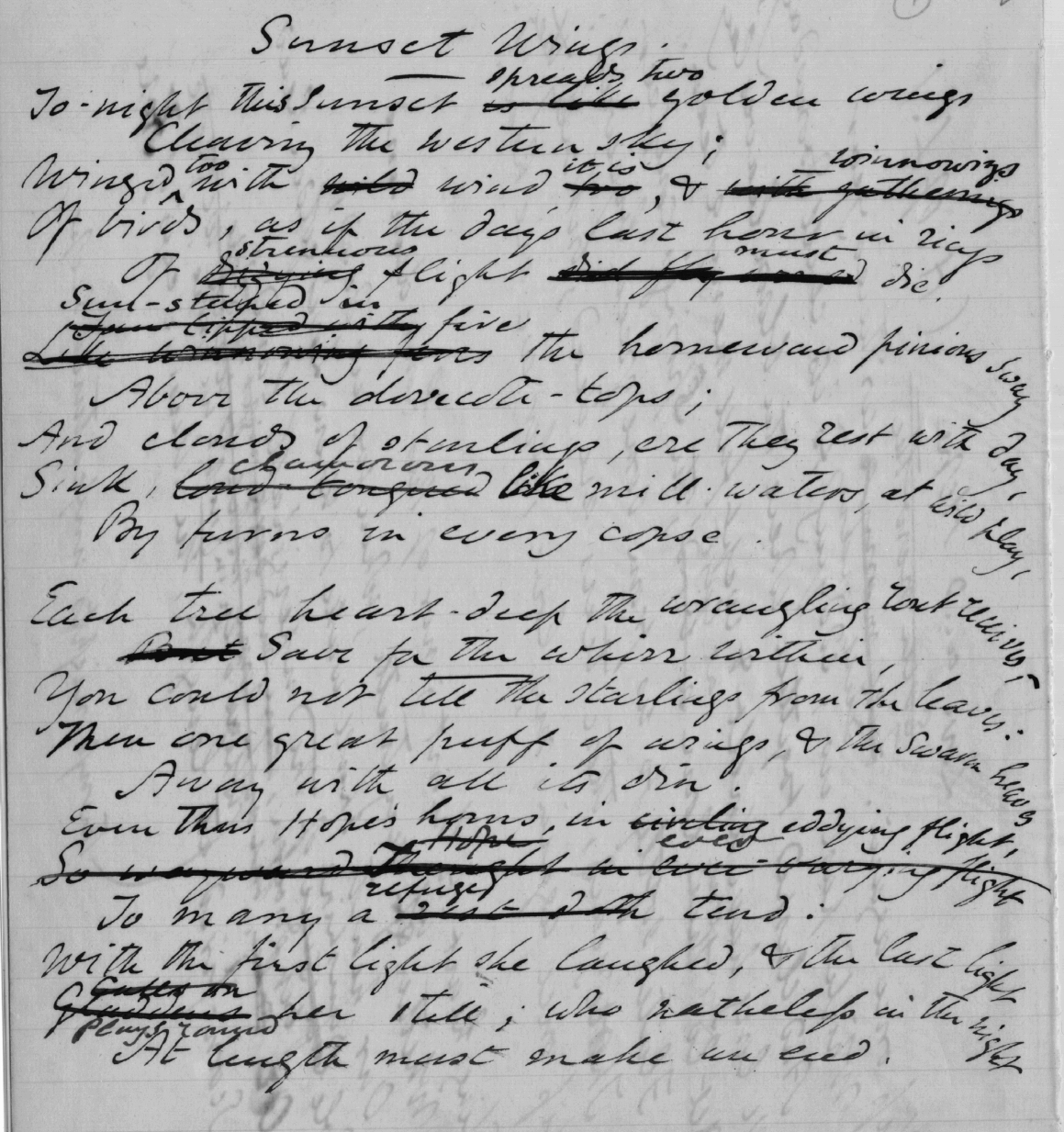
To-night this sunset spreads two golden wings
    Cleaving the western sky;
Winged too with wind it is, and winnowings
Of birds; as if the day's last hour in rings
    Of strenuous flight must die.

Sun-steeped in fire, the homeward pinions sway
    Above the dovecote-tops;
And clouds of starlings, ere they rest with day,
Sink, clamorous like mill-waters, at wild play,
    By turns in every copse:

Each tree heart-deep the wrangling rout receives, —
    Save for the whirr within,
You could not tell the starlings from the leaves;
Then one great puff of wings, and the swarm heaves
    Away with all its din.

Even thus Hope's hours, in ever-eddying flight,
    To many a refuge tend;
With the first light she laughed, and the last light
Glows round her still; who natheless in the night
    At length must make an end.

And now the mustering rooks innumerable
    Together sail and soar,
While for the day's death, like a tolling knell,
Unto the heart they seem to cry, Farewell,
    No more, farewell, no more!

Is Hope not plumed, as 'twere a fiery dart?
    And oh! thou dying day,
Even as thou goest must she too depart,
And Sorrow fold such pinions on the heart
    As will not fly away?
This is 'Sunset Wings' by D.G. Rossetti, from Sonnets and Lyrical Poems, (London, 1894). It is the 48th poem that T.E. Lawrence wrote out in Minorities, his pocket book of blank pages.

Lawrence was fond of Rossetti's poems and believed they transcended the man himself. In a letter to his friend Charlotte Shaw he said 'Rossetti was a very great poet: and his poetry was much greater than himself.' (30.X.28 quoted by Jeremy Wilson, the editor of Minorities)

The poem is technically interesting and scans well. Natheless, in the fourth stanza, means nevertheless. The poem turns on this stanza and, for me, it has the most emotional force.


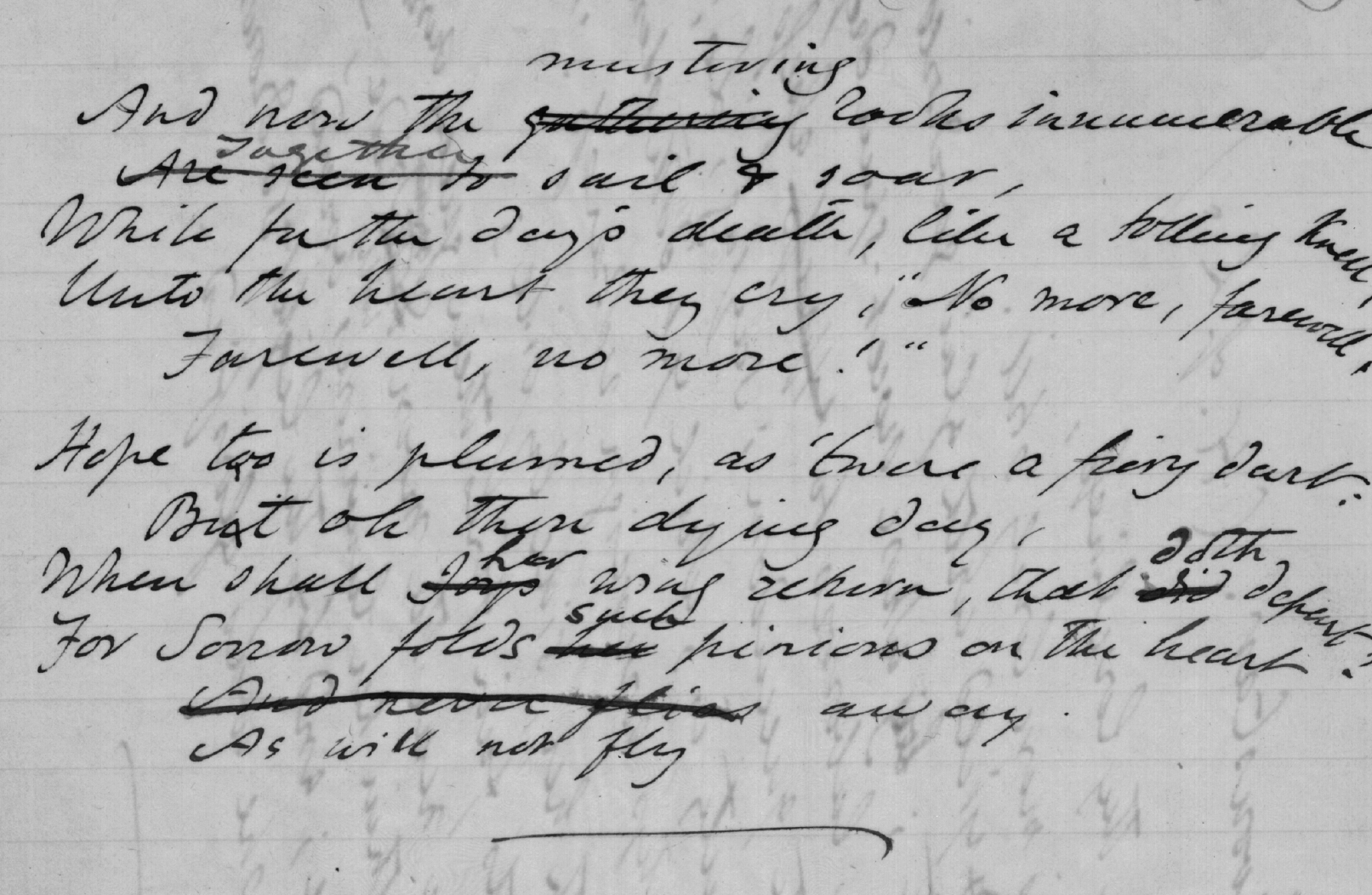
{Click to view full size; these two images show Rossetti's draft manuscript of the poem; source Delaware Art Museum draft manuscript on rossettiarchive.org}


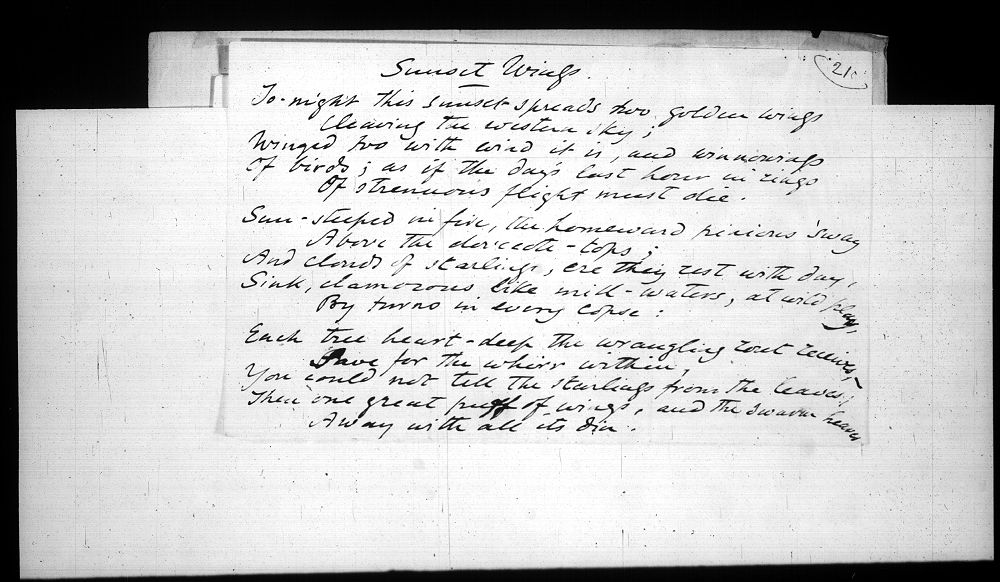
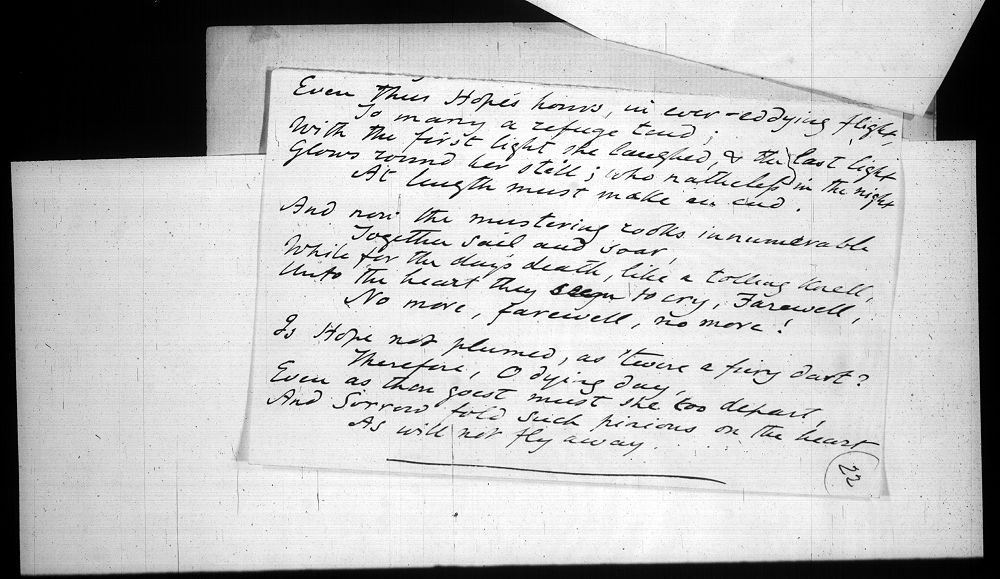
{Click to view full size; these two images show a fair copy of the poem made in 1871; source rossettiarchive.org}


Some sources:

Minorities, by T E Lawrence; ed. by Jeremy Wilson (London, Cape, 1971).

Ballads & sonnets, by Dante Gabriel Rossetti; edited by Walter Pater (T. B. Mosher, 1903)

Scholarly Commentary on 'Sunset Wings'

Monday, March 30, 2009

you mumble and sigh and turn your head

Why do you lie with your legs ungainly huddled,
And one arm bent across your sullen cold
Exhausted face? It hurts my heart to watch you,
Deep-shadow'd from the candle's guttering gold;
And you wonder why I shake you by the shoulder;
Drowsy, you mumble and sigh and turn your head. . . .
You are too young to fall asleep for ever;
And when you sleep you remind me of the dead.

This is 'The Dug-Out' by Siegfried Sassoon, from Picture Show, (Privately-printed by the author, Cambridge, 1919). It is the 47th poem that T.E. Lawrence wrote out in Minorities, his pocket book of blank pages. The ellipsis is in the original printed version.


Some sources:

Minorities, by T E Lawrence; ed. by Jeremy Wilson (London, Cape, 1971).

Picture-show, by Siegfried Sassoon (New York, E. P. Dutton & Company, 1920)

Sunday, March 29, 2009

I am rich in all that I have lost

When I was young my heart and head were light,
And I was gay and feckless as a colt
Out in the fields, with morning in the may,
Wind on the grass, wings in the orchard bloom.
   O thrilling sweet, my joy, when life was free,
   And all the paths led on from hawthorn-time
   Across the carolling meadows into June.

But now my heart is heavy-laden. I sit
Burning my dreams away beside the fire:
For death has made me wise and bitter and strong;
And I am rich in all that I have lost.
   O star shine on the fields of long-ago,
   Bring me the darkness and the nightingale;
   Dim wealds of vanished summer, peace of home,
   And silence; and the faces of my friends.
This is 'Memory' by Siegfried Sassoon, from Picture Show, (Cambridge, 1919). It is the xxxx poem that T.E. Lawrence wrote out in Minorities, his pocket book of blank pages.

Sassoon privately published the first edition of Picture Show in an edition of 200 copies. The book has only 34 leaves.


{A Browning automatic pistol that Sassoon purchased because he had little respect for Colt service revolver which the British Army issued to its officers. This photo is not directly related to the poem. He wrote that he would use the pistol to shoot himself rather than suffer a lingering death if he should be wounded in no-man's land. Unlike many contemporaries, he survived WWI and lived to experience the emotion described in this poem. source: Royal Welch Fusiliers Museum* }


Some sources:

Minorities, by T E Lawrence; ed. by Jeremy Wilson (London, Cape, 1971).

Picture-show, by Siegfried Sassoon (New York, E. P. Dutton & Company, 1920).

--------------------
Note:

*
The website of the Royal Welch Fusiliers Museum says:
The service issue revolvers of the First World War were large and clumsy, intended for use in the confines of trench or bunker - or as a last resort. Not surprisingly, wealthy officers sometimes purchased smaller, handier, examples for themselves, with semi-automatic pistols being especially popular.

One such officer was renowned poet and author Siegfried Sassoon. As he confides in Memoirs of an Infantry Officer (1930):
..I was weary of my Colt revolver, with which I knew I couldn't hit anything, although I had blazed it off a few times in the dark when I was pretending to be important in No-Man's Land. The only object I could be sure of hitting was myself.
But it wasn't simply the inaccuracy of the revolver as an offensive weapon which troubled Sassoon. Like many others, he was appalled by the prospect of a slow death "lying out in a shell-hole with something more serious than a Blighty wound". In such circumstances, he reasoned, it would be necessary to end it all quickly, while "to blow one's brains out with that clumsy Colt was unthinkable". With this grim prospect in mind, Sassoon purchased a 7.62mm Browning semi-automatic from the London branch of the Army and Navy Stores in March 1916, on his way back from leave to France.

Rumours of a massive summer offensive also prompted Sassoon's purchase, and as he left the idyllic Kent of his childhood he wondered whether he would ever return again.

Over the next two and half years Sassoon served variously with the 1st and 2nd Battalions, Royal Welch Fusiliers, in France and Flanders and with the 25th Battalion in Palestine and France.

When out on patrol in No Man's Land, Sassoon wrote that he would clutch the Browning pistol in his breeches pocket for reassurance, no doubt helping to give an outward appearance of calm.

Although twice wounded (once in the head) Sassoon never needed to use the pistol for the desperate purpose he had intended. After the war he gave it to a fellow officer, who later emigrated to Australia. After many years, the pistol returned to Wales and can be seen today on display in the Regimental Museum, clearly engraved 'S. Sassoon 1 RWF'.

Saturday, March 28, 2009

Eve with a berry half way to her lips

Eve, with her basket, was
Deep in the bells and grass,
Wading in bells and grass
Up to her knees,
Picking a dish of sweet
Berries and plums to eat,
Down in the bell and grass
Under the trees.

Mute as a mouse in a
Corner the cobra lay,
Circled round a bough of the
Cinnamon tall. . . .
Now to get even and
Humble proud heaven and
Now was the moment or
Never at all.

"Eva!" Each syllable
Light as a flower fell,
"Eva!" he whispered the
Wondering maid,
Soft as a bubble sung
Out of a linnet's lung,
Soft and most silverly
"Eva!" he said.

Picture that orchard sprite,
Eve, with her body white,
Supple and smooth to her
Slim finger tips.
Wondering, listening,
Listening, wondering,
Eve with a berry
Half-way to her lips.

Oh had our simple Eve
Seen through the make-believe!
Had she but known the
Pretender he was!
Out of the boughs he came,
Whispering still her name,
Tumbling in twenty rings
Into the grass.

Here was the strangest pair
In the world anywhere,
Eve in the bells and grass
Kneeling, and he
Telling the story low. . . .
Singing birds saw them go
Down the dark path to
The Blasphemous Tree.

O what a clatter when
Titmouse and Jenny Wren
Saw him successful and
Taking his leave!
How the birds rated him,
How they all hated him!
How they all pitied
Poor motherless Eve!

Picture her crying
Outside in the lane,
Eve, with no dish of sweet
Berries and plums to eat,
Haunting the gate of the
Orchard in vain. . . .
Picture the lewd delight
Under the hill to-night --
"Eva!" the toast goes round,
"Eva!" again.
This is 'Eve' by Ralph Hodgson, from Poems, (London, 1917). It is the 45th poem that T.E. Lawrence wrote out in Minorities, his pocket book of blank pages. The ellipses are in the poem itself; they don't reflect omissions that Lawrence made when he put the poem in Minorities.


The Bryn Mawr College Library Special Collections Dept. holds the Ralph Hodgson and Aurelia Bolliger Hodgson Papers where you can find some images of the man and some of his work as an artist.


{Portrait of Ralph Hodgson painted in Japan, artist and date unknown; from the Bryn Mawr Special Collections site}


{Galley proof of Hodgson's poems "Time" and "Eve" with corrections c. 1917 with note on the back by CL Fraser; from the Bryn Mawr Special Collections site}


Some sources:

Minorities, by T E Lawrence; ed. by Jeremy Wilson (London, Cape, 1971).

POEMS, by Ralph Hodgson, from the American edition (NY, 1918).

Poems,Ralph Hodgson (London, Macmillan, 1917).

Ralph Hodgson entry in wikipedia.

Friday, March 27, 2009

your mind’s the room where you have slept

If you could crowd them into forty lines!
Yes; you can do it, once you get a start;
All that you want is waiting in your head,
For long-ago you’ve learnt it off by heart.
                .     .     .     .     .                
Begin: your mind’s the room where you have slept,
(Don’t pause for rhymes), till twilight woke you early.
The window stands wide-open, as it stood
When tree-tops loomed enchanted for a child
Hearing the dawn’s first thrushes through the wood
Warbling (you know the words) serene and wild.

You’ve said it all before: you dreamed of Death,
A dim Apollo in the bird-voiced breeze
That drifts across the morning veiled with showers,
While golden weather shines among dark trees.

You’ve got your limitations; let them sing,
And all your life will waken with a cry:
Why should you halt when rapture’s on the wing
And you’ve no limit but the cloud-flocked sky? . . .

But some chap shouts, ‘Here, stop it; that’s been done!’ —
As God might holloa to the rising sun,
And then relent, because the glorying rays
Remind Him of green-glinting Eden days,
And Adam’s trustful eyes as he looks up
From carving eagles on his beechwood cup.

Young Adam knew his job; he could condense
Life to an eagle from the unknown immense . . . .
Go on, whoever you are; your lines can be
A whisper in the music from the weirs
Of song that plunge and tumble toward the sea
That is the uncharted mercy of our tears.
                .     .     .     .     .                
I told you it was easy! . . . Words are fools
Who follow blindly, once they get a lead.
But thoughts are kingfishers that haunt the pools
Of quiet; seldom-seen: and all you need
Is just that flash of joy above your dream.
So, when those forty platitudes are done,
You’ll hear a bird-note calling from the stream
That wandered through your childhood; and the sun
Will strike the old flaming wonder from the waters . . . .
And there’ll be forty lines not yet begun.
This is 'Limitations' by Siegfried Sassoon. It is the 44th poem that T.E. Lawrence wrote out in Minorities, his pocket book of blank pages.

Sassoon wrote it out for Lawrence in Lawrence's copy of Sassoon's Picture Show. It later appeared in the American edition of that book. The ellipses are in the poem itself; they don't reflect omissions that Lawrence made when he put the poem in Minorities.

It's very good, is it not?


Some sources:

Minorities, by T E Lawrence; ed. by Jeremy Wilson (London, Cape, 1971).

Poems by Siegfried Sassoon on poemhunter.com

Siegfried Sassoon on poetryconnection.net

Thursday, March 26, 2009

T.E. Lawrence, Minorities, Nos. 30-43

Here are links to the 30th-43rd poems that T.E. Lawrence wrote out in Minorities, his pocket book of blank pages. With exception of two, they're all from his copy of the The Oxford Book of English Verse. I'm particularly fond of no. 42.
30. Dominus Illuminatio Mea, by R.D. Blackmore

31. Ode Intimations of Immortality from Recollections of Early Childhood, by William Wordsworth

32. Salve!, by T.E. Brown

33. Elizabeth of Bohemia, by Sir Henry Wotton*

34. Love, by George Herbert

35. The Great Misgiving, by William Watson. The editor of Minorities says Lawrence wrote this poem into his pocket book on November 4, 1917, a day on which he learned of the treachery of a fighting companion. Having planned an attack on a railway and now being certain that the enemy knew his plans, he decided to proceed regardless. In Seven Pillars of Wisdom he wrote: 'The Turks, if they took the most reasonable precautions, would trap us at the bridge. We took council with Fahad and decided to push on none the less, trusting to the usual incompetence of our enemy. It was not a confident decision.'

36. Youth and Age, by Samuel Taylor Coleridge**

37. Death the Leveller, by James Shirley.

38. The Vine, by James Thomson. In 1922 Lawrence wrote to Robert Graves: 'By the way James Thomson's Sunday up the River is most excellent, isn't it?'

39. Lawrence did not copy this out of his OBEV. It is verse XVI from 'Sunday up the River' by James Thompson's The City of Dreadful Night, and other poems (London, 1910)
My love is the flaming Sword
To fight through the world;
Thy love is the Shield to ward,
And the Armor of the Lord
And the Banner of Heaven unfurled.
40. Bride Song, from 'The Prince's Progress' by Christina Georgina Rossetti

41. Kubla Khan, by Samuel Taylor Coleridge. In general, Lawrence did not think highly of Coleridge's work. He wrote his friend Charlotte Shaw that the man 'wrote so little that was quintessential: and a cargo of dross.' (30.X.28 to C. F. Shaw.)

42. Lawrence did not copy this out of his OBEV. It is 'Everyone Sang' from Siegfried Sassoon's Picture Show (Cambridge, 1919)
Everyone suddenly burst out singing;
And I was filled with such delight
As prisoned birds must find in freedom,
Winging wildly across the white
Orchards and dark-green fields; on — on — and out of sight.

Everyone's voice was suddenly lifted;
And beauty came like the setting sun:
My heart was shaken with tears; and horror
Drifted away . . . O, but Everyone
Was a bird; and the song was wordless; the singing will never be done.
In a letter written in 1929 Lawrence said Sassoon's poetry 'touches nearer to my own train of mind than the work of anyone else publishing. Every verse of his makes me say "I wish to God I'd said that": and his fox-hunting gave me a shock of astonishment that he was so different and so good to know. If I was trying to export the ideal Englishman to an international exhibition, I think I'd choose S.S. for chief exhibit.'

43. Ode to a Nightingale, by John Keats


{Siegfried Sassoon; source: ebooks-library}


{Siegfried Sassoon; source: Imperial War Museum}


{Siegfried Sassoon at the Fourth Army School, May 1916; source: Imperial War Museum}


Notes:
* Lawrence wrote out the first three verses and omitted the last:
You meaner beauties of the night,
  That poorly satisfy our eyes
More by your number than your light,
  You common people of the skies;
  What are you when the moon shall rise?

You curious chanters of the wood,
  That warble forth Dame Nature's lays,
Thinking your passions understood
  By your weak accents; what 's your praise
  When Philomel her voice shall raise?

You violets that first appear,
  By your pure purple mantles known
Like the proud virgins of the year,
  As if the spring were all your own;
  What are you when the rose is blown?
** Lawrence omitted parts of this poem, as shown.
Verse, a breeze 'mid blossoms straying,
Where Hope clung feeding, like a bee —
Both were mine! Life went a-maying
With Nature, Hope, and Poesy,
      When I was young!
When I was young? — Ah, woful When!
Ah! for the change 'twixt Now and Then!
This breathing house not built with hands,
This body that does me grievous wrong,
O'er aery cliffs and glittering sands,
How lightly then it flash'd along —
Like those trim skiffs, unknown of yore,
On winding lakes and rivers wide,
That ask no aid of sail or oar,
That fear no spite of wind or tide!
Naught cared this body for wind or weather
When Youth and I lived in 't together.


Flowers are lovely! Love is flower-like;
Friendship is a sheltering tree;
O the joys, that came down shower-like,
Of Friendship, Love, and Liberty,
      Ere I was old!
Ere I was old? Ah, woful Ere,
Which tells me, Youth 's no longer here!
O Youth! for years so many and sweet,
'Tis known that thou and I were one;
I'll think it but a fond conceit —
It cannot be that thou art gone!
Thy vesper-bell hath not yet toll'd —
And thou wert aye a masker bold!
What strange disguise hast now put on,
To make believe that thou art gone?
I see these locks in silvery slips,
This drooping gait, this alter'd size:
But springtide blossoms on thy lips,
And tears take sunshine from thine eyes!
Life is but thought: so think I will
That Youth and I are housemates still.


Dewdrops are the gems of morning,
But the tears of mournful eve!
Where no hope is, life 's a warning
That only serves to make us grieve,
      When we are old!

That only serves to make us grieve
With oft and tedious taking-leave,
Like some poor nigh-related guest
That may not rudely be dismist.
Yet hath outstay'd his welcome while,
And tells the jest without the smile.

Wednesday, March 25, 2009

others could not, that night

Downhill I came, hungry, and yet not starved,
Cold, yet had heat within me that was proof
Against the North wind; tired, yet so that rest
Had seemed the sweetest thing under a roof.

Then at the inn I had food, fire, and rest,
Knowing how hungry, cold, and tired was I.
All of the night was quite barred out except
An owl’s cry, a most melancholy cry.

Shaken out long and clear upon the hill
No merry note, nor cause of merriment,
But one telling me plain what I escaped
And others could not, that night, as in I went.

And salted was my food, and my repose,
Salted and sobered too, by the bird’s voice
Speaking for all who lay under the stars,
Soldiers and poor, unable to rejoice.
This is 'The Owl' by Edward Thomas, from the Collected Poems (Selwyn & Blount, 1920). It is the 29th poem that T.E. Lawrence wrote out in Minorities, his pocket book of blank pages.

It was written after World War I, somberly.


{Edward Thomas from the First World War Poetry Digital Archive}


Some sources:

Minorities, by T E Lawrence; ed. by Jeremy Wilson (London, Cape, 1971).

Collected poems, by Edward Thomas (Selwyn & Blount, 1920)

The Edward Thomas Collection, First World War Poetry Digital Archive

Edward Thomas 1878-1917 entry on enotes.com

Tuesday, March 24, 2009

shadow of daisy cast upon stone

Ss fair, so sweet, withal so sensitive,
Would that the little Flowers were born to live,
Conscious of half the pleasure which they give;

That to this mountain-daisy's self were known
The beauty of its star-shaped shadow, thrown
On the smooth surface of this naked stone!

And what if hence a bold desire should mount
High as the Sun, that he could take account
Of all that issues from his glorious fount!

So might he ken how by his sovereign aid
These delicate companionships are made;
And how he rules the pomp of light and shade;

And were the Sister-power that shines by night
So privileged, what a countenance of delight
Would through the clouds break forth on human sight!

Fond fancies! wheresoe'er shall turn thine eye
On earth, air, ocean, or the starry sky,
Converse with Nature in pure sympathy;

All vain desires, all lawless wishes quelled,
Be Thou to love and praise alike impelled,
Whatever boon is granted or withheld.
This is an untitled poem by Wordsworth known as "So fair, so sweet." It is poem LXII in the section, 'Poems of Sentiment and Reflection' of the Poetical Works (London, 1917) and it is the 28th poem that T.E. Lawrence wrote out in Minorities, his pocket book of blank pages.

Wordsworth wrote this in 1844, very late in life. It has characteristic subject matter but its technique is unusual for him. Lawrence was not generally fond of Wordsworth's verse, assigning to him, more than Keats, 'a congenital inability to write a good poem' and he left no clues why this one mattered to him. My guess is that he liked the sound and meaning of 'converse with Nature in pure sympathy' and 'whatever boon is granted or whithheld.'

Two modern editors, E. de Selincourt and Helen Darbishire, tell us:
The incident which gave rise to the composition of this poem has been recorded by several persons. R. P. Graves recalls the walk to Longrigg Tarn with W., Professor Archer Butler, Sir William Hamilton, and Julius C. Hare: "The splendour of a July noon surrounded us, and lit up the landscape with the Langdale Pikes soaring above, and the bright Tarn shining beneath; and when the poet's eyes were satisfied with their feast on the beauties familiar to them, they sought relief in the search, to them a happy vital habit, for new beauty in the flower-enamelled turf at his feet. There his attention was arrested by a fair smooth stone, of the size of an ostrich's egg, seeming to imbed at its centre, and at the same time to display a dark star-shaped fossil of most distinct outline. Upon closer inspection this proved to be the shadow of a daisy projected upon it with extraordinary precision by the intense light of an almost vertical sun. The poet drew the attention of the rest of the party to the minute but beautiful phenomenon, and gave expression at the time to thoughts suggested by it." And on Sept. 14, 1844, J. C. Hare wrote to W.: "One of the brightest days in those happy three weeks was that on which we accompanied you to Loughrigg Tarn; for that walk bore its part in ripening our previous friendship, if I may not call it our fraternal affection, into something still dearer and better; nor shall I ever forget your stopping and drawing our attention to the exquisitely pencilled shadow the daisy cast upon a neighbouring stone. I remember saying at the time 'We shall have a sonnet upon it,' and this probably has been fulfilled, I rejoice to learn, save that, instead of the sonnet, you have adopted a new form of verse, that is, new, I believe, in your writings, in composing the beautiful triplets you have had the kindness to send.


Some sources:

Minorities, by T E Lawrence; ed. by Jeremy Wilson (London, Cape, 1971)

The Poems of William Wordsworth (1893)

William Wordsworth, The Poetical Works, ed. E. de Selincourt and Helen Darbishire (5 vols, Oxford, 1940-49; rev. 1952-59).

Sunday, March 22, 2009

to whinny-muir thou com'st at last

Here are links to the 20th-27th poems that T.E. Lawrence wrote out in Minorities, his pocket book of blank pages. They're all from his copy of the The Oxford Book of English Verse. Of this group, the 17th c. ballad has the most interest. 'A Lyke-Wake Dirge' is a popular song which appears in Sir Walter Scott's Minstrelsy of the Scottish Border and other sources. It is described as a "charm sung ... while watching a dead body, previous to interment. The tune is doleful and monotonous, and, joined to the mysterious import of the words, has a solemn effect. The word sleet, in the chorus, seems to be corrupted from sell, or salt; a quantity of which, in compliance with a popular superstition, is frequently placed on the breast of a corpse. ... The dirge is included by John Aubrey in his Remaines of Gentilisme and Judaisms, 1686-7, ... prefaced thus: — 'The beliefe in Yorke-shire was amongst the vulgar (perhaps is in part still) that after the person's death the soule went over Whinny-moore, and till about 1616-1624 at the funerale a woman came (like a Praefica), and sang the following song.'

Here is the text:
This ae nighte, this ae nighte,
   — Every nighte and alle,
Fire and fleet and candle-lighte,
  And Christe receive thy saule.

When thou from hence away art past,
   — Every nighte and alle,
To Whinny-muir thou com'st at last;
  And Christe receive thy saule.

If ever thou gavest hosen and shoon,
   — Every nighte and alle,
Sit thee down and put them on;
  And Christe receive thy saule.

If hosen and shoon thou ne'er gav'st nane
   — Every nighte and alle,
The whinnes sall prick thee to the bare bane;
  And Christe receive thy saule.

From Whinny-muir when thou may'st pass,
   — Every nighte and alle,
To Brig o' Dread thou com'st at last;
  And Christe receive thy saule.

From Brig o' Dread when thou may'st pass,
   — Every nighte and alle,
To Purgatory fire thou com'st at last;
  And Christe receive thy saule.

If ever thou gavest meat or drink,
   — Every nighte and alle,
The fire sall never make thee shrink;
  And Christe receive thy saule.

If meat or drink thou ne'er gav'st nane,
   — Every nighte and alle,
The fire will burn thee to the bare bane;
  And Christe receive thy saule.

This ae nighte, this ae nighte,
   — Every nighte and alle,
Fire and fleet and candle-lighte,
  And Christe receive thy saule.


Some sources:

Minorities, by T E Lawrence; ed. by Jeremy Wilson (London, Cape, 1971).

The Oxford Book of English Verse HTML edition

Sir Walter Scott's Minstrelsy of the Scottish Border, compiled by Walter Scott (W. Blackwood and sons, 1902)

Saturday, March 21, 2009

one stone the more swings to her place

MY new-cut ashlar takes the light
  Where crimson-blank the windows flare;
By my own work, before the night,
  Great Overseer, I make my prayer.

If there be good in that I wrought,
  Thy hand compell'd it, Master, Thine;
Where I have fail'd to meet Thy thought
  I know, through Thee, the blame if mine.

One instant's toil to Thee denied
  Stands all Eternity's offence;
Of that I did with Thee to guide
  To Thee, through Thee, be excellence.

Who, lest all thought of Eden fade,
  Bring'st Eden to the craftsman's brain,
Godlike to muse o'er his own trade
  And manlike stand with God again.

The depth and dream of my desire,
  The bitter paths wherein I stray,
Thou knowest Who hast made the Fire,
  Thou knowest Who hast made the Clay.

One stone the more swings to her place
  In that dread Temple of Thy worth--
It is enough that through Thy grace
  I saw naught common on Thy earth.

Take not that vision from my ken;
  O, whatsoe'er may spoil or speed,
Help me to need no aid from men,
  That I may help such men as need!
This is 'A Dedication' by Rudyard Kipling, from T.E. Lawrence's copy of the Oxford Book of English Verse. It is the 19th poem he wrote out in Minorities, his pocket book of blank pages.

I'm fond of much that Kipling wrote, including many of the jingly poems, but this one, not. I wonder why Lawrence wanted to keep it with him. In some cases, the poems he copied out of OBEV were ones he loved when young, and though he did not say that about this one (or anything at all about it), it may be that he scrawled it in his book out of juvenile remembrance. The copy of OBEV that Lawrence carried with him in Arabia has dates inscribed by some poems. This one has the date July 17, 1917, on which day he was on a British naval vessel. He had just successfully negotiated support for his plans to extend the Arab revolt northward toward Damascus.

The poem draws its images from Freemasonry. An ashlar is a dressed stone, usually rectangular looking a bit like a large brick. Freemasons use the stones as metaphors for advancement through degrees of hierarchy, from the rough-stone of the new initiate to the carefully cut and smoothed finished stone of the advanced practitioner.

The editor of Minorities writes that Kipling showed an interest in Lawrence before he read Seven Pillars. Afterwards, Lawrence wrote, Kipling 'dropped me like a stale egg.' (20.iii.28 to C. F. Shaw.)

Some sources:

Minorities, by T E Lawrence; ed. by Jeremy Wilson (London, Cape, 1971).

A Dedication, The Oxford Book of English Verse, HTML edition

An Index to Poetry and Recitations, by Edith Granger (A. C. McClurg & company, 1918)

Rudyard Kipling and Freemasonry

The Masonic Poetry of Rudyard Kipling (pdf) by Bro John Davies, Given before the Master, Brethren and Visitors of the Lodge of St. Michael no 2933 E.C. on Thursday 2nd February 2006.

Friday, March 20, 2009

and no birds sing

Oh what can ail thee, knight-at-arms,
      Alone and palely loitering?
The sedge has withered from the lake,
      And no birds sing.

Oh what can ail thee, knight-at-arms,
      So haggard and so woe-begone?
The squirrel's granary is full,
      And the harvest's done.

I see a lily on thy brow,
      With anguish moist and fever-dew,
And on thy cheeks a fading rose
      Fast withereth too.

I met a lady in the meads,
      Full beautiful - a faery's child,
Her hair was long, her foot was light,
      And her eyes were wild.

I made a garland for her head,
      And bracelets too, and fragrant zone;
She looked at me as she did love,
      And made sweet moan.

I set her on my pacing steed,
      And nothing else saw all day long,
For sidelong would she bend, and sing
      A faery's song.

She found me roots of relish sweet,
      And honey wild, and manna-dew,
And sure in language strange she said -
      'I love thee true'.

She took me to her elfin grot,
      And there she wept and sighed full sore,
And there I shut her wild wild eyes
      With kisses four.

And there she lulled me asleep
      And there I dreamed - Ah! woe betide! -
The latest dream I ever dreamt
      On the cold hill side.

I saw pale kings and princes too,
      Pale warriors, death-pale were they all;
They cried - 'La Belle Dame sans Merci
      Hath thee in thrall!'

I saw their starved lips in the gloam,
      With horrid warning gaped wide,
And I awoke and found me here,
      On the cold hill's side.

And this is why I sojourn here
      Alone and palely loitering,
Though the sedge is withered from the lake,
      And no birds sing.


This is 'La Belle Dame sans Merci' by John Keats, from T.E. Lawrence's copy of the Oxford Book of English Verse. It is the 18th poem he wrote out in Minorities, his pocket book of blank pages.

The editor of Minorities says Lawrence felt Keats could be too sugary, but his music soared when he succeeded in restraining himself. He quotes a letter: "Art creation is avoidance as much as it is presentation. And it's interesting to see Keats' growth in force (and decline in sweetness) from Endymion to Hyperion." (from a letter to V. Richards written in 1922)


{This painting of 1893 by John Waterhouse is found on many websites; it's based on La Belle Dame Sans Merci and it illustrates the lines:

She took me to her elfin grot,
      And there she gaz'd and sighed deep,
And there I shut her wild sad eyes -
      So kiss'd to sleep.*}


Some sources:

Minorities, by T E Lawrence; ed. by Jeremy Wilson (London, Cape, 1971).

The Oxford Book of English Verse, HTML edition


Note: * This is from a revised version of the poem, not the one that's most anthologized:
Ah, what can ail thee, wretched wight,
Alone and palely loitering;
The sedge is wither'd from the lake,
And no birds sing.

Ah, what can ail thee, wretched wight,
So haggard and so woe-begone?
The squirrel's granary is full,
And the harvest's done.

I see a lily on thy brow,
With anguish moist and fever dew;
And on thy cheek a fading rose
Fast withereth too.

I met a lady in the meads
Full beautiful, a faery's child;
Her hair was long, her foot was light,
And her eyes were wild.

I set her on my pacing steed,
And nothing else saw all day long;
For sideways would she lean, and sing
A faery's song.

I made a garland for her head,
And bracelets too, and fragrant zone;
She look'd at me as she did love,
And made sweet moan.

She found me roots of relish sweet,
And honey wild, and manna dew;
And sure in language strange she said,
I love thee true.

She took me to her elfin grot,
And there she gaz'd and sighed deep,
And there I shut her wild sad eyes--
So kiss'd to sleep.

And there we slumber'd on the moss,
And there I dream'd, ah woe betide,
The latest dream I ever dream'd
On the cold hill side.

I saw pale kings, and princes too,
Pale warriors, death-pale were they all;
Who cry'd--"La belle Dame sans merci
Hath thee in thrall!"

I saw their starv'd lips in the gloam
With horrid warning gaped wide,
And I awoke, and found me here
On the cold hill side.

And this is why I sojourn here
Alone and palely loitering,
Though the sedge is wither'd from the lake,
And no birds sing.

-- Unpublished Poems of John Keats

Thursday, March 19, 2009

having done that, Thou hast done

Wilt Thou forgive that sin where I begun,
     Which was my sin, though it were done before?
Wilt Thou forgive that sin through which I run,
     And do run still, though still I do deplore?
When Thou hast done, Thou hast not done;
          For I have more.

Wilt Thou forgive that sin which I have won
     Others to sin, and made my sins their door?
Wilt Thou forgive that sin which I did shun
     A year or two, but wallow'd in a score?
When Thou hast done, Thou hast not done;
          For I have more.

I have a sin of fear, that when I've spun
     My last thread, I shall perish on the shore;
But swear by Thyself that at my death Thy Son
     Shall shine as He shines now and heretofore:
And having done that, Thou hast done;
          I fear no more.
This is "A Hymn to God the Father" by John Donne, which Lawrence copied from the Oxford Book of English Verse into Minorities, his pocket book of blank pages.

With this poem, Lawrence begins to depart from his original goal of including only works by minor poets, but the inconsistency was surely of no account to him. He had little respect of consistency for its own sake and so, for example, he would torture the editors of Seven Pillars of Wisdom by varying his English renderings of Arabic names and places. Moreover his main goal was to have with him, during his travels, those poems which were most important to him in one easily portable book.

That said, the poem certainly has the musical quality that Lawrence sought and it has in fact been set to music. Its tone also meets his wish to focus on works in a minor, that is to say, pessimistic or death-concerned, key.

It bears one pun on the poet's name: "Donne" can be read for "done". Thus "Thou hast done" = "Thou has Donne". It also puns on the name of his young wife: "For I have more" = "For I have (Anne) More". These word plays, his reference to himself as a spider, and the playful admonition, "Thou hast not done" all mitigate the sin-drenched, petitionary, and self-flagellating aspects of the poem. Donne's standing tall while acknowledging his faults, forthrightly facing his own death, and yet doubting that Heaven awaits him would have appealed to Lawrence. And there is something outrageously self-confident in his final assertion that at his death "Thy Son / Shall shine as He shines now and heretofore."


Some sources:

Minorities, by T E Lawrence; ed. by Jeremy Wilson (London, Cape, 1971).

The Oxford Book of English Verse, 1250-1900, ed. by Arthur Thomas Quiller-Couch (1908)

A Hymn to God the Father, music for tenor and piano (1987)

HIDDEN SOURCES: Western Esoteric Influence on the Arts

A Hymn to God the Father

Wednesday, March 18, 2009

the insufferable sufficiency of breath

NOT unto us, O Lord,
Not unto us the rapture of the day,
The peace of night, or love's divine surprise,
High heart, high speech, high deeds 'mid honouring eyes;
For at Thy word
All these are taken away.

Not unto us, O Lord:
To us thou givest the scorn, the scourge, the scar,
The ache of life, the loneliness of death,
The insufferable sufficiency of breath;
And with Thy sword
Thou piercest very far.

Not unto us, O Lord:
Nay, Lord, but unto her be all things given--
My light and life and earth and sky be blasted--
But let not all that wealth of loss be wasted:
Let Hell afford
The pavement of her Heaven!
This is "Non Nobis" by Henry Cust. It appeared first anonymously and then with due credit in the Oxford Book of English Verse early in the 20th century. It is the 16th poem that Lawrence wrote out in Minorities, his pocket book of blank pages.

First of a consecutive series of 11 poems that Lawrence put in Minorities out of OBEV. One (number 5) preceded and others would follow. This is not surprising since he had carried the Quiller-Couch OBEV with him during his wartime service in the Arab states.

The editor of Minorities says that Cust was a relative of a colleague of Lawrence's during the war. He relates this anecdote: "In Law­rence's copy of the O.E.V. this poem is dated 22.xi.I7. Lawrence was at Azrak on this date (see Chapter LXXXI of Seven Pillars), two days earlier he had been captured during a reconnaissance at Deraa, and brutally treated by the Turks. On the morning of the 21st he escaped, and returned to Azrak, but could not face the prospect of a winter's diplomacy there with the smooth northern townspeople who now came to make contact with the Arab forces. Instead he set out on November 23rd for Akaba."

According to his wikipedia entry, Cust was an randy aristocrat, editor of an influential periodical, and a Conservative Member of Parliament.

It says Cust was a member of a group called The Souls, were a small, loosely-knit but distinctive social group of prominent and well-born men and women including author Margot Asquith, who wrote:
Mr. Harry Cust is the last of the Souls that I intend writing about and was in some ways the rarest and the most brilliant of them all. Some one who knew him well wrote truly of him after he died:
He tossed off the cup of life without fear of it containing any poison, but like many wilful men he was deficient in will-power.
. . . Harry Cust had an untiring enthusiasm for life. At Eton he had been captain of the school and he was a scholar of Trinity. He had as fine a memory as Professor Churton Collins or my husband and an unplumbed sea of knowledge, quoting with equal ease both poetry and prose. He edited the Pall Mall Gazette brilliantly for several years. With his youth, brains and looks, he might have done anything in life; but he was fatally self-indulgent and success with my sex damaged his public career. He was a fastidious critic and a faithful friend, fearless, reckless and unforgettable.

He wrote one poem, [Non Nobis] which appeared anonymously in the Oxford Book of English Verse.


Some sources:

Minorities, by T E Lawrence; ed. by Jeremy Wilson (London, Cape, 1971).

The Oxford Book of English Verse, 1250-1900, ed. by Arthur Thomas Quiller-Couch
Published by Clarendon Press, (Clarendon, 1908)

Margot Asquith, an Autobiography, by Margot Asquith (George H. Doran company, 1920)

An Autobiography, by Margot Asquith (George H. Doran company, 1920)

Tuesday, March 17, 2009

death is strong and full of blood and fair

Who hath given man speech? or who hath set therein
A thorn for peril and a snare for sin?
For in the word his life is and his breath,
     And in the word his death,
That madness and the infatuate heart may breed
     From the word's womb the deed
And life bring one thing forth ere all pass by,
Even one thing which is ours yet cannot die —
Death.. Hast thou seen him ever anywhere,
Time's twin-born brother, imperishable as he
Is perishable and plaintive, clothed with care
     And mutable as sand,
But death is strong and full of blood and fair
And perdurable and like a lord of land?
Nay, time thou seest not, death thou wilt not see
Till life's right hand be loosened from thine hand
     And thy life-days from thee.
For the gods very subtly fashion
     Madness with sadness upon earth:
Not knowing in any wise compassion,
     Nor holding pity of any worth;
And many things they have given and taken,
     And wrought and ruined many things;
The firm land have they loosed and shaken,
     And sealed the sea with all her springs;
They have wearied time with heavy burdens
     And vexed the lips of life with breath:
Set men to labour and given them guerdons,
     Death, and great darkness after death:
Put moans into the bridal measure
     And on the bridal wools a stain;
And circled pain about with pleasure,
     And girdled pleasure about with pain;
And strewed one marriage-bed with tears and fire
For extreme loathing and supreme desire.

What shall be done with all these tears of ours?
     Shall they make watersprings in the fair heaven
To bathe the brows of morning? or like flowers
Be shed and shine before the starriest hours,
     Or made the raiment of the weeping Seven?
Or rather, O our masters, shall they be
Food for the famine of the grievous sea,
     A great well-head of lamentation
Satiating the sad gods? or fall and flow
Among the years and seasons to and fro,
     And wash their feet with tribulation
And fill them full with grieving ere they go?
     Alas, our lords, and yet alas again,
Seeing all your iron heaven is gilt as gold
     But all we smite thereat in vain;
Smite the gates barred with groanings manifold,
     But all the floors are paven with our pain.
Yea, and with weariness of lips and eyes,
With breaking of the bosom, and with sighs,
     We labour, and are clad and fed with grief
And filled with days we would not fain behold
And nights we would not hear of; we wax old,
     All we wax old and wither like a leaf.
We are outcast, strayed between bright sun and moon;
     Our light and darkness are as leaves of flowers,
Black flowers and white, that perish; and the noon
     As midnight, and the night as daylight hours.
     A little fruit a little while is ours,
          And the worm finds it soon.

But up in heaven the high gods one by one
     Lay hands upon the draught that quickeneth,
Fulfilled with all tears shed and all things done,
     And stir with soft imperishable breath
     The bubbling bitterness of life and death,
And hold it to our lips and laugh; but they
Preserve their lips from tasting night or day,
     Lest they too change and sleep, the fates that spun,
The lips that made us and the hands that slay;
     Lest all these change, and heaven bow down to none,
Change and be subject to the secular sway
     And terrene revolution of the sun.
Therefore they thrust it from them, putting time away.

I would the wine of time, made sharp and sweet
     With multitudinous days and nights and tears
     And many mixing savours of strange years,
Were no more trodden of them under feet,
     Cast out and spilt about their holy places:
That life were given them as a fruit to eat
And death to drink as water; that the light
Might ebb, drawn backward from their eyes, and night
     Hide for one hour the imperishable faces.
That they might rise up sad in heaven, and know
Sorrow and sleep, one paler than young snow,
     One cold as blight of dew and ruinous rain;
Rise up and rest and suffer a little, and be
Awhile as all things born with us and we,
     And grieve as men, and like slain men be slain.

For now we know not of them; but one saith
     The gods are gracious, praising God; and one,
When hast thou seen? or hast thou felt his breath
     Touch, nor consume thine eyelids as the sun,
Nor fill thee to the lips with fiery death?
     None hath beheld him, none
Seen above other gods and shapes of things,
Swift without feet and flying without wings,
Intolerable, not clad with death or life,
     Insatiable, not known of night or day,
The lord of love and loathing and of strife
     Who gives a star and takes a sun away;
Who shapes the soul, and makes her a barren wife
     To the earthly body and grievous growth of clay;
Who turns the large limbs to a little flame
     And binds the great sea with a little sand;
Who makes desire, and slays desire with shame;
     Who shakes the heaven as ashes in his hand;
Who, seeing the light and shadow for the same,
     Bids day waste night as fire devours a brand,
Smites without sword, and scourges without rod -
     The supreme evil, God.

Yea, with thine hate, O God, thou hast covered us,
     One saith, and hidden our eyes away from sight,
And made us transitory and hazardous,
     Light things and slight;
Yet have men praised thee, saying, He hath made man thus,
     And he doeth right.
Thou hast kissed us, and hast smitten; thou hast laid
Upon us with thy left hand life, and said,
Live: and again thou hast said, Yield up your breath,
And with thy right hand laid upon us death.
Thou hast sent us sleep,and stricken sleep with dreams,
     Saying, Joy is not, but love of joy shall be;
Thou hast made sweet springs for all the pleasant streams,
     In the end thou hast made them bitter with the sea.
Thou hast fed one rose with dust of many men;
     Thou hast marred one face with fire of many tears;
Thou hast taken love, and given us sorrow again;
     With pain thou hast filled us full to the eyes and ears.
Therefore because thou art strong, our father, and we
     Feeble; and thou art against us, and thine hand
Constrains us in the shallows of the sea
     And breaks us at the limits of the land;
Because thou hast bent thy lightnings as a bow,
     And loosed the hours like arrows; and let fall
Sins and wild words and many a winged woe
     And wars among us, and one end of all;
Because thou hast made the thunder, and thy feet
     Are as a rushing water when the skies
Break, but thy face as an exceeding heat
     And flames of fire the eyelids of thine eyes;
Because thou art over all who are over us;
     Because thy name is life and our name death;
Because thou art cruel and men are piteous,
     And our hands labour and thine hand scattereth;
Lo, with hearts rent and knees made tremulous,
     Lo, with ephemeral lips and casual breath,
          At least we witness of thee ere we die
That these things are not otherwise, but thus;
     That each man in his heart sigheth, and saith,
          That all men even as I,
All we are against thee, against thee, O God most high.
This is an extract from a chorus in "Atalanta in Calydon" by Algernon Swinburne in his play Atalanta in Calydon: a tragedy (London, 1894). It is the 15th poem that Lawrence wrote out in Minorities, his pocket book of blank pages.

In his time, Swinburne was considered to be one of England's greatest poets, worthy successor to Alfred, Lord Tennyson and Robert Browning. This entry my therefore seem to be a major departure from Lawrence's goal to include only minor poets in Minorities, but in fact he did not consider Swinburne to be great. In letters written in 1913 and 1927, he called him long-winded and boring. Because of its length and the hand-cramping trouble it's likely to have caused him as he transcribed it, this chorus must have had special significance in Lawrence's hierarchy of works by minor poets, set in a minor key, which have an appealing lyricism.

The editor of Minorities says Lawrence used a metaphor from the chorus in the dedication poem of Seven Pillars of Wisdom: "Love, the way-weary, groped to your body, our brief wage ours for the moment / Before earth's soft hand explored your shape, and the blind worms grew fat upon / Your substance."* Modern commentary tends to associate the lines with homosexual love, but others point out that Lawrence was not particularly strongly inclined toward either homo- or heterosexuality; he had an Oxonian tolerance for the sexual adventurism of others, but seems not himself to have been highly libidinized. The identity of "S.A.", the subject of Lawrence's dedication is thoroughly discussed in a page by Yagitani Ryôkoa called An 'S.A.' Mystery, which says that, typically of Lawrence, the initials cannot assuredly be assigned to any one person or concept.**


{This is the second half of the extract in Lawrence's hand from Minorities; source: Minorities, by T E Lawrence; ed. by Jeremy Wilson (London, Cape, 1971).}


{source: Special Collections and Archives, Univ of California, Irvine}


{Algernon Charles Swinburne, painting by William Bell Scott, 1860; source: victorianweb.org}


Here is the Atalanta story from wikipedia:
Atalanta (Greek: Αταλάντη, English translation: "balanced") is a character from ancient Greek mythology.

After being told by an oracle she would be ruined if she were to marry, Atalanta set up a contest to win her hand in marriage. All of the suitors that wanted to marry her would have to race her, and if they beat her in the race, they won her hand in marriage; if not they would die by her hand. After she meets and instantly loves Hippomenes, she begs him not to race her. She fears if he loses she will have to kill him, and she has fallen in love with him on sight, but because of her competitive nature and the oracle's promise that marriage will be her demise, she must kill him should he lose – per the rules of her own contest.

Hippomenes prays to the goddess of love, Aphrodite, for help in winning the race and thus Atalanta's hand. Aphrodite, taking pity on the love-sick man, devises a plan to help Hippomenes win the race without necessarily cheating.

Aphrodite gives Hippomenes three golden apples and tells him to throw them on the race track at different stages in the race. Atalanta is distracted by these golden apples and therefore stops each time Hippomenes throws them, giving Hippomenes a slight advantage over her own speed. Hippomenes wins the race and her hand in marriage.
This page describes Atalanta's connection with Calydon.


Notes:

* Susan H. Warren believes that a Thomas Hardy poem, He Never Expected Much, may, in turn, draw upon Lawrence's metaphor, but it is difficult to see a close correspondence. Hardy has "The World," meaning our lives in the world, speak thus:
Many have loved me desperately,
Many with smooth serenity,
While some have shown contempt of me
Till they dropped underground.
**Yagitani Ryôkoa gives the following candidates list for S.A.
* Achmed, Sheik Ahmed or 'Salim' Ahmed, otherwise Dahoum
* 'Son Altesse', Her Highness, i.e. Fareedeh el Akle -- Robert Graves
* A lay figure of literary passion -- Vyvyan Richards
* An imaginary person of neutral sex -- TE himself
* Sheikh or Sharif Ali -- Desmond Stewart
* Prince Feisal -- an article in the Beirut newspaper, L'Orient, on 1 October 1965 [Lives, McGraw-Hill ed., p.181; Panther ed., p.185]
* One is a person and one a place: Dahoum and Syria or Arabia
'as a personification as well as a person - a combination of the person and the place, a symbol of the pre-war happiness of life at Carchemish' -- A. W. Lawrence [ibid.]
* Syria and Arabia -- Fareedeh el Akle
* Sarah Aaronsohn (d.1917), a Jewish intelligence agent, sister of Aaron Aaronsohn
-- Put forward firstly by Flora Armitage in her TE biography The Desert and the Stars, Holt, New York, 1955 [p.135]. Anita Engle wrote an appendix entitled 'The Lawrence-Sarah Myth' in her book The Nili Spies, The Hogarth Press, London, 1959. Supported by a close friend of TE's, Dr Ernest Altounyan [Lives, McGraw-Hill ed., p.181; Panther ed., p.186]. I found two letters in the correspondence column of Sunday Times in 1989 and 1992 supported Sarah Aaronsohn.[*7]
* 'an idea or spirit rather than an individual' -- Michael Yardley [Backing into the Limelight: A Biography of T. E. Lawrence, Harrap, London 1985, p.48]
* 'An imaginary conception, unrelated to a particular person or place, which represented all that he had found that was fair and gentle and lovable in Arabia and its peoples' -- Anthony Nutting [Lawrence of Arabia: The Man and The Motive, Signet ed., p.234 (first published from Hollis Carter, London 1961)]


{On left: Miss Fareedeh/Fareedah or Farida el Akle, a modern-thinking Christian Arab, who taught Lawrence Arabic and was said to be embarrassingly fond of him; on right: an unusually pale-skinned Arab named Dahoum or Dahum, a waterboy or donkey boy, who Lawrence felt to be a kindred spirit and who died young. source: An 'S.A.' Mystery}


Some sources:

Minorities, by T E Lawrence; ed. by Jeremy Wilson (London, Cape, 1971).

Atalanta in Calydon: a tragedy (London, Chatto & Windus, 1875)

Thomas Hardy and T. E. Lawrence: A Literary Friendship, by Susan H. Warren; Journal of the T. E. Lawrence Society, Vol. VI, No. 2, Spring 1997.

Seven Pillars of Wisdom, by T.E. Lawrence - Dedication
Monday, March 16, 2009

labour and longing and despair the long day brings

Strange grows the river on the sunless evenings!
The river comforts me, grown spectral, vague and dumb:
Long was the day; at last the consoling shadows come:
Sufficient for the day are the day's evil things!

Labour and longing and despair the long day brings;
Patient till evening men watch the sun go west;
Deferred, expected night at last brings sleep and rest:
Sufficient for the day are the days evil things!

At last the tranquil Angelus of evening rings
Night's curtain down for comfort and oblivion
Of all the vanities observed by the sun:
'Sufficient for the day are the day's evil things!'
This is 'Vesperal' by Ernest Dowson, from The Poems of Ernest Dowson, with a memoir by Arthur Symons (London, 1913). It is the 14th poem that Lawrence wrote out in Minorities, his pocket book of blank pages.

I have previously described Dowson: here and here.

Vespers are evening prayers. The phrase "Sufficient for the day are the day's evil things!" is a variant of a line from the Sermon on the Mount in the Gospel of Matthew. Dowson was a Roman Catholic and therefore might have been familiar with the Oxford translation into English from the Latin Vulgate. I give extracts from the Gospel of Matthew from a translation of 1836 below.

Verses 25-end of Matthew, Chapter 6:

25 § Therefore I say to you, be not solicitous for your life, what you shall eat, nor for your body what you shall put on. Is not the life more than the meat: and the body more than the raiment?

26 Behold the birds of the air, for they neither sow, nor do they reap, nor gather into barns: and your heavenly Father feedeth them. Are not you of much more value than they?

27 And which of you by taking thought, can add to his stature one cubit?

28 And for raiment why are you solicitous? consider the lilies of the field how they grow: they labour not, neither do they spin.

29 But I say to you, that not even Solomon in all his glory was arrayed as one of these.

30 And if the grass of the field, which is to-day, and to-morrow is cast into the oven, God doth so clothe: how much more you, O ye of little faith?

31 Be not solicitous therefore, saying, What shall we eat: or what shall we drink, or where with shall we be clothed?

32 For after all these things do the heathens seek. For your Father knoweth that you have need of all these things.

33 Seek ye therefore first the kingdom of God, and his justice, and all these things shall be added unto you.

34 Be not therefore solicitous for to-morrow; for the morrow will be solicitous for itself. Sufficient for the day is the evil thereof.

{source: The Holy Bible translated from the Latin Vulgate; diligently compared with the Hebrew, Greek, and other editions, in divers languages. With annotations, references, and an historical and chronological index (Oxford, 1836) }


Some sources:

Minorities, by T E Lawrence; ed. by Jeremy Wilson (London, Cape, 1971).

The Poems of Ernest Dowson (London, 1915)

The Poems of Ernest Dowson (New York, 1922)

Canonical hours on wikipedia

Vespers in the Catholic Encyclopedia

Vespers on wikipedia

Matthew 6:34 multilingual translations from Biblos.com

The Holy Bible translated from the Latin Vulgate; diligently compared with the Hebrew, Greek, and other editions, in divers languages. With annotations, references, and an historical and chronological index (Oxford, 1836)

Sunday, March 15, 2009

In deinem lieben Lichte gehn

O sähst du, voller Mondenschein,
Zum letztenmal auf meine Pein,
Den ich so manche Mitternacht
An diesem Pult herangewacht:
Dann, iiber Bfichern und Papier,
Triibsel'ger Freund, erschienst du mir!
Ach! konnt' ich doch auf Bergeshoh'n
In deinem lieben Lichte gehn,
Um Bergeshohle mit Geistern schweben,
Auf Wiesen in deinem Dammer weben,
Vori allem Wissensqualm entladen,
In deinem Tau gesund mich baden!
This is an extract from Act 1, Scene 1 of Goethe's Faust. It is the 13th entry in T.E. Lawrence's manuscript pocket book which he called Minorities. I've given some English translations below.


{These illustrations come from old editions of Faust}


Three renderings in English:
O full and splendid Moon, whom I
Have, from this desk, seen climb the sky
So many a midnight, — would thy glow
For the last time beheld my woe!
Ever thine eye, most mournful friend,
O'er books and papers saw me bend;
But would that I, on mountains grand,
Amid thy blessed light could stand,
With spirits through mountain-caverns hover,
Float in thy twilight the meadows over,
And, freed from the fumes of lore that swathe me,
To health in thy dewy fountains bathe me!
{From: FAUST, Johann Wolfgang von Goethe, WITH ILLUSTRATIONS BY Harry Clarke, TRANSLATED INTO ENGLISH, IN THE ORIGINAL METRES, BY Bayard Taylor}


O, may you look, full moon that shines,
On my pain for this last time:
So many midnights from my desk,
I have seen you, keeping watch:
When over my books and paper,
Saddest friend, you appear!
Ah! If on the mountain height
I might stand in your sweet light,
Float with spirits in mountain caves,
Swim the meadows in twilight’ waves,
Free from the smoke of knowledge too,
Bathe in your health-giving dew!
{From: Faust Part I, (Scenes I to III) A. S. Kline 2003}


O couldst thou, light of the full moon,
Look now the last upon my pain,
Thou for whom I have sat belated
So many midnights here and waited
Till, over book and papers, thou
Didst shine, sad friend, upon my brow.
{Louis MacNeice's translation of the first half of the extract, from: Goethe's Faust, a review of a translation by Randall Jarrell (STEPHEN SPENDER, Books, New York Times, January 2, 1977. Spender calls this translation "a tour de force of formal virtuosity."}


Some sources:

Minorities, by T E Lawrence; ed. by Jeremy Wilson (London, Cape, 1971).

Faust (1838)

FAUST, Johann Wolfgang von Goethe, WITH ILLUSTRATIONS BY Harry Clarke, TRANSLATED INTO ENGLISH, IN THE ORIGINAL METRES, BY Bayard Taylor

Faust Part I, (Scenes I to III) A. S. Kline 2003

Faust Faust: a tragedy
By Johann Wolfgang von Goethe, Bayard Taylor, James Adey Birds
Translated by Bayard Taylor
Published by F.A. Brockhaus, 1881

Songs and scenes from Goethe's Faust, ed. by Theodore Martin, et. al. 1883

Goethe's Faust, a review of a translation by Randall Jarrell (STEPHEN SPENDER, Books, New York Times, January 2, 1977

Saturday, March 14, 2009

all the dragons born of pain

My thoughts came drifting down the Prison where I lay —
Through the Windows of their Wings the stars were shining —
The wings bore me away — the russet Wings and grey
With feathers like the moon-bleached Flowers — I was a God reclining:
Beneath me lay my Body's Chain and all the Dragons born of Pain
As I burned through the Prison Roof to walk on Pavement Shining.

The Wild Wind of Liberty swept through my Hair and sang beyond:
I heard the Souls of men asleep chattering in the Eaves
And rode on topmost Boughs of Heaven's single-moon-fruited Silver Wand,
Night's unifying Tree whereof the central Stars be leaves —
0 Thoughts, Thoughts, Thoughts, — Fire-angel-birds relentless —
Will you not brood in God's Star-tree and leave Red Heart tormentless!


This is 'The Pensive Prisoner' by James Elroy Flecker, from The Collected Poems of James Elroy Flecker, with an Introduction by J.C. Squire (London, 1918). It is the 12th poem that Lawrence wrote out in Minorities, his pocket book of blank pages.

Considered to be one of Flecker's best, the poem meets Lawrence's criteria for verses he chose to carry about with him: neither the poet nor the work is great in the usual sense, it is musical, and the tenor is anguished, yearning, and — with its impossible hopefulness — pessimistic. Still, its diction and imagery are more Romantic, in the mode of William Blake, than are most of the others.

Some of the images in this poem inspired Lawrence while writing The Mint, after Seven Pillars probably his best-known work. This extract from that memoir is from Part I, Chapter 4, p. 19:
At ten-fifteen lights out; and upon their dying flash every sound ceased. Silence and the fear came back to me. Through the white windows streaked white diagonals from the conflicting arc-lamps without. Within there ruled the stupor of first sleep, as of embryons in the natal caul. My observing spirit slowly and deliberately hoisted itself from place to prowl across this striped upper air, leisurely examining the forms stretched out so mummy-still in the strait beds. Our first lesson in the Depot had been of our apartness from life. This second vision was of our sameness, body by body. How many souls gibbered that night in the roof-beams, seeing it? Once more mine panicked, suddenly, and fled back to its coffin-body. Any cover was better than the bareness.
{ -- source: T. E. Lawrence, The Mint on the telawrence.net pages. It is The editor of Minorities, Jeremy Wilson, who draws attention to this correspondence.}
.


{left to right: Flecker, his book, he and friend Beazley}


Some sources:

Minorities, by T E Lawrence; ed. by Jeremy Wilson (London, Cape, 1971).

The Collected Poems of James Elroy Flecker (1921)

Living age, Eighth Series, Volume IV, October, November, December, 1916, pp. 461-68 (a review of the book)

T. E. Lawrence, The Mint

Friday, March 13, 2009

of these my fill

Silence, loneliness, darkness —
       These, and of these my fill.
While God in the rush of the Maytide
       Without is working His will.

Without are the wind and the wall-flowers.
       The leaves and the nests and the rain.
And in all of them God is making
       His beautiful purpose plain.

But I wait in a horror of strangeness —
       A tool on His workshop floor.
Worn to the butt, and banished
       His hand for evermore.
This is verse XLIX from "Hawthorn and Lavender" by W.E. Henley's Hawthorn and Lavender, with other Verses (London, 1901). It is the 11th poem that Lawrence wrote out in Minorities, his pocket book of blank pages.

The verses of this poem take the reader through the course of the year, season by season, as a metaphor for the passage of life from birth to death. This stanza comes near the end. The one just before begins:
Gray hills, gray skies, gray lights,
And still, gray sea —
O fond, O fair,
The Mays that were,
When the wild days and wilder nights
Made it like heaven to be!
And the one after it:
So let me hence as one
Whose part in the world has been dreamed out and done
Henley was popular in his time but his work is rarely now antholigized. He was a quotable poet whose verses have an innocent religiosity that now seems trite. He shows up in anthologies of quotations for his overwrought patriotism and Victorian individualist fervor. Examples: "What have I done for you, England, my England? What is there I would not do, England, my own?" "It matters not how strait the gate, How charged with punishments the scroll, I am the master of my fate: I am the captain of my soul." "Out of the night that covers me, Black as the Pit from pole to pole, I thank whatever gods may be For my unconquerable soul."


{Mr. William Ernest Henley, Nov. 26, 1892, from "The National Observer"; source: a rare prints site}


Some sources:

Minorities, by T E Lawrence; ed. by Jeremy Wilson (London, Cape, 1971).

Hawthorn and lavender, with other verses, by William Ernest Henley (London, David Nutt, 1901)

Hawthorn and Lavender with Other Verses, by William Ernest Henley (London, David Nutt, 1901)

William Ernest Henley

W. E. Henley, The Cambridge History of English and American Literature in 18 Volumes (1907–21); Volume XIII. The Victorian Age, Part One; VI. Lesser Poets of the Middle and Later Nineteenth Century.

Thursday, March 12, 2009

the blackbird screaming from the wood

O golden love that waitest me,

The days pass on, pass on a pace,
       Sometimes I have a little rest

In fairest dreams, when on thy face
       My lips lie, or thy hands are prest

About my forehead, and thy lips
       Draw near and nearer to mine own;
But when the vision from me slips,
       In colourless dawn I lie and moan,

And wander forth with fever'd blood,
       That makes me start at little things,
The blackbird screaming from the wood,
       The sudden whirr of pheasants' wings.

0 dearest, scarcely seen by me —
This is an extract from "Spell-bound" by William Morris, found in his book, The Defence of Guenevere and Other Poems. Making up the central section of the poem, these lines are given in Italic type in the printed text. (See full text here.)

This is the 10th entry that Lawrence wrote out in Minorities, his pocket book of blank pages. See the previous post for an account of Lawrence's affection for Morris's poetry. In its extreme romanticism this poem differs from others that Lawrence chose to carry about with him, but it does generally meet his selection criteria.


{First page of the first poem in the book and the last page of the first edition of the book; source: Toronto Public Library}


Some sources:

Minorities, by T E Lawrence; ed. by Jeremy Wilson (London, Cape, 1971).

The Defence of Guenevere (1875)

The Defence of Guenevere and Other Poems, by William Morris, edited by Robert Steele (A. Moring, 1904)

The Defence of Guenevere and Other Poems by William Morris (1908)

Wednesday, March 11, 2009

green groweth the grass o'er the field of the slaughter

Fair is the world, now autumn's wearing,
And the sluggard sun lies long abed;
Sweet are the days, now winter's nearing,
And all winds feign that the wind is dead.

Dumb is the hedge where the crabs hang yellow,
Bright as the blossoms of the spring;
Dumb is the close where the pears grow mellow,
And none but the dauntless redbreasts sing.

Fair was the spring, but amidst his greening
Grey were the days of the hidden sun;
Fair was the summer, but overweening,
So soon his o'er-sweet days were done.

Come then, love, for peace is upon us,
Far off is failing, and far is fear,
Here where the rest in the end hath won us,
In the garnering tide of the happy year.

Come from the grey old house by the water,
Where, far from the lips of the hungry sea,
Green groweth the grass o'er the field of the slaughter,
And all is a tale for thee and me.
This untitled poem appears in William Morris's Story of the Glittering Plain. Lawrence used the Kelmscott Press edition of London, 1904, as his source. It is the 9th entry written out in Minorities, his pocket book of blank pages.

Lawrence recognized that Morris was no great poet and did not believe that the poem itself achieved a transcendent greatness. In 1929 he wrote his friend Charlotte Shaw that 'the charm and comfort of imperfection makes up for most of the failures of the world. We admire the very great, but love the less: perhaps that is why I would choose to live with the works of William Morris, if I had to make a single choice. My reason tells me that he isn't a very great writer: but then, he wrote just the stuff I like.' On another occasion he wrote Shaw: 'I suppose everybody loves one writer, unreasonably. I'd rather Morris than the world.' (source: letters of T.E.L. to C.F. Shaw 10 April 1929 and 23 March 1927; quoted in Catalogue of the T. E. Lawrence Centenary Exhibition held at the National Portrait Gallery, London, 1988-9. Jeremy Wilson, editor of Minorities says Morris was 'unquestionably Lawrence's favourite author.' (p. 249)

Lawrence loved the press work of Morris as well and once tentatively planned to emulate Morris by setting up a private press like Morris's Kelmscott. The impressions of The Story of the Glittering Plain turned out at this press are splendid, with typographic elements and decoration by Morris and illustrations by Walter Crane.


{Title Page of the 1894 edition; source: Beinecke Library, Yale University}


{Some initials by Morris; source: University of Florida Rare Book Collection}


{Caption: The Kelmscott edition of The Story of the Glittering Plain open at an illustration which shows Hallblithe, the hero of the story, lying on the ground in weakness while three men surround him, one putting a cup of wine to his lips in order to refresh him. The illustration is within woodcut borders designed by Morris with his curling leaf-motifs. Source: Special Collections, University of Leeds}


Some sources:

Minorities, by T E Lawrence; ed. by Jeremy Wilson (London, Cape, 1971).

Story of the Glittering Plain (1892)

Morris, William (1834–1896). Biographical note

The Story of the Glittering Plain (1891)

The Story of the Glittering Plain or The Land of Living Men by William Morris

"The story of the Glittering Plain which has been also called the Land of Living Men or the Acre of the Undying"

The Story Of The Glittering Plain, Or The Land of Living Men, introduction by Graham Seaman