Showing posts with label racing. Show all posts

Thursday, September 26, 2013

Fast boats

A boat owned by billionaire Larry Ellison won the 2013 America's Cup series of sailboat races. It defeated the challenger Emirates Team New Zealand in a comeback performance having lost most of the early races and won all the late ones. A costly series of overnight refits is credited with lifting the US boat's fortunes.

There is a compilation of videos documenting the race here: America's Cup 2013.

Run on and off since the middle of the nineteenth century, the race pits boats from two countries against each other. An ornate trophy passes to the winner of the event. Various yacht clubs and syndicates in the United States held the cup for many years, and during the past few decades it has been won, and defended, by Australia, Italy, Switzerland, and New Zealand. Great Britain, the first to accept a challenge for the cup, has never won it. By convention, the defending country determines the rules of each race, including the specifications of the boats.

This year's series of races took place between boats representing the United States and New Zealand. It followed elimination contests among challengers from Italy and Sweden as well as New Zealand. Aiming to profit from interest by local spectators and an international video audience, the US syndicate opted for a location, San Francisco Bay, which offered excellent spectator views and a scenic backdrop for video cameras. It chose a boat design which took advantage of the Bay's strong winds and tidal currents. And it set a course which insured that the boats would achieve maximum speed in long up- and downwind legs. The boats themselves, designated AC72, were large catamarans with sails like airplane wings, rudders analogous to the rudder/elevator combination of airplanes, and daggerboards which (akin to the tail and wings of an airplane) served the dual purpose of keel/centerboard and hydrofoil. During preliminary races, the top speed of these boats proved to be greater than fifty miles per hour.

However, sailing at top speed proved to be too dangerous. During the preliminaries an Oracle boat in the US stable flipped and was wrecked with no injury to the crew and another, Artemis from Sweden, flipped at high speed, killing one member of the crew. As a result the race committee established rules to rein in dangerous maneuvering at high speed.

Over the eleven miles that the boats traveled in each race, the eleven-man teams accomplished complicated changes of course — tacks and jibes — very rapidly and with great skill and they made frequent rapid adjustments when traveling on straight paths at top speed, all aimed at gaining the few seconds advantage that made the difference between victory and defeat. Almost literally flying, the boats were made to travel in the downwind leg of the course at twice the speed of the wind. Explanations of the physics that lie behind this achievement are opaque. The skipper of a sailboat will trim his sails to achieve maximum speed for any given course. When the boat is at rest the true wind and something called the "apparent wind" come from the same direction at the same speed. When the boat is sailing at an angle into the wind, the "apparent wind" is greater than the true wind and we are told that the difference between apparent and true wind is what enables a boat to sail faster than the wind.
As the sail moves into the wind, it "feels" a faster wind on its face. This is called the relative velocity of the wind with respect to the sail. A wind of larger relative velocity exerts a larger force on the sail, which accelerates the boat. The boat moves faster, which increases the relative speed of the wind, which increases the wind-force, which accelerates the boat, and on and on.

-- How Sailboats Sail Against the Wind, Physics for Architects

A boat won't actually sail faster than the wind, however, unless the sails are unusually efficient and the drag of the water on the hull is reduced to a minimum. The most efficient sails are no longer made of cloth but rather carbon fiber and kevlar. Called wingsails, they are composed of fore and aft sections that resemble the wing and flap of airplanes. The wingsail's "flap" is unlike the airplane's, however, being proportionately much larger than the wing itself. The wing and flap are constantly monitored by sensors connected to onboard computers and can be independently adjusted to increase or decrease the amount of lift the wing provides. Greatest lift is needed at slow speeds, but it comes at the cost of increased drag. Thus, like an airplane during take off, in flight, and landing, the boat's wingsail is adjusted to give the best balance of lift and drag as the boat moves faster or slower through the water. This constant adjustment takes the place of much of the sail trimming that's needed when using conventional sails (sheeting in and sheeting out) and in fact the AC72's wingsail is swung off center a great deal less than are conventional sails.

This graphic names the parts of a wingsail and explains its operation.

{source: Wing-Sail-tech on uconnwelcomemat.wordpress.com}

The second major element in achieving flight on water is the reduction in resistance of the water itself. This drag is reduced to a minimum by use of wing-like hydrofoils to raise the hulls out of the water. Once the wingsail has brought the boat to a critical speed one of the two foils, or both, raise the hulls out of the water. Like the job done by the wingsail, the work done by the foils is difficult to fathom. The weight of the America's Cup AC72 boats is something like 13,000 pounds. Once the boat is foiling, it can accelerate to maximum speed, up to about twice the speed of the wind.

The following photo shows the Emirates Team New Zealand boat elevated on one of its two hydrofoils (the other is raised above the port hull). The two aft rudders have adjustable wing extensions, but they are used, like the elevators on the tail section of an airplane to which they are analogous, to keep the hulls parallel with the water surface and not to raise the hulls into flying mode.

{Caption: Emirates Team New Zealand’s AC72 foil sailing on the Hauraki gulf. Auckland, 6 September 2012. Photo copyright Chris Cameron / Emirates Team New Zealand; source: vsail.info}

Below is a computer drawing of an AC72 catamaran such as the ones racing for the America's Cup. I've marked the image to show the articulated wingsail and the starboard hydrofoil, which sailors call a daggerboard. Daggerboards not only provide lift, but also help keep the boat from being pushed sideways against the wind. This function is performed by the keel or centerboard of mono-hulled vessels. Note that AC72 daggerboards are lifted up and down vertically while centerboards swing up and down from a forward pivot (keels are fixed in place). The AC72 boats can carry two jibs, as shown here, but in most races they have carried only one small one. The jibs (also called foresails or softsails) are made of cloth and their main job is to direct air over the wingsail.


This image shows the two boats that competed in this year's America's Cup series. The next one, directly below, shows what America's Cup competitors looked like in 1899.

{Caption: Emirates Team New Zealand leads Oracle Team USA down the first run in race seven on day four of the America's Cup 34, 9/12/2013; source: emirates-team-new-zealand.americascup.com}

The 1899 boats, like all America's Cup boats contenders to 1988, were mono-hulled. They were gaff-rigged sloops with narrow beam. The sail area was enormous. It's evident that they are manned by about twice the number of sailors as are this year's boats (which the rules limit to a total of eleven).

{Caption: Shamrock and Columbia maneuvering for the start, Detroit Publishing Co., Oct. 19, 1899; source: Library of Congress Prints and Photographs Division}

This image indicates how large is the AC72 wingsail. The AC45 is a catamaran which closely resembles the AC72 on a smaller scale. It was used in shakedown and elimination races prior to this years America's Cup series.

{Source: uconnwelcomemat.com}

As the image suggests, it's the height of the AC72 wingsail which most impresses. Its supporting mast is 131 feet high. By comparison, the yacht that won the America's Cup for the first time (1851) and the schooners and sloops that raced for the Cup during the rest of the nineteenth century had masts no higher than 105 feet.

The location of the race in San Francisco Bay and its windward/leeward course as well as the speed-oriented design of the boats themselves were chosen with a view to making money off the event. Huge numbers of on-site spectators and world-wide TV viewers could pretty much be guaranteed by the excitement generated in extremely fast racing close to a major city, offering on-land as well as on-water viewing of spectators, and TV viewing via large numbers of video cameras, in helicopter, in tracking boats, and onboard the AC72s themselves.

In fact, the boats' design proved to sacrifice safety for speed. When, during preliminary races, one accident destroyed a boat and another killed a sailor, rules had to be revised to prevent possible collisions during the critical moments just prior to start and to shut down racing when winds, currents, and wave heights made it too dangerous. "Too dangerous" is a relative measure, however, as the race series has proved to involve a great deal of risk for boats and crews.

This graphic shows the course. The high-speed long legs between windward and leeward gates, which the boats traversed three times during each race, insured that spectators got to see many extremely fast tacks and jibes.


It's difficult for people accustomed to soft-sail racing to comprehend how the AC72s are able to reach their highest speeds when sailing with the wind at their backs. They do not run before the wind in the usual sense but rather jibe and jibe again just as if they were tacking into the wind. That is to say they take a zig-zag course when the wind is astern just as they do when it is coming from the front. During these jibes they actually look like they are tacking since the wingsail is not let out, as a soft sail would be, but is kept close-hauled as in tacking. As one sailor said: "You might have also observed how tight in the sails were trimmed in the 'downwind' heading. They were tight – even the non-winged headsail. This means the AC72s were on a close haul heading downwind. Messes with your mind doesn't it?" (Apparent Wind on Americas Cup AC72's)

So, the defender and the challenger in this year's America's Cup were fast and exciting to watch. During early races in the series they were also evenly matched. The boats seemed to be capable of the same speed and maneuverability. Sailing skill, tactical acumen, and quite a bit of luck mattered most in determining who would win each race in the series. Oracle gained an edge, however, after making a number of adjustments to the boat after it lost enough races to come within one of losing the Cup. The most significant change was apparently the installation or revision of an automatic levelling system. It is said that the Emirates Team New Zealand boat, relying on manual control of its stabilizers, couldn't match Oracle's computerized system. Ironically, the technology used by Oracle was designed and built by New Zealanders under contract to Oracle's owner Larry Ellison. It's worth noting that both boats were built in New Zealand and both were mostly crewed by New Zealanders. Many accounts credited the Oracle Team USA win with increases in sailing skill achieved during the race series rather than changes made to the boat.

Early on, the US team had shown that they were capable of cheating. During preliminary races the crew of the US boat were caught adding weight to the bow in order to improve its fore-and-aft trim. In other sports, it's the norm to exclude cheaters from competition, but, since the United States were the defenders, the entire series of races would have to be canceled if the US side was prevented from sailing. Therefore, although race officials declared that "the seriousness of the breaches cannot be understated," they contented themselves with barring from competition the sailors who were found to be directly involved in the scandal and with giving the challenger a two point advantage in the race series. The two-point advantage meant that the Emirates Team New Zealand boat needed nine points to win while Oracle Team USA required eleven. A "point" in this context is the winning of a race in the America's Cup series.

One might suspect that the lack of sportsmanship shown by the American side had something to do with the billionaires' club atmosphere of the races themselves, billionaires being thought by some to be accustomed to getting their way by fair means or foul.

We are accustomed to the influence of individual wealth in sports: baseball, football, and soccer teams owned by billionaires as well as billionaire owners of race horses and race cars. As owners and participants both, wealthy people dominate elite sports like polo and dressage, and they reserve to themselves certain exclusive ski resorts, golf clubs, and shore properties. The America's Cup races were dominated by men of wealth considerably more than other sports. The cost of competing was calculated at about $100 million per participant. Larry Ellison, owner of the US boats, is said to be the third richest man in America, fifth richest in the world, and the owners or major investors in the challenger boats were mainly billionaires themselves. There were three challengers participating in preliminary races to determine who would sail against Oracle Team USA. Sweden's boat, Artemis, belongs to billionaire Torbjorn Tornqvist, a Swedish oil magnate; Italy's, Luna Rossa, by billionaire Patrizio Bertelli, Prada's chief executive, backed Italy’s Luna Rossa. Although New Zealand's team was partly financed by its government, its main source of funds was the sovereign wealth fund of the United Arab Emirates and that fund is directed by the ruling monarch of the country and his family, who are billionaires.

As we're accustomed to the presence of billionaires in sports, so we're also accustomed to the billionaires' practice of treating sports as investments, or quasi-businesses, whose tax consequences are often the production of massive deductions. I've found little information on this practice in the America's Cup races beyond the obvious concern to maximize revenue from spectators, whether in San Francisco or watching TV worldwide.

The down-to-the-wire racing and a dramatic come-from-behind finish of this year's America's Cup series made for an exciting spectacle, but the sport is so much more outrageously elitist than other spectator sports that this Cup is bound, like most of the others, to be quickly forgotten. As the editor of Slate says,
Oracle Team USA fell way behind and then beat Emirates Team New Zealand, proving once and for all that the mercenary Kiwis who race monstrously expensive death boats for the good old Stars and Stripes perform better in the clutch than the Kiwis who race monstrously expensive death boats for the motherland... There’s really no rational reason for someone who isn't from New Zealand and/or some type of robber baron to care even one bit about the America’s Cup, or to root for Larry Ellison and his team of sailing carpetbaggers.
-- The Miracle on San Francisco Bay; Oracle Team USA’s billionaire-funded, cheat-tastic America’s Cup comeback reveals the awesome power of the inspirational sports narrative. by Josh Levin, Sept. 25, 2013, in Slate

----------------

Some additional images:

This shows the left, leeward, hull of the US boat, Oracle, showing the leeward hydrofoil daggerboard (below the American flag) and the leeward rudder (red). The rudder has a fin which provides horizontal trim to the hull (it raises and lowers the stern) as well as twisting to turn the boat.

source: AC34, Louis Vuitton Finals: Weekend Wrapup on catsailingnews.com

This shows the Emirates New Zealand boat from above. It is here shown headed downwind, but nonetheless close-hauled (both jib and wingsail are close to parallel with the hull). The white dash-marks just to the right of the wing (a wide center-mark and adjacent narrow marks) show how very little the wing swivels from side to side. You can see that the starboard daggerboard is down while the port one is up. It's hard to tell, but it seems that neither hull is touching the water; that is to say, the boat is flying on its starboard hydrofoil daggerboard. You can see the disturbance in the water caused by the port rudder, but it's obvious the port hull is entirely elevated.

source: catsailingnews.com


This list gives the AC72 design parameters:
LOA 22.0 meters (72 feet)
Beam 14.0 meters (46 feet)
Displacement 5,700 kilograms (12,500 pounds)
All-up weight 7,000 kilograms (15,500 pounds)
Wingsail area 260 square meters (2,800 square feet)
Wingsail height 40 meters (130 feet)
Wingsail chord 8.5 meters (28 feet)
Sail trimming Manual grinders
Configuration Twin-hulled catamaran
Crew 11
Sail trimming No mechanically powered systems
Sail area reduction Removable top sections/leech elements
Appendages Maximum of 2 rudders, 2 daggerboards
Construction Minimum 600 grams per square meter outer-skin;
High-modulus carbon-fiber permitted in wingsail spar

-- 34th America’s Cup: New AC72 class, the fast, spectacular, wingsail catamaran unveiled, September 20, 2010

This shows one of Oracle's boats capsizing in preliminary trails a year ago.
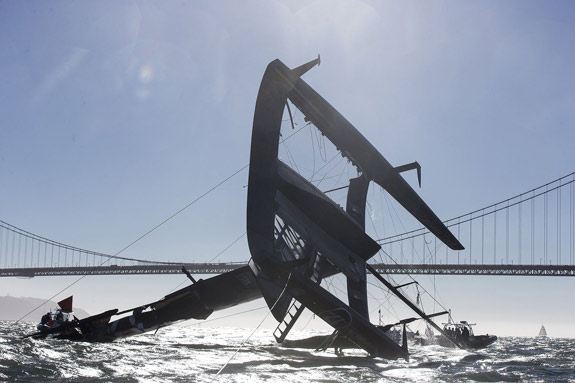
{Caption: Oct 16, 2012: Oracle Team USA's disastrous AC72 capsize; source: cupinfo.com}

This gives an idea of the size of the wingsail.

{Caption: Emirates New Zealand wing sail; source sfgate.com}

-------------

Some sources:

Kiwis Reach Record Speed in AC 72-Foot Catamaran, Associated Press, Jul 19, 2013

The Boat That Could Sink the America’s Cup by Adam Fisher, 05/09/13 on wired.com

America's Cup
on YouTube

Day 6 racing blog
SEPTEMBER 15, 2013
on americascup.com
Race 10 Performance Data

Course: 5 Legs/10.02 nautical miles
Elapsed Time: ETNZ – 22:00, OTUSA – 22:16
Delta: ETNZ +:16
Total distance sailed: ETNZ – 11.8 NM, OTUSA – 11.7 NM
Average Speed: ETNZ – 32.25 knots (37 mph), OTUSA – 31.76 knots (36 mph)
Top Speed: ETNZ – 43.01 knots (49 mph), OTUSA – 44.98 knots (52 mph)
Windspeed: Average – 18.3 knots, Peak – 22.3 knots
Number of Tacks/Jibes: ETNZ – 7/7, OTUSA – 7/7

Emirates Team New Zealand gets leg up on ORACLE TEAM USA
SEPTEMBER 7, 2013
by Sean McNeill

America's Cup: Emirates Team NZ admits AC72 can foil sailing downwind by Richard Gladwell on sail-world.com

Americas Cup Apparent Wind on nauticed.org

Apparent Wind on Americas Cup AC72's on nauticed.org

America's Cup boats use innovative design built for speed and power on latimes.com

The Sailors and Their Flying Machines, nytimes.com

THE WORLD’S FASTEST BOATS on americascup.com

wingsails on wingsails.com

America's Cup News and Information on cupinfo.com

America's Cup on YouTube

America's Cup: How hydrofoiling works in the AC72's on sail-world.com

Image Bank on americascup.com

Severe penalties for cheating Team Oracle by Duncan Johnstone, 4/9/13, on stuff.co.nz

Yet another AC34 Controversy by Adam Cort, Aug 16, 2013, on sailmagazine.com

AC34 Team Oracle Caught Cheating…Again on flyingpenguin.com

Billionaire death race: inside America's Cup and the world's most dangerous sailboat. Capsized yachts and a sailor’s death cast a pall over this week’s finals. by Casey Newton on September 3, 2013, on The Verge

Winging It: America’s Cup Racers Push the Sailboat to Its Limits by Adam Fisher, August 18, 2011, in Wired magazine

The Husky Sailors Take on America…or at least its Cup

The Lawson history of the America's cup: a record of fifty years by Winfield M. Thompson (Boston, Mass., T.W. Lawson, 1902)

Wing-Sail-tech at uconnwelcomemat.wordpress.com

AC34: The Anatomy of an AC72 by Mike Drummond, Jun 19, 2013, in Sail Magazine

AC34: How to Get Around the Racecourse by Kimball Livingston, Sail Magazine, Jun 18, 2013

Well at least the horse racing industry is recovering by Lydia DePillis, September 23, 2013, in the Washington Post

"Valkyrie's Steel Mast Will Be One Hundred and Five Feet Long and Very Light." New York Times, August 6, 1896 (filed Glascow, July 7).

Made-for-TV America’s Cup Imperils Sailors Pursuing Speed by Aaron Kuriloff, Sep 12, 2013, on bloomberg.com

AC72: Ellison's Dream Is Scariest Racing Yacht Yet on bloomberg.com

Larry Ellison's Ahab-Like Quest For The America's Cup by Daniel Fisher, on Forbes, 5/22/2013

Meet the Billionaires Behind America’s Cup by Tara Loader Wilkinson, 14 August 2013, on wealthx.com

Board of Directors, Investment Corporation of Dubai

Larry Ellison's Amazing Victory and Huge Failure by Jonathan Mahler Sep 25, 2013, on bloomberg.com

The Miracle on San Francisco Bay; Oracle Team USA’s billionaire-funded, cheat-tastic America’s Cup comeback reveals the awesome power of the inspirational sports narrative. by Josh Levin, Sept. 25, 2013, in Slate

Kiwi fans ask: 'Did Oracle cheat?' by Tom McRae, 26 Sep 2013, 3news.co.nz

America's Cup: Legal challenge not likely by Paul Lewis, Sep 26, 2013, on nzherald.co.nz

America's Cup on wikipedia

AC72 (America's Cup 72 class) on wikipedia

Sailing faster than the wind on wikipedia

Wingsail on wikipedia

Sailing hydrofoil

-------------

Note: Photos on this page are either in the public domain or are reproduced under fair use provisions of copyright law. Images link back to source and sources are explicitly named. Photos deemed to be infringing will be removed on notification to this blog's owner via comment or email.

Tuesday, May 08, 2012

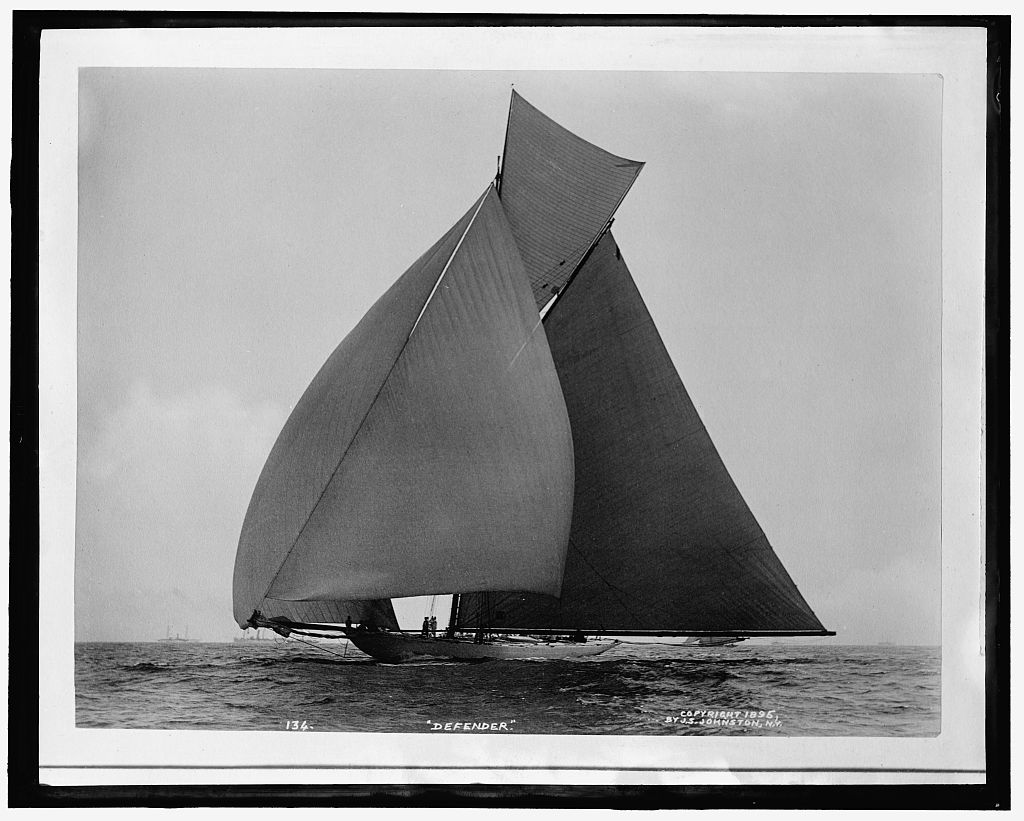
Defender

I found this image on a favorite tumblelog and I subsequently used it in a tumblr post of my own.[1]


It shows the yacht Defender and it can be found in the Detroit Publishing Company Collection of LC's Prints and Photographs Division.[2] The photographer, John S. Johnston, did a whole series on the Defender.

The caption gives the year (1895) but does not give the month or day. It does have "134" written on it and a nearby photo, number 132, shows the Defender on August 2, 1895, competing in the Goelet Cup so it's pretty near certain our photo was taken during the same race.

The yacht belonged to William Kissam Vanderbilt.[3] He was a cousin of Louis Windmuller's wife, Annie.[4] Windmuller didn't go in for yacht racing. His recreations were urban and close to home. He belonged to city clubs and supported city charities. An immigrant from Germany who never lost his German connections, he loved the city's German singing clubs and beer gardens. He was also a famous city walker and one of his last acts was to form a club of walkers. He traveled much for business, but also for pleasure, chiefly to Germany, France, England, and Italy.

Louis Windmuller had arrived in New York penniless and worked his way up to a comfortable prosperity. William Kissam Vanderbilt was born to wealthy parents and was never forced to earn a living. He did work as a manager of the family railroads but as someone learning the family business rather than in the entrepreneurial spirit of his grand- and my great-grandfather.[5] The differences between the two men were many, but the most obvious, I think, was in their choice of recreation. Where Windmuller walked, W.K.V. raced. He raced horses and he raced yachts. He founded New York's Jockey Club, owned both stables and race courses, and ran horses that won. And he was co-owner of the yacht defender.

Windmuller and his wife Annie saw only two of their six children survive to adulthood: a son and a daughter. Neither possessed the energy, cheerful optimism, and tempered ambition of their father. The son, Adolph, made a half-hearted effort to manage one of his father's enterprises (the importing firm which was Windmuller's first success) but did not stick with it and lived most of his life as a man of leisure.[6] My father, his nephew, called him a n'er do well. The daughter, Clara, was not expected to earn a living and, unlike others among her contemporaries in upper-middle-class New York, she did not attempt to make a name for herself by charity work, cultural contributions, agitation for reform, or even any sort of active participation in New York society.[7]

Somewhat late in life, Clara married a man who worked for her father. He, Julius, was a distant relative who had come from Germany with the expectation that Windmuller would put him to work. After serving in a clerical position in an organization of which Windmuller was treasurer he was, in the year following his marriage to Clara, appointed secretary-treasurer of a bank that Windmuller had helped to found and of which he was president.[8] In 1913, when his father in law died, the will was found to be not so generous to him as it was to Adolph and Julius consequently labored in the bank for the rest of his working life, eventually rising to be its manager. Once he found himself secure in his employment, he put in his bankers' hours, married his benefactor's daughter, fathered a family of four, let himself be caught with a girlfriend in the conjugal bed, and indulged in a passion for boating. The last two were actually related since he had the habit of inviting women to cruise with him from time to time.

This photo shows Julius and Clara shipboard during the first (happy) years of their marriage.

The year is 1902 or '03. He is 34 and she two years younger.

Julius was a power boat enthusiast so this photo — taken at about the same time — shows Clara on someone else's ship.


From about 1900 to about 1942 Julius owned maybe half a dozen craft, each 30- to 40 feet long, with paid skipper and crew. At the bank they called him "Commodore" (as, in similar manner, underlings had given Cornelius Vanderbilt that title) and he belonged to a number of yacht clubs including the Colonial, uptown on the Hudson near his home on Riverside Drive, and the Harlem on City Island.[9] My father once took me to the latter. The club house was rustic and in my memory its chief feature was a monumental pool table near windows overlooking the moorings.

This shows a diving demonstration at the Colonial Yacht Club in 1914 or 1915.

{Caption: Famous diver Elsie Hanneman at the Colonial Yacht Club; photo by the Bain News Service; the club was located on the small beach just below Riverside Drive on the Hudson River, roughly between 140th and 142nd Streets in Harlem; source: Library of Congress Prints and Photographs Division}

Taken at about the same time, this photo shows canoe jousting, the club, and some of the city in the background.

{Caption: Canoe Tilting at the Colonial Yacht Club, by the Bain News Service; same source }

This shows the Harlem Yacht Club in 1906. I recollect it looked much the same in the late 1950s when my father took me there.

{Caption: Harlem Yacht Club, City Island, N.Y. by the W. F. Sleight Post Card Co., Mount Vernon, N.Y., 1906; source: Long Island Historic Postcards Collection (collection 346), Special Collections and University Archives, Stony Brook University Libraries}

----------

Some sources:

The Yacht Photography of J.S. Johnston - Defender

Defender - 32nd America's Cup

Goelet Cup, New York Times, August 6, 1887

DEFENDER BREAKS DOWN; Snapped a Hollow Gaff in Goelet Cup Races, New York Times, August 2, 1895

THE GOELET CUP, New York Times, August 3, 1895

William Kissam Vanderbilt on wikipedia

"Newly-elected officers of the Colonial Y. C." in The Rudder, Volume 35 (Fawcett Publications, 1919)

Harlem Yacht Club By Evelyn Schneider, Harlem Yacht Club historian, as published in the July 2008 issue of Wind Check

Century of American savings banks, pub. under the auspices of the Savings banks association of the state of New York in commemoration of the centenary of savings banks in America (New York : B. F. Buck & company, 1917)


----------

Notes:

[1] The favorite Tumblr blog is Chemin faisant by Catherine Willis and my own is rouleur.

[2] Prints and Photographs Division of the Library of Congress

[3] W.K. Vanderbilt was co-owner.

[4] Annie and W.K. were niece and nephew-once-removed, respectively, of John Edmund Thorne. W.K.'s father, also W.K., was son of J.E.T.'s brother-in-law, Samuel Kissam. Annie was daughter of J.E.T.'s sister, Sarah Lenington Thorne. If you've patience, you can trace the connection in these genealogies: Descendants of William Thorne & Susannah Booth and Windmuller Genealogy. I've written fequently about my great-grandfather. To see posts about him, click the "Louis Windmuller" link in the list of labels in the panel at right.

[5] Up until 1903 William Kissam Vanderbilt was active in the management of the family railroads, including the New York Central. His grandfather Cornelius had owned that business and, it doesn't surprise me to find that Louis Windmuller was a shareholder. Cornelius and Louis were different in many ways, but both were energetic businessmen and managers of financial affairs. In 1865 Windmuller joined other prominent New Yorkers in petitioning the state government for relief from Civil War regulations that kept rail fares and tariffs artificially low (Evening Journal, New York, March 21, 1865). In addition to the names of Cornelius and my great-grandfather, the petition showed those of William Astor, Henry Sloane, and other prominent merchants and financiers.

[6] Louis Windmuller's first successful business was "Louis Windmuller and Roelker, commissioning agents." I've written a few posts dealing with its affairs. [7] My blog post on the wives of the forty-eighters gives some idea of what determined women could accomplish at the time. It is four notable German-American women. Even within her narrow community Annie was outshined by her close neighbors the Sussdorfs whose womenfolk founded a local Sunday school and provided support for the church to which they and the Windmullers belonged. Regarding the social whirl, the Windmuller family does appear in the Social Register but the only Windmuller parties you'll find in the newspapers of the time are privately family ones and the Windmullers are never seen out coaching or at Newport or even in connection with their socially-prominent daughter in law, Adolph's wife Carolyn Hague, known as Madam Thurn.

[8] In 1901 Windmuller made Julius secretary in the Legal Aid Society, which he had helped to found and of which he was treasurer. In 1903 Windmuller helped found the Maiden Lane Bank for Savings in the building where he had previously helped found the Maiden Lane Safe Deposit Company. Here are excerpts from an article about the bank.
At the time of the establishment of the Maiden Lane Savings Bank — 1903, under the General Banking Law — it was estimated that there were about 150,000 clerks and workingmen employed in the Jewelry District, who were all earning good wages and of whom at least 25 per cent. were living either in New Jersey or on Long Island and did not have the time to make deposits in the banks in the neighborhood where they lived. In order to give these people proper facilities for depositing their surplus earn-ings without inconvenience, it was proposed to establish a new Savings Bank in that section of the city and to keep it open for receiving deposits from 9 o'clock in the morning until 5:30 in the evening, Saturdays included. It was proposed to locate the bank in the basement of the building at the corner of Maiden Lane and Broadway, where the Maiden Lane Safe Deposit Company had their premises. ... The board of directors of the Maiden Lane Safe Deposit Company was approached with the proposition to rent space in their premises and the proposition was met in a liberal manner. ... The rapid increase in deposits is ample proof that a Savings Bank was needed in the down-town section of the Borough of Manhattan. ... First officers: Louis Windmiiller, president; J. Heynen, secretary-treasurer. -- Century of American savings banks, pub. under the auspices of the Savings banks association of the state of New York in commemoration of the centenary of savings banks in America (New York : B. F. Buck & company, 1917)

[9] In 1919 Julius was elected to the board of directors of the Colonial. SeeThe Rudder, Volume 35 (Fawcett Publications, 1919).

Wednesday, August 18, 2010

Passo di Gavia

I record sporting events to watch while I'm doing my afternoon treadmill run. These days I'm finishing a review of this year's Giro d'Italia and I've just come to Stage 20 for which the numbers are impressive. Only 110 miles long, the stage was short by Giro standards but not the less difficult since five mountains and almost 21,000 feet of climbing were packed into it. The riders crossed the highest point on the fourth of the five climbs. As is normal at that time of year — May 28th — that fourth mountain, the Passo di Gavia, was covered by many feet of snow. For most of the race the weather was windy and clouds were low, but there was no precipitation. However, conditions were so bad at the mountain finish that Italian TV was only sporadically able to provide the video images being captured by its many motorcycle- and helicopter-borne cameras.

During video outages, the race commentators showed clips of the 1988 race over the Gavia. On that memorable occasion, the riders crossed the pass in a snowstorm. Erik Breukink took the stage and Andy Hampsten rose to overall leader, having the lowest cumulative time for all stages to that point. At the end of the three-week race, Erik would end up in second place and Andy in first — the only American (or any non-European) ever to win the Giro. Andy currently divides his time between homes in Tuscany and Colorado. He leads bike tours in Tuscany and sells Hampsten-branded bikes in the US. He reports that life is good. Erik is currently manager of the Rabobank racing team and is pleased with the team's performance in major tours, though wins have been scarce.

Back in 2007, I did a blog post on Erik and Andy on the Gavia: snow, gentle and ferocious.

This photo shows Erik on that occasion:


{source: giroditalia's flickr photstream}

And this one shows Andy:


{Andy Hampsten, Passo di Gavia, 1988; source: outyourbackdoor.com}

Here's what the pass looked like this year:


{source: Giro d’Italia Stage 20 on cyclingtipsblog}

This year's race profile map gives an idea of the stage's climbs and descents.


{source: Giro home page}

This photo of part of the Gavia gives an idea what the riders face in both climbing and descending the mountain.


{source: iegestuhl-und-action.de}

Here are links to two Youtube videos from this year:

Giro 2010 Stage 20 Passo di Gavia (pt.1) on Youtube

Giro 2010 Stage 20 Passo di Gavia (pt.2) on Youtube

And here's one from 1988:

Giro d'Italia 1988, Passo di Gavia on Youtube

-----------

Some sources:

Update: Gavia Pass for Saturday on the ItalianCyclingJournal blog

Giro’10 St. 20 on Pez Cycling News

Andy’s Epic Day On The Gavia on Pez Cycling News

Gavia Pass on wikipedia

Friday, July 16, 2010

not your usual race tactic

As I mentioned the other day, Joost Posthuma rode the Tour of Austria this year rather than the Tour de France. Ă–sterreich Rundfahrt runs only a week, while La Grande Boucle runs a full three. Joost's in training these days rather than racing so, after four years of riding the TdF, he gets to watch it on TV this year. In an interview held earlier this week — posted on his website — He says he's enjoying watching the race, an experience which he finds quite strange and very unlike riding in it. To him the images on the screen make the event seem remote and much less physically and mentally taxing than it is in real life. He gives as an example the bunch sprint that often comes at the end of flat stages. On screen it looks smooth and efficient, but in the pack it's frighteningly fast and chaotic. The speed is extremely high. Riders are tired and some so spaced-out that they can't concentrate as they should.

He said this the day before Mark Renshaw was ejected from the race for head butting Julian Dean. Both were trying to set up the run to the finish line for their teams' respective top sprinters, Mark Cavendish and Tyler Farrar. They and the other lead-out men had cranked up the speed of the peloton to over 40 miles per hour (70 kph). At this speed the tiniest mistake can cause a massive crash. Renshaw accelerated to pass Dean on his left and Dean put his elbow in front of Renshaw's to counteract the move. In most sprints Renshaw would then have countered by leaning into Dean with his shoulder. In this one, Renshaw believed he couldn't use his shoulder without bringing them both down so he bumped Dean's helmet with his own. He did this three times. This image, taken from video, shows one of these head butts.


{source: 3news.co.nz}

Here's a video of the event.


Jon Brand reports that "As Renshaw hit Dean, one fan shouted, 'Zizou, Zizou,' the nickname of former French soccer star Zinedine Zidane. Zidane was famously ejected for head-butting an Italian defender during the 2006 World Cup final in Germany." (As it happens, I did a blog post or two on Zidane back then.)

As in the Zizou incident, no one was injured by Renshaw's unusual tactic.

Interviewed afterward, Dean said he was flabbergasted to get bonked on the helmet. He supported the officials' decision to send Renshaw packing. Renshaw said when Dean hooked his elbow over his own he had no choice but to use his head in order to keep his position. He said, "the object was to hold my line and stay upright."

Most of the articles I've seen say that Renshaw did wrong. They say shoulder bumping and elbowing are permitted in sprint lead outs, but not butting. It's also generally seen as ok to push with the head, but, as one coach says, a sprinter will get in trouble for using his helmet like a hammer. Others say head butts are a legitimate tactic for maintaining position. A former racer is quoted as saying "I’ve been mixed up in bunch sprints where I have been the lead out man or I have been having to sprint myself and people have head butted me. I've done it back. I've even taken my hand off to fend people off me."

Here's a smattering of news accounts.

Mark Cavendish's team-mate Mark Renshaw disqualified

Head butting is part of the cycling game

Tour de France Stage 11 turns into 'gladiator arena'

Head Butts Mar Stage Finish at Tour de France

Dean says ejection a fair punishment for head-butting rival

----------

This photo, from Joost's website, shows him on the podium after he won the time trial in the Tour of Austria last week.

Thursday, July 08, 2010

Hot Town

Heat Wave

1. From New York City in 1944.


{August 1944: Columbus Circle during heat wave. Large Coca Cola sign and thermometer registering 100 degrees on top of building next to the Mayflower Hotel, New York. Photo by Marie Hansen for Life Magazine; source: Life archive}

2. New York's tenements in 1900.


{Summer 1900: Mulberry St. in New York; Free ice by Byron (Detroit Publishing Co.); source: Library of Congress}

Detail views of this image:


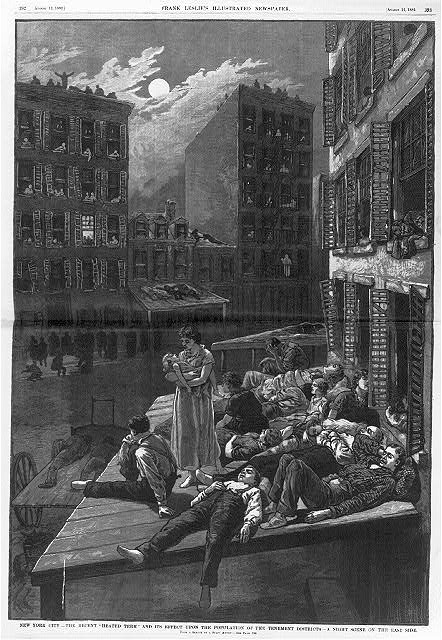
3. 1870s-'90s: Prints and drawings of residents of the New York tenements in the heat of summer from illustrated weeklies and other sources.


{August 12, 1882: New York City - The recent "heated term" and its effect upon the population of the tenement districts A night scene on the East Side / / from sketch by a staff artist. Frank Leslie's illustrated newspaper, Aug. 12, 1882, p. 393. Source: Library of Congress}


{August 1, 1885: The roof was a place to escape the heat of the summer night — "On The Roof of A Tenement House"; Harper's Weekly; source: Maggie Land Blanck's web page called New York City, Tenement Life}


{1899: Illustration from the book, The New Metropolis; source: Maggie Land Blanck's web page called New York City, Tenement Life}


{1878: Among the Tenement Houses During the Heated Term - Just Before Daybreak; Harpers Weekly; New York Public Library ID 809927; source: Maggie Land Blanck's web page called New York City, Tenement Life}

4. Summer sports: Robert Capa took this shot during the Tour de France in 1939.

{In the summer of 1939 Capa spent twenty days following the 2500 mile Tour de France. Capa followed the race on a motorbike riden by his friend. The resulting photographs were published in Match magazine. From Match magazine 27th July 1939 Tour De France. My source: fansinaflashbulb by erinbarnett}

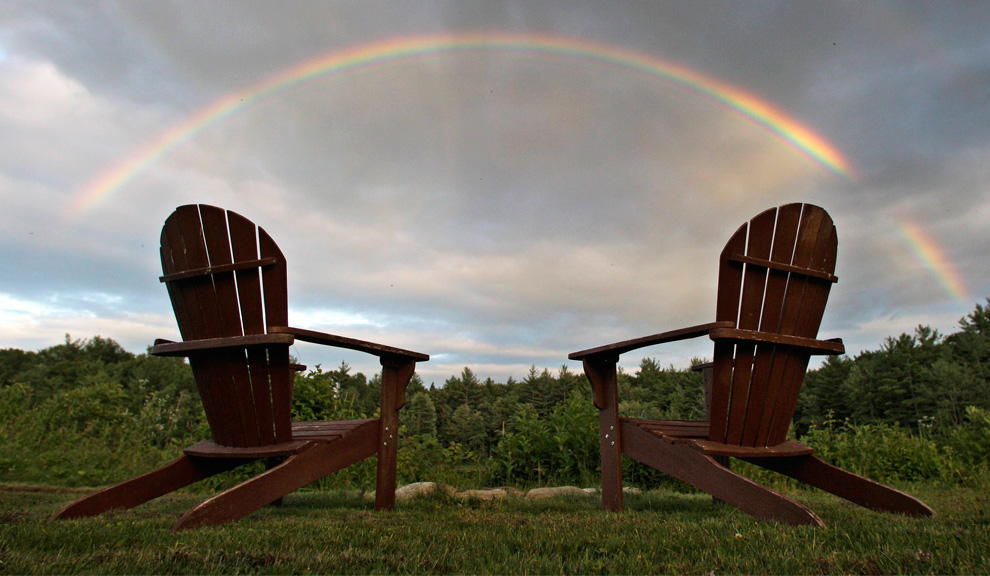
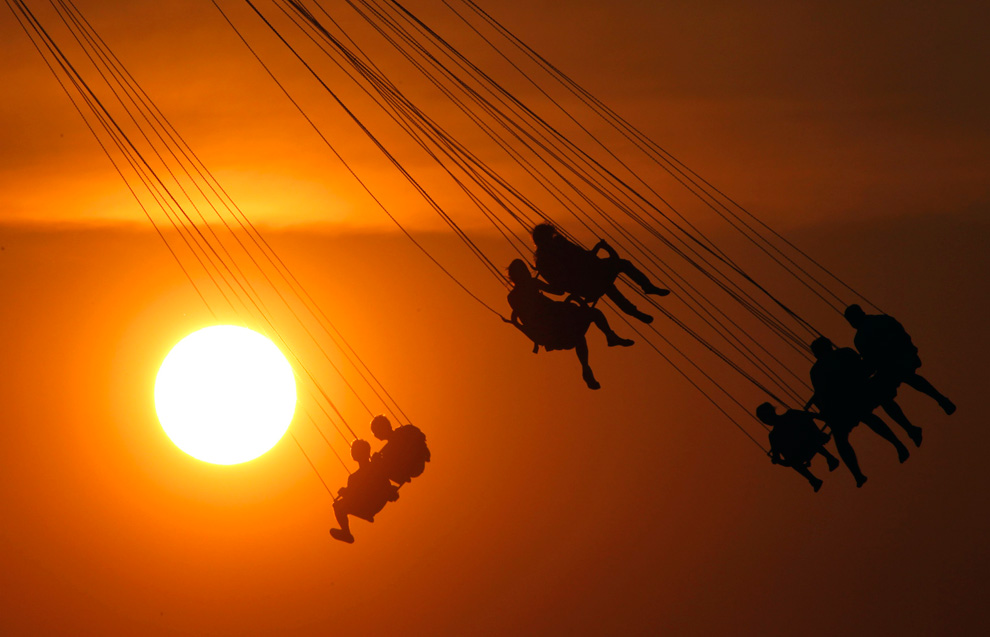
5. Some images from the ever excellent Big Picture on boston.com: Summer is here


{People cool off from the heat of the day under water sprayed from a fire engine on Independence Day in Philadelphia, Sunday, July 4, 2010. (AP Photo/Matt Rourke)}


{With two empty Adirondack chairs next to a fire pit, a rainbow stretches across the sky at Adams Pond in East Derry, New Hampshire on July 1, 2010. (AP Photo/Charles Krupa)}


{Youngsters enjoy a swing ride in an Athens amusement park at sunset in Greece on July 6, 2010. (REUTERS/Yannis Behrakis) }


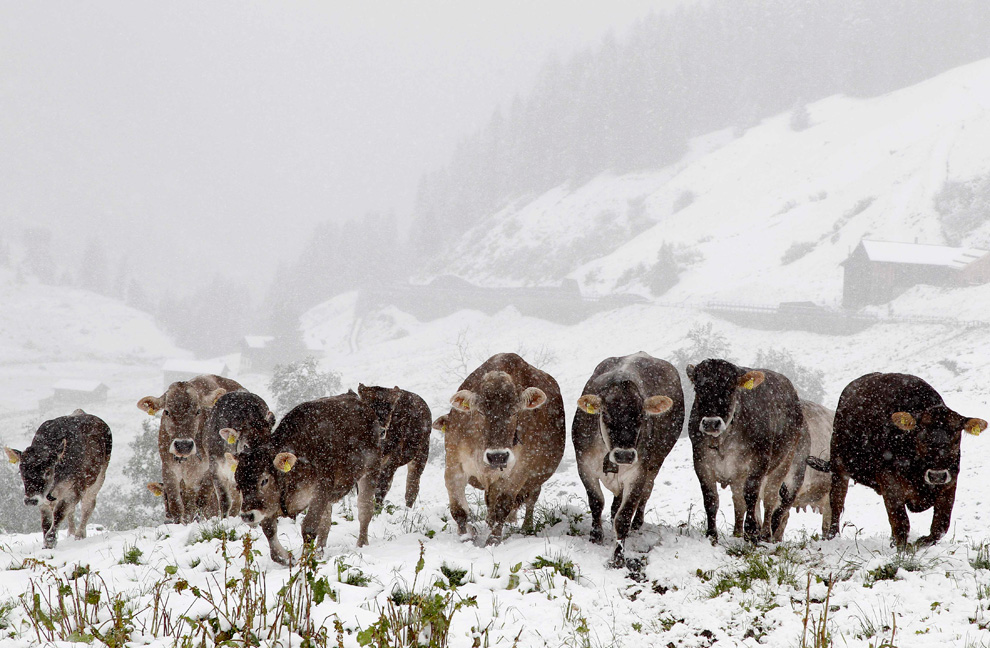
{Cows graze on a snow covered pasture at Tschuggen above Davos, Switzerland on Sunday, June 20, 2010. One day before the astronomical beginning of summer the snow line in Switzerland dropped down to 1,500 meters. (AP Photo/Keystone/Arno Balzarini)}


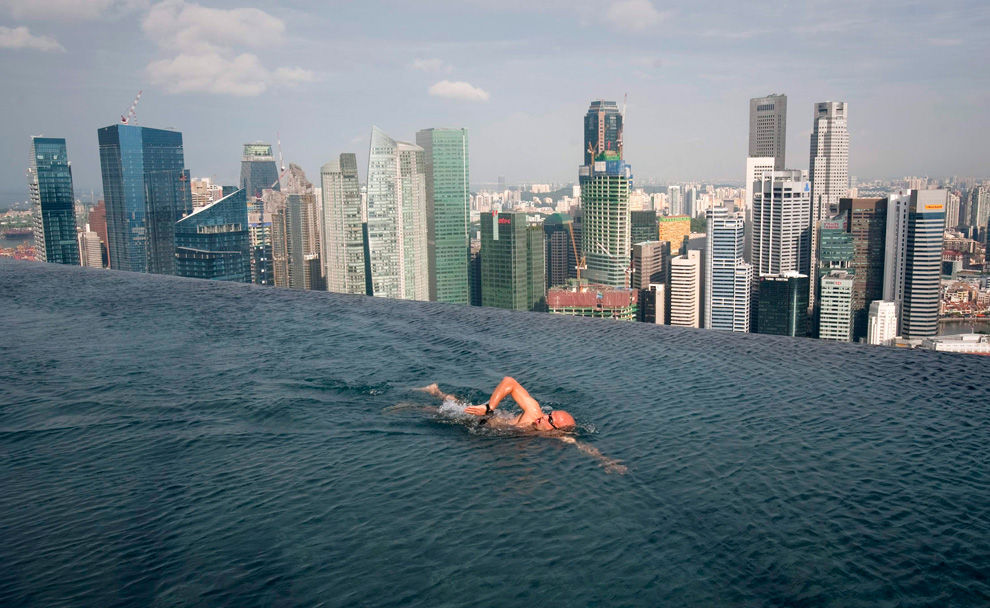
{A guest swims in the infinity pool of the Skypark that tops the Marina Bay Sands hotel towers in Singapore June 24, 2010.}

5. Some Lovin' from the Spoonful.

The Lovin' Spoonful — Summer in the City

Hot town, summer in the city
Back of my neck getting dirty and gritty
Been down, isn't it a pity
Doesn't seem to be a shadow in the city

All around, people looking half dead
Walking on the sidewalk, hotter than a match head

But at night it's a different world
Go out and find a girl
Come-on come-on and dance all night
Despite the heat it'll be alright

And babe, don't you know it's a pity
That the days can't be like the nights
In the summer, in the city

Cool town, evening in the city
Dressing so fine and looking so pretty
Cool cat, looking for a kitty
Gonna look in every corner of the city
Till I'm wheezing like a bus stop
Running up the stairs, gonna meet you on the rooftop

But at night it's a different world
Go out and find a girl
Come-on come-on and dance all night
Despite the heat it'll be alright

And babe, don't you know it's a pity
That the days can't be like the nights
In the summer, in the city

Hot town, summer in the city
Back of my neck getting dirty and gritty
Been down, isn't it a pity
Doesn't seem to be a shadow in the city

All around, people looking half dead
Walking on the sidewalk, hotter than a match head

But at night it's a different world
Go out and find a girl
Come-on come-on and dance all night
Despite the heat it'll be alright

And babe, don't you know it's a pity
That the days can't be like the nights
In the summer, in the city

Wednesday, March 24, 2010

Milan-San Remo

Milan-San Remo, the Spring classic bike race which bills itself as La Classicissima went off very well this year. At the line, Oscar Frere proved to have the right tactics and the best legs. He rides for the Rabobank squad and although the rider I follow most closely, Joost Posthuma, wasn't in this race, the result is a satisfying one. 'Tho it was the third time Oscar won, the announcers and the race cameras picked out other former winners and current favorites in the run up to the finish. I kept seeing the bright orange flash of his jersey behind or nearby the guys the photogs were watching. The replays showed both his skill in maneuvering himself into position leading up to the sprint and the enormous surge with which he pulled away from contenders.


Julian Dean's race diary blog tells a different story. Milan-San Remo is so very long and so very fast that — after a few hours of riding — racers who get shelled out the back have little hope of rejoining the front bunch. About half way through, Dean got caught up in a crash, was unable to reconnect, and lost so much time that he and another sufferer lost more than an hour on the lead group. He writes, in typical New Zealand idiom:
I was out the arse because I was going bad, now I had to keep going to the finish, hoping that at some point I might see someone coming from the finish to collect me after they finally realised I was MIA. But it didn't happen and I had to ride a miserable 100km to the finish with no fluids or food on one of the worst days I’ve had on the bike for as long as I can remember. . . .

Eventually, after almost 8 hours, I rolled into San Remo to the team bus feeling more than a little cheesed off and disillusioned as to the lack of consideration of the welfare the team has for its riders - especially for an athlete who’s struck a bad day and needs a little more support than they might need on regular occasions. What added to my frustration was that in my heart I knew I had done all I could to get back on top of my form after being crook and even though I couldn’t contribute much on this particular day, I still buried myself for the team.

Anyway that’s often what you get when you have a bad day. Unless you are running at the top of your game, professional sport can be very demoralizing and disheartening no matter how long you’ve been in it and how much stature you have. Everybody prefers to be with a winner....


{Dean at MSR on another day; source: his team's website}

A couple of days ago, a race page I follow called Cyclingnews did an article on an experience similar to Dean's from twenty-five years ago: Phinney and Kiefel recall 7-11's wild Milan-San Remo

At that time the American team, 7-Eleven, had just begun racing in Europe. They entered MSR hoping to put someone on the podium but expecting just to gain some valuable experience. Davis Phinney and Ron Kiefel were their two star riders, both successful in US races, and, eventually, in European ones as well. This day, March 16, 1985, was not to be Phinney's best. Beforehand he's given what he takes to be valuable advice to eat constantly in order to avoid running out of energy at the end — the race being so very long and hard. He fills his jersey pockets with the pannini that riders ate in those days and ate one after the other. For this, he's derided by one of the best racers of all time. As he tells it, "After about 60km Sean Kelly pulls up next to me while I'm stuffing my face. My gut is so full that my knees are banging into it while I'm pedalling. Kelly says, 'What are you doing? You're eating like a pig! You'll never make the finish like that'."

Then: "As we came into the little town before the Turchino [climb] started I was on the far right side, in the second row, and we're just flying along. There's a sharp left turn and the pack drifted a little bit wide to the point where I was pushed off the road. I went flying off the road, crashed into this chain fence separating the road from the sidewalk and dislocated my finger."

It was very cold and wet that day. Fellow team member Eric Heiden stopped to help Phinney and manages to pull the dislocated finger back to normal, but Phinney had lost steam. Heiden managed to get himself back in the race, but Phinney did not. He remembers: "Here I am at this big race, Milan-San Remo, off the back with three other knuckleheads, still riding with race numbers on. I'm dirty, wet, cold and hungry, because I have no food, and we're still a long way from San Remo. We realized that we're screwed."

Two of the four struggle on but Phinney and a Belgian rider decide to leave the course and see whether they can't hitch a ride to the finish on the nearby autostrada — a limited-access tollroad. They're stopped at the tollbooth and since neither knows the dialect which the tolltaker uses, they're near out of hope until the tolltaker finally figures out why these two bike riders are plaguing him and calls race headquarters. Phinney's team manager eventually sends a car for them. I'd love to see a photo of the two, dirty, cold, wet, hungry, dejected; standing by their bikes at the entrance to an Italian superhighway.


{Kiefel and Phinney at a warm and sunny race in Colorado a year or two before their MSR adventure; source: rbaction.net}

Sunday, March 14, 2010

Steve McQueen

I was washing the car the other day and my next door neighbor, the former fighter pilot, came over to reminisce about the muscle cars he's owned over the years. The topic brought to mind a fast bike I once owned. Not a racing bicycle, tho I've owned some, but the Triumph Bonneville I had through most of my college years.

I'd bought it from the boyfriend of my cousin Jo, my older and urbanely slender cousin Jo who was overfond of martinis. He'd bought it new and found it inconvenient to keep it in Manhattan. I myself had no storage problems.

I thought about the bike today on seeing this photo in a favorite microblog.

It shows Steve McQueen on the set of The Great Escape. He's not riding a Bonneville but a similar model, the TR6 Trophy. (I don't think anyone minded that the Trophy didn't look much like the German bikes of the '30s and '40s.)

This Bonneville is just like the one I tore around on.


McQueen was a bike racer, bike builder, and collector of old bikes. In a photo essay which Popular Science did on him in 1966 he said the Bonneville was production bike of its time for high speed and manoeuverability. In 1962 a Bonneville set a land speed record of 224.57mph. This photo, from that shoot, shows him on the one he owned.


This shot shows him on a bike he'd hybridized himself. It's a Rickman-Metisse with a BSA fork-crown, Ceriani forks, and many customizations.


The article gives a helpful table comparing the bikes in the test.


Here are some stills from the movie.

One of the movie's most memorable scenes shows this trick. For insurance reasons the film studio forbid McQueen to do it himself. Instead it was performed by his friend the stuntman Bud Ekins.


The wikipedia article on McQueen says "According to the commentary track on The Great Escape DVD, it was difficult to find riders as skilled as McQueen. At one point, due to clever editing, McQueen is seen in a German uniform chasing himself on another bike."


{These shots come from IMDB}

McQueen's biography makes interesting reading. He got himself into and out of trouble while struggling to grow up under trying circumstances. As a kid he was a thief and gang member who took punishment again and again for his major aversion to following anyone's rules. Bounced from household to household by his turbulent and troubled family, he survived stints in reform school, the merchant marine, and the US Marine Corps, ending up a bonafide and decorated hero for saving the lives of other Marines by pulling them from a tank that was sinking into the Arctic Ocean. Pretty much fearless and highly skilled in racing cars and motorcycles, he subsequently supported himself partly by competing in weekend motorcycle races and was able to buy his first motorcycle with his winnings.

This wikipedia photo is a mugshot taken following a DWI arrest in Anchorage, Alaska, 1972.


For more on Bonnevilles, see:

Significant Motorcycles in Triumph History

Triumph Bonneville by Soren Winslow

Triumph Bonneville wikipedia article

----
{Note: I've reproduced photos on this page under fair use provisions of US copyright law. Let me know if you'd like me to remove any shots that belong to you.}