Showing posts with label morality. Show all posts

Saturday, May 28, 2011

you who know nothing of the works of God

I'm reading a book called How to live, or, a life of Montaigne: in one question and twenty attempts at an answer. Its author, Sarah Bakewell, does a good job of showing the man's life through his written works. She writes about the tower chamber where he thought and wrote and describes the ceiling joists on which he inscribed Biblical and classical quotations that he wanted to keep in mind.

As it happens, there's currently another well-reviewed book that covers much the same ground — When I Am Playing with My Cat, How Do I Know That She Is Not Playing with Me? — and its author, Saul Frampton, quotes a few of these Sentences de la «librairie», as the French call them. One of them Frampton renders as "You who do not know how the mind is joined to the body know nothing of the works of God."

This, in its aphoristic certitude, reminds me of the ersatz Carl Jung quote I wrote about the other day ("Until you make the unconscious conscious, it will direct your life and you will call it fate"). However, unlike the one credited to Jung, the quote Frampton gives us has an exact source. Frampton's comes from Montaigne's Latin: "SICVT IGNORAS QVOMODO ANIMA CONIVNGATVR CORPORI SIC NESCIS OPERA DEI" which in turn comes from a statement in Ecclesiastes.[1] Others have rendered Montaigne's Latin into English somewhat differently than Frampton does, but all the translations have the same sense: if you don't know how the mind (or soul) is joined to (or united with) the body, you know nothing of God's works.[2]

Montaigne, it emerges, was paraphrasing his source. The text he drew upon — eleventh verse, fifth line of Ecclesiastes — is all about fate intervening in the affairs of humankind, of one's inability to read the future, and, specifically in this line, what is present but not visible. It reads, in the Vulgate, "quomodo ignoras quae sit via spiritus et qua ratione conpingantur ossa in ventre praegnatis sic nescis opera Dei qui fabricator est omnium." Even not knowing Latin you can tell this is quite different from Montaigne's joist inscription. We've "spritus" instead of "anima" and a whole extra clause about "ossa" and "ventre praegnais" not to mention a replacement of "sicut" with "quomodo" as the intro word.

As with all Biblical texts, there are plenty of English versions of this passage. The New American Standard Bible gives: "Just as you do not know the path of the wind and how bones are formed in the womb of the pregnant woman, so you do not know the activity of God who makes all things." This is somewhat clunky but also pretty close to Young's Literal Translation: "As thou knowest not what is the way of the spirit, How -- bones in the womb of the full one, So thou knowest not the work of God who maketh the whole." In contrast, the KJV has "As thou knowest not what is the way of the spirit, nor how the bones do grow in the womb of her that is with child: even so thou knowest not the works of God who maketh all." Word for word, the Hebrew text reads: "who not know how long the path of the wind bones the womb of the pregnant so not know the activity of God who makes all."[3]

We do not know why Montaigne made the change or what it meant to him. Frampton says there was an earlier inscription beneath the one he paraphrased from Ecclesiastes. The earlier one came from Lucretius: "There is no new pleasure to be gained by living longer."[4] Frampton believes that in overwriting Lucretius with Ecclesiastes Montaigne "shifted from the philosophy of death to the philosophy of life; from being not afraid to die to being not afraid to live." Whether literally factual or not, this statement is consistent with Montaigne's shifting viewpoints as viewed through his writings.

I can't find that Frampton or the (very many) other students of Montaigne's writings take up his paraphrasing Ecclesiastes as he does, but I am nonetheless interested in what he's done. I like the way Montaigne has taken a fairly routine statement of God's unknowable majesty (much like the one that God forced on Job about which I've previously written) and twisted it into a somewhat more profound philosophic challenge. The end result is a surprisingly concise statement of religious certitude: there are things, like the interaction of mind and body, about which we know practically nothing and about which, quite likely, we never will know very much. These areas of ignorance are the space occupied by religion in human societies. Using many more words, Spinoza in the 17th century and more than a few thinkers in succeeding centuries have said much the same thing.[5]

So, again, side by side: the Jungian challenge that Jung seems not to have uttered: "Until you make the unconscious conscious, it will direct your life and you will call it fate" and the Biblical challenge as poetically reinterpreted by Montaigne: "You who do not know how the mind is joined to the body know nothing of the works of God."

Portrait of Michel de Montaigne, date and artist unknown

{source: wikipedia}

Le Château de Montaigne (ca. 1890). The château burned in 1885 and later restored. The library was damaged by the fire but not destroyed.

{source: wikipedia}

A closer view of the tower.

{source: firstknownwhenlost blog}

Diagram of the ceiling beams.

{source: philo5 blog}

A closer view of part of the beams

{source: citations-latines-et-grecques-gravées-au-plafond-de-la-librairie-de-montaigne-source-cliquez-sur-l-imagepersonae.jimdo.com}

----------------

Some sources:

A Catalog of Montaigne’s Beam Inscriptions

Montaigne avait fait peindre sur les poutres du plafond de sa tour des sentences grecques et latines.

As Sentenças pintadas nas vigas da “librairie” de Montaigne publicadas em 1861 e 1894 (pdf)

The Man Within, Why Montaigne is worth knowing, a review by Liam Julian, in the Weekly Standard, May 30, 2011, Vol. 16, No. 35. The book reviewed is When I Am Playing with My Cat, How Do I Know That
She Is Not Playing with Me? Montaigne and Being in Touch with Life by Saul Frampton (Pantheon, 2011)

Two Books on Montaigne: review by Nicholas Shakespeare in the Telegraph (UK) February 14 2011, reviewing Frampton and What Do I Know? by Paul Kent (Beautiful Books, 2011)

Biblos.com: Search, Read, Study the Bible in Many Languages also known as ScriptureText.com Multilingual Bible

Montaigne les sentences de sa librairie

When I Am Playing with My Cat, How Do I Know That She Is Not Playing with Me?
Saul Frampton (Random House Digital, Inc., 2011)

Montaigne avait fait peindre sur les poutres du plafond de sa tour des sentences grecques et latines.

Studies in Montaigne by Grace Norton (The Macmillan company, 1904)

Ecclesiastes 11:5 on the biblegateway web site

LES SENTENCES - DE MONTAIGNE

Montaigne les sentences de sa librairie

Sentences de la «librairie» par Michel de Montaigne

De rerum natura Titus Lucretius Carus, 97 - 55 a. Chr. n.

Mezentius the Epicurean by Leah Kronenberg (Transactions of the American Philological Association, Volume 135, Number 2, Autumn 2005)

-----

Notes:

[1] Others render this differently. An earlier author, Grace Norton, tells us that the inscription is much obliterated and thus the exact text is thus somewhat in doubt. She renders it as "Quare ignoras quomodo anima conjungitur corpori, nescis opera Dei." -- Studies in Montaigne by Grace Norton (The Macmillan company, 1904)

[2] Here are four other renderings of the Latin into English:
  • "You who do not know how the soul embraces the body, you know nothing of God's works." -- Montaigne les sentences de sa librairie
  • "You who know nothing of how the soul marries the body, you therefore know nothing of God's works."
  • "Since you do not know how the soul is united to the body, you do not know God's work." -- LES SENTENCES
  • "You who know nothing of how the soul marries the body, you therefore know nothing of God's works."
[3] I like the comparative texts given on the Biblos site, but there are quite a few others to choose from (see ScriptureText.com Multilingual Bible).

[4] Lucretius wrote: "nec nova vivendo procuditur ulla voluptas" which is probably closer to "nor is any new pleasure forged by living" than the translation Frampton gives, but the sense is the same: there's no assured pleasure in prolonging life merely for the sake of living. (See Mezentius the Epicurean by Leah Kronenberg (Transactions of the American Philological Association, Volume 135, Number 2, Autumn 2005)

[5] For Spinoza, the mind is "a certain modification of the divine intelligence" companion to and not separate from the body. He says mind and body are made up of the same elemental substance. They are different aspects of the same being and that being is God. (See for example descartes and spinoza, mind and body: the problem of interaction by Daniel Siksay

Thursday, April 14, 2011

insufflation

Hannah Arendt opposed autocratic government in her homeland, left Europe to escape imprisonment, arrived in New York without resources, ignorant of the language, lacking skills that would provide her with a good income, and forced to make the best of a bad situation. Her experiences parallel the men who emigrated to New York following the failure of the German Revolutions of 1848. America in the latter half of the 19th century was generally kind to its German immigrants and the Forty-Eighters — the five whose lives I've described — flourished.[1] Like her, they were well-educated and highly articulate. They found it easy to write, but, for the most part, did not take up writing as their main occupation. Like her, they remained true to their early beliefs and were active in their new country as progressives. They opposed political corruption and advocated reforms to correct the many injustices suffered by people less fortunate than themselves. Like her, they

-- were (again for the most part) adamantly independent in thought as well as political affiliation,
-- understood the central place of cultural institutions in civic life,
-- found New York to be a congenial place to live.
Like her, as young immigrants, they set out to establish themselves during a time when a clash of opposing ideologies produced horrible battlefield slaughter and dislocation of millions of destitute people. The Forty-Eighters saw the beginning of class-based political struggles which continued in Arendt's lifetime.

Yet she was much unlike them. The Forty-Eighters knew poetry and revered the famous poets, but were not themselves poetical, showed no inclination to put in words what the great poems meant to them. They were practical thinkers, not, as she was, a passionate one. They were all socially prominent, active in politics and deeply involved in numerous business ventures; they all became sufficiently well-to-do as to be able to enjoy leisure. They traveled widely. They often used their influence to advance their own interests, but, as often, what they did benefitted others without much benefitting themselves. Their paths to prosperity were hardly smooth ones — there were panics, there were attempts by competitors to impoverish them; there were temptations, to which they sometimes succumbed, to squander their savings on foolhearty ventures, and there were times when even government agents conspired against them. Nonetheless they were able to attain modest wealth, or better, and were disposed to use their leisure to advance worthy causes.

Although she mixed freely in the world of the New York intelligentsia, Arendt wasn't a clubby person. You can't picture her in your mind's eye singing gay German songs over frothy steins. It's hard to imagine banquets being given in her honor by her close friends, complete with lengthy tributes given as toasts by prominent guests. The Forty-Eighters enjoyed eating and drinking together and they did give one another such large scale social events. They spent Sunday afternoons roistering in New York's German beer gardens. The sang in weekly gatherings of Liederkranz. They enjoyed their lunches and dinners in the city's restaurants and clubs.[2]

More significantly, the Forty-Eighters could not have imagined the transformation of a repressive form of government they knew and loathed — conservative autocracy — into a radical new and far worse one — totalitarianism — with fundamentally perverted moral values. And, much less, they could not foresee the uncountable murders committed by the totalitarian regimes of Hitler, Stalin, Pol Pot, Mao, and others.

Arendt was a political philosopher. She studied public persona and power relationships in societies and nations. As a political theorist she would not have been expected to show a deep interest in literature and it therefore it may seem a bit odd that she loved poetry. Political theory concerns itself with the power relationships, governance, and the conflicts of people in class, tribal, and cultural groupings, and poetry is a form of literature which is often taken to be personal, private, and free of at least external factiousness. All the same she revered the famous poets and worked hard to put into words what it was that makes their best work penetrate your waking and sleeping existences, give you shivers, cause you to stop and think, stop and feel deeply emotions that seem to have, and perhaps really do have, elemental authenticity.

She became friends with W.H. Auden, deeply read his poetry, and, on his death, wrote feelingly about the man and his worth.

There seems much that separates Arendt and Auden — woman and man, German Jewish pariah and English Anglican member of a conforming middle class, theorist and poet — yet they had much in common. They were both well educated, both immigrants from societies that had become alien to them, both secularized but paradoxically deeply religious, and both outsiders at odds with dominant social norms.

Both felt strongly, as Arendt put it, "the grimness of the present," burdened as it is both with the atrocities of the past and with a future which could as easily be worse as better.[3] Yet neither was pessimistic. When Auden died, Arendt wrote that his power as a poet came from his capacity to express his assent to life in the present, this grim present. She wrote of his capacity to sing a "praise that pitches itself against all that is most unsatisfactory in man's condition on this earth and sucks its strength out of the wound"[4] She shared this capacity. As early as 1929, in her Ph.D. thesis, she wrote about expressing gratitude for the gift of life, however miserable be this existence. The writing is a complex analysis of St. Augustine's consideration of the many forms of love: Godly, carnal, charitable, self-regarding, ... and ways in which a certain kind of love, caritas, permits a person to be unworldly pure and still fully participate in the world's chaotic disturbances. This concept of love requires facing up to reality and acknowledging one's own faults and the world's. It is not a passive giving in, but active and engaged.[5]

Arendt and Auden sought to show this unifying love in their own work. Auden expressed the idea more than once, but probably most succinctly in the need to "make a vineyard of the curse." The line appears in his poem In Memory of W. B. Yeats. In it, addressing Yeats and invoking his own powers and those of all great poets, Auden asks the poet:
With your unconstraining voice
Still persuade us to rejoice;

With the farming of a verse
Make a vineyard of the curse...[6]
Arendt copied out this poem when preparing notes for her essay on Auden at the time of his death. Of the last couplet — "In the prison of his days / Teach the free man how to praise." — she said "Praise is the key-word of these lines, not praise of 'the best of all possible worlds' — as though it were up to the poet (or the philosopher) to justify God's creation &mdash but praise that pitches itself against all that is most unsatisfactory in man's condition on this earth..."[7]

In a note card she typed while preparing her remembrance of Auden, Arendt seems to have acknowledged that this love that is expressed as holy praise is elusive and the poet or philosopher who sings this praise — who can "bless what there is for being" — is, paradoxically, no less a mortal soul than any other. The card quotes without comment Auden's famous line: "Poetry makes nothing happen." In the essay she helps us understand this line by quoting Auden's statement that "mad Ireland hurt [Yeats] into poetry" and reflecting it back on Auden — he also was hurt into poetry.

The same card quotes a phrase Auden used to express an immanent God, present but elusive, easily misperceived or not perceived at all. The phrase is "At his holy insufflation" and she adds one that follows about a "bubble-headed creature" whose sense of identity with holiness screens him off from elbow-jostling men and women in the streets and roads.[8] Auden reminds the reader that God chose man as receptical for the grace of the Holy Spirit. He asks what if God had chosen some other creature; have you ever considered what might be the result? Arendt knew and saw that Auden knew as well, that what I'm calling holy praise could not be simply willed into existence, not attained by training or right living. There is something more needed — a facing up to, and even praising an awkward and frequently unspeakably ugly reality — but how to do that they do not say.

These note cards by Hannah Arendt can be found in the The Hannah Arendt Papers at the Library of Congress


"At his holy insufflation"


----------


{Auden in 1939 by Carl Van Vechten; source: wikipedia}


{Hannah Arendt, German Postage Stamp of 1988; source: wikipedia}

---------

Some sources:

Reflections on literature and culture by Hannah Arendt, edited by Susannah Young-ah Gottlieb (Stanford University Press, 2007).

Love and Saint Augustine by Hannah Arendt (University of Chicago Press, 1996) an edited version of the thesis Arendt wrote under Karl Jaspers in 1929.

Love and Saint Augustine reviewed by George McKenna

What St. Augustine Taught Hannah Arendt about “how to live in the world”: Caritas, Natality and the Banality of Evil by Joanna Vecchiarelli Scott (pdf)

"Reflection on the Right to Will": Auden's "Canzone"and Arendt's Notes on Willing by Susannah Young-Ah Gottlieb

"Reflection on the Right to Will": Auden's "Canzone" and Arendt's Notes on Willing
Author(s): Susannah Young-Ah Gottlieb
Source: Comparative Literature, Vol. 53, No. 2 (Spring, 2001), pp. 131-150
Published by: Duke University Press on behalf of the University of Oregon
Stable URL: http://www.jstor.org/stable/3593505.

The Origins of Totalitarianism by Hannah Arendt, Preface to the First Edition

The origins of totalitarianism by Hannah Arendt (Houghton Mifflin Harcourt, 1994)

Wonder and Gratitude in the Thought of Arendt by Richard J. Gill

"Thinking What We Are Doing," a review of Hannah Arendt's The Human Condition, by W.H. Auden, in A company of readers: uncollected writings of W.H. Auden, Jacques Barzun, and Lionel Trilling edited by Arthur Krystal

In Memory of W. B. Yeats by W.H. Auden

The Hannah Arendt Papers at the Library of Congress

The Cambridge companion to W.H. Auden edited by Stan Smith (Cambridge University Press, 2004)

W. H. AUDEN: FROM MYTH TO PARABLE by Edward Mendelson

Selected poems by W.H. Auden (Vintage, 2007)

---------

Notes:

[1] My great-grandfather was one of the five Forty-Eighters. I've written frequently about his life in New York. See, for example, this post: an obituary. I've also made a family history web page that takes its focus from life: Louis Windmuller and Family. Here are links to three posts about the four other Forty-Eighters and one about their wives: The four men were Carl Schurz, Henry Villard, Abraham Jacobi and Oswald Ottendorfer.

[2] There are lots of sources attesting to this love of communal eating, drinking, and speechifying. See for example: Banquet to the Honorable Carl Schurz, Banquet in Honor of Dr. Jacobi, Annual banquet, of the New York Chamber of Commerce, Herr Windmuller Confesses, and Club men of New York: their occupations, and business and home addresses: sketches of each of the organizations: college alumni associations (Republic Press, 1893).

[3] From the introduction to the first edition of The Origins of Totalitarianism: "We can no longer afford to take that which was good in the past and simply call it our heritage, to discard the bad and simply think of it as a dead load which by itself time will bury in oblivion. The subterranean stream of Western history has finally come to the surface and usurped the dignity of our tradition. This is the reality in which we live. And this is why all efforts to escape from the grimness of the present into nostalgia for a still intact past, or into the anticipated oblivion of a better future, are vain."

[4] "Remembering Wystan H. Auden, Who Died in the Night of the Twenty-eighth of September, 1973," in Reflections on literature and culture by Hannah Arendt, edited and with an Introduction by Susannah Young-ah Gottlieb

[5] She puts forth this argument in her Ph.D. thesis of 1929, Love and Saint Augustine by Hannah Arendt (University of Chicago Press, 1996) an edited version of the thesis Arendt wrote under Karl Jaspers in 1929.

[6] The extract is from In Memory of W. B. Yeats by W.H. Auden

[7] Same source as note 4.

[8] The phrases come from Auden's poem "Bucolics, I Winds (for Alex Leger)". Here is the context:
That Pliocene Friday when,
At His Holy insufflation
(Had He picked a teleost
Or an arthropod to inspire,
Would our death also have come?)
One bubble-brained creature said:--
‘I am loved, therefore I am’--:
And well by now might the lion
Be lying down with the kid,
Had he stuck to that logic.
-- Selected poems by W.H. Auden (Vintage, 2007)
I had to look up the word insufflation, it's a pumping of air into an orifice or a breathing in. OED gives this quote: "With the insufflation of his soul, Adam received also the grace of the Holy Spirit." (J. W. Burgon in Fortn. Rev. Apr. 593, 1887).

Monday, January 12, 2009

Walter, Hannah

This is the post which I said I might write about the intersected lives of Hannah Arendt and Walter Benjamin. In 1933 they became friends in Paris having both fled Germany to escape Nazi persecution. I've been trying to imagine them at that time, in that place, circumstanced as they were. And I've been failing. She was 27, he 41. She was plucky and outgoing, he more cautious and fearful. There was no stability in their lives, no predictability, no scope for plans of any substantial duration. They lived moment-to-moment and mere survival was their main objective. Yet there were opportunities. They were served by what optimism they could each muster regarding their ability to survive. They came to understand that one of their most important duties to themselves was to nurture tight bonds with widely-separated friends, to help friends and to call upon friends for help. Their lives sound romantic, adventurous, full of possibilities for the remaking their world out of the debris created by its collapse. But having to flee to survive, having to exist in poverty, being stateless, homeless, and subject to an immensely powerful, viscious, and implacably evil enemy, all these things lack any element of gratification.

Hannah Arendt and Walter Benjamin became friends in that wartime Paris of 1933. They remained close until 1940 when, believing he was about to be captured by the Gestapo, he killed himself. The death brought Arendt closer to Benjamin's great friend Gershom Scholem. Subsequently, the two exchanged letters, mostly about him, until their falling out in 1963 over Arendt's treatment of the Eichmann trial in Jerusalem. I recently wrote something about an article Benjamin on aura in art and something about Arendt's conception of evil.

Arendt and Benjamin had much in common. Both were determined individualists and neither's lasting significance or accomplishments can be summarized in only a few words. Both understood the immense destructive potential of the modern nation state. Both believed that subject peoples (whether defined by enthnicity, religion, culture, or class) were fundamentally at risk unless they had means of defending themselves. Both believed that the Jewish people should not form a state of their own, but that they should work to set up federal structures in which groups could live together in harmony.*

And both rejected the self-confident materialism of their parents' milieu. They rebelled against the whole generation of German Jews represented by their parents, with their assertion of class-superiority among lesser Jews and their blindness to the deeply rooted antisemitism of the Christian culture in which they lived.

There are many lesser common threads in the lives of Hannah Arendt and Walter Benjamin. He was quite a bit older than she, but they were both secular, assimilated, German Jews, both born to families having substantial means, both urban, both highly educated. They were both members of the European intelligentsia and were both articulate, creative, and highly individualistic. Both suffered from the obscene antisemitism which the Nazi's brought out in the German people. Both were incarcerated for being Jews and managed to escape. Both confronted the Zionism of their times and both developed beliefs that were political and cultural rather than religious. Both confronted Marxism and, undogmatically, neither joined the Communist Party, but both had proletarian sympathies, were anti-capitalist, and both gave serious consideration to the possibility that Marxist theory might offer a solution to the impasses of European politics (though benjamin's thought aligned with Marxism much more closely than Arendt's).

Both endured periods of hand-to-mouth existence. Both were theorists. Both worked to help young people. Both hated clichés. Both had lovers and spouses. Both were great talkers who loved impassioned conversation.

As friends they supported one another. Arendt, for example, tried to help Benjamin in 1939 when he, despondent and eager to leave occupied Paris, needed contacts in safer places.

Their similarities are somewhat clarified by seeing how they differed from their common friend Scholem. He had been born in the same circumstances -- substantial, assimilated, secular, urban, German, and Jewish. But, unlike Arendt and Benjamin, his rebellion against crude materialism and fruitless attempts at a true assimilation led him to a deep commitment to the Jewish faith. Where they stayed secular, worldly, deeply skeptical about the irrationalities of religious belief, he became a mystic and, ultimately, a celebrated professor of Judaism at the university in Jerusalem.

There were also differences between the two. For example, he was morose, she outgoing. His work was as a student of culture, hers as a student of politics.

Their biographies are worth reading. I've listed some sources below.


{Benjamin in Paris, around 1938; from a web page about an opera that includes him as a character}


{Working in the in the bibliothèque national, 1939; source: isgreaterthan.net}


{Arendt in Paris in the mid-1930's, by Algosobre Vestibular}


{An affidavit used in lieu of passport. As stateless persons neither Arendt nor Benjamin could travel without some form of documentation and this (which was hers) is an example. Source: LC Manuscripts Division}


{Introduction to the third edition of Origins of Totalitarianism Typescript with author's alterations from the LC Manuscript Div}


some of my sources:

Walter Benjamin, By Gershom Gerhard Scholem, Gershom Scholem, Lee Siegel, Harry Zohn

Hannah Arendt at Jewish Virtual Library.

A Question of Justice, on Arendt, at the Malaspina modern lit site.

ZION’S REBEL DAUGHTER in New Left Review.

Hannah Arendt and Heinrich Blücher at Louis Proyect's blog.

Hannah Arendt (1906-1975) at Kirjasto.Sci.Fi a literary calendar site.

Encyclopedia of World Biography on Walter Benjamin.

Benjamin Chronology (pdf)

Walter Benjamin: The Story of a Friendship by Gershom Scholem.

Walter Benjamin: the Story of a Friendship, review by Mike Mosher of the book by Gershom Scholem.

Gerschom Scholem by Sharon Naveh.

Illuminations: Essays and Reflections, by Walter Benjamin.

The Correspondence of Walter Benjamin, 1910-1940, Translated , edited, and annotated by Manfred R. Jacobson and Evelyn M. Jacobson.

‘I merely belong to them’, Judith Butler's LRB review.

---------------------
Note
* The ideal of a federation of peoples was fairly widely held from the end of the 19th century through the early 1950's. It began with a statement of principles from the Social Democratic Party in Austria, became a more widely held position in the aftermath of World War I, and was resurrected by Arendt in criticising plans for the establishment of a Jewish nation-state in Palestine.

Judith Butler explains Arendt's thought on the subject in a review of The Jewish Writings in LRB, May 10, 2007:
In the late 1930s and early 1940s, Arendt thought that the Jews might become a nation among nations, part of a federated Europe; she imagined that all the European nations that were struggling against Fascism could ally with one another, and that the Jews might have their own army that would fight against Fascism alongside other European armies. She argued then for a nation without territory, a nation that makes sense only in a federated form, that would be, by definition, a constitutive part of a plurality. Later she would prefer the proposal of a federated Jewish-Arab state to the established notion that the state of Israel should be based on principles of Jewish sovereignty. ... If the nation-state relies on nationalism and invariably produces massive numbers of stateless people, it clearly needs to be opposed. ... The polity she comes to imagine, however briefly, is something other than the nation-state: a federation that diffuses both claims of national sovereignty and the ontology of individualism. In her critique of Fascism as well as in her scepticism towards Zionism, she clearly opposes those disparate forms of the nation-state that rely on nationalism and create massive statelessness and destitution. Paradoxically, and perhaps shrewdly, the terms in which Arendt criticised Fascism came to inform her criticisms of Zionism, though she did not and would not conflate the two.
- ‘I merely belong to them’
See also:

The Reluctant Modernism of Hannah Arendt, by Seyla Benhabib:
Arendt distinguishes the grand French idea of the "sovereignty of the people" from "the nationalist claims of autarchical existence." The sovereignty of the people refers to the democratic self-organization and political will of a group of people, who may or may not be members of the same nationality, to constitute themselves as a self-governing and self-regulating body politic. Through such acts of sovereignty, as a nation of citizens, as opposed to a nation of ethnic affiliation.
- The Reluctant Modernism of Hannah Arendt
Regarding the proposal by the Austrian Social Democrats, see the wikipedia article on Austromarxism:
Austromarxism was a Marxist theoretical current, led by Victor Adler, Otto Bauer, Karl Renner and Max Adler, members of the Social Democratic Workers' Party of Austria during the late decades of the Austro-Hungarian Monarchy and the First Austrian Republic (1918-1934). It is known for its theory of nationality and nationalism, and its attempt to conciliate it with socialism in the imperial context. Hence, Otto Bauer thought of the "personal principle" as a way of gathering the geographically divided members of the same nation. In Social Democracy and the Nationalities Question (1907), he wrote that "The personal principle wants to organize nations not in territorial bodies but in simple association of persons.", thus radically disjoining the nation from the territory and making of the nation a non-territorial association.
- Austromarxism
And a 1935 article by the Spanish Communist revolutionary, Andrés Nin:
The nation is a “personal association”. The complexity of present day economic relationships and the ease of communications encourage constant migration within multi-national States, with the result that those who leave their native land are considered foreigners and receive worse legal treatment. “No nation can be confined to pre-determined limits.” Therefore the principle of nationalities is fundamentally anti-national.

According to Renner, a solution will be found through a “personal”, not a territorial principle. “Nations should organise, not according to territorial units but as associations of persons, not as States but as peoples ...” “Naturally, as a people cannot exist without territory, the local population must be able to influence the administration. If that is organised on the basis of the personal principle, a territorial organisation will be a useful coordinator which will allow nationalities to be identified and help isolated people to join the relevant group.” The Nation State is adequate in situations where there are few internal national conflicts, but if applied in Austria it would cause problems and ultimately break up the State. Everything will be for the best, as in the best possible world, if the territorial principle is replaced by the panacea of a complicated system of “judicial” and “cultural” institutions.

People of the same nationality, living in a given area within the State, outside their own territory, will form a “national Community”, that is a “Corporation with its own public and private law, with capital and the power to make laws and raise taxes”. A given number of communities, linked territorially and culturally will form a district with similar corporate rights. “Those districts combined constitute the nation, that is a legal person in public and private law.”
- Austro-Marxism and the National Question, Andrés Nin, 1935

Friday, January 09, 2009

a home of mine that my neighbor respects

Denis Dutton's Arts and Letters Daily always contains something that interests. The other day he pointed to Adam Kirsch's New Yorker profile of Hannah Arendt and drew attention not, as I did, to the personal flaws which Kirsch says kept Arendt from any effective "confrontation with political evil, especially the evil of the Holocaust," but rather to Kirsch's comment that Arendt is "still a thinker for our time, ... a time when failed states have again and again become the settings for mass murder."

I like the way this statement draws attention to an oddity in Kirsch's argument.

Kirsch says Arendt kept an aristocratic disdain which made her unable to sympathize with, he says to love, people in any collective sense. He says this aloofness led her to believe that, in his words, "our love for the world actually makes it harder for us to love the people who inhabit it." This rings true as a trait of Arendt's, but the statement seems to me less than profound since it's true as well of other political theorists and public intellectuals both of her own generation and of ones that came before. Kirsch says Arendt's "rejection of inwardness" is key to appreciating the value of her work but he also says that it makes her legacy "questionable." Myself, I believe conscious separation of the personal from the public in her life and work shows a strength that she shares with her peers in the philosophic community. She and they recognize that while objectivity is unattainable, a person should try to create conditions which favor its possibility and to suppress conditions which are likely to prevent it.

Were she alive, Arendt, I believe, would have responded to Kirsch by saying that authentic love of people in any collective sense is nonsensical. During the avalanche of criticism that followed the publication of Eichmann in Jerusalem, Arendt was tasked with failing to show a "love of the Jewish people." In reply she said the word love is not appropriate for an abstract collective entity such as "Jewish people." Even if its close relation "belief" were substituted for the original "love," she said there would be little practical significance in the phrase. Religious belief made sense to her, although she believed it did not belong in politics. A non-religious fervor for a people did not.*

As Dutton shows, Kirsch praises Arendt for her recognition that the rhetoric of human rights does not help groups of people when they are attacked. When assaulted by others a people must fight back and if they have too little power they will be beaten. Kirsch mentions Yugoslavia and Rwanda, and Darfur in this connection, but does not point out that the struggle between Palestine and Israel is of the same character. Many Israelis were stateless before the formation of that nation and many Palestinians became stateless during the wars that followed that formation. Though their tactics differ dramatically, both sides have struggled to attain enough power to resist the other. The title of Kirsch's essay is Beware of Pity as if to say that the neutrality Arendt strove to achieve kept her from feeling sympathy with the Jews. I wonder, in the current conflict in Gaza what would pity avail; what does it avail? It is true of Gaza as it is true of Yugoslavia, Rwanda, and Darfur, the problem is a political one "and it can be solved only politically."

Arendt had no illusions about the nature of this political problem or the difficulty of solving it. During the 1948 war for Israeli independence Arendt wrote that local inhabitants should not be driven out of what was then Palestine. She believed that Israel should not establish itself as a fortress Jewish state surrounded by hostile Arab ones. At the time she wrote: "A home that my neighbor does not recognize and respect is not a home." Instead of the state that was wished for by "world Jewry, Zionist and non-Zionist," Israel would be an armed and introverted society, in which "political thought would center around military strategy," degenerating into "one of those small warrior tribes about whose possibilities and importance history has amply informed us since the days of Sparta," leaving the Arabs "homeless exiles," and the Arab problem as "the only real moral and political issue of Israeli politics."
{The quotes are from ‘Peace or Armistice in the Near East?’, in Jewish Writings, pp. 444, 448, which I found in Zion’s Rebel Daughter, by Gabriel Piterberg.}

----------------
* In an article in the London Review of Books (‘I merely belong to them’, May 10, 2007), Judith Butler describes this exchange between Arendt and Gershom Scholem in 1963. She writes:
Scholem went on to impugn Arendt’s personal motives: ‘In the Jewish tradition there is a concept, hard to define and yet concrete enough, which we know as Ahabath Israel: “Love of the Jewish people”. In you, dear Hannah, as in so many intellectuals who came from the German left, I find little trace of this.’ Arendt, after disputing that she was from the German left (and, indeed, she was no Marxist), replies:
You are quite right – I am not moved by any ‘love’ of this sort, and for two reasons: I have never in my life ‘loved’ any people or collective – neither the German people, nor the French, nor the American, nor the working class or anything of that sort. I indeed love ‘only’ my friends and the only kind of love I know of and believe in is the love of persons. Secondly, this ‘love of the Jews’ would appear to me, since I am myself Jewish, as something rather suspect. I cannot love myself or anything which I know is part and parcel of my own person. To clarify this, let me tell you of a conversation I had in Israel with a prominent political personality who was defending the – in my opinion disastrous – non-separation of religion and state in Israel. What [she] said – I am not sure of the exact words any more – ran something like this: ‘You will understand that, as a socialist, I, of course, do not believe in God; I believe in the Jewish people.’ I found this a shocking statement and, being too shocked, I did not reply at the time. But I could have answered: the greatness of this people was once that it believed in God, and believed in Him in such a way that its trust and love towards Him was greater than its fear. And now this people believes only in itself? What good can come out of that? Well, in this sense I do not ‘love’ the Jews, nor do I ‘believe’ in them; I merely belong to them as a matter of course, beyond dispute or argument.
Butler's article is a review of Jewish Writings.

Addendum:

I've tweaked this post repeatedly in an effort to get it to say what I mean. I'm done now. I wish I had the self-discipline to revise my posts in draft until I'm fully satisfied with them.

Tuesday, January 06, 2009

shining light on darkness

Update: I've found a short piece that chronicles the impact of Arendt's book on Eichmann: The Eichmann Polemics: Hannah Arendt and Her Critics, by Michael Ezra (London, 2007).


A while back I wrote about the Milgram experiments and what I called the problem of evil. At the time I recalled, but did not mention, Hannah Arendt's notorious construction, "fearsome, word-and-thought-defying banality of evil." A quarter century ago Arendt was attacked for her use of the phrase with its suggestion that the perpetrators of the Holocaust were normal in the same sense that their victims were normal. She was held to be trivializing a world-changing event and demeaning the millions who perished in it. Though she wrote that Adolpf Eichmann deserved to die on the gallows, many believed that she had excused him of guilt and, in fact, indulged in the hideous act of blaming European Jews themselves for their extermination.

It took a decade or more before more balanced appraisals could appear. In an NYRB exchange of letters printed in 1980, A.P. Martinich said Elie Kedourie had unfairly attacked Arendt by calling her perverse and saying she trivialized Eichmann's crimes. In his response, Kedourie says that wasn't the intent but that he could not accept Arendt's conclusion that evil could be banal: "What the qualification banal seems to me in the end to do is, precisely, to banalize evil, to make it not something in which choice is central, but rather the outcome of the inability to avoid clichés and the like. This I find unsustainable and objectionable."

Since then it has become less objectionable to assert that ordinary-seeming people can do monstrous things. As James Waller wrote in a book called Becoming Evil (OUP, 2002), Eichmann "did his job simply, and thoughtlessly, because he was a person 'duty bound' to a social hierarchy committed to such extraordinary evil."

And more recently two authors of a paper given in the Argyle Lecture series of 2007 say that ordinary people are drawn to join groups that develop their predisposition to cruelty and then collectively "normalize oppression." They say
This view that ordinary people can do monstrous things derives strength neither from psychology alone nor from history alone, but from the convergence between the two. And that convergence extends beyond identification of the phenomenon, to the way in which it is explained. ...

When Milgram sought to make sense of what had happened in his own obedience studies, ... he translated Arendt’s ideas into the concept of an 'agentic state' in which people suspend their capacity to make informed moral judgments and relinquish responsibility for what they do to those in authority. Regardless of what it is that they are being asked to do, once in an agentic state, the person’s sole concern becomes how well they do the bidding of these authorities. These ideas were later taken even further by Zimbardo. He argued that the sense of obligation and duty to which Milgram referred was not dependent on the presence of strong authority figures. Instead, he suggested that people can be led to perpetrate atrocities not because they blindly follow orders, but because they conform blindly to what is expected of them as a group member.
{see Questioning the banality of evil, S. Alexander Haslam and Stephen D. Reicher re-examine the established view, in an article based on the 2007 Argyle Lecture and Stanford prison experiment.}
This makes sense to me. Boys and girls are taught that life is precious and murder heinous and yet those who become soldiers are then taught to kill. In this teaching inflicting death is taught as duty; it is taught by imposing the disciplines of strict hierarchy; and it is assured by establishing a culture in which group loyalties surpass personal needs and desires. The experiments of Milgram and Zimbardo show how easily this is done.

Strangely, Adam Kirsch ignores these developments in a New Yorker piece devoted to what he sees as Arendt's regretable predispositon to view evil as banal: Beware of Pity, Hannah Arendt and the power of the impersonal, January 12, 2009. Though he does not say so outright, the piece conveys to the reader that Arendt did, indeed, excuse the executioner and unpityingly convict the blameless victim. Read it if you have the time. While unfair to Arendt and her work it is well written and gives many useful insights into her psychological makeup and the key moments in the development of her intellectual and personal lives.

Some extracts:
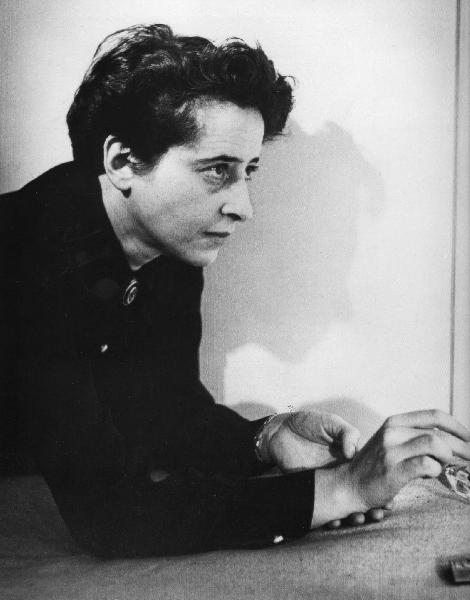
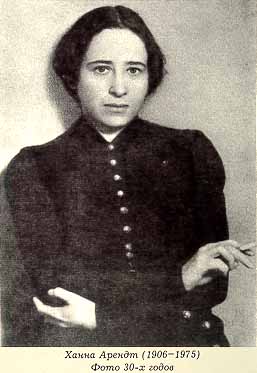
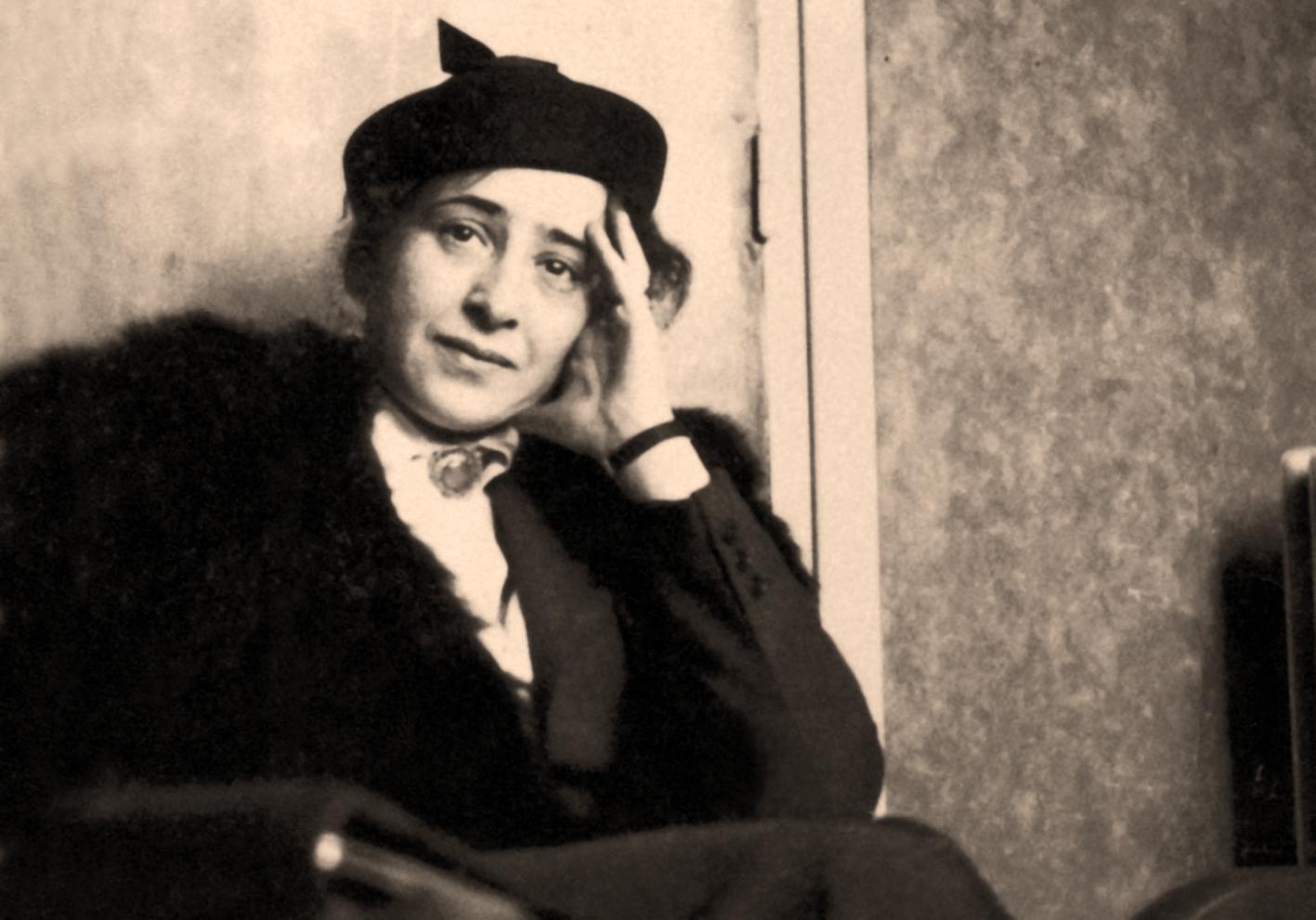
Arendt’s legend—or, perhaps it is better to say, her image—has become as important to posterity as her theories. In part, of course, this is because Arendt is one of the few women in the traditionally male pantheon of political philosophy. It makes sense that it is feminist readers who find the most food for thought in Arendt’s image—even though Arendt denied that she was a feminist. Julia Kristeva devotes some pages of her recent book on Arendt to her changing appearance, as documented in photographs: from the girlish “seductress” of the nineteen-twenties, gazing poetically at the camera, to the confident intellectual of the fifties, whose “femininity . . . beats a retreat” as her face becomes “a caricature of the . . . battle scars” received during her public career.

Kristeva’s reverie on Arendt’s “psychic bisexuality” is not the kind of attention that gets paid to Kant or Heidegger. Yet it is a sign of the way that Arendt has emerged as something both more and less than a political theorist. The most rewarding way to read Arendt, and the best way to make sense of both the strengths and the limitations of her work, is to approach her as Michelle-Irène Brudny does in “Hannah Arendt: An Essay in Intellectual Biography”: “I definitely take Hannah Arendt to be less a political philosopher or a political theorist . . . than an author in the strong sense of the word.” Kristeva, still more emphatically, considers Arendt’s writings “to be less a body of work than an action.” Like so many Jewish writers of her generation, Arendt attempted in her work to shine the light of intellect on the extreme darkness she lived through. That she chose to do this in the most impersonal of genres—philosophy and history—rather than through memoir, or even poetry (which she loved to read, and wrote from time to time), is itself a clue to the immense psychological pressures that shaped her work and, in the end, partly disfigured it.


{source: Judith Butler, Asociación de Estudiantes de Filosofía UCR}


{source: http://photo.sina.com.cn/photo/4af198f522564acf6b521}


{source: Aronnax}


{caption: Arendt in a Paris café, in 1935. Source: Three White Leopards}


{source: flickr}


{source: flickr}

Wednesday, September 24, 2008

whom do you trust?

I've been interested in the expansion of commerce in 17th-century England; particularly interested in the importance of credit, and, with regard to credit, particularly interested in the importance of trust. Partly for that reason I recently read Jane Jacobs's Systems of Survival which sets out to explain a pair of competing moral systems: the guardian syndrome and the commerce syndrome. She derives these syndromes from the behaviors two occupational groups: the one evolved from aristocratic moral structures and the other from the moral structures of businessmen. It's a good read. The guardians are those who govern, who run the bureaucracy, and who dispense justice. They trust only their own kind and strictly by the rules of honor (which give plenty of latitude for deception). In contrast, commercial people treasure honesty, not for its own sake but because trading requires trust.

Jacobs isn't saying these moral codes are observed by everyone all the time, but that each group has ways to enforce its own precepts. They both try to minimize deviation from their own specific norms. She also isn't saying that these two competing syndromes comprise all the rules that people strive to follow in their attempts to lead good lives. These are simply the ones that separate the one group from the other. I've put a table showing the two lists at bottom.

Jacobs points out that guardian group must step in when the morals of the commerce group break down. That is to say governments regulate commerce for the good of citizens. Though there are ideologies that regret this intervention, almost everyone regards it as necessary. She also says governments can't actually perform the functions of the commercial group -- government run business operations rarely succeed. (She says they never do). That's because the moral structures are inimicable. It's an interesting way of looking at things; basically an update on a position that Plato has Socrates take. There's a quick summary in this pdf document.

So now we're seeing government debate what to do to correct the mess created by the big New York banks (and others). You can look at the arguments from a Systems-of-Survival point of view.

But I'm more interested in one aspect: the betrayal of trust. Steven Pearlstein writes about the subject today. In an article called The Words Left Unspoken in the Bailout Debate he says:
Political systems, communities, markets all share one common characteristic -- at their core, they all require a level of trust among the participants if they are going to work. In recent years, we have allowed that trust to erode to the point that our political system is paralyzed by partisan bickering and communities are fractured into enclaves of race and class. Now markets are collapsing because investors realize they have been misled by corporate executives, investment banks, ratings agencies and regulators. As a country, there is an urgent need to rebuild that trust. In different ways, that is what both the McCain and Obama campaigns are all about. And it is the same challenge that now faces us in this financial crisis.
Where Pearlstein writes about the trust we should be able to place in large financial institutions, an academic blogger writes, indirectly, about the trust we should be able to place in our military. In a post called Counterinsurgency Comes Home, he writes about an Iraq-seasoned infantry brigade being deployed to "help the people at home" through sophisticated military action to counter civil unrest. The blogger has first-hand knowledge since he's currently serving in the Army in Kuwait. (He writes for Cliopatria, a group blog, and is a historian in graduate school at UCLA.) If you read the whole article from which he quotes, the unit sound more helpful than threatening (Brigade homeland tours start Oct. 1). But, in light of the misplaced trust that has produced so many horrors in recent years, including the current financial crisis, you have to wonder. Why do we need Army specialists to do the job the National Guard is tasked to perform? There used to be fears of large standing armies which might subvert the rights of citizens. As James Madison put it in Anti-Federalist Papers No. 10 of 24 January 1788,
The liberties of a people are in danger from a large standing army, not only because the rulers may employ them for the purposes of supporting themselves in any usurpations of power, which they may see proper to exercise, but there is great hazard, that an army will subvert the forms of the government, under whose authority, they are raised, and establish one, according to the pleasure of their leader.
We no longer have quite that fear, but with the drastic undermining of civil liberties in the current war on terror and the embracing of torture as a judicial tool, and all else that increases the power of the state to coerce its citizens, there is very good reason to withhold trust when the Army says its deploying a seasoned combat-ready force on our own territory for our own good.

Here are Jacobs's two syndromes:
Guardian Syndrome's
Moral Precepts
Commerce Syndrome's
Moral Precepts
   
  • Shun trading
  • Exert prowess
  • Be obedient and disciplined
  • Adhere to tradition
  • Respect hierarchy
  • Be loyal
  • Take vengeance
  • Deceive for the sake of the task
  • Make rich use of leisure
  • Be ostentatious
  • Dispense largesse
  • Be exclusive
  • Show fortitude
  • Be fatalistic
  • Treasure honor
  • Shun force
  • Compete
  • Be efficient
  • Be open to inventiveness and novelty
  • Use initiative and enterprise
  • Come to voluntary agreements
  • Respect contracts
  • Dissent for the sake of the task
  • Be industrious
  • Be thrifty
  • Invest for productive purposes
  • Collaborate easily with strangers and aliens
  • Promote comfort and convenience
  • Be optimistic
  • Be honest