In the 16th and 17th centuries most rules probably were easily identifiable as ancestors of the school ruler of the 1950s. This one comes from a carpenter's toolbox aboard a warship that was sunk during a sea fight in 1545.

{From a group of carpenter's tools, including a mallet, drill handle, and plane, found in chests stowed in one of the main deck cabins of the Mary Rose, one of Henry VIII's warships which was sunk in battle in 1545; source: wikipedia}
From Shakespeare's time forward, however, rules could be and often were both more precise and more versatile. Here is a folding rule used by a ship's carpenter in during the first half of the 17th century.[2]
Front

Back

Extension arm

{17th Century English Three-Fold Ship Carpenter’s Rule, a two foot rule, made of boxwood and brass. Front has four scales (inch, two sets of lines for setting a ship's mast, and a scale for making octagon shapes — use of the octagon scale is described here). Back was used for timber and board measure and contains scales for measuring areas and volumes. The extension arm carries a logarithmic line of numbers 1-10 and would have been used with a pair of dividers. Source: http://www.teodolite.it/arch_carp_rule.htm in antichi strumenti topografici. (I have reproduced this image under fair use provisions of US copyright law.)}
The scales on the back of this rule are for estimating how much wood is needed for a given construction project, whether as timber or board measure. Timber measure was given in cubic feet or yards; board measure in square feet or yards. These scales accord with instructions given by Leonard Digges in 1556. Here is a page from Digges' book, A booke named Tectonicon, brieflie shewing the exact measuring, and speedie reckoning all manner of land, squares, timber, stone, steeples, pillers, globes, etc..

{A booke named Tectonicon, brieflie shewing the exact measuring, and speedie reckoning all manner of land, squares, timber, stone, steeples, pillers, globes, etc. ... With other things pleasant and necessarie, most conducible for surveyers, landmeaters, joyners, carpenters, and masons by Leonard Digges (London, Imprinted by F. Kyngston, 1605); first published in 1556}
Here is Digges' template for a carpenter's rule showing the timber scale and another one to be used for calculating board measure.[3]

This handsome example of a two-foot folding carpenter's rule has the Digges scales on its first arm (the arm having inch measure 1 to 12). The second arm continues the lumber measure scales and labels them. There are also degree markings on its hinged joint permitting the rule to be used as a sector for measuring distances and heights. It is nicely detailed and worth a close look (as usual, click to view full size).

{Folding Rule, Brass, 305 mm in radius, signed by Humfrey Cole, 1575, London; source: Museum of the History of Science, Oxford (I have reproduced this image under fair use provisions of US copyright law.)}
It's a safe bet that most of Digges' readers would use his instructions to obtain wooden rules like the ship's carpenter's version not shiny brass ones. The latter would be too expensive for most of the men whom Digges called artificers to afford. In writing the book, Digges addressed himself expressly to such men, those who could read but only in English and who could count money (as most men could) but whose knowledge of mathematics was limited.
In his prefatory remarks Digges says others before him have written books on surveying, carpentry, and related subjects, but they wrote in inaccessible languages (as he says, "locked up in strange Tongues") and assume knowledge of mathematics (that is, they require the "art of numbring"). For these reasons, he says, they have little value for British artificers: "they doe profit (or have furthered) very little the most part: Certes nothing at all, the Landmeater, Carpenter, Mason, wanting the aforesaid".[4]
Digges' book serves his readers well. It's written clearly in an informal style and gives many useful examples. The surveyors, carpenters, masons, and other workmen who followed his advice, giving it a first reading "confusely," then closely, and finally with diligence, "wittely to practise: so few things shall be unknowe."
Writing a whole century later, John Collins does much the same for seamen, makers of sun dials, and students of navigation.
In a book called Navigation by the mariners plain scale new plain'd he gives basic lessons in elementary geometry with many illustrations, provides detailed instructions for applying this mathematical knowledge in navigation at sea, and shows many demonstrations from actual experience. He tells his readers how to account for changes in vessel speed and in compass readings due to magnetic variation and how to adjust for the drift of a vessel due to wind and currents, and he discusses problems resulting from cloud covers obscuring the sun or stars, and the like.[5] He also acknowledges that seamen are hampered most of all through not having accurate charts for their points of destination: "unless the true Longitudes and Latitudes of Places be known, their true Courses and Distances cannot be found, whence it will unavoidably follow, that no true reckoning can be kept." This chapter concludes: "Notwithstanding the imperfections and uncertainties that arise in the practick part, yet it should be our endeavour to render this excellent Art as easie and certain as we can, which is the thing I am at, and the Instrument here used being the Plaine Scale, is, as I said before, in every mans power."[6]
The Plaine Scale to which Collins referred is a rule which he shows thus:

On this scale,
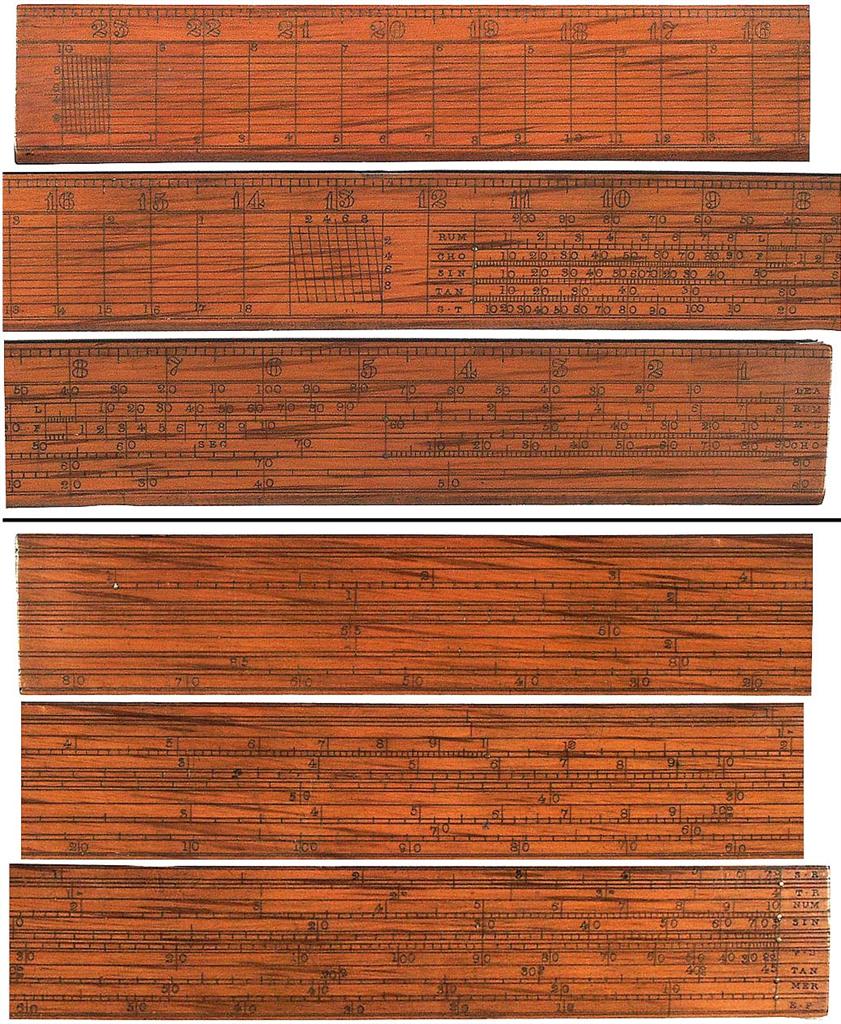
C is the scale of secantsCollins' plain scale is a version of Gunter's scale. Invented by Edmund Gunter and first described in a book he wrote in 1624,[7] this scale eventually became so common on sailing ships as simply to be called the Gunter by its users.[8] This is a detail from a common two-foot version of the scale. Its top line of numbers shows inches. I don't know what the next scale is. Below it you find rhumbe, chord, sine, tangent, semi-tangent.
S the scale of sines
C the scale of chords
R the scale of rhumbe
P the scale of semi-tangents, and
L the scale of tangents

{Detail from a Gunter's scale. You can vier the whole scale here. Source: KRING HISTORISCHE REKENINSTRUMENTEN}
Like Digges, Collins addresses readers of, in his words, the "meanest sort," i.e., those who possess few or no advantages of wealth and education. To that end he includes engraved plates showing the plain scale and other tools which readers could make for themselves. Aside from them, the only tools needed were a straight edge and a pair of dividers, or as he put it "a pair of Compasses and a bare Ruler."
A few years ago there was a Gresham lecture which brings out points similar to the ones I'm making here about the production and use of mathematical instruments and those who made them, about those who instructed others about these instruments, and about those who actually put them to use. It's History from Below: mathematics, instruments and archaeology, a lecture by Stephen Johnston, Museum of the History of Science, Oxford University, Thursday, 3 November 2005.
-----
Some sources:
A booke named Tectonicon, brieflie shewing the exact measuring, and speedie reckoning all manner of land, squares, timber, stone, steeples, pillers, globes, etc. ... With other things pleasant and necessarie, most conducible for surveyers, landmeaters, joyners, carpenters, and masons by Leonard Digges (London, Imprinted by F. Kyngston, 1605); first published in 1556
Navigation by the mariners plain scale new plain'd, or, A treatise of geometrical and arithmetical navigation; wherein sayling is performed in all the three kindes by a right line, and a circle divided into equal parts. Containing 1. New ways of keeping of a reckoning, or platting of a traverse, both upon the plain and Mercators chart ... 2. New rules for estimating the ships way through currents, and for correcting the dead reckoning. 3. The refutation of divers errors, and of the plain chart, and how to remove the error committed thereby ... as also a table thereof made to every other centesm. 4. A new easie method of calculation for great circle-sayling, with new projections, schemes and charts ... 5. Arithmetical navigation, or navigation performed by the pen, if tables were wanting ... By John Collins of London, Pen-man, accomptant, philomathet (London : printed by Tho. Johnson for Francis Cossinet, and are to be sold at the Anchor and Mariner in Tower-street, as also by Henry Sutton mathematical instrument-maker in Thread needle street, behinde the Exchange, 1659)
Digges, Leonard in the galileo Project at Rice Univ.
Folding Rule, signed by Humfrey Cole, 1575, London
Brass, 305 mm in radius, Inventory no. 49631, Epact number: 79726
A Late 17th-Century Armed Merchant Vessel in the Western Approaches by Neil Cunningham Dobson, Odyssey Marine Exploration, Tampa, USA, and Sean A. Kingsley, Wreck Watch Int., London, United Kingdom (pdf)
Like father, like son? John Dee, Thomas Digges and the identity of the mathematician by Stephen Johnston, Museum of the History of Science, University of Oxford
The Logarithms and Rules on the Calculating Tools page of the History of Computers web site
Gunter's rule, one step before the Slide Rule, on the History of Computing web site
The description, nature and general use, of the sector and plain-scale briefly and plainly laid down; as also a short account of the uses of the lines of numbers, artificial sines and tangents by Edmund Stone (Printed for Tho. Wright; and sold by Tho. Heath mathematical instrument maker, next the Fountain Tavern in the Strand., 1721)
An introduction to the theory ... of plane and spherical trigonometry ... including the theory of navigation by Thomas Keith (London, Longman, Hurst, Rees, Orme, and Brown, 1816)
On the history of Gunter's scale and the slide rule during the seventeenth century by Florian Cajori (Berkeley, Univ. of California Press, 1920)
History from Below: mathematics, instruments and archaeology, a lecture by Stephen Johnston, Museum of the History of Science, Oxford University, Thursday, 3 November 2005
-----------
Notes:
[1] The post is men holding rules, Secondat, January 21, 2012.
[2] Full caption: "17th Century English Three Fold Ship Carpenter’s Rule — The two foot rule, made of boxwood and brass SCALES 1. Side A has four scales: -a. An inch scale [0]-18, divided to unit, half, quarter, eighth and numbered by 1 to 18. This continues to 24 on the brass leg. -b. A pair of sectoral lines, used for setting out the taper of a ship’s mast. The inner sector lines on each of the boxwood legs are graduated P, 3Q, 2Q, 1Q and MH, representing Partners, third, second, and first Quarters, and Masthead. The function of this sector is to provide a series of diameter measurements. The second, or outer set of the two sector lines are designated S, 3Q, 2Q, 1Q and YA, for Slings, third, second, and first Quarters, and Yardarm. -c. the octagon scale, to left and right of the rule joint, scaled 0 to 28 Side B for timber and board measure was designed to be used for measuring areas and volumes. This particular format was established during the 17th century as an adaptation of a design first published by Leonard Digges in 1556 Side B has three elements: -a. The line of board measure running from 9 to 36. The scale ends 4in from the end of the leg (4 x 36 = 144 = 1ft square). -b. The line of timber measure from 11 to 33. -c. A table of timber undermeasure. This is continuous with the timber line and supplies values for 1 to 8in, which the rule cannot accommodate on the scale line. The edge carries a logarithmic line of numbers 1-10. The logarithmic line of numbers on the edge was first published by Edmund Gunter in the 1620s. In the form found here, which appeared on a range of instruments in the 17th century, it would have been used with a pair of dividers."
[3] Note that Digges puts the lumber scales are on the front side of the rule he describes, along with a 12-inch scale. The back side of his rule has a scale for use in measuring angles and distances (a quadrant). Note also that he calls the device a ruler not a rule. The terms seem to have been interchangeable at the time. And finally, notice that the printer has done Digges wrong: the numbers by the side of the timber and board hash marks are grossly misplaced.
[4] The landmeater measured land, apparently with less skill than the surveyor. Here is Digge's address to the reader in full:
L. D. to the Reader — Although many have put forth sufficient and certain rules to measure all manner of superficies, etc., yet in that the art of numbring hath been required, yea, chiefly those rules hid and as it were locked up in strange tongues, they doe profit or have furthered very little, for the most part, yea, nothing at all, the landmeater, carpenter, mason, wanting the aforesayd. For their sakes I am here provoked not to hide but to open the talent I have received, yea, to publish in this our tongue very shortly if God give life a volumne containing the flowers of the sciences mathematicall largely applied to our outward practise profitably pleasant to all manner men. Here mine advice shall be to those artificers, that will profit in this or any of my bookes now published, or that hereafter shall be, first confusedly to read them through, then with more judgement, read at the third reading wittily to practise. So, few things shall be unknowne. Note, oft diligent reading joyned with ingenious practise causeth profitable labour. Thus most hartely farewell, loving reader, to whom I wish myselfe present to further thy desire and practise in these.[5] Leonard's son, Thomas Digges, was John Dee's foster son wikipedia: "Thomas was the son of Leonard Digges, the mathematician and surveyor. After the death of his father, Thomas grew up under the guardianship of John Dee, a typical Renaissance natural philosopher."
[5] This discussion of the "uncertainties of navigation" includes description of the parallax error that occurs when the sun is at the horizon. Since readings are taken at noon, this problem only occurs during winter in northern latitudes.
[6] Collins gives this definition: "By a Plain Chart, is meant a Chart drawn on Paper or Pasteboard, lined with Meridians and Parallels, making right Angles each with other, and numbered with degrees both of Latitude and Longitude, each equal to other, and what is commonly performed in casting up a Traverse on such a Chart, we shall perform on a Blank of Paper."
[7] Gunter's book is The description and use of the sector, cross-staff, bow, quadrant, and other instruments (London, 1624) republished in The works of Edmund Gunter : containing the description and use of the sector, cross-staff, bow, quadrant, and other instruments. with a canon of artificial sines and tangents to a radius of 10,00000 parts, and the logarithms from an unite to 10000 ... and some questions in navigation added by Mr. Henry Bond ... To which is added, the description and use of another sector and quadrant, both of them invented by Mr. Sam. Foster ... furnished with more lines, and differing from those of Mr.Gunters both in form and manner of working by Edmund Gunter, ed. by William Leybourn (London, Printed by A.C. for Francis Eglesfield, 1673).
[8] Gunter's navigational scale was used by the Royal Navy up to the 1840s. The historian of mathematics, Florian Cajori, gives this description:
We begin with Anthony Wood's account of Wingate's introduction of Gunter's scale into France.In 1624 he transported into France the rule of proportion, having a little before been invented by Edra. Gunter of Gresham Coll. and communicated it to most of the chiefest mathematicians then residing in Paris: who apprehend[ed] the great benefit that might accrue thereby...Gunter's scale, which Wingate calls the "rule of proportion," contained, as described in the French edition of 1624, four lines: (1) A single line of numbers; (2) a line of tangents; (3) a line of sines; (4) a line, one foot in length, divided into 12 inches and tenths of inches, also a line, one foot in length, divided into tenths and hundredths.


 Posts