Showing posts with label art. Show all posts

Saturday, October 15, 2011

Sussdorfs

I recently heard from a woman whose home is not far from the place where my great-grandfather, Louis Windmuller, lived for much of the nineteenth century.[1] I've written about this summer home of his quite a few times already.[2] The email she sent me links to a set of comments on a blog called Ephemeral New York. The subject of the post is a drypoint print by a highly-regarded artist named Martin Lewis[3] The print is called "Rainy Day, Queens" and it shows an urban scene having a broad street rising as it recedes. In the foreground pedestrians and a few cars occupy what is evidently a viaduct, overpass, or bridge and in the background there are apartment buildings on both sides of the avenue. Here's a small image of the print. You can see a larger view here.[4]


In readers' comments to the blog post you find speculation about the location of the scene which Lewis depicts. Most commenters believe it shows a viaduct over the Long Island Railroad in Long Island City or the nearby Sunnyside Yards. I favor this set of opinions.[5] On the other hand One commenter, with support from a couple of others, says the artist is standing on a street in Woodside and is facing the Sunnyside rail yards to the west. This commenter says the artist depicts a "crumbling bluestone sidewalk on Skillman Ave.," with Roosevelt Avenue to his back. "The crest of the hill," he says, "is the point where 54th Street zig-zags across Skillman."

This commenter, T.J. Connick, gives a link to a photo in NYPL's Digital Gallery. It's this photo that prompted the email message to me about my blog post. The writer, Deniz Hughes, points out that the photo shows property that was adjacent to the place owned by my great-grandfather, Louis Windmuller.

Here's the photo. It shows the home of the Sussdorf family, who were not only the Windmuller's neighbors but also their friends. Louis Windmuller was twenty years younger than Gustav Sussdorf, but they held much in common. Both were born in Germany and had emigrated to America at a young age. Both were successful merchants who spent winter months in Manhattan and summered on their estates in Woodside. Both were religious converts who helped establish St. Paul's Protestant Episcopal Church at Woodside. Windmuller and Gustav's son William H. served many years as church vestrymen and their wives and daughters were active in the church's Sunday school and social activities. I've written about the two families before.[6]


{The accompanying description says: "54th Street (foreground, unpaved), between Roosevelt Ave. (left) and Skillman Ave. (right), showing in the foreground the G. Susdorff house from 1860-1873. It was gone in April 1925. In the background are homes on 52nd Street. The photo was taken in 1924. Source: NYPL Digital Gallery}


This detail from the photo shows the Sussdorf home.


This detail shows a row of houses on 52nd Street.


This is an obituary of Gustav Sussdorf.[7]

{Newtown Register, October 29, 1896}

This is a detail from a fire insurance atlas page. I've marked it to show where the photographer was standing. Note that the atlas reflects an earlier time; it was made a decade before the photo and a couple of decades before the print was made.

{Detail from Queens, Vol. 2, Double Page Plate No. 15; Part of Ward Two Woodside; [Map bounded by Kelly Ave., Woodside Ave., Greenpoint Ave., Thomson Ave.; Including Astoria Road (Highway to Calvary Cemetery) (Celtic Ave.), Middleburg Ave., Jackson Ave., Solon St., Mecke St.] 1908 updated to 1912, Atlas of the borough of Queens, city of New York, based upon official plans and maps on file in the various city offices; supplemented by careful field measurements and personal observations by and under the supervision of Hugo Ullitz. First and second wards: Long Island City and Newtown. Source: NYPL Digital Gallery}

This detail from a 1923 map shows the general area around the Windmuller and Sussdorf properties. I've marked it to show the rough location of the two houses, the school, and the photographer.

{Map of the borough of Queens. "Supplement to The Brooklyn Eagle Almanac, 1923." Williams Map & Guide Co. Source: Library of Congress}

This satellite image shows the location of the two houses and camera.


In the lower right of the satellite image, just below Doughboy Plaza, you can see a school, P.S. 11. Here is a photo of the school as it looked in 1925. The photographer was standing on the southwest corner of 56th St. and Woodside Ave. The trees to the right are on the lower part of the Windmuller property.

{"Woodside Avenue, at the S.W. corner of 56th Street, showing Public School No. 11. Taken by Percy Loomis Sperr, 1925. May be reproduced." Source: NYPL Digital Gallery}

NYPL has another photo showing the construction of 54th St. northward from Skillman Ave. in 1931, the same year Martin Lewis made his drypoint print. Here's a link to the image: Queens: 54th Street - Skillman Avenue (1931). The trees in the background of this photo are on the Windmuller estate. The Sussdorf estate is to the left, behind the apartment building and P.S. 11 is at right.

I see nothing in these photos to lend support to the thesis that the Lewis print shows this part of Queens. For more views of this part of Woodside, see a blog called Woodside, A Tour Through the Past, Present, and Culture of a Historic Urban Community. The blog was created by a student at SUNY Purchase named Janel Lloyd. In one section of the blog, Lloyd pairs photos of the area covered by the Sussdorf and Windmuller states. The pairs show what the place looked like in ca. 1940 and what they look like today. This screen shot shows one such pair and gives Lloyd's description.

{See Lloyd's "Denotation" page for source information. I'm using this screen shot under copyright fair use provisions.}

The photograph on the left, from ca. 1940, was taken from a position not far from the place from which the photograph of the Sussdorf house was made, but the camera was pointed further north in this case. The photo is similar to one taken from the elevated platform of the LIRR station at the corner of Roosevelt and Woodside Avenues. If you look closely, you can see Hell Gate Bridge on the horizon at left. Nearby buildings are single family homes, either in row houses or unattached. There are multi-story apartments in the distance, outside the bounds of Woodside.

The area around Woodside was, of course, urbanized, but the transition from rural farmland, to suburban single-family houses, to multi-story apartment buildings was a slow one. During the first two decades of the twentieth century, urbanization spread eastward through and beyond Long Island City, but some communities on its eastern border, like Woodside, nonetheless retained much of their rural or suburban character. This photo of a homestead in Maspeth, a mile and a half south of the Sussdorf and Windmuller homes, shows an old farmstead as it looked in 1929, just two years before the Lewis made the print.

{"55th Drive (foreground, along line of fence), north side, between 58th Street (right) and 56th Street (left), showing the Nicholas Covert house and outbuilding. This is one a set of four views taken on different occasions and from slightly different angles." September 1929. May be reproduced. Source: NYPL Digital Gallery}

NYPL has another photo showing the undeveloped nature of Woodside and its environs in the 1920s. One of them I've previously discussed.[8] Here's another.

{"Maspeth Ave., north side, between 55th and 56th Streets, showing a northwest view of the James Way farmhouse, last in a set of four pictures." 1924. May be reproduced. Source: NYPL Digital Gallery}

---------

Some sources:

Know where this was?

Woodside, A Tour Through the Past, Present, and Culture of a Historic Urban Community

Denizblog

Ephemeral New York

NYPL Digital Gallery

----------

Notes:

[1] She's a Woodside resident named Deniz Hughes and she has an excellent blog called DenizBlog.

[2] The "Woodside" label in the list in the right hand panel leads you to posts on that subject. In particular note:
[3] Prints by Martin Lewis fetch a great deal at auction. One of the "Rainy Day" prints sold for more than $16,000 not long ago.

[4] I'd show a large version of the print, but I'm unsure of the copyright status of images made from it.

[5] This photo, from NYPL's digital gallery, gives a general idea of what I believe to be the area which the print shows. The photo shows an apartment building on only one side of the street, the sidewalk barrier at the right of the overpass is different, and of course the Lewis print does not show the Manhattan skyline in the distance. On the other hand the slope and the light fixture are right, so the artist may, as the commenter says, have been located at one of the neighboring overpasses in this area.


[6] On the relationship between Windmullers and Sussdorfs see the blog posts listed above and also Friedle women and three country homes.

[7] Here the obituary of Gustav Sussdorf's son, Louis Albert, from the New York Times. It's tempting to think that the Sussdorf's named him in honor of a son of Louis Windmuller, named Louis Adelbert or Albert, who died in 1872 age 10 days.
Louis Albert Sussdorf Former Stock Exchange Member Dies at Long Island Home.

Louis Albert Sussdorf, a retired member of the New York Stock Exchange, died on Sunday at his Summer home in Bridgehampton, L.I. The Rev. Ernest Sinfield of St. George's Protestant Episcopal Church, Flushing, will officiate at the funeral services this afternoon in Mr. Sussdorf's former residence at 144-51 Sanford Avenue, flushing. Born in Charleston, S.C., seventy years ago, Mr. Sussdorf became a member of the shipping firm of Sussdorf, Zalvo & Co. He formerly lived in Elmhurst, Queens.

Surviving are a widow, Mrs. Rebecca Moore Hyatt Sussdorf; two sons, Louis Sussdorf Jr., counselor at the American Embassy in Brussels, Belgium, and Ralph H. Susdorf of Orange, Calif., and two daughters, Mrs. Grace M. Thayer and Miss Elsie Purdy Sussdorf.

Burial will take place in Old St. James churchyard, Elmhurst.

-- New York Times, July 18, 1934
And here is the death notice for Gustav's wife, Jane: "Sussdorff. At Woodside, L. I., July 13, 1902, JANE M. SUSSDORFF, wife of the late Gustav, in the 76th year of her age. Funeral service at her late residence Tuesday, July 15, at four P. M. Carriages will be in waiting at station on arrival of 3:30 P. M. train from Long Island City. Interment at convenience of family. Charleston (S. C.) papers please copy." -- New York Herald, July 14, 1902

[8] It's the one I linked to above as being similar to the 1940 photo shown on Janel Lloyd's blog.

Thursday, September 22, 2011

17th Lancers

The other day I showed a 1903 photo of the newsstand at 23rd Street and 6th Avenue in Manhattan. In it you can see a reproduction of a painting from the Second Boer War. It's called "All that was left of them" and it shows a squadron of British cavalry under attack and apparently determined to fight to the finish. The squadron was part of the 17th Lancers regiment and the fight occurred at Modderfontein farm during the Battle of Elands River. This battle took place almost exactly 110 years ago on September 17, 1901.

It may seem odd that the only picture on display in the newsstand would be this one. The event wasn't hot news in 1903 and what's depicted isn't heroic in the usual sense: the lancers' suffering defeat in an ambush by rag-tag Boer farmer-soldiers. By 1903 it was surely known that the battle was at least partly the result of a mistake: some of the Boer commandos had put on captured British uniforms and the lancers couldn't at first tell whether they were being approached (and then surrounded) by friend or foe.[1]

It's possible that the guy who ran the newsstand had some connection to the fight, but just as likely that he showed the picture because it attracted business to his stand. Pictures of battle scenes — even, as here, scenes of imminent defeat — were popular and the painter of this one was one of the best, Richard Caton Woodville. There's inherently a lot of drama in a fight to the last man and Woodville has done a good job of showing both the desperate plight of the lancers and their determination to stand firm.

Here's a copy of the picture as full-color chromolithograph.

{Caption: Woodville, Richard Caton, 1856-1927: All that was left of them. A stirring incident of the late South African War; source: Alexander Turnbull Library, National Library of New Zealand}

A card that accompanies one copy of the print helps explain some of its popularity. The card reads:
All That Was Left Of Them.

At Modderfontein on September the 17th, 1901, the C Squadron of the 17th Lancers were surprised and surrounded. The odds were one hundred and fifty of our Lancers to four hundred of the enemy - the position untenable; - but answering their young officer's shout of 'Death or Glory Boys' they upheld that famous motto of their regiment by fighting till they fell by explosive bullets at twenty, ten, and even five yards.

Such deeds may not win battles, but such courage makes our nation.
The call 'Death or Glory' was the motto of the 17th Lancers and their cap badge showed a death's head with the motto "Or Glory".[1]

Here's what the cap badge looks like.[2] You can see it bottom left in the picture above.

{source: wikipedia}

This detail from the newsstand post shows the print.

{source: Library of Congress Prints and Photos Division}

The 17th has always been a "light" cavalry, meaning that it employed hunter-size horses rather than the large war-horses needed for heavy cavalry.[3] Originally they were dragoons, soldiers who rode to battle but dismounted to engage the enemy, but in the early 1820s they were converted to soldiers who fought on horseback — lancers.

The 17th fought in the battle of Bunker Hill during the American Revolution[5] and following the Battle of Long Island were encamped in and around Newtown — the locale where my great-grandfather, Louis Windmuller, would build his home.[6]

---------

Some sources:

MODDERFONTEIN 17 September 1901 by R W Smith, Military History Journal, Vol 13, No 1, June 2004

The annals of Newtown, in Queens county, New-York

HISTORY OF QUEENS COUNTY, with illustrations, Portraits & Sketches of Prominent Families and Individuals. New York: W.W. Munsell & Co.; 1882

The 17th Lancers

The Birth of the American Cavalry

A History of the 17th Lancers (Duke of Cambridge's Own) John William Fortescue
Publisher: Macmillan and co.
Year: 1895

17th Lancers "Death or Glory"

17th Light Dragoons on the British Empire web site

The Battle of Long Island 1776 on the British Battles web site

17th Lancers in wikipedia

Battle of Elands River in wikipedia

Battle of Long Island

Battle of Long Island Hard Times followed Battle of Long Island by Gus Dallas, Printed by The Richmond Hill Record

17th Light Dragoons

----------

Notes:

[1] The 17th Dragoons page on the "British Empire" web site summarizes the fight: "A small group of Boers were forced to find new mounts, food and ammunition or face certain capture. They came across a small outpost of the 17th Lancers who were resting in the grounds of a farm house. The British mistook the Khaki clad Boers for British until they started a withering fire on the unprepared Lancers. The Boers were then joined by another troop of Commandoes who had heard the commotion from afar. These joined in from the rear of the Lancers and helped to inflict serious casualties on the troop of Lancers. In total, 36 Lancers were killed and many more were wounded. The worst aspect of this loss is that they themselves provided the Boers with further mounts and ammunition to continue fighting against the British for an even longer period of time." -- 17th Lancers

[2] The wikipedia article on the 17th Lancers explains: "In 1759, Colonel John Hale of the 47th Foot was ordered back to Britain with General James Wolfe's final dispatches and news of his victory in the Battle of Quebec. After his return, he was rewarded with land in Canada and granted permission to raise a regiment of light dragoons. He formed the regiment in Hertfordshire on 7 November 1759 as the 18th Regiment of (Light) Dragoons, which also went by the name of Hale's Light Horse. The admiration of his men for General Wolfe was evident in the cap badge Colonel Hale chose for the regiment: the Death's Head with the motto 'Or Glory'. In 1761 it was renumbered as the 17th."

[3] Until 1823, the 17th Lancers were the 17th Dragoons. The 17th Dragoons page on the "British Empire" web site explains the emblem: "The evocative Death's Head emblem has been used time and again by desperadoes and tribes from time immemorial. Its first use as a regimental emblem seems to have been by a German unit of Hussars known as the 'Totenkopf' Hussars. As many British units and soldiers had served in Germany at around this time as part of the Seven Years War (1756 - 1763). It is probable that they saw this emblem and revelled in its associations of piracy and plunder - perfect values to a Light Cavalry unit. Indeed, down to the present time the regiment is still commonly referred to as 'The Tots'." -- 17th Light Dragoons

[4] The 17th Dragoons page on the "British Empire" web site explains the difference between light and heavy cavalry in terms of horses: "The Light Dragoons main distinction from their heavier cousins was in the type of horse employed. Rather than use the big and burly heavy cart cobs the Light Dragoons preferred the use of smaller, leaner hunter horses (under 15.1 hands). Originally, the Light Dragoons were not equipped with swords of any sort rather their main armament was a carbine that could have a bayonet fitted, pistols and an axe. They were trained to be able to fire from the saddle. Speed and agility (of rider and horse) were prized over strength and sturdiness. These attributes would prove to be valuable ones in the small scale actions common to colonial campaigns for a long time to come." -- 17th Light Dragoons

[5] Regarding Bunker Hill, one source says "On the action on Long Island the 17th were to find themselves in an excellent position to trap the American army who were pinned with their backs to the river. Unfortunately, General Howe did not take advantage of the situation, and 12,000 Americans rowed to safety to Manhattan Island."

[6] The brigade was encamped where the IND subway yards sit today, near Queens Borough Hall, and officers and noncoms were billeted at homes in Newtown.

[7] Here's an account to the quartering of men in the area around Newtown. "The officers and noncommissioned officers occupied the homes of Queens citizens. Ten to 20 noncoms were assigned to a house. They were ordered to take over just one room in the house, and they shrewdly chose the kitchen, setting up hammocks in tiers. British officers were arrogant, and Queens folk had to tip their hats outdoors or stand like inferiors when speaking to them inside their own homes. Slave owners grumbled that their slaves tended to become snippy and disobedient after they saw how the officers pushed the master around." -- Battle of Long Island


Monday, May 23, 2011

color printing

In the 1890s, American printers produced some excellent color advertising. This ad for Newsboy Cigars was printed in 1894 by the Calvert Lithographic Co.


{Newsboy cigars. Manufactured by Brown Brothers, Detroit, 1894, Calvert Lithographic Co.; source: Library of Congress}

This one dates from about the same time.


{Drink Coca-Cola 5 cents, 189- , print: chromolithograph; summary: Print shows a well dressed young woman, wearing hat, white gloves, and pearls, holding up a glass of Coca-Cola, seated at a table on which is a vase of roses, the "Drink Coca-Cola" sign, and a paper giving the location of the "Home Office [of the] Coca-Cola Co." as well as branch locations; source: Library of Congress[1]}

Although digital imaging can be somewhat flakey, I imagine you can tell that these two make good use of a wide range of color tones.

Impressed on newsprint using high-speed, multi-cylinder rotary presses, advertisements in the local press couldn't attain such high quality. But, even in 1909, they looked pretty good, as this page from the New York Herald of 1909 attests. You can assume it looked a lot better on the day it came out. The highly-acidic wood-pulp paper on which it was printed will have deteriorated much more during the past century than the heavier stock on which the cigar and Coke ads appeared, and as the paper aged the colors will have grow dim.


{This comes from the Herald of 1909; source: NYPL Digital Gallery}

Newspaper color work from earlier in the 19th century is also surprisingly good. This example comes from a New York weekly, Frank Leslie's Illustrated Newspaper, in 1883.


{"North Carolina &mdash An Illicit Whisky Still in the Mountains Surprised by Revenue Officers," from a sketch by J.S. Hodgson, a page in Frank Leslie's Illustrated Newspaper for the week ending September 1, 1883; source: Shirley Stipp Ephemera Collection, D.H. Ramsey Library, Special Collections, UNC}

This one comes from more than a decade before.


{Grant at the capture of the city of Mexico by E. Leutze, made between 1860 and 1870; source: Library of Congress}

Many newspaper illustrations were what we call political cartoons. This patriotic example appeared in the New York Herald on January 9, 1898. It isn't usually identified as typical of the era's yellow journalism, but this cartoon does fit the mold pretty well. When it appeared the high-circulation dailies, such as Hearst's New York Journal were flaming American jingoism and the Spanish American War was just about to break out.[2]

{"Uncle Sam -- Now Let Some of the Other Fellows Invent Something" by Charles Nelan, New York Herald, January 9, 1898; source: Cartoon Research Library, Ohio State University}

This 1895 drawing shows a multi-cylinder color press. These presses printed multiple colors in one operation at high speed.


{source: flickr}

These presses were enormous and immensely complicated. Containing about 50,000 separate pieces, they were something like thirty-five feet long, seventeen feet high and twelve feet wide. Although they used only four colors, they'd have some 64 sources of ink, called fountains. Fed by huge rolls of paper, they build up a color illustration by overlaying first yellow, then red, then blue, one after the other. The paper wound its way through the press much too fast for the different impressions to be visible, but if they were you would be able to see what the following images show. Note that the fourth color, black, is not part of this somewhat simplistic demonstration of the overlay process.


{source:
Modern industrial progress by Charles Henry Cochrane (J.B. Lippincott company, 1904) }

Although the process was highly automated, a great deal of skill was required in creating the plates from which each impression would be drawn and setting up the press to insure that the plates and unrolling paper were precisely aligned.[3] In most cases the artist would create the original color work using pen and ink or brush and paint. The work would be photographed three or more times using color filters to isolate, respectively, the yellow, red, and blue tones, and their variants. By a process called photoengraving, the photographic negatives (all of them black and white) would be used to make at least three printing plates and these, in turn, would be used to make the stereotype plates that were attached to the rollers of the giant presses. Each stereotype printing plate would be inked with a separate color to impress the paper as it wound its way through the press.[4]

The cigar and Coke ads were not made on one of these presses. They were poster-sized placards meant for display in shop windows, on advertising kiosks, and the like. The Coke ad was made by a process called chromolithography. In the late 19th century, chromolithographs were called "chromos." They were color lithographs and their quality varied greatly, depending on the skill of the printers and the size of the project's budget. The best were costly and could be extremely faithful to the original. They were made either by repeated impressions of a flat sheet of paper against inked lithographic stones or by a rotary method called offset lithography. A book published in 1875 describes this process clearly and in some detail.[5]

This enlargement from the Coke ad shows the tonal gradations that could be achieved in a relatively high quality chromo print.


The Newsboys Cigars ad has more abrupt tonal gradations. Although the curator identified the ad as a lithograph, the enlargement I've put below shows that it has been reproduced via halftone process. While chromolithography was done on lithographic flatbed or offset presses, halftone printing could be done on letterpress printing equipment, the same type of presses that were used to publish daily newspapers. In halftone work, tonal gradations are conveyed by dots of pigment. When the dots are close together the eye sees relatively intense tones; as they're increasingly separated, the eye sees lighter tones of the pigment. Making high quality halftones is difficult and time-consuming, requiring exact registration of the paper through multiple impressions, but the process is nonetheless cheaper and faster than is high quality chromolithography. Half-tone illustrations could be inserted along with text on the pages of daily newspapers, but this would normally be done for black and white photographs rather than color pictures.[6]

Here is an enlargement from the cigar ad that's comparable to the one of the Coke ad.


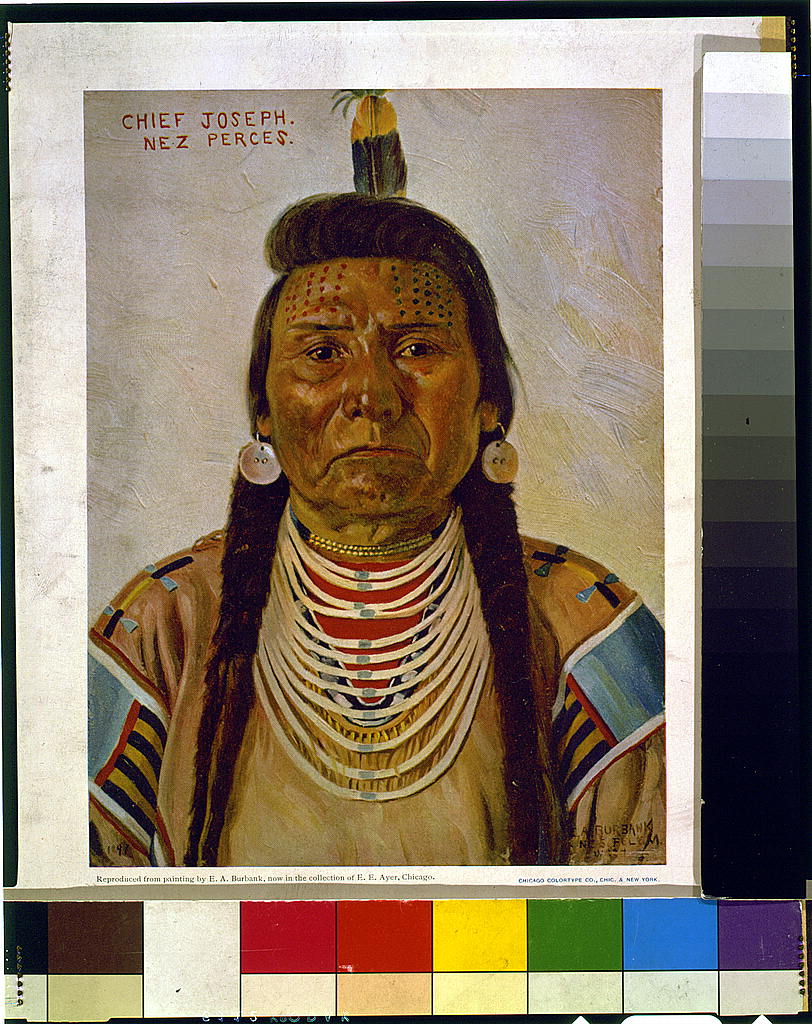
Compare this detail from a halftone reproduction of a painting of Chief Joseph made in 1897.


Here's the painting from which I've taken the Chief Joseph detail. Note that in this case the Library of Congress curator has identified the print as a halftone.


{Halftone reproduction of a painting by E.A. Burbank of Chief Joseph, Nez Percé chief, head-and-shoulders portrait, facing front, published by the Chicago Colortype Co., 1897; source: Library of Congress}


The New York Public Library has an excellent set of web pages describing and demonstrating chromolithography. Note in particular its sets of progressive proofs of a print called Prang's Prize Babies.

The two small crosses that you may have noticed on the Coke ad show it to be a type of proof. The crosses helped the printer determine that the registration was accurate as each successive color overlay was made. Once exact registration was assured, the crosses would, of course, be removed so as not to appear in the production prints.

-----------

Some sources:

The New Journalism 1865-1919

The Penny Press

Six thousand years of history see other blog post

The Daily Newspaper in America see other blog post

"Printing Presses" in The Encyclopedia Americana Encyclopedia Americana Corp., 1919

"The Development of the Rotary Web Press" in The American manual of presswork Oswald publishing company, 1916

Modern industrial progress by Charles Henry Cochrane (J.B. Lippincott company, 1904)

Color printing in wikipedia

History and present condition of the newspaper and periodical press of the United States by Simon Newton Dexter North (Govt. print. off., 1884)

American dictionary of printing and bookmaking by Wesley Washington Pasko (H. Lockwood, 1894)

History of Color Printing

COLOR PRINTING IN THE NINETEENTH CENTURY An Exhibition at the Hugh M. Morris Library, University of Delaware, Newark, Delaware, August 27 - December 19, 1996,curated by Iris Snyder

The wonders of modern mechanism, a résumé of progress in mechanical, physical, and engineering science at the dawn of the twentieth century by Charles Henry Cochrane (J.B. Lippincott company, 1900)

Chromolithography on wikipedia

"How Chromos are Made" in The living age, Vol 95 (Littell, Son and Co., 1867)

"Chromo-Lithography" in House documents, otherwise publ. as Executive documents, 13th congress, 2d session-49th congress, 1st session (Gov't Printing Office, 1876)

The half-tone process: A practical manual of photo-engraving in half-tone on zinc, copper, and brass by Julius Verfasser (Iliffe & sons, limited, 1904)

The chemistry of light and photography: in its application to art, science, and industry by Hermann Wilhelm Vogel (London, Henry S. King & Co., 1875)

Commercial engraving and printing, a manual of practical instruction and reference covering commercial illustrating and printing by all processes, for advertising managers, printers, engravers, lithographers, paper men, photographers, commercial artists, salesmen, instructors, students and all others interested in these and allied trades by Charles William Hackleman (Commercial Engraving Publishing Company, 1921)

--------

Notes:

[1] Wikipedia gives a bit more detail: '"Drink Coca-Cola 5¢", an 1890s advertising poster showing a woman in fancy clothes (partially vaguely influenced by 16th- and 17th-century styles) drinking Coke. The card on the table says "Home Office, The Coca-Cola Co. Atlanta Ga. Branches: Chicago, Philadelphia, Los Angeles, Dallas". Notice the cross-shaped color registration marks near the bottom center and top center (which presumably would have been removed for a production print run). Someone has crudely written on it at lower left (with an apparent leaking fountain pen) "Our Faovrite" [sic].'

[2] Contemporaries news readers didn't use the term yellow journalism at that time. To them it was yellow kid journalism, after Outcault's Yellow Kid comic strips, about which I've previously written (see New York Sunday comics in the 90s & aughts).

[3] A contemporary account describes the whole process in considerable detail: Modern industrial progress by Charles Henry Cochrane (J.B. Lippincott company, 1904). I've outlined the method of making newspaper text in a previous blog post: Newspaper Story.

[4] In practice, more than three printing plates could be used. There might be one for black and grey tones and another for brown. Where faithfulness to the original picture was important, such as with high quality fine art reproductions, more plates would be added for different prominent tones in the original.

[5] "Photo-Lithography" in The chemistry of light and photography: in its application to art, science, and industry by Hermann Wilhelm Vogel (London, Henry S. King & Co., 1875

[6] See "Halftones" in the same source, and:
HALF-TONE ILLUSTRATION OVERLAYING

By "half-tone," in so far as this relates to printing plates made by the photo-mechanical process, is meant all engravings, pictorial and otherwise, which have their grays or lighter tones produced or enhanced by mesh formations over the face of the engraving, whether these be conveyed through a "dotted" or "lined" glass screen — the usual mechanical manner of producing half-tone effects on this character of printing plate.
-- The Inland and American printer and lithographer (Maclean-Hunter Pub. Co., 1895)

Wednesday, September 01, 2010

Broadway in the '30s

The print shows a section of Broadway in 1836. It's an etching made from a drawing by an English artist and land surveyor, Thomas Hornor, and it's remarkable for its accurate detail and something akin to photographic realism.[1] Our viewpoint is a position on Broadway just south of its intersection with Canal Street. We are looking north and can clearly see the block between Canal and Grand Street but beyond that point it's increasingly difficult to make things out.

{Caption: Broadway, New-York. Shewing each Building from the Hygeian Depot corner of Canal Street, to beyond Niblo's Garden. Etched by T. Hornor. Printed by W. Neale. 17% x 27. Published in New York by Joseph Stanley and Co. Source: Library of Congress}

Here are some detail views of this interesting cityscape.

1. Broadway above Canal in 1836 had trees. Most look to be poplars. Its a shopping district and there are apartments above the shops. In one of these a woman, apparently with babe in arms, looks out at the passing scene. The sidewalks are crowded with people who seem to be well-dressed and — many of them — better than modestly prosperous. Dogs run loose while horses are kept carefully under control.


2. We are at the dawn of the age of electric traction and the first electric streetcar was already running on nearby Fourth Avenue. Here on Broadway, however, horses are the only means of transport, so much so that they are almost as abundant as people. Pedestrians occupy the streets as well as the sidewalks. There is a high pole with foot pegs for climbing and a Phrygian cap on top.[2] It must be a Liberty pole. There was one of these poles nearby at City Hall Park and evidently here at Broadway and Grand as well.[3] Note the presence of "Tattersalls" mid-block. Broadway House looks like a hotel but was considered to be an inn or tavern at the time. It was known for hosting political meetings.[4]


3. Joseph Stanley published this etching and he was not shy to have Hornor put his establishment front and center.[5] The uprights with cross-pieces were evidently used to display goods for sale, though no goods are here present. Note the cigar store. Two of my German-immigrant relatives were in the "segar" selling business in these years, though the shops they operated were in Washington Street a few blocks away. Nearby, Cornelius McLean runs a business making fanlights and window sashes.[6] The Bank Coffee House started out south of this location, in the rear of the Bank of New York at William and Pine Streets. I don't know when it moved here. "Coffee house" in this instance is a euphemism for tavern. The place was known as a merchants' gathering place.[7] The wagon carrying "Spring Water" is a reminder that the Croton Aqueduct has yet to be constructed.[8]


4. In these times people gathered at windows to catch light for reading or sewing, as do these ladies. The sign at 416 announces a trunk maker, but a book published in 1833 records a boot and shoe manufactury run by C.B. and J.C. Greene at this location.[9] In 1850, the owner's name was Adolphus Loss.[10] Mr. Wright, also at 416, sells, caps, and furs. [11]


5. Located at Stanley's shop at 50 Canal Street, the "General Depot for the Sale of Morison's Hygeian Medicine" sold the "Vegetable Universal Pills" of James Morison, a British entrepreneur who had announced that everyone could maintain his own health without the services of "elitistic" physicians. The plants in the windows proclaim the virtues of medicines based on natural plant products.[12] Analysis of the secret-formula pills showed that they were no more than laxatives. Signs proclaim the bookseller, Stanley, to be the American agent for sale of all London editions and of English editions of London and American writers. Here, in the 1830s, English authors seem to outrank the home-grown variety. In this view as in others, it's apparent that this part of Broadway was the fashionable shopping district of the 1830s.


6. There are horse-drawn omnibuses and hired coaches as well as private carriages. This was a period when men still rode horses in the city merely to get from one place to another. In a short while the cost and inconvenience of this form of transportation would eliminate it from common use.


7. Here we have one of the omnibuses, grandly pulled by four matched horses. The driver is assisted by a groom. Everyone rides inside. The British mail-style coach with roof-top seating would come later.[13] If it hasn't been plain before, it certainly is now clear to us that anarchy reigns on this part of Broadway. There's no lane discipline nor any sense that vehicles in motion take precedence over bodies at rest.[14] There are three large beams rising at angles on the sidewalk, but what they are I cannot say.


8. More public transport, more dogs, more pedestrians strolling street and sidewalk. There are many women out and about, most of them unescorted by men. There's only one cab-like vehicle that I can see. The hansom cab was invented in England in 1834 and only later introduced into the traffic of New York City. At the time our drawing was made people would hire much less maneuverable and more expensive Hackney Coaches to get around in.


9. Street-sellers outside the trunk and hat shops. You can buy wood to burn, potted flowers and notions, boots and curtain stuff. Note that the woodseller will cut to order.


10. Ice was a summer luxury. It would be harvested from ice ponds in winter and kept in sawdust-filled warehouses as long as possible through the warm months.


11. Lockwood's was a bookseller, here advertising as a school book depository. A memoirist of 1893 remembers the "famous book-store of Roe Lockwood, on Broadway, below Lispenard Street, where all the boys of forty years ago went to purchase their school-books."[15] I think the wig maker was John Hotblack, "wig and ornamental hair manufacturer, wholesale and retail, 415 Broadway."[16] One of the dogs has a dead bird in its mouth; two others look ready to fight over it. No one nearby pays any attention to the three. Street sellers on this side of Broadway offer potatoes and other foodstuffs that can't be identified.


12. Here's the title of the print. Niblo's Garden was operated by John Niblo at 557 Broadway, then only a couple of years old. It was a public garden and theater.[17] Back then, the suburbs began not far north of its location.


Here's a copy of the print with aquatint in lower resolution.


{Hand-colored etching aquatinted by J. Hill, 1838; source: "unforth Claire H." on flickr -- About unforth / Claire H.}

She also gives these detail views.


An old book has yet another version.


{Broadway and Canal in 1836 from Valentine's manual of old New York, Volume 12, edited by Henry Collins Brown (Valentine's manual, inc., 1917)}

-----------

Some sources:

Niblo's Garden, in The New York clipper annual (1892) at Columbia University Libraries
(New York : Frank Queen Pub. Co., 1883-)

Thomas Hornor: Pictural Land Surveyor, by Ralph Hyde; Source: Imago Mundi, Vol. 29 (1977), pp. 23-34. Published by: Imago Mundi, Ltd. Stable URL: http://www.jstor.org/

The iconography of Manhattan Island 1498-1909 (v. 6) by I. N. Phelps Stokes
(New York, Robert H. Dodd, 1915-1928)

The New York mercantile union business directory (S. French, L.C. & H.L. Pratt, 1850).

Bowery Village, The diary of Michael Floy, Jr., Bowery village, 1833-1837, by M Floy; Richard Albert Edward Brooks; Margaret Floy Washburn (New Haven, Yale University Press, 1941)

Valentine's manual of old New York, Volume 12, edited by Henry Collins Brown (Valentine's manual, inc., 1917)

----------------

Notes:

[1] Photography had been invented at the time Hornor made this drawing, but no photograph of the time could match the fine detail he produced.

[2] To Americans of the time, the Phrygian cap symbolized liberty achieved by revolution. It was the bonnet rouge of the Parisian sans-culottes and Marianne, the national symbol of France, is normally shown wearing one.

[3] There was definitely one at this intersection in 1856 &mdash see Liberty Pole on barrypopik.com. However, this drawing made in 1852 shows the pole sporting an American flag, still surmounted by windvane but lacking the cap.

{Broadway looking north at Grand St., engraved on copper for the Society of Iconophiles of New York, by Walter M. Aikman 1905 from a painting by R. Bond 1852. Source: NYPL Digital Gallery}

[4] Tattersall's is easy to make out in this drawing. Broadway House is the large building on the corner to the left.

{Broadway between Howard and Grand Streets, in 1840. 17 x 24.8 cm. Cutting from Munsey's magazine. Source: NYPL Digital Gallery}

Regarding Broadway House, see The iconography of Manhattan Island 1498-1909 (v. 6) by I. N. Phelps Stokes
(New York, Robert H. Dodd, 1915-1928) and Historic Lower Broadway, Relics of the Past Becoming Scarce in That Section, but a Few Remain to Recall the Men and Events of Importance in Days Gone By. New York Times, May 24, 1903, Sunday, Page 33.

[5] As well as publishing books and prints, J. Stanley & Co. ran the Franklin Circulating Library and Reading Room. This ad appears in New York As It Is (1833).


[6] See New-York as it is: containing a general description of the City of New-York; list of officers, public institutions, and other useful information: including the public officers, &c. of the City of Brooklyn : with additions and corrections : accompanied by a correct map by Edwin Williams (T.R. Tanner, 1833)

[7] See History Of Coffee in Old New York.

[8] I've written a number of blog posts about the aqueduct. One of them discusses "tea water," a term, like "spring water," which merchants used to convey the notions of purity and fresh taste. [9] Trow's New York city directory (J. F. Trow., 1860)

[10] New-York as it is: containing a general description of the City of New-York; list of officers, public institutions, and other useful information: including the public officers, &c. of the City of Brooklyn : with additions and corrections : accompanied by a correct map by Edwin Williams (T.R. Tanner, 1833)

[11] For Adolphus Loss: The New York mercantile union business directory (S. French, L.C. & H.L. Pratt, 1850).

[12] See The Nineteenth Century — The Beginnings of Modern Medicine by Albert S. Lyons>. Here is a page from New-York as it is of 1833:


[13] I've done a series of blog posts on these horse-drawn omnibuses: [14] In fact the practice of marking lanes and enforcing lane discipline did not evolve until the 20th century. See the wikipedia article on lanes for more on this.

[15] The quote comes from Bowery Village, The diary of Michael Floy, Jr., Bowery village, 1833-1837, by M Floy; Richard Albert Edward Brooks; Margaret Floy Washburn (New Haven, Yale University Press, 1941). See also The New York mercantile union business directory) (S. French, L.C. & H.L. Pratt, 1850)

[16] Wigs New-York as it is (1833).

[17] New-York As It Is (1833) carried this ad for Niblo's:


And see (The New York mercantile union business directory). And see also Niblo's Garden, The New York clipper annual, 1892(New York, Frank Queen Pub. Co., 1883-)