Showing posts with label poetry. Show all posts

Wednesday, May 18, 2011

high on the Hurrum Hills

I like verse anthologies. I generally read them through, skimming over entries that don't grab my attention, but also trying to read with fresh eyes ones that have painful familarity. It's surprising how often these books contain things both new and admirable. A couple years back I reproduced some poems of this latter sort from Minorities, a notebook of verse which T.E. Lawrence wrote for himself and carried about in the Arabian deserts. The anthology that's currently on my nightstand is Seven ages : poetry for a lifetime, edited by David Owen (London: Michael Joseph, 1992). It's done in sections after the Shakespeare poem.* I've just begun the fourth, the soldier, and was pleased there to find Kipling's "A Code of Morals".
"A Code of Morals"
Lest you should think this story true
I merely mention I
Evolved it lately. 'Tis a most
Unmitigated misstatement.
Now Jones had left his new-wed bride to keep his house in order,
And hied away to the Hurrum Hills above the Afghan border,
To sit on a rock with a heliograph; but ere he left he taught
His wife the working of the Code that sets the miles at naught.

And Love had made him very sage, as Nature made her fair;
So Cupid and Apollo linked , per heliograph, the pair.
At dawn, across the Hurrum Hills, he flashed her counsel wise -
At e'en, the dying sunset bore her husband's homilies.

He warned her 'gainst seductive youths in scarlet clad and gold,
As much as 'gainst the blandishments paternal of the old;
But kept his gravest warnings for (hereby the ditty hangs)
That snowy-haired Lothario, Lieutenant-General Bangs.

'T'was General Bangs, with Aide and Staff, who tittupped on the way,
When they beheld a heliograph tempestuously at play.
They thought of Border risings, and of stations sacked and burnt -
So stopped to take the message down - and this is what they learnt -

"Dash dot dot, dot, dot dash, dot dash dot" twice. The General swore.
"Was ever General Officer addressed as 'dear' before?
"'My Love,' i' faith! 'My Duck,' Gadzooks! 'My darling popsy-wop!'
"Spirit of great Lord Wolseley, who is on that mountain top?"

The artless Aide-de-camp was mute, the gilded Staff were still,
As, dumb with pent-up mirth, they booked that message from the hill;
For clear as summer lightning-flare, the husband's warning ran: -
"Don't dance or ride with General Bangs -- a most immoral man."

[At dawn, across the Hurrum Hills, he flashed her counsel wise -
But, howsoever Love be blind, the world at large hath eyes.]
With damnatory dot and dash he heliographed his wife
Some interesting details of the General's private life.

The artless Aide-de-camp was mute, the shining Staff were still,
And red and ever redder grew the General's shaven gill.
And this is what he said at last (his feelings matter not): -
"I think we've tapped a private line. Hi! Threes about there! Trot!"

All honour unto Bangs, for ne'er did Jones thereafter know
By word or act official who read off that helio.
But the tale is on the Frontier, and from Michni to Mooltan
They know the worthy General as "that most immoral man."
About which you might wish to know:
First printed in Civil and Military Gazette, April 6th, 1886, the poem appeared in the New York Tribune on July 6th, 1890. We do not know whether this light-hearted piece was based on a true story, or whether Kipling, intrigued by the possibilities of intercepting heliograph messages, simply made up the incident. The heading suggests the latter, but his readers in Simla or Lahore may have known otherwise. The original heading ('...‘Tis my nineth...') implies that most of his verses were his own inventions, but in fact much of their appeal was that they echoed the scandals and rumours of the day. -- "A Code of Morals" (notes edited by Roberta Baldi)


{Heliograph being used by British soldiers during the Boer War, from the Illustrated London News, 1879; source: storeysltd.co.uk}


{William Mulready, The Seven Ages of Man (1838); source: shakespeare.emory.edu}

--------

Some sources:

Heliograph, article in wikipedia

notes on "A Code of Morals" by Roberta Baldi

What Are The "Seven Ages Of Man"?

William Mulready. The Seven Ages of Man. 1838.

-----------

Note:

* Here's what Shakespeare wrote:
At first the infant,
Mewling and puking in the nurse's arms.
Then, the whining schoolboy with his satchel
And shining morning face, creeping like snail
Unwillingly to school. And then the lover,
Sighing like furnace, with a woeful ballad
Made to his mistress' eyebrow. Then a soldier,
Full of strange oaths, and bearded like the pard,
Jealous in honour, sudden, and quick in quarrel,
Seeking the bubble reputation
Even in the cannon's mouth. And then the justice
In fair round belly, with good capon lin'd,
With eyes severe, and beard of formal cut,
Full of wise saws, and modern instances,
And so he plays his part. The sixth age shifts
Into the lean and slipper'd pantaloon,
With spectacles on nose, and pouch on side,
His youthful hose well sav'd, a world too wide,
For his shrunk shank, and his big manly voice,
Turning again towards childish treble, pipes
And whistles in his sound. Last scene of all,
That ends this strange eventful history,
Is second childishness and mere oblivion,
Sans teeth, sans eyes, sans taste, sans everything.
-- The Seven Ages of Man, William Shakespeare

Thursday, April 21, 2011

Auden's God

A couple of weeks ago we attended the funeral of an aunt. We'd had tea with her maybe a month before, but didn't know she had an aortal aneurysm that could have killed her at any time. We loved her, wish we'd seen more of her, and miss her now.

The celebrant was an Episcopalian priest who didn't know her and didn't pretend to. He conducted a short, dignified, and to me a memorable ceremony. His voice was gently sonorous and his diction precise. He did not declaim but simply spoke, yet the effect, if in no way the act, was as a musical performance, like listening to a string quartet and being carried away by the complex and familiar sounds. I felt dreamy-contemplative, one part of me communally present and the other privately wandering. He spoke the words of the King James version of the Bible, so familiar to him that he did not so much read as render them from memory. And so familiar to me that the words did not convey their usual prosaic meanings but rather, as when hearing a difficult poem, they had a collective, emotional impact more than a commonplace intellectual one.

I listened more attentively when the priest quoted Paul's first letter to the Corinthians. The letter says we are transformed when called into heaven. "All flesh is not the same flesh." As people, beasts, fishes, and birds all differ, "so also," the passage reads, "there is one glory of the sun, another glory of the moon, and another glory of the stars." When a person dies, he says, the "natural body" "is raised a spiritual body."[1]

Thinking about the "spiritual body" I recalled a homily once heard at Mass in which the priest said God is eternal, immaterial, without dimension and outside time. This description conforms to Spinoza's definition of a being that is infinite, necessary, uncaused, and indivisible.

W.H. Auden's concept of God was similar. He felt that God as father, lord, or other anthropomorphic descriptors was an artifact of language. We can't comfortably request blessings from Spinoza's God, can't envision such a being in our prayers, can't invoke what's basically indescribable in normal discourse. It followed for Auden, as Spinoza, that the immaterial God for which the anthropomorphized one stands isn't outside us but lies as much within as without. However, where Spinoza said all religion is superstition, Auden found a way to craft belief — and a commitment to religious observance — out of his faith. It mattered to him greatly that it was an act of this God to breathe into his Adam not just life, but consciousness, understanding of time's motions, and the ability to plan, make judgments, and cause things to happen.

Auden called this gift "making, knowing, and judging."[2] He believed that the way to God was through God's human creatures. Although Saint Matthew has Jesus say there are two fundamental commandments, Auden says they are one: "love thy God" (the first) is "like" (meaning identical with) "love thy neighbor" (the second).[3] Auden wrote "If it [i.e., an expression, a poem or other work of art] praises the Creator, it does so indirectly by praising His creatures..."[4] This gift which Auden's God gave humans was a terrible one; not terrible in the sense of wrongly done, but terrible in the sense of unimaginably frightening. This gift — the freedom of humankind to perceive themselves as separate beings, to make individual judgments, to create and to destroy — was once thought to have God-imposed limits, but events of the 20th century, particularly from the rise of Nazism onward, proved this belief to be a false one.

Auden considered this subject more than once, probably most memorably in a poem called Friday's Child.[5] The poem was a tribute to Dietrich Bonhoeffer, a German pastor and theologian who was executed by hanging on April 9, 1945, for his efforts to assassinate Hitler. He was one of a very few religious leaders who not only opposed National Socialism but actively worked to subvert it.

In writing about Bonhoeffer Auden concealed in a kind of joke the depth of his feeling about what seems have been a cosmic injustice. Concerning the power that totalitarian states use in order to destroy the lives of millions the poem asks:
What reverence is rightly paid
To a Divinity so odd
He lets the Adam whom He made
Perform the Acts of God?
The poem says the God-given human mind (the "self-observed observing Mind") has little skill in using the freedom it possesses:
Though instruments at Its command
Make wish and counterwish come true,
It clearly cannot understand
What It can clearly do.
The poem ends with a sorrowful meditation on Good Friday.
Meanwhile, a silence on the cross,
As dead as we shall ever be,
Speaks of some total gain or loss,
And you and I are free

To guess from the insulted face
Just what Appearances He saves
By suffering in a public place
A death reserved for slaves.
Auden agreed with what Bonhoeffer said: "To be a Christian does not mean to be religious in a particular way, to cultivate some particular form of asceticism.., but to be a human being. It is not some religious act which makes a Christian what he is, but participation in the suffering of God in the life of the world." The awful freedom which humans possess necessarily entails suffering. For Auden, the pain endured by God and humankind is mutual. We have the freedom not to experience this, but he believes we are wrong when we so choose.

These words make Auden seem profoundly pessimistic, but he was not. He believed in laughter, in getting on with life. He recognized that he had a choice between hope and despair and he chose hope and therefore learned to "bless what there is for being:"
That singular command I do not understand,
Bless what there is for being,
Which has to be obeyed, for
What else am I made for,
Agreeing or disagreeing?[6]
As Hannah Arendt said of him, his response to "the curse" was a "praise that pitches itself against all that is most unsatisfactory in man's condition on this earth and sucks its strength out of the wound." Arendt wrote this as a comment on lines in Auden's poem on W.B. Yeats.[7] Addressing Yeats, Auden makes a request:
With your unconstraining voice
Still persuade us to rejoice;

With the farming of a verse
Make a vineyard of the curse.

In the prison of his days
Teach the free man how to praise.


--------

Some sources:

canzoni

"w. h. auden - family ghosts" website by Nicholas Jenkins, Department of English, Stanford University

Auden and Christianity by Arthur C. Kirsch (Yale University Press, 2005)

Auden’s Memorial to Yeats by Katherine Bailey

W. H. AUDEN’S WISDOM, FAITH, AND HUMOR by Walter G. Moss (pdf)

Auden and God by Edward Mendelson, reviewing Auden and Christianity by Arthur Kirsch (pdf)

"Reflection on the Right to Will": Auden's "Canzone"and Arendt's Notes on Willing by SUSANNAH YOUNG-AH GOTTLIEB

"The Quest for Auden" by Austin Warren in The Sewanee Review, Vol. 87, No. 2 (Spring, 1979), pp. 229-248. Published by: The Johns Hopkins University Press Stable URL: http://www.jstor.org/stable/27543545

"Auden's Religious Leap" by Justin Replogle in Wisconsin Studies in Contemporary Literature, Vol. 7, No. 1 (Winter - Spring, 1966), pp. 47-75. Published by: University of Wisconsin Press Stable URL: http://www.jstor.org/stable/1207210 .

Auden and the Limits of Poetry by Alan Jacobs

Forgiveness as a Manifestation of Divine Charity 2011 April 12,
by Joshua Miller

Regions of sorrow: anxiety and messianism in Hannah Arendt and W.H. Auden by Susannah Young-ah Gottlieb (Stanford University Press, 2003)

"Auden in the Fifties: Rites of Homage" by Monroe K. Spears in The Sewanee Review, Vol. 69, No. 3 (Jul. - Sep., 1961), pp. 375-398. Published by: The Johns Hopkins University Press Stable URL: http://www.jstor.org/stable/27540685 .

The Bible Is Dead; Long Live the Bible by Timothy Beal

Auden Explains Real Function of All Ritual published in the April 1, 1944 issue of the Phoenix

Prose: 1939-1948 by W.H. Auden, Vol. 2 (Princeton University Press, 2002)

----------

Notes:

[1] This is I Corinthians 15:39-41, 44. It concludes,
And so it is written, 'The first man Adam became a living being.' The last Adam became a life-giving spirit. However, the spiritual is not first, but the natural, and afterward the spiritual. The first man was of the earth, made of dust; the second Man is the Lord from heaven. As was the man of dust, so also are those who are made of dust; and as is the heavenly Man, so also are those who are heavenly. And as we have borne the image of the man of dust, we shall also bear the image of the heavenly Man.
[2] "Making, Knowing, and Judging" by W.H. Auden, from The Dyer's Hand, Part IV

[3] Matthew 22:36-40 (King James Version)
Master, which is the great commandment in the law? Jesus said unto him,
Thou shalt love the Lord thy God with all thy heart, and with all thy soul, and with all thy mind. This is the first and great commandment. And the second is like unto it, Thou shalt love thy neighbour as thyself. On these two commandments hang all the law and the prophets.
[4] Auden wrote this in The Dyer's Hand ("Making, Knowing, and Judging"). Here is the context:
The impulse to create a work of art is felt when, in certain persons, the passive awe provoked by sacred beings or events is transformed into a desire to express that awe in a rite of worship or homage, and to be fit homage, this rite must be beautiful. This rite has no magical or idolatrous intention; nothing is expected in return. Nor is it, in a Christian sense, an act of devotion. If it praises the Creator, it does so indirectly by praising His creatures among which may be human notions of the Divine Nature. With God as Redeemer, it has, so far as I can see, little if anything to do.
[5] Here is the whole poem. It's available on a number of web sites. I don't mean to abuse copyright, however, and will remove it if shown that I've put it here improperly.
Friday's Child

(In memory of Dietrich Bonhoeffer, martyred at Flossenbürg, April 9, 1945)

He told us we were free to choose
But, children as we were, we thought---
"Paternal Love will only use
Force in the last resort

On those too bumptious to repent."
Accustomed to religious dread,
It never crossed our minds He meant
Exactly what He said.

Perhaps He frowns, perhaps He grieves,
But it seems idle to discuss
If anger or compassion leaves
The bigger bangs to us.

What reverence is rightly paid
To a Divinity so odd
He lets the Adam whom He made
Perform the Acts of God?

It might be jolly if we felt
Awe at this Universal Man
(When kings were local, people knelt);
Some try to, but who can?

The self-observed observing Mind
We meet when we observe at all
Is not alarming or unkind
But utterly banal.

Though instruments at Its command
Make wish and counterwish come true,
It clearly cannot understand
What It can clearly do.

Since the analogies are rot
Our senses based belief upon,
We have no means of learning what--
Is really going on,

And must put up with having learned
All proofs or disproofs that we tender
Of His existence are returned
Unopened to the sender.

Now, did He really break the seal
And rise again? We dare not say;
But conscious unbelievers feel
Quite sure of Judgement Day.

Meanwhile, a silence on the cross,
As dead as we shall ever be,`
Speaks of some total gain or loss,
And you and I are free

To guess from the insulted face
Just what Appearances He saves
By suffering in a public place
A death reserved for slaves.
[6] This comes from Auden's poem Precious five of 1950.

[7] On this, see my last blog post: insufflation.

Thursday, April 14, 2011

insufflation

Hannah Arendt opposed autocratic government in her homeland, left Europe to escape imprisonment, arrived in New York without resources, ignorant of the language, lacking skills that would provide her with a good income, and forced to make the best of a bad situation. Her experiences parallel the men who emigrated to New York following the failure of the German Revolutions of 1848. America in the latter half of the 19th century was generally kind to its German immigrants and the Forty-Eighters — the five whose lives I've described — flourished.[1] Like her, they were well-educated and highly articulate. They found it easy to write, but, for the most part, did not take up writing as their main occupation. Like her, they remained true to their early beliefs and were active in their new country as progressives. They opposed political corruption and advocated reforms to correct the many injustices suffered by people less fortunate than themselves. Like her, they

-- were (again for the most part) adamantly independent in thought as well as political affiliation,
-- understood the central place of cultural institutions in civic life,
-- found New York to be a congenial place to live.
Like her, as young immigrants, they set out to establish themselves during a time when a clash of opposing ideologies produced horrible battlefield slaughter and dislocation of millions of destitute people. The Forty-Eighters saw the beginning of class-based political struggles which continued in Arendt's lifetime.

Yet she was much unlike them. The Forty-Eighters knew poetry and revered the famous poets, but were not themselves poetical, showed no inclination to put in words what the great poems meant to them. They were practical thinkers, not, as she was, a passionate one. They were all socially prominent, active in politics and deeply involved in numerous business ventures; they all became sufficiently well-to-do as to be able to enjoy leisure. They traveled widely. They often used their influence to advance their own interests, but, as often, what they did benefitted others without much benefitting themselves. Their paths to prosperity were hardly smooth ones — there were panics, there were attempts by competitors to impoverish them; there were temptations, to which they sometimes succumbed, to squander their savings on foolhearty ventures, and there were times when even government agents conspired against them. Nonetheless they were able to attain modest wealth, or better, and were disposed to use their leisure to advance worthy causes.

Although she mixed freely in the world of the New York intelligentsia, Arendt wasn't a clubby person. You can't picture her in your mind's eye singing gay German songs over frothy steins. It's hard to imagine banquets being given in her honor by her close friends, complete with lengthy tributes given as toasts by prominent guests. The Forty-Eighters enjoyed eating and drinking together and they did give one another such large scale social events. They spent Sunday afternoons roistering in New York's German beer gardens. The sang in weekly gatherings of Liederkranz. They enjoyed their lunches and dinners in the city's restaurants and clubs.[2]

More significantly, the Forty-Eighters could not have imagined the transformation of a repressive form of government they knew and loathed — conservative autocracy — into a radical new and far worse one — totalitarianism — with fundamentally perverted moral values. And, much less, they could not foresee the uncountable murders committed by the totalitarian regimes of Hitler, Stalin, Pol Pot, Mao, and others.

Arendt was a political philosopher. She studied public persona and power relationships in societies and nations. As a political theorist she would not have been expected to show a deep interest in literature and it therefore it may seem a bit odd that she loved poetry. Political theory concerns itself with the power relationships, governance, and the conflicts of people in class, tribal, and cultural groupings, and poetry is a form of literature which is often taken to be personal, private, and free of at least external factiousness. All the same she revered the famous poets and worked hard to put into words what it was that makes their best work penetrate your waking and sleeping existences, give you shivers, cause you to stop and think, stop and feel deeply emotions that seem to have, and perhaps really do have, elemental authenticity.

She became friends with W.H. Auden, deeply read his poetry, and, on his death, wrote feelingly about the man and his worth.

There seems much that separates Arendt and Auden — woman and man, German Jewish pariah and English Anglican member of a conforming middle class, theorist and poet — yet they had much in common. They were both well educated, both immigrants from societies that had become alien to them, both secularized but paradoxically deeply religious, and both outsiders at odds with dominant social norms.

Both felt strongly, as Arendt put it, "the grimness of the present," burdened as it is both with the atrocities of the past and with a future which could as easily be worse as better.[3] Yet neither was pessimistic. When Auden died, Arendt wrote that his power as a poet came from his capacity to express his assent to life in the present, this grim present. She wrote of his capacity to sing a "praise that pitches itself against all that is most unsatisfactory in man's condition on this earth and sucks its strength out of the wound"[4] She shared this capacity. As early as 1929, in her Ph.D. thesis, she wrote about expressing gratitude for the gift of life, however miserable be this existence. The writing is a complex analysis of St. Augustine's consideration of the many forms of love: Godly, carnal, charitable, self-regarding, ... and ways in which a certain kind of love, caritas, permits a person to be unworldly pure and still fully participate in the world's chaotic disturbances. This concept of love requires facing up to reality and acknowledging one's own faults and the world's. It is not a passive giving in, but active and engaged.[5]

Arendt and Auden sought to show this unifying love in their own work. Auden expressed the idea more than once, but probably most succinctly in the need to "make a vineyard of the curse." The line appears in his poem In Memory of W. B. Yeats. In it, addressing Yeats and invoking his own powers and those of all great poets, Auden asks the poet:
With your unconstraining voice
Still persuade us to rejoice;

With the farming of a verse
Make a vineyard of the curse...[6]
Arendt copied out this poem when preparing notes for her essay on Auden at the time of his death. Of the last couplet — "In the prison of his days / Teach the free man how to praise." — she said "Praise is the key-word of these lines, not praise of 'the best of all possible worlds' — as though it were up to the poet (or the philosopher) to justify God's creation &mdash but praise that pitches itself against all that is most unsatisfactory in man's condition on this earth..."[7]

In a note card she typed while preparing her remembrance of Auden, Arendt seems to have acknowledged that this love that is expressed as holy praise is elusive and the poet or philosopher who sings this praise — who can "bless what there is for being" — is, paradoxically, no less a mortal soul than any other. The card quotes without comment Auden's famous line: "Poetry makes nothing happen." In the essay she helps us understand this line by quoting Auden's statement that "mad Ireland hurt [Yeats] into poetry" and reflecting it back on Auden — he also was hurt into poetry.

The same card quotes a phrase Auden used to express an immanent God, present but elusive, easily misperceived or not perceived at all. The phrase is "At his holy insufflation" and she adds one that follows about a "bubble-headed creature" whose sense of identity with holiness screens him off from elbow-jostling men and women in the streets and roads.[8] Auden reminds the reader that God chose man as receptical for the grace of the Holy Spirit. He asks what if God had chosen some other creature; have you ever considered what might be the result? Arendt knew and saw that Auden knew as well, that what I'm calling holy praise could not be simply willed into existence, not attained by training or right living. There is something more needed — a facing up to, and even praising an awkward and frequently unspeakably ugly reality — but how to do that they do not say.

These note cards by Hannah Arendt can be found in the The Hannah Arendt Papers at the Library of Congress


"At his holy insufflation"


----------


{Auden in 1939 by Carl Van Vechten; source: wikipedia}


{Hannah Arendt, German Postage Stamp of 1988; source: wikipedia}

---------

Some sources:

Reflections on literature and culture by Hannah Arendt, edited by Susannah Young-ah Gottlieb (Stanford University Press, 2007).

Love and Saint Augustine by Hannah Arendt (University of Chicago Press, 1996) an edited version of the thesis Arendt wrote under Karl Jaspers in 1929.

Love and Saint Augustine reviewed by George McKenna

What St. Augustine Taught Hannah Arendt about “how to live in the world”: Caritas, Natality and the Banality of Evil by Joanna Vecchiarelli Scott (pdf)

"Reflection on the Right to Will": Auden's "Canzone"and Arendt's Notes on Willing by Susannah Young-Ah Gottlieb

"Reflection on the Right to Will": Auden's "Canzone" and Arendt's Notes on Willing
Author(s): Susannah Young-Ah Gottlieb
Source: Comparative Literature, Vol. 53, No. 2 (Spring, 2001), pp. 131-150
Published by: Duke University Press on behalf of the University of Oregon
Stable URL: http://www.jstor.org/stable/3593505.

The Origins of Totalitarianism by Hannah Arendt, Preface to the First Edition

The origins of totalitarianism by Hannah Arendt (Houghton Mifflin Harcourt, 1994)

Wonder and Gratitude in the Thought of Arendt by Richard J. Gill

"Thinking What We Are Doing," a review of Hannah Arendt's The Human Condition, by W.H. Auden, in A company of readers: uncollected writings of W.H. Auden, Jacques Barzun, and Lionel Trilling edited by Arthur Krystal

In Memory of W. B. Yeats by W.H. Auden

The Hannah Arendt Papers at the Library of Congress

The Cambridge companion to W.H. Auden edited by Stan Smith (Cambridge University Press, 2004)

W. H. AUDEN: FROM MYTH TO PARABLE by Edward Mendelson

Selected poems by W.H. Auden (Vintage, 2007)

---------

Notes:

[1] My great-grandfather was one of the five Forty-Eighters. I've written frequently about his life in New York. See, for example, this post: an obituary. I've also made a family history web page that takes its focus from life: Louis Windmuller and Family. Here are links to three posts about the four other Forty-Eighters and one about their wives: The four men were Carl Schurz, Henry Villard, Abraham Jacobi and Oswald Ottendorfer.

[2] There are lots of sources attesting to this love of communal eating, drinking, and speechifying. See for example: Banquet to the Honorable Carl Schurz, Banquet in Honor of Dr. Jacobi, Annual banquet, of the New York Chamber of Commerce, Herr Windmuller Confesses, and Club men of New York: their occupations, and business and home addresses: sketches of each of the organizations: college alumni associations (Republic Press, 1893).

[3] From the introduction to the first edition of The Origins of Totalitarianism: "We can no longer afford to take that which was good in the past and simply call it our heritage, to discard the bad and simply think of it as a dead load which by itself time will bury in oblivion. The subterranean stream of Western history has finally come to the surface and usurped the dignity of our tradition. This is the reality in which we live. And this is why all efforts to escape from the grimness of the present into nostalgia for a still intact past, or into the anticipated oblivion of a better future, are vain."

[4] "Remembering Wystan H. Auden, Who Died in the Night of the Twenty-eighth of September, 1973," in Reflections on literature and culture by Hannah Arendt, edited and with an Introduction by Susannah Young-ah Gottlieb

[5] She puts forth this argument in her Ph.D. thesis of 1929, Love and Saint Augustine by Hannah Arendt (University of Chicago Press, 1996) an edited version of the thesis Arendt wrote under Karl Jaspers in 1929.

[6] The extract is from In Memory of W. B. Yeats by W.H. Auden

[7] Same source as note 4.

[8] The phrases come from Auden's poem "Bucolics, I Winds (for Alex Leger)". Here is the context:
That Pliocene Friday when,
At His Holy insufflation
(Had He picked a teleost
Or an arthropod to inspire,
Would our death also have come?)
One bubble-brained creature said:--
‘I am loved, therefore I am’--:
And well by now might the lion
Be lying down with the kid,
Had he stuck to that logic.
-- Selected poems by W.H. Auden (Vintage, 2007)
I had to look up the word insufflation, it's a pumping of air into an orifice or a breathing in. OED gives this quote: "With the insufflation of his soul, Adam received also the grace of the Holy Spirit." (J. W. Burgon in Fortn. Rev. Apr. 593, 1887).

Monday, April 04, 2011

canzoni

Turmoil is too weak a descriptor for the heart-rending tragedies inflicted by gods and their fellow men on earth's undeserving souls. In celebrating the genius of W.H. Auden, Hannah Arendt tries to help us come to terms with it all. She quotes the poet:
In the deserts of the heart
Let the healing fountain start,
In the prison of his days
Teach the free man how to praise.
And she says his deep acknowledgement of "unsuccess" in himself and all of us is one of the things that made him not just good but great. He invoked Yeats' voice and his own in a hymn of praise, not as thanksgiving but as reconciliation. She says the poets' praise "sucks its own strength from the wound." For her Auden, Yeats, and all the great poets sang of gods that "spin unhappiness and evil things toward mortals so that they may be able to tell the tales and sing the songs."

Here is how Auden rendered this song:
Faces, orations, battles, bait our will
As questionable forms and noises will;
Whole phyla of resentments every day
Give status to the wild men of the world
Who rule the absent-minded and this world.

...

Our claim to own our bodies and our world
Is our catastrophe. What can we know
But panic and caprice until we know
Our dreadful appetite demands a world
Whose order, origin, and purpose will
Be fluent satisfaction of our will?

...

For through our lively traffic all the day,
In my own person I am forced to know
How much must be forgotten out of love,
How much must be forgiven, even love.

...

Dear fellow-creature, praise our God of Love
That we are so admonished, that no day
Of conscious trial be a wasted day.

Or else we make a scarecrow of the day,
Loose ends and jumble of our common world,
And stuff and nonsense of our own free will;
Or else our changing flesh may never know
There must be sorrow if there can be love.
Auden told us, Arendt says, to shun rhetoric, doctrine, and theoretical systems, and to beware of seductions that blind one to reality. He wrote,
I could (which you cannot)
Find reasons fast enough
To face the sky and roar
In anger and despair
At what is going on,
Demanding that it name
Whoever is to blame:
The sky would only wait
Till all my breath was gone
And then reiterate
As if I wasn't there
That singular command
I do not understand,
Bless what there is for being,
Which has to be obeyed, for
What else am I made for,
Agreeing or disagreeing?
Photos from more than a decade before they met, when both were young.

{Arendt; source: outlaws4x4.com — Auden; source: drudginggoblin.blogspot.com}

Welcome to National Poetry Month.

----------

A note on sources:

Arendt's comments on Auden were first published in the New Yorker in 1973 and, since then, in Reflections on literature and culture by Hannah Arendt, edited by Susannah Young-ah Gottlieb (Stanford University Press, 2007).

The first poem quoted is Auden's In Memory of W. B. Yeats.

The second is his Canzone.

The third is his 'Precious five'.

Other sources:

Hannah Arendt: for love of the world by Elisabeth Young-Bruehl (Yale University Press, 2004)

"In Memory of WB Yeats" by W H Auden (poetry reading) on Youtube

"Reflection on the Right to Will": Auden's "Canzone"and Arendt's Notes on Willing by Susannah Young-Ah Gottlieb

Hannah Arendt: for love of the world by Elisabeth Young-Bruehl (Yale University Press, 2004)

"Reflection on the Right to Will": Auden's "Canzone" and Arendt's Notes on Willing
Author(s): Susannah Young-Ah Gottlieb
Source: Comparative Literature, Vol. 53, No. 2 (Spring, 2001), pp. 131-150
Published by: Duke University Press on behalf of the University of Oregon
Stable URL: http://www.jstor.org/stable/3593505 .

Wednesday, January 26, 2011

Marvell

Nigel Smith's new book, Andrew Marvell: The Chameleon has received quite a few good reviews.[1] The one that's impressed me most is Robert Polito's in Bookforum.

Polito quotes this little piece of the long poem, Upon Appleton House:
They seem within the polished grass
A landskip drawn in looking-glass.
And shrunk in the huge pasture show
As spots, so shaped, on faces do.
Such fleas, ere they approach the eye,
In multiplying glasses lie.
They feed so wide, so slowly move,
As constellations do above.[2]
He gives the stanza's context and then a lovely explication. He tell us Marvel is observing a herd of grazing cattle and these "cattle soon enact a comedy of slippery, mutating scale, as neither the world nor the language for describing that world will stand still. By way of a pun on "polished grass" and "polished glass," Marvell thinks the cattle look like they are within a landscape painted on a mirror — a seventeenth-century art vogue. Next he imagines someone looking into the mirror, so that the cattle resemble blemishes on a face. The diminished cattle, now "spots," remind him of fleas, but fleas then viewed through a microscope ("multiplying glasses"), such that they—simultaneously cattle, spots, and fleas—emerge as large as stars." Polito calls this a "delirious loop de loop of cattle/spots/fleas/stars." He sees echoes of this whirligig style in three modern American poets[3] but then comes back to the timeframe of the poem itself, saying its genius comes forth in imagery that forces attention on the concurrent English Civil War: in the country-house verses violence arises everywhere —
the playful "silken ensigns," "fragrant volleys," and "gentle forts" of Fairfax's garden flowers, and, most powerfully, the careless savagery of the mowers: "These massacre the grass along . . . where . . . the plain / Lies quilted o'er with bodies slain." Even that little farrago about the cattle, spots, fleas, and stars ends up as Marvell's protest about how impossible it is for us to see and comprehend such civic horrors.
Polito tells us Marvell was truely the chameleon that Nigel Smith sees in him, as difficult for his contemporaries to comprehend as for us who inspect him from afar. Polito ends by praising the deftness of Smith's touch as "he rolls up barrels of documenting particulars without disturbing [the poet's] core eeriness."


{Andrew Marvell ca. 1657; source: varia on tumbler}

-------

Notes:

[1] Here are links to some. [2] You can read the whole poem here: Upon Appleton House, to my Lord Fairfax

[3] Elizabeth Bishop's "Crusoe in England," James Merrill's "The Changing Light at Sandover," and John Ashbery's "Self-Portrait in a Convex Mirror."

Tuesday, January 25, 2011

transmigration

Derek Walcott has just won this year's T. S. Eliot Prize. The Guardian has a selection of poems from the winning book, White Egrets. The book is very good. Wolcott is very good. There's much deserving here.

Still, when I read the poems from the 2010 prize shortlist which the Guardian helpfully provides, it wasn't a Wolcott that took my breath away, but rather this pair of stanzas from John Haynes' book simply titled You.
A child is like a soul. That outlives us.
That starts off wholly physical and then
is slowly transmigrating as it must,
a voice, a face, a bike left on the lawn,
because love's also made of metaphors
of other things. We become sentences.
We get translated into something else.

Dad, what's it like to die? And when you're dead
will you still hear me play the violin?
Will you be you? Or just the word instead
of you?
No, I'll be you. I'll snuggle in
your memory like hide and seek again.
The similes he knows are not quite lies
are not quite tears, quite standing in his eyes.
Though I'm not so impressed with other extracts from the book, this strikes home nicely, bringing forth my own feeling of an incarnated love which joins me with my son and daughter. And it speaks as well to my own sonship with my loving father, who now snuggles elusively in waking and sleeptime dream.

Haynes' book, which, as the Guardian says, is the name of Haynes' wife, is about familial love. Here's what the Guardian editors have to say:
Born in Newquay, Cornwall, in 1936, John Haynes's first book was Sabon Gari (1974), published by London Magazine editions, followed by a book under the Nigerian name of Idi Bukar, First the Desert Came, and the Torturer (1986), published by Rag Press in Zaria. He has won prizes in the National Poetry Competition and the Arvon Competition. His book-length poem, Letter to Patience (Seren, 2006), won the Costa award. He is currently working on a radio play commissioned by the BBC.

The You of the title is John Haynes's wife of many years and the book is not just a celebration of and meditation on personal love and devotion, but a record of how such love moves out of a family and is refracted out into the community and the wider world. The narrator is a white British man and his wife was born and raised in Nigeria. The poem explores a partnership based on culturally quite different – and in some aspects painfully incompatible – conceptions of "love".
John Haynes

{source: jhaynes.tab.co.uk}

Thursday, October 22, 2009

slipping into the chittering waters

I'm still reading the Psychopathology of Everyday Life in my giant book of Freud. Chapter 5 deals with mistakes in speech, what he called parapraxis and we've come to call the Freudian slip. Freud's examples are interesting* but not up to this one from mylifeisaverage.com: "Last night while working at Blockbuster I asked someone if they wanted any coke or popcorn, but it came out as poke or cockporn. We finished the transaction in silence. MLIA."

Mistakes in speech merge into the murkiness of witty verbal extravagance including intentional and unintended malapropisms and puns as well as neologisms and, ultimately, the linguistic gymnastics of Joyce's Finnegans Wake.

For example (from the eighth chapter of the first book) —
She was just a young thin pale soft shy slim slip of a thing then, sauntering, by silvamoonlake and he was a heavy trudging lurching lieabroad of a Curraghman, making his hay for whose sun to shine on, as tough as the oaktrees (peats be with them!) used to rustle that time down by the dykes of killing Kildare, for forstfellfoss with a plash across her. She thought she's sankh neathe the ground with nymphant shame when he gave her the tigris eye! O happy fault! Me wish it was he! You're wrong there, corribly wrong! Tisn't only tonight you're anacheronistic! It was ages behind that when nullahs were nowhere, in county Wickenlow, garden of Erin, before she ever dreamt she'd lave Kilbride and go foaming under Horsepass bridge, with the great southerwestern windstorming her traces and the midland's grain-waster asarch for her track, to wend her ways byandby, robecca or worse, to spin and to grind, to swab and to thrash, for all her golden lifey in the barleyfields and pennylotts of Humphrey's fordofhurdlestown and lie with a landleaper, wellingtonorseher. . . . .

Can't hear with the waters of. The chittering waters of. Flitter-ing bats, fieldmice bawk talk. Ho! Are you not gone ahome? What Thom Malone? Can't hear with bawk of bats, all thim liffey-ing waters of. Ho, talk save us! My foos won't moos. I feel as old as yonder elm. A tale told of Shaun or Shem? All Livia's daughter-sons. Dark hawks hear us. Night! Night! My ho head halls. I feel as heavy as yonder stone. Tell me of John or Shaun? Who were Shem and Shaun the living sons or daughters of? Night now! Tell me, tell me, tell me, elm! Night night! Telmetale of stem or stone. Beside the rivering waters of, hitherandthithering waters
of. Night!
---------------

Youtube has a video of Joyce himself reciting from this chapter of the book. You can tell from it that what he's given us is a musical setting of an extended prose poem which falls easily on the ear.

{James Joyce "Anna Livia Plurabelle" Poem Animation Movie}
The text of this reading can be found at Anna Livia Plurabelle, Finnegans Wake. In addition, The online shorter Finnegans Wake gives a paraphrase.


{James Joyce; source: Fractal Ontology}


{See contents of this composite image here; source: Flashpoint Mag}


{Click image to view many other Joyce images; source: themodernworld.com}

Links:

What can we learn from slips of the tongue?

Finnegans Links

The mystery of the muse: Anna Livia Plurabelle uncovered

Lucia Joyce is Anna Livia Plurabelle

-----------

Notes:

*Example 1: "Two women stopped in front of a drugstore, and one said to her companion, 'If you will wait a few moments I'll soon be back,' but she said movements instead. She was on her way to buy some castoria for her child.

Example 2:
A lady once expressed herself in society -- the very words show that they were uttered with fervour and under the pressure of a great many secret emotions: "Yes, a woman must be pretty if she is to please the men. A man is much better off. As long as he has five straight limbs, he needs no more !"

This example affords us a good insight into the intimate mechanisms of a mistake in speech by means of condensation and contamination (cf. p. 72). It is quite obvious that we have here a fusion of two similar modes of expression: --
"As long as he has his four straight limbs."

" As long as he has all his five senses."
Or the term "straight" may be the common element of the two intended expressions: --
"As long as he has his straight limbs."

"All five should be straight."
[ -- Freud does not elaborate beyond this point.]

Friday, August 14, 2009

Milton, found

Where I live these days have been hot and hazy; I see thunder clouds but there's been no rain. Perfect weather for the current issue of Poetry. As Dwight Garner of NYT's Papercuts blog says, it celebrates The Poetry of Summer. Typical of its worth is the short poem Captain Haddock vs. the PTA by Amy Beeder ("a former human rights observer in Haiti and Suriname, and a high school teacher in West Africa").
{Click the link to read it; I won't violate copyright by reproducing it here.}

The mag also contains a good article on the bowdlerization of Milton's Paradise Lost: Sing, God-awful Muse! by Philadelphia poet Daisy Fried. Both the article and reader comments that follow it are worth the read.

She sounds off about lit profs and their students who complain that the poem is too hard to understand and she compares the profs nattering to the warnings of a prenatal instructor who told her that giving birth and nurturing a baby were undertakings fraught with pain, difficulty, and constant threat of missteps leading near to disaster — and who then commanded her to "relax." Refreshingly, she says both the profs and the instructor are full of it. I agree.

I carried a small book of Milton's poetry with me one winter while traveling on business. Stuck in O'Hare while storms raged all round, I relished the intense concentration Paradise Lost required and enjoyed the whole of it page after page.

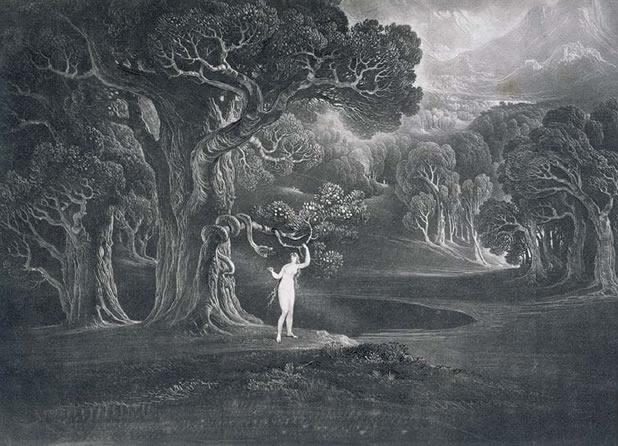
It comforts me to recall my view of the huge snow drifts across the runways, seated as I am now, a bit sweaty, typing these words, barefoot, clothed in shorts and a T shirt. I think of relatives recently returned from a Jamaica whose honeymoon photo gallery includes a shot of the two posed before a jungle of palm fronds with a great snake entwining them.

Daisy Fried quotes this out of Milton:
Of Man’s first disobedience and the fruit
Of that forbidden tree whose mortal taste
Brought death into the world and all our woe,
With loss of Eden, till one greater Man
Restore us and regain the blissful seat,
Sing, Heavenly Muse.
And then quotes on prof's supposed clarification of these supposedly mystifying words:
Tell the story, Heavenly Muse: of humankind’s first trespass, of forbidden fruit whose lethal taste brought death and sorrow to our world, and drove us out of Eden—until one greater human should redeem us and regain the happy place we lost.
She goes on —
God-awful enough to tempt me to try my own prose version:
Sing, Muse, of our first sin, the bite of the apple which brought death and woe to the world, and lost us paradise, which we won’t get back till Jesus Christ —
Worse than God-awful! But trying to make Milton idiomatic forced me to discover how necessary his language — syntactically Latinate, defiantly unidiomatic in his own time — is to meaning and to feeling in Paradise Lost.
Good for her!


{thunder cloud; source: www.abc.net.au}


{Angel Raphael visits Eden, from Milton's Paradise Lost. [John Martin, 1825]; source: roofhouse.com}


{Eve in the garden; source: jurisdynamics.blogspot.com}


{a birth helper — doula — as doulas should be; source: http://www.intuitivedoula.com/}

Tuesday, August 11, 2009

Life must go on

Last March, the New York Public Library staged an excellent Tribute to John Updike presented by his publisher, Alfred A. Knopf, and The New Yorker magazine which published most of his poems and many stories. All speakers but one are connected with those two organizations. The exception is his son, David, an author himself, who teaches English at Roxbury Community College, in Boston.

The reminiscences are touching, humorous, and — as you'd expect — literate. One alone addresses the side of Updike's work I most appreciate: his poetry. This speaker, Deborah Garrison, said "his poetry has a very special place for us as readers, I think, because in the poems we feel that the distinction between the speaker’s voice and John Updike himself dissolves and rightly or wrongly, we have a sense that we’re hearing directly from him as he contemplates earthworms or turning sixty-one or dream objects and we have a great sense of intimacy and for those of us who — for readers, of course, who would never meet him or those of us who were only privileged to meet him on occasion over the years in the city, this was a real gift to us, this sense of intimacy that we felt in the poems, that we were really hearing his own thoughts."
{Photo credit: Robert Spencer for The New York Times}

She read three poems: The Stunt Flier, Fine Point, and A Rescue. In this last one, Updike writes:
Today I wrote some words that will see print.
Maybe they will last ‘forever,’ in that
someone will read them, their ink making
a light scratch on his mind or hers.
He then tells a small anecdote of a time he rescued a bird from his garden shed —
Without much reflection, for once, I stepped
to where its panicked heart
was making commotion, the flared wings drumming,
and with clumsy soft hands
pinned it against a pane,
held loosely cupped
this agitated essence of the air,
and through the open door released it,
like a self-flung ball,
to all that lovely perishing outdoors.
She did not read my favorite, Aerie, which begins
By following many a color-coded corridor
and taking an elevator up through the heart of the hospital
amid patients with the indignant stare of parrots
from within their cages of drugs,
one can arrive at the barbershop . . .
Or his typically backhanded celebration of Pain which begins:
Pain flattens the world - its bubbles
of bliss, its epiphanies, its upright
sticks of day-to-day business -
and shows us what seriousness is.
And which includes this powerful image of those who try to help its sufferers:
. . . and women bring their engendering smiles
and eyes of famous mercy,
these kind things slide away
like rain beating on a filthy window
The tribute by his son is quoted in yesterday's New York Times: A Toast to the Visible World: Remembering John Updike. It shows Updike as a man at ease with himself, wearing his celebrity comfortably, enjoying the ordinary pleasures of life.

Updike's poetic images reveal connections between astounding artistic achievement and the commonplace elements of daily life. Here's the start of a close observation of some great paintings:
Gradations of Black

(Third Floor, Whitney Museum)

Ad Reinhardt's black, in Abstract Painting 33,
    seems atmosphere, leading the eye into
that darkness where, self-awakened, we
grope for the bathroom switch; no light comes on,
    but slowly we perceive the corners of his square
black canvas to be squares just barely brown.
. . .
I saw a painting in the same series — Reinhardt's "Abstract Painting No. 4" of 1961 — in the Westmoreland Museum of American Art on our return trip from a brief midwest holiday. Having — the day before — been delayed by a breakdown and some heavy traffic outside Chicago, our visit to this hilltop museum was a special delight.

The Reinhardt is a square painting which at first sight seems uniformly black, but, more closely inspected, shows itself to be made up of nine squares in shades of very dark greys and browns — as Updike tells us. View this reproduction in full-size to get the general idea.

{source: http://www.flickr.com/photos/dannydanh/ on flickr}

The show is a traveling exhibit called
Modern Masters from the Smithsonian American Art Museum. I liked all of it, in addition to the Reinhardt, particularly the Gottliebs and the paintings of Joan Mitchell, Helen Frankenthaler, and Grace Hartigan which aren't shown as often as those of their male counterparts.


{Image credit: Joan Mitchell, My Landscape II, 1967, oil, Smithsonian American Art Museum, Gift of Mr. and Mrs. David K. Anderson, Martha Jackson Memorial Collection; source: Westmoreland Museum}


{This is MoMa's black Reinhardt. Photo by "ListenMissy!" on Flickr via
http://www.preservationtoday.com/tag/education/}


Here are some images from the exhibit. Source: Westmoreland Museum of American Art

Click for Larger Image Click for Larger Image Click for Larger Image Click for Larger Image

Some links on the exhibit:


Addendum: During our travels we stayed in motels run by the Country Inn & Suites chain (which we liked). One of their amenities is a small library for guests to raid for evening reads. There I found the Collected Poems of Edna St. Vincent Millay containing this with its striking (and somewhat Updike-esque) final line:
LAMENT, by Edna St. Vincent Millay

Listen, children:
Your father is dead.
From his old coats
I'll make you little jackets;
I'll make you little trousers
From his old pants.
There'll be in his pockets
Things he used to put there,
Keys and pennies
Covered with tobacco;
Dan shall have the pennies
To save in his bank;
Anne shall have the keys
To make a pretty noise with.
Life must go on,
And the dead be forgotten;
Life must go on,
Though good men die;
Anne, eat your breakfast;
Dan, take your medicine;
Life must go on;
I forget just why.
{Image source: http://www.spartacus.schoolnet.co.uk/Jmillay.htm}


Disclaimer: The quotes on this page have all been made under fair use provisions of US copyright law.

Thursday, May 07, 2009

Margot Tennant meets Alfred Tennyson

The entry in Emerson's Journals on meeting Tennyson reminds me of this description from Margot Asquith's autobiography:
Tennyson was a magnificent creature to look at. He had everything: height, figure, carriage, features and expression. Added to this he had what George Meredith said of him to me, "the feminine hint to perfection." He greeted me by saying:

"Well, are you as clever and spurty as your sister Laura?"

I had never heard the word "spurty" before, nor indeed have I since. To answer this kind of frontal attack one has to be either saucy or servile; so I said nothing memorable. We sat down to tea and he asked me if I wanted him to dress for dinner, adding: "Your sister said of me, you know, that I was both untidy and dirty."

To which I replied: "Did you mind this?"

Tennyson : "I wondered if it was true. Do you think I'm dirty?"

Margot: "You are very handsome."

Tennyson : "I can see by that remark that you think I am. Very well then, I will dress for dinner. Have you read Jane Welsh Carlyle's letters?"

Margot: "Yes, I have, and I think them excellent. It seems a pity," I added, with the commonplace that is apt to overcome one in a first conversation with a man of eminence, "that they were ever married; with any one but each other, they might have been perfectly happy."

Tennyson: "I totally disagree with you. By any other arrangement four people would have been unhappy instead of two."

After this I went up to my room. The hours kept at Aldworth were peculiar; we dined early and after dinner the poet went to bed. At ten o'clock he came downstairs and, if asked, would read his poetry to the company till past midnight.

I dressed for dinner with great care that first night and, placing myself next to him when he came down, I asked him to read out loud to me.

Tennyson: "What do you want me to read?"

Margot: "Maud."

Tennyson: "That was the poem I was cursed for writing! When it came out no word was bad enough for me! I was a blackguard, a ruffian and an atheist! You will live to have as great a contempt for literary critics and the public as I have, my child!"

While he was speaking, I found on the floor, among piles of books, a small copy of Maud, a shilling volume, bound in blue paper. I put it into his hands and, pulling the lamp nearer him, he began to read.

There is only one man — a poet also — who reads as my host did; and that is my beloved friend, Professor Gilbert Murray. When I first heard him at Oxford, I closed my eyes and felt as if the old poet were with me again.

Tennyson's reading had the lilt, the tenderness and the rhythm that makes music in the soul. It was neither singing, nor chanting, nor speaking, but a subtle mixture of the three; and the effect upon me was one of haunting harmonies that left me profoundly moved.

He began, "Birds in the high Hall-garden," and, skipping the next four sections, went on to, "I have led her home, my love, my only friend," and ended with:
There has fallen a splendid tear
         From the passion-flower at the gate.
She is coming, my dove, my dear.
         She is coming, my life, my fate;
The red rose cries, "She is near, she is near;"
         And the white rose weeps, "She is late;"
The larkspur hstens, "I hear, I hear;"
         And the lily whispers, "I wait."

She is coming, my own, my sweet ;
         Were it ever so airy a tread,
My heart would hear her and beat,
         Were it earth in an earthly bed;
My dust would hear her and beat.
         Had I lain for a century dead;
Would start and tremble under her feet.
         And blossom in purple and red.

When he had finished, he pulled me on to his knee and said: "Many may have written as well as that, but nothing that ever sounded so well!"

I could not speak.

He then told us that he had had an unfortunate experience with a young lady to whom he was reading Maud. "She was sitting on my knee," he said, "as you are doing now, and after reading,
Birds in the high Hall-garden
When twilight was falling,
Maud, Maud, Maud, Maud,
They were crying and calling.
I asked her what bird she thought I meant. She said, "A nightingale." This made me so angry that I nearly flung her to the ground: 'No, fool! . . . Rook!' said I."

I got up, feeling rather sorry for the young lady, but was so afraid he was going to stop reading that I quickly opened The Princess and put it into his hands, and he went on.

I still possess the little Maud, bound in its blue paper cover, out of which he read to us, with my name written in it by Tennyson.

The morning after my arrival I was invited by our host to go for a walk with him, which flattered me very much; but after walking at a great pace over rough ground for two hours I regretted my vanity. Except my brother Glenconner I never met such an easy mover. The most characteristic feature left on my mind of that walk was Tennyson's appreciation of other poets.


Some sources:
An autobiography by Margot Asquith (Doran & Co. 1920)

Maud, by Alfred Tennyson (E. Moxon & co., 1859)

The Princess by Alfred Tennyson (E. Moxon & co., 1859)

Emerson meets Tennyson

From the Journals of Ralph Waldo Emerson:
[ca. May 7 1848]        


I saw Tennyson, first, at the house of Coventry Patmore, where we dined together [on May 5]. His friend Brookfield was also of the party. I was contented with him, at once. He is tall, scholastic-looking, no dandy, but a great deal of plain strength about him, and though cultivated, quite unaffected; quiet, sluggish sense and strength, refined, as all English are, and good-humoured. The print of his head in Homes book is too rounded and handsome. There is in him an air of general superiority, that is very satisfactory. He lives very much with his college set, Spedding, Brookfield, Hallam, Rice, and the rest, and has the air of one who is accustomed to be petted and indulged by those he lives with, like George Bradford. Take away Hawthorne's bashfulness, and let him talk easily and fast, and you would have a pretty good Tennyson.

He has just come home from Ireland, where he had seen much vaporing of the Irish youth against England, and described a scene in some tavern, I think, where a hot young man was flourishing a drawn sword, and swearing that he would drive it to the hilt into the flesh and blood of Englishmen. Tennyson was disgusted, and going up to the young man, took out his penknife, and offered it to him. "I am an Englishman," he said, "and there is my penknife, and, you know, you will not so much as stick that into me." The youth was disconcerted and said he knew he was not an Englishman. "Yes, but I am." Hereupon the companions of the youth interfered, and apologized for him, he had been in drink and was excited, etc.

Tennyson talked of Carlyle, and said, "If Carlyle thinks the Christian religion has lost all vitality, he is wholly mistaken." Tennyson and all Carlyle's friends feel the caprice and incongruity of his opinions. He talked of London as a place to take the nonsense out of a man.

It is his brother, Tennyson Turner, who wrote the verses which Wordsworth praised.

When Festus was spoken of, I said that a poem must be made up of little poems, but that in Festus were no single good lines; you could not quote one line. Tennyson quoted
There came a hand between the sun and us, And its five fingers made five nights in air.
After dinner, Brookfield insisted that we should go to his house, so we stopped an omnibus, and, not finding room inside for all three, Tennyson rode on the box, and B. and I within. Brookfield, knowing that I was going to France, told me that, if I wanted him, Tennyson would go. "That is the way we do with him," he said. "We tell him he must go and he goes. But you will find him heavy to carry."

At Brookfield's house we found young Hallam, with Mrs. Brookfield, a very pleasing woman. I told Tennyson that I heard from his friends very good accounts of him, and I and they were persuaded that it was important to his health, an instant visit to Paris; and that I was to go on Monday, if he was ready. He was very good-humoured, and affected to think that I should never come back alive from France, it was death to go. But he had been looking for two years for somebody to go to Italy with, and was ready to set out at once, if I would go there. I was tempted, of course, to pronounce for Italy; but now I had agreed to give my course in London. He gave me a cordial invitation to his lodgings (in Buckingham Place), where I promised to visit him before I went away.

On [the next day?] I found him at home in his lodgings, but with him was a Church clergy man, whose name I did not know, and there was no conversation. He was sure, again, that he was taking a final farewell of me, as I was going among the French bullets, but promised to be in the same lodgings, if I should escape alive after my three weeks in Paris. So we parted. I spent a month in Paris, and, when I returned, he had left London.[added later]

Carlyle describes him as staying in London through a course of eight o'clock dinners every night for months until he is thoroughly fevered. Then, notice is given to one of his friends, as lately to Aubrey de Vere, who has a fine estate in Ireland (thirty miles from Limerick), to come and carry him off bodily. Tennyson had capitulated, on three conditions: first, that he should not hear anything about Irish distress; second, that he should not come downstairs to breakfast; third, that he might smoke in the house. I think these were the three. So poor Tennyson, who had been in the worst way, but had not force enough to choose where to go, and so sat still, was now disposed of.

Tennyson was in plain black suit and wears glasses. Carlyle thinks him the best man in England to smoke a pipe with, and used to see him much; had a place in his little garden, on the wall, where Tennyson's pipe was laid up. He has other brothers, I believe, besides Tennyson Turner, the elder; and, I remember, Carlyle told me with glee some story of one of them, who looked like Alfred, and whom some friend, coming in, found lying on the sofa and addressed him, "Ah, Alfred, I am glad to see you," and he said, "I am not Alfred, I am Septimus; I am the most morbid of all the Tennysons."

I suppose he is self-indulgent and a little spoiled and selfish by the warm and universal favor he has found. Lady Duff Gordon told me that the first day she saw him he lay his whole length on the carpet, and rolled himself to her feet and said, "Will you please to put your feet on me for a stool." Coventry Patmore described him as very capricious and as once spending the evening with a dozen friends, "not, to be sure, his equals, but as nearly his equals as any that could be collected." Yet Tennyson would not say a word, but sat with his pipe, silent, and at last said, "I am going to Cheltenham; I have had a glut of men." When he himself proposed, one day, to read Tennyson a poem which he had just finished, that Tennyson might tell him of anything which his taste would exclude, Tennyson replied, "Mr. Patmore,you have no idea how many applications of this sort are made to me."

Dr. T. P. Shepherd, of Providence, who travelled in the East with W. Stirling, told me that he met Tennyson at a hotel in Amsterdam, and lived there a fortnight with him, not knowing his name, but riding out with him to see the environs, and meeting at the table d'hote. He set his servant to ascertain from Tennyson's servant his master's name; but the man was only a valet de place, and did not know; for Tennyson scrupulously concealed his name, and got into trouble with the police about his passport. Dr. Shepherd thought he must be Carlyle, from the strength and brilliancy of his conversation, until he spoke of Carlyle. One day, however, he recited the "Moated Grange," and inquired of Dr. Shepherd if they liked such verses in America. Dr. Shepherd replied, yes, he knew the verses; they were by Tennyson, and, though he could not say they were widely known, yet they had a very cordial troop of admirers in the United States. "Well," replied the other, "I am Tennyson." And thereafter their acquaintance was intimate, and he made Dr. Shepherd promise to visit him in England. But when Dr. Shepherd was in England, and inquired for him, he found, he said, that he was in a kind of retreat for the sane, which they keep there, and so saw him not.

Mr. Sylvester told me that Mr. Farie could draw a model of any loom or machine after once seeing it, for Rees's Cyclopaedia, and did so in the Strutt's mills.

Mr. Hallam asked me, at Lord Ashburton's, "Whether Swedenborg were all mad, or partly knave?" He knew nothing of Thomas Taylor, nor did Milman, nor any Englishman.


{Tennyson as a young man; source: Twickenham Museum}


{Coventry Patmore; source: famouspoetsandpoems.com}


William Henry Brookfield entry in wikipedia


James Spedding entry in wikipedia

Arthur Hallam entry in wikipedia


{Henry Hallam; source: today in literature}


Festus, a poem by the English poet Philip James Bailey - wikipedia entry

Festus, by Philip James Bailey (text)

Aubrey Thomas De Vere, entry in the Britannica 11th ed.


Some sources:

Journals Of Ralph Waldo Emerson 1820-1872, with Annotations, edited by Edward Waldo Emerson and Waldo Emerson Forbes; Vol. VII, 1845-1848 (London, Constable & Co.; Boston And New York Houghton Mifflin Company, 1913)

Journals Of Ralph Waldo Emerson 1820-1872, with Annotations, edited by Edward Waldo Emerson and Waldo Emerson Forbes; Vol. VII, 1845-1848, (New York, Houghton Mifflin Company, 1912)