Showing posts with label Dorothea Lange. Show all posts

Thursday, November 01, 2012

Harvesting Oats


{Click image to enlarge. Caption: Harvesting oats. Clayton, Indiana, south of Indianapolis, by Dorothea Lange for the Farm Security Administration; source: FSA/OWI Collection of the Prints and Photographs Division , Library of Congress}

During the mid-1930s dust-bowl drought and in record-setting heat Dorothea Lange took her Rollei on assignment to an Indiana farm. The month of July in 1936 was the hottest on record in and around Clayton, Indiana. She traveled there for her employer, the Farm Security Administration, to photograph an oat harvest.

Her photos show farming in a period of transition. The farmers obtained most of the power they needed from horses and their own muscles but they would bring in power equipment at harvest time. The equipment would be cooperatively purchased and maintained among local farmers or one farmer would own and rent it. The power source would be an engine, probably a self-propelled one like the modern tractor. The engine would power a thresher which separated the oats from the stalks on which they grew. The photos show the thresher but not the engine and it's evident that Lange wasn't much interested in machines but rather the men and horses.

Oats were harvested like other grains. The oat plants would be mowed down and bundled then threshed to separate seed from stalk. This mowing and bundling had already been done when Lange arrived. Her photos show the oat plants being loaded to horse-drawn wagons and brought to the thresher where they're forked into the receiving end. The thresher pounds the plants to loosen the seed which then drops to a receiving chamber. From there it's augured up and out to a receiving wagon. The cut up stalks are blown out to make a vast pile in the field where the work is being done.

The oats — the seeds of the oat plant — are used in making beer, in cereal for breakfast, and as feed for horses and other livestock. The cut up stalks are strewn in animal stalls. Because of drought and heat this is not a good year for oats but you can't tell that from the photos.

The following photos are all captioned either "Harvesting oats. Clayton, Indiana, south of Indianapolis" or "The threshing of oats. Clayton, Indiana, south of Indianapolis." Lange took them all in the same photo-shoot and they're typically excellent as documentary record, human study, and photographic art. As with the first, they all come from the FSA/OWI Collection of the Prints and Photographs Division , Library of Congress.


Bundles of oats were tossed into the mouth of the thresher (also called a separator). A 1979 article describes the process:
A chain operated feeder fed the bundles into rapidly moving arms which cut the string tie from the bundles and spread the stalks of grain going into the giant stomach of the old separator.

As the stalks of grain moved into the machine a cylinder beat the grain from the stalks and a huge blower blew the straw from the grain.

The straw went flying out the blower and the grain was augered from the bowels of the machine.
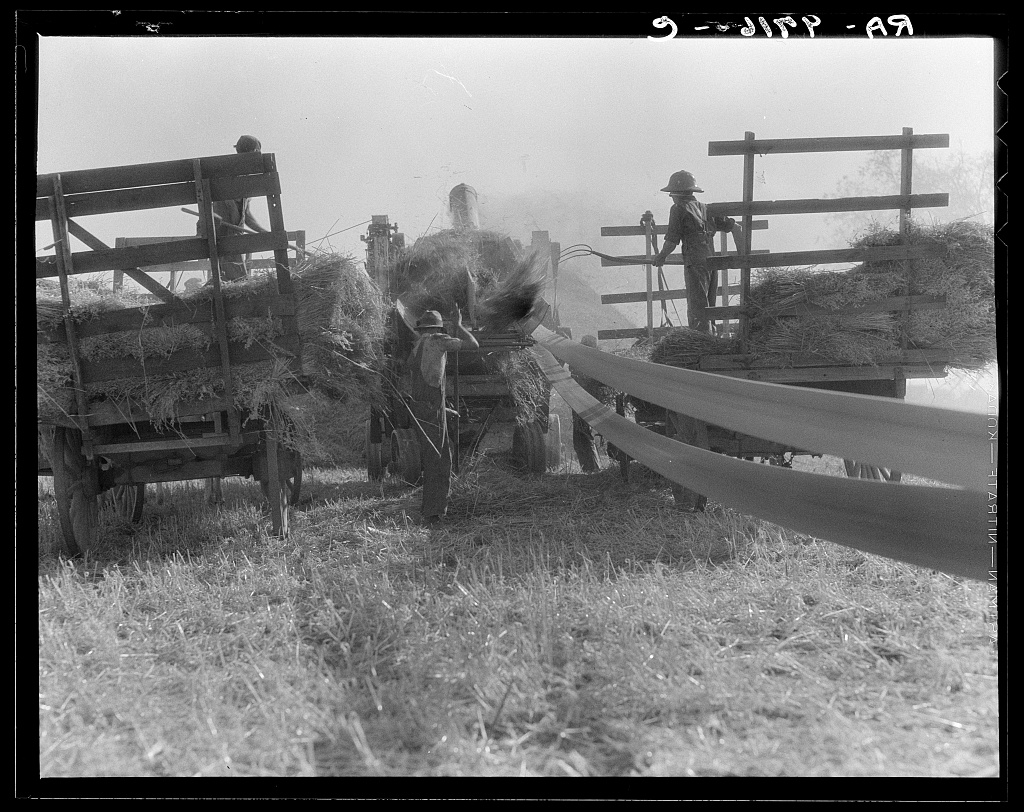


The engine powers the thresher by means a long, wide belt made of canvas or leather. The whole process is dangerous to men and horses alike but the belt is particularly hazardous. If it breaks in opeation it whips around at great speed causing serious injury wherever it strikes flesh.


This photo and the one that follows show part of the augur mechanism for transporting the oats from the belly of the thresher to a waiting wagon.


In addition to the augur this shows a pipe, at left, from which the stalks are expelled.


------

This video shows theshing in action. The tractor is modern but the thresher itself is authentically 1930s.


This image shows the type of tractor used in 1930s oat threshing.


{Men threshing oats in 1930's, Mississippi Digital Library}

These are hop seeds.


{Source: 99 Facts About Beer On the Wall... by Jennifer Daniel in Business Week, October 25, 2012}

The camera Lange used for this shoot was a Rollieflex Standard. This shows this medium format camera (6x6 cm) and her large format one (4x5").


{Dorothea Lange's cameras -- Graphix series D and Rolleiflex; source: womensconference.org}

This is a Rollieflex Standard, much like the one she used.


{Standard Rolleiflex Model 6RF 621 1933 with lens hood. Franke and Heidecke's second design for a 6X6 twin lens refex camera, it has all the features that the Rollei twin lens camera's were going to have for the next 50 years. The lens hood is the original Rollei item. Source: dave_dockerill on flickr (the caption is his).}

This shows pages 2-3 of the Instruction Manual for the Rolleiflex Standard.


This shows Lange using her Rollie to photograph a migrant laborer in 1937.


{Dorothea Lange taking a photograph of a agricultural worker. 1937. Rondal Partridge. Source: Daring to Look, Dorothea Lange’s Photographs and Reports from the Field, by Anne Whiston Spirn (U of Chicago Press, 2008)}

------------

Some sources:

Harvesting oats - yesteryear style! by Jan Lee Buxengard in the Spring Grove Herald (Minnesota)
Extract: "Bundles were loaded onto the wagons and brought to the belt-driven threshing machine, which was powered by a tractor. Workers forked the bundles into the machine, heads first. Sharp sickle knives/blades cut the twine. As the bundle moves into the machine, it goes through concave cylinders that loosen the oats from the stem. Then it goes onto the shaker that walks the straw back to the blower and onto the straw pile. Meanwhile, the oats and chaff fall to the bottom of the machine and onto an auger and to the side where an elevator brings the oats up to the hopper to be weighed. At each quarter bushel, the hopper dumps the oats into an auger that takes it to the wagon."

Survivor of 1936 drought recalls conditions by Bob Buttgen, The News Sun, Monday, July 16, 2012
Excerpt:
WAWAKA, Ind. (AP) Tom Franks was 15 years old in 1936, the year that Indiana and much of the country suffered through a severe drought that spawned the Dust Bowl era in many parts of America.Now, at the age of 91, Franks still can recall the horrible conditions his family had to endure on their 77-acre farm in Wawaka.

"The corn only got to about 3 feet high, and with no water available, it just turned brown," he said. "Back then, we didn't plant corn until the first of June, because of the chance of frost and freeze. I can still see that short corn and how brown it got. Just like it's going to get this year if we don't get any rain."

Franks said his parents, Frank and Vida Franks, had six daughters and one son, William Thomas Franks. "I was fifth in line," he said.

Franks has lived an extraordinary life. Living through the drought as a teenager is just one of many trials for the man who is a hero in many respects.

Along with his many years in farming, he's a decorated World War II veteran who was presented with the Bronze Star and two Purple Hearts. Twice he was shot by German soldiers in Europe, and each time he went back to the front lines after being patched up.

He's been widowed twice and survived prostate cancer, open-heart surgery and a hip replacement.

"I've pretty much outlived my friends and my enemies," he said with a well-earned chuckle.

"Our farm had just about everything back then," he said of the 1930s. "We grew red clover, oats, corn and wheat. We didn't know anything about soybeans back then. We didn't have beef cattle but had dairy cows. There were lots of ducks, geese and turkeys that had the run of the yard. We had 10 cows and probably 100 laying hens, plus four sows and a few ewes.

"I know it was dry back then, but I don't remember us having the heat like we've had this summer," he said.

(According to the National Weather Service, the highest temperature ever recorded in Indiana came during the summer of 1936, when Collegeville recorded 116 degrees.)

The Frankses didn't have electricity in 1936, and there were plenty of chores to keep a teenage boy busy.

"One thing they never taught me was how to milk a cow, and I didn't mind not knowing that," he said with a grin.

Franks has lived his entire life within a mile or so from the farm where he grew up. These days, at 91, his mind is as sharp as a tack. He's still active, having attended Wawaka High School's class reunion back in June.

"We had 21 in our class, and that was the biggest class ever, up to that time," he said. "I think there's just three of us who are still around."

Farming was much simpler back then, he recalled.

"We hadn't heard of hybrid corn yet. We just had open-pollinated corn. You'd go out in the field and pick the best ears you could find for seed the next year. You didn't have any seed salesman coming around," he said.

"Dad had a Fortson tractor. It was a hard-starting thing. You had to crank the handle just right to get it to spark and get out the way when it kicked back. I remember he traded that in on a 1020 International, and later traded that one in for a Farmall F-20," he said. "They paved U.S. 6 back in '33 or '34. Our tractor had big lugs on it, and we'd have to cover them up if we were going to drive on the pavement very far.

"We also had a big team of horses, and I enjoyed working those horses. But I also enjoyed driving our tractors. Our red clover crop was planted back in February. We would make hay out of it, and the clover made it through the spring before the drought hit that summer.

"Mom had a yard garden and grew Navy beans and potatoes. We always had a basement full of potatoes in the fall. After we harvested the Navy beans, we would stomp on them to open them up and let the wind blow away the chaff.

"We had a well that was real shallow, probably only had to go down 15 feet or so to get water. I remember we had to pump the water out with a hand pump, but eventually we got a windmill that would run the pump for us," Franks said.

"Back then, we didn't realize how hard it was for my parents and what they were going through," he recalled. "We were just coming out of the Depression. I can still remember the day after the banks closed (in 1929). Dad came back from going to bank in town, and he told us there was no money. I still remember the look of panic on my mother's face. I will never forget that.

"Dad was one of the lucky ones; he had a job driving kids to school, and that brought us a little extra money," he said. "We didn't have too much money to spend, but we had parents who loved us, and that was enough for us."

The Impact of the 1936 Corn-Belt Drought on American Farmers’ Adoption of Hybrid Corn by Richard Sutch (University of California, Riverside and the National Bureau of Economic Research, Draft of January 6, 2010) (pdf)
Extract: "A severe and sustained drought struck central North America during the 1930s. Centered on eastern Kansas, it extended north into the Canadian prairies, east to the Illinois- Indiana boarder, south to the Gulf of Mexico, and west into Montana and Idaho. See Figure 1. The seven-year period of low rainfall and high temperatures, 1932-1938, was unprecedented in the memory of the Euro-Americans who inhabited the region in its extent, severity, and duration. It has been described by climate scientists as ―one of the most severe environmental catastrophes in U.S. history [Schubert et al, 2004: 1855]. The period is best remembered for the ―Dust Bowl conditions created on the panhandles of Texas and Oklahoma, and adjacent parts of New Mexico, Colorado, and Kansas."

1930's: Threshing Wheat with a Threshing Machine was a Fun Time on the Farm, Work Horses Were Very Important on Small Farms in the 1930's, by Stewart Lodge, Yahoo! Contributor Network
Extract: "No threshing day story would be complete without mention of the noon meal. The neighborhood farmers who brought their horses and wagons would also bring their wives. The wives would all bring their favorite homemade pies or cakes. Then they would stay and help cook all the meat and vegetable dishes. The cooking was done on a wood stove with a room temperature of 120 degrees or more. The workers all had very large appetites, but it was almost impossible to sample all the many dishes. The hard part was trying to work so soon after such a tremendous meal. This ritual was repeated several times as you traveled to all your neighbors' farms to repay them for their help. Each wife tried to outdo the others. It is no wonder that threshing day dinners were legendary."

FSA Photographs in Indiana,
Program of Digital Scholarship, University Library, IUPUI

Back home again: Indiana in the Farm Security Administration photographs, 1935-1943, by Robert L. Reid, United States. Farm Security Administration (Indiana University Press, 1987)

Annual Crop Summary, 1936, Indiana Crops and Livestock, US Department of Agriculture, Bureau of Agricultural Economics (pdf)

Maximum and Minimum Temperatures in Indiana, Indiana State Climate Office, Purdue University

THRESHING OATS CHALLENGES MEN AND OLD MACHINES by Bob Harrington on farmcollector.com

99 Facts About Beer On the Wall... by Jennifer Daniel in Business Week, October 25, 2012

It's Global Warming, Stupid by Paul M. Barrett in Business Week on November 01, 2012
Extract: "This July was the hottest month recorded in the U.S. since record-keeping began in 1895, according to the National Oceanic and Atmospheric Administration. The U.S. Drought Monitor reported that two-thirds of the continental U.S. suffered drought conditions this summer."

Rolleiflex (standard) in camerapedia.wikia

The first Rolleiflex cameras on roleiclub.com

Economy of Indiana in wikipedia

1936 North American heat wave in wikipedia

Graphlex Series D Camera

Rollieflex Camera on wikipedia


Sunday, March 13, 2011

make me a pallet


Mississippi John Hurt, Make Me a Pallet on Your Floor
I've been listening to this over and over. Like good poetry it gains from repeated hearings. As others have pointed out, this is not mean blues, it's graceful, subtle, and sweet. The music is more complex than at first it seems. The voice is whiskey mellow and the phrasing is relaxed rather than intense.

Although this recording is an old friend, it hasn't lost any of its appeal through familiarity. I first heard John Hurt sing it back in 1964 when a bunch of us drove to Newport for the Blues Festival. With crowds of other happy people we slept on the beach, ate hot dogs, and soaked up music. As it happens you can find me in a photo of the audience listing to John Hurt that memorable time. The image appears on the sleeves of the LP record set that Vanguard issued some months later and it looks like this.

I'm located at about 11 o'clock next to my brother, by two college classmates, and behind my best friend and suitemate.


Mississippi John Hurt had a face that showed his soft-spoken gentleness and dignified, poised bearing. To me it also showed his resilience, something of the hardships he'd endured, and the patient endurance often seen in photos that show sharecroppers of his generation.

{image source: mleddy.blogspot.com}


{source: Ordinary finds}


{source: delta-slider.blogspot.com}

He was a field hand, later a share-cropper in a tiny hamlet called Avalon, Mississippi. Hardly anything remains of Avalon today. There had to be a country store because, with just a mule-drawn wagon or their own feet for transportation, most share-croppers couldn't survive without one, and the remains of that store can still be found in Avalon. There's hardly anything else — a few houses plus his old home, now the Mississippi John Hurt Museum which looks like this.

{museum: msjohnhurtmuseum.com}

Like most institutions in the Jim-Crow South, farming on shares was exploitive, but, within that harsh environment, it was also a repository of many rural virtues. Share-croppers could easily move their few possessions from one shack to another, seeking better land, better land-owners, better contracts regarding the provisions needed before planting and the division of proceeds after the crop was in. The work required families to work together, each member except the very youngest taking part in running their borrowed bit of farmstead. Having little or no money they bartered and, in hard times, tended to give one another unselfish communal support.

There were many men and women who grew up with memories of rich black soil warming their bare feet and hot sunshine making intense shadows in the crop rows as they hoed out weeds or picked off weevils. And many of them felt privileged to have lived through that time despite the recurrent periods of suffering they were forced to endure.[1] Hurt himself turned down opportunities to leave saying he "just never wanted to get away from home."[2] Though hours were long, the life was not one of unrelenting work. When very young, Hurt found time to teach himself to play a borrowed guitar and later developed his skill while doing music for Saturday night dances near home. Once "discovered" and recorded, he spent time in cities and festivals like the one I attended, but always returned home and, at the end of his life, died in Avalon as he had long lived there.

The lyrics to Make Me a Pallet give you no sense of the art he brings to their expression. The story is fairly routine in the country blues genre — a man and woman together, each seeking to hide from a jealous lover — but there's nothing salacious in Hurt's treatment of the theme. He asks for comfort not ecstasy. He's tired and will be happy to be bedded down low, warm and safe, away from cold sleet and snow. He wants to keep close, to be kept close.

Hurt uses the song's broad vowel sounds to express a longing for a temporary refuge. He makes wonderful use of its long "o" sounds — low, door, and floor, along with more, snow, and go. The repeated sounds, words, and phrases subtly alter with each iteration. In its many variations, the word me attains something special that I find difficult to express, particularly when held, as they are in the last two lines of the chorus.
Make Me A Pallet On Your Floor

Mississippi John Hurt

Make me down a pallet on your floor
Make me down
Make me a pallet down soft and low
Make me a pallet on your floor

Up the country forty miles or more
I'm goin up the country while there's cold sleet and snow
No telling how much further I may go

Just make me down
Make me down
Make me a pallet down soft and low
Make me a pallet on your floor

Well, sleeping, my back and shoulders tired
The way I'm sleeping my back and shoulders tired
Gonna turn over and try it on the side

Oh make me down
Make me down
Make me a pallet down soft and low
Make me a pallet on your floor

Don't you let my good girl catch you here
Don't let my good girl catch you here
Oh she might shoot you, like to cut and starve you too
No tellin what she might do

Yes make me down
Make me down
Make me a pallet down soft and low
Make me a pallet on your floor

Make it baby close behind your door
Make me a pallet close behind your door
Make it where your good man'll never go

Oh make me down
Make me down
Make me a pallet on your floor
-----------

Here are some photos that Dorothea Lange and Marion Post Wolcott took for the Farm Security Administration between 1936 and 1939. All come from collections in the Prints and Photos Division of the Library of Congress.


{Mississippi Delta Negro children by Dorothea Lange, 1936 July}


{Sharecropper's cabin and sharecropper's wife, ten miles south of Jackson, Mississippi, by Dorothea Lange, 1937 June}


{Negro sharecropper and wife. Mississippi. They have no tools, stock, equipment, or garden. By Dorothea Lange, 1937 June-July}


{Feet of Negro cotton hoer near Clarksdale, Mississippi, by Dorothea Lange, 1937 June}


{Negroes fishing in creek near cotton plantations outside Belzoni, Mississippi, by Marion Post Wolcott, 1939 Oct}

-------------

Notes:

[1] I've done a number of blog posts on aspects of share-cropping, including these: [2] The quote is given in the wikipedia article on MJH. It is taken from Lawrence Cohen's essay accompaying Avalon Blues: The Complete 1928 Okeh Recordings. (Columbia/Legacy, CD, 1996)

Friday, May 28, 2010

forced internment of 1942

Here are more photos of war relocation -- the forced migration to rural internment camps of Americans of Japanese Ancestry from West Coast states of the US. My main source is the Japanese American Relocation Digital Archive of the University of California. There are lots of good images on this site and also in Linda Gordon's article on Worldpress.org: Internment Without Charges: Dorothea Lange and the Censored Images of Japanese American Internment and in an online exhibit of the Smithsonian Museum of American History: Japanese Americans and the U.S. Constitution .

Unless otherwise noted, all the images I show here are by Dorothea Lange and are found in collections of the Bancroft Library, University of California, Berkeley. Lange probably also wrote the captions that appear with her photos. As I explained in yesterday's post, she had taken a job with War Relocation Authority and was instructed to show the internment program in a positive light. Within the constraints placed upon her she succeeded in giving a much more balanced depiction of the program, including many of its injustices and the patient endurance of those who suffered under it.

To give a broader context, I've intermixed other images along with Lange's photos and put all in roughly chronological order.


{Caption: Henry Mitarai, age 36, successful large-scale farm operator with his family on their ranch about six weeks before evacuation. This family, along with other families of Japanese ancestry, will spend the duration at War Relocation Authority centers. -- Mountain View, California. 3/30/42}


{Caption: Wash-day 48 hours before evacuation of persons of Japanese ancestry from this farming community in Santa Clara County. Evacuees will be housed in War Relocation Authority centers for the duration. -- San Lorenzo, California. 5/5/42}


{Caption: Florin, Calif.--Businesses are being sold by owners of Japanese ancestry. Evacuation of all residents of Japanese descent from this area is due in two days. -- Florin, California. 5/11/42}


{Caption: Yugoslavian farmer is taking over berry farm formerly operated by residents of Japanese ancestry, who are being sent to assembly points and later to be housed in War Relocation Authority centers for the duration. -- Centerville, California. 4/18/42}


{Caption: Awaiting evacuation bus. Posters in background list names of families, buses to which they are assigned, and departure times. Evacuees of Japanese ancestry will be housed in War Relocation Authority centers for the duration. -- Centerville, California. 5/9/42}


{Caption: Hayward, Calif.--A young member of an evacuee family awaiting evacuation bus. Evacuees of Japanese ancestry will be housed in War Relocation Authority centers for the duration. -- Hayward, California. 5/8/42}


{Caption: This girl, who worked as a strawberry picker on an Alameda County farm, awaits evacuation bus. Evacuees of Japanese ancestry will be housed in War Relocation Authority centers for the duration. -- Centerville, California. 5/9/42}


{Caption: Hayward, Calif. -- Grandfather and grandchildren awaiting evacuation bus. The grandfather conducted a dyeing and cleaning business. The family unit is preserved during the evacuation and at War Relocation Authority centers where evacuees of Japanese ancestry will be housed for the duration. -- Hayward, California. 5/8/42}


{Caption: US WWI veteran proudly wearing his uniform as staff member accounts for him at Santa Anita assembly center for persons of Japanese ancestry evacuated from West Coast, Arcadia, CA, US - April 05, 1942; this photo appeared in LIFE magazine and comes from the Life photo archive.}


{Caption: San Francisco, Calif., Apr. 1942--Residents, of Japanese ancestry, appearing at the Civil control station for registration in response to the Army's exclusion order No. 20--The evacuees will be housed in War relocation authority centers for the duration}


{Caption: San Pedro, Calif. Apr. 1942--Residents of Japanese ancestry being moved from Los Angeles harbor before their eventual resettlement in war relocation authority centers}


{Caption: Take Fresh Air? (Fresh Air Break on the Trip from Fresno to Jerome); painted in 1957 by Henry Sugimoto; source: Japanese American National Museum (Los Angeles, Calif.)}


{Caption: Hayward, Calif.--Two children of the Mochida family who, with their parents, are awaiting evacuation bus. The youngster on the right holds a sandwich given her by one of a group of women who were present from a local church. The family unit is kept intact during evacuation and at War Relocation Authority centers where evacuees of Japanese ancestry will be housed for the duration. 5/8/42}


{Caption: Persons of Japanese ancestry arrive at the Santa Anita Assembly Center from San Pedro. Evacuees lived at this center at the former Santa Anita race track before being moved inland to relocation centers. Photographer: Clem Albers, Arcadia, CA, April 5, 1942. Source: National Archives, 210-G-3B-414.}


{Caption: Manzanar, Calif.--Newcomers move into Manzanar, a War Relocation Authority center for evacuees of Japanese ancestry. -- Photographer: Clem Albers. 4/2/42; source: Bancroft Library}


{Caption: Manzanar, Calif.--Grandfather of Japanese ancestry teaching his little grandson to walk at this War Relocation Authority center for evacuees. 7/3/42}


{Caption: Manzanar, Calif.--Far end of barrack row looking west to the desert beyond with the mountains in the background. Evacuees at this War Relocation Authority center are encountering the terrific desert heat. 7/2/42}


{Caption: Supper time! Meal times are the big events of the day within an assembly center. This is a line-up of evacuees waiting for the B shift at 5:45 P.M. They carry with them their own dishes and cutlery in bags to protect them from the dust. They, themselves, individually wash their own dishes after each meal, since dish washing facilities in the mess halls prove inadequate. Most of the residents prefer this second shift because they sometimes get second helpings, but the groups are rotated each week. There are eighteen mess halls in camp which, together, accommodate 8,000 persons three times each day. All food is prepared and served by evacuees. -- San Bruno, California. 6/16/42}


{Caption: Dinner is served cafeteria style to young and old in the mess halls at the Heart Mountain Relocation Center. -- Photographer: Tom Parker -- Heart Mountain, Wyoming. 9/23/42; source: Bancroft Library}


{Caption: One of the young Heart Mountain school children is enjoying a swing on the center's play ground. -- Photographer: Hikaru Iwasaki -- Heart Mountain, Wyoming. 11/24/43; source: Bancroft Library}


{Caption: T/4 Taniguchi visits his wife and daughter at the Minidoka Relocation Center before returning to his unit in the Pacific. Taniguchi volunteered for the Army in 1942 when he and his family were at Tule Lake before it became a segregation center. He served in the China-Burma-India theatre and served on loan to General Wingate's Chindits, a British unit fighting in the Burma Jungles often behind Japanese lines. -- Hunt, Idaho. March 1943}


{Caption: Send Off Husband at Jerome Camp painted in 1943 by Henry Sugimoto; source: Japanese American National Museum}


{Arcadia, California. Military police on duty in watch-tower at Santa Anita Park assembly center for evacuees of Japanese ancestry. Evacuees are transferred later to War Relocation Authority centers for the duration. 6 April 1942; Photo by Clem Albers; source: National Archives}


{Caption: Manzanar, Calif.--Karl Yoneda, Block Leader at this War Relocation Authority center for evacuees of Japanese ancestry. He is married to a Caucasian and they have a child four years old. The family are spending the duration at this center. Former occupation: Longshoreman. 7/3/42}


{Caption: At home at Heart Mountain, painted in December 1942 by Estelle Ishigo; source: Dept of Special Collections/UCLA Library}


{Caption: Reverend Yamazaki Was Beaten in Camp Jerome, painted in 1943 by Henry Sugimoto; source: Japanese American National Museum}


{Caption: Freedom Day Came painted in 1945 by Henry Sugimoto at Camp Jerome; source:
Japanese American National Museum }


{Mr. George Oni and his daughter Georgette Chize Oni biding farewell to brother Henry Oni. 7 February 1946; source: National Archives}


{Caption: Roaring into Sacramento Monday morning, July 30, a special train of seven cars brought some 450 Japanese American residents of California back to their homes after residences of over three years at the Rohwer Center of the War Relocation Authority, McGehee, Arkansas. Met by several officers of the WRA at Sacramento, Robert Allison, Assistant Relocation Officer at the Rohwer Center, who accompanied the returnees and all the passengers, reported a satisfactory and uneventful trip during the 2,000 miles, over lines of four railways and with equipment varying from a fairly modern cafe car to antiquated wooden coaches of the gaslight era. However, there were no complaints from the returnees, numbering young, old, and babies in arms, with a tourist sleeper reserved for the aged and a few who were ill. En route several crowded troop trains, in some cases bearing G.I.'s back from the South Pacific, were met by the Rohwer Special on sidings. All reported that hearty and cordial greetings were exchanged. Disembarking at various stations between Sacramento and Los Angeles, the returnees found many friends to greet them, both Caucasian and Japanese Americans. The unanimous verdict? We're glad to get home! -- Photographer: Hikaru Iwasaki -- Los Angeles, California. 7/30/45; source: Bancroft Library}

See also:

Relocation and Incarceration of Japanese Americans During World War II

Japanese American Relocation Digital Archive

Japanese Americans and the U.S. Constitution Smithsonian Museum of American History

Internment Without Charges: Dorothea Lange and the Censored Images of Japanese American Internment by Linda Gordon (Japan Focus, December 4, 2006)

The Preservation of a People: A Look at the Evacuation and Relocation of the People of Japanese Ancestry in the United States during World War II

Against the Tide

The Photographs of Dorothea Lange (1895-1965)

Japanese American internment

Dorothea Lange’s Images of the WWII Internment of People of Japanese Ancestry

War Relocation Authority

Dorothea Lange biography at Berkeley.edu

Dorothea Lange wikipedia article

Internment Without Charges: Dorothea Lange and the Censored Images of Japanese American Internment

Santa Anita Racetrack Assembly Center,(Arcadia) California

A Short Chronology of Japanese American History

The Japanese Internment

Report of the Commission on Wartime Relocation and Internment of Civilians

Addendum:

{Caption: [A sign, showing a drawing of a Japanese head and reading "Get in trim for fighting him. Swim at Sutro's," posted on a building, San Francisco, Calif.]}