Showing posts with label bicycles. Show all posts

Friday, July 23, 2010

Spen King

I noticed an obit the other day reporting that the designer of the Range Rover had died "of injuries sustained in a collision between his bicycle and a van." Although the death has been widely reported, its cause has remained vague. Reporters have contented themselves with repeating the passive-voice phrase I've just quoted and near variants: they say he died of "injuries that occurred during a cycling accident" or "after suffering complications following a cycling accident." None say how the crash occurred or who caused it. As Tom Vanderbilt and many bike bloggers tell us, reporters almost always describe crashes involving bikes and motor vehicles as if they simply happened of their own accord, without anyone bringing them about.

Still, about this particular crash there proved to be even fewer hard facts than usual. After spending a bit too much time on the search, at last I think I've got something. On June 9 the local paper reported that a man had been struck on the head and mortally injured in a collision with a van at an intersection in King's home town. The victim was unconscious when taken to the local hospital and soon after died. Although the reporter was unable to identify him, the description, location, and timing make it almost certain that the dead man was King.[1]

A guy named John Riley, writing to the discussion list called BentRider Online, adds this: "Apparently he [King] was riding a bike because an eye surgery precluded driving. Had a head-on collision with a van, but I can't find out any more about it." Riley then gives this quote: "The accident was a head-on between him on his bike (no helmet) and a delivery van last Tuesday, not far from his home. He had ridden to the ATM to get cash to pay his housekeeper. He cannot drive because of a detached retina operation a couple of weeks ago."[2]

King was in pretty good shape and quite active for an 85-year-old. An acquaintance of his said "If you're wondering why a man of 85 would be jumping on a bicycle, well then you didn't know Spen. He was a very fit, inquisitive, energetic engineer who refused to let the years slow him down.[3] Still, he had been forced to stop driving after an operation for a detached retina and one's reflexes at 85 are quite a bit slower than those of a younger man. It seems reasonable to conclude that his disabilities may, directly or indirectly, have brought about the crash, but, still, it would be good to know whether the driver of the van was speeding, turning a corner unsafely, using a mobile phone, or what.

If it seems ironic that the designer of the prototype of all SUVs was victim of a collision with a delivery van, it's really not, or not very much anyway. King didn't design the Land Rover as the glitzy monster of urban boulevards and suburban side streets. For him, it was a working vehicle for people who owned estates. Almost all the obits quote him as saying that vehicles like the Range Rover he created were "never intended as a status symbol but later incarnations of my design seem to be intended for that purpose." Some accounts say he called such status seekers "stupid."

Eventually, he came to regret having brought a gas-guzzler into the world, saying, in 2004, "I find it distressing that that the popularity of four-by-fours has had such a noticeable correlative effect on environmental damage."[4]

There is some irony, however, in the story of his death. It emerges in that fact that he had campaigned strenuously for improved forward driver vision. He pointed to numerous studies showing that pedestrians, bicyclists, and motorcyclists were at risk due to over-wide windshield posts and other obstructions of drivers' vision. One of the obits points out:
The danger was brought home to him when he stopped to let some pedestrians over a crossing. "I thought they were all clear; then, as I moved off, I found some more had followed behind them. They were hidden behind the screen pillar, and I had to jam the brakes on again." Other potential danger spots were junctions, roundabouts and right-hand bends. "Of course, if the driver moves his head he can see round the pillar. However, my observations and experience make me think drivers very often don't do this."
-- Safe Speed, SMIDSY (Sorry Mate, I Didn't See You)
Far from envisioning the celeb-piloted Rodeo Drive SUVs,[5] in designing the Range Rover he simply wished to provide some creature comforts to the gloriously rugged Rover.[6] If you've seen Stephen Frears' movie, The Queen, you'll probably recall the sequence where Queen Elizabeth gets stuck while driving her Rover at Balmoral. Her use of the car is the one King had in mind when he designed it.


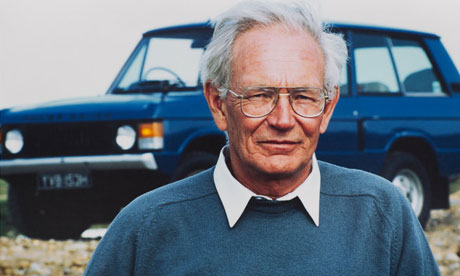
{King with his Range Rover; source: Guardian}


{Queen Elizabeth driving her Range Rover; as you can see this is by Tim Graham on Getty Images}

This map shows about where the van crashed into King.

View Cross Ln, New St, Price Rd in a larger map


{Range Rover prototype, 1970; source: Ann Lockley's blog}

---------

See also:

Charles Spencer King, wikipedia article

Father Of The Range Rover Dies At Age 85

Charles S. King, Range Rover Designer, Dies at 85, obit in the NY Times

Article by Spen King, The following is an extract of an article which appeared in: The Electronic Telegraph Tuesday 20 June 1995

Range Rover Creator Charles Spencer "Spen" King Dead at 85

father of Range Rover dies following bike accident

Range Rover Legend, Spen King, Dies after Bicycle Accident

First Range Rover designer dies

Charles Spencer King obituary in the Guardian

Charles Spencer King, British engineer who helped create Range Rover, dies at 85, obit in the Washington Post

Charles Spencer 'Spen' King (1925-2010) on the Classic and Performance Cars web site

Charles Spencer King, Creator of Range Rover, Dead at 85 on carguideweb.com

Spen King

Obituary: Farewell to Spen King, the man who made the Range Rover


Creator of Range Rover dies


----------

Notes:

[1] The report is in the Leaminton Courier and sister papers for June 9th. Here it is in full:
AN 85-year-old cyclist was found unconscious by ambulance crews after suffering serious head injuries in a crash with a van in Cubbington. The collision happened in Cross Lane, at the junction with New Street and Price Road near Cubbington Primary School at 3.20pm on Tuesday. An ambulance, a rapid response vehicle, and Warwickshire and Northamptonshire air ambulance attended the scene. A West Midlands ambulance service spokesman said:
On arrival crews found a bicycle and a van that had been in a collision. The cyclist, a man believed to be 85 years old, suffered serious head injuries and is believed to have been unconscious before the ambulance crews' arrival. The man received emergency treatment at the scene and was transferred by land ambulance to University Hospital, Coventry. The ambulance was met by a doctor who anaesthetised the patient, before continuing en route to the hospital for further emergency treatment. The hospital had been alerted to the arrival and his serious injuries. The van driver was not injured.
Police are appealing for witnesses to the accident, which took place near the school. Anyone who witnessed the collision is asked to contact PC Wayne Knight at the Greys Mallory Traffic base on 01926 415415. -- Elderly cyclist injured in crash with van in Cubbington
[2] Oddly, the link he provides with the quote does not lead back to it: http://www.autocar.co.uk/News/NewsArticle/Land%20Rover-Range%20Rover%20LRX/250721/

[3] Range Rover Creator Charles Spencer "Spen" King Dead at 85, British Automotive Legend Dies After Tragic Bicycle Accident, by Bill Baker

[4] Charles Spencer King obituary

[5] I got this from rangerovers.net:
Celebrity is a state of existential otherness, a kind of hyper-leverage in the world such that in any situation the celebrity has more traction, more weight to throw around, more altitude, a bigger nut, the best seat in the house. Such an advantaged state can also describe life behind the wheel of the Range Rover. All of this, it seems to me, presents a branding problem for Range Rover, articulated by no less than the man who invented it, Charles Spencer King. Mr. King, who died June 26, came to loathe the popularity of "Chelsea tractors" with wealthy urbanites—and he was in good company: several European cities have taken steps to ban SUVs from city streets. "Sadly, the 4x4 has become an acceptable alternative to Mercedes or BMW for the pompous, self-important driver," several obituaries noted that Mr. King told the Daily Mail in 2004. "To use them for the school run, or even in cities or towns at all, is completely stupid."
-- Range Rover: Still King of the Hill


[6] The is the rugged rover of post-war Britain.

These images come from an article, Fit for a Queen, which appeared in Land Rover in 2008.

Monday, September 21, 2009

end of a long hard race

I watched quite a bit of the Tour of Spain (Vuelta a España) on broadcast TV. Sad to say, Joost Posthuma, the bike racer whose career I follow most closely, did not take part in it. His team had decided to put him in the Tour of Britain, and then he came down with the 'flu* and didn't start that one either.

Meanwhile, Garmin-Slipstream, an American team which prides itself on racing clean, did very well in the Spanish tour. I've a couple of favorite riders on that team: David Millar and Julian Dean — the one a Scot who was caught taking performance enhancing drugs, served his suspension, and is now a sort of grizzled veteran of the sport; the other a New Zealander who has always raced clean (or so I believe). Millar is a mountain specialist who can turn in a good time trial. Dean is a sprinter who's likely to come in at the back of the pack on the mountain stages. Like Joost, they're both used mainly as support riders with occasional chances to shine on their own. And like Joost, they both value cooperative effort a bit more than individual celebrity.

It was a pleasure to see Millar win the Stage 20 time trial.

He writes infrequently on the Garmin blog, but always engagingly and with great generosity towards his mates. About this win, in a post called Winning, he says
I am so relieved that I won — I am so happy that I felt as good as I hoped to — and above all, I am over the bloody moon I won a sword! [This sword is the Sword of Toledo, see photo and caption below.]

But what makes this great is that I can share my success with my team. Kiwi Guy [i.e., Julian Dean] is sitting here next to me right now having a beer, he has done 62 grand tour stages this year, 63 tomorrow. From May 9 until now he has on average raced every other day… that is our sport. That is Kiwi Guy! He is so sick and tired and finished and yet he hasn’t given up.

{David Millar (Garmin-Slipstream) was given a sword made in the host town of Toledo. source: cyclingnews.com; photo credit Fotoreporter Sirotti}


{Two images of David Millar from Garmin-Slipstream's banner head celebrating his Stage 20 victory}

Julian Dean writes on his own blog — julian dean pro cyclist — rather than on the Garmin page; or, more often these days, his wife Carole writes. Dean is very much the realist about himself and his racing. Carole's writing is conversational, personal, and quite funny. They both make plain the hardships of professional bike racing, its dangers and the huge effort required of riders to persevere.

On the first day of the Vuelta, Dean writes: "Yep, it’ll be three out of three for me. I’m lining up for my third start in a Grand Tour for 2009 [The Tour de France, the Giro d'Italia, and the Vuelta]. . . I’m not sure whether I’m going to be much use. . . My bets are that I’m not likely to be that good." During the Tour de France, Dean and a rider on the Rabobank Team were hit by pellets from an air gun. About this Dean writes:
As you may have heard, my ‘shot’ finger blew up like a ping pong ball, got super red, hot and nasty and heinously infected. All this drama culminated in the rather urgent surgical removal of the ‘foreign body’. I was hoping the Doc’s report would say, “bullet” or at least, “pellet” but obviously neither of those were clinical enough! Anyway, all this action saw me spend a couple of weeks on some serious antibiotics. It knocked me around a bit – on top of already being buckled after the Tour - and I feel like I’ve only really been coming right over the last week or so. Not really in enough time to do some serious training for the Vuelta.
In his second post he writes: "I was unsure of how I would be after limited preparation coming into the Vuelta, I actually felt and rode great. The best place to be on days like today is in the front and I was comfortable there the whole day, battling to stay out of trouble. Coming into the sprint, it all seemed like it was going in slow motion. I was able to sit in comfortably, finding my place and moving around with my fingers up my nose, as we often say in cycling when racing feels easy. I placed Tyler well and was happy with how the day had worked out." And then, "On to Stage 2 and the dream was over for ‘Freddy Fresh Legs’. It seemed like the day before I could do no wrong and on this day I couldn't do anything right. . . . It was a real struggle the whole day. I was just off my game and did a shit job."

Worse was to come: "Stage 3’s weather to Liege, was nothing short of a hellhole. The first 50km were ok but from then on we were pelted with relentless rain – all 175 km to the finish. Inevitably the stage became a crash fest. I was one of the first guys to go down in a crash that was really my own fault. I locked it up coming into a corner when I wasn't paying attention for a split second. Initially I managed to keep it upright, sliding for some time but then I hit the gutter and high-sided over top of the bike onto the deck. I wasn't really badly injured but did have a substantial gash below my left knee. I decided not to look at it again after an initial ‘peek’ and just got on the bike to see if I could ride. After struggling to get back to the race, I made my way to the medical car where, after quite an effort that took four attempts, they finally managed to get it covered up. I was able to continue on – somewhat a little battered and bruised but essentially not too bad. I was feeling shit and besides, it wasn’t like I was going to be able to contribute anything positive to the final anyway."

Dean is silent after this post and Carole takes over. She writes:
Hey all. Carole here. You'll just have to put up with me updating you for now. I've asked, nudged, urged and finally pleaded for Julz to flick me through one of his own but to no avail. His third 'grandie' for the year is taking its toll on his body and his mind.

Have to say I'm expecting little more than an empty shell by the time I get him back! I'd say boobs on a bull would be more useful than Julz as a husband after his hectic 2009 season.

The results page on Cyclingnews does little justice to the work horses of the peloton. My Mum asked me, "Isn't Julz feeling very good?". Well if you look at the black and white of it, it certainly doesn't look too flash for our Julz. But I know that our Julz has been busting his arse for one and all and although is weeeeeeellllll dowwwwwwwwwwwwwwwnnnnnnnnnn on GC, he's proving once again to be an integral piece in the machine we commonly label as the 'team'.

He's the only guy left who has started all three 'grandies' this year, finished both the Giro and Tour and is still trucking in the Vuelta.
And later:
Right, who's stabbing the crap out of a voodoo doll of Julz??? It's mad. Unbelieveable.... Friggin unbelieveable. That guy has the shittiest luck...

The 16th stage of the Vuelta came down to a sprint today. I was glued to the tv watching the final kms and spotted Julz nicely tucked in the front of the peloton.

I was fizzing that for the first time this year Julz was going to have an opportunity to sprint for himself.

Things were unfolding nicely in the race for him while my house was unfolding chaotically at the wee hands of the boys as they took full advantage of my complete and utter focus on the telly.

Anyway, with about 3km to go, the peloton was seriously getting down to pre-sprint business through the city streets of Puertollano. The overhead TV shot showed the front of the peloton and me being soooo familar with Julian's riding style I quickly picked him out. He was without a team-mate and making his way up the outside of the peloton to get into a better position. I was impressed with how easy he was moving up.... at which point one guy got squeezed out, which squeezed the guy beside him out, which squeezed Julz out toward the barrier. That was ok, Julz still had enough room to move... until he collided with a spectator who was hanging too far over the barrier! Beauty. So there my eyes were fixated on this body tumbling over the handle bars. At that split-second, I wished I wasn't so good at picking him out of the bunch 'coz the feeling that floods me whenever I see him crash is that of such dread and fear that it really does make me nauseous. And then there's the wait..... Waiting to see whether he's ok or not. One eye wants to continue watching for any signs of 'ok-ness' while the other eye just wants to seal water-tight shut just in case Julz is really hurt. I've witnessed too many of his crashes on live TV and shared every post-crash rehabilitation period with him so my 'fear-metre' is hypersensitive these days. . .

Anyway, thankfully Julz was ok. He sent me a message as soon as he got back to the bus to tell me he was fine; no skin left but no broken bones. Grated like a chunk of parmesan cheese but not crumbled, I can handle. Phew.
And finally:
Well, the nut-bag has pretty much nailed it! Just the 110km womble into Madrid tomorrow left and barring any bizarre meteorite-crashing-into-Spain-and-wiping- out-the-parcours-into-Madrid-incident, Julz WILL cross that finish line tomorrow.

He IS the walking dead right now. He has an ever-growing list of 'ailments' which now include mouth ulcers, cold sores and the flu - all on top of his sore neck, skinless back and the hole in his knee (from his crash in Stage 4). How he is still racing is beyond the comprehension of a non-athlete such as myself, but why he is still racing is something I can understand and have fully supported even if it does mean the boys and I will be left with trying to 'rebuild' Julian from the squillions of broken pieces that'll get sent home to us on Monday! . . .

So he's fizzing to have made it. I talked to him tonight and he's quietly chuffed with himself. In true Julz style he's certainly not out there blowing his own trumpet... But then leave his trumpet-blowing to me, I reckon.

{Julian Dean on the pavement (in a different race); source: roadcycling.com}


{Julian Dean upright; source: Garmin photo}

----------
* See entry for 9/12/09 on Joost's page.

Friday, September 04, 2009

women awheel, 1896

Few of those now with us can recall the time when bicycles were far more prevalent than cars, SUVs, crossovers, pickups, and minivans, and when cycling was a valuable step toward the liberation of women from the confines of Victorian repression.

Looking for something else, I found an article on women bicyclists in 1896. It's from the Reivew of Reviews of that year. Here's the whole item:

CYCLING FOR WOMEN.

THERE is an article in the Nineteenth Century, by Dr. W. H. Fenton, entitled "A Medical View of Cycling for Ladies." Dr. Fenton — sensible man that he is — recognizes that, far from being dangerous to health, cycling has done more to improve the health of women than almost anything that has ever been invented:
Let it at once be said, an organically sound woman can cycle with as much impunity as a man. Thank heaven, we know now that this is not one more of the sexual problems of the day. Sex has nothing to do with it, beyond the adaptation of machine to dress and dress to machine. Women are capable of great physical improvement where the opportunity exists. Dress even now heavily handicaps them. How fatiguing, and dangerous were heavy petticoats and flowing skirts in cycling even a few years ago, the plucky pioneers alone can tell us.

DRESS WARMLY.

Inappropriate dress has a certain number of chills to account for. When fair practice has been made, and the 'hot stage,' so to speak, is over, the feet, ankles, neck and arms get very cold when working up against wind. Gaiters or spats, high collars, close-fitting sleeves meet this difficulty. Summer or winter it is far safer to wear warm absorbent underclothing and avoid cotton.

The diseases of women take a front place in our social life; but if looked into, 90 per cent, of them are functional ailments, begotten of ennui and lack of opportunity of some means of working off their superfluous, muscular, nervous, and organic energy. The effect of cycling, within the physical capacity of a woman, acts like a charm for gout, rheumatism and indigestion. Sleeplessness, so-called 'nerves,' and all those petty miseries for which the 'liver' is so often made the scapegoat, disappear in the most extraordinary way with the fresh air inhaled, and with the tissue destruction and reconstruction effected by exercise and exhilaration.

A FOE TO INVALIDISM*.

The large abdominal muscles do little in riding down hill or on level ground; but in hill-climbing great strain is thrown upon them. There are many reasons why women should not overtax this group. Already thousands of women, qualifying for general invalidism, have been rescued by cycling. Women are very subject to varicose veins in the legs. Cycling often rids them of this trouble. A girl who has to stand for hours and hours serving behind a counter gets relief untold from an evening spin on her 'bike.' Her circulation has been improved, and the aches and pains which would have shortly made an old woman of her have gone, and a sense of exhilaration and relief has taken their place.


{Lady cyclists at the cycle track, Grand Hall, Olympia, Kensington, London, March 1896. Notice that the ladies are not conventionally wasp-waisted; presumably it was ok not to wear those horrendous whale-bone corsets if you were a bike racer. Source: Mlle Serpolette at Olympia, users.senet.com.au}


{Society ladies cycling in Hyde Park, London, 1896. From "Vanity Fair" (London, June 1896). These women and the ones in the illustration that follows definitely are confined in the tight corsets of the time. Source: Heritage Images}


{Fashions for Cycling, The Ladies Standard Magazine, Vol. XVII, No. 4 (June 1897). You might think that the artist made these women appear to have smaller waists than is anatomically possible, but wikipedia says "wasp waist measurements of 18 to 16 inches were not uncommon and were often striven for as the reigning standard of feminine beauty in the period." Source: Library of Congress}


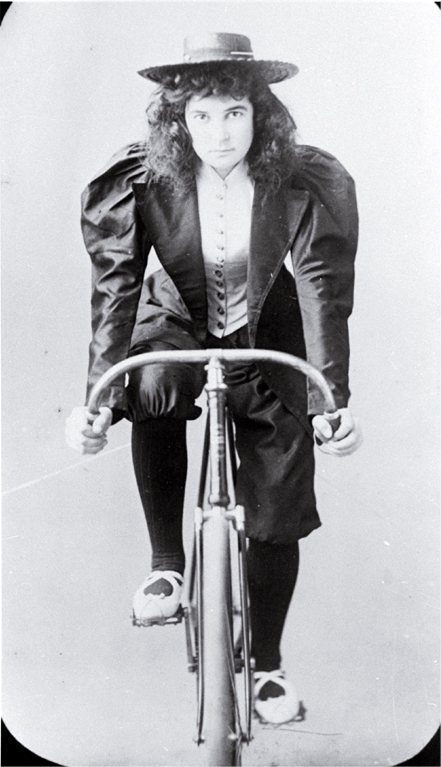
{Lady racing cyclist, Lancaster Park, Christchurch [ca. 1896]; source: Christ Church City Libraries}


{Women's cycling attire in 1896; source: cyclingfunmontreal.blogspot.com}


This issue of The Review of reviews contains a few other articles on the pervasiveness and benefits of cycling, including:
1. The World's Sporting Impulse, by Charles D. Lanier, It would be weak to heap bicycle statistics on the heads of readers who have each day a procession of evidence on every smoothly paved street that the world is awheel. . . . Nowadays the world may easily be divided into people who wheel and people who do not, and the former class seem to hold the balance of power, possessing as they do the solidarity due to this single enthusiasm. The bicycle has become a power in economics and politics. . . .

2. THE CONQUERING "CYCLE."

SARAH A. TOOLEY gives in The Woman at Home a pleasing sketch of Princess Maud of Wales, and does justice to the royal maiden's independence of character and love of fun. Incidental evidence is borne to the way in which the cycle is ousting the horse in the circles which have most influence on fashion:
Knowing how devoted Princess Maud is to animals, and that she has always been the best equestrienne in the family, her friends have felt some surprise at the enthusiasm with which she has taken to the bicycle. At one time she rode her saddle horse daily, but now that beautiful creature sighs in vain for his fair and fearless rider, for the horse of wheels has quite superseded him in her favor. A characteristic reason was given for this change by a man on the estate. 'Yes,' he said to me, 'the Princesses don't often come out on horseback now — you see they finds the bicycles so much handier.'

It would be impossible to find a more graceful and expert rider of the bicycle than Princess Maud. She sits perfectly upright, without the slightest approach to the stoop which so many cyclists seem unable to avoid, and her feet work the pedals without any apparent effort. Her cycling dress is of black or navy blue, and consists of a short, narrow, serge skirt, tight fitting jacket and vest, and a small hat turned up at the sides, or a toque to match her dress. She appears to find this costume easy and comfortable and has never adopted any approach to the rational dress. Mud has no terrors for her, for I have had the pleasure of seeing her spinning along the Sandringham roads just after a thaw, when one hardly knew where to walk to avoid the slush. She is a very rapid rider, and is generally seen well in advance of her sister, the Princess Victoria, who, though an equally graceful rider, is less adventurous. When the Princesses are out cycling it will generally be found that their mother's pony carriage is not far away.
At Mentmore, too, where one might have thought the cult of St. Ladas would cast out any foreign god, we learn from Fred. Dolman's paper in Cassell's Family Magazine, the bicycle has taken the place of the pony in the affections of Lord Rosebery's two sons.


Note:
*This topic has interested me since, some years ago, I was helping my daughter review notes for an American History exam and read how invalidism was an indirect product of the economic prosperity that the first few generations of US citizens enjoyed. Her text book said the expansion of the middle class permitted a growing specialization of the sexes, and women, in leaving the workplace and taking responsibility for managing servants in the home, would — often enough — develop this invalidism. This evolutionary change was accompanied by the movement to distinguish between morally pure and strong womenfolk and morally corrupt and weak men — the dressing of women in white clothing and placing them on pedestals. Some sources on invalidism:

Wednesday, September 02, 2009

sharing the road

Back when I bike-commuted I observed lots of aberrant behavior among the four-wheeled vehicles with which I shared the road. I learned to be especially careful of ones that made turns into my path of travel as I was entering an intersection. An oncoming driver would lurch leftward at me with no prior signal and very little chance for me to react. Frightening. After one of these near misses it would take half a mile or so before my heart rate began to return to something like normal. Fortunately I did always escape and only once had a car strike me — and that when the driver tried to make a right turn as he was overtaking me; then, since we were both going the same direction before he began the turn, the damage was negligible on my part and non-existent on his.

During these commutes the most terrifying drivers were those men and women who cruised without hesitation through stops signs and red lights. At certain busy intersections I learned to wait after my light had turned green to be sure all cross traffic was stopped. At the very worst of these intersections I was happy to see the bright flashes of the red-light cameras and can attest that they make a big difference in driver behavior.

You might think the drivers who failed to stop were simply distracted, as by cell phones, but — while I did see many who were so distracted — this group of drivers was no nearly as scary because they were almost all driving at or below the speed limit. Drivers seem to slow down a bit while cell phoning, texting, or reading a book. The scary ones were the ones who were already going fast and who sped up as lights turned red.

This came to mind on reading an account of a state lawmaker in Wisconsin who ran a red light and struck a bicyclist in Madison near the state capitol. A local TV station covered this piece of news. The driver did not flee the scene of his crime; police showed up and cited him. What's most interesting is that the collision was caught on camera.

It turns out that an out-of-service bus was at the intersection — and in fact right next to the cyclist, blocking the cyclist's view to his left — and the driver had his on-board video camera turned on and pointed to the front. Here's what the camera caught:


The lawmaker was cited for running the red light. Police reported that there was no evidence that he was high on drugs or alcohol. So far, the city attorney's office has made no other charges against him, but may yet decide to do so.

The cyclist is a regular commuter. He was taken to a local hospital and has since been released. There have been no comments from him or his family about his injuries or recovery.

Some news reports on this:
Unfortunately, it's quite common for what are euphemistically called "accidents" involving redlight runners and cyclists or pedestrians to be treated as something like acts of God, that is to say regrettable but not culpable actions. Drivers who recklessly endanger the lives of others are considered to be "inattentive" rather than asocially, and maybe criminally aggressive.

Here are some blog posts on this subject:
Yes, it's true that bicyclists run red lights, fail to stop at stop signs, and frequently don't signal their turns. However, there's a difference, is there not, between one whose actions endanger himself (or herself) but pose little threat for others versus those who are operating motor vehicles (which to bicyclists and pedestrians do frequently seem to be agents of death and destruction)?

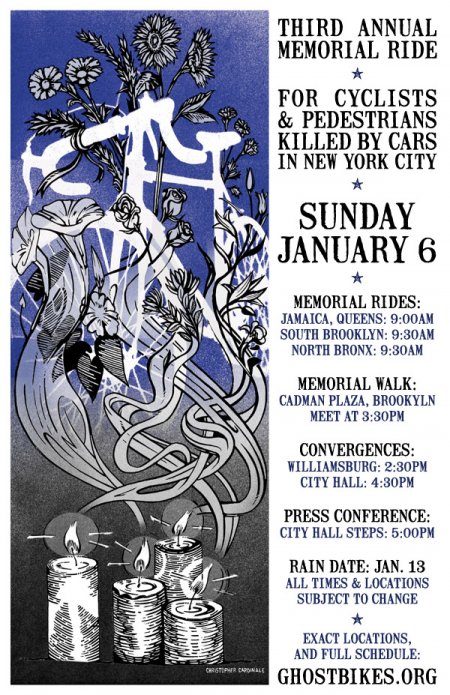
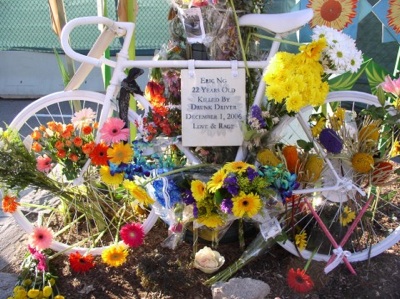
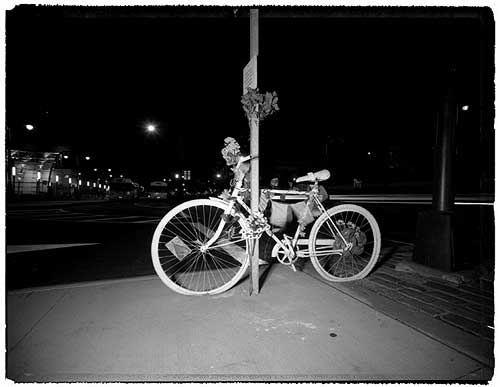
Here are images of some ghost bikes. Part of a grassroots action to call attention to the deaths that drivers cause by their actions. You can read about the campaign here, here, here, here, here, here, and here (these web pages are the sources of the photos given below).

Monday, August 31, 2009

The Ride

A few decades ago, when the internet was bright and new and the web was yet unborn, I noticed that people who work with computers tend also to be bicyclists. These things — the tendency and my noticing it — had advantages as I found I could buy and sell used bikes and gear via electronic communication with guys far distant. These transactions worked well quite a long time before there was an eBay, or Cragslist, or any of that. Geeks tend also, it seems, to nurture art and design and they can be good photographers and designers in their own right of course.

These thoughts coalesced when I came across yesterday's post in the Examiner's Bicycle Transportation Blog by Adam Voiland (which I recommend). It's Weekend Pick: Ilovedust illustrations and it concerns Ilovedust, (that is to day "I Love Dust") which is a British graphic design outfit. The post explains that they created some very nice bike pictures for the first issue of The Ride Journal. This issue is now available in pdf format: http://www.theridejournal.com/the_ride_issue1.pdf (It's a big file and may take awhile to download, but the wait is worth it.)

The journal explains itself here. It's a journal of personal stories by racers and commuters, roadies, cross-country riders, track racers, BMXers, and all, from whatevery country they call home, but most of all it's a magazine of good images and great design. These should give you some idea of the overall quality of its images and design:


{This graphic was made for the second issue of The Ride Journal. It's called Hokusai Ramp and is by Mig Pilot who says it's "my take on the mighty wave. Hand sketched, scanned and digitally painted." my source: flickr}


{This and the next two are by the ilovedust design group; my source: fishwithoutmeat on wordpress}


{my source: ilovedust on wordpress}


{my source: urbanvelo.com}


{my source: theridejournal.com}


{my source: ilovedust on wordpress}


{my source: fixedgearswitzerland.com}


Note: I've put reduced-size images on this blog post under fair use provisions of Copyright Law. If you'd like your image removed, please contact me via comment and I'll take it down.

Saturday, July 25, 2009

inside view of the Tour de France

This is the last day of this year's edition of the Tour de France. By tradition there's no real competition until the very end on the boulevards of Paris. While I'm writing, the riders are rolling through the countryside conversing casually with each other. In pre-race interviews they say the race was unusually tactical and hard, building from a relatively undramatic beginning to a major conflict in yesterday's stage ending with the fierce climb of Mont Ventoux. They also point out that the number and enthusiasm of spectators was astounding this year, culminating with huge crowds of joyful people on Ventoux. And they point out that drug testing seems finally have succeeded in eliminating illegal performance-enhancing substances: a huge amount of controls and no detections.

I'm confident that one racer whose career I've been following off and on for the past few years hasn't used any such substances. He's a personable and modest guy of relatively modest achievements who's Dutch born riding for a Dutch team: Joost Posthuma.

This photo, taken last year, shows him in less garish clothing than his blue and orange Rabo kit:

{source: dailypeloton}


There are short biographies and early photos of him on his own web page and at this Dutch site: http://www.owc-oldenzaal.nl/?RubriekID=2399

His personal web site also has an extensive photo gallery.

Quite a few riders have personal blogs and a growing number of them tweet and some regularly blog.

This year, Joost has been doing daily interviews from his mobile phone while on the massage table each evening.

Here are some highlights from his calls.

His work day can seem surprisingly mundane. He loves his morning coffee, gets cranky when he's delayed at an airport and looks forward to a pre-dinner shower at the end of a short flight; he puts in his day's work and relaxes in the evening by reading a book, watching sports on TV, catching up with friends and family on his mobile phone, and accessing the Internet with his notebook.

Although he's won some of the less-well-known races, here at the Tour de France he's a support rider, helping to give the team's leading riders a chance at winning stages and placing highly in the overall classification. He's looked out for opportunities to get in breaks during the flat stages but missed the deciding break of the day until yesterday's great stage to Mont Ventoux. This 16-man break stayed away from the third kilometer until nearly the last of this 167 k stage. He worried that the peloton would catch the group and increased his pace to keep them off.

This photo shows him at peak effort as lead rider on the lower slopes of Mont Ventoux:

{source: cyclingnews}


Not a mountain specialist, Joost's effort helped give his teammate, Juan Garate, the wherwithal to win the stage at the top of the mountain.


{Garate pulling away to win;source: cyclingnews. Click here for a thumbnail page of cyclingnews images from this stage.}


Most of this tour's 21 stages, he helped protect the leaders and ferried food and drink from the cars at rear back to team members in the peloton. Although the team's managers were growing increasingly upset with the team's performance until it's success yesterday, Joost never felt that he'd performed poorly and reports times he won praise for doing good work from both his fellow team members and the team's managers.

An even-tempered and friendly kind of guy, he's not prone to make controversial statements. He can be pretty funny as for example in his comments on the Tour's radio-free day. Calling the stage a race without ears, he said race organizers, in seeking ways to back off from technological advances, should require riders to go back to using toeclips and hairnets (which he calls "sausage hats").

Perhaps it's odd that Joost doesn't say much about performance-enhancing drugs. Along with other team members, he was recently called to to give information as evidence is accumulated against a former member of his team. He only just mentions that and his other comments deal with the extensive test program of the Tour, which he takes in stride.

In response to the interviewer's question, he says he's never broken a bone, though he's had his share of injuries. The topic arises because, as usually happens, a couple of riders have crashed and been forced to abandon because of bone breaks. He's strained his knee but has avoided scrapes and bruises as well.

He appreciates encouragement he's received from the many Dutch fans who line the roads but didn't like being thumped on the back by an over-enthusiastic (and probably over-beered) Netherlander on one mountain stage.

He's content with the cold and wet as well as the hot and dry weather they've encountered and didn't complain about the winds of Provence which raged yesterday.

He looks forward to visits with his parents and other relatives, and with his girl friend of course, when they're able to attend stages. He looks forward to getting back to his garden at home and being reunited with his dog.

Friends and family members write in the "guestbook" on his website to give words of encouragement during the unsuccessful stages of this year's Tour and congratulations on his success yesterday. One couple say, roughly: "Hey beautiful mountain goat. We've been watching this afternoon's ride you with awe and admiration. We congratulate you, on the team's stage victory, and your own performance 1.56 behind the winner on the Mont Ventoux." A woman admirer writes: "Congratulations on the victory of Mont Ventoux. You rode very strongly today. Echt Klasse! Yesterday night I rode back from the Tour along with your parents who were sitting in our bus. I had a nice week's holiday at the Tour."


Notes:
--------------------
Some previous posts about Joost:

---------------------
Some examples of rider blogs:


----------------
Joost on "ears:"
No oortjes - ears: "I just got a phone voice mail from my mother. She is angry and disappointed in the [radio-free] stage today. She's a major cycle racing fan, and is upset at how tame the racing is right now. Today there was no real competition.
------------------------

Joost on radio-free day:

The interviewer asks Joost whether there was tacit agreement to take the day easy in protest. Joost says nothing concerted, but a kind of consensus to ride easy. He says, "It is ridiculous that we possess modern communications and can't use them." What's next? he says, will tomorrow they require the riders to used toeclips and wear sausage helmets. "Back in time."


{toeclip pedals; source: wikipedia}


{toeclip cleats; source: wikipedia}


{"sausage helmet"; aka hairnet or vegetable basket; source: labicletta}


{Laurent Fignon with toeclips; source: grahamwatson}


{Fignon with "sausage helmet"; source: pezcyclingnews}


------------

Drug testing:
According to Pat McQuaid, the head of the International Cycling Union, the Tour de France will be the most rigorously tested sports event in history. There will be about 520 doping tests, and several of the 180 riders are already in the cross-hairs even before the three-week showcase even begins. {source}


----------------

This shows Laurens ten Dam scraped and bruised. He fell on a fast descent and posted this photo of himself afterward.


{photo by Laurens ten Dam posted on Twitter}

Friday, July 24, 2009

three weeks in July

Alan Taylor's "Big Picture" on Boston.com has a feature on the Tour de France today:

{Bradley Wiggins of Britain speeds down Col du Tourmalet in the Pyrenees mountains during the 9th stage of the Tour de France on Sunday July 12, 2009. (AP Photo/Bas Czerwinski)}

There's one more hugely difficult stage to run before the final run-in to Paris on Sunday. In three weeks of tough riding everyone's been rung through the ringer time after time. My favorite rider isn't one of the stars, he's one of the guys on the Rabobank team who provides support to the team's sprinters and its contender for the overall race leader. Though he's been doing his job extremely well, the team has done poorly. Through bad luck, tactical mistakes, and lack of form, they've failed to take a stage victory and have no chance for a high-place finish at the conclusion of the race.

That's put only a small damper on my enthusiasm. It's been an interesting race all the same. In daily telephone interviews, the guy I follow, Joost Posthuma, has been giving insights into the events of this year's Tour and the difficulties he's faced. You can read the series, in Dutch, here: https://www.rabobankcentraaltwente.nl/JoostPosthuma/.

I'll give some highlights in another post.

For now, here are a few photos from the gallery on his web site.
{All photos are copyrighted; I'm providing these thumbnails under fair use provisions of copyright law.}


12th stage, hot and dry, July 16

13th stage, cold and wet, July 17
 

14th stage, July 18: his mom was able to get off work this day

15th stage, July 19: collecting water bottles to distribute to team members,

Sunday, May 31, 2009

bikes

Yesterday's post on city biking brought back some memories. Back in the late 60s Richard Ballantine was a friend of a friend. I read his books knowing that his biking risks were greater than mind because he's deaf. It's comforting to know that he could survive, and thrive, as a traffic jamming cyclist in the hostile environments of Manhattan and London.

The identification of one of David Byrne's bikes as an Austro-Daimler brought to mind one of many old bikes I've acquired and learned to love.

Thus, this brief reminiscence:

I read about bike racing, bike commuting, recreational riding, and the like. Bikes are sport. They're transportation. They're for exercise, cruising, showing off, social shoulder-rubbing, and family Q-time. Many are handsome; many are lovable; many are expressions of individuality. Using bikes can be social responsible and economically sound.

My first bike came as a Christmas present when I was 5. Before I got it a 7-year old friend of my sister had taught me to stay upright (and to use the coaster brake) by releasing me on a steep driveway that ended at the garage — sink or swim.


The next one was a larger version of the same: fat-tire Columbia single-speed jobs. Mine was blue and not quite so deluxe as this Schwinn.


These were followed by a 3-speed "English racer" which came down to me from a big cousin and which I used on my long and hilly paper route. It looked like this.


Years before I got this 3-speed, I first saw a European bike with derailleur shifting. That was in the mid 1950s at the home of my best friend Tommy. His father had brought a 10-speed home from Germany long before anyone in the US knew about this type of bike. It looked like this.


It was too large for me to ride and I didn't actually try out that style until a decade later when I was in graduate school and I borrowed one from a friend. Liking it, I picked up a 5-speed for a few bucks at the annual Madison police auction — a bike with a broken spoke on the front wheel which I never bothered to fix. It was red but otherwise looked something like this.


I got another used 5-speed for getting around in London when I lived there a year or so later.


Thereafter I latched onto the first of a series of 10-speed bikes for commuting and weekend riding when living, successively, in Connecticut, Bethesda, and Chevy Chase.

One of these was a new Peugeot PX-10E which I bought from a shop in Brooklyn, a first mail-order purchase. It looked like this.

A Mid 1970s Peugeot PX-10E

A bit later I bought a Raleigh Competition at a local shop and took it bike touring in the Cotswolds and northern England one memorable week in May. It looked like this.

The Raleigh Competition Series


At another local shop I later picked up an Austro-Daimler Puch frame and fork and built it up into a bike that looked like this.

http://collection.rydjor.com/bikecollection/1976ausd.htm

I sold that bike a few years ago and am now riding another old one, about which I've already done a blog post: Vitus - the bike


Note: I usually try to credit my photo sources and am sorry that I failed to track most of these.