Showing posts with label cars. Show all posts

Sunday, March 18, 2012

Bugatti

As a twelve-year-old I devoured books of instruction, from the WWII NAVPER books on hand tools, to a Kodak "data book" on how to take good pictures; from a book on how to shoot with bow and arrow, to one on fishing with fly rod, and (a little later) another on maintenance of two-cycle outboard motors. Though I was notoriously a daydreamer, this reading wasn't entirely removed from reality. I never mastered any of the skills, but I did make a not-so-bad-for-a-sixth-grader attempt at all of them. On the other hand, it's true my favorite book was on a subject about which I could only fantasize. This was a little mass-market paperback by Ken W. Purdy called The Kings of the Road. The image at right shows the cover of my copy, now a majestic 58 years old and one of only a handful of books I've retained that long. Purdy was then editor of True magazine and, you can read in the book's acknowledgements, had written some of the book's chapters as articles in the mag.[1]

The best of them is Chapter II of the book, "The Fabulous Bugatti," which had appeared in True's issue of October 1949.

This chapter (along with all the rest of them) is now available on a blog:
The Kings Of The Road - by Ken W. Purdy by a British student who calls himself Scooby_Lab.

Here's an excerpt.
[Ettore Bugatti] ... was a demonstrable genius, a combination of artist and engineer. His life was a compound of paradox. He did not particularly care for motor racing, yet his cars were fastest over the ground of their time. He was a mild and courteous man, yet he liked to be given, even in his home, the autocratic title, ‘Le Patron’. ... The products of his wizardry were twentieth century to the minute, yet he ran his factory, with which was combined his aviaries, his kennels, his stables, his vineyards, his museums, his distillery, his boatyard, like a prince’s domain. ... He was not wealthy, but he refused to consider the question of cost in the making of a motor-car.

What kind of cars inspire this devotion? Are they dead silent, smooth riding as mobile feather beds, quick to start in the blackness of zero mornings, so easy to drive that a child can manage them? They are not! Most Bugattis are noisy in every way a car can be noisy, plus a few ways peculiar to themselves; when the temperature slips to the area of 30F. most of them are seized with a stubborn reluctance to fire at all, and indeed Bugatti himself blandly advised purchasers of his cars to invest in heated garages. ... And no Bug ever built was designed to be driven by children of the rich. ... The multiplate Bugatti clutches are often either all in or all out and nothing in between, giving the car a marked tendency to start off with a neck-snapping jerk. The clutch on some models must be adjusted to a hair and dosed with just the right mixture of kerosene and oil, lest it refuse to come free at all, thus forcing the hapless driver to make gear changes with hope and prayer. Bugatti favoured cable-operated brakes demanding heavy foot pressure, and on one occasion loftily told a customer that he made his cars to go, not to stop. Heavy though they were, the race-bred Bugatti brakes were efficient and virtually fade-proof. Bugatti detested detachable cylinder heads. On one model the rear axle, transmission and crankshaft must be removed before the valves can be ground. The Bugatti water pump is something to make strong men weep, and some of the racing models fling oil about like a gusher gone berserk. ‘It comes out of everything but the tyre valves and gets into everything including your hair,’ one devoted owner reports.
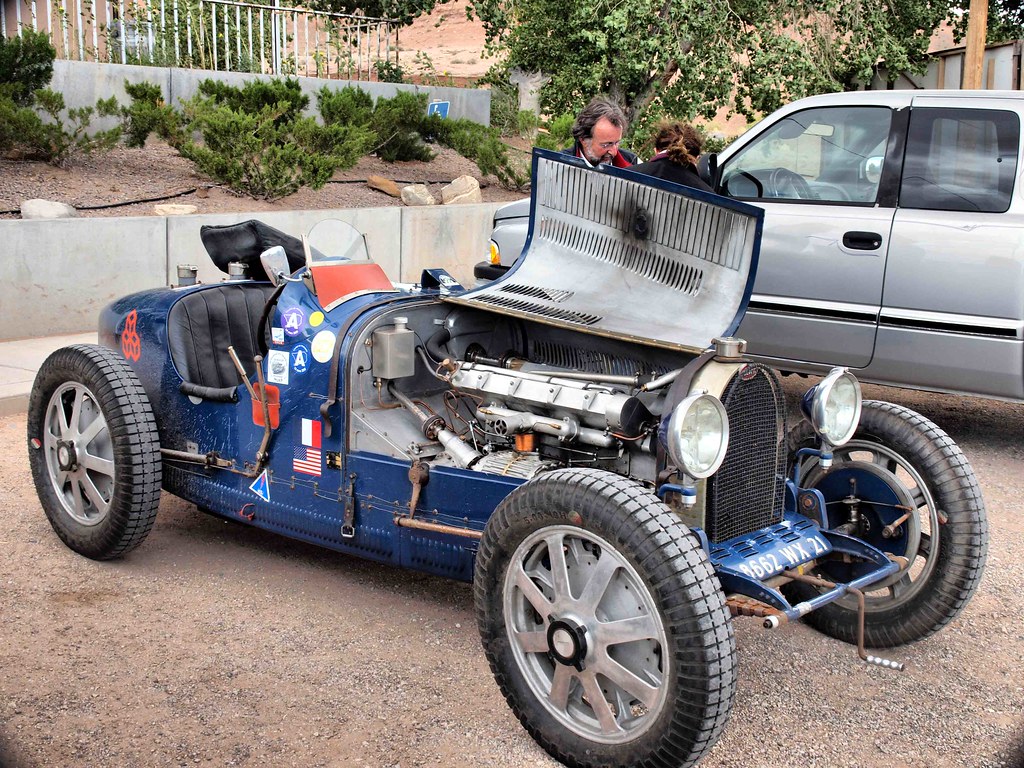
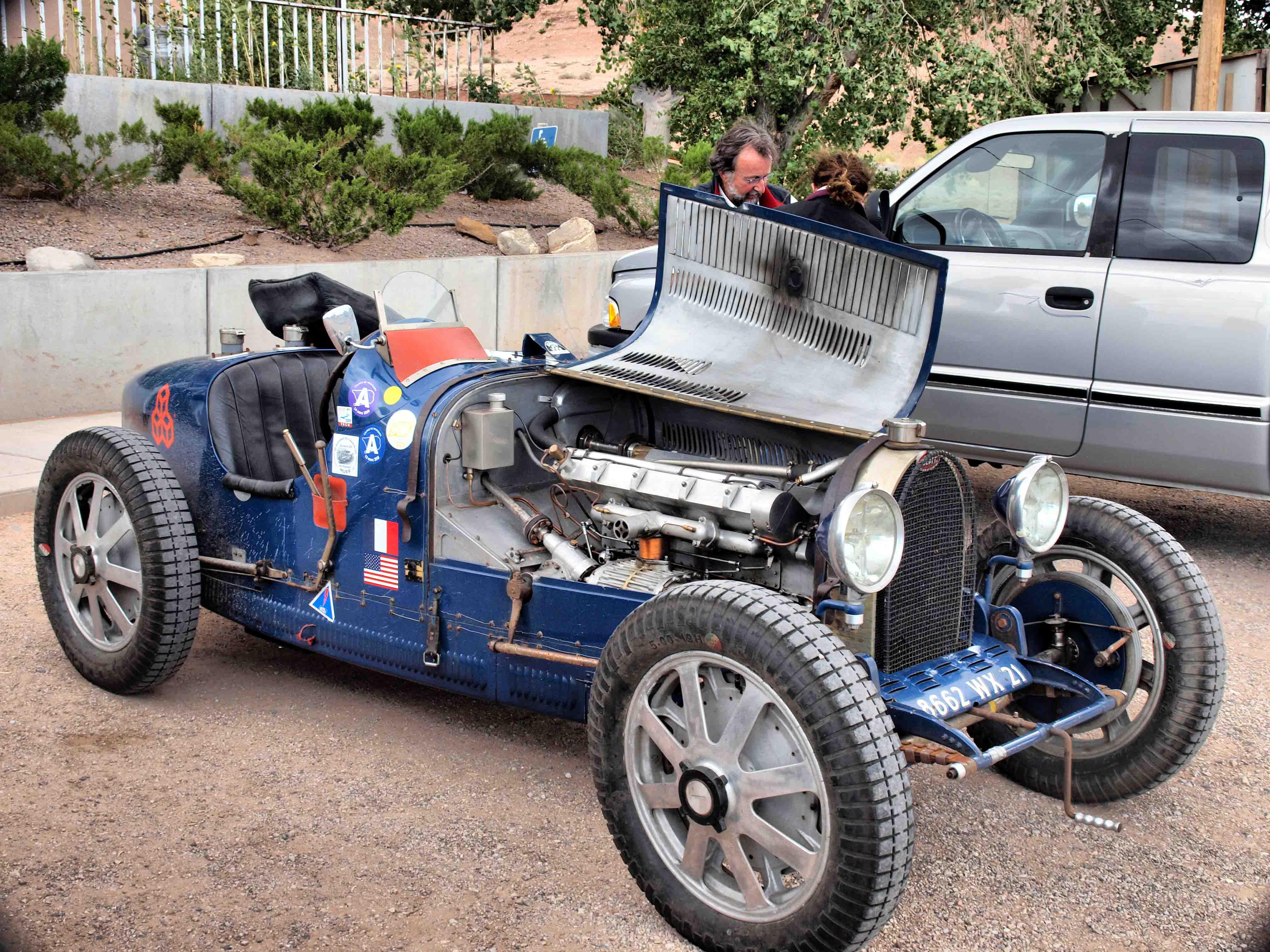
Purdy's passion for the Bugatti came to mind recently when I saw this photo.


It comes from a photojournal of flickr images by Ken Hircock called saxonfenken's photostream. This link takes you to the original post: Vintage Bugatti. His full-size image of the car is here.

There are lots and lots of Bugatti photos on the web. What sets this one apart is the condition of the car. It's not another Concours-d'Elegance showpiece, but rather a "driver." It's clearly not an car that's kept for show and only given infrequent and short outings. About it, Ken Hircock says "In a small Utah country town of Hanksville, a convoy of Vintage Bugatti's pulled up for breakfast, they were touring the United States and had already travelled 1500 miles"

I judge this car to be one of only fifty that were manufactured between 1928 and 1930, the supercharged Type 35C. Of the various Type 35 models, the author of a wikipedia article says: "The Type 35 was phenomenally successful, winning over 1,000 races in its time. It took the Grand Prix World Championship in 1926 after winning 351 races and setting 47 records in the two prior years. At its height, Type 35s averaged 14 race wins per week. Bugatti organized the Targa Florio as a special spotlight for this car, and it claimed victory there for five consecutive years, from 1925 through 1929."

And about the 35C: "The Type 35C featured a roots type supercharger, despite Ettore Bugatti's disdain for forced induction. Output was nearly 128 hp (95 kW) with a single Zenith carburettor. Type 35Cs won the 1928 and 1930 French Grand Prix. Fifty examples left the factory."

This Youtube video of a 35C show car is lovingly filmed with decent audio of the engine sound. Note the instrument panel to be seen between 20 and 30 sec. and the external gear shift and hand brake levers between 30 and 40.

{Uploaded by carchannelclassic on Sep 14, 2011. "I recorded this beautiful blue Bugatti Type 35 B during Concours d'Elegance Antwerp."}

This Youtube shows the 35 in full race mode.

{Uploaded by 4kam on Jul 8, 2010. Monaco Historic Grand Prix 2010, Bugatti Type 35 onboard video footage courtesy of Duncan Pittaway. The Bugatti Type 35 was the first ever winner of the Monaco Grand Prix in 1929. Footage shot with a 4Kam Onboard Camera and DV4 Solid State Video Recorder.}

You can see still photos of this car and its driver here. It's clearly a version A of 1925 (dual-carbs and not supercharger).

You'll find a bunch of other good Type 35 videos here.

There's a famous story that the great Isadora Duncan was killed in an accident while riding in a Type 35 (or maybe a Type 37). As the story has it: "According to oral tradition, her last words were: 'Farewell, my friends, I am off to glory!' As the car drove off, she threw a long silk scarf around her neck, which entangled in one of the car’s open-spoked wheels. The heavy embroidered silk pulled instantly taut and snapped the dancer’s neck."[2]

You can find a description of the 35C engine, with photos, here and this video gives a CAD tour of the engine, inside out, including the blower.

Two other videos.
Tour en Bugatti Type 35

Bugatti Type 37A at Road America

----------

Some sources:

Bugatti Type 35 35B 35C 35T

Bugatti type 35

Bugatti Models

1927 Bugatti Type 35B

Bugatti Type 35 engine

Bugatti Type 35 (1924)

------

General note: I've reproduced text and photos under fair use provisions of U.S. Copyright Law and will remove any for which it's shown fair use does not apply.

Notes to text:

[1] This is the cover of the issue of True magazine in which Purdy's article on the Bugatti appeared (Oct. 1949).
.
{Contents:

Issue Date: OCTOBER, 1949; VOL. 25, NO.149
COVER: Special Fly to Hunt map. Cover by John Atherton.

BOOK-LENGTHER: The Pioneer Baron of Burglars ... Alan Hynd. In the palmy days of bank burglary, the top man of them all was Maximilian Shinburn, a real artist at turning off a jug. Full page color illustration by David Berger.

ADVENTURE:
The Champions of the Northland ... Bruce A. Wilson. Illustrated by John Pike.
A Time for Battle ... George Scullin. Full page color illustration by Tom Lovell.
The White Magic of Voodoo ... Allan Gould & Emile C. Schurmacher.

IN THE NEWS:
"We Will Be First to Die" ... Richard Tregaskis.
The Hamster Man . ... Robert M. Hyatt.
Store Hair ... Fred Rosen.
Your Clothes Do the Talking.
TRUE Tested Trends.

PERSONALITIES: TRUE'S Who: How to Pick Pockets in Public ... Daniel P. Mannix.

SPORTS:
Good Hunting--and Where. Map by John R. Hull.
Cricket Is for Men Only ... Bob Deindorfer.
You Want to Watch Them ... Marshall Goldberg.

SCIENCE:
The Fabulous Bugatti ... Ken W. Purdy. [With color photos!]
What's New in Scope Sights? ... Lucian Cary.

PICTORIAL: Vip's Tips for Men--How to Baby-Sit ... Virgil Partch.

FACT MYSTERY: The Case of the Naked Widow ... Archie McFedries. Full page color illustration by Louis Glanzman.

SHORT FEATURES: TRUEly Yours; Next Month; The Editor Speaking; Man to Man Answers; TRUE Goes Shopping; Books for Men; This Funny Life; Strange But True; The Mountain Boys; A Slight Oversight; The Offshore Bus; Pennsylvania's Last Buffalo; Build It Yourself; Never Underestimate an Eskimo; Know These Railroad Records; Twists. TRUE, A Fawcett Publication.
-- source: eBay}

Here's a different, but representative, article from magaszine: The Sky-High Invention, Hiller's Flying Platform, by John DuBarry, True Magazine, September 1956

[2] I've mentioned Isadora Duncan once before.

Friday, July 23, 2010

Spen King

I noticed an obit the other day reporting that the designer of the Range Rover had died "of injuries sustained in a collision between his bicycle and a van." Although the death has been widely reported, its cause has remained vague. Reporters have contented themselves with repeating the passive-voice phrase I've just quoted and near variants: they say he died of "injuries that occurred during a cycling accident" or "after suffering complications following a cycling accident." None say how the crash occurred or who caused it. As Tom Vanderbilt and many bike bloggers tell us, reporters almost always describe crashes involving bikes and motor vehicles as if they simply happened of their own accord, without anyone bringing them about.

Still, about this particular crash there proved to be even fewer hard facts than usual. After spending a bit too much time on the search, at last I think I've got something. On June 9 the local paper reported that a man had been struck on the head and mortally injured in a collision with a van at an intersection in King's home town. The victim was unconscious when taken to the local hospital and soon after died. Although the reporter was unable to identify him, the description, location, and timing make it almost certain that the dead man was King.[1]

A guy named John Riley, writing to the discussion list called BentRider Online, adds this: "Apparently he [King] was riding a bike because an eye surgery precluded driving. Had a head-on collision with a van, but I can't find out any more about it." Riley then gives this quote: "The accident was a head-on between him on his bike (no helmet) and a delivery van last Tuesday, not far from his home. He had ridden to the ATM to get cash to pay his housekeeper. He cannot drive because of a detached retina operation a couple of weeks ago."[2]

King was in pretty good shape and quite active for an 85-year-old. An acquaintance of his said "If you're wondering why a man of 85 would be jumping on a bicycle, well then you didn't know Spen. He was a very fit, inquisitive, energetic engineer who refused to let the years slow him down.[3] Still, he had been forced to stop driving after an operation for a detached retina and one's reflexes at 85 are quite a bit slower than those of a younger man. It seems reasonable to conclude that his disabilities may, directly or indirectly, have brought about the crash, but, still, it would be good to know whether the driver of the van was speeding, turning a corner unsafely, using a mobile phone, or what.

If it seems ironic that the designer of the prototype of all SUVs was victim of a collision with a delivery van, it's really not, or not very much anyway. King didn't design the Land Rover as the glitzy monster of urban boulevards and suburban side streets. For him, it was a working vehicle for people who owned estates. Almost all the obits quote him as saying that vehicles like the Range Rover he created were "never intended as a status symbol but later incarnations of my design seem to be intended for that purpose." Some accounts say he called such status seekers "stupid."

Eventually, he came to regret having brought a gas-guzzler into the world, saying, in 2004, "I find it distressing that that the popularity of four-by-fours has had such a noticeable correlative effect on environmental damage."[4]

There is some irony, however, in the story of his death. It emerges in that fact that he had campaigned strenuously for improved forward driver vision. He pointed to numerous studies showing that pedestrians, bicyclists, and motorcyclists were at risk due to over-wide windshield posts and other obstructions of drivers' vision. One of the obits points out:
The danger was brought home to him when he stopped to let some pedestrians over a crossing. "I thought they were all clear; then, as I moved off, I found some more had followed behind them. They were hidden behind the screen pillar, and I had to jam the brakes on again." Other potential danger spots were junctions, roundabouts and right-hand bends. "Of course, if the driver moves his head he can see round the pillar. However, my observations and experience make me think drivers very often don't do this."
-- Safe Speed, SMIDSY (Sorry Mate, I Didn't See You)
Far from envisioning the celeb-piloted Rodeo Drive SUVs,[5] in designing the Range Rover he simply wished to provide some creature comforts to the gloriously rugged Rover.[6] If you've seen Stephen Frears' movie, The Queen, you'll probably recall the sequence where Queen Elizabeth gets stuck while driving her Rover at Balmoral. Her use of the car is the one King had in mind when he designed it.


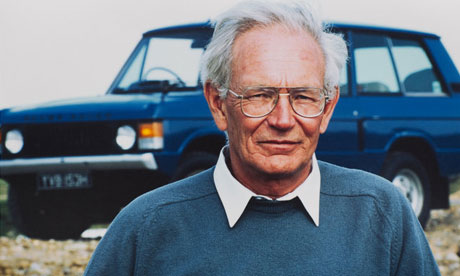
{King with his Range Rover; source: Guardian}


{Queen Elizabeth driving her Range Rover; as you can see this is by Tim Graham on Getty Images}

This map shows about where the van crashed into King.

View Cross Ln, New St, Price Rd in a larger map


{Range Rover prototype, 1970; source: Ann Lockley's blog}

---------

See also:

Charles Spencer King, wikipedia article

Father Of The Range Rover Dies At Age 85

Charles S. King, Range Rover Designer, Dies at 85, obit in the NY Times

Article by Spen King, The following is an extract of an article which appeared in: The Electronic Telegraph Tuesday 20 June 1995

Range Rover Creator Charles Spencer "Spen" King Dead at 85

father of Range Rover dies following bike accident

Range Rover Legend, Spen King, Dies after Bicycle Accident

First Range Rover designer dies

Charles Spencer King obituary in the Guardian

Charles Spencer King, British engineer who helped create Range Rover, dies at 85, obit in the Washington Post

Charles Spencer 'Spen' King (1925-2010) on the Classic and Performance Cars web site

Charles Spencer King, Creator of Range Rover, Dead at 85 on carguideweb.com

Spen King

Obituary: Farewell to Spen King, the man who made the Range Rover


Creator of Range Rover dies


----------

Notes:

[1] The report is in the Leaminton Courier and sister papers for June 9th. Here it is in full:
AN 85-year-old cyclist was found unconscious by ambulance crews after suffering serious head injuries in a crash with a van in Cubbington. The collision happened in Cross Lane, at the junction with New Street and Price Road near Cubbington Primary School at 3.20pm on Tuesday. An ambulance, a rapid response vehicle, and Warwickshire and Northamptonshire air ambulance attended the scene. A West Midlands ambulance service spokesman said:
On arrival crews found a bicycle and a van that had been in a collision. The cyclist, a man believed to be 85 years old, suffered serious head injuries and is believed to have been unconscious before the ambulance crews' arrival. The man received emergency treatment at the scene and was transferred by land ambulance to University Hospital, Coventry. The ambulance was met by a doctor who anaesthetised the patient, before continuing en route to the hospital for further emergency treatment. The hospital had been alerted to the arrival and his serious injuries. The van driver was not injured.
Police are appealing for witnesses to the accident, which took place near the school. Anyone who witnessed the collision is asked to contact PC Wayne Knight at the Greys Mallory Traffic base on 01926 415415. -- Elderly cyclist injured in crash with van in Cubbington
[2] Oddly, the link he provides with the quote does not lead back to it: http://www.autocar.co.uk/News/NewsArticle/Land%20Rover-Range%20Rover%20LRX/250721/

[3] Range Rover Creator Charles Spencer "Spen" King Dead at 85, British Automotive Legend Dies After Tragic Bicycle Accident, by Bill Baker

[4] Charles Spencer King obituary

[5] I got this from rangerovers.net:
Celebrity is a state of existential otherness, a kind of hyper-leverage in the world such that in any situation the celebrity has more traction, more weight to throw around, more altitude, a bigger nut, the best seat in the house. Such an advantaged state can also describe life behind the wheel of the Range Rover. All of this, it seems to me, presents a branding problem for Range Rover, articulated by no less than the man who invented it, Charles Spencer King. Mr. King, who died June 26, came to loathe the popularity of "Chelsea tractors" with wealthy urbanites—and he was in good company: several European cities have taken steps to ban SUVs from city streets. "Sadly, the 4x4 has become an acceptable alternative to Mercedes or BMW for the pompous, self-important driver," several obituaries noted that Mr. King told the Daily Mail in 2004. "To use them for the school run, or even in cities or towns at all, is completely stupid."
-- Range Rover: Still King of the Hill


[6] The is the rugged rover of post-war Britain.

These images come from an article, Fit for a Queen, which appeared in Land Rover in 2008.

Wednesday, September 02, 2009

sharing the road

Back when I bike-commuted I observed lots of aberrant behavior among the four-wheeled vehicles with which I shared the road. I learned to be especially careful of ones that made turns into my path of travel as I was entering an intersection. An oncoming driver would lurch leftward at me with no prior signal and very little chance for me to react. Frightening. After one of these near misses it would take half a mile or so before my heart rate began to return to something like normal. Fortunately I did always escape and only once had a car strike me — and that when the driver tried to make a right turn as he was overtaking me; then, since we were both going the same direction before he began the turn, the damage was negligible on my part and non-existent on his.

During these commutes the most terrifying drivers were those men and women who cruised without hesitation through stops signs and red lights. At certain busy intersections I learned to wait after my light had turned green to be sure all cross traffic was stopped. At the very worst of these intersections I was happy to see the bright flashes of the red-light cameras and can attest that they make a big difference in driver behavior.

You might think the drivers who failed to stop were simply distracted, as by cell phones, but — while I did see many who were so distracted — this group of drivers was no nearly as scary because they were almost all driving at or below the speed limit. Drivers seem to slow down a bit while cell phoning, texting, or reading a book. The scary ones were the ones who were already going fast and who sped up as lights turned red.

This came to mind on reading an account of a state lawmaker in Wisconsin who ran a red light and struck a bicyclist in Madison near the state capitol. A local TV station covered this piece of news. The driver did not flee the scene of his crime; police showed up and cited him. What's most interesting is that the collision was caught on camera.

It turns out that an out-of-service bus was at the intersection — and in fact right next to the cyclist, blocking the cyclist's view to his left — and the driver had his on-board video camera turned on and pointed to the front. Here's what the camera caught:


The lawmaker was cited for running the red light. Police reported that there was no evidence that he was high on drugs or alcohol. So far, the city attorney's office has made no other charges against him, but may yet decide to do so.

The cyclist is a regular commuter. He was taken to a local hospital and has since been released. There have been no comments from him or his family about his injuries or recovery.

Some news reports on this:
Unfortunately, it's quite common for what are euphemistically called "accidents" involving redlight runners and cyclists or pedestrians to be treated as something like acts of God, that is to say regrettable but not culpable actions. Drivers who recklessly endanger the lives of others are considered to be "inattentive" rather than asocially, and maybe criminally aggressive.

Here are some blog posts on this subject:
Yes, it's true that bicyclists run red lights, fail to stop at stop signs, and frequently don't signal their turns. However, there's a difference, is there not, between one whose actions endanger himself (or herself) but pose little threat for others versus those who are operating motor vehicles (which to bicyclists and pedestrians do frequently seem to be agents of death and destruction)?

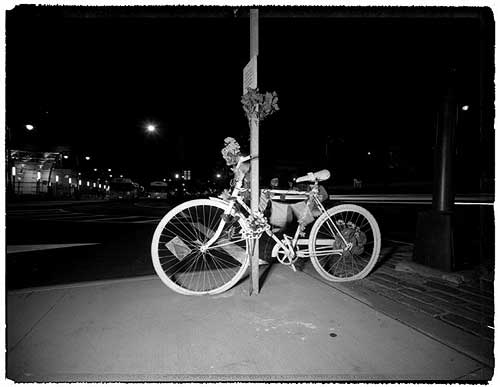
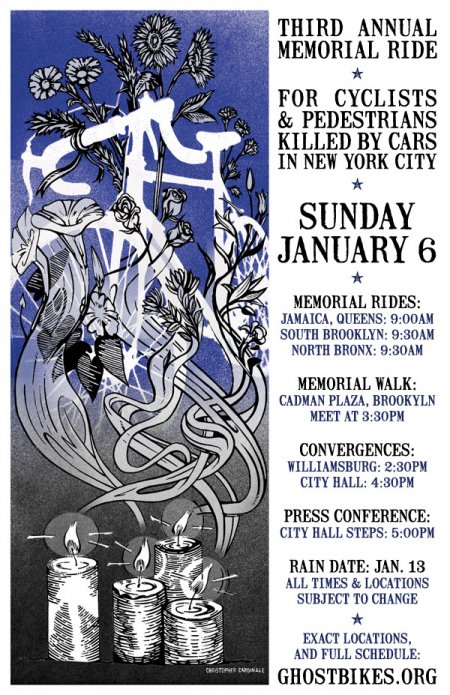
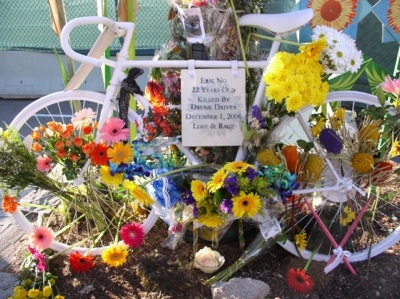
Here are images of some ghost bikes. Part of a grassroots action to call attention to the deaths that drivers cause by their actions. You can read about the campaign here, here, here, here, here, here, and here (these web pages are the sources of the photos given below).

Friday, April 10, 2009

Hupmobile

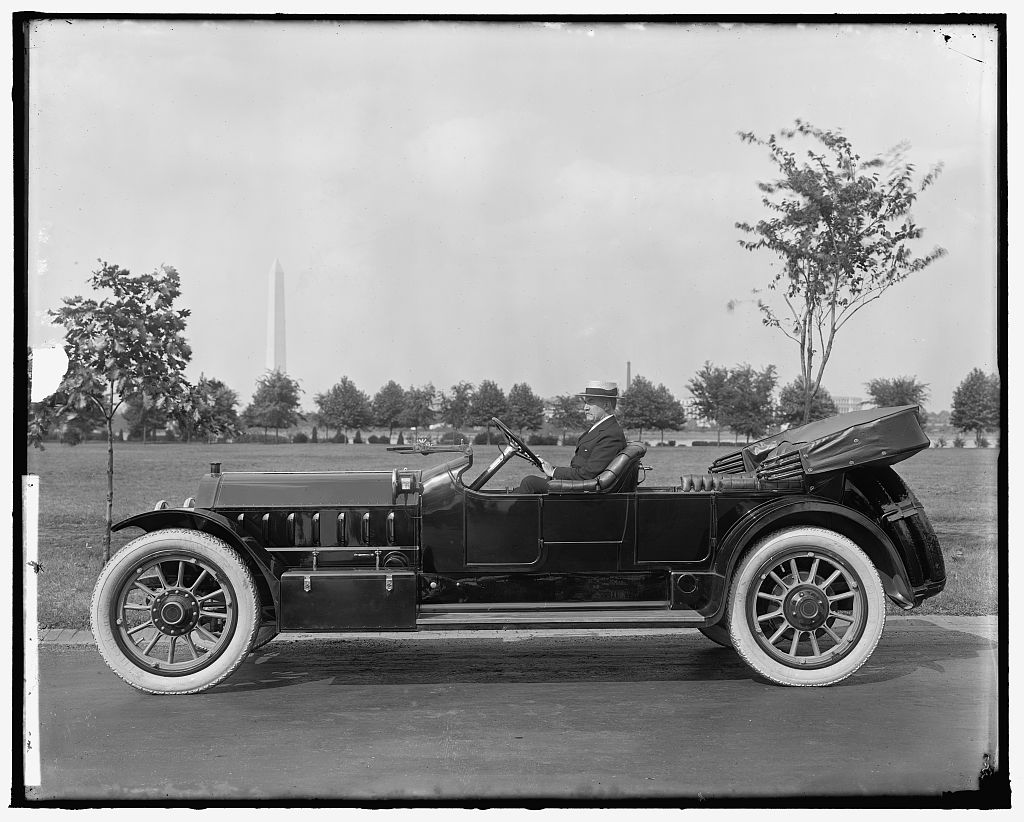
Shorpy.com — which calls itself 'a vintage photography blog featuring thousands of high-definition images from the 1850s to 1950s,' — frequently features photos from LC's Prints and Photos Div. Yesterday's images included a Marmon touring car from about 1914. Here are links to the LC photos: normal size, high resolution, highest resolution (without compression).

The photo reminds me of one that appears in our family photo albums from the late 1940s. I haven't seen it for years, but, as I recall, it shows one of these touring cars on the parking strip in front of our house. Taken following a winter snow storm, it lets you see how the large wheels on that car set it above the accumulated snow.

I'm sure my parents bought the car second hand and expect it was 15 or 20 years old at the time the photo was taken. I thought it might be a Marmon, but even second-hand, those cars were probably outside my family's price range and, anyway, I recall our car having wooden-spoked wheels and Marmons of the 1920s had wire wheels or even steel disks.

It's more likely that it was a Hupmobile. They were cheaper and the models of the '20s did have wood spokes. It was also a lighter weight car and most models had a four cylinder motor rather than a six. That's important because although it was big (enormous from my little-kid perspective) I remember that my mother would start it by putting it in gear and then pushing it to turn the engine over, climbing into the driver's seat via the dashboard as the car began to chug forward.

I'm sure it had a fabric touring top as well as the running board and wood wheels.

We didn't hold onto it very long.

The car we owned might have been the touring version of the 1917-1925 Model R. Like this:

{source: http://clubs.hemmings.com/}


I can almost recall the feel of the plush seats and massiveness of the steering wheel. Note the spark and throttle levers next to the horn button. You advanced the spark timing and opened the throttle and then used battery ignition, or, if it was dead (as if frequently was) used the start crank or (my mother's method) pushed the car in order to start it.


{interior of a 1922; source: http://americandreamcars.com/}


Here are photos of some old Hupmobiles from antique car sites:


{1925; source: http://www.autogallery.org.ru/}


{Another 1925}


{1922; source: http://www.autogallery.org.ru/}


{Another 1922; source: http://americandreamcars.com/}


{1913; source: www.ironstonefoundation.org}


Some Hupmobile sites:

Hupmobile entry in wikipedia

Hupmobile Club

Wapedia Wiki: Hupmobile

Sunday, October 05, 2008

Margaret Atwood and me

Margaret Atwood was born a few years earlier than me and somewhat northward. She's also of the other sex and is one of the best writers in the world. These differences between the two of us suggest we have little in common. All the same some of her memories tally fairly closely with mine. They're in excerpts from her new book: Payback in FT: Forgive us our debts. Her topics are things that are on my mind these days: debt and debtors; banks and interest; revenge and forgiveness; and what can happen when you let your reptilian brain control the somewhat more rational one upstairs. But she leads with the reminiscences and they are what resonated sympathetically this bright Sunday morning.

She remembers the allowance she got (a nickel for her, a quarter for me) and how its spending -- in those primitive days -- led to much tooth decay. She remembers the tactics we used for accumulating wealth in comic books, glass marbles, and cards. (She recalls cigarette cards while mine mostly came from bubble gum packs.) She remembers the bank where she deposited money earned on her first paying job -- the fear of the tellers behind their high counters and the mystery of money "earning" more money in interest that showed up in the little savings book with its dark blue cover and light blue pages. About bank interest she asks "How could a fiction generate real objects? I knew from Peter Pan that if you ceased to believe in fairies they would drop dead: if I stopped believing in banks, would they too expire? The adult view was that fairies were unreal and banks were real. But was that true?" I never asked myself that question. But -- although I couldn't slake my addiction to candy or discipline myself to frequent and thorough tooth brushing, my first experience of banking did lead me to understand that you could save and, much later, buy things much more expensive than a ten-cent ice cream cone.

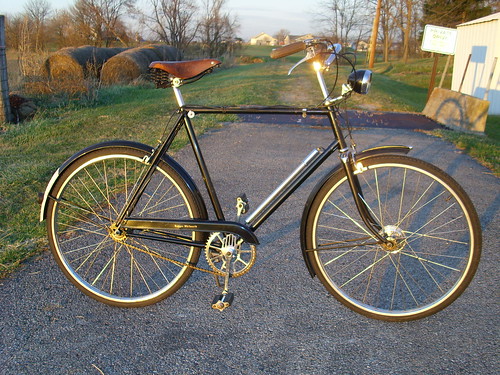
My first real job was a paper route. It was 1956 and I was 14-15. The route was long: out-and-back, about 4 mi. each way. It took me over the biggest hills our village possessed and it passed through none of the new housing "developments" with their closely-set newspaper customers. It must have been one of the least desirable I think now, but then it just was what it was. I was proud to learn the ways of shouldering the loaded bag on my Rudge Whitworth and was mostly conscientious -- in my own shy way -- in making my weekday afternoon round. I plagued my mom to drive me (in snow, ice, or pouring rain) as little as might be.

{A Rudge Whitworth, courtesy flickr}


{The red line shows the route; I left from and returned to our home, just about where the "e" is on Dalmeny Rd. -- upper right; Kemey's Cove (mentioned below) is left of the square by Revolutionary Rd.}


I earned money and remembered who paid up on time and who didn't, who tipped in coins and who in candy bars. I banked much of my take. And I observed.

I knew the mom's, some of the kids, and all of the dogs. And, because it was in the blood of boys my age at the time, I knew every car in every driveway.

Those were the years when performance and efficiency mattered little, style much. Cars were V8 powered, chromed, finned, and huge. I appreciated the cars of that time though never thought to own one. (My first car, bought 3 years later for $50, was a '50 Chev, all black with rusted out floorboards.)

Observing the newer models on my paper route, I noticed the three-tone jobs and in particular the three-tone Desoto. It's now hard to find images of this car. Here's one:


{Desoto three-tone 1955 on allpar.com}


Here is a shot of the much-finned 1956 Fireflite, two-tone:

{1956 Desoto from a geocities page}


(If you care, there's a A Full History of DeSoto.)

Though I didn't really aspire to own a Desoto, I did have plans for my paper route savings. For $110 I bought a kit to make a 10-foot racing pram much like this.
"
{This comes from jimshotwellboats.com; I have a photo of mine somewhere or other which I'll post if ever found*}

Typically, I researched the purchase, carefully made the boat, and then didn't find much use for it. The river wasn't all that close to home and I couldn't drive myself there. I had no local friends with boats. So it sat down on Kemey's Cove while I found other things to do with my adolescent life and later became an embarrassment to my parents while I stored it in our next door neighbor's garage.

You'd think there was a lesson for me in this -- one about spending as wisely as you save, but I think I got all I really wished for in saving for, purchasing, and building the kit into a seaworthy racer.

------------------
* I found it: