Showing posts with label family history. Show all posts

Tuesday, May 08, 2012

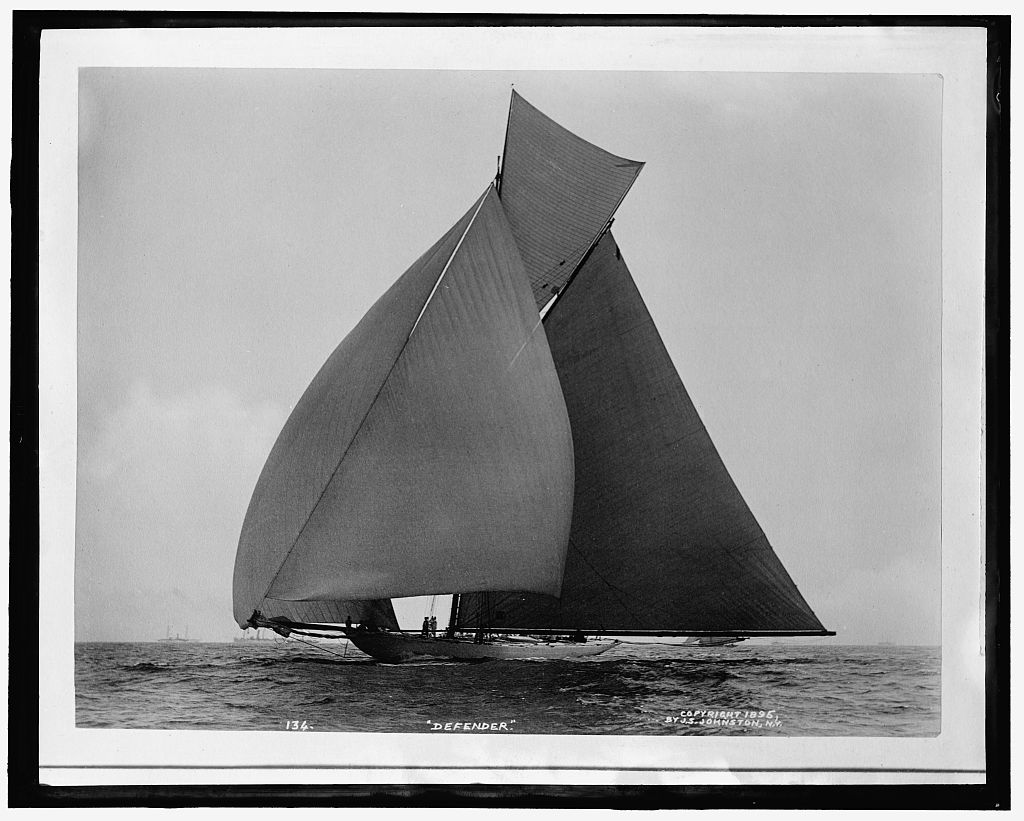
Defender

I found this image on a favorite tumblelog and I subsequently used it in a tumblr post of my own.[1]


It shows the yacht Defender and it can be found in the Detroit Publishing Company Collection of LC's Prints and Photographs Division.[2] The photographer, John S. Johnston, did a whole series on the Defender.

The caption gives the year (1895) but does not give the month or day. It does have "134" written on it and a nearby photo, number 132, shows the Defender on August 2, 1895, competing in the Goelet Cup so it's pretty near certain our photo was taken during the same race.

The yacht belonged to William Kissam Vanderbilt.[3] He was a cousin of Louis Windmuller's wife, Annie.[4] Windmuller didn't go in for yacht racing. His recreations were urban and close to home. He belonged to city clubs and supported city charities. An immigrant from Germany who never lost his German connections, he loved the city's German singing clubs and beer gardens. He was also a famous city walker and one of his last acts was to form a club of walkers. He traveled much for business, but also for pleasure, chiefly to Germany, France, England, and Italy.

Louis Windmuller had arrived in New York penniless and worked his way up to a comfortable prosperity. William Kissam Vanderbilt was born to wealthy parents and was never forced to earn a living. He did work as a manager of the family railroads but as someone learning the family business rather than in the entrepreneurial spirit of his grand- and my great-grandfather.[5] The differences between the two men were many, but the most obvious, I think, was in their choice of recreation. Where Windmuller walked, W.K.V. raced. He raced horses and he raced yachts. He founded New York's Jockey Club, owned both stables and race courses, and ran horses that won. And he was co-owner of the yacht defender.

Windmuller and his wife Annie saw only two of their six children survive to adulthood: a son and a daughter. Neither possessed the energy, cheerful optimism, and tempered ambition of their father. The son, Adolph, made a half-hearted effort to manage one of his father's enterprises (the importing firm which was Windmuller's first success) but did not stick with it and lived most of his life as a man of leisure.[6] My father, his nephew, called him a n'er do well. The daughter, Clara, was not expected to earn a living and, unlike others among her contemporaries in upper-middle-class New York, she did not attempt to make a name for herself by charity work, cultural contributions, agitation for reform, or even any sort of active participation in New York society.[7]

Somewhat late in life, Clara married a man who worked for her father. He, Julius, was a distant relative who had come from Germany with the expectation that Windmuller would put him to work. After serving in a clerical position in an organization of which Windmuller was treasurer he was, in the year following his marriage to Clara, appointed secretary-treasurer of a bank that Windmuller had helped to found and of which he was president.[8] In 1913, when his father in law died, the will was found to be not so generous to him as it was to Adolph and Julius consequently labored in the bank for the rest of his working life, eventually rising to be its manager. Once he found himself secure in his employment, he put in his bankers' hours, married his benefactor's daughter, fathered a family of four, let himself be caught with a girlfriend in the conjugal bed, and indulged in a passion for boating. The last two were actually related since he had the habit of inviting women to cruise with him from time to time.

This photo shows Julius and Clara shipboard during the first (happy) years of their marriage.

The year is 1902 or '03. He is 34 and she two years younger.

Julius was a power boat enthusiast so this photo — taken at about the same time — shows Clara on someone else's ship.


From about 1900 to about 1942 Julius owned maybe half a dozen craft, each 30- to 40 feet long, with paid skipper and crew. At the bank they called him "Commodore" (as, in similar manner, underlings had given Cornelius Vanderbilt that title) and he belonged to a number of yacht clubs including the Colonial, uptown on the Hudson near his home on Riverside Drive, and the Harlem on City Island.[9] My father once took me to the latter. The club house was rustic and in my memory its chief feature was a monumental pool table near windows overlooking the moorings.

This shows a diving demonstration at the Colonial Yacht Club in 1914 or 1915.

{Caption: Famous diver Elsie Hanneman at the Colonial Yacht Club; photo by the Bain News Service; the club was located on the small beach just below Riverside Drive on the Hudson River, roughly between 140th and 142nd Streets in Harlem; source: Library of Congress Prints and Photographs Division}

Taken at about the same time, this photo shows canoe jousting, the club, and some of the city in the background.

{Caption: Canoe Tilting at the Colonial Yacht Club, by the Bain News Service; same source }

This shows the Harlem Yacht Club in 1906. I recollect it looked much the same in the late 1950s when my father took me there.

{Caption: Harlem Yacht Club, City Island, N.Y. by the W. F. Sleight Post Card Co., Mount Vernon, N.Y., 1906; source: Long Island Historic Postcards Collection (collection 346), Special Collections and University Archives, Stony Brook University Libraries}

----------

Some sources:

The Yacht Photography of J.S. Johnston - Defender

Defender - 32nd America's Cup

Goelet Cup, New York Times, August 6, 1887

DEFENDER BREAKS DOWN; Snapped a Hollow Gaff in Goelet Cup Races, New York Times, August 2, 1895

THE GOELET CUP, New York Times, August 3, 1895

William Kissam Vanderbilt on wikipedia

"Newly-elected officers of the Colonial Y. C." in The Rudder, Volume 35 (Fawcett Publications, 1919)

Harlem Yacht Club By Evelyn Schneider, Harlem Yacht Club historian, as published in the July 2008 issue of Wind Check

Century of American savings banks, pub. under the auspices of the Savings banks association of the state of New York in commemoration of the centenary of savings banks in America (New York : B. F. Buck & company, 1917)


----------

Notes:

[1] The favorite Tumblr blog is Chemin faisant by Catherine Willis and my own is rouleur.

[2] Prints and Photographs Division of the Library of Congress

[3] W.K. Vanderbilt was co-owner.

[4] Annie and W.K. were niece and nephew-once-removed, respectively, of John Edmund Thorne. W.K.'s father, also W.K., was son of J.E.T.'s brother-in-law, Samuel Kissam. Annie was daughter of J.E.T.'s sister, Sarah Lenington Thorne. If you've patience, you can trace the connection in these genealogies: Descendants of William Thorne & Susannah Booth and Windmuller Genealogy. I've written fequently about my great-grandfather. To see posts about him, click the "Louis Windmuller" link in the list of labels in the panel at right.

[5] Up until 1903 William Kissam Vanderbilt was active in the management of the family railroads, including the New York Central. His grandfather Cornelius had owned that business and, it doesn't surprise me to find that Louis Windmuller was a shareholder. Cornelius and Louis were different in many ways, but both were energetic businessmen and managers of financial affairs. In 1865 Windmuller joined other prominent New Yorkers in petitioning the state government for relief from Civil War regulations that kept rail fares and tariffs artificially low (Evening Journal, New York, March 21, 1865). In addition to the names of Cornelius and my great-grandfather, the petition showed those of William Astor, Henry Sloane, and other prominent merchants and financiers.

[6] Louis Windmuller's first successful business was "Louis Windmuller and Roelker, commissioning agents." I've written a few posts dealing with its affairs. [7] My blog post on the wives of the forty-eighters gives some idea of what determined women could accomplish at the time. It is four notable German-American women. Even within her narrow community Annie was outshined by her close neighbors the Sussdorfs whose womenfolk founded a local Sunday school and provided support for the church to which they and the Windmullers belonged. Regarding the social whirl, the Windmuller family does appear in the Social Register but the only Windmuller parties you'll find in the newspapers of the time are privately family ones and the Windmullers are never seen out coaching or at Newport or even in connection with their socially-prominent daughter in law, Adolph's wife Carolyn Hague, known as Madam Thurn.

[8] In 1901 Windmuller made Julius secretary in the Legal Aid Society, which he had helped to found and of which he was treasurer. In 1903 Windmuller helped found the Maiden Lane Bank for Savings in the building where he had previously helped found the Maiden Lane Safe Deposit Company. Here are excerpts from an article about the bank.
At the time of the establishment of the Maiden Lane Savings Bank — 1903, under the General Banking Law — it was estimated that there were about 150,000 clerks and workingmen employed in the Jewelry District, who were all earning good wages and of whom at least 25 per cent. were living either in New Jersey or on Long Island and did not have the time to make deposits in the banks in the neighborhood where they lived. In order to give these people proper facilities for depositing their surplus earn-ings without inconvenience, it was proposed to establish a new Savings Bank in that section of the city and to keep it open for receiving deposits from 9 o'clock in the morning until 5:30 in the evening, Saturdays included. It was proposed to locate the bank in the basement of the building at the corner of Maiden Lane and Broadway, where the Maiden Lane Safe Deposit Company had their premises. ... The board of directors of the Maiden Lane Safe Deposit Company was approached with the proposition to rent space in their premises and the proposition was met in a liberal manner. ... The rapid increase in deposits is ample proof that a Savings Bank was needed in the down-town section of the Borough of Manhattan. ... First officers: Louis Windmiiller, president; J. Heynen, secretary-treasurer. -- Century of American savings banks, pub. under the auspices of the Savings banks association of the state of New York in commemoration of the centenary of savings banks in America (New York : B. F. Buck & company, 1917)

[9] In 1919 Julius was elected to the board of directors of the Colonial. SeeThe Rudder, Volume 35 (Fawcett Publications, 1919).

Sunday, February 26, 2012

Fox Conner

I dote on Ralph E. Luker's postings to the history blog called Cliopatria and while visiting there I happened upon a link to a book review by Jonathan Yardley. Yardley is always worth reading and this piece is as good as most. It's his review of Jean Edward Smith's new book on Dwight Eisenhower and in it he happens to mention the military officers who mentored Eisenhower during the two decades following his 1915 graduation from West Point. The name of one of these men caught my eye because it's the name of an uncle of my brother's wife.

I remember the uncle as owner of a smallish manufacturing plant which, from the 1930s through the '60s, produced a humane animal trap called Havahart™. I remembered two other facts: (1) the traps were invented by an eccentric German who sold the patent to the uncle sometime before WWII and (2) after the outbreak of that war, the uncle switched production from traps to a military item: liners for the fuel tanks of armored vehicles.

A bit of research shows both these facts to be true.

I also have a vague memory of the old brick factory where the traps and liners were made, located in Ossining right next door to the village in which I had been raised. Though I'm uncertain I actually saw it, there's no doubt about the existence of the place. Having begun as a plant for making a patent medicine called Brandreth's Pills and having been turned to other uses in the next 150 years or so, it now stands unkempt and empty.

This image shows the office building with the factory structures behind.

{The photo was taken from the west, or river, side of the property; caption: Buildings of the former Brandreth Pill Factory complex in Ossining, NY, USA source: wikipedia}

This is what the main factory buildings look like.

{Taken from the north, this shows part of the office and two of the Brandreth factory buildings; source: aolcdn.com}[1]

This river-side view of the property comes from a certificate awarding the right to sell Brandreth Pills in Italy. It is dated 1863. The base of the copula still exists but there are only a few indistinct remains of the Greek-revival portico seen up the hill at right. The buildings are located on a cove of the Hudson River with the New York Central Railroad (indicated by smoke from a locomotive chimney) and Haverstraw Bay (indicated by distant hills) shown on the horizon. There is some artistic license taken. The cove was somewhat smaller than shown and the buildings are shown facing the wrong direction. They faced the river to the west, not, as shown, south toward the hamlets of Sing Sing and Sparta. The building at center is the original factory; at right is an office, and the hill-side structures are a "summer house" (with copula) and residence (with columned portico).[2]

{Detail from a Brandreth certificate of agency of 1863; source: Westchester Archives}

This detail from an 1868 property atlas shows the cove and orientation of the buildings. Click to view full size. Most of the factory structures are shown top left. There is one by the train tracks at river side and the remaining Brandreth buildings are office, store house, stable and residences.[3]

{Detail from Singsing, Town of Ossining, Westchester Co., N.Y. (Atlas of New York and vicinity by F.W. Beers published by Beers, Ellis & Soule, New York, 1868); source: David Rumsey Historical Map Collection}

This satellite image shows the area as it is now. The two residences that I've marked are both modern buildings built roughly on the location of the original ones. The building marked "Office" dates from 1838 and is the first factory building on the site. It is labeled "Pill Fact." on the 1863 atlas. The buildings I call "Pill and Plaster Factory Bldgs" were built in the next couple of decades and are called "Drug Mill & Plaster Manufactury" on the atlas.[4]

{source: Google}

This photo shows the property from out on the river to the west. The "Pill and Plaster Factory Bldgs" are directly behind the white structure at left. The "office" is along the shore at right. Other structures are hidden by the trees. The church seen mid-right is the one where the factory owners and their families attended services.

{The Brandreth property seen from the river; source: hiddencove.us}

The uncle's name was Fox Conner as was the name of Eisenhower's mentor, and the one was son to the other — Fox Brandreth Conner, son of Fox Conner. Fox Conner was General Pershing's chief of staff. There's much to be read about him, and if you're interested, the wikipedia article on him is a good place to start. There's also a book on him, Grey Eminence: Fox Conner and the Art of Mentorship by Edward Cox (New Forums Press, 2010).

The factory that Fox Brandreth Conner ran has an interesting history.

The first factory building was put up in 1836 on property purchased from Oliver Cromwell Field, a direct descendant of the Lord Protector.[5] Field's house, on a promontory called Spring Hill, became the residence of the new owner, Benjamin Brandreth. You can read a concise history of Benjamin Brandreth and his family here (pdf). His grandfather invented Brandreth's Pills in Leeds, England, and Benjamin brought the business first to New York City and then to the land he'd bought from Field. The pills were a powerful vegetable-based purgative. A great-great grandfather of Fox Brandreth Conner, Benjamin was one of America's first advertising geniuses. His entrepreneurial ability made them just about universally known in their time. An astute businessman, he succeeded in acquiring and preserving a considerable fortune. In his book, Humbugs of the World P.T. Barnum describes Brandreth's early success:
"Great and reasonable as might have been the faith of Dr. Brandreth in the efficacy of his pills, his faith in the potency of advertising them was equally strong. ... Column upon column of advertisements appeared in the newspapers, in the shape of learned and scientific pathological dissertations, the very reading of which would tempt a poor mortal to rush for a box of Brandreth's Pills; so evident was it (according to the advertisement) that nobody ever had or ever would have "pure blood," until from one to a dozen boxes of the pills had been taken as "purifiers." The ingenuity displayed in concocting these advertisements was superb, and was probably hardly equaled by that required to concoct the pills.

No pain, ache, twinge, or other sensation, good, bad, or indifferent, ever experienced by a member of the human family, but was a most irrefragable evidence of the impurity of the blood; and it would have been blasphemy to have denied the "self-evident" theory, that " all diseases arise from impurity or imperfect circulation of the' blood, and that by purgation with Brandreth's Pills all disease may be cured." The doctor continued to let his advertising keep pace with his patronage; and he was finally, in the year 1836, compelled to remove his manufactory to Sing Sing, where such perfectly incredible quantities of Brandreth's Pills have been manufactured and sold that it would hardly be safe to give the statistics. Suffice it to say, that the only "humbug" which I suspect in connection with the pills was, the very harmless and unobjectionable yet novel method of advertising them; and as the doctor amassed a great fortune by their manufacture, this very fact is prima facie evidence that the pill was a valuable purgative.
In 1848 Brandreth purchased rights to a sticking plaster for relieving aches and pains: Allcock's Porous Plasters for Lumbago and All Pains. This too he heavily advertised and it was said to be so beneficial that the only problem its users faced was in removing the thing once it had done its work. Over the next century Brandreth and his successors added to the list of manufactured goods produced in the factory buildings: (1) ammunition-box liners for the military during World War I, (2) nail polish (3) mannequins, (4) cell forms for bulletproof fuel tanks during World War II, (5) an ersatz coffee, and (6) a fiberglass boat, the Swallow Model Adirondack Guideboat.

This lithograph was made just prior to the time Brandreth built his first factory building. The artist is standing on high land in the hamlet of Sing Sing, later to become the village of Ossining. The view is to the north west and Oliver Cromwell Field's property, where Brandreth will build, is out of sight, over the hill at center. The neck of land jutting into the Hudson is Croton Point. This part of the river is called Haverstraw Bay. The small peak pointed skyward on the horizon is High Tor, where Rip Van Winkle fell asleep.

{Caption: Sing-Sing or Mount Pleasant, lithograph by Jacques Gérard Milbert, Jacques, from: Itineraire pittoresque du fleuve Hudson et des parties laterales de l'Amerique du Nord, d'apres les dessins originaux pris sur les lieux. Source: NYPL Digital Gallery}

This painting shows Haverstraw Bay in 1839 with the artist standing in Sing Sing looking south and west. By this time Brandreth had built his first factory but it and the Field residence are out of sight to our right.

{The artist is W.H. Bartlett; source: rootsweb.ancestry.com}

This 1885 ad for the pills and the porous plasters shows Haverstraw Bay looking southwest from the river-side factory. The boy has one of the plasters on his back.

{source: wikipedia}

Here are some testimonial-style advertisements from the New York Tribune in 1871. Notice the willingness of officials to help promote what was then a place where many of the village's young women and not a few of its men found work.

{The Tribune almanac and political register edited by Horace Greeley (The Tribune Association, 1871)}

This detail from a property atlas shows the factory structures and residences as of 1893. H.C. Symonds was a member of the Brandreth clan. The house was labeled "Mrs. Brandreth" on earlier maps. I suspect that Miss J. Van Wyck was one as well. Her house was labeled "P.G. Van Wyck" on earlier maps. The original factory building is here labeled "Store House".

{Atlas: Sing Sing by Julius Bien & Co., 1893: source: David Rumsey Map Collection}

This larger view shows the growth of the village in the 60 years since Brandreth first moved there.


I haven't forgotten that it was the humane traps which first attracted my interest in the factory. This ad for it appeared in 1962.


As I say, Ossining is next door to the village where I was raised and I've consequently done some blog posts in which it figures. Here are some links: --------

Some sources:

“Eisenhower in War and Peace” by Jean Edward Smith a review by Jonathan Yardley, February 6, 2012

"Brandreth Pills" in Brother Jonathan: A weekly compend of belles lettres and the fine arts, standard literature, and general intelligence Horatio Hastings Weld, John Neal, George M. Snow, Edward Stephens (Wilson & Company, 1842)

Brandreth Pills in The Humbugs of the World, An Account of Humbugs, Delusions, Impositions, Quackeries, Deceits and Deceivers Generally, in All Ages, by P. T. Barnum (1866)

Ossining's Historic Brandreth Pill Factory, Ossining's Brandreth Pill factory gained its National Register designation in 1980 because of its connection with Dr. Benjamin Brandreth, by former Ossining Mayor Miguel Hernandez in Ossining Patch

Benjamin Brandreth on DaleCemetery.com

EPN Real Estate Services to complete Hidden Cove on the Hudson, New England Real Estate Journal, January 8, 2008, an article about proposed development of the property

Hidden Cove on the Hudson, documents related to proposed development of the property for upscale housing

Draft Environmental Impact Statement Hidden Cove on the Hudson (pdf), one of the documents

Archaeological Assessment Hidden Cove on the Hudson (pdf) another of the documents

When Sing Sing Was a 'Model' Prison March 19, 2009, in Postscripts, an online magazine offering a pastiche of articles on current affairs, history, technics, opinion, writing, advice, humor and trivia.

Purgation Unlimited James Harvey Young, in The Toadstool Millionaires: A Social History of Patent Medicines in America before Federal Regulation

Brandreth Pill Factory Documents, 1863-1900

The Tribune almanac and political register edited by Horace Greeley (The Tribune Association, 1871)

Archaeological Assessment and Field Investigation, Hidden Cove Development, Brandreth Pill Factory, Village Of Ossining, Westchester County, New York (pdf)

"A Most Mephitic Mystery" by venta Belgarum in The Sandisfield Times, Vol. 1, No. 5, August 2010

Brandreth's Pills in Historical Images of the Drug Market, Medical Collectors Association Newsletter, December 22, 2000


Allcock's Porous Plasters by Caroline Rance on October 16th, 2009

Œuvres complètes d'Alexis de Tocqueville (M. Lévy frères, 1865)

Fiberglass Adirondack Guideboat in Boats and Boating in the Adirondacks by Hallie E. Bond (Syracuse University Press, 1998)

Gen Fox Conner on findagrave.com

Thomas Allcock on findagrave.com

Benjamin Brandreth on wikipedia

Thomas Allcock on wikipedia

FUNERAL OF DR. BRANDRETH.; SING SIGN VILLAGE IN MOURNING--THE WHOLE POPULATION AT THE FUNERAL, New York Times, February 23, 1880

DEATH OF G.A. BRANDRETH.; Head of a Well-Known Manufacturing Company and Prominent in the Affairs of His Town, New York Times, November 16, 1897

BERNJAMIN BRANDRETH'S WILL.; HOW HE DISPOSED OF HIS PROPERTY AND BUSINESS, New York Times, February 26, 1880

Dr. Brandreth Symonds, New York Times, August 26, 1905

DEATH OF G.A. BRANDRETH.; Head of a Well-Known Manufacturing Company and Prominent in the Affairs of His Town, New York Times, November 16, 1897

Conner -- Brandreth, New York Times, June 5, 1902

Paid Notice: Deaths CONNER, FOX BRANDRETH, New York Times, July 19, 2000
Extract: "CONNER, FOX BRANDRETH - Fox Brandreth Conner of Ossining died on July 17, 2000, at the Arden Hill Nursing Home in Goshen, NY. He was 95. Mr. Conner was born June 23, 1905, at Fort Hamilton Army Base in Brooklyn, NY. He was the son of Major General Fox Conner, Chief of Operations for the American Expeditionary Forces in Europe during World War I, and Virginia Brandreth Conner. Mr. Conner married Muriel Macpherson in 1927. She died on September 12, 1986. ... In 1929, he joined the family business, the Allcock Manufacturing Company, in Ossining. ... In the 1930s, the company began producing Havahart traps, humane traps that capture animals alive and unhurt. Mr. Conner became President of the company in 1945 and began to focus exclusively on manufacturing Havahart traps, which became the country's most popular humane animal traps, sold in the United States and overseas. ... Mr. Conner was an avid fisherman and outdoor sportsman, spending much of his time at the family seasonal residence in the Adirondack Mountains at Brandreth Park, NY. He enjoyed gardening and reading, and was an accomplished wood sculptor. ... "

Brandreth Pill Factory
Extract: "During the later years of the 19th century and the early 20th, the factory began to diversify its operations in response to increasing federal regulation of the patent-medicine industry. Among the new products were ammunition-box liners for the military during World War I. ... Franklin Brandreth stepped down in 1928 and was replaced by his grandson Fox Brandreth Conner. By then the domestic market for the pills it had once manufactured in abundance was gone. ...In 1940 the company sold the buildings at the southern end of the property to the Gallowhur corporation, which used them to make insect repellent and suntan lotion. The rights to the pill formula were also sold off after World War II. Brandreth's company, under the Allcock name, continued its manufacturing operations in the 1870s complex until 1979. They were later used by the Filex Corporation, a maker of steel office furniture."

------

Notes:

[1] Jaime Martorano and Abandoned New York have made available excellent, though fiercely protected, photo sets of the factory complex.

[2] Here is the full certificate.

{source: hudsonriver.westchesterarchives.com}

[3] Notice that one local resident bears the name Conner: "Jas. Conner" lives in a house on Snowden Ave. (top right of image). I don't know anything about the man but there may be a connection with the Conner family which eventually took over management of the Brandreth factory. It's also interesting to see a member of the Van Wyck family on the Brandeth property. The house of "P.G. Van Vyk" at Grove Hill is just east of the office and store house and somewhat north of Mrs. Brandreth's residence.

[4] Notice that there is a Van Wyck St. pointing south west toward the Van Wyck property. An atlas of 1893 shows "Miss J. Van Wyck" to be owner of this place. It also shows that the house of Mrs. Brandreth then belonged to a "H.C. Symonds". Symonds was a member of the Brandreth family.

[5] Alexis de Tocqueville once visited Oliver Cromwell Field at his home in Sing Sing: "Singsing, 31 mai 1831. Il y a à Singsing un vieillard qui se rappelle avoir vu les Indiens établis dans 'ce lieu. Le nom même de Singsing est tiré du nom d'un chef indien. On nous montre une maison où demeure un descendant d'Olivier Cromwell."

Thursday, November 17, 2011

a fire on Reade Street

From time to time I've written about the many occupations of my great-grandfather, Louis Windmuller.[1] During his long life he helped found and manage a surprising number of business ventures — fire insurance, title insurance, banks, and land companies. Despite all this activity (and somewhat more[2]) he never abandoned his first enterprise as a "commission merchant" in an office called Louis Windmuller & Roelker at 20 Reade St. in Manhattan.[3]

Here you see the firm name and a signature on a back check he signed while the business was still young.

{source: stampwants}

The other day a reader left an interesting comment on a post I'd written a year ago about the commission merchant business. Using the handle "codepic," this person wrote:
Hi, I bumped into your blog post because I'm trying to track where my antique trunk is made. I found a parts catalog in here http://www.thisoldtrunk.com/store/index.php?main_page=product_info&cPath=7&products_id=112 from which I found the crystallized tin being described and I guess it's the same type of tin my trunk is made of. Interestingly the parts catalog dates to 1889 and has the address "20 Reade Street, New York". Have you seen any reference to Campfield or Wood family during your research?
The short answer to the question is "no" I do not know of any links between my great-grandfather's commission agent business and the firm of Campfield & Wood. Intrigued by the question I've done some online searching and come up with some interesting finds.

Campfield & Wood was in the business of supplying parts to manufacturers of trunks. Alexander Campfield held a patent for a zinc plating process used in the 1870s on metal trunk coverings like the one you see here with its interesting stamped pattern.

{Small trunk (27 x 14 x 12 in.) having a tin cover over pine wood. The tin is zinc plated by a patterned processing that was (probably) the one patented by Alexander Campfield in 1876; source: Collectors Weekly}

Here are the cover and a couple of pages from the source which codepic cites.


{1889 Campfield and Wood Trunk Parts Catalog, 29 pp, containing illustrations and descriptions of trunk locks, rollers, catches, handles, clamps, stamped metal, etc. Includes tools, trunk tacks, wood, and lining paper.}

Campfield & Wood show up in city directories of the 1870s, including these three.

{Wilson's New York City Copartnership Directory (The Trow City Directory Company, 1879)}


{Gouldings New York city directory (Lawrence G. Goulding., 1877)}


{This entry in a copartnership directory of 1874 shows a couple of silent partners who had lent money to the business; Wilson's New York City Copartnership Directory, John F. Trow, Publisher, H. Wilson, Compiler (Trow City Directory Co., 1874)}

It's interesting that in the 1830s there was a firm called Campfield & Wood & Co., carriage-makers, located not far from 20 Reade St.


I'm sure there's more to be learned about Campfield & Wood, and I'm also sure that that firm and my great-grandfather's occupied offices at 20 Reade St. by coincidence and not from any connection between the two. Apart from street address there's nothing I can find that associates the one with the other.

New York City directories list the two businesses and many of their neighbors, both in the building at 20 Reade Street and in the buildings on either side of them.

The other businesses in their building include a supplier of wrapping paper, a merchant, an individual, one E. B. Higgins, who did not choose to have his occupation listed, and these three:


{source: Trow's Directory, 1872}

Next door at 18 Reade you can find a representative of the San Francisco firm of Murphy, Grant, & Co., the "largest and oldest wholesale dry-goods house on the Pacific Coast."[4] This is an 1896 trade card of Murphy, Grant, & Co. showing that they made the best overalls in the world.

{source: Harmer-Schau Auction Galleries}

Two doors to the east, at 16 Reade, were a manufacturer of pool tables[5] and two agents for the Thomas Manufacturing Co., which made mowers, rakes, and "tillage implements" in Springfield, Ohio. This is an ad for one of the Thomas Mfg. Co.'s seed drilling machines.[6]

{source (as you can see): an eBay auction}

A photoengraver, the National Photo-Engraving Co., occupied space in both 16 and 18 Reade. The firm's specialty was in printing stationery and books rather than the usual reproductions of drawings and paintings. Here is one of their ads, along with a (low-quality) reproduction of the work sample that the ad cites.


On the west side of 20 Reade the occupants were just as various. At 22-26 Reade were a print shop belonging to William P. Atkin, a bookbinder named Louis Gilbert, a purveyor of paper[7], a perfume manufacturer, and manufacturers of water meters and hydraulic power implements. In addition, the Dutch Reformed Church in America had its "Domestic Offices" and a shop at 26 Reade Street. R. Brinkerhoff, the Business Agent, was member of a family which had made its home at that address since the 18th century.[9]

The perfume manufacturer was Theodore Ricksecker who is credited as the first American perfumier.[8] This souvenir comes from the 1884 World Industrial and Cotton Centennial Exposition in New Orleans.

{source: eBay auction}

The water meter and hydraulic power vendors were the same business.[10]


Also at 26 Reade Street was the Baldwin & Gleason Co., makers of celluloid pins and buttons.


There's a lot to be learned about 20 Reade and its neighbors from accounts of a fire that consumed the building next door. The Times gave the event extensive coverage, as you can read here: PERFUME-LADEN SMOKE CHOKES FIRE FIGHTERS; Five Also Badly Hurt at Fierce Blaze on Reade Street. Exploding Celluloid Spreads the Flames Which Burn Out a Five-Story Building and Damage Adjacent Property (New York Times, December 23, 1901). You can read the story here. The City's own fire report is more succinct. It says that on December 22, 1901, a fire destroyed the six-story brick building at 22-26 Reade Street. The fire stared in the sub-basement and extended upwards to the top floor by means of vertical belt shafts (used for powering manufacturing equipment) and the building's elevator shaft.[11] The Times' reporter wrote that the fire caused explosions when it reached the Baldwin & Gleason workshop. "These sounded like the bursting of big firecrackers, but were not of sufficient force to endanger the firemen and others inside the danger lines." The report also says that when the fire reached the Ricksecker establishment on the top two floors, "the odor of perfumes cold be discerned all the way down the block, and the firemen said afterward that ordinary smoke was nothing by comparison to that laden with the sickening smell of musk or even of high-priced colognes."

The Times man found that a man had been working in the sub-cellar early the same morning as the fire and it was presumed he had inadvertently left behind a cigarette stub or burning match behind.

As the fire progressed, he said, "the scene in the alley [behind the building] was probably the most remarkable of the whole fire. This alley is only 25 feet wide. From the fire escapes of buildings on one side it almost possible to reach to those on the other. Firemen swarmed up the escapes, but by the time they reached their positions of vantage the smoke was so dense that they could not be seen a few yards away. To an onlooker at the lower end of the alley it appeared as though they must all be suffocated, but they were not, and relatively few had to stop their work. In a saloon at the corner of the alley and Elm Street the celebrated belt given to John L. Sullivan by popular subscription when he was champion prizefighter of the world was on exhibition. The owners of the place heard of the fire and rushed down town to get out the treasure, which contains 365 diamonds and 15½ pounds of gold."

The Times reporter assures his readers that "the well-known landmark called Cobweb Hall, which has been standing since the memory of the oldest inhabitants began,... was not hurt except by having its walls and interior saturated with the thick smoke." Chances are, the smoke added to the ambience of this hangout. Another Times article described the place: "Rusty silverware, ceilings dusty with cobwebs, bar furniture, tables, and chairs of remote date, old prints on the walls, and Pattullo's name [that of the founder] in silver letters, on the front windows of the hostelry." (NYT, November 16, 1902)[12]

This detail from a panoramic map of Manhattan, made about 1900 shows the block where 20 Reade Street could be found. The building at 22-26 is shown out of scale (much narrower than it actually was). I've marked it in red. In addition I've identified the building at 20 Reade and also put white circles around the locations of "Cobweb Hall" and the saloon where the extravagant John L. Sullivan belt was being displayed.

{Bird's-eye-view of Manhattan and adjacent districts, New York City, New York, ca. 1900, Not drawn to scale; source: Library of Congress}

This detail from a fire insurance map of 1897 shows the block where the fire took place. I've outlined 22-26 Reade in blue and shown the rough locations of the saloon and "Cobweb Hall."

{Insurance maps of the City of New York. Borough of Manhattan. Volume 3. Published by Sanborn Map Co., 11 Broadway, New York. 1904. Source: NYPL Digital Gallery}

------

Some sources:

Collectors Weekly, Small Herringbone tin Trunk with Wood Handles. "Herringbone style tin in great shape. Measures 27" long, 14" wide 12" deep. Pine under the metal. Wooden runners on the bottom are offset, appears to be hand made."

Bird's-eye-view of Manhattan and adjacent districts, New York City, New York, ca. 1900, Not drawn to scale; source: Library of Congress

The Bay of San Francisco, the metropolis of the Pacific Coast and its suburban cities, a history (Lewis Publishing Co., 1892)

Index of wills, inventories, etc. in the office of the Secretary of State prior to 1901 (New Jersey. Dept. of State, 1912)

PERFUME-LADEN SMOKE CHOKES FIRE FIGHTERS; Five Also Badly Hurt at Fierce Blaze on Reade Street. Exploding Celluloid Spreads the Flames Which Burn Out a Five-Story Building and Damage Adjacent Property. New York Times, December 23, 1901. Extract: "Reade Street was the scene of all the excitement that the intricate machinery of the New York Fire Department can arouse at a dangerous conflagration yesterday afternoon. The building at 22, 24, and 26 was completely gutted from its sub-cellar to its roof. Chief Edward F. Croker estimated the losses to be at least $75,000, and the police said that the damage would not be far short of $100,000."

Report of the Fire Department of the City of New York (1902)

Safety Maintenance & Production , Volume 11 Insurance Engineering, Record for the Year 1905 (January 1906)

The Southeastern reporter, Volume 19 (West Pub. Co., 1894)

Index of wills, inventories, etc. in the office of the Secretary of State prior to 1901 (New Jersey. Dept. of State, 1912)

Home furnishing review, Volume 12 (Andrew J. Haire, 1897)

American printer and lithographer (Moore Publishing Co., 1895)

Annual report of the Commissioner of Labor, Issue 11, Part 1 (State Dept. of Labor, 1913)

The International harvester co (United States. Bureau of Corporations, Govt. Print. Off., 1913)

The Pharmaceutical era (New York, D. O. Haynes & Co., 1877)

The Sun. (New York, November 12, 1908)

The book of New York; forty years' recollections of the American metropolis (The Book of New York company, 1912)

The Mission field, Volume 1 (Boards of the Reformed Church in America, 1888)

Bragaws, my blog post dated November 20, 2010

The family of Joris Dircksen Brinckerhoff, 1638 compiled by Richard Brinkerhoff (New York, R. Brinkerhoff, 1887)

Pressure Lamps International

Ricksecker's Perfumes

Report of the Fire Department of the City of New York (1902)

http://digitalgallery.nypl.org/nypldigital/id?1996607

The Trow City Directory Co.'s, formerly Wilson's, copartnership and corporation directory of New York City (Trow, 1874)

The Trow City Directory Co.'s, formerly Wilson's, copartnership and corporation directory of New York City (Trow, 1879)

Gouldings New York city directory (Lawrence G. Goulding., 1877)

The Trow (formerly Wilson's) copartnership and corporation directory of New York City (Trow, 1901)

The Trow (formerly Wilson's) copartnership and corporation directory of New York City (Trow, 1909)

1897/98 LAIN'S DIRECTORY Brooklyn

Wilson's New York City Copartnership Directory, John F. Trow, Publisher, H. Wilson, Compiler (Trow City Directory Co., 1874)

Gouldings New York city directory (Lawrence G. Goulding., 1877)

Wilson's New York City Copartnership Directory (The Trow City Directory Company, 1879)

Longworth's American almanac: New-York register and city directory (T. Longworth, 1837)

------

Notes:

[1] For my posts on the man click the "Louis Windmuller" link in the panel at right. Here are links to the LW&R ones:

[2] His obituary in the Evening Post gave a pretty full run down of his many activities. You can read it here: Louis Windmuller Dead, New York Evening Post, October 20, 1913.

[3] He helped found and manage the Title Guarantee and Trust Company, the German-American insurance Company, the Hide and Leather National Bank, the German Alliance insurance Co., the Maiden Lane Safe Deposit Co. and Maiden Lane Savings Bank, the Bond and Mortgage Guarantee Company, the South Manhattan Realty Co., and the Newtown Savings Bank. Two years before his death Who's who in Finance, Banking, and Insurance (N.Y. 1911) gave the tersest possible summary of his public life:
Windmuller, Louis

Merchant, banker; born Münster, Westphalia, Germany, 1835; educated Gymnasium Carollnum, Münster; came to the United States, 1863; since then resident of New York City; married, New York City, Nov. 23, 1859, Annie Eliza Lefman.

Successfully engaged in business in New York City as a merchant; senior member of the firm of Louis Windmuller & Roelker of New-York and Frankfort-on-the-Main, Germany; president Maiden Lane Savings Bank; first vice-president and director Maiden Lane Safe Deposit Co.; director and one of the founders German- American Insurance Co., Title Guarantee and Trust Co., German Alliance Insurance Co., South Manhattan Realty Co.

Independent; supported Cleveland on tariff issue, and in campaign of 1892, with Carl Schurz and others, formed the German-American Cleveland Union, contributing effectually to the Cleveland success of that year. Supported McKinley on financial issue, 1896; chairman German American Hughes Alliance, aiding in election of Governor Hughes 1908.

Member New York Chamber of Commerce, New York Board of Trade and Transportation (managing director); treasurer Legal Aid Society, giving gratuitously legal aid to helpless strangers. Life member New York Historical Society; member Germanistic Society, Germanic Museum Ass'n of Cambridge, Mass, (vice-president); vice-president Heine Monument Ass'n, Arion Society.

Recreations: Long walks; art and book collector.

Clubs: Merchants', Lotos, Press, Underwriters, New York Athletic, National Arts, Reform (treasurer since 1889).

Contributor on Economic, civic, and financial questions to North American Review, The Forum. Outlook, New York Times, New York Evening Post, New Yorker Staats Zeitung. Meyer's Konversations. Lexicon, the Berlin Nation and other periodicals.

Residence: Woodside, Queens Borough. Office: 20 Reade St., N. Y. City.
[4] This shows the Murphy, Grant, & Co. building in the 1870s.

{From a panorama engraving showing San Francisco by Frederick Hess, 1875}

For more on Murphy, Grant, & Co. see The Bay of San Francisco, the metropolis of the Pacific Coast and its suburban cities, a history (Lewis Publishing Co., 1892)

[5] Wallie Dorr, pool tables. "The sole manufacturer of the Doré [pool] tables is Wallie Dorr, 16 and 18 Reade street, New York, who is also the manufacturer of the novel and fascinating parlor game Loo-Wese, which in a brief period has become one of the best sellers and leaders in the higher class of toy lines." -- Home furnishing review, Volume 12 (Andrew J. Haire, 1897). See also: Wallie Dorr Co., 16-18 Reade st. (George S. Van DeWater, partner) -- Annual report of the Commissioner of Labor, Issue 11, Part 1 (State Dept. of Labor, 1913)

[6] The Thomas Manufacturing Co. also made razors like this one.


And early in the 20th century became known for its "pressure lamps" like this "kerosafe" model.


[7] The Vernon Paper Company were general paper dealers specializing in wrapping papers. See Lockwood's directory of the paper and allied trades, Volume 31 (Vance Pub. Corp., 1905) and Printing trades blue book (A.F. Lewis & Co., 1918) " Wrapping Papers, Vernon, Paul E., &Co. 22-24-26 Reade; tel. Worth 4725"

[8] Here's an ad for Ricksecker perfumes.

{source: vintagefeedsacks.blogspot}

"He is credited to have been the first American to establish a perfumery company, launching his first fragrance in 1868. Over the decades, he became renowned for his rich spice and floral fragrances in perfumes and colognes. His use of pottery and glass, in a variety of shapes, colors, techniques, and sizes were part of the appeal -- then, as is now for collectors." -- Ricksecker's Perfumes

[9] Some of the Brinkerhoff family were neighbors of the Louis Windmuller family in Woodside, Queens. George Brinckerhoff owned a farm a few hundred yards south of the Windmuller land as shown in this property map. George Brinckerhoff was connected to Louis Windmuller's wife, Annie, via Magretia Brinckerhoff who married Theodorus Van Wyck in 1693. Their daughter, Altje Van Wyck married Richard Thorne from whom Annie was directly descended. -- Bragaws on my blog, November 20, 2010.

[10] "The Standard Water Meter Company, successors to the Tuerk Hydraulic Power Company, manufacturers of Water Meters and Motors, are now situated at 22 to 26 Reade street, New York City. Their former place of business was 23 Vandewater street, and It is at the latter address that the factory Is yet situated. The Standard Disk Meter which they are putting upon the market has been approved by the Municipal Water Works Commissioner. It has the very latest improvements, and for accuracy and fine mechanical work they claim it cannot be excelled." -- Sanitary and heating age (Sanitary and Heating Publishing, 1901)

[11] Report of the Fire Department of the City of New York (1902)

[12] Cobweb Hall was popular among actors, professional people, sporting men, and politicians. "Mayor Grant and Mayor Gilroy used to drop in there frequently to discuss city affairs with the other celebrities who frequented the place" and its' second owner himself served as a city alderman at one time (New York Sun, February 18, 1919). A contemporary account says Cobweb Hall was
an aged and dust-encrusted structure, hedged in by the massive growths of a recent day. On a gray November afternoon, when snow threatens, let us enter the "snug," which is reached by a passage in front of an unembellished bar; the absence of all pretension is its charm; and if the tumblers of hot whisky-toddies which subdue the chill in the air with their aroma, are vicious on so cold a day, then here, at least, the vice is in its naked ugliness, without a speck of tinsel to gild it. Cobwebs are stretched across the walls and the ceiling; gauzy seas of them have veiled every object — the pyramids of ale-casks, and the demijohns at the bars. From every corner and crevice the eye meets them depending by their silken threads; but, notwithstanding their plenitude, it would appear less sacrilegious to the custodian to rob an altar of its plate than to destroy one of the finely-spun nets that have given his establishment its name. No one comes here or should come seeking luxury, for it does not exist. The tables and chairs are of plain deal, without cloths or cushions; albeit, they are as strong as the steaming Lochinvar and Dublin punches, that are served to you in glasses, not such as you have been used to, but plenary crystals that hold a generous half-pint. ... Genial sobriety is the rule at "Cobweb Hall," however. Men come through its dingy portals, and while away whole afternoons in sipping the hot toddies, and recalling the past with old friends and acquaintances. The atmosphere itself has an effect in giving the mind a retrospective turn, and in its yellow haze evolve the teeming figures of old times which have seemed almost lost to memory. -- "English Haunts in New York," Appletons journal , Volume 10 (D. Appleton and Co., 1873)
Wednesday, October 19, 2011

Sidonie Dittmarsch and family

A distant relative of mine who's collaborated with me in sorting out some difficult genealogical questions recently came up with a nice find. My small stash of old family letters includes a condolence from a grandmother, four generations back, to a woman named Sidonie.[1] The distant relative, Alexandra Shand, discovered that the recipient of the condolence was Sidonie Dittmarsch, mother-in-law of my great-uncle, Adolph Windmuller.

Adolph's wife was, in Alexandra's words, "the fascinating Caroline (Lilly) Thurn Hague Windmuller." Caroline had a sister, Clara, and a brother, Theodore. Her parents were Sidonie Dittmarsch Thurn and Leopold Thurn.

New York's newspapers of the second half of the 19th century show a "Prof. Leopold Thurn" as teacher of drawing and painting on one occasion and of German on quite a few others.[2] They also show a Leopold Thurn making trans-Atlantic voyages, but whether this Leopold was Caroline's father I cannot say. The 1880 Census gives more satisfying information. It records Leopold Thurn as head of a household containing "Lidonis" his wife, his three children, and a servant. The occupation of both husband and wife is given as "Childrens Furnishing Goods."[3] By 1901 Leopold may have died, for in that year Sidonie is recorded as hosting the reception for Caroline's wedding to my great-uncle at her (Sidonie's) townhouse at 30 W. 36th St.[4] A year later Sidonie is recorded as leasing her townhouse to a tenant — none other than the famous Finley Peter Dunne.[5]

{New York Times, November 27, 1902}

I know nothing about Leopold Thurn's origins. Sidonie's father, Albert Ludwig Dittmarsch, was a merchant in Dresden, Germany. Her mother, Emilie Karoline Ranft, was the daughter of a Protestant pastor. Her brother, Emil Dittmarsch, was a the Philadelphia manager of a Milwaukee malt company.

Sidonie was 23 years old when she applied for permission to leave Dresden for the U.S. A quarter of a century later her name appears in diary of the piano manufacturer, William Steinway. He says he's had a New Year's call from her husband whom he refers to as "Mr. Thurn, husband of Sidonie Dittmarsch."[6] This phrasing suggests what I've suspected: that Sidonie had a somewhat larger impact on those around her than did Leopold.

By the time of Sidonie's death, in 1919, Caroline had become a successful and respected designer, maker, and seller of wedding gowns and other expensive women's clothing. The death notice says Sidonie was at a summer resort on the northern shore of the Long Island when her life came to an end.

{New York Herald, July 11, 1919}

In 1915 the Times had reported that Caroline had rented a summer place in the same location. There's no certainty that Caroline was in the same summer rental four years later, but it's entirely possible.
She rented this mansion or, possibly, another building on the estate.[7]

{Caption: Firwood, a Darien waterfront estate has 325 feet on L.I. Sound, a swimming pool, gardens and 4.84 acres in a one-acre zone. The estate remained in one family for 129 years. Inside Firwood, first built in 1860, and rebuilt and expanded 30 years later, are 14 bedrooms, nine baths and 13 elaborate antique fireplaces. Three living levels, with both walk-up attic and basement, the house features turrets, multiple chimneys and spectacular views. Source: Stamford Advocate, copied under fair use provisions of copyright law.}

Sidonie may or may not have put her husband in the shade; Caroline definitely put Adolph there. She had great talent, business acumen, and entrepreneurial ability while he was content to dally in finance and to drive about in her yellow Rolls Royce and other chauffeured vehicles.

After their marriage, he moved in with her (rather than their seeking a new home together or her moving into his place). A newspaper account some years after the wedding shows him to be living in 52 East 66th Street, a town house that her mother owned.[8] Here, via Google Street View, is what the building looks like today. Note that the lower part of No. 52 is obscured by a tree. (There's a view of the entryway here.)

View Larger Map
Caroline's sister, Clara, was married twice, first to a man named Patterson, then to George Anson Wilson.[9] Caroline likewise first married Ernest Hague, with whom she had two sons, and then married my great-uncle. I don't know whether, on re-marrying, either or both were widows or divorcées.

It's an oddity that men whose middle or last name is "de forest" recur in records and news accounts connected with Sidonie, Caroline, and the Windmullers. The 1880 Census records that Dewin Deforest, a 47-year-old salesman of dry goods, lived in the same building as the Thurns.[10] When Caroline and Adolph married in 1901, his best man was William De Forest Bostwick.[11] In 1903 the townhouse where Sidonie lived, 30 W. 36th Street, was leased first to Mrs. Nathaniel De Forest and then to Othniel De Forest.[12] Robert W. De Forest served with Louis Windmuller on civic committees and both were trustees of the Title Guarantee and Trust Co. (which Louis had helped to found).[13] Henry de Forest Baldwin served with Louis Windmuller as an officer of the Reform Club and he was one of the speakers at a ceremonial tribute to Windmuller given in the last year of his life.[14]

Finally, I should note that I have written before about my fascinating great-aunt:
-------------

Some sources:

I am indebted to communications from two descendants of my great-aunt Caroline as well as from Alexandra Shand for information contained in this blog post. See the sections on the Thurn-Dittmarsch family in my Windmuller genealogy for more on this subject.

Family Tree of Alexander R. Grässer and Birgit C. Karg for the Dittmarsch genealogy

Frauenwiki Dresden for Sidonie's travel to the U.S.

The William Steinway Diary, American History Museum, Smithsonian Institution

The Wine and spirit bulletin 1903, for Emil Dittmarsch

Long Neck Point, by Maggie Gordon for the Darien News, Feb. 1, 2010; about Collender's Point; points out that Andrew Carnegie spent summer vacations at the Brick House at roughly the same time Carolyn Hague was there.

John Alexander Joyce "John Alexander Joyce (1842-1915) Kentucky, Washington D.C., Missouri, Joyce, John Alexander, soldier, lawyer, poet, and biographer, b. Ireland, 1842; d. Washington, D.C. Jan. 1915."

Crimmins estate boasts vast waterfront

Firwood on the Sound Historical house on the market for $16.75 million on the Crimmins estate

Room for a Baker’s Dozen on the Crimmins estate

52 East 66th Street · Upper Eastside, NYC

Weddings of a Day, Dunne-Abbott, New York Times, December 10, 1902
--------------

Notes:

[1] Here's the text of the condolence.
New York, January 16, 1865

My Sidonie

Please receive this my first letter to you and I intend to continue my correspondence from time to time if you are pleased to answer my letters. If I did not write to you I have only my excuse to offer except a hesitation to be the first to communicate.

Your last letter caused us sorrow for the death of your good Father when I looked at his picture so fine looking and healthy -- I thought he might live many years. your loss is great and only you as a loving daughter can know this and never let me tell you will you find his place filled. I know all this I have like yourself neither father nor mother and speaking for self concerning words from our parents to us when present ... will come to us when our loved ones are gone: you must try and sustain yourself for your family and I know you have a kind and loving husband, children Brother and Sister [to] take care of your health. I will expect a letter from you in due time My love joined with my daughters Joan and Hannah to your husband, yourself and children and all your family. I am with love and wishing all happiness, your

- Abby Lennington
[2] On "Prof. Leopold Thurn" see for example a display ad for the Brooklyn Conservatory of Music in the Brooklyn Daily Eagle of September 20, 1865.

[3] "Furnishing goods" included shirts, socks, underwear, belts, scarfs, collars, and the like. One ad listed: "Boys' and Children's Furnishing Goods: Shirts, Waists, Blouses, Underwaists, Hose Supporters, Neckwear, Collars; all carefully selected and a profusion of styles and qualities that will make easy choosing." -- Muncie Morning News, April 14, 1900.

Here are the census records for Leopold and Sidonie:
Leopold THURN on familysearch.org
Census Place New York, New York (Manhattan), New York City-Greater, New York
1880
Birth Year <1822>
Birthplace GER. BRANDENBURG
Age 58
Occupation Childrens Furnishing Goods
Marital Status M
Race W
Head of Household Leopold THURN
Relation Self
Father's Birthplace GER BRAN.
Mother's Birthplace GER. BRAN.

Lidonis THURN
Census Place New York, New York (Manhattan), New York City-Greater, New York
1880
Birth Year <1833>
Birthplace SAXONY
Age 47
Occupation Children Furnishing Goods
Marital Status M
Race W
Head of Household Leopold THURN
Relation Wife
Father's Birthplace SAXONY
Mother's Birthplace SAXONY
[4] Here is what a New York Times reporter had to say about the Windmuller-Hague wedding.

{New York Times, June 6, 1901}

[5] Finley Peter Dunne was famous for his character Mr. Dooley. Dunne's work is funny and quotable: "A fanatic is a man that does what he thinks the Lord would do if He knew the facts of the case." He was a Chicagoan but in 1890 he "moved to New York City, where he married Mary Abbott's daughter Margaret Abbott, had four children and continued to write books and articles. He died in 1936 in New York at age 68 of cancer." -- Finley Peter Dunne

[6] The entry reads: "New York, Jan'y 1st 1881. Saturday. Remain home all day, have quite a number of New Year Cards, and also calls among them Mr. Thurn, husband of Sidonie Dittmarsch of Dresden. Fred Steins and Carl Prox of Brooklyn take supper with us Measure children, Georges height 5 feet 6 inches his weight 127#. Paulas height 5 feet 4¼ inches her weight 110#. I weigh #191, and wife 160#."

[7] The place was on Collender's Point, in Noroton, Darien, Connecticut. It's possible that Caroline leased a smaller house on the property of the estate, but the report in the Times does not make that seem to be so: "Fish & Marvin have leased furnished for the Summer the Colonial House and three acres owned by John D. Crimins at Collender's Point, Noroton, to Mrs. A.C. Windmuller of this city." -- New York Times, March 18, 1915. For more information on the Crimmins place, see Excerpts from John D. Crimmins' Diary.
I like this view of the sound from the side porch.

{Source: Stamford Advocate, reproduced under fair use provisions of copyright}

[8] When Caroline was married to Afred Hague she had also lived in her mother's Upper East Side townhouse. See note 4 for mention of Sidonie's home at 52 E. 66th. Some details about the property are given in a NYT real estate offering: 52 EAST 66TH STREET. Here's the relevant part of a report on the mental condition of Adolph's father, my great-grandfather, Louis Windmuller.

{New York Times, September 24, 1913}

[9] Caroline's sister marries for second time
NYT 20 Oct 1909

[10] Here's the record:
Name: Derwin Deforest
Home in 1880: New York City, New York, New York
Age: 35
Estimated Birth Year: abt 1845
Birthplace: Vermont
Father's birthplace: Vermont
Mother's birthplace: Vermont
Neighbors: View others on page
Occupation: Salesman Dry Goods
Marital Status: Single
Race: White
Gender: Male
It's surely irrelevant, but a popular poet of the time, Col. John A. Joyce, dedicated a poem to Derwin Deforest:
Jewels of memory. By Col. John A. Joyce (Washington, D.C., Gibson brothers, 1895) "The Voice of the Clock (Dedicated to Derwin De Forest, of New York.)
TICK, tick, the moments fly,
Tick, tick, we live and die.
Tick, tick, goes the hour,
Tick, tick, fades the flower.

Tick, tick, heart beats go,
Tick, tick, weal or woe.
Tick, tick, soon are fled,
Tick, tick, lost and dead.

Tick, tick, days and years,
Tick, tick, smiles and tears.
Tick, tick, wind and wave,
Tick, tick, grief, the grave.
[11] See note 4, above.

[12] Mrs. De Forest leases 30 W. 36th Street:

{New York Times, October 29, 1903}

[13] TITLE GUARANTEE AND TRUST CO., 176 Broadway, New York. Trustees: John Jacob Astor, Frank Bailey, E. T. Bedford, Charles S. Brown, Julien T. Davies. Robert W. de Forest, Robert Godot, Martin Joost, A. D. Jullliard, Clarence H. Kelsey, Woodbury Langdon, James D. Lynch. It. II. Macdouald, James H. Manning, Edgar L. Marston. William J. Matheson, Charles Matlack, William A. Nash, William H. Nichols, Robert Olyphant, Charles A. Peabody, William H. Porter, Frederick Potter, Charles Richardson, Henry Itoth. James Speyer, Sauford H. Steele, Paul M. Warburg, Ellis D. Williams, Louis Windmuller. -- Directory of directors in the city of New York (Audit Co., 1911)

[14] HONOR LOUIS WINDMULLER; Members of the Reform Club Praise His Long Services.