Wednesday, March 30, 2005

Trollope and a good meal

Lately, we have been watching the BBC miniseries, The Barchester Chronicles over dinner. Full of gratitude to our friend John F. for the recommendation, we are enjoying every moment.

Our previous dinner-hour miniseries was Horatio Hornblower - The Complete Adventures every bit as pleasurable in its own very different way.

Here's some information about the Trollope drama. First a review by Bret Fetzer from moviepages.com, then excerpts from a Donald Pleasance fan site:

The first two episodes of this BBC miniseries only hint at the delights to come. A lawsuit aimed at church reform in the town of Barchester forces a decent middle-aged clergyman (the august Donald Pleasence, best known in the U.S. for the Halloween movies) into a moral crisis and a conflict with his son-in-law, a pompous archdeacon (Nigel Hawthorne, The Madness of King George). The gracefully written and acted narrative shows glimpses of dry wit--but in episode 3, the arrival of a new bishop (Clive Swift, Keeping Up Appearances), his imperious wife (Geraldine McEwan, The Magdalene Sisters), and his devious chaplain (Alan Rickman, Truly Madly Deeply, the Harry Potter movies) launches The Barchester Chronicles into a satirical power struggle all the more mesmerizing because of the smallness of the territory. The scheming of the citizens and clergy of this British town is both Byzantine and wonderfully comic as the tempestuous personalities claw and dig at each other.

Rickman, in one of his first film or television roles, turns in a tour de force of oily ambition. McEwan's ferocious machinations are downright terrifying, while the sputtering Hawthorne (The Madness of King George) seems constantly in danger of bursting a vein. At the center of it all is Pleasence. Making goodness compelling has always been difficult, since wickedness is always more dramatic; but Pleasence brings a deep and stirring passion to his role that proves as engaging as all the back-biting that surrounds him. And these are just the more familiar faces; a host of lesser-known actors give equally superb performances. The final episode (of seven) will have you on pins and needles. The Barchester Chronicles, adapted from two novels by Anthony Trollope, is one of those marvels of British television, a skillful production that proves intelligent fare can be hugely entertaining. --Bret Fetzer


----------------------------------


THE BARCHESTER CHRONICLES

1982 Television Comedy/Drama Mini-Series

THE BARCHESTER CHRONICLES was aired over seven nights on the program MASTERPIECE THEATRE on PBS in the United States from October 28--December 9, 1984.

CAST AND CREW:

DONALD PLEASENCE (Reverend Septimus Harding)
GERALDINE McEWAN (Mrs. Proudie)
NIGEL HAWTHORNE (Dr. Grantly)
SUSAN HAMPSHIRE (La Signora Madeline Versey Neroni)
ALAN RICKMAN (Reverend Obadiah Slope)
CLIVE SWIFT (Dr. Proudie)
JANET MAW (Eleanor Harding)
DAVID GWILLIM (John Bold)
ANGELA PLEASENCE (Mrs. Grantly)
JOSEPH O'CONOR (Bunce)

Directed by DAVID GILES
Written by ALAN PLATER
(Based on the novels THE WARDEN and BARCHESTER TOWERS by ANTHONY TROLLOPE)
Produced by JONATHAN POWELL

PORTRAITS AND STILLS:
  • DONALD PLEASENCE AS REVEREND SEPTIMUS HARDING
  • PLEASENCE AND JANET MAW

    REVIEWS:
  • ERIC ESTRIN (Los Angeles Magazine)

  • CATHLEEN SCHINE (Vogue)

    STAR LINKS:
  • A TRIBUTE TO SIR NIGEL HAWTHORNE
  • GERALDINE McEWAN: A CAREER IN THEATRE, FILM AND TELEVISION
  • RICKMAN IN THE ROUND
  • THE RICKMANISTA REVIEW

    AUTHOR LINK:
  • ANTHONY TROLLOPE: AN OVERVIEW

    MINI-SERIES LINKS:
  • INTERNET MOVIE DATABASE
  • Wednesday, March 23, 2005

    An excellent day's bicycling

    Rain today, giving opportunity for a haircut; haircut weeks overdue. The opportunity arrives because I can drive to work and stop off for the cut on the way home. It was in the mid-70's that I first started using Pierre as my barber and have stuck faithfully since. Since he's even older than I am, the time will come when I have to find another. This already happened with my GP, my "primary care physician" at our HMO, who retired a bit more than a year ago; he advised me to choose someone relatively young for my new doc. I'm also growing older alongside my dentist and she is quite likely to retire before I stop needing her services. These transitions may be inevitable, but they are not a pleasure for me.

    Yesterday was another story: frigid inbound ride, but pleasant since it's now light enough for me to ride the middle third of the trip through the park, rather than along its border. My arrival at LC gave me a view that I anticipate the whole year: sun rising majestically before me as I turn onto Independence Ave in front of the building where I work. Independence being exactly East-West in orientation and pointing exactly at the mid-point between the sun's most Northern and most Southern yearly extremes, it's an event like the glorious solstice and equinox lightings at the prehistoric calendrical monuments of Europe.

    The wind finally turned, improving my spirits on yesterday's outbound ride. After weeks of daily headwinds, I was blessed with still air and some gentle southerly breezes. Though I'd told myself to take it easy, I found that I couldn't slow down after catching two traffic lights green that are usually red for me, and, though slowed by winter gear and in indifferent winter physical condition, I also found that I made it home without once having to put my foot down on pavement -- a small moment of triumph, but one worth trying to remember.

    I recently scanned and converted to online form parts of an old cycling manual, called simply CYCLING and published in 1972 by the Italian Central Sports School and the European professional racing commission of the time. Since it's sort of germane to my topic and is right at hand, here's first part of the chapter on bike frames, in the stilted academic prose of corporate authorship with, apparently, literal translation. I quote it for its intrinsic interest, but mostly because yesterday afternoon I experienced a nice sense of harmony with my bicycle.

    Chapter 5 Modalities for constructing a frame to measure

    The mechanical machine (bicycle) and the human machine (athlete) must be as far as possible harmonized, that is to say they should form a single unit in order for the cyclist to obtain maximum performance. Therefore, bearing in mind that the morphology of the athlete varies from one person to another while at the same time generally remaining within given limits, it is indispensable to plan and carry out a bicycle which is perfectly suited to the physique of the athlete.

    Tuesday, March 22, 2005

    An essay

    This is an essay about balance. I use the word essay in Montesquieu's sense: an attempt, a trial; embarking on a small journey without knowing the destination; a trial whose conclusion can't be know at the start.

    It seems more days than not, dressed in my bike clothes, I encounter someone as I'm arriving or departing; someone who makes a friendly inquiry about my commute or simply asks how far I go and whether I ride when it's cold or wet.

    Last week a woman passing me in the hallway simply said, "You must lead a balanced life." I've been thinking about that.

    I thought first of balancing the polar extremes of the mentally- (and sometimes emotionally-) taxing workday and the physically-demanding and sometimes psychically-enlarging commutes.

    The woman is Asian, so I also thought about Confucian and Buddhist concepts of balance and the "middle way," though not very deeply since I didn't see any particular connection, no more than are present in other belief systems.

    Of course, there's the trivial sense in which balance keeps us upright while we walk and while I ride, but that's a ludicrous and belittling train of thought. It's certainly not what she meant and, anyway, the gyroscopic effect of the turning wheels insures that bicycling rarely involves balancing -- only when I'm waiting for a light to change or traffic to move and only then when I try to avoid putting a foot down on the pavement.

    More seriously, I thought about homeostasis, the internal balance that keeps us healthy. It's not something you can will yourself to achieve, but you can lead your life so as to promote the likelihood of that condition, no? It's a good thought. Healthy food, good exercise, seeking occasions for belly laughs, meditation, gentle stretching, maybe (someday) Yoga. Not bad.

    How about aesthetic balance, the proportions of elements within a frame, for example; blocks of light and dark shapes; positioning of horizontal and vertical elements. That stuff? Pleasing thought, but not, for me, easily achieved.

    Statistical concepts of mean and median -- nice metaphorical approaches to the subject maybe, but not very intellectually satisfying for me.

    Balance does pretty well relate to an intellectualism that has caught my imagination: Freud's concept of the antithetical meaning of primal words (well not originally his concept, but publicized by him). As I've said before, he didn't make much of it and the idea that primal words have opposite meanings isn't pursuasive. There isn't any evidence that these words, autoantonyms, are specially primal (aboriginal) and a lot of them don't have truly antithetical meaning. A classic example is the word "leave" which can mean both to depart and to cause to remain behind; or "cleave," meaning both to cut apart and to stick together; or "trim," meaning to cut things off or to add extra bits on. There's a list of these at http://users.erols.com/kmdavis/lanhum2.html. It's really not so impressive a concept as one might hope. (However, if you read French, this source investigates whether the concept holds in Middle Eqyptian; interesting, he says, because Abel's original concept focused on ancient Egyptian usage -- abstract in English.)

    All the same, this idea of primal autoantonyms has had some traction in my thinking, since it has led me to try to imagine the language used by early man (or woman) in communicating about ranges of qualities like hot and cold. One could imagine that prehistoric men first developed a concept ("hot-cold") and used linguistic modifiers to communicate more hot-coldness or less hot-coldness. My thought is that separate words for the extreme conditions, hot and cold, emerged later. In other words, first, the thought might have been about more of the "hot-cold" quality or less of the "hot-cold" quality, only later actually giving the low-temp range one word (cold) and the high-range another word (hot). If this actually happened, then "hot-cold" would be a primal word having a kind of anthetical meaning. I haven't been able to find a source that discusses this possiblity, though I haven't tried very hard.

    Not really much to do with balance, except that the expression for the concept (hot-cold, near-far, sharp-blunt, whatever) implies a kind of equilibrium - maybe.

    Wikipedia, as so often seems to be the case, has a nice take on the concept. Its discussion of balance leads one to an article on homeostasis. This mentions homeostasis as a factor in aging: "Organismal aging is generally characterized by the declining ability to respond to stress, increasing homeostatic imbalance and increased risk of disease. Because of this, death is the ultimate consequence of aging." And, yes, though I don't actually perceive it, I can well imagine that striving for balance is also striving to stay alive so long as possible. Though of course, being alive is not the true goal here, it's being actively, productively alive; belonging with dignity to the human community of the living.

    In the day-to-day world of eating, sleeping, earning a living and the like, I sometimes think of the balancing involved in deciding whether to buy something. In this context, I attempt a balance between my intellectual belief in "doing without" (as in conserving resources and saving the planet) and my primal acquisitive urge of "doing with" (as in getting things for me and mine). This is too big a topic for a short thought-trial like this. I'll limit myself to a single conflict of motives -- Item: I like the idea of being relatively free of material acquisitiveness; trying not to define my sense of well being in the consumer goods I've surrounded myself with. I don't do very well at this, but better than many. Item: I like the idea of being free of rules that bind me to unvarying behavior. It's easy to call up images of my intensely Calvinist forbears and their stubborn rectitude. Moving on....

    Like Emerson, I wish to balance my sense of individuality with my sense of community. There's even a bicycling connection in that since bike races are won by individuals but ordinarily the individuals who win must work together with their opponents during much of the race.

    Perhaps there are other senses of the word balance that apply to my case. Equilibrium is suggestive. There are mechanical, chemical, economic, and even ethical equilibria. My favorite is the psychological one mentioned in the wikipedia entry on the topic:
    * Equilibrium: Psychologically some balance between desires and satisfaction is important; somewhat paradoxically complete satisfaction may not be ideal, it can be argued that perhaps it is better if things are left to be desired.
    * In various practical matters an equilibrium is useful, e.g.:
    o in a conversation, between talking and listening;
    o in a personal relationship, between giving and taking;
    o between buying and reading books (apart from lent books).

    Pondering equilibrium leads to thoughts of other "equi-" words, particularly equipoise. I'm running low on imagination, and letting this thought stream run on too long, at this point, so I'll just allude to some possible ways that equipoise might apply to the statement "You must lead a balanced life" by giving a couple of quotes: The OED says that a man named Norris wrote, in 1699, of the equipoise displayed by Descartes: "So great reason..to lay the foundation of his Philosophy in an equipoise of mind." To balance this, OED quotes Samuel Johnson, writing in the Idler in 1759, told of a man who "lives in a continual equipoise of doubt."


    Having introduced that thought, I'm tempted to end this essay with a labored pun: equipoise suggesting "equine equipage," a horse and cart. This is a Barrie Maguire connection: to the left you see his painting, "The Tackled Pony." Unfotunately, ending thus would demonstrate, wouldn't it, that I don't lead a balanced life but am plagued by a trivial obsession with words? So, to avoid that misleading implication, maybe I'd better seek another way out.

    Instead, here and now, I think I'll bring this to a close with a return to the beginning. As I do this, maybe you'll see the start and finish themselves balancing. It's worth a try.

    So, to wrap up, I announced this as an essay and explained my meaning. Essay has a common root with the word "assay," and also a common meaning as a process of trying, or trial generally, though assay's best-known meaning is the "trial of metals to determine the quantity of metal in an ore or alloy or of the fineness of coin or bullion." The OED has much on this word as noun and verb. Among its quotes is one from Measure for Measure: "Angelo had neuer the purpose to corrupt her; onely he hath made an assay of her vertue." So, since my topic is balance, and this is an essay -- an assay in the sense of OED's quotation from Sterne: "'Tis an assay upon human nature" (1778), I choose to conclude with this picture of an assayer's scale, confirming what this essay as a whole tends to show, that I do have an obsession with words but maybe one that is not entirely trivial.

    Sunday, March 20, 2005

    Four tenors and a pony

    I forget how I first happened to see Barrie Maguire's art. I think someone included this Joyce image on his blog. He, Maguire, does paintings and prints, mostly of Ireland and Irish subjects. There's an introduction to himself and the work at Meet Barrie Maguire

    Maguire says:
    I'm a child of the 50s who went off to Notre Dame to worship Football.  Before I knew it I was married and working as an Art Director at a big Advertising Agency.... In 1998, after a magical first visit to Ireland, I began painting for the first time since college.  Ireland captured me... and I've been painting the Irish people, animals, and green patchwork quilt countryside ever since....I am not the Barry McGuire who sang "Eve of Destruction."  Neither am I the McGwire who hit 70 homeruns, nor the Barry who hit 700.

    He's done series called Ireland & the Irish, Listowel Horse Fair, Burren Sketches, The Irish Quilts, and, not surprisingly, Irish Writers. I particlarly like this photo of Maguire and the subjects of this last, his "four tenors."


    Because I can't resist and because she's about to return to Towson, here, for Julia, a Listowel Pony, by Maguine:

    'false wealth' and where it's leading us (maybe)

    Let me say upfront that what I'm writing about here is a genuine confusion of mine, not a rhetorical pretense. (Not, as you all know, that I ever indulge in the latter.) If anyone can help me understand what this is about, I welcome the instruction.

    If you succeed in parsing this little essay to the end, you'll see that I've found an interesting connection between credit card debt and the defeat of Democratic candidates in the last election. It's about at least one good reason for debtors to vote Republican.

    This doesn't start out to be about politics, however. I just wonder, with the huge federal deficit and plummet of value of the dollar, why hasn't the American economy collapsed? Its continuing strength is a mystification.

    The newspapers say this strength is based not on manufacturing innovations but on the propensity of Americans to continually increase their indebtedness in order to buy consumer goods. Thus my Vanguard weekly email message tells me consumer debt 'skyrocketed' in January: "The Fed reported that $11.5 billion was added to total credit outstanding during the month, the largest increase since October 2004 and nearly twice the amount expected." So, maybe you could say the economy is being driven by the famous U.S. consumerism.

    As we all know, lots of the consumer goods that Americans buy are produced outside the U.S. I recently started receiving press releases from the Bureau of Economic Analysis which tells me that in 2004 gap between imports and exports of consumer goods increased 25% over the previous year.

    When Americans buy more from abroad than they sell, the difference is made up in the transfer of U.S. dollars to foreigners (of course) and this is, I expect, the main reason for the big decline in the value of the dollar relative to the Euro and other currencies.

    Foreign holders of dollars don't just sit on them -- although some Asian central banks do have huge dollar reserves (mostly China and Japan).

    Because of the (mystifying) strength of the U.S. economy, they tend to spend the dollars to buy U.S. assets such as corporate stocks and bonds. Overall, the BEA says, "net financial inflows for foreign direct investment in the United States were $115.5 billion in 2004, up from $39.9 billion in 2003;" that's an astounding increase.

    So, is it reasonable to say that the economy is being sustained by foreign investment? I think it might be so.

    There's an uncomfortable "what if" that's obviously worrying Alan Greenspan these days: What if foreigners start thinking that investments in the U.S. are becoming too risky; what if they begin to think that economic growth based on consumer indebtedness can't last much longer. The federal deficit, the decline in the value of the dollar, and, I imagine, other factors, are likely to drive up interest rates, The passage of the new bankruptcy legislation is likely to increase that upward pressure I would guess. Increased interest rates have to decrease consumer purchases. The house of cards could begin to fall.

    As many have pointed out, since the U.S. is now so heavily dependent on purchase of assets by foreigners, any decline in their expectations regarding the strength of the U.S. economy could, by itself, bring the economy down. What helps sustain us, I think, is the understanding they have that they don't have a whole lot of choice. They are so heavily invested in the U.S. economy that they can't afford to jeopardize it. I think that's what Greenspan (and the whole Bush administration) are counting on: that foreign holders of U.S. assets will cooperate with the U.S. to prevent an economic collapse. We can all hope they will continue to cooperate and that their cooperation will be effective, right?

    Having said all that, here's the connection between credit card debt and the last election. It's a comment on a post that appeared in the Crooked Timber weblog. I reproduce the comment first and then the blog item. Note the idea of 'false wealth' that the author speaks about. It seems to me to be directly related to consumerism and consumer debt.

    See if you can make the same connection I did between foreign investment in the U.S. and American credit card indebtedness: 'false wealth' -> credit card indebtedness -> fragile engine of the world economy -> uncertain foreign confidence in this engine.

    Doesn't this give a clue to the enormous power of ideas -- so much more influential than facts, events, or hard, cold reality? It's the idea of individual 'wealth' -- a false idea -- that seems to drive the U.S. economy. And it's foreigners' (unreliable) willingness to accept this myth that -- to a large extent -- keeps it going.

    Comment:

    It is interesting that the rise in consumer debt isn’t often linked, as it should be, in my opinion, to the stagnation of wages. I really think that the Repubs are eventually cutting their own throats this way — the only way to maintain a system that distributes wealth mainly to the already wealthy while stalling wealth creation - in the form of real wage increases to the producers — is to create a sphere of 'false' wealth. This is the political brilliance of the American credit sector. It is no coincidence that the extension of credit (at higher interest) to the lower and lower middle class has coincided with crushing the higher wage demands of that same class. Without credit cards and the embrace by the market of the two-earner household, the lower and middle class household would never have scraped by in the eighties and nineties. But they did, and they have exploited their sense of (false) wealth to vote for the party that will guarantee them tax cuts — the Repubs. This makes a certain economic sense — in the short term, at least, any money coming in counts. And, of course, living on false wealth is living in the short term permanently.

    The best strategy for the Repubs will be to cast this as a moral question — those nasty households out there ‘stealing’ from nice credit card companies. I see no reason that they won’t be successful at this — the media will go for that story, and will wink at or simply sleep through such real rip offs as the World Comm bankruptcy.

    Posted by roger · March 8, 2005 04:59 PM


    ==================================

    Here's the Crooked Timber post

    March 08, 2005
    The chains of debt
    Posted by John Quiggin

    I’ve been sitting on this great post about reforms to US bankruptcy laws and how they fit into the general pattern of risk being shifted from business to workers and to ordinary people in general. But I waited too long and Paul Krugman’s already written it. So go and read his piece, and then, if you want, you can look at the things I was going to write that Krugman hasn’t said already.

    First, if you’re looking for reading on this general topic, let me recommend "When All Else Fails : Government as the Ultimate Risk Manager," (David A. Moss), which I reviewed here. Moss shows how both bankruptcy and limited liability were (correctly) viewed as significant departures from laissez-faire when they were introduced in the 19th century. Of course, there’s no hint that the sacred status of limited liability is going to be challenged any time soon.

    Second, given the rising trend in bankruptcy, this is going to affect a lot of people, quite possibly most people, at some time. Currently, more people go bankrupt than get divorced every year and, although the number has declined marginally with the economic recovery, the underlying trend is clearly upward. The proposed reforms are unlikely to change this. Although the bill will make bankruptcy a less attractive option for people who are already in difficulty, this demand side effect will be more than offset by the increased willingness of credit card companies and other lenders to lend to people with precarious repayment capacity.

    Finally, while Krugman is probably right in describing the target of the reformers as a system of debt peonage, my long exposure to Dickens (and more recently to Patrick O’Brien) leads me to think that the large and powerful incarceration lobby might get in on the act here - anyone for debtors’ prison?

    The Bagaduce Music Lending Library

    Uncle Ernie is a volunteer helping to organize scores at The Bagaduce Music Lending Library.

    About its volunteers, the library says: "Volunteers are the heart and soul of the Music Library. From its beginnings in 1983, volunteer efforts have been responsible for the bulk of the Library's functioning.... The Library would simply not exist without this wonderful support. Volunteers sort music, erase pencil markings from scores, flag music needing repairs, complete the repairs, enter music titles in our database, plan and assist at events, and assist visitors with research and browsing the stacks."


    Every now and then there's an article about The Maine Music Box project in which the BMLL is a partner.

    The most recent is a feature article in D-Lib Magazine. The Maine Music Box is the magazine's featured collection this month.


    Here, to the left, is an image of the cover of sheet music for the song Flash Light by Edwin Ellis.

    About this piece of music, the article says: "Flash Light by Edwin Ellis, arranged by E.T. Paull, 1909. One of the "mascot" images of the Vocal Popular collection. E.T. Paull was the second most popular composer and arranger of marches at the turn of the century, behind only John P. Sousa. However, his greatest talent was in publishing, and his pieces are still valued for their distinctive, colorful covers. The lithographs were usually (as in this case) done by A. Hoen & Company. Courtesy of Folger Library and the University of Maine."

    Monday, March 07, 2005

    "Ein Stein"

    Great weather for today's funeral; huge turnout with standees at the back of the church; mile-long cortege to the cemetary couldn't be kept together, one segment turning back to the church after getting lost and another showing up after 20 minutes of waiting and lots of cell-phone prompting (we were the last car in the first segment, fortunately for us). At the cemetary broad-winged birds circled in the warm gusts over a nearby stand of wood. I mentioned this to the pastor, calling them hawks; turkey buzzards, he corrected. Yes, I said, but seems more tactful at an interment to call them hawks. He agreed.

    The graphic at left has nothing to with Chapel Hill; it's one of the names the deceased went by. He was "Unc" to neices and nephews, "DD" to his grandchildren, and "Major" to just about everyone else -- except the Army who insisted on his baptismal name, Charles, since, they reasoned, it wouldn't do for a Private to receive mail as "Major." His sister says their mother started calling him Major while still in womb, just as a way to gently refer to the impending birth ("We're waiting for Major" rather than "You're going to have a new brother or sister.") Why Major, she doesn't know.

    The service included singing by two grand daughters and brief reminiscences by one daughter, the decedant's partner in business, and a bunch of guys he worked with. One of the speakers sang an Irish dirge acapella, adapted to honor Major by name. Others told stories illustrating Major's positive outlook, work ethic, and commitment to his metier. Maybe the best involved "the last man on the sales board." This refers to the monthly tally of sales volume giving each salesperson's name in rank order. At one point while he was sales manager early in his business career, Major had to report to the general manager each month. The sales manager asked Major why the same guy ended up on the bottom month after month. Major pointed out that the dealership was one of many thousands in the country and that its rank was at the top of the heap. So, Major said, "you have to realize that our last-man is the best last-man in the country." The story-teller added that the last-man had a hugely successful month within the same year.

    I attended another funeral last week -- one for the wife of a co-worker -- and couldn't help thinking about what it takes to make a funeral service work. Both that one and this were intensely personal. The pastor knew the deceased well and spoke in both cases about the person in detail. In both cases the pastor was MC as well as celebrant of the ritual. In both cases there was no obvious conflict between the two functions. I don't think that's easy, but they both made it look so. You could say, well of couse they do it all the time, but it also seemed to me that they made the event appear fresh and poinant, not canned and formalistic.

    In both cases, I enjoyed the reliance on the tried-and-true, as least so far as music is concerned: Amazing Grace sung in both as well as other simple, heart-felt Protestant stand-bys; for example, "Abide With Me" last week.

    This day's warm gusts reminded me of last week's cold winds out of the northwest and west, doubling the effort that it takes me to pedal home each day. but today, soft harbingers of spring. (I try to avoid exclamation marks so imagine one at the end of that last sentence.) The eastern horizon is bright red these mornings, letting me know how soon I'll be able to take a (preferred) unlit back route to work; and then again reminding me how much I dislike the arrival, soon after, of Daylight Saving Time.

    I'm calling this post "Ein Stein" but it's taking me a while to introduce that subject.

    Here's the start of the introduction:

    I participated in a ceremony of another type last week: secular, work-related; but still with a tried-and-true piece of music -- in this case "Climb Every Mountain" -- sung by a musical staff member as introductory entertainment.

    I attended because four staff members were to receive awards and I wanted to be present to help honor them. Formerly I would introduce each one and give them the praise they were due, but the new format for the ceremony deals with awardees in groups and the director (my boss's boss in this instance) does all the speaking for staff members in each directorate. [Aside: This is better than the old format which took too long and bored many people almost beyond endurance.]

    Well.... As usual, I didn't realize the ceremony was on my schedule until the day it occurred. No problem there, but as it happens my wardrobe for the day was not quite tuned to the event. You see I rotate clothing in a way that makes it unnecessary to bring in fresh shirt and trousers every day. Generally I alternate between a blue shirt with grey trousers and a white shirt with blue trousers. I keep a sport coat that matches both outfits pretty well. I rotate my many ties one after the other. This day, most unusually, my shirt choice was not between white and blue, but between greenish-blue and bluish-green; in addition, my tie of the day was a rich purple with green markings. It's shown on the left. The outfit looked ok, but I wasn't quite as unnoticeable as I like to be at ceremonies like this one.

    Then, I found, none of my four awardees could or wished to be present. And further, I found, I was an award recipient myself. I might have quietly disappeared -- since I find this kind of thing embarassing -- but the woman who runs the show was delighted to see me and voiced her delight in such a way that I couldn't simply go away. So, I stood to be honored; and -- I must say -- didn't mind a bit since I was standing near people I like and respect and there were quite a few of us on our feet at once, myself blessedly just one of the crowd.

    Now -- Ein Stein --

    One more thing making me self-conscious at the ceremony was a bout of flyaway hair. This doesn't happen more than a few times a year, always at about the time I realize that I should have gotten a haircut at least a week before. I thought to myself "just what I need: Einstein hair." And that led me to think about a new weblog that Arts & Letters Daily put me on to.

    You'll see the connection in a minute.

    The blog is called Sight and Sound and it's at http://www.signandsight.com/.

    Its home page currently has the following interesting graphic which gave me my subject line:

    Strangely, the pun doesn't seem to be intentional since the link from the text below the graphic is a straightforward appreciation connected with Germany's Federal Cultural Foundation. Still, the pun is there whether acknowledged or not and, I think, it's appropriate to the sightandsound webpage. Here's why:

    It's an English-language German site with a nice introductory essay on the two languages, English and German. I think Allen will particularly appreciate this so I hope he reads my blog and has gotten this far down this entry. Here are parts of the essay:

    Four Words are Better than Two On the new website signandsight.com. By John Lambert

    Some webreaders may inadvertently take the name of our new website signandsight.com for one word. "signandsight" may indeed look like one of those long, difficult to pronounce words so commonly associated with the German language, like "Panzerkampfwagen" for the English "tank", "Lebkuchenherz" for "cookie" or "DampfbĂĽgeleisen" for "iron". But although these readers should be commended for associating our sitename with German, they should know that "signandsight" is English, not even Dinglish ("Dinglish", as it is widely spoken in Berlin and elsewhere, is formed by mixing German words into your English, English words into your German, and der Reste just how es kommt).

    The majority of our webreaders will not take signandsight for one German word, but for two English ones (leaving aside the copula "and"). And yet, a closer look will reveal that while of course there are only two words in English, there are also two in Deutsch.

    ... [lots of text left out] ...

    [T]ake "sign and sight" and pronounce them in Deutsch. By pronouncing the first "s" in "sign" as a long "z", like in "snooze" you get the German word "to be" – "sein". And if you do the same with "sight" but this time give the "s" a hard "ts" as in "tsetse fly", you get the German word "Zeit" – meaning "time". If you string these two words together, you get the title of one of the most famous books of 20th century German philosophy, namely Martin Heidegger's "Sein und Zeit" – "Being and Time". So as you can imagine, we're proud of our webname.

    But I'll be frank. In choosing our name signandsight, we also played with other names like "sink and feel", "in-kraut" and "Herman's accent" and hesitated between three English words for the German "Zeit": "sight", "cite" and "site". Why, you ask, go for such a mediocre pun? Why don't we just say what we mean? My answer is: first, our pun is not mediocre, and second, we do say what we mean. We decide what we want to say, then we make it mean what we want it to mean. If this strikes you as abstruse, give it a try. You may well find you've been doing it all along.

    Queen's guitarist and other confusions

    This is from a news blog in the Guardian. It's followed by bits from wikipedia on the Yardbirds and Eric Clapton.

    Not so wonderful tonight

    Photograph: Kirsty Wigglesworth/AFP/Getty

    The Queen meets legendary guitarists Jeff Beck, Eric Clapton, Jimmy Page and Brian May (l to r) during a reception at Buckingham Palace

    "Philip and I are interested in music and we've had this terrible press," the Queen recently told Sir Peter Maxwell Davies, the master of the Queen's music. "We are not philistines." She may have regretted her boast when today's Daily Telegraph plopped onto the breakfast table alongside the Tupperware storage jars.

    Yesterday, on the very day she announced a new award for musicians, the Queen invited a gaggle of ageing rockers into her lovely home and made it quite clear she had no idea who they were. The Telegraph kindly put the story on its front page with a big photograph, and it's well worth a read.

    "Have you been playing long?" was her question to Eric Clapton, followed by, "Are you a guitarist too?" to Jimmy Page. Presumably they don't have internet search engines at the palace, which makes you wonder what on earth she said to Bill Gates while she was knighting him today.
    Posted by Sheila Pulham at March 2, 2005 03:14 PM


    See also Clapton's reaction in the Telegraph.

    Some of the comments left on this post are good. Here are a couple of them.

    Comments

    She was probably asking them how to deal with a tight g-string. How do the Who lyrics go? "Hope I die before I get old...."
    Comments posted by: Montevani at March 2, 2005 08:26 PM

    "One has all of your 78's....."
    Comments posted by: Montevani at March 2, 2005 09:11 PM

    Go, go, go, Little Queenie, go!
    Comments posted by: Supernova at March 3, 2005 01:23 AM

    Well, just LOOK at 'em all! Would YOU have recognized that lot from the Yardbirds, either??!!
    Comments posted by: Lee at March 3, 2005 07:43 PM

    When QEII asked Eric Clapton "Who are you?", he answered: "Ask Pete (Townshend)!"
    Comments posted by: Christian at March 3, 2005 08:12 PM

    Someone told QEII that Eric Clapton, Jeff Beck and Brian May play the guitar. So, QEII said "Aaaah, yiou all are guitarist, quite well". And then she saw Jimmy Page. QEII asked him: "You, too?". Jimmy answered: "No, I was Led Zeppelin guitarist!"
    Comments posted by: Christian at March 3, 2005 08:16 PM

    I wonder if the name name tags were for her benefit, or theirs?
    Comments posted by: Montevani at March 3, 2005 08:21 PM

    QEII saw Brain May and aked to him: Did you play the guitar, too?". "Yes, I was Queen´s guitarist" answered Brian. "Oh, this is the first time I know that I have a personal guitarist. So, I will go for a dinner in Prague tomorrow. You have to play there at 8 PM".
    Comments posted by: Christian at March 4, 2005 10:05 PM


    From the Wikipedia entry on The Yardbirds
    The Yardbirds were an early British rock band, noted for spawning the careers of several of rock music's most famous guitarists, including Eric Clapton, Jeff Beck, and Jimmy Page.

    THE YARDBIRDS: Keith Relf (vocals); Jim McCarty (drums); Chris Dreja (guitar, bass) and... Anthony "Top" Topham (guitar -- 62-63?); Eric Clapton (guitar 63?-65); Jeff Beck (Guitar 65-68); Jimmy Page (bass, guitar 66-68)


    From the Wikipedia entry on Eric Clapton

    Eric Clapton CBE (born Eric Patrick Clapp on March 30, 1945 in The Green, Ripley, Surrey), is a British guitarist and composer, nicknamed slowhand. He is generally considered the world's premier living guitarist.

    Born as an illegitimate son of the 16 year old Patricia Molly Clapp and Edward Walter Fryer, a 24 year old Canadian soldier stationed in the UK, Clapton's father returned to his wife in Canada before he was born. Eric grew up with his grandparents believing they were his parents, and that his mother was his older sister. Years later his mother married another Canadian soldier, moved to Canada and left Eric with his grandparents. When Eric was 9 years old he found out, and the experience became a defining moment in his life.

    Math

    A couple of short items that may tickle your fancy:

    I picked up the reference to this site on Blogdex.

    What's Special About This Number?

    0 is the additive identity.
    1 is the multiplicative identity.
    2 is the only even prime.
    3 is the number of spatial dimensions we live in.
    4 is the smallest number of colors sufficient to color all planar maps.
    5 is the number of Platonic solids.
    6 is the smallest perfect number.
    7 is the smallest number of integer-sided rectangles that tile a rectangle so that no 2 rectangles share a common length.
    8 is the largest cube in the Fibonacci sequence.
    9 is the maximum number of cubes that are needed to sum to any positive integer.
    10 is the base of our number system.
    11 is the largest known multiplicative persistence.
    12 is the smallest abundant number.
    13 is the number of Archimedian solids.
    14 is the smallest number n with the property that there are no numbers relatively prime to n smaller numbers.
    15 is the smallest composite number n with the property that there is only one group of order n.
    16 is the only number of the form xy=yx with x and y different integers.
    17 is the number of wallpaper groups.
    18 is the only number that is twice the sum of its digits.
    19 is the maximum number of 4th powers needed to sum to any number.
    20 is the number of rooted trees with 6 vertices.


    This came to me via email from a co-worker. It's a bit long, but it's good stuff. Reminds me of the old days of the internet, when we only had text-based messages and bulletin boards, no Web. Geeks spent their time sharing stuff like this.

    1. Ratio of an igloo's circumference to its diameter = Eskimo Pi
    2. 2000 pounds of Chinese soup = Won ton
    3. 1 millionth of a mouthwash = 1 microscope
    4. Time between slipping on a peel and smacking the pavement = 1 bananosecond
    5. Weight an evangelist carries with God = 1 billigram
    6. Time it takes to sail 220 yards at 1 nautical mile perhour = Knotfurlong
    7. 365.25 days of drinking low calorie beer = 1 Lite year
    8. 16.5 feet in the Twilight Zone = 1 Rod Serling
    9. Half a large intestine = 1 semicolon
    10. 1,000,000 aches = 1 megahurtz
    11. Basic unit of laryngitis - 1 hoarsepower
    12. Shortest distance between two jokes - a straight line
    13. 453.6 graham crackers = 1 pound cake
    14. 1 million microphones = 1 megaphone
    15. 1 million bicycles = 1 megacycles
    16. 365.25 days = 1 unicycle
    17. 2000 mockingbirds = two kilomockingbirds
    18. 10 cards = 1 decacard
    19. 52 cards = 1 deckacard
    20. 1 kilogram of falling figs = 1 fig Newton
    21. 1000 grams of wet socks = 1 literhose
    22. 1 millionth of a fish = 1 microfiche
    23. 1 trillion pins = 1 terrapin
    24. 10 rations = 1 decaration
    25. 100 rations = 1 C-ration
    26. 2 monograms = 1 diagram
    27. 8 nickels = 2 paradigms
    28. 2.4 statute miles of intravenous surgical tubing at Yale University Hospital = 1 I.V. League

    Major King

    I've been working on family history over the weekend. That explains the vacancy here on the blog. I've been thinking about some topics, however.

    Sadly, I'm home today to attend the funeral of an uncle on B's side. He was a man with an ebullient personality, warm ties with his family, and a knack for selling. Here are extracts from the obit in the Washington Post.

    Charles R. 'Major' King Auto Dealer

    Charles R. "Major" King, 68, who with a business partner owned and managed four Ourisman auto dealerships in the Washington area, died March 2 at Anne Arundel Medical Center of complications from a broken hip. He lived in Davidsonville.

    Mr. King was born in Boonesboro, Md., and raised in Baltimore, where after graduating from high school, he sold cars with his father at A.D. Anderson Chevrolet.

    He then spent four years in the Army before returning to A.D. Anderson in the early 1960s. In 1971, he joined Ourisman Chevrolet in Marlow Heights and helped lead the dealership to sell more than 8,000 vehicles annually.

    In 1978, Mr. King partnered with Danny Korengold to buy Ourisman Dodge in Alexandria, followed by Ourisman World of Ford in Alexandria in 1982, Ourisman Fairfax Toyota in 1989 and Ourisman Chantilly Toyota in 2002.

    Saturday, February 26, 2005

    Bowdler in Paris; tsk, tsk, tsk


    This is for Nick, since he's taking a course in Shakespeare this spring. The Sunday Times has a review of a new book on the French reaction to Shakespeare's plays, over the centuries. Apprently, he greatly offended delicate sensibilities. For example, the reviewer says of Voltaire that "he went to his grave believing Shakespeare had offered 'a few pearls in an enormous dungheap'." Here is the Pricenoia link for the book. Here's a citation and some extracts:


    The Sunday Times - Books
    February 20, 2005
    Literature: Shakespeare Goes to Paris by John Pemble REVIEWED BY SEBASTIAN FAULKS
    SHAKESPEARE GOES TO PARIS: How the Bard Conquered France
    by John Pemble
    Hambledon and London £19.99 pp240

    Extracts:

    The French classical theatre ... [was] well adapted, in Racine’s hands, to the expression of noble sentiments, but prone to tinkly repetition and inhospitable to rough passion.

    Then came this Englishman — a Caliban from the island of fog and bad food, whose pious and practical people enjoyed violent entertainments and bouts of introspection punctuated by sea voyages to plunder other countries.... Voltaire, who did so much to bring England to the French, is the key figure in this story, and he went to his grave believing Shakespeare had offered “a few pearls in an enormous dungheap”. He hated the pantomime that accompanied performance, the blank verse with emotion surging through the enjambement, the common characters, and the language where metaphor and association seem to breed without control. ...

    Shakespeare was dragooned into the classical alexandrine... As late as 1904, when King Lear was staged for the first time in Paris, Kent’s lines at the height of the storm, “The tyranny of the open night’s too rough / For nature to endure” became “Il n’est pas possible de rester plus longtemps dehors.” ...

    The French language was admirably suited to philosophy and logic, but not really to poetry, as Shakespeare was starting to demonstrate. His English verse, by contrast, had not only reached the rabble; it had helped define their sense of nationality. He had invented Englishness. Such an idea was incomprehensible in France, where a writer was not an “inventor”, but the sum or epitome of what had gone before....

    Successive 19th-century translators not only gentrified the diction, they rewrote the plots. The ghost of Hamlet’s father returned in the final scene and told him to survive; Malcolm took republican vows; Romeo and Juliet lived happily ever after.
    Here'a a pointer to Thomas Bowdler and his Family Shakespeare, if you're interested.

    Thursday, February 24, 2005

    Well, why not the OED?

    This is another followup to my post on the word well. As you'd expect, the OED, Christopher Ricks' favorite reference work, has much to say about the word well. Here are just few interesting examples:

    Used to denote a state of good fortune, welfare, or happiness:
    1310 in Wright Lyric P. xviii. 59
    Suete Jhesu, wel may him be, That the may in blisse se!
    1400 Destr. Troy 477 Well were that woman might weld hym for euer.
    1489 CAXTON Sonnes of Aymon xxiv. 528
    Now wold I be well in my ship in the myddes of the see, for if I abyde him, he shall make an ende of me.

    Used to denote a person in favour, in good standing or estimation, on good terms, with (another person).
    c1450 Godstow Reg. 26
    She was fayre and comly, and well was with the kyng almyhty.

    On terms of intimate friendship or familiarity with (a woman).
    1784 R. BAGE Barham Downs I. 91
    You must know Sir, I have the honour to be well with Mrs. Gadbury, Lady Conollan's woman.

    Pleased or satisfied with (oneself). Also well to do.
    1865 'ANNIE THOMAS' On Guard I. iv. 61
    His horses..rattled over the stones..at a rate he would not have driven them had he been well with himself just then.

    In a state of prosperity or affluence; more explicitly well in goods or cash, well in the world.
    1606 DEKKER Sev. Sinnes v. (Arb.) 36
    Richmens sonnes that were left well, and had more money giuen by will, then they had wit how to bestow it.

    Well and warm: in comfortable and affluent circumstances.
    571 CAMPION Hist. Irel. II. ix. (1633) 114
    But you are well and warme and so hold you.

    Favourably circumstanced; having things as one wishes them to be.
    1440 Partonope 5281
    When wymmen be well they can not cese.
    1598 SHAKES. Merry W. I. i. 278
    An. Wil't please your worship to come in, Sir? Sl. No, I thank you forsooth, hartely; I am very well.

    Well in Shakespeare

    This is another takeoff from the posting below on the word well in David Crystals The Stories of English.

    The Shakespeare section of the rhymezone site lets you find instances of well (and any other word) in his works. Here are a couple of interesting findings, in addition to the examples that David Crystal gives and to the one from Hamlet I quoted in the post on well in the blues.

    The Tempest
    SEBASTIAN: Thou dost snore distinctly;
    There's meaning in thy snores.

    ANTONIO: I am more serious than my custom: you
    Must be so too, if heed me; which to do
    Trebles thee o'er.

    SEBASTIAN: Well, I am standing water.

    ANTONIO: I'll teach you how to flow.

    SEBASTIAN: Do so: to ebb
    Hereditary sloth instructs me.

    ANTONIO: O,
    If you but knew how you the purpose cherish
    Whiles thus you mock it! how, in stripping it,
    You more invest it! Ebbing men, indeed,
    Most often do so near the bottom run
    By their own fear or sloth.


    Troilus & Cressida
    CRESSIDA: There is among the Greeks Achilles, a better man than Troilus.

    PANDARUS: Achilles! a drayman, a porter, a very camel.

    CRESSIDA: Well, well.

    PANDARUS: 'Well, well!' why, have you any discretion? have
    you any eyes? Do you know what a man is? Is not
    birth, beauty, good shape, discourse, manhood,
    learning, gentleness, virtue, youth, liberality,
    and such like, the spice and salt that season a man?

    CRESSIDA: Ay, a minced man: and then to be baked with no date
    in the pie, for then the man's date's out.

    Just "Well, Well, Well"

    Here's some more about the word well. My main posting on this topic is the extract from the book by David Crystal below. Thinking about Crystal's discussion of well in Middle- and Early Modern English, I wondered how Christopher Ricks would treat the topic and that led me to think about one of Ricks' passions, the lyrics of Bob Dylan. Hardly surprising that Dylan has used well extensively. It's an attrative word for song writers: lots of grammatic uses, amenable to interesting ambiguities of meaning, and, probably most important it's a sound that works well in song as well as poetry.

    I limited myself to occurances of the phrase "well, well, well" because that's something you can search without getting overwhelmed by results and because it's just an interesting phrase.

    Here's one part of Dylan's song, Well, Well, Well. Dylan just uses the watery noun form and obviously appreciates the rhyming potential:
    Bob Dylan/Danny O'Keefe - Well, Well, Well
    Dig your hole in the ground
    All the way down to hell
    'Til there ain't no more water
    In the well, well, well
    When you're down on your knees
    With nothin' left to sell
    Try diggin' a little deeper
    In the well, well, well

    ======================

    That phrase, "well, well, well" shows up in the blues quite frequently, mostly used to impart or reinforce emotions and sometimes, as below, calling to mind associations, as, this case, the idea of well-being (associated with the prase "die easy") that comes with the peace of death. Dylan did a cover of a song by Blind Willie Johnson that uses the word over and over.

    Bob Dylan - In My Time Of Dyin'
    ORIGINAL LYRICS AND MUSIC BY BLIND WILLIE JOHNSON
    Well, in my time of dyin' don't want nobody to mourn.
    All I want for you to do is take my body home.
    Well, well, well,
    so I can die easy.
    Well, well, well.
    Well, well, well,
    so I can die easy.
    Jesus gonna make up,
    Jesus gonna make up,
    Jesus gonna make up my dying bed.

    =========================

    Here's a treatment by Muddy Waters, who could use the well sound better than just about anyone. I can't explain the associated meanings of the word in this usage; there's more than just pure sound, but what I can't say.

    Muddy Waters - Mannish Boy
    I'm a full grown man
    Man
    I'm a natural born lovers man
    Man
    I'm a rollin' stone
    I'm a man-child
    I'm a hoochie coochie man
    well, well, well, well
    hurry, hurry, hurry, hurry
    Don't hurt me, don't hurt me child
    don't hurt me, don't hurt, don't hurt me child
    well, well, well, well

    Yeah

    ============================

    Guns N' Roses seems to like the rhyming potential:
    Guns N' Roses - My Michelle
    Well, well, well you just can't tell
    Well, well, well my Michelle


    =============================

    John Lennon seems to me like Hamlet in his usage:

    John Lennon - Well, Well, Well
    I took my loved one to a big field
    So we could watch the english sky
    Were both feeling guilty
    And neither one of us knew just why
    Well Well Well Oh Well


    OPHELIA: Good my lord,
    How does your honour for this many a day?

    HAMLET: I humbly thank you; well, well, well.

    OPHELIA: My lord, I have remembrances of yours,
    That I have longed long to re-deliver;
    I pray you, now receive them.

    HAMLET: No, not I;
    I never gave you aught.

    Well; well, well; well, well, well

    I'm still reading The Stories of English. It's a big book and it tends just a tad to the academically dusty and dry. Its small flights are very welcome. Below I've reproduced one of these; a riff on the word well. It's a short "interlude" in the narrative, one of many interspersed in the text. I can imagine what Christopher Ricks would do with this material (only just barely imagine, but that's the joy of Ricks after all).

    Here's the Pricenoia listing for Stories. You'll find the AllConsuming listing for it in the Books I'm Reading section to the right.

    I scanned and OCR'ed the text to get the following copy. It is certain to have errors, for which I apologize. In putting it here, I'm stretching the fair use provision in Copyright. I hope you'll agree that this copy shows off the book well the way sample chapters do on sites like Amazon. Anyway, I hope you enjoy it as much as I do.

    It's long, and I'm afraid I can't resist adding to it from other sources. But I'll do that in a separate post (well, as it turned out, separate posts).

    Extract from The Stories of English by David Crystal:
    Interlude 8

    Well well

    Well, this interlude presents another feature of conversational style.


    We would not expect to see such an opening in a formal written text. Well is out of place. When the word is used in this way, it does not express such meanings as the adjectival 'healthy' or 'satisfied', the adverbial 'successfully' or 'properly' or the nominal 'spring of water'. It is one of a group of words that has a range of subtle factions marking the way a discourse is structured or the relationship between the participants in a dialogue. And they are characteristic of the more informal kind of conversational English.

    Well can mark a change of topic or action (well what book did you read, then?) or introduce a piece of reported speech (he said well not everybody thinks like that). It can mitigate the force of a confrontation: well I don't think so is more pacifying and less abrupt than the bare I don't think so. It can express rapport: Well how are you! And it can be used to emphasize uncertainty (well I'm not sure about that), express an attitude (well!), or just fill a silence (well . . . ). In all cases we are dealing with one of the most distinctive and frequent features of colloquial style.

    The first examples of this range of use are in Middle English, and provide an important indication of the way styles were evolving during that period. Well was often used in Old English in its adjectival, adverbial, and nominal meanings, but not in a clear discourse-marking way. The nearest we get to this function is the way wella or wel la was used as an attention-getting device before important statements, equivalent perhaps to 'Listen!', and sometimes translated as 'Alas!'. Old English made more use of Hwæt!, used at the beginning of a discourse as a call to the listener to focus attention on a familiar point or story which is to follow. Its most famous literary manifestation was as the opening word of the Beowulf saga. Its closest modern conversational equivalent would be you know? or do you know?

    Neither wel la nor hwæt survived in Middle English. But Chaucer, with his sharp ear, shows that wel was already established in a discourse function introducing a piece of direct speech. The Manciple has been a little reluctant to tell his story, having stepped in to replace the drunken and incapable Cook, and his opening remark shows the softening force of the word (Prologue, The Manciple's Tale, II. 25, 104):
    'Wel,' quod the Maunciple, 'if it may doon ese
    To thee, sire Cook, and to no wight displese . . .'
    In other words: if people don't mind my stepping in. . . The Host is delighted:
    Telle on thy tale, Manciple, I thee preye.
    And off the Manciple goes with the new topic:
    'Wel, sire,' quod he, 'now herkneth what I seye.
    Wel (also in now wel) is used ten times by Chaucer's characters in its discourse function, always preceding a quod- quod she, quod oure hoost, quod Pandare. It is also used in prose. At about the same time as Chaucer was writing, we find it in Thomas Usk's The Testament of Love (1384-5, Book II, Chapter 7, l.7). This particular instance is striking, as it contrasts with well in a different sense:
    'Wel,' quod I, 'this inpossession [imposition] I wol [will] wel understande.'
    A century later we see well preceding the verb said in The Morte Darthur. In Book I, Chapter I, for example, we find two well-users interacting:
    Then for pure anger and for great love of fair Igraine the king Uther fell sick. So came to the king Uther Sir Ulfius, a noble knight, and asked the king why he was sick. I shall tell thee, said the king, I am sick for anger and for love of fair Igraine, that I may not be whole. Well, my lord, said Sir Ulfius, I shall seek Merlin, and he shall do you remedy, that your heart shall be pleased. So Ulfius departed, and by adventure he met Merlin in a beggar's array, and there Merlin asked Ulfius whom be sought. And he said he had little ado to tell him. Well, said Merlin, I know whom thou seekest, for thou seekest Merlin; therefore seek no farther, for I am he; and if King Uther will well reward me, and be sworn unto me to fulfil my desire, that shall be his honour and profit more than mine; for I shall cause him to have all his desire. All this will I undertake, said Ulfius, that there shall be nothing reasonable but thou shalt have thy desire. Well, said Merlin, he shall have his intent and desire. And therefore, said Merlin, ride on your way, for I will not be long behind.
    Merlin is evidently being very accommodating.

    But for the full range of discourse uses of well, we have to wait for Early Modern English. We find rapport uses, for example, in the second act of Nicholas Udall's Ralph Roister Doister (1566):
    TALKAPACE Well, Truepenny, never but flinging! [rushing around]
    ALYFACE And frisking!
    TRUEPENNY Well, Tibet and Annot, still swinging and whisking! [dashing about]
    TALKAPACE But ye roil abroad. [gad about]
    And earlier in the play we find Talkapace softening a caution with an early use of well inside a sentence:
    If ye do so again, well, I would advise you say.
    It is Shakespeare who illustrates virtually every well usage in his plays, and puts them into the mouths of characters from all social ranks. The only usage which is missing is the one introducing direct speech - unsurprisingly, as these are plays not narratives - but even this function is touched upon when the rebel Holland reflects (Henry VI Part 2, IV.ii.7, with First Folio punctuation):
    Well, I say, it was never merry world in England, since Gentlemen came up.
    Apart from this, we have well expressing group rapport, as when Horatio invites Barnardo to tell his story (Hamlet, I.i.33):
    Well, sit we down . . .
    There is well expressing change of event, as when Hamlet gives the players leave to go (III.ii.55):
    Well, go make you ready.
    We see well offering the chance of a new topic when Hamlet, after an aside to Horatio, turns to Osrick once again (V.ii.I34):
    Well, sir?
    The word seems to be just filling the silence in Hotspur's account of his boredom in listening to Glendower ranting on (Henry IV Part I, III.i.152)
    I cried 'Hum', and 'Well, go to!'
    And it becomes a substitute for articulate speech in All's Well That Ends Well when Parolles, returning from a battle, expostulates (II.v.87):
    Lose our drum? Well.
    Shakespeare actually gives us a discoursal gloss when he has Hamlet warn his fellows (I.v.I75) that he does not want the game given away when he puts 'an antic disposition on'
    by pronouncing of some doubtful phrase,
    As 'Well, well, we know' . . .
    And in this dialogue (Henry IV Part I, I.ii.45) well marks someone wanting to reduce the force of a confrontation. Falstaff has addressed Prince Hal in typical blustering style, but when he receives an equally forceful response, he yields:
    FALSTAFF What a plague have I to do with a buff jerkin?
    PRINCE HAL Why, what a pox have I to do with my Hostess of the tavern?
    FALSTAFF Well, thou hast called her to a reckoning many a time and oft.
    This is a scene full of linguistic fencing: as many as seven of the sixty exchanges begin with a discourse well. And one of them shows an expansion of the usage:
    PRINCE HAL Well then, once in my days I'll be a madcap.
    Well then is one of several ways of adding emphasis. Well now is another, used by the countess in All's Well That Ends Well (I.iii.94). It is an interesting usage, as they are the very opening words of a private conversation with her steward, an invitation to speak intimately:
    COUNTESS Well, now.
    STEWARD I know, madam, you love your gentlewoman entirely.
    Doubling the well is another way of adding emotion to an interaction. Somerset's tension is apparent when he asks the others which rose they will choose, white or red, to show which side they are on (Henry VI Part I, II.iv.55)
    Well, well, come on; who else?
    In Coriolanus (II.i.26) the tribunes Brutus and Sicinius are so irritated by Menenius' long-windedness that they break out into a joint exclamatory prompt:
    Well, well sir, well.
    And in Macbeth (V.i.51) the Doctor uses a triple well, at a loss to know how to react on hearing the profound sigh from the sleepwalking Lady Macbeth:
    GENTLEWOMAN I would not have such a heart in my bosom, for the dignity of the whole body.
    DOCTOR Well, well, well.
    GENTLEWOMAN Pray God it be, sir.
    What is interesting about the Gentlewoman's response, of course, is her taking the Doctor's words literally. This must be the first recorded instance in written English of someone failing to understand a discourse function of well.

    Thursday, February 17, 2005

    A brief note about physical pain

    Cycling news: I did some hill climbing Sunday and, since I hadn't been doing much climbing lately, suffered from stiff muscles this week. No big problem there, except the weather turned both cold and windy, with big gusts out of the Northwest -- the direction I ride to get home. The homebound route is more up than down and headwinds make it feel like mountain climbing. In the circumstances, my muscular aches and pains took on a new dimension as they say. So Wednesday, suffering the while, I happened to notice that it took me 48 minutes to make the trip, a good thirteen minutes and something like 40% more time than my quickest time. The wind continued today leading me to think of the sufferings of cycling's greatest racers. The image shows Laurent Fignon, the last Frenchman to win the Tour de France. It was taken in 1983 on one of the high climbs of the tour, as you can see. The month is July, of course, not February, but, in my wintry misery, I still can empathize with his agony. I have other reasons to identify with Fignon: He was one of the few professionals to wear clear-lens glasses (as I do); his mates called him "The Professor" because he had been to university and was known to read the occasional book, not just comics; and he had an appealing eccentricity for a professional athlete (he hated the intrusiveness of the press). Why do I ride when conditions cause me to suffer? Well, I don't usually know whether I'm to suffer or not on any day. When I expect to suffer, at least some of the time I don't get what I expect: setting off I can feel like a wet dishrag and, as I get into stride, find that the ride turns out to be a glorious one. Also, when things get bad, I console myself with what my favoite Fluppy Dog (Stanley I think it was) used to say: "Adventure, Jamie, Adventure!" Then, there's the reason I put in another post (months ago): I don't mind thinking of myself as one of the "hard men" of the sport, even if there's precious little truth in the conceit.

    A bishop in the arms of a king

    I've been reading David Crystal's book The Stories of English (see my reading list in the panel at right). Though I once tried to work my way through Chaucer in all it's original glory, I've generally been content to read modern versions of the very oldest English literature and have rarely had the patience to decode more than little bits Old and Middle English. Still, the history of the language is interesting and Crystal does it full justice. In a section I just finished reading he uses the Peterborough Chronicle to tell the story of the transition from Old to Middle and one of the passages he chooses is striking. Here's the translation into Modern English (on an odd web site called "The Pebrite of Miercinga RĂ­ce"this site):
    A.D. 1123. In this year was the King Henry, at Christmastide at Dunstable, and there came to him the ambassadors of the Earl of Anjou. And thence he went to Woodstock; and his bishops and his whole court with him. Then did it betide on a Wednesday, which was on the fourth day before the ides of January, that the king rode in his deer-fold; the Bishop Roger of Salisbury on one side of him, and the Bishop Robert Bloet of Lincoln on the other side of him. And they rode there talking together. Then sank down the Bishop of Lincoln, and said to the king, "Lord king, I die." And the king alighted down from his horse, and lifted him betwixt his arms, and let men bear him home to his inn. There he was soon dead;
    The image is of King Henry I

    A Northern Lapwing

    The local press is happily reporting intense interest in a rare bird sighting. Apprarently before now the northern lapwing has never been seen in Maryland. Here's what they say on the web site of WJZ Eyewitness News:
    There have been 22 documented sightings of the northern lapwing in the United States, but none in Maryland until Saturday afternoon, when Lynn Nelson of Frederick spotted it on Jeff and Denise Bryant's horse-breeding farm about 75 miles northwest of Baltimore. "When we drove up to the bird, we thought it was a killdeer," Nelson's husband, Skip, told The Frederick News-Post. He said they posted their discovery on the Internet, prompting a flurry of e-mails and the hasty arrivals of excited birders. The Maryland Ornithological Society has posted some of their photographs on its World Wide Web site, www.mdbirds.org."
    The image comes from the Wikipedia entry for the bird.

    Sunday, February 13, 2005

    Ask a Nineteenth-Century Whaling Expert


    I've been meaning to point you to a funny spoof that appeared on Crooked Timber recently. It's appropriate for April First, but most welcome now.

    Ask a Nineteenth-Century Whaling Expert by Ted Barlow

    Here's the post itself; click the link above to read the many funny comments it attracted:
    Since Crooked Timber’s first publication in 1953, “Ask a Nineteenth-Century Whaling Expert” has consistently been one of its most popular features. We are pleased to bring you the novelist Kenneth Gardner, author of Rich Man’s Coffin.

    I’m baffled at the economics of nineteenth-century whaling. In Moby-Dick, Herman Melville says that a whaling expedition would be a success if a crew of 40 men captured the oil from 40 whales in 48 months. Each whale produced about 40-50 barrels of oil. Presumably this oil had to be cover the approximate costs of four years’ labor, plus the costs of operating the ship, plus a sizeable profit for the investors in these risky ventures.

    How could whale-oil have been so valuable? I understand that it was scarce, that illumination is highly desirable, and apparently it smelled nice. But there were substitutes, weren’t there?

    Ted B., Houston, TX


    Kenneth Gardner writes:

    At that time you had the same resistance to technology transition as we have in boom markets today which may not be as efficient as their more technologically savvy counterparts, but are still ‘cheaper’ in the eyes of their producers in terms of the amount of time and energy required to make the transition. Best example of course, is the abundance of crude oil and our resistance to move to alternative and more efficient natural sources. The same was true in the 19th century whaling industry.

    Ironically, my example of crude oil also answers your question about the possibility of alternatives to whale oil in the 19th century. Yes, crude had been discovered. Did efficient or effective means of drilling and refining exist then? Hell no. Was there much pressure on society to develop this technology in the face of abundant whale oil? No again.

    Also, you underestimate the value and amount of whale oil being harvested by overlooking a commonly overlooked fact about old whaling: The whole whale value. They sold the bones to dress makers, and ambergris, the basis of 19th century perfume, was worth more at that time per ounce than gold is today, relatively. One Sperm Whale could yield an 800 pound lump of ambergris, a glandular secretion. Most importantly, whale oil was almost in a pure form with the only refining being the boiling down and straining of the fat. There was a lot of money made on those 4-year voyages!

    Lastly, the whaling that Melville wrote about in Moby-Dick was ‘open-ocean’ whaling which was tedious and dangerous, with Sperm Whale numbers dwindling by the mid-1800s. But bear in mind, that archaic yet lucrative practice was tied into the colonization of the world and the development of other lucrative trades like sneaking up on millions of easy harbor seals on foreign, exotic shores and bringing home coat furs that were worth their weight in gold. Moreover, whalers were discovering ‘shore-whaling,’ where they would go and find the calving shores of the whales and lay claim to an entire coastline and set up towns and just start reaping in the biggest female Black Whales, which were twice as big and yielded twice as much profit as the nearly extinct Sperm Whales. It was easy pickings, and that industry started roaring just as the kind of whaling the Melville did was dying. So don’t wonder if those investors were getting their monies worth by sending out a bunch of hacks to sail the world for a few years and bring back what they could. They were bringing back tremendous wealth.


    [Ted Barlow writes}: In case my framing was too cute, Kenneth Gardner is a real guy, who has written a real historical novel called Rich Man’s Coffin about an escaped slave who joins a whaling expedition. He was kind enough to write this response for me.

    Posted on January 31, 2005 03:47 PM UTC

    Dresden

    Famed for its baroque architechure and cultural riches, Dresden, before World War II, was one of the most beautiful cities in Europe. Chris Bertram on Crooked Timber notes that today is the 60th anniversary of the bombing of Dresden. Actually it's the anniversary of the day the attacks began; they continued over three days until more than 90% of the city center had been destroyed and an unknown numbers of residents had been killed (estimates range from 25,000 to 60,000). This I didn't know as a child.

    Back then, I knew Dresden as the name of a china clock and candleabra that sat on the glassfronted rosewood cabinet in our dining room. The set looked a little like the ones in the following photos.
    I'm pretty sure the set came down to us from the estate of Louis Windmuller (about whom I've written separately). It has been a long time since I thought about this 19th-c. version of a rococo flight of fancy. I expect I've always been embarassed at it's unembarassed extravagance and, if asked, probably would have said it suffered fatally from a total absence of artistic good taste. If you're interested, there's a good description of Dresden porcelain here.

    As an adult my knowledge of Dresden has remained second-hand and, until fairly recently, I can only think of two sources for what little I knew: Kurt Vonnegut's Slaughterhouse Five and Nicholas Freeling's Dresden Green. I suppose everyone knows the Vonnegut. The Freeling is well worth a read, though it's not one of his fine Van der Valk or Castang mysteries.

    My more recent indirect contact was via Victor Klemperer's Diaries. Here is the Amazon page for the second volume, the volume that contains his description of the firebombing, and here is the LC catalog record.

    Klemperer's diaries have had a greater influence on me than most other books I've read, not just recently but for a long time. His story is an amazing one and his telling is superb. Better you read them yourselves than I elaborate further. For me, the reading experience is like reading Primo Levi -- something to do with facing up to the worst; what can we mean by the word "evil" if not embodied in the experiences Klemperer and Levi and the experiences of the millions of slaughtered and the others who saw and survived?

    The English-language site of Der Spiegel currently has two articles about Klemperer. The first, VICTOR KLEMPERER'S DRESDEN DIARIES, quotes from Klemperer's account of the firestorm. Der Spiegel says, "Victor Klemperer, a Christian of Jewish descent, wrote what many feel is the best account of what day-to-day life was like for Jews in Third Reich Germany. In all liklihood, the bombing of Dresden saved him from being sent to the Auschwitz gas chambers. Here is his diary entry describing his survival of the Dresden firestorm."

    The other, VICTOR KLEMPERER, "I am German, the Others Are Un-German" is about Klemperer and the diaries: "The Nazis made Victor Klemperer's life a living hell. Baptized Christian but of Jewish descent, Hitler's henchmen labeled him "un-German." In a bizarre twist of fate, Klemperer could essentially thank a catastrophe -- the bombing of Dresden sixty years ago -- for saving him from the terror of the Nazi regime."

    There's a nice short site about Klemperer and the diaries here (my source for the photo). The H-Net review is here.

    A Valentine for Saturn

    This photo shows Saturn's moon Mimas in orbit over the planet's northern hemisphere. It's in the news because of Saturn's enexpected blue color. There's a brief explantion below.


    Tomorrow is St. Valentine's Day, set aside to celebrate romantic love. Saturn (understandably) does not much figure in love poetry, but at least one source brings the festival of Saturn and the festival of St. Valentine relatively close in time (this year anyway): According to Wikipedia, the Roman festival of Saturn was precedessor to carnival (MardiGras).

    Now that we have reached Winter's mid-point and can't but look forward to Spring, here is a poem of love that reveals Saturn gamboling in April:
    From you have I been absent in the spring,
    When proud-pied April, dress'd in all his trim,
    Hath put a spirit of youth in everything,
    That heavy Saturn laugh'd and leap'd with him.
    Yet nor the lays of birds, nor the sweet smell
    Of different flowers in odour and in hue,
    Could make me any summer's story tell,
    Or from their proud lap pluck them where they grew;
    Nor did I wonder at the Lily's white,
    Nor praise the deep vermillion in the Rose;
    They were but sweet, but figures of delight,
    Drawn after you, you pattern of all those.
    ...Yet seem'd it Winter still, and, you away,
    ...As with your shadow I with these did play.

    Sonnet 98, "From You I Have Been Absent," by William Shakespeare
    Here a description of the photo in Space.com:
    Blue and Moon: Mimas Revisited

    Saturn's moon Mimas drifts along in its orbit against the azure backdrop of the planet's northern latitudes in this true color view. The long, dark lines on the atmosphere are shadows cast by the planet’s rings.

    Saturn’s northern hemisphere is presently relatively cloud-free and rays of sunlight take a long path through the atmosphere. This results in sunlight being scattered at shorter (bluer) wavelengths, thus giving the northernmost latitudes their bluish appearance at visible wavelengths.

    At bottom, craters on icy Mimas (398 kilometers, 247 miles across) give the moon a dimpled appearance. (Image Credit: NASA/JPL/Space Science Institute)


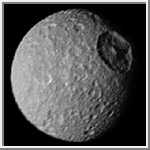
    And here is an enlargement of Mimas:


    Solarviews.com gives information about the Mimas's most distinctive feature: "The crater [named Herschel] is 130 kilometers (80 miles) wide, one-third the diameter of Mimas. Herschel is 10 kilometers (6 miles) deep, with a central mountain almost as high as Mount Everest on Earth." The overall appearance of Mimas, it's impressive crater, and, possibly, its mythological association, lead people to call it the "Death Star" of Star Wars fame.

    Saturday, February 12, 2005

    The Budget, four years out

    I've been trying to get out of the habit of passing along links ("hey, look at this!") on the theory that people come to a blog to hear something from the person writing it, not just observe another instance of a web sighting. We can all peruse the same sources if we wish and it's presumtuous to believe that something's interesting to you just because it's interesing to me. Still, having said all that, I am passing along a reference to a report on the long-term impact of the Bush budget. As this account, from Sabrina on BeSpacific, says, this isn't (yet) public information.
    Previously Unreleased Gov Docs on Budget Reveal Cuts
    Unpublished Administration Budget Documents Show Domestic Cuts Would Significantly Reduce Funding For Most Public Services: "The budget the Administration has released shows cuts in discretionary programs only for 2006. This analysis uses back-up materials OMB has provided Congress to show the size of the discretionary program cuts by program area over the next five years; the cuts triple by the fifth year."
    PDF of full report
    View Related Reports on Federal Tax Policies
    The chart below comes from the first of the links in Sabrina's post.

    Tuesday, February 08, 2005

    Nick's Challenge

    Nick writes:

    Life through Lou By GobberGo: "Answer the questions with titles of songs by one artist or group. Post this in your own journal."


    Here are his topics and my responses, using titles of songs by Pete Townshend (that's a picture of him above).

    1. Hello, have you ever met me?: Ask Yourself
    2. Are you male or female: Anyway, Anyhow, Anywhere
    3. Describe yourself: Exquisitely Bored*
    4. Your best piece of advice: Time Is Passing
    5. Describe your last relationship: Secondhand Love
    6. Describe your last crush: Rough Mix
    7. Say something to someone you have a crush on: You're So Clever**
    8. Say something to an ex: So Sad About Us***
    9. Say something to someone who hurt you severely: Won't Get Fooled Again***
    10. How do you feel right now: Crashing by Design

    ===============
    *
    or:
    English Boy
    Misunderstood
    I Am an Animal


    ===============
    **
    or:
    Time Is Passing
    My Baby Gives It Away


    ***
    or:
    I Won't Run Any More

    ===============
    ****
    or:
    I Eat Heavy Metal
    I Am Secure
    Hiding Out


    Monday, February 07, 2005

    Ruth Warrick

    The mother of my high-shool friend Jon McNamara died recently. Because she was a famous actress, all the papers noticed. I remember her as striking - really quite beautiful - in makeup and very strange without it; otherwise she seemed to me a mom like other moms. This photo shows her in 1970, a half a decade after I last saw her. I recall that she drove a car having a device that automatically dimmed the high beams wen cars approached. Quite cool. They lived in a big frame house near the train station and belonged to a golf club that you could walk to if you wished (though we didn't much that I can recall). In the basement of their house there were big cartons of products given her by sponsors of the soap opera in which she starred. Later on Jon changed his name to take his birth father's. His sister Karen played bassoon well and, strange to remember, was a Baptist.

    The obit in Paybill was pretty good.

    Ruth Warrick of "All My Children" Is Dead at 88
    By Kenneth Jones
    18 Jan 2005

    Ruth Warrick, one of the grand ladies of TV soap operas whose career included her movie debut with "Citizen Kane" as well as a flirtation with Broadway and work in stock, died Jan. 15.

    Ms. Warrick, known to fans of ABC's "All My Children" as Phoebe Tyler Wallingford, died in her Manhattan home of complications from pneumonia, her manager told The New York Times. She was 88.

    In the classic 1941 film, "Citizen Kane," she played Charles Foster Kane's wife, Emily, niece to the president. She made only three appearances on Broadway, in Miss Lonelyhearts (1957), the musical Take Me Along (replacing Eileen Herlie) and in the 1974 revival of Irene.

    The native of St. Joseph, MO, was no stranger to the stage, however, having studied acting with Antoinette Perry and Brock Pemberton, and played in many stock productions — as early as 1933 at the University of Kansas. In 1960 she was Anna in The King and I at the Music Fair in Toronto. Her work in film, radio and theatre was eclipsed by her work on "All My Children." As rich and grand Phoebe, she appeared on the program since 1970.

    Ms. Warrick was married five times. Survivors include three children, Karen Langenwalter, Jon Rolf and Robert McNamara; a grandson; and six great-grandchildren
    .
    This photo shows here in 1999.

    The Washington Post added:

    Ms. Warrick's casting in coldly intelligent roles belied a blunt, sometimes bawdy sense of humor. During one "All My Children" rehearsal, she approached a bored cameraman and flashed open her cape to reveal that she was topless. Later, to protest the network's poor air-conditioning system, she conducted rehearsal in a housecoat unzipped to her belly button. She said she liked slipping into the ocean at public beaches in a long top and panties.

    Ms. Warrick could be outlandish, outdoing all the pretensions at a diamond-studded Broadway opening by wearing a flamboyant crown. She also was a sincere Democratic political activist engaged in voter registration drives. Moreover, she taught acting to poor black and Hispanic students in New York and helped start a job-training program in the Watts section of Los Angeles after riots there in the 1960s.


    Living well

    Haven't meant to take a week off & don't know how it was that I did. Maybe it's that...

    We've been living well.

    Couple of weeks ago we hosted movie night - a gathering like a book group to see a DVD movie. B. did a full Indian meal out of her Christmas cookery book (gift of sister Sue). Great food, lots of conversation, & good cinema too.

    This past Saturday we went to a Mardi-Gras party ("Samdi"-Gras as I thought). Hors d'oeuvres first at John's and then dinner dance at St. Anthony's in Brookland. The band was just right - five old guys doing big-band standards (swing, two-step, waltz, and even tango); nice big dance floor, lots of room. Our table -- four married couples and a matched pair of singles -- danced the whole four hours of it and closed the place down. B. wore a tiara!

    Sunday we attended a recital - cello & piano - at a church in Northwest DC where we often hear good music. B. knows the muic director well and the performers are generally top quality.

    Not to long ago I chafed at the cold weather and then snow & ice, but have sprung out onto the roadway as the temperature rose these past days. My winter legs were surprisingly in form over the weekend; riding faster than I thought I would & not much off my warm-weather personal-best rates of speed. And this afternoon riding home encumbered by a pack full of layers needed for the ride in I managed a rare feat that can only be done at my quickest pace (and a certain amount of luck to boot): a passage of two dozen successive traffic lights without having to stop.

    This reminds me of some bike encounters of recent months. I unusually wheel through neighborhoods without anyone's notice or maybe some kidding around from high school kids after release. So it's memorable when people offer encouraging commentary. One guy I particularly appreciated was hanging out at a bus stop deep in the Shaw neighborhood on my inbound ride; he called out "Way to go Superman!" In my own neighborhood, a teenage girl called to congratulate me for wearing a helmet. Drivers usually do no better than tolerate me, but one recent afternoon a guy in an oncoming car flashed his lights and gave me thumbs-up. Finally, off bike, but in bike clothes, a woman who works in the Law Library (whom I don't know) told me my bike commuting made me a legend in LC. It does help.