An Oregon public station recently broadcast a news piece about a library that closed for three days to install a new catalog system. See Busy Library System Closed For Three Days. The short item says the catalog system is, essentially, the library's brain.
The analogy of catalog and brain brings to mind Gottfried Leibniz, one of the first men of science to suppose the mind to be a functional part of the brain and not a separate, though immaterial entity. Since he was also one of the first men to create a calculating computer and to develop a programming language based on binary arithmetic, it's quite possible he made the association between the biological operations of the brain and the mechanical operations of the computer. And further, since he was one of the first to attempt the use of numbers to encode knowledge in a universal classification scheme, he might be said to have prepared the way for the digital library controlled by relational database.
Since he was a librarian and a cataloger at that, he certainly was capable of visualizing a catalog system as a library's brain. Though I don't believe he wrote anything to that effect, it's interesting to speculate that he might be the great- great- great-grandfather of today's systems librarians.

{This image shows the library that Leibniz ran in Wolfenbüttel, Germany. Source.}
Leibniz's catalog used author as main-entry. At pretty much the same time, as general archivist of the principality of Brunswick-Lunenburg, he designed a subject-based classification scheme for legal documents.


{The first image shows the Leibniz computer. The second shows Leibniz's system of binary arithmetic which might have been used to program the step-reckoner. Source.}
Although he's not too well known for these efforts to solve cataloging problems, he's very well known as one of the originators of the modern computer. In the early 1670's he made plans for one of the first mechanical calculators, a proto-computer which he called a step-reckoner.

{I think this depicts the numeric basis for Leibniz's universal classification scheme, which he called an alphabet of human thought. I'm not sure about this because the source of the diagram is a web page in German and other sources concerning the sceme are somewhat vague. Source.}
Leibniz's alphabet of human thought was an attempt he made to work out a universal classification scheme for all knowledge, a kind of prototype for online research resources supported by relational databases. He did not finish this work and did not begin the attempt to apply it however.
To effect this alphabet of human thought, Leibniz aimed to establish a numerical scheme: the characteristic numbers for all ideas. He wasn't the first to think of this, nor the first to give up without completing it. But he was probably the first who was capable of foreseeing a primitive precuror of modern-day computer databases. About this effort, he wrote:
There must be invented, I reflected, a kind of alphabet of human thoughts... Through the connection of its letters and the analysis of words which are composed out of them, everything else can be discovered and judged... It took strenuous reflection on my part, but I finally discovered the way.... Once the characteristic numbers are established for most concepts, mankind will then possess a new instrument which will enhance the capabilities of the mind to a far greater extent than optical instruments strengthen the eyes, and will supersede the microscope and telescope to the same extent that reason is superior to eyesight. Great as is the benefit which the magnetic needle has brought to sailors, far greater will be the benefits which this constellation will bring to all those who ply the seas of investigation and experiment. What further will come out of it, lies within the lap of destiny.
- Leibniz, George MacDonald Ross, University of Leeds Electronic Text Centre. Originally published: Oxford University Press (Past Masters) 1984. Electronic edition : Leeds Electronic Text Centre July 2000
- Wikipedia articles on Leibniz, Alphabet of Human Thought, and Universal Language.
- Registry: The world's most predominant record keeping system, David O. Stephens. The ARMA Records Management Quarterly, Jan 1995.
- Gottfried Wilhelm Leibniz, 1646 - 1716, Brief an den Herzog von Braunschweig-Wolfenbüttel, Rudolph August
- Library Time Line
- Jürgen Schmidhuber's page on Gottfried Wilhelm von LEIBNIZ
- The MAA Online book review column, The Universal Computer: The Road from Leibniz to Turing, by Martin Davis, Reviewed by Mark Johnson
- THE METHOD OF MATHEMATICS, by Gottfried Wilhelm Leibniz, Preface to the General Science, from the page: Characteristica Universalis and the Origin of the Symbolator, by Dr. Andreas Goppold at the University of Ulm.


 I've started using

 This reminds Pierre of a book, Simenon's
  A resident of Lausanne, Simenon would come for a cut every couple of weeks. Pierre says Simenon told him once that he had just finished a new book. He liked it so much, he said, that if all his other work disappeared, he would be satisfied to be the author of this one. The book is
  I ask Pierre about the Maigret books because I've enjoyed them for years and own all the ones I could acquire in second-hand bookstores. He tells me Simenon told him how he wrote them: systematically, almost mechanically. He would find a subject, observing a man sitting on a bench in a park, he would imagine a life for him -- a wife who detests him for his drinking -- and would develop a plot around the marital conflict. The books are all almost exactly the same length. They all took almost exactly the same time to write. He would write the manuscripts and put them aside, finding publishers later, sometimes years later. Here's

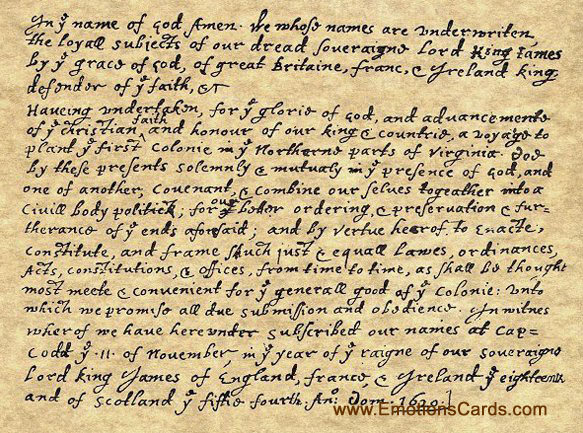 Though I'm a bit too lazy to try to figure out why, I think "compact" might be the better term. The image shows the Mayflower Compact, famous but nothing to do with Julia and Nick's agreement. It's here because it's the only compact of this nature for which it's easy to find an image. Here's OED on the term: Etymology: "It. compatto (Florio), ad. L. compact-um a compact, agreement, from the verb compacisci to covenant together." Definition: " A covenant or contract made between two or more persons or parties; a mutual agreement or understanding; 'a mutual and settled appointment between two or more, to do or to forbear something' (J.). It is used without a in phrases, as by, from, with compact; also to strike compact." Quotation: "1590 SHAKES. Com. Err. II. ii. 163 What is the course and drift of your compact?"
 I found this T-shirt on a web site and couldn't resist including it here, though it's hardly related to the compact. I got it from a page called





 Posts
Posts