Friday, September 16, 2005

Cataloging system as library brain

I'm cross-posting this from the intranet blog at work. I made the connection between the news item and certain contributions to intellectual history made by Leibniz because I'm still reading Neal Stephenson's huge Baroque Cycle and there's lots about Leibniz in the three volumes of it. What follows is the post from the library weblog:

An Oregon public station recently broadcast a news piece about a library that closed for three days to install a new catalog system. See Busy Library System Closed For Three Days. The short item says the catalog system is, essentially, the library's brain.

The analogy of catalog and brain brings to mind Gottfried Leibniz, one of the first men of science to suppose the mind to be a functional part of the brain and not a separate, though immaterial entity. Since he was also one of the first men to create a calculating computer and to develop a programming language based on binary arithmetic, it's quite possible he made the association between the biological operations of the brain and the mechanical operations of the computer. And further, since he was one of the first to attempt the use of numbers to encode knowledge in a universal classification scheme, he might be said to have prepared the way for the digital library controlled by relational database.

Since he was a librarian and a cataloger at that, he certainly was capable of visualizing a catalog system as a library's brain. Though I don't believe he wrote anything to that effect, it's interesting to speculate that he might be the great- great- great-grandfather of today's systems librarians.


{This image shows the library that Leibniz ran in Wolfenbüttel, Germany. Source.}
Leibniz's catalog used author as main-entry. At pretty much the same time, as general archivist of the principality of Brunswick-Lunenburg, he designed a subject-based classification scheme for legal documents.


{The first image shows the Leibniz computer. The second shows Leibniz's system of binary arithmetic which might have been used to program the step-reckoner. Source.}

Although he's not too well known for these efforts to solve cataloging problems, he's very well known as one of the originators of the modern computer. In the early 1670's he made plans for one of the first mechanical calculators, a proto-computer which he called a step-reckoner.


{I think this depicts the numeric basis for Leibniz's universal classification scheme, which he called an alphabet of human thought. I'm not sure about this because the source of the diagram is a web page in German and other sources concerning the sceme are somewhat vague. Source.}
Leibniz's alphabet of human thought was an attempt he made to work out a universal classification scheme for all knowledge, a kind of prototype for online research resources supported by relational databases. He did not finish this work and did not begin the attempt to apply it however.


To effect this alphabet of human thought, Leibniz aimed to establish a numerical scheme: the characteristic numbers for all ideas. He wasn't the first to think of this, nor the first to give up without completing it. But he was probably the first who was capable of foreseeing a primitive precuror of modern-day computer databases. About this effort, he wrote:
There must be invented, I reflected, a kind of alphabet of human thoughts... Through the connection of its letters and the analysis of words which are composed out of them, everything else can be discovered and judged... It took strenuous reflection on my part, but I finally discovered the way.... Once the characteristic numbers are established for most concepts, mankind will then possess a new instrument which will enhance the capabilities of the mind to a far greater extent than optical instruments strengthen the eyes, and will supersede the microscope and telescope to the same extent that reason is superior to eyesight. Great as is the benefit which the magnetic needle has brought to sailors, far greater will be the benefits which this constellation will bring to all those who ply the seas of investigation and experiment. What further will come out of it, lies within the lap of destiny.


Some sources:

Wednesday, September 14, 2005

The Cannibal


Click here for full-size version of this photo.
Mostly they called him The Cannibal, but here he is The King. I scanned this photo from a the center-fold of a British magazine, Cycle Sport; the issue of March 2002. Here's most of the accompanying text.
Stage One 'A'
Tour de France 1971

The King Parades Before His Subjects

Mulhouse, eastern France, just before the start of a mammouth day in the saddle for the riders of the 1971 Tour de France. The day consisted of three split stages and would take the peloton first to Basle in Switzerland, then to Freiburg in Germany and back to Mulhouse. Members of the Mars-Flandria team sit kerbside, snacking on their early-morning rations, and looking on like schoolboy fans as the master, Eddy Merckx, arrives for that day's lesson.

Riders in Photo: Left to Right

Marinus Wagtmans (Hol)
riding behind Merckx
Rini Wagtmans, christened 'Kuifje' (Tufty) by the Dutch fans, on account of the tuft of white he had down the middle of his curly brown hair, was one of the best descenders in the sport.

Eddy Merckx (Bel)
centre, riding
Instantly recognisable, Merckx is clad in the yellow jersey he had won in the previous day's prologue team time trial. He would go on to win this Tour, his third in a row, and take the green jersey too, but it would not be without a struggle. On the mountainous 11th stage to Orcieres-Merlette, in stifling heat, the mercurial Spaniard Luis Ocana did what he'd been threatening to do for some time and inflicted a crushing defeat on Merckx to take over the yellow jersey and lead the Tour by over eight minutes. Ocana crashed out in the Pyrenees and did not finish the Tour.

Edy Schutz (Lux)
seated fourth right
Champion of Luxembourg six times in succession between 1966 and 1971 and three times winner of his national tour, this was Edy Schutz's last season as a pro rider.

Roger De Vlaeminck (Bel)
seated third right
This picture was taken at the beginning of De Vlaeminck's rivalry with Eddy Merckx, a rivalry heightened by language differences. At the time the Flemish felt very strongly that they were being governed unfairly by the French-speaking Walloons. De Vlaeminck, one of the best ever Classic riders, was the Flemish people's champion, and some of the more extreme of them thought that the French-speaking Merckx was their enemy, especially as he had a Flemish name.
       All this is history; however, you can see by De Vlaeminck's face that he was never intimidated by Merckx, in fact in this picture he looks like he has just cracked a joke at his expense. Wagtmans seems to have found it funny, even if Merckx looks like he's trying to ignore it.
       The Tour de France was never to De Vlaeminck's liking, even if he could trouble Merckx in a one-week stage race. In fact he didn't even get to the end of this race and in future years did everything he could to avoid it.

Eric De Vlaeminck (Bel)
seated second right
A seven times world cyclo-cross champion, Eric De Vlaeminck was no slouch on the road either as the first three placings in Flesch Wallonne and Ghent-Wevelgem testify. In this Tour he was there largely to look after his younger brother, Roger, and he finished 61st.

Eric Leman (Bel)
seated, first right
Super-fast sprinter Leman, a three times winner of the Tour of Flanders, actually won this stage. He won two others in the 1971 race, at Armiens and Nevers, but like most sprinters he found the mountains difficult and finished 91st overall.

Tuesday, September 13, 2005

Taking it all in

In one of many articles on yesterday's match in the Ashes series, the Sydney Morning Herald reports what Australia's best player, Warne, said to England's hero, Pietersen, when he shook his hand. Warne ran up to Pietersen when he had finally bowled out after making 158 runs, thus becoming the leading run-scorer of the series. The SMH reporter quotes Pietersen:
"It was a special moment when Warney ran over to me when I walked off the field. He just said to me, 'Make sure you take this moment in, it's a special special moment, you've played a special special innings. Make sure you just savour this moment, take it all in and acknowledge everybody'."


Photo caption: Kevin Pietersen leaves the field after scoring 158 runs on the fifth day of the 5th Test. Photo: AP

Monday, September 12, 2005

They Did It!

Things looked bad in the morning when some of England's best batters fell to the superior bowling of Australia's Shane Warne, but England's lesser lights came through to save the match. In true cricketing style Warne congratulated Pietersen, the author of his team's defeat: "When Pietersen was finally dismissed, Warne ran over to him to shake his hand as he headed for the pavilion in the evening shadows." Here's what CNN reports:

WORLD SPORT
England take Ashes after Oval draw

Monday, September 12, 2005; Posted: 1:50 p.m. EDT (17:50 GMT)


Photo caption: Pietersen's superb innings was the benchmark for England's Ashes win

extracts:

LONDON, England -- Kevin Pietersen scored an outrageous maiden Test century at The Oval to seal England's first Ashes triumph for almost two decades.

Six runs ahead after the first innings and resuming their second on 34 for one, England recovered from a top-order collapse to bat out almost the entire day before being dismissed for 335.

The world champions, who had been hoping to set up a run chase in the final session, were left to face less than an over from Steve Harmison, getting to four without loss before accepting both the light and their historic defeat.

The South Africa-born Pietersen ...faced 187 balls and batted for four and three-quarter hours, helping to put on 60 for the sixth wicket with Paul Collingwood and 109 for the seventh with Ashley Giles.

In his last Test in England and one day short of his 36th birthday, Shane Warne produced a mammoth, exhausting performance to take six wickets for 124 to go with his six for 122 in the first innings, but did not get enough support from his team mates.

England last won the Ashes in 1986-87 - Australia winning a record eight series in a row since.


This photo shows some of Australia's outstanding fielding

Photo caption: Paul Collingwood and Pietersen put on 60 before Ponting takes a diving catch off Warne to dismiss Collingwood for 10.


Photo caption: Pietersen survives three dropped catches on the way to a massive 158 - England are in the hunt on 221-7 at tea.

Sunday, September 11, 2005

England: They could actually do it!

From the BBC:
Last Updated: Sunday, 11 September 2005, 15:20 GMT 16:20 UK
England set sights on Ashes glory
Fifth Test, The Oval, day four:
England 373 & 34-1 v Australia 367

This is Andrew Flintoff, England's best all-round player (bowler & batsman). About this photo the Beeb says: "Crowd hero Flintoff does it again, nipping one back to Simon Katich whose dismissal leaves Australia on 330-5."

This photo's caption on the BBC page: "The wickets continue to fall and Australia are 367 all out when Brett Lee is caught by Ashley Giles"

Library Thing

I've started using LibraryThing to keep track of the books I've read and wish to read. It replaces BooksWeLike and AllConsuming which I tried out but didn't like as much.

The OpenDirectoryProject has a current list of "collection managers" like LibraryThing, but doesn't list BooksWeLike or AllConsuming, so I guess they're in a different category. Here's the list:
  • bibliophil.org - Keep track of your books in a customized library.
  • Delicious Library - Macintosh software to catalog, browse, and share books, movies, music, and video games.
  • Elf - Offers reminders via e-mail and RSS on library books that are checked out.
  • LibraryThing - Catalogs yours books online. Free for up to 200 titles.
  • Listal - A Web-based DVD, music, game and book collection manager.
  • Reader² - Keeps a list of books you read and/or recommend.

You can see part of my LibraryThing list in the Current Reading section of the right-hand column of this page. You'll find the book I'm reading (or books, if more than one), the one I just finished, and the one I think I'll read next. You can see my whole catalog on LibraryThing here. Click Title, Author, or Date in the column header to change the sort. Click the little catalog card icon on right to see LC bibliographic data and click the book cover image at left to see Amazon's entry. The icon of a person on right leads to "social data." It's a listing of the LibraryThing users who have put the book in their catalogs. You can click on the links to see the other books in their catalogs. (If you're a user at that point you can also add books to your catalog from their catalog if you wish.) Click the numbers that follow the words "display style" to see different forms of catalog entry. No. 3 is most like a library catalog record.

LibraryThing has its own blog and there's been lots of discussion of it in others' blogs, including Library Stuff, Findory, Early Modern Notes, and TransBlawg.

Stefan Hayden has an in depth review. Here are excerpts from his review:
LibraryThing is a great new app that let you catalog you’re books. It’s in early beta and although it needs a lot of feature as far as search, design, and usability it’s a stellar start to what could be the next great website. It’s so easy to bash sites for what they don’t have and so I’m gonna make an extra effort to highlight why it’s so great.

First, as a designer and developer, I was glowing when I saw the “One-step sign up / sign in”. This is such a usable sign up form that it almost made me cry. Simplicity at it’s best. After you sign in you can go to the Add Books tab and start searching for books. Search results are listed in a side iframe which allows for dynamic loading of results. Wonderful use of AJAX as if you are unhappy with your search you can edit what is already in the search box. Clicking any link will add the book to your library and if you make a mistake you can just X it out directly after you add it. It’s some nice work of javascript. Back on the Catalog page you can view all your books. On the right you can edit the book and add tags (yes tags!) and comments as well as view the Library of Congress Card Data. All the text is searchable through a little javascript find link on the top right. Other features include exporting a CSV format which works with excel and (still being worked on) importing your library from Delicious Library. The free account only lest you index up to 200 books. The best part is that the pro account is a one time fee of $10, which if you have more then 200 books is a very worth while investment.

[He goes into a whole bunch of drawbacks at this point, then concludes:] Wow this is really long. While I have been rather harsh to LibraryThing only my love for it could develop this much passion (which is the new way to market of course). When it’s all said and done the site is in beta and is being actively developed. While it is interesting that some elements are done beautifully and some are badly designed or even missing there is every reason to believe that they will be addressed and quickly.

Visit my Library at STHayden!

Friday, September 09, 2005

Getting a haircut

Despite my headline this is a story about Georges Simenon. I've had the same dentist and same hair cutter for 30 years. We're growing old together. I learned about both from fellow workers at CIS back in the mid 70's in Bethesda. I've stuck with them, happily, ever since. In the dentist's case, that's through three moves of office. In the hair cutter's, it's more like a dozen or half again more.

Think about it. Warren Beatty is a couple of years older than Pierre, the hair cutter, and five years older than me. He was in his mid-thirties when he played a roguish hair cutter in Shampoo and is 68 now.


Pierre, like the Beatty character in Shampoo, works in hair salons, not barber shops. Back in 1970 or so, Beth convinced me that hair dressers are much better than barbers and, in my experience, she's right.

Pierre is Swiss.

Today, waiting for my turn in his chair, he tells the guy behind the cash register that I look like Lance Armstrong. I say I wish I had a young celeb hanging on my arm as he does. I say it just to be companionable, I don't really mean it. Later, in the chair, I tell Pierre that he did well by the woman who was his previous customer. He says her hair is too thick; she should have let him cut it shorter, but he agrees that she looks good. He tells me she's in her mid-80's and has a new boy friend. A widow, she's buried four husbands. He also says she goes to Mass every day. I tell him my thoughts on high divorce rates: that people used to get out of marriages (good or bad) though the death of spouses, so that it used - at one time - to be pretty common for a woman to have had three or even four husbands. We also talk about the failed marriages that didn't dissolve in divorce, but in which both partners lived separate lives.

This reminds Pierre of a book, Simenon's The Cat (the link takes you to a NYT review. Click here to find the book in a library.) Pierre tells me the plot: an elderly couple's relationship has deteriorated into such hatred that they no longer speak to each other, but communicate using notes on little pieces of paper which they crumple and toss into each other's laps. They have split the kitchen into two functional areas because one fears the other will resort to poison. They each have pets - a cat and a bird - and one fingers the other as murderer when the bird dies. I checked for reviews and found one person who wrote of this tale: "The reader turns the pages in mounting horror, unable to do other than read on."

Pierre then tells me that he used to cut Simenon's hair. When he was young, 19 or so, he worked in a salon in the Palace Hotel in Lausanne.
A resident of Lausanne, Simenon would come for a cut every couple of weeks. Pierre says Simenon told him once that he had just finished a new book. He liked it so much, he said, that if all his other work disappeared, he would be satisfied to be the author of this one. The book is The Little Saint. A review article in the New York Times bears out what Pierre says. A review in the Saturday Review says: "THE LITTLE SAINT may be the most joyous novel Simenon has written...his story is lively, realistic, genial and magnetic."


I ask Pierre about the Maigret books because I've enjoyed them for years and own all the ones I could acquire in second-hand bookstores. He tells me Simenon told him how he wrote them: systematically, almost mechanically. He would find a subject, observing a man sitting on a bench in a park, he would imagine a life for him -- a wife who detests him for his drinking -- and would develop a plot around the marital conflict. The books are all almost exactly the same length. They all took almost exactly the same time to write. He would write the manuscripts and put them aside, finding publishers later, sometimes years later. Here's a list. (The author of this list gives a nice quote from T.S. Eliot: "I now prefer Claret to Burgundy and I prefer Inspector Maigret to Arsene Lupin". This was Eliot's response to the question "the two most important changes in his life?", in The Fiftieth Anniversary Report of the Harvard Class of 1910.) Lately, I've been watching Maigret in TV series as available on Netflix. (This link takes you to one of them.)>

Pierre also tells me how Simenon could embarrass him. Pierre came from a rural area and was, he says so unsophisticated that he was more like a 12 year old than a 19 year old. So when Simenon bragged about the many women he had, Pierre was thoroughly embarrassed. (Simenon liked to brag about his prowess with women; see here for example, where he's called a self-confessed sex-addict.)

(Simenon. Note nice haircut.) Pierre's story is that Simenon insisted that he have the right to approve two actors in any film or tv production made from his books. He didn't really want to select the actors, just wanted to have an excuse to rub shoulders with celebrities. Simenon once told Pierre about a trip to Brussels about the filming of a Maigret story. He told Pierre he insisted that he be able to smoke a pipe in the place where filming was done. Though this was strictly against the rules, they allowed him to smoke. He said he stayed in a first class hotel that had been built with money from the Vatican. And then he tells Pierre that he was having trouble getting to sleep in the Pope's hotel, as he called it, and about 11:30 or midnight, he made a call and two minutes later had a woman in his room Pierre says he and the nail girl turned bright red and hung their heads. It took him awhile before he could look straight at Simenon.

(This is The Palace Hotel) Pierre also told me what it was like when a Saudi Prince would descend on the Palace Hotel with his family and entourage. It's another story and I've done enough typing. In short, everything had to be arranged for the convenience of the Saudis, not at all an easy thing to accomplish, but at the end, he handed the hotel the equivalent of $300,000 to distribute among the staff as tips. The management shared it out as fairly as they could. Pierre doesn't remember how much he got.

A marriage compact

Julia and Nick have a longstanding agreement that the first to marry will pay the other $100. No, they're not anti-marriage. When Julia suggested I blog about the agreement, I wondered what term to use in describing it. My first thought was to use the word "pact." I knew the term death pact, and sure enough, the term marriage pact is also common, though at least one usage doesn't apply in this case (friends who agree to marry each other if they're both unhitched at some future date).

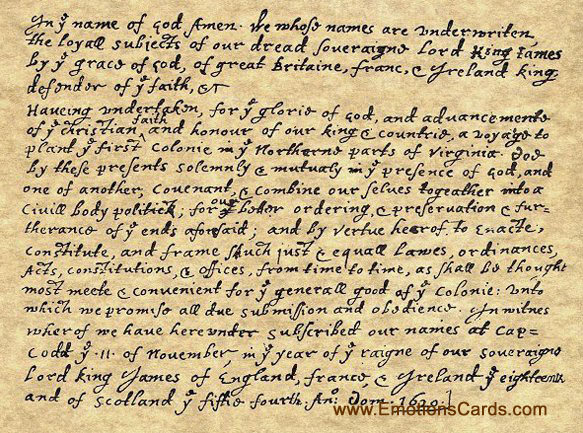
Though I'm a bit too lazy to try to figure out why, I think "compact" might be the better term. The image shows the Mayflower Compact, famous but nothing to do with Julia and Nick's agreement. It's here because it's the only compact of this nature for which it's easy to find an image. Here's OED on the term: Etymology: "It. compatto (Florio), ad. L. compact-um a compact, agreement, from the verb compacisci to covenant together." Definition: " A covenant or contract made between two or more persons or parties; a mutual agreement or understanding; 'a mutual and settled appointment between two or more, to do or to forbear something' (J.). It is used without a in phrases, as by, from, with compact; also to strike compact." Quotation: "1590 SHAKES. Com. Err. II. ii. 163 What is the course and drift of your compact?"

I found this T-shirt on a web site and couldn't resist including it here, though it's hardly related to the compact. I got it from a page called Busted Tees : Jokes you can wear! Hilarious T-Shirts which I spotted on oishii. Here are some more:


Thursday, September 08, 2005

The Ashes today


It's begun: day one of the Fifth Test Match of The Ashes cricket series.
Summary on BBC Sport

Wednesday, September 07, 2005

The ministry of reshelving

I found this one on oishii. As its home page says, oishii is based on del.icio.us, the social bookmarking service. It polls the del.cio.us front page every 5 minutes, and returns all sites bookmarked by at least 30 people. Click the oishii link above to see how it works. I just checked for other sources that refer to the "the ministry of reshelving" and found an article on the Boston Globe on the project. You can read it for background information on what follows. When you've done reading the following post, go over to flickr where there is a ministry-of-reshelving group with discussion as well as photos. If you scroll down below the following post, you'll find one part of this discussion.

Here, in full, is the posting I found in oishii:
the ministry of reshelving


8/14/05 - Our uniform
Originally uploaded by Avant Game.

This week, we launched the Ministry of Reshelving project. My partners in crime as founding members of the ministry: George, Kiyash, and Monica.

This weekend we relocated 19 copies of George Orwell's 1984 in four different bookstores in Palo Alto, San Francisco, and Berkeley. It was high stealth adventure.

You are invited to join our efforts.

How to Serve the Ministry of Reshelving

1. Select a local bookstore to carry out your reshelving activities.

2. Download and print "This book has been relocated by the Ministry of Reshelving" bookmarks and "All copies of 1984 have been relocated" notecards to take with you to the bookstore. Or make your own. We recommend bringing a notecard and 5-10 bookmarks to each store.

3. Go to the bookstore and locate its copies of George Orwell's 1984. Unless the Ministry of Reshelving has already visited this bookstore, it is probably currently incorrectly classified as "Fiction" or "Literature."

4. Discreetly move all copies of 1984 to a more suitable section, such as "Current Events", "Politics", "History", "True Crime", or "New Non-Fiction."

5. Insert a Ministry of Reshelving bookmark into each copy of any book you have moved. Leave a notecard in the empty space the books once occupied.

6. If you spot other incorrectly classified books, feel free to relocate them.

7. Please report all reshelving efforts to the Ministry. Email your store name, location, # of 1984 copies reshelved, and any other reshelving activities conducted, to reshelving @ avantgame.com. Photos of your mission can be uploaded to Flickr, tagged as "reshelving", and submitted to the Ministry of Reshelving group.

Our goal is to relocate one thousand nine hundred and eighty-four copies, and to complete successful reshelving of 1984 in all 50 United States. Global contributions are welcome.

Note: this project is not a critique of bookstore culture, the state of the shelving industry, or even of pervasive government surveillance. It is merely an observation that 2 + 2 = 5, and 5 is no longer fiction.

UPDATE:

Many thanks to everyone for their feedback on this project.

We at the Ministry of Reshelving support all efforts to properly classify fiction and nonfiction texts. So here are some alternative (or complementary) tactics.

*Ask to speak to a bookstore manager, perhaps a time when the bookstore is not busy. Introduce yourself as a representative of the Ministry and simply suggest the relocation. Do not relocate any books. Simply have a friendly conversation. Perhaps have a card referring the manager to the Ministry of Reshelving Flickr group.

*Mod the current Ministry bookmarks to SUGGEST relocation of the books. Insert these in all copies. Do not actually relocate the books.

*Stage a photo of the relocation, and then return the books to their original location. This might not be revolution, but it is a rehearsal for the revolution.

*Create a notecard to leave at the bookstore in the section you think 1984 should be properly shelved. The notecard could say "Sorry! There are no more copies of George Orwell's 1984 in the __________ section. Additional copies are located in the fiction and literature section."

*Before you conduct your 1984 reshelving, look around the store for a few books left out by other customers and put them back where they belong. Do a bit of 'traditional' reshelving on behalf of the employees. Then do your 1984 reshelving.

These mods are designed to address people's concerns with the impact of the project on customers and bookstore employees and owners. I'm 100% committed to making these kinds of experiments as sociable as possible, while still confronting the issues of: Where is it appropriate for the public to play, to intervene, to suggest alternatives, to tag, to reclassify, to be expressive? It is clear to me that many people do not feel that bookstores are a proper location for such play and intervention. I very much disagree, but I am learning much from their comments and reactions.

If you would like to understand the motivations of this project better, why not read a minor statement on avant gaming?

Final update: Comments have been suspended on this blog in accordance with Godwin's law. The Ministry of Reshelving, however, continues its work.


Here is a sample contribution from the ministry-of-reshelving group on Flickr:
Greeting from the Canadian Branch.

This afternoon during the lunchhour myself and another student went to our campus bookstore at the University of British Columbia in Vancouver, Canada. We found and documented evidence of 1984 being improperly shelved in Fiction.

We reshelved 19 copies with bookmarks in Current Affairs and replaced the empty space with a notecard.

We were continually on the lookout for staff, and had to pretend we were customers on more than one occasion. We exited the premises without incident.

www.flickr.com/photos/tyfn/sets/773654/

Tuesday, September 06, 2005

One of the Millions of Hurricane Katrina Stories

Read One of the Millions of Hurricane Katrina Stories by Michael Homan if you can. I won't try to extract from it. It's a powerful eye-witness account and compelling personal narrative.

Two newspaper editorials are also worth your time. The lead editorial in Sunday's Washington Post -- Disaster Economics -- says it's likely, though far from certain, the U.S. economy will take the event in stride. This counters something I read and blogged about a few days ago concerning the destruction of the Port of Southern Louisiana, but it rings true nonetheless. In contrast, Katrina and the Gas Pump, an editorial in today's NYT, says high demand and short supply of gasoline is not a temporary problem:
Gasoline prices seem destined to stay elevated until at least next spring. Even if the damage in the Gulf Coast is repaired soon - a big if - oil producers and refiners will require a premium to compensate for the risk that another killer storm could further disrupt operations in this hurricane season. Moreover, Katrina is causing refineries to draw down oil stockpiles that would have been used to produce home heating fuel for use this winter. That makes for a very thin supply cushion in the months ahead - not to mention high home-heating bills on top of high gasoline prices.

But even before the hurricane hit, oil producers were pumping all-out to meet demand. Driven mainly by gasoline consumption in the United States and industrialization in China and India, the world's consumption of oil is 85 million barrels a day. That is just short of the maximum that can be pumped, and leaves only about 1 million barrels a day in spare capacity, the lowest level in three decades. As with gasoline, the thinner the cushion, the higher the price.
The writer says it's clear that Americans need to conserve energy, particularly by cutting back on needless driving of automobiles.

Monday, September 05, 2005

PBWiki


PBWiki is a quick and easy personal home page. I've tried it out and like how it works.

My first page came to life in the blink of an eye, a finger-snap of time, the duration of a quick coffee-break from in my workday (although I couldn't resist tinkering with it after I'd done the basics). Take a look; it's called baroudeur -- yet another French bike racing soubriquet.

It's free. You can make more than one page. You can keep your page private or permit others to view it. You can be its only webmaster or you can invite others to add to and alter its contents or make new pages if they wish.

It can be used for book lists, chore lists, reminders, records of visits to the doctor's office or notes on physical fitness. Imagine!

You could also create a collaborative page for planning future events (a holiday!).

It could be used for an academic assignment (easier than that home page on the college web site).

Or just a personal page, fancy free.

Sunday, September 04, 2005

Jabbor Gibson


Photo source: http://www.sadlyno.com/
This photo shows Jabbor Gibson with his commandeered bus and its passengers.

There are lots of news and blog accounts about Jabbor's feat; you probably aleady know about this. Here's a short summary from KRGVTV:

Eighteen-year-old Jabbor Gibson jumped aboard the bus as it sat abandoned on a street in New Orleans and took control.

“I just took the bus and drove all the way here…seven hours straight,’ Gibson admitted. “I hadn’t ever drove a bus.”

The teen packed it full of complete strangers and drove to Houston. He beat thousands of evacuees slated to arrive there.

“It’s better than being in New Orleans,” said fellow passenger Albert McClaud, “we want to be somewhere where we’re safe.”


A blog called Tattered Coat has a pointer to this and other stories of this morning.

Katrina Sources from Matt

At the bottom of the post on Jabbor Gibson, I linked to a post on a blog by "Matt" called The Tattered Coat. Matt is keeping a Summary of Useful Resources on the Katrina Aftermath at the top of his blog. Here's the link: http://www.tatteredcoat.com/

Matt's blog has a tattered coat as logo and its motto is "but a paltry thing."

I bet Nick will know the source:
An aged man is but a paltry thing,
A tattered coat upon a stick, unless
Soul clap its hands and sing, and louder sing
For every tatter in its mortal dress.
William Butler Yeats, Sailing to Byzantium, st. 2, The Tower (1928).

Here's a link to the whole of The Tower from Humanities Web.

It's a death song and it ends:
.....gather me
Into the artifice of eternity.

Once out of nature I shall never take
My bodily form from any natural thing,
But such a form as Grecian goldsmiths make
Of hammered gold and gold enameling
To keep a drowsy Emperor awake;
Or set upon a golden bough to sing
To lords and ladies of Byzantium
Of what is past, or passing, or to come.

Great White Horse

Barbara got us Dear Frankie on Netflix. We watched it over dinner and liked it. Along with much else that's good, the music fits well; some original orchestral stuff and some popular pieces. "Great White Horse" by Buck Owens is particularly significant. Here's the lyric:

GREAT WHITE HORSE
(Buck Owens - Larry Scott)
« © '70 Tree Publishing, BMI »

(When I was a young girl I used to dream of a lover
To be my shining knight of strength one day
He'd carry me to a castle in the heavens and battle all my dragons on the way
And he'd ride down on a great white horse; he'd bring me love I was longing for
He'd bring me charm and lasting peace on a great white horse he'd ride away with me
Singing dum-di-de-dum-dum-dum-di-de-dum)

When I was a young man I used to dream of a maiden
With long soft hair flowing in the wind
Her laughing eyes and loving arms would follow
When I'd sail around the world and back again
And I'd ride down on a great white horse I'd bring the love she was longing for
I'd bring her laughter and sunny days
And on a great white horse I'd carry her away
Singing dum-di-de-dum-dum-dum-di-de-dum

(The time has flown I find there are no dragons)
and I don't wanna sail the seven seas
(Anywhere we are becomes our castle) and the only world I want is here with me
And we both ride on a great white horse we found the love we were longing for
(You're my sunshine on a rainy day) you're my April you're my May
Singing dum-di-de-dum-dum-dum-di-de-dum

(When I was a young girl I used to dream of a lover
To be my shining knight of strength one day
He'd carry me to a castle in the heavens and battle all my dragons on the way
And he'd ride down on a great white horse; he'd bring me love I was longing for
He'd bring me charm and lasting peace on a great white horse he'd ride away with me
Singing dum-di-de-dum-dum-dum-di-de-dum)


The "great white horse" theme brings to mind my post on the contribution of great horses to the rise of Europe as the Middle Ages turned into the Renaissance.

Image from this earlier post. It's a Frieslander.

One of my favorite authors, Rosemary Sutcliff, wrote a book about the Great White Horse of Uffington: Sun Horse, Moon Horse (Amazon link). This horse is not Buck Owens', nor is it a Medieval war horse, but far more ancient and mysterious.


The White Horse, Oxfordshire, UK

Here's an introduction to the subject:

The Uffington white horse

The Uffington Horse{Click photo for full view.} The Uffington white horse, one of only four that face to the right, is high on an escarpment of the Berkshire Downs below Whitehorse Hill, a mile and a half south of the village of Uffington, and it looks out over the Vale of the White Horse. Though on the Berkshire Downs, it has been in Oxfordshire since county boundary alterations in the 1970s. It is cut, not on the steepest slope of the hill, but on the much shallower slope near the top, and can only really be viewed well from afar or from above.

This is by far the oldest of all the white horses, and is of an entirely different design to the others. Unlike the solid and more or less naturalistic figures of the other horses, the Uffington white horse is formed from stylized curving lines some ten feet or less wide, and its length of around 365 feet makes it over twice as long as the longest of the Wiltshire horses. Whether it is indeed intended to represent a horse, or some other creature instead, has been debated, but it has certainly been called a horse since at least medieval times. A cartulary of the Abbey of Abingdon from between 1072 and 1084 refers to "the place commonly known as the White Horse Hill" ("locum qui vulgo mons albi equi nuncupatur").

Until 1995 the Uffington white horse was thought to date from the Iron Age. However, in the nineteen-nineties, a new dating technique was developed. This technique, optical stimulated luminescence dating (OSL), can show how long soil has been hidden from sunlight. The lines of the horse consist of trenches dug in the hillside, then filled with chalk. OSL testing of soil from between the lower layers of that chalk shows that it has been buried since between 1400 BC and 600 BC, and probably between 1200 BC and 800 BC, and thus the horse is of Bronze Age origin.

The original purpose of this horse is unknown. It may have been the emblem of a local tribe, and have been cut as a totem or badge marking their land, or it may have had a religious purpose or significance. The horse-goddess Epona was worshipped by the Celts in Gaul, and she had a counterpart in Britain, Rhiannon, so the Uffington white horse may have been cut by adherents of a cult of the horse-goddess.

Alternatively, the horse could have been cut by worshippers of the sun god Belinos or Belenus, who was associated with horses. He was sometimes depicted on horseback, and Bronze and Iron Age sun chariots were shown as being drawn by horses. Conceivably, if this suggestion is correct, the horse could have been cut on the shallower slope at the top of the hill in order to be seen from above by the god himself.

The young readers' historical novel "Sun Horse, Moon Horse" by Rosemary Sutcliff, though fiction, is a fascinating speculation on the cutting of the Uffington horse by a member of the Iceni tribe, and paints a vivid picture of what life in the Bronze Age might have been like.

The Uffington white horse can be seen from up to twenty miles away in good conditions. It can be seen close up from the top of nearby Dragon Hill, but is perhaps best viewed from three or four miles away, being on the very top of the escarpment where the slope is less steep. In July 2004 I was told that the horse is looking clean, and that English Heritage are to erect a fence around it.

Saturday, September 03, 2005

Nothing to say about Brad and Angelina

A newsman writes about the insidiousness of blogs, using his own as example:

The Tail That Wags the Blog
They behave like fun-loving slackers,
but they're secretly staging a coup
By Joel Achenbach
Sunday, August 21, 2005; Page W13

extracts:

Rough Draft (Richard Thompson)

[My] blog originated as a catch basin for mental detritus, for the kind of stuff not good enough for print, but too good to waste on casual conversation or, worse, mere thinking. But this spring I began allowing "comments," and the blog suddenly mutated. America, it turns out, is full of smart, clever, creative people who happen to have no interest in working and whose employers have unwisely given them Internet access. Thus every day, on my blog, these strangers show up, just to shoot the breeze, flirt, kvetch, veer off topic and, most of all, pay zero attention to what I have written.

As an artist, my normal impulse is to write things that people don't care about and, ideally, can't even understand. Gibberish. But my freedom of expression is hampered by the blogging software that tracks every page view. In the old days, the age of print, a journalist had very little data on how many people read a particular story. Now I can track readership second by second, eyeball by eyeball. It's obvious what people want: political screeds and celebrity gossip. A few weeks back, I blogged three paragraphs on Karl Rove. Someone at Google News linked to the blog, and a Rovestorm erupted, a festival of vituperation, with a commensurately outstanding number of page views.

The continual focus-grouping explains why most bloggers write as though their primary goal is to rise in the Google search results. The more you mention people like Brad Pitt and Angelina Jolie, the more readers you will have, and the more links, and the more you will rise in Google's estimation. I have nothing really to say about Brad Pitt and Angelina Jolie, and am not even remotely interested in Brad Pitt and Angelina Jolie, but I know that my blog will be read by more people if it mentions famous celebrities who might be secretly boinking, such as Brad Pitt and Angelina Jolie.

Read Joel Achenbach weekdays at washingtonpost.com/achenblog.

Friday, September 02, 2005

Katrina - today

     The mind is its own place, and in it self
       Can make a Heav'n of Hell, a Hell of Heav'n.
                                    - Milton
                                     Paradise Lost

At work things are normal, though lots are taking today off so as to have a four-day weekend. Going about our usual tasks is the right thing to do. It just feels wrong.

Here are some of the sources on the aftermath of Katrina. I don't say they're the best; just ones I've found to be useful, provocative, moving.
InterDictor blog
Coverage from the Financial Times
NYT Editorial
Satellite imagry
List of places that are accepting donations
A web guide

Thursday, September 01, 2005

Katrina

Have we become accustomed to disasters, even hardened to them? Consider Iraq and the slaughter-house events in Africa. The Asian tsunami. See this link for a list of natural disasters. See any newspaper for disasters caused by humankind. So many so frequent, and so cumulatively numbing.

And yet....

The devastation of Katrina caught me off guard. As the hurricane approached the Gulf Coast it wasn't supposed to be so dreadfully powerful.

I'm distraught, benumbed, overwhelmed by news of Katrina's destruction of New Orleans and adjacent Gulf Coast -- the immediate destruction, the horrible aftermath, still unfolding: difficult rescues of survivors, uncontrolable looting, bodies floating in the water and resulting disease risks. thousands displaced with no expectation of returning anytime soon {here's a concise update from Reuters}. It's terrible, awful, close to unimaginable, and, according to one source, much of the damage was preventable.

The immediate loss is shattering in life, health, home, and livelihood to thousands and thousands of people. The long-term loss is yet to be calculated. We're already seeing the impact on the price of gas. One commenter points out that the Port of Southern Louisiana, one of the biggest in the world, is expected to be out of commission for some months. The economic damage could be "plausibly equal to 5% of the US balance of trade with the rest of the world." The cost in lost trade could equal expenditures for the war in Iraq.

Read this post from the Phantom Professor if you have a chance. She quotes a poem by Charles Bukowski that has the lines:
New Orleans was a
place to
hide.
I could piss away my life,
unmolested.
except for
the rats.
the rats in my small dark room
very much resented sharing it
with me.
they were large and fearless
and stared at me with eyes
that spoke
an unblinking
death.
Here are some images picked up from Yahoo.


AFP graphic


Canal Street is flooded one day after Hurricane Katrina struck in New Orleans


Remains of a three-bedroom house in D'lberville, Miss.


Bourbon Street in the French Quarter


People leaving the Superdome in the hopes of catching a ride out of town

Wednesday, August 31, 2005

Haiku

Julia read this out Sunday morning before we left for the beginning of her sophomore year at Goucher.
LIFE IS SHORT | Autobiography as Haiku

At ages 90 and 88, and not too spry, my husband and I very carefully made our way from the parking lot into the grocery store.

As we were checking out later, the cashier said, "I saw you two coming in and you looked so cute holding hands like honeymooners."

"Actually," I truthfully replied, "we were holding each other up!"

Sunday, August 28, 2005; Page D01